

Grip Strength Cutpoints for the Identification of Clinically Relevant Weakness
Open accessThe DOI matches its Crossref record; 38 of the 38 references it cites were found in a registry or an index.
Abstract
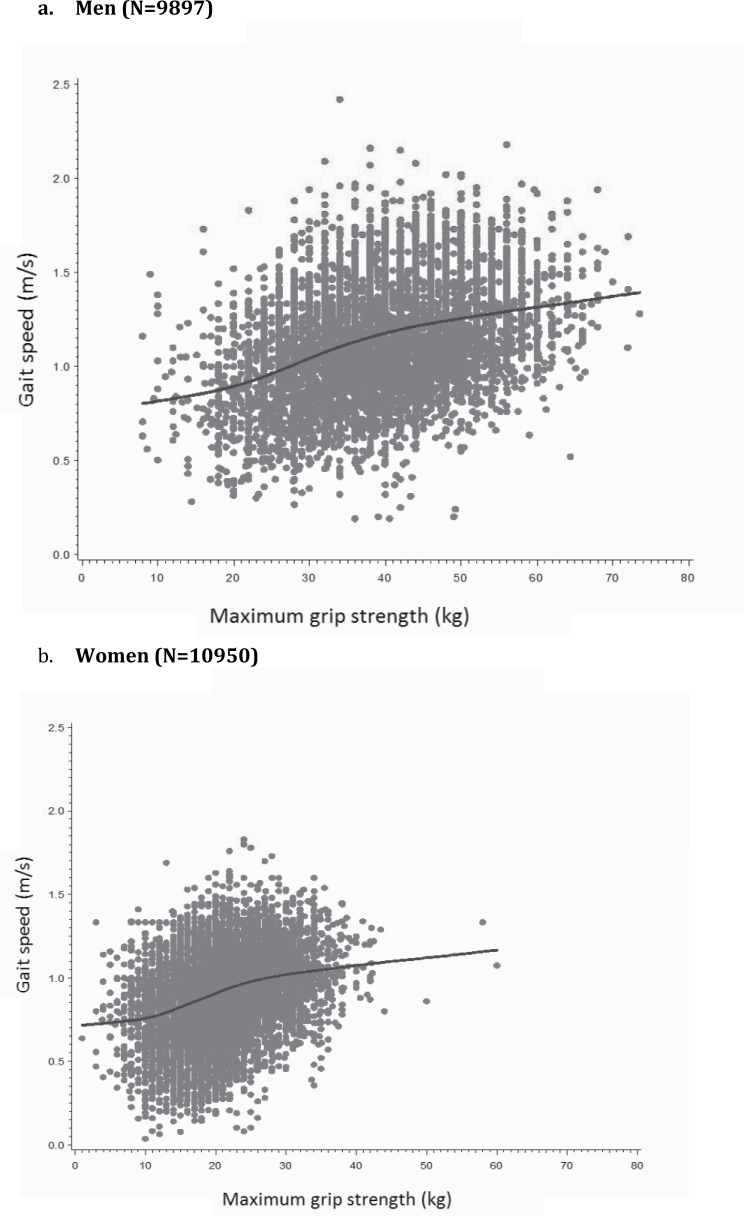
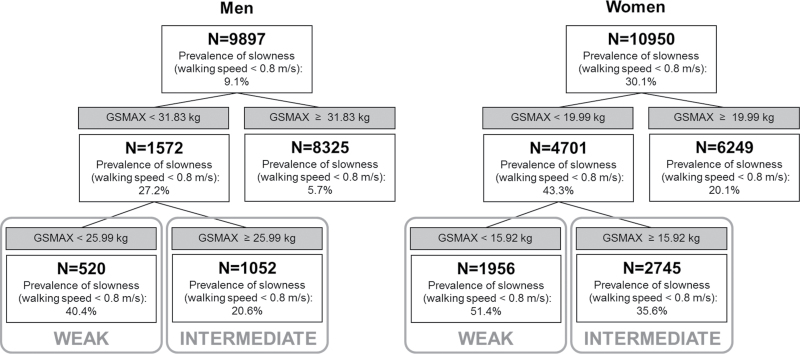
BACKGROUND: Weakness is common and contributes to disability, but no consensus exists regarding a strength cutpoint to identify persons at high risk. This analysis, conducted as part of the Foundation for the National Institutes of Health Sarcopenia Project, sought to identify cutpoints that distinguish weakness associated with mobility impairment, defined as gait speed less than 0.8 m/s. METHODS: In pooled cross-sectional data (9,897 men and 10,950 women), Classification and Regression Tree analysis was used to derive cutpoints for grip strength associated with mobility impairment. RESULTS: In men, a grip strength of 26-32 kg was classified as "intermediate" and less than 26 kg as "weak"; 11% of men were intermediate and 5% were weak. Compared with men with normal strength, odds ratios for mobility impairment were 3.63 (95% CI: 3.01-4.38) and 7.62 (95% CI 6.13-9.49), respectively. In women, a grip strength of 16-20 kg was classified as "intermediate" and less than 16 kg as "weak"; 25% of women were intermediate and 18% were weak. Compared with women with normal strength, odds ratios for mobility impairment were 2.44 (95% CI 2.20-2.71) and 4.42 (95% CI 3.94-4.97), respectively. Weakness based on these cutpoints was associated with mobility impairment across subgroups based on age, body mass index, height, and disease status. Notably, in women, grip strength divided by body mass index provided better fit relative to grip strength alone, but fit was not sufficiently improved to merit different measures by gender and use of a more complex measure. CONCLUSIONS: Cutpoints for weakness derived from this large, diverse sample of older adults may be useful to identify populations who may benefit from interventions to improve muscle strength and function.
Overview
The claims and statistics of this paper haven’t been checked yet.
Free: it reads the open-access text and checks the first 5 claims that cite a source we can check. Create a free account to check every claim.
Integrity signals
Registry
Cites
Statistics
Figures
Verification
Claims the paper makes
The claims and statistics of this paper haven’t been checked yet.
Free: it reads the open-access text and checks the first 5 claims that cite a source we can check. Create a free account to check every claim.
Claims other papers make about this one
Each is checked against this paper’s own text: does it say what the citing paper says it does?
The source backs part of the claim, not all of it — or backs it for a different population, condition or comparison.
In the citing paper
“while data from FNIH classified 4.1% of men and 14.0% of women as having sarcopenic obesity using high BMI and low grip strength as measures of obesity and low muscle strength, respectively202.”
From Sarcopenic obesity in older adults: aetiology, epidemiology and treatment strategies (2018) · cites this paper as [202]
Experimental — accuracy not yet measuredThe source backs part of the claim, not all of it — or backs it for a different population, condition or comparison.
In the citing paper
“For example, grip strength less than 26kg or 16kg for men and women respectively is highly predictive of mobility disability.”
From Successful aging: Advancing the science of physical independence in older adults (2015) · cites this paper as Alley, Shardell, Peters, McLean, Dam, Kenny, Fragala, Harris, Kiel, Guralnik, Ferrucci, Kritchevsky, Studenski, Vassileva, and Cawthon 2014
Experimental — accuracy not yet measuredThe check wasn’t confident either way, so it gives no verdict — never disputed.
In the citing paper
“Efforts to create cutpoints for muscle mass and muscle strength from population studies (community-dwelling older adults) recommended cutpoint for grip strength of 26 kg for men vs. 16 kg for women, and for appendicular lean body mass (measured with DXA) of 19.75 kg for men vs. 15.02 kg for women (Alley et al., 2014; Cawthon et al., 2014).”
From Myosteatosis in the Context of Skeletal Muscle Function Deficit: An Interdisciplinary Workshop at the National Institute on Aging (2020) · cites this paper as Alley et al., 2014
Experimental — accuracy not yet measuredIn the citing paper
“Efforts to create cutpoints for muscle mass and muscle strength from population studies (community-dwelling older adults) recommended cutpoint for grip strength of 26 kg for men vs. 16 kg for women, and for appendicular lean body mass (measured with DXA) of 19.75 kg for men vs. 15.02 kg for women (Alley et al., 2014; Cawthon et al., 2014).”
From Myosteatosis in the Context of Skeletal Muscle Function Deficit: An Interdisciplinary Workshop at the National Institute on Aging (2020) · cites this paper as Alley et al., 2014
In the citing paper
“Sarcopenia is a muscle disease (muscle failure) rooted in adverse muscle changes that accrue across a lifetime; sarcopenia is common among adults of older age but can also occur earlier in life.”
From Sarcopenia: revised European consensus on definition and diagnosis (2019) · cites this paper as [30]
Self-check
Percentages, sums and reported differences re-computed from the paper’s own numbers.
The self-check needs the paper’s full text.
Citations
Cites
Classification and Regression Trees.
Gordon, A. D., Breiman, L., Friedman, J. H., Olshen, R. A., & Stone, C. J. (1984) · Biometrics · doi:10.2307/2530946 · Cited by 23,522
Classification and Regression Trees.
Ryzin, J. V., Breiman, L., Friedman, J. H., Olshen, R. A., & Stone, C. J. (1986) · Journal of the American Statistical Association · doi:10.2307/2288003 · Cited by 20,825
Sarcopenia: European consensus on definition and diagnosis
Cruz-Jentoft, A. J., Baeyens, J. P., Bauer, J. M., Boirie, Y., Cederholm, T., Landi, F., Martin, F. C., Michel, J.-P., Rolland, Y., Schneider, S. M., et al. (2010) · Age and Ageing · doi:10.1093/ageing/afq034 · Cited by 11,601
Risk Factors for Hip Fracture in White Women
Cummings, S. R., Nevitt, M. C., Browner, W. S., Stone, K., Fox, K. M., Ensrud, K. E., Cauley, J., Black, D., & Vogt, T. M. (1995) · New England Journal of Medicine · doi:10.1056/nejm199503233321202 · Cited by 3,595 · cited 1×
“Participants Data available for this phase of the FNIH Sarcopenia Project analysis included: the Study of Osteoporotic Fractures, both the original cohort (study Visit 6) (14) and African American cohort (study Visit 1) (15); the Osteoporotic Fractures in Men Study (baseline visit) (16); the Health, Aging and Body Com…”
MethodFielding, R. A., Vellas, B., Evans, W. J., Bhasin, S., Morley, J. E., Newman, A. B., Abellan van Kan, G., Andrieu, S., Bauer, J., Breuille, D., et al. (2011) · Journal of the American Medical Directors Association · doi:10.1016/j.jamda.2011.01.003 · Cited by 3,256
Self-citationGoodpaster, B. H., Park, S. W., Harris, T. B., Kritchevsky, S. B., Nevitt, M., Schwartz, A. V., Simonsick, E. M., Tylavsky, F. A., Visser, M., Newman, A. B., et al. (2006) · The Journals of Gerontology Series A: Biological Sciences and Medical Sciences · doi:10.1093/gerona/61.10.1059 · Cited by 3,083 · cited 1×
“Strength declines more rapidly in men at older ages (32), and the association between strength and physical function appears stronger in men than in women (5,33).”
BackgroundSelf-citationRoberts, H. C., Denison, H. J., Martin, H. J., Patel, H. P., Syddall, H., Cooper, C., & Sayer, A. A. (2011) · Age and Ageing · doi:10.1093/ageing/afr051 · Cited by 3,001 · cited 3×
“By using the maximum measured grip strength from either hand, we sought to minimize variation based on these factors, but variation due to dynamometer used, hand position, and other factors may still exist (28).”
BackgroundMethodInfluentialStudenski, S. A., Peters, K. W., Alley, D. E., Cawthon, P. M., McLean, R. R., Harris, T. B., Ferrucci, L., Guralnik, J. M., Fragala, M. S., Kenny, A. M., et al. (2014) · The Journals of Gerontology: Series A · doi:10.1093/gerona/glu010 · Cited by 2,545
Self-citationEpidemiological approaches to heart disease: the Framingham study
Dawber, T. R., Meadors, G. F., & Moore, F. E. (1951) · American Journal of Public Health and the Nations Health · doi:10.2105/ajph.41.3.279 · Cited by 2,148 · cited 1×
“Participants Data available for this phase of the FNIH Sarcopenia Project analysis included: the Study of Osteoporotic Fractures, both the original cohort (study Visit 6) (14) and African American cohort (study Visit 1) (15); the Osteoporotic Fractures in Men Study (baseline visit) (16); the Health, Aging and Body Com…”
MethodLauretani, F., Russo, C. R., Bandinelli, S., Bartali, B., Cavazzini, C., Di Iorio, A., Corsi, A. M., Rantanen, T., Guralnik, J. M., & Ferrucci, L. (2003) · Journal of Applied Physiology · doi:10.1152/japplphysiol.00246.2003 · Cited by 1,946 · cited 2×
“M USCLE weakness is related to poor physical performance and incident mobility limitations among older adults (1–6).”
BackgroundSelf-citation
Research works printed but not linked: 4
- 2012, The Journals of Gerontology Series A: Biological Sciences and Medical Sciences, 67, 28
- 2014, The Journals of Gerontology Series A: Biological Sciences and Medical Sciences, 5, 567
- 2007, American Journal of Epidemiology, 165, 1076, 10.1093/aje/kwk115 · DOI · Paper page
- 2010, Physical Therapy, 90, 196, 10.2522/ptj.20090079 · DOI · Paper page
Cited by
Sarcopenia: revised European consensus on definition and diagnosis
Cruz-Jentoft, A. J., Bahat, G., Bauer, J., Boirie, Y., Bruyère, O., Cederholm, T., Cooper, C., Landi, F., Rolland, Y., Sayer, A. A., et al. (2019) · Age and Ageing · doi:10.1093/ageing/afy169 · Cited by 13,818
Studenski, S. A., Peters, K. W., Alley, D. E., Cawthon, P. M., McLean, R. R., Harris, T. B., Ferrucci, L., Guralnik, J. M., Fragala, M. S., Kenny, A. M., et al. (2014) · The Journals of Gerontology: Series A · doi:10.1093/gerona/glu010 · Cited by 2,545
“The second manuscript in the series focuses on developing clinically relevant criteria for weakness based on grip strength (9); the third on criteria for low muscle mass (10); the fourth on longitudinal predictions based on the weakness and muscle mass criteria (11); and the fifth presents comparisons between the FNIH…”
BackgroundInfluentialSelf-citationSarcopenic obesity in older adults: aetiology, epidemiology and treatment strategies
Batsis, J. A., & Villareal, D. T. (2018) · Nature Reviews Endocrinology · doi:10.1038/s41574-018-0062-9 · Cited by 1,382
Fragala, M. S., Cadore, E. L., Dorgo, S., Izquierdo, M., Kraemer, W. J., Peterson, M. D., & Ryan, E. D. (2019) · Journal of Strength and Conditioning Research · doi:10.1519/jsc.0000000000003230 · Cited by 1,290
Self-citationGrip Strength: An Indispensable Biomarker For Older Adults
Bohannon, R. W. (2019) · Clinical Interventions in Aging · doi:10.2147/cia.s194543 · Cited by 994
Frailty in older adults: a nationally representative profile in the United States
Bandeen-Roche, K., Seplaki, C. L., Huang, J., Buta, B., Kalyani, R. R., Varadhan, R., Xue, Q.-L., Walston, J. D., & Kasper, J. D. (2015) · The Journals of Gerontology Series A: Biological Sciences and Medical Sciences · doi:10.1093/gerona/glv133 · Cited by 800
“Our scoring method may characterize some individuals as “frail” who could have performed highly if tested, and the use of percentile-based cutpoints bears further consideration: Research to optimize or tailor cutpoints for clinical relevance (35) is needed.”
MethodMuscle strength: clinical and prognostic value of hand-grip dynamometry
Bohannon, R. W. (2015) · Current Opinion in Clinical Nutrition and Metabolic Care · doi:10.1097/mco.0000000000000202 · Cited by 539
McGregor, R. A., Cameron-Smith, D., & Poppitt, S. D. (2014) · Longevity & Healthspan · doi:10.1186/2046-2395-3-9 · Cited by 532
Schaap, L. A., van Schoor, N. M., Lips, P., & Visser, M. (2018) · The Journals of Gerontology: Series A · doi:10.1093/gerona/glx245 · Cited by 498
“We used cut-off scores of <26 kg for men and <16 kg for women to define low handgrip strength according to the FNIH definition (5).”
McLean, R. R., Shardell, M. D., Alley, D. E., Cawthon, P. M., Fragala, M. S., Harris, T. B., Kenny, A. M., Peters, K. W., Ferrucci, L., Guralnik, J. M., et al. (2014) · The Journals of Gerontology: Series A · doi:10.1093/gerona/glu012 · Cited by 475
“The Foundation for the National Institutes of Health (FNIH) Sarcopenia Project aimed to address this gap in knowledge, and in the first two phases of the project, we determined preliminary, evidence-based cut-points for both grip strength and grip strength standardized to body size as candidate indicators of clinicall…”
BackgroundMethodInfluentialSelf-citationCorrea-de-Araujo, R., Addison, O., Miljkovic, I., Goodpaster, B. H., Bergman, B. C., Clark, R. V., Elena, J. W., Esser, K. A., Ferrucci, L., Harris-Love, M. O., et al. (2020) · Frontiers in Physiology · doi:10.3389/fphys.2020.00963 · Cited by 468
Self-citationSarcopenia and Physical Frailty: Two Sides of the Same Coin
Cesari, M., Landi, F., Vellas, B., Bernabei, R., & Marzetti, E. (2014) · Frontiers in Aging Neuroscience · doi:10.3389/fnagi.2014.00192 · Cited by 468
“Just recently, in order to address the existing inconsistencies, a set of articles by the foundation for the national institutes of health (FNIH) has been published (Alley et al., 2014; Cawthon et al., 2014; Dam et al., 2014; McLean et al., 2014; Studenski et al., 2014).”
BackgroundCawthon, P. M., Peters, K. W., Shardell, M. D., McLean, R. R., Dam, T.-T. L., Kenny, A. M., Fragala, M. S., Harris, T. B., Kiel, D. P., Guralnik, J. M., et al. (2014) · The Journals of Gerontology Series A: Biological Sciences and Medical Sciences · doi:10.1093/gerona/glu023 · Cited by 388
“In the first phase of analyses (reported in an accompanying article) (8), the cutpoint for grip strength as a discriminator of slowness (defined as a walking speed of ≤0.”
BackgroundSelf-citationGlobal variation in grip strength: a systematic review and meta-analysis of normative data
Dodds, R. M., Syddall, H. E., Cooper, R., Kuh, D., Cooper, C., & Sayer, A. A. (2016) · Age and Ageing · doi:10.1093/ageing/afv192 · Cited by 372
An evidence-based comparison of operational criteria for the presence of sarcopenia
Dam, T.-T., Peters, K. W., Fragala, M., Cawthon, P. M., Harris, T. B., McLean, R., Shardell, M., Alley, D. E., Kenny, A., Ferrucci, L., et al. (2014) · The Journals of Gerontology Series A: Biological Sciences and Medical Sciences · doi:10.1093/gerona/glu013 · Cited by 363
Self-citationSuccessful aging: Advancing the science of physical independence in older adults
Anton, S. D., Woods, A. J., Ashizawa, T., Barb, D., Buford, T. W., Carter, C. S., Clark, D. J., Cohen, R. A., Corbett, D. B., Cruz-Almeida, Y., et al. (2015) · Ageing Research Reviews · doi:10.1016/j.arr.2015.09.005 · Cited by 292
Screening for muscle wasting and dysfunction in patients with chronic kidney disease
Carrero, J. J., Johansen, K. L., Lindholm, B., Stenvinkel, P., Cuppari, L., & Avesani, C. M. (2016) · Kidney International · doi:10.1016/j.kint.2016.02.025 · Cited by 282
“Although lower extremity strength is more relevant to mobility, grip strength is correlated with lower extremity strength(82) and closely related to mobility outcomes.(82,83) Muscle power is defined as the amount of work generated per unit of time and is perhaps the measure of muscle function that is most closely rela…”
BackgroundCorrea-de-Araujo, R., Harris-Love, M. O., Miljkovic, I., Fragala, M. S., Anthony, B. W., & Manini, T. M. (2017) · Frontiers in Physiology · doi:10.3389/fphys.2017.00087 · Cited by 268
“, grip strength <26 kg for men and <16 kg for women) have been associated with functional mobility consequences and incident mobility impairment (Alley et al., 2014; McLean et al., 2014; Studenski et al., 2014).”
BackgroundSelf-citationDefining Sarcopenia in Terms of Incident Adverse Outcomes
Woo, J., Leung, J., & Morley, J. E. (2015) · Journal of the American Medical Directors Association · doi:10.1016/j.jamda.2014.11.013 · Cited by 261
Fragala, M. S., Kenny, A. M., & Kuchel, G. A. (2015) · Sports Medicine · doi:10.1007/s40279-015-0305-z · Cited by 246
“While some discrepancy remains as to whether or not to distinguish dynapenia from sarcopenia or whether muscle weakness should be incorporated into clinical definitions of sarcopenia, our recent work has revealed that muscle weakness is an important factor in distinguishing older adults with mobility impairment [26].”
BackgroundSelf-citationPutative Cut‐Points in Sarcopenia Components and Incident Adverse Health Outcomes: An SDOC Analysis
Cawthon, P. M., Manini, T., Patel, S. M., Newman, A., Travison, T., Kiel, D. P., Santanasto, A. J., Ensrud, K. E., Xue, Q., Shardell, M., et al. (2020) · Journal of the American Geriatrics Society · doi:10.1111/jgs.16517 · Cited by 231
“For women, the FNIH Sarcopenia Project was a little lower than ours (<16 kg) but found an intermediate cutpoint for muscle weakness that was identical to our definition of muscle weakness.(36) The newly revised European Working Group for Sarcopenia in Older Persons (EWGSOP2)(3) uses grip strength cut-points of 16 kg f…”
MethodSelf-citationHandgrip Strength and Health in Aging Adults
McGrath, R. P., Kraemer, W. J., Snih, S. A., & Peterson, M. D. (2018) · Sports Medicine · doi:10.1007/s40279-018-0952-y · Cited by 227
Kittiskulnam, P., Chertow, G. M., Carrero, J. J., Delgado, C., Kaysen, G. A., & Johansen, K. L. (2017) · Kidney International · doi:10.1016/j.kint.2017.01.024 · Cited by 216
Protein intake and muscle function in older adults
Deer, R. R., & Volpi, E. (2015) · Current Opinion in Clinical Nutrition and Metabolic Care · doi:10.1097/mco.0000000000000162 · Cited by 206
De Buyser, S. L., Petrovic, M., Taes, Y. E., Toye, K. R. C., Kaufman, J.-M., Lapauw, B., & Goemaere, S. (2016) · Age and Ageing · doi:10.1093/ageing/afw071 · Cited by 198
“They used classification and regression tree analyses in pooled cross-sectional data from several cohort studies which first retained cut-off points for grip strength and grip strength adjusted to body mass index (BMI) associated with mobility impairment [6], and then cut-off points for appendicular”
MethodHirani, V., Blyth, F., Naganathan, V., Le Couteur, D. G., Seibel, M. J., Waite, L. M., Handelsman, D. J., & Cumming, R. G. (2015) · Journal of the American Medical Directors Association · doi:10.1016/j.jamda.2015.02.006 · Cited by 191
Sarcopenic Obesity: Epidemiologic Evidence, Pathophysiology, and Therapeutic Perspectives
Koliaki, C., Liatis, S., Dalamaga, M., & Kokkinos, A. (2019) · Current Obesity Reports · doi:10.1007/s13679-019-00359-9 · Cited by 176
Physical Functional Assessment in Older Adults
Patrizio, E., Calvani, R., Marzetti, E., & Cesari, M. (2021) · The Journal of Frailty & Aging · doi:10.14283/jfa.2020.61 · Cited by 166
“Values adjusted for BMI or height also exists (23).”
BackgroundAssociation Between Purpose in Life and Objective Measures of Physical Function in Older Adults
Kim, E. S., Kawachi, I., Chen, Y., & Kubzansky, L. D. (2017) · JAMA Psychiatry · doi:10.1001/jamapsychiatry.2017.2145 · Cited by 167
The Epidemiology of Sarcopenia
Dodds, R. M., Roberts, H. C., Cooper, C. C., & Sayer, A. A. (2015) · Journal of Clinical Densitometry · doi:10.1016/j.jocd.2015.04.012 · Cited by 190
An Overview of Sarcopenic Obesity
Cauley, J. A. (2015) · Journal of Clinical Densitometry · doi:10.1016/j.jocd.2015.04.013 · Cited by 193
Comparison of Handgrip and Leg Extension Strength in Predicting Slow Gait Speed in Older Adults
Fragala, M. S., Alley, D. E., Shardell, M. D., Harris, T. B., McLean, R. R., Kiel, D. P., Cawthon, P. M., Dam, T. L., Ferrucci, L., Guralnik, J. M., et al. (2016) · Journal of the American Geriatrics Society · doi:10.1111/jgs.13871 · Cited by 148
“8 m/s) (as described previously).(7,8) Similar to continuous analysis, three models were tested to examine the relative contributions of grip and leg strength to walking speed, based on the strength of the relationship (the coefficient) and the accuracy of discrimination of the outcome (the c-statistic).”
MethodInfluentialSelf-citationFrailty Phenotype and Healthcare Costs and Utilization in Older Women
Ensrud, K. E., Kats, A. M., Schousboe, J. T., Taylor, B. C., Cawthon, P. M., Hillier, T. A., Yaffe, K. S., Cummings, S., Cauley, J. A., Langsetmo, L., et al. (2018) · Journal of the American Geriatrics Society · doi:10.1111/jgs.15381 · Cited by 168
Self-citationSarcopenia and frailty: new challenges for clinical practice
Dodds, R., & Sayer, A. A. (2016) · Clinical Medicine · doi:10.7861/clinmedicine.16-5-455 · Cited by 140
Developing Consensus Criteria for Sarcopenia: An Update
McLean, R. R., & Kiel, D. P. (2015) · Journal of Bone and Mineral Research · doi:10.1002/jbmr.2492 · Cited by 129
“8m/s.((29)) The investigators noted that whereas CART analyses identified cutpoints of absolute grip strength for both sexes, grip strength standardized to body mass index (BMI) provided a marginally better fit in women.”
BackgroundSelf-citationCawthon, P. M., Travison, T. G., Manini, T. M., Patel, S., Pencina, K. M., Fielding, R. A., Magaziner, J. M., Newman, A. B., Brown, T., Kiel, D. P., et al. (2020) · The Journals of Gerontology Series A · doi:10.1093/gerona/glz081 · Cited by 127
Self-citationHandgrip Strength in Old and Very Old Adults: Mood, Cognition, Function, and Mortality
Stessman, J., Rottenberg, Y., Fischer, M., Hammerman‐Rozenberg, A., & Jacobs, J. M. (2017) · Journal of the American Geriatrics Society · doi:10.1111/jgs.14509 · Cited by 140
“Similarly, cut-offs to define a low HGS have recently been suggested, which may be useful in predicting certain negative clinical outcomes such as mobility impairment and mortality.(3,4) Handgrip strength has been shown to predict mortality in various populations of different ages, and the cross-sectional and longitud…”
BackgroundThe Longitudinal Associations of Handgrip Strength and Cognitive Function in Aging Americans
McGrath, R., Vincent, B. M., Hackney, K. J., Robinson‐Lane, S. G., Downer, B. G., & Clark, B. C. (2019) · Journal of the American Medical Directors Association · doi:10.1016/j.jamda.2019.08.032 · Cited by 132
Arnold, W. D., & Clark, B. C. (2023) · Ageing Research Reviews · doi:10.1016/j.arr.2023.101966 · Cited by 143
Alba, D. L., Wu, L., Cawthon, P. M., Mulligan, K., Lang, T., Patel, S., King, N. J., Carter, J. T., Rogers, S. J., Posselt, A. M., et al. (2019) · The Journal of Clinical Endocrinology & Metabolism · doi:10.1210/jc.2018-00952 · Cited by 117
Self-citationMaltais, M. L., Ladouceur, J. P., & Dionne, I. J. (2016) · Journal of Strength and Conditioning Research · doi:10.1519/jsc.0000000000001255 · Cited by 116
“Nonetheless, when combined together, sarcopenia and dynapenia have been shown to influence the capacity to perform tasks of daily living, muscle strength, and physical capacity in older adults (1) and must be corrected to prevent further problems related to physical capacity.”
BackgroundMasanés, F., Rojano i Luque, X., Salvà, A., Serra-Rexach, J. A., Artaza, I., Formiga, F., Cuesta, F., López Soto, A., Ruiz, D., & Cruz-Jentoft, A. J. (2017) · The Journal of nutrition, health and aging · doi:10.1007/s12603-016-0844-5 · Cited by 116
“However, when sarcopenia is defined according to alterations in at least one of these parameters, use of Fried (19) or FNIH Sarcopenia Project (20, 21) values has little impact on prevalence and does not greatly affect comparability between studies, even when these are conducted in different settings.”
McGrath, R. P., Johnson, N., Klawitter, L. A., Mahoney, S. J., Trautman, K. A., Carlson, C. M., Rockstad, E., & Hackney, K. J. (2020) · SAGE Open Medicine · doi:10.1177/2050312120910358 · Cited by 135
Cesari, M., Landi, F., Calvani, R., Cherubini, A., Bari, M. D., KORTEBEIN, P. M., Signore, S. D., Lain, R. L., Vellas, B. J., Pahor, M., et al. (2017) · Aging Clinical and Experimental Research · doi:10.1007/s40520-016-0716-1 · Cited by 127
“, slow gait speed) as the outcome of interest [24, 46].”
BackgroundRecommendations for the conduct of clinical trials for drugs to treat or prevent sarcopenia
Reginster, J.-Y., Cooper, C., Rizzoli, R., Kanis, J. A., Appelboom, G., Bautmans, I., Bischoff-Ferrari, H. A., Boers, M., Brandi, M. L., Bruyère, O., et al. (2016) · Aging Clinical and Experimental Research · doi:10.1007/s40520-015-0517-y · Cited by 112
“The FNIH-SP analysis [39] identified two threshold values each for men and for women; thus defining three strength groups: low, intermediate and high.”
MethodSarcopenia and frailty: new challenges for clinical practice
Dodds, R., & Sayer, A. A. (2015) · Clinical Medicine · doi:10.7861/clinmedicine.15-6-s88 · Cited by 112
Cawthon, P. M., Blackwell, T. L., Cauley, J., Kado, D. M., Barrett‐Connor, E., Lee, C. G., Hoffman, A. R., Nevitt, M., Stefanick, M. L., Lane, N. E., et al. (2015) · Journal of the American Geriatrics Society · doi:10.1111/jgs.13788 · Cited by 110
“11) In those without event, n = 3,136 Appropriately reclassified, n (%) 1 (0) 982 (31) Inappropriately reclassified, n (%) 147 (5) 495 (16) No change, n (%) 2,988 (95) 1,659 (53) NRI (95% CI), nonevents 0.”
Self-citationSfeir, J. G., Drake, M. T., Khosla, S., & Farr, J. N. (2022) · Mayo Clinic Proceedings · doi:10.1016/j.mayocp.2022.03.011 · Cited by 105
Ismail, C., Zabal, J., Hernandez, H. J., Woletz, P., Manning, H., Teixeira, C., DiPietro, L., Blackman, M. R., & Harris-Love, M. O. (2015) · Frontiers in Physiology · doi:10.3389/fphys.2015.00302 · Cited by 107
Sarcopenia among patients receiving hemodialysis: weighing the evidence
Kittiskulnam, P., Carrero, J. J., Chertow, G. M., Kaysen, G. A., Delgado, C., & Johansen, K. L. (2016) · Journal of Cachexia Sarcopenia and Muscle · doi:10.1002/jcsm.12130 · Cited by 107
“8m/s according to the Foundation for the National Institutes of Health (FNIH) criteria.(30,31)”
MethodHirani, V., Naganathan, V., Blyth, F., Couteur, D. L., Seibel, M., Waite, L., Handelsman, D., Hsu, B., & Cumming, R. (2016) · The journals of gerontology. Series A, Biological sciences and medical sciences · doi:10.1093/gerona/glw055 · Cited by 85
Pavasini, R., Serenelli, M., Celis-Morales, C. A., Gray, S. R., Izawa, K. P., Watanabe, S., Colin-Ramírez, E., Castillo‐Martínez, L., Izumiya, Y., Hanatani, S., et al. (2018) · Heart · doi:10.1136/heartjnl-2018-313816 · Cited by 107
Spira, D., Buchmann, N., Nikolov, J., Demuth, I., Steinhagen‐Thiessen, E., Eckardt, R., & Norman, K. (2015) · The Journals of Gerontology Series A · doi:10.1093/gerona/glu246 · Cited by 99
Handgrip Strength Asymmetry and Weakness Are Associated with Lower Cognitive Function: A Panel Study
McGrath, R., Cawthon, P. M., Cesari, M., Snih, S. A., & Clark, B. C. (2020) · Journal of the American Geriatrics Society · doi:10.1111/jgs.16556 · Cited by 99
“Men with maximal HGS less than 26 kg and women with maximal HGS less than 16 kg were considered weak.(4)”
BackgroundSelf-citationMcGrath, R., Vincent, B. M., Jurivich, D. A., Hackney, K. J., Tomkinson, G. R., Dahl, L. J., & Clark, B. C. (2020) · The Journals of Gerontology Series A · doi:10.1093/gerona/glaa100 · Cited by 106
“Men with maximal HGS <26 kg and women with maximal HGS <16 kg were considered weak (21).”
BackgroundTomkinson, G. R., Lang, J. J., Rubín, L., McGrath, R. P., Gower, B., Boyle, T., Klug, M. G., Mayhew, A., Blake, H. T., Ortega, F. B., et al. (2024) · Journal of sport and health science/Journal of Sport and Health Science · doi:10.1016/j.jshs.2024.101014 · Cited by 155
“,62 (cid:2) 67 Another approach is to establish norm-referenced cut-points.”
Kirwan, R. P., Mazidi, M., Rodríguez García, C., Lane, K. E., Jafari, A., Butler, T., Perez de Heredia, F., & Davies, I. G. (2022) · The American Journal of Clinical Nutrition · doi:10.1093/ajcn/nqab355 · Cited by 89
Vasconcelos, K. S. D. S., Dias, J. M. D., Bastone, A. D. C., Vieira, R. A., Andrade, A. C. D. S., Perracini, M. R., Guerra, R. O., & Dias, R. C. (2015) · The journal of nutrition health & aging · doi:10.1007/s12603-015-0584-y · Cited by 97
“This relationship is bidirectional, as sarcopenia is also a risk factor for disability (29-30,41-42).”
Yu, R., Ong, S., Cheung, O., Leung, J. C. S., & Woo, J. (2017) · Journal of the American Medical Directors Association · doi:10.1016/j.jamda.2017.03.006 · Cited by 95
Alexandre, T. D. S., Scholes, S., Santos, J. L. F., Duarte, Y. A. D. O., & de Oliveira, C. M. (2017) · Clinical Nutrition · doi:10.1016/j.clnu.2017.09.018 · Cited by 89
Parra-Soto, S. L., Pell, J. P., Celis-Morales, C. A., & Ho, F. K. W. (2021) · Journal of Cachexia Sarcopenia and Muscle · doi:10.1002/jcsm.12863 · Cited by 86
“Studies have shown that relative HGS might be a better indicator for muscle weakness [15], as 78 well as more predictive of cardiometabolic diseases [16].”
BackgroundLi, N., Ou, J., He, H., He, J., Zhang, L., Peng, Z., Zhong, J., & Jiang, N. (2024) · Journal of NeuroEngineering and Rehabilitation · doi:10.1186/s12984-024-01369-y · Cited by 88
“…by evidence including that low grip strength is associated with repeated falls [17], low grip strength is shown to be a stronger predictor of cardiovascular mortality than blood pressure [18], and that both low grip strength and leg extensor strength were associated with impaired mobility [19].”
BackgroundBuchmann, N., Spira, D., Norman, K., Demuth, I., Eckardt, R., & Steinhagen-Thiessen, E. (2016) · Deutsches Ärzteblatt international · doi:10.3238/arztebl.2016.0253 · Cited by 78
Strandkvist, V. J., Larsson, A., Pauelsen, M., Nyberg, L., Vikman, I., Lindberg, A., Gustafsson, T., & Röijezon, U. (2021) · Archives of Gerontology and Geriatrics · doi:10.1016/j.archger.2021.104345 · Cited by 98
Low Muscle Strength Thresholds for the Detection of Cardiometabolic Risk in Adolescents
Peterson, M. D., Zhang, P., Saltarelli, W. A., Visich, P. S., & Gordon, P. M. (2015) · American Journal of Preventive Medicine · doi:10.1016/j.amepre.2015.09.019 · Cited by 89
Muscle Weakness Thresholds for Prediction of Diabetes in Adults
Peterson, M. D., Zhang, P., Choksi, P., Markides, K. S., & Al Snih, S. (2016) · Sports Medicine · doi:10.1007/s40279-015-0463-z · Cited by 78
Handgrip strength values of Portuguese older adults: a population based study
Mendes, J., do Amaral, T. F., Borges, N., Santos, A., Padrão, P., Moreira, P. A. M., Afonso, C., & Negrão, R. (2017) · BMC Geriatrics · doi:10.1186/s12877-017-0590-5 · Cited by 115
“The International Working Group on Sarcopenia recommends the inclusion of height value for determining relative muscle mass, in a context of functional disability [49].”
BackgroundMethodInfluentialWiśniowska-Szurlej, A., Ćwirlej-Sozańska, A. B., Wołoszyn, N., Sozański, B., & Wilmowska-Pietruszyńska, A. (2019) · BioMed Research International · doi:10.1155/2019/1042834 · Cited by 107
“A recent study containing normative data from the FNIH Sarcopenia Project regarding the strength of handgrip and further life course indicated that the limit for the occurrence of the weakness syndrome is HGS for women under 16 kg and for men under 27 kg [31].”
BackgroundRamírez‐Vélez, R., Peña, J. C., Martínez-Torres, J., Tordecilla‐Sanders, A., Correa‐Bautista, J. E., Lobelo, F., & García‐Hermoso, A. (2017) · Scientific Reports · doi:10.1038/srep42622 · Cited by 83
“…risk factors (e.g. obesity, systemic low-grade inflammation, insulin resistance) is equally unequivocal, and recent national efforts to identify cut points or thresholds for lambda-mu-sigma (LMS) among young people 13,14 will help clinicians to screen individuals at greatest risk 15 .”
BackgroundKemmler, W., Teschler, M., Weißenfels, A., Sieber, C., Freiberger, E., & von Stengel, S. (2017) · Osteoporosis International · doi:10.1007/s00198-017-3964-9 · Cited by 71
“calculated to optimally identify Bclinically relevant weakness^ [22, 23].”
BackgroundZhou, H., Liao, Y., Peng, Z., Liu, F., Wang, Q., & Yang, W. Q. (2023) · Journal of Cachexia Sarcopenia and Muscle · doi:10.1002/jcsm.13263 · Cited by 85
“As long as they were reported by at least five studies, subgroup analyses and meta-regression were performed to explore potential sources of between-study heterogeneities from age at baseline, gender (female% for meta-regression), BMI at baseline, location of study (specific country for meta-regression), duration of f…”
BackgroundCut Points for Clinical Muscle Weakness Among Older Americans
Duchowny, K. A., Peterson, M. D., & Clarke, P. J. (2017) · American Journal of Preventive Medicine · doi:10.1016/j.amepre.2016.12.022 · Cited by 71
“6 m/second for slow gait speed,(31) 29% of men and 22% of women were classified as weak, which is still greater than twice the prevalence identified using the FNIH cut points.(11) Lastly, one major driver of sarcopenia is the subsequent loss in muscle mass.”
BackgroundHirani, V., Cumming, R. G., Naganathan, V., Blyth, F., Couteur, D. G. L., Hsu, B., Handelsman, D. J., Waite, L. M., & Seibel, M. J. (2017) · The Journals of Gerontology Series A · doi:10.1093/gerona/glx086 · Cited by 82
Effect of HIV-infection and cumulative viral load on age-related decline in grip strength
Schrack, J. A., Jacobson, L. P., Althoff, K. N., Erlandson, K. M., Jamieson, B. D., Koletar, S. L., Phair, J., Brown, T. T., & Margolick, J. B. (2016) · AIDS · doi:10.1097/qad.0000000000001245 · Cited by 77
“To provide clinical perspective, we examined the effect of HIV status on the time to clinical weakness (<26 kg) [8].”
BackgroundResultInfluentialMoreira, V. G., Perez, M., & Lourenço, R. A. (2019) · Clinics · doi:10.6061/clinics/2019/e477 · Cited by 81
“The FNIH collected pooled data from multiple studies to develop criteria for weakness and low MM based on the association of both variables with slow GS (34).”
MethodFrailty assessment: from clinical to radiological tools
Bentov, I., Kaplan, S. J., Pham, T. N., & Reed, M. J. (2019) · British Journal of Anaesthesia · doi:10.1016/j.bja.2019.03.034 · Cited by 74
Lee, S., Wu, L.-C., Chiang, S., Lu, L.-H., Chen, C., Lin, C., Ni, C., & Lin, C. (2020) · BioMed Research International · doi:10.1155/2020/6936879 · Cited by 93
Cacciatore, S., Calvani, R., Marzetti, E., Picca, A., Coelho‐Júnior, H. J., Martone, A. M., Massaro, C., Tosato, M., & Landi, F. (2023) · Nutrients · doi:10.3390/nu15041026 · Cited by 77
Towards Personalized Management of Sarcopenia in COPD
van Bakel, S. I. J., Gosker, H. R., LANGEN, R. C. J., & Schols, A. M. W. J. (2021) · International Journal of COPD · doi:10.2147/copd.s280540 · Cited by 75
Monaco, M. D., Castiglioni, C., Toma, E. D., Gardin, L., Giordano, S., Monaco, R. D., & Tappero, R. (2015) · Aging Clinical and Experimental Research · doi:10.1007/s40520-014-0306-z · Cited by 78
“The cutpoints for muscle mass were defined to discriminate the presence of weakness [35] whereas those for grip strength were aimed to discriminate mobility impairment [36].”
Frailty and sarcopenia in Bogotá: results from the SABE Bogotá Study
Samper‐Ternent, R., Ortiz, C. A. R., Ottenbacher, K. J., & Cano, C. A. (2016) · Aging Clinical and Experimental Research · doi:10.1007/s40520-016-0561-2 · Cited by 86
“Studies, we followed what other researchers have done and modified the cut-off points set to identify alterations in walking speed, and grip strength [13, 29, 30].”
ResultDuchowny, K. A., Clarke, P. J., & Peterson, M. D. (2017) · The journal of nutrition health & aging · doi:10.1007/s12603-017-0951-y · Cited by 76
“Previous work that has sought to measure and define clinical muscle weakness has derived cutpoints from sample-specific distributions (1), and relied on nonrepresentative reference populations (3, 30), or non-nationally representative, pooled data sources to establish definitions for weakness (18), all of which may no…”
Bahat, G., Tufan, A., Kılıç, C., Aydın, T., Akpınar, T. S., Köse, M., Erten, N., Karan, M. A., & Cruz-Jentoft, A. J. (2018) · The Aging Male · doi:10.1080/13685538.2018.1499081 · Cited by 74
“32 kg/22 kg [10], 30 kg/20 kg [12], 26 kg/ 16 kg [13] in males/females.”
BackgroundCesari, M., Rolland, Y., Abellan Van Kan, G., Bandinelli, S., Vellas, B., Ferrucci, L., & Kritchevsky, S. (2015) · The Journals of Gerontology: Series A · doi:10.1093/gerona/glu181 · Cited by 66
“A CaRT analysis model was used for identifying the gender-specific cut-points of HG for predicting mobility disability (12).”
MethodSelf-citationFrailty and sarcopenia: From theory to clinical implementation and public health relevance
Cesari, M., Nobili, A., & Vitale, G. (2016) · European Journal of Internal Medicine · doi:10.1016/j.ejim.2016.07.021 · Cited by 79
Kim, M., & Shinkai, S. (2017) · Geriatrics and gerontology international/Geriatrics & gerontology international · doi:10.1111/ggi.13027 · Cited by 70
Handgrip Strength Asymmetry and Weakness May Accelerate Time to Mortality in Aging Americans
McGrath, R., Tomkinson, G. R., LaRoche, D. P., Vincent, B. M., Bond, C. W., & Hackney, K. J. (2020) · Journal of the American Medical Directors Association · doi:10.1016/j.jamda.2020.04.030 · Cited by 64
Ibrahim, K., May, C. R., Patel, H. P., Baxter, M. A., Sayer, A. A., & Roberts, H. C. (2018) · BMC Geriatrics · doi:10.1186/s12877-018-0768-5 · Cited by 75
“Sarcopenia, the loss of skeletal muscle mass and strength with age, is an ageing syndrome [6] with a prevalence in hospitalised older people of around 10%, and 30% among nursing home residents [7].”
BackgroundBalogun, S. A., Winzenberg, T. M., Wills, K. E., Scott, D. S., Callisaya, M. L., Cicuttini, F., Jones, G., & Aitken, D. A. (2019) · Archives of Gerontology and Geriatrics · doi:10.1016/j.archger.2019.01.015 · Cited by 67
Alexandre, T. D. S., Scholes, S., Santos, J. L. F., & de Oliveira, C. M. (2018) · The Journals of Gerontology Series A · doi:10.1093/gerona/gly182 · Cited by 72
“Dynapenia was defined based on two cutoff points for grip strength: less than 26 kg for men and less than 16 kg for women, in accordance with the recommendations of the Foundation for the National Institutes of Health Biomarkers Consortium Sarcopenia Project (23).”
MethodNeural Mechanisms of Age-Related Loss of Muscle Performance and Physical Function
Clark, B. C. (2023) · The Journals of Gerontology Series A · doi:10.1093/gerona/glad029 · Cited by 71
Tang, T., Hwang, A., Liu, L.-K., Lee, W., Chen, L.-Y., Wu, Y., Huang, C., Hung, C.-H., Wang, C., Lin, M.-H., et al. (2017) · The Journals of Gerontology Series A · doi:10.1093/gerona/glx148 · Cited by 72
“However, accruing evidence suggests that adiposity may significantly affect functional performance, independent of ALM (6–11); this association is more evident in women who generally have greater adiposity than men (6,7,10,12,13).”
BackgroundMeasuring hand grip strength in rheumatoid arthritis
Higgins, S. C., Adams, J., & Hughes, R. (2018) · Rheumatology International · doi:10.1007/s00296-018-4024-2 · Cited by 77
Muscle Strength and Functional Limitations: Preserving Function in Older Mexican Americans
McGrath, R., Robinson-Lane, S. G., Peterson, M. D., Bailey, R. R., & Vincent, B. M. (2018) · Journal of the American Medical Directors Association · doi:10.1016/j.jamda.2017.12.011 · Cited by 59
Tessier, A., Wing, S. S., Rahme, E., Morais, J. A., & Chevalier, S. (2019) · Journal of Cachexia Sarcopenia and Muscle · doi:10.1002/jcsm.12462 · Cited by 65
“low handgrip strength are <26 kg for men and <16 kg for women.(19) The IWGS defines sarcopenia as the combination of low ALM and low gait speed (<1.”
BackgroundMethodHandgrip strength in old and oldest old Swiss adults – a cross-sectional study
Wearing, J., Könings, P., Stokes, M. J., & de Bruin, E. D. (2018) · BMC Geriatrics · doi:10.1186/s12877-018-0959-0 · Cited by 77
Growth Charts for Muscular Strength Capacity With Quantile Regression
Peterson, M. D., & Krishnan, C. (2015) · American Journal of Preventive Medicine · doi:10.1016/j.amepre.2015.05.013 · Cited by 69
Grip strength measurement: Towards a standardized approach in sarcopenia research and practice
Schaap, L. S., Fox, B., Henwood, T. R., Bruyère, O., Reginster, J.-Y., Beaudart, C., Buckinx, F., Roberts, H. C., Cooper, C. C., Cherubini, A., et al. (2016) · European Geriatric Medicine · doi:10.1016/j.eurger.2015.11.012 · Cited by 66
“Recently, the FNIH Sarcopenia Study performed research in which pooled data from nine sources of community-dwelling older persons were included [15,46].”
MethodOba, H., Matsui, Y., Arai, H., Watanabe, T., Iida, H., Mizuno, T., Yamashita, S., Ishizuka, S., Suzuki, Y., Hiraiwa, H., et al. (2021) · BMC Geriatrics · doi:10.1186/s12877-021-02187-w · Cited by 63
“compared with muscle mass, muscle strength is more associated with falling and limited mobility [3, 4], and”
BackgroundPerianayagam, A., Selvamani, Y., Thiyagarajan, J. A., & Sadana, R. (2021) · Scientific Reports · doi:10.1038/s41598-021-99047-9 · Cited by 60
Metadata
- Authors
- Alley, D. E., Shardell, M. D., Peters, K. W., McLean, R. R., Dam, T.-T. L., Kenny, A. M., Fragala, M. S., Harris, T. B., Kiel, D. P., Guralnik, J. M., Ferrucci, L., Kritchevsky, S. B., Studenski, S. A., Vassileva, M. T., & Cawthon, P. M.
- Affiliations
- University of Maryland, Baltimore (US)
- California Pacific Medical Center (US)
- Beth Israel Deaconess Medical Center (US)
- Columbia University (US)
- University of Central Florida (US)
- National Institutes of Health (US)
- National Institute on Aging (US)
- Wake Forest University (US)
- University of Pittsburgh (US)
- Foundation for the National Institutes of Health (US)
- Corresponding author
- Alley, D. E.
- ORCID
- Venue
- The Journals of Gerontology Series A: Biological Sciences and Medical Sciences
- Publisher
- Oxford University Press (OUP)
- Published
- 2014-04-14
- Volume
- 69
- Issue
- 5
- Pages
- 559-566
- ISSN
- 1079-5006 (ISSN-L)
- 1758-535X
- PMC
- PMC3991145
- OpenAlex
- W2127873216
- Cited by
- 535
- References
- 38
- Citations by year
- 2026: 32 · 2025: 40 · 2024: 49 · 2023: 45 · 2022: 41 · 2021: 60 · 2020: 41 · 2019: 46 · 2018: 47 · 2017: 44 · 2016: 39 · 2015: 35 · 2014: 16
- FWCI
- 29.78
- Type
- journal article
- Language
- en
- Open access
- hybrid
- doi.org
- Licence
- cc-by-nc
- Locations
- The Journals of Gerontology Series A (publishedVersion, cc-by-nc)
- Europe PMC (PubMed Central) (publishedVersion, cc-by-nc)
- PubMed Central (publishedVersion, cc-by-nc)
- PubMed (publishedVersion)
- Digital Access to Scholarship at Harvard (DASH) (Harvard University) (submittedVersion, cc-by)
- Journal of International Crisis and Risk Communication Research (submittedVersion)
- Funders
- National Institutes of Health (1u13ag041583-01)
- National Institute on Aging (1U13AG041583, P30AG024827)
- Topics
- Health Sciences › Medicine › Physiology (medical) › Nutrition and Health in Aging
- Health Sciences › Medicine › Geriatrics and Gerontology › Frailty in Older Adults
- Health Sciences › Health Professions › Physical Therapy, Sports Therapy and Rehabilitation › Balance, Gait, and Falls Prevention
- Keywords
- grip strength, muscle weakness, cut-off values, mobility impairment, walking speed, sarcopenia, older adults, sex differences, body mass index, muscle strength
- MeSH terms
- Age Factors, Aged, Aged, 80 and over, Cross-Sectional Studies, Female, Gait, Humans, Male, Sex Factors, United States, Hand Strength, Muscle Weakness, Mobility Limitation, Sarcopenia
About these checks
Registry, retraction, Cites and statistics results are computed, not judged, with one exception: a printed reference that no index lists is read once by a model before it counts as a citation error. Claims are extracted by a model and kept only when their quote appears verbatim in the text; each cited source is then checked, with a model’s help, for whether it says what the claim relies on. Those verdicts can be wrong — read the claim’s quote and the cited source before relying on one.
Statistics and arithmetic are recomputed, not judged.
Confidence bands are shown only for fields calibrated on our annotated test set. None is calibrated yet, so no band is shown.
What counts as a claim ›How we measure confidence ›How we check this ›
Are you an author, or do you see a problem with this page? Request a review
Data sources
Bibliographic data: Semantic Scholar, OpenAlex, Crossref.
Contains information from the Semantic Scholar Academic Graph Datasets, made available under the ODC Attribution License (ODC-BY 1.0).
Semantic Scholar’s data is described in: Kinney, R., et al. (2023). The Semantic Scholar Open Data Platform. arXiv:2301.10140.
