

Grip Strength Cutpoints for the Identification of Clinically Relevant Weakness
Open accessThe DOI matches its Crossref record; 38 of the 38 references it cites were found in a registry or an index.
Abstract
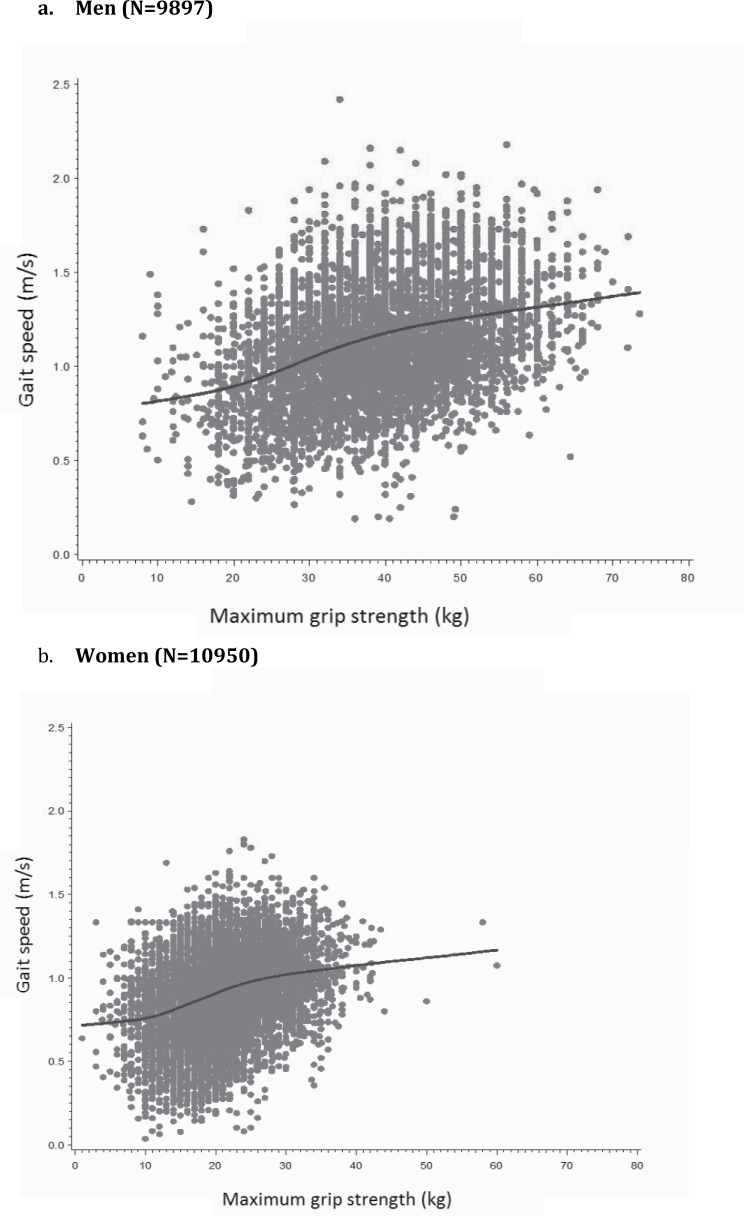
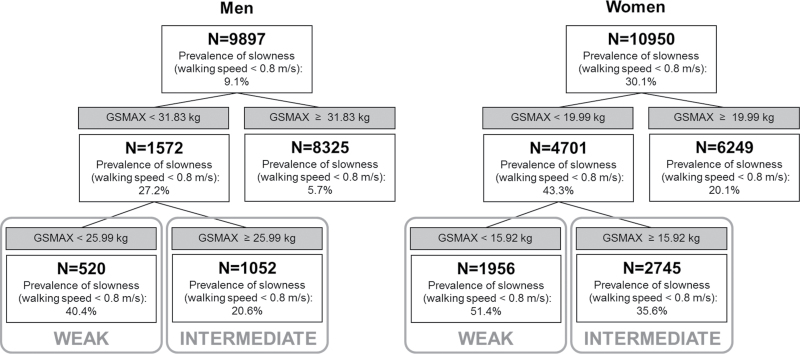
BACKGROUND: Weakness is common and contributes to disability, but no consensus exists regarding a strength cutpoint to identify persons at high risk. This analysis, conducted as part of the Foundation for the National Institutes of Health Sarcopenia Project, sought to identify cutpoints that distinguish weakness associated with mobility impairment, defined as gait speed less than 0.8 m/s. METHODS: In pooled cross-sectional data (9,897 men and 10,950 women), Classification and Regression Tree analysis was used to derive cutpoints for grip strength associated with mobility impairment. RESULTS: In men, a grip strength of 26-32 kg was classified as "intermediate" and less than 26 kg as "weak"; 11% of men were intermediate and 5% were weak. Compared with men with normal strength, odds ratios for mobility impairment were 3.63 (95% CI: 3.01-4.38) and 7.62 (95% CI 6.13-9.49), respectively. In women, a grip strength of 16-20 kg was classified as "intermediate" and less than 16 kg as "weak"; 25% of women were intermediate and 18% were weak. Compared with women with normal strength, odds ratios for mobility impairment were 2.44 (95% CI 2.20-2.71) and 4.42 (95% CI 3.94-4.97), respectively. Weakness based on these cutpoints was associated with mobility impairment across subgroups based on age, body mass index, height, and disease status. Notably, in women, grip strength divided by body mass index provided better fit relative to grip strength alone, but fit was not sufficiently improved to merit different measures by gender and use of a more complex measure. CONCLUSIONS: Cutpoints for weakness derived from this large, diverse sample of older adults may be useful to identify populations who may benefit from interventions to improve muscle strength and function.
Overview
The claims and statistics of this paper haven’t been checked yet.
Free: it reads the open-access text and checks the first 5 claims that cite a source we can check. Create a free account to check every claim.
Integrity signals
Registry
Cites
Statistics
Figures
Verification
Claims the paper makes
The claims and statistics of this paper haven’t been checked yet.
Free: it reads the open-access text and checks the first 5 claims that cite a source we can check. Create a free account to check every claim.
Claims other papers make about this one
Each is checked against this paper’s own text: does it say what the citing paper says it does?
The source backs part of the claim, not all of it — or backs it for a different population, condition or comparison.
In the citing paper
“while data from FNIH classified 4.1% of men and 14.0% of women as having sarcopenic obesity using high BMI and low grip strength as measures of obesity and low muscle strength, respectively202.”
From Sarcopenic obesity in older adults: aetiology, epidemiology and treatment strategies (2018) · cites this paper as [202]
Experimental — accuracy not yet measuredThe source backs part of the claim, not all of it — or backs it for a different population, condition or comparison.
In the citing paper
“For example, grip strength less than 26kg or 16kg for men and women respectively is highly predictive of mobility disability.”
From Successful aging: Advancing the science of physical independence in older adults (2015) · cites this paper as Alley, Shardell, Peters, McLean, Dam, Kenny, Fragala, Harris, Kiel, Guralnik, Ferrucci, Kritchevsky, Studenski, Vassileva, and Cawthon 2014
Experimental — accuracy not yet measuredThe check wasn’t confident either way, so it gives no verdict — never disputed.
In the citing paper
“Efforts to create cutpoints for muscle mass and muscle strength from population studies (community-dwelling older adults) recommended cutpoint for grip strength of 26 kg for men vs. 16 kg for women, and for appendicular lean body mass (measured with DXA) of 19.75 kg for men vs. 15.02 kg for women (Alley et al., 2014; Cawthon et al., 2014).”
From Myosteatosis in the Context of Skeletal Muscle Function Deficit: An Interdisciplinary Workshop at the National Institute on Aging (2020) · cites this paper as Alley et al., 2014
Experimental — accuracy not yet measuredIn the citing paper
“Efforts to create cutpoints for muscle mass and muscle strength from population studies (community-dwelling older adults) recommended cutpoint for grip strength of 26 kg for men vs. 16 kg for women, and for appendicular lean body mass (measured with DXA) of 19.75 kg for men vs. 15.02 kg for women (Alley et al., 2014; Cawthon et al., 2014).”
From Myosteatosis in the Context of Skeletal Muscle Function Deficit: An Interdisciplinary Workshop at the National Institute on Aging (2020) · cites this paper as Alley et al., 2014
In the citing paper
“Sarcopenia is a muscle disease (muscle failure) rooted in adverse muscle changes that accrue across a lifetime; sarcopenia is common among adults of older age but can also occur earlier in life.”
From Sarcopenia: revised European consensus on definition and diagnosis (2019) · cites this paper as [30]
Self-check
Percentages, sums and reported differences re-computed from the paper’s own numbers.
The self-check needs the paper’s full text.
Citations
Cites
Classification and Regression Trees.
Gordon, A. D., Breiman, L., Friedman, J. H., Olshen, R. A., & Stone, C. J. (1984) · Biometrics · doi:10.2307/2530946 · Cited by 23,522
Classification and Regression Trees.
Ryzin, J. V., Breiman, L., Friedman, J. H., Olshen, R. A., & Stone, C. J. (1986) · Journal of the American Statistical Association · doi:10.2307/2288003 · Cited by 20,825
Sarcopenia: European consensus on definition and diagnosis
Cruz-Jentoft, A. J., Baeyens, J. P., Bauer, J. M., Boirie, Y., Cederholm, T., Landi, F., Martin, F. C., Michel, J.-P., Rolland, Y., Schneider, S. M., et al. (2010) · Age and Ageing · doi:10.1093/ageing/afq034 · Cited by 11,601
Risk Factors for Hip Fracture in White Women
Cummings, S. R., Nevitt, M. C., Browner, W. S., Stone, K., Fox, K. M., Ensrud, K. E., Cauley, J., Black, D., & Vogt, T. M. (1995) · New England Journal of Medicine · doi:10.1056/nejm199503233321202 · Cited by 3,595 · cited 1×
“Participants Data available for this phase of the FNIH Sarcopenia Project analysis included: the Study of Osteoporotic Fractures, both the original cohort (study Visit 6) (14) and African American cohort (study Visit 1) (15); the Osteoporotic Fractures in Men Study (baseline visit) (16); the Health, Aging and Body Com…”
MethodFielding, R. A., Vellas, B., Evans, W. J., Bhasin, S., Morley, J. E., Newman, A. B., Abellan van Kan, G., Andrieu, S., Bauer, J., Breuille, D., et al. (2011) · Journal of the American Medical Directors Association · doi:10.1016/j.jamda.2011.01.003 · Cited by 3,256
Self-citationGoodpaster, B. H., Park, S. W., Harris, T. B., Kritchevsky, S. B., Nevitt, M., Schwartz, A. V., Simonsick, E. M., Tylavsky, F. A., Visser, M., Newman, A. B., et al. (2006) · The Journals of Gerontology Series A: Biological Sciences and Medical Sciences · doi:10.1093/gerona/61.10.1059 · Cited by 3,083 · cited 1×
“Strength declines more rapidly in men at older ages (32), and the association between strength and physical function appears stronger in men than in women (5,33).”
BackgroundSelf-citationRoberts, H. C., Denison, H. J., Martin, H. J., Patel, H. P., Syddall, H., Cooper, C., & Sayer, A. A. (2011) · Age and Ageing · doi:10.1093/ageing/afr051 · Cited by 3,001 · cited 3×
“By using the maximum measured grip strength from either hand, we sought to minimize variation based on these factors, but variation due to dynamometer used, hand position, and other factors may still exist (28).”
BackgroundMethodInfluentialStudenski, S. A., Peters, K. W., Alley, D. E., Cawthon, P. M., McLean, R. R., Harris, T. B., Ferrucci, L., Guralnik, J. M., Fragala, M. S., Kenny, A. M., et al. (2014) · The Journals of Gerontology: Series A · doi:10.1093/gerona/glu010 · Cited by 2,545
Self-citationEpidemiological approaches to heart disease: the Framingham study
Dawber, T. R., Meadors, G. F., & Moore, F. E. (1951) · American Journal of Public Health and the Nations Health · doi:10.2105/ajph.41.3.279 · Cited by 2,148 · cited 1×
“Participants Data available for this phase of the FNIH Sarcopenia Project analysis included: the Study of Osteoporotic Fractures, both the original cohort (study Visit 6) (14) and African American cohort (study Visit 1) (15); the Osteoporotic Fractures in Men Study (baseline visit) (16); the Health, Aging and Body Com…”
MethodLauretani, F., Russo, C. R., Bandinelli, S., Bartali, B., Cavazzini, C., Di Iorio, A., Corsi, A. M., Rantanen, T., Guralnik, J. M., & Ferrucci, L. (2003) · Journal of Applied Physiology · doi:10.1152/japplphysiol.00246.2003 · Cited by 1,946 · cited 2×
“M USCLE weakness is related to poor physical performance and incident mobility limitations among older adults (1–6).”
BackgroundSelf-citation
Research works printed but not linked: 4
- 2012, The Journals of Gerontology Series A: Biological Sciences and Medical Sciences, 67, 28
- 2014, The Journals of Gerontology Series A: Biological Sciences and Medical Sciences, 5, 567
- 2007, American Journal of Epidemiology, 165, 1076, 10.1093/aje/kwk115 · DOI · Paper page
- 2010, Physical Therapy, 90, 196, 10.2522/ptj.20090079 · DOI · Paper page
Cited by
Items 501–535 of 535
Frailty and its Determinants among Elderly People of Rural Tamil Nadu - A Cross-Sectional Study
Malai Ammal, M., Vijayakumar, M., & Vijayalakshmi, M. (2025) · Healthline · doi:10.51957/healthline_754_2025
Um Passo à Frente na Avaliação da Força de Preensão Manual na Insuficiência Cardíaca
Cesarino, E. J., de Castro, M. L., de Andrade, R. C. G., & Restini, C. B. A. (2025) · Arquivos Brasileiros de Cardiologia · doi:10.36660/abc.20250579
Park, D. Y., Kim, B., Lee, O., & Kim, Y. S. (2025) · The Korean Journal of Sports Medicine · doi:10.5763/kjsm.2025.43.4.238
Handgrip Strength in Heart Failure: Developing a Reference Equation
Parahiba, S. M., Ribeiro, É. C. T., Knobloch, I. D. S., Dapper, D., Perry, I. D. S., Clausell, N., Luft, V. C., Souza, G. C., & Rabelo, E. R. (2025) · Arquivos Brasileiros de Cardiologia · doi:10.36660/abc.20240777i
“30 Thus, incorporating height into predictive models for HGS is essential to obtain values that are consistent with an individual’s structural and anatomical characteristics.”
Additional file 1 of Grip strength cut-points from the Swiss DO-HEALTH population
Gagesch, M., Wieczorek, M., Abderhalden, L. A., Lang, W., Freystaetter, G., Armbrecht, G., Kressig, R. W., Vellas, B. J., Rizzoli, R., Blauth, M., et al. (2023) · Figshare · doi:10.6084/m9.figshare.23896122
Abdalla, P. P., Bohn, L., da Silva, L. S. L., dos Santos, A. P., Júnior, M. F. T., Venturini, A. C. R., dos Santos Carvalho, A., Gomez, D. M., Mota, J., & Machado, D. R. L. (2021) · Figshare · doi:10.6084/m9.figshare.17284334
Handgrip Strength Increase is Modulated by the Risk of Malnutrition After Dental Prostheses
Dreyer, E. (2025) · Journal of Dental Health and Oral Research · doi:10.46889/jdhor.2025.6307
A Step Forward in the Assessment of Handgrip Strength in Heart Failure
Cesarino, E. J., de Castro, M. L., de Andrade, R. C. G., & Restini, C. B. A. (2025) · Arquivos Brasileiros de Cardiologia · doi:10.36660/abc.20250579i
Facal-Mayo, D., Picón, E., Blumen, H. M., Lojo‐Seoane, C., Nieto‐Vieites, A., Stern, Y., & Pereiro, A. X. (2025) · Brain Sciences · doi:10.3390/brainsci16010040
“Although few studies have differentiated between the time taken to perform different subtasks, it has also been hypothesized that a long duration between subtasks will be associated with poorer cognitive function [28].”
The association of frailty with health care costs using the FRAIL scale
Schousboe, J. T., Langsetmo, L., Kats, A. M., Boyd, C. M., Sheets, K. M., Fink, H. A., & Ensrud, K. E. (2026) · Aging Clinical and Experimental Research · doi:10.1007/s40520-025-03272-5 · Cited by 2
“Weakness was defined as grip strength 20 kg for women and 32 kg for men [30].”
Burgo-Beiro, C., Facal-Mayo, D., Dosil‐Díaz, C., Felpete, A., Villamide-Gesto, J., & Campos‐Magdaleno, M. (2026) · Aging Clinical and Experimental Research · doi:10.1007/s40520-026-03330-6
“The second measure was a handgrip strength measure (related to both weakness and mobility outcomes [47]), assessed using a handheld dynamometer.”
Yang, B., Yan, X., Zheng, Z., Wu, F., Ding, X., Chen, X., Oldenburg, B. F., Song, H., Zhou, Y., Zhang, H., et al. (2026) · medRxiv · doi:10.64898/2026.01.28.26345092
Internet of Things dynamic dynamometer to measure handgrip strength
Lee, M. S., Lee, A. W., Yeh, D. P., Schroeder, P., Yeh, C. S., & Yeh, K. (2026) · Review of Scientific Instruments · doi:10.1063/5.0294061
Fuster, V., Haro, D., Orrit, X., Elosúa, R., Santos-Beneit, G., Fernandez-Jimenez, R., Badia, A., Bodega, P., Carral, V., de Cos-Gandoy, A., et al. (2026) · JACC Advances · doi:10.1016/j.jacadv.2026.102597
Casado-Peña, J. P., Arrunátegui-Salas, G., Montufar-Leon, C., y Rosas, V. G. S., Bayes, C. L., Serrano, L. H. V., Vieira, L. H. P., & Casado, F. L. (2026) · Human Movement · doi:10.5114/hm/214838
“= 0.12 – two-tailed, = 0.05 and = 0.80) considering the worst-case of the results derived from two previous literature studies [7, 13], the calculated required minimum sample size was 2218 subjects.”
InfluentialMachado, Y. O., Luiz, M. M., Máximo, R. D. O., Lima, S. S., Steptoe, A., de Oliveira, C. M., & Alexandre, T. D. S. (2026) · GeroScience · doi:10.1007/s11357-026-02193-z
Steig, J., Kieser, J., & McGrath, R. P. (2026) · Advances in Geriatric Medicine and Research · doi:10.20900/agmr20260006
“Males and females with handgrip strength 26 kg and 16 kg were considered as having weakness, respectively [22].”
Wu, W., Fu, C., Zhao, Y., & Zhao, J. (2026) · Aging Clinical and Experimental Research · doi:10.1007/s40520-026-03398-0
“Dynapenia was defined according to cut-off values of 26 kg for men and 16 kg for women [24].”
Effects of hearing intervention on physical function: A secondary analysis of the ACHIEVE study
Deal, J. A., Zhang, W., Jiang, K., Huang, A., Pike, J. R., Arnold, M., Burgard, S., Chen, Z. S., Chisolm, T., Couper, D. J., et al. (2026) · PLoS ONE · doi:10.1371/journal.pone.0347500 · Cited by 1
Physical Function Decline Among Adults With Moderate-to-Severe CKD
Schrauben, S. J., Brown, R., Shlipak, M. G., Tangri, N., Zhang, X., Nair, D., Leonard, M. B., Bauer, S., Lash, J. P., Balantrapu, S., et al. (2026) · Kidney International Reports · doi:10.1016/j.ekir.2026.106584 · Cited by 1
Milliati, J. D. S., da Silva, T. B. P., Máximo, R. D. O., Luiz, M. M., Lima, S. S., Steptoe, A., de Oliveira, C. M., & Alexandre, T. D. S. (2026) · Diabetes Obesity and Metabolism · doi:10.1111/dom.70839
“Grip strength was measured in kilograms to assess muscle strength and treated as a continuous variable [27].”
Shitogishi, H., Yamabe, D., Suzuki, M., Chiba, Y., Yan, H., Hatayama, R., Murakami, H., Chida, Y., Kakutani, K., & Doita, M. (2026) · Spine Surgery and Related Research · doi:10.22603/ssrr.2026-0033
Lu, Z., Hu, Y., He, H., Tu, J., & Shan, G. (2026) · Journal of Endocrinological Investigation · doi:10.1007/s40618-026-02916-1
“…most existing studies suffer from important limi - tations, including insufficient sample representativeness (e.g., data restricted to rural populations [19]), restriction to specific subgroups such as older adults [ 22], or focus on only one muscle region (e.g., appendicular skeletal muscle [17]).”
Tsujimoto, K., & Watanabe, S. (2026) · Cureus · doi:10.7759/cureus.111171
“Handgrip strength is easy to measure and highly reproducible, and is a useful predictor of mortality and cardiovascular events in patients with cardiovascular diseases [14,15].”
Wang, W., Zhen, J., & Zhu, X. (2026) · Medicine · doi:10.1097/md.0000000000049483
“[25,32,33] The interaction between BMI and other factors offers insights into the clinical interpretation of this joint high-risk phenotype.”
Spexoto, M. C. B., Máximo, R. D. O., Tofani, P. S., Luiz, M. M., Guandalini, V. R., de Oliveira, D. C., de Souza, A. F., Steptoe, A., de Oliveira, C. M., & Alexandre, T. D. S. (2026) · Archives of Gerontology and Geriatrics · doi:10.1016/j.archger.2026.106370
Langsetmo, L., Schousboe, J. T., Kats, A. M., Taylor, B. C., Boyd, C. M., Sheets, K. M., & Ensrud, K. E. (2026) · PLoS ONE · doi:10.1371/journal.pone.0354978
“…shrinkage (recent weight loss of ≥5% or ≥10 pounds or BMI 18.5 kg/m 2 ), [9] weakness (grip strength 32 kg for men or 20 kg for women), [21] self-reported poor energy, slowness (gait speed 0.8 m/s for men or 0.6 m/s for women or use of a walking aid), [9,22,23] and low physical…”
InfluentialPan, Y., & Bi, J. (2026) · Archives of Gerontology and Geriatrics · doi:10.1016/j.archger.2026.106382
Pisfil, S. L. C., Mau, A. Y. D., Huamanchumo-Barrientos, V. E., Samame-Pérez, R. M., Sosa-Quispe, E. E., Tipula-Tipula, E. M., Rueda-Villegas, Á. E., Munarriz-Medina, R., & Esquinas, A. M. (2026) · Frontiers in Rehabilitation Sciences · doi:10.3389/fresc.2026.1904963
“…2019), the Foundation for the National Institutes of Health (FNIH) Sarcopenia Project, and the Sarcopenia Definition and Outcomes Consortium (SDOC) unanimously recognize low muscle strength as the primary operational indicator for initiating sarcopenia assessment and risk stratification (3 – 6).”
Assessment of hypoxia resistance in patients with Parkinson’s disease
Guseva, O. V., & Жукова, Н. Г. (2026) · Russian neurological Journal · doi:10.30629/2658-7947-2026-31-3-43-50
Li, R., Nan, S., Feng, X., & Aohan, X. (2026) · medRxiv · doi:10.64898/2026.09.04.26362242
Hromádka, F., Knybel, L., Krahulik, J., & Stryja, D. (2026) · BMC Musculoskeletal Disorders · doi:10.1186/s12891-026-10482-z
de León‐González, E. D., Cavazos, H. E. G., Hernandez, A. C. I., Perez, A. D. C., Alcala, M. N. G., Leon, A. M. D., & Hermosillo, H. G. (2026) · European Geriatric Medicine · doi:10.1007/s41999-026-01611-x
Sun, M., Tian, C., Liu, H., Guo, H., & Yan, T. (2026) · British Journal Of Nutrition · doi:10.1017/s0007114526108253
Tanner, C. Y., Schwarz, A., Steffen, H., & Kelso, A. (2026) · German Journal of Sports Medicine · doi:10.5960/dzsm.2026.678
Metadata
- Authors
- Alley, D. E., Shardell, M. D., Peters, K. W., McLean, R. R., Dam, T.-T. L., Kenny, A. M., Fragala, M. S., Harris, T. B., Kiel, D. P., Guralnik, J. M., Ferrucci, L., Kritchevsky, S. B., Studenski, S. A., Vassileva, M. T., & Cawthon, P. M.
- Affiliations
- University of Maryland, Baltimore (US)
- California Pacific Medical Center (US)
- Beth Israel Deaconess Medical Center (US)
- Columbia University (US)
- University of Central Florida (US)
- National Institutes of Health (US)
- National Institute on Aging (US)
- Wake Forest University (US)
- University of Pittsburgh (US)
- Foundation for the National Institutes of Health (US)
- Corresponding author
- Alley, D. E.
- ORCID
- Venue
- The Journals of Gerontology Series A: Biological Sciences and Medical Sciences
- Publisher
- Oxford University Press (OUP)
- Published
- 2014-04-14
- Volume
- 69
- Issue
- 5
- Pages
- 559-566
- ISSN
- 1079-5006 (ISSN-L)
- 1758-535X
- PMC
- PMC3991145
- OpenAlex
- W2127873216
- Cited by
- 535
- References
- 38
- Citations by year
- 2026: 32 · 2025: 40 · 2024: 49 · 2023: 45 · 2022: 41 · 2021: 60 · 2020: 41 · 2019: 46 · 2018: 47 · 2017: 44 · 2016: 39 · 2015: 35 · 2014: 16
- FWCI
- 29.78
- Type
- journal article
- Language
- en
- Open access
- hybrid
- doi.org
- Licence
- cc-by-nc
- Locations
- The Journals of Gerontology Series A (publishedVersion, cc-by-nc)
- Europe PMC (PubMed Central) (publishedVersion, cc-by-nc)
- PubMed Central (publishedVersion, cc-by-nc)
- PubMed (publishedVersion)
- Digital Access to Scholarship at Harvard (DASH) (Harvard University) (submittedVersion, cc-by)
- Journal of International Crisis and Risk Communication Research (submittedVersion)
- Funders
- National Institutes of Health (1u13ag041583-01)
- National Institute on Aging (1U13AG041583, P30AG024827)
- Topics
- Health Sciences › Medicine › Physiology (medical) › Nutrition and Health in Aging
- Health Sciences › Medicine › Geriatrics and Gerontology › Frailty in Older Adults
- Health Sciences › Health Professions › Physical Therapy, Sports Therapy and Rehabilitation › Balance, Gait, and Falls Prevention
- Keywords
- grip strength, muscle weakness, cut-off values, mobility impairment, walking speed, sarcopenia, older adults, sex differences, body mass index, muscle strength
- MeSH terms
- Age Factors, Aged, Aged, 80 and over, Cross-Sectional Studies, Female, Gait, Humans, Male, Sex Factors, United States, Hand Strength, Muscle Weakness, Mobility Limitation, Sarcopenia
About these checks
Registry, retraction, Cites and statistics results are computed, not judged, with one exception: a printed reference that no index lists is read once by a model before it counts as a citation error. Claims are extracted by a model and kept only when their quote appears verbatim in the text; each cited source is then checked, with a model’s help, for whether it says what the claim relies on. Those verdicts can be wrong — read the claim’s quote and the cited source before relying on one.
Statistics and arithmetic are recomputed, not judged.
Confidence bands are shown only for fields calibrated on our annotated test set. None is calibrated yet, so no band is shown.
What counts as a claim ›How we measure confidence ›How we check this ›
Are you an author, or do you see a problem with this page? Request a review
Data sources
Bibliographic data: Semantic Scholar, OpenAlex, Crossref.
Contains information from the Semantic Scholar Academic Graph Datasets, made available under the ODC Attribution License (ODC-BY 1.0).
Semantic Scholar’s data is described in: Kinney, R., et al. (2023). The Semantic Scholar Open Data Platform. arXiv:2301.10140.
