

Grip Strength Cutpoints for the Identification of Clinically Relevant Weakness
Open accessThe DOI matches its Crossref record; 38 of the 38 references it cites were found in a registry or an index.
Abstract
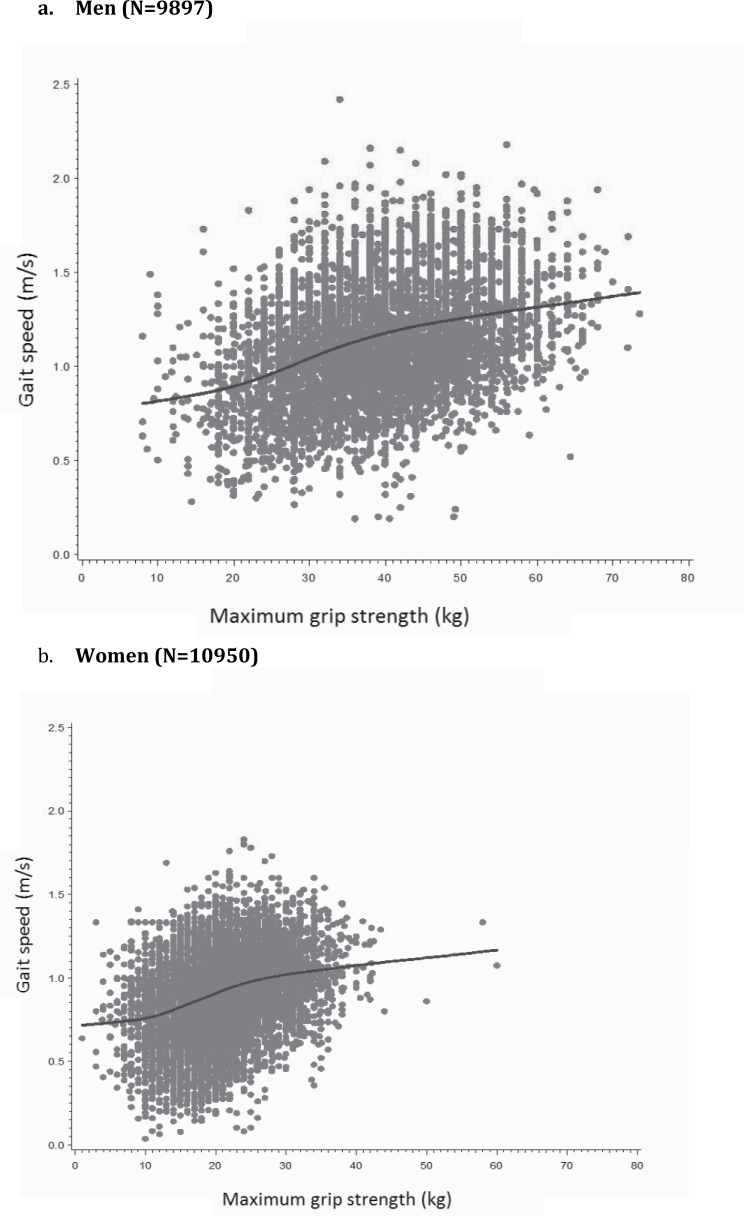
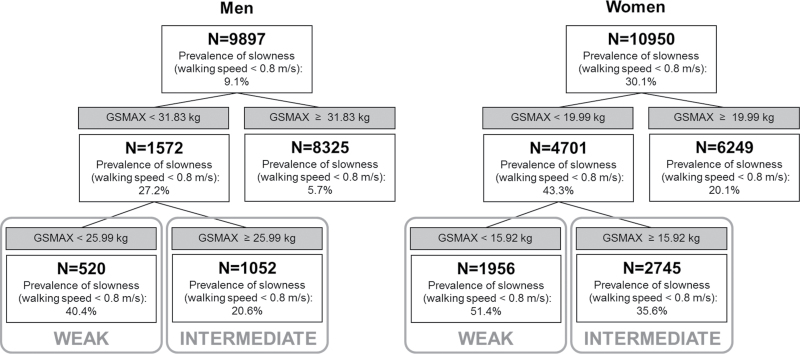
BACKGROUND: Weakness is common and contributes to disability, but no consensus exists regarding a strength cutpoint to identify persons at high risk. This analysis, conducted as part of the Foundation for the National Institutes of Health Sarcopenia Project, sought to identify cutpoints that distinguish weakness associated with mobility impairment, defined as gait speed less than 0.8 m/s. METHODS: In pooled cross-sectional data (9,897 men and 10,950 women), Classification and Regression Tree analysis was used to derive cutpoints for grip strength associated with mobility impairment. RESULTS: In men, a grip strength of 26-32 kg was classified as "intermediate" and less than 26 kg as "weak"; 11% of men were intermediate and 5% were weak. Compared with men with normal strength, odds ratios for mobility impairment were 3.63 (95% CI: 3.01-4.38) and 7.62 (95% CI 6.13-9.49), respectively. In women, a grip strength of 16-20 kg was classified as "intermediate" and less than 16 kg as "weak"; 25% of women were intermediate and 18% were weak. Compared with women with normal strength, odds ratios for mobility impairment were 2.44 (95% CI 2.20-2.71) and 4.42 (95% CI 3.94-4.97), respectively. Weakness based on these cutpoints was associated with mobility impairment across subgroups based on age, body mass index, height, and disease status. Notably, in women, grip strength divided by body mass index provided better fit relative to grip strength alone, but fit was not sufficiently improved to merit different measures by gender and use of a more complex measure. CONCLUSIONS: Cutpoints for weakness derived from this large, diverse sample of older adults may be useful to identify populations who may benefit from interventions to improve muscle strength and function.
Overview
The claims and statistics of this paper haven’t been checked yet.
Free: it reads the open-access text and checks the first 5 claims that cite a source we can check. Create a free account to check every claim.
Integrity signals
Registry
Cites
Statistics
Figures
Verification
Claims the paper makes
The claims and statistics of this paper haven’t been checked yet.
Free: it reads the open-access text and checks the first 5 claims that cite a source we can check. Create a free account to check every claim.
Claims other papers make about this one
Each is checked against this paper’s own text: does it say what the citing paper says it does?
The source backs part of the claim, not all of it — or backs it for a different population, condition or comparison.
In the citing paper
“while data from FNIH classified 4.1% of men and 14.0% of women as having sarcopenic obesity using high BMI and low grip strength as measures of obesity and low muscle strength, respectively202.”
From Sarcopenic obesity in older adults: aetiology, epidemiology and treatment strategies (2018) · cites this paper as [202]
Experimental — accuracy not yet measuredThe source backs part of the claim, not all of it — or backs it for a different population, condition or comparison.
In the citing paper
“For example, grip strength less than 26kg or 16kg for men and women respectively is highly predictive of mobility disability.”
From Successful aging: Advancing the science of physical independence in older adults (2015) · cites this paper as Alley, Shardell, Peters, McLean, Dam, Kenny, Fragala, Harris, Kiel, Guralnik, Ferrucci, Kritchevsky, Studenski, Vassileva, and Cawthon 2014
Experimental — accuracy not yet measuredThe check wasn’t confident either way, so it gives no verdict — never disputed.
In the citing paper
“Efforts to create cutpoints for muscle mass and muscle strength from population studies (community-dwelling older adults) recommended cutpoint for grip strength of 26 kg for men vs. 16 kg for women, and for appendicular lean body mass (measured with DXA) of 19.75 kg for men vs. 15.02 kg for women (Alley et al., 2014; Cawthon et al., 2014).”
From Myosteatosis in the Context of Skeletal Muscle Function Deficit: An Interdisciplinary Workshop at the National Institute on Aging (2020) · cites this paper as Alley et al., 2014
Experimental — accuracy not yet measuredIn the citing paper
“Efforts to create cutpoints for muscle mass and muscle strength from population studies (community-dwelling older adults) recommended cutpoint for grip strength of 26 kg for men vs. 16 kg for women, and for appendicular lean body mass (measured with DXA) of 19.75 kg for men vs. 15.02 kg for women (Alley et al., 2014; Cawthon et al., 2014).”
From Myosteatosis in the Context of Skeletal Muscle Function Deficit: An Interdisciplinary Workshop at the National Institute on Aging (2020) · cites this paper as Alley et al., 2014
In the citing paper
“Sarcopenia is a muscle disease (muscle failure) rooted in adverse muscle changes that accrue across a lifetime; sarcopenia is common among adults of older age but can also occur earlier in life.”
From Sarcopenia: revised European consensus on definition and diagnosis (2019) · cites this paper as [30]
Self-check
Percentages, sums and reported differences re-computed from the paper’s own numbers.
The self-check needs the paper’s full text.
Citations
Cites
Classification and Regression Trees.
Gordon, A. D., Breiman, L., Friedman, J. H., Olshen, R. A., & Stone, C. J. (1984) · Biometrics · doi:10.2307/2530946 · Cited by 23,522
Classification and Regression Trees.
Ryzin, J. V., Breiman, L., Friedman, J. H., Olshen, R. A., & Stone, C. J. (1986) · Journal of the American Statistical Association · doi:10.2307/2288003 · Cited by 20,825
Sarcopenia: European consensus on definition and diagnosis
Cruz-Jentoft, A. J., Baeyens, J. P., Bauer, J. M., Boirie, Y., Cederholm, T., Landi, F., Martin, F. C., Michel, J.-P., Rolland, Y., Schneider, S. M., et al. (2010) · Age and Ageing · doi:10.1093/ageing/afq034 · Cited by 11,601
Risk Factors for Hip Fracture in White Women
Cummings, S. R., Nevitt, M. C., Browner, W. S., Stone, K., Fox, K. M., Ensrud, K. E., Cauley, J., Black, D., & Vogt, T. M. (1995) · New England Journal of Medicine · doi:10.1056/nejm199503233321202 · Cited by 3,595 · cited 1×
“Participants Data available for this phase of the FNIH Sarcopenia Project analysis included: the Study of Osteoporotic Fractures, both the original cohort (study Visit 6) (14) and African American cohort (study Visit 1) (15); the Osteoporotic Fractures in Men Study (baseline visit) (16); the Health, Aging and Body Com…”
MethodFielding, R. A., Vellas, B., Evans, W. J., Bhasin, S., Morley, J. E., Newman, A. B., Abellan van Kan, G., Andrieu, S., Bauer, J., Breuille, D., et al. (2011) · Journal of the American Medical Directors Association · doi:10.1016/j.jamda.2011.01.003 · Cited by 3,256
Self-citationGoodpaster, B. H., Park, S. W., Harris, T. B., Kritchevsky, S. B., Nevitt, M., Schwartz, A. V., Simonsick, E. M., Tylavsky, F. A., Visser, M., Newman, A. B., et al. (2006) · The Journals of Gerontology Series A: Biological Sciences and Medical Sciences · doi:10.1093/gerona/61.10.1059 · Cited by 3,083 · cited 1×
“Strength declines more rapidly in men at older ages (32), and the association between strength and physical function appears stronger in men than in women (5,33).”
BackgroundSelf-citationRoberts, H. C., Denison, H. J., Martin, H. J., Patel, H. P., Syddall, H., Cooper, C., & Sayer, A. A. (2011) · Age and Ageing · doi:10.1093/ageing/afr051 · Cited by 3,001 · cited 3×
“By using the maximum measured grip strength from either hand, we sought to minimize variation based on these factors, but variation due to dynamometer used, hand position, and other factors may still exist (28).”
BackgroundMethodInfluentialStudenski, S. A., Peters, K. W., Alley, D. E., Cawthon, P. M., McLean, R. R., Harris, T. B., Ferrucci, L., Guralnik, J. M., Fragala, M. S., Kenny, A. M., et al. (2014) · The Journals of Gerontology: Series A · doi:10.1093/gerona/glu010 · Cited by 2,545
Self-citationEpidemiological approaches to heart disease: the Framingham study
Dawber, T. R., Meadors, G. F., & Moore, F. E. (1951) · American Journal of Public Health and the Nations Health · doi:10.2105/ajph.41.3.279 · Cited by 2,148 · cited 1×
“Participants Data available for this phase of the FNIH Sarcopenia Project analysis included: the Study of Osteoporotic Fractures, both the original cohort (study Visit 6) (14) and African American cohort (study Visit 1) (15); the Osteoporotic Fractures in Men Study (baseline visit) (16); the Health, Aging and Body Com…”
MethodLauretani, F., Russo, C. R., Bandinelli, S., Bartali, B., Cavazzini, C., Di Iorio, A., Corsi, A. M., Rantanen, T., Guralnik, J. M., & Ferrucci, L. (2003) · Journal of Applied Physiology · doi:10.1152/japplphysiol.00246.2003 · Cited by 1,946 · cited 2×
“M USCLE weakness is related to poor physical performance and incident mobility limitations among older adults (1–6).”
BackgroundSelf-citation
Research works printed but not linked: 4
- 2012, The Journals of Gerontology Series A: Biological Sciences and Medical Sciences, 67, 28
- 2014, The Journals of Gerontology Series A: Biological Sciences and Medical Sciences, 5, 567
- 2007, American Journal of Epidemiology, 165, 1076, 10.1093/aje/kwk115 · DOI · Paper page
- 2010, Physical Therapy, 90, 196, 10.2522/ptj.20090079 · DOI · Paper page
Cited by
Items 301–400 of 535
Dilloway, T., Ashby, D. R., Hickson, M., Temple, A., & Johansson, L. (2022) · Journal of Renal Nutrition · doi:10.1053/j.jrn.2022.08.002 · Cited by 10
Myostatin and Activin A as Biomarkers of Sarcopenia in Inflammatory Bowel Disease Patients
Godala, M. M., Gaszyńska, E., Walczak, K., & Małecka-Wojciesko, E. (2024) · Nutrients · doi:10.3390/nu16060810 · Cited by 12
“The better attempt for the dominant hand was considered the relevant measurement [51].”
BackgroundImpact of denosumab on muscle health in older adults in long-term care
Haeri, N. S., Perera, S., & Greenspan, S. L. (2025) · Bone · doi:10.1016/j.bone.2025.117552 · Cited by 12
Ritti‐Dias, R. M., Cucato, G. G., Franco, F. G. D. M., Cendoroglo, M. S., Nasri, F., Costa, M. L. M., Carvalho, J. A. M., & de Matos, L. D. N. J. (2016) · Clinics · doi:10.6061/clinics/2016(09)06 · Cited by 12
“, who showed that handgrip strength was a strong predictor of mobility limitation in a representative sample of 9,897 men and 10,950 women (17).”
BackgroundLong, G., Chen, C., Tan, M., & Yi, P. (2021) · Orthopaedic Surgery · doi:10.1111/os.13007 · Cited by 12
Luiz, M. M., Schneider, I. J. C., Kuriki, H. U., Fattori, A., Rampinelli, V. P. C., Steptoe, A., Alexandre, T. D. S., & de Oliveira, C. M. (2022) · Archives of Gerontology and Geriatrics · doi:10.1016/j.archger.2022.104739 · Cited by 10
Pajares, B., Roldán‐Jiménez, C., Alba, E., & Vargas, A. I. C. (2022) · International Journal of Environmental Research and Public Health · doi:10.3390/ijerph191811203 · Cited by 11
“Upper limb strength training was targeted mainly in those patients with handgrip strength lower than 16 kg [53,54].”
BackgroundSoltanisarvestani, M., Lynskey, N., Gray, S. R., Gill, J. M. R., Pell, J. P., Sattar, N. A., Welsh, P. I., Ho, F. K. W., Celis-Morales, C. A., & Petermann-Rocha, F. E. (2023) · Scandinavian Journal of Medicine and Science in Sports · doi:10.1111/sms.14352 · Cited by 8
Haeri, N. S., Perera, S., & Greenspan, S. L. (2023) · Bone · doi:10.1016/j.bone.2023.116867 · Cited by 12
Cai, D., Zhang, H., & Wang, Y. (2023) · Geriatrics and gerontology international/Geriatrics & gerontology international · doi:10.1111/ggi.14652 · Cited by 10
Poor Physical Function as a Marker of Sarcopenia in Adults with Class II/III Obesity
Stoklossa, C. J., Ghosh, S. S., Forhan, M. A., Sharma, A. M., Terada, T., Siervo, M., Baracos, V. E., Padwal, R. S., Hung, P. A., Sawyer, M. B., et al. (2017) · Current Developments in Nutrition · doi:10.3945/cdn.117.001743 · Cited by 11
“ability, the current study identified sarcopenia based on a clinically meaningful cutpoint (data114 driven approach) whereby a value below which individuals would be at an increased risk for a 115 health outcome [11, 40, 41, 9, 10].”
Women’s spousal choices and a man’s handshake: Evidence from a Norwegian study of cohort differences
Skirbekk, V., Hardy, M. A., & Strand, B. H. (2018) · SSM - Population Health · doi:10.1016/j.ssmph.2018.04.004 · Cited by 10
“, 2016) and is most important for health at older ages, due to age-related decline and implications for mobility (Alley et al., 2014; Stephan, Chalabaev, Kotter-Grühn, & Jaconelli, 2013).”
BackgroundKEMMLER, W. K., von Stengel, S., & Kohl, M. (2018) · Clinical Interventions in Aging · doi:10.2147/cia.s167899 · Cited by 10
Confortin, S. C., Ono, L. M., Meneghini, V., Pastorio, A., Barbosa, A. R., & d’Orsi, E. (2018) · Revista de Nutrição · doi:10.1590/1678-98652018000400004 · Cited by 13
“This is a relatively simple, non-invasive and low-cost measurement, and handgrip strength has been associated with physical performance [6,7].”
BackgroundLuiz, M. M., Máximo, R. D. O., de Oliveira, D. C., Ramírez, P. C., de Souza, A. F., Delinocente, M. L. B., Steptoe, A., de Oliveira, C. M., & Alexandre, T. D. S. (2020) · Journal of Nutrition · doi:10.1093/jn/nxaa258 · Cited by 10
“Dynapenia was defined as grip strength <26 kg for men and <16 kg for women (37).”
BackgroundAssociation of sarcopenia with important health conditions among community-dwelling Asian women
Wong, B. W.-X., Thu, W. P. P., Chan, Y. H., Logan, S. J. S., Cauley, J. A., & Yong, E. (2023) · PLoS ONE · doi:10.1371/journal.pone.0281144 · Cited by 12
Jin, H., Zhou, J., & Wu, C. (2020) · BMJ Open · doi:10.1136/bmjopen-2020-042396 · Cited by 9
Clinical Relevance of Physical Function Outcomes in Cancer Cachexia
Caeiro, L., Quiroz, S. J., Hegarty, J. S., Grewe, E., Garcia, J. M., & Anderson, L. J. (2024) · Cancers · doi:10.3390/cancers16071395 · Cited by 9
“…point in time, such as that provided for sarcopenia, wherein HGS and 5STS are used for diagnosis (which require confirmation via the direct measurement of muscu-larity), while the timed up-and-go, 400-m walk, SPPB, or habitual gait speed alone can be used to determine sarcopenia severity [68,69].”
MethodNouri, A., Mansour‐Ghanaei, R., Esmaeilpour-Bandboni, M., & Chaboki, B. G. (2021) · International Urology and Nephrology · doi:10.1007/s11255-021-03034-y · Cited by 8
Felix, R. J., Mishra, R., Thomas, J. C., Wilson, B. P., Antonisamy, B., & Gopal, G. K. (2022) · Journal of Frailty Sarcopenia and Falls · doi:10.22540/jfsf-07-183 · Cited by 11
Cho, E., Soh, H. S., Lee, J.-R., Yun, J., Bae, W. K., & Lee, H. (2023) · Frontiers in Medicine · doi:10.3389/fmed.2023.1212946 · Cited by 8
Chowdhury, E., Nelson, M. R., Ernst, M. E., Margolis, K. L., Beilin, L. J., Johnston, C. I., Woods, R. L., Murray, A. M., Wolfe, R. S., Storey, E., et al. (2019) · American Journal of Hypertension · doi:10.1093/ajh/hpz192 · Cited by 8
de Lima, A. B., Henriques‐Neto, D., Ribeiro, G. D. S., Gouveia, É. R., & Baptista, F. (2022) · International Journal of Environmental Research and Public Health · doi:10.3390/ijerph19159297 · Cited by 10
“0 kg for women) [50], as they are very similar to those observed in our sample to discriminate mobility limitation, namely 27.”
BackgroundKlawitter, L. A., Collins, K. S., Ringhofer, D., Christensen, B. K., & McGrath, R. P. (2022) · International journal of exercise science · doi:10.70252/kyva8985 · Cited by 7
“Low HGS (or weakness), which can differentially be determined with a multitude of HGS cut-points (16), is robustly associated with several clinically relevant health outcomes (1).”
BackgroundPai, M., & Muhammad, T. (2024) · Scientific Reports · doi:10.1038/s41598-023-50613-3 · Cited by 7
“Given sex differences in BMI and body composition, HGS should not be the unitary factor in gauging muscle strength or physical fitness 64,65 .”
BackgroundWizgier, D., Meng, Y., Das, A., Naganathan, V., Blyth, F., Couteur, D. G. L., Handelsman, D. J., Waite, L. M., Ribeiro, R. V., Shivappa, N., et al. (2024) · British Journal Of Nutrition · doi:10.1017/s0007114524000126 · Cited by 9
“While grip strength and walking speed are both measures of upper and lower limb strength, respectively, walking speed is a cumulative measure of other factors, including cognition, balance and vision (27) .”
Dynapenia and sarcopenia identify walking speed decline in women but not in men
Souza, I. L. D. P. C. E., de Oliveira, D. C., de Souza, T. B., Ramírez, P. C., Cochar‐Soares, N., Luiz, M. M., Delinocente, M. L. B., Steptoe, A., de Oliveira, C. M., & Alexandre, T. D. S. (2024) · Archives of Gerontology and Geriatrics · doi:10.1016/j.archger.2024.105545 · Cited by 11
Batsis, J. A., Gilbert‐Diamond, D., McClure, A. C., Weintraub, A. B., Sette, D., Mecchella, J. N., Rotenberg, S., Cook, S. B., & Rothstein, R. I. (2019) · Clinical Medicine Insights Arthritis and Musculoskeletal Disorders · doi:10.1177/1179544119862288 · Cited by 8
McGrath, R., Johnson, P. J., McGrath, R. P., Cawthon, P. M., Klawitter, L. A., & Choi, B. (2022) · Journal of Applied Gerontology · doi:10.1177/07334648221092399 · Cited by 9
“Men with HGS 26-kg and women with HGS 16-kg were considered weak (Alley et al., 2014).”
BackgroundSelf-citationCezário, K., Santos, C. A. F., Filho, C. D. M. A., Amirato, G. R., Paixão, V., Almeida, E. B., do Amaral, J. B., Caldo‐Silva, A., Pimenta, N., Sampaio, A. R., et al. (2022) · Healthcare · doi:10.3390/healthcare10091736 · Cited by 9
Andrews, J. S., Gold, L. S., Reed, M. J., Hough, C. L., Garcia, J. M., McClelland, R. L., Fitzpatrick, A. L., Covinsky, K. E., Crane, P. K., Yaffe, K. S., et al. (2022) · The Journals of Gerontology Series A · doi:10.1093/gerona/glac254 · Cited by 9
Self-citationEgund, L., Paulin, T. K., Ekstubbe, H., Bartosch, P., & Malmgren, L. (2023) · The Journal of Frailty & Aging · doi:10.14283/jfa.2023.22 · Cited by 7
“8 m/s) as the dependent variable, as suggested by Alley et al (25), and maximum repetition knee extension (Nms) as the scale dependent variable, we performed a Classification and Regression Tree (CRT) analysis to establish a clinically relevant threshold for knee strength that would closely mirror a HGS <16kg.”
MethodInfluentialThe Physiology of Aging and Exercise
Fragala, M. S. (2015) · Springer eBooks · doi:10.1007/978-3-319-16095-5_1 · Cited by 8
Self-citationAssociação entre cognição e força de preensão manual em idosos: revisão integrativa
Silva, N., & de Menezes, T. N. (2016) · Ciência & Saúde Coletiva · doi:10.1590/1413-812320152111.22872015 · Cited by 10
dos Santos, E. P. R., Silva, C. D. F. R., Ohara, D. G., Matos, A. P., Pinto, A. C. P. N., & Pegorari, M. S. (2021) · Geriatric Nursing · doi:10.1016/j.gerinurse.2021.02.016 · Cited by 8
Xue, Q., Guralnik, J. M., Beamer, B. A., Fried, L. P., & Chaves, P. H. M. (2014) · The Journals of Gerontology Series A · doi:10.1093/gerona/glu149 · Cited by 8
Self-citationFrailty or sarcopenia: which is a better indicator of mortality risk in older adults?
de Souza, A. F., Ramírez, P. C., de Oliveira, D. C., Máximo, R. D. O., Luiz, M. M., Delinocente, M. L. B., Spexoto, M. C. B., Steptoe, A., de Oliveira, C. M., & Alexandre, T. D. S. (2024) · Journal of Epidemiology & Community Health · doi:10.1136/jech-2024-222678 · Cited by 9
Association of multidimensional frailty and dynapenia with fall risk in older adults
Ghorbanzadeh, M., Bakhtiari, A., Hajian‐Tilaki, K., & Abbaszadeh-Amirdehi, M. (2025) · BMC Geriatrics · doi:10.1186/s12877-025-06097-z · Cited by 9
“Dynapenia was defined using sex-specific thresholds: 30 kg for men, 20 kg for women [25].”
Gore, S., Chou, L., Karmarkar, A. M., Adhikari, D., Keysor, J. J., Taylor, J. A., & Kumar, A. (2025) · BMC Geriatrics · doi:10.1186/s12877-025-06390-x · Cited by 9
“[60–62] While this approach helps account for body size variation, it may misclassify strength in individuals with sarcopenic obesity, where BMI may reflect fat mass rather than lean mass. NHATS does not include body composition measures such as fat-free mass or appen-dicular lean mass, which…”
Christensen, L. W. S., Dalhoff, K., Iversen, E., Juul‐Larsen, H. G., Rasmussen, L. J. H., Andersen, A. L., Andersen, O., & Houlind, M. B. (2025) · Basic & Clinical Pharmacology & Toxicology · doi:10.1111/bcpt.70132 · Cited by 7
Ensrud, K. E., Schousboe, J. T., Kats, A. M., Taylor, B. C., Duan‐Porter, W., Sheets, K. M., Boyd, C. M., Cawthon, P. M., & Langsetmo, L. (2024) · The Journals of Gerontology Series A · doi:10.1093/gerona/glae245 · Cited by 6
Self-citationdos Santos, C. A., Fraga-Maia, H., Pitanga, F. J. G., de Almeida, M. D. C. C., da Fonseca, M. D. J. M., Aquino, E. M. L., Cardoso, L. D. O., Griep, R. H., Barreto, S. M., Suemoto, C. K., et al. (2025) · Journal of Cachexia Sarcopenia and Muscle · doi:10.1002/jcsm.13723 · Cited by 9
Everink, I. H. J., Grund, S., Benzinger, P., de Vries, A., Gordon, A. L., van Wijngaarden, J. P., Bauer, J. M., & Schols, J. M. G. A. (2023) · Journal of Clinical Medicine · doi:10.3390/jcm12082918 · Cited by 6
Pereira, L. D. N., Pegorari, M. S., Patrizzi, L. J., de Walsh, I. A. P., Silva, C. D. F. R., da Silva, J. D. S., Matos, A. P., Pinto, A. C. P. N., & Ohara, D. G. (2023) · Clinical Interventions in Aging · doi:10.2147/cia.s411170 · Cited by 10
“We determined the presence of dynapenia by adopting cut-off points for handgrip strength: we considered as reduced muscle strength values < 16 kgf for women and < 26 kilograms/force (kgf) for men.(21)”
MethodRoldán‐Jiménez, C., Pajares, B., Ruiz-Medina, S., Trinidad‐Fernández, M., González‐Sánchez, M., Ribelles, N., García‐Almeida, J. M., Ríos-López, M. J., Alba, E., & Vargas, A. I. C. (2021) · Supportive Care in Cancer · doi:10.1007/s00520-021-06470-9 · Cited by 10
“Another strength is that, besides oncology history and clinical interview, the baseline assessment includes measures widely employed in the research field, such as hand-grip strength [34, 35], 30-STS [20, 36], and validated patient-reported outcomes (additional file 2).”
BackgroundDelinocente, M. L. B., Luiz, M. M., de Oliveira, D. C., de Souza, A. F., Ramírez, P. C., Máximo, R. D. O., Cochar‐Soares, N., Steptoe, A., de Oliveira, C. M., & Alexandre, T. D. S. (2022) · Calcified Tissue International · doi:10.1007/s00223-022-01021-8 · Cited by 9
“Finally, in the identification of dynapenia, we considered the handgrip strength cutoff points recommended by the Foundation for the National Institutes of Health Sarcopenia Project (FNIH) that are strongly associated with adverse outcomes closely linked to the musculoskeletal system [23, 26].”
BackgroundMethodBaillet, M., Morello, R., Vittecoq, O., Chavoix, C., & Marcelli, C. (2023) · Osteoporosis International · doi:10.1007/s00198-023-06701-1 · Cited by 6
“Slow walking is known to be associated with many risk factors for falls, such as impaired cognitive functions, especially executive functions [13, 14], fear of falling [15], low handgrip strength [16], polypharmacy [17], and use of psychotropic drugs [18].”
BackgroundSex Differences in Fear of Falling among Older Adults with Low Grip Strength.
Lim, E. (2016) · PubMed Central · Cited by 10
Manini, T. M., & Clark, B. C. (2016) · Journal of Cachexia Sarcopenia and Muscle · doi:10.1002/jcsm.12128 · Cited by 6
“Recently, grip strength—because of ease of use, predictive capability, and robust use across many studies —has been identified as a potential screening tool to label older adults with clinically significant muscle weakness.(5)”
Supporting impaired hand function in activities of daily living and rehabilitation
Radder, B. (2018) · doi:10.3990/1.9789036546584 · Cited by 6
Johnson, N. L., Bekhet, A. K., Zint, E., Wang, J., Peña, S., Hecke, A. V. V., Garnier‐Villarreal, M., & Ng, A. V. (2024) · Western Journal of Nursing Research · doi:10.1177/01939459241253221 · Cited by 9
“38 Grip strength was measured using a handgrip dynamometer.”
MethodAliberti, S. M., Menini, A., Sacco, A. M., Romano, Martino, A. D., Acampora, V., Izzo, G., Sorrentino, C., Nurzyńska, D., Meglio, F. D., et al. (2026) · Life · doi:10.3390/life16010106 · Cited by 5
“Against a background of persistent heterogeneity in operational definitions and cut-offs, as documented by EWGSOP2 [3] and the NIH Foundation initiatives [36–39], these findings provide concrete evidence that diagnostic simplification can be achieved without compromising accuracy.”
de Amorim, J. S. C., Perracini, M. R., Alexandre, T. D. S., Máximo, R. D. O., & Nascimento-Souza, M. A. (2023) · Journal of Aging and Health · doi:10.1177/08982643231169315 · Cited by 8
Balancing fracture risk versus risk of mortality before fracture among women aged 80 years or older
Schousboe, J. T., Langsetmo, L., Fink, H. A., Kado, D. M., Cauley, J. A., Taylor, B. C., & Ensrud, K. E. (2024) · Journal of the American Geriatrics Society · doi:10.1111/jgs.18859 · Cited by 6
Peng, L., Xiang, Q., Zhou, Y. J., & Yin, R. (2024) · Journal of Alzheimer s Disease · doi:10.3233/jad-231375 · Cited by 5
Farahani, M. R., Sharifi, F., Payab, M., Shadman, Z., Fakhrzadeh, H., Moodi, M., Khorashadizadeh, M., Ebrahimpur, M., Taheri, M., Ebrahimi, P., et al. (2024) · Journal of Diabetes & Metabolic Disorders · doi:10.1007/s40200-024-01501-8 · Cited by 5
“Dynapenia was defined as grip strength < 26 kg for men and < 16 kg for women [26].”
Lima, S. S., Máximo, R. D. O., Luiz, M. M., Tofani, P. S., Silveira, L. C., de Souza, T. B., da Silva, T. B. P., Guandalini, V. R., Lima‐Costa, M. F., de Oliveira, C. M., et al. (2025) · Cadernos de Saúde Pública · doi:10.1590/0102-311xen155624 · Cited by 8
Hand Grip Strength as A Potential Nutritional Assessment Tool in Long-Term Care Homes
Whiting, S. J., Cheng, P. C., Thorpe, L., Viveky, N., Alcorn, J., Hadjistavropoulos, T., & Dahl, W. J. (2016) · Journal Of Aging Research And Healthcare · doi:10.14302/issn.2474-7785.jarh-16-1177 · Cited by 11
Ohara, D. G., Moreira, Y. P., Silva, C. D. F. R., Matos, A. P., Onofre, T., Jamami, M., Pinto, A. C. P. N., & Pegorari, M. S. (2021) · European Geriatric Medicine · doi:10.1007/s41999-021-00560-x · Cited by 5
“in the Foundation for the National Institutes of Health Sarcopenia Project [22].”
BackgroundInfluentialAltajar, S., Wang, N., Rosenthaler, M. P., Murabito, J. M., & Long, M. T. (2023) · Journal of Clinical Medicine · doi:10.3390/jcm12247523 · Cited by 7
Park, D. Y., Rho, J., Kim, E., & Kim, Y. S. (2024) · Metabolic Syndrome and Related Disorders · doi:10.1089/met.2024.0006 · Cited by 7
Laurson, K. R., Welk, G. J., Saint‐Maurice, P. F., & Eisenmann, J. C. (2021) · Measurement in Physical Education and Exercise Science · doi:10.1080/1091367x.2021.2017292 · Cited by 8
“The standards are established by backextrapolating from existing adult criterionreferenced standards for grip strength based on CRW (Alley et al., 2014).”
BackgroundMethodInfluentialBraun, T., Wiegard, A., Geritz, J., Hansen, C., Tan, K. E., Hildesheim, H., Kudelka, J., Maetzler, C., Welzel, J., Romijnders, R., et al. (2022) · PubMed Central · doi:10.11909/j.issn.1671-5411.2022.09.010 · Cited by 8
Grip strength, working memory, and emotion perception in middle-aged males
Aly, M., Sakamoto, M., & Kamijo, K. (2024) · Progress in brain research · doi:10.1016/bs.pbr.2023.12.004 · Cited by 5
An update on methods for sarcopenia diagnosis: from bench to bedside
Rossi, A. P., Rubele, S., D’Introno, A., Zoico, E., Bradimarte, P., Amadio, G., Nori, N., Gnerre, P., Mazzali, G., Fantin, F., et al. (2018) · Italian Journal of Medicine · doi:10.4081/itjm.2018.995 · Cited by 7
Grip strength measured by manual muscle testing lacks diagnostic accuracy
Bohannon, R. W. (2018) · Isokinetics and Exercise Science · doi:10.3233/ies-182162 · Cited by 6
“For example, Alley et al used 26 kg as a standard for men and 16 kg as a standard for women [17].”
González-Martin, A. M., Limón-Villegas, E. S., Reyes-Castillo, Z., Esparza-Ros, F., Hernández-Palma, L. A., Santillán-Rivera, M. S., Herrera-Amante, C. A., Ramos-García, C. O., & Righini, N. (2025) · Journal of Functional Morphology and Kinesiology · doi:10.3390/jfmk10030276 · Cited by 4
“The existence of multiple diagnostic methods and cut-off values leads to low concordance and may result in underdiagnosis or overdiagnosis [12,22,23].”
Christensen, L. W. S., Juul‐Larsen, H. G., Nielsen, R. L., Bornæs, O., Treldal, C., Aharaz, A., Gemmer, M., Andersen, T. S., Long, D. H., Olsen, G. M., et al. (2025) · British Journal of Clinical Pharmacology · doi:10.1002/bcp.70399 · Cited by 5
Relative handgrip strength, lifestyles and cancer risk in older adults: a multi-country cohort study
Lian, Y., & Luo, P. (2026) · QJM · doi:10.1093/qjmed/hcaf333 · Cited by 4
A short history of sarcopenia and frailty and their impact on advanced chronic liver disease
Filip, P. V., Cuciureanu, D., Pop, C.-S., & Diaconu, S.-L. (2024) · Journal of Medicine and Life · doi:10.25122/jml-2024-0304 · Cited by 8
Song, S., Lim, J.-Y., Kim, M., Won, C. W., & Park, H. (2025) · The journal of nutrition health & aging · doi:10.1016/j.jnha.2025.100713 · Cited by 5
“Sarcopenia in that study was defined using appendicular lean mass divided by BMI, based on cut-points proposed by the Foundation for the National Institutes of Health Sarcopenia Project [33], and low muscle strength assessed by handgrip strength [34].”
Blamoutier, M., Boissy, P., Brière, S., Faucher, G., Lauzé, M., & Duval, C. (2018) · JCSM Clinical Reports · doi:10.17987/jcsm-cr.v3i1.42 · Cited by 4
“Two groups were formed based on a grip strength test result according to NIH recommendation [11]:the dynapenic group (aGS≤19.”
MethodResultWang, Y., Islam, R. M., Hussain, S. M., McNeil, J. J., & Davis, S. R. (2023) · The Journals of Gerontology Series A · doi:10.1093/gerona/glad287 · Cited by 8
“The continuous variables of physical function were categorized into dichotomous variables, using the cut-points for the identification of clinically relevant weakness and poor physical condition (28,31).”
BackgroundMethodRole of handgrip strength in predicting the quality of life in older adults: A cross-sectional study
Eskandarzadeh, M., Mansour‐Ghanaei, R., Pourghane, P., & Chaboki, B. G. (2024) · Journal of Education and Health Promotion · doi:10.4103/jehp.jehp_287_23 · Cited by 4
“[24]”
Matsui, Y., Takemura, M., Suzuki, Y., Watanabe, T., Maeda, K., Satake, S., & Arai, H. (2024) · PLoS ONE · doi:10.1371/journal.pone.0311043 · Cited by 7
“However, previous studies have reported that muscle strength is more closely related to falls and motor function than muscle mass [4,5].”
BackgroundPark, D. Y., Lim, B., & Lee, O. (2024) · Metabolic Syndrome and Related Disorders · doi:10.1089/met.2024.0177 · Cited by 5
Association of gait speed and handgrip strength with falls in older adults: the role of cognition
Satış, N. K., Demircan, S. K., & Naharcı, M. İ. (2024) · TURKISH JOURNAL OF MEDICAL SCIENCES · doi:10.55730/1300-0144.5882 · Cited by 5
“Handgrip strength (HGS) and gait speed (GS), which are physical parameters that change with age, are closely related to each other, reflecting muscle function and future fall risk [14 – 18].”
BackgroundMaltais, M. L., Bois-dit-Bonclaude, M. D., Amamou, T., Riesco, É., & Dionne, I. J. (2017) · Aging Clinical and Experimental Research · doi:10.1007/s40520-017-0880-y · Cited by 5
Isaka, M., Sugimoto, K., Fujimoto, T., Yasunobe, Y., Keyu, X., Onishi, Y., Yoshida, S., Takahashi, T., Kurinami, H., Akasaka, H., et al. (2020) · JCSM Clinical Reports · doi:10.1002/crt2.30 · Cited by 4
Said, R. G. A. E.-A., Abd-Elmonem, A. M., & Aly, M. G. (2021) · Pakistan Journal of Medical and Health Sciences · doi:10.53350/pjmhs211561709 · Cited by 4
“Moreover, it has been stated that, grip strength is a good predictor of hand functions ([29-32]).”
BackgroundLin, H., & Ren, H. (2021) · Frontiers in Public Health · doi:10.3389/fpubh.2021.755695 · Cited by 4
“Therefore, (1) This paper built an association model based on communication style and specific”
BackgroundMethodInfluentialPapadopoulos, E., Helal, A. A., Jin, R., Monginot, S., Berger, A. S., Romanovsky, L., & Alibhai, S. M. H. (2023) · Journal of Geriatric Oncology · doi:10.1016/j.jgo.2023.101426 · Cited by 4
Traditional and elastic resistance training enhances functionality and lipid profile in the elderly
Silva, B. S. D. A., Lira, F. S., de Freitas, M. C., Uzeloto, J. S., dos Santos, V. R., Freire, A. P. C. F., Bertolini, G. N., & Gobbo, L. A. (2020) · Experimental Gerontology · doi:10.1016/j.exger.2020.110921 · Cited by 6
Refining the FitnessGram with criterion-referenced Standards for Musculoskeletal Fitness
MACDONALD, H. M., & Kang, M. (2022) · Measurement in Physical Education and Exercise Science · doi:10.1080/1091367x.2022.2100222 · Cited by 4
Effect of muscle strength on deep vein thrombosis: A Mendelian randomization study
Gao, Y., Chen, H., Ke, D.-Z., Li, C., Jiang, Z., & Pu, B. (2024) · Medicine · doi:10.1097/md.0000000000040138 · Cited by 3
“[22] The data utilized in our study was obtained from the FinnGen study.”
MethodExamining the role of different weakness categories for mobility and future falls in older Americans
McGrath, R. P., Jurivich, D. A., Christensen, B. K., Choi, B., Langford, M., Rhee, Y. S., Tomkinson, G. R., & Hackney, K. J. (2023) · Aging Clinical and Experimental Research · doi:10.1007/s40520-023-02516-6 · Cited by 3
“For example, the absolute weakness cut-points from the SDOC are < 35.5-kg in men and < 20.0-kg in women, whereas the well-utilized cut-points from Alley et al. [36] were < 26.0-kg in men and < 16.0-kg in women.”
MethodInfluentialHellman-Bronstein, A. T., Luukkaala, T. H., Ala‐Nissilä, S., & Nuotio, M. S. (2024) · European Geriatric Medicine · doi:10.1007/s41999-024-00997-w · Cited by 4
“Grip strength was measured in the stronger hand with a Jamar dynamometer and defined as weakened if less than 16 kg [28].”
MethodSutin, A. R., Luchetti, M., Stéphan, Y., Mansor, N. B., Kekäläinen, T., & Terracciano, A. (2024) · GeroScience · doi:10.1007/s11357-024-01335-5 · Cited by 4
Ensrud, K. E., Schousboe, J. T., Kats, A. M., Fink, H. A., Taylor, B. C., Sheets, K. M., Boyd, C. M., & Langsetmo, L. (2024) · Journal of the American Geriatrics Society · doi:10.1111/jgs.19287 · Cited by 4
Luiz, M. M., Máximo, R. D. O., de Souza, A. F., de Souza, T. B., Lima, S. S., Silveira, L. C., da Silva, T. B. P., Steptoe, A., de Oliveira, C. M., & Alexandre, T. D. S. (2025) · Diabetes Obesity and Metabolism · doi:10.1111/dom.16317 · Cited by 3
Block strength training based on age-related functional consequences in older women
Jofré‐Saldía, E., Festa, R. R., Villalobos-Gorigoitía, Á., Jorquera-Aguilera, C., Ojeda, Á. H., Cancino-López, J., & Gea-García, G. M. (2025) · PLoS ONE · doi:10.1371/journal.pone.0323501 · Cited by 4
“In older women, an absolute handgrip strength (AHS) of 16–20-kg is classified as intermediate weakness and 16-kg as weak [23].”
InfluentialLuiz, M. M., Máximo, R. D. O., de Oliveira, D. C., Ramírez, P. C., de Souza, A. F., Delinocente, M. L. B., Steptoe, A., de Oliveira, C. M., & Alexandre, T. D. S. (2022) · Nutrients · doi:10.3390/nu14102012 · Cited by 5
“Handgrip strength was used to diagnose dynapenia (<26 kg for men and <16 kg for women) [31].”
MethodKis, O., Buch, A., Eldor, R., & Moran, D. S. (2023) · Biomedicines · doi:10.3390/biomedicines11020352 · Cited by 5
Cook, S. B., Chaudhry, B. A., Petersen, C. L., MacKenzie, T. A., & Batsis, J. A. (2024) · Advanced Biology · doi:10.1002/adbi.202400068 · Cited by 4
Yu, J. H., Lee, H. T., Jang, S. K., Lee, A. Y., & Seo, J. (2025) · Clinical Endoscopy · doi:10.5946/ce.2024.209 · Cited by 4
Electronic hand grip dynamometer
Kudrna, P., Tejkl, L., & Rožánek, M. (2017) · E-Health and Bioengineering Conference (EHB) · doi:10.1109/ehb.2017.7995408 · Cited by 3
Chen, Y., Du, Y. J., Sun, Z., Liu, Q., Sun, C., Lin, H., Jin, M., Fu, J., Ma, F., Li, W., et al. (2021) · Journal of Alzheimer s Disease · doi:10.3233/jad-201537 · Cited by 3
Saengrut, B., Yoda, T., Kimura, Y., Ishimoto, Y., Rattanasathien, R., Saito, T., Chunjai, K., Miyamoto, K., Sirimuengmoon, K., Pudwan, R., et al. (2021) · International Journal of Environmental Research and Public Health · doi:10.3390/ijerph19010140 · Cited by 4
Mahoney, K. B. (2016) · Digital Commons - URI (University of Rhode Island) · doi:10.23860/thesis-mahoney-kayla-2016 · Cited by 3
“The test was performed with the participant seated in a chair with the elbow bent to 90 degrees using a standardized protocol [22].”
MethodTian, X., Xia, X., Zhang, Y., Xu, Q., & Wang, A. (2025) · Clinical Nutrition · doi:10.1016/j.clnu.2025.05.007 · Cited by 4
Metadata
- Authors
- Alley, D. E., Shardell, M. D., Peters, K. W., McLean, R. R., Dam, T.-T. L., Kenny, A. M., Fragala, M. S., Harris, T. B., Kiel, D. P., Guralnik, J. M., Ferrucci, L., Kritchevsky, S. B., Studenski, S. A., Vassileva, M. T., & Cawthon, P. M.
- Affiliations
- University of Maryland, Baltimore (US)
- California Pacific Medical Center (US)
- Beth Israel Deaconess Medical Center (US)
- Columbia University (US)
- University of Central Florida (US)
- National Institutes of Health (US)
- National Institute on Aging (US)
- Wake Forest University (US)
- University of Pittsburgh (US)
- Foundation for the National Institutes of Health (US)
- Corresponding author
- Alley, D. E.
- ORCID
- Venue
- The Journals of Gerontology Series A: Biological Sciences and Medical Sciences
- Publisher
- Oxford University Press (OUP)
- Published
- 2014-04-14
- Volume
- 69
- Issue
- 5
- Pages
- 559-566
- ISSN
- 1079-5006 (ISSN-L)
- 1758-535X
- PMC
- PMC3991145
- OpenAlex
- W2127873216
- Cited by
- 535
- References
- 38
- Citations by year
- 2026: 32 · 2025: 40 · 2024: 49 · 2023: 45 · 2022: 41 · 2021: 60 · 2020: 41 · 2019: 46 · 2018: 47 · 2017: 44 · 2016: 39 · 2015: 35 · 2014: 16
- FWCI
- 29.78
- Type
- journal article
- Language
- en
- Open access
- hybrid
- doi.org
- Licence
- cc-by-nc
- Locations
- The Journals of Gerontology Series A (publishedVersion, cc-by-nc)
- Europe PMC (PubMed Central) (publishedVersion, cc-by-nc)
- PubMed Central (publishedVersion, cc-by-nc)
- PubMed (publishedVersion)
- Digital Access to Scholarship at Harvard (DASH) (Harvard University) (submittedVersion, cc-by)
- Journal of International Crisis and Risk Communication Research (submittedVersion)
- Funders
- National Institutes of Health (1u13ag041583-01)
- National Institute on Aging (1U13AG041583, P30AG024827)
- Topics
- Health Sciences › Medicine › Physiology (medical) › Nutrition and Health in Aging
- Health Sciences › Medicine › Geriatrics and Gerontology › Frailty in Older Adults
- Health Sciences › Health Professions › Physical Therapy, Sports Therapy and Rehabilitation › Balance, Gait, and Falls Prevention
- Keywords
- grip strength, muscle weakness, cut-off values, mobility impairment, walking speed, sarcopenia, older adults, sex differences, body mass index, muscle strength
- MeSH terms
- Age Factors, Aged, Aged, 80 and over, Cross-Sectional Studies, Female, Gait, Humans, Male, Sex Factors, United States, Hand Strength, Muscle Weakness, Mobility Limitation, Sarcopenia
About these checks
Registry, retraction, Cites and statistics results are computed, not judged, with one exception: a printed reference that no index lists is read once by a model before it counts as a citation error. Claims are extracted by a model and kept only when their quote appears verbatim in the text; each cited source is then checked, with a model’s help, for whether it says what the claim relies on. Those verdicts can be wrong — read the claim’s quote and the cited source before relying on one.
Statistics and arithmetic are recomputed, not judged.
Confidence bands are shown only for fields calibrated on our annotated test set. None is calibrated yet, so no band is shown.
What counts as a claim ›How we measure confidence ›How we check this ›
Are you an author, or do you see a problem with this page? Request a review
Data sources
Bibliographic data: Semantic Scholar, OpenAlex, Crossref.
Contains information from the Semantic Scholar Academic Graph Datasets, made available under the ODC Attribution License (ODC-BY 1.0).
Semantic Scholar’s data is described in: Kinney, R., et al. (2023). The Semantic Scholar Open Data Platform. arXiv:2301.10140.
