

Grip Strength Cutpoints for the Identification of Clinically Relevant Weakness
Open accessThe DOI matches its Crossref record; 38 of the 38 references it cites were found in a registry or an index.
Abstract
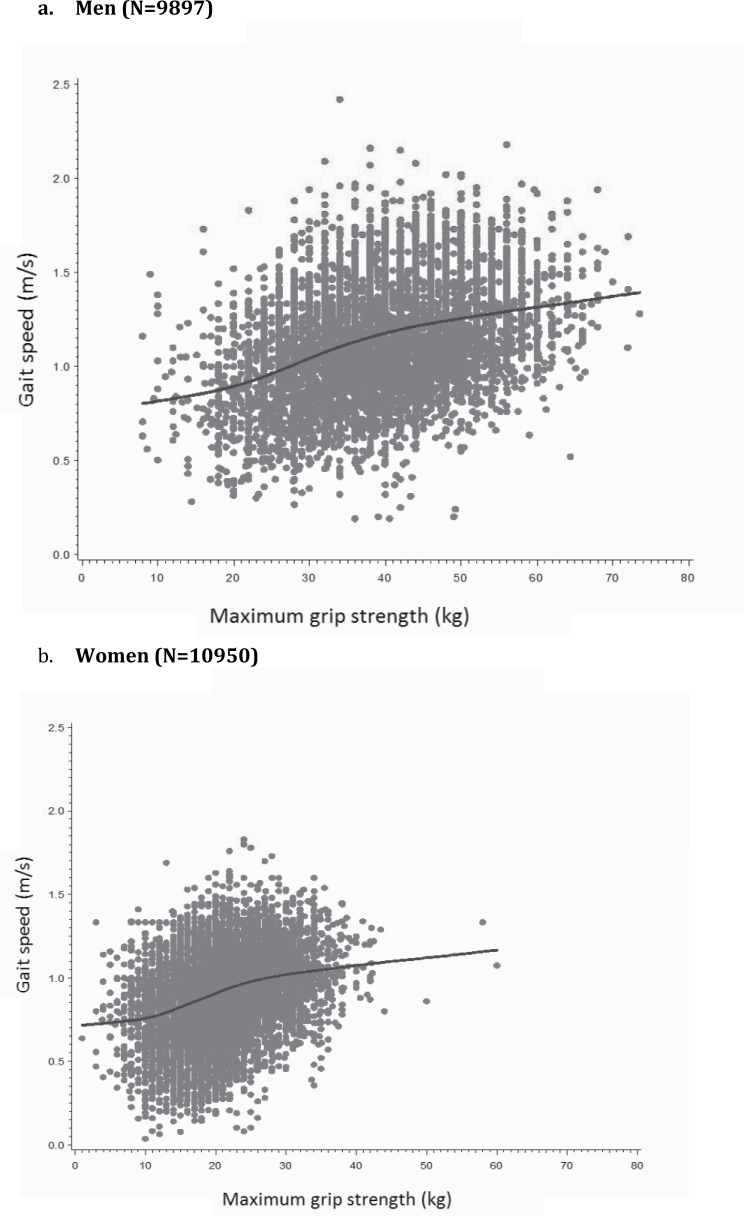
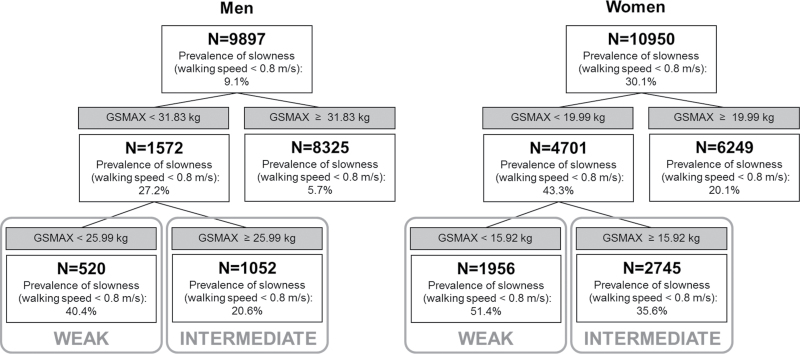
BACKGROUND: Weakness is common and contributes to disability, but no consensus exists regarding a strength cutpoint to identify persons at high risk. This analysis, conducted as part of the Foundation for the National Institutes of Health Sarcopenia Project, sought to identify cutpoints that distinguish weakness associated with mobility impairment, defined as gait speed less than 0.8 m/s. METHODS: In pooled cross-sectional data (9,897 men and 10,950 women), Classification and Regression Tree analysis was used to derive cutpoints for grip strength associated with mobility impairment. RESULTS: In men, a grip strength of 26-32 kg was classified as "intermediate" and less than 26 kg as "weak"; 11% of men were intermediate and 5% were weak. Compared with men with normal strength, odds ratios for mobility impairment were 3.63 (95% CI: 3.01-4.38) and 7.62 (95% CI 6.13-9.49), respectively. In women, a grip strength of 16-20 kg was classified as "intermediate" and less than 16 kg as "weak"; 25% of women were intermediate and 18% were weak. Compared with women with normal strength, odds ratios for mobility impairment were 2.44 (95% CI 2.20-2.71) and 4.42 (95% CI 3.94-4.97), respectively. Weakness based on these cutpoints was associated with mobility impairment across subgroups based on age, body mass index, height, and disease status. Notably, in women, grip strength divided by body mass index provided better fit relative to grip strength alone, but fit was not sufficiently improved to merit different measures by gender and use of a more complex measure. CONCLUSIONS: Cutpoints for weakness derived from this large, diverse sample of older adults may be useful to identify populations who may benefit from interventions to improve muscle strength and function.
Overview
The claims and statistics of this paper haven’t been checked yet.
Free: it reads the open-access text and checks the first 5 claims that cite a source we can check. Create a free account to check every claim.
Integrity signals
Registry
Cites
Statistics
Figures
Verification
Claims the paper makes
The claims and statistics of this paper haven’t been checked yet.
Free: it reads the open-access text and checks the first 5 claims that cite a source we can check. Create a free account to check every claim.
Claims other papers make about this one
Each is checked against this paper’s own text: does it say what the citing paper says it does?
The source backs part of the claim, not all of it — or backs it for a different population, condition or comparison.
In the citing paper
“while data from FNIH classified 4.1% of men and 14.0% of women as having sarcopenic obesity using high BMI and low grip strength as measures of obesity and low muscle strength, respectively202.”
From Sarcopenic obesity in older adults: aetiology, epidemiology and treatment strategies (2018) · cites this paper as [202]
Experimental — accuracy not yet measuredThe source backs part of the claim, not all of it — or backs it for a different population, condition or comparison.
In the citing paper
“For example, grip strength less than 26kg or 16kg for men and women respectively is highly predictive of mobility disability.”
From Successful aging: Advancing the science of physical independence in older adults (2015) · cites this paper as Alley, Shardell, Peters, McLean, Dam, Kenny, Fragala, Harris, Kiel, Guralnik, Ferrucci, Kritchevsky, Studenski, Vassileva, and Cawthon 2014
Experimental — accuracy not yet measuredThe check wasn’t confident either way, so it gives no verdict — never disputed.
In the citing paper
“Efforts to create cutpoints for muscle mass and muscle strength from population studies (community-dwelling older adults) recommended cutpoint for grip strength of 26 kg for men vs. 16 kg for women, and for appendicular lean body mass (measured with DXA) of 19.75 kg for men vs. 15.02 kg for women (Alley et al., 2014; Cawthon et al., 2014).”
From Myosteatosis in the Context of Skeletal Muscle Function Deficit: An Interdisciplinary Workshop at the National Institute on Aging (2020) · cites this paper as Alley et al., 2014
Experimental — accuracy not yet measuredIn the citing paper
“Efforts to create cutpoints for muscle mass and muscle strength from population studies (community-dwelling older adults) recommended cutpoint for grip strength of 26 kg for men vs. 16 kg for women, and for appendicular lean body mass (measured with DXA) of 19.75 kg for men vs. 15.02 kg for women (Alley et al., 2014; Cawthon et al., 2014).”
From Myosteatosis in the Context of Skeletal Muscle Function Deficit: An Interdisciplinary Workshop at the National Institute on Aging (2020) · cites this paper as Alley et al., 2014
In the citing paper
“Sarcopenia is a muscle disease (muscle failure) rooted in adverse muscle changes that accrue across a lifetime; sarcopenia is common among adults of older age but can also occur earlier in life.”
From Sarcopenia: revised European consensus on definition and diagnosis (2019) · cites this paper as [30]
Self-check
Percentages, sums and reported differences re-computed from the paper’s own numbers.
The self-check needs the paper’s full text.
Citations
Cites
Classification and Regression Trees.
Gordon, A. D., Breiman, L., Friedman, J. H., Olshen, R. A., & Stone, C. J. (1984) · Biometrics · doi:10.2307/2530946 · Cited by 23,522
Classification and Regression Trees.
Ryzin, J. V., Breiman, L., Friedman, J. H., Olshen, R. A., & Stone, C. J. (1986) · Journal of the American Statistical Association · doi:10.2307/2288003 · Cited by 20,825
Sarcopenia: European consensus on definition and diagnosis
Cruz-Jentoft, A. J., Baeyens, J. P., Bauer, J. M., Boirie, Y., Cederholm, T., Landi, F., Martin, F. C., Michel, J.-P., Rolland, Y., Schneider, S. M., et al. (2010) · Age and Ageing · doi:10.1093/ageing/afq034 · Cited by 11,601
Risk Factors for Hip Fracture in White Women
Cummings, S. R., Nevitt, M. C., Browner, W. S., Stone, K., Fox, K. M., Ensrud, K. E., Cauley, J., Black, D., & Vogt, T. M. (1995) · New England Journal of Medicine · doi:10.1056/nejm199503233321202 · Cited by 3,595 · cited 1×
“Participants Data available for this phase of the FNIH Sarcopenia Project analysis included: the Study of Osteoporotic Fractures, both the original cohort (study Visit 6) (14) and African American cohort (study Visit 1) (15); the Osteoporotic Fractures in Men Study (baseline visit) (16); the Health, Aging and Body Com…”
MethodFielding, R. A., Vellas, B., Evans, W. J., Bhasin, S., Morley, J. E., Newman, A. B., Abellan van Kan, G., Andrieu, S., Bauer, J., Breuille, D., et al. (2011) · Journal of the American Medical Directors Association · doi:10.1016/j.jamda.2011.01.003 · Cited by 3,256
Self-citationGoodpaster, B. H., Park, S. W., Harris, T. B., Kritchevsky, S. B., Nevitt, M., Schwartz, A. V., Simonsick, E. M., Tylavsky, F. A., Visser, M., Newman, A. B., et al. (2006) · The Journals of Gerontology Series A: Biological Sciences and Medical Sciences · doi:10.1093/gerona/61.10.1059 · Cited by 3,083 · cited 1×
“Strength declines more rapidly in men at older ages (32), and the association between strength and physical function appears stronger in men than in women (5,33).”
BackgroundSelf-citationRoberts, H. C., Denison, H. J., Martin, H. J., Patel, H. P., Syddall, H., Cooper, C., & Sayer, A. A. (2011) · Age and Ageing · doi:10.1093/ageing/afr051 · Cited by 3,001 · cited 3×
“By using the maximum measured grip strength from either hand, we sought to minimize variation based on these factors, but variation due to dynamometer used, hand position, and other factors may still exist (28).”
BackgroundMethodInfluentialStudenski, S. A., Peters, K. W., Alley, D. E., Cawthon, P. M., McLean, R. R., Harris, T. B., Ferrucci, L., Guralnik, J. M., Fragala, M. S., Kenny, A. M., et al. (2014) · The Journals of Gerontology: Series A · doi:10.1093/gerona/glu010 · Cited by 2,545
Self-citationEpidemiological approaches to heart disease: the Framingham study
Dawber, T. R., Meadors, G. F., & Moore, F. E. (1951) · American Journal of Public Health and the Nations Health · doi:10.2105/ajph.41.3.279 · Cited by 2,148 · cited 1×
“Participants Data available for this phase of the FNIH Sarcopenia Project analysis included: the Study of Osteoporotic Fractures, both the original cohort (study Visit 6) (14) and African American cohort (study Visit 1) (15); the Osteoporotic Fractures in Men Study (baseline visit) (16); the Health, Aging and Body Com…”
MethodLauretani, F., Russo, C. R., Bandinelli, S., Bartali, B., Cavazzini, C., Di Iorio, A., Corsi, A. M., Rantanen, T., Guralnik, J. M., & Ferrucci, L. (2003) · Journal of Applied Physiology · doi:10.1152/japplphysiol.00246.2003 · Cited by 1,946 · cited 2×
“M USCLE weakness is related to poor physical performance and incident mobility limitations among older adults (1–6).”
BackgroundSelf-citation
Research works printed but not linked: 4
- 2012, The Journals of Gerontology Series A: Biological Sciences and Medical Sciences, 67, 28
- 2014, The Journals of Gerontology Series A: Biological Sciences and Medical Sciences, 5, 567
- 2007, American Journal of Epidemiology, 165, 1076, 10.1093/aje/kwk115 · DOI · Paper page
- 2010, Physical Therapy, 90, 196, 10.2522/ptj.20090079 · DOI · Paper page
Cited by
Items 201–300 of 535
Chung, K. C., Kim, H. M., Malay, S., Shauver, M. J., Chung, K. C., Kim, H. M., Haase, S. C., Lawton, J. N., Lien, J. R., Momoh, A. O., et al. (2019) · The Journal Of Hand Surgery · doi:10.1016/j.jhsa.2019.05.016 · Cited by 24
McGrath, R., Vincent, B. M., Peterson, M. D., Jurivich, D. A., Dahl, L. J., Hackney, K. J., & Clark, B. C. (2019) · Journal of the American Medical Directors Association · doi:10.1016/j.jamda.2019.10.016 · Cited by 28
Application of Cut‐Points for Low Muscle Strength and Lean Mass in Mobility‐Limited Older Adults
Grosicki, G. J., Travison, T. G., Zhu, H., Magaziner, J., Binder, E. F., Pahor, M., Correa‐de‐Araujo, R., Cawthon, P. M., Bhasin, S., Orwig, D., et al. (2020) · Journal of the American Geriatrics Society · doi:10.1111/jgs.16525 · Cited by 24
Self-citationEibich, P., Buchmann, N., Kroh, M., Wagner, G. G., Steinhagen‐Thiessen, E., Demuth, I., & Norman, K. (2015) · The Journals of Gerontology Series A · doi:10.1093/gerona/glv171 · Cited by 33
“The FNIH cut-off values for grip strength (11) were not used in this analysis because only 7 participants’ grip strength fell below these cut-off values.”
MethodNebuloni, C. C., Máximo, R. D. O., de Oliveira, C. M., & Alexandre, T. D. S. (2019) · The Journals of Gerontology Series A · doi:10.1093/gerona/glz257 · Cited by 25
“The highest value for the dominant hand was used in our analysis (9).”
MethodSantos, C. A. F., Amirato, G. R., Jacinto, A. F., Pedrosa, A., Caldo‐Silva, A., Sampaio, A. R., Pimenta, N., Santos, J. M. B., Pochini, A. D. C., & Bachi, A. L. L. (2022) · Healthcare · doi:10.3390/healthcare10020323 · Cited by 34
“In relation to the application of simple tests of physical performance, we used traditional protocols described in the scientific literature [12,13,27,28].”
MethodBatsis, J. A., GERMAIN, C. M., Vásquez, E., & Bartels, S. J. (2016) · European Journal of Clinical Nutrition · doi:10.1038/ejcn.2016.90 · Cited by 27
Definition and diagnosis of sarcopenia: Asia-Pacific perspectives
Huang, W.-F., Chen, Y., Chang, C., & Wu, C. (2025) · Osteoporosis and Sarcopenia · doi:10.1016/j.afos.2025.05.004 · Cited by 26
“Studies have shown that while the relationships between gait speed and strength, or muscle mass and strength, were not altered by body weight adjustments in men, the link between muscle mass and strength in women was affected by such adjustments [20,21].”
Rodríguez-García, W. D., García-Castañeda, L., Vaquero‐Barbosa, N., Mendoza-Núñez, V. M., Orea‐Tejeda, A., Perkisas, S., Vandewoude, M. F. J., & Castillo‐Martínez, L. (2018) · European Geriatric Medicine · doi:10.1007/s41999-018-0032-8 · Cited by 29
Some clarifications of terminology may facilitate sarcopenia assessment
Lewandowicz, A., Slawinski, P. R., Kądalska, E., & Targowski, T. (2020) · Archives of Medical Science · doi:10.5114/aoms.2020.91293 · Cited by 25
“In women, hand grip strength of 16–20 kg was classified as average and less than 16 kg as weak [58].”
BackgroundAndrews, J. S., Gold, L. S., Reed, M. J., Garcia, J. M., McClelland, R. L., Fitzpatrick, A. L., Hough, C. L., Cawthon, P. M., & Covinsky, K. E. (2021) · The Journals of Gerontology Series A · doi:10.1093/gerona/glab332 · Cited by 26
Self-citationWoo, J., Yu, R., & Leung, J. C. S. (2017) · Journal of the American Medical Directors Association · doi:10.1016/j.jamda.2017.09.006 · Cited by 27
Identifying Sarcopenia in Female Long‐Term Care Residents: A Comparison of Current Guidelines
Kotlarczyk, M. P., Perera, S., Nace, D. A., Resnick, N. M., & Greenspan, S. L. (2017) · Journal of the American Geriatrics Society · doi:10.1111/jgs.15213 · Cited by 23
“Grip strength cut-points for weakness (<16 kg) or intermediate weakness (16–20 kg) were associated with mobility impairment as assessed according to slow gait speed.(7) The FNIH 1 muscle mass cut-point was determined as the value that predicted weak grip strength (<16 kg).”
MethodGingrich, A., Spiegel, A., Gradl, J. E., Skurk, T., Hauner, H., Sieber, C. C., Volkert, D., & Kiesswetter, E. (2018) · Aging Clinical and Experimental Research · doi:10.1007/s40520-018-1081-z · Cited by 26
Bone Mineral Metabolism Status, Quality of Life, and Muscle Strength in Older People
Verde, Z., Giaquinta, A., Sainz, C., Díaz-Ondina, M., & Araque, A. F. (2019) · Nutrients · doi:10.3390/nu11112748 · Cited by 28
“For the identification of participants with clinically meaningful weakness, handgrip strength was classified in two categories as follows: weak-intermediate and normal, according to cut-off values published by Alley et al., 2014 [19].”
MethodEducation, occupation and operational measures of sarcopenia: Six years of Australian data
Brennan-Olsen, S. L., Vogrin, S., Balogun, S. A., Wu, F., Scott, D. S., Jones, G., Hayes, A., Phu, S., Duque, G., Beauchamp, A., et al. (2020) · Australian Journal on Ageing · doi:10.1111/ajag.12816 · Cited by 27
Haeri, N. S., Perera, S., Nadkarni, N. K., & Greenspan, S. L. (2024) · The journal of nutrition health & aging · doi:10.1016/j.jnha.2024.100207 · Cited by 23
Abdalla, P. P., Bohn, L., da Silva, L. S. L., dos Santos, A. P., Júnior, M. F. T., Venturini, A. C. R., Carvalho, A. D. S., Martínez‐Gómez, D., Mota, J. A. P. S., & Machado, D. R. L. (2021) · BMC Sports Science Medicine and Rehabilitation · doi:10.1186/s13102-021-00390-1 · Cited by 27
“HGS normalized by ratio standard (body mass or BMI) [18, 61, 62] or stratified by BMI quartiles [7].”
BackgroundWelk, G. J., Janz, K. F., Laurson, K. R., Mahar, M. T., Zhu, W., & Pavlovic, A. (2022) · Measurement in Physical Education and Exercise Science · doi:10.1080/1091367x.2021.2014331 · Cited by 24
Kuriyama, K., Matsui, Y., Suzuki, Y., Mizuno, T., Watanabe, T., Takemura, M., Ishizuka, S., Yamashita, S., Imagama, S., & Arai, H. (2022) · Bone · doi:10.1016/j.bone.2022.116487 · Cited by 24
Santos, C. A. F., Amirato, G. R., Paixão, V., Almeida, E. B., do Amaral, J. B., Monteiro, F. R., Roseira, T., Juliano, Y., Novo, N. F., Rossi, M. N., et al. (2023) · Frontiers in Medicine · doi:10.3389/fmed.2023.1206989 · Cited by 21
Contours of “here”: Phenomenology of space for assisted living residents approaching end of life
Vandenberg, A. E., Ball, M. M., Kemp, C. L., Doyle, P. J., Fritz, M., Halpin, S. N., Hundley, L., & Perkins, M. M. (2018) · Journal of Aging Studies · doi:10.1016/j.jaging.2018.03.001 · Cited by 24
Grip strength and healthy aging
Kozakai, R. (2017) · The Journal of Physical Fitness and Sports Medicine · doi:10.7600/jpfsm.6.145 · Cited by 25
Electromyographic analysis of an ergonomic risk factor: overhead work
Kınalı, G., Kara, S., & Yıldırım, M. S. (2016) · Journal of Physical Therapy Science · doi:10.1589/jpts.28.1924 · Cited by 19
Sui, S. X., Holloway‐Kew, K. L., Hyde, N. K., Williams, L. J., Tembo, M. C., Leach, S., & Pasco, J. A. (2020) · JCSM Clinical Reports · doi:10.1002/crt2.22 · Cited by 23
“In contrast, the aim of developing the FNIH definition was to assist clinicians in making a differential diagnosis of people who have low physical function due to sarcopenia (low muscle mass and strength) and those with low physical function due to other causes.(4,17,18) The FNIH definition used mobility impairment me…”
BackgroundMethodRamírez, E., Salas, R., Bouzas, C., Pastor, R., & Tur, J. A. (2021) · Gerontology · doi:10.1159/000519304 · Cited by 23
Almugbel, F. A., Timilshina, N., Papadopoulos, E., Al-Showbaki, L., & Alibhai, S. M. H. (2021) · Journal of Geriatric Oncology · doi:10.1016/j.jgo.2021.12.002 · Cited by 22
Ramírez, P. C., Máximo, R. D. O., de Oliveira, D. C., de Souza, A. F., Luiz, M. M., Delinocente, M. L. B., Steptoe, A., de Oliveira, C. M., & Alexandre, T. D. S. (2023) · The journal of nutrition health & aging · doi:10.1007/s12603-023-2039-1 · Cited by 21
“Moreover, the FNIH group (25) recommends grip strength cut-off points of 16 kg for women and 26 kg for men as the best indicators of weakness, whereas Aubertin-Leheudre and colleagues used 19.9 kg for women and 31.9 kg for men.”
InfluentialSpringstroh, K. A., Gal, N. J., Ford, A., Whiting, S. J., & Dahl, W. J. (2016) · Journal of Nutrition in Gerontology and Geriatrics · doi:10.1080/21551197.2016.1209146 · Cited by 21
“Ten percent of all participants (4 M; 9 W) were categorized with clinically relevant weakness using highest HGS of either hand for comparisons as did Alley and colleagues (34).”
BackgroundMethodResultInfluentialPeriodontal Disease and Grip Strength among Older Adults
Aravindakshan, V., Hakeem, F. F., & Sabbah, W. (2020) · Geriatrics · doi:10.3390/geriatrics5030046 · Cited by 19
“We have also used different cut-off points for low grip strength based on previous systematic reviews [20,21] as well as studies conducted on a diverse cohort of older adults [22].”
MethodMaeda, S. S., Albergaria, B., Szejnfeld, V. L., Lazaretti‐Castro, M., Arantes, H. P., Ushida, M., Domiciano, D. S., Pereira, R. M. R., Marin-Mio, R. V., de Oliveira, M. L., et al. (2022) · Revista Brasileira de Reumatologia · doi:10.1186/s42358-022-00240-9 · Cited by 32
“More recently, the FNIH Sarcopenia Project defined normative cutoff values for handgrip strength in men and women older than 65 years (Table 6) [44, 45].”
BackgroundGuillamón-Escudero, C., Diago-Galmés, A., Zuazua-Rico, D., Maestro-González, A., Tenías, J. M., Soriano, J. M., & Garrido, J. F. (2022) · International Journal of Environmental Research and Public Health · doi:10.3390/ijerph19148473 · Cited by 22
Hypertension and Its Treatment at Age 90 Years: Is There an Association with 5-Year Mortality?
Stessman, J., Bursztyn, M., Gershinsky, Y., Hammerman‐Rozenberg, A., & Jacobs, J. M. (2017) · Journal of the American Medical Directors Association · doi:10.1016/j.jamda.2016.12.076 · Cited by 21
Tangvoraphonkchai, K., Hung, R. K. Y., Sadeghi‐Alavijeh, O., & Davenport, A. (2018) · Nutrition in Clinical Practice · doi:10.1002/ncp.10003 · Cited by 19
Owen, P. J., Daly, R. M., Via, J. D., Mundell, N. L., Livingston, P. M., Rantalainen, T., & Fraser, S. F. (2019) · Calcified Tissue International · doi:10.1007/s00223-019-00586-1 · Cited by 20
Soares, V. N., Fattori, A., Neri, A. L., & Fernandes, P. T. (2019) · Ciência & Saúde Coletiva · doi:10.1590/1413-812320182411.07592018 · Cited by 35
Wang, Y., Ping, Y., Jin, H., Ge, N., & Wu, C. (2020) · BMJ Open · doi:10.1136/bmjopen-2020-038147 · Cited by 21
The Correlation between Hand Grip Strength and Nutritional Variables in Ambulatory Cancer Patients
Pereira, A. A. C., Zaia, R. D., Souza, G. H. G., Luizeti, B. O., Andreola, R., Vizzotto, A. O., & Ferrari, A. (2020) · Nutrition and Cancer · doi:10.1080/01635581.2020.1750662 · Cited by 24
Oliveira, V. H. F., Borsari, A. L., Cárdenas, J. D. G., Alves, C. M., Castro, N. F., Marinello, P. C., Padilha, C. S., Webel, A. R., Erlandson, K. M., & Deminice, R. (2020) · JAIDS Journal of Acquired Immune Deficiency Syndromes · doi:10.1097/qai.0000000000002576 · Cited by 19
Definición y evolución del concepto de sarcopenia
Tocino, M. L. S., Cigarrán, S., Ureña, P., González‐Casaus, M. L., Mas, S., Iguacel, C. G., Ortíz, A., & Parra, E. G. (2023) · Nefrología · doi:10.1016/j.nefro.2023.08.001 · Cited by 38
Orwig, D. L., Magaziner, J., Fielding, R. A., Zhu, H., Binder, E. F., Cawthon, P. M., Bhasin, S., Correa-de-Araujo, R., Manini, T., Patel, S., et al. (2020) · The Journals of Gerontology: Series A · doi:10.1093/gerona/glaa076 · Cited by 17
Self-citationAssociation of Muscle Strength with Non-Alcoholic Fatty Liver Disease in Korean Adults
Lee, S., Kwon, Y., Jung, D., & Kim, J.-K. (2022) · International Journal of Environmental Research and Public Health · doi:10.3390/ijerph19031675 · Cited by 20
“Recently, sarcopenia is defined as muscle failure, with low muscle strength overtaking muscle mass, which shows that muscle strength is a primary indicator of sarcopenia over muscle mass [46,47].”
BackgroundChanges in nutritional status and associated factors in a geriatric post-hip fracture assessment
Helminen, H., Luukkaala, T. H., Saarnio, J., & Nuotio, M. S. (2017) · European Geriatric Medicine · doi:10.1016/j.eurger.2017.02.002 · Cited by 19
“In men, grip strength less than 26 kg and in women less than 16 kg in the stronger hand was defined as weakened [19].”
BackgroundFactors associated with decreased hand grip strength in the elderly
Lenardt, M. H., Carneiro, N. H. K., Betiolli, S. E., Binotto, M. A., Ribeiro, D. K. D. M. N., & Teixeira, F. F. R. (2016) · Escola Anna Nery · doi:10.5935/1414-8145.20160082 · Cited by 24
Adachi, T., Kono, Y., Iwatsu, K., Shimizu, Y., & Yamada, S. (2017) · Archives of Gerontology and Geriatrics · doi:10.1016/j.archger.2017.10.003 · Cited by 24
Garagarza, C. A., Flores, A. L., & Valente, A. (2017) · Nutrition in Clinical Practice · doi:10.1177/0884533617725512 · Cited by 19
Dynapenia is highly prevalent in older patients with advanced idiopathic pulmonary fibrosis
Bocchino, M., Alicante, P., Capitelli, L., Stanziola, A. A., Gallotti, L., Gregorio, A. D., Rea, G., Sanduzzi, A., & Scalfi, L. (2021) · Scientific Reports · doi:10.1038/s41598-021-97424-y · Cited by 19
Moreira, M. A., Vafaei, A., da Câmara, S. M. A., do Nascimento, R. A., de Morais, M. S. M., Almeida, M. D. G., & Maciel, Á. C. C. (2019) · Women & Health · doi:10.1080/03630242.2019.1688445 · Cited by 17
“In analyses, we used grip strength (Kgf) adjusted for BMI (Kg/m2), because previous research has suggested that comparing this composite measure to grip strength alone provides a better fit mainly for women (Alley et al. 2014).”
MethodUltrasound Evaluation of the Rectus Femoris for Sarcopenia in Patients with Early Subacute Stroke
Choi, Y., Im, S., & Park, G. (2021) · Journal of Clinical Medicine · doi:10.3390/jcm10143010 · Cited by 16
“The hand grip test, walking velocity, and the sit-to-stand test can be used to evaluate sarcopenia [12,13].”
MethodHellman-Bronstein, A. T., Luukkaala, T. H., Ala‐Nissilä, S., Kujala, M. A., & Nuotio, M. S. (2022) · Aging Clinical and Experimental Research · doi:10.1007/s40520-021-02046-z · Cited by 14
“Grip strength was measured in the stronger hand with a Jamar dynamometer and defined as weakened if less than 16 kg [27].”
MethodHyperuricemia Associated with Low Skeletal Muscle in the Middle-Aged and Elderly Population in China
Chen, L., Wu, L., Li, Q., Hu, Y., Ma, H., Lin, H., & Gao, X. (2022) · Experimental and Clinical Endocrinology & Diabetes · doi:10.1055/a-1785-3729 · Cited by 16
“Additionally, previous studies have indicated noticeable effects of the body mass adjusted ASM on the relationship between muscle strength and muscle mass in women [21, 23].”
BackgroundGaspar, P. M., Campos‐Magdaleno, M., Pereiro, A. X., Facal-Mayo, D., & Juncos‐Rabadán, O. (2022) · Frontiers in Psychology · doi:10.3389/fpsyg.2022.968343 · Cited by 16
“, 2001) were used to assess frailty phenotypes: (1) self-reported exhaustion or fatigue; (2) weakness, measured by the grip strength of the dominant hand with a calibrated dynamometer and using the mean value of three measurements (cut-off <26 for men and < 16 for women; Alley et al., 2014); (3) slow ambulation measur…”
MethodEvaluation of the nutritional status of patients with liver cirrhosis
Janota, B., Krupowicz, A., Noras, K., & Janczewska, E. (2023) · World Journal of Hepatology · doi:10.4254/wjh.v15.i7.914 · Cited by 18
Porta, M., Pilloni, G., Corona, F., Fastame, M. C., Hitchcott, P. K., Penna, M. P., & Pau, M. (2018) · European Geriatric Medicine · doi:10.1007/s41999-018-0025-7 · Cited by 20
Godziuk, K., Woodhouse, L. J., Prado, C. M. M., & Forhan, M. A. (2020) · Clinical Nutrition ESPEN · doi:10.1016/j.clnesp.2020.08.005 · Cited by 16
Brennan-Olsen, S. L., Bowe, S. J., Kowal, P. R., Naidoo, N., Quashie, N. T., Eick, G. N., Agrawal, S., & D’Este, C. A. (2019) · Calcified Tissue International · doi:10.1007/s00223-019-00609-x · Cited by 24
Counteracting the Trajectory of Frailty and Sarcopenia in Older Adults
Litchford, M. D. (2014) · Nutrition in Clinical Practice · doi:10.1177/0884533614536231 · Cited by 19
de Araújo, F. C., da Silva, K. S., Ohara, D. G., Matos, A. P., Pinto, A. C. P. N., & Pegorari, M. S. (2022) · Ciência & Saúde Coletiva · doi:10.1590/1413-81232022272.01122021 · Cited by 19
van den Hoek, D., Mallard, A. R., Garrett, J. M., Beaumont, P. L., Howells, R. J., Spathis, J. G., Pearson, J., & Latella, C. (2024) · International Journal of Sports Science & Coaching · doi:10.1177/17479541241244481 · Cited by 21
“34 However, clinically relevant muscle weakness is often based on handgrip values (e.g. normal strength, intermediate and weak scores) 36 and it is possible that similar meaningful norms identifying at-risk individuals could be developed from squat and bench press community data 20 with additional…”
Definition and evolution of the concept of sarcopenia
Tocino, M. L. S., Guldris, S. C., Ureña, P., González‐Casaus, M. L., Mas, S., Gracia-Iguacel, C., Ortiz, A., & González‐Parra, E. (2024) · Nefrología (English Edition) · doi:10.1016/j.nefroe.2023.08.007 · Cited by 36
Meng, F., Zhang, Y., Liu, C., & Zhou, C. (2024) · Frontiers in Public Health · doi:10.3389/fpubh.2024.1417660 · Cited by 22
Denosumab for osteoporosis in older adults in long‐term care: A randomized trial
Greenspan, S. L., Perera, S., Haeri, N. S., Nace, D. A., & Resnick, N. M. (2024) · Journal of the American Geriatrics Society · doi:10.1111/jgs.19260 · Cited by 17
Klawitter, L. A., Bradley, A., Hackney, K. J., Tomkinson, G. R., Christensen, B. K., Kraemer, W. J., & McGrath, R. P. (2021) · Journal of Functional Morphology and Kinesiology · doi:10.3390/jfmk6040079 · Cited by 21
“Males and females with maximal HGS <26-kilograms and <16-kilograms were considered weak, respectively [20].”
BackgroundRuthes, E. M. P., Lenardt, B. C. D. C., Lass, A. D., Petroski, C. A., de Mello, M. F., de Andrade, A. B., Souza, C. J. F., de Matos, O., & Castelo‐Branco, C. (2022) · Gynecological Endocrinology · doi:10.1080/09513590.2022.2119956 · Cited by 17
“Values below 16 kg in women were considered as abnormal according to both FNIH and EWGSOP2 [13].”
MethodZhou, J., Liu, B., Ye, H., & Duan, J. (2023) · Experimental Gerontology · doi:10.1016/j.exger.2023.112259 · Cited by 14
Monaco, M. D., & Castiglioni, C. (2015) · Journal of Geriatric Physical Therapy · doi:10.1519/jpt.0000000000000075 · Cited by 15
Aakjær, M., Houlind, M. B., Treldal, C., Ankarfeldt, M. Z., Jensen, P. S., Andersen, O., Iversen, E., Christrup, L. L., & Petersen, J. (2019) · Journal of Clinical Medicine · doi:10.3390/jcm8010089 · Cited by 15
“f: Low handgrip strength was defined as < 26 kg for males and <16 kg for females [29].”
BackgroundCaillouet, K. A., & Cosío-Lima, L. (2019) · Experimental Gerontology · doi:10.1016/j.exger.2019.04.001 · Cited by 18
“Additionally, most studies reviewed incorporated three measures for each hand in handgrip strength protocols (Alley et al., 2014).”
InfluentialHaagsma, A. B., de Souza, D. L. B., Vasconcellos, G. M., Olandoski, M., Jerez‐Roig, J., & Baena, C. P. (2023) · Physical Therapy · doi:10.1093/ptj/pzad057 · Cited by 13
Grip strength cut-points from the Swiss DO-HEALTH population
Gagesch, M., Wieczorek, M., Abderhalden, L. A., Lang, W., Freystaetter, G., Armbrecht, G., Kressig, R. W., Vellas, B. J., Rizzoli, R., Blauth, M., et al. (2023) · European Review of Aging and Physical Activity · doi:10.1186/s11556-023-00323-6 · Cited by 13
“Considered as an established marker for weakness, low GS has been linked to poor mobility outcomes in older adults, [8, 9] acts as a recognized measure assessing weakness in physical frailty, [10] and helps identify probable sarcopenia [4, 11].”
BackgroundClinically Relevant Cut-off Points for the Diagnosis of Sarcopenia in Older Korean People
Choe, Y., Joh, J., & Kim, Y. (2017) · The Journals of Gerontology Series A · doi:10.1093/gerona/glx052 · Cited by 14
“8 m/s) and weak grip (men: < 26 kg, women: < 16 kg) (2,3).”
Kim, H.-N., Kim, S., Eun, Y., & Song, S.-W. (2021) · Clinical Nutrition · doi:10.1016/j.clnu.2021.02.034 · Cited by 13
de Aquino, M. P. M., Cirino, N. T. D. O., Lima, C. A., Ventura, M. D. M., Hill, K., & Perracini, M. R. (2022) · Experimental Gerontology · doi:10.1016/j.exger.2022.111699 · Cited by 13
Grip Strength and Sports Performance in Competitive Master Weightlifters
Huebner, M., Riemann, B. L., & Hatchett, A. G. (2023) · International Journal of Environmental Research and Public Health · doi:10.3390/ijerph20032033 · Cited by 23
“Two men had clinically relevant weak GS, defined as less than 26 kg for men and less than 16 kg for women [26].”
BackgroundMarconcin, P., Espanha, M., Yázigi, F., & Campos, P. (2016) · BMC Musculoskeletal Disorders · doi:10.1186/s12891-016-1115-7 · Cited by 15
“Although this study will not examine hand OA, this test has been used in the elderly as an indicator of sarcopenia and/or disability [96, 97].”
MethodSilva, B. S. D. A., Lira, F. S., Rossi, F. E., de Freitas, M. C., Freire, A. P. C. F., dos Santos, V. R., & Gobbo, L. A. (2018) · Journal of Exercise Rehabilitation · doi:10.12965/jer.1836412.206 · Cited by 14
“The reduction of strength and functional capacity is also another characteristic in sarcopenic older adults, generating frailty, loss of autonomy, and higher risk of falls and fractures (Alley et al., 2014; Manini et al., 2007).”
Backgroundde Freitas, M. C., Pereira, C. G. D. S., Batista, V. C., Rossi, F. E., Ribeiro, A. S., Cyrino, E. S., Cholewa, J. M., & Gobbo, L. A. (2019) · Journal of Exercise Rehabilitation · doi:10.12965/jer.1836534.267 · Cited by 15
“A decrease in SMM in conjunction with reduced neuromuscular potential in sarcopenic people leads to a reduction in muscular strength which ultimately results in a decreased functional capacity, difficulties completing activities of daily living, increased risk of falls and fractures, and lowered quality life (Alley et…”
BackgroundInfluentialScherbov, S., Spitzer, S., & Steiber, N. (2022) · BMJ Open · doi:10.1136/bmjopen-2021-058489 · Cited by 12
Nuotio, M. S., Luukkaala, T. H., & Tammela, T. L. J. (2018) · Aging Clinical and Experimental Research · doi:10.1007/s40520-018-0946-5 · Cited by 12
Combined Effect of Dynapenia (Muscle Weakness) and Low Vitamin D Status on Incident Disability
Borim, F. S. A., Alexandre, T. D. S., Neri, A. L., Máximo, R. D. O., Silva, M. F., & de Oliveira, C. M. (2018) · Journal of the American Medical Directors Association · doi:10.1016/j.jamda.2018.06.006 · Cited by 15
Imaging Software‐Based Sarcopenia Assessment in Gastroenterology: Evolution and Clinical Meaning
Marasco, G., Sadalla, S., Vara, G., Golfieri, R., Festi, D., Colecchia, A., & Renzulli, M. (2021) · Canadian Journal of Gastroenterology and Hepatology · doi:10.1155/2021/6669480 · Cited by 13
“In 2014, the Foundation for the National Institute of Health Sarcopenia Project [5] identified clinically relevant cut-points for muscle grip, mobility impairment [6], and low muscle mass [7].”
Association between Oral Health Status and Relative Handgrip Strength in 11,337 Korean
Kim, J. E., Kim, N., Choi, C., & Chung, K. (2021) · Journal of Clinical Medicine · doi:10.3390/jcm10225425 · Cited by 12
“Correspondingly, physical function plays an important role in the quality of life [1] and handgrip strength is widely used to conveniently evaluate physical functions [2,3].”
BackgroundDietary Intake Patterns of Community-Dwelling Older Adults After Acute Hospitalization
Deer, R., Hosein, E., Mera, A., Howe, K., Goodlett, S., Robertson, N., & Volpi, E. (2021) · The Journals of Gerontology Series A · doi:10.1093/gerona/glab232 · Cited by 13
Longitudinal Associations Between Optimism and Objective Measures of Physical Functioning in Women
Koga, H. K., Grodstein, F., Williams, D. R., Manson, J. E., Tindle, H. A., Shadyab, A. H., Michael, Y. L., Saquib, N., Naughton, M. J., Guimond, A., et al. (2024) · JAMA Psychiatry · doi:10.1001/jamapsychiatry.2023.5068 · Cited by 11
Taylor, K. A., Carroll, M. K., Short, S. A., & Goode, A. P. (2024) · Scientific Reports · doi:10.1038/s41598-024-55978-7 · Cited by 10
Santanasto, A. J., Miljkovic, I., Cvejkus, R., Wheeler, V. W., & Zmuda, J. M. (2019) · The Journals of Gerontology Series A · doi:10.1093/gerona/glz233 · Cited by 13
“5× higher, than the FNIH grip strength cut-point, which was developed using gait speed (12).”
MethodResultTsai, P., Yang, H.-C., Lin, C. S., Sung, C., Chu, P., & Hsu, Y. (2021) · Nutrients · doi:10.3390/nu13103605 · Cited by 12
“This revision was based on a growing body of evidence on the role of low muscle strength in predicting recurrent falls, poor healthcare outcomes, all-cause mortality, and functional decline in older adults [8,9].”
BackgroundIschemic Preconditioning Improves Handgrip Strength and Functional Capacity in Active Elderly Women
Telles, L. G. D. S., Billaut, F., Cunha, G. P. S. D. A. F. N., Ribeiro, A. D. S., Monteiro, E. R., Barreto, A. C., Leitão, L., Panza, P. S., Vianna, J. M., & Novaes, J. D. S. (2022) · International Journal of Environmental Research and Public Health · doi:10.3390/ijerph19116628 · Cited by 17
“[2], hand grip strength is a relevant marker of muscle weakness (<16 kg in women) and is well established as a biomarker of age-related physical disability and early mortality [36,37].”
BackgroundAssociation of Handgrip Strength with Diabetes Mellitus in Korean Adults According to Sex
Lee, S., Moon, J. E., & Kim, J.-K. (2022) · Diagnostics · doi:10.3390/diagnostics12081874 · Cited by 12
“Sarcopenia is considered muscle failure, with low muscle strength superior to a lack of muscle mass, which suggests that muscle strength is a primary indicator of sarcopenia [41,42].”
BackgroundWakaba, K., Osuka, Y., Kojima, N., & Sasai, H. (2023) · Journal of the American Medical Directors Association · doi:10.1016/j.jamda.2023.07.007 · Cited by 11
Optimal Cutoffs of Grip Strength for Definition as Weakness in the Elderly
Dong, R., Guo, Q., & Wang, J. (2014) · Journal of Biosciences and Medicines · doi:10.4236/jbm.2014.29003 · Cited by 10
“4-m Speed Measurement [4] Participants were instructed to stand with both feet touching the starting line and to begin walking at their usual pace after a verbal command was given.”
MethodFunctional capacity, renal function and vitamin D in community-dwelling oldest old
Araújo, L. M. Q., Moreira, P. F. D. P., Filho, C. D. M. A., de Araújo, L. V., Riguetti, M. T. P., Kirsztajn, G. M., Neto, M. C., Sesso, R., & Cendoroglo, M. S. (2019) · International Urology and Nephrology · doi:10.1007/s11255-019-02081-w · Cited by 10
The Influence of Hand Tool Design on Hand Grip Strength: A Review
Fakulti Kejuruteraan Pembuatan, U. T. M. M., Halim, I., Umar, R. Z. R., Fakulti Kejuruteraan Pembuatan, U. T. M. M., Mohamed, M. S. S., Fakulti Kejuruteraan Pembuatan, U. T. M. M., Ahmad, N., Fakulti Kejuruteraan Pembuatan, U. T. M. M., Saptari, A., Padmanathan, V., et al. (2019) · International Journal of Integrated Engineering · doi:10.30880/ijie.2019.11.06.007 · Cited by 10
“In addition to that, data on hand grip strength are also meaningful for predicting muscle weakness [7], determining the functional capabilities of Abstract: Hand is made up of bones, tendons, ligaments, nerves and blood vessels that can be easily debilitated and injured if the hand tool is not design ergonomically.”
BackgroundMonaco, M. D., Castiglioni, C., Bardesono, F., Milano, E., & Massazza, G. (2020) · Archives of Gerontology and Geriatrics · doi:10.1016/j.archger.2020.104190 · Cited by 10
Leme, D. E. D. C. (2021) · Clinical Nutrition ESPEN · doi:10.1016/j.clnesp.2021.01.006 · Cited by 12
Muscular Strength and Quality of Life in Older Adults: The Role of ACTN3 R577X Polymorphism
Fernández-Araque, A., Giaquinta-Aranda, A., Rodríguez-Díez, J. A., Carretero-Molinero, S., López-López, J., & Verde, Z. (2021) · International Journal of Environmental Research and Public Health · doi:10.3390/ijerph18031055 · Cited by 12
“For the identification of participants with clinically meaningful weakness, HGS was classified in two categories as follows: weak-intermediate and normal, according to cut-off values published by Alley et al., 2014 [39].”
MethodWhat are optimum target levels of hemoglobin in older adults?
Kara, O., Soysal, P., Smith, L., & Kıskaç, M. (2021) · Aging Clinical and Experimental Research · doi:10.1007/s40520-021-01854-7 · Cited by 11
Dietary Protein Intake and Transition between Frailty States in Octogenarians Living in New Zealand
Teh, R., Mendonça, N., Muru‐Lanning, M., MacDonell, S. O., Robinson, L. A., & Kerse, N. M. (2021) · Nutrients · doi:10.3390/nu13082843 · Cited by 10
“Participants were assigned a score of 0 (absence) or 1 (presence) for each of five items; unintentional weight loss (≥5% weight loss in the last 12 months), weakness (grip strength < 20 kg for women; <30 kg for men) [22], poor endurance/fatigue (a negative response to “Do you feel full of energy?”), slowness (defined…”
BackgroundLaddu, D., LaMonte, M. J., Haring, B., Kim, H., Cawthon, P. M., Bea, J. W., Banack, H. R., Cauley, J. A., Allison, M., Martin, L. W., et al. (2021) · Archives of Gerontology and Geriatrics · doi:10.1016/j.archger.2021.104576 · Cited by 11
Self-citationHandgrip strength is inversely associated with augmentation index in patients with type 2 diabetes
Hamasaki, H., & Yanai, H. (2023) · Scientific Reports · doi:10.1038/s41598-023-28392-8 · Cited by 11
Metadata
- Authors
- Alley, D. E., Shardell, M. D., Peters, K. W., McLean, R. R., Dam, T.-T. L., Kenny, A. M., Fragala, M. S., Harris, T. B., Kiel, D. P., Guralnik, J. M., Ferrucci, L., Kritchevsky, S. B., Studenski, S. A., Vassileva, M. T., & Cawthon, P. M.
- Affiliations
- University of Maryland, Baltimore (US)
- California Pacific Medical Center (US)
- Beth Israel Deaconess Medical Center (US)
- Columbia University (US)
- University of Central Florida (US)
- National Institutes of Health (US)
- National Institute on Aging (US)
- Wake Forest University (US)
- University of Pittsburgh (US)
- Foundation for the National Institutes of Health (US)
- Corresponding author
- Alley, D. E.
- ORCID
- Venue
- The Journals of Gerontology Series A: Biological Sciences and Medical Sciences
- Publisher
- Oxford University Press (OUP)
- Published
- 2014-04-14
- Volume
- 69
- Issue
- 5
- Pages
- 559-566
- ISSN
- 1079-5006 (ISSN-L)
- 1758-535X
- PMC
- PMC3991145
- OpenAlex
- W2127873216
- Cited by
- 535
- References
- 38
- Citations by year
- 2026: 32 · 2025: 40 · 2024: 49 · 2023: 45 · 2022: 41 · 2021: 60 · 2020: 41 · 2019: 46 · 2018: 47 · 2017: 44 · 2016: 39 · 2015: 35 · 2014: 16
- FWCI
- 29.78
- Type
- journal article
- Language
- en
- Open access
- hybrid
- doi.org
- Licence
- cc-by-nc
- Locations
- The Journals of Gerontology Series A (publishedVersion, cc-by-nc)
- Europe PMC (PubMed Central) (publishedVersion, cc-by-nc)
- PubMed Central (publishedVersion, cc-by-nc)
- PubMed (publishedVersion)
- Digital Access to Scholarship at Harvard (DASH) (Harvard University) (submittedVersion, cc-by)
- Journal of International Crisis and Risk Communication Research (submittedVersion)
- Funders
- National Institutes of Health (1u13ag041583-01)
- National Institute on Aging (1U13AG041583, P30AG024827)
- Topics
- Health Sciences › Medicine › Physiology (medical) › Nutrition and Health in Aging
- Health Sciences › Medicine › Geriatrics and Gerontology › Frailty in Older Adults
- Health Sciences › Health Professions › Physical Therapy, Sports Therapy and Rehabilitation › Balance, Gait, and Falls Prevention
- Keywords
- grip strength, muscle weakness, cut-off values, mobility impairment, walking speed, sarcopenia, older adults, sex differences, body mass index, muscle strength
- MeSH terms
- Age Factors, Aged, Aged, 80 and over, Cross-Sectional Studies, Female, Gait, Humans, Male, Sex Factors, United States, Hand Strength, Muscle Weakness, Mobility Limitation, Sarcopenia
About these checks
Registry, retraction, Cites and statistics results are computed, not judged, with one exception: a printed reference that no index lists is read once by a model before it counts as a citation error. Claims are extracted by a model and kept only when their quote appears verbatim in the text; each cited source is then checked, with a model’s help, for whether it says what the claim relies on. Those verdicts can be wrong — read the claim’s quote and the cited source before relying on one.
Statistics and arithmetic are recomputed, not judged.
Confidence bands are shown only for fields calibrated on our annotated test set. None is calibrated yet, so no band is shown.
What counts as a claim ›How we measure confidence ›How we check this ›
Are you an author, or do you see a problem with this page? Request a review
Data sources
Bibliographic data: Semantic Scholar, OpenAlex, Crossref.
Contains information from the Semantic Scholar Academic Graph Datasets, made available under the ODC Attribution License (ODC-BY 1.0).
Semantic Scholar’s data is described in: Kinney, R., et al. (2023). The Semantic Scholar Open Data Platform. arXiv:2301.10140.
