

Grip Strength Cutpoints for the Identification of Clinically Relevant Weakness
Open accessThe DOI matches its Crossref record; 38 of the 38 references it cites were found in a registry or an index.
Abstract
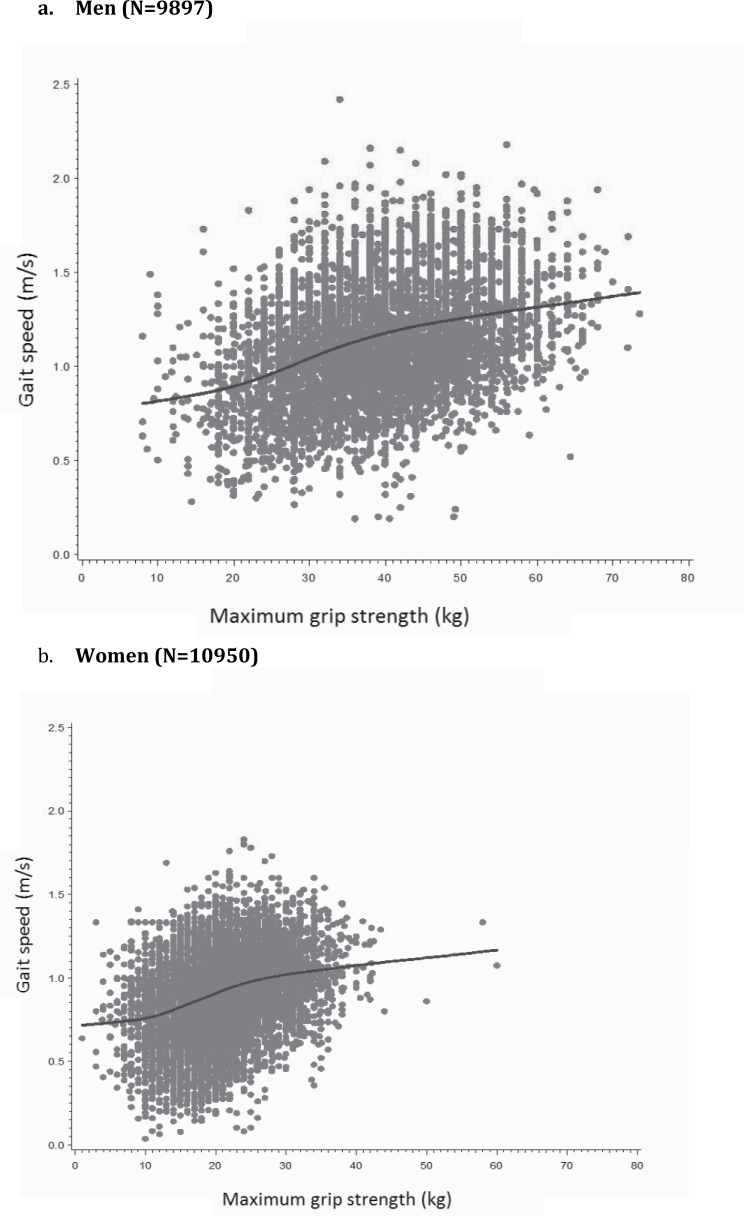
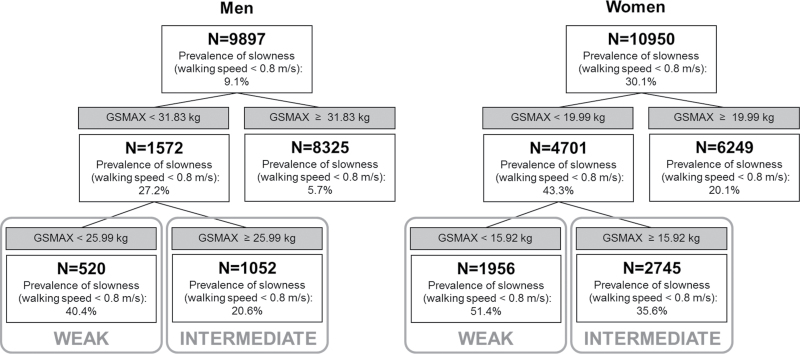
BACKGROUND: Weakness is common and contributes to disability, but no consensus exists regarding a strength cutpoint to identify persons at high risk. This analysis, conducted as part of the Foundation for the National Institutes of Health Sarcopenia Project, sought to identify cutpoints that distinguish weakness associated with mobility impairment, defined as gait speed less than 0.8 m/s. METHODS: In pooled cross-sectional data (9,897 men and 10,950 women), Classification and Regression Tree analysis was used to derive cutpoints for grip strength associated with mobility impairment. RESULTS: In men, a grip strength of 26-32 kg was classified as "intermediate" and less than 26 kg as "weak"; 11% of men were intermediate and 5% were weak. Compared with men with normal strength, odds ratios for mobility impairment were 3.63 (95% CI: 3.01-4.38) and 7.62 (95% CI 6.13-9.49), respectively. In women, a grip strength of 16-20 kg was classified as "intermediate" and less than 16 kg as "weak"; 25% of women were intermediate and 18% were weak. Compared with women with normal strength, odds ratios for mobility impairment were 2.44 (95% CI 2.20-2.71) and 4.42 (95% CI 3.94-4.97), respectively. Weakness based on these cutpoints was associated with mobility impairment across subgroups based on age, body mass index, height, and disease status. Notably, in women, grip strength divided by body mass index provided better fit relative to grip strength alone, but fit was not sufficiently improved to merit different measures by gender and use of a more complex measure. CONCLUSIONS: Cutpoints for weakness derived from this large, diverse sample of older adults may be useful to identify populations who may benefit from interventions to improve muscle strength and function.
Overview
The claims and statistics of this paper haven’t been checked yet.
Free: it reads the open-access text and checks the first 5 claims that cite a source we can check. Create a free account to check every claim.
Integrity signals
Registry
Cites
Statistics
Figures
Verification
Claims the paper makes
The claims and statistics of this paper haven’t been checked yet.
Free: it reads the open-access text and checks the first 5 claims that cite a source we can check. Create a free account to check every claim.
Claims other papers make about this one
Each is checked against this paper’s own text: does it say what the citing paper says it does?
The source backs part of the claim, not all of it — or backs it for a different population, condition or comparison.
In the citing paper
“while data from FNIH classified 4.1% of men and 14.0% of women as having sarcopenic obesity using high BMI and low grip strength as measures of obesity and low muscle strength, respectively202.”
From Sarcopenic obesity in older adults: aetiology, epidemiology and treatment strategies (2018) · cites this paper as [202]
Experimental — accuracy not yet measuredThe source backs part of the claim, not all of it — or backs it for a different population, condition or comparison.
In the citing paper
“For example, grip strength less than 26kg or 16kg for men and women respectively is highly predictive of mobility disability.”
From Successful aging: Advancing the science of physical independence in older adults (2015) · cites this paper as Alley, Shardell, Peters, McLean, Dam, Kenny, Fragala, Harris, Kiel, Guralnik, Ferrucci, Kritchevsky, Studenski, Vassileva, and Cawthon 2014
Experimental — accuracy not yet measuredThe check wasn’t confident either way, so it gives no verdict — never disputed.
In the citing paper
“Efforts to create cutpoints for muscle mass and muscle strength from population studies (community-dwelling older adults) recommended cutpoint for grip strength of 26 kg for men vs. 16 kg for women, and for appendicular lean body mass (measured with DXA) of 19.75 kg for men vs. 15.02 kg for women (Alley et al., 2014; Cawthon et al., 2014).”
From Myosteatosis in the Context of Skeletal Muscle Function Deficit: An Interdisciplinary Workshop at the National Institute on Aging (2020) · cites this paper as Alley et al., 2014
Experimental — accuracy not yet measuredIn the citing paper
“Efforts to create cutpoints for muscle mass and muscle strength from population studies (community-dwelling older adults) recommended cutpoint for grip strength of 26 kg for men vs. 16 kg for women, and for appendicular lean body mass (measured with DXA) of 19.75 kg for men vs. 15.02 kg for women (Alley et al., 2014; Cawthon et al., 2014).”
From Myosteatosis in the Context of Skeletal Muscle Function Deficit: An Interdisciplinary Workshop at the National Institute on Aging (2020) · cites this paper as Alley et al., 2014
In the citing paper
“Sarcopenia is a muscle disease (muscle failure) rooted in adverse muscle changes that accrue across a lifetime; sarcopenia is common among adults of older age but can also occur earlier in life.”
From Sarcopenia: revised European consensus on definition and diagnosis (2019) · cites this paper as [30]
Self-check
Percentages, sums and reported differences re-computed from the paper’s own numbers.
The self-check needs the paper’s full text.
Citations
Cites
Classification and Regression Trees.
Gordon, A. D., Breiman, L., Friedman, J. H., Olshen, R. A., & Stone, C. J. (1984) · Biometrics · doi:10.2307/2530946 · Cited by 23,522
Classification and Regression Trees.
Ryzin, J. V., Breiman, L., Friedman, J. H., Olshen, R. A., & Stone, C. J. (1986) · Journal of the American Statistical Association · doi:10.2307/2288003 · Cited by 20,825
Sarcopenia: European consensus on definition and diagnosis
Cruz-Jentoft, A. J., Baeyens, J. P., Bauer, J. M., Boirie, Y., Cederholm, T., Landi, F., Martin, F. C., Michel, J.-P., Rolland, Y., Schneider, S. M., et al. (2010) · Age and Ageing · doi:10.1093/ageing/afq034 · Cited by 11,601
Risk Factors for Hip Fracture in White Women
Cummings, S. R., Nevitt, M. C., Browner, W. S., Stone, K., Fox, K. M., Ensrud, K. E., Cauley, J., Black, D., & Vogt, T. M. (1995) · New England Journal of Medicine · doi:10.1056/nejm199503233321202 · Cited by 3,595 · cited 1×
“Participants Data available for this phase of the FNIH Sarcopenia Project analysis included: the Study of Osteoporotic Fractures, both the original cohort (study Visit 6) (14) and African American cohort (study Visit 1) (15); the Osteoporotic Fractures in Men Study (baseline visit) (16); the Health, Aging and Body Com…”
MethodFielding, R. A., Vellas, B., Evans, W. J., Bhasin, S., Morley, J. E., Newman, A. B., Abellan van Kan, G., Andrieu, S., Bauer, J., Breuille, D., et al. (2011) · Journal of the American Medical Directors Association · doi:10.1016/j.jamda.2011.01.003 · Cited by 3,256
Self-citationGoodpaster, B. H., Park, S. W., Harris, T. B., Kritchevsky, S. B., Nevitt, M., Schwartz, A. V., Simonsick, E. M., Tylavsky, F. A., Visser, M., Newman, A. B., et al. (2006) · The Journals of Gerontology Series A: Biological Sciences and Medical Sciences · doi:10.1093/gerona/61.10.1059 · Cited by 3,083 · cited 1×
“Strength declines more rapidly in men at older ages (32), and the association between strength and physical function appears stronger in men than in women (5,33).”
BackgroundSelf-citationRoberts, H. C., Denison, H. J., Martin, H. J., Patel, H. P., Syddall, H., Cooper, C., & Sayer, A. A. (2011) · Age and Ageing · doi:10.1093/ageing/afr051 · Cited by 3,001 · cited 3×
“By using the maximum measured grip strength from either hand, we sought to minimize variation based on these factors, but variation due to dynamometer used, hand position, and other factors may still exist (28).”
BackgroundMethodInfluentialStudenski, S. A., Peters, K. W., Alley, D. E., Cawthon, P. M., McLean, R. R., Harris, T. B., Ferrucci, L., Guralnik, J. M., Fragala, M. S., Kenny, A. M., et al. (2014) · The Journals of Gerontology: Series A · doi:10.1093/gerona/glu010 · Cited by 2,545
Self-citationEpidemiological approaches to heart disease: the Framingham study
Dawber, T. R., Meadors, G. F., & Moore, F. E. (1951) · American Journal of Public Health and the Nations Health · doi:10.2105/ajph.41.3.279 · Cited by 2,148 · cited 1×
“Participants Data available for this phase of the FNIH Sarcopenia Project analysis included: the Study of Osteoporotic Fractures, both the original cohort (study Visit 6) (14) and African American cohort (study Visit 1) (15); the Osteoporotic Fractures in Men Study (baseline visit) (16); the Health, Aging and Body Com…”
MethodLauretani, F., Russo, C. R., Bandinelli, S., Bartali, B., Cavazzini, C., Di Iorio, A., Corsi, A. M., Rantanen, T., Guralnik, J. M., & Ferrucci, L. (2003) · Journal of Applied Physiology · doi:10.1152/japplphysiol.00246.2003 · Cited by 1,946 · cited 2×
“M USCLE weakness is related to poor physical performance and incident mobility limitations among older adults (1–6).”
BackgroundSelf-citation
Research works printed but not linked: 4
- 2012, The Journals of Gerontology Series A: Biological Sciences and Medical Sciences, 67, 28
- 2014, The Journals of Gerontology Series A: Biological Sciences and Medical Sciences, 5, 567
- 2007, American Journal of Epidemiology, 165, 1076, 10.1093/aje/kwk115 · DOI · Paper page
- 2010, Physical Therapy, 90, 196, 10.2522/ptj.20090079 · DOI · Paper page
Cited by
Items 401–500 of 535
Stéphan, Y., Sutin, A. R., Luchetti, M., Karaköse, S., Hajek, A., O’Súilleabháin, P. S., & Terracciano, A. (2025) · Aging & Mental Health · doi:10.1080/13607863.2025.2562139 · Cited by 3
“Weak grip strength was defined as 26kg for males and 16kg for females and coded as 1 and ≥26kg for males and ≥16kg for females coded as 0 (Alley et al., 2014).”
Cirino, N. T. D. O., de Aquino, M. P. M., Lima, C. A., Santos, F. C., Ventura, M. D. M., & Perracini, M. R. (2025) · Arquivos de Neuro-Psiquiatria · doi:10.1055/s-0045-1812302 · Cited by 2
“The cutoff points used for male and female patients were of < 26kg/f and < 16kg/f respectively; 30 (cid:129) slow walking speed: assessed in a 4.60-m corridor, with 2 m for acceleration and deceleration.”
InfluentialBeavers, K. M., Serra, M. C., Weaver, A. A., & Houston, D. K. (2020) · Elsevier eBooks · doi:10.1016/b978-0-12-813073-5.00035-6 · Cited by 6
Cabral, A., Neto, E. T. D. R., Szejnfeld, V. L., de Oliveira, L. M., & Pinheiro, M. A. A. (2019) · Revista Paulista de Reumatologia · doi:10.46833/reumatologiasp.2019.18.4.6-16 · Cited by 7
Força de preensão manual em idosos e a aptidão para condução veicular
Lenardt, M. H., Lourenço, T. M., Betiolli, S. E., Binotto, M. A., Sétlik, C. M., & Barbiero, M. M. A. (2023) · Revista Brasileira de Enfermagem · doi:10.1590/0034-7167-2021-0729 · Cited by 8
“HGS can identify muscle weakness in older adults and somehow interfere with the motor skills of older adults driver when driving, by decreasing strength and range of motion(6-7).”
BackgroundThe Role of Different Weakness Cut-Points for Future Cognitive Impairment in Older Americans
McGrath, R. P., Tomkinson, G. R., Hamm, J. M., Juhl, K., Knoll, K., Parker, K. R. B., Smith, A. E., & Rhee, Y. S. (2023) · Journal of the American Medical Directors Association · doi:10.1016/j.jamda.2023.07.021 · Cited by 2
Walpot, J., Herck, P. V., Heyning, C. M. V. D., Bosmans, J. M., Massalha, S., Inácio, J. R., Heidbüchel, H., & Malbrain, M. L. N. G. (2023) · Anaesthesiology Intensive Therapy · doi:10.5114/ait.2023.132460 · Cited by 6
“In the pathophysiological thinking about sarcopenia, low skeletal muscle mass as the principal determinant has shifted towards low muscle strength [7–9].”
BackgroundAssociation of cancer with functional decline at old age: a longitudinal study in Danish twins
Mohammadnejad, A., Ryg, J., Ewertz, M., Jylhävä, J., Hjelmborg, J., & Galvin, A. (2024) · Scandinavian Journal of Public Health · doi:10.1177/14034948241240823 · Cited by 2
Gajjar, N. P., Noronha, T., Anumasa, R., Mariarathinam, P., & Mariappan, A. (2024) · Clinical Epidemiology and Global Health · doi:10.1016/j.cegh.2024.101657 · Cited by 5
de Oliveira, T. M., Moreira, P. D. A., dos Anjos, M. S., de Assumpção, D., & Corona, L. P. (2025) · Cadernos de Saúde Pública · doi:10.1590/0102-311xpt233323 · Cited by 3
Sarcopenia in the Context of Skeletal Muscle Function Deficit (SMFD)
Correa‐de‐Araujo, R. (2017) · InTech eBooks · doi:10.5772/intechopen.68979 · Cited by 2
Briggs, M. S., Rethman, K., & Lopez, M. T. (2018) · International Journal of Sports Physical Therapy · doi:10.26603/ijspt20180255 · Cited by 3
Hand Grip Strength in Elderly Patients with Chronic Illnesses: A Case Control Study
Akinwande, O. A., Adegbesan, O. A., Babalola, J., Atowoju, A. A., & Mbada, C. E. (2015) · JOURNAL OF HEALTH SCIENCE · Cited by 2
Yamada, Y. (2015) · 体力科學 · doi:10.7600/jspfsm.64.461 · Cited by 3
Monaco, M. D., Castiglioni, C., Bardesono, F., Milano, E., & Massazza, G. (2019) · American Journal of Physical Medicine & Rehabilitation · doi:10.1097/phm.0000000000001234 · Cited by 2
Muscle weakness assessment in non-hypoxemic COPD out-patients at tertiary care hospitals
Zuberi, F. F., Zuberi, B. F., Ali, F. S., & Bader, N. (2021) · Pakistan Journal of Medical Sciences · doi:10.12669/pjms.37.2.3127 · Cited by 3
Prevalencia de sarcopenia en población adulta mayor en Costa Rica
Barrientos-Calvo, I., & Picado-Ovares, E. (2021) · Acta Médica Costarricense · doi:10.51481/amc.v63i2.1121 · Cited by 5
Undiagnosed Dementia Is Associated with Poor Physical Function in Older Adults
McGrath, R. P., Robinson‐Lane, S. G., Klawitter, L. A., Rhee, Y. S., Hamm, J. M., McCourt, M. E., Parker, K. R. B., & Hackney, K. J. (2022) · Journal of Alzheimer s Disease · doi:10.3233/jad-220257 · Cited by 3
“Men with HGS <26 kg and women with HGS <16 kg were classified as weak [36].”
Association of handgrip strength with new-onset CKD in Korean adults according to gender
Lee, S., Kim, M., Lee, H.-J., & Kim, J.-K. (2023) · Frontiers in Medicine · doi:10.3389/fmed.2023.1148386 · Cited by 2
“Sarcopenia is regarded as muscle failure with low muscle strength being a superior measure to a lack of muscle mass (52, 53).”
BackgroundTang, R., Chen, J., Ma, H., Deng, J., Zhang, Y., & Xu, Q. (2023) · International Urology and Nephrology · doi:10.1007/s11255-023-03836-2 · Cited by 3
Tosato, M., Marzetti, E., Picca, A., & Calvani, R. (2024) · Springer eBooks · doi:10.1007/978-3-030-74720-6_116 · Cited by 2
Força de preensão manual em idosos e a aptidão para condução veicular
Lenardt, M. H., Lourenço, T. M., Betiolli, S. E., Binotto, M. A., Sétlik, C. M., & Barbiero, M. M. A. (2023) · Revista Brasileira de Enfermagem · doi:10.1590/0034-7167-2021-0729pt · Cited by 2
Hand grip strength as a nutritional assessment tool
Cheng, P. C. (2014) · University Library - University of Saskatchewan (University of Saskatchewan) · Cited by 3
Does the liver accelerate ageing: Talking muscles and liver?
Trenell, M. I., & Marchesini, G. (2016) · Journal of Hepatology · doi:10.1016/j.jhep.2016.10.018 · Cited by 3
(2023) · Journal of Cachexia Sarcopenia and Muscle · doi:10.1002/jcsm.13325 · Cited by 2
Šagát, P. (2023) · Journal of Clinical Medicine · doi:10.3390/jcm12196408 · Cited by 1
“Previous criterion-referenced standards among older adults have been established to detect sarcopenia [20,21], muscle weakness [22], mobility limitations [23], and diabetes [24].”
BackgroundInfluentialGrip strength of law enforcement officers and its implications
Hsiao, H. (2024) · Applied Ergonomics · doi:10.1016/j.apergo.2024.104390 · Cited by 2
Diago-Galmés, A., Guillamón-Escudero, C., Tenías, J. M., Soriano, J. M., & Garrido, J. F. (2024) · Nutrients · doi:10.3390/nu16223904 · Cited by 2
The association of multiple built environment factors with a clinical measure of grip strength
Baghela, M., Parks, J., & Bhatti, P. (2025) · Environmental Epidemiology · doi:10.1097/ee9.0000000000000391 · Cited by 1
Zhang, K. (2025) · Archives of Gerontology and Geriatrics · doi:10.1016/j.archger.2025.105870 · Cited by 1
Predictive models of weakness among older adults: the contribution of oral health indicators
de Mello, A. L. S. F., Pereira, M. C., Figueiredo, D. D. R., d’Orsi, E., Peres, M. A., & Peres, K. G. (2025) · Brazilian Oral Research · doi:10.1590/1807-3107bor-2025.vol39.064 · Cited by 1
“6 Limitations must be acknowledged when interpreting these results and applying the models in real-world scenarios.”
Gomez, R. J., Monteiro, F. R., Botelho, A. R., Nardy, A., da Silva, F. C., de Almeida, M. S., Paixão, V., Silva, B. R., Rossi, M., do Amaral, J. B., et al. (2025) · BMC Geriatrics · doi:10.1186/s12877-025-06347-0 · Cited by 1
“Physical function assessments included the Timed-up-go test (TUGT, in seconds) and gait speed (meters/second) [23–25], conducted following established protocols and guidelines from the European Working Group on Sarco-penia in Older People (EWGSOP) [26].”
Cardiorespiratory Fitness, Muscle Strength, and the Risk of Incident Chronic Kidney Disease
Liu, M., Gao, M., Wang, Y., Wu, M., Li, Y., Cui, Y., Zeng, F., & Zhu, Z. (2025) · Mayo Clinic Proceedings · doi:10.1016/j.mayocp.2025.07.034 · Cited by 2
Fink, H. A., Sheets, K. M., Langsetmo, L., Schousboe, J. T., Kats, A. M., & Ensrud, K. E. (2025) · Journal of General Internal Medicine · doi:10.1007/s11606-025-10073-z · Cited by 1
“…(recent weight loss of ≥ 5% or ≥ 10 pounds or BMI 18.5 kg/meters-squared), 30 weakness (grip strength 32 kg for men or 20 kg for women), 31 self-reported poor energy, slowness (gait speed 0.8 m/s for men or 0.6 m/s for women or use of a walking aid), 30,32,33 and low physical…”
InfluentialAraque, A. F., Giaquinta-Aranda, A., Velasco, V., Sáinz-Gil, M., Romero‐Marco, P., & Verde, Z. (2026) · Geriatric Nursing · doi:10.1016/j.gerinurse.2026.103910 · Cited by 1
Silva, F. R. D. M., Souza, A. S. R., de Mello, M. J. G., dos Santos, P. A. A., dos Santos, L. F. B. M., Fayh, A. P. T., & Sales, J. T. D. O. L. (2026) · Journal of Geriatric Oncology · doi:10.1016/j.jgo.2026.102897 · Cited by 1
A sensorimotor function construct to assess mild cognitive impairment risk
Wanigatunga, A. A., Wang, H., Huang, D., Davoudi, A., Dougherty, R. J., Tian, Q., Deal, J. A., Abraham, A. G., Simonsick, E. M., Gross, A. L., et al. (2026) · Alzheimer s & Dementia · doi:10.1002/alz.71332 · Cited by 1
Self-citationTopkan, E., Somay, E., Öztürk, D., & Selek, U. (2026) · Diagnostics · doi:10.3390/diagnostics16111611 · Cited by 1
“…regarding generalizability to populations with differing body composition, ethnic background, and cancer-related metabolic alterations persisted [10,35,36], the IWGS and FNIH frameworks collectively accelerated the transition toward function-centered conceptualization of sarcopenia and…”
UPDATE ON DEFINITIONS OF SARCOPENIA
Studenski, S. A. (2015) · The Journal of Frailty & Aging · doi:10.14283/jfa.2015.60 · Cited by 1
Self-citationJAMDA Maintains Excellent Impact Factor
Morley, J. E. (2017) · Journal of the American Medical Directors Association · doi:10.1016/j.jamda.2017.06.033 · Cited by 1
Xu, H., Sun, J., Liu, Y., Tian, L., Liu, J., Shi, J., Liu, M., & Zheng, X.-Y. (2020) · Calcified Tissue International · doi:10.1007/s00223-020-00778-0 · Cited by 1
Sex and body composition influences the Quilombolas strength
Pereira, L. C., de Santana, F. S., Lamarca, F., Garcia, K. R., Karnikowski, M., Neto, L. S. S., Oliveira, H. B., Osório, N. B., da Silva, I. C. R., & Karnikowski, M. G. D. O. (2020) · JCSM Clinical Reports · doi:10.1002/crt2.28 · Cited by 1
(2018) · Asian Journal of Gerontology and Geriatrics · doi:10.12809/ajgg-2018-295-oa · Cited by 1
Barry, D. (2020) · Elsevier eBooks · doi:10.1016/b978-0-323-43044-9.00217-x · Cited by 2
Schousboe, J. T., Langsetmo, L., Kats, A. M., Taylor, B. C., Boyd, C. M., Riper, D. C. V., Kado, D. M., Duan‐Porter, W., Cawthon, P. M., & Ensrud, K. E. (2024) · Journal of General Internal Medicine · doi:10.1007/s11606-024-08875-8 · Cited by 1
Self-citationHulme, A., Sangelaji, B., Walker, C., Fallon, T., Denham, J., Martin, P., Woodruffe, S., Bell, K., Aniftos, M., Kirkpatrick, J., et al. (2024) · Journal of Interprofessional Care · doi:10.1080/13561820.2024.2380436 · Cited by 2
“…literature, our grip strength findings fall within the intermediate (male 26 to 31.9 kg; female 16 to 19.9 kg) to normal (male ≥32.0 kg; female ≥20.0 kg) categories based on the National Institutes of Health Sarcopenia Project (Alley et al., 2014), and others (de Souza Vasconcelos et al., 2016).”
InfluentialMastrud, M., Juhl, K., Dahl, L. J., Haiderbhai, S., Lahr, P., Manocha, G. D., Olson, A., Raum, J., Theige, D., & McGrath, R. P. (2025) · Therapeutics · doi:10.3390/therapeutics2010004 · Cited by 1
“Males The highest recorded HGS measurement was reviewed by healthcare providers. and females with HGS <26-kg and <16-kg were considered weak [11].”
Rooks, D. (2019) · Current Physical Medicine and Rehabilitation Reports · doi:10.1007/s40141-019-00236-5 · Cited by 1
Nordic walking in winter as the multitask training in patients with Parkinson’s disease
Guseva, O. V., & Жукова, Н. Г. (2021) · S S Korsakov Journal of Neurology and Psychiatry · doi:10.17116/jnevro202112101138 · Cited by 2
Price, K. J., Gordon, B. A., Bird, S. R., & Benson, A. C. (2021) · International Journal of Environmental Research and Public Health · doi:10.3390/ijerph18178950 · Cited by 2
“While mean values for grip strength at the conclusion of cardiac rehabilitation were above critical thresholds (26–32 kg for men and 16–20 kg for women), some participants were still close to the threshold of disability [27,33] based on their muscular strength, suggesting that the resistance training load prescribed d…”
BackgroundSamakkarnthai, P., & Sfeir, J. G. (2021) · Springer eBooks · doi:10.1007/978-3-030-83951-2_8 · Cited by 1
Weak Hand Grip Strength Is Associated with Alexithymia in Outpatients in a Mexican Population
Mendoza, A. D. G., Fresán, A., González‐Castro, T. B., Pool-García, S., Tovilla‐Zárate, C. A., Castillo-Ávila, R. G., Vázquez, P. I. A., López‐Narváez, M. L., & Nicolini, H. (2022) · Brain Sciences · doi:10.3390/brainsci12050576 · Cited by 2
Exercise Interventions to Prevent and Improve Sarcopenia
Peterson, M. D., & Rexach, J. A. S. (2021) · Wiley eBooks · doi:10.1002/9781119597896.ch22 · Cited by 3
Hellman-Bronstein, A. T., Luukkaala, T. H., Ala‐Nissilä, S., & Nuotio, M. S. (2024) · Research Square · doi:10.21203/rs.3.rs-3932478/v1 · Cited by 1
Electromyographic analysis of upper extremity muscles during overhead work
Kınalı, G., Kara, S., & Yıldırım, M. S. (2015) · Medical Technologies National Conference · doi:10.1109/tiptekno.2015.7374609
Clinical trials for conditions of low muscle mass and strength
Studenski, S. A., Correa‐de‐Araujo, R., & Ferrucci, L. (2015) · Wiley eBooks · doi:10.1002/9781118323434.ch11
Self-citationLawford‐Smith, H. (2015)
Núñez, D. F. (2016) · Revista Clínica Escuela de Medicina UCR-HSJD · doi:10.15517/rc_ucr-hsjd.v6i5.27535 · Cited by 2
The Relationship Between Adiponectin Levels and Appendicular Lean Mass in Postmenopausal Women
Puchala, S. (2015) · OhioLink ETD Center (Ohio Library and Information Network)
Relationship Between Arthritis and Muscular Strength in Older Women with Symptoms of Sarcopenia
Renna, E. N. (2017) · Digital Commons - URI (University of Rhode Island) · doi:10.23860/thesis-renna-emily-2017
Yabe, H., Onoyama, A., Ito, S., Imoto, Y., Masuda, A., Kono, K., Moriyama, Y., Kimura, K. B., & Kasuga, H. (2017) · Rigakuryoho Kagaku · doi:10.1589/rika.32.403
Pre-frailty in the elderly and the driver license test for motor vehicles
Lenardt, M. H., Betiolli, S. E., Sakai, L. M., Carneiro, N. H. K., Binotto, M. A., & Moraes, D. C. (2017) · Rev Rene · doi:10.15253/2175-6783.2017000400009 · Cited by 2
“Analyses based on data from the Sarcopenia Project concluded that increases in hand grip strength may have positive effects on the physical fitness of the elderly(17).”
MethodLustosa, L. P., Batista, P. P., Ribeiro-Samora, G. A., Assis, M. G., Ennes, T. D. O., & Scianni, A. A. (2018) · Topics in Geriatric Rehabilitation · doi:10.1097/tgr.0000000000000186 · Cited by 1
Magalhães, M. A. Z. (2018) · Digital Library of Theses and Dissertations (Universidade de São Paulo) · doi:10.11606/d.5.2018.tde-28092018-121711
Método Pilates: uma ferramenta para a melhora do desempenho físico-funcional de idosos?
de Souza, R. O. B. (2019) · Digital Library of Theses and Dissertations (Universidade de São Paulo) · doi:10.11606/d.100.2019.tde-18062019-133902
de França, N. A. G. (2019) · Digital Library of Theses and Dissertations (Universidade de São Paulo) · doi:10.11606/t.6.2019.tde-27062019-150226 · Cited by 2
Handgrip strength accuracy as discriminator of functional independence in centenarian women
Fortunato, A. R., da Silva, R. E. L., & Mazo, G. Z. (2020) · Brazilian Journal of Kinanthropometry and Human Performance · doi:10.1590/1980-0037.2020v22e57447
Muscle strength and quality in old and oldest-old people
Wearing, J. (2021) · Research Publications (Maastricht University) · doi:10.26481/dis.20210119jw
Cheung, C., & Li, G. H. (2021) · Osteoporosis and Sarcopenia · doi:10.1016/j.afos.2021.03.005
“This is in line with the recent consensus that muscle strength overtakes the role of muscle mass as the principal determinant of sarcopenia [1,5,6].”
ResultGuseva, O. V., & Жукова, Н. Г. (2021) · Advances in Gerontology · doi:10.1134/s2079057021040032
“According to the literature, indicators of the hand-grip strength less than 16 kg in women are interrelated with limitation of physical activity and mortality [3].”
BackgroundBatsis, J. A. (2015) · Springer eBooks · doi:10.1007/978-3-319-12125-3_38-1
Batsis, J. A. (2016) · Springer eBooks · doi:10.1007/978-3-319-11251-0_38
Joseph, B. A., & Hassan, A. (2020) · Springer eBooks · doi:10.1007/978-3-319-47771-8_8
Sarcopenia: assessment, management, and outcomes
Gutiérrez‐Robledo, L. M., & Pérez‐Zepeda, M. U. (2017) · Oxford University Press eBooks · doi:10.1093/med/9780198701590.003.0056 · Cited by 1
Joseph, B. A., & Hassan, A. (2017) · Springer eBooks · doi:10.1007/978-3-319-20317-1_8-1
Fatores de Risco para Quedas em Idosos e suas Associações com Adesão a um Programa de Prevenção
Sinato, C. M., & Batistoni, S. S. T. (2022) · Revista Kairós Gerontologia · doi:10.23925/2176-901x.2021v24i3p95-114
Tosato, M., Marzetti, E., Picca, A., & Calvani, R. (2023) · Springer eBooks · doi:10.1007/978-3-030-01782-8_116-1
Abdalla, P. P. (2022) · Digital Library of Theses and Dissertations (Universidade de São Paulo) · doi:10.11606/t.83.2022.tde-13052022-120415
Vega, C. A. W., Nur’aini, B., Priyono, B., Widita, E., Hanindriyo, L., Agustina, D., Naritasari, F., Widyaningrum, R., & Rodestawati, B. (2023) · Jurnal Kesehatan Vokasional · doi:10.22146/jkesvo.76423 · Cited by 1
Souza, L. H. R., Fernandes, R. S., & Fagundes, B. D. A. (2023) · Revista de Ciências Médicas e Biológicas · doi:10.9771/cmbio.v22i1.43532 · Cited by 2
Baek, Y.-J., Yi, C., Kwon, O.-Y., & Cho, S. (2023) · Physical Therapy Korea · doi:10.12674/ptk.2023.30.3.202
Fesyun, A. D., Marchenkova, L., & Vasileva, V. A. (2023) · Bulletin of Rehabilitation Medicine · doi:10.38025/2078-1962-2023-22-3-66-74
Moore, D., & Gallagher, J. (2024) · Physiotherapy Practice and Research · doi:10.3233/ppr-230764 · Cited by 1
Criteria of syndrome frailty in Parkinson´s disease
Guseva, O. V., & Жукова, Н. Г. (2024) · S S Korsakov Journal of Neurology and Psychiatry · doi:10.17116/jnevro202412403152
Radhika, A., & Shanmugavalli, T. (2024) · Salud Ciencia y Tecnología - Serie de Conferencias · doi:10.56294/sctconf2024905 · Cited by 1
Amer, F. E., Mamdouh, K. A., Hassan, T., El‐Nabie, W. A. A., & Eltalawy, H. A. (2024) · Beni-Suef University Journal of Basic and Applied Sciences · doi:10.1186/s43088-024-00518-5 · Cited by 1
“Similarly, a decreased Hb level has been shown to directly correlate with decreased HGS in elderly Australians [62, 63], which is attributed to tissue hypoxia reducing oxygen supply to the muscles, directly affecting muscle strength, regardless of anemia [61].”
BackgroundDizziness, physical capacity, and health-related aspects among 70-year-olds in an urban population
Lindell, E., Finizia, C. A., Frändin, K., Falk, H., Sterner, T. R., Skoog, I. G., & Kollén, L. (2024) · Journal of Gerontology and Geriatrics · doi:10.36150/2499-6564-n636
Yoo, S., & Park, D. Y. (2024) · The Korean Journal of Sports Medicine · doi:10.5763/kjsm.2024.42.4.262
Sletten, R., Slaaen, M., Oldervoll, L. M., Skjellegrind, H. K., Benth, J. Š., Åström, L., Kirkevold, Ø., Bergh, S., Grønberg, B. H., Rostoft, S., et al. (2024) · European Urology Open Science · doi:10.1016/j.euros.2024.11.005
Nitayarak, H., Toleama, A., Madiyoh, N., Mahae, N., Pedpak, R., & Charntaraviroj, P. (2025) · Work · doi:10.1177/10519815241303333 · Cited by 1
Exercise for parents of individuals with autism spectrum disorder: a mixed method pilot study
Johnson, N. L., Bekhet, A. K., Zint, E., Wang, J., Peña, S., Hecke, A. V. V., & Ng, A. V. (2025) · International Journal of Developmental Disabilities · doi:10.1080/20473869.2025.2483276
McGrath, R. P., Tomkinson, G. R., Andrew, S., Batesole, J., Carling, C., Christensen, B. K., FitzSimmons, S., Heimbuch, H., Hoang, T., Jurivich, D. A., et al. (2025) · The Journal of Frailty & Aging · doi:10.1016/j.tjfa.2025.100045
“Thereafter, we conducted a multivariate analysis and simulated the binary outcome of slow gait speed ( 0.8 m/s) [15], which was selected because it represents poor physical performance as the next step in the disabling process after low muscle function [2].”
InfluentialWang, H., Bai, M.-H., Li, Z., Wang, J., & Wang, Q. (2025) · Appetite · doi:10.1016/j.appet.2025.108037 · Cited by 1
Stéphan, Y., Sutin, A. R., Luchetti, M., & Terracciano, A. (2025) · The Journals of Gerontology Series B · doi:10.1093/geronb/gbaf150
González-Ponce, F., Gámez-Nava, J. I., Jacobo-Cuevas, H., Ponce-Guarneros, J. M., Valdivia-Tangarife, E. R., Nava-Valdivia, C. A., Rodriguez-Jimenez, N. A., Ramírez-Villafaña, M., Gómez-Ramírez, E. E., González-Vázquez, S. A., et al. (2025) · International Journal of Molecular Sciences · doi:10.3390/ijms26178232
Is hand grip strength a reliable indicator of clinical total knee arthroplasty outcomes?
Freijo, V., Molina, B., & Villalba, J. (2025) · Journal of Clinical Orthopaedics and Trauma · doi:10.1016/j.jcot.2025.103213 · Cited by 1
Physical Frailty, Social Support and Psychological Well-being in the Older Portuguese Population
Gaspar, P. M., Lages, M., Victor, J. A., Facal-Mayo, D., & Juncos‐Rabadán, O. (2025) · Springer proceedings in business and economics · doi:10.1007/978-3-031-94487-1_51
Konvalinková, R., Srp, M., Dolečková, K., Čapek, V., Gál, O., Hoskovcová, M., & Klempíř, J. (2025) · Journal of Huntington s Disease · doi:10.1177/18796397251385607
Metadata
- Authors
- Alley, D. E., Shardell, M. D., Peters, K. W., McLean, R. R., Dam, T.-T. L., Kenny, A. M., Fragala, M. S., Harris, T. B., Kiel, D. P., Guralnik, J. M., Ferrucci, L., Kritchevsky, S. B., Studenski, S. A., Vassileva, M. T., & Cawthon, P. M.
- Affiliations
- University of Maryland, Baltimore (US)
- California Pacific Medical Center (US)
- Beth Israel Deaconess Medical Center (US)
- Columbia University (US)
- University of Central Florida (US)
- National Institutes of Health (US)
- National Institute on Aging (US)
- Wake Forest University (US)
- University of Pittsburgh (US)
- Foundation for the National Institutes of Health (US)
- Corresponding author
- Alley, D. E.
- ORCID
- Venue
- The Journals of Gerontology Series A: Biological Sciences and Medical Sciences
- Publisher
- Oxford University Press (OUP)
- Published
- 2014-04-14
- Volume
- 69
- Issue
- 5
- Pages
- 559-566
- ISSN
- 1079-5006 (ISSN-L)
- 1758-535X
- PMC
- PMC3991145
- OpenAlex
- W2127873216
- Cited by
- 535
- References
- 38
- Citations by year
- 2026: 32 · 2025: 40 · 2024: 49 · 2023: 45 · 2022: 41 · 2021: 60 · 2020: 41 · 2019: 46 · 2018: 47 · 2017: 44 · 2016: 39 · 2015: 35 · 2014: 16
- FWCI
- 29.78
- Type
- journal article
- Language
- en
- Open access
- hybrid
- doi.org
- Licence
- cc-by-nc
- Locations
- The Journals of Gerontology Series A (publishedVersion, cc-by-nc)
- Europe PMC (PubMed Central) (publishedVersion, cc-by-nc)
- PubMed Central (publishedVersion, cc-by-nc)
- PubMed (publishedVersion)
- Digital Access to Scholarship at Harvard (DASH) (Harvard University) (submittedVersion, cc-by)
- Journal of International Crisis and Risk Communication Research (submittedVersion)
- Funders
- National Institutes of Health (1u13ag041583-01)
- National Institute on Aging (1U13AG041583, P30AG024827)
- Topics
- Health Sciences › Medicine › Physiology (medical) › Nutrition and Health in Aging
- Health Sciences › Medicine › Geriatrics and Gerontology › Frailty in Older Adults
- Health Sciences › Health Professions › Physical Therapy, Sports Therapy and Rehabilitation › Balance, Gait, and Falls Prevention
- Keywords
- grip strength, muscle weakness, cut-off values, mobility impairment, walking speed, sarcopenia, older adults, sex differences, body mass index, muscle strength
- MeSH terms
- Age Factors, Aged, Aged, 80 and over, Cross-Sectional Studies, Female, Gait, Humans, Male, Sex Factors, United States, Hand Strength, Muscle Weakness, Mobility Limitation, Sarcopenia
About these checks
Registry, retraction, Cites and statistics results are computed, not judged, with one exception: a printed reference that no index lists is read once by a model before it counts as a citation error. Claims are extracted by a model and kept only when their quote appears verbatim in the text; each cited source is then checked, with a model’s help, for whether it says what the claim relies on. Those verdicts can be wrong — read the claim’s quote and the cited source before relying on one.
Statistics and arithmetic are recomputed, not judged.
Confidence bands are shown only for fields calibrated on our annotated test set. None is calibrated yet, so no band is shown.
What counts as a claim ›How we measure confidence ›How we check this ›
Are you an author, or do you see a problem with this page? Request a review
Data sources
Bibliographic data: Semantic Scholar, OpenAlex, Crossref.
Contains information from the Semantic Scholar Academic Graph Datasets, made available under the ODC Attribution License (ODC-BY 1.0).
Semantic Scholar’s data is described in: Kinney, R., et al. (2023). The Semantic Scholar Open Data Platform. arXiv:2301.10140.
