

The DOI matches its Crossref record; 38 of the 39 references it cites were found in a registry or an index; 8 of the 18 sources its claims cite were checked for support.
A novel mutation within the MIR96 gene causes non-syndromic inherited hearing loss in an Italian family by altering pre-miRNA processing
Open accessAbstract
The miR-96, miR-182 and miR-183 microRNA (miRNA) family is essential for differentiation and function of the vertebrate inner ear. Recently, point mutations within the seed region of miR-96 were reported in two Spanish families with autosomal dominant non-syndromic sensorineural hearing loss (NSHL) and in a mouse model of NSHL. We screened 882 NSHL patients and 836 normal-hearing Italian controls and identified one putative novel mutation within the miR-96 gene in a family with autosomal dominant NSHL. Although located outside the mature miR-96 sequence, the detected variant replaces a highly conserved nucleotide within the companion miR-96*, and is predicted to reduce the stability of the pre-miRNA hairpin. To evaluate the effect of the detected mutation on miR-96/mir-96* biogenesis, we investigated the maturation of miR-96 by transient expression in mammalian cells, followed by real-time reverse-transcription polymerase chain reaction (PCR). We found that both miR-96 and miR-96* levels were significantly reduced in the mutant, whereas the precursor levels were unaffected. Moreover, miR-96 and miR-96* expression levels could be restored by a compensatory mutation that reconstitutes the secondary structure of the pre-miR-96 hairpin, demonstrating that the mutation hinders precursor processing, probably interfering with Dicer cleavage. Finally, even though the mature miR-96 sequence is not altered, we demonstrated that the identified mutation significantly impacts on miR-96 regulation of selected targets. In conclusion, we provide further evidence of the involvement of miR-96 mutations in human deafness and demonstrate that a quantitative defect of this miRNA may contribute to NSHL.
Overview
AI snapshot
Written from the paper’s full text.
TL;DR
A novel heterozygous MIR96 +57T>C mutation, located outside mature miR-96 but within the miR-96* seed region, was identified in an Italian family with autosomal dominant progressive non-syndromic hearing loss. Functional assays show the mutation alters pre-miR-96 folding, reduces mature miR-96 and miR-96* without affecting precursor levels, and impairs target regulation, suggesting a quantitative miR-96 defect can contribute to deafness.
Key findings
- Screening 882 NSHL patients and 836 normal-hearing Italian controls identified miR-96(+57T>C) in one family with autosomal dominant progressive NSHL; the variant was absent in controls and segregated with hearing loss in affected individuals, though it was also present in three normal-hearing children.
- In HeLa cells, the +57T>C mutant significantly reduced mature miR-96 by 85% (P = 0.0006) and miR-96* by 77% (P = 0.019), while pre-miR-96 levels were unaffected; a compensatory +23A>G mutation restored both mature miRNA levels to values not significantly different from wild-type.
- The known miR-96(+13G>A) mutation reduced mature miR-96 (P < 0.0001) but did not affect miR-96* levels, and its effect was not rescued by restoring precursor folding, indicating a different pathogenic mechanism from +57T>C.
- Luciferase assays showed 3 of 8 candidate 3′UTRs (MYRIP, ACVR2B, CACNB4) were regulated by miR-96/miR-96*; the +57T>C mutation reduced silencing by approximately 50%, and MYRIP regulation—dependent uniquely on miR-96—was restored by the double +23A>G+57T>C mutant.
Methods
- Case–control mutational screening: 882 genetically undiagnosed Italian NSHL patients (30% familial, 70% sporadic) and 836 normal-hearing Italian controls; MIR183, MIR96, and MIR182 were prescreened by high-resolution melting followed by direct sequencing.
- Functional studies: mfold was used to predict pre-miR-96 secondary structure; psiUX expression vectors carrying wild-type, mutant, or double-mutant pre-miR-96 were transiently transfected into HeLa cells, and mature miR-96, miR-96*, and pre-miR-96 levels were measured by real-time RT–PCR using the ΔΔCT method.
- Target validation: eight candidate target 3′UTRs were cloned into psiCHECK2 and tested by luciferase reporter assays; miRNA expression profiles were also examined in human and mouse tissues, including mouse Organ of Corti.
Limitations
- Stated: a direct role of miR-96* in NSHL pathogenesis remains unproved; none of the putative miR-96* target sites was validated by luciferase assays; more extensive and detailed experiments are needed to define any role of miR-96* in the inner ear.
- Stated: the mutation was present in three normal-hearing children, which may reflect age-related onset or incomplete penetrance, so those individuals might still develop hearing loss.
- Evident from the text: functional assays were performed in HeLa cells rather than inner ear hair cells, and the mutation was characterized in a single Italian family, limiting generalization and leaving the inner-ear-specific mechanism unresolved.
Model-written summary. Check it against the paper before relying on it.
Integrity signals
Registry
Cites
Statistics
Figures
Verification
Claims the paper makes
27 Own result · 22 Own interpretation · 9 Own method · 4 Partly supported · 4 No basis given · 3 Not checked yet · 1 Supported so far · 1 Couldn’t confirm · 1 No full text of the sources · accuracy not yet measured
The cited sources support only part of this claim — read each source’s verdict below.
In the paper
“Importantly, this highly conserved family of miRNAs shows expression in ciliated neurosensory organs across phyla and has recently been demonstrated to contribute specifically to the differentiation and function of the mechanosensory hair cells in the vertebrate inner ear (10,11).”
§ A novel mutation within the MIR96 gene causes non-syndromic inherited hearing loss in an Italian family by altering pre-miRNA processing > INTRODUCTION
What the sources say
- Partly supportedcites [10] Soukup, 2009, Residual microRNA expression dictates the extent of inner ear development in conditional Dicer knockout mice, Dev. Biol. sourceExperimental — accuracy not yet measured
The Abstract reports that residual miR-183 expression closely corresponds to the degree of hair-cell differentiation, and the Discussion (‘Hair cell development’; page unavailable) describes a critical role for miRNAs in that process. But this Dicer-knockout study does not establish that the miR-96/182/183 family specifically is essential, or demonstrate its role in hair-cell function. (LLM, conf=0.88)
- Partly supportedcites [11] Li, 2010, MicroRNA-183 family members regulate sensorineural fates in the inner ear, J. Neurosci. sourceExperimental — accuracy not yet measured
The Introduction identifies miR-96, miR-182 and miR-183 as a conserved family expressed in neurosensory organs of vertebrates and invertebrates. The Abstract and Discussion report that altering these miRNAs changes hair-cell numbers and development in zebrafish. The paper does not demonstrate that the entire family is essential for hair-cell function across vertebrates; its hearing-loss evidence concerns miR-96 mutations reported in other studies. (LLM, conf=0.87)
boosteddirect- Asserted: passes — The authors put it forward as true.
- Checkable: passes — It can be checked against evidence.
- Load-bearing: passes — The paper’s conclusions depend on it.
- Based: passes — The paper gives a reason why it holds.
- Partly supported
The cited sources support only part of this claim — read each source’s verdict below.
In the paper
“Indeed, tight regulation of miR-96 levels within the vertebrate inner ear seems to be crucial for the correct function and development of hair cells, as demonstrated by knockdown experiments in zebrafish (11) and by the phenotypic differences between the heterozygous and the homozygous diminuendo mice (15,16).”
§ A novel mutation within the MIR96 gene causes non-syndromic inherited hearing loss in an Italian family by altering pre-miRNA processing > DISCUSSION
What the sources say
- Partly supportedcites [11] Li, 2010, MicroRNA-183 family members regulate sensorineural fates in the inner ear, J. Neurosci. sourceExperimental — accuracy not yet measured
The Results sections on miR-183-family knockdown report that miR-96 knockdown in zebrafish reduced inner-ear hair-cell numbers, supporting a role for miR-96 levels in hair-cell development. The cited paper does not show that the knockdown impaired hair-cell function; the diminuendo-mouse comparison is attributed to other citations in the sentence. (LLM, conf=0.84)
- Partly supportedcites [15] Lewis, 2009, An ENU-induced mutation of miR-96 associated with progressive hearing loss in mice, Nat. Genet. sourceExperimental — accuracy not yet measured
The paper reports different hair-cell defects and hearing phenotypes in heterozygous and homozygous diminuendo mice (passage 8; section labeled Abstract, page unavailable), supporting the part attributed to the mouse study. It studies a mutation in miR-96’s seed region, however, and reports mature miRNAs in both wild-type and mutant hair cells (passage 1); it does not establish that tight regulation of miR-96 levels causes those differences. (LLM, conf=0.87)
- Not checked yetcites [16] Kuhn, 2011, miR-96 regulates the progression of differentiation in mammalian cochlear inner and outer hair cells, Proc. Natl Acad. Sci. USA source
Checked before — its earlier verdict is held back until a new check runs.
boosteddirect- Asserted: passes — The authors put it forward as true.
- Checkable: passes — It can be checked against evidence.
- Load-bearing: passes — The paper’s conclusions depend on it.
- Based: passes — The paper gives a reason why it holds.
- Partly supported
The cited sources support only part of this claim — read each source’s verdict below.
In the paper
“In this respect, it should be recalled that the diminuendo mouse, which carries a mutant miR-96 seed region, does not have a major effect on miR-96 expression levels (15).”
§ A novel mutation within the MIR96 gene causes non-syndromic inherited hearing loss in an Italian family by altering pre-miRNA processing > DISCUSSION
What the sources say
- Partly supportedcites [15] Lewis, 2009, An ENU-induced mutation of miR-96 associated with progressive hearing loss in mice, Nat. Genet. sourceExperimental — accuracy not yet measured
The passage on the Mirn96 cluster (page unavailable) reports mature miR-96 expression in hair cells of both wild-type and homozygous diminuendo mice, and suggests the mutation does not have a major effect on miRNA processing or export. It does not directly compare miR-96 expression levels, so the claim is more specific than the evidence. (LLM, conf=0.83)
plain- Asserted: passes — The authors put it forward as true.
- Checkable: passes — It can be checked against evidence.
- Load-bearing: unclear — It is unclear whether the paper’s conclusions depend on it.
- Based: passes — The paper gives a reason why it holds.
- Partly supported
The sources with a verdict support this claim; the rest weren’t checked yet, have no full text we could read, or their verdicts aren’t rated yet.
In the paper
“Even though mutations within miR-96 are not a common cause of deafness, as evidenced by this and previous works (14,17), the description of novel causative variants might help in elucidating the pathogenic mechanisms underlying the DFNA50-associated phenotype.”
§ A novel mutation within the MIR96 gene causes non-syndromic inherited hearing loss in an Italian family by altering pre-miRNA processing > DISCUSSION
What the sources say
- Not checked — no full text of the sourcecites [14] Mencía, 2009, Mutations in the seed region of human miR-96 are responsible for nonsyndromic progressive hearing loss, Nat. Genet. source
- Supportedcites [17] Hildebrand, 2010, miRNA mutations are not a common cause of deafness, Am. J. Med. Genet. A source
The Discussion reports miR-96 mutations in only 2 of 568 Spanish families with hereditary hearing loss and none of 150 American families with autosomal dominant nonsyndromic hearing loss. It explicitly concludes that mutations in miR-96 are a relatively rare cause of nonsyndromic hearing loss, supporting the citing sentence’s paraphrase. (LLM, conf=0.94)
plain- Asserted: passes — The authors put it forward as true.
- Checkable: passes — It can be checked against evidence.
- Load-bearing: unclear — It is unclear whether the paper’s conclusions depend on it.
- Based: passes — The paper gives a reason why it holds.
A result the paper reports from its own data — it cites no other source for it, so there is none to check. The quote shows it is in the paper.
In the paper
“Finally, even though the mature miR-96 sequence is not altered, we demonstrated that the identified mutation significantly impacts on miR-96 regulation of selected targets.”
§ A novel mutation within the MIR96 gene causes non-syndromic inherited hearing loss in an Italian family by altering pre-miRNA processing > Abstract
boosteddirectSingle case- Asserted: passes — The authors put it forward as true.
- Checkable: passes — It can be checked against evidence.
- Load-bearing: passes — The paper’s conclusions depend on it.
- Based: passes — The paper gives a reason why it holds.
A result the paper reports from its own data — it cites no other source for it, so there is none to check. The quote shows it is in the paper.
In the paper
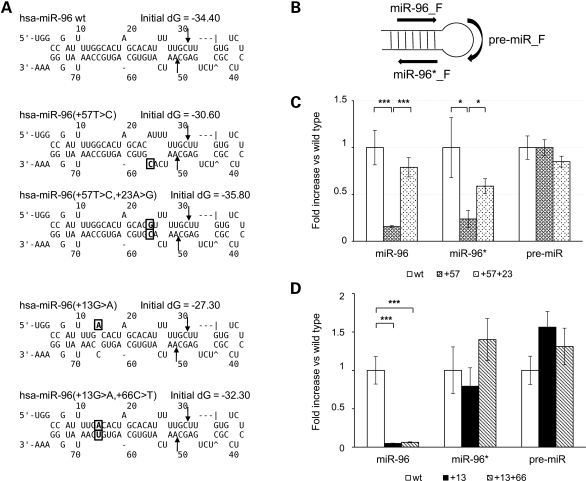
“We found that both miR-96 and miR-96* levels were significantly reduced in the mutant, whereas the precursor levels were unaffected.”
§ A novel mutation within the MIR96 gene causes non-syndromic inherited hearing loss in an Italian family by altering pre-miRNA processing > Abstract
plaindirect- Asserted: passes — The authors put it forward as true.
- Checkable: passes — It can be checked against evidence.
- Load-bearing: passes — The paper’s conclusions depend on it.
- Based: passes — The paper gives a reason why it holds.
- Rests on an assumption: The processing of miR-96 in HeLa cells reflects the processing in the human inner ear relevant to hearing loss.
A result the paper reports from its own data — it cites no other source for it, so there is none to check. The quote shows it is in the paper.
In the paper
“Moreover, miR-96 and miR-96* expression levels could be restored by a compensatory mutation that reconstitutes the secondary structure of the pre-miR-96 hairpin, demonstrating that the mutation hinders precursor processing, probably interfering with Dicer cleavage.”
§ A novel mutation within the MIR96 gene causes non-syndromic inherited hearing loss in an Italian family by altering pre-miRNA processing > Abstract
hedgedconditionalSingle case- Asserted: passes — The authors put it forward as true.
- Checkable: passes — It can be checked against evidence.
- Load-bearing: passes — The paper’s conclusions depend on it.
- Based: passes — The paper gives a reason why it holds.
- Rests on an assumption: The processing of miR-96 in HeLa cells reflects the processing in the human inner ear relevant to hearing loss.
A result the paper reports from its own data — it cites no other source for it, so there is none to check. The quote shows it is in the paper.
In the paper
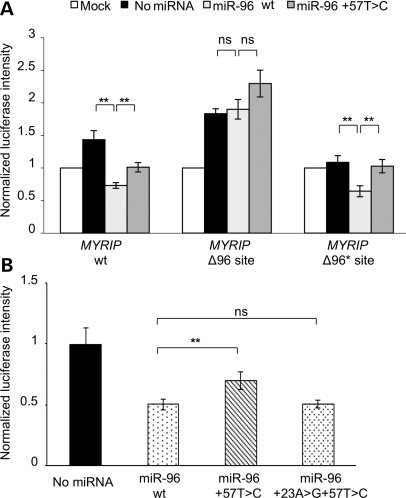
“To confirm this hypothesis, we repeated the luciferase assays using the double miR-96(+23A>G+57T>C) mutant, and observed that in this case the downregulation of MYRIP 3′UTR was restored to a level similar to that of the wild-type miR-96 (Fig. 3B).”
§ A novel mutation within the MIR96 gene causes non-syndromic inherited hearing loss in an Italian family by altering pre-miRNA processing > RESULTS > Impact of the +57T>C mutation on miRNA target regulation
plain- Asserted: passes — The authors put it forward as true.
- Checkable: passes — It can be checked against evidence.
- Load-bearing: passes — The paper’s conclusions depend on it.
- Based: passes — The paper gives a reason why it holds.
- Rests on an assumption: The luciferase reporter assays reflect endogenous regulation of miR-96 targets.
A result the paper reports from its own data — it cites no other source for it, so there is none to check. The quote shows it is in the paper.
In the paper
“However, as we have shown that the novel mutation also reduces the expression levels of miR-96* and potentially alters the recognition of its targets, a contribution of this miRNA species to NSHL pathogenesis cannot be ruled out.”
§ A novel mutation within the MIR96 gene causes non-syndromic inherited hearing loss in an Italian family by altering pre-miRNA processing > INTRODUCTION
boosteddirect- Asserted: passes — The authors put it forward as true.
- Checkable: passes — It can be checked against evidence.
- Load-bearing: unclear — It is unclear whether the paper’s conclusions depend on it.
- Based: passes — The paper gives a reason why it holds.
A result the paper reports from its own data — it cites no other source for it, so there is none to check. The quote shows it is in the paper.
In the paper
“In fact, none of the putative miR-96* target sites was validated by luciferase-based assays (Supplementary Material, Fig. S5).”
§ A novel mutation within the MIR96 gene causes non-syndromic inherited hearing loss in an Italian family by altering pre-miRNA processing > DISCUSSION
plain- Asserted: passes — The authors put it forward as true.
- Checkable: passes — It can be checked against evidence.
- Load-bearing: unclear — It is unclear whether the paper’s conclusions depend on it.
- Based: passes — The paper gives a reason why it holds.
- Probably not a substantial claim. 18
- It may state two separate claims as one. 33
The cited sources support only part of this claim — read each source’s verdict below.
In the paper
“Recently, point mutations within the seed region of miR-96 were reported in two Spanish families with autosomal dominant non-syndromic sensorineural hearing loss (NSHL) and in a mouse model of NSHL.”
§ A novel mutation within the MIR96 gene causes non-syndromic inherited hearing loss in an Italian family by altering pre-miRNA processing > Abstract
What the sources say
- Not checked — no full text of the sourcecites [14] Mencía, 2009, Mutations in the seed region of human miR-96 are responsible for nonsyndromic progressive hearing loss, Nat. Genet. source
- Partly supportedcites [15] Lewis, 2009, An ENU-induced mutation of miR-96 associated with progressive hearing loss in mice, Nat. Genet. sourceExperimental — accuracy not yet measured
The paper reports a seed-region miR-96 mutation associated with progressive hearing loss in its diminuendo mouse model. It also reports two different seed-region changes in humans with progressive hearing loss, citing an accompanying study (discussion passage; page unavailable). Our copy does not establish that the human cases were two Spanish families or had autosomal dominant sensorineural hearing loss, and it describes the mouse trait as semi-dominant rather than specifically non-syndromic. (LLM, conf=0.86)
- Not checked yetcites [16] Kuhn, 2011, miR-96 regulates the progression of differentiation in mammalian cochlear inner and outer hair cells, Proc. Natl Acad. Sci. USA source
Checked before — its earlier verdict is held back until a new check runs.
plaindirectn = 2- Asserted: passes — The authors put it forward as true.
- Checkable: passes — It can be checked against evidence.
- Load-bearing: fails — The paper’s conclusions may not depend on it.
- Based: passes — The paper gives a reason why it holds.
Probably not a substantial claim. The paper’s conclusions may not depend on it. It may state two separate claims as one.
The cited sources that could be checked couldn’t confirm or dispute this claim.
In the paper
“The miR-96* has been experimentally detected in humans, mouse, platypus and zebrafish (mirBase, http://www.mirbase.org/) (18), suggesting that also the miRNA* species has been maintained throughout vertebrate evolution, although its sequence is only partially conserved.”
§ A novel mutation within the MIR96 gene causes non-syndromic inherited hearing loss in an Italian family by altering pre-miRNA processing > RESULTS > A novel NSHL-causing mutation within the MIR96 gene
What the sources say
- Could not verifycites [18] Soares, 2009, Parallel DNA pyrosequencing unveils new zebrafish microRNAs, BMC Genomics sourceExperimental — accuracy not yet measured
The Results section, “Star sequences of zebrafish microRNAs” (page unavailable), reports detection of zebrafish miRNA* sequences generally. Searches for miR-96*, miR-96, and the named vertebrate species found no passage establishing detection of miR-96* in those species or its partial sequence conservation. (LLM, conf=0.72)
hedgedcorrelational- Asserted: passes — The authors put it forward as true.
- Checkable: passes — It can be checked against evidence.
- Load-bearing: fails — The paper’s conclusions may not depend on it.
- Based: passes — The paper gives a reason why it holds.
Probably not a substantial claim. The paper’s conclusions may not depend on it. It may state two separate claims as one.
- Could not verify
A result the paper reports from its own data — it cites no other source for it, so there is none to check. The quote shows it is in the paper.
In the paper
“This reporter system showed that three (MYRIP, ACVR2B, CACNB4) out of eight luciferase-3′UTR constructs were controlled by human miR-96/miR-96* and that the miR-96(+57T>C) mutation led, in all cases, to a significantly reduced silencing (∼50%) of luciferase expression compared with the wild-type pre-miR-96 (Fig. 3A and Supplementary Material, Fig. S5).”
§ A novel mutation within the MIR96 gene causes non-syndromic inherited hearing loss in an Italian family by altering pre-miRNA processing > RESULTS > Impact of the +57T>C mutation on miRNA target regulation
plaindirect- Asserted: passes — The authors put it forward as true.
- Checkable: passes — It can be checked against evidence.
- Load-bearing: passes — The paper’s conclusions depend on it.
- Based: passes — The paper gives a reason why it holds.
It may state two separate claims as one.
- Rests on an assumption: The luciferase reporter assays reflect endogenous regulation of miR-96 targets.
A result the paper reports from its own data — it cites no other source for it, so there is none to check. The quote shows it is in the paper.
In the paper
“Both miR-96 and miR-96* levels were significantly increased in the double mutant compared with the +57T>C mutant (P= 0.0003 and P= 0.02, respectively) restoring mature miRNA expression at levels not significantly different from the wild-type (Fig. 2C).”
§ A novel mutation within the MIR96 gene causes non-syndromic inherited hearing loss in an Italian family by altering pre-miRNA processing > RESULTS > The miR-96(+57T>C) mutation is rescued by reconstituting the precursor secondary structure
plaindirect- Asserted: passes — The authors put it forward as true.
- Checkable: passes — It can be checked against evidence.
- Load-bearing: passes — The paper’s conclusions depend on it.
- Based: passes — The paper gives a reason why it holds.
It may state two separate claims as one.
- Rests on an assumption: The processing of miR-96 in HeLa cells reflects the processing in the human inner ear relevant to hearing loss.
A result the paper reports from its own data — it cites no other source for it, so there is none to check. The quote shows it is in the paper.
In the paper
“We screened 882 NSHL patients and 836 normal-hearing Italian controls and identified one putative novel mutation within the miR-96 gene in a family with autosomal dominant NSHL.”
§ A novel mutation within the MIR96 gene causes non-syndromic inherited hearing loss in an Italian family by altering pre-miRNA processing > Abstract
hedgeddirectSingle case- Asserted: passes — The authors put it forward as true.
- Checkable: passes — It can be checked against evidence.
- Load-bearing: passes — The paper’s conclusions depend on it.
- Based: passes — The paper gives a reason why it holds.
It may state two separate claims as one.
A result the paper reports from its own data — it cites no other source for it, so there is none to check. The quote shows it is in the paper.
In the paper
“Interestingly, expression levels of both miR-96 and miR-96* were significantly reduced in the mutant (+57T>C) compared with the wild-type (85% reduction, P= 0.0006 for miR-96 and 77% reduction, P= 0.019, for miR-96*, respectively), whereas the precursor levels were unaffected by the mutation (Fig. 2C).”
§ A novel mutation within the MIR96 gene causes non-syndromic inherited hearing loss in an Italian family by altering pre-miRNA processing > RESULTS > The +57T>C mutation impairs pre-miRNA processing into mature miR-96 and miR-96*
plaindirect- Asserted: passes — The authors put it forward as true.
- Checkable: passes — It can be checked against evidence.
- Load-bearing: passes — The paper’s conclusions depend on it.
- Based: passes — The paper gives a reason why it holds.
It may state two separate claims as one.
- Rests on an assumption: The processing of miR-96 in HeLa cells reflects the processing in the human inner ear relevant to hearing loss.
A result the paper reports from its own data — it cites no other source for it, so there is none to check. The quote shows it is in the paper.
In the paper
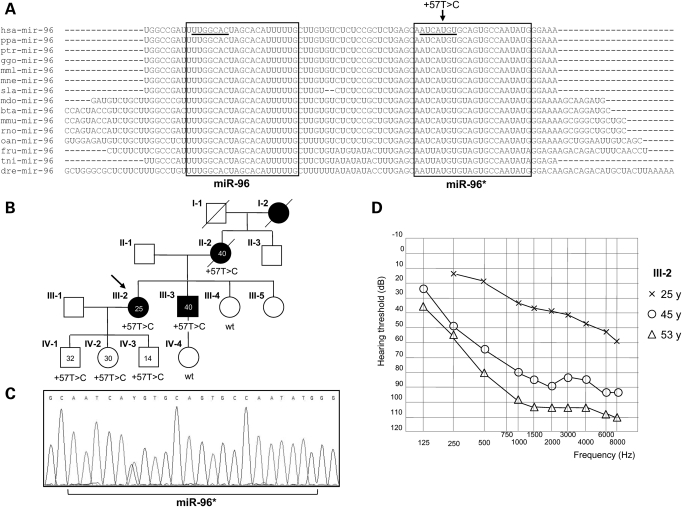
“The last variant identified, miR-96(+57T>C) (NR_029512.1:c.57T>C; NT_007933.15:g.67447397A>G) is located in the stem region of the pre-miRNA and replaces a residue that is fully conserved throughout vertebrate evolution, from fish to primates (Fig. 1A).”
§ A novel mutation within the MIR96 gene causes non-syndromic inherited hearing loss in an Italian family by altering pre-miRNA processing > RESULTS > A novel NSHL-causing mutation within the MIR96 gene
plain- Asserted: passes — The authors put it forward as true.
- Checkable: passes — It can be checked against evidence.
- Load-bearing: passes — The paper’s conclusions depend on it.
- Based: passes — The paper gives a reason why it holds.
It may state two separate claims as one.
A result the paper reports from its own data — it cites no other source for it, so there is none to check. The quote shows it is in the paper.
In the paper
“Although located outside the mature miR-96 sequence, the detected variant replaces a highly conserved nucleotide within the companion miR-96*, and is predicted to reduce the stability of the pre-miRNA hairpin.”
§ A novel mutation within the MIR96 gene causes non-syndromic inherited hearing loss in an Italian family by altering pre-miRNA processing > Abstract
plainSingle case- Asserted: passes — The authors put it forward as true.
- Checkable: passes — It can be checked against evidence.
- Load-bearing: passes — The paper’s conclusions depend on it.
- Based: passes — The paper gives a reason why it holds.
It may state two separate claims as one.
A result the paper reports from its own data — it cites no other source for it, so there is none to check. The quote shows it is in the paper.
In the paper
“In particular, the change occurs at position +6, within the miR-96* seed region (Fig. 1A).”
§ A novel mutation within the MIR96 gene causes non-syndromic inherited hearing loss in an Italian family by altering pre-miRNA processing > RESULTS > A novel NSHL-causing mutation within the MIR96 gene
plain- Asserted: passes — The authors put it forward as true.
- Checkable: passes — It can be checked against evidence.
- Load-bearing: unclear — It is unclear whether the paper’s conclusions depend on it.
- Based: passes — The paper gives a reason why it holds.
It may state two separate claims as one.
A result the paper reports from its own data — it cites no other source for it, so there is none to check. The quote shows it is in the paper.
In the paper
“The miR-96(+57T>C) substitution introduces a base-pairing mismatch, decreasing the free energy value and creating an enlarged RNA bulge in the pre-miR-96 stem, close to the Dicer cleavage site (Fig. 2A).”
§ A novel mutation within the MIR96 gene causes non-syndromic inherited hearing loss in an Italian family by altering pre-miRNA processing > RESULTS > The +57T>C mutation impairs pre-miRNA processing into mature miR-96 and miR-96*
plaindirect- Asserted: passes — The authors put it forward as true.
- Checkable: passes — It can be checked against evidence.
- Load-bearing: passes — The paper’s conclusions depend on it.
- Based: passes — The paper gives a reason why it holds.
It may state two separate claims as one.
- Rests on an assumption: The mfold-predicted secondary structure of pre-miR-96 reflects the actual RNA secondary structure.
A result the paper reports from its own data — it cites no other source for it, so there is none to check. The quote shows it is in the paper.
In the paper
“The miR-96(+57T>C) variant segregates with the phenotype within the family, being present in all affected individuals and absent in the normal hearing individuals III-4 and IV-4.”
§ A novel mutation within the MIR96 gene causes non-syndromic inherited hearing loss in an Italian family by altering pre-miRNA processing > RESULTS > A novel NSHL-causing mutation within the MIR96 gene
plaincorrelationalSingle case- Asserted: passes — The authors put it forward as true.
- Checkable: passes — It can be checked against evidence.
- Load-bearing: passes — The paper’s conclusions depend on it.
- Based: passes — The paper gives a reason why it holds.
It may state two separate claims as one.
A result the paper reports from its own data — it cites no other source for it, so there is none to check. The quote shows it is in the paper.
In the paper
“In this case, the mutant showed a significant reduction in mature miR-96 (P< 0.0001) but, unexpectedly, miR-96* levels were unaffected (Fig. 2D), suggesting an at least partially different pathogenic mechanism.”
§ A novel mutation within the MIR96 gene causes non-syndromic inherited hearing loss in an Italian family by altering pre-miRNA processing > RESULTS > The +57T>C mutation impairs pre-miRNA processing into mature miR-96 and miR-96*
plaindirect- Asserted: passes — The authors put it forward as true.
- Checkable: passes — It can be checked against evidence.
- Load-bearing: passes — The paper’s conclusions depend on it.
- Based: passes — The paper gives a reason why it holds.
It may state two separate claims as one.
- Rests on an assumption: The processing of miR-96 in HeLa cells reflects the processing in the human inner ear relevant to hearing loss.
A result the paper reports from its own data — it cites no other source for it, so there is none to check. The quote shows it is in the paper.
In the paper
“No significant alteration of miR-96, miR-96* and pre-miR-96 levels was measured by real-time RT–PCR, although the rs73159662 mutant tends to produce slightly elevated levels of both mature miRNA species (Supplementary Material, Fig. S3).”
§ A novel mutation within the MIR96 gene causes non-syndromic inherited hearing loss in an Italian family by altering pre-miRNA processing > RESULTS > The +57T>C mutation impairs pre-miRNA processing into mature miR-96 and miR-96*
plain- Asserted: passes — The authors put it forward as true.
- Checkable: passes — It can be checked against evidence.
- Load-bearing: passes — The paper’s conclusions depend on it.
- Based: passes — The paper gives a reason why it holds.
It may state two separate claims as one.
A result the paper reports from its own data — it cites no other source for it, so there is none to check. The quote shows it is in the paper.
In the paper
“Indeed, transfection of a double-mutant vector carrying a compensatory mutation, psiUX-miR-96(+13G>A+66C>T), confirmed this hypothesis: miR-96 levels were still markedly reduced in the double mutant compared with the wild-type (P< 0.0001), and not significantly different from the +13G>A mutant, whereas the miR-96* and pre-miRNA levels remained unaffected (Fig. 2D).”
§ A novel mutation within the MIR96 gene causes non-syndromic inherited hearing loss in an Italian family by altering pre-miRNA processing > RESULTS > The miR-96(+57T>C) mutation is rescued by reconstituting the precursor secondary structure
plain- Asserted: passes — The authors put it forward as true.
- Checkable: passes — It can be checked against evidence.
- Load-bearing: passes — The paper’s conclusions depend on it.
- Based: passes — The paper gives a reason why it holds.
It may state two separate claims as one.
- Rests on an assumption: The processing of miR-96 in HeLa cells reflects the processing in the human inner ear relevant to hearing loss.
A result the paper reports from its own data — it cites no other source for it, so there is none to check. The quote shows it is in the paper.
In the paper
“The miR-96(+57T>C) mutation was found in the heterozygous state in a patient with a family history of autosomal dominant progressive NSHL (with the age of onset ranging from ∼25 to 40) and was absent in all 839 normal-hearing controls.”
§ A novel mutation within the MIR96 gene causes non-syndromic inherited hearing loss in an Italian family by altering pre-miRNA processing > RESULTS > A novel NSHL-causing mutation within the MIR96 gene
plaincorrelationalSingle case- Asserted: passes — The authors put it forward as true.
- Checkable: passes — It can be checked against evidence.
- Load-bearing: passes — The paper’s conclusions depend on it.
- Based: passes — The paper gives a reason why it holds.
It may state two separate claims as one.
The paper states this without a source or data behind it here, so there is nothing to check it against. The quote shows it is in the paper.
In the paper
“In particular, the family carrying the +57(T>C) mutation is characterized by a late onset (between 25 and 40 years) and a slow progression of the hearing impairment.”
§ A novel mutation within the MIR96 gene causes non-syndromic inherited hearing loss in an Italian family by altering pre-miRNA processing > DISCUSSION
plaincorrelationalSingle case- Asserted: passes — The authors put it forward as true.
- Checkable: passes — It can be checked against evidence.
- Load-bearing: unclear — It is unclear whether the paper’s conclusions depend on it.
- Based: passes — The paper gives a reason why it holds.
It may state two separate claims as one.
A result the paper reports from its own data — it cites no other source for it, so there is none to check. The quote shows it is in the paper.
In the paper
“Neither the proband nor any affected individuals of her family referred visual or olfactory problems; however, episodes of vertigo were reported in the proband (III-2), her mother (II-2) and her brother (III-3).”
§ A novel mutation within the MIR96 gene causes non-syndromic inherited hearing loss in an Italian family by altering pre-miRNA processing > RESULTS > A novel NSHL-causing mutation within the MIR96 gene
plainSingle case- Asserted: passes — The authors put it forward as true.
- Checkable: passes — It can be checked against evidence.
- Load-bearing: unclear — It is unclear whether the paper’s conclusions depend on it.
- Based: passes — The paper gives a reason why it holds.
It may state two separate claims as one.
A result the paper reports from its own data — it cites no other source for it, so there is none to check. The quote shows it is in the paper.
In the paper
“The proband shows non-syndromic, bilateral, sensorineural deafness that onset as a mild hearing impairment at ∼25 years and slowly progressed first to a severe form at the age of 45 and then to a profound form in the sixth decade (Fig. 1D).”
§ A novel mutation within the MIR96 gene causes non-syndromic inherited hearing loss in an Italian family by altering pre-miRNA processing > RESULTS > A novel NSHL-causing mutation within the MIR96 gene
plainSingle case- Asserted: passes — The authors put it forward as true.
- Checkable: passes — It can be checked against evidence.
- Load-bearing: unclear — It is unclear whether the paper’s conclusions depend on it.
- Based: passes — The paper gives a reason why it holds.
It may state two separate claims as one.
The paper states this without a source or data behind it here, so there is nothing to check it against. The quote shows it is in the paper.
In the paper
“In the mouse Organ of Corti, the miR-96* could be cloned, but not reliably quantitated by real-time RT–PCR.”
§ A novel mutation within the MIR96 gene causes non-syndromic inherited hearing loss in an Italian family by altering pre-miRNA processing > DISCUSSION
hedged- Asserted: passes — The authors put it forward as true.
- Checkable: passes — It can be checked against evidence.
- Load-bearing: fails — The paper’s conclusions may not depend on it.
- Based: passes — The paper gives a reason why it holds.
Probably not a substantial claim. The paper’s conclusions may not depend on it.
A result the paper reports from its own data — it cites no other source for it, so there is none to check. The quote shows it is in the paper.
In the paper
“Two novel MIR183 variants, miR-183(+3G>T) and miR-183(-27C>T), were detected, each in one proband: both were located outside the mature miRNA sequence at non-conserved nt residues, were absent in normal-hearing controls, but did not segregate with hearing loss in the corresponding families (the variants were absent in at least one affected relative in the corresponding family).”
§ A novel mutation within the MIR96 gene causes non-syndromic inherited hearing loss in an Italian family by altering pre-miRNA processing > RESULTS > A novel NSHL-causing mutation within the MIR96 gene
plain- Asserted: passes — The authors put it forward as true.
- Checkable: passes — It can be checked against evidence.
- Load-bearing: fails — The paper’s conclusions may not depend on it.
- Based: passes — The paper gives a reason why it holds.
Probably not a substantial claim. The paper’s conclusions may not depend on it. It may state two separate claims as one.
A result the paper reports from its own data — it cites no other source for it, so there is none to check. The quote shows it is in the paper.
In the paper
“Profiling of miR-96* expression in a panel of human and mouse tissues evidenced that, although expressed at very low levels, miR-96* shows some degree of differential expression, suggesting that it might be regulated in a tissue-specific manner (Supplementary Material, Fig. S6).”
§ A novel mutation within the MIR96 gene causes non-syndromic inherited hearing loss in an Italian family by altering pre-miRNA processing > DISCUSSION
hedgedcorrelational- Asserted: passes — The authors put it forward as true.
- Checkable: passes — It can be checked against evidence.
- Load-bearing: fails — The paper’s conclusions may not depend on it.
- Based: passes — The paper gives a reason why it holds.
Probably not a substantial claim. The paper’s conclusions may not depend on it. It may state two separate claims as one.
A conclusion the paper draws from its own results — it cites no other source for it, so there is none to check. The quote shows it is in the paper.
In the paper
“While the construct lacking the miR-96*-binding site was still significantly responsive to miR-96 repression (P< 0.01), the mutant deprived of miR-96-binding site was not (Fig. 3A), indicating that MYRIP 3′UTR is regulated uniquely by miR-96, and that the predicted miR-96* binding site is not functional.”
§ A novel mutation within the MIR96 gene causes non-syndromic inherited hearing loss in an Italian family by altering pre-miRNA processing > RESULTS > Impact of the +57T>C mutation on miRNA target regulation
hedgeddirect- Asserted: passes — The authors put it forward as true.
- Checkable: passes — It can be checked against evidence.
- Load-bearing: passes — The paper’s conclusions depend on it.
- Based: passes — The paper gives a reason why it holds.
It may state two separate claims as one.
- Rests on an assumption: The luciferase reporter assays reflect endogenous regulation of miR-96 targets.
A conclusion the paper draws from its own results — it cites no other source for it, so there is none to check. The quote shows it is in the paper.
In the paper
“A novel mutation within the MIR96 gene causes non-syndromic inherited hearing loss in an Italian family by altering pre-miRNA processing”
plaindirectSingle case- Asserted: passes — The authors put it forward as true.
- Checkable: passes — It can be checked against evidence.
- Load-bearing: passes — The paper’s conclusions depend on it.
- Based: passes — The paper gives a reason why it holds.
It may state two separate claims as one.
- Rests on an assumption: The processing of miR-96 in HeLa cells reflects the processing in the human inner ear relevant to hearing loss.
- Rests on an assumption: The presence of the miR-96(+57T>C) variant in three normal-hearing children is due to incomplete penetrance or age-related onset of hearing loss.
A conclusion the paper draws from its own results — it cites no other source for it, so there is none to check. The quote shows it is in the paper.
In the paper
“The miR-96(+57T>C) mutation causes a reduction in both mature miRNAs but does not alter the expression level of the miRNA precursor, thus suggesting a defect in the Dicer-mediated cleavage.”
§ A novel mutation within the MIR96 gene causes non-syndromic inherited hearing loss in an Italian family by altering pre-miRNA processing > RESULTS > The miR-96(+57T>C) mutation is rescued by reconstituting the precursor secondary structure
hedgeddirect- Asserted: passes — The authors put it forward as true.
- Checkable: passes — It can be checked against evidence.
- Load-bearing: passes — The paper’s conclusions depend on it.
- Based: passes — The paper gives a reason why it holds.
It may state two separate claims as one.
- Rests on an assumption: The mfold-predicted secondary structure of pre-miR-96 reflects the actual RNA secondary structure.
A conclusion the paper draws from its own results — it cites no other source for it, so there is none to check. The quote shows it is in the paper.
In the paper
“Moreover, miR-96 and miR-96* expression levels could be restored by a compensatory mutation that reconstitutes the secondary structure of the pre-miR-96 hairpin, demonstrating that the mutation hinders precursor processing, probably interfering with Dicer cleavage.”
§ A novel mutation within the MIR96 gene causes non-syndromic inherited hearing loss in an Italian family by altering pre-miRNA processing > Abstract
hedgedconditionalSingle case- Asserted: passes — The authors put it forward as true.
- Checkable: passes — It can be checked against evidence.
- Load-bearing: passes — The paper’s conclusions depend on it.
- Based: passes — The paper gives a reason why it holds.
It may state two separate claims as one.
- Rests on an assumption: The processing of miR-96 in HeLa cells reflects the processing in the human inner ear relevant to hearing loss.
- Rests on an assumption: The mfold-predicted secondary structure of pre-miR-96 reflects the actual RNA secondary structure.
What the paper did — it cites no source for this, so there is none to check. The quote shows it is in the paper.
In the paper
“Standard curves were generated to verify that the RT–PCR assays had comparable amplification efficiencies (see Materials and Methods and Supplementary Material, Fig. S2).”
§ A novel mutation within the MIR96 gene causes non-syndromic inherited hearing loss in an Italian family by altering pre-miRNA processing > RESULTS > The +57T>C mutation impairs pre-miRNA processing into mature miR-96 and miR-96*
plain- Asserted: passes — The authors put it forward as true.
- Checkable: passes — It can be checked against evidence.
- Load-bearing: passes — The paper’s conclusions depend on it.
- Based: passes — The paper gives a reason why it holds.
Probably not a substantial claim.
A conclusion the paper draws from its own results — it cites no other source for it, so there is none to check. The quote shows it is in the paper.
In the paper
“In the case of the miR-96(+57T>C) mutation, however, a direct role of miR-96* in NSHL pathogenesis has still to be proved.”
§ A novel mutation within the MIR96 gene causes non-syndromic inherited hearing loss in an Italian family by altering pre-miRNA processing > DISCUSSION
plain- Asserted: passes — The authors put it forward as true.
- Checkable: passes — It can be checked against evidence.
- Load-bearing: fails — The paper’s conclusions may not depend on it.
- Based: passes — The paper gives a reason why it holds.
Probably not a substantial claim. The paper’s conclusions may not depend on it.
What the paper did — it cites no source for this, so there is none to check. The quote shows it is in the paper.
In the paper
“This study was approved by the local Ethical Committee of the University of Milan and was performed according to the Declaration of Helsinki and to the Italian legislation on sensible data recording.”
§ A novel mutation within the MIR96 gene causes non-syndromic inherited hearing loss in an Italian family by altering pre-miRNA processing > MATERIALS AND METHODS > Patients selection
plain- Asserted: passes — The authors put it forward as true.
- Checkable: passes — It can be checked against evidence.
- Load-bearing: fails — The paper’s conclusions may not depend on it.
- Based: passes — The paper gives a reason why it holds.
Probably not a substantial claim. The paper’s conclusions may not depend on it. It may state two separate claims as one.
What the paper did — it cites no source for this, so there is none to check. The quote shows it is in the paper.
In the paper
“Although in principle the primers for the amplification of mature miR-96 and miR-96* can also amplify the pre-miRNA, real-time RT–PCR conditions were set up to favor the amplification of the mature forms and the analysis of melting curves confirmed the presence of a single amplification product (data not shown).”
§ A novel mutation within the MIR96 gene causes non-syndromic inherited hearing loss in an Italian family by altering pre-miRNA processing > MATERIALS AND METHODS > Ex-vivo analysis of miRNA expression and biogenesis
plain- Asserted: passes — The authors put it forward as true.
- Checkable: passes — It can be checked against evidence.
- Load-bearing: passes — The paper’s conclusions depend on it.
- Based: passes — The paper gives a reason why it holds.
Probably not a substantial claim. It may state two separate claims as one.
A conclusion the paper draws from its own results — it cites no other source for it, so there is none to check. The quote shows it is in the paper.
In the paper
“The phenotypic differences with the previously reported families might be partly explained by molecular findings: a quantitative defect of miR-96 expression may lead to a delayed or reduced penetrance of the hearing impairment, whereas mutations directly impairing miR-96 target recognition would probably result in an earlier defect of hearing.”
§ A novel mutation within the MIR96 gene causes non-syndromic inherited hearing loss in an Italian family by altering pre-miRNA processing > DISCUSSION
hedgedconditional- Asserted: passes — The authors put it forward as true.
- Checkable: passes — It can be checked against evidence.
- Load-bearing: passes — The paper’s conclusions depend on it.
- Based: passes — The paper gives a reason why it holds.
It may state two separate claims as one.
What the paper did — it cites no source for this, so there is none to check. The quote shows it is in the paper.
In the paper
“In this case, the psiUX constructs used for miRNA expression contained only the miR-96 precursor, thus avoiding the confounding effect of cloning the related miR-183.”
§ A novel mutation within the MIR96 gene causes non-syndromic inherited hearing loss in an Italian family by altering pre-miRNA processing > MATERIALS AND METHODS > MiRNA target validation by luciferase assays
plaindirect- Asserted: passes — The authors put it forward as true.
- Checkable: passes — It can be checked against evidence.
- Load-bearing: fails — The paper’s conclusions may not depend on it.
- Based: passes — The paper gives a reason why it holds.
Probably not a substantial claim. The paper’s conclusions may not depend on it.
What the paper did — it cites no source for this, so there is none to check. The quote shows it is in the paper.
In the paper
“In all experiments, miR-183 was used as internal control to normalize for transfection efficiency.”
§ A novel mutation within the MIR96 gene causes non-syndromic inherited hearing loss in an Italian family by altering pre-miRNA processing > RESULTS > The +57T>C mutation impairs pre-miRNA processing into mature miR-96 and miR-96*
plain- Asserted: passes — The authors put it forward as true.
- Checkable: passes — It can be checked against evidence.
- Load-bearing: fails — The paper’s conclusions may not depend on it.
- Based: passes — The paper gives a reason why it holds.
Probably not a substantial claim. The paper’s conclusions may not depend on it.
None of the sources cited for this claim have been checked yet.
In the paper
“Interestingly, one SNP within the miR-146a, which confers an increased risk to develop thyroid cancer, not only hindered the pre-miRNA processing, but also affected the seed region of the companion miR-146a*, similarly to the miR-96(+57T>C) mutation.”
§ A novel mutation within the MIR96 gene causes non-syndromic inherited hearing loss in an Italian family by altering pre-miRNA processing > DISCUSSION
What the sources say
- Not checked yetcites [26] Jazdzewski, 2009, Polymorphic mature microRNAs from passenger strand of pre-miR-146a contribute to thyroid cancer, Proc. Natl Acad. Sci. USA source
Checked before — its earlier verdict is held back until a new check runs.
plaindirect- Asserted: passes — The authors put it forward as true.
- Checkable: passes — It can be checked against evidence.
- Load-bearing: fails — The paper’s conclusions may not depend on it.
- Based: passes — The paper gives a reason why it holds.
Probably not a substantial claim. The paper’s conclusions may not depend on it. It may state two separate claims as one.
- Not checked yet
What the paper did — it cites no source for this, so there is none to check. The quote shows it is in the paper.
In the paper
“Clinical history ruled out environmental factors as cause of the hearing loss and physical examination did not reveal any evidence of syndromic features.”
§ A novel mutation within the MIR96 gene causes non-syndromic inherited hearing loss in an Italian family by altering pre-miRNA processing > MATERIALS AND METHODS > Patients selection
plain- Asserted: passes — The authors put it forward as true.
- Checkable: passes — It can be checked against evidence.
- Load-bearing: passes — The paper’s conclusions depend on it.
- Based: passes — The paper gives a reason why it holds.
It may state two separate claims as one.
A conclusion the paper draws from its own results — it cites no other source for it, so there is none to check. The quote shows it is in the paper.
In the paper
“Profiling of miR-96* expression in a panel of human and mouse tissues evidenced that, although expressed at very low levels, miR-96* shows some degree of differential expression, suggesting that it might be regulated in a tissue-specific manner (Supplementary Material, Fig. S6).”
§ A novel mutation within the MIR96 gene causes non-syndromic inherited hearing loss in an Italian family by altering pre-miRNA processing > DISCUSSION
hedgedcorrelational- Asserted: passes — The authors put it forward as true.
- Checkable: passes — It can be checked against evidence.
- Load-bearing: fails — The paper’s conclusions may not depend on it.
- Based: passes — The paper gives a reason why it holds.
Probably not a substantial claim. The paper’s conclusions may not depend on it.
What the paper did — it cites no source for this, so there is none to check. The quote shows it is in the paper.
In the paper
“Signed informed consent was obtained from all participants and from parents of subjects younger than 18 years.”
§ A novel mutation within the MIR96 gene causes non-syndromic inherited hearing loss in an Italian family by altering pre-miRNA processing > MATERIALS AND METHODS > Patients selection
plain- Asserted: passes — The authors put it forward as true.
- Checkable: passes — It can be checked against evidence.
- Load-bearing: fails — The paper’s conclusions may not depend on it.
- Based: passes — The paper gives a reason why it holds.
Probably not a substantial claim. The paper’s conclusions may not depend on it. It may state two separate claims as one.
In the paper
“This is the third mutation described in this gene in humans, and the first in a different population from that of the original report (14).”
§ A novel mutation within the MIR96 gene causes non-syndromic inherited hearing loss in an Italian family by altering pre-miRNA processing > DISCUSSION
What the sources say
- Not checked — no full text of the sourcecites [14] Mencía, 2009, Mutations in the seed region of human miR-96 are responsible for nonsyndromic progressive hearing loss, Nat. Genet. source
plain- Asserted: passes — The authors put it forward as true.
- Checkable: passes — It can be checked against evidence.
- Load-bearing: unclear — It is unclear whether the paper’s conclusions depend on it.
- Based: passes — The paper gives a reason why it holds.
It may state two separate claims as one.
What the paper did — it cites no source for this, so there is none to check. The quote shows it is in the paper.
In the paper
“Conversely, standard curves were generated to verify that the RT–PCR assays to detect: (i) wild-type miR-96, miR-96(+13G>A) or miR-96(+23A>G); (ii) wild-type miR-96* and miR-96*(+66T>C); (iii) wild-type pre-miR-96, pre-miR-96(+42C>T) and pre-miR-96(+36T>C) had comparable amplification efficiencies (Supplementary Material, Fig. S2).”
§ A novel mutation within the MIR96 gene causes non-syndromic inherited hearing loss in an Italian family by altering pre-miRNA processing > MATERIALS AND METHODS > Ex-vivo analysis of miRNA expression and biogenesis
plain- Asserted: passes — The authors put it forward as true.
- Checkable: passes — It can be checked against evidence.
- Load-bearing: passes — The paper’s conclusions depend on it.
- Based: passes — The paper gives a reason why it holds.
Probably not a substantial claim.
None of the sources cited for this claim have been checked yet.
In the paper
“The miR-146a* was expressed in both normal and tumor thyroid tissues and the altered regulation of the miRNA* targets in heterozygotes compared with homozygotes was suggested as the possible mechanism underlying tumor predisposition (26).”
§ A novel mutation within the MIR96 gene causes non-syndromic inherited hearing loss in an Italian family by altering pre-miRNA processing > DISCUSSION
What the sources say
- Not checked yetcites [26] Jazdzewski, 2009, Polymorphic mature microRNAs from passenger strand of pre-miR-146a contribute to thyroid cancer, Proc. Natl Acad. Sci. USA source
Checked before — its earlier verdict is held back until a new check runs.
hedgedconditional- Asserted: passes — The authors put it forward as true.
- Checkable: passes — It can be checked against evidence.
- Load-bearing: fails — The paper’s conclusions may not depend on it.
- Based: passes — The paper gives a reason why it holds.
Probably not a substantial claim. The paper’s conclusions may not depend on it. It may state two separate claims as one.
- Not checked yet
None of the sources cited for this claim have been checked yet.
In the paper
“Other studies have reported that common SNPs within miRNA genes can lead to impaired miRNA processing, and might be associated with increased susceptibility to human diseases (23–25).”
§ A novel mutation within the MIR96 gene causes non-syndromic inherited hearing loss in an Italian family by altering pre-miRNA processing > DISCUSSION
What the sources say
- Not checked — no full text of the sourcecites [23] Duan, 2007, Single nucleotide polymorphism associated with mature miR-125a alters the processing of pri-miRNA, Hum. Mol. Genet. source
- Not checked yetcites [24] Sun, 2009, SNPs in human miRNA genes affect biogenesis and function, RNA source
Checked before — its earlier verdict is held back until a new check runs.
- Not checked yetcites [25] Jazdzewski, 2008, Common SNP in pre-miR-146a decreases mature miR expression and predisposes to papillary thyroid carcinoma, Proc. Natl Acad. Sci. USA source
Checked before — its earlier verdict is held back until a new check runs.
hedgedcorrelational- Asserted: passes — The authors put it forward as true.
- Checkable: passes — It can be checked against evidence.
- Load-bearing: fails — The paper’s conclusions may not depend on it.
- Based: passes — The paper gives a reason why it holds.
Probably not a substantial claim. The paper’s conclusions may not depend on it. It may state two separate claims as one.
A conclusion the paper draws from its own results — it cites no other source for it, so there is none to check. The quote shows it is in the paper.
In the paper
“Interestingly, also the three affected families (the two Spanish and the here reported Italian one) show some degree of phenotypic variation, suggesting that the pathogenic mechanisms underlying each family's phenotype might be at least partially different.”
§ A novel mutation within the MIR96 gene causes non-syndromic inherited hearing loss in an Italian family by altering pre-miRNA processing > DISCUSSION
hedgedconditionaln = 3- Asserted: passes — The authors put it forward as true.
- Checkable: passes — It can be checked against evidence.
- Load-bearing: fails — The paper’s conclusions may not depend on it.
- Based: passes — The paper gives a reason why it holds.
Probably not a substantial claim. The paper’s conclusions may not depend on it.
The paper relies on this without support.
The processing of miR-96 in HeLa cells reflects the processing in the human inner ear relevant to hearing loss.
“To this aim, expression vectors (psiUX) containing genomic DNA fragments spanning both miR-183 and miR-96 precursors, and corresponding to either the miR-96 wild-type or the miR-96(+57T>C) sequences, were generated and used to transiently transfect HeLa cells.”
The paper relies on this without support.
The mfold-predicted secondary structure of pre-miR-96 reflects the actual RNA secondary structure.
“we used the mfold program (19) to examine how the newly identified nt variation could alter the predicted RNA secondary structure of pre-miR-96.”
The paper relies on this without support.
The luciferase reporter assays reflect endogenous regulation of miR-96 targets.
“we co-transfected a vector expressing either the wild-type or the mutant pre-miR-96 hairpin into HeLa cells, together with a construct containing the luciferase reporter cDNA coupled to the 3′UTR of each target gene (psiCHECK2-3′UTR).”
The paper relies on this without support.
The presence of the miR-96(+57T>C) variant in three normal-hearing children is due to incomplete penetrance or age-related onset of hearing loss.
“this may be due either to the age-relatedness of hearing loss in the family (all non-penetrants are below the average age of onset of the disease among affected relatives) or to incomplete penetrance.”
Claims other papers make about this one
Each is checked against this paper’s own text: does it say what the citing paper says it does?
The source backs part of the claim, not all of it — or backs it for a different population, condition or comparison.
In the citing paper
“Heterozygous loss-of-function point mutations of miRNA genes are associated with several human congenital disorders1–5”
From Gain-of-function mutation of microRNA-140 in human skeletal dysplasia (2019) · cites this paper as [2]
Experimental — accuracy not yet measuredThe source backs part of the claim, not all of it — or backs it for a different population, condition or comparison.
In the citing paper
“Besides gene dosage abnormalities37,38, single nucleotide substitutions in two miRNA genes have been identified in human diseases: MIR96 mutations in autosomal dominant deafness 50 (#613704) and MIR184 mutations in EDICT syndrome (#614303) and familial and sporadic cases of keratoconus1–5,39.”
From Gain-of-function mutation of microRNA-140 in human skeletal dysplasia (2019) · cites this paper as [2]
Experimental — accuracy not yet measured
Self-check
Percentages, sums and reported differences re-computed from the paper’s own numbers.
Each contradiction between two passages listed here was confirmed by an independent check.
Rated minor: it would not touch a result — a value no result rests on, a p-value that stays on the same side of the significance level, or a conflict that is clerical, resolved elsewhere in the paper, or outside its own findings.
In the paper
§ A novel mutation within the MIR96 gene causes non-syndromic inherited hearing loss in an Italian family by altering pre-miRNA processing > RESULTS > A novel NSHL-causing mutation within the MIR96 gene
“The miR-96(+57T>C) mutation was found in the heterozygous state in a patient with a family history of autosomal dominant progressive NSHL (with the age of onset ranging from ∼25 to 40) and was absent in all 839 normal-hearing controls.”
§ A novel mutation within the MIR96 gene causes non-syndromic inherited hearing loss in an Italian family by altering pre-miRNA processing > RESULTS > A novel NSHL-causing mutation within the MIR96 gene
“A cohort composed of 882 genetically undiagnosed Italian NSHL patients, including sporadic and familial cases, and 836 normal-hearing Italian controls was screened for mutations in miR-96, miR-182 and miR-183 genes.”
Rated minor: it would not touch a result — a value no result rests on, a p-value that stays on the same side of the significance level, or a conflict that is clerical, resolved elsewhere in the paper, or outside its own findings.
In the paper
§ A novel mutation within the MIR96 gene causes non-syndromic inherited hearing loss in an Italian family by altering pre-miRNA processing > MATERIALS AND METHODS > Ex-vivo analysis of miRNA expression and biogenesis
“wild-type miR-96* and miR-96*(+66T>C)”
§ A novel mutation within the MIR96 gene causes non-syndromic inherited hearing loss in an Italian family by altering pre-miRNA processing > RESULTS > The miR-96(+57T>C) mutation is rescued by reconstituting the precursor secondary structure
“psiUX-miR-96(+13G>A+66C>T)”
Citations
Cites
Analysis of Relative Gene Expression Data Using Real-Time Quantitative PCR and the 2−ΔΔCT Method
Livak, K. J., & Schmittgen, T. D. (2001) · Methods · doi:10.1006/meth.2001.1262 · Cited by 180,860
MicroRNAs: Target Recognition and Regulatory Functions
Bartel, D. P. (2009) · Cell · doi:10.1016/j.cell.2009.01.002 · Cited by 20,068
Mfold web server for nucleic acid folding and hybridization prediction
Zuker, M. (2003) · Nucleic Acids Research · doi:10.1093/nar/gkg595 · Cited by 13,404
The widespread regulation of microRNA biogenesis, function and decay
Krol, J., Loedige, I., & Filipowicz, W. (2010) · Nature Reviews Genetics · doi:10.1038/nrg2843 · Cited by 4,672
Mutation of the mouse klotho gene leads to a syndrome resembling ageing
Kuro-o, M., Matsumura, Y., Aizawa, H., Kawaguchi, H., Suga, T., Utsugi, T., Ohyama, Y., Kurabayashi, M., Kaname, T., Kume, E., et al. (1997) · Nature · doi:10.1038/36285 · Cited by 3,837
Beighton, P., & Beighton, G. (1997) · Springer eBooks · doi:10.1007/978-1-4471-0925-9_118 · Cited by 3,165
The role of site accessibility in microRNA target recognition
Kertesz, M., Iovino, N., Unnerstall, U., Gaul, U., & Segal, E. (2007) · Nature Genetics · doi:10.1038/ng2135 · Cited by 2,460
Gene silencing by microRNAs: contributions of translational repression and mRNA decay
Huntzinger, E., & Izaurralde, E. (2011) · Nature Reviews Genetics · doi:10.1038/nrg2936 · Cited by 2,339
RNAhybrid: microRNA target prediction easy, fast and flexible
Kruger, J., & Rehmsmeier, M. (2006) · Nucleic Acids Research · doi:10.1093/nar/gkl243 · Cited by 1,941
Comprehensive modeling of microRNA targets predicts functional non-conserved and non-canonical sites
Betel, D., Koppal, A., Agius, P., Sander, C., & Leslie, C. (2010) · Genome Biology · doi:10.1186/gb-2010-11-8-r90 · Cited by 1,592
Cited by
Sorted by citations
Items 101–102 of 102
Genetics of the Monogenic Causes of Nonsyndromic Hearing Loss
Khetarpal, P., Panigrahi, I., & Thakur, S. (2024) · Encyclopedia of Life Sciences · doi:10.1002/9780470015902.a0029715
Computational Approaches for Predicting Mutation Effects on RNA Structure
Sabarinathan, R., & Gorodkin, J. (2014) · Elsevier eBooks · doi:10.1016/b978-0-444-53632-7.01109-6
Metadata
- Authors
- Soldà, G., Robusto, M., Primignani, P., Castorina, P., Benzoni, E., Cesarani, A., Ambrosetti, U., Asselta, R., & Duga, S.
- Affiliations
- University of Milan (IT)
- Fondazione IRCCS Ca' Granda Ospedale Maggiore Policlinico (IT)
- Corresponding author
- Soldà, Giulia
- Venue
- Human Molecular Genetics
- Publisher
- Oxford University Press (OUP)
- Published
- 2011-10-28
- Volume
- 21
- Issue
- 3
- Pages
- 577-585
- ISSN
- 0964-6906 (ISSN-L)
- 1460-2083
- PMC
- PMC3259013
- OpenAlex
- W2109723356
- Cited by
- 102
- References
- 39
- Citations by year
- 2026: 1 · 2025: 5 · 2024: 10 · 2023: 6 · 2022: 6 · 2021: 2 · 2020: 6 · 2019: 9 · 2018: 7 · 2017: 9 · 2016: 5 · 2015: 13 · 2014: 7 · 2013: 13 · 2012: 3
- FWCI
- 3.61
- Type
- journal article
- Language
- en
- Open access
- hybrid
- doi.org
- Licence
- cc-by-nc
- Locations
- Human Molecular Genetics (publishedVersion, cc-by-nc)
- PubMed (publishedVersion)
- Europe PMC (PubMed Central) (submittedVersion, cc-by-nc)
- PubMed Central (submittedVersion, cc-by-nc)
- Topics
- Life Sciences › Neuroscience › Sensory Systems › Hearing, Cochlea, Tinnitus, Genetics
- Life Sciences › Biochemistry, Genetics and Molecular Biology › Cancer Research › MicroRNA in disease regulation
- Health Sciences › Medicine › Genetics (clinical) › Congenital Ear and Nasal Anomalies
- Keywords
- miR-96, non-syndromic sensorineural hearing loss, pre-miRNA processing, compensatory mutations, microRNA biogenesis, inner ear development, Italian families
- MeSH terms
- Gene Expression Regulation, Hearing Loss, Sensorineural, HeLa Cells, Humans, Italy, Mutation, Nucleic Acid Conformation, RNA Precursors, RNA Processing, Post-Transcriptional, MicroRNAs
About these checks
Registry, retraction, Cites and statistics results are computed, not judged, with one exception: a printed reference that no index lists is read once by a model before it counts as a citation error. Claims are extracted by a model and kept only when their quote appears verbatim in the text; each cited source is then checked, with a model’s help, for whether it says what the claim relies on. Those verdicts can be wrong — read the claim’s quote and the cited source before relying on one.
A language model drew the claims from the paper on 2026-10-20, under version 3 of the claim definition (model deepseek-v4.1-flash, prompt extract-v3).
A second model labelled each claim on 2026-10-20 (model jev-1.13-20260917, definition revision gold-guideline-v0.2).
Cited sources are checked with a language model’s help (gpt-6-sol).
Statistics and arithmetic are recomputed, not judged.
Confidence bands are shown only for fields calibrated on our annotated test set. None is calibrated yet, so no band is shown.
What counts as a claim ›How we measure confidence ›How we check this ›
Are you an author, or do you see a problem with this page? Request a review
