

Monospecific renaming within the cyanobacterial genus Limnospira (Spirulina) and consequences for food authorization
Open accessThe DOI matches its Crossref record; 68 of the 69 references it cites were found in a registry or an index.
Abstract
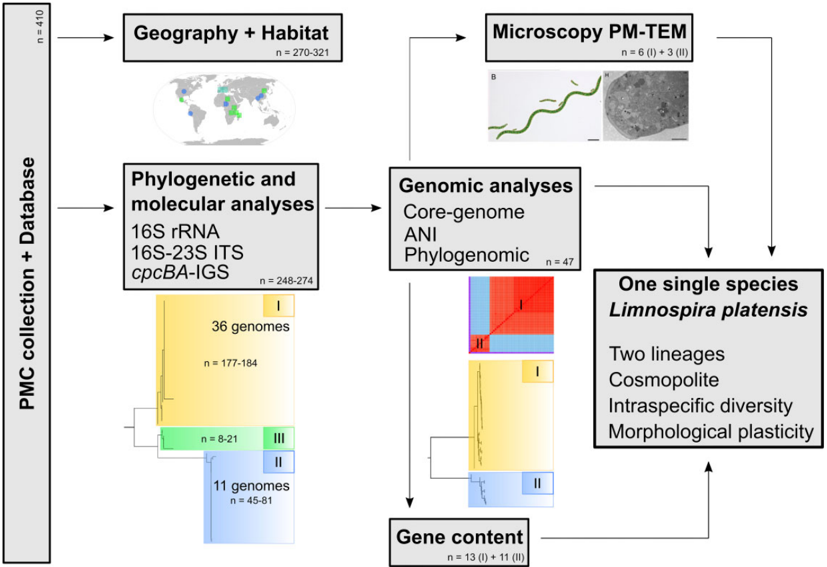
Aims: The cyanobacterial genus, Limnospira (anc. Arthrospira Stizenberger ex Gomont 1892), commonly called “Spirulina”, is widely used for commercial purposes because of its high protein content and beneficial probiotic metabolites. Thus, the taxonomy of this genus is important because of its consequences for food applications. Methods and results: We constructed a database with formation on all Limnospira strains plus new ones from 72 new French isolates. We used a polyphasic approach (phylogenetic, phylogenomic, presence or absence of coding DNA sequences, morphological, and ultrastructure analyses) to confirm that the species A. platensis belonged to the genus Limnospira (L. platensis Gomont comb. nov. Basionym. Arthrospira platensis Gomont 1892) and that the genus Limnospira was monospecific, only represented by L. platensis. Conclusions: This study highlighted the large intra-specific diversity of L. platensis, independent of the affiliations of the phylogenetic clades or geographical location of the habitats and the subsequent physiological and metabolic plasticity.
Overview
The claims and statistics of this paper haven’t been checked yet.
Free: it reads the open-access text and checks the first 5 claims that cite a source we can check. Create a free account to check every claim.
Integrity signals
Registry
Cites
Statistics
Figures
Verification
Claims the paper makes
The claims and statistics of this paper haven’t been checked yet.
Free: it reads the open-access text and checks the first 5 claims that cite a source we can check. Create a free account to check every claim.
Claims other papers make about this one
Each is checked against this paper’s own text: does it say what the citing paper says it does?
The cited source doesn’t support the claim as written.
In the citing paper
“Summarizing the taxonomical pirouettes of spirulina, one can conclude that three groups of organisms are distinguished at present:Spirulina spp.—12 species with the type strain Spirulina subsalsa;Arthrospira spp.—about 35 species with the type strain Arthrospira jenneri;Limnospira spp.—4 species with the type strain Limnospira fusiformis (formerly Spirulina fusiformis), as well as Limnospira (”
From Spirulina/Arthrospira/Limnospira—Three Names of the Single Organism (2024) · cites this paper as [27]
Checked by a reasoning model — may be wrong.
Experimental — accuracy not yet measuredThe source backs part of the claim, not all of it — or backs it for a different population, condition or comparison.
In the citing paper
“Recent advances in whole-genome sequencing allowed the comparison of complete and draft genomes of Limnospira strains (30 genomes of strains in total, many of which have been newly isolated) [27]. This comparison revealed that the genus Limnospira is rather monospecific and represented by L. platensis PCC 7345 (number in Pasteur Culture Collection; accessed on 14 August 2024) as a reference strain”
From Spirulina/Arthrospira/Limnospira—Three Names of the Single Organism (2024) · cites this paper as [27]
Experimental — accuracy not yet measuredThe cited source says what the claim attributes to it.
In the citing paper
“All other strains, including the previously named L. fusiformis, L. indica, L. maxima, and all other related strains should be considered as substrains of L. platensis [27]”
From Spirulina/Arthrospira/Limnospira—Three Names of the Single Organism (2024) · cites this paper as [27]
Self-check
Percentages, sums and reported differences re-computed from the paper’s own numbers.
The self-check needs the paper’s full text.
Citations
Cites
Fast gapped-read alignment with Bowtie 2
Langmead, B., & Salzberg, S. L. (2012) · Nature Methods · doi:10.1038/nmeth.1923 · Cited by 56,400
MEGA X: Molecular Evolutionary Genetics Analysis across Computing Platforms
Kumar, S., Stecher, G., Li, M., Knyaz, C., & Tamura, K. (2018) · Molecular Biology and Evolution · doi:10.1093/molbev/msy096 · Cited by 37,529
SPAdes: A New Genome Assembly Algorithm and Its Applications to Single-Cell Sequencing
Bankevich, A., Nurk, S., Antipov, D., Gurevich, A. A., Dvorkin, M., Kulikov, A. S., Lesin, V. M., Nikolenko, S. I., Pham, S., Prjibelski, A. D., et al. (2012) · Journal of Computational Biology · doi:10.1089/cmb.2012.0021 · Cited by 25,987
Prokka: rapid prokaryotic genome annotation
Seemann, T. (2014) · Bioinformatics · doi:10.1093/bioinformatics/btu153 · Cited by 18,818
Mfold web server for nucleic acid folding and hybridization prediction
Zuker, M. (2003) · Nucleic Acids Research · doi:10.1093/nar/gkg595 · Cited by 13,404
Parks, D. H., Imelfort, M., Skennerton, C. T., Hugenholtz, P., & Tyson, G. W. (2015) · Genome Research · doi:10.1101/gr.186072.114 · Cited by 12,496
Interactive Tree Of Life (iTOL) v5: an online tool for phylogenetic tree display and annotation
Letunic, I., & Bork, P. (2021) · Nucleic Acids Research · doi:10.1093/nar/gkab301 · Cited by 11,124
MAFFT online service: multiple sequence alignment, interactive sequence choice and visualization
Katoh, K., Rozewicki, J., & Yamada, K. D. (2019) · Briefings in Bioinformatics · doi:10.1093/bib/bbx108 · Cited by 8,909
High throughput ANI analysis of 90K prokaryotic genomes reveals clear species boundaries
Jain, C., Rodriguez-R, L. M., Phillippy, A. M., Konstantinidis, K. T., & Aluru, S. (2018) · Nature Communications · doi:10.1038/s41467-018-07641-9 · Cited by 5,748
Roary: rapid large-scale prokaryote pan genome analysis
Page, A. J., Cummins, C. A., Hunt, M., Wong, V. K., Reuter, S., Holden, M. T. G., Fookes, M., Falush, D., Keane, J. A., & Parkhill, J. (2015) · Bioinformatics · doi:10.1093/bioinformatics/btv421 · Cited by 5,736
(2021) · doi:10.1093/molbev/msab293 · Cited by 5,335
Kang, D. D., Li, F., Kirton, E., Thomas, A., Egan, R., An, H., & Wang, Z. (2019) · PeerJ · doi:10.7717/peerj.7359 · Cited by 3,750
A large-scale evaluation of algorithms to calculate average nucleotide identity
Yoon, S.-H., Ha, S.-M., Lim, J., Kwon, S., & Chun, J. (2017) · Antonie van Leeuwenhoek · doi:10.1007/s10482-017-0844-4 · Cited by 3,632
ABGD, Automatic Barcode Gap Discovery for primary species delimitation
PUILLANDRE, N., LAMBERT, A., BROUILLET, S., & ACHAZ, G. (2012) · Molecular Ecology · doi:10.1111/j.1365-294x.2011.05239.x · Cited by 3,324
Kim, M., Oh, H.-S., Park, S.-C., & Chun, J. (2014) · International Journal of Systematic and Evolutionary Microbiology · doi:10.1099/ijs.0.059774-0 · Cited by 3,202
Yarza, P., Yilmaz, P., Pruesse, E., Glöckner, F. O., Ludwig, W., Schleifer, K.-H., Whitman, W. B., Euzéby, J., Amann, R., & Rosselló-Móra, R. (2014) · Nature Reviews Microbiology · doi:10.1038/nrmicro3330 · Cited by 2,589
Criscuolo, A., & Gribaldo, S. (2010) · BMC Evolutionary Biology · doi:10.1186/1471-2148-10-210 · Cited by 1,633
(2002) · doi:10.1007/0-306-46855-7 · Cited by 1,429
COG database update: focus on microbial diversity, model organisms, and widespread pathogens
Galperin, M. Y., Wolf, Y. I., Makarova, K. S., Vera Alvarez, R., Landsman, D., & Koonin, E. V. (2021) · Nucleic Acids Research · doi:10.1093/nar/gkaa1018 · Cited by 932
Spirulina, the edible microorganism.
Ciferri, O. (1983) · Microbiological Reviews · doi:10.1128/mmbr.47.4.551-578.1983 · Cited by 745
Spirulina Platensis Arthrospira
(1997) · doi:10.1201/9781482272970 · Cited by 704
Robust taxonomic classification of uncharted microbial sequences and bins with CAT and BAT
von Meijenfeldt, F. A. B., Arkhipova, K., Cambuy, D. D., Coutinho, F. H., & Dutilh, B. E. (2019) · Genome Biology · doi:10.1186/s13059-019-1817-x · Cited by 541
Natural Products from Cyanobacteria: Focus on Beneficial Activities
Demay, J., Bernard, C., Reinhardt, A., & Marie, B. (2019) · Marine Drugs · doi:10.3390/md17060320 · Cited by 324
Self-citationAndrade, L. M. (2018) · MOJ Food Processing & Technology · doi:10.15406/mojfpt.2018.06.00144 · Cited by 272
Polyphyly of true branching cyanobacteria (Stigonematales)
Gugger, M. F., & Hoffmann, L. (2004) · International Journal of Systematic and Evolutionary Microbiology · doi:10.1099/ijs.0.02744-0 · Cited by 192
Nowicka-Krawczyk, P., Mühlsteinová, R., & Hauer, T. (2019) · Scientific Reports · doi:10.1038/s41598-018-36831-0 · Cited by 185
How many species of Cyanobacteria are there? Using a discovery curve to predict the species number
Nabout, J. C., Rocha, B. S., Carneiro, F. M., & Sant’Anna, C. L. (2013) · Biodiversity and Conservation · doi:10.1007/s10531-013-0561-x · Cited by 164
Genetic Diversity of Cylindrospermopsis Strains (Cyanobacteria) Isolated from Four Continents
Gugger, M., Molica, R., Le Berre, B., Dufour, P., Bernard, C., & Humbert, J.-F. (2005) · Applied and Environmental Microbiology · doi:10.1128/aem.71.2.1097-1100.2005 · Cited by 161
Self-citationHarvest of Arthrospira platensis from Lake Kossorom (Chad) and its household usage among the Kanembu
Abdulqader, G., Barsanti, L. A., & Tredici, M. R. (2000) · Journal of Applied Phycology · doi:10.1023/a:1008177925799 · Cited by 154
Riboflavin, niacin, folate and vitamin B12 in commercial microalgae powders
Edelmann, M., Aalto, S., Chamlagain, B., Kariluoto, S., & Piironen, V. (2019) · Journal of Food Composition and Analysis · doi:10.1016/j.jfca.2019.05.009 · Cited by 152
Ecogenomics and Taxonomy of Cyanobacteria Phylum
Walter, J. M., Coutinho, F. H., Dutilh, B. E., Swings, J., Thompson, F. L., & Thompson, C. C. (2017) · Frontiers in Microbiology · doi:10.3389/fmicb.2017.02132 · Cited by 149
RAxML-Light: a tool for computing terabyte phylogenies
Stamatakis, A., Aberer, A. J., Goll, C., Smith, S. A., Berger, S. A., & Izquierdo-Carrasco, F. (2012) · Bioinformatics · doi:10.1093/bioinformatics/bts309 · Cited by 148
A shared core microbiome in soda lakes separated by large distances
Zorz, J., Sharp, C. E., Kleiner, M., Gordon, P. M. K., Pon, R. T., Dong, X., & Strous, M. (2019) · Nature Communications · doi:10.1038/s41467-019-12195-5 · Cited by 145
Airborne Algae and Cyanobacteria Occurrence and Related Health Effects
Moustaka-Gouni, M. (2011) · Frontiers in Bioscience · doi:10.2741/e285 · Cited by 143
Μάρκου, Γ. (2014) · Applied Biochemistry and Biotechnology · doi:10.1007/s12010-014-0727-3 · Cited by 131
Highly repetitive DNA sequences in cyanobacterial genomes
Mazel, D., Houmard, J., Castets, A. M., & Tandeau de Marsac, N. (1990) · Journal of Bacteriology · doi:10.1128/jb.172.5.2755-2761.1990 · Cited by 127
Using Core Genome Alignments To Assign Bacterial Species
Chung, M. C., Munro, J. B., Tettelin, H., & Hotopp, J. C. D. (2018) · mSystems · doi:10.1128/msystems.00236-18 · Cited by 98
Scheldeman, P., Baurain, D., Bouhy, R., Scott, M., Mühling, M., Whitton, B. A., Belay, A., & Wilmotte, A. (1999) · FEMS Microbiology Letters · doi:10.1111/j.1574-6968.1999.tb13471.x · Cited by 94
Defining Cyanobacterial Species: Diversity and Description Through Genomics
Willis, A., & Woodhouse, J. N. (2020) · Critical Reviews in Plant Sciences · doi:10.1080/07352689.2020.1763541 · Cited by 82
Algae as food and food supplements in Europe
Araújo, R., & Peteiro, C. (2021) · DIGITAL.CSIC (Spanish National Research Council (CSIC)) · doi:10.2760/049515 · Cited by 71
Cellamare, M., Duval, C., Drelin, Y., Djédiat, C., Touibi, N., Agogué, H., Leboulanger, C., Ader, M., & Bernard, C. (2018) · FEMS Microbiology Ecology · doi:10.1093/femsec/fiy108 · Cited by 69
Self-citationLin, S., Haas, S. A., Żemojtel, T., Xiao, P., Vingron, M., & Li, R. (2010) · Nature Precedings · doi:10.1016/j.gene.2010.11.011 · Cited by 69
Dadheech, P. K., Ballot, A., Casper, P., Kotut, K., Novelo, E., Lemma, B., Pröschold, T., & Krienitz, L. (2010) · Phycologia · doi:10.2216/09-71.1 · Cited by 61
Baurain, D., Renquin, L., Grubisic, S., Scheldeman, P., Belay, A., & Wilmotte, A. (2002) · Journal of Phycology · doi:10.1046/j.1529-8817.2002.01010.x · Cited by 50
Mazel, D., Bernard, C., Schwarz, R., Castets, A. M., Houmard, J., & de Marsac, N. T. (1991) · Molecular Microbiology · doi:10.1111/j.1365-2958.1991.tb02146.x · Cited by 48
Self-citationManen, J.-F., & Falquet, J. (2002) · International Journal of Systematic and Evolutionary Microbiology · doi:10.1099/00207713-52-3-861 · Cited by 47
Quo vadis, taxonomy of cyanobacteria (2019)
Komárek, J. (2020) · Fottea · doi:10.5507/fot.2019.020 · Cited by 45
Leboulanger, C., Agogué, H., Bernard, C., Bouvy, M., Carré, C., Cellamare, M., Duval, C., Fouilland, É., Got, P., Intertaglia, L., et al. (2017) · PLoS ONE · doi:10.1371/journal.pone.0168879 · Cited by 45
Self-citationBallot, A., Dadheech, P. K., & Krienitz, L. (2004) · Algological Studies/Archiv für Hydrobiologie, Supplement Volumes · doi:10.1127/1864-1318/2004/0113-0037 · Cited by 43
Avila-Leon, I., Chuei Matsudo, M., Sato, S., & de Carvalho, J. C. M. (2012) · Journal of Applied Microbiology · doi:10.1111/j.1365-2672.2012.05303.x · Cited by 38
Natural and anthropogenic dispersal of cyanobacteria: a review
Curren, E., & Leong, S. C. Y. (2020) · Hydrobiologia · doi:10.1007/s10750-020-04286-y · Cited by 38
(2021) · doi:10.1101/2021.04.13.439755 · Cited by 36
Castro-Severyn, J., Pardo-Esté, C., Mendez, K. N., Fortt, J., Marquez, S., Molina, F., Castro-Nallar, E., Remonsellez, F., & Saavedra, C. P. (2021) · Microbiology Spectrum · doi:10.1128/spectrum.00444-21 · Cited by 36
Berthold, D. E., Lefler, F. W., & Laughinghouse, H. D. (2022) · Phycologia · doi:10.1080/00318884.2021.2006589 · Cited by 27
Taxonomic revision of commercially used Arthrospira(Cyanobacteria) strains: a polyphasic approach
Papapanagiotou, G., & Gkelis, S. (2019) · European Journal of Phycology · doi:10.1080/09670262.2019.1624832 · Cited by 26
Hamlaoui, S., Yéprémian, C., Duval, C., Marie, B., Djédiat, C., Piquet, B., Bernard, C., & Duperron, S. (2022) · Cryptogamie Algologie · doi:10.5252/cryptogamie-algologie2022v43a3 · Cited by 26
Self-citationCarrieri, D., Ananyev, G., Lenz, O., Bryant, D. A., & Dismukes, G. C. (2011) · Applied and Environmental Microbiology · doi:10.1128/aem.00612-11 · Cited by 25
Does a Barcoding Gap Exist in Prokaryotes? Evidences from Species Delimitation in Cyanobacteria
Eckert, E. M., Fontaneto, D., Coci, M., & Callieri, C. (2014) · Life · doi:10.3390/life5010050 · Cited by 25
Manen, J. F. (2002) · INTERNATIONAL JOURNAL OF SYSTEMATIC AND EVOLUTIONARY MICROBIOLOGY · doi:10.1099/ijs.0.01981-0 · Cited by 23
Bouma‐Gregson, K., Crits‐Christoph, A., Olm, M. R., Power, M. E., & Banfield, J. F. (2021) · Molecular Ecology · doi:10.1111/mec.16208 · Cited by 21
Miklaszewska, M., Waleron, M., Morin, N., Calusinska, M., Wilmotte, A., Tandeau De Marsac, N., Rippka, R., & Waleron, K. (2012) · European Journal of Phycology · doi:10.1080/09670262.2012.692817 · Cited by 19
Misztak, A. E., Waleron, M., Furmaniak, M., Waleron, M. M., Bazhenova, O., Daroch, M., & Waleron, K. F. (2021) · Cells · doi:10.3390/cells10123411 · Cited by 19
Rasouli-Dogaheh, S., Komárek, J., Chatchawan, T., & Hauer, T. (2022) · PLoS ONE · doi:10.1371/journal.pone.0261682 · Cited by 19
Comte, K., Coursin, T., & Carre-Mlouka, A. (2013) · Phycologia · doi:10.2216/12-063.1 · Cited by 9
Using Core Genome Alignments to Assign Bacterial SpeciesPreprint
Chung, M. C., Munro, J. B., & Hotopp, J. C. D. (2018) · bioRxiv (Cold Spring Harbor Laboratory) · doi:10.1101/328021 · Cited by 7
Willis, A., Woodhouse, J. N., Neilan, B. A., & Burford, M. A. (2021) · Elsevier eBooks · doi:10.1016/b978-0-12-822861-6.00021-2 · Cited by 5
Kumar, D., Dhar, D. W., Nehra, P., & Kumar, N. (2017) · Cited by 4
STUDIES ON THE MICROSTRUCTURE AND ULTRASTRUCTURE OF Spirulina erdosensis
Xiuying, T., Chen, Q., Gao, L.-Y., et al. (2002) · Journal of Inner Mongolia Agricultural University · Cited by 1
STUDIES ON THE MICROSTRUCTURE AND ULTRASTRUCTURE OF Spirulina erdosensis
田秀英, 乔辰, 高凌岩, 郭芳芳, & 张炳文 (2002) · Journal of Inner Mongolia Agricultural University · Cited by 1
Research works printed but not linked: 11
- 11. Castenholz RW. Subsection III, order oscillatoriales. In: Stanley JT, Bryant MP, Pfenning N, Holt JG (eds), Bergey's Man- ual Syst Bacteriol . Baltimore: William and Wilkins, 1989, 1771-80.
- 21. Desikachary TV , Jeeji Bai N. Taxonomic studies in Spirulina. In: Se- shradi CV, Jeeji Bai N (eds), Spirulina, ETTA National Symposium . Madras: MCRC, 1992. 12-21.
- 22. Duval C , Hamlaoui S, Piquet B et al . Diversity of cyanobacteria from thermal muds (Balaruc-Les-Bains, France) with the descrip- tion of Pseudochroococcus coutei gen. nov., sp. nov. FEMS Microbes 2021; 2 :xtab006. https:// doi.org/ 10.1093/ femsmc/xtab006 . · DOI
- 26. Gardner NL. New Pacific Coast Marine Algae I . 6 , University of Cali- fornia Publications in Botany, 1917, 377-416.
- 27. Geitler L. Cyanophyceae. In: Pascher A (ed.), Süsswasserflora Deutsch- lands, Österreichs Und Der Schweiz . Jena: Fischer, G. Verlag, 1925, 450.
- 28. Gomont MA. Monographie Des Oscillariées: (Nostacacées Homocys- tées) . 716 : In: Annales des Sciences Naturelles, Botanique, Série. Masson, 1893. 91-264.
- 29. González-Resendiz L , Johansen JR, León-Tejera H et al . A bridge too far in naming species: a total evidence approach does not support recognition of four species in Desertifilum (Cyanobacteria). J Phycol 2019; 55 :898-911. https:// doi.org/ 10.1111/ jpy.12867 . · doi:10.1111/jpy.12867
- 32. Halary S , Duperron S, Kim Tiam S et al . Intra-population genomic diver- sity of the bloom-forming cyanobacterium, Aphanizomenon gracile, at low spatial scale. ISME Commun 2023; 3 :1-4. https:// doi.org/ 10 .21203/rs.3.rs-617160/v1 .
- 34. Iteman I , Rippka R, de Marsac NT et al . Comparison of conserved structural and regulatory domains within divergent 16S rRNA-23S rRNA spacer sequences of cyanobacteria. Microbiol 2000; 146 :12. https:// doi.org/ 10.1099/ 00221287-146-6-1275 . · DOI · Paper page
- 42. Lane DJ. 16S/23S sequencing. In: Stackebrandt E., Goodfellow M (eds), Nucleic Acid Tech Bacterial Syst . Chichester; New York: John Wiley & Sons Ltd, 1991,115-175 .
- 67. Voronichin NN. K biologii mineralizovanych vodojemov Kulundin- skoj stepi. Rudy Soveta Izucheniu Prirodnych Resursov, Ser Sibirsk 1934; 8 :177-183.
Cited by
Podgórska-Kryszczuk, I. (2024) · Molecules · doi:10.3390/molecules29225387 · Cited by 88
Spirulina/Arthrospira/Limnospira—Three Names of the Single Organism
Sinetova, M. A., Kupriyanova, E. V., & Los, D. A. (2024) · Foods · doi:10.3390/foods13172762 · Cited by 51
“Recent advances in whole-genome sequencing allowed the comparison of complete and draft genomes of Limnospira strains (30 genomes of strains in total, many of which have been newly isolated) [27].”
BackgroundInfluentialSpirulina in the 21st century: Five reasons for success in Europe
Vieira, V. V., Benemann, J. R., Vonshak, A., Belay, A., Ras, M., Unamunzaga, C., Cadoret, J., & Rizzo, A. (2025) · Journal of Applied Phycology · doi:10.1007/s10811-025-03536-7 · Cited by 39
“…(Manen and Falquet 2002) 2023 Meta-analytic synthesis coupled with several phylogenetic analyses shows that the genus Limnospira is mono-specific (Roussel et al. 2023) site in Mexico, Spirulina had been identified as impeding the carbonate evaporation process, but then was recognized as a…”
Self-citationChwil, M., Mihelič, R., Matraszek, R., Terlecka, P., Skoczylas, M. M., & Terlecki, K. (2024) · Pharmaceuticals · doi:10.3390/ph17101321 · Cited by 41
“It is obtained from many species of the genus Arthrospira , e.g., A. fusiformis , A. indica , A. maxima , and A. platensis [9,10].”
BackgroundSpirulina as a Key Ingredient in the Evolution of Eco-Friendly Cosmetics
Ramos, S. D. P., Bürck, M., da Costa, S. F. F., Assis, M., & Braga, A. R. C. (2025) · BioTech · doi:10.3390/biotech14020041 · Cited by 30
Metadata
- Authors
- Roussel, T., Halary, S., Duval, C., Piquet, B., Cadoret, J.-P., Vernès, L., Bernard, C., & Marie, B.
- Affiliations
- Centre National de la Recherche Scientifique (FR)
- Muséum national d'Histoire naturelle (FR)
- Algama , 81 rue Réaumur, 75002 Paris , France
- ORCID
- Venue
- Journal of Applied Microbiology
- Publisher
- Oxford University Press (OUP)
- Published
- 2023-08-01
- Volume
- 134
- Issue
- 8
- ISSN
- 1364-5072 (ISSN-L)
- 1365-2672
- OpenAlex
- W4385690912
- Cited by
- 39
- References
- 67
- Citations by year
- 2026: 16 · 2025: 8 · 2024: 14 · 2023: 1
- FWCI
- 3.47
- Type
- journal article
- Language
- en
- Open access
- hybrid
- doi.org
- Licence
- Locations
- Journal of Applied Microbiology (publishedVersion, cc-by)
- PubMed (publishedVersion)
- HAL (submittedVersion, other-oa)
- Funders
- French National Research Agency (ANR-13-BS06-0001, ANR-21-CE02-0027-01)
- Topics
- Life Sciences › Agricultural and Biological Sciences › Ecology, Evolution, Behavior and Systematics › Protist diversity and phylogeny
- Life Sciences › Agricultural and Biological Sciences › Ecology, Evolution, Behavior and Systematics › Biocrusts and Microbial Ecology
- Life Sciences › Biochemistry, Genetics and Molecular Biology › Molecular Biology › Genomics and Phylogenetic Studies
- Keywords
- Arthrospira, Spirulina, Limnospira platensis, monospecific genus, bacterial taxonomy, intraspecific variation, cyanobacteria, probiotic metabolites, phylogenomics
- MeSH terms
- Phylogeny, Genetic Variation, Spirulina
About these checks
Registry, retraction, Cites and statistics results are computed, not judged, with one exception: a printed reference that no index lists is read once by a model before it counts as a citation error. Claims are extracted by a model and kept only when their quote appears verbatim in the text; each cited source is then checked, with a model’s help, for whether it says what the claim relies on. Those verdicts can be wrong — read the claim’s quote and the cited source before relying on one.
Statistics and arithmetic are recomputed, not judged.
Confidence bands are shown only for fields calibrated on our annotated test set. None is calibrated yet, so no band is shown.
What counts as a claim ›How we measure confidence ›How we check this ›
Are you an author, or do you see a problem with this page? Request a review
Data sources
Bibliographic data: Semantic Scholar, OpenAlex, Crossref.
Contains information from the Semantic Scholar Academic Graph Datasets, made available under the ODC Attribution License (ODC-BY 1.0).
Semantic Scholar’s data is described in: Kinney, R., et al. (2023). The Semantic Scholar Open Data Platform. arXiv:2301.10140.
