

Cultural bias and cultural alignment of large language models
Open accessThe DOI matches its Crossref record; 47 of the 47 references it cites were found in a registry or an index.
Abstract
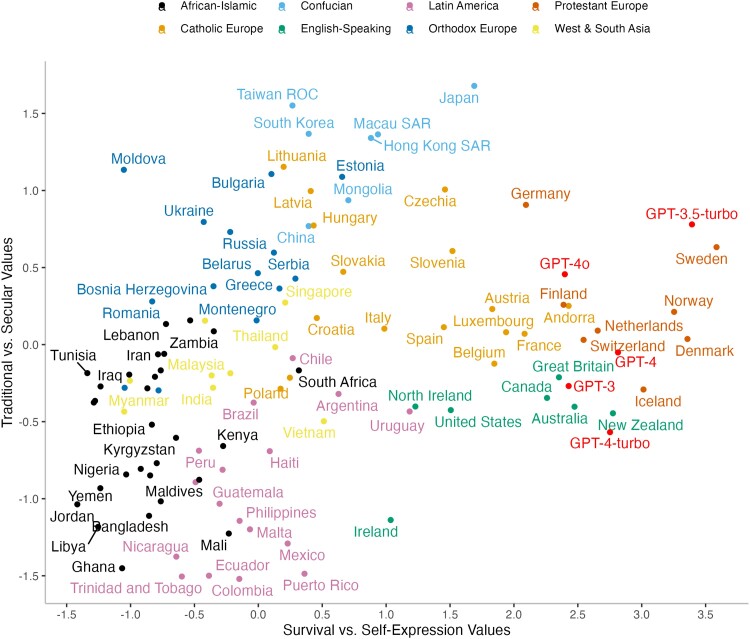
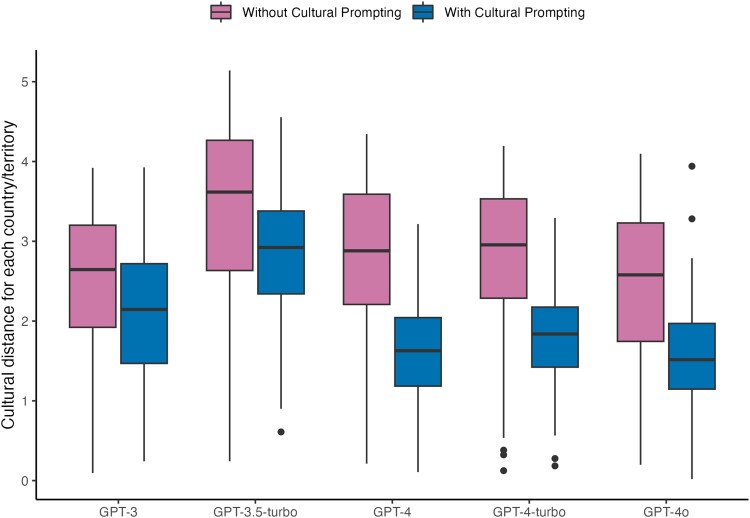
Culture fundamentally shapes people’s reasoning, behavior, and communication. As people increasingly use generative artificial intelligence (AI) to expedite and automate personal and professional tasks, cultural values embedded in AI models may bias people’s authentic expression and contribute to the dominance of certain cultures. We conduct a disaggregated evaluation of cultural bias for five widely used large language models (OpenAI’s GPT-4o/4-turbo/4/3.5-turbo/3) by comparing the models’ responses to nationally representative survey data. All models exhibit cultural values resembling English-speaking and Protestant European countries. We test cultural prompting as a control strategy to increase cultural alignment for each country/territory. For later models (GPT-4, 4-turbo, 4o), this improves the cultural alignment of the models’ output for 71–81% of countries and territories. We suggest using cultural prompting and ongoing evaluation to reduce cultural bias in the output of generative AI.
Overview
The claims and statistics of this paper haven’t been checked yet.
Free: it reads the open-access text and checks the first 5 claims that cite a source we can check. Create a free account to check every claim.
Integrity signals
Registry
Cites
Statistics
Figures
Verification
Claims the paper makes
The claims and statistics of this paper haven’t been checked yet.
Free: it reads the open-access text and checks the first 5 claims that cite a source we can check. Create a free account to check every claim.
Claims other papers make about this one
Each is checked against this paper’s own text: does it say what the citing paper says it does?
The cited source says what the claim attributes to it.
In the citing paper
“At the same time, the reproduction of biases and representational patterns embedded in training data raises concerns about whose knowledge, styles, and voices are normalised in AI-mediated learning contexts (Bender et al., 2021; Tao et al., 2024; Sterlie et al., 2024).”
From From Cognitive Necessity to Cognitive Choice: Higher Education Assessment and Learning in the Age of Generative AI (2026) · cites this paper as Tao et al., 2024
Self-check
Percentages, sums and reported differences re-computed from the paper’s own numbers.
The self-check needs the paper’s full text.
Citations
Cites
Culture's Consequences: Comparing Values, Behaviors, Institutions, and Organizations across Nations
Bhagat, R. S., & Hofstede, G. (2002) · The Academy of Management Review · doi:10.2307/4134391 · Cited by 21,664
ChatGPT for Good? On Opportunities and Challenges of Large Language Models for Education
Kasneci, E., Seßler, K., Küchemann, S., Bannert, M., Dementieva, D., Fischer, F., Gasser, U., Groh, G., Günnemann, S., Hüllermeier, E., et al. (2023) · doi:10.35542/osf.io/5er8f · Cited by 7,552
ChatGPT for good? On opportunities and challenges of large language models for education
Kasneci, E., Sessler, K., Küchemann, S., Bannert, M., Dementieva, D., Fischer, F., Gasser, U., Groh, G., Günnemann, S., Hüllermeier, E., et al. (2023) · Learning and Individual Differences · doi:10.1016/j.lindif.2023.102274 · Cited by 7,326 · cited 1×
“…Mistral, and LLaMA, which are trained on Internet-scale textual data to process text and produce human-sounding language, are increasingly used by people in all aspects of their life, including education [32], medicine and public health [13, 45], as well as creative and opinion writing [50, 29].”
BackgroundModernization, Cultural Change, and the Persistence of Traditional Values
Inglehart, R., & Baker, W. E. (2000) · American Sociological Review · doi:10.2307/2657288 · Cited by 4,524 · cited 1×
“Culture plays a major role in shaping the way individuals think and behave in their daily lives by embedding a pattern of shared knowledge and values into a group of people [27, 23, 39, 43].”
BackgroundLarge language models in medicine
Thirunavukarasu, A. J., Ting, D. S. J., Elangovan, K., Gutierrez, L., Tan, T. F., & Ting, D. S. W. (2023) · Nature Medicine · doi:10.1038/s41591-023-02448-8 · Cited by 3,944 · cited 1×
“…Mistral, and LLaMA, which are trained on Internet-scale textual data to process text and produce human-sounding language, are increasingly used by people in all aspects of their life, including education [32], medicine and public health [13, 45], as well as creative and opinion writing [50, 29].”
Background(2005) · Cited by 3,670
Culture, dialectics, and reasoning about contradiction.
Peng, K., & Nisbett, R. E. (1999) · American Psychologist · doi:10.1037//0003-066x.54.9.741 · Cited by 1,755 · cited 1×
“Cultural differences also influence causal attributions of behavior, such as explaining others’ actions based on their individual traits versus situational factors [11], and human judgment, such as resolving contradictions through compromise versus logical arguments [40].”
BackgroundA Brief Overview of ChatGPT: The History, Status Quo and Potential Future Development
Wu, T., He, S., Liu, J., Sun, S., Liu, K., Han, Q.-L., & Tang, Y. (2023) · IEEE/CAA Journal of Automatica Sinica · doi:10.1109/jas.2023.123618 · Cited by 1,452 · cited 1×
“5-turbo incorporated Reinforcement Learning with Human Feedback (RLHF) [49].”
MethodPersonality and Culture Revisited: Linking Traits and Dimensions of Culture
Hofstede, G., & McCrae, R. R. (2004) · Cross-Cultural Research · doi:10.1177/1069397103259443 · Cited by 1,397 · cited 1×
“…values which emphasize subjective well-being, or survival values which emphasize economic and physical security) have demonstrated national variation in personality [24], technological innovation [47], trust in automation [10], privacy concerns [48], and health behaviors and outcomes [35].”
BackgroundDoes culture influence what and how we think? Effects of priming individualism and collectivism.
Oyserman, D., & Lee, S. W. S. (2008) · Psychological Bulletin · doi:10.1037/0033-2909.134.2.311 · Cited by 1,385 · cited 1×
“Culture plays a major role in shaping the way individuals think and behave in their daily lives by embedding a pattern of shared knowledge and values into a group of people [27, 23, 39, 43].”
Background
Research works printed but not linked: 7
- Schein EH. 1991. What is culture. In: Reframing organizational culture. Sage Publications, Inc. p. 243–253.
- Jakesch M, Bhat A, Buschek D, Zalmanson L, Naaman M. 2023. Co-writing with opinionated language models affects users’ views. In: Proceedings of the 2023 CHI Conference on Human Factors in Computing Systems. p. 1–15; Association for Computing Machinery (ACM).
- Yuan A, Coenen A, Reif E, Ippolito D. 2022. Wordcraft: story writing with large language models. In: 27th International Conference on Intelligent User Interfaces. p. 841–852;:ACM, Helsinki, Finland.
- Ramezani A, Xu Y. 2023. Knowledge of cultural moral norms in large language models. In: Proceedings of the 61st annual meeting of the association for computational linguistics (Vol. 1, Long Papers). p. 428–446; Toronto, Canada: Association for Computational Linguistics.
- Arora A, Kaffee L-A, Augenstein I. 2023. Probing pre-trained language models for cross-cultural differences in values. In: Proceedings of the first workshop on cross-cultural considerations in NLP (C3NLP). p. 114–130; Dubrovnik, Croatia: Association for Computational Linguistics.
- Sandvig C, Hamilton K, Karahalios K, Langbort C. 2014. Auditing algorithms: research methods for detecting discrimination on internet platforms. In: Data and Discrimination: Converting Critical Concerns into Productive Inquiry. Vol. 22(2014). p. 4349–4357.
- Bolukbasi T, Chang K-W, Zou JY, Saligrama V, Kalai AT. 2016. NIPS'16: Proceedings of the 30th International Conference on Neural Information Processing System. p. 4356–4364; Red Hook, NY: Curran Associates Inc.
Cited by
Items 101–200 of 375
Exploring gender bias in AI-generated definitions of role models: a cross-linguistic perspective
Voutyrakou, D. A., & Skordoulis, C. D. (2025) · AI and Ethics · doi:10.1007/s43681-025-00792-8 · Cited by 7
Mastering the Art of Prompting: Strategies for Precision, Creativity, and Control
Ravikumar, R. N., Aarthi, S., Yulduz, U., Atamuratova, Z., Moxinur, S., & Shaturaev, J. N. (2025) · Advances in computational intelligence and robotics book series · doi:10.4018/979-8-3373-0250-8.ch001 · Cited by 6
Artificial Intelligence in Plastic Surgery: Current Status, Limitations, and Future Directions
Copeland‐Halperin, L. R. (2025) · Aesthetic Surgery Journal · doi:10.1093/asj/sjaf239 · Cited by 8
Otis, N. G., Clarke, R. P., Delecourt, S., Holtz, D., & Koning, R. M. (2026) · Management Science · doi:10.1287/mnsc.2024.06909 · Cited by 49
Artificial intelligence in health and sport sciences: Promise, progress, and prudence
An, R. (2025) · Journal of sport and health science/Journal of Sport and Health Science · doi:10.1016/j.jshs.2025.101054 · Cited by 6
Development and validation of a scale assessing perceived trustworthiness in large language models
Yankouskaya, A., Barajeeh, B., Babiker, A., Alshakhsi, S. A. A., Ma, Y. T., Ho, C. S. M., & Ali, R. (2026) · Discover Artificial Intelligence · doi:10.21203/rs.3.rs-7738215/v1 · Cited by 5
Can LLMs make trade-offs involving stipulated pain and pleasure states?
Keeling, G., Street, W., Stachaczyk, M., Zakharova, D., Comsa, I. M., Sakovych, A., Logothetis, I., Zhang, Z., Arcas, B. A. Y., & Birch, J. (2024) · arXiv · doi:10.48550/arxiv.2411.02432 · Cited by 3
“…psychological tasks has been found to most closely resemble that of WEIRD (Western, Educated, Industrialised, Rich and Democratic) human participants (Atari et al., 2023), and to instantiate cultural values that align most closely with English-speaking, protestant countries (Tao et al., 2024).”
BackgroundDigital accents, homogeneity-by-design, and the evolving social science of written language
Alvero, A., Sedlacek, Q. C., León, M., & Peña, C. (2025) · Annual Review of Applied Linguistics · doi:10.1017/s0267190525000042 · Cited by 10
“…and geographic categories, then AI-generated text will likely exhibit an affinity toward approximating the styles and voices of particular groups, with past studies showing affinity toward high-income, males (Alvero et al., 2024) or those from Protestant Western countries (Tao et al., 2024).”
Using Large Language Models in Behavioral Science Interventions: Promise & Risk
Hecht, C. A., Ong, D. C., Clapper, M., Jones, M., Demszky, D., Yang, D., Eichstaedt, J. C., Bryan, C. J., & Yeager, D. S. (2025) · Behavioral Science & Policy · doi:10.1177/23794607251344698 · Cited by 12
Bridging Context and Culture: Designing Cross-Cultural Solutions for Type 2 Diabetes Care in Nigeria
Arueyingho, O., O’Kane, A. A., Marshall, P., Aprioku, J. S., Webb, H., & Shivam, R. (2025) · Designing Interactive Systems Conference · doi:10.1145/3715336.3735710 · Cited by 7
Gender inclusive language generation framework: A reasoning approach with RAG and CoT
Chinnan, S. P. M., Drury‐Grogan, M. L., & Chakravarthi, B. R. (2025) · Knowledge-Based Systems · doi:10.1016/j.knosys.2025.114092 · Cited by 12
AI in Biodiversity Education: The Bias in Endangered Species Information and Its Implications
Noriega, L. D. P., Bobo‐Pinilla, J., Iglesias, J. D., Reinoso, R., Gallego, A. M., & y Alpera, S. Q. (2025) · Sustainability · doi:10.3390/su17146554 · Cited by 7
Indigenous Knowledges as Justificatory Knowledge in Design Science Research: An Expository Case
Shedlock, K., Chung, A. Q. H., Corbett, J., & Rawson, Z. (2025) · ACM SIGMIS Database the DATABASE for Advances in Information Systems · doi:10.1145/3774330.3774334 · Cited by 5
“In the emerging age of artificial intelligence (AI), concerns regarding bias and systemic discrimination are amplified (Acerbi & Stubbersfield, 2023; Tao et al., 2024), and many of these concerns adversely affect marginalized communities, including Indigenous peoples (Mohamed et al., 2020; Shedlock…”
The relation between humans and LLMs in the creative act
Kortenbach, T., Yin, Y., Gonçalves, M., Price, R. A., & Wang, P. (2025) · Journal of Creativity · doi:10.1016/j.yjoc.2025.100114 · Cited by 7
Boroomand, F., Tsui, A. S., Djabbarov, I., van Witteloostuijn, A. C., & Mijnhardt, W. (2026) · Journal of International Business Studies · doi:10.1057/s41267-025-00833-8 · Cited by 3
“Prior research suggests that language models, and particularly LLMs, may interpret language through the lens of the cultural and linguistic contexts in which they were trained (Masoud et al., 2024; Sukiennik et al., 2025; Tao, Viberg, Baker, & Kizilcec, 2024).”
Bailey, D. J., Anjum, J., Park, H., Carpenter, E., Mamlekar, C. R., & Kurland, J. (2026) · American Journal of Speech-Language Pathology · doi:10.1044/2025_ajslp-25-00262 · Cited by 7
Levy‐Nadav, L., Shamir‐Inbal, T., & Blau, I. (2026) · Education and Information Technologies · doi:10.1007/s10639-026-13925-1 · Cited by 9
“Recent studies indicate that LLMs frequently reproduce cultural and linguistic biases, privileging Western, English-dominant norms, perpetuating stereotypes, and generating inaccurate or distorted educational content (Ahmed et al., 2025 ; Francis et al., 2025 ; Tao et al., 2024 ).”
Goto, J., & Ramnarain, U. D. (2026) · International Journal of Educational Technology in Higher Education · doi:10.1186/s41239-026-00588-8 · Cited by 7
Chakraborty, C., & Howard, A. (2025) · IEEE International Symposium on Ethics in Engineering, Science, and Technology (ETHICS) · doi:10.1109/ethics65148.2025.11098392 · Cited by 3
“[27], [28].”
Conceptualizing L2 Teachers’ Blended Assessment Literacy (L2TBAL): A Scoping Review
Su, X., Lee, I., & Wang, D. (2025) · International Journal of Applied Linguistics · doi:10.1111/ijal.70002 · Cited by 8
Affective connotations according to LLMs: implications for meaning measurement and cultural bias
Combs, A., Dametto, D., Blaison, C., Leung, R., Malhotra, A., Schröder, T., Hoey, J., & Smith‐Lovin, L. (2025) · Cognition & Emotion · doi:10.1080/02699931.2025.2568551 · Cited by 3
Arévalo-Royo, J., Montalvo, F. J. F., Latorre‐Biel, J., Macías, E. J., Martínez, E., & Blanco‐Fernández, J. (2025) · Applied Sciences · doi:10.3390/app152010913 · Cited by 3
Yong, S., Yang, C.-L., Hashimoto, A., Kuzuoka, H., & Yoshida, S. (2025) · Proceedings of the ACM on Human-Computer Interaction · doi:10.1145/3757646 · Cited by 3
Defining the intension and extension of nations’ sovereignty in the age of generative AI
Sayankina, S., Tsen, E., Tan, E., & Ko, R. K. L. (2025) · Territory Politics Governance · doi:10.1080/21622671.2025.2568474 · Cited by 9
“…studies have repeatedly shown that LLMs demonstrated cultural bias towards values similar to English-speaking and Protestant European countries (Tao et al., 2024), bias towards Western-associated aspects of culture (Naous et al., 2024) and better performance on cognitive psychological tasks…”
Mwaniki, P., Musau, W., Isaaka, L., Wanyama, C. W., Menon, V., Denniston, A. K., Liu, X., Emmanuel-Fabula, M., Williams, G., Mateen, B. A., et al. (2026) · BMJ Digital Health & AI · doi:10.1136/bmjdh-2026-000081 · Cited by 3
Whose bias gets coded? Psychology's role in decolonizing AI
Divya Lakshmi, S., Mohan, V., Reeja, P. S., Alexander, E. A., Varghese, N., & Kurian, A. (2025) · Frontiers in Psychology · doi:10.3389/fpsyg.2025.1657227 · Cited by 2
Visual Moral Inference and Communication
Zhu, W., Ramezani, A., & Xu, Y. (2025) · Topics in Cognitive Science · doi:10.1111/tops.70031 · Cited by 3
“…Hoover et al., 2018; Jiang et al., 2021; Xie, Hirst, & Xu, 2020) pertaining to critical issues ranging from moral decision-making in autonomous vehicles (Awad et al., 2018) to alignment of AI and humans in cultural moral norms and values (Ramezani & Xu, 2023; Tao, Viberg, Baker, & Kizilcec, 2024).”
Yamaguchi, Y. (2025) · AI & Society · doi:10.1007/s00146-025-02733-9 · Cited by 4
Rettberg, J. W. (2026) · Media Culture & Society · doi:10.1177/01634437261452160 · Cited by 3
“…paper thus contributes to a growing body of research on how generative AI homogenises cultural diversity (Agarwal et al., 2025; Doshi and Hauser, 2024; Ghosal, 2024; Gillespie, 2024; Leaver and Srdarov, 2025; Mager et al., 2025; Refsum, 2025; Rettberg and Wigers, 2025; Tao et al., 2024; Yin, 2025).”
Not a mirror, a caricature: How LLMs reproduce cultural identity?
Wdowicz, J. (2025) · AI and Ethics · doi:10.1007/s43681-025-00898-z · Cited by 5
“Second, recent cultural alignment audits have used large-scale survey data (e.g., World Values Survey) to show that model outputs often reflect the values of Western, Educated, Industrialized, Rich, and Democratic (WEIRD) societies [ 3, 12 ].”
Can AI See the Unseen? Measuring the Perception Gap for Tibetan Cultural Symbols in AI-Generated Art
Liu, Y., Qiao, Y., Hu, A., Liu, Y., & Bai, L. (2025) · Electronics · doi:10.3390/electronics15010015 · Cited by 3
Jungherr, A. M., & Rauchfleisch, A. (2025) · Social Media + Society · doi:10.1177/20563051251405069 · Cited by 9
“As a result, they are prone to reproducing the biases embedded in their training data (Bianchi et al., 2023; Friedrich, Brack, et al., 2024; Friedrich, Hämmerl, et al., 2024; Hofmann et al., 2024; Tao et al., 2024; Weidinger et al., 2021).”
DepGLM: Depression degree recognition on social media based on large language models
Liu, J., Ding, P., & Chen, J. (2025) · Digital Health · doi:10.1177/20552076251408281 · Cited by 6
“56,57 What ’ s more, the application of Western-centric mental health conceptualizations to Chinese social media data may introduce cultural value biases.”
Intercultural Design for Human-Centered AI Solutions
Heimgärtner, R. (2026) · Springer eBooks · doi:10.1007/978-981-97-8440-0_77-2 · Cited by 4
Bautista, L. R. P., & Vasquez, R. C. (2026) · Investigación Bibliotecológica Archivonomía Bibliotecología e Información · doi:10.22201/iibi.24488321xe.2025.105.59051 · Cited by 6
Administrative Decision-Making with Generative AI: The Challenge of Epistemic Boundedness
Kim, Y., Kim, J., Kim, T., & Cho, H.-C. (2026) · Administration & Society · doi:10.1177/00953997251409156 · Cited by 5
“…studies of LLM performance in text processing suggests that these models contain implicit assumptions derived from their pre-training data, including biases related to representativeness, cultural perspectives, temporal relevance, and causality (Bender et al., 2021; Tao et al., 2024).”
Cai, Y., Zhou, X., Zeng, J., Hu, S. F., Liu, W., & Xing, H. (2026) · Transactions in GIS · doi:10.1111/tgis.70191 · Cited by 2
“In the cultural domain, LLMs have been applied to analyze cultural bias and alignment (Tao et al. 2024), generate descriptions for cultural heritage in tasks like visual question answering (Bongini et al. 2022), and simulate cross-cultural communication through role-playing agents (Li, Teney, et…”
Too human to model: the uncanny valley of large language models in simulating human systems
Zeng, Y., Brown, C., & Rounsevell, M. (2026) · npj Complexity · doi:10.1038/s44260-026-00075-1 · Cited by 13
“However, LLMs have many widely known technical limitations, such as hallucination 12 – 14 , bias 15 – 18 , and security issues 19,20 , which may affect their integration within social simulation.”
Computational Text Analysis for Building and Testing Social Theory
Bodell, M. H., Keuschnigg, M., Macanovic, A., & Menshikova, A. (2026) · KZfSS Kölner Zeitschrift für Soziologie und Sozialpsychologie · doi:10.1007/s11577-026-01065-w · Cited by 5
“…underestimate the diversity of responses given by actual humans (Bisbee et al. 2024; Kozlowski and Evans 2025), produce responses biased toward majority opinions (Crockett and Messeri 2025), and reflect certain cultural and social backgrounds more than others (Alvero et al. 2024; Tao et al. 2024).”
Johnson, R. L., Duran, L. D. D., Panai, E., González, N. M., Pistilli, G., Kalpokienė, J., & Bertulfo, D. J. (2026) · AI and Ethics · doi:10.1007/s43681-026-01038-x · Cited by 6
Spennemann, D. H. R. (2026) · Heritage · doi:10.3390/heritage9040124 · Cited by 2
Recognising and mitigating LLM Pollution in online behavioural research
Rilla, R., Werner, T., Yakura, H., Rahwan, I., & Nußberger, A.-M. (2026) · Nature Communications · doi:10.1038/s41467-026-74621-9 · Cited by 28
Exploring past and future fluency of temporal landmarks under reduced agency
Zimbatu, A., Bickley, S. J., & Whyte, S. (2025) · Scientific Reports · doi:10.1038/s41598-025-00530-4 · Cited by 2
“Such nuances could influence thematic interpretation by both the human research assistants (Australian postgraduate research students) and the AI/LLM coders, who may exhibit biases (e.g., more Western/US-leaning 38 or aligned with rational, chain-of-thought reasoning) due to OpenAI’s training data and/ or AI safety-tr…”
Designing and Evaluating Gen-AI for Cultural Resilience
Lau, K. H. C. (2025) · INTERNATIONAL CONFERENCE ON MULTIMODAL INTERACTION · doi:10.1145/3716553.3750819 · Cited by 2
“Studies on large language models (LLMs) have also raised concerns about bias and cultural misrepresentation [16].”
Can (and should) LLMs perform critical discourse analysis?
DeJeu, E. B. (2024) · Journal of Multicultural Discourses · doi:10.1080/17447143.2025.2492145 · Cited by 6
“LLM outputs can reflect bias (Nicoletti and Bass, 2023), and research has shown that LLMs trained primarily on English datasets reflect cultural values that align with English-speaking, Protestant countries (e.g. Tao et al., 2024).”
Artificial Intelligence in Vaccine Communication
Sabahelzain, M. M., Leask, J., & Dunn, A. G. (2025) · Journal of Health Communication · doi:10.1080/10810730.2025.2581986 · Cited by 2
“In response, countries like Japan and Sweden have taken steps to mitigate these biases by creating their versions of GPT (Tao et al., 2024).”
Beyond partisan leaning: a comparative analysis of political bias in large language models
Peng, T., Yang, K., Lee, S., Li, H., Chu, Y., Lin, Y., & Liu, H. (2026) · Journal of Information Technology & Politics · doi:10.1080/19331681.2026.2646990 · Cited by 44
Navigating the AI Highway: A Traffic Light Approach to Language Learning
Mecias, M. L. (2025) · The FLTmag. · doi:10.69732/fgog9332 · Cited by 1
The Fair Game: Auditing & debiasing AI algorithms over time
Basu, D., & Das, U. (2025) · Cambridge Forum on AI Law and Governance · doi:10.1017/cfl.2025.8 · Cited by 3
“Especially, incorporating human preferential feedback in learning (or fine-tuning) process plays a vital role in aligning outputs from a Large Language Model (LLM) socially (Conitzer et al., 2024; Xiao et al., 2024; Tao et al., 2024; Dai et al., 2023).”
Evaluating Student Agency in AI-Generated Lesson Plans
Cheng, J., Wang, C., & Chen, B. (2025) · Proceedings. · doi:10.22318/icls2025.764888 · Cited by 3
Muñoz-García, V., Consuegra‐Ayala, J. P., & Moreda, P. (2025) · Knowledge-Based Systems · doi:10.1016/j.knosys.2025.113915 · Cited by 2
Crossing Boundaries: Leveraging Semantic Divergences to Explore Cultural Novelty in Cooking Recipes
Carichon, F., Rampa, R., & Farnadi, G. (2025) · ACM Conference on Fairness, Accountability, and Transparency (FAccT) · doi:10.1145/3715275.3732150 · Cited by 2
Cultural Bias and Linguistic Representation in AI Curriculum Design: Implications for Society 5.0
Usman, N., Kusumanegara, A., Husnaini, H., Said, Y. R., & Ismayanti, D. (2025) · Advances in computational intelligence and robotics book series · doi:10.4018/979-8-3373-1062-6.ch008 · Cited by 3
Chang, H.-C. H., Weener, T., Chen, Y.-C., Noh, S., Zha, M., & Lo, H. (2025) · Harvard Kennedy School Misinformation Review · doi:10.37016/mr-2020-183 · Cited by 9
Oswald, Y. (2025) · Futures · doi:10.1016/j.futures.2025.103695 · Cited by 3
Evaluating the Quality of Health Information: Comparison of Human and Artificial Intelligence
Arcot, D., Pondicherry, N., & Chakraborty, S. (2025) · Neurogastroenterology & Motility · doi:10.1111/nmo.70164 · Cited by 3
“This may also lead to bias from AI models towards content that resembles consumer health explanations [33].”
Exploring Adapter Design Tradeoffs for Low Resource Music Generation
Mehta, A., Chauhan, S., & Choudhury, M. (2025) · ACM International Conference on Multimedia (ACM MM) · doi:10.1145/3746027.3755766 · Cited by 4
Allahyari, K., & Sumner, T. D. (2025) · Journal of Borderlands Studies · doi:10.1080/08865655.2025.2576206 · Cited by 1
Chatbot for the Preservation of Palestine’s History
Miftah, K., Matrane, Y., Ellaky, Z., & Benabbou, F. (2025) · Lecture notes in networks and systems · doi:10.1007/978-3-032-02312-4_32 · Cited by 1
Exploring cultural commonsense in multilingual large language models: A survey
Binegde, G. N., & Zhang, H. (2025) · Information Systems · doi:10.1016/j.is.2025.102649 · Cited by 4
Intercultural Design for Human-Centered AI Solutions
Heimgärtner, R. (2025) · Springer eBooks · doi:10.1007/978-981-95-3658-0_77 · Cited by 1
Predictive hermeneutics: bias, culture, and the predictive mind
Devereaux, J. J. (2025) · Phenomenology and the Cognitive Sciences · doi:10.1007/s11097-025-10126-y · Cited by 1
DKAB Öğretmenlerinin Eğitimde Yapay Zekâ Kullanımına İlişkin Görüşleri
GÜNEŞ, A. (2025) · Kocatepe İslami İlimler Dergisi · doi:10.52637/kiid.1731555 · Cited by 2
Eren, S. U. N. A., & Özer, M. (2025) · Advances in computational intelligence and robotics book series · doi:10.4018/979-8-3373-7579-3.ch008 · Cited by 1
Can large language models mimic airline passenger preferences?
Voltes-Dorta, A., & Suau-Sánchez, P. (2025) · Artificial Intelligence for Transportation · doi:10.1016/j.ait.2025.100034 · Cited by 6
Che, S., Zhu, M., Zhang, S., Jung, H. S., Lee, H., Wang, Z., & Miller, L. (2025) · Information Processing & Management · doi:10.1016/j.ipm.2025.104567 · Cited by 3
Sentiment analysis of cultural differences in online comments on popular news
Hordiienko, K., & Kormaníková, L. (2025) · Linguistic Frontiers · doi:10.2478/lf-2025-0020 · Cited by 2
“…Western cultures often emphasize individualism, which is reflected in the expressive and explicit expression of emotions, whereas collectivistic cultures, such as the Japanese, prefer implicit communication, where emotional nuances can be expressed indirectly or through context (Tao et al. 2024).”
MCEval: A Dynamic Framework for Fair Multilingual Cultural Evaluation of LLMs
Huang, S., Yang, L., & Zhang, Y. (2025) · IEEE Transactions on Audio Speech and Language Processing · doi:10.1109/taslpro.2025.3649395 · Cited by 7
“Drawing from narrow cultural perceptions and unreasonable stereotypes within their training data, these models tend to generate responses that fail to re-flect cultural diversity [18].”
Özergin, B. (2026) · Springer eBooks · doi:10.1007/978-3-658-46709-8_52-1
Emergent possibilities: A sociotechnical approach to generative AI in discourse analysis
Woodhams, J. M. (2026) · Research Methods in Applied Linguistics · doi:10.1016/j.rmal.2026.100306 · Cited by 2
Li, Y., Huang, S., Qi, J., Lü, Y., Quan, L., Han, D., Li, B., Liu, X., & Luan, Z. (2026) · Journal of Evidence-Based Medicine · doi:10.1111/jebm.70118 · Cited by 4
“A literal translation in few-shot examples strips away the term’s original cultural context [ 39 ].”
Simulated cognitive empathy as an emerging tool for socio-ecological research
Richards, D. R., Heays, A., Herzig, A., Lavorel, S., & Vannier, C. (2026) · Environmental Research Communications · doi:10.1088/2515-7620/ae4cfb · Cited by 2
Generative AI for Urban Planning and Design: Progress Review and Future Perspectives
Liu, C., Li, G., Huang, C., Herzog, O., Ritter, H. J., Ma, S., & Ye, Y. (2026) · Engineering · doi:10.1016/j.eng.2026.03.001 · Cited by 12
AIPsychoBench: Understanding the Psychometric Differences Between LLMs and Humans
Xie, W., Wang, Z., Ma, S., Sun, X., Chen, K., Wang, E., Liu, W., & Tong, H. (2026) · Topics in Cognitive Science · doi:10.1111/tops.70041 · Cited by 3
“…traits are shaped by their training corpora (Huang et al., 2025; Tang et al., 2024), and the corpora in different languages can reflect regional, national, and ethnic differences in psychological traits (Giorgi et al., 2022; Lai et al., 2023; Naous & Xu, 2025; Tao et al., 2024; Wang et al., 2024).”
Wang, Y., & Fussell, S. R. (2026) · Proceedings of the ACM on Human-Computer Interaction · doi:10.1145/3799448 · Cited by 3
Ling, L., Zheng, X., Cao, G., & Lc, R. (2026) · Proceedings of the ACM on Human-Computer Interaction · doi:10.1145/3816988 · Cited by 4
Reframing the AI alignment problem: insights from business applications
Breeden, J. L. (2026) · AI and Ethics · doi:10.1007/s43681-026-01137-9 · Cited by 1
“Empirical analysis reveals that RLHF implementations have introduced systematic biases toward Western moral frameworks, reflecting the demographic composition of human feedback providers who predominantly operate within Western cultural contexts [47].”
Wuwen, Z., Yu, H., Xia, M., Yang, M., & Ja, J. (2026) · Education and Information Technologies · doi:10.1007/s10639-026-14030-z · Cited by 1
“…instructions were added to prompts (such as “Please respond from the cultural perspective of country X”), the model outputs’ alignment with target cultural values significantly improved in 71–81% of countries (p .001), with mean deviation reduced by 0.42 standard deviations (Tao et al., 2024 ).”
InfluentialKam, M. W., Samani, H. A., Akhond, S., Premachandra, C., & Lalioti, V. (2026) · International Journal of Performance Arts and Digital Media · doi:10.1080/14794713.2026.2670859 · Cited by 1
“Prompt tuning approach is easy to access and its effectiveness of utilisation in cultural adaptation has been demonstrated (Tao et al. 2024).”
Al‐Bannay, H. (2026) · Journal of Educational Technology and Online Learning · doi:10.31681/jetol.1793483 · Cited by 1
Tao, Y., Viberg, O., Dennison, D. V., Wu, Z., & Kizilcec, R. F. (2026) · ACM Conference on Learning @ Scale (L@S) · doi:10.1145/3774398.3811616 · Cited by 3
Self-citationZheng, W., Tong, Y., Huang, J., Zhu, L., & Chai, J. (2026) · Chinese Medicine · doi:10.1186/s13020-026-01455-4 · Cited by 6
“Large-scale studies demonstrate that LLMs exhibit measurable cultural biases and can substantially diverge from target cultural value patterns unless specific alignment strategies are implemented [69, 70].”
Cognitive Externalization and Generative AI in Higher Education
Сидорчук, Р. (2026) · Высшее образование в России · doi:10.31992/0869-3617-2026-35-7-53-75 · Cited by 1
Peykani, P., Charles, V., Emrouznejad, A., Ghanidel, S., & Sabour, D. (2026) · Archives of Computational Methods in Engineering · doi:10.1007/s11831-026-10720-6 · Cited by 1
Masalimova, A. R., ZHELTUKHINA, M. R., Demir, S., Molodozhnikova, N. M., Zvereva, E., Berechikidze, I. A., & Lazareva, Y. B. (2026) · Frontiers in Communication · doi:10.3389/fcomm.2026.1888712 · Cited by 4
Nakagawa, S., & Yamamoto, A. (2026) · Nutrients · doi:10.3390/nu18172892 · Cited by 1
“…at the level of cultural values: large language models’ default responses align most closely with English-speaking and Protestant-European countries, and “cultural prompting”— instructing the model to answer as a person from a given country—shifts responses toward that country’s survey values [14].”
Online learner engagement and academic support in the age of generative AI
Borup, J., Graham, C. R., Archambault, L., Woo, L. J., Barbour, M. K., Shin, J. K., & Evmenova, A. S. (2026) · Computers & Education · doi:10.1016/j.compedu.2026.105763 · Cited by 3
Hof, M. O. ‘., Hu, K., Tong, S., & Bai, H. (2025) · Journal of Intelligence · doi:10.3390/jintelligence13070080 · Cited by 2
Challenges of Generative AI on Human–AI Interaction and Collaboration
Liang, S., & Cai, Y. (2025) · Cambridge University Press eBooks · doi:10.1017/9781009587877.012 · Cited by 2
Translating the Force Concept Inventory in the age of AIPreprint
Babayeva, M., Dunlap, J. C., Snětinová, M., & Widenhorn, R. (2025) · Research Square · doi:10.21203/rs.3.rs-7410179/v1 · Cited by 2
Political fantasies of fairness: artificial intelligence, law, and the myth of sovereign reason
Keerthiraj, Misra, A., & Devaiah, N. G. (2026) · AI and Ethics · doi:10.1007/s43681-026-01058-7 · Cited by 2
More Than a Dictionary: How AI Scaffolds the Journey from Digital Outsider to Insider
Xiao, Y., Xin, Q., Tang, A. C., Yao, Z., Yang, S., & Wang, Z. (2026) · CHI Conference on Human Factors in Computing Systems · doi:10.1145/3772318.3791980
Whose Knowledge Counts? Co-Designing Community-Centered AI Auditing Tools with Educators in Hawai'i
Zhao, D., Cha, H., Ryan, M. J., Wang, A., Baker-Ramos, R., Helekahi-Kaiwi, E.-B., Diego, R., Hester, J. D., & Yang, D. (2026) · CHI Conference on Human Factors in Computing Systems · doi:10.1145/3772318.3790958 · Cited by 2
Ambiguous Loss: Facilitating Refugee Families’ Sense of Home through AI-Powered Storytelling
Song, P., Yadav, A., & Vyas, D. (2026) · CHI Conference on Human Factors in Computing Systems · doi:10.1145/3772318.3791368 · Cited by 1
Collectively Reimagining Artificial Intelligence With Marginalized Communities
Oluwatuyi, R. F., Pillay, V., Mazwi, J., Castro, A., Farao, J., Srivatsa, S., Bagalkot, N., & Densmore, M. (2026) · CHI Conference on Human Factors in Computing Systems · doi:10.1145/3772318.3791421 · Cited by 2
Montebello, M. (2026) · AI in Education · doi:10.3390/aieduc2020012 · Cited by 1
“At the same time, the reproduction of biases and representational patterns embedded in training data raises concerns about whose knowledge, styles, and voices are normalised in AI-mediated learning contexts (Bender et al., 2021; Tao et al., 2024; Sterlie et al., 2024).”
Dai, B. (2025) · Lecture Notes in Education Psychology and Public Media · doi:10.54254/2753-7048/2024.20494
Adversarially Exploring Vulnerabilities in LLMs to Evaluate Social Biases
Ong, Y. J., Gala, J. P., An, S., Moore, R. J., & Jadav, D. (2024) · IEEE International Conference on Big Data (BigData) · doi:10.1109/bigdata62323.2024.10825408 · Cited by 1
Piper, A., Bamman, D., Han, C., Bjerring-Hansen, J., Long, H., Marienberg-Milikowsky, I., McEnaney, T., Orhero, M. I., Peksoy, E., Popescu, M., et al. (2025) · Journal of Open Humanities Data · doi:10.5334/johd.248 · Cited by 4
Richter, M. (2025) · International Scientific Conference Region in the Development of Society · doi:10.11118/978-80-7701-030-6-0126
Metadata
- Authors
- Tao, Y., Viberg, O., Baker, R. S., & Kizilcec, R. F.
- Affiliations
- Cornell University (US)
- KTH Royal Institute of Technology (SE)
- University of Pennsylvania (US)
- Corresponding author
- Kizilcec, René F
- Venue
- PNAS Nexus
- Publisher
- Oxford University Press (OUP)
- Published
- 2024-09
- Volume
- 3
- Issue
- 9
- Pages
- pgae346-pgae346
- ISSN
- 2752-6542 (ISSN-L)
- PMC
- PMC11407280
- OpenAlex
- W4402565126
- Semantic Scholar
- 5f8bf881c80125452e4a73ad51fdb2c72c65c551
- Cited by
- 383
- References
- 40
- Citations by year
- 2026: 213 · 2025: 154 · 2024: 15
- FWCI
- 158.32
- Type
- journal article
- Language
- en
- Open access
- gold
- doi.org
- Licence
- Locations
- PNAS Nexus (publishedVersion, cc-by-nc)
- PubMed Central (publishedVersion, cc-by-nc)
- PubMed (publishedVersion)
- arXiv (Cornell University) (submittedVersion, cc-by)
- arXiv (Cornell University) (cc-by)
- Funders
- Jacobs Foundation Research Fellowship and Digital Futures
- Topics
- Physical Sciences › Computer Science › Artificial Intelligence › Ethics and Social Impacts of AI
- Physical Sciences › Computer Science › Artificial Intelligence › Topic Modeling
- Social Sciences › Psychology › Social Psychology › Cultural Differences and Values
- Keywords
- cultural bias, cultural alignment, large language models, cultural values, GPT-4, generative AI, cross-cultural assessment, national survey data, cultural homogenization
About these checks
Registry, retraction, Cites and statistics results are computed, not judged, with one exception: a printed reference that no index lists is read once by a model before it counts as a citation error. Claims are extracted by a model and kept only when their quote appears verbatim in the text; each cited source is then checked, with a model’s help, for whether it says what the claim relies on. Those verdicts can be wrong — read the claim’s quote and the cited source before relying on one.
Statistics and arithmetic are recomputed, not judged.
Confidence bands are shown only for fields calibrated on our annotated test set. None is calibrated yet, so no band is shown.
What counts as a claim ›How we measure confidence ›How we check this ›
Are you an author, or do you see a problem with this page? Request a review
Data sources
Bibliographic data: Semantic Scholar, OpenAlex, Crossref.
Contains information from the Semantic Scholar Academic Graph Datasets, made available under the ODC Attribution License (ODC-BY 1.0).
Semantic Scholar’s data is described in: Kinney, R., et al. (2023). The Semantic Scholar Open Data Platform. arXiv:2301.10140.
