

Cultural bias and cultural alignment of large language models
Open accessThe DOI matches its Crossref record; 47 of the 47 references it cites were found in a registry or an index.
Abstract
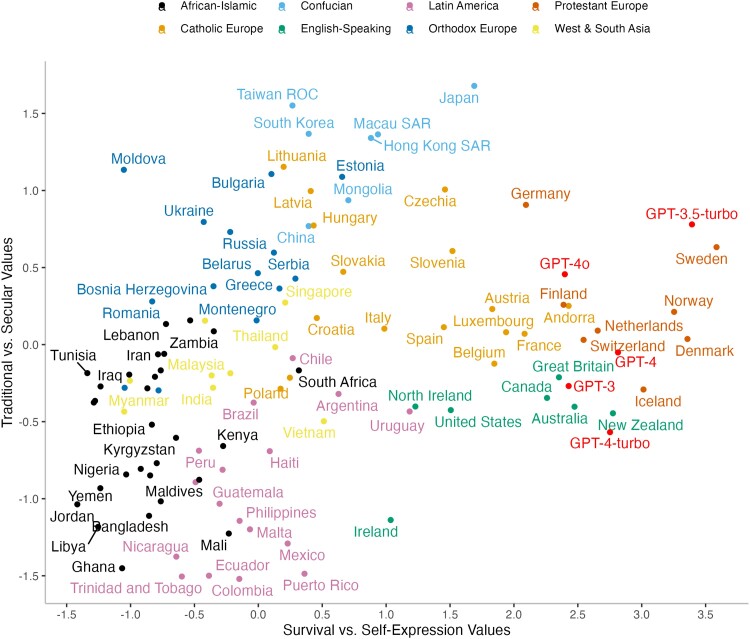
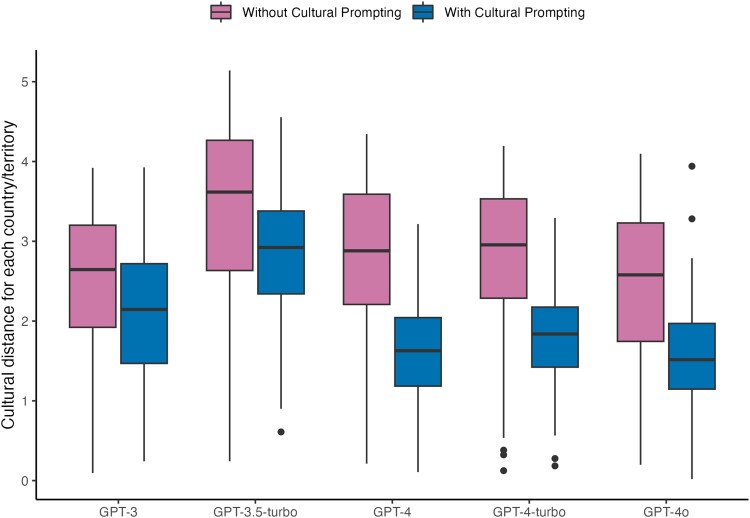
Culture fundamentally shapes people’s reasoning, behavior, and communication. As people increasingly use generative artificial intelligence (AI) to expedite and automate personal and professional tasks, cultural values embedded in AI models may bias people’s authentic expression and contribute to the dominance of certain cultures. We conduct a disaggregated evaluation of cultural bias for five widely used large language models (OpenAI’s GPT-4o/4-turbo/4/3.5-turbo/3) by comparing the models’ responses to nationally representative survey data. All models exhibit cultural values resembling English-speaking and Protestant European countries. We test cultural prompting as a control strategy to increase cultural alignment for each country/territory. For later models (GPT-4, 4-turbo, 4o), this improves the cultural alignment of the models’ output for 71–81% of countries and territories. We suggest using cultural prompting and ongoing evaluation to reduce cultural bias in the output of generative AI.
Overview
The claims and statistics of this paper haven’t been checked yet.
Free: it reads the open-access text and checks the first 5 claims that cite a source we can check. Create a free account to check every claim.
Integrity signals
Registry
Cites
Statistics
Figures
Verification
Claims the paper makes
The claims and statistics of this paper haven’t been checked yet.
Free: it reads the open-access text and checks the first 5 claims that cite a source we can check. Create a free account to check every claim.
Claims other papers make about this one
Each is checked against this paper’s own text: does it say what the citing paper says it does?
The cited source says what the claim attributes to it.
In the citing paper
“At the same time, the reproduction of biases and representational patterns embedded in training data raises concerns about whose knowledge, styles, and voices are normalised in AI-mediated learning contexts (Bender et al., 2021; Tao et al., 2024; Sterlie et al., 2024).”
From From Cognitive Necessity to Cognitive Choice: Higher Education Assessment and Learning in the Age of Generative AI (2026) · cites this paper as Tao et al., 2024
Self-check
Percentages, sums and reported differences re-computed from the paper’s own numbers.
The self-check needs the paper’s full text.
Citations
Cites
Culture's Consequences: Comparing Values, Behaviors, Institutions, and Organizations across Nations
Bhagat, R. S., & Hofstede, G. (2002) · The Academy of Management Review · doi:10.2307/4134391 · Cited by 21,664
ChatGPT for Good? On Opportunities and Challenges of Large Language Models for Education
Kasneci, E., Seßler, K., Küchemann, S., Bannert, M., Dementieva, D., Fischer, F., Gasser, U., Groh, G., Günnemann, S., Hüllermeier, E., et al. (2023) · doi:10.35542/osf.io/5er8f · Cited by 7,552
ChatGPT for good? On opportunities and challenges of large language models for education
Kasneci, E., Sessler, K., Küchemann, S., Bannert, M., Dementieva, D., Fischer, F., Gasser, U., Groh, G., Günnemann, S., Hüllermeier, E., et al. (2023) · Learning and Individual Differences · doi:10.1016/j.lindif.2023.102274 · Cited by 7,326 · cited 1×
“…Mistral, and LLaMA, which are trained on Internet-scale textual data to process text and produce human-sounding language, are increasingly used by people in all aspects of their life, including education [32], medicine and public health [13, 45], as well as creative and opinion writing [50, 29].”
BackgroundModernization, Cultural Change, and the Persistence of Traditional Values
Inglehart, R., & Baker, W. E. (2000) · American Sociological Review · doi:10.2307/2657288 · Cited by 4,524 · cited 1×
“Culture plays a major role in shaping the way individuals think and behave in their daily lives by embedding a pattern of shared knowledge and values into a group of people [27, 23, 39, 43].”
BackgroundLarge language models in medicine
Thirunavukarasu, A. J., Ting, D. S. J., Elangovan, K., Gutierrez, L., Tan, T. F., & Ting, D. S. W. (2023) · Nature Medicine · doi:10.1038/s41591-023-02448-8 · Cited by 3,944 · cited 1×
“…Mistral, and LLaMA, which are trained on Internet-scale textual data to process text and produce human-sounding language, are increasingly used by people in all aspects of their life, including education [32], medicine and public health [13, 45], as well as creative and opinion writing [50, 29].”
Background(2005) · Cited by 3,670
Culture, dialectics, and reasoning about contradiction.
Peng, K., & Nisbett, R. E. (1999) · American Psychologist · doi:10.1037//0003-066x.54.9.741 · Cited by 1,755 · cited 1×
“Cultural differences also influence causal attributions of behavior, such as explaining others’ actions based on their individual traits versus situational factors [11], and human judgment, such as resolving contradictions through compromise versus logical arguments [40].”
BackgroundA Brief Overview of ChatGPT: The History, Status Quo and Potential Future Development
Wu, T., He, S., Liu, J., Sun, S., Liu, K., Han, Q.-L., & Tang, Y. (2023) · IEEE/CAA Journal of Automatica Sinica · doi:10.1109/jas.2023.123618 · Cited by 1,452 · cited 1×
“5-turbo incorporated Reinforcement Learning with Human Feedback (RLHF) [49].”
MethodPersonality and Culture Revisited: Linking Traits and Dimensions of Culture
Hofstede, G., & McCrae, R. R. (2004) · Cross-Cultural Research · doi:10.1177/1069397103259443 · Cited by 1,397 · cited 1×
“…values which emphasize subjective well-being, or survival values which emphasize economic and physical security) have demonstrated national variation in personality [24], technological innovation [47], trust in automation [10], privacy concerns [48], and health behaviors and outcomes [35].”
BackgroundDoes culture influence what and how we think? Effects of priming individualism and collectivism.
Oyserman, D., & Lee, S. W. S. (2008) · Psychological Bulletin · doi:10.1037/0033-2909.134.2.311 · Cited by 1,385 · cited 1×
“Culture plays a major role in shaping the way individuals think and behave in their daily lives by embedding a pattern of shared knowledge and values into a group of people [27, 23, 39, 43].”
Background
Research works printed but not linked: 7
- Schein EH. 1991. What is culture. In: Reframing organizational culture. Sage Publications, Inc. p. 243–253.
- Jakesch M, Bhat A, Buschek D, Zalmanson L, Naaman M. 2023. Co-writing with opinionated language models affects users’ views. In: Proceedings of the 2023 CHI Conference on Human Factors in Computing Systems. p. 1–15; Association for Computing Machinery (ACM).
- Yuan A, Coenen A, Reif E, Ippolito D. 2022. Wordcraft: story writing with large language models. In: 27th International Conference on Intelligent User Interfaces. p. 841–852;:ACM, Helsinki, Finland.
- Ramezani A, Xu Y. 2023. Knowledge of cultural moral norms in large language models. In: Proceedings of the 61st annual meeting of the association for computational linguistics (Vol. 1, Long Papers). p. 428–446; Toronto, Canada: Association for Computational Linguistics.
- Arora A, Kaffee L-A, Augenstein I. 2023. Probing pre-trained language models for cross-cultural differences in values. In: Proceedings of the first workshop on cross-cultural considerations in NLP (C3NLP). p. 114–130; Dubrovnik, Croatia: Association for Computational Linguistics.
- Sandvig C, Hamilton K, Karahalios K, Langbort C. 2014. Auditing algorithms: research methods for detecting discrimination on internet platforms. In: Data and Discrimination: Converting Critical Concerns into Productive Inquiry. Vol. 22(2014). p. 4349–4357.
- Bolukbasi T, Chang K-W, Zou JY, Saligrama V, Kalai AT. 2016. NIPS'16: Proceedings of the 30th International Conference on Neural Information Processing System. p. 4356–4364; Red Hook, NY: Curran Associates Inc.
Cited by
Items 301–375 of 375
Malagon-Palacios, L. J., Bruner, K. L., Mullinax, H. M., Sevillano, C. N., & Yosai, E. R. (2026) · Frontiers in Psychology · doi:10.3389/fpsyg.2026.1815521
“Moreover, AI has been found to be culturally biased, as five common models demonstrated cultural values similar to English-speaking countries and European countries (Tao et al., 2024).”
David, B., Isingoma, B., Nakatumba-Nabende, J., & Jjingo, D. (2026) · Cureus Journal of Computer Science. · doi:10.7759/s44389-026-00167-y
Can AI deliver appropriate support for diverse student profiles?: A large-scale evaluation
López‐Pernas, S., de Oliveira, E. A., Misiejuk, K., Deriba, F. G., Kaliisa, R., & Saqr, M. (2026) · Computers in Human Behavior Artificial Humans · doi:10.1016/j.chbah.2026.100357
Ali, J. (2026) · Advances in computational intelligence and robotics book series · doi:10.4018/979-8-3373-7724-7.ch009
Dai, D. W., & Consoli, S. (2026) · Language and Intercultural Communication · doi:10.1080/14708477.2026.2692971
“Because LLM outputs are generated by predicting likely continuations from learned statistical regularities in their training dataset, they can reproduce widely circulated cultural generalisations and stereotypes (Tao et al., 2024).”
Dong, Q., & Qi, J. (2026) · Communications in computer and information science · doi:10.1007/978-981-92-3734-0_13
Raman, Not Varelse — Why Acceptably Controllable AGI Policies Cluster Around Human-Like Stacks
Buteau, T., & Kommrusch, S. (2026) · Lecture notes in computer science · doi:10.1007/978-3-032-33010-9_9
Simulating strategic interactions with AI agents
Tranchero, M., Brenninkmeijer, C.-F., Murugan, A., & Nagaraj, A. (2026) · Strategic Management Journal · doi:10.1002/smj.70112 · Cited by 5
The Role of AI in Shaping Organizational Culture and Values
Makinde, O. F. (2026) · Advances in computational intelligence and robotics book series · doi:10.4018/979-8-3373-5213-8.ch016
Stillman, M., Kruspe, A., Kirjakovski, A., & Marutschke, D. M. (2026) · Journal of Cultural Cognitive Science · doi:10.1007/s41809-026-00198-w · Cited by 2
Generative AI in urban science and practice
Zhang, Y., Xu, F., Wang, Q., Moro, E., Yue, Y., Wang, H., Чэн, Б., Liu, Y., Fang, D., Gong, P., et al. (2026) · Nature Cities · doi:10.1038/s44284-026-00492-2 · Cited by 1
“…evaluations across 107 countries document systematic clustering of LLM responses toward Western cultural dimensions, with nonWestern value systems consistently under represented 61 —suggesting that the challenge for urban social simu lation is representational rather than merely linguistic.”
Goudarzi, A., & Zonouz, A. N. (2026) · Digital studies in language and literature · doi:10.1515/dsll-2026-0052 · Cited by 1
“The methodological framework of bias analysis in this study builds upon Tao et al. (2024), who assessed cultural bias in GPT-family models using a dis-aggregated evaluation approach grounded in the World Values Survey.”
InfluentialGenerating and analyzing personality questionnaires using large language models
Monsa, R., Zohar, A., & Arzy, S. (2026) · iScience · doi:10.1016/j.isci.2026.116909
“It should be noted that GPT-4 tends to reflect Western, English-speaking populations, 64,70 and that demographic factors such as age may influence mean personality response levels.”
Kuek, J. H. L., Sündermann, O., & Goh, Y. S. (2026) · International Journal of Mental Health Nursing · doi:10.1111/inm.70328
Colonialism in code: linguistic hegemony and epistemic exclusion in large language models
Gao, L. (2026) · AI & Society · doi:10.1007/s00146-026-03184-6 · Cited by 4
Cross-Lingual Bias in Educational Feedback Research: Making AI Mediation Visible
Ducasse, A. M., & Caño, E. (2026) · Business and Professional Communication Quarterly · doi:10.1177/23294906261467895 · Cited by 1
Hadith-Aligned Arabic Story Generation for Children Using Fine-Tuned Large Language Models
Alshutayri, A. O., Almehmadi, A., Miran, R., Abdulhadi, H., & Almaashi, F. (2026) · Arabian Journal for Science and Engineering · doi:10.1007/s13369-026-11562-x
Akay, S. (2026) · Advances in computational intelligence and robotics book series · doi:10.4018/979-8-3373-7837-4.ch004
Rouabhia, R. (2026) · IGI Global eBooks · doi:10.4018/979-8-3373-9028-4.ch008
Practical Implementation of AI Governance and Guardrail Agents for Enterprise Applications
Pham, D. N., Lukose, D., & Shi-Nash, A. (2026) · Springer eBooks · doi:10.1007/978-3-032-12201-8_12 · Cited by 1
Özergin, B. (2026) · Springer eBooks · doi:10.1007/978-3-658-51525-6_52
Benchmarking accuracy and bias on encyclopedic knowledge in (vision-)language models
Cassese, M., Puccetti, G., & Esuli, A. (2026) · Expert Systems with Applications · doi:10.1016/j.eswa.2026.134002
Payne, C. T., Morse, A. K., Reilly, B. O., Henry, G. K., Crawford, L. M., Roper, B. P., Traver, J., Vanodia, R. M., Mansour, A., Mundluru, S. N., et al. (2026) · Journal of the Pediatric Orthopaedic Society of North America · doi:10.1016/j.jposna.2026.100447
“Tao et al. [17] found that multiple models of ChatGPT tended to express cultural values from English-speaking countries, but with intentional “ cultural prompting, ” the text output can be manipulated to align with the specified culture.”
Intercultural language education in the age of chatbots: reaffirming the central role of criticality
Borghetti, C., & Beaven, A. (2026) · Language and Intercultural Communication · doi:10.1080/14708477.2026.2704076
“These include the misrepresentation of cultural worldviews pertaining to minority groups (Lee, 2025), alignment with dominant cultural paradigms (Cao et al., 2023; Tao et al., 2024), and risk of reinforcing cultural bias and widening the digital gap (Karakas, 2023; Klimova & Chen, 2024).”
AI-Enabled Real-World Evidence in Oncology: A Statistical Perspective for Regulatory Decisions
Gao, L., Feng, D., & Yu, B. (2026) · Therapeutic Innovation & Regulatory Science · doi:10.1007/s43441-026-01036-5
Creativity in Language Education in the Age of AI
Gao, X. (2026) · Palgrave studies in teaching and learning Chinese · doi:10.1007/978-3-032-31122-1_2
Global Trends in Research Ethics in the Context of Artificial Intelligence
Resulbegoviq, H. (2026) · Advances in computational intelligence and robotics book series · doi:10.4018/979-8-2600-1232-1.ch012
Zhang, R., Schulz, P. J., Tay, I. Q., Lim, C., Lee, J., & Goh, W. W. B. (2026) · doi:10.2196/preprints.110795
Magulod, G. C., Visitacion, M. W., & Columna, C. D. E. (2026) · Asian Journal of Psychiatry · doi:10.1016/j.ajp.2026.105140
Glocalizing the theory of learning: a pluriversal perspective on health professions education
Zary, N. (2026) · Frontiers in Medicine · doi:10.3389/fmed.2026.1929357
“The bias is both cultural and clinical: leading models tend to reflect the values of English-speaking and Protestant-European countries, and prompting only partially mitigates this skew (62).”
Perry, A., & Cameron, C. D. (2026) · Cambridge University Press eBooks · doi:10.1017/9781009639057.002
AI Should Develop Human Empathy, Not Replace It
Landes, E., & Everett, J. A. (2026) · Cambridge University Press eBooks · doi:10.1017/9781009639057.030
Perry, A., & Cameron, C. D. (2026) · Cambridge University Press eBooks · doi:10.1017/9781009639057.024
Literature review on large language models (LLMs) for cross-cultural project management
Shen, Y., Çetindamar, D., & Zhang, Y. (2026) · AI & Society · doi:10.1007/s00146-026-03357-3
de Pereira, J. R. L. (2026) · De Gruyter eBooks · doi:10.1515/9783111373096-022
López-Nores, M., Antoniou, A., Kamel, M. M., Dahroug, A., & Lykourentzou, I. (2026) · AI · doi:10.3390/ai7100393
“Culture-specific evidence reinforces this need: prominent LLMs align by default more closely with https://doi.org/10.3390/ai7100393 some national value patterns than others, while explicit cultural prompting can shift that alignment [18].”
InfluentialKim, H. L. (2026) · Journal of Macromarketing · doi:10.1177/02761467261483227
Peng, L., Li, Y., Xue, B., Zhang, Z., & Li, Q. (2026) · International Journal of Human-Computer Interaction · doi:10.1080/10447318.2026.2726090
Generative AI in multilingual Global South classrooms
Tafazoli, D., Roe, J., Tregubova, Y. A., Perkins, M., & Nguyen, T. A. (2026) · ELT Journal · doi:10.1093/elt/ccag041
Critical thinking, journalism, and AI in the Global South: in search of conceptual clarity
Estella, P. G. (2026) · Media Asia · doi:10.1080/01296612.2026.2721295
The framework of prior knowledge in online credibility evaluation
Kiili, C., Bråten, I., & Coiro, J. (2026) · Educational Psychologist · doi:10.1080/00461520.2026.2717081 · Cited by 2
AI in Language Access: Mapping Training Needs Through the Lens of Language Access Managers
Jiménez-Crespo, M. A., & Rodríguez, S. A. (2026) · Applied Sciences · doi:10.3390/app16189174
Cultural bias or universal traits? Exploring personality-like profiles of large language models
Hang, Y., Soto, C. J., Lignier, B., Ling, Z., Liu, Q., Wang, Y., Zhu, J., He, X., & Wu, W. (2026) · Royal Society Open Science · doi:10.1098/rsos.252491
Large language models as human proxies
Karetnikov, N., Rahwan, I., & Svetinović, D. (2026) · Nature Computational Science · doi:10.1038/s43588-026-01060-3 · Cited by 6
Jia, M., Lam, F. Y. N., & Wang, X. (2026) · PEC Innovation · doi:10.1016/j.pecinn.2026.100505
“The key message was taken from Heller et al. [4].”
InfluentialTransfer learning guided by cultural distance enables effective cross cultural content adaptation
Zhong, L. (2026) · Discover Artificial Intelligence · doi:10.1007/s44163-026-02267-z
Teachers as Custodians of Trust: Linking Learning Analytics and Learning Design in the AI Era
Svetec, B., Divjak, B., Rienties, B., & Muukkonen, H. (2026) · Communications in computer and information science · doi:10.1007/978-3-032-39106-3_10
Public Perception of Generative AI in Education: A Multiplatform Social Media Analysis
Anisa, N., Warnars, H. L. H. S., Kurniawan, Y., Sfenrianto, & Prabowo, H. (2026) · International Conference on Information Management and Technology (ICIMTech) · doi:10.1109/icimtech202671078.2026.11699020
“In addition, the dominance of English-language datasets in NLP research also has the potential to cause linguistic bias and limited generalization [3], [4].”
Üretken Yapay Zekâda Dil ve Konum Farklarının Görsel Söyleme Etkisi: DALL-E 3 Örneği
Taşkıran, M. S., & KULLUK, R. (2026) · Kültür ve İletişim · doi:10.18691/kulturveiletisim.1951815
AI Sovereignty, Data Bias, and Ethical Challenges in International Law
Lo, N. (2026) · Asian Journal of Law and Society · doi:10.1017/als.2026.10053
Gorban, C., Roux, S., Ryan, S., & Torous, J. B. (2026) · Psychiatric Services · doi:10.1176/appi.ps.20250679
Framing the Formless: A Xing–Qi–Shen Framework for Culturally Aware Multimodal Human–AI Co-Creation
Yu, C., Tan, S., Zhang, Y., & Yu, L. (2026) · INTERNATIONAL CONFERENCE ON MULTIMODAL INTERACTION · doi:10.1145/3776574.3831143
Judging Turn-Taking Through a Monocultural Lens: A Parallel-Corpus Probe of Cultural Bias in LLMs
Keleşoğlu, N. (2026) · Companion Publication of the International Conference on Multimodal Interaction (ICMI Companion) · doi:10.1145/3776591.3836647 · Cited by 1
More than we can make: generative AI, artistic forms, and artistic becoming
Zoran, A. R. (2026) · AI & Society · doi:10.1007/s00146-026-03379-x · Cited by 1
When Alignment Breaks: On Inference Integrity in Text-to-Image Models
Lin, B. Q. L., Li, F., & Luo, B. (2026) · Lecture notes in computer science · doi:10.1007/978-3-032-38702-8_3
Worldview sovereignty and sovereign morality in LLMs: a cross-lingual experiment
Тихомирова, Е. Г., Dushkin, R. V., Kuzmin, A. A., & Cherepkov, P. A. (2026) · SN Social Sciences · doi:10.1007/s43545-026-01803-z
“…it has been documented across a growing body of work employing varied methodologies, including comparisons against the World Values Survey (Tao et al. 2024), Hofstede-based probing (Arora et al. 2023), cross-cultural benchmarking (Mushtaq et al. 2026), and studies of prompt-language and…”
InfluentialHosseinian, F., & Sheikhansari, I. (2026) · AI and Ethics · doi:10.1007/s43681-026-01437-0
Kulakaç, N., & Tuncer, M. (2026) · CIN Computers Informatics Nursing · doi:10.1097/cin.0000000000001634
Xu, Q., & Yusuf, A. (2026) · Journal of Studies in International Education · doi:10.1177/10283153261491732
Duan, J., Chen, J., Shi, T., Wang, L., 李, 继., Qu, Q., Meng, X., Song, Y., & Wang, J. (2026) · Journal of Transport Geography · doi:10.1016/j.jtrangeo.2026.104871
Chen, F., Wang, Q., Wang, L., & Bhatia, S. (2026) · Nature Human Behaviour · doi:10.1038/s41562-026-02611-4 · Cited by 1
Generative AI and Intercultural Competence in Higher Education: A Scoping Review (2022–2026)
Li, J., Han, J., & Einfalt, J. (2026) · Education Sciences · doi:10.3390/educsci16101691
Beyond access and algorithms: a curricular model for inquiry-driven student-AI engagement
Ko, S. (2026) · Artificial Intelligence in Education · doi:10.1108/aiie-08-2025-0258
Nakagawa, S., & Yamamoto, A. (2026) · medRxiv · doi:10.64898/2026.10.09.26365134 · Cited by 1
Künstliche Intelligenz im Verlagswesen
Thomalla, E. (2026) · Springer eBooks · doi:10.1007/978-3-662-67725-4_37-1
Li, R., Zhang, L., & Feng, S. (2026) · International Journal of Human-Computer Interaction · doi:10.1080/10447318.2026.2744497
Fan, L., & Pei, Y. (2026) · International Journal of Human-Computer Interaction · doi:10.1080/10447318.2026.2741021
Heartly, L. (2026) · Octopus · doi:10.57874/xbpm-zf45
Regional Affective Differences in LLMs
Chetvergov, A., Evseev, A., Solovev, M., Sivoraksha, T., Ukolov, S., Kuschenko, V., Chistyakova, M., & Bolovtsov, S. (2026) · Lecture notes in computer science · doi:10.1007/978-3-032-41546-2_16
The Centaur Situation: The Grounds and Limits of the Cognitive Alliance
Игоревич, З. Д., Gruzdev, I., Nikolskiy, V. S., Ganzha, R. M., Startsev, S., & Александрович, Т. А. (2026) · Высшее образование в России · doi:10.31992/0869-3617-2026-35-8-9-21-44
AI-mediated data collection and the relocation of values in qualitative health research
Sauerbrei, A., Kerasidou, A., & Lucivero, F. (2026) · JME Practical Bioethics · doi:10.1136/jmepb-2026-000240
Lemoine-Rodríguez, R., Biewer, C., Mast, J., & Taubenböck, H. (2026) · Cities · doi:10.1016/j.cities.2026.107696
Emergence of Biased Consensus in Multi-Agent LLM Debates
Okawa, M. (2026) · arXiv · doi:10.48550/arxiv.2608.02827
“…2025), disability-related disparities (Panda et al., 2025), ideological biases (Buyl et al., 2024), political biases (Santurkar et al., 2023; Rozado, 2024), geocultural biases (Tao et al., 2024), regional biases (Manvi et al., 2024; Dudy et al., 2025), and linguistic biases (Smith et al., 2024).”
Metadata
- Authors
- Tao, Y., Viberg, O., Baker, R. S., & Kizilcec, R. F.
- Affiliations
- Cornell University (US)
- KTH Royal Institute of Technology (SE)
- University of Pennsylvania (US)
- Corresponding author
- Kizilcec, René F
- Venue
- PNAS Nexus
- Publisher
- Oxford University Press (OUP)
- Published
- 2024-09
- Volume
- 3
- Issue
- 9
- Pages
- pgae346-pgae346
- ISSN
- 2752-6542 (ISSN-L)
- PMC
- PMC11407280
- OpenAlex
- W4402565126
- Semantic Scholar
- 5f8bf881c80125452e4a73ad51fdb2c72c65c551
- Cited by
- 383
- References
- 40
- Citations by year
- 2026: 213 · 2025: 154 · 2024: 15
- FWCI
- 158.32
- Type
- journal article
- Language
- en
- Open access
- gold
- doi.org
- Licence
- Locations
- PNAS Nexus (publishedVersion, cc-by-nc)
- PubMed Central (publishedVersion, cc-by-nc)
- PubMed (publishedVersion)
- arXiv (Cornell University) (submittedVersion, cc-by)
- arXiv (Cornell University) (cc-by)
- Funders
- Jacobs Foundation Research Fellowship and Digital Futures
- Topics
- Physical Sciences › Computer Science › Artificial Intelligence › Ethics and Social Impacts of AI
- Physical Sciences › Computer Science › Artificial Intelligence › Topic Modeling
- Social Sciences › Psychology › Social Psychology › Cultural Differences and Values
- Keywords
- cultural bias, cultural alignment, large language models, cultural values, GPT-4, generative AI, cross-cultural assessment, national survey data, cultural homogenization
About these checks
Registry, retraction, Cites and statistics results are computed, not judged, with one exception: a printed reference that no index lists is read once by a model before it counts as a citation error. Claims are extracted by a model and kept only when their quote appears verbatim in the text; each cited source is then checked, with a model’s help, for whether it says what the claim relies on. Those verdicts can be wrong — read the claim’s quote and the cited source before relying on one.
Statistics and arithmetic are recomputed, not judged.
Confidence bands are shown only for fields calibrated on our annotated test set. None is calibrated yet, so no band is shown.
What counts as a claim ›How we measure confidence ›How we check this ›
Are you an author, or do you see a problem with this page? Request a review
Data sources
Bibliographic data: Semantic Scholar, OpenAlex, Crossref.
Contains information from the Semantic Scholar Academic Graph Datasets, made available under the ODC Attribution License (ODC-BY 1.0).
Semantic Scholar’s data is described in: Kinney, R., et al. (2023). The Semantic Scholar Open Data Platform. arXiv:2301.10140.
