

Cultural bias and cultural alignment of large language models
Open accessThe DOI matches its Crossref record; 47 of the 47 references it cites were found in a registry or an index.
Abstract
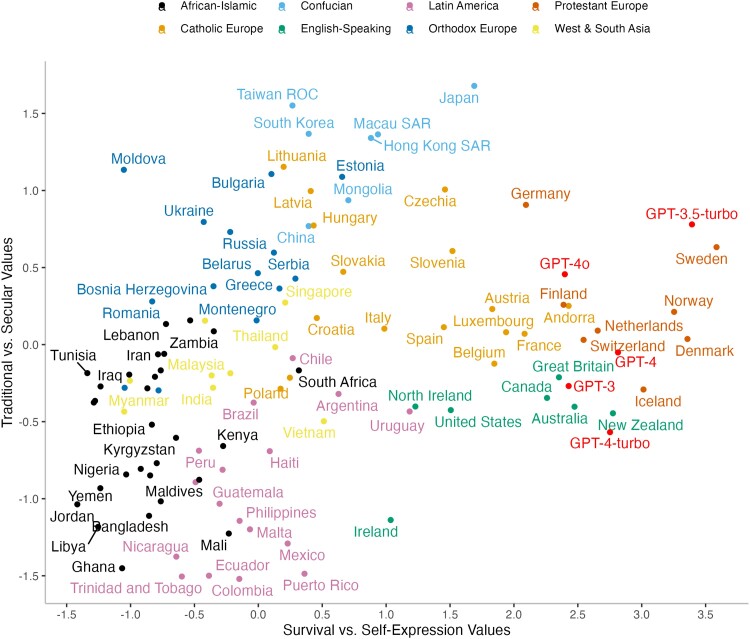
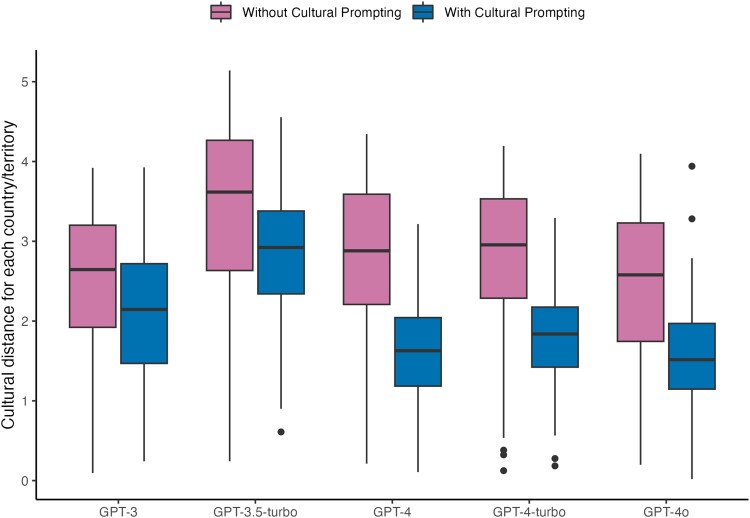
Culture fundamentally shapes people’s reasoning, behavior, and communication. As people increasingly use generative artificial intelligence (AI) to expedite and automate personal and professional tasks, cultural values embedded in AI models may bias people’s authentic expression and contribute to the dominance of certain cultures. We conduct a disaggregated evaluation of cultural bias for five widely used large language models (OpenAI’s GPT-4o/4-turbo/4/3.5-turbo/3) by comparing the models’ responses to nationally representative survey data. All models exhibit cultural values resembling English-speaking and Protestant European countries. We test cultural prompting as a control strategy to increase cultural alignment for each country/territory. For later models (GPT-4, 4-turbo, 4o), this improves the cultural alignment of the models’ output for 71–81% of countries and territories. We suggest using cultural prompting and ongoing evaluation to reduce cultural bias in the output of generative AI.
Overview
The claims and statistics of this paper haven’t been checked yet.
Free: it reads the open-access text and checks the first 5 claims that cite a source we can check. Create a free account to check every claim.
Integrity signals
Registry
Cites
Statistics
Figures
Verification
Claims the paper makes
The claims and statistics of this paper haven’t been checked yet.
Free: it reads the open-access text and checks the first 5 claims that cite a source we can check. Create a free account to check every claim.
Claims other papers make about this one
Each is checked against this paper’s own text: does it say what the citing paper says it does?
The cited source says what the claim attributes to it.
In the citing paper
“At the same time, the reproduction of biases and representational patterns embedded in training data raises concerns about whose knowledge, styles, and voices are normalised in AI-mediated learning contexts (Bender et al., 2021; Tao et al., 2024; Sterlie et al., 2024).”
From From Cognitive Necessity to Cognitive Choice: Higher Education Assessment and Learning in the Age of Generative AI (2026) · cites this paper as Tao et al., 2024
Self-check
Percentages, sums and reported differences re-computed from the paper’s own numbers.
The self-check needs the paper’s full text.
Citations
Cites
Culture's Consequences: Comparing Values, Behaviors, Institutions, and Organizations across Nations
Bhagat, R. S., & Hofstede, G. (2002) · The Academy of Management Review · doi:10.2307/4134391 · Cited by 21,664
ChatGPT for Good? On Opportunities and Challenges of Large Language Models for Education
Kasneci, E., Seßler, K., Küchemann, S., Bannert, M., Dementieva, D., Fischer, F., Gasser, U., Groh, G., Günnemann, S., Hüllermeier, E., et al. (2023) · doi:10.35542/osf.io/5er8f · Cited by 7,552
ChatGPT for good? On opportunities and challenges of large language models for education
Kasneci, E., Sessler, K., Küchemann, S., Bannert, M., Dementieva, D., Fischer, F., Gasser, U., Groh, G., Günnemann, S., Hüllermeier, E., et al. (2023) · Learning and Individual Differences · doi:10.1016/j.lindif.2023.102274 · Cited by 7,326 · cited 1×
“…Mistral, and LLaMA, which are trained on Internet-scale textual data to process text and produce human-sounding language, are increasingly used by people in all aspects of their life, including education [32], medicine and public health [13, 45], as well as creative and opinion writing [50, 29].”
BackgroundModernization, Cultural Change, and the Persistence of Traditional Values
Inglehart, R., & Baker, W. E. (2000) · American Sociological Review · doi:10.2307/2657288 · Cited by 4,524 · cited 1×
“Culture plays a major role in shaping the way individuals think and behave in their daily lives by embedding a pattern of shared knowledge and values into a group of people [27, 23, 39, 43].”
BackgroundLarge language models in medicine
Thirunavukarasu, A. J., Ting, D. S. J., Elangovan, K., Gutierrez, L., Tan, T. F., & Ting, D. S. W. (2023) · Nature Medicine · doi:10.1038/s41591-023-02448-8 · Cited by 3,944 · cited 1×
“…Mistral, and LLaMA, which are trained on Internet-scale textual data to process text and produce human-sounding language, are increasingly used by people in all aspects of their life, including education [32], medicine and public health [13, 45], as well as creative and opinion writing [50, 29].”
Background(2005) · Cited by 3,670
Culture, dialectics, and reasoning about contradiction.
Peng, K., & Nisbett, R. E. (1999) · American Psychologist · doi:10.1037//0003-066x.54.9.741 · Cited by 1,755 · cited 1×
“Cultural differences also influence causal attributions of behavior, such as explaining others’ actions based on their individual traits versus situational factors [11], and human judgment, such as resolving contradictions through compromise versus logical arguments [40].”
BackgroundA Brief Overview of ChatGPT: The History, Status Quo and Potential Future Development
Wu, T., He, S., Liu, J., Sun, S., Liu, K., Han, Q.-L., & Tang, Y. (2023) · IEEE/CAA Journal of Automatica Sinica · doi:10.1109/jas.2023.123618 · Cited by 1,452 · cited 1×
“5-turbo incorporated Reinforcement Learning with Human Feedback (RLHF) [49].”
MethodPersonality and Culture Revisited: Linking Traits and Dimensions of Culture
Hofstede, G., & McCrae, R. R. (2004) · Cross-Cultural Research · doi:10.1177/1069397103259443 · Cited by 1,397 · cited 1×
“…values which emphasize subjective well-being, or survival values which emphasize economic and physical security) have demonstrated national variation in personality [24], technological innovation [47], trust in automation [10], privacy concerns [48], and health behaviors and outcomes [35].”
BackgroundDoes culture influence what and how we think? Effects of priming individualism and collectivism.
Oyserman, D., & Lee, S. W. S. (2008) · Psychological Bulletin · doi:10.1037/0033-2909.134.2.311 · Cited by 1,385 · cited 1×
“Culture plays a major role in shaping the way individuals think and behave in their daily lives by embedding a pattern of shared knowledge and values into a group of people [27, 23, 39, 43].”
Background
Research works printed but not linked: 7
- Schein EH. 1991. What is culture. In: Reframing organizational culture. Sage Publications, Inc. p. 243–253.
- Jakesch M, Bhat A, Buschek D, Zalmanson L, Naaman M. 2023. Co-writing with opinionated language models affects users’ views. In: Proceedings of the 2023 CHI Conference on Human Factors in Computing Systems. p. 1–15; Association for Computing Machinery (ACM).
- Yuan A, Coenen A, Reif E, Ippolito D. 2022. Wordcraft: story writing with large language models. In: 27th International Conference on Intelligent User Interfaces. p. 841–852;:ACM, Helsinki, Finland.
- Ramezani A, Xu Y. 2023. Knowledge of cultural moral norms in large language models. In: Proceedings of the 61st annual meeting of the association for computational linguistics (Vol. 1, Long Papers). p. 428–446; Toronto, Canada: Association for Computational Linguistics.
- Arora A, Kaffee L-A, Augenstein I. 2023. Probing pre-trained language models for cross-cultural differences in values. In: Proceedings of the first workshop on cross-cultural considerations in NLP (C3NLP). p. 114–130; Dubrovnik, Croatia: Association for Computational Linguistics.
- Sandvig C, Hamilton K, Karahalios K, Langbort C. 2014. Auditing algorithms: research methods for detecting discrimination on internet platforms. In: Data and Discrimination: Converting Critical Concerns into Productive Inquiry. Vol. 22(2014). p. 4349–4357.
- Bolukbasi T, Chang K-W, Zou JY, Saligrama V, Kalai AT. 2016. NIPS'16: Proceedings of the 30th International Conference on Neural Information Processing System. p. 4356–4364; Red Hook, NY: Curran Associates Inc.
Cited by
Items 201–300 of 375
From Words to Waves: How Gender Bias Perpetuates AI-Based Music Generation
Wu, B. (2025) · Highlights in Science Engineering and Technology · doi:10.54097/ykbyh440
Lin, Z., & Zhao, X. (2025) · SSRN Electronic Journal · doi:10.2139/ssrn.5261067 · Cited by 1
Saleki, M., & Amin, M. R. (2025) · Lecture notes in computer science · doi:10.1007/978-3-031-93982-2_28
Lin, Z., Trogrlić, G., de Vreese, C. H., & Helberger, N. (2025) · ACM Conference on Fairness, Accountability, and Transparency (FAccT) · doi:10.1145/3715275.3732065 · Cited by 3
Wang, X., & P.O.Box: No. 127 Youyi West Road, B. D. (2025) · Information Theories and Applications · doi:10.54521/ijita32-01-p07
Cross-Platform Aesthetic Analysis: A Computer Vision Study of REDnote and Instagram
Cai, Y.-Q., Zhao, T.-F., & Ma, L. (2025) · International Conference on Machine Intelligence Theory and Applications (MiTA) · doi:10.1109/mita66017.2025.11100251
“Their findings indicate that specifying a cultural identity in the prompt (cultural prompting) significantly reduces cultural bias in the output of recent models for most countries [10].”
Li, Y. (2026) · Journal of Research in Personality · doi:10.1016/j.jrp.2026.104744 · Cited by 1
Beyond the Algorithm: Educational Justice for Plurilingual Students in AI-Assisted Classrooms
Khari, M. (2025) · IGI Global eBooks · doi:10.4018/979-8-3373-2670-2.ch015 · Cited by 2
Does AI speak your language? Large language models and psychometric development in Indian languages
Shah, V., Sundaresh, S., Nayok, S. B., Pathak, H., Sreeraj, V. S., Shivakumar, V., Kumar, V., & Venkatasubramanian, G. (2025) · Asian Journal of Psychiatry · doi:10.1016/j.ajp.2025.104729
Liu, J. (2025) · ACM Conference on Computer Supported Cooperative Work (CSCW) · doi:10.1145/3715070.3747331 · Cited by 2
Music, Technology, and Living Archives at the Grainger Museum
Lim, M., Knibbe, J., Chen, B., & Buntine, M. H. (2025) · Springer eBooks · doi:10.1007/978-3-032-02025-3_8
When Generative AI Goes to the Museum: Visual Stereotyping of Curators and Museum Spaces
Spennemann, D. H. R., & Robinson, W. A. (2025) · Information · doi:10.3390/info16110936 · Cited by 5
Calixto, G. M., Angeluci, A. C. B., & Bitencourt, E. C. (2025) · H2D|Revista de Humanidades Digitais · doi:10.21814/h2d.6680
Amjad, A. I. (2025) · Advances in computational intelligence and robotics book series · doi:10.4018/979-8-3373-4217-7.ch006 · Cited by 4
Uncovering Cultural Biases and Stereotypes in Large Language Models
Dorleon, G., & Shujaa, S. (2025) · Lecture notes in computer science · doi:10.1007/978-981-95-4861-3_5 · Cited by 2
How LLMs Handle Cultural Bias: Reactions to Asian Minority Historical Narratives
Shujaa, S., Dorleon, G., & Tang, A. (2025) · Lecture notes in computer science · doi:10.1007/978-981-95-4861-3_3 · Cited by 5
Mitigating Bias in Large Language Models Associated with Occupational Stereotypes
Chakraborty, C., & Howard, A. (2025) · IEEE International Symposium on Technology and Society (ISTAS) · doi:10.1109/istas65609.2025.11269614
“Related evidence from cultural-alignment prompting shows that referencing population-level targets can measurably improve alignment to demographic distributions [28].”
Herasimovich, V., Pousa-Unanue, A., Alzua-Sorzabal, A., Guereño-Omil, B., & Liang, R. (2025) · Estudios Turísticos · doi:10.61520/et.2302025.1269 · Cited by 1
“Pese a su avance, los modelos de lenguaje de gran tamaño (LLM) siguen presentando sesgos lingüísticos y culturales que afectan su neutralidad, especialmente en contextos culturalmente sensibles como el turismo (Fleisig et al., 2024; Z. Liu, 2023; Tao et al., 2024).”
Cash or Comfort? How LLMs Value Your Inconvenience
Cedro, M., Ichmoukhamedov, T., Goethals, S., He, Y., Hinns, J., & Martens, D. (2026) · Communications of the ACM · doi:10.1145/3799434 · Cited by 3
“This mirrors a number of concerns in prior work that LLM responses may be sensitive to user attributes such as gender, race, or dialect [29, 30, 31] and are more aligned to Western cultural norms [32, 33].”
Revolutionizing Language Learning and Proficiency With Adaptive Assessments and AI-Driven System
Nurfadhilah, E., Afra, D. I. N., Putra, P. K., Untariyati, N. A., Fajri, R., Pebiana, S., & Riza, H. (2025) · Advances in computational intelligence and robotics book series · doi:10.4018/979-8-3373-0275-1.ch010
Toward human-centered AI-assisted terminology work
Martín, A. S. (2026) · Terminology International Journal of Theoretical and Applied Issues in Specialized Communication · doi:10.1075/term.00095.mar · Cited by 3
“The tendency of LLMs to reproduce such cultural distortions has already been documented by Tao et al. (2024).”
Wysocki, A. (2025) · Roczniki Nauk Społecznych · doi:10.18290/rns2025.0043 · Cited by 1
“…strategies to control and work with AI chatbots, such as cultural prompting or cultural fine-tuning (Abrar et al., 2025; Choudhary, 2024; Tao et al., 2024; Masoud et al., 2025); the creation of multilingual and multicultural data corpora (Karpouzis, 2024; Liu, 2023; Yuan, Hu, Zhang,…”
Opuszko, M., & Böhm, P. (2026) · Communications in computer and information science · doi:10.1007/978-3-032-12313-8_7
Lim, S.-Y., Sato, K., Takami, K., Parady, G., & KIM, E. (2026) · Travel Behaviour and Society · doi:10.1016/j.tbs.2026.101374 · Cited by 2
Knowledge Democratization: Beyond AI, Beyond Disruption
Yadav, P. S. (2026) · Future of business and finance · doi:10.1007/978-3-032-11748-9_12
Yamani, A. Z., Baslyman, M., & Ahmed, M. (2025) · ACM International Conference on AI-Powered Software (AIware) · doi:10.1109/aiware69974.2025.00022 · Cited by 2
Dev, N., & Joy, S. (2026) · International Journal of Human-Computer Interaction · doi:10.1080/10447318.2026.2615218
“By contrast, the AI strand employed a protocol devised by the authors and theoretically informed by (Boden, 2016; Colton & Wiggins, 2012; Porter & Machery, 2024), alongside relevant debates on ethics and reception of AI creativity (Tao et al., 2024; Theodorou & Dignum, 2020).”
A Freirean approach to breaking the spiral of silence in AI-mediated education
Al‐Bannay, H. (2026) · Journal of Educational Technology and Online Learning · doi:10.31681/jetol.1784305 · Cited by 1
Custom AI Ethics and Literacy Frameworks (Phase 4)
Woodring, D. (2026) · Springer eBooks · doi:10.1007/978-3-032-05205-6_16
Behind the Words: Unmasking Bias Lurking in LLMs and Data
Dhingra, N., Kale, G., Chavan, H., & Arora, S. (2025) · IEEE Pune Section International Conference (PuneCon) · doi:10.1109/punecon67554.2025.11378839
“Similarly work in [11] have highlighted that large language models (LLMs) often exhibit sociocultural and regional biases embedded within their training data In summary, prior research has shown that large language models such as BERT, RoBERTa, and GPT-2 frequently inherit and reproduce social…”
Ethical Considerations in GenAI Integration in TESOL
Savvidou, C. (2026) · Springer eBooks · doi:10.1007/978-3-032-14502-4_5
Quality, Compliance, and Ethical Responsibility
Yu, J. S., & Yao, Y. (2026) · Springer eBooks · doi:10.1007/978-981-95-4632-9_13
Mukherjee, A., & Ghosh, S. (2025) · IEEE International Conference on Computer Vision Workshops · doi:10.1109/iccvw69036.2025.00160 · Cited by 4
“Previous work has extensively studied the cultural bias and cultural alignment of Large Language Models (LLMs) [1, 16, 31].”
Research on Aligning Large Models with Human Values Using Lora Fine-Tuning
Wang, Y., & Ma, N. (2025) · International Conference on Computer Science, Electronic Information Engineering and Intelligent Control Technology (CEI) · doi:10.1109/cei66465.2025.11398511
“In the future, as value alignment technologies continue to evolve, efficient alignment methods will provide crucial support for achieving safety and reliability [12] [13].”
Osifo, A., Aydoğan, M., & İZMİR, E. K. (2026) · Frontiers in Education · doi:10.21203/rs.3.rs-8722631/v1
AI in Foreign Language Assessment: Enhancing Efficiency Without Losing Meaning
Ramakrishna, N. K. (2026) · Advances in computational intelligence and robotics book series · doi:10.4018/979-8-3373-2721-1.ch007
Qi, W., Huang, F., An, J., & Kwak, H. (2025) · IEEE ... International Conference on Data Mining workshops · doi:10.1109/icdmw69685.2025.00023 · Cited by 3
“Second, while these studies have identified various biases [7], [25], [28], they often fall short of uncovering the underlying sources of these biases or proposing potential solutions.”
Mapping Research on Social Cognitive Bias in Large Language Models
Zhang, S., Li, J., Gao, Y., Li, Y., Zhang, X., & Li, X. (2025) · IEEE ... International Conference on Data Mining workshops · doi:10.1109/icdmw69685.2025.00159
“Future work should compare bias manifestations across diverse societies to distinguish culturally relative stereotypes from universal preju-dices [30].”
Emergent Biases in Large Language Models: A Critical Review of Taxonomy and Evaluations
Ismail, S., & Aygün, R. S. (2025) · IEEE International Conference on Cognitive Machine Intelligence (CogMI) · doi:10.1109/cogmi67134.2025.00036
“Interaction-induced and culturally reinforced biases illustrate how user feedback loops can align LLMs with majority values, potentially marginalizing minority perspectives [22], [42].”
InfluentialNo skin in the game: why agentic AI requires principal-agent governance
Prause, M. (2026) · AI and Ethics · doi:10.1007/s43681-026-01067-6 · Cited by 2
AI and creativity in event concept development: Vietnamese event management student perspectives
Viol, M., Postma, D., & McMillan, L. (2026) · Journal of Teaching in Travel & Tourism · doi:10.1080/15313220.2026.2649210 · Cited by 2
Koenig, P. D., & Rone, J. (2026) · Information Communication & Society · doi:10.1080/1369118x.2026.2645876 · Cited by 2
Understanding and predicting cultural change
Varnum, M. E. W., & Grossmann, I. (2026) · Advances in experimental social psychology · doi:10.1016/bs.aesp.2026.03.004
Kuczynski, A. M., & Areán, P. A. (2026) · Current Treatment Options in Psychiatry · doi:10.1007/s40501-026-00380-5 · Cited by 1
Decoding traditional knowledge: AI-powered solutions for preservation and interpretation
Bhat, G. S., Pauline, S., Chemalamudi, S., Srinivas, P., & Jain, K. K. (2026) · AI & Society · doi:10.1007/s00146-026-03010-z
“Algorithmic bias may further marginalize underrepresented knowledge systems, especially when models are trained predominantly on bio-medical or Western scientific corpora (Tao et al. 2024; Hanna et al. 2025).”
Apprentissage multiannotateur et explications communes en logique du premier ordre
Aoual, M. K. (2024) · theses.fr (ABES) · doi:10.70675/4056956dzb9abz47ecz8f08zfe994fc46d42
Kabyshev, E. (2026) · BRICS Law Journal · doi:10.21684/2412-2343-2026-13-1-8-16
Cui, N., Luo, S., Zhang, Y., & Huang, C. (2026) · CHI Conference Extended Abstracts on Human Factors in Computing Systems (CHI EA) · doi:10.1145/3772363.3798796
Hu, W.-C. (2026) · Journal of College Reading and Learning · doi:10.1080/10790195.2026.2656248 · Cited by 1
“Large language models are trained on large-scale web data that may reflect uneven global data ecologies, potentially leading to Western-leaning cultural biases (Kerche et al., 2026; Longpre et al., 2024; Tao et al., 2024).”
The Place of Humor, Empathy, and Cultural Nuances in AI-Supported Tools
Vaishnav, P. B. (2026) · Advances in computational intelligence and robotics book series · doi:10.4018/979-8-3373-6325-7.ch003
Large language models as a conduit for value shifts in contemporary China
Cao, L., & Dai, L. (2026) · Chinese Sociological Review · doi:10.1080/21620555.2026.2656193
Evaluation of Large Language Model’s Cross-Cultural Non-Verbal Behavior Understanding
Li, Z., Zou, Y., Cen, C., et al. (2026) · doi:10.1109/btfm69084.2026.11484108
Ataguba, G., Oyebode, O., Alslaity, A., Frempong, G., Imran, M., & Orji, R. (2026) · Journal of Healthcare Informatics Research · doi:10.1007/s41666-026-00235-x · Cited by 1
Large Language Models and Gender Bias: An Empirical AnalysisPreprint
ÇAKIR, P., & TEMİR, E. (2026) · Research Square · doi:10.21203/rs.3.rs-9577604/v1
Communicating SDGs in the Era of AI Economy: Towards an AI-Sustainability Exclusion Theory
Yusha’u, M. J. (2026) · Springer eBooks · doi:10.1007/978-3-032-16800-9_1
Glikson, E., Asscher, O., & Harush, R. (2026) · Cross Cultural & Strategic Management · doi:10.1108/ccsm-09-2024-0230
Gamification for Inclusive Large Language Models
Samimi-Dehkordi, L., Kolahdouz-Rahimi, S., & Fatima, S. (2026) · Advances in computational intelligence and robotics book series · doi:10.4018/979-8-3373-6063-8.ch003
Olajubu, B. J., Etuka, C. E., Hussaini, M. L., & Angama, L. J. (2026) · Human Arenas · doi:10.1007/s42087-026-00619-w
“A large-scale comparative study further demonstrated that GPT-4 produced value judgments statistically aligned with United States cultural norms on individualism and power distance, diverging significantly from the moral frameworks of collectivist societies (Tao et al., 2024).”
Ismaili, Y. (2026) · Globalisation Societies and Education · doi:10.1080/14767724.2026.2669938
Dai, A. X. (2026) · International Journal of Human-Computer Interaction · doi:10.1080/10447318.2026.2667475
MELT: A Style-Adaptive Multimodal Folktale Generation Framework for Underrepresented Cultures
Choi, H., Kim, Y., Kim, D., et al. (2026) · Electronics · doi:10.3390/electronics15102083
Arani, S. M. N., & Qohroudi, M. Q. (2026) · Iranian and Persian Studies. · doi:10.1007/978-981-95-4593-3_3
Generalized psychology and human wellness in the era of artificial intelligence: A review
Jia, S., Ren, Y., Wu, M. S., & Peng, K. (2026) · Well-Being Sciences Review · doi:10.54844/wsr.2025.1113
Obeidat, B. (2026) · Social Sciences & Humanities Open · doi:10.1016/j.ssaho.2026.102951 · Cited by 2
Gumelar, A. B., Paramita, A. S., Tahalele, P. L., Thohari, K., Kurniawan, A., & Salmanarrizqie, A. (2026) · International Conference on Current Research in Artificial Intelligence and Data Science (ICCRAIDS) · doi:10.1109/iccraids67816.2026.11519693
“Increasing the value of CRS represents a higher semantic similarity between the LLM-generated response and the actual cultural content, thus meeting the criterion of cultural fidelity in high-stakes tests [18].”
Kundurti, N., & Schweizer, J. (2026) · doi:10.2196/preprints.101964
Bilgiç, B., & Turan, S. (2026) · World Journal of Psychiatry · doi:10.5498/wjp.v16.i6.119773 · Cited by 2
Silvestri, C., & Silika, K. K. (2026) · Policing A Journal of Policy and Practice · doi:10.1093/police/paag023
LLM for social good: A value-driven LLM framework to embed social good values
Li, V. O. K., Lam, J. C. K., Han, Y., Crowcroft, J., & Cheung, L. Y. L. (2026) · Data & Policy · doi:10.1017/dap.2026.10061 · Cited by 1
“At the same time, embedding explicit value sets risks reinforcing dominant cultural norms or introducing bias if poorly governed (Tao et al., 2024).”
Sakharkar, M., Jalihal, P., Chang, S., Patel, P. N., Chavez, M. M., & Levi, J. R. (2026) · Otolaryngology · doi:10.1002/ohn.70309 · Cited by 1
“8 As a result, LLM ‐ generated content may perpetuate these biases, potentially leading to harmful consequences for patients.”
Rauchfleisch, A., & Jungherr, A. M. (2026) · New Media & Society · doi:10.1177/14614448261449271 · Cited by 1
Do AI Models Have Values? Measuring Cultural Value Orientations Across 30 Large Language Models
Zhang, S., & Han, Q. (2026) · IEEE Conference on Artificial Intelligence (CAI) · doi:10.1109/cai68641.2026.11536432 · Cited by 1
“Tao et al. [18] further compared LLM responses with nationally representative human survey data, showing that models tend to default toward Western value profiles but that explicit cultural prompting can improve alignment with local norms.”
Lindenberg, D. (2026) · Multimodality & Society · doi:10.1177/26349795261459896
Kuhail, M. A., Følstad, A., & Alimamy, S. (2026) · Tourism Recreation Research · doi:10.1080/02508281.2026.2670299 · Cited by 1
Translation and Cross‐Cultural Adaptation of the Chronic Rhinosinusitis Control Test for Global Use
Pae, H. K., Xia, D., Sun, H., Chen, Y., Yi, K., Song, M., Sato, E., Abasi, A. R., Ballah, J., Babarczy, A., et al. (2026) · International Forum of Allergy & Rhinology · doi:10.1002/alr.70194 · Cited by 1
Shen, Y., Yang, W., & Shie, A. (2026) · Scientific Reports · doi:10.1038/s41598-026-56781-2
“No mature theoretical or practical frameworks currently address how to integrate cultural norms into prompts or guide conversational AI to generate pragmatic strategies that foster long-term collaboration 1 .”
Implicit Affective Steering: A Design Probe for Generative Curatorial Storytelling
Ma, M. C., Shi, L., Li, H., Cheng, J., & Kirk, D. S. (2026) · Designing Interactive Systems Conference · doi:10.1145/3800645.3812861
“Beyond advancing interaction design for generative cultural heritage, this work also interrogates a critical generative bottleneck : even when outputs are linguistically fluent, LLMs may reinforce culturally dominant narrative tropes and framing defaults [1, 6, 62].”
InfluentialHow two AI models depict ageing: a cross-cultural analysis of ChatGPT and Doubao
Zhong, X. (2026) · Social Semiotics · doi:10.1080/10350330.2026.2686256
Peters, D., Espinoza, F., Re, M. D., Ivetta, G., Benotti, L., & Calvo, R. A. (2026) · AI and Ethics · doi:10.1007/s43681-026-01196-y · Cited by 8
“While valuable, these quantitative approaches lack the benefits of context and depth that come from qualitative research with community involvement.”
YAPAY ZEKÂ TARAFINDAN ÜRETİLEN GÖRSELLERDE BASMAKALIPLAR: TÜRKİYE TEMSİLİ ÜZERİNE BİR İNCELEME
TAŞDELEN, H., & ALTIN, Ş. Y. (2026) · Çukurova Üniversitesi Sosyal Bilimler Enstitüsü Dergisi · doi:10.35379/cusosbil.1695903
Rozado, D., & Tetlock, P. E. (2026) · Theory and Society · doi:10.1007/s11186-026-09719-6 · Cited by 1
“Finally, Tao et al. (2024) found that LLMs default to Western cultural norms, but tend to align more closely with a country’s culture when prompted to respond as a typical person from that country.”
Califano, G., & Vecchio, R. (2026) · Food Quality and Preference · doi:10.1016/j.foodqual.2026.106024
Baker-Ramos, R., Mhasakar, M., Raja, V. K. B., Helekahi-Kaiwi, E.-B., Gelder, W., Carter, B., Diego, R., Cabral, A., & Hester, J. D. (2026) · ACM International Conference on Interaction Design and Children (IDC) · doi:10.1145/3773077.3806104
Auditing LLM-Governed Social Robots with Culture-Specific Moral Gradients
Ng, C., & Kasneci, G. (2026) · ACM Conference on Fairness, Accountability, and Transparency (FAccT) · doi:10.1145/3805689.3812366
The Paradox of the Present Era: AI as Environmental Liberation and Leviathan
Guldi, J. (2026) · Environmental History · doi:10.1086/741658
Can you Help me Also to Write? Using LLMs to Evaluate Essays that Contain Filipino English Features
Ocumpaugh, J. L., Liu, X., Rodrigo, M. M. T., Kai, S., & Andres, J. M. A. (2026) · Communications in computer and information science · doi:10.1007/978-3-032-29791-4_14
Wang, F., Guo, L. P., & Zhang, Y. R. (2026) · Education and Information Technologies · doi:10.1007/s10639-026-14060-7
“In addition, cultural norms represented in training data may influence what models learn to treat as “better” or more appropriate responses during pretraining and alignment processes (Tao et al., 2024).”
Kobayashi, M., Goto, A., & Himuro, A. (2026) · BMC Psychology · doi:10.1186/s40359-026-05067-3
“Prior research has proposed persona prompting and native-language prompting as mechanisms for adapting LLMs to specific cultural and linguistic contexts [3, 5, 6, 10, 20].”
InfluentialReflect: Transparent Principle-Guided Reasoning for Constitutional Alignment at Scale
Bell, H., Zhang, C., Haque, M. M., Zaman, S., Potdar, D., & Fain, B. (2026) · ACM Conference on Fairness, Accountability, and Transparency (FAccT) · doi:10.1145/3805689.3806454 · Cited by 2
“LLM deployments are diverse with respect to users, values, cultures, and contexts [19, 24, 41, 43, 61, 67, 71, 72, 77].”
Improving Malay Cultural Appropriateness in Multilingual Llms Through Persona-Based Prompting
Saw, H. L., Khaw, Y.-M. J., Jamil, N. S., & Tan, T.-P. (2026) · IEEE Symposium on Computer Applications & Industrial Electronics (ISCAIE) · doi:10.1109/iscaie68866.2026.11576392 · Cited by 1
“To address this, the study [8] implemented cultural prompting, instructing models to respond as if they were a person from a specific country or cultural context.”
InfluentialAmbiguity Collapse by LLMs: A Taxonomy of Epistemic Risks
Gur-Arieh, S., Wang, A., & Fazelpour, S. (2026) · ACM Conference on Fairness, Accountability, and Transparency (FAccT) · doi:10.1145/3805689.3806469 · Cited by 7
The paradox of inclusion: Generative AI and the center-periphery divide in language education
Shi, K. (2026) · System · doi:10.1016/j.system.2026.104103 · Cited by 1
Графин, А. Д., Золин, А. А., & Shekhovtsov, O. I. (2026) · Современные наукоемкие технологии (Modern High Technologies) · doi:10.17513/snt.40839
Impartial Intelligence? Evidence of Country-Label Sensitivity in AI Financial Analysis
Motoki, F. Y. S., & Pinto, J. P. (2026) · Journal of Business Ethics · doi:10.1007/s10551-026-06385-7 · Cited by 2
Grout, V. (2026) · International Conference on Information Technology Based Higher Education and Training (ITHET) · doi:10.1109/ithet69978.2026.11584958
“People generally criticize AI when they perceive (or are directed to perceive) it as being biased, but often expect it to reflect their own personal or cultural biases [24], which they may not question [25].”
Lei, L., Zhang, W., Liu, H. G., & Gu, J. (2026) · International Conference on Computer Supported Cooperative Work in Design (CSCWD) · doi:10.1109/cscwd68734.2026.11582415
“Tao et al. leveraged multinational value survey data to reveal cultural drift patterns in GPT-series models and proposed cultural prompting, which enhances cultural consistency by embedding cultural background information into prompts without modifying model parameters [17].”
GenAI-enabled versus human assessment of written assignments
Lin, S., Ngai, G., Lee, P., Ip, A. K. Y., & Kwan, K. (2026) · Innovations in Education and Teaching International · doi:10.1080/14703297.2026.2699254 · Cited by 1
From rules to roles: A generative AI-driven agent-based model for land-use decisions
Vannier, C., Dété, M., Richards, D., Heays, A. N., Lavorel, S., & Quénol, H. (2026) · Ecological Modelling · doi:10.1016/j.ecolmodel.2026.111731 · Cited by 1
Cempellin, L. (2026) · Springer eBooks · doi:10.1007/978-3-032-21685-4_17
Recognizing Creativity as a Right: Human and Cultural Rights for Creativity in the Age of AI
Issak, A., Spivak, S. C., Srinivasan, R., & Harteveld, C. (2026) · Creativity and Cognition · doi:10.1145/3803784.3807529
“There has been a growing need for GenAI tools to become more culturally sensitive [42, 55, 80, 97, 132].”
Metadata
- Authors
- Tao, Y., Viberg, O., Baker, R. S., & Kizilcec, R. F.
- Affiliations
- Cornell University (US)
- KTH Royal Institute of Technology (SE)
- University of Pennsylvania (US)
- Corresponding author
- Kizilcec, René F
- Venue
- PNAS Nexus
- Publisher
- Oxford University Press (OUP)
- Published
- 2024-09
- Volume
- 3
- Issue
- 9
- Pages
- pgae346-pgae346
- ISSN
- 2752-6542 (ISSN-L)
- PMC
- PMC11407280
- OpenAlex
- W4402565126
- Semantic Scholar
- 5f8bf881c80125452e4a73ad51fdb2c72c65c551
- Cited by
- 383
- References
- 40
- Citations by year
- 2026: 213 · 2025: 154 · 2024: 15
- FWCI
- 158.32
- Type
- journal article
- Language
- en
- Open access
- gold
- doi.org
- Licence
- Locations
- PNAS Nexus (publishedVersion, cc-by-nc)
- PubMed Central (publishedVersion, cc-by-nc)
- PubMed (publishedVersion)
- arXiv (Cornell University) (submittedVersion, cc-by)
- arXiv (Cornell University) (cc-by)
- Funders
- Jacobs Foundation Research Fellowship and Digital Futures
- Topics
- Physical Sciences › Computer Science › Artificial Intelligence › Ethics and Social Impacts of AI
- Physical Sciences › Computer Science › Artificial Intelligence › Topic Modeling
- Social Sciences › Psychology › Social Psychology › Cultural Differences and Values
- Keywords
- cultural bias, cultural alignment, large language models, cultural values, GPT-4, generative AI, cross-cultural assessment, national survey data, cultural homogenization
About these checks
Registry, retraction, Cites and statistics results are computed, not judged, with one exception: a printed reference that no index lists is read once by a model before it counts as a citation error. Claims are extracted by a model and kept only when their quote appears verbatim in the text; each cited source is then checked, with a model’s help, for whether it says what the claim relies on. Those verdicts can be wrong — read the claim’s quote and the cited source before relying on one.
Statistics and arithmetic are recomputed, not judged.
Confidence bands are shown only for fields calibrated on our annotated test set. None is calibrated yet, so no band is shown.
What counts as a claim ›How we measure confidence ›How we check this ›
Are you an author, or do you see a problem with this page? Request a review
Data sources
Bibliographic data: Semantic Scholar, OpenAlex, Crossref.
Contains information from the Semantic Scholar Academic Graph Datasets, made available under the ODC Attribution License (ODC-BY 1.0).
Semantic Scholar’s data is described in: Kinney, R., et al. (2023). The Semantic Scholar Open Data Platform. arXiv:2301.10140.
