

Affective Polarization in Comparative and Longitudinal Perspective
Open accessThe DOI matches its Crossref record; 20 of the 21 references it cites were found in a registry or an index; 5 of the 34 sources its claims cite were checked for support.
Abstract
Existent research shows that affective polarization has been intensifying in some publics, diminishing in others, and remaining stable in most. We contribute to this debate by providing the most encompassing comparative and longitudinal account of affective polarization so far. We resort to a newly assembled dataset able to track partisan affect, with varying time series, in eighteen democracies over the last six decades. We present results based on two different operational measures of affective polarization: Reiljan's Affective Polarization Index, based on reported partisans only, and Wagner's weighted distance from the most liked party, based on the whole electorate. Our reassessment of affective polarization among partisans confirms that an intensifying trend is observable in a number of countries but it is, by no means, generalizable to all established democracies. Regarding the longitudinal assessment of affective polarization among the electorate, we confirm that US citizens have become more affectively polarized over time.
Overview
CoChat Summary
## TL;DR
This paper assembles a comparative-longitudinal dataset on affective polarization in 18 democracies over 1961–2020 and shows that trends are highly country-specific among partisans. Using a whole-electorate measure, the authors find that rising affective polarization is, with some minor exceptions, mainly an American story.
## Key findings
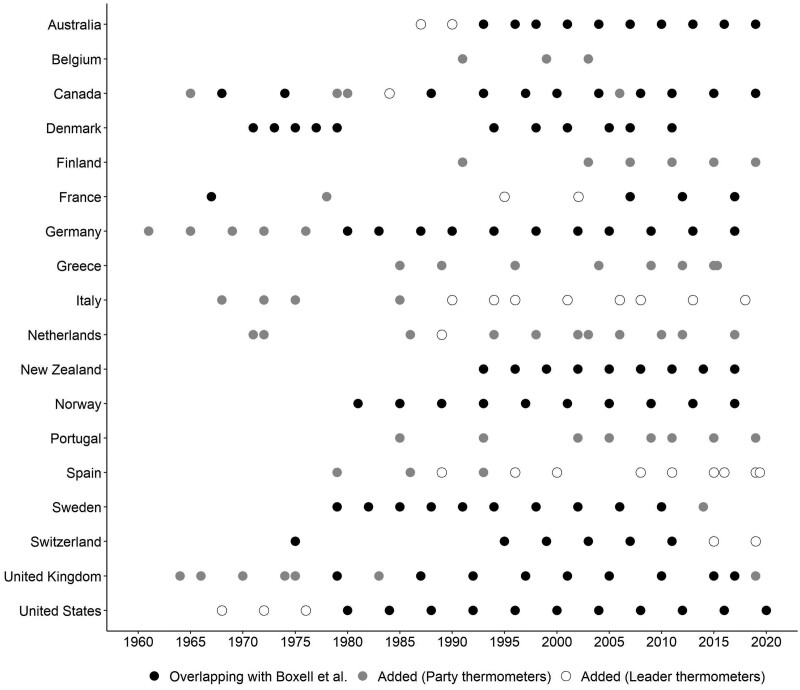
- The dataset covers 191 election studies from 18 democracies over 1961–2020, adding 7 countries and 27 data points to prior work.
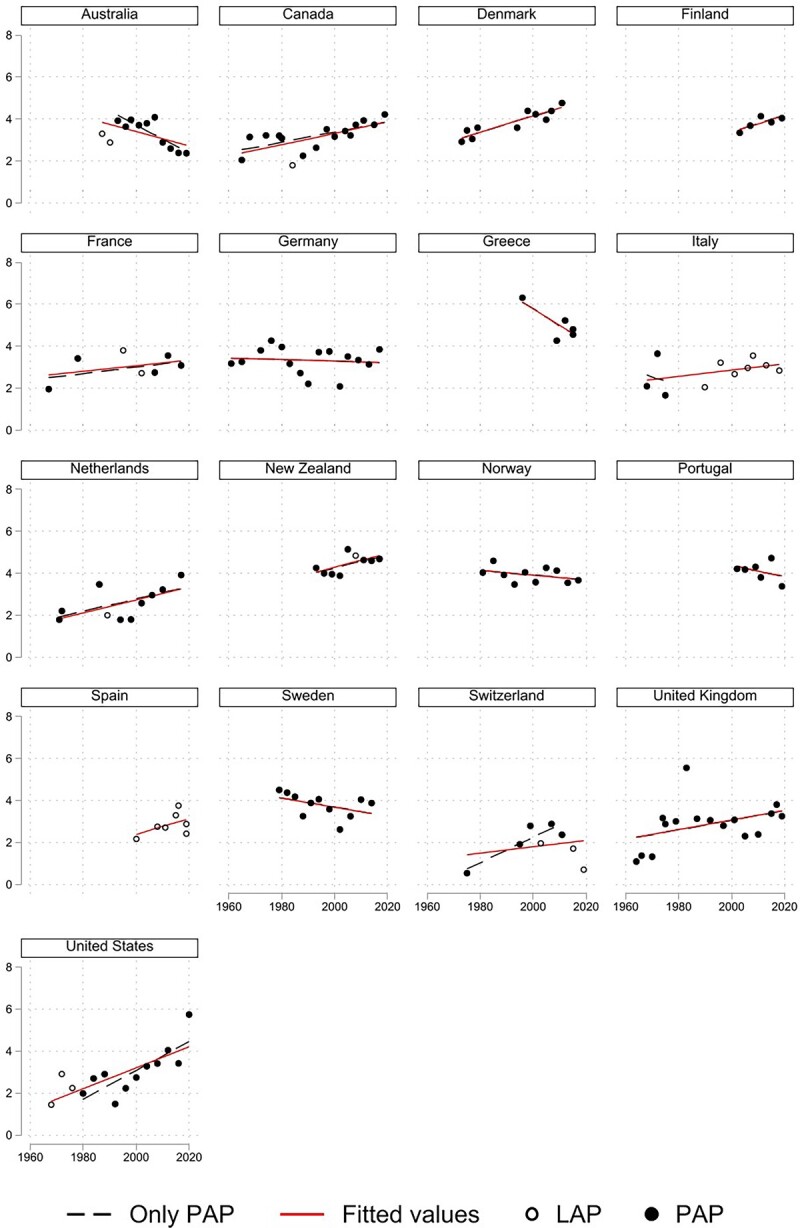
- Among partisans (Reiljan’s API), the trend is positive in 11 countries and negative in 6 countries; statistically significant linear trends appear in 7 of 17 countries, with positive slopes in Canada, Denmark, Netherlands, New Zealand, United Kingdom, and the United States, and a negative slope in Australia.
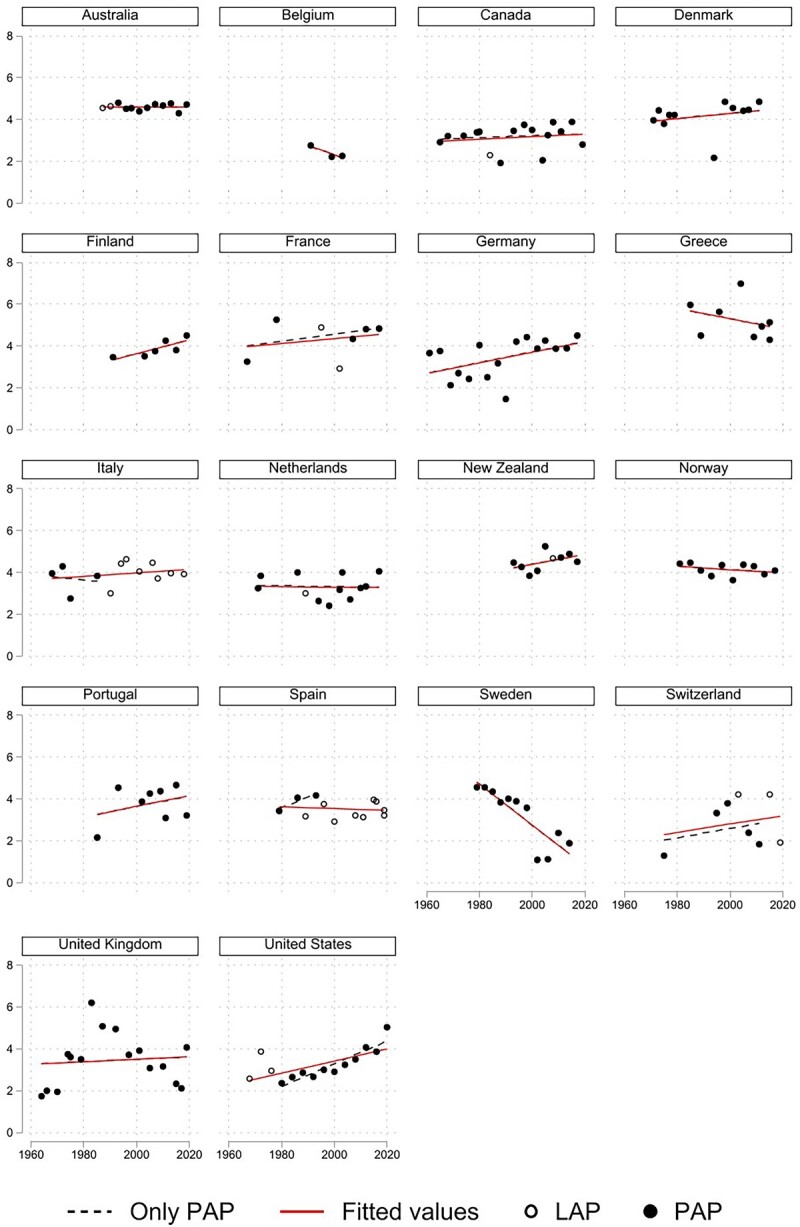
- Among the whole electorate (Wagner’s measure), the data show little indication of a cross-national trend; statistically significant increases appear most noticeably in the United States and Germany, while Sweden decreases markedly.
- The paper’s main conclusion is that US citizens have become more affectively polarized over time.
## Methods
- The study uses a newly assembled comparative-longitudinal dataset of national election studies with feeling thermometer questions, drawing on the West European Voter project for 14 West European democracies and national election study programs for Australia, Canada, New Zealand, and the United States.
- It operationalizes affective polarization with two measures: Reiljan’s Affective Polarization Index (API) for reported partisans only, and Wagner’s weighted mean distance from the most liked party for the whole electorate.
- Thermometer scores are rescaled to 0–10, and the analysis examines country-specific longitudinal trends, using regression fit lines / estimates to assess significance.
## Limitations
- The paper explicitly notes that conceptualization matters and that results depend on whether affective polarization is defined for partisans only or for the whole electorate.
- It also makes clear that the available measures depend on the presence of feeling thermometer questions, which were not available in all election studies; the authors substituted party-leader thermometers when party thermometers were unavailable (N = 26). This is a limitation evident from the text.
- The paper describes the cross-national pattern among partisans as idiosyncratic, and for some countries it cannot compare trends with prior work due to differences in underlying data sources and sample definitions (e.g., Germany); this is evident from the text.
Model-written summary. Check it against the paper before relying on it.
Integrity signals
Registry
Cites
Statistics
Figures
Verification
Claims the paper makes
5 Valid · 0 Not valid · 16 Not checked · 17 Own results and interpretations
The cited sources support only part of this claim — read each source’s verdict below.
In the paper
“These studies converge on the finding that levels of affective polarization are not especially prominent in the United States, but that polarization has grown stronger there than anywhere else.”
§ Affective Polarization in Comparative and Longitudinal Perspective > Introduction
What the sources say
- Not checked — no full text of the sourcecites Gidron, Adams, and Horne 2020 matched to “American Affective Polarization in Comparative Perspective” (2020) source
- Partly supportedcites Reiljan 2020 matched to “Fear and Loathing Across Party Lines (Also) in Europe: Affective Polarisation in European Party Systems” (2020) sourceExperimental — accuracy not yet measured
The first clause is directly supported: in 'Levels of affective polarisation in Europe and the United States' Reiljan reports that 'intense AP is highly present in European party systems, and the United States is far from being at the head of the pack', with the US average API sitting between the NWE and CEE/SE cohorts. The second clause of the same citing sentence — that polarisation 'has grown stronger there than anywhere else' — is not what this paper establishes: it records only 'a notable increase between 2008 and 2012' in the US (and repeats Iyengar et al. 2012's finding of a dramatic surge among US partisans), while documenting comparable or sharper temporal rises in single European countries (Greece, Portugal, Poland, Bulgaria). So the superlative growth claim attributed to this source is unsupported by our copy. (LLM, conf=0.72)
- Not matchedcites Boxell, Gentzkow, and Shapiro 2021
An author–year citation the paper’s reference list doesn’t settle. We don’t search these by name.
plain- Asserted: passes — The authors put it forward as true.
- Checkable: passes — It can be checked against evidence.
- Load-bearing: passes — The paper’s conclusions depend on it.
- Based: passes — The paper gives a reason why it holds.
A result the paper reports from its own data — it cites no other source for it, so there is none to check. The quote shows it is in the paper.
In the paper
“Regarding the longitudinal assessment of affective polarization among the electorate, we confirm that US citizens have become more affectively polarized over time.”
- Also stated in: § Conclusions · boosted
“US citizens have indeed become more affectively polarized over time.”
§ Affective Polarization in Comparative and Longitudinal Perspective > Abstract
boostedstates a cause- Asserted: passes — The authors put it forward as true.
- Checkable: passes — It can be checked against evidence.
- Load-bearing: passes — The paper’s conclusions depend on it.
- Based: passes — The paper gives a reason why it holds.
- Rests on an assumption not shown here.
- Also stated in: § Conclusions · boosted
In the paper
“Through this dataset, we are able to expand upon Boxell, Gentzkow, and Shapiro’s (2021) most encompassing comparative longitudinal account of affective polarization to date in terms of both geographical scope (seven added countries: Belgium, Finland, Greece, Italy, Netherlands, Portugal, Spain) and time span (twenty-seven data points added to the countries already featured in Boxell et al.’s study”
§ Affective Polarization in Comparative and Longitudinal Perspective > Data and Measures
What the sources say
- Not matchedcites Boxell, Gentzkow, and Shapiro 2021
An author–year citation the paper’s reference list doesn’t settle. We don’t search these by name.
plain- Asserted: passes — The authors put it forward as true.
- Checkable: passes — It can be checked against evidence.
- Load-bearing: passes — The paper’s conclusions depend on it.
- Based: passes — The paper gives a reason why it holds.
- Rests on an assumption not shown here.
- Not matched
A result the paper reports from its own data — it cites no other source for it, so there is none to check. The quote shows it is in the paper.
In the paper
“When it comes to the linearity of these trends, the regression fit lines (see table 1) report conventional levels of statistical significance in seven out of the seventeen countries under analysis”
§ Affective Polarization in Comparative and Longitudinal Perspective > Trends in Affective Polarization among Partisans
plain- Asserted: passes — The authors put it forward as true.
- Checkable: passes — It can be checked against evidence.
- Load-bearing: unclear — It is unclear whether the paper’s conclusions depend on it.
- Based: passes — The paper gives a reason why it holds.
A result the paper reports from its own data — it cites no other source for it, so there is none to check. The quote shows it is in the paper.
In the paper
“six of them have positive slopes (Canada, Denmark, Netherlands, New Zealand, United Kingdom and the United States)”
§ Affective Polarization in Comparative and Longitudinal Perspective > Trends in Affective Polarization among Partisans
plain- Asserted: passes — The authors put it forward as true.
- Checkable: passes — It can be checked against evidence.
- Load-bearing: unclear — It is unclear whether the paper’s conclusions depend on it.
- Based: passes — The paper gives a reason why it holds.
18 more claims
Create a free account to see all 38 claims and to verify the 2 references still open.
- It may state two separate claims as one. 7
- Probably not a substantial claim. 8
- The quote only partly states this claim. 2
Claims other papers make about this one
Each is checked against this paper’s own text: does it say what the citing paper says it does?
The cited source says what the claim attributes to it.
In the citing paper
“Measuring affective polarization, however, becomes significantly more complex in multiparty contexts (Garzia et al., 2023;Harteveld, 2021;Reiljan, 2020;Tichelbaecker et al., 2023;Wagner, 2021).”
From Measuring affective polarization: Matching concepts to measures (2026) · cites this paper as Garzia et al., 2023
The cited source says what the claim attributes to it.
In the citing paper
“Scholars consequently have suggested weighting each party's measure of affect based on its relative size within the electoral systemfor example, by vote share (Garzia et al., 2023;Reiljan, 2020;Reiljan et al., 2024;Wagner, 2021).This approach is also beneficial in cases where researchers want to measure affective polarization in a comparative perspective (e.g.Reiljan et al., 2024).”
From Measuring affective polarization: Matching concepts to measures (2026) · cites this paper as Garzia et al., 2023
Citations
Cites
The Origins and Consequences of Affective Polarization in the United States
Iyengar, S., Lelkes, Y., Levendusky, M., Malhotra, N., & Westwood, S. J. (2019) · Annual Review of Political Science · doi:10.1146/annurev-polisci-051117-073034 · Cited by 3,603 · cited 1×
“The terms “affective polarization” (Iyengar et al. 2019; Wagner 2021), “partisan polarization” (Stoker and Jennings 2008; Levendusky and Malhotra 2016), or “partisan affective polarization” (Robison and Moskowitz 2019; Stoetzer et al.”
BackgroundIyengar, S., Sood, G., & Lelkes, Y. (2012) · Public Opinion Quarterly · doi:10.1093/poq/nfs038 · Cited by 2,996
Uncivil Agreement: How Politics Became Our Identity
Mason, L. (2018) · doi:10.7208/chicago/9780226524689.001.0001 · Cited by 1,985
Mason, L. (2015) · American Journal of Political Science · doi:10.1111/ajps.12089 · Cited by 1,458 · cited 1×
“…trends in the United States could be ascribed to the country’s differential effects of partisan sorting on social and issue polarization (Mason 2015, 2018; Harteveld 2021).8 Our findings invite a deeper reflection on the bases upon which affective polarization is conceptualized and…”
BackgroundThe rise of negative partisanship and the nationalization of U.S. elections in the 21st century
Abramowitz, A. I., & Webster, S. (2016) · Electoral Studies · doi:10.1016/j.electstud.2015.11.001 · Cited by 978
Political Sectarianism in America
Finkel, E. J., Bail, C. A., Cikara, M., Ditto, P. H., Iyengar, S., Klar, S., Mason, L., McGrath, M. C., Nyhan, B., Rand, D. G., et al. (2020) · Science · doi:10.1126/science.abe1715 · Cited by 931 · cited 3×
“15; Finkel et al. 2020, p. 534). Comparative research going beyond American affective polarization has emerged in recent years (Gidron, Adams, and Horne 2020; Reiljan 2020; Boxell, Gentzkow, and Shapiro 2021; Garzia and Ferreira da Silva 2021; Wagner 2021). These studies converge on the finding that levels of affectiv…”
BackgroundInfluentialAffective Polarization in Multiparty Systems
Wagner, M. (2021) · Electoral Studies · doi:10.1016/j.electstud.2020.102199 · Cited by 593
Reiljan, A. (2020) · European Journal of Political Research · doi:10.1111/1475-6765.12351 · Cited by 592 · cited 2×
“The Affective Polarization Index (API) for multiparty systems was developed by Reiljan (2020).”
BackgroundMethodAmerican Affective Polarization in Comparative Perspective
Gidron, N., Adams, J., & Horne, W. (2020) · doi:10.1017/9781108914123 · Cited by 481
(Mis)perceptions of Partisan Polarization in the American Public
Levendusky, M. S., & Malhotra, N. (2016) · Public Opinion Quarterly · doi:10.1093/poq/nfv045 · Cited by 356
Research works printed but not linked: 1
- Garzia Diego, Ferreira da Silva Frederico, De Angelis Andrea. 2021. Leaders without Partisans: Dealignment, Media Change, and the Personalization of Politics. London/New York: ECPR Press/Rowman & Littlefield.
Cited by
Patterns of affective polarization toward parties and leaders across the democratic world
REILJAN, A., GARZIA, D., FERREIRA DA SILVA, F., & TRECHSEL, A. H. (2024) · American Political Science Review · doi:10.1017/s0003055423000485 · Cited by 98
“Most of the comparative literature has so far relied on an equivalent of the feeling ther-mometer, that is, the party like – dislike scale (Boxell, Gentzkow, and Shapiro 2022; Garzia, Ferreira da Silva, and Maye 2023; Gidron, Adams, and Horne 2020; Reiljan 2020; Wagner 2021).”
BackgroundSelf-citationAffective polarization in Europe
Wagner, M. (2024) · European Political Science Review · doi:10.1017/s1755773923000383 · Cited by 80
Comellas, J. M., & Torcal, M. (2023) · Electoral Studies · doi:10.1016/j.electstud.2023.102615 · Cited by 57
Putting the affect into affective polarisation
Bakker, B. N., & Lelkes, Y. (2024) · Cognition and Emotion · doi:10.1080/02699931.2024.2362366 · Cited by 43
“…a ff ective polarisation outside the United States (e.g. Bassan-Nygate & Weiss, 2022; Bäck et al., 2023; Boxell et al., 2024; Garrett & Bankert, 2020; Garzia et al., 2023; Gidron et al., 2020; Harteveld, 2021; Hobolt et al., 2021; Hobolt et al., 2023; Janssen, 2024; Kekkonen & Ylä-Anttila, 2021;…”
BackgroundDeepening the rift: Negative campaigning fosters affective polarization in multiparty elections
Martin, D., & Nai, A. (2024) · Electoral Studies · doi:10.1016/j.electstud.2024.102745 · Cited by 37
We love, they hate: Emotions in affective polarization and how partisans may use them
Versteegen, P. L. (2024) · Political Psychology · doi:10.1111/pops.12955 · Cited by 40
The (alleged) consequences of affective polarization: A survey experiment in nine democracies
Harteveld, E., Berntzen, L. E., Kokkonen, A., Kelsall, H., Linde, J., & Dahlberg, S. (2026) · European Journal of Political Research · doi:10.1017/s1475676526101273 · Cited by 24
“…institutional effects are unlikely to be uniform: comparative measures show that affective polarization can be substantial even in long-standing consensus democracies, implying that coalitions can coexist with high animosity (Reiljan 2020; Wagner 2021; Garzia, Ferreira da Silva, and Maye 2023).”
Winners, losers, and affective polarization
Andrews, J., & Huang, Y.-S. (2025) · Party Politics · doi:10.1177/13540688241292556 · Cited by 11
“Garzia et al. (2023) fi nd similar trends in affective polarization across samples of partisans and the electorate as a whole in eighteen established democracies.”
Mass Polarization across Time and Space
Mehlhaff, I. D. (2025) · Cambridge University Press eBooks · doi:10.1017/9781009350662 · Cited by 9
Ideological and affective polarization in multiparty systemsPreprint
Leininger, A., Grünewald, F., & Buntfuß, N. (2023) · SocArXiv (OSF Preprints) · doi:10.31235/osf.io/mz6rs · Cited by 13
Ferreira da Silva, F., & Garzia, D. (2024) · Public Opinion Quarterly · doi:10.1093/poq/nfae053 · Cited by 9
“…Ryan 2022)—in Western publics has motivated a growing research interest in the topic, now extending beyond the original American focus into multiparty contexts (Gidron, Adams, and Horne 2020; Reiljan 2020; Wagner 2021; Boxell, Gentzkow, and Shapiro 2022; Garzia, Ferreira da Silva, and Maye 2023).”
Self-citationKobayashi, T., Zhang, Z., & LIU, L. (2024) · Communication Research · doi:10.1177/00936502241289109 · Cited by 13
Park, J., & Warner, B. R. (2024) · International Journal of Public Opinion Research · doi:10.1093/ijpor/edae033 · Cited by 7
Does polarization increase participation? A systematic literature review and meta-analysis
Kołczyńska, M. (2025) · European Political Science Review · doi:10.1017/s1755773925000116 · Cited by 11
Establishing the construct and predictive validity of brief measures of affective polarization
Kasper, J., Schumacher, G., & Bakker, B. N. (2025) · European Journal of Political Research · doi:10.1111/1475-6765.70022 · Cited by 5
“As explained above, we are interested in whether full and brief measures reflect the same construct and show consistent associations with other variables, rather than comparing absolute values (e.g., Boxell et al., 2024; Garzia et al., 2023), which may differ depending on scale length.”
Vanagt, J., & Kollberg, M. (2025) · European Journal of Political Research · doi:10.1111/1475-6765.70012 · Cited by 8
Mukerjee, S., & Shen, C. (2024) · Political Communication · doi:10.1080/10584609.2024.2446348 · Cited by 9
“Inter-party animosity has escalated in numerous democracies globally (Garzia et al., 2023).”
Tartaglione, J., & de‐Wit, L. (2024) · British Journal of Social Psychology · doi:10.1111/bjso.12787 · Cited by 10
Ciobanu, C., & Sandu, D. (2024) · Comparative Political Studies · doi:10.1177/00104140241259453 · Cited by 5
“…is mostly focused on the unique political climate of the United States (Iyengar et al., 2019), while recent years have seen more comparative AP work (Garzia et al., 2023; Reiljan et al., 2023; Ruggeri et al., 2021); and 4) it does not always account against whom in the out-party is polarization…”
Election Outcomes and Affective Polarization in the United States
Phillips, J. B., & Warner, S. B. (2026) · Political Research Quarterly · doi:10.1177/10659129251411892 · Cited by 5
“Garzia et al. (2023) show that trends in polarization have varied widely across countries over the last 30 years, and polarization itself can be operationalized differently depending on the structure of a country ’ s partisan politics (Tichelbaecker et al. 2023).”
Neyazi, T. A., Ee, T. K., & Kuru, O. (2025) · Social Science Computer Review · doi:10.1177/08944393251362247 · Cited by 14
“Unlike issue or ideological polarization, which re fl ect divergence in policy or beliefs, affective polarization refers to the emotional and identity-based antagonism that un-dermines democratic deliberation (Garzia et al., 2023; Lelkes et al., 2017).”
In-Party Love, Out-Party Hate, and Affective Polarization in Twelve Established Democracies
Garzia, D., & da Silva, F. F. (2025) · Public Opinion Quarterly · doi:10.1093/poq/nfaf013 · Cited by 17
“…(and longitudinal) research on affective polarization, we rely on party feeling thermometers as an instrument to capture survey respondents’ feelings toward the parties (Gidron et al. 2020; Reiljan 2020; Wagner 2021; Garzia, Ferreira da Silva, and Maye 2023; Boxell, Gentzkow, and Shapiro 2024).”
Self-citationMerten, L., & Niedringhaus, J. (2024) · The Journal of Economic Inequality · doi:10.1007/s10888-024-09641-w · Cited by 5
“7 Two things are worth mentioning: On the one hand, the spread constitutes an attitude-based measure of both ingroup and outgroup evaluations (Röllicke 2023) and does not capture the closeness or extent of identification with a party (Garzia et al. 2023).”
The political communication of polarizing leaders. Evidence from Italy
Mariotti, C., & Stanziano, A. (2024) · Contemporary Italian Politics · doi:10.1080/23248823.2024.2362487 · Cited by 5
“…US) and decreasing in others (especially in Europe, in countries such as Sweden, Greece, Portugal, and Norway) (Boxell, Gentzkow, and Shapiro 2022; Garzia, Ferreira da Silva, and Maye 2023), we intend to test, by looking at leaders’ communication, whether this new trend of depolarization can be…”
Parks and social capital: An analysis of the 100 most populous U.S. cities
Klein, W. P., Locke, D. H., Niu, K., & Frumkin, H. (2025) · Urban forestry & urban greening · doi:10.1016/j.ufug.2025.128956 · Cited by 4
“Contemporary evidence suggests high levels of polarization and segregation in U.S. society by race/ethnicity, social class, and ideology (Finkel et al., 2020; Garzia et al., 2023; Iyengar et al., 2019; Loh et al., 2020; Mijs and Roe, 2021; Skelley and Fuong, 2022; label).”
The Sectarian Divide: The Dynamics of Populism in South Korea
Jung, Y. J. (2025) · Journal of East Asian Studies · doi:10.1017/jea.2025.13 · Cited by 5
The countervailing impacts of significant 2020 events on youth delinquency
Baumer, E. P., & Staff, J. (2025) · Criminology · doi:10.1111/1745-9125.12410 · Cited by 5
Leader Effects in an Era of Negative Politics: Who Has a Negativity Bias?
Aaldering, L., da Silva, F. F., Garzia, D., Gattermann, K., & Nai, A. (2025) · Politics and Governance · doi:10.17645/pag.9187 · Cited by 7
“On the other hand, we see a stark rise in affective polarization, unfolding as deepening hostile feelings experienced by voters towards the out‐party and their supporters (e.g., Garzia et al., 2023; Iyengar et al., 2012; Iyengar & Westwood, 2015; Reiljan, 2020).”
Self-citationCivil society IV: Democratic solidarity and the non-civil scaffolding of the civil sphere
Watts, G., & Horgan, M. (2025) · Filozofija i drustvo · doi:10.2298/fid2501011w · Cited by 6
Segovia, C. (2023) · Estudios Internacionales · doi:10.5354/0719-3769.2023.71014 · Cited by 5
“One of those signs is the increased levels of affective polarization documented in several countries (Gidron et al., 2020; Segovia, 2022; Garzia et al., 2023).”
Poljak, Ž., & Muraille, J. (2025) · American Politics Research · doi:10.1177/1532673x251410935 · Cited by 3
Yuniar, A. D., Ananda, K. S., & Kamarudin, S. B. (2025) · Media Asia · doi:10.1080/01296612.2025.2582030 · Cited by 2
“Research indicates that users often curate their social media feeds by following accounts and sources that reinforce their viewpoints, a behavior that can contribute to phenomena such as filter bubbles and echo chambers (Garzia et al., 2023).”
da Silva, F. F. (2025) · South European Society & Politics · doi:10.1080/13608746.2025.2562297 · Cited by 3
Self-citationEstimating affective polarization on a social network
Hohmann, M., & Coscia, M. (2025) · PLoS ONE · doi:10.1371/journal.pone.0328210 · Cited by 5
“We expect elevated levels of polarization in political debates, even on previously unknown topics like COVID-19, given the consistent upward trend in affective polarization in the United States since the 1960s [26].”
Dynamics of Electoral Polarisation in Climate Policy Discourse: A Temporal Network Analysis
Drecker, P. (2025) · Politics and Governance · doi:10.17645/pag.10004 · Cited by 6
“Therefore, several studies have examined polarisation in different countries (Dalton, 2021; Reiljan, 2020; Wagner, 2021) as well as the long‐term development of polarisation over time (Boxell et al., 2024; DiMaggio et al., 1996; Garzia et al., 2023; Munzert & Bauer, 2013).”
Quest for Significance and Violent Extremism
Molinario, E., Webber, D. J., Jaśko, K., & Kruglanski, A. W. (2025) · Cambridge University Press eBooks · doi:10.1017/9781009407892.009 · Cited by 3
Revers, M., & Coleman, S. R. (2025) · American Journal of Cultural Sociology · doi:10.1057/s41290-025-00264-w · Cited by 5
Learning to Like the Enemy: Moral Learning Reduces Affective Polarization
Moran, T., & Walther, E. (2025) · Social Psychological and Personality Science · doi:10.1177/19485506251343667 · Cited by 2
“We used the party affiliation of Democrats and Republicans in the present context because, despite the ubiquity of affective polarization, recent studies show that the levels are most alarming in the U.S. population (Garzia et al., 2023).”
Ripping the public apart? Politicians’ dark personality and affective polarization
Nai, A., da Silva, F. F., Aaldering, L., Gattermann, K., & Garzia, D. (2025) · European Journal of Political Research · doi:10.1111/1475-6765.70002 · Cited by 5
Self-citationGalais, C., & Balinhas, D. (2024) · International Journal of Public Opinion Research · doi:10.1093/ijpor/edae059 · Cited by 6
The Evolution of Public Opinion Over Gay Rights in Switzerland
Siegel, S. N. (2024) · Political Research Quarterly · doi:10.1177/10659129241278665 · Cited by 6
“They also report positive, but not statistically signi fi cant, increases in polarization in Switzerland (Garzia, Ferreira da Silva, and Maye 2023), but Bartels (2003) fi nds little evidence for ideological polarization in Europe.”
Fernández, J. J., Castillo, A. M. J., & Wen, F. (2024) · International Sociology · doi:10.1177/02685809241262715 · Cited by 3
“The United States is undergoing a particular increase in affective polarization and the presence of strong and antagonistic political identities may be especially conducive to parti-san-motivated reasoning (Bolsen et al., 2014; Garzia et al., 2023).”
Hall, J., & Whitt, S. (2024) · Journal of Behavioral and Experimental Economics · doi:10.1016/j.socec.2024.102253 · Cited by 2
Political polarization in low- and middle-income countries
Larreguy, H., & Tiburcio, E. (2026) · Nature Human Behaviour · doi:10.1038/s41562-026-02507-3 · Cited by 6
How does affective polarization feel? A comparative description
Lawall, K., Versteegen, P. L., & Tsakiris, M. (2026) · European Journal of Political Research · doi:10.1017/s1475676526101170 · Cited by 3
Molnár, A., & Loewenstein, G. F. (2026) · Political Psychology · doi:10.1111/pops.70138 · Cited by 1
Affective partisan polarization, citizens’ attitudes, and political behavior in Swiss democracy
Jansen, B., & Stutzer, A. (2026) · Zeitschrift für schweizerische Statistik und Volkswirtschaft/Schweizerische Zeitschrift für Volkswirtschaft und Statistik/Swiss journal of economics and statistics · doi:10.1186/s41937-025-00145-6 · Cited by 3
“While Boxell et al. (2024) and Garzia et al. (2023) report a positive time trend of AP between 1975 and 2011 3 , Gidron et al. (2020) do not qualify the longitudinal pattern (in terms of a trend) for Switzerland.”
Robinson, J., & Dassonneville, R. C. (2026) · Electoral Studies · doi:10.1016/j.electstud.2025.103042 · Cited by 2
To polarize or not to polarize? Unveiling 2024 European election communication strategies
Mariotti, C., & Stanziano, A. (2025) · European Journal of Communication · doi:10.1177/02673231251388263 · Cited by 1
“Recent longitudinal studies suggest that affective polarization is increasing in some countries, particularly in the United States, while showing signs of decline in others, such as Sweden, Greece, Portugal, and Norway (Boxell et al., 2022; Garzia et al., 2023).”
Introducing a novel method to support polarized citizens to sustain political dialogue
English, A., & Mahendran, K. (2025) · Political Psychology · doi:10.1111/pops.70080 · Cited by 1
“A substantial body of recent evidence (Garzia et al., 2023; Schmidt-Catran & Czymara, 2023) indicates Western societies are increasingly polarized over political and culture war issues.”
Kuhn, U., & Marquis, L. (2025) · European Journal of Political Research · doi:10.1017/s1475676525100248 · Cited by 3
Cultural Polarization and Social Groups: The Case of Book Banning
Childress, C., Rawlings, C. M., & Maghbouleh, N. (2025) · International Journal of Politics Culture and Society · doi:10.1007/s10767-025-09545-1 · Cited by 1
Partisan animosity and protest participation in the United States
Warner, S. B. (2025) · Social Forces · doi:10.1093/sf/soaf066 · Cited by 3
Unaffected polarization? Populism and affective polarization in comparative perspective
Stefanelli, A., & Silva, B. C. (2025) · Political Psychology · doi:10.1111/pops.70027 · Cited by 1
Eck, B., & Paulis, E. (2025) · British Journal of Political Science · doi:10.1017/s0007123425000365 · Cited by 3
“Finally, the countries exhibit different average levels of affective polarization (Garzia et al. 2023).”
Good and Bad Science? Spanish-Speaking YouTube Users’ Comments on Science Content
Serrano-Contreras, I.-J., Marin, J. G., & Luengo, Ó. G. (2024) · International Journal of Public Opinion Research · doi:10.1093/ijpor/edae045 · Cited by 1
Bubble reachers and uncivil discourse in polarized online public sphere
Kobellarz, J. K., Broćić, M., Silver, D. L., & Silva, T. H. (2024) · PLoS ONE · doi:10.1371/journal.pone.0304564 · Cited by 6
Measuring affective polarization: Matching concepts to measures
Druckman, J. N., Klar, S., Krupnikov, Y., Levendusky, M., & Ryan, J. B. (2026) · Political Psychology · doi:10.1111/pops.70152 · Cited by 3
Political Talk and Participation Survey Analysis
Duyn, E. V. (2026) · Oxford University Press eBooks · doi:10.1093/9780197820865.005.0006
Duyn, E. V. (2026) · Oxford University Press eBooks · doi:10.1093/9780197820865.003.0007
Duyn, E. V. (2026) · Oxford University Press eBooks · doi:10.1093/9780197820865.005.0002
Duyn, E. V. (2026) · Oxford University Press eBooks · doi:10.1093/9780197820865.005.0001
Duyn, E. V. (2026) · Oxford University Press eBooks · doi:10.1093/9780197820865.005.0004
Duyn, E. V. (2026) · Oxford University Press eBooks · doi:10.1093/9780197820865.002.0004
Duyn, E. V. (2026) · Oxford University Press eBooks · doi:10.1093/9780197820865.003.0005
Partisanship Is Thicker than Water
Duyn, E. V. (2026) · Oxford University Press eBooks · doi:10.1093/9780197820865.003.0004
Love in the Time of Partisan Media
Duyn, E. V. (2026) · Oxford University Press eBooks · doi:10.1093/9780197820865.003.0003
What’s Politics Got to Do with It?
Duyn, E. V. (2026) · Oxford University Press eBooks · doi:10.1093/9780197820865.003.0001
Duyn, E. V. (2026) · Oxford University Press eBooks · doi:10.1093/9780197820865.003.0002
Political Socialization Survey Analysis
Duyn, E. V. (2026) · Oxford University Press eBooks · doi:10.1093/9780197820865.005.0005
Duyn, E. V. (2026) · Oxford University Press eBooks · doi:10.1093/9780197820865.005.0003
Duyn, E. V. (2026) · Oxford University Press eBooks · doi:10.1093/9780197820865.003.0015
Moralization Will Tear Us Apart
Duyn, E. V. (2026) · Oxford University Press eBooks · doi:10.1093/9780197820865.003.0006
Moral Identity Gap Survey Analysis
Duyn, E. V. (2026) · Oxford University Press eBooks · doi:10.1093/9780197820865.005.0007
Farjam, M., Meyer, H., Segesten, A. D., & Brüggemann, M. (2026) · Journalism · doi:10.1177/14648849261491026 · Cited by 1
Benedek, I. (2026) · Journal of Contemporary Central and Eastern Europe · doi:10.1080/25739638.2026.2719475
Engaging citizens? The role of negativity and incivility on politicians’ social media
Muraille, J., & Poljak, Ž. (2026) · Acta Politica · doi:10.1057/s41269-026-00430-z
Incivility Among Politicians: Driven by Rational Minds or Personal Drives?
Poljak, Ž., & Maes, B. J. (2026) · The International Journal of Press/Politics · doi:10.1177/19401612261477641
Affective polarisation in the 2023 New Zealand general election
Jamieson, T. H., & Bakewell, S. (2026) · Political Science · doi:10.1080/00323187.2026.2718048
Partisanship and the Social Construction of Deservingness in the United States
Ellis, C., & Faricy, C. (2026) · Political Behavior · doi:10.1007/s11109-026-10184-1 · Cited by 1
From instability to hostility: Coalition collapse and affective polarization
Hormig, F., & Otteni, C. (2026) · Electoral Studies · doi:10.1016/j.electstud.2026.103114 · Cited by 1
González, Y. M., & Skigin, N. (2026) · American Journal of Political Science · doi:10.1111/ajps.70073 · Cited by 1
Election salience revisited: How elections (do not) boost affective polarization
Eck, B., & Michel, E. (2026) · Electoral Studies · doi:10.1016/j.electstud.2026.103116
Affective polarization and the support for populist and technocratic governance
Engler, S., Bantel, I., & Leemann, L. (2026) · Party Politics · doi:10.1177/13540688261461499
Arceneaux, K., & Bakker, B. N. (2026) · Political Psychology · doi:10.1111/pops.70165
Priming common European and democratic values does not reduce affective polarization
Canalejo-Molero, Á., Cicchi, L., da Silva, F. F., Garzia, D., Reiljan, A., & Trechsel, A. H. (2026) · European Political Science Review · doi:10.1017/s1755773926100496
Self-citationWhat Makes an Emotion Political? Affective Polarisation as a Test Case for Political Emotions
Brogaard, B. “. (2026) · Cambridge University Press eBooks · doi:10.1017/9781009493741.004
Emotional Politics and Political Emotions
Osler, L., & Szanto, T. (2026) · Cambridge University Press eBooks · doi:10.1017/9781009493741.002
Regional affects and attitudes towards immigrants: the case of Belgium
Michel, E., Gandenberger, M., & Manatschal, A. (2026) · Acta Politica · doi:10.1057/s41269-026-00423-y
McMurtrie, B. L., Williams, M. N., Philipp, M. C., Roemer, A., & Hebden, R. T. (2026) · European Journal of Social Psychology · doi:10.1002/ejsp.70081 · Cited by 1
Continuous growth of social polarization for scale-free networks
Pan, B., & Liu, J. (2026) · Chaos An Interdisciplinary Journal of Nonlinear Science · doi:10.1063/5.0322613
Political polarization threatens fairness and reciprocity in the USA
Fetchenhauer, D., Graczyk, T. M., Triemer, S. J., Lang, A., Winterhagen, S., & Kemp, S. (2026) · Scientific Reports · doi:10.1038/s41598-026-42697-4
Angry losers? The (null) effects of feeling electoral loss on anti-democratic attitudes
Lawall, K., Michalaki, K., & Tsakiris, M. (2026) · European Journal of Political Research · doi:10.1017/s1475676525100601 · Cited by 1
Salman, A., & Kolikant, Y. B. (2026) · Educational Research Review · doi:10.1016/j.edurev.2026.100769 · Cited by 1
Beyond partisanship: Ideological identities and affective evaluations
Hjermitslev, I. B., & Wagner, M. (2026) · European Journal of Political Research · doi:10.1017/s147567652510056x · Cited by 4
“On the one hand, research indeed finds that levels of affective polarization in Europe and the United States are not vastly different (Reiljan 2020; Wagner 2021; Garzia, Ferreira da Silva, and Maye 2023), even if the negative trends found in the US are less pronounced there.”
The unifying magic of the unwaved flag: Do national identity primes reduce affective polarization?
Nordbrandt, M., Gustavsson, G., & Breidahl, K. N. (2026) · European Journal of Political Research · doi:10.1017/s1475676525100649 · Cited by 1
“On both sides of the Atlantic (Boxell, Gentzkow, Shapiro et al. 2024; Garzia, Ferreira da Silva, Maye et al. 2023; Gidron, Adams, Horne et al. 2023; Wagner 2021), the tendency to see one ’ s political adversaries not just as opponents but as enemies driven by bad or misguided intentions appears as…”
Ársælsson, K. M., & Lelkes, Y. (2026) · Oxford University Press eBooks · doi:10.1093/obo/9780199756841-0322
Alam, R., & Gill, M. J. (2026) · Personality and Social Psychology Review · doi:10.1177/10888683251407825
Metadata
- Authors
- Garzia, D., Ferreira da Silva, F., & Maye, S.
- Affiliations
- University of Lausanne (CH)
- Senior Researcher, Institute of Political Studies, University of Lausanne , Lausanne, Switzerland
- Corresponding author
- Garzia, Diego
- Venue
- Public Opinion Quarterly
- Publisher
- Oxford University Press (OUP)
- Published
- 2023-02-01
- Volume
- 87
- Issue
- 1
- Pages
- 219-231
- ISSN
- 0033-362X (ISSN-L)
- 1537-5331
- PMC
- PMC10127533
- OpenAlex
- W4321787097
- Semantic Scholar
- e894926f593684c74ba066a80d70f36e8489268f
- Cited by
- 137
- References
- 17
- Citations by year
- 2026: 56 · 2025: 48 · 2024: 27 · 2023: 6
- FWCI
- 134.05
- Type
- journal article
- Language
- en
- Open access
- hybrid
- doi.org
- Licence
- Locations
- Public Opinion Quarterly (publishedVersion, cc-by)
- PubMed Central (publishedVersion, cc-by)
- PubMed (publishedVersion)
- SERVAL (Université de Lausanne) (submittedVersion, cc-by)
- Archivio istituzionale della ricerca (Alma Mater Studiorum Università di Bologna) (submittedVersion)
- IRIS (submittedVersion, cc-by)
- Funders
- Swiss National Science Foundation (PCEFP1_186898)
- Topics
- Social Sciences › Political Science and International Relations › Electoral Systems and Political Participation
- Social Sciences › Sociology and Political Science › Media Influence and Politics
- Social Sciences › Political Science and International Relations › Political Theory and Democracy
- Keywords
- affective polarization, partisan affect, political attitudes, democracy, longitudinal trends, cross-national comparison
About these checks
Registry, retraction, Cites and statistics results are computed, not judged, with one exception: a printed reference that no index lists is read once by a model before it counts as a citation error. Claims are extracted by a model and kept only when their quote appears verbatim in the text; each cited source is then checked, with a model’s help, for whether it says what the claim relies on. Those verdicts can be wrong — read the claim’s quote and the cited source before relying on one.
The claim verdicts this report counts are experimental: their accuracy is not yet measured.
A language model drew the claims from the paper on 2026-10-10, under version 3 of the claim definition (model deepseek-v4.1-flash, prompt extract-v3).
A second model labelled each claim on 2026-10-10 (model jev-1.13-20260917, definition revision gold-guideline-v0.2).
Cited sources are checked with a language model’s help (qwen3.8-omni-flash).
Statistics and arithmetic are recomputed, not judged.
Confidence bands are shown only for fields calibrated on our annotated test set. None is calibrated yet, so no band is shown.
What counts as a claim ›How we measure confidence ›How we check this ›
Are you an author, or do you see a problem with this page? Request a review
Data sources
Bibliographic data: Semantic Scholar, OpenAlex, Crossref.
Contains information from the Semantic Scholar Academic Graph Datasets, made available under the ODC Attribution License (ODC-BY 1.0).
Semantic Scholar’s data is described in: Kinney, R., et al. (2023). The Semantic Scholar Open Data Platform. arXiv:2301.10140.
