

Workplace Heterogeneity and the Rise of West German Wage Inequality*
The DOI matches its Crossref record; 144 of the 147 references it cites were found in a registry or an index, and 1 are not checked yet; none of the 8 sources its claims cite is checked for support yet.
Abstract
We study the role of establishment-specific wage premiums in generating recent increases in West German wage inequality. Models with additive fixed effects for workers and establishments are fit into four subintervals spanning the period from 1985 to 2009. We show that these models provide a good approximation to the wage structure and can explain nearly all of the dramatic rise in West German wage inequality. Our estimates suggest that the increasing dispersion of West German wages has arisen from a combination of rising heterogeneity between workers, rising dispersion in the wage premiums at different establishments, and increasing assortativeness in the assignment of workers to plants. In contrast, the idiosyncratic job-match component of wage variation is small and stable over time. Decomposing changes in mean wages between different education groups, occupations, and industries, we find that increasing plant-level heterogeneity and rising assortativeness in the assignment of workers to establishments explain a large share of the rise in inequality along all three dimensions.
Checked 2026-11-19 · 1 reference not checked yet
Overview
CoChat Summary
TL;DR
Using West German administrative data from 1985–2009, the paper shows that models with additive person and establishment fixed effects explain nearly all of the rise in wage inequality. The increase is driven by rising worker-effect variance, rising establishment-premium variance, and increased assortative matching of high-wage workers to high-wage plants.
Key findings
- In the AKM variance decomposition, total log-wage variance rose from 0.137 in interval 1 (1985–1991) to 0.249 in interval 4 (2002–2009). The variance of person effects rose from 0.084 to 0.127 and contributed 39% of the total rise; establishment-effect variance rose from 0.025 to 0.053 and contributed 25%; the covariance term rose from 0.003 to 0.041 and contributed 34%.
- Assortative matching increased: the correlation between person and establishment effects rose from 0.034 in interval 1 to 0.249 in interval 4. Counterfactuals imply that holding sorting constant would have produced 69% of the actual variance rise, while holding establishment-effect variance constant would have produced 64%.
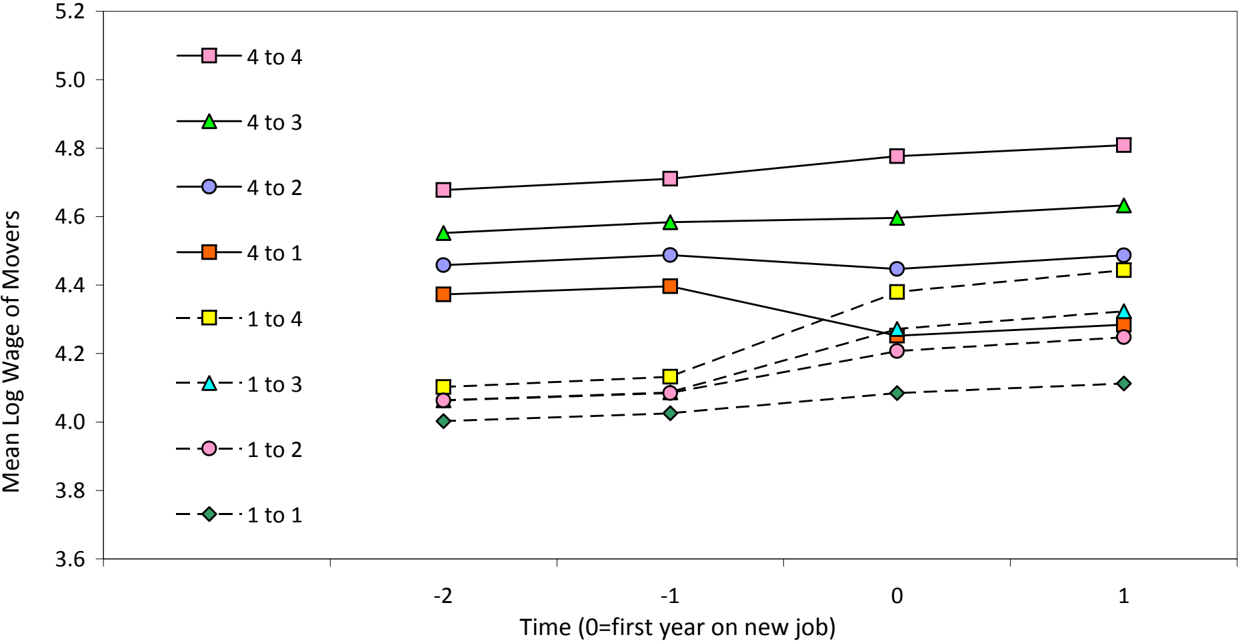
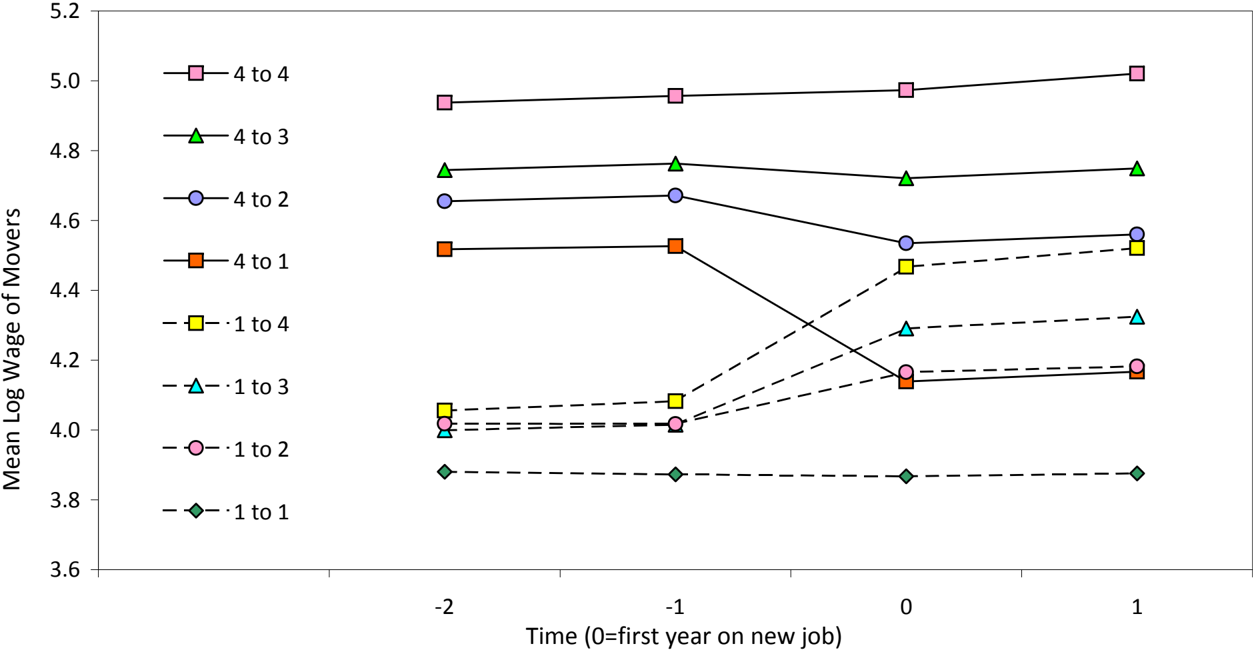
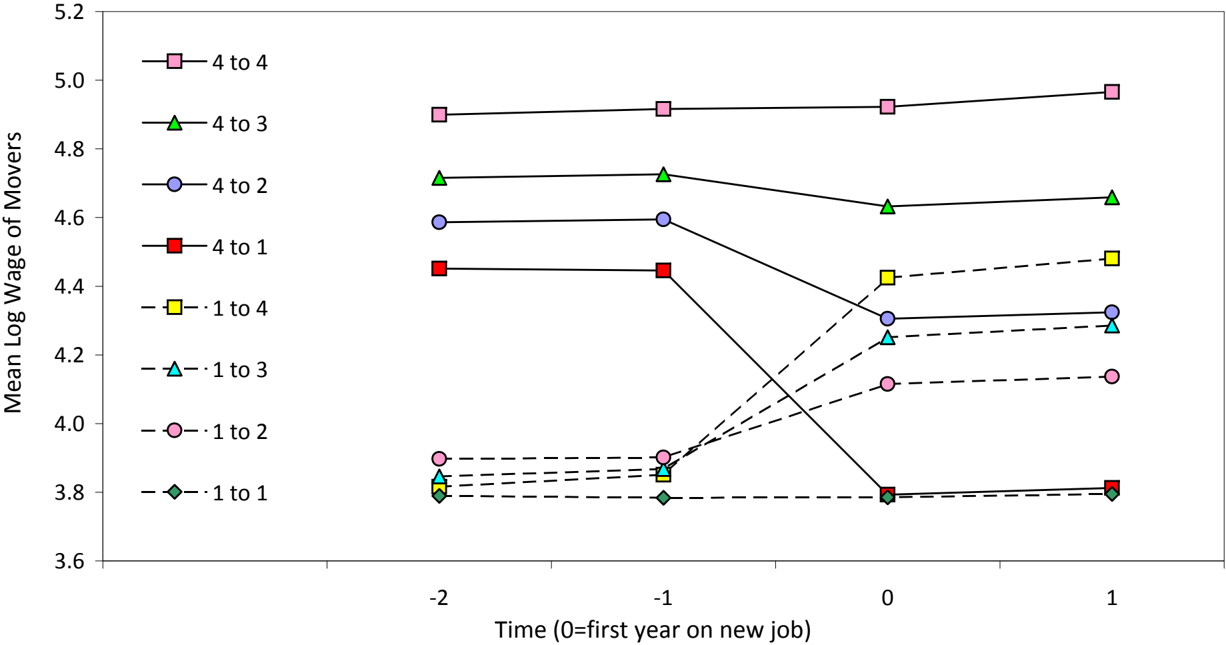
- Job-mobility event studies show growing establishment premia: a trend-adjusted move from quartile 1 to quartile 4 co-worker-wage establishments was associated with a 23 log-point gain in 1985–1991 versus 47 log points in 2002–2009; the reverse move yielded losses of 22 versus 43 log points.
- Between-group decompositions attribute 70% of the relative rise in university-educated men’s wages and 80% of the relative fall for workers with no/missing qualifications to establishment effects. For occupations, 42% of the rise in between-occupation variance is from person–establishment covariance, 28% from establishment variance, and about 30% from person variance; for industries, 44% is person variance, 19% establishment variance, and 42% sorting.
Methods
- Data: German Social Security records from the IEB, focusing on full-time West German men age 20–60 from 1985–2009, with parallel analyses for full-time women. The main sample has 85–90 million person-year observations per interval and about 17 million individual workers.
- Model: AKM-style log daily wage equation with additive person fixed effects, establishment fixed effects, time-varying covariates, and an error component; estimated by OLS on the largest connected set of establishments linked by worker mobility. Censored earnings are imputed using Tobit models.
- Analyses: variance decompositions and counterfactuals across four overlapping intervals (1985–1991, 1990–1996, 1996–2002, 2002–2009); event studies of job changers; decompositions of between-group wage gaps by education, occupation, and industry; and establishment cohort/collective-bargaining analyses.
Limitations
- The paper states that earnings are censored at the Social Security maximum (10–12% of male observations and 1–3% of female observations per year), so it uses Tobit imputation and checks robustness using apprentice-trained men, who have lower censoring rates.
- The paper states that establishment identifiers are administrative: ownership changes can create new establishment IDs, and only about half of EID births/deaths are estimated to be true plant openings/closings. It also states that sampling errors bias estimated variances upward and the covariance downward, and it does not construct bias-corrected estimates, assuming biases are similar across intervals.
- The paper states that collective bargaining cannot be assigned a causal role because firms choose coverage, and that female estimates may have more negatively biased covariance terms due to fewer observed matches per plant/worker. Evident from the text: the main analysis is restricted to full-time workers in West Germany, excluding civil servants, self-employed, and many part-time/mini-job workers, which limits generalizability.
Model-written summary. Check it against the paper before relying on it.
Integrity signals
Registry
Cites
Statistics
Figures


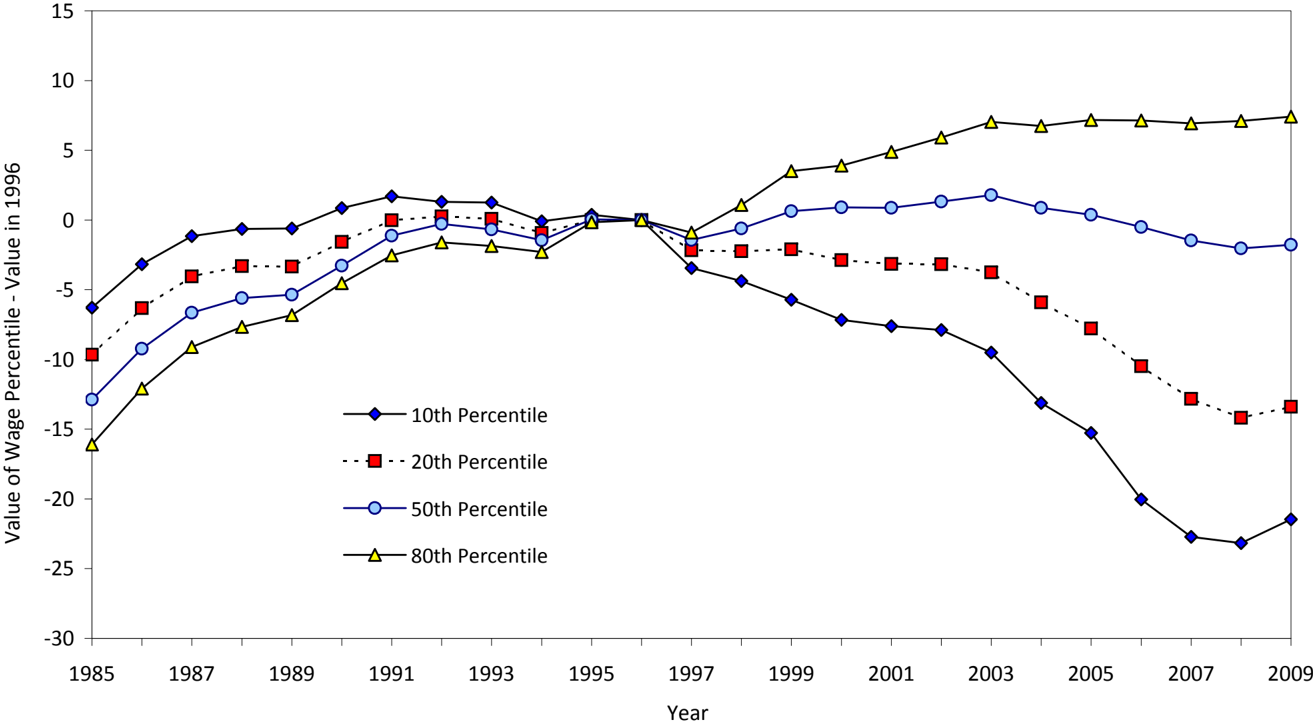
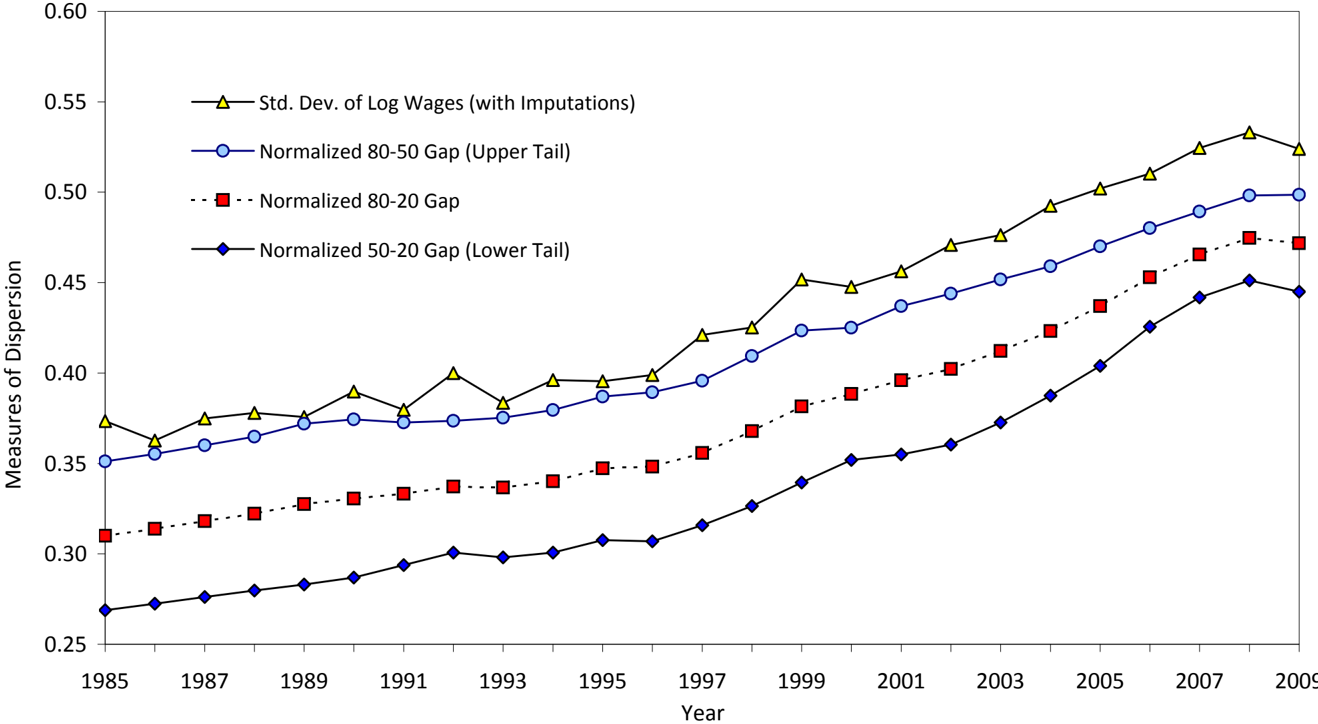
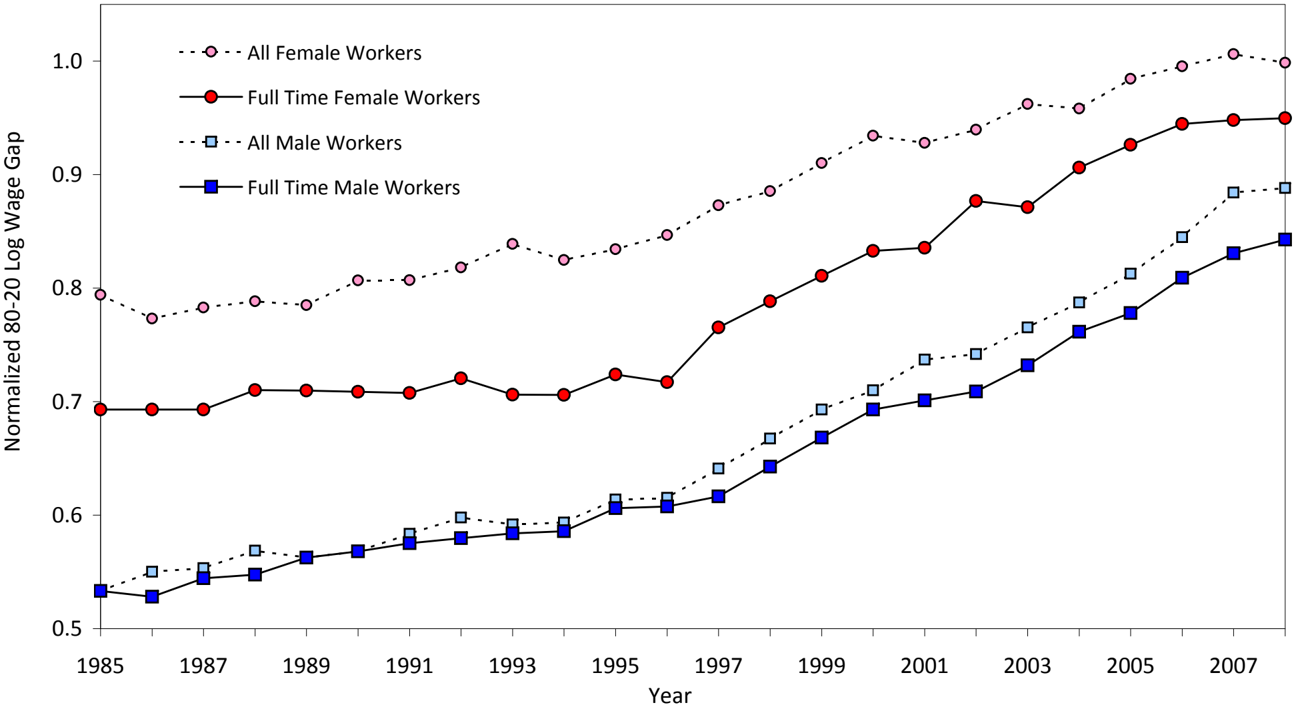
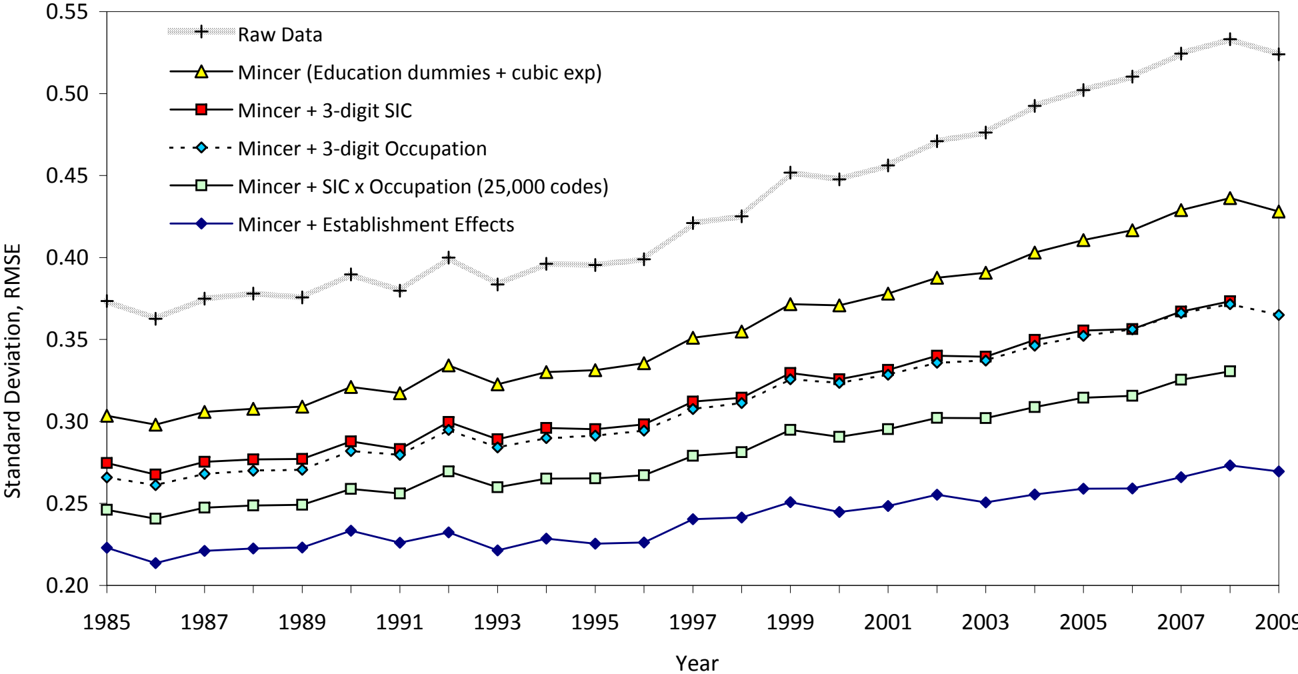
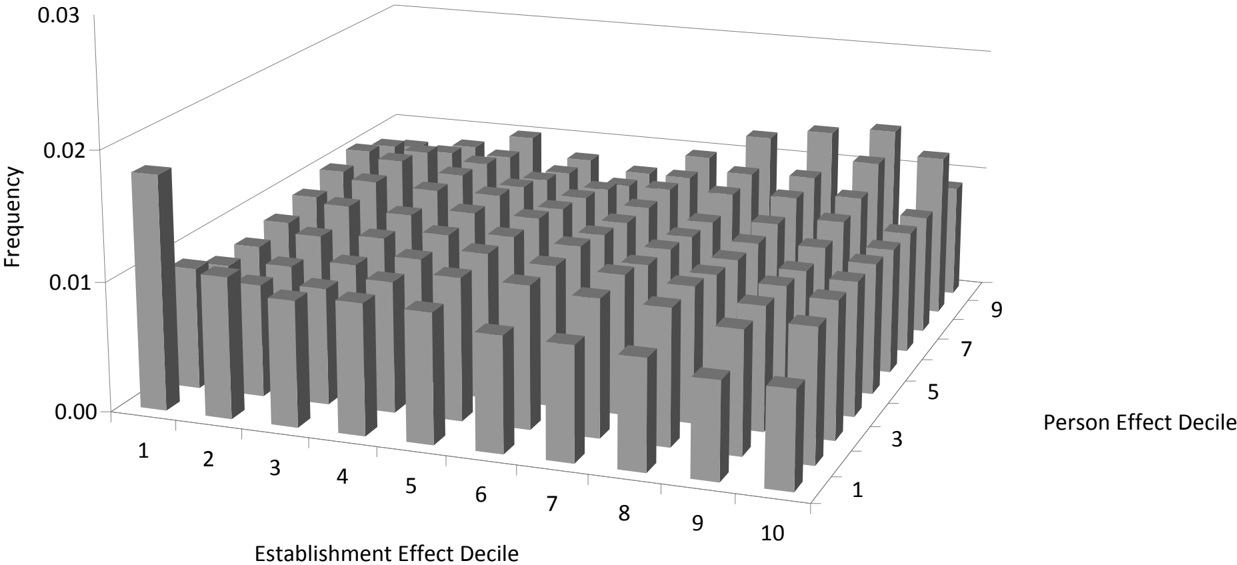
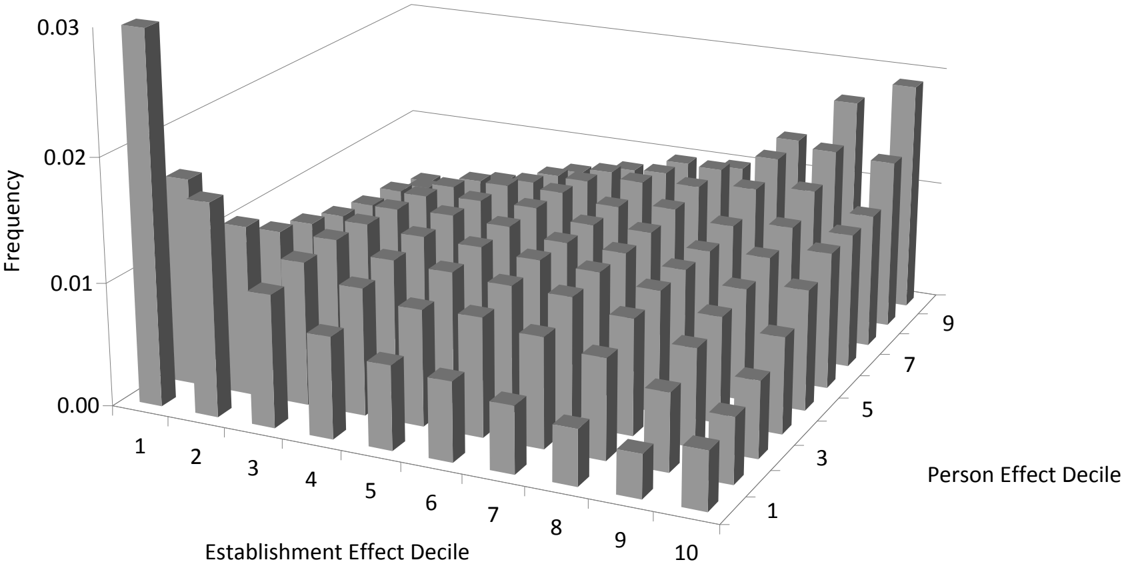
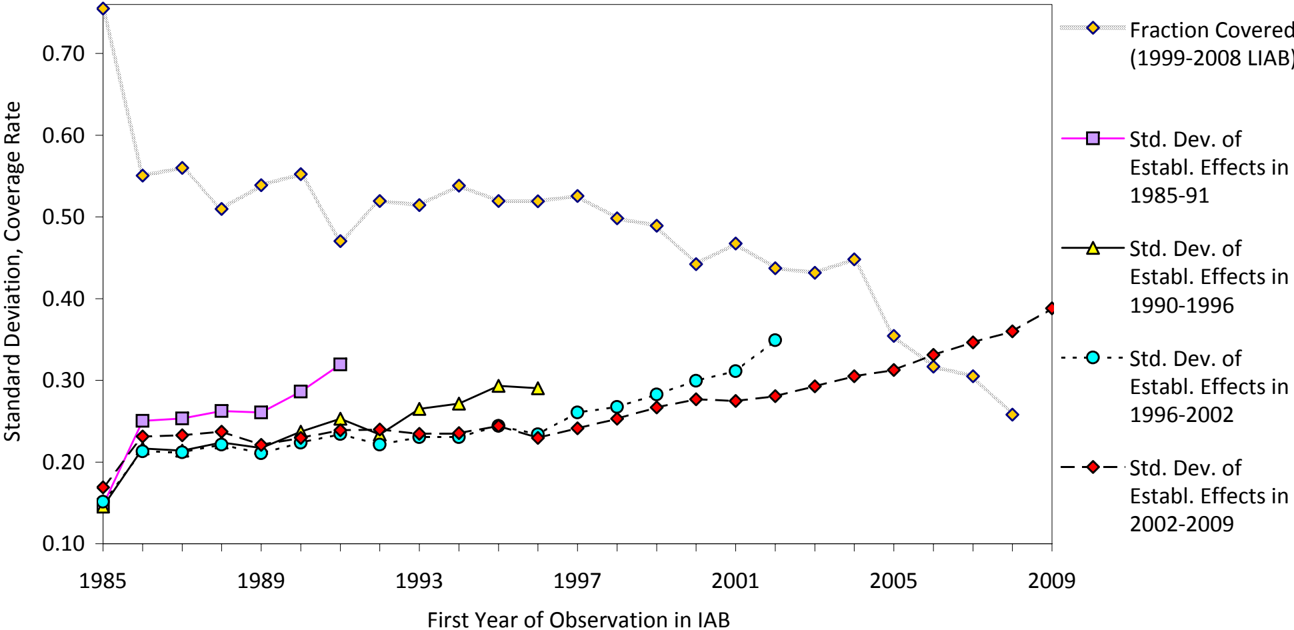
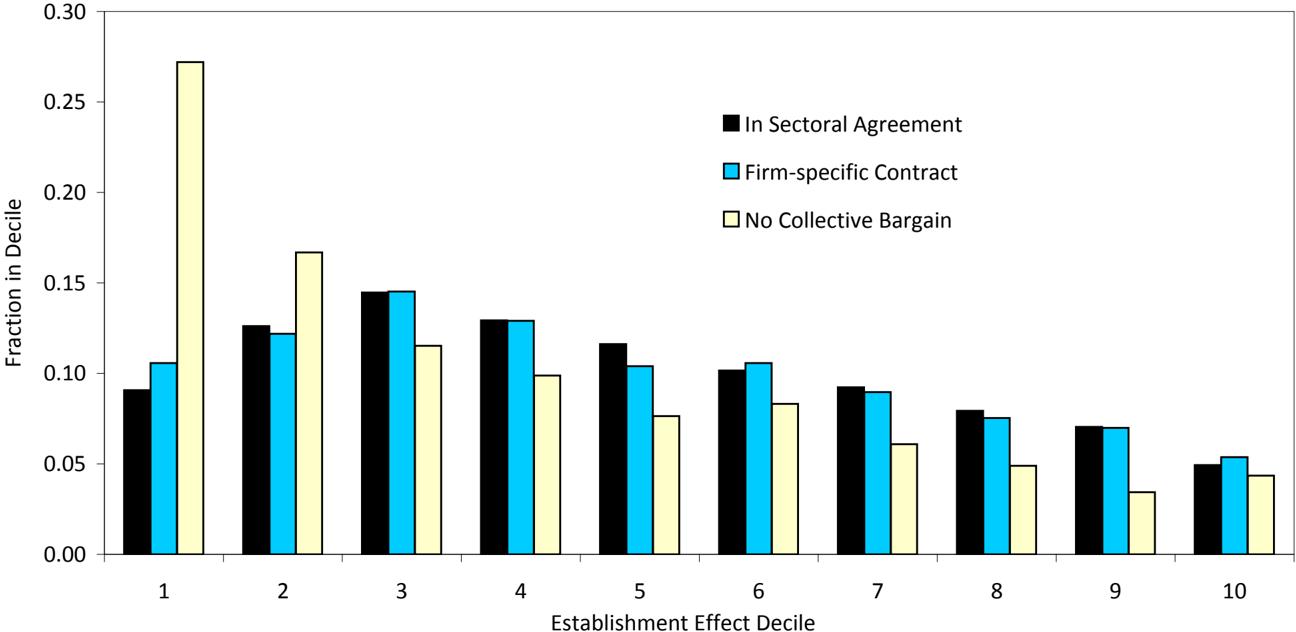
Verification
Claims the paper makes
0 Valid · 0 Not valid · 8 Not checked · 191 Own results and interpretations
A result the paper reports from its own data — it cites no other source for it, so there is none to check. The quote shows it is in the paper.
In the paper
“In particular, generalized non-separable models with xed e/ects for each job yield only a small improvement in explanatory power relative to the AKM speci cation, both within narrow time intervals and between intervals.”
plain- Asserted: passes — The authors put it forward as true.
- Checkable: passes — It can be checked against evidence.
- Load-bearing: passes — The paper’s conclusions depend on it.
- Based: passes — The paper gives a reason why it holds.
A result the paper reports from its own data — it cites no other source for it, so there is none to check. The quote shows it is in the paper.
In the paper
“Classifying establishments by entry year, we nd a trend toward increasing heterogeneity among establishments that entered the labor market after the mid-1990s, coupled with relatively small changes in the variability of the premiums paid by continuing establishments.”
plain- Asserted: passes — The authors put it forward as true.
- Checkable: passes — It can be checked against evidence.
- Load-bearing: passes — The paper’s conclusions depend on it.
- Based: passes — The paper gives a reason why it holds.
A result the paper reports from its own data — it cites no other source for it, so there is none to check. The quote shows it is in the paper.
In the paper
“We nd that two-thirds of the increase in the pay gap between higher and lower-educated workers is attributable to a widening in the average workplace pay premiums received by di/erent education groups.”
plainstates a cause- Asserted: passes — The authors put it forward as true.
- Checkable: passes — It can be checked against evidence.
- Load-bearing: passes — The paper’s conclusions depend on it.
- Based: passes — The paper gives a reason why it holds.
A result the paper reports from its own data — it cites no other source for it, so there is none to check. The quote shows it is in the paper.
In the paper
“In particular, the standard deviation rose by 15 log points from 1985 to 2009, the (normalized) 80-20 gap rose by 16 log points, the 80-50 gap rose by 15 log points, and the 50-20 gap rose by 18 log points.”
plain- Asserted: passes — The authors put it forward as true.
- Checkable: passes — It can be checked against evidence.
- Load-bearing: unclear — It is unclear whether the paper’s conclusions depend on it.
- Based: passes — The paper gives a reason why it holds.
118 more claims
Create a free account to see all 199 claims and to verify the 4 references still open.
- It may state two separate claims as one. 61
- Probably not a substantial claim. 17
- The quote only partly states this claim. 3
Claims other papers make about this one
Each is checked against this paper’s own text: does it say what the citing paper says it does?
The check wasn’t confident either way, so it gives no verdict — never disputed.
In the citing paper
“We estimate below that 75% is labor income.16”
From “Capitalists in the Twenty-First Century” (2019) · cites this paper as [16]
Experimental — accuracy not yet measured
Citations
Cites
A heteroskedasticity-consistent covariance matrix estimator and a direct test for heteroskedasticity
White, H. (1980) · Econometrica · doi:10.2307/1912934 · Cited by 25,861
The Skill Content of Recent Technological Change: An Empirical Exploration
Autor, D. H., Levy, F., & Murnane, R. J. (2003) · The Quarterly Journal of Economics · doi:10.1162/003355303322552801 · Cited by 6,205
On the Pooling of Time Series and Cross Section Data
Mundlak, Y. (1978) · Econometrica · doi:10.2307/1913646 · Cited by 5,412
Changes in Relative Wages, 1963-1987: Supply and Demand Factors
Katz, L. F., & Murphy, K. M. (1992) · The Quarterly Journal of Economics · doi:10.2307/2118323 · Cited by 4,793
Equilibrium Unemployment as a Worker Discipline Device
Shapiro, C., & Stiglitz, J. E. (1986) · Efficiency Wage Models of the Labor Market · doi:10.1017/cbo9780511559594.004 · Cited by 4,652
Misallocation and Manufacturing TFP in China and India*
Hsieh, C.-T., & Klenow, P. J. (2009) · Quarterly Journal of Economics · doi:10.1162/qjec.2009.124.4.1403 · Cited by 4,175
Job Creation and Job Destruction in the Theory of Unemployment
Mortensen, D. T., & Pissarides, C. A. (1994) · The Review of Economic Studies · doi:10.2307/2297896 · Cited by 3,840
Hybrid Corn: An Exploration in the Economics of Technological Change
Griliches, Z. (1957) · Econometrica · doi:10.2307/1905380 · Cited by 3,330
Labor Contracts as Partial Gift Exchange
Akerlof, G. A. (1982) · The Quarterly Journal of Economics · doi:10.2307/1885099 · Cited by 3,210
Plants and Productivity in International Trade
Bernard, A. B., Eaton, J., Jensen, J. B., & Kortum, S. (2003) · American Economic Review · doi:10.1257/000282803769206296 · Cited by 2,980
Research works printed but not linked: 1
- 70. Rees, Albert and George Schultz. 1970. Workers in an Urban Labor Market. Chicago: University of Chicago Press.
Cited by
Items 1,301–1,400 of 1,904
Earnings Inequality in Germany: A Decomposition-AnalysisPreprint
Levsen, D. (2018) · SSRN Electronic Journal · doi:10.2139/ssrn.3130671 · Cited by 1
Schooling Choice, Labour Market Matching, and WagesPreprint
Schwartz, J. (2018) · RePEc: Research Papers in Economics · doi:10.48550/arxiv.1803.09020 · Cited by 1
King, J. (2016) · eScholarship (California Digital Library) · Cited by 1
Essays on Employment and Wages in the German Labor Market
Priesack, K. (2017) · GenderOpen - Repositorium für die Geschlechterforschung · doi:10.18452/19360 · Cited by 1
The Impact of Pension Reforms on Income Inequality, Savings, and Health
Etgeton, S. (2019) · doi:10.17169/refubium-1960 · Cited by 2
When politicians collude with firms: the impact of elite networks on inequality
Vuković, V. (2019) · Oxford University Research Archive (ORA) (University of Oxford) · doi:10.5287/ora-ae0ndaop8 · Cited by 1
The productivity effects of worker mobility between heterogeneous firmsPreprint
Stockinger, B., & Wolf, K. (2018) · RePEc: Research Papers in Economics · doi:10.15456/ger.2018317.122859 · Cited by 1
Man Versus Machine: Automation, Market Structure and SkillsPreprint
Aniket, K. (2017) · SSRN Electronic Journal · doi:10.2139/ssrn.3213532 · Cited by 1
Human Capital in Labor Economics - Novel Perspectives and Research Strategies
Eppelsheimer, J. (2020) · University of Regensburg Publication Server (University of Regensburg) · doi:10.5283/epub.41142 · Cited by 1
Essays on Globalization and Economic Development
Manelici, I. (2020) · eScholarship (California Digital Library) · Cited by 1
Essays in Labor and Political Economics
Simola, S. (2020) · Aaltodoc (Aalto University) · Cited by 1
Firms, Jobs, and Gender Disparities in Top Incomes: Evidence from BrazilPreprint
Benguria, F. (2020) · SSRN Electronic Journal · doi:10.17848/wp20-338 · Cited by 1
Job-to-Job Transitions, Sorting, and Wage GrowthPreprint
Jinkins, D. C., & Morin, A. (2017) · SSRN Electronic Journal · doi:10.2139/ssrn.2940591 · Cited by 1
Labor Market Sorting in GermanyPreprint
Schulz, B., & Lochner, B. (2016) · RePEc: Research Papers in Economics · Cited by 1
Kunz, J., Staub, K. E., & Winkelmann, R. (2017) · SSRN Electronic Journal · doi:10.2139/ssrn.3074193 · Cited by 1
Wages in High-Tech Start-Ups – Do Academic Spin-Offs Pay a Wage Premium?Preprint
Dorner, M., Fryges, H., & Schopen, K. (2015) · SSRN Electronic Journal · doi:10.2139/ssrn.2621418 · Cited by 1
Wages in High-Tech Start-Ups – Do Academic Spin-Offs Pay a Wage Premium?Preprint
Dorner, M., Fryges, H., & Schopen, K. (2015) · SSRN Electronic Journal · doi:10.2139/ssrn.2616856 · Cited by 1
Credit Supply, Firms, and Earnings Inequality
Moser, C., Saidi, F., Wirth, B., & Wolter, S. (2026) · CESifo · doi:10.65864/mo5qhmth0e · Cited by 1
Offshoring and non-monotonic employment effects across industries in general equilibriumPreprint
Baumgarten, D., Irlacher, M., & Koch, M. (2018) · RePEc: Research Papers in Economics · doi:10.5282/ubm/epub.43049 · Cited by 1
Yu, B. (2018) · SSRN Electronic Journal · doi:10.2139/ssrn.3207890 · Cited by 1
Give it Another Shot: Startup Experience and the Mobilization of Human Resources in New VenturesPreprint
Rocha, V. C., & Pozzoli, D. (2021) · SSRN Electronic Journal · doi:10.2139/ssrn.3874365 · Cited by 1
Economic Mobility and Frictional Labor Markets
Staiger, M. (2021) · University Libraries (University of Maryland) · doi:10.13016/idly-jfpf · Cited by 1
Collective bargaining, wage inequality and firm dynamics
Briskar, J. (2021) · ERA · doi:10.7488/era/1085 · Cited by 1
Do Workers Share in Firm Success? Pass-Through Estimates for New ZealandPreprint
Allan, C., & Maré, D. C. (2021) · SSRN Electronic Journal · doi:10.2139/ssrn.3954537 · Cited by 1
High-Skill Migration, Multinational Companies and the Location of Economic ActivityPreprint
Morales, N. (2018) · SSRN Electronic Journal · doi:10.2139/ssrn.3336003 · Cited by 1
Ownership Networks and Earnings Inequality
Huneeus, F., Larraín, B., Larraín, M., & Prem, M. (2022) · doi:10.18235/0004265 · Cited by 1
Long-term Vertical Contracts, Geography, and the Persistence of Brand Shares *Preprint
Clark, R., Houde, J., & Zhu, X. (2022) · SSRN Electronic Journal · doi:10.2139/ssrn.4144776 · Cited by 1
Malleability of Alcohol Consumption: Evidence from Migrants
Hinnosaar, M., & Liu, E. (2022) · National Bureau of Economic Research · doi:10.3386/w30245 · Cited by 1
New Perspectives on Inequality in Latin AmericaPreprint
Submitter, U. D. L. A. D. O. E. (2022) · SSRN Electronic Journal · doi:10.2139/ssrn.4164227 · Cited by 1
Shareholder Power and the Decline of LaborPreprint
Falato, A., Kim, H., & von Wachter, T. (2022) · SSRN Electronic Journal · doi:10.2139/ssrn.4153096 · Cited by 1
New Perspectives on Inequality in Latin AmericaPreprint
Sierra, M. F., & Serrano, G. (2022) · SSRN Electronic Journal · doi:10.2139/ssrn.4168497 · Cited by 1
The German Model of Industrial Relations: Balancing Flexibility and Collective ActionPreprint
Jäger, S., Noy, S., & Schoefer, B. (2022) · SSRN Electronic Journal · doi:10.2139/ssrn.4196322 · Cited by 1
Supervisors and Performance Management SystemsPreprint
Frederiksen, A., Kahn, L., & Lange, F. (2017) · RePEc: Research Papers in Economics · Cited by 1
A Simple Method to Estimate Large Fixed Effects Models Applied to Wage Determinants and Matching
Mittag, N. (2015) · ASEP · Cited by 1
Bad Times, Bad Jobs? How Recessions Affect Early Career Trajectories
Mahajan, P., Patki, D., & Stüber, H. (2022) · Working paper series · doi:10.29412/res.wp.2022.12 · Cited by 1
Occupational Tasks and Wage Inequality in Germany: A Decomposition AnalysisPreprint
Koomen, M., & Backes‐Gellner, U. (2022) · SSRN Electronic Journal · doi:10.2139/ssrn.4275343 · Cited by 1
Trends in the German Income Distribution: 2005/06 to 2010/11
Biewen, M., Ungerer, M., & Löffler, M. (2016) · MADOC (University of Mannheim) · Cited by 1
Coordination of Hours within the FirmPreprint
Labanca, C., & Pozzoli, D. (2023) · SSRN Electronic Journal · doi:10.2139/ssrn.4438813 · Cited by 1
Accident-induced absence from work and wage ladders
Bisztray, M., Bíró, A., da Fonseca, J. G., & Molnár, T. L. (2023) · doi:10.1920/wp/ifs.2023.3023 · Cited by 1
Birds of a Feather Earn Together. Gender and Peer Effects at the WorkplacePreprint
Messina, J., Sanz‐de‐Galdeano, A., & Terskaya, A. (2024) · SSRN Electronic Journal · doi:10.2139/ssrn.4691176 · Cited by 2
Three essays on preferences for redistribution : A dynamic perspective
Rafhi, B. E. (2020) · theses.fr (ABES) · doi:10.70675/48875769z7262z484fz8ecdz224a74fef07c · Cited by 1
Earnings Growth, Inequality and Absolute Mobility in Germany, 1882-2019Preprint
Bönke, T., Harnack‐Eber, A., & Penz, H. (2024) · SSRN Electronic Journal · doi:10.2139/ssrn.4822704 · Cited by 1
Job Mobility and Assortative MatchingPreprint
Braunschweig, L., Dauth, W., & Roth, D. H. W. (2024) · SSRN Electronic Journal · doi:10.2139/ssrn.4926525 · Cited by 1
Preliminary Findings: Task Clarity and Credibility in Relational Contracts
Antić, N., Morjaria, A., & Marcos, M. Á. T. (2024) · doi:10.18235/0013146 · Cited by 1
Whom Should I Work For? Firm Characteristics and New Workers' Future PayPreprint
Li, Y., & Yoon, H. (2024) · SSRN Electronic Journal · doi:10.2139/ssrn.4971923 · Cited by 1
Évolution de la distribution de la productivité des entreprises québécoises entre 2005 et 2019
Dostie, B., & Dufour, G. (2024) · doi:10.54932/qurl7652 · Cited by 1
Empirical Bayes Methods in Labor EconomicsPreprint
Walters, C. (2024) · SSRN Electronic Journal · doi:10.2139/ssrn.5001380 · Cited by 2
The Distribution of National Income in Germany, 1992-2019Preprint
Bach, S., Bartels, C., & Neef, T. (2024) · SSRN Electronic Journal · doi:10.2139/ssrn.5048647 · Cited by 1
Measuring Quality of Life Under Spatial FrictionsPreprint
Ahlfeldt, G. M., Bald, F., Roth, D. H. W., & Seidel, T. (2024) · SSRN Electronic Journal · doi:10.2139/ssrn.5069977 · Cited by 1
Education, Credit, and Firm OutcomesPreprint
Deli, Y. D., Delis, M. D., Peydró, J., & Whelan, A. (2025) · SSRN Electronic Journal · doi:10.2139/ssrn.5054596 · Cited by 1
Employee-Owned Firms and the Careers of Young WorkersPreprint
Burdín, G., & Garcia‐Louzao, J. (2025) · SSRN Electronic Journal · doi:10.2139/ssrn.5114900 · Cited by 1
The Evolution of Unobserved Skill Returns in the U.S.: A New Approach Using Panel DataPreprint
Lochner, L. M., Park, Y., & Shin, Y. (2025) · SSRN Electronic Journal · doi:10.2139/ssrn.5122125 · Cited by 1
What Drives Wage Sorting? Evidence from West GermanyPreprint
Mouton, A. (2025) · SSRN Electronic Journal · doi:10.2139/ssrn.5168865 · Cited by 1
The impact of labour demand shocks when occupational labour supplies are heterogeneous
Böhm, M. J., Etheridge, B., & Irastorza-Fadrique, A. (2025) · doi:10.1920/wp.ifs.2025.1525 · Cited by 1
Firm-Level Technology Adoption in Times of CrisisPreprint
Arntz, M., Böhm, M. J., Graetz, G., Gregory, T., Lehmer, F., & Lipowski, C. (2025) · SSRN Electronic Journal · doi:10.2139/ssrn.5224323 · Cited by 1
Adjusters and Casualties: The Anatomy of Labor Market Displacement
Hanushek, E. A., Janßen, S., Light, J., & Simon, L. (2025) · National Bureau of Economic Research · doi:10.3386/w33667 · Cited by 1
Education, Sorting and Wages: A Structural Matching ApproachPreprint
Corblet, P. (2025) · SSRN Electronic Journal · doi:10.2139/ssrn.5396926 · Cited by 1
Domestic Outsourcing and Young-worker Entry into the Formal Sector
Felix, M., & Wong, M. (2025) · National Bureau of Economic Research · doi:10.3386/w34172 · Cited by 1
Firms and ethnic wage differences
Maré, D. C., & Fabling, R. B. (2025) · Motu working paper · doi:10.29310/wp.2025.07 · Cited by 1
The Long-Term Effects of Teachers’ Gender Stereotypes on Labor OutcomesPreprint
Martinez, J. (2025) · SSRN Electronic Journal · doi:10.2139/ssrn.5797015 · Cited by 1
Offshoring and labour market inequalitiesPreprint
Schwörer, T. (2013) · RePEc: Research Papers in Economics · Cited by 1
Essays on regional inequalities, innovation and global connectivity
Pardy, M. (2024) · London School of Economics and Political Science Theses Online (London School of Economics and Political Science) · doi:10.21953/lse.00004619 · Cited by 1
Gender Wage Inequalities within Firms
Zimmermann, F. (2023) · doi:10.25593/open-fau-14 · Cited by 1
How Does Potential Unemployment Insurance Benefit Duration Affect Reemployment Timing and Wages?Preprint
Felder, R., Frings, H., & Mittag, N. (2024) · SSRN Electronic Journal · doi:10.2139/ssrn.4979606 · Cited by 1
Commuting behavior of employees in Germany with a focus on georeferenced data
Jost, R. (2024) · University of Regensburg Publication Server (University of Regensburg) · doi:10.5283/epub.55421 · Cited by 1
Firm Responses to High-Speed InternetPreprint
Steimer, H. (2020) · RePEc: Research Papers in Economics · doi:10.5282/ubm/epub.74219 · Cited by 1
Essays on Alternative Work Arrangements
Ganserer, A. (2021) · heiDOK (Heidelberg University) · doi:10.11588/heidok.00029670 · Cited by 1
Labor Market Impact of Disruptions in Global Value Chains
Meister, M. (2024) · Econstor (Econstor) · doi:10.48720/iab.dp.2410 · Cited by 1
Essays on Minimum Wages, Labour Supply and Public Finances
Blömer, M. J. (2023) · edoc Publication server (Humboldt University of Berlin) · doi:10.18452/26267 · Cited by 1
NIHR Policy Research Programme report: investigating variation in pay in adult social care
Atkinson, C., Ullah, A., Woodhams, C., William, W., Arif, S., Guillaume, C., Willocks, K., Hebson, G., & NIHR (2024) · e-space (Manchester Metropolitan University) · doi:10.23634/mmu.00637390 · Cited by 1
De-Routinization in the Fourth Industrial Revolution - Firm-Level Evidence
Arntz, M., Genz, S., Gregory, T., Lehmer, F., & Zierahn, U. (2024) · Zenodo (CERN European Organization for Nuclear Research) · doi:10.5281/zenodo.13904588 · Cited by 1
Essays on the Economics of Sickness Absence, Working Conditions and Health in the Labor Market
Hiesinger, K. (2024) · University of Regensburg Publication Server (University of Regensburg) · doi:10.5283/epub.55427 · Cited by 1
Warnke, A. J. (2017) · FreiDok plus (Universitätsbibliothek Freiburg) · doi:10.6094/unifr/12673 · Cited by 1
Agglomerations, tasks and wage growthPreprint
Perl, M. (2023) · RePEc: Research Papers in Economics · doi:10.4419/96973165 · Cited by 1
Workplace Connections and Labor Migration: The Role of Information in Shaping ExpectationsPreprint
Hansch, M., Nimczik, J. S., & Spitz‐Oener, A. (2024) · RePEc: Research Papers in Economics · Cited by 1
Ex Ante Heterogeneity, Separations, and Labor Market DynamicsPreprint
Barreto, C., & Merkl, C. (2024) · RePEc: Research Papers in Economics · Cited by 1
Indriðadóttir, M. K. (2020) · Skemman · Cited by 1
Wage subsidies, job-displacement and Swedish firms: A comparison between policy systems
Lombardi, S., Skans, O. N., & Vikström, J. (2018) · Econstor (Econstor) · Cited by 1
Essays on Development Economics and State Capacity
de Gouvea Scot de Arruda, T. (2021) · eScholarship (California Digital Library) · Cited by 1
Explaining Inequality in Economic Outcomes: An Empirical and Experimental Approach
Detlefsen, L. M. (2018) · MACAU: Open Access Repository of Kiel University (University Library Kiel) · Cited by 1
Three essays on trade and development: International production networks and labor market inequality
Leawsakul, K. (2025) · UWA Profiles and Research Repository (University of Western Australia) · doi:10.26182/5zag-g444 · Cited by 1
TWICE: Tree-based Wage Inference with Clustering and EstimationPreprint
Bakirov, A., Prato, F. D., & Zacchia, P. (2026) · arXiv (Cornell University) · doi:10.48550/arxiv.2601.00776 · Cited by 1
A Roadmap for Developing a New Linked Employer-Employee Data Infrastructure
Forth, J., Bryson, A., & Palmou, C. (2025) · City Research Online (City University London) · Cited by 1
The Future of Work. A scoping study
Eichhorst, W., & Berrebi-Hoffmann, I. (2025) · HAL · doi:10.2767/1001083ke-01-25-198 · Cited by 1
Fiscal capacity and state-building in Sub-Saharan Africa
Knebelmann, J. (2021) · theses.fr (ABES) · doi:10.70675/9234d869za152z43e0zb919z21354853a9c3 · Cited by 1
Essays on Short-Time Work and on Firm Labor Demand
Lapeyre, A. (2024) · theses.fr (ABES) · doi:10.70675/2a7d00a2z0794z46f9zb830zcfee0c123ebc · Cited by 1
The political economy of media production and consumption in France
Hengel, M. (2023) · theses.fr (ABES) · doi:10.70675/5edf0910z1d6bz4a5cz9693zc2883ec214d9 · Cited by 1
Separations Revisited: Do Layoffs or Quits Drive Lower Separation Rates in High-Quality Firms?
Dobbin, C., Fernandez, D., & Zohar, T. (2026) · National Bureau of Economic Research · doi:10.3386/w35177 · Cited by 1
Imperfect Self-knowledge about Skills and Skill Mismatch
Göller, D., Brox, E., & Wolter, S. C. (2026) · CESifo · doi:10.65864/imsb9g1a2h · Cited by 1
Who Competes for Whom? Monopsony in Ability-Segregated Labor Markets
Lorenzini, L. (2026) · CESifo · doi:10.65864/sxzgaylier · Cited by 1
Leão, P. (2026) · OpenArchive@CBS (Copenhagen Business School) · doi:10.22439/phd.29.2026 · Cited by 1
Selective Firing and LemonsPreprint
Weynandt, M. A. (2014) · RePEc: Research Papers in Economics · Cited by 1
M&As, Employee Costs, and Labor Reallocation
LAGARAS, S. (2026) · The Journal of Finance · doi:10.1111/jofi.70065
Essays in health economics and productivity
Sacarny, A. (2014) · DSpace@MIT (Massachusetts Institute of Technology)
Essays on international trade and firm dynamics
Spiegel, G. (2015) · Electronic Theses of LMU Munich (Ludwig-Maximilians-Universität München) · doi:10.5282/edoc.18265
The Dynamics of Earnings in Germany
Bönke, T., Giesecke, M. N., & Lüthen, H. (2015) · Refubium (Universitätsbibliothek der Freien Universität Berlin) · doi:10.17169/refubium-23379
Trade Competition, Technology and Labor ReallocationPreprint
Baziki, S. B., Ginja, R., & Borota, T. (2018) · RePEc: Research Papers in Economics · doi:10.13140/rg.2.2.17511.55209
Plant Productivity Dispersion and the College Premium: Evidence from the United States 1977-1997Preprint
Stijepic, D. (2015) · SSRN Electronic Journal · doi:10.2139/ssrn.2635529
Metadata
- Authors
- Card, D., Heining, J., & Kline, P.
- Affiliations
- University of California, Berkeley (US)
- Corresponding author
- Kline, Patrick
- ORCID
- Card, David
- Venue
- The Quarterly Journal of Economics
- Publisher
- Oxford University Press (OUP)
- Published
- 2013-05-02
- Volume
- 128
- Issue
- 3
- Pages
- 967-1015
- ISSN
- 0033-5533 (ISSN-L)
- 1531-4650
- OpenAlex
- W2141295263
- Cited by
- 1,904
- References
- 146
- Citations by year
- 2026: 153 · 2025: 204 · 2024: 228 · 2023: 156 · 2022: 185 · 2021: 178 · 2020: 143 · 2019: 125 · 2018: 156 · 2017: 113 · 2016: 105 · 2015: 71 · 2014: 58 · 2013: 22
- FWCI
- 118.40
- Type
- journal article
- Language
- en
- Open access
- closed
- Locations
- The Quarterly Journal of Economics (publishedVersion)
- RePEc: Research Papers in Economics (submittedVersion)
- Econstor (Econstor) (submittedVersion)
- Funders
- Washington Center for Equitable Growth
- Topics
- Social Sciences › Economics, Econometrics and Finance › Economics and Econometrics › Labor market dynamics and wage inequality
- Social Sciences › Economics, Econometrics and Finance › Economics and Econometrics › Historical Economic and Social Studies
- Social Sciences › Sociology and Political Science › Income, Poverty, and Inequality
- Keywords
- wage inequality, job matching, fixed effects model, education and wages
About these checks
Registry, retraction, Cites and statistics results are computed, not judged, with one exception: a printed reference that no index lists is read once by a model before it counts as a citation error. Claims are extracted by a model and kept only when their quote appears verbatim in the text; each cited source is then checked, with a model’s help, for whether it says what the claim relies on. Those verdicts can be wrong — read the claim’s quote and the cited source before relying on one.
A language model drew the claims from the paper on 2026-11-17, under version 3 of the claim definition (model deepseek-v4.1-flash, prompt extract-v3).
A second model labelled each claim on 2026-11-17 (model jev-1.13-20260917, definition revision gold-guideline-v0.2).
Statistics and arithmetic are recomputed, not judged.
Confidence bands are shown only for fields calibrated on our annotated test set. None is calibrated yet, so no band is shown.
What counts as a claim ›How we measure confidence ›How we check this ›
Are you an author, or do you see a problem with this page? Request a review
Data sources
Bibliographic data: Semantic Scholar, OpenAlex, Crossref.
Contains information from the Semantic Scholar Academic Graph Datasets, made available under the ODC Attribution License (ODC-BY 1.0).
Semantic Scholar’s data is described in: Kinney, R., et al. (2023). The Semantic Scholar Open Data Platform. arXiv:2301.10140.
