

Workplace Heterogeneity and the Rise of West German Wage Inequality*
The DOI matches its Crossref record; 144 of the 147 references it cites were found in a registry or an index, and 1 are not checked yet; none of the 8 sources its claims cite is checked for support yet.
Abstract
We study the role of establishment-specific wage premiums in generating recent increases in West German wage inequality. Models with additive fixed effects for workers and establishments are fit into four subintervals spanning the period from 1985 to 2009. We show that these models provide a good approximation to the wage structure and can explain nearly all of the dramatic rise in West German wage inequality. Our estimates suggest that the increasing dispersion of West German wages has arisen from a combination of rising heterogeneity between workers, rising dispersion in the wage premiums at different establishments, and increasing assortativeness in the assignment of workers to plants. In contrast, the idiosyncratic job-match component of wage variation is small and stable over time. Decomposing changes in mean wages between different education groups, occupations, and industries, we find that increasing plant-level heterogeneity and rising assortativeness in the assignment of workers to establishments explain a large share of the rise in inequality along all three dimensions.
Checked 2026-11-19 · 1 reference not checked yet
Overview
CoChat Summary
TL;DR
Using West German administrative data from 1985–2009, the paper shows that models with additive person and establishment fixed effects explain nearly all of the rise in wage inequality. The increase is driven by rising worker-effect variance, rising establishment-premium variance, and increased assortative matching of high-wage workers to high-wage plants.
Key findings
- In the AKM variance decomposition, total log-wage variance rose from 0.137 in interval 1 (1985–1991) to 0.249 in interval 4 (2002–2009). The variance of person effects rose from 0.084 to 0.127 and contributed 39% of the total rise; establishment-effect variance rose from 0.025 to 0.053 and contributed 25%; the covariance term rose from 0.003 to 0.041 and contributed 34%.
- Assortative matching increased: the correlation between person and establishment effects rose from 0.034 in interval 1 to 0.249 in interval 4. Counterfactuals imply that holding sorting constant would have produced 69% of the actual variance rise, while holding establishment-effect variance constant would have produced 64%.
- Job-mobility event studies show growing establishment premia: a trend-adjusted move from quartile 1 to quartile 4 co-worker-wage establishments was associated with a 23 log-point gain in 1985–1991 versus 47 log points in 2002–2009; the reverse move yielded losses of 22 versus 43 log points.
- Between-group decompositions attribute 70% of the relative rise in university-educated men’s wages and 80% of the relative fall for workers with no/missing qualifications to establishment effects. For occupations, 42% of the rise in between-occupation variance is from person–establishment covariance, 28% from establishment variance, and about 30% from person variance; for industries, 44% is person variance, 19% establishment variance, and 42% sorting.
Methods
- Data: German Social Security records from the IEB, focusing on full-time West German men age 20–60 from 1985–2009, with parallel analyses for full-time women. The main sample has 85–90 million person-year observations per interval and about 17 million individual workers.
- Model: AKM-style log daily wage equation with additive person fixed effects, establishment fixed effects, time-varying covariates, and an error component; estimated by OLS on the largest connected set of establishments linked by worker mobility. Censored earnings are imputed using Tobit models.
- Analyses: variance decompositions and counterfactuals across four overlapping intervals (1985–1991, 1990–1996, 1996–2002, 2002–2009); event studies of job changers; decompositions of between-group wage gaps by education, occupation, and industry; and establishment cohort/collective-bargaining analyses.
Limitations
- The paper states that earnings are censored at the Social Security maximum (10–12% of male observations and 1–3% of female observations per year), so it uses Tobit imputation and checks robustness using apprentice-trained men, who have lower censoring rates.
- The paper states that establishment identifiers are administrative: ownership changes can create new establishment IDs, and only about half of EID births/deaths are estimated to be true plant openings/closings. It also states that sampling errors bias estimated variances upward and the covariance downward, and it does not construct bias-corrected estimates, assuming biases are similar across intervals.
- The paper states that collective bargaining cannot be assigned a causal role because firms choose coverage, and that female estimates may have more negatively biased covariance terms due to fewer observed matches per plant/worker. Evident from the text: the main analysis is restricted to full-time workers in West Germany, excluding civil servants, self-employed, and many part-time/mini-job workers, which limits generalizability.
Model-written summary. Check it against the paper before relying on it.
Integrity signals
Registry
Cites
Statistics
Figures


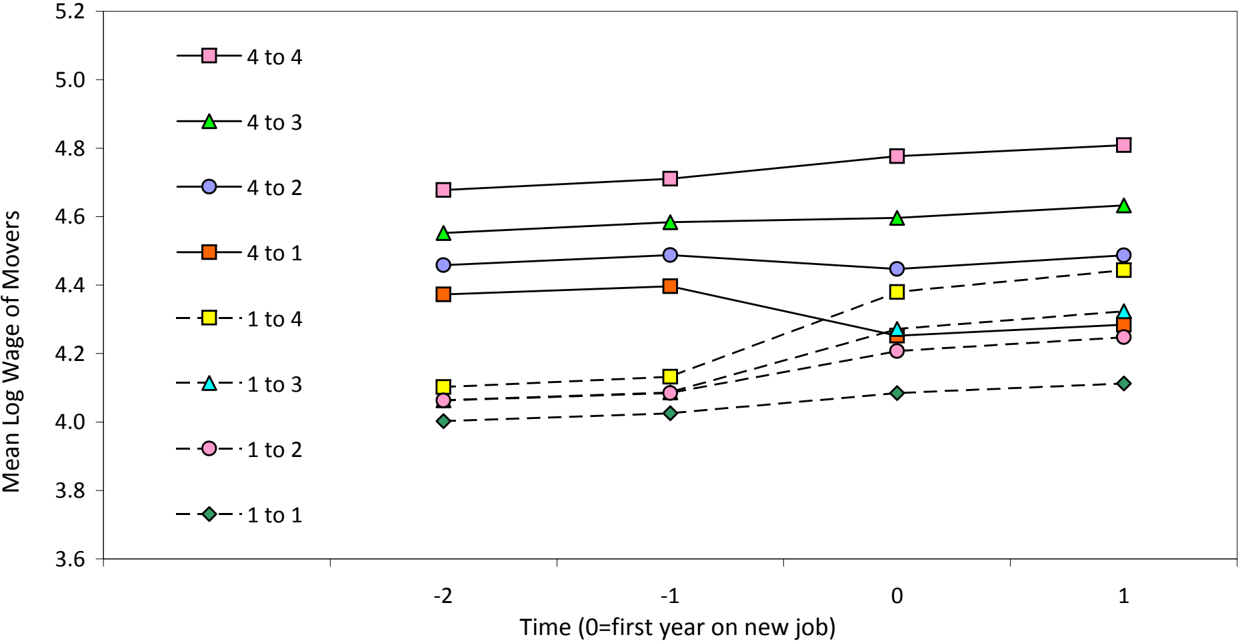
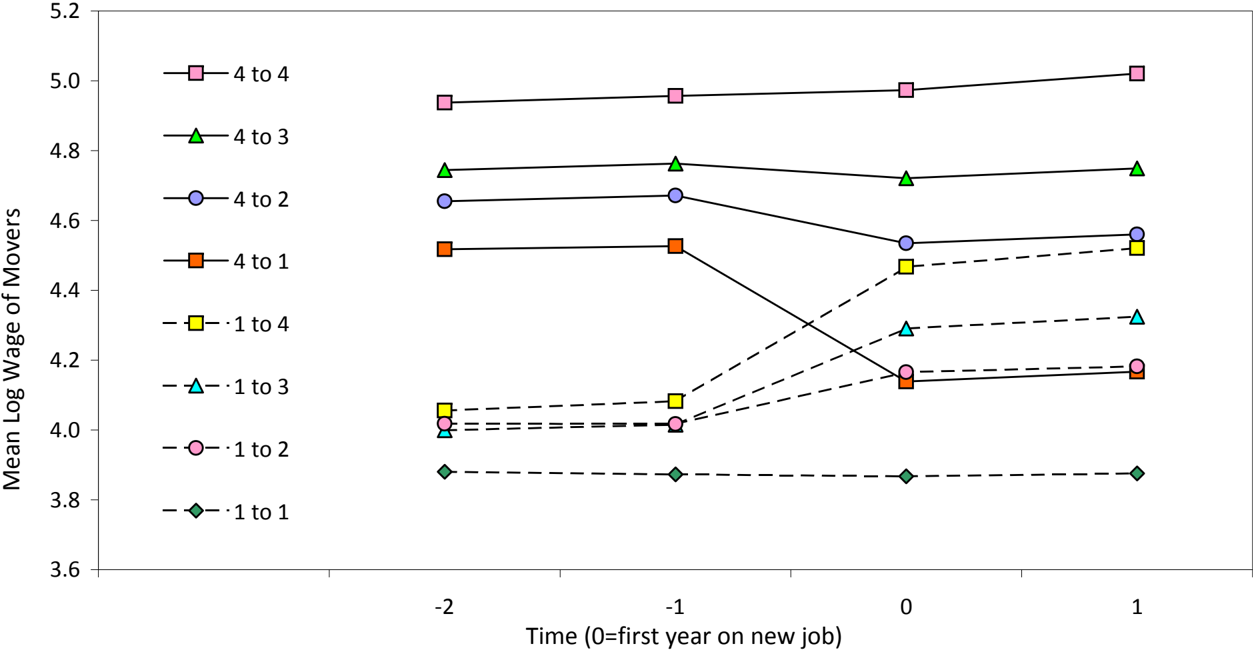
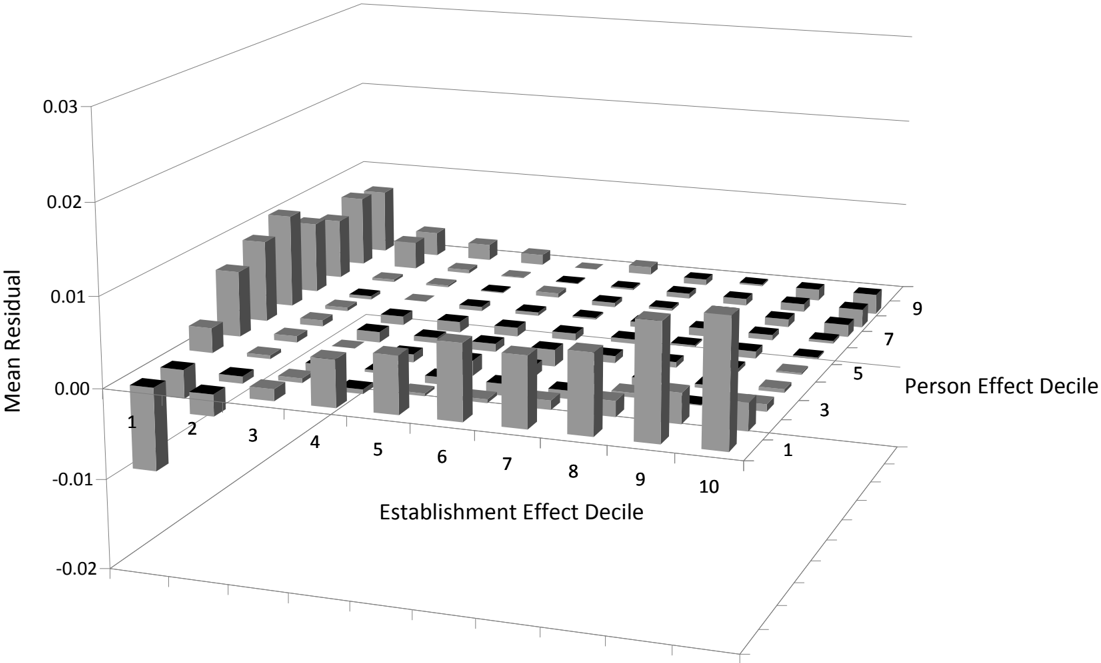
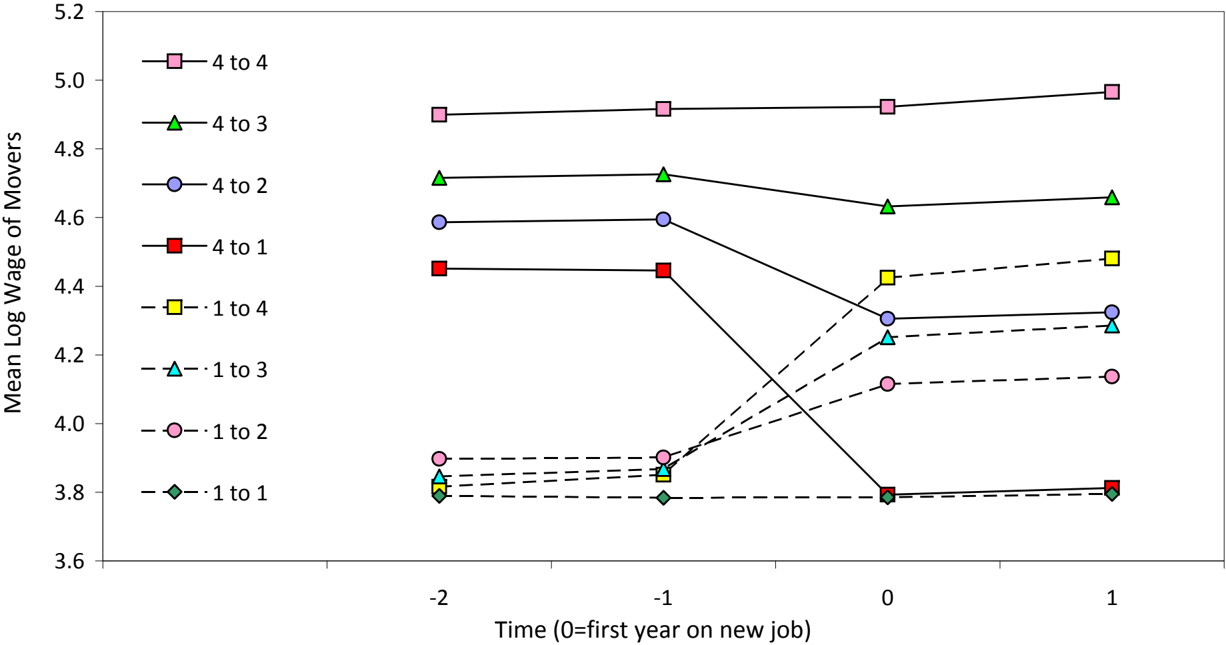
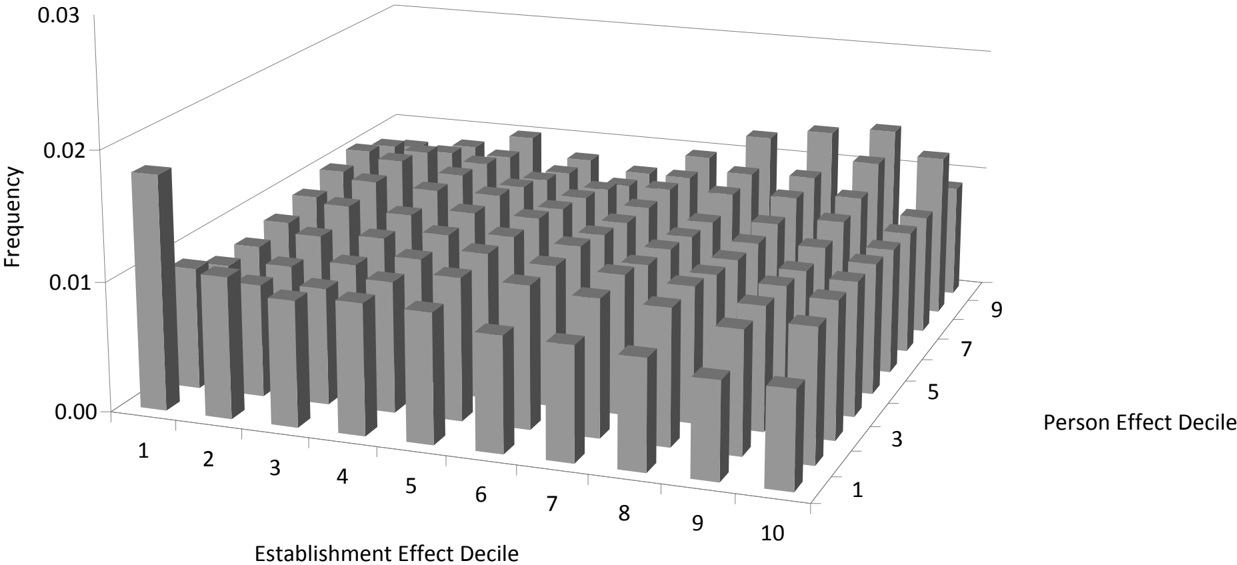
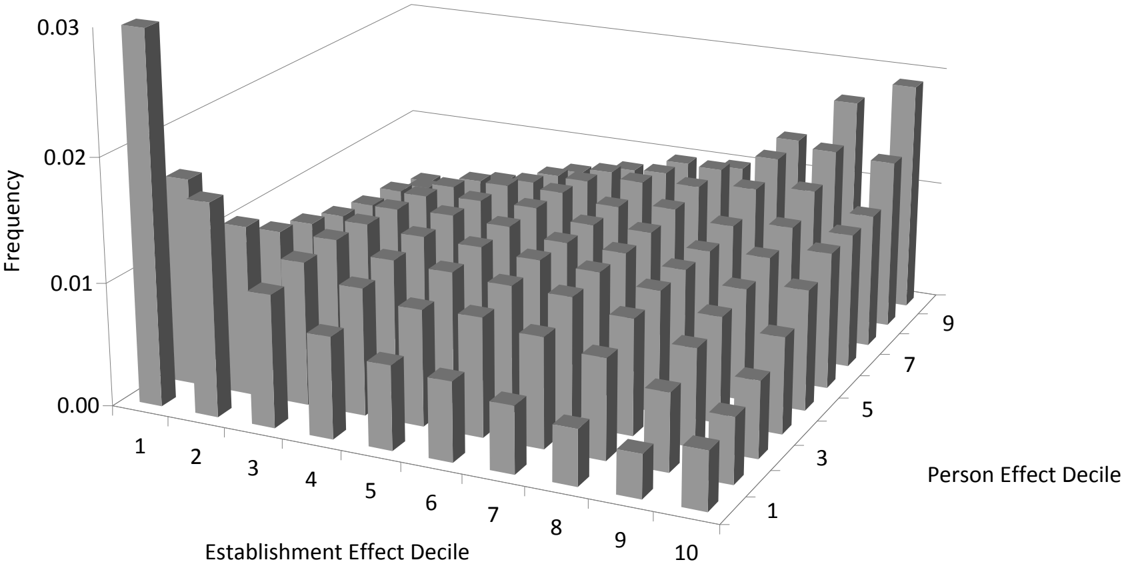
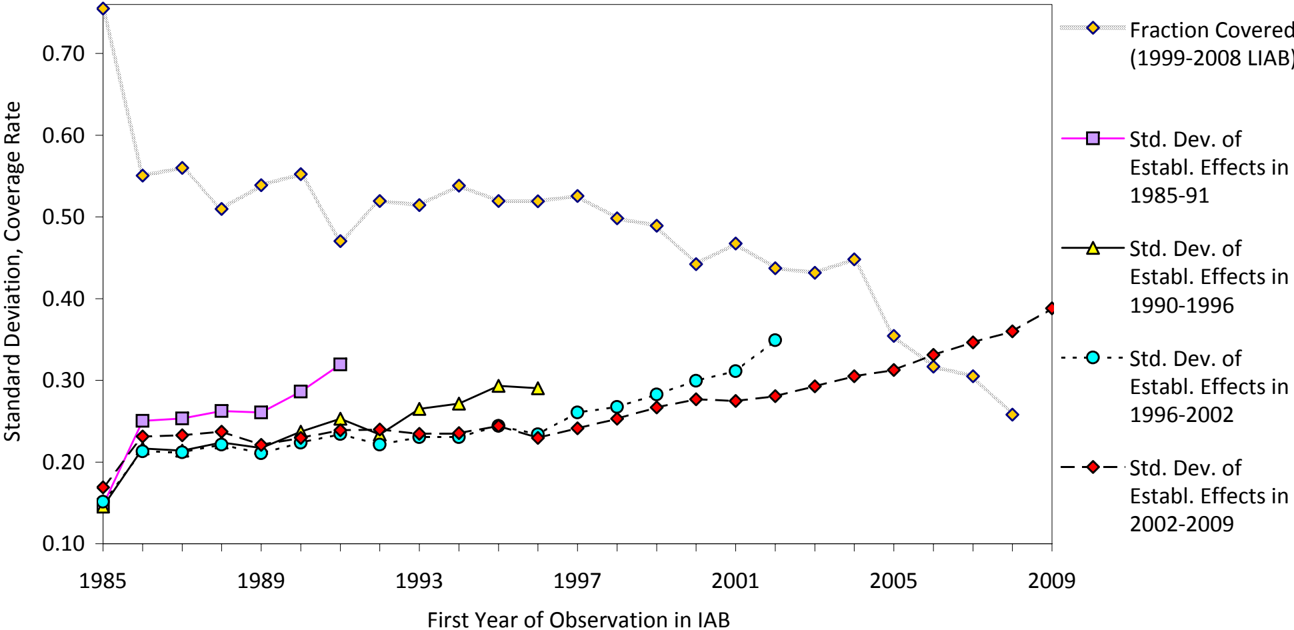
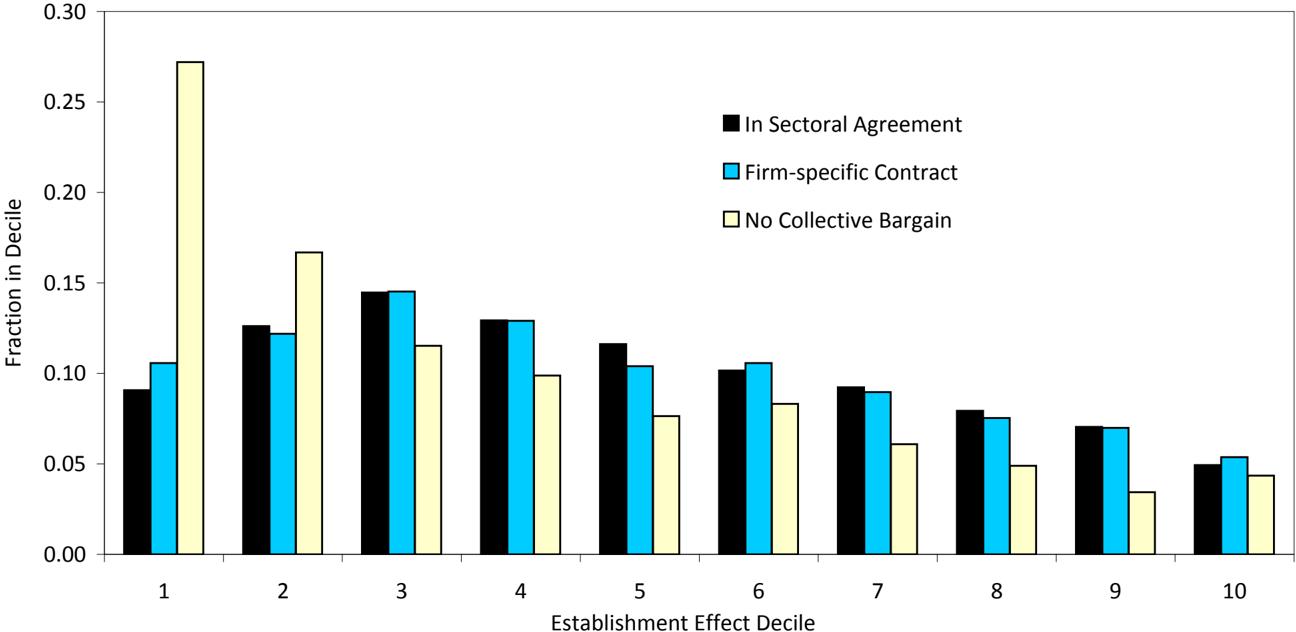
Verification
Claims the paper makes
0 Valid · 0 Not valid · 8 Not checked · 191 Own results and interpretations
A result the paper reports from its own data — it cites no other source for it, so there is none to check. The quote shows it is in the paper.
In the paper
“In particular, generalized non-separable models with xed e/ects for each job yield only a small improvement in explanatory power relative to the AKM speci cation, both within narrow time intervals and between intervals.”
plain- Asserted: passes — The authors put it forward as true.
- Checkable: passes — It can be checked against evidence.
- Load-bearing: passes — The paper’s conclusions depend on it.
- Based: passes — The paper gives a reason why it holds.
A result the paper reports from its own data — it cites no other source for it, so there is none to check. The quote shows it is in the paper.
In the paper
“Classifying establishments by entry year, we nd a trend toward increasing heterogeneity among establishments that entered the labor market after the mid-1990s, coupled with relatively small changes in the variability of the premiums paid by continuing establishments.”
plain- Asserted: passes — The authors put it forward as true.
- Checkable: passes — It can be checked against evidence.
- Load-bearing: passes — The paper’s conclusions depend on it.
- Based: passes — The paper gives a reason why it holds.
A result the paper reports from its own data — it cites no other source for it, so there is none to check. The quote shows it is in the paper.
In the paper
“We nd that two-thirds of the increase in the pay gap between higher and lower-educated workers is attributable to a widening in the average workplace pay premiums received by di/erent education groups.”
plainstates a cause- Asserted: passes — The authors put it forward as true.
- Checkable: passes — It can be checked against evidence.
- Load-bearing: passes — The paper’s conclusions depend on it.
- Based: passes — The paper gives a reason why it holds.
A result the paper reports from its own data — it cites no other source for it, so there is none to check. The quote shows it is in the paper.
In the paper
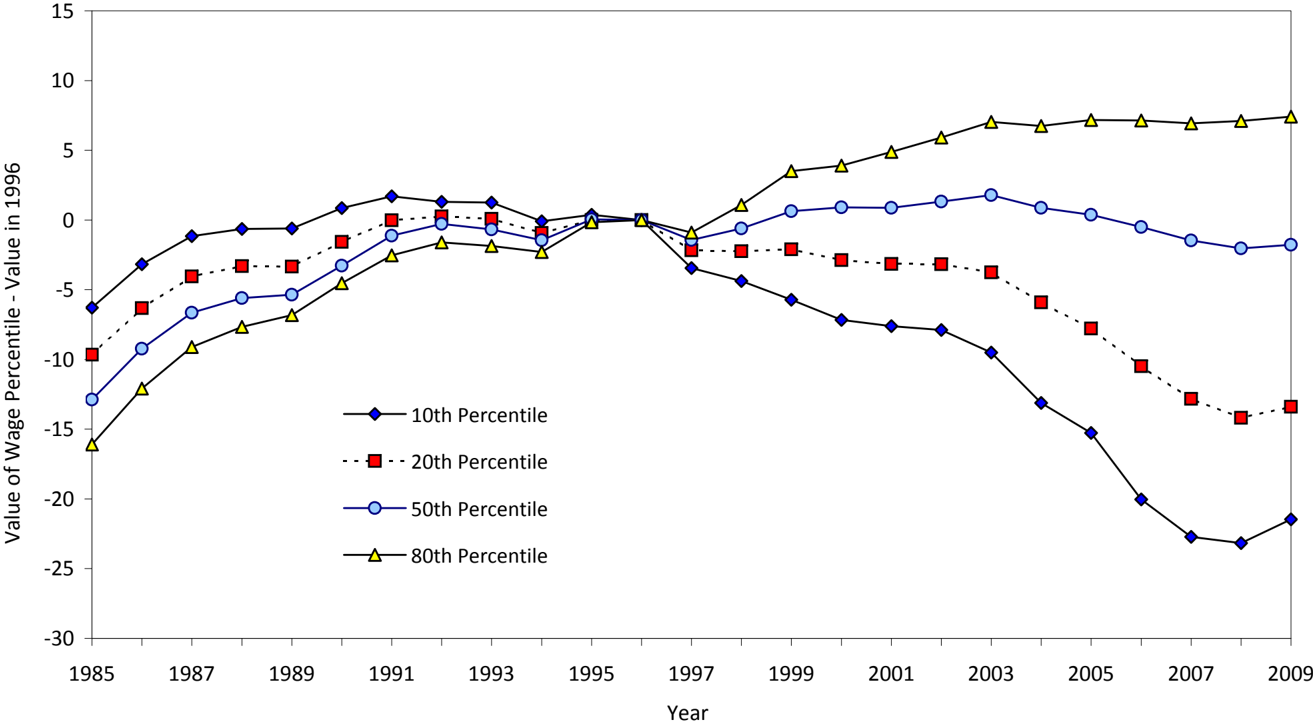
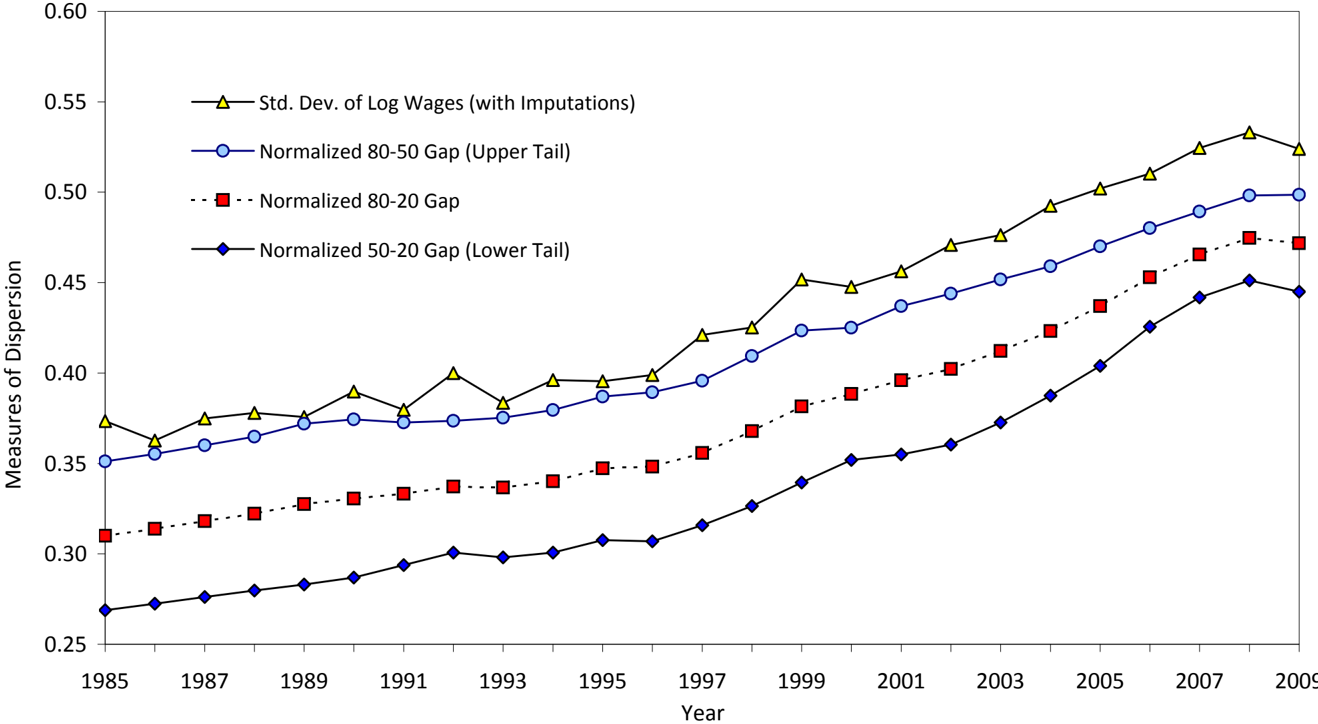
“In particular, the standard deviation rose by 15 log points from 1985 to 2009, the (normalized) 80-20 gap rose by 16 log points, the 80-50 gap rose by 15 log points, and the 50-20 gap rose by 18 log points.”
plain- Asserted: passes — The authors put it forward as true.
- Checkable: passes — It can be checked against evidence.
- Load-bearing: unclear — It is unclear whether the paper’s conclusions depend on it.
- Based: passes — The paper gives a reason why it holds.
118 more claims
Create a free account to see all 199 claims and to verify the 4 references still open.
- It may state two separate claims as one. 61
- Probably not a substantial claim. 17
- The quote only partly states this claim. 3
Claims other papers make about this one
Each is checked against this paper’s own text: does it say what the citing paper says it does?
The check wasn’t confident either way, so it gives no verdict — never disputed.
In the citing paper
“We estimate below that 75% is labor income.16”
From “Capitalists in the Twenty-First Century” (2019) · cites this paper as [16]
Experimental — accuracy not yet measured
Citations
Cites
A heteroskedasticity-consistent covariance matrix estimator and a direct test for heteroskedasticity
White, H. (1980) · Econometrica · doi:10.2307/1912934 · Cited by 25,861
The Skill Content of Recent Technological Change: An Empirical Exploration
Autor, D. H., Levy, F., & Murnane, R. J. (2003) · The Quarterly Journal of Economics · doi:10.1162/003355303322552801 · Cited by 6,205
On the Pooling of Time Series and Cross Section Data
Mundlak, Y. (1978) · Econometrica · doi:10.2307/1913646 · Cited by 5,412
Changes in Relative Wages, 1963-1987: Supply and Demand Factors
Katz, L. F., & Murphy, K. M. (1992) · The Quarterly Journal of Economics · doi:10.2307/2118323 · Cited by 4,793
Equilibrium Unemployment as a Worker Discipline Device
Shapiro, C., & Stiglitz, J. E. (1986) · Efficiency Wage Models of the Labor Market · doi:10.1017/cbo9780511559594.004 · Cited by 4,652
Misallocation and Manufacturing TFP in China and India*
Hsieh, C.-T., & Klenow, P. J. (2009) · Quarterly Journal of Economics · doi:10.1162/qjec.2009.124.4.1403 · Cited by 4,175
Job Creation and Job Destruction in the Theory of Unemployment
Mortensen, D. T., & Pissarides, C. A. (1994) · The Review of Economic Studies · doi:10.2307/2297896 · Cited by 3,840
Hybrid Corn: An Exploration in the Economics of Technological Change
Griliches, Z. (1957) · Econometrica · doi:10.2307/1905380 · Cited by 3,330
Labor Contracts as Partial Gift Exchange
Akerlof, G. A. (1982) · The Quarterly Journal of Economics · doi:10.2307/1885099 · Cited by 3,210
Plants and Productivity in International Trade
Bernard, A. B., Eaton, J., Jensen, J. B., & Kortum, S. (2003) · American Economic Review · doi:10.1257/000282803769206296 · Cited by 2,980
Research works printed but not linked: 1
- 70. Rees, Albert and George Schultz. 1970. Workers in an Urban Labor Market. Chicago: University of Chicago Press.
Cited by
Items 1,201–1,300 of 1,904
Can the Labor Demand Curve Explain Job Polarization?Preprint
Peichl, A., & Popp, M. (2022) · SSRN Electronic Journal · doi:10.2139/ssrn.4135924 · Cited by 2
Addario, S. L. D., Kline, P., Saggio, R., & Sølvsten, M. (2022) · SSRN Electronic Journal · doi:10.2139/ssrn.4154472 · Cited by 2
Self-citationJob Displacement, Family Dynamics and Spousal Labor SupplyPreprint
Halla, M., Schmieder, J., & Weber, A. M. (2018) · RePEc: Research Papers in Economics · Cited by 2
Entrepreneurship through employee mobility, innovation, and growth
Baslandze, S. (2022) · doi:10.29338/wp2022-10 · Cited by 2
Firms and Labor Market Inequality: Evidence and Some TheoryPreprint
Card, D., Cardoso, A. R., Heining, J., & Kline, P. (2016) · RePEc: Research Papers in Economics · Cited by 2
Self-citationFirm consolidation and labor market outcomes
Dobbelaere, S., McCormack, G., Prinz, D., & Sóvágó, S. (2023) · doi:10.1920/wp.ifs.2022.4522 · Cited by 2
Disaggregated Economic AccountsPreprint
Andersen, A. L., Huber, K., Johannesen, N., Straub, L., & Vestergaard, E. T. (2022) · SSRN Electronic Journal · doi:10.2139/ssrn.4273143 · Cited by 2
Skill Depreciation during Unemployment: Evidence from Panel DataPreprint
Cohen, J., Johnston, A. C., & Lindner, A. (2023) · SSRN Electronic Journal · doi:10.2139/ssrn.4395997 · Cited by 2
The Heterogeneous Impacts of Job Displacement: Evidence from Canadian Job Separation Records
Birinci, S., Park, Y., & See, K. G. (2023) · doi:10.20955/wp.2023.022 · Cited by 2
Equalising Monetary Policy - The Earnings Heterogeneity Channel in ActionPreprint
Groiss, M. (2023) · SSRN Electronic Journal · doi:10.2139/ssrn.4570695 · Cited by 2
Inequality and Market Power in Latin America and the Caribbean
Eslava, M., García-Marín, Á., & Messina, J. (2023) · doi:10.18235/0005234 · Cited by 2
Birds of a Feather Earn Together. Gender and Peer Effects at the WorkplacePreprint
Messina, J., Sanz‐de‐Galdeano, A., & Terskaya, A. (2023) · SSRN Electronic Journal · doi:10.2139/ssrn.4629426 · Cited by 2
Firm Heterogeneity and the Incidence of Earned Income Tax Credits: Evidence from ItalyPreprint
Zurla, V. (2024) · SSRN Electronic Journal · doi:10.2139/ssrn.4747214 · Cited by 2
The Global Market for Remote White-Collar JobsPreprint
Cui, J., & Solomon, S. (2024) · SSRN Electronic Journal · doi:10.2139/ssrn.4942498 · Cited by 2
A Firm Link: Overall, Between- and Within-Firm Inequality Through the Lens of a Sorting ModelPreprint
Gola, P., & Zhao, Y. (2024) · RePEc: Research Papers in Economics · doi:10.48550/arxiv.2410.11532 · Cited by 2
L’Emploi à bas salaire en France: Une perspective transnationale
Barreto, C., Carcillo, S., Fluchtmann, J., Georgieff, A., Hijzen, A., Pacifico, D., Pearsall, E.-J., & Puymoyen, A. (2025) · OECD social employment and migration working papers · doi:10.1787/8b481c6b-fr · Cited by 2
The Evolution of Unobserved Skill Returns in the U.S.: A New Approach Using Panel DataPreprint
Lochner, L. M., Park, Y., & Shin, Y. (2025) · RePEc: Research Papers in Economics · doi:10.48550/arxiv.2501.09917 · Cited by 2
Workers' Job Prospects and Young Firm DynamicsPreprint
Kim, S. (2025) · SSRN Electronic Journal · doi:10.2139/ssrn.5167702 · Cited by 2
Bidding for Talent: A Test of Conduct in a High-Wage Labor MarketPreprint
Roussille, N., & Scuderi, B. (2025) · SSRN Electronic Journal · doi:10.2139/ssrn.5268642 · Cited by 2
The Costs of Job Displacement and the Demand for Industry-Specific Human CapitalPreprint
Milgrom, M. (2025) · SSRN Electronic Journal · doi:10.2139/ssrn.5324378 · Cited by 2
Pennies from Haven: Tax Havens and Employee CompensationPreprint
Alstadsæter, A., Bjørkheim, J. B., Davies, R. B., & Scheuerer, J. (2025) · SSRN Electronic Journal · doi:10.2139/ssrn.5711043 · Cited by 2
Division of Labor in the Global Economy
Becker, S. O., Egger, H., Koch, M., & Muendler, M.-A. (2025) · National Bureau of Economic Research · doi:10.3386/w34549 · Cited by 2
Firms and the Gender Wage Gap: A Comparison of Eleven Countries
Palladino, M. G., Bertheau, A., Hijzen, A., Kunze, A., Barreto, C., Gülümser, D., Lachowska, M., Lassen, A. S., Lattanzio, S., Lochner, B., et al. (2025) · doi:10.21033/wp-2025-24 · Cited by 2
Helping and Antisocial Behavior in the WorkplacePreprint
Haylock, M., Kampkötter, P., Kosfeld, M., & von Siemens, F. A. (2023) · SSRN Electronic Journal · doi:10.2139/ssrn.4456332 · Cited by 2
Essays on local labor markets, firm taxation and worker mobility
Korfmann, P. (2020) · Technische Universität Dortmund Eldorado (Technische Universität Dortmund) · doi:10.17877/de290r-21858 · Cited by 2
Einwanderung klug, einfach und fair gestalten: Ein Vorschlag mit doppelter DividendePreprint
Barišić, M., Jäger, S., Manning, A., Muñoz, M., Rinne, U., & Stuhler, J. L. (2023) · RePEc: Research Papers in Economics · Cited by 2
Marriage and Divorce under Labor Market Uncertainty
Holzner, C., & Schulz, B. (2019) · Cited by 2
Manufacturing work beyond manufacturing industries: A reassessment of structural change
Boddin, D., & Kroeger, T. (2025) · Econstor (Econstor) · Cited by 2
Choosing Career and Family: The Multidimensional Returns to College Majors
Campos, C., Muñoz, P., Bucarey, A., & Contreras, D. (2026) · National Bureau of Economic Research · doi:10.3386/w34736 · Cited by 2
The Heterogeneous Earnings Impact of Job Loss Across Workers, Establishments, and Markets
Athey, S. C., Simon, L., Skans, O. N., Vikström, J., & Yakymovych, Y. (2026) · National Bureau of Economic Research · doi:10.3386/w34946 · Cited by 3
Firms' growth in frictional markets
Patault, B. (2021) · theses.fr (ABES) · doi:10.70675/a328132cz58edz4fcdz8ac8zb939e03251b6 · Cited by 2
Off the Labor Supply Curve: The Zero Employer Size Wage Effect Within Large Firms
Diegmann, A., Müller, S., & Schoefer, B. (2026) · National Bureau of Economic Research · doi:10.3386/w35265 · Cited by 2
Patents, Firm Rents, and Worker Compensation: Causal Evidence from Quasi-Random Patent Allocation
Alam, A., & Diegmann, A. (2026) · CESifo · doi:10.65864/7qasibmo1y · Cited by 2
The butcher, the brewer, or the baker: The role of occupations in explaining wage inequality
Hou, S., & Milsom, L. (2021) · Oxford University Research Archive (ORA) (University of Oxford) · Cited by 2
A promising front in the war on inequality
Grusky, D. B. (2020) · Proceedings of the National Academy of Sciences · doi:10.1073/pnas.2005162117 · Cited by 1
Arandara, A. M. P., & Takahashi, S. (2022) · Applied Economics · doi:10.1080/00036846.2022.2155609 · Cited by 1
Employer calling: Incidence and worker-level effects of on-call work in Germany
Borah, M., Fackler, D., Stegmaier, J., & Weigt, E. (2023) · German Journal of Human Resource Management Zeitschrift für Personalforschung · doi:10.1177/23970022231181142 · Cited by 1
Labor market competition and inequality
Garcia‐Louzao, J., & Ruggieri, A. (2026) · Journal of Development Economics · doi:10.1016/j.jdeveco.2026.103821 · Cited by 1
Earnings assimilation of post‐reunification East German migrants in West Germany
Riphahn, R. T., & Sauer, I. (2024) · Labour · doi:10.1111/labr.12279 · Cited by 1
Evolution of Elite Networks and Inequality: Inequality in the Very Long Run
Vuković, V. (2024) · Oxford University Press eBooks · doi:10.1093/oso/9780197774229.003.0003 · Cited by 1
Использование интернет-сервисов по поиску работы для оценки влияния технологий на спрос на труд
Рудаков, И. О. (2024) · Creative Economy · doi:10.18334/ce.18.8.121463 · Cited by 1
Firm consolidation and labor market outcomes
Dobbelaere, S., McCormack, G., Prinz, D., & Sóvágó, S. (2025) · Journal of Economic Behavior & Organization · doi:10.1016/j.jebo.2025.107036 · Cited by 1
Decomposing Income Inequality: The Role of the Happiness Gap
Wang, J., Wang, Y., & Yan, J. (2025) · Healthcare · doi:10.3390/healthcare13121401 · Cited by 1
Ex ante heterogeneity, separations, and labor market dynamics
Barreto, C., & Merkl, C. (2025) · Journal of Monetary Economics · doi:10.1016/j.jmoneco.2025.103845 · Cited by 1
Background wage premia, beyond education: Firm sorting and unobserved abilities of graduates
Bonacini, L., Patriarca, F., & Santoni, E. (2025) · Economics of Education Review · doi:10.1016/j.econedurev.2025.102733 · Cited by 1
Firms, industries and the gender wage gap
Buzaglo-Baris, S. (2025) · Labour Economics · doi:10.1016/j.labeco.2025.102817 · Cited by 1
Are ‘good’ firms, good for all employees?
Targa, M. (2025) · Labour Economics · doi:10.1016/j.labeco.2025.102816 · Cited by 1
Arbeitsmarktdynamik und Einkommensungleichheit in Deutschland: Ein Überblick von 1983 bis 2020
Blömer, M., Herold, E., Lay, M., Peichl, A., Rathje, A.-C., Schüle, P., Steuernagel, A., & Blömer, M. (2024) · RePEc: Research Papers in Economics · Cited by 1
Godøy, A., & Isaksen, E. (2025) · London School of Economics and Political Science Research Online (London School of Economics and Political Science) · Cited by 1
The Work-from-home Wage Premium
Francisco, F. R. B. O. S., Li, H., Sauvagnat, J., & Schmitz, T. (2026) · Federal Reserve Bank of San Francisco, Working Paper Series · doi:10.24148/wp2026-02 · Cited by 1
Beyond average wages: wage inequality in Medieval England, 1300–1514
Ridolfi, L. (2026) · Cliometrica · doi:10.1007/s11698-026-00331-3 · Cited by 1
M&As Efficiency Gains: Evidence from Branch-Level Data
Mariani, L. A., & Ricca, B. (2026) · Journal of Financial and Quantitative Analysis · doi:10.1017/s0022109026102786 · Cited by 1
Race, Ethnicity, and Nonpayment of Unemployment Insurance: The Role of the Employer
Lachowska, M., & Woodbury, S. A. (2026) · AEA Papers and Proceedings · doi:10.1257/pandp.20261094 · Cited by 1
Bachmann, R., Demir, G., Green, C. P., & Uhlendorff, A. (2026) · Economica · doi:10.1111/ecca.70054 · Cited by 1
Does Corporate Expansion Create Better Jobs?
Weixiang, G., Qiaoran, L., Xiao, M., Yuejun, D., & Zhao, L. N. (2026) · Journal of Management Research and Review · doi:10.65150/ep-jmrr/v2e7/2026-02 · Cited by 1
Collective Bargaining and Monopsony: The Regulation of Noncompete Agreements in France
Boeri, T., Crescioli, T., Garnero, A., & Luisetto, L. G. (2026) · Industrial Relations A Journal of Economy and Society · doi:10.1111/irel.70036 · Cited by 1
Work-from-home and wage convergence across cities: An exploration
Agrawal, D. R., & Brueckner, J. K. (2026) · Regional Science and Urban Economics · doi:10.1016/j.regsciurbeco.2026.104283 · Cited by 1
Frontier technology adopters and the aggregate decline of routine jobs
Arntz, M., Genz, S., Gregory, T., Lehmer, F., & Zierahn, U. (2026) · Journal of Economic Behavior & Organization · doi:10.1016/j.jebo.2026.107732 · Cited by 1
The cost of job loss in carbon-intensive sectors: Evidence from Germany
Barreto, C., Grundke, R., & Krill, Z. (2026) · Journal of Public Economics · doi:10.1016/j.jpubeco.2026.105779 · Cited by 1
Biewen, M., Fitzenberger, B., & Rümmele, M. (2026) · Journal of Applied Econometrics · doi:10.1002/jae.70088 · Cited by 1
The long-term effects of teachers’ gender stereotypes on labor outcomes
Martínez, J. J. (2026) · Journal of Development Economics · doi:10.1016/j.jdeveco.2026.103917 · Cited by 1
Artificial intelligence technologies, skills demand and employment: Evidence from linked job ads
Peede, L., & Stops, M. (2026) · Labour Economics · doi:10.1016/j.labeco.2026.102974 · Cited by 1
Inequality Matters for Development
Berrama, L., Maro, V. D., López-Calva, L. F., & Warrinnier, N. (2026) · Oxford Open Economics · doi:10.1093/ooec/odag013 · Cited by 1
Groizard, J. L. (2015) · Cited by 1
On the Allocation of Productivity Growth and the Determinants of U. S. Income Inequality
Liu, S., Sickles, R. C., & Zhang, S. (2018) · Springer proceedings in business and economics · doi:10.1007/978-3-319-68678-3_3 · Cited by 1
A theory of intra-firm group design
Tümen, S. (2015) · Journal of Productivity Analysis · doi:10.1007/s11123-015-0452-0 · Cited by 1
Better Safe than Sorry? The Effects of Income Risk and Unemployment Risk on Wages
Nagl, W. (2014) · Labour · doi:10.1111/labr.12033 · Cited by 1
The Productivity Effects of Worker Mobility Between Heterogeneous Firms
Stockinger, B., & Wolf, K. (2018) · German Economic Review · doi:10.1111/geer.12175 · Cited by 1
Wage Inequality Changes since 1990: Key Trends and Stylized Facts
Messina, J., & Silva, J. (2017) · World Bank, Washington, DC eBooks · doi:10.1596/978-1-4648-1039-8_ch2 · Cited by 1
The Role of Labor Demand Conditions in Wage Inequality Trends
Messina, J., & Silva, J. (2017) · World Bank, Washington, DC eBooks · doi:10.1596/978-1-4648-1039-8_ch4 · Cited by 1
Redistribution, trade and corruption: an empirical assessment
Reinecke, A., & Schmerer, H. (2018) · Applied Economics · doi:10.1080/00036846.2018.1436153 · Cited by 1
Bachmann, R., Boockmann, B., Cim, M., Felder, R., Frings, H., Janisch, L., Schaffner, S., Späth, J. A., & Tamm, M. (2018) · RePEc: Research Papers in Economics · Cited by 1
Trade Exposure and the Decline in Collective Bargaining: Evidence From Germany
Baumgarten, D., & Lehwald, S. (2026) · Industrial Relations A Journal of Economy and Society · doi:10.1111/irel.70046 · Cited by 1
TOTEX Malmquist index for CPI-X regulation: Does it correctly estimate the true frontier shift?
Meyer, R., Brunekreeft, G., & Elias, G. (2020) · Journal of Regulatory Economics · doi:10.1007/s11149-020-09411-2 · Cited by 1
Ungleichheit unter der Lupe – neue politische Antworten auf ein bekanntes Thema
Niehues, J., Stockhausen, M., Peichl, A., Bartels, C., Bossler, M., Fitzenberger, B., Seidlitz, A., Kuhn, M., Baldenius, T., Kohl, S., et al. (2020) · Ifo-Schnelldienst · Cited by 1
Skills, Tasks, and Wages in Labor Markets
Storm, E. (2020) · UWM Digital Commons (University of Wisconsin–Milwaukee) · Cited by 1
The American Political Economy Confronts COVID-19
Hacker, J. S., Hertel‐Fernandez, A., Pierson, P., & Thelen, K. (2021) · Cambridge University Press eBooks · doi:10.1017/9781009029841.015 · Cited by 1
Task-level match effects and worker productivity: evidence from pitchers and catchers
Biolsi, C., Goff, B., & Wilson, D. P. (2021) · Applied Economics · doi:10.1080/00036846.2021.1999898 · Cited by 1
Transmission of Income Variations to Consumption Variations: The Role of the Firm
Jin, M., Liu, Y., Meng, J., & Zhang, Y. (2024) · The Review of Economics and Statistics · doi:10.1162/rest_a_01157 · Cited by 1
A New Measure of Wage Risk: Occupation-Specific Evidence for Germany
Herwartz, H., Rodriguez-Justicia, D., & Theilen, B. (2022) · Social Indicators Research · doi:10.1007/s11205-022-02995-6 · Cited by 1
Barth, E., Bryson, A., Davis, J. C., & Freeman, R. B. (2014) · London School of Economics and Political Science Research Online (London School of Economics and Political Science) · Cited by 1
Ethics, Customary Law, and Law Enforcement
Congleton, R. D. (2022) · Oxford University Press eBooks · doi:10.1093/oso/9780197642788.003.0006 · Cited by 1
David Card, Nobel Prize 2021: The design-based revolution
Goux, D., & Maurin, É. (2023) · Revue d économie politique · doi:10.3917/redp.331.0001 · Cited by 1
College Networks and Re-employment of Displaced Workers
Ost, B., Pan, W., & Webber, D. (2023) · Finance and Economics Discussion Series · doi:10.17016/feds.2023.043 · Cited by 1
Pay Incentives, Intangibles, and Gender Wage Inequality
Perugini, C., & Fabrizio Pompei, B. (2022) · Industry and Innovation · doi:10.1080/13662716.2023.2254264 · Cited by 1
Double qualifications and gender: The case of Germany
Bellmann, L., & Prümer, S. (2023) · Bulletin of Geography Socio-economic series · doi:10.12775/bgss-2023-0034 · Cited by 1
Autor, D., & Deming, D. J. (2024) · Springer eBooks · doi:10.1007/978-3-031-52053-2_43 · Cited by 1
Cui prodest? A firm‐level analysis of hiring credits
Santoni, E., Patriarca, F., & Scarlato, M. (2025) · Economica · doi:10.1111/ecca.12572 · Cited by 1
Job specialization and labor market turnover
Murali, S. (2025) · Review of Economic Dynamics · doi:10.1016/j.red.2025.101305 · Cited by 1
Blömer, M., Herold, E., Lay, M., Peichl, A., Rathje, A.-C., Schüle, P., & Steuernagel, A. (2024) · RePEc: Research Papers in Economics · Cited by 1
The Role of Firms and Occupations in Wage Inequality
Hou, S., & Milsom, L. H. (2025) · Econstor (Econstor) · Cited by 1
Partial Specialization and Heterogeneous Task Assignments
Liu, C. (2026) · American Economic Journal Macroeconomics · doi:10.1257/mac.20230209 · Cited by 1
Filser, A., Achard, P., Amend, I. M., Frodermann, C., Gaede, I., & Wagner, S. (2026) · International Journal for Population Data Science · doi:10.1186/s12651-026-00430-8 · Cited by 1
An engine of (pay) growth? Productivity and wages in the UK auto industry
Keiller, A. N., Obermeier, T., Teichgraeber, A., & Reenen, J. M. V. (2026) · Labour Economics · doi:10.1016/j.labeco.2026.102970 · Cited by 1
Inequality-Adjusted Gender Wage Differentials in GermanyPreprint
Selezneva, E., & Kerm, P. V. (2013) · SSRN Electronic Journal · doi:10.2139/ssrn.2316993 · Cited by 1
What Are The Returns To Regional Mobility? Evidence From Mass LayoffsPreprint
Findeisen, S., Dauth, W., & Lindner, A. (2015) · RePEc: Research Papers in Economics · Cited by 1
Occupational Skills and the Evolution of WagesPreprint
Rinawi, M., & Backes‐Gellner, U. (2015) · RePEc: Research Papers in Economics · Cited by 1
Occupational Choice and Matching in the Labor MarketPreprint
Mak, E., & Siow, A. (2017) · RePEc: Research Papers in Economics · Cited by 1
Schäffler, J. (2016) · RePEc: Research Papers in Economics · Cited by 1
Human Capital, Firm Capabilities, and InnovationPreprint
Bhaskarabhatla, A., Hegde, D., & Peeters, T. L. P. R. (2017) · SSRN Electronic Journal · doi:10.2139/ssrn.3084638 · Cited by 2
Metadata
- Authors
- Card, D., Heining, J., & Kline, P.
- Affiliations
- University of California, Berkeley (US)
- Corresponding author
- Kline, Patrick
- ORCID
- Card, David
- Venue
- The Quarterly Journal of Economics
- Publisher
- Oxford University Press (OUP)
- Published
- 2013-05-02
- Volume
- 128
- Issue
- 3
- Pages
- 967-1015
- ISSN
- 0033-5533 (ISSN-L)
- 1531-4650
- OpenAlex
- W2141295263
- Cited by
- 1,904
- References
- 146
- Citations by year
- 2026: 153 · 2025: 204 · 2024: 228 · 2023: 156 · 2022: 185 · 2021: 178 · 2020: 143 · 2019: 125 · 2018: 156 · 2017: 113 · 2016: 105 · 2015: 71 · 2014: 58 · 2013: 22
- FWCI
- 118.40
- Type
- journal article
- Language
- en
- Open access
- closed
- Locations
- The Quarterly Journal of Economics (publishedVersion)
- RePEc: Research Papers in Economics (submittedVersion)
- Econstor (Econstor) (submittedVersion)
- Funders
- Washington Center for Equitable Growth
- Topics
- Social Sciences › Economics, Econometrics and Finance › Economics and Econometrics › Labor market dynamics and wage inequality
- Social Sciences › Economics, Econometrics and Finance › Economics and Econometrics › Historical Economic and Social Studies
- Social Sciences › Sociology and Political Science › Income, Poverty, and Inequality
- Keywords
- wage inequality, job matching, fixed effects model, education and wages
About these checks
Registry, retraction, Cites and statistics results are computed, not judged, with one exception: a printed reference that no index lists is read once by a model before it counts as a citation error. Claims are extracted by a model and kept only when their quote appears verbatim in the text; each cited source is then checked, with a model’s help, for whether it says what the claim relies on. Those verdicts can be wrong — read the claim’s quote and the cited source before relying on one.
A language model drew the claims from the paper on 2026-11-17, under version 3 of the claim definition (model deepseek-v4.1-flash, prompt extract-v3).
A second model labelled each claim on 2026-11-17 (model jev-1.13-20260917, definition revision gold-guideline-v0.2).
Statistics and arithmetic are recomputed, not judged.
Confidence bands are shown only for fields calibrated on our annotated test set. None is calibrated yet, so no band is shown.
What counts as a claim ›How we measure confidence ›How we check this ›
Are you an author, or do you see a problem with this page? Request a review
Data sources
Bibliographic data: Semantic Scholar, OpenAlex, Crossref.
Contains information from the Semantic Scholar Academic Graph Datasets, made available under the ODC Attribution License (ODC-BY 1.0).
Semantic Scholar’s data is described in: Kinney, R., et al. (2023). The Semantic Scholar Open Data Platform. arXiv:2301.10140.
