

Workplace Heterogeneity and the Rise of West German Wage Inequality*
The DOI matches its Crossref record; 144 of the 147 references it cites were found in a registry or an index, and 1 are not checked yet; none of the 8 sources its claims cite is checked for support yet.
Abstract
We study the role of establishment-specific wage premiums in generating recent increases in West German wage inequality. Models with additive fixed effects for workers and establishments are fit into four subintervals spanning the period from 1985 to 2009. We show that these models provide a good approximation to the wage structure and can explain nearly all of the dramatic rise in West German wage inequality. Our estimates suggest that the increasing dispersion of West German wages has arisen from a combination of rising heterogeneity between workers, rising dispersion in the wage premiums at different establishments, and increasing assortativeness in the assignment of workers to plants. In contrast, the idiosyncratic job-match component of wage variation is small and stable over time. Decomposing changes in mean wages between different education groups, occupations, and industries, we find that increasing plant-level heterogeneity and rising assortativeness in the assignment of workers to establishments explain a large share of the rise in inequality along all three dimensions.
Checked 2026-11-19 · 1 reference not checked yet
Overview
CoChat Summary
TL;DR
Using West German administrative data from 1985–2009, the paper shows that models with additive person and establishment fixed effects explain nearly all of the rise in wage inequality. The increase is driven by rising worker-effect variance, rising establishment-premium variance, and increased assortative matching of high-wage workers to high-wage plants.
Key findings
- In the AKM variance decomposition, total log-wage variance rose from 0.137 in interval 1 (1985–1991) to 0.249 in interval 4 (2002–2009). The variance of person effects rose from 0.084 to 0.127 and contributed 39% of the total rise; establishment-effect variance rose from 0.025 to 0.053 and contributed 25%; the covariance term rose from 0.003 to 0.041 and contributed 34%.
- Assortative matching increased: the correlation between person and establishment effects rose from 0.034 in interval 1 to 0.249 in interval 4. Counterfactuals imply that holding sorting constant would have produced 69% of the actual variance rise, while holding establishment-effect variance constant would have produced 64%.
- Job-mobility event studies show growing establishment premia: a trend-adjusted move from quartile 1 to quartile 4 co-worker-wage establishments was associated with a 23 log-point gain in 1985–1991 versus 47 log points in 2002–2009; the reverse move yielded losses of 22 versus 43 log points.
- Between-group decompositions attribute 70% of the relative rise in university-educated men’s wages and 80% of the relative fall for workers with no/missing qualifications to establishment effects. For occupations, 42% of the rise in between-occupation variance is from person–establishment covariance, 28% from establishment variance, and about 30% from person variance; for industries, 44% is person variance, 19% establishment variance, and 42% sorting.
Methods
- Data: German Social Security records from the IEB, focusing on full-time West German men age 20–60 from 1985–2009, with parallel analyses for full-time women. The main sample has 85–90 million person-year observations per interval and about 17 million individual workers.
- Model: AKM-style log daily wage equation with additive person fixed effects, establishment fixed effects, time-varying covariates, and an error component; estimated by OLS on the largest connected set of establishments linked by worker mobility. Censored earnings are imputed using Tobit models.
- Analyses: variance decompositions and counterfactuals across four overlapping intervals (1985–1991, 1990–1996, 1996–2002, 2002–2009); event studies of job changers; decompositions of between-group wage gaps by education, occupation, and industry; and establishment cohort/collective-bargaining analyses.
Limitations
- The paper states that earnings are censored at the Social Security maximum (10–12% of male observations and 1–3% of female observations per year), so it uses Tobit imputation and checks robustness using apprentice-trained men, who have lower censoring rates.
- The paper states that establishment identifiers are administrative: ownership changes can create new establishment IDs, and only about half of EID births/deaths are estimated to be true plant openings/closings. It also states that sampling errors bias estimated variances upward and the covariance downward, and it does not construct bias-corrected estimates, assuming biases are similar across intervals.
- The paper states that collective bargaining cannot be assigned a causal role because firms choose coverage, and that female estimates may have more negatively biased covariance terms due to fewer observed matches per plant/worker. Evident from the text: the main analysis is restricted to full-time workers in West Germany, excluding civil servants, self-employed, and many part-time/mini-job workers, which limits generalizability.
Model-written summary. Check it against the paper before relying on it.
Integrity signals
Registry
Cites
Statistics
Figures


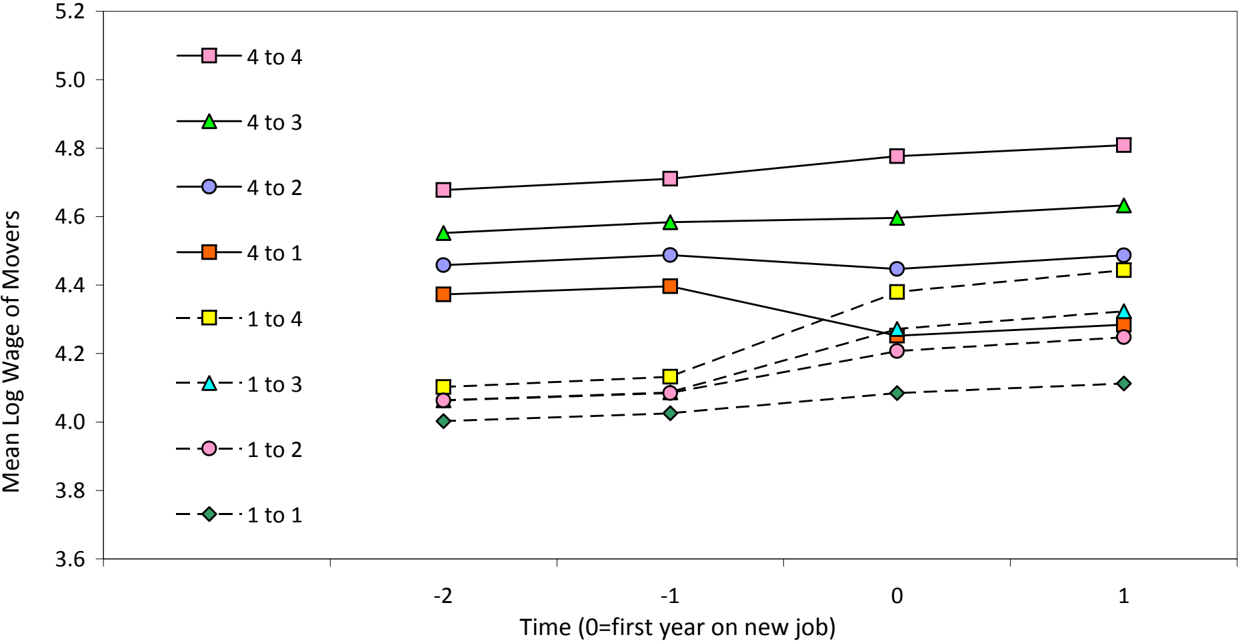
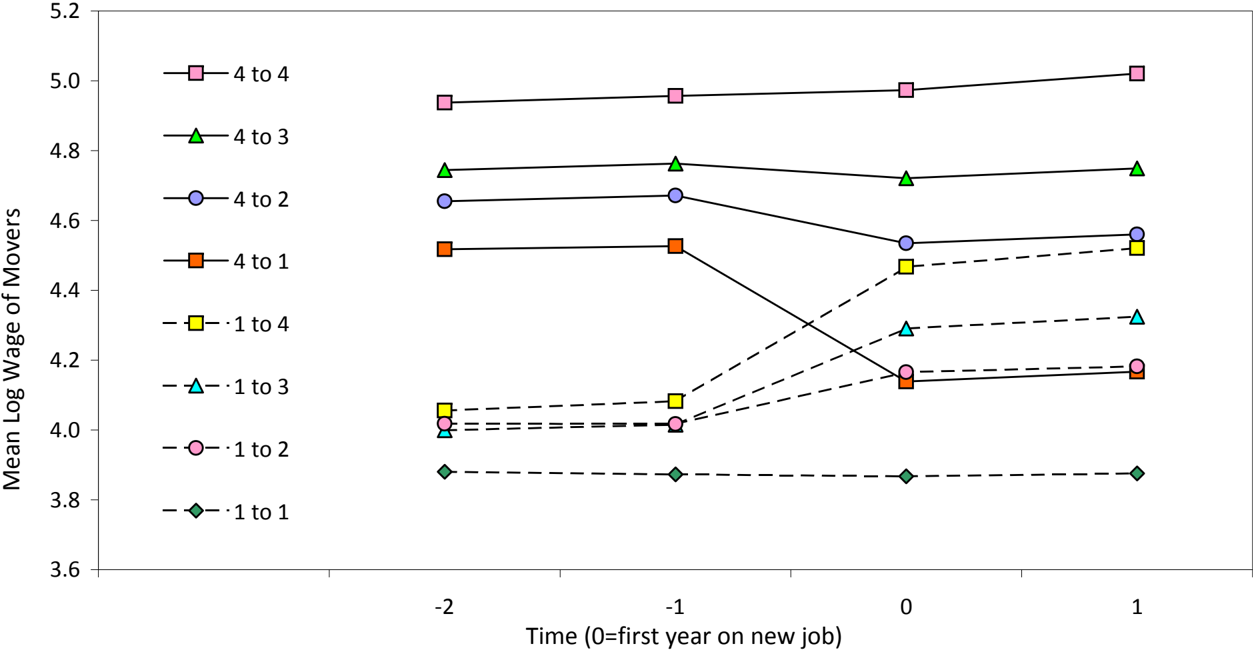
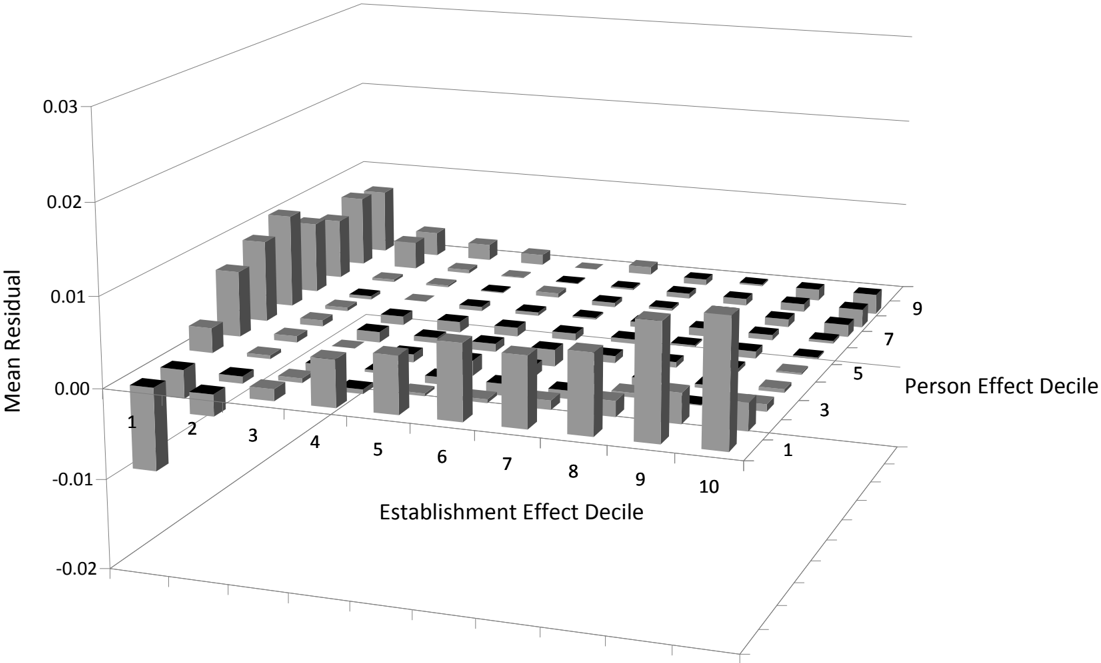
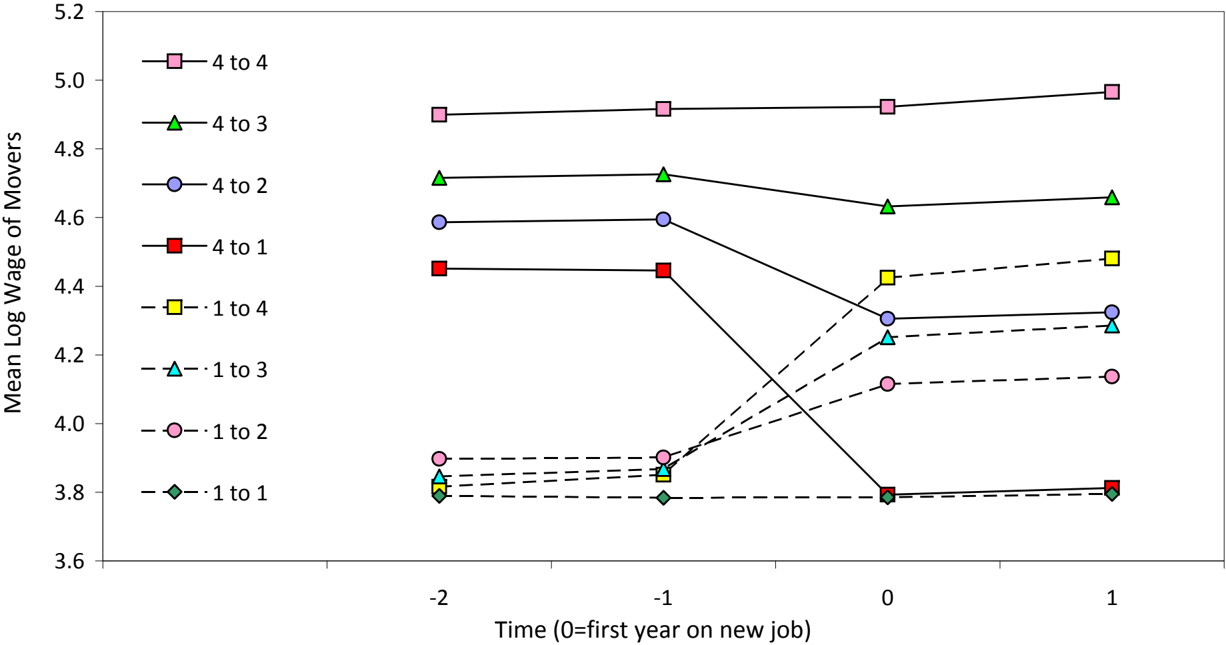
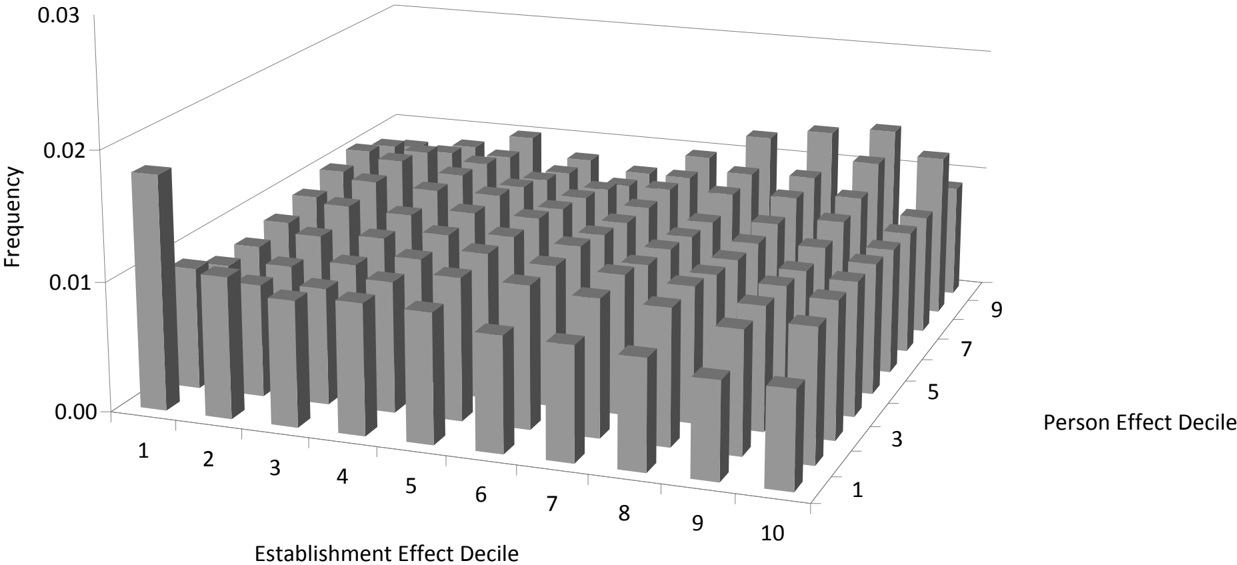
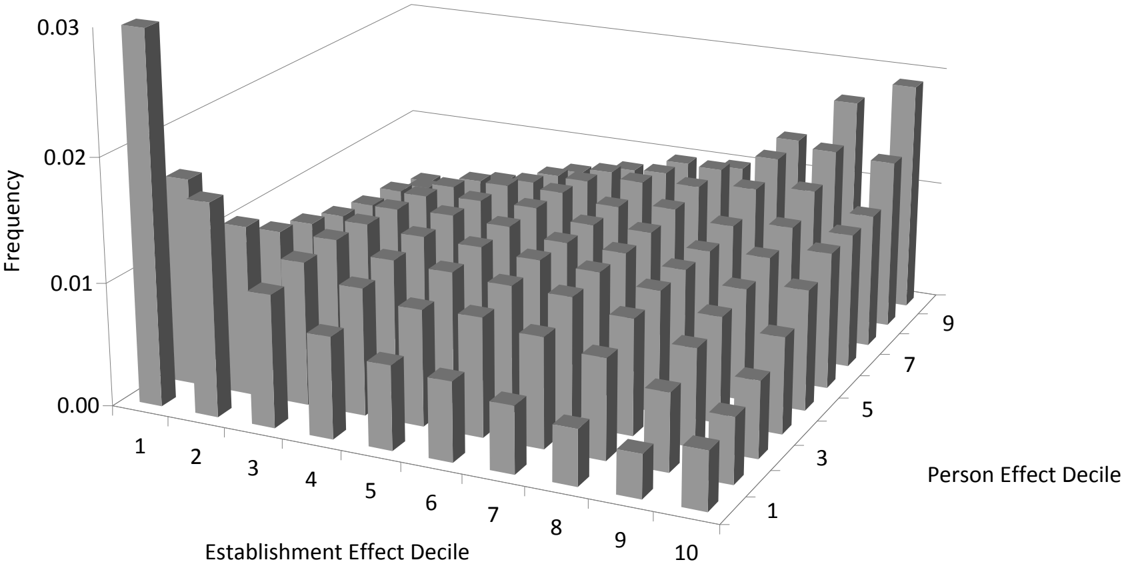
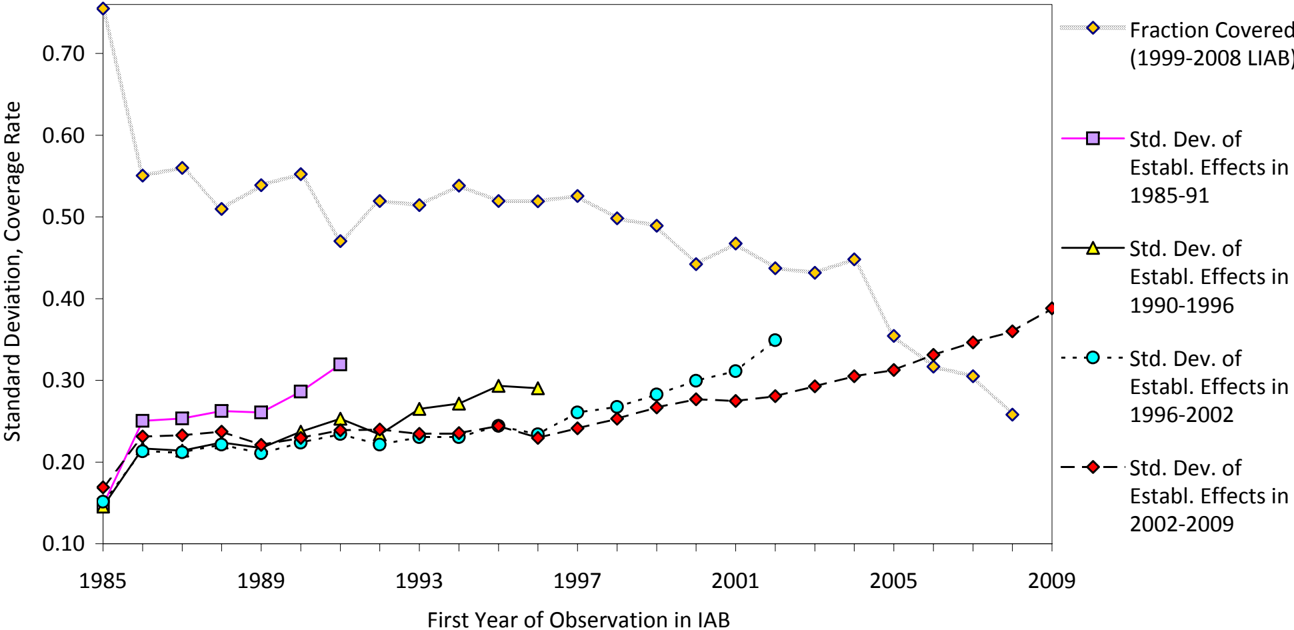
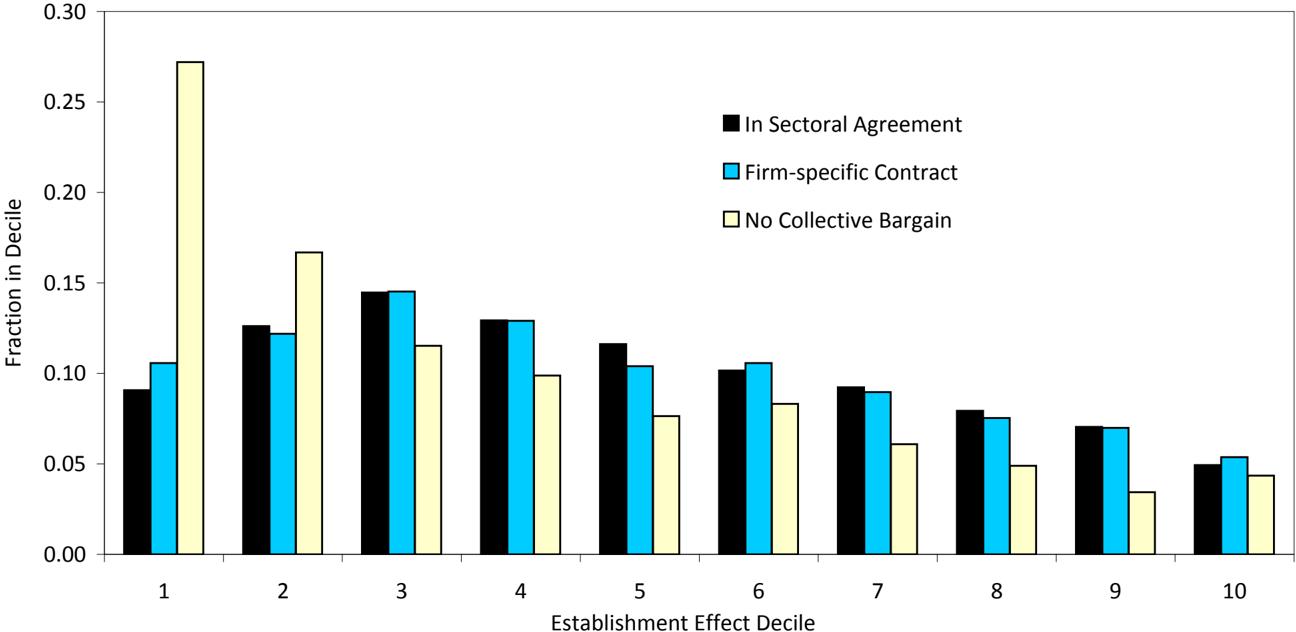
Verification
Claims the paper makes
0 Valid · 0 Not valid · 8 Not checked · 191 Own results and interpretations
A result the paper reports from its own data — it cites no other source for it, so there is none to check. The quote shows it is in the paper.
In the paper
“In particular, generalized non-separable models with xed e/ects for each job yield only a small improvement in explanatory power relative to the AKM speci cation, both within narrow time intervals and between intervals.”
plain- Asserted: passes — The authors put it forward as true.
- Checkable: passes — It can be checked against evidence.
- Load-bearing: passes — The paper’s conclusions depend on it.
- Based: passes — The paper gives a reason why it holds.
A result the paper reports from its own data — it cites no other source for it, so there is none to check. The quote shows it is in the paper.
In the paper
“Classifying establishments by entry year, we nd a trend toward increasing heterogeneity among establishments that entered the labor market after the mid-1990s, coupled with relatively small changes in the variability of the premiums paid by continuing establishments.”
plain- Asserted: passes — The authors put it forward as true.
- Checkable: passes — It can be checked against evidence.
- Load-bearing: passes — The paper’s conclusions depend on it.
- Based: passes — The paper gives a reason why it holds.
A result the paper reports from its own data — it cites no other source for it, so there is none to check. The quote shows it is in the paper.
In the paper
“We nd that two-thirds of the increase in the pay gap between higher and lower-educated workers is attributable to a widening in the average workplace pay premiums received by di/erent education groups.”
plainstates a cause- Asserted: passes — The authors put it forward as true.
- Checkable: passes — It can be checked against evidence.
- Load-bearing: passes — The paper’s conclusions depend on it.
- Based: passes — The paper gives a reason why it holds.
A result the paper reports from its own data — it cites no other source for it, so there is none to check. The quote shows it is in the paper.
In the paper
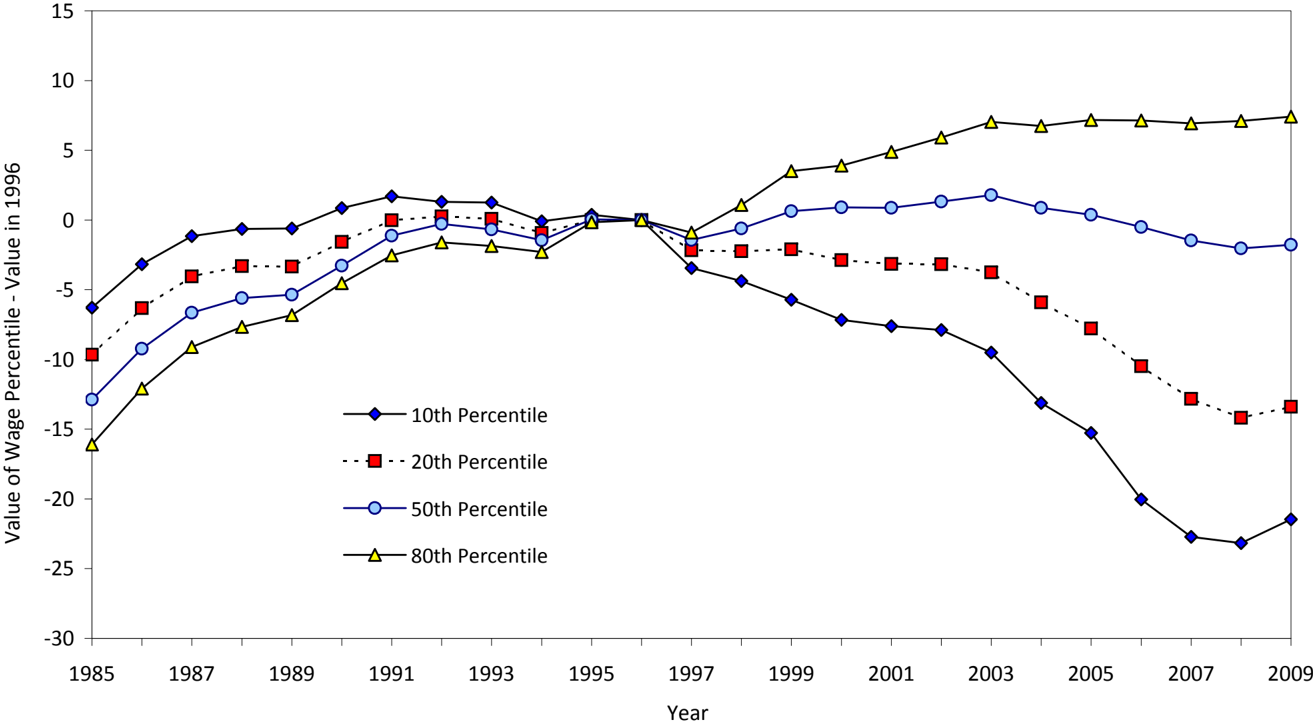
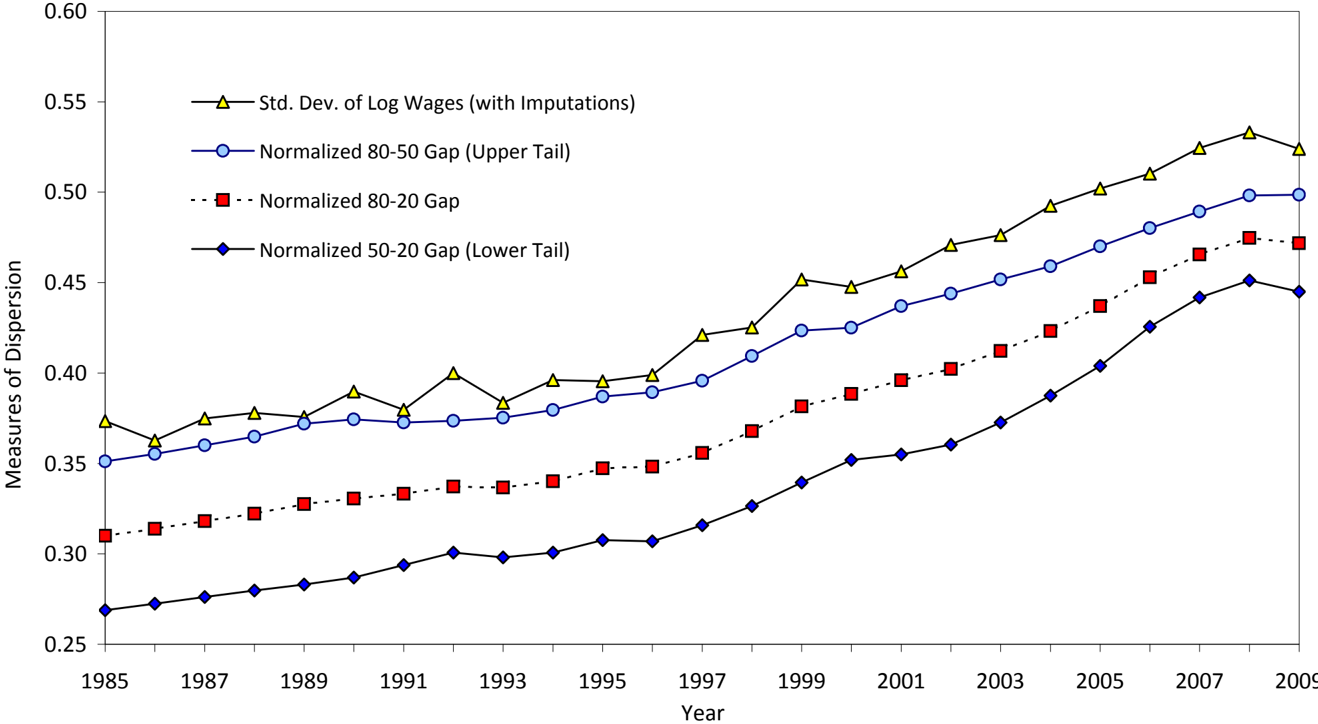
“In particular, the standard deviation rose by 15 log points from 1985 to 2009, the (normalized) 80-20 gap rose by 16 log points, the 80-50 gap rose by 15 log points, and the 50-20 gap rose by 18 log points.”
plain- Asserted: passes — The authors put it forward as true.
- Checkable: passes — It can be checked against evidence.
- Load-bearing: unclear — It is unclear whether the paper’s conclusions depend on it.
- Based: passes — The paper gives a reason why it holds.
118 more claims
Create a free account to see all 199 claims and to verify the 4 references still open.
- It may state two separate claims as one. 61
- Probably not a substantial claim. 17
- The quote only partly states this claim. 3
Claims other papers make about this one
Each is checked against this paper’s own text: does it say what the citing paper says it does?
The check wasn’t confident either way, so it gives no verdict — never disputed.
In the citing paper
“We estimate below that 75% is labor income.16”
From “Capitalists in the Twenty-First Century” (2019) · cites this paper as [16]
Experimental — accuracy not yet measured
Citations
Cites
A heteroskedasticity-consistent covariance matrix estimator and a direct test for heteroskedasticity
White, H. (1980) · Econometrica · doi:10.2307/1912934 · Cited by 25,861
The Skill Content of Recent Technological Change: An Empirical Exploration
Autor, D. H., Levy, F., & Murnane, R. J. (2003) · The Quarterly Journal of Economics · doi:10.1162/003355303322552801 · Cited by 6,205
On the Pooling of Time Series and Cross Section Data
Mundlak, Y. (1978) · Econometrica · doi:10.2307/1913646 · Cited by 5,412
Changes in Relative Wages, 1963-1987: Supply and Demand Factors
Katz, L. F., & Murphy, K. M. (1992) · The Quarterly Journal of Economics · doi:10.2307/2118323 · Cited by 4,793
Equilibrium Unemployment as a Worker Discipline Device
Shapiro, C., & Stiglitz, J. E. (1986) · Efficiency Wage Models of the Labor Market · doi:10.1017/cbo9780511559594.004 · Cited by 4,652
Misallocation and Manufacturing TFP in China and India*
Hsieh, C.-T., & Klenow, P. J. (2009) · Quarterly Journal of Economics · doi:10.1162/qjec.2009.124.4.1403 · Cited by 4,175
Job Creation and Job Destruction in the Theory of Unemployment
Mortensen, D. T., & Pissarides, C. A. (1994) · The Review of Economic Studies · doi:10.2307/2297896 · Cited by 3,840
Hybrid Corn: An Exploration in the Economics of Technological Change
Griliches, Z. (1957) · Econometrica · doi:10.2307/1905380 · Cited by 3,330
Labor Contracts as Partial Gift Exchange
Akerlof, G. A. (1982) · The Quarterly Journal of Economics · doi:10.2307/1885099 · Cited by 3,210
Plants and Productivity in International Trade
Bernard, A. B., Eaton, J., Jensen, J. B., & Kortum, S. (2003) · American Economic Review · doi:10.1257/000282803769206296 · Cited by 2,980
Research works printed but not linked: 1
- 70. Rees, Albert and George Schultz. 1970. Workers in an Urban Labor Market. Chicago: University of Chicago Press.
Cited by
Items 1,101–1,200 of 1,904
Matching Through Search ChannelsPreprint
Carrillo‐Tudela, C., Kaas, L., & Lochner, B. (2023) · SSRN Electronic Journal · doi:10.2139/ssrn.4625460 · Cited by 3
Inventor Returns and MobilityPreprint
Harhoff, D., Heller, D., & Momtaz, P. P. (2024) · SSRN Electronic Journal · doi:10.2139/ssrn.4795980 · Cited by 3
Workers, Workplaces, Sorting, and Wage Dispersion in Mexico
Pérez, J. E. P., & Nuño‐Ledesma, J. G. (2024) · doi:10.36095/banxico/di.2024.06 · Cited by 3
The composition of labour input: Sensitivity testing and results for productivity analysis
Ward, A., & Zinni, B. (2024) · OECD statistics working papers · doi:10.1787/5d9b866a-en · Cited by 3
Horowitz-Manski-Lee Bounds with Multilayered Sample SelectionPreprint
Kroft, K., Mourifié, I., & Vayalinkal, A. (2024) · SSRN Electronic Journal · doi:10.2139/ssrn.4957406 · Cited by 3
Careers and Wages in Family Firms: Evidence from Matched Employer-Employee DataPreprint
Pagano, M., Porto, E. D., Schivardi, F., Saggio, R., & Pezone, V. (2024) · SSRN Electronic Journal · doi:10.2139/ssrn.5022074 · Cited by 3
Assortative Matching and Wages: The Role of SelectionPreprint
Borovičková, K., & Shimer, R. J. (2024) · SSRN Electronic Journal · doi:10.2139/ssrn.5032548 · Cited by 3
Careers and Wages in Family Firms: Evidence from Matched Employer-Employee Data
Porto, E. D., Pagano, M., Pezone, V., Saggio, R., & Schivardi, F. (2024) · National Bureau of Economic Research · doi:10.3386/w33219 · Cited by 3
Low-wage employment in France: A cross-country perspective
Barreto, C., Carcillo, S., Fluchtmann, J., Georgieff, A., Hijzen, A., Pacifico, D., Pearsall, E.-J., & Puymoyen, A. (2025) · OECD social employment and migration working papers · doi:10.1787/82539f44-en · Cited by 3
The Evolution of Unobserved Skill Returns in the U.S.: A New Approach Using Panel Data
Lochner, L. M., Park, Y., & Shin, Y. (2025) · National Bureau of Economic Research · doi:10.3386/w33407 · Cited by 3
Cities, Aggregate Welfare, and GrowthPreprint
Gehr, K., & Pflüger, M. (2025) · SSRN Electronic Journal · doi:10.2139/ssrn.5172521 · Cited by 3
Training within FirmsPreprint
Diaz, B., Nazarrett, A. N., Ramirez, J., Sadun, R., & Tamayo, J. (2025) · SSRN Electronic Journal · doi:10.2139/ssrn.5215983 · Cited by 3
Corporate Minimum Wages and Working PovertyPreprint
Wilmers, N., Roh, S., & Tang, J. (2025) · SocArXiv (OSF Preprints) · doi:10.31235/osf.io/t8wqk_v1 · Cited by 3
Optimal Estimation of Two-Way Effects under Limited Mobility
Cheng, X., Ho, S. C., & Schorfheide, F. (2025) · National Bureau of Economic Research · doi:10.3386/w34014 · Cited by 3
How do Barbarians Get to the Gates? Private Equity Careers, Styles, and ReturnsPreprint
Jackson, B. (2025) · SSRN Electronic Journal · doi:10.2139/ssrn.5687143 · Cited by 3
The Implications of Sorting for Immigrant Wage Assimilation and Changing Cohort Quality in Canada
Lehrer, S., & Rawling, L. (2025) · National Bureau of Economic Research · doi:10.3386/w34462 · Cited by 3
Sorting Within and Across French Production HierarchiesPreprint
Spanos, G. (2015) · RePEc: Research Papers in Economics · Cited by 3
Who Benefits from Place-based Policies? Evidence from Matched Employer-Employee Data
Grunau, P., Hoffmann, F., Lemieux, T., & Titze, M. (2024) · Econstor (Econstor) · doi:10.18717/dpj5gp-1b03 · Cited by 3
Wang, Y. (2022) · SSRN Electronic Journal · doi:10.2139/ssrn.4110474 · Cited by 3
Robust Contracting with Career ConcernsPreprint
Gan, T., & Li, H. (2025) · arXiv (Cornell University) · doi:10.48550/arxiv.2507.22852 · Cited by 3
Organized Labor Versus Robots? : Evidence from Micro DataPreprint
Findeisen, S., Dauth, W., & Schlenker, O. (2024) · RePEc: Research Papers in Economics · doi:10.48787/kops/352-2-pkkgn822nr6u9 · Cited by 3
Rent Sharing and the Gender Bargaining Gap: Evidence from the Banking SectorPreprint
Coskun, S., Taşkın, A. A., & Gartner, H. (2026) · SSRN Electronic Journal · doi:10.2139/ssrn.6885015 · Cited by 3
Coworker Networks from Student Jobs: A Flying Start at Labor Market Entry?Preprint
Demir, G., Hertweck, F., Sandner, M., & Yükselen, I. (2024) · SSRN Electronic Journal · doi:10.2139/ssrn.5065244 · Cited by 3
Monopsony, Markdowns, and Minimum Wages
Faia, E., Lochner, B., & Schoefer, B. (2026) · National Bureau of Economic Research · doi:10.3386/w34699 · Cited by 3
Worker Beliefs About Outside Options
Jäger, S., Roth, C., Roussille, N., & Schoefer, B. (2021) · doi:10.71432/zsp.pb.2021.02 · Cited by 3
Labor market dynamics with sorting
Schulz, B. (2023) · Journal of Economic Dynamics and Control · doi:10.1016/j.jedc.2023.104776 · Cited by 3
Started From the Bottom, Now We’re (Working) Here: Workplace Segregation by Social Class Origin
Hällsten, M., & Wartin, A. T. (2026) · Work and Occupations · doi:10.1177/07308884261445024 · Cited by 2
Elite Networks: The Political Economy of Inequality
Vuković, V. (2024) · doi:10.1093/oso/9780197774229.001.0001 · Cited by 3
Dealing with Censored Earnings in Register Data
Beckmannshagen, M., König, J., Retter, I., Schlüter, C., Schröder, C., & Tchokni, Y. (2025) · Jahrbücher für Nationalökonomie und Statistik · doi:10.1515/jbnst-2024-0037 · Cited by 2
Occupational Autonomy and Wage Divergence: Evidence From European Survey Data
Rabensteiner, T., & Guschanski, A. (2025) · British Journal of Industrial Relations · doi:10.1111/bjir.70003 · Cited by 2
Chinetti, S. (2025) · Oxford Bulletin of Economics and Statistics · doi:10.1111/obes.70002 · Cited by 2
Breaking Out of Low‐Effort Traps: Bureaucratic Leadership by Persuasion
Haus, M. (2026) · Governance · doi:10.1111/gove.70139 · Cited by 2
Zimmermann, F. (2025) · International Migration Review · doi:10.1177/01979183251365910 · Cited by 2
Sotherland, N., & Stange, K. (2026) · Economics of Education Review · doi:10.1016/j.econedurev.2026.102770 · Cited by 2
Firm size and the automation wage premium
Bisio, L., Cuzzola, A., Grazzi, M., & Moschella, D. (2026) · Small Business Economics · doi:10.1007/s11187-026-01227-2 · Cited by 2
Two decades of earnings inequality in Hungary
Boza, I., Neubrandt, M., & Pető, R. (2026) · Journal of Macroeconomics · doi:10.1016/j.jmacro.2026.103779 · Cited by 2
Clemens, M. A. (2026) · Labour Economics · doi:10.1016/j.labeco.2026.102984 · Cited by 3
Hesse, G. (2013) · Cited by 2
Arbeitsmarkt 2015: Bestandsaufnahme und Handlungserfordernisse
Walwei, U. (2015) · Gesundheits- und Sozialpolitik · doi:10.5771/1611-5821-2015-1-7 · Cited by 2
Ownership networks and labor income
Huneeus, F., Larraín, B., Larraín, M., & Prem, M. (2023) · The Journal of Law Economics and Organization · doi:10.1093/jleo/ewad027 · Cited by 2
Does Increasing the Riskiness of Choices Widen Gender Gaps?
Hirshman, S. D., & Willén, A. (2024) · Management Science · doi:10.1287/mnsc.2023.04088 · Cited by 2
ESTIMATION OF THE GREAT DECOUPLING ON THE EXAMPLE OF CROATIA, AS COMPARED WITH GERMANY AND POLAND
Bosna, J. (2018) · Poslovna izvrsnost - Business excellence · doi:10.22598/pi-be/2018.12.1.33 · Cited by 2
Sources of German Income Inequality Across Time and Space
Deutschmann, F. (2019) · Emerald Group Publishing Limited eBooks · doi:10.1108/s1049-258520190000027004 · Cited by 2
Unequal worker exposure to establishment deaths
Macartney, H., Nielsen, E. R., & Rodriguez, V. (2021) · Labour Economics · doi:10.1016/j.labeco.2021.102073 · Cited by 2
de Souza, P. H. G. F., Maciel, F. B., & Foguel, M. N. (2023) · Boletim Mercado de Trabalho · doi:10.38116/bmt76/nt1 · Cited by 2
Domestic outsourcing and employment security
Guo, N., Li, D. D., & Wong, M. B. (2026) · Journal of Development Economics · doi:10.1016/j.jdeveco.2026.103816 · Cited by 2
Is the Public Sector Losing the Battle for Talent? Evidence from Long French Panel Data
Bargain, O., Etienne, A., & Melly, B. (2025) · The Economic Journal · doi:10.1093/ej/ueaf069 · Cited by 2
Bad Times, Bad Jobs? How Recessions Affect Early Career Trajectories
Mahajan, P., Patki, D., & Stüber, H. (2025) · Journal of Labor Economics · doi:10.1086/739199 · Cited by 2
On the move: local opportunities and youth migration
Xu, X. (2025) · Fiscal Studies · doi:10.1111/1475-5890.70011 · Cited by 2
Convenio colectivo, sindicatos y dispersión salarial: evidencia de Argentina
Lombardo, C., & Martínez Correa, J. (2019) · El Servicio de Difusión de la Creación Intelectual (National University of La Plata) · Cited by 2
Rising inequality, declining mobility: The evolution of intergenerational mobility in Germany
Baarck, J., Bode, M., & Peichl, A. (2026) · Journal of Public Economics · doi:10.1016/j.jpubeco.2026.105811 · Cited by 4
Black, D. A., Taylor, L. J., & Zaber, M. A. (2015) · Journal of Economic and Social Measurement · doi:10.3233/jem-150412 · Cited by 2
ECONOMIC INEQUALITY: A SURVEY OF RECENT LITERATURE
Kulikauskas, D. (2013) · Ekonomika · doi:10.15388/ekon.2013.0.1137 · Cited by 2
The role of the firm in worker wage dispersion: an analysis of the Ghanaian manufacturing sector
Chatterjee, S. (2016) · IZA Journal of Labor & Development · doi:10.1186/s40175-016-0062-x · Cited by 2
Rebollo‐Sanz, Y. F. (2017) · International Journal of Manpower · doi:10.1108/ijm-04-2016-0082 · Cited by 2
Lohnbildung und Lohnverteilung
Gangl, M. (2018) · Springer eBooks · doi:10.1007/978-3-658-02256-3_8 · Cited by 2
ON THE USE OF FIRM FIXED EFFECTS AS A PRODUCTIVITY MEASURE FOR ANALYZING LABOR MARKET MATCHING
Ehrl, P. (2018) · Bulletin of Economic Research · doi:10.1111/boer.12173 · Cited by 2
Wie entstand die Ungleichheit der Einkommen in Deutschland und was sollte man dagegen tun?
Horn, G. A. (2018) · List Forum für Wirtschafts- und Finanzpolitik · doi:10.1007/s41025-018-0107-9 · Cited by 2
Recall – A way to mitigate adverse effects of unemployment on earnings across occupations?
Edler, S., Jacobebbinghaus, P., & Liebig, S. (2019) · Research in Social Stratification and Mobility · doi:10.1016/j.rssm.2019.01.003 · Cited by 2
Die Ungleichheit von Lebenserwerbseinkommen
Bönke, T., & Lüthen, H. (2020) · Wirtschaftsdienst · doi:10.1007/s10273-020-2625-3 · Cited by 2
Responsabilidad social de las organizaciones (RSO)
Gorrochategui, N., de Oliveira, M. M., Palamara, N. S., Fernández, W. D. O., Peretti, M. F., Buraschi, M., Amato, C. N., Pinzón, M. M., Osorio, M. G., Santiago, A. L. F., et al. (2019) · doi:10.32457/isbn9789568454388382019-ed1 · Cited by 2
WAGE RISK, EMPLOYMENT RISK, AND THE RISE IN WAGE INEQUALITY
Mecikovsky, A., & Wellschmied, F. (2024) · International Economic Review · doi:10.1111/iere.12735 · Cited by 2
Features shaping second-level bargaining: The case of the Brescian industrial system
Casnici, N., Albertini, S., & Castellani, M. (2020) · STUDI ORGANIZZATIVI · doi:10.3280/so2020-002001 · Cited by 2
Seckler, M. (2019) · Review of Income and Wealth · doi:10.1111/roiw.12511 · Cited by 2
Lønnsforskjeller mellom kvinner og menn – hvilken rolle spiller bedriften?
Østbakken, K. M., & Frisell, M. M. (2021) · Tidsskrift for kjønnsforskning · doi:10.18261/issn.1891-1781-2021-01-03 · Cited by 2
La gestión de los datos administrativos en España: diagnóstico y retos de futuro
Almunia, M., & Rey‐Biel, P. (2021) · Cuadernos Económicos de ICE · doi:10.32796/cice.2021.102.7313 · Cited by 2
Capital Account Liberalization and Wage Inequality: Evidence from Firm Level Data
Eklou, K. M., & Foster, S. (2023) · IMF Working Paper · doi:10.5089/9798400235139.001 · Cited by 2
The ‘German Job Miracle’ and Its Impact on Income Inequality: A Decomposition Study
Mühlhan, J. (2023) · doi:10.34196/ijm.00274 · Cited by 2
David Card, Nobel Prize 2021: the Design-Based Revolution
Goux, D., & Maurin, É. (2023) · Revue d économie politique · doi:10.3917/redp.331.0025 · Cited by 2
Firm‐specific Human Capital Accumulation: Evidence from Brazil*
Pires, T., Szydłowski, A., & Zhao, S. (2023) · Oxford Bulletin of Economics and Statistics · doi:10.1111/obes.12570 · Cited by 2
A New Semiparametric Approach to Analysing Conditional Income DistributionsPreprint
Silbersdorff, A., Klein, N., & Kneib, T. (2014) · SSRN Electronic Journal · doi:10.2139/ssrn.2404335 · Cited by 2
Inequality and Financial Stability in an Agent-Based Model
Fischer, T. (2015) · Technischen Universität Darmstadt · doi:10.26083/tuprints-00004536 · Cited by 2
Higher-Order Income Risk and Social Insurance Policy Over the Business CyclePreprint
Madera, R., Guvenen, F., Domeij, D., & Busch, C. (2015) · RePEc: Research Papers in Economics · Cited by 4
Worker-firm matching in a global economy
Tito, M. D. (2015) · cIRcle (University of British Columbia) · doi:10.14288/1.0166437 · Cited by 2
Rukwid, R. (2016) · University writing server of the University of Hohenheim (Universität Hohenheim) · Cited by 2
Lebenslagen in Deutschland: Vierter Armuts- und Reichtumsbericht
Achatz, J., Beste, J., Bruckmeier, K., Fohrbeck, A., Heining, J., Kruppe, T., Kupka, P., Ludsteck, J., Promberger, M., Rudolph, H., et al. (2013) · Econstor (Econstor) · Cited by 2
Self-citationOn the Link between Job Polarisation and Wage Inequality - A regional approach for GermanyPreprint
Reinhold, M. (2016) · RePEc: Research Papers in Economics · Cited by 3
Trends in the German Income Distribution: 2005/06 to 2010/11Preprint
Biewen, M., Ungerer, M., & Löffler, M. (2016) · SSRN Electronic Journal · doi:10.2139/ssrn.2887474 · Cited by 2
Measuring Labor Market Segmentation from Incomplete DataPreprint
Wiener, N. M. (2018) · RePEc: Research Papers in Economics · doi:10.7275/11776873 · Cited by 2
Workers, Firms and Life-Cycle Wage DynamicsPreprint
Bingley, P., & Cappellari, L. (2018) · SSRN Electronic Journal · doi:10.2139/ssrn.3153366 · Cited by 2
Wage mobility, wage inequality, and tasks: Empirical evidence from Germany, 1984-2014Preprint
Çoban, M. (2017) · RePEc: Research Papers in Economics · Cited by 2
Essays on State Capacity and Local Public Goods
Schönholzer, D. (2018) · eScholarship (California Digital Library) · Cited by 2
Essays on the Role of the Firm in Labor Economics
Smith, B. S. (2018) · eScholarship (California Digital Library) · Cited by 2
Essays on imperfect competition in the labor market
Caldwell, S. (2019) · Upjohn Research (W.E. Upjohn Institute for Employment Research) · Cited by 2
Managers' Productivity and Recruitment in the Public SectorPreprint
Muñoz, P., & Prem, M. (2019) · SSRN Electronic Journal · doi:10.2139/ssrn.3480718 · Cited by 2
Essays in development and political economy
Shaukat, M. (2019) · DSpace@MIT (Massachusetts Institute of Technology) · Cited by 2
Selection into Employment and the Gender Wage Gap across the Distribution and Over Time
Granados, P. G., & Wrohlich, K. (2020) · publish.UP (University of Potsdam) · doi:10.25932/publishup-44169 · Cited by 2
Brändle, T., Grunau, P., Haylock, M., & Kampkötter, P. (2020) · RePEc: Research Papers in Economics · doi:10.15496/publikation-41500 · Cited by 2
Wang, Y. (2020) · eScholarship (California Digital Library) · Cited by 2
Why Are Some Regions So Much More Productive than Others?Preprint
Lacava, C. (2021) · SSRN Electronic Journal · doi:10.2139/ssrn.3982335 · Cited by 2
Cantoni, E., & Pons, V. (2020) · National Bureau of Economic Research · doi:10.3386/w27998 · Cited by 2
Dissecting Idiosyncratic Earnings Risk
Ozkan, S., Storesletten, K., Holter, H. A., & Halvorsen, E. (2022) · doi:10.20955/wp.2022.024 · Cited by 2
Cultural Biases in Migration: Estimating Non-Monetary Migration CostsPreprint
Falck, O., Lameli, A., & Ruhose, J. (2015) · RePEc: Research Papers in Economics · Cited by 2
New Imported Inputs, Wages and Worker MobilityPreprint
Colantone, I., Matano, A., & Naticchioni, P. (2018) · SSRN Electronic Journal · doi:10.2139/ssrn.3178584 · Cited by 2
Wage Inequality in Latin America: Learning from Matched Employer-Employee Data
Muñoz, E., Rucci, G., Saltiel, F., & Urzúa, S. (2018) · doi:10.18235/0001727 · Cited by 2
Institutions, labor market segmentation and competitiveness in the german political economy
Herrero, D. (2020) · Library Open Repository (Universidad Complutense Madrid) · Cited by 2
Skill Demand and Wages. Evidence from Linked Vacancy DataPreprint
Ziegler, L. (2022) · SSRN Electronic Journal · doi:10.2139/ssrn.4183423 · Cited by 2
Within-firm Pay Inequality and Firm PerformancePreprint
Vito, A. D., & Gómez, J.-P. (2022) · SSRN Electronic Journal · doi:10.2139/ssrn.4008989 · Cited by 2
When Immigrants Meet Exporters: A Reassessment of the Immigrant Wage GapPreprint
Marchal, L., Ourens, G., & Sabbadini, G. (2022) · SSRN Electronic Journal · doi:10.2139/ssrn.4100463 · Cited by 2
Metadata
- Authors
- Card, D., Heining, J., & Kline, P.
- Affiliations
- University of California, Berkeley (US)
- Corresponding author
- Kline, Patrick
- ORCID
- Card, David
- Venue
- The Quarterly Journal of Economics
- Publisher
- Oxford University Press (OUP)
- Published
- 2013-05-02
- Volume
- 128
- Issue
- 3
- Pages
- 967-1015
- ISSN
- 0033-5533 (ISSN-L)
- 1531-4650
- OpenAlex
- W2141295263
- Cited by
- 1,904
- References
- 146
- Citations by year
- 2026: 153 · 2025: 204 · 2024: 228 · 2023: 156 · 2022: 185 · 2021: 178 · 2020: 143 · 2019: 125 · 2018: 156 · 2017: 113 · 2016: 105 · 2015: 71 · 2014: 58 · 2013: 22
- FWCI
- 118.40
- Type
- journal article
- Language
- en
- Open access
- closed
- Locations
- The Quarterly Journal of Economics (publishedVersion)
- RePEc: Research Papers in Economics (submittedVersion)
- Econstor (Econstor) (submittedVersion)
- Funders
- Washington Center for Equitable Growth
- Topics
- Social Sciences › Economics, Econometrics and Finance › Economics and Econometrics › Labor market dynamics and wage inequality
- Social Sciences › Economics, Econometrics and Finance › Economics and Econometrics › Historical Economic and Social Studies
- Social Sciences › Sociology and Political Science › Income, Poverty, and Inequality
- Keywords
- wage inequality, job matching, fixed effects model, education and wages
About these checks
Registry, retraction, Cites and statistics results are computed, not judged, with one exception: a printed reference that no index lists is read once by a model before it counts as a citation error. Claims are extracted by a model and kept only when their quote appears verbatim in the text; each cited source is then checked, with a model’s help, for whether it says what the claim relies on. Those verdicts can be wrong — read the claim’s quote and the cited source before relying on one.
A language model drew the claims from the paper on 2026-11-17, under version 3 of the claim definition (model deepseek-v4.1-flash, prompt extract-v3).
A second model labelled each claim on 2026-11-17 (model jev-1.13-20260917, definition revision gold-guideline-v0.2).
Statistics and arithmetic are recomputed, not judged.
Confidence bands are shown only for fields calibrated on our annotated test set. None is calibrated yet, so no band is shown.
What counts as a claim ›How we measure confidence ›How we check this ›
Are you an author, or do you see a problem with this page? Request a review
Data sources
Bibliographic data: Semantic Scholar, OpenAlex, Crossref.
Contains information from the Semantic Scholar Academic Graph Datasets, made available under the ODC Attribution License (ODC-BY 1.0).
Semantic Scholar’s data is described in: Kinney, R., et al. (2023). The Semantic Scholar Open Data Platform. arXiv:2301.10140.
