

Clinical characteristics of fatal and recovered cases of coronavirus disease 2019 in Wuhan, China: a retrospective study.
Open accessThe DOI matches its Crossref record; 28 of the 30 references it cites were found in a registry or an index, and 2 are not checked yet.
Abstract
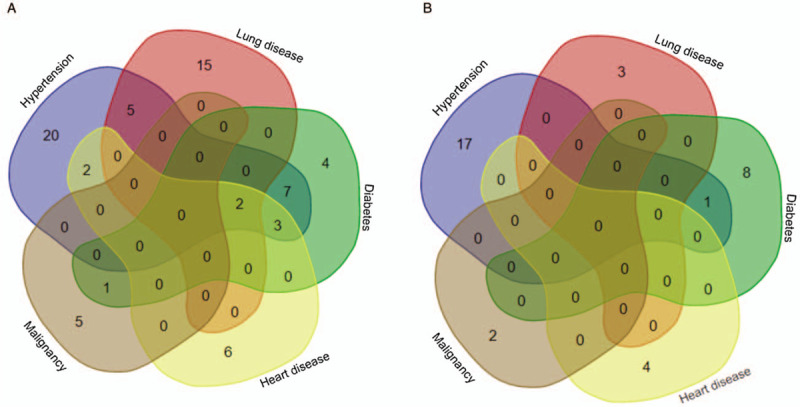
Background: The 2019 novel coronavirus has caused the outbreak of the acute respiratory disease in Wuhan, Hubei Province of China since December 2019. This study was performed to analyze the clinical characteristics of patients who succumbed to and who recovered from 2019 novel coronavirus disease (COVID-19). Methods: Clinical data were collected from two tertiary hospitals in Wuhan. A retrospective investigation was conducted to analyze the clinical characteristics of fatal cases of COVID-19 (death group) and we compare them with recovered patients (recovered group). Continuous variables were analyzed using the Mann-Whitney U test. Categorical variables were analyzed by χ 2 test or Fisher exact test as appropriate. Results: Our study enrolled 109 COVID-19 patients who died during hospitalization and 116 recovered patients. The median age of the death group was older than the recovered group (69 [62, 74] vs. 40 [33, 57] years, Z = 9.738, P < 0.001). More patients in the death group had underlying diseases (72.5% vs. 41.4%, χ 2 = 22.105, P < 0.001). Patients in the death group had a significantly longer time of illness onset to hospitalization (10.0 [6.5, 12.0] vs. 7.0 [5.0, 10.0] days, Z = 3.216, P = 0.001). On admission, the proportions of patients with symptoms of dyspnea (70.6% vs. 19.0%, χ 2 = 60.905, P < 0.001) and expectoration (32.1% vs. 12.1%, χ 2 = 13.250, P < 0.001) were significantly higher in the death group. The blood oxygen saturation was significantly lower in the death group (85 [77, 91]% vs. 97 [95, 98]%, Z = 10.625, P < 0.001). The white blood cell (WBC) in death group was significantly higher on admission (7.23 [4.87, 11.17] vs. 4.52 [3.62, 5.88] ×10 9/L, Z = 7.618, P < 0.001). Patients in the death group exhibited significantly lower lymphocyte count (0.63 [0.40, 0.79] vs. 1.00 [0.72, 1.27] ×10 9/L, Z = 8.037, P < 0.001) and lymphocyte percentage (7.10 [4.45, 12.73]% vs. 23.50 [15.27, 31.25]%, Z = 10.315, P < 0.001) on admission, and the lymphocyte percentage continued to decrease during hospitalization (7.10 [4.45, 12.73]% vs. 2.91 [1.79, 6.13]%, Z = 5.242, P < 0.001). Alanine transaminase (22.00 [15.00, 34.00] vs. 18.70 [13.00, 30.38] U/L, Z = 2.592, P = 0.010), aspartate transaminase (34.00 [27.00, 47.00] vs. 22.00 [17.65, 31.75] U/L, Z = 7.308, P < 0.001), and creatinine levels (89.00 [72.00, 133.50] vs. 65.00 [54.60, 78.75] μmol/L, Z = 6.478, P < 0.001) were significantly higher in the death group than those in the recovered group. C-reactive protein (CRP) levels were also significantly higher in the death group on admission (109.25 [35.00, 170.28] vs. 3.22 [1.04, 21.80] mg/L, Z = 10.206, P < 0.001) and showed no significant improvement after treatment (109.25 [35.00, 170.28] vs. 81.60 [27.23, 179.08] mg/L, Z = 1.219, P = 0.233). The patients in the death group had more complications such as acute respiratory distress syndrome (ARDS) (89.9% vs. 8.6%, χ 2 = 148.105, P < 0.001), acute cardiac injury (59.6% vs. 0.9%, χ 2 = 93.222, P < 0.001), acute kidney injury (18.3% vs. 0%, χ 2 = 23.257, P < 0.001), shock (11.9% vs. 0%, χ 2 = 14.618, P < 0.001), and disseminated intravascular coagulation (DIC) (6.4% vs. 0%, χ 2 = 7.655, P = 0.006). Conclusions: Compared to the recovered group, more patients in the death group exhibited characteristics of advanced age, pre-existing comorbidities, dyspnea, oxygen saturation decrease, increased WBC count, decreased lymphocytes, and elevated CRP levels. More patients in the death group had complications such as ARDS, acute cardiac injury, acute kidney injury, shock, and DIC.
Overview
The claims and statistics of this paper haven’t been checked yet.
Free: it reads the open-access text and checks the first 5 claims that cite a source we can check. Create a free account to check every claim.
Integrity signals
Registry
Cites
Statistics
Figures
Verification
Claims the paper makes
The claims and statistics of this paper haven’t been checked yet.
Free: it reads the open-access text and checks the first 5 claims that cite a source we can check. Create a free account to check every claim.
Claims other papers make about this one
Each is checked against this paper’s own text: does it say what the citing paper says it does?
The cited source says what the claim attributes to it.
In the citing paper
“Given the fact that this group is reportedly more vulnerable during COVID-19 (Chen et al., 2020; Deng et al., 2020; Liu W. et al., 2020; Pan et al., 2020; World Health Organization, 2020), the findings are consistent with other similar studies (Rajkumar, 2020; Özdin and Bayrak Özdin, 2020).”
From Knowledge of COVID-19 and Its Influence on Mindfulness, Cognitive Emotion Regulation and Psychological Flexibility in the Indian Community (2020) · cites this paper as Deng et al., 2020
Self-check
Percentages, sums and reported differences re-computed from the paper’s own numbers.
The self-check needs the paper’s full text.
Citations
Cites
Clinical features of patients infected with 2019 novel coronavirus in Wuhan, China
Huang, C., Wang, Y., Li, X., Ren, L., Zhao, J., Hu, Y., Zhang, L., Fan, G., Xu, J., Gu, X., et al. (2020) · The Lancet · doi:10.1016/s0140-6736(20)30183-5 · Cited by 48,884
A novel coronavirus from patients with pneumonia in China, 2019
Zhu, N., Zhang, D., Wang, W., Li, X., Yang, B., Song, J., Zhao, X., Huang, B., Shi, W., Lu, R., et al. (2020) · New England Journal of Medicine · doi:10.1056/nejmoa2001017 · Cited by 28,244
Yang, X., Yu, Y., Xu, J., Shu, H., Xia, J., Liu, H., Wu, Y., Zhang, L., Yu, Z., Fang, M., et al. (2020) · The Lancet Respiratory Medicine · doi:10.1016/s2213-2600(20)30079-5 · Cited by 10,066 · cited 7×
“Discussion Table 2: Clinical symptoms and signs of the death and recovered groups with COVID-19.”
ResultInfluentialSelf-citationChan, J. F.-W., Yuan, S., Kok, K.-H., To, K. K.-W., Chu, H., Yang, J., Xing, F., Liu, J., Yip, C. C.-Y., Poon, R. W.-S., et al. (2020) · The Lancet · doi:10.1016/s0140-6736(20)30154-9 · Cited by 8,944 · cited 2×
“2019-nCoV is also a beta coronavirus that causes ARDS and can be transmitted between humans.([7]) Similar to SARS-CoV, the 2019-nCoV is speculated to use the angiotensin-converting enzyme (ACE) 2 as a receptor for cell invasion.”
BackgroundWan, Y., Shang, J., Graham, R., Baric, R. S., & Li, F. (2020) · Journal of Virology · doi:10.1128/jvi.00127-20 · Cited by 4,341
Self-citationAssiri, A., Al-Tawfiq, J. A., Al-Rabeeah, A. A., Al-Rabiah, F. A., Al-Hajjar, S., Al-Barrak, A., Flemban, H., Al-Nassir, W. N., Balkhy, H. H., Al-Hakeem, R. F., et al. (2013) · The Lancet Infectious Diseases · doi:10.1016/s1473-3099(13)70204-4 · Cited by 1,435 · cited 2×
“Previous studies also showed that the transaminases were elevated in the MERS and SARS patients.([20-23]) A recent study showed that elderly patients infected with 2019-nCoV have higher CRP levels.”
BackgroundResultWeiss, S. R., & Leibowitz, J. L. (2011) · Advances in Virus Research · doi:10.1016/b978-0-12-385885-6.00009-2 · Cited by 896 · cited 1×
“Coronaviruses are enveloped RNA viruses that could affect birds, humans, and other mammals, leading to respiratory, digestive, hepatic, and nervous system disorders.([4,5]) Among the six coronaviruses known to infect humans, two of them can cause ARDS, which are the severe acute respiratory syndrome coronavirus (SARSC…”
BackgroundFatal swine acute diarrhoea syndrome caused by an HKU2-related coronavirus of bat origin
Zhou, P., Fan, H., Lan, T., Yang, X.-L., Shi, W.-F., Zhang, W., Zhu, Y., Zhang, Y.-W., Xie, Q.-M., Mani, S., et al. (2018) · Nature · doi:10.1038/s41586-018-0010-9 · Cited by 757 · cited 1×
“Coronaviruses are enveloped RNA viruses that could affect birds, humans, and other mammals, leading to respiratory, digestive, hepatic, and nervous system disorders.([4,5]) Among the six coronaviruses known to infect humans, two of them can cause ARDS, which are the severe acute respiratory syndrome coronavirus (SARSC…”
BackgroundSelf-citationWong, R. S. M., Wu, A., To, K. F., Lee, N., Lam, C. W. K., Wong, C. K., Chan, P. K. S., Ng, M. H. L., Yu, L. M., Hui, D. S., et al. (2003) · BMJ · doi:10.1136/bmj.326.7403.1358 · Cited by 561 · cited 1×
“that during the acute phase of SARS-CoV infection in humans, the blood lymphocyte counts, particularly CD4 + and CD8 + T cell counts, were decreased.([16-18]) Another study suggested that lymphocyte cells, especially CD4 + and CD8 + T cells may play protective roles in coronavirus infection.”
BackgroundSun, P., Qie, S., Liu, Z., Ren, J., Li, K., & Xi, J. (2020) · Journal of Medical Virology · doi:10.1002/jmv.25735 · Cited by 523
Cited by
Items 601–656 of 656
Role of Leukocytes Ratio in Predicting Survival with COVID-19
Nadeem, S., Mahar, S., Rafique, S., Sohail, F., Jawed, M., Anwer, M., & Ali, M. (2023) · Pakistan Journal of Medicine and Dentistry · doi:10.36283/pjmd12-2/009
Utilidad de la proteína C-reactiva para determinar la gravedad de infección por SARS-CoV-2 en Perú
Alburqueque-Melgarejo, J., Quezada, J. C. R., Flores, H. M. V., Massa, V. R. D. C., & Cruz-Vargas, J. A. D. L. (2023) · Revista chilena de infectología · doi:10.4067/s0716-10182023000200085
Epidemiological Analysis of the Second Wave of COVID-19 in a Moroccan Hospital
Chahbi, Z., Badaoui, M., Raiteb, M., Mouharir, M., Belatik, I., Kaddouri, S., Qaçif, H., & Zyani, M. (2023) · Scholars Journal of Applied Medical Sciences · doi:10.36347/sjams.2023.v11i06.011
Fattahi, F., Farnia, M. R., Rezaei, B., Rafiei, H., Oskui, A. G., Amiri, A. M., & Rezaei, M. R. (2023) · Journal of Renal Endocrinology · doi:10.34172/jre.2023.25096
“The other reported common complication in COVID-19 patients especially, in severe stage, is coagulation disorders (10,11).”
BackgroundMiryan, M., Moradi, S., Soleimani, D., Pasdar, Y., Jangjoo, A., Bagherniya, M., Guest, P. C., Ashari, S., & Sahebkar, A. (2023) · Advances in experimental medicine and biology · doi:10.1007/978-3-031-28012-2_24 · Cited by 1
Does COVID-19 Augmented Life-threatening Spontaneous Iliopsoas Hematomas?
Keten, T. (2023) · Comprehensive Medicine · doi:10.14744/cm.2023.79663
Pratiwi, A. E., Suwarsa, O., Achadiyani, & Atik, N. (2023) · Journal Of Vocational Health Studies · doi:10.20473/jvhs.v7.i1.2023.68-76
“Meanwhile, older people with comorbidities or organ function disorders have potential to more easily aggravate the development of diseases and even cause death, with characteristics such as decreasing oxygen saturation and lymphocytes, increasing white blood cells and CRP levels (Deng et al., 2020).”
BackgroundVigneswaran, R., Kumar, S. R. S., Venkatachalam, T., Kalaiselvi, P., Sattanathan, K., Rajaguru, R., & Srinivasan, N. (2022) · Journal of Pharmaceutical Research International · doi:10.9734/jpri/2022/v34i27b36010
Tang, P., Ai, X., Wang, M., Hu, Y., Pan, Q., & Jiang, J. (2023) · Frontiers in Oncology · doi:10.3389/fonc.2023.1220518
Gonzalez, C., Musso, G., Louzan, J. R., Dominguez, J. M., Gomez, C., Appendino, G., Abaca, A., Clemente, L., Latasa, D., Manago, M., et al. (2023) · Medicina Intensiva (English Edition) · doi:10.1016/j.medine.2023.07.011
Protective effects of IL18-105G>A and IL18-137C>G genetic variants on severity of COVID-19Preprint
Mori, M. T. E., Simão, A. N. C., Danelli, T., Oliveira, S. R., Cassela, P. L. C. S., Trigo, G. L., Cardoso, K. D. M., Tejo, A. M., Tano, Z. N., de Almeida, E. R. D., et al. (2023) · Research Square · doi:10.21203/rs.3.rs-3350276/v1
PROGNOSTIC VALUE OF CELLULAR CHANGES IN THE BLOOD TEST DURING COVID-19 INFECTION
Khanyukov, O. O., Pesotskaya, L. A., Krotova, V., Panina, S., & Sapozhnychenko, L. V. (2023) · Bulletin of Problems Biology and Medicine · doi:10.29254/2077-4214-2023-3-170-130-134
Analisis Waktu Sembuh Penderita Covid-19: Penelitian Multisenter
Wahyudi, F. D., Wardhani, D. W. S. R., & Larasati, T. (2023) · Jurnal Kesehatan · doi:10.26630/jk.v14i2.3784
“Penderita lanjut usia memiliki korelasi yang erat dengan peristiwa kematian (Deng et al ., 2020).”
BackgroundCOVID-19 and arterial hypertension: points of contact and outcomes of the pathological process
Dzhusoeva, E. G., & Моисеева, М. В. (2023) · Scientific Bulletin of the Omsk State Medical University · doi:10.61634/2782-3024-2023-9-41-48
(2023) · International Journal of Biology Pharmacy and Allied Sciences · doi:10.31032/ijbpas/2023/12.12.7634
“COVID-19, a SARSCoV2 infection, causes fever, cough, and shortness of breath [1, 2] .”
HUBUNGAN HIPERTENSI TERHADAP TINGKAT KEPARAHAN PASIEN COVID-19 DI RSDC WISMA ATLET KEMAYORAN
Alek, A., & Syahrizal, S. (2023) · (Jurnal Ilmiah Mahasiswa Kesehatan Masyarakat) · doi:10.37887/jimkesmas.v8i1.31952
Improvement of Ablution Skills Through the Practice Methode (Drill)
Nasution, A. B. M. D., Tabroni, I., Xavier, M., & Elliot, M. (2023) · Journal Emerging Technologies in Education · doi:10.55849/jete.v1i4.467
Legarreta, C., la Sen, M. D., & Alonso-Quesada, S. (2024) · Mathematics · doi:10.3390/math12020245
Uyar, S., Yalçınkaya, Z., Aslan, F. E., & Yalın, H. (2024) · Health Sciences Quarterly · doi:10.26900/hsq.2273
“Therefore, it is important to reveal the determinant effect of HT on mortality in COVID-19 patients [10, 12, 14, 17, 29, 30].”
BackgroundDawood, A. A. (2024) · Journal of microbiology epidemiology immunobiology · doi:10.36233/0372-9311-399
Acute Kidney Injury in Adults due to COVID-19 infection: A Systematic Review and Meta-Analysis
Koley, S., Bose, A., & Mukherjee, M. (2023) · Journal of Survey in Fisheries Sciences · doi:10.53555/sfs.v10i1s.2160
Laboratory markers used to predict mortality in severe COVID-19Preprint
Patmano, M., Bi̇ndal, A., & cansun, F. (2024) · doi:10.22541/au.170666976.67195905/v1
Erdogan, A., Arslan, Y. K., Aydın, S., Ölmez, H., & Tosun, M. (2024) · doi:10.22541/au.170666404.47715665/v1
Analysis of Lethality Linked to the COVID-19 Epidemic in Senegal from March to August 2020
Bondha, A. C., & Tine, J. A. D. (2024) · World Journal of Public Health · doi:10.11648/j.wjph.20240901.15
Dar, A. R. A., Aleem, M., Qureshi, M. Z. A., & Khan, T. (2024) · Pakistan Armed Forces Medical Journal · doi:10.51253/pafmj.v74i2.10193
Factors Affecting Mortality in COVID-19 Patients with Pre-Existing Chronic Kidney Disease
Shyama, S., Vardhan, H., Ojha, V. S., Biswas, R., Ahmad, S., & Kumar, A. (2024) · Indian Journal of Nephrology · doi:10.25259/ijn_67_2024
Costa, G. P. (2024) · Digital Library of Theses and Dissertations (Universidade de São Paulo) · doi:10.11606/d.109.2024.tde-21052024-072553
Dehghani, S., Zeinalkhani, F., Amiri, M., Hakim, P. K., Zeinalkhani, H., Rajabi, H., Azizinik, F., & Katouli, F. S. (2024) · EAS Journal of Radiology and Imaging Technology · doi:10.36349/easjrit.2024.v06i04.003
Alem, S. A., & Moustafa, A. A. (2022) · Reviews in Medical Microbiology · doi:10.1097/mrm.0000000000000329
“[23] -Time from illness onset to hospital admission1⁄410 (6.”
Saeedi, A., Morovatshoar, R., Mohammadnahal, L., Pooladvand, V., Raesi, R., Hushmandi, K., Daneshi, S., & Pour, H. H. (2024) · The Open Public Health Journal · doi:10.2174/0118749445339251241114094239
Isha, S., Raavi, L., Jonna, S., NATARAJA, H., Craver, E. C., Jenkins, A., Hanson, A., Balasubramanian, P., Balavenkataraman, A., Tekin, A., et al. (2025) · Biomarker Insights · doi:10.1177/11772719241296624 · Cited by 1
Asari, S. N. M., Safian, N., Ali, N. K. M., & Zulkifli, N. I. (2025) · Scientific Reports · doi:10.1038/s41598-025-07363-1 · Cited by 2
“This publication also shared similar results 28 .”
HSPB7 and tetranectin levels are associated with severity of COVID-19
Kılıç-Erkek, Ö., Gündoğdu, G., Akın, D., & Bor-Küçükatay, M. (2025) · Pamukkale Medical Journal · doi:10.31362/patd.1685453
Çekin, N., Akın, Ş., Pınarbaşı, E., & Doğan, H. O. (2025) · Molecular Biology Reports · doi:10.1007/s11033-025-11225-4
“Additionally, hs-Troponin, a marker of cardiac injury [ 31], and AST levels, reflecting hepatic dysfunction [ 32], were elevated.”
Shi, C., Wang, L., Ye, J., Gu, Z., Wang, S., Xia, J., Xie, Y., Li, Q., Renjie, X., & Lin, N. (2021) · Figshare · doi:10.6084/m9.figshare.14936502
Yassin, A., Nawaiseh, M. B., Shaban, A., Alsherbini, K., El-Salem, K., Soudah, O., & Abu-Rub, M. (2021) · Figshare · doi:10.6084/m9.figshare.14344454
Shi, C., Wang, L., Ye, J., Gu, Z., Wang, S., Xia, J., Xie, Y., Li, Q., Xu, R., & Lin, N. (2021) · Figshare · doi:10.6084/m9.figshare.14936505
Li, J., Chen, Y., Chen, S., Wang, S., Zhang, D., Wang, J., Postmus, D., Zeng, H., Qin, G., Shen, Y., et al. (2020) · Figshare · doi:10.6084/m9.figshare.13467131
Li, J., Chen, Y., Chen, S., Wang, S., Zhang, D., Wang, J., Postmus, D., Zeng, H., Qin, G., Shen, Y., et al. (2020) · Figshare · doi:10.6084/m9.figshare.13467133
Yassin, A., Nawaiseh, M. B., Shaban, A., Alsherbini, K., El-Salem, K., Soudah, O., & Abu-Rub, M. (2021) · Figshare · doi:10.6084/m9.figshare.14344460
Liu, K.-C., Xu, P., Lv, W.-F., Chen, L., Qiu, X.-H., Yao, J.-L., Gu, J.-F., Hu, B., & Wei, W. (2020) · Figshare · doi:10.6084/m9.figshare.12864779
Self-citationde Almeida-Pititto, B., Dualib, P. M., Zajdenverg, L., Dantas, J. R., de Souza, F. D., Rodacki, M., & Bertoluci, M. C. (2020) · Figshare · doi:10.6084/m9.figshare.12900566
Yassin, A., Nawaiseh, M. B., Shaban, A., Alsherbini, K., El-Salem, K., Soudah, O., & Abu-Rub, M. (2021) · Figshare · doi:10.6084/m9.figshare.14344457
Yassin, A., Nawaiseh, M. B., Shaban, A., Alsherbini, K., El-Salem, K., Soudah, O., & Abu-Rub, M. (2021) · Figshare · doi:10.6084/m9.figshare.14344463
Liu, K.-C., Xu, P., Lv, W.-F., Chen, L., Qiu, X.-H., Yao, J.-L., Gu, J.-F., Hu, B., & Wei, W. (2020) · Figshare · doi:10.6084/m9.figshare.12864782
Self-citationYassin, A., Nawaiseh, M. B., Shaban, A., Alsherbini, K., El-Salem, K., Soudah, O., & Abu-Rub, M. (2021) · Figshare · doi:10.6084/m9.figshare.14344442
Yassin, A., Nawaiseh, M. B., Shaban, A., Alsherbini, K., El-Salem, K., Soudah, O., & Abu-Rub, M. (2021) · Figshare · doi:10.6084/m9.figshare.14344451
Yassin, A., Nawaiseh, M. B., Shaban, A., Alsherbini, K., El-Salem, K., Soudah, O., & Abu-Rub, M. (2021) · Figshare · doi:10.6084/m9.figshare.14344448
Yassin, A., Nawaiseh, M. B., Shaban, A., Alsherbini, K., El-Salem, K., Soudah, O., & Abu-Rub, M. (2021) · Figshare · doi:10.6084/m9.figshare.14344445
Yassin, A., Nawaiseh, M. B., Shaban, A., Alsherbini, K., El-Salem, K., Soudah, O., & Abu-Rub, M. (2021) · Figshare · doi:10.6084/m9.figshare.14344466
Banquirigo, R. S., Gargaritano, J. L. E., Romero, R. J., Torrevillas, J. M., & Vista, G. A. (2023) · Philippine Journal of Internal Medicine · doi:10.65564/pjim.19917a5a62
Labiak, І. H., & Кіндратів, Е. О. (2025) · Прикарпатський вісник наукового товариства імені Шевченка ПУЛЬС · doi:10.21802/2304-7437-2025-24(80)-16-27
HSPB7 and tetranectin levels are associated with severity of COVID-19
Kılıç-Erkek, Ö., Gündoğdu, G., Akın, D., & KÜÇÜKATAY, Z. M. B. (2025) · DergiPark (Istanbul University)
ACE2 Polymorphisms and COVID-19 Severity: A Study on Their Relationship with Clinical Findings
Çekin, N., Akın, Ş., Pınarbaşı, E., & Dogan, H. (2026) · Genetic Testing and Molecular Biomarkers · doi:10.1177/19450265261440903
“According to the literature, the elevation of CRP has been associated with the negative aspects of COVID-19 disease, including the development of ARDS, increased HsTroponin levels, and death with myocardial injury (Deng et al., 2020; Young et al., 2020; Terpos et al., 2020).”
A Metagenomic Biosurveillance Network for Emerging Infectious Diseases: A Simulation-Based Model
Meusel, I., Manheim, D., Delaney, O., Greene, D., Tobolsky, R., Pálya, H., Shapiro, N., & Sharma, S. (2026) · Health Security · doi:10.1177/23265094261453732
“14,19 Metagenomic next generation sequencing (mNGS) is a group of technologies that enables untargeted sequencing, reading out a random sub-set of RNA and DNA sequences in a sample without prior assumptions about its contents.”
Munthali, A., M’kandawire, E., & Chidumayo, N. N. (2026) · Health Science Reports · doi:10.1002/hsr2.73199
Metadata
- Authors
- Deng, Y., Liu, W., Liu, K., Fang, Y.-Y., Shang, J., Zhou, L., Wang, K., Leng, F., Wei, S., Chen, L., & Liu, H.-G.
- Affiliations
- Tongji Hospital (CN)
- Central Hospital of Wuhan (CN)
- Department of Respiratory and Critical Care Medicine, Tongji Hospital, Tongji Medical College, Huazhong University of Science and Technology, Wuhan, Hubei 430030, China
- Corresponding author
- Liu, Wei
- Liu, Kui
- Venue
- Chinese Medical Journal
- Published
- 2020-03-20
- Volume
- 133
- Issue
- 11
- Pages
- 1261-1267
- ISSN
- 0366-6999 (ISSN-L)
- 2542-5641
- PMC
- PMC7289311
- OpenAlex
- W3013689008
- Semantic Scholar
- 1b052499e1ff8e4bc2bc78ca7b3d2344d47c0239
- Cited by
- 657
- References
- 29
- Citations by year
- 2026: 3 · 2025: 17 · 2024: 20 · 2023: 41 · 2022: 77 · 2021: 198 · 2020: 300
- FWCI
- 20.18
- Type
- journal article
- Language
- en
- Open access
- gold
- doi.org
- Licence
- Locations
- Chinese Medical Journal (publishedVersion, cc-by-nc-nd)
- PubMed Central (publishedVersion, cc-by-nc-nd)
- PubMed (publishedVersion)
- DOAJ (DOAJ: Directory of Open Access Journals) (submittedVersion, cc-by-sa)
- Topics
- Health Sciences › Medicine › Infectious Diseases › COVID-19 Clinical Research Studies
- Health Sciences › Medicine › Clinical Neurology › Long-Term Effects of COVID-19
- Health Sciences › Medicine › Infectious Diseases › SARS-CoV-2 and COVID-19 Research
- Keywords
- COVID-19 pandemic, SARS-CoV-2, fatal outcome, recovered patients, clinical features, dyspnea, oxygen saturation, white blood cell count, C-reactive protein, procalcitonin, length of hospital stay, underlying comorbidities, acute respiratory illness, Wuhan outbreak, prognostic factors, mortality risk factors
- MeSH terms
- Betacoronavirus, COVID-19, SARS-CoV-2, Adult, Aged, Aged, 80 and over, C-Reactive Protein, Female, Humans, Male, Middle Aged, Oxygen, Pneumonia, Viral, Retrospective Studies, Coronavirus Infections, Pandemics
About these checks
Registry, retraction, Cites and statistics results are computed, not judged, with one exception: a printed reference that no index lists is read once by a model before it counts as a citation error. Claims are extracted by a model and kept only when their quote appears verbatim in the text; each cited source is then checked, with a model’s help, for whether it says what the claim relies on. Those verdicts can be wrong — read the claim’s quote and the cited source before relying on one.
Statistics and arithmetic are recomputed, not judged.
Confidence bands are shown only for fields calibrated on our annotated test set. None is calibrated yet, so no band is shown.
What counts as a claim ›How we measure confidence ›How we check this ›
Are you an author, or do you see a problem with this page? Request a review
Data sources
Bibliographic data: Semantic Scholar, OpenAlex, Crossref.
Contains information from the Semantic Scholar Academic Graph Datasets, made available under the ODC Attribution License (ODC-BY 1.0).
Semantic Scholar’s data is described in: Kinney, R., et al. (2023). The Semantic Scholar Open Data Platform. arXiv:2301.10140.
