

A Web-Based Mindfulness Stress Management Program in a Corporate Call Center: A Randomized Clinical Trial to Evaluate the Added Benefit of Onsite Group Support
Open accessThe DOI matches its Crossref record; 84 of the 84 references it cites were found in a registry or an index.
Abstract
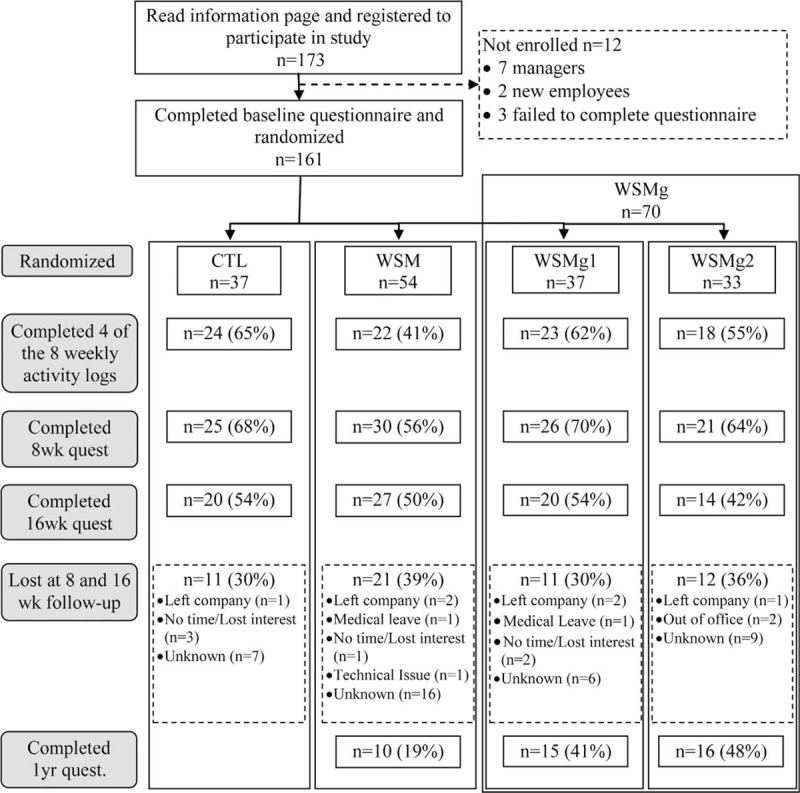
OBJECTIVE: The objective of this study is to determine the effectiveness of an 8-week web-based, mindfulness stress management program (WSM) in a corporate call center and added benefit of group support. METHODS: One hundred sixty-one participants were randomized to WSM, WSM with group support, WSM with group and expert clinical support, or wait-list control. Perceived stress, burnout, emotional and psychological well-being, mindfulness, and productivity were measured at baseline, weeks 8 and 16, and 1 year. RESULTS: Online usage was low with participants favoring CD use and group practice. All active groups demonstrated significant reductions in perceived stress and increases in emotional and psychological well-being compared with control. Group support improved participation, engagement, and outcomes. CONCLUSION: A self-directed mindfulness program with group practice and support can provide an affordable, effective, and scalable workplace stress management solution. Engagement may also benefit from combining web-based and traditional CD delivery.
Overview
The claims and statistics of this paper haven’t been checked yet.
Free: it reads the open-access text and checks the first 5 claims that cite a source we can check. Create a free account to check every claim.
Integrity signals
Registry
Cites
Statistics
Figures
Verification
Claims the paper makes
The claims and statistics of this paper haven’t been checked yet.
Free: it reads the open-access text and checks the first 5 claims that cite a source we can check. Create a free account to check every claim.
Claims other papers make about this one
Each is checked against this paper’s own text: does it say what the citing paper says it does?
The cited source says what the claim attributes to it.
In the citing paper
“Most interventions (18/28, 64%) were focused on reducing stress [21-35] and depressive symptoms [23,31,36-39] in employees.”
From Acceptability of Web-Based Mental Health Interventions in the Workplace: Systematic Review (2022) · cites this paper as [21]
The cited source says what the claim attributes to it.
In the citing paper
“The magnitude of improvement following intervention compared with controls ranged from small to medium in two studies19,54) and medium to large in one study53).”
From Web-based interventions for the management of stress in the workplace: Focus, form, and efficacy (2017) · cites this paper as [53]
In the citing paper
“Support for the efficacy of mindfulness techniques was provided by all four studies although just one19) was considered to be of moderate methodological quality, with the remainder classified as low53,54) or very low55) in quality.”
From Web-based interventions for the management of stress in the workplace: Focus, form, and efficacy (2017) · cites this paper as [53]
Self-check
Percentages, sums and reported differences re-computed from the paper’s own numbers.
The self-check needs the paper’s full text.
Citations
Cites
A Global Measure of Perceived Stress
Cohen, S., Kamarck, T., & Mermelstein, R. (1983) · Journal of Health and Social Behavior · doi:10.2307/2136404 · Cited by 32,807 · cited 1×
“Thus, perceived psychosocial stress measured using the Perceived Stress Scale (PSS) was chosen as the primary outcome.(52) PSS uses 10 items to measure a person’s perception of, and response to, daily hassles and stress, resulting in a total stress score of 0 (best) to 40 (worst).”
MethodThe benefits of being present: Mindfulness and its role in psychological well-being
Brown, K. W., & Ryan, R. M. (2003) · Journal of Personality and Social Psychology · doi:10.1037/0022-3514.84.4.822 · Cited by 13,448 · cited 1×
“Mindfulness was assessed using the Mindfulness Attention Awareness Scale (MAAS), which is composed of 15 items asking about the frequency of various mindful states in daily life, resulting in a total score of 1 (least mindful) to 6 (most mindful).(55) Overall psychological and emotional well-being and function was mea…”
MethodMaslach, C., Schaufeli, W. B., & Leiter, M. P. (2001) · Annual Review of Psychology · doi:10.1146/annurev.psych.52.1.397 · Cited by 12,852
Yusuf, S., Hawken, S., Ôunpuu, S., Dans, T., Avezum, A., Lanas, F., McQueen, M., Budaj, A., Pais, P., Varigos, J., et al. (2004) · The Lancet · doi:10.1016/s0140-6736(04)17018-9 · Cited by 12,026
No adjustments are needed for multiple comparisons.
Rothman, K. J. (1990) · Epidemiology · doi:10.1097/00001648-199001000-00010 · Cited by 5,965 · cited 2×
“comparisons; the implication of this adjustment is reviewed in the Discussion.(61) To quantify the magnitude of the intervention effect, we computed the Cohen d effect size using the ratio of the observed change in each outcome between or within each group over the baseline standard deviation for the whole population…”
MethodInfluentialSocial Relationships and Health.
Cohen, S. (2004) · American Psychologist · doi:10.1037/0003-066x.59.8.676 · Cited by 4,852
Norman, G. R., Sloan, J. A., & Wyrwich, K. W. (2003) · Medical Care · doi:10.1097/01.mlr.0000062554.74615.4c · Cited by 4,700
Mindfulness training as a clinical intervention: a conceptual and empirical review
Baer, R. A. (2003) · Clinical Psychology: Science and Practice · doi:10.1093/clipsy.bpg015 · Cited by 4,577 · cited 1×
“Mindfulness meditation consists of developing focused attention, nonjudgmental awareness, openness, curiosity, and acceptance of internal and external present experiences, all of which aim to help individuals act more reflectively rather than impulsively.(16,20) Practice of mindfulness meditation results in a decrease…”
BackgroundMindfulness training as a clinical intervention: A conceptual and empirical review.
Baer, R. A. (2003) · Clinical Psychology: Science and Practice · doi:10.1093/clipsy/bpg015 · Cited by 4,576
Mindfulness-based stress reduction and health benefits
Grossman, P., Niemann, L., Schmidt, S., & Walach, H. (2004) · Journal of Psychosomatic Research · doi:10.1016/s0022-3999(03)00573-7 · Cited by 3,958
Research works printed but not linked: 2
- Maslach C Jackson SE Leiter MP Maslach Burnout Inventory Manual. Mountain View, CA: Consulting Psychologists Press; 1996.
- Taylor SE Social support. In: Friedman HS Silver RC (Eds). Foundations of Health Psychology. New York, NY: Oxford University Press; 2007; 145– 171.
Cited by
Heber, E., Ebert, D. D., Lehr, D., Cuijpers, P., Berking, M., Nobis, S., & Riper, H. (2017) · Journal of Medical Internet Research · doi:10.2196/jmir.5774 · Cited by 408
“Nine unguided studies reported the use of automated or telephone and mail reminders for completion of the intervention [23,25,28,29,33,36,42,55,56] (Table 2).”
Carolan, S., Harris, P. R., & Cavanagh, K. (2017) · Journal of Medical Internet Research · doi:10.2196/jmir.7583 · Cited by 385
“Seventeen (81%) of the interventions included in the studies used a website as their primary means of delivering the intervention [42-54,56-59], 2 (10%) delivered the intervention via a computer application [41,60], 1 (5%) via email [39], and one (5%) through a standalone computer [55].”
MethodInfluentialMindfulness-Based Programs in the Workplace: a Meta-Analysis of Randomized Controlled Trials
Vonderlin, R., Biermann, M., Bohus, M., & Lyssenko, L. (2020) · Mindfulness · doi:10.1007/s12671-020-01328-3 · Cited by 259
Stratton, E., Lampit, A., Choi, I., Calvo, R. A., Harvey, S. B., & Glozier, N. (2017) · PLOS ONE · doi:10.1371/journal.pone.0189904 · Cited by 252
Engagement and retention in digital mental health interventions: a narrative review
Boucher, E. M., & Raiker, J. S. (2024) · BMC Digital Health · doi:10.1186/s44247-024-00105-9 · Cited by 181
“Another study found that engagement rates were higher for an online stress management program for workplace settings when it was accompanied by a weekly support group compared to a fully self-guided program, although support groups in this case met face-to-face rather than virtually [69].”
BackgroundJayawardene, W. P., Lohrmann, D. K., Erbe, R. G., & Torabi, M. R. (2017) · Preventive Medicine Reports · doi:10.1016/j.pmedr.2016.11.013 · Cited by 185
“…exclusively for prevention have varied widely by targeted health outcome andparticipant type,with only a few conducted online (Aikens et al., 2014; Allexandre et al., 2016; Cavanagh et al., 2013; Glueck and Maercker, 2011; Mak et al., 2015; Morledge et al., 2013;Wahbeh et al., 2016;Wolever et…”
BackgroundMethodInfluentialSommers-Spijkerman, M., Austin, J., Bohlmeijer, E., & Pots, W. (2021) · JMIR Mental Health · doi:10.2196/28168 · Cited by 179
“gSix outliers were removed: Allexandre et al [41] (study 1); Hoffmann et al [129]; Levin et al [130] (study 1); Levin et al [48]; Ly et al [49]; Mak et al”
BackgroundMethodInfluentialLyzwinski, L. N., Caffery, L., Bambling, M., & Edirippulige, S. (2019) · JMIR mHealth and uHealth · doi:10.2196/12210 · Cited by 159
“Our second recent systematic review [75] reviewed the types of electronic mindfulness-based interventions for weight, eating, and stress [76-96], finding that there has not been a mobile mindfulness-based RCT that implemented an app or SMS text messages for weight management or weight-related health behaviors (diet an…”
BackgroundPhillips, E. A., Gordeev, V. S., & Schreyögg, J. (2019) · Scandinavian Journal of Work, Environment & Health · doi:10.5271/sjweh.3839 · Cited by 148
“Aikens et al, 2014 (82) + - + + Imamura et al, 2016 (65) + - + - + Allexandre et al, 2016 (84) + - - + Jonas et al, 2017 (83) + - + - + Billings et al, 2008 (61) ? - + Ketelaar et al, 2013 (85) + - - - ?”
Chan, X. W., Shang, S., Brough, P. A., Wilkinson, A. J., & Lu, C. (2022) · Asia Pacific Journal of Human Resources · doi:10.1111/1744-7941.12355 · Cited by 171
“10 (Allexandre et al. 2016).”
Tarro, L., Llauradó, E., Ulldemolins, G., Hermoso, P., & Solà, R. (2020) · International Journal of Environmental Research and Public Health · doi:10.3390/ijerph17061901 · Cited by 141
“, 2016 [37] Sed No 8-week + 16-week Edu No FtF + WB 8 1 h G WH PROD Non-S Weak”
BackgroundTaylor, H., Strauss, C., & Cavanagh, K. (2021) · Clinical Psychology Review · doi:10.1016/j.cpr.2021.102078 · Cited by 102
Implementing practices focused on workplace health and psychological wellbeing: A systematic review
Daniels, K., Watson, D., Nayani, R., Tregaskis, O., Hogg, M., Etuknwa, A., & Semkina, A. (2021) · Social Science & Medicine · doi:10.1016/j.socscimed.2021.113888 · Cited by 92
Sakuraya, A., Imamura, K., Watanabe, K., Asai, Y., Ando, E., Eguchi, H., Nishida, N., Kobayashi, Y., Arima, H., Iwanaga, M., et al. (2020) · Frontiers in Psychology · doi:10.3389/fpsyg.2020.528656 · Cited by 71
“, vigor/ vitality) (Aikens et al., 2014; Allexandre et al., 2016), and the mental component of QOL (Allexandre et al.”
BackgroundMethodInfluentialMindfulness-based programmes to reduce stress and enhance well-being at work: a realist review
Micklitz, K., Wong, G., & Howick, J. (2021) · BMJ Open · doi:10.1136/bmjopen-2020-043525 · Cited by 107
Gaigg, S. B., Flaxman, P. E., McLaven, G., Shah, R., Bowler, D. M., Meyer, B., Roestorf, A., Haenschel, C., Rodgers, J., & South, M. (2020) · Autism · doi:10.1177/1362361320909184 · Cited by 80
“…uncommon and may represent ‘spontaneous’ improvement over extended evaluation periods, the utilisation of other sources of support, or growing positive anticipation of gaining access to a potentially effective treatment (e.g. Allexandre et al., 2016; Barkham & Shapiro, 1990; Flaxman & Bond, 2010).”
BackgroundCarolan, S., Harris, P. R., Greenwood, K., & Cavanagh, K. (2017) · Internet Interventions · doi:10.1016/j.invent.2017.08.001 · Cited by 63
“…reported that only 5% of participants started one or more of the modules (Boiler et al., 2014), and a trial of digital mindfulness delivered in a workplace reported that between 42% and 52% of all participants in the active conditions never logged on to the program (Allexandre et al., 2016).”
BackgroundMichaelsen, M. M., Graser, J., Onescheit, M., Tuma, M. P., Werdecker, L., Pieper, D., & Esch, T. (2023) · Mindfulness · doi:10.1007/s12671-023-02130-7 · Cited by 70
Hutchins (2015) · doi:10.1097/acm.0000000000002546 · Cited by 67
Stratton, E., Lampit, A., Choi, I., Gavelin, H. M., Aji, M., Taylor, J., Calvo, R. A., Harvey, S. B., & Glozier, N. (2022) · Journal of Medical Internet Research · doi:10.2196/37776 · Cited by 72
“%) studies used 3 intervention arms [44,53].”
Zhang, Y., Xue, J., & Huang, Y. (2020) · Medicine · doi:10.1097/md.0000000000020493 · Cited by 63
Addressing psychosocial work-related stress interventions: A systematic review
Restrepo, J., & Lemos, M. (2021) · Work · doi:10.3233/wor-213577 · Cited by 58
Lyzwinski, L. N., Caffery, L., Bambling, M., & Edirippulige, S. (2018) · Telemedicine and e-Health · doi:10.1089/tmj.2017.0117 · Cited by 52
Investigating Adherence to an Online Introductory Mindfulness Program
Forbes, L., Gutierrez, D., & Johnson, S. K. (2018) · Mindfulness · doi:10.1007/s12671-017-0772-4 · Cited by 54
“Furthermore, only two studies have reported on factors related to online intervention adherence (Allexandre et al. 2016; Howells et al. 2014).”
BackgroundRenfrew, M. E., Morton, D. P., Morton, J. K., Hinze, J. S., Beamish, P., Przybylko, G., & Craig, B. A. (2020) · Journal of Medical Internet Research · doi:10.2196/15592 · Cited by 56
“Allexandre et al [50] compared no support, group support, and group support with added expert clinical support for a stress management intervention.”
Stratton, E., Jones, N., Peters, S. E., Torous, J., & Glozier, N. (2021) · Journal of Occupational & Environmental Medicine · doi:10.1097/jom.0000000000002267 · Cited by 48
“One of the studies had two intervention arms(23) and one had three.(24) The intervention arms were treated as individual studies for analysis in the meta-analysis.”
BackgroundTwenty years of research on mindfulness at work: A structured literature review
Stuart‐Edwards, A., MacDonald, A., & Ansari, M. A. (2023) · Journal of Business Research · doi:10.1016/j.jbusres.2023.114285 · Cited by 58
Reyes, A. T., Bhatta, T. R., Muthukumar, V., & Gangozo, W. J. (2020) · Archives of Psychiatric Nursing · doi:10.1016/j.apnu.2020.02.004 · Cited by 44
Alhasani, M., Mulchandani, D., Oyebode, O., Baghaei, N., & Orji, R. (2022) · Frontiers in Public Health · doi:10.3389/fpubh.2022.777567 · Cited by 47
“First, stress management apps usually tailor educational and interactive modules to users based on established various intervention techniques, including mindfulness, meditation, or breathing exercises (106–108).”
BackgroundWeb-based interventions for the management of stress in the workplace: Focus, form, and efficacy
Ryan, C., Bergin, M., Chalder, T., & Wells, J. S. G. (2017) · Journal of Occupational Health · doi:10.1539/joh.16-0227-ra · Cited by 42
Bartlett, L., Lovell, P., Otahal, P., & Sanderson, K. (2017) · Mindfulness · doi:10.1007/s12671-016-0643-4 · Cited by 42
Bégin, C., Berthod, J., Martinez, L. Z., & Truchon, M. (2022) · Journal of Technology in Behavioral Science · doi:10.1007/s41347-022-00267-1 · Cited by 41
“The most prevalent one was difficulties with engagement, motivation, and participation over time in the intervention (Allexandre et al., 2016; Collins et al., 2020; Joyce et al., 2018; Kopencey, 2017).”
BackgroundRung, A. L., Oral, E., Berghammer, L., & Peters, E. S. (2020) · JMIR mHealth and uHealth · doi:10.2196/15943 · Cited by 39
“In addition, evidence suggests that clinical or therapist support is beneficial for promoting adherence in behavioral web-based interventions [12,44].”
BackgroundRenfrew, M. E., Morton, D. P., Morton, J. K., & Przybylko, G. (2021) · Frontiers in Psychology · doi:10.3389/fpsyg.2021.716106 · Cited by 42
Telehealth Mindfulness-Based Interventions for Chronic Pain: The LAMP Randomized Clinical Trial
Burgess, D. J., Calvert, C., Campbell, E. H., Allen, K. D., Bangerter, A. K., Behrens, K., Branson, M., Brønfort, G., Cross, L. J. S., Evans, R., et al. (2024) · JAMA Internal Medicine · doi:10.1001/jamainternmed.2024.3940 · Cited by 43
Renfrew, M. E., Morton, D. P., Morton, J. K., Hinze, J. S., Przybylko, G., & Craig, B. A. (2020) · Journal of Medical Internet Research · doi:10.2196/19945 · Cited by 35
“A web-based mindfulness and stress management RCT [38] compared the effects of no support, group support only, and group support with added clinician support on engagement and outcomes.”
Matiz, A., Fabbro, F., & Crescentini, C. (2018) · Mindfulness · doi:10.1007/s12671-017-0865-0 · Cited by 33
“…meditation settings may be in accordance with previous research that has investigated similar topics in the area of self-help (Cavanagh et al. 2014; Mantzios and Giannou 2014) and Internet-based MBI (Allexandre et al. 2016; Morledge et al. 2013; Spijkerman et al. 2016; Wahbeh and Oken 2016).”
BackgroundResultInfluentialVictorson, D. E., Sauer, C. M., Wolters, L., Maletich, C., Lukoff, K., & Sufrin, N. (2020) · Mindfulness · doi:10.1007/s12671-020-01373-y · Cited by 33
“Examples of these additional arms included a supportive or behavioral component ( n = 4) such as weekly meeting groups and expert clinical support (Allexandre et al. 2016), behavior change training (Mak et al. 2015), an online message board (Morledge et al. 2013”
BackgroundInfluentialAcceptability of Web-Based Mental Health Interventions in the Workplace: Systematic Review
Scheutzow, J., Attoe, C., & Harwood, J. (2022) · JMIR Mental Health · doi:10.2196/34655 · Cited by 30
“6) 161 RCT comparing 4 groups, including no support, group support, Web-based interactive educational stress management program (website), Allexandre et al [21], United States 15% (intervention) ed practices and showed low use of program.”
BackgroundMethodInfluentialOnline training in mind-body therapies: different doses, long-term outcomes
Kemper, K. J., Rao, N., Gascon, G., & Mahan, J. D. (2017) · Journal of Evidence-Based Complementary & Alternative Medicine · doi:10.1177/2156587217701857 · Cited by 29
Computer-based versus in-person interventions for preventing and reducing stress in workers
Kuster, A. T., Dalsbø, T. K., Luong Thanh, B. Y., Agarwal, A., Durand-Moreau, Q. V., & Kirkehei, I. (2017) · Cochrane Database of Systematic Reviews · doi:10.1002/14651858.cd011899.pub2 · Cited by 28
Egger, S. M., Frey, S., Sauerzopf, L., & Meidert, U. (2023) · Workplace Health & Safety · doi:10.1177/21650799231170872 · Cited by 30
Brief Online Focused Attention Meditation Training: Immediate Impact
Kemper, K. J., & Rao, N. (2017) · Journal of Evidence-Based Complementary & Alternative Medicine · doi:10.1177/2156587216663565 · Cited by 24
Burgess, D. J., Evans, R., Allen, K. D., Bangerter, A. K., Brønfort, G., Cross, L. J. S., Ferguson, J. E., Haley, A. C., Campbell, E. H., Mahaffey, M., et al. (2020) · Pain Medicine · doi:10.1093/pm/pnaa337 · Cited by 28
“, accountability, support, motivation), which may increase participation and engagement and improve outcomes [19].”
BackgroundKerr, D. C., Ornelas, I. J., Lilly, M. M., Calhoun, R., & Meischke, H. (2019) · Journal of Medical Internet Research · doi:10.2196/13449 · Cited by 25
“MBIs encourage participants toward a nonjudgmental acceptance of stressors through the cultivation of present-centered awareness [12-14].”
Dema, H., Paska, A. V., Kouter, K., Katrašnik, M., Jensterle, M., Janež, A., Oblak, A., Škodlar, B., & Bon, J. (2023) · Current Issues in Molecular Biology · doi:10.3390/cimb45040178 · Cited by 24
“Allexandre and colleagues reported statistically significant differences in the normative population in emotional well-being, emotional role functioning, and energy [81].”
BackgroundStrauss, C., Dunkeld, C., & Cavanagh, K. (2021) · Internet Interventions · doi:10.1016/j.invent.2021.100413 · Cited by 19
“Research testing models of health behaviour such as the Theory of Planned Behaviour (TPB) (Ajzen, 1991) are warranted to improve understanding of engagement in self-help MBIs such as Headspace.”
ResultInfluentialRiley, T. D., Roy, S., Parascando, J. A., Wile, K., LaGamma, C., Dong, H., & Zgierska, A. E. (2022) · Journal of Integrative and Complementary Medicine · doi:10.1089/jicm.2021.0415 · Cited by 18
“26 To the authors’ knowledge, only one study assessed the effects of the full live online MBSR, 33 comparing it with the in-person MBSR training or an active comparison (walking group) in 38 adults with chronic fatigue after stroke or traumatic brain injury.”
Optimizing Workplace Digital Mental Health Interventions: Systematic Review and Meta-Analysis
Stratton, E., Morris, R. W., Milton, A. C., Deady, M., Choi, I., & Glozier, N. (2025) · Journal of Medical Internet Research · doi:10.2196/71253 · Cited by 18
Eklund, C., Söderlund, A., & Elfström, M. L. (2021) · JMIR Mental Health · doi:10.2196/17314 · Cited by 17
“Stress management interventions have been shown to be effective in different target groups [10-12].”
BackgroundGutiérrez, D., Forbes, L., & Johnson, S. K. (2020) · Counseling and Values · doi:10.1002/cvj.12138 · Cited by 16
Reyes, A. T., Serafica, R., & Sojobi, A. (2020) · Archives of Psychiatric Nursing · doi:10.1016/j.apnu.2020.09.005 · Cited by 15
Borrás, R. M., Navarrete, J., Bellosta‐Batalla, M., Martínez-Brotóns, C., & Martínez‐Rubio, D. (2022) · International Journal of Environmental Research and Public Health · doi:10.3390/ijerph19106226 · Cited by 15
Bienestar eudaimónico y meditación mindfulness en los contextos laborales: una revisión sistemática
Rincón, I. C., García‐Palacios, A., & Vázquez, S. S. (2023) · Anales de Psicología · doi:10.6018/analesps.493671 · Cited by 15
“Existe cierta correlación entre las dimensiones del bienestar psicológico propuestas por Ryff (2018) y el engagement profesional (Amasifuen, 2016).”
BackgroundMindfulness-Based Workplace Interventions for Wellness Promotion
King, A. P. J. (2019) · Integrating psychiatry and primary care · doi:10.1007/978-3-030-04266-0_13 · Cited by 20
The emotional stability of elders with tai chi experience in the sequential risk‐taking task
Yang, J., Liu, Z., Liu, S., Li, L., Zheng, L., & Guo, X. (2019) · PsyCh Journal · doi:10.1002/pchj.279 · Cited by 15
Mohammed, W. A., Pappous, A. S., Muthumayandi, K., & Sharma, D. (2018) · European Journal of Physiotherapy · doi:10.1080/21679169.2018.1452980 · Cited by 17
“Moreover, Allexandre et al. [63] and Ivtzan et al. [64] found through an online intervention that mindfulness had positive effects in improving wellbeing and also workplace stress.”
The Mindfulness-Based Social Work and Self-Care Programme: A Focus Group Study
Maddock, A., McGuigan, K., McCusker, P., & Kellock, J. (2023) · Clinical Social Work Journal · doi:10.1007/s10615-023-00897-9 · Cited by 13
Phansikar, M., Gothe, N. P., Hernández, R., Lara-Cinisomo, S., & Mullen, S. P. (2023) · Journal of Behavioral Medicine · doi:10.1007/s10865-022-00385-4 · Cited by 16
The Handbook of Wellness Medicine
IsHak, W. W. (2020) · Cambridge University Press eBooks · doi:10.1017/9781108650182 · Cited by 13
Lippmann, M., Laudel, H., Heinzle, M., & Narciss, S. (2019) · Journal of Medical Internet Research · doi:10.2196/12497 · Cited by 10
“8 2 0 2 2 ++a Allexandre et al (2016), United States [29]”
BackgroundInfluentialWoods‐Giscombé, C. L., Conklin, J., Dodd, A., Barthold, L. F., Perry, Y., Brooks, J. L., Bradford, A., Vines, S., Smith, R., Ikharo, E., et al. (2022) · Current Cardiovascular Risk Reports · doi:10.1007/s12170-022-00708-9 · Cited by 10
A Systematic Review of Workplace Stress and Its Impact on Mental Health and Safety
Torres, G., Backstrom, J., & Duffy, V. G. (2023) · Lecture notes in computer science · doi:10.1007/978-3-031-48041-6_41 · Cited by 14
Liptáková, S., Světlák, M., Matis, J., Slezáčková, A., & Rastislav, R. (2022) · Ceskoslovenska psychologie · doi:10.51561/cspsych.66.3.233 · Cited by 9
“Allexandre et al. (2016) found that group practice enhanced adherence.”
Radheshyam, A., Ramani, V. K., Thupalle, S., Darukaradhya, T. B., & Naik, R. (2024) · Health Science Reports · doi:10.1002/hsr2.1950 · Cited by 13
“29 Such health promotional initiatives have the potential to advance the overall well ‐ being of employees.”
BackgroundLimphaibool, W., Limphaibool, N., & Davidson, C. (2017) · PSAKU International Journal of Interdisciplinary Research · doi:10.12778/235108618x15452373186010 · Cited by 8
Weerasekara, M., & Smedberg, Å. B. (2019) · International Conference on Advanced Computer Science and Information Systems · doi:10.1109/icacsis47736.2019.8979813 · Cited by 11
Delivery of Complementary and Integrative Health Using Virtual Health Resources: A Scoping Review
Haun, J. N., Alman, A. C., Jean‐Baptiste, E., Melillo, C., McMahon-Grenz, J., & Paykel, J. M. (2022) · Journal of Integrative and Complementary Medicine · doi:10.1089/jicm.2021.0458 · Cited by 9
Why Mindfulness/Meditation Is a “No-Brainer” for Health-Care Professionals
Calabrese, L. H. (2018) · Journal of Patient Experience · doi:10.1177/2374373518774390 · Cited by 9
“Previous studies from our institution (11) examining the effectiveness of web-based mindfulness interventions in non-healthrelated workplaces have suggested that minimizing time required out of the workplace for practice and social or group support enhances both participation and results.”
BackgroundWorkplace Culture of Health and Equitable Workforce Well-Being: A Scoping Literature Review
Gupta, R., Stiehl, E., Wator, C., Pratap, P. L., & Sherman, B. W. (2025) · American Journal of Health Promotion · doi:10.1177/08901171251326316 · Cited by 8
“Ten studies intentionally recruited low-wage workers 18,27,28,56,63,65,73,92,95,97 as shown in Table 2.”
InfluentialVainre, M., Dalgleish, T., Bendriss‐Otiko, T., Butler, M., Kirkpatrick, A., Kosugiyama, N., Mariscotti, F., Martinez‐Sosa, C., Sideri, A., Soenksen, S., et al. (2025) · Stress and Health · doi:10.1002/smi.70123 · Cited by 7
“For the 5–24 weeks post‐intervention period, task performance correlations (Allexandre et al. 2016; Garrote‐Caparrós et al. 2022; Vainre et al. 2024) and adaptive performance correlations (Aikens et al. 2014; Nielsen et al. 2021; Bonde et al. 2022) were calculated from published results.”
Young, P. A., Elgee, A., Chow, V., Haslam, C. O., & Barker, J. B. (2024) · Mental Health Science · doi:10.1002/mhs2.84 · Cited by 6
Hayati, N. (2025) · Jurnal Dedikasi Pengabdian Pendidikan · doi:10.64008/qfj2z839 · Cited by 6
“Program mindfulness ini dilaksanakan dalam 8 sesi yang berlangsung selama empat minggu, dengan pertemuan dua kali dalam seminggu (Allexandre et al., 2016).”
Maciel, R. R. B. T., Chiavegato, L. D., Camelier, F. W. R., Portella, D. D. A., de Souza, M. C., & Padula, R. S. (2021) · Contemporary Clinical Trials Communications · doi:10.1016/j.conctc.2021.100722 · Cited by 7
“Interventions for stress management (21 randomized controlled trials, n = 5260 participants) have shown that only 45% of participants complete proposed interventions [34].”
BackgroundRice, V. J. B., Schroeder, P. J., & Allison, S. C. (2024) · Work · doi:10.3233/wor-230645 · Cited by 6
A Web-based Stress Reduction Program for Occupational Health
Kabakibi, M. N., & Macauley, K. A. (2019) · The International Journal of Health Wellness and Society · doi:10.18848/2156-8960/cgp/v09i02/29-37 · Cited by 4
“In the workplace, stress leads to emotional exhaustion, job dissatisfaction, lower productivity, and impaired performance (Allexandre et al., 2016).”
BackgroundHandley, N. R., Tomescu, O. A., & López, A. M. (2020) · JCO Oncology Practice · doi:10.1200/op.20.00334 · Cited by 4
Eklund, C., Elfström, M. L., Eriksson, Y., & Söderlund, A. (2019) · European Journal of Physiotherapy · doi:10.1080/21679169.2018.1468814 · Cited by 3
Khanal, M. K., Saunders, P., Nguyen, K., Hatmi, M. A., Asiri, H. M. A., Shahin, W., Millar, R., Karimi, L., & de Courten, B. V. (2026) · Health Psychology Review · doi:10.1080/17437199.2026.2652892 · Cited by 4
Steinberg, B. A., Mulugeta, Y., Quatman‐Yates, C. C., Williams, M., Gogineni, A., & Klatt, M. D. (2025) · International Journal of Mental Health Promotion · doi:10.32604/ijmhp.2025.067232 · Cited by 3
“A growing body of evidence has shown that MBIs, ranging from traditional Mindfulness–Based Stress Reduction (MBSR) [24], to innovative mindfulness interventions that combine in-person, virtual, and/or app-based methods of delivery, can be implemented in various workplace environments [27,28].”
Web-Based Expert System to Detect Stress on College Students
Persulessy, G. B. V., Pratama, N. S., Setiawan, N., & Sevani, N. (2019) · ComTech Computer Mathematics and Engineering Applications · doi:10.21512/comtech.v10i1.4987 · Cited by 3
“This result is accordance with Felsten (2004), Billings et al. (2008), Sevani and Silvia (2015), Oguntimilehin, Abiola, and Adeyemo (2015), and Allexandre et al.”
BackgroundResultInfluentialThe Handbook of Wellness Medicine
Snellings, J. E. (2021) · Family Medicine · doi:10.22454/fammed.2021.204951 · Cited by 3
Kavaratzis, S., & Choi, E. (2026) · Work & Stress · doi:10.1080/02678373.2026.2631980 · Cited by 3
“Online delivery also saw varied success when compared to the in-person intervention, where participants cited community and group support as important elements that did not always translate in the online modality (e.g. Allexandre et al., 2016).”
Innovative Call Center Applications Focused on Financial Marketing in the Turkish Banking Sector
Dınçer, H., & Mengir, A. (2019) · Advances in marketing, customer relationship management, and e-services book series · doi:10.4018/978-1-7998-2559-3.ch007 · Cited by 2
Dieppe, P. A., Goldingay, S., & Warber, S. L. (2020) · Cambridge University Press eBooks · doi:10.1017/9781108650182.042 · Cited by 3
Engaging the Five Senses: Taste, Smell, See, Listen, and Touch
Bokarius, V., & Bokarius, A. V. (2020) · Cambridge University Press eBooks · doi:10.1017/9781108650182.037 · Cited by 2
İş Yeri Temelli Ruh Sağlığını Geliştirme Programları: Sistematik İnceleme
DÜLCEK, S., & Şişman, F. N. (2021) · Halk Sağlığı Hemşireliği Dergisi · doi:10.54061/jphn.946046 · Cited by 4
IsHak, W. W. (2020) · Cambridge University Press eBooks · doi:10.1017/9781108650182.052 · Cited by 2
Wellness Interventions in the Workplace
Chernoff, R. A. (2020) · Cambridge University Press eBooks · doi:10.1017/9781108650182.020 · Cited by 3
Perera, D. M., & Moe, J. L. (2020) · Cambridge University Press eBooks · doi:10.1017/9781108650182.005 · Cited by 3
Sharma‐Brymer, V., Dashper, K. L., & Brymer, E. (2020) · Cambridge University Press eBooks · doi:10.1017/9781108650182.034 · Cited by 3
IsHak, W. W., Mann, A., Manoukian, V., Pakhdikian, S., Chaudhry, M., Liu, A., & Bart, R. (2020) · Cambridge University Press eBooks · doi:10.1017/9781108650182.001 · Cited by 2
Well-Being and Work–Life Balance: Cultural, Positive Psychology, and Practical Perspectives
Bolton, M. A., Lobben, I., Pruzinsky, T., & Stern, T. A. (2020) · Cambridge University Press eBooks · doi:10.1017/9781108650182.046 · Cited by 3
Forgiveness, Gratitude, and Spirituality
Idicula, S. A., Thrower, N., & Lomax, J. W. (2020) · Cambridge University Press eBooks · doi:10.1017/9781108650182.029 · Cited by 1
Wellness Interventions in Patients Living with Chronic Medical Conditions
Steiner, A. J., Aguilar-Hernandez, L., Pizano, D. R., Dascal, J., & IsHak, W. W. (2020) · Cambridge University Press eBooks · doi:10.1017/9781108650182.014 · Cited by 2
Brakenridge, C. L., Silverwood, A. J., Potter, R. E., Oakman, J., Hadgraft, N. T., Goode, A. D., Mulcahy, S. K., & Healy, G. N. (2025) · Safety Science · doi:10.1016/j.ssci.2025.106945 · Cited by 2
The Biopsychosocial Assessment
Somjee, L., & Esbitt, S. A. (2020) · Cambridge University Press eBooks · doi:10.1017/9781108650182.003 · Cited by 1
Duraimani, S. L. (2016) · IRA-International Journal of Applied Sciences · doi:10.21013/jas.v4.n3.p3 · Cited by 1
Ooi, S. L., & Pak, S. C. (2020) · Cambridge University Press eBooks · doi:10.1017/9781108650182.033 · Cited by 1
Emotional Intelligence and Its Role in Sustaining Fulfillment in Life
Sax, H. C., & Gewertz, B. L. (2020) · Cambridge University Press eBooks · doi:10.1017/9781108650182.038 · Cited by 1
Metadata
- Authors
- Allexandre, D., Bernstein, A. M., Walker, E., Hunter, J., Roizen, M. F., & Morledge, T. J.
- Affiliations
- Cleveland Clinic (US)
- Corresponding author
- Allexandre, Didier
- ORCID
- Allexandre, Didier
- Venue
- Journal of Occupational & Environmental Medicine
- Published
- 2016-03
- Volume
- 58
- Issue
- 3
- Pages
- 254-264
- ISSN
- 1076-2752 (ISSN-L)
- PMC
- PMC4768630
- OpenAlex
- W2417570686
- Cited by
- 157
- References
- 83
- Citations by year
- 2026: 10 · 2025: 7 · 2024: 6 · 2023: 11 · 2022: 12 · 2021: 12 · 2020: 68 · 2019: 10 · 2018: 4 · 2017: 13 · 2016: 4
- FWCI
- 13.72
- Type
- journal article
- Language
- en
- Open access
- hybrid
- doi.org
- Licence
- cc-by-nc-nd
- Locations
- Journal of Occupational and Environmental Medicine (publishedVersion, cc-by-nc-nd)
- PubMed Central (publishedVersion, cc-by-nc-nd)
- PubMed (publishedVersion)
- Topics
- Social Sciences › Psychology › Clinical Psychology › Mindfulness and Compassion Interventions
- Social Sciences › Psychology › Applied Psychology › Digital Mental Health Interventions
- Social Sciences › Psychology › Social Psychology › Stress and Burnout Research
- Keywords
- occupational stress, call center employees, online intervention, group support, burnout, perceived stress, psychological well-being, emotional well-being, labor productivity, self-guided intervention, intervention engagement
- MeSH terms
- Call Centers, Adult, Counseling, Efficiency, Emotions, Female, Group Processes, Humans, Male, Mental Health, Middle Aged, Social Support, Stress, Psychological, Occupational Health, Workplace, Internet, Mindfulness
About these checks
Registry, retraction, Cites and statistics results are computed, not judged, with one exception: a printed reference that no index lists is read once by a model before it counts as a citation error. Claims are extracted by a model and kept only when their quote appears verbatim in the text; each cited source is then checked, with a model’s help, for whether it says what the claim relies on. Those verdicts can be wrong — read the claim’s quote and the cited source before relying on one.
Statistics and arithmetic are recomputed, not judged.
Confidence bands are shown only for fields calibrated on our annotated test set. None is calibrated yet, so no band is shown.
What counts as a claim ›How we measure confidence ›How we check this ›
Are you an author, or do you see a problem with this page? Request a review
Data sources
Bibliographic data: Semantic Scholar, OpenAlex, Crossref.
Contains information from the Semantic Scholar Academic Graph Datasets, made available under the ODC Attribution License (ODC-BY 1.0).
Semantic Scholar’s data is described in: Kinney, R., et al. (2023). The Semantic Scholar Open Data Platform. arXiv:2301.10140.
