

Living well with chronic pain: a 12-month randomized controlled trial revealing impact from the digital pain self-management program EPIO
Open accessThe DOI matches its Crossref record; 75 of the 79 references it cites were found in a registry or an index; 13 of the 34 sources its claims cite were checked for support.
Abstract
Introduction:Chronic pain affects a wide range of physical and psychological aspects of life for those impacted. Psychosocial treatment approaches may be of support, but outreach is still limited.Objectives:To evaluate the efficacy of EPIO, an evidence-informed, user-centered digital self-management intervention for people with chronic pain, in a 12-month randomized controlled trial.Methods:People living with chronic pain (N = 266) were randomized to the EPIO intervention (n = 132) or a usual-care control group (n = 134). The intervention was delivered in a simple blended care model, and outcome measures collected at baseline, 6 months, and 12 months. Generalized linear models for repeated measures were fitted to compare groups over time.Results:Participants were primarily female (81%), median age 49 years (range 22-78), with heterogeneous pain conditions, and had lived with pain >5 years (77.6%). A mixed linear model with all timepoints included revealed no statistically significant group differences for the primary outcome of pain interference. Significant psychological benefits in favor of the intervention group were however detected for depression (P = 0.022), self-regulatory fatigue (P = 0.024), vitality (P = 0.016), and mental health (P = 0.047). Baseline to 12-month changes showed additional favorable effects for anxiety (between-group mean differences [MDs] = 0.79, P = 0.047), depression (MD = 1.08, P = 0.004), self-regulatory fatigue (MD = 2.42, P = 0.021), pain catastrophizing (MD = 2.62, P = 0.009), and health-related quality of life.Conclusions:The EPIO program aims to improve outreach of evidence-based pain self-management interventions. Findings demonstrate how using EPIO can lead to sustainable psychological change, enhancing mental health and health-related quality of life for people suffering from pain, providing a chance to live well with the pain. Copyright © 2024 The Author(s).
Overview
CoChat Summary
## TL;DR
In this 12-month randomized controlled trial of adults with chronic pain, the digital self-management program EPIO did not improve the primary outcome of pain interference. It was associated with statistically significant benefits for several psychological outcomes, including depression, self-regulatory fatigue, and some health-related quality-of-life subscales.
## Key findings
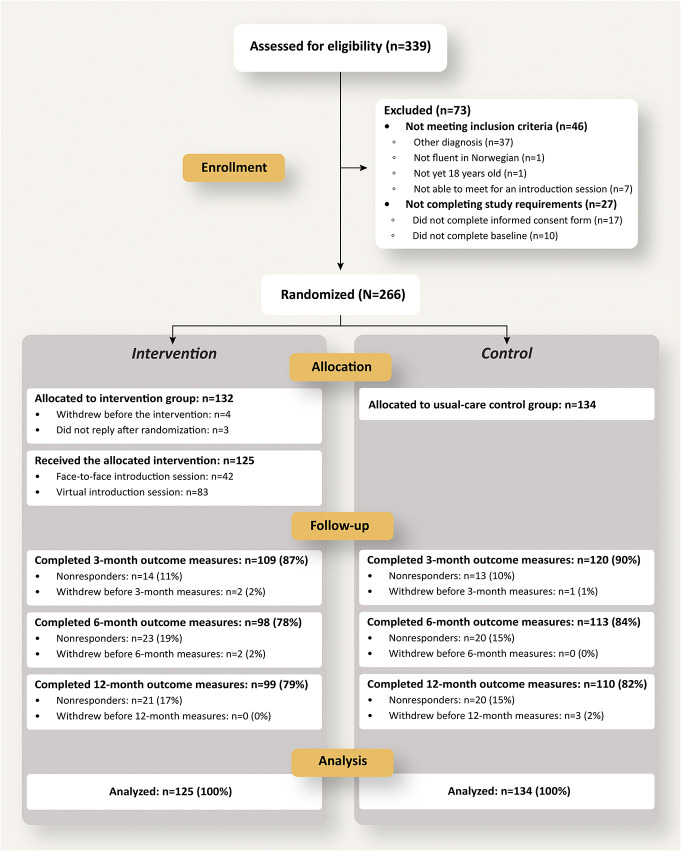
- The trial enrolled 266 participants; 259 were included in the final analysis (125 intervention, 134 control). The intervention group had 66% (82/125) completers, defined as completing at least 6 of 9 modules.
- Over 12 months, there were no statistically significant between-group differences for the primary outcome, pain interference.
- Compared with usual care, EPIO showed statistically significant benefits for depression, self-regulatory fatigue, and HRQoL subscales vitality and mental health across all timepoints.
- From baseline to 12 months, significant between-group differences favored EPIO for anxiety (MD = 0.79, P = 0.047), depression (MD = 1.08, P = 0.004), self-regulatory fatigue (MD = 2.42, P = 0.021), and pain catastrophizing rumination (MD = 1.06, P = 0.016), magnification (MD = 0.57, P = 0.035), and total (MD = 2.62, P = 0.009).
## Methods
- Design: Two-armed, 12-month randomized controlled trial comparing the app-based EPIO intervention with a usual-care control group; analyses used intention-to-treat generalized linear models for repeated measures.
- Sample/data: Adults with chronic pain recruited via a medical institution, collaborating practices, social media, and patient organizations; eligibility required pain for ≥3 months, age 18+, smartphone/tablet access, Norwegian language ability, and attendance at an introduction session. Final sample was 259.
- Main analysis: Primary outcome was pain interference; secondary outcomes included anxiety, depression, self-regulatory fatigue, HRQoL, pain catastrophizing, and pain acceptance. Qualitative follow-up phone-call notes (267 notes) were also thematically analyzed.
## Limitations
- The authors state that participants were self-selected/volunteers, and the sample was mostly female, Anglo-American, and higher educated, which limits generalizability.
- The paper states that high heterogeneity in pain conditions may have limited power for subgroup analyses, and that multiple statistical tests may inflate type I error.
- The study did not monitor whether the control group used other self-management training during the trial, so analyses could not control for this; this is explicitly stated in the paper.
- Evident from the text: true blinding was not possible because participants were assigned to EPIO or not.
Model-written summary. Check it against the paper before relying on it.
Integrity signals
Registry
Cites
Statistics
Figures
Verification
Claims the paper makes
7 Valid · 4 Not valid · 7 Not checked · 42 Own results and interpretations
The cited sources that could be checked couldn’t confirm or dispute this claim.
In the paper
“The improvement in self-regulatory capacity seen in this study might therefore be explained through the primarily CBT-based EPIO content,36 targeting cognitive, emotional, and behavioral factors necessary for self-regulation.”
§ Living well with chronic pain: a 12-month randomized controlled trial revealing impact from the digital pain self-management program EPIO > 4. Discussion > 4.2. Mental health, quality of life, and self-regulation
What the sources say
- Could not verifycites [36] Ledel Solem IK Varsi C Eide H Kristjansdottir OB Børøsund E Schreurs KMG Waxenberg LB Weiss KE Morrison EJ Haaland-Øverby M Bevan K Zangi HA Stubhaug A Solberg Nes L. A user-centered approach to an evidence-based electronic health pain management intervention for people with chronic pain: design and development of EPIO. J Med Internet Res 2020; 22: e15889. 31961331 PMC7001051 sourceExperimental — accuracy not yet measured
The Introduction and Discussion discuss how the design of web-based interventions may affect well-being and adherence, but they do not describe EPIO or its CBT-based content. Searches for EPIO, CBT, and self-regulatory capacity found no passage linking those concepts to the improvement proposed in the citing sentence. (LLM, conf=0.76)
hedgedstates a possible cause- Asserted: passes — The authors put it forward as true.
- Checkable: passes — It can be checked against evidence.
- Load-bearing: passes — The paper’s conclusions depend on it.
- Based: passes — The paper gives a reason why it holds.
- Could not verify
A result the paper reports from its own data — it cites no other source for it, so there is none to check. The quote shows it is in the paper.
In the paper
“mental health (MD = −4.5, P = 0.035)”
§ Living well with chronic pain: a 12-month randomized controlled trial revealing impact from the digital pain self-management program EPIO > 3. Results > 3.2. Between-group differences
plainstates a cause- Asserted: passes — The authors put it forward as true.
- Checkable: passes — It can be checked against evidence.
- Load-bearing: passes — The paper’s conclusions depend on it.
- Based: passes — The paper gives a reason why it holds.
A result the paper reports from its own data — it cites no other source for it, so there is none to check. The quote shows it is in the paper.
In the paper
“pain catastrophizing rumination (MD = 1.06, P = 0.016)”
§ Living well with chronic pain: a 12-month randomized controlled trial revealing impact from the digital pain self-management program EPIO > 3. Results > 3.2. Between-group differences
plainstates a cause- Asserted: passes — The authors put it forward as true.
- Checkable: passes — It can be checked against evidence.
- Load-bearing: passes — The paper’s conclusions depend on it.
- Based: passes — The paper gives a reason why it holds.
A result the paper reports from its own data — it cites no other source for it, so there is none to check. The quote shows it is in the paper.
In the paper
“Including all timepoints in the mixed model, no statistically significant between-group differences were observed over the 12 months for the primary outcome of pain interference (Table 2).”
§ Living well with chronic pain: a 12-month randomized controlled trial revealing impact from the digital pain self-management program EPIO > 3. Results > 3.2. Between-group differences
plain- Asserted: passes — The authors put it forward as true.
- Checkable: passes — It can be checked against evidence.
- Load-bearing: passes — The paper’s conclusions depend on it.
- Based: passes — The paper gives a reason why it holds.
A result the paper reports from its own data — it cites no other source for it, so there is none to check. The quote shows it is in the paper.
In the paper
“role-emotional (MD = −14.52, P = 0.029)”
§ Living well with chronic pain: a 12-month randomized controlled trial revealing impact from the digital pain self-management program EPIO > 3. Results > 3.2. Between-group differences
plainstates a cause- Asserted: passes — The authors put it forward as true.
- Checkable: passes — It can be checked against evidence.
- Load-bearing: passes — The paper’s conclusions depend on it.
- Based: passes — The paper gives a reason why it holds.
18 more claims
Create a free account to see all 60 claims and to verify the 5 references still open.
- It may state two separate claims as one. 27
- Probably not a substantial claim. 21
Citations
Cites
The Hospital Anxiety and Depression Scale
Zigmond, A. S., & Snaith, R. P. (1983) · Acta Psychiatrica Scandinavica · doi:10.1111/j.1600-0447.1983.tb09716.x · Cited by 47,139
(1992) · PubMed · Cited by 33,716
The MOS 36-ltem Short-Form Health Survey (SF-36): I. Conceptual Framework and Item Selection
Ware, J. E., & Sherbourne, C. D. (1992) · Medical Care · doi:10.1097/00005650-199206000-00002 · Cited by 30,033
Depression and quality of life in older persons: A review
Sivertsen, H., Bjørkløf, G. H., Engedal, K., Selbæk, G., & Helvik, A.-S. (2015) · Dementia and Geriatric Cognitive Disorders · doi:10.1159/000437299 · Cited by 14,152
CONSORT 2010 Statement: updated guidelines for reporting parallel group randomised trials
the CONSORT Group, Schulz, K. F., Altman, D. G., & Moher, D. (2010) · BMC Medicine · doi:10.1186/1741-7015-8-18 · Cited by 13,371
Developing and evaluating complex interventions: the new Medical Research Council guidance
Craig, P., Dieppe, P., Macintyre, S., Michie, S., Nazareth, I., & Petticrew, M. (2008) · BMJ · doi:10.1136/bmj.a1655 · Cited by 10,995
Hoffmann, T. C., Glasziou, P. P., Boutron, I., Milne, R., Perera, R., Moher, D., Altman, D. G., Barbour, V., Macdonald, H., Johnston, M., et al. (2014) · BMJ · doi:10.1136/bmj.g1687 · Cited by 10,548
One size fits all? What counts as quality practice in (reflexive) thematic analysis?
Braun, V., & Clarke, V. (2021) · Qualitative Research in Psychology · doi:10.1080/14780887.2020.1769238 · Cited by 9,727
CONSORT 2010 Statement: updated guidelines for reporting parallel group randomised trials
Schulz, K. F., Altman, D. G., Moher, D., & for the CONSORT Group (2010) · BMJ · doi:10.1136/bmj.c332 · Cited by 9,329
The Pain Catastrophizing Scale: Development and validation.
Sullivan, M. J. L., Bishop, S. R., & Pivik, J. (1995) · Psychological Assessment · doi:10.1037//1040-3590.7.4.524 · Cited by 8,227
Skivington, K., Matthews, L., Simpson, S. A., Craig, P., Baird, J., Blazeby, J. M., Boyd, K. A., Craig, N., French, D. P., McIntosh, E., et al. (2021) · BMJ · doi:10.1136/bmj.n2061 · Cited by 5,808
Ego depletion: Is the active self a limited resource?
Baumeister, R. F., Bratslavsky, E., Muraven, M., & Tice, D. M. (1998) · Journal of Personality and Social Psychology · doi:10.1037//0022-3514.74.5.1252 · Cited by 5,312 · cited 1×
“Studies have shown capacity for self-regulation to be a limited source that can be fatigued, 4,5,55 and the complexity of chronic pain likely negatively affects ability to self-regulate.”
BackgroundCore outcome measures for chronic pain clinical trials: IMMPACT recommendations
Dworkin, R. H., Turk, D. C., Farrar, J. T., Haythornthwaite, J. A., Jensen, M. P., Katz, N. P., Kerns, R. D., Stucki, G., Allen, R. R., Bellamy, N., et al. (2005) · Pain · doi:10.1016/j.pain.2004.09.012 · Cited by 3,732
Core outcome domains for chronic pain clinical trials: IMMPACT recommendations
Turk, D. C., Dworkin, R. H., Allen, R. R., Bellamy, N., Brandenburg, N., Carr, D. B., Cleeland, C., Dionne, R., Farrar, J. T., Galer, B. S., et al. (2003) · Pain · doi:10.1016/j.pain.2003.08.001 · Cited by 3,510
Chronic pain: an update on burden, best practices, and new advances
Cohen, S. P., Vase, L., & Hooten, W. M. (2021) · The Lancet · doi:10.1016/s0140-6736(21)00393-7 · Cited by 2,614
2016 revisions to the 2010/2011 fibromyalgia diagnostic criteria
Wolfe, F., Clauw, D. J., Fitzcharles, M.-A., Goldenberg, D. L., Häuser, W., Katz, R. L., Mease, P. J., Russell, A. S., Russell, I. J., & Walitt, B. (2016) · Seminars in Arthritis and Rheumatism · doi:10.1016/j.semarthrit.2016.08.012 · Cited by 2,232
Chronic pain: a review of its epidemiology and associated factors in population-based studies
Mills, S. E. E., Nicolson, K. P., & Smith, B. H. (2019) · British Journal of Anaesthesia · doi:10.1016/j.bja.2019.03.023 · Cited by 1,728
Psychological therapies for the management of chronic pain (excluding headache) in adults
Williams, A. C. D. C., Eccleston, C., & Morley, S. (2012) · Cochrane Database of Systematic Reviews · doi:10.1002/14651858.cd007407.pub3 · Cited by 1,634 · cited 1×
“72”
The IASP classification of chronic pain for ICD-11: chronic primary pain
Nicholas, M., Vlaeyen, J. W. S., Rief, W., Barke, A., Aziz, Q., Benoliel, R., Cohen, M., Evers, S., Giamberardino, M. A., Goebel, A., et al. (2019) · Pain · doi:10.1097/j.pain.0000000000001390 · Cited by 1,424
Persuasive System Design Does Matter: a Systematic Review of Adherence to Web-based Interventions
Kelders, S. M., Kok, R. N., Ossebaard, H. C., & Van Gemert-Pijnen, J. E. (2012) · Journal of Medical Internet Research · doi:10.2196/jmir.2104 · Cited by 1,308 · cited 1×
“33,56 This is also an increase from the 50% completion seen at 3 months, 9 indicating EPIO fostered continued program engagement over the year, and more than 3 months might be needed for people with chronic pain to engage in pain self-management interventions.”
BackgroundKeller, S., Bann, C. M., Dodd, S. L., Schein, J., Mendoza, T. R., & Cleeland, C. S. (2004) · The Clinical Journal of Pain · doi:10.1097/00002508-200409000-00005 · Cited by 1,233
Acceptance of chronic pain: component analysis and a revised assessment method
McCracken, L. M., Vowles, K. E., & Eccleston, C. (2004) · Pain · doi:10.1016/j.pain.2003.10.012 · Cited by 1,101
Hayes, S. C. (2016) · Behavior Therapy · doi:10.1016/j.beth.2016.11.006 · Cited by 785
Schäfer, T., & Schwarz, M. A. (2019) · Frontiers in Psychology · doi:10.3389/fpsyg.2019.00813 · Cited by 774
The fear-avoidance model of pain
Vlaeyen, J. W. S., Crombez, G., & Linton, S. J. (2016) · Pain · doi:10.1097/j.pain.0000000000000574 · Cited by 716 · cited 1×
“17,18,68 Pain is a subjective phenomenon that can only be assessed through self-report, and a combination of quantitative and qualitative measures might therefore enable more in-depth explorations, as seen through the EPIO feasibility pilot.”
BackgroundHeart rate variability reflects self-regulatory strength, effort, and fatigue
Segerstrom, S. C., & Nes, L. S. (2007) · Psychological Science · doi:10.1111/j.1467-9280.2007.01888.x · Cited by 606 · cited 1×
“Studies have shown capacity for self-regulation to be a limited source that can be fatigued, 4,5,55 and the complexity of chronic pain likely negatively affects ability to self-regulate.”
BackgroundSelf-citationPsychological therapies for the management of chronic pain (excluding headache) in adults
Williams, A. C. D. C., Fisher, E., Hearn, L., & Eccleston, C. (2020) · Cochrane Database of Systematic Reviews · doi:10.1002/14651858.cd007407.pub4 · Cited by 605
Van Damme, S., Crombez, G., Bijttebier, P., Goubert, L., & Van Houdenhove, B. (2002) · Pain · doi:10.1016/s0304-3959(01)00463-8 · Cited by 579 · cited 1×
“65”
Pain and the global burden of disease
Rice, A. S. C., Smith, B. H., & Blyth, F. M. (2016) · Pain · doi:10.1097/j.pain.0000000000000454 · Cited by 498
Loge, J. H., Kaasa, S., Hjermstad, M. J., & Kvien, T. K. (1998) · Journal of Clinical Epidemiology · doi:10.1016/s0895-4356(98)00098-5 · Cited by 400
Challenges in Participant Engagement and Retention Using Mobile Health Apps: Literature Review
Amagai, S., Pila, S., Kaat, A. J., Nowinski, C. J., & Gershon, R. C. (2022) · Journal of Medical Internet Research · doi:10.2196/35120 · Cited by 343
The strength model of self-regulation: conclusions from the second decade of willpower research
Baumeister, R. F., Tice, D. M., & Vohs, K. D. (2018) · Perspectives on Psychological Science · doi:10.1177/1745691617716946 · Cited by 338 · cited 1×
“Studies have shown capacity for self-regulation to be a limited source that can be fatigued, 4,5,55 and the complexity of chronic pain likely negatively affects ability to self-regulate.”
BackgroundSieverink, F., Kelders, S. M., & van Gemert-Pijnen, J. E. (2017) · Journal of Medical Internet Research · doi:10.2196/jmir.8578 · Cited by 331 · cited 1×
“33,56 This is also an increase from the 50% completion seen at 3 months, 9 indicating EPIO fostered continued program engagement over the year, and more than 3 months might be needed for people with chronic pain to engage in pain self-management interventions.”
BackgroundThe Norwegian Brief Pain Inventory Questionnaire
Klepstad, P., Loge, J. H., Borchgrevink, P. C., Mendoza, T. R., Cleeland, C. S., & Kaasa, S. (2002) · Journal of Pain and Symptom Management · doi:10.1016/s0885-3924(02)00526-2 · Cited by 313
Depression and Anxiety in Pain
Woo, A. K. (2010) · Reviews in Pain · doi:10.1177/204946371000400103 · Cited by 306
Lee, J.-A., Choi, M., Lee, S. A., & Jiang, N. (2018) · BMC Medical Informatics and Decision Making · doi:10.1186/s12911-018-0591-0 · Cited by 303
Trompetter, H. R., Bohlmeijer, E. T., Veehof, M. M., & Schreurs, K. M. G. (2015) · Journal of Behavioral Medicine · doi:10.1007/s10865-014-9579-0 · Cited by 255
Self-citationExecutive functions, self-regulation, and chronic pain: a review
Solberg Nes, L., Roach, A. R., & Segerstrom, S. C. (2009) · Annals of Behavioral Medicine · doi:10.1007/s12160-009-9096-5 · Cited by 242 · cited 1×
“46,48,58,69 The improvement in self-regulatory capacity seen in this study might therefore be explained through the primarily CBT-based EPIO content, 36 targeting cognitive, emotional, and behavioral factors necessary for self-regulation.”
BackgroundSelf-citationApplication of standardized regression coefficient in meta-analysis
Nieminen, P. (2022) · BioMedInformatics · doi:10.3390/biomedinformatics2030028 · Cited by 230
Psychological approaches to chronic pain management: evidence and challenges
Eccleston, C., Morley, S. J., & Williams, A. C. D. (2013) · British Journal of Anaesthesia · doi:10.1093/bja/aet207 · Cited by 223
Current status of acceptance and commitment therapy for chronic pain: A narrative review
Feliu Soler, A., Montesinos, F., Gutiérrez-Martínez, O., Scott, W., McCracken, L., & Luciano, J. (2018) · Journal of Pain Research · doi:10.2147/jpr.s144631 · Cited by 198
How to increase reach and adherence of web-based interventions: a design research viewpoint
Ludden, G. D., van Rompay, T. J., Kelders, S. M., & van Gemert-Pijnen, J. E. (2015) · Journal of Medical Internet Research · doi:10.2196/jmir.4201 · Cited by 185
Psychological Interventions for the Treatment of Chronic Pain in Adults
Driscoll, M. A., Edwards, R. R., Becker, W. C., Kaptchuk, T. J., & Kerns, R. D. (2021) · Psychological Science in the Public Interest · doi:10.1177/15291006211008157 · Cited by 176
Benefits of mobile apps in pain management: Systematic review
Thurnheer, S. E., Gravestock, I., Pichierri, G., Steurer, J., & Burgstaller, J. M. (2018) · JMIR mHealth and uHealth · doi:10.2196/11231 · Cited by 160
den Hollander, M., Goossens, M., de Jong, J., Ruijgrok, J., Oosterhof, J., Onghena, P., Smeets, R., & Vlaeyen, J. W. S. (2016) · Pain · doi:10.1097/j.pain.0000000000000651 · Cited by 155 · cited 1×
“17,18,68 Pain is a subjective phenomenon that can only be assessed through self-report, and a combination of quantitative and qualitative measures might therefore enable more in-depth explorations, as seen through the EPIO feasibility pilot.”
BackgroundVarsi, C., Solberg Nes, L., Kristjansdottir, O. B., Kelders, S. M., Stenberg, U., Zangi, H. A., Børøsund, E., Weiss, K. E., Stubhaug, A., Asbjørnsen, R. A., et al. (2019) · Journal of Medical Internet Research · doi:10.2196/14255 · Cited by 148
Self-citationHuygens, M. W. J., Vermeulen, J., Swinkels, I. C. S., Friele, R. D., van Schayck, O. C. P., & de Witte, L. P. (2016) · BMC Health Services Research · doi:10.1186/s12913-016-1484-5 · Cited by 131
Fernandes, L., Storheim, K., Lochting, I., & Grotle, M. (2012) · BMC Musculoskeletal Disorders · doi:10.1186/1471-2474-13-111 · Cited by 130
Multi-disciplinary interventions for chronic pain involving education: a systematic review
Joypaul, S., Kelly, F., McMillan, S. S., & King, M. A. (2019) · PLOS ONE · doi:10.1371/journal.pone.0223306 · Cited by 119
Devan, H., Farmery, D., Peebles, L., & Grainger, R. (2019) · JMIR mHealth and uHealth · doi:10.2196/13080 · Cited by 115
Self-regulatory deficits in fibromyalgia and temporomandibular disorders
Nes, L. S., Carlson, C. R., Crofford, L. J., de Leeuw, R., & Segerstrom, S. C. (2010) · Pain · doi:10.1016/j.pain.2010.05.009 · Cited by 107 · cited 1×
“46,48,58,69 The improvement in self-regulatory capacity seen in this study might therefore be explained through the primarily CBT-based EPIO content, 36 targeting cognitive, emotional, and behavioral factors necessary for self-regulation.”
BackgroundSelf-citationVincent, A., Nes, S., Ehlers, & Whipple (2013) · Journal of Pain Research · doi:10.2147/jpr.s40014 · Cited by 101
Mobile applications for pain management: an app analysis for clinical usage
Zhao, P., Yoo, I., Lancey, R., & Varghese, E. (2019) · BMC Medical Informatics and Decision Making · doi:10.1186/s12911-019-0827-7 · Cited by 93
Moman, R. N., Dvorkin, J., Pollard, E. M., Wanderman, R., Murad, M. H., Warner, D. O., & Hooten, W. M. (2019) · Pain Medicine · doi:10.1093/pm/pnz164 · Cited by 93
Talboom-Kamp, E. P. W. A., Verdijk, N. A., Kasteleyn, M. J., Numans, M. E., & Chavannes, N. H. (2018) · Clinical eHealth · doi:10.1016/j.ceh.2018.01.001 · Cited by 86
Patients’ Needs and Requirements for eHealth Pain Management Interventions: Qualitative Study
Ledel Solem, I. K., Varsi, C., Eide, H., Kristjansdottir, O. B., Mirkovic, J., Børøsund, E., Haaland-Øverby, M., Heldal, K., Schreurs, K. M., Waxenberg, L. B., et al. (2019) · Journal of Medical Internet Research · doi:10.2196/13205 · Cited by 80 · cited 1×
“The EPIO intervention program is designed and developed with sound theoretical foundation, stakeholder involvement and testing, qualitative and quantitative feasibility explorations, implementation planning, and taking adherence/attrition challenges into account 10,11,36,37,66 before RCT.”
MethodSelf-citationLedel Solem, I. K., Varsi, C., Eide, H., Kristjansdottir, O. B., Børøsund, E., Schreurs, K. M. G., Waxenberg, L. B., Weiss, K. E., Morrison, E. J., Haaland-Øverby, M., et al. (2020) · Journal of Medical Internet Research · doi:10.2196/15889 · Cited by 80 · cited 5×
“The EPIO intervention program is designed and developed with sound theoretical foundation, stakeholder involvement and testing, qualitative and quantitative feasibility explorations, implementation planning, and taking adherence/attrition challenges into account 10,11,36,37,66 before RCT.”
BackgroundMethodInfluentialSelf-citationObro, L. F., Heiselberg, K., Krogh, P. G., Handberg, C., Ammentorp, J., Pihl, G. T., & Osther, P. J. S. (2021) · Patient Education and Counseling · doi:10.1016/j.pec.2020.10.026 · Cited by 65 · cited 1×
“1,11,51,60 Study participants recommended incorporating EPIO into pain rehabilitation programs and including EPIO in a multidisciplinary setting (eg, combined with physical therapy 24 ), might enhance impact, particularly where fear of pain and movement are impediments for physical improvement.”
BackgroundBuhrman, M., Fredriksson, A., Edström, G., Shafiei, D., Tärnqvist, C., Ljótsson, B., Hursti, T., Gordh, T., & Andersson, G. (2013) · European Journal of Pain · doi:10.1002/j.1532-2149.2012.00244.x · Cited by 60
An update on cognitive therapy for the management of chronic pain: a comprehensive review
Urits, I., Hubble, A., Peterson, E., Orhurhu, V., Ernst, C. A., Kaye, A. D., & Viswanath, O. (2019) · Current Pain and Headache Reports · doi:10.1007/s11916-019-0794-9 · Cited by 59
Varsi, C., Ledel Solem, I. K., Eide, H., Børøsund, E., Kristjansdottir, O. B., Heldal, K., Waxenberg, L. B., Weiss, K. E., Schreurs, K. M. G., Morrison, E. J., et al. (2021) · BMC Health Services Research · doi:10.1186/s12913-021-06278-7 · Cited by 53
Pilot testing an app-based stress management intervention for cancer survivors
Børøsund, E., Varsi, C., Clark, M. M., Ehlers, S. L., Andrykowski, M. A., Sleveland, H. R. S., Bergland, A., & Nes, L. S. (2020) · Translational Behavioral Medicine · doi:10.1093/tbm/ibz062 · Cited by 49
Self-citationAtkinson, T. M., Halabi, S., Bennett, A. V., Rogak, L. J., Sit, L., Li, Y., Kaplan, E. B., Basch, E., & Cancer and Leukemia Group B (2012) · Pain Medicine · doi:10.1111/j.1526-4637.2012.01498.x · Cited by 35
Digital stress management in cancer: testing StressProffen in a 12-month randomized controlled trial
Børøsund, E., Ehlers, S. L., Clark, M. M., Andrykowski, M. A., Cvancarova Småstuen, M., & Solberg Nes, L. (2022) · Cancer · doi:10.1002/cncr.34046 · Cited by 35
Digital Self-Management in Support of Patients Living With Chronic Pain: Feasibility Pilot Study
Bostrøm, K., Børøsund, E., Varsi, C., Eide, H., Flakk Nordang, E., Schreurs, K. M., Waxenberg, L. B., Weiss, K. E., Morrison, E. J., Cvancarova Småstuen, M., et al. (2020) · JMIR Formative Research · doi:10.2196/23893 · Cited by 34 · cited 2×
“10,11 Digital wearables could also complement self-report measures, for example to gauge factors such as physical activity and sleep.”
BackgroundMethodSelf-citationEffectiveness of a Multidisciplinary Worksite Stress Reduction Programme for Women
Werneburg, B. L., Herman, L. L., Preston, H. R., Rausch, S. M., Warren, B. A., Olsen, K. D., & Clark, M. M. (2011) · Stress and Health · doi:10.1002/smi.1380 · Cited by 32
den Hollander, M., Smeets, R. J. E. M., van Meulenbroek, T., van Laake-Geelen, C. C. M., Baadjou, V. A., & Timmers, I. (2022) · Physical Therapy · doi:10.1093/ptj/pzab270 · Cited by 30
Nes, L. S., Ehlers, S. L., Whipple, M. O., & Vincent, A. (2017) · Pain Practice · doi:10.1111/papr.12480 · Cited by 21 · cited 1×
“46,48,58,69 The improvement in self-regulatory capacity seen in this study might therefore be explained through the primarily CBT-based EPIO content, 36 targeting cognitive, emotional, and behavioral factors necessary for self-regulation.”
BackgroundSelf-citationEide, H., Leren, L., & Sørebø, Ø. (2017) · Disability and Rehabilitation · doi:10.1080/09638288.2016.1198427 · Cited by 19
Self-citationEngaging with EPIO, a digital pain self-management program: a qualitative study
Bostrøm, K., Varsi, C., Eide, H., Børøsund, E., Kristjansdottir, Ó. B., Schreurs, K. M. G., Waxenberg, L. B., Weiss, K. E., Morrison, E. J., Nordang, E. F., et al. (2022) · BMC Health Services Research · doi:10.1186/s12913-022-07963-x · Cited by 18 · cited 3×
“10,11 Digital wearables could also complement self-report measures, for example to gauge factors such as physical activity and sleep.”
BackgroundMethodAerts, J. E. M., & Dam, A. V. (2018) · Psychology · doi:10.4236/psych.2018.910139 · Cited by 16 · cited 1×
“1,11,51,60 Study participants recommended incorporating EPIO into pain rehabilitation programs and including EPIO in a multidisciplinary setting (eg, combined with physical therapy 24 ), might enhance impact, particularly where fear of pain and movement are impediments for physical improvement.”
BackgroundCognitive fatigue weakens the effects of distraction on pain
Vogel, T. A., Desjardins, S., Chabot, B., Otto, A. R., Falk, C. F., & Roy, M. (2023) · Pain · doi:10.1097/j.pain.0000000000002985 · Cited by 15
Eiken, A.-G., Nordanger, D. Ø., Nes, L. S., & Varsi, C. (2022) · JMIR Formative Research · doi:10.2196/34458 · Cited by 12 · cited 1×
“1,11,51,60 Study participants recommended incorporating EPIO into pain rehabilitation programs and including EPIO in a multidisciplinary setting (eg, combined with physical therapy 24 ), might enhance impact, particularly where fear of pain and movement are impediments for physical improvement.”
BackgroundSelf-citationBostrøm, K., Børøsund, E., Eide, H., Varsi, C., Kristjansdottir, Ó. B., Schreurs, K. M. G., Waxenberg, L. B., Weiss, K. E., Morrison, E. J., Stavenes Støle, H., et al. (2023) · Journal of Medical Internet Research · doi:10.2196/47284 · Cited by 12 · cited 2×
“9,43 Self-regulatory capacity could also be associated with the current improvement seen in pain catastrophizing (ie, exaggerating, ruminating on, and feeling helpless about the pain).”
BackgroundSelf-citationExploratory analyses: How to meaningfully interpret and report them
Roberts, A., Roche, M., & Sainani, K. L. (2023) · PM&R · doi:10.1002/pmrj.12980 · Cited by 5 · cited 1×
“77 Fourth, because the study did not monitor whether the control group engaged in any types of self-management training during the study period, analyses could not control for this aspect.”
Background
Research works printed but not linked: 2
- Beck JS. Cognitive behavior therapy. London: The Guilford Press, 2020.
- Institute of Medicine Committee on Advancing Pain Research, Care, and Education. The National Academies Collection: reports funded by National Institutes of Health. Relieving pain in America: a blueprint for transforming prevention, care, education, and research. Washington: National Academies Press (US), 2011. 22553896
Cited by
Marcinkowska, A. B., Wiśniewski, J., Sobstyl, M. R., Kierońska-Siwak, S., & Winklewski, P. J. (2026) · Frontiers in Psychology · doi:10.3389/fpsyg.2026.1783577 · Cited by 5
“…rather than eliminates pain predict greater satisfaction, with patients viewing partial relief as meaningful success (Linde et al., 2007 problem-solving when complications arise, acting as a protective factor against catastrophizing and depression (Kardash et al., 2024; Solberg Nes et al., 2024).”
Strand, E. B., Varsi, C., Børøsund, E., Eide, H., Schreurs, K. M. G., Waxenberg, L. B., Weiss, K. E., Morrison, E. J. P., Støle, H. S., Kristjánsdóttir, Ó. B., et al. (2025) · Frontiers in Psychology · doi:10.3389/fpsyg.2025.1540852 · Cited by 4
Self-citationLi, M., Feng, M., Li, M., Wei, J., Shen, L., Zhang, N., Li, Q., Song, R., & Li, H. (2025) · Patient Preference and Adherence · doi:10.2147/ppa.s531129 · Cited by 2
“39,43”
Sanabria‐Mazo, J. P., Rodríguez‐Freire, C., Royuela-Colomer, E., Ponce‐López, P., Alonso‐Coello, P., Barrios, V., Navarrete, J., Pérez‐Aranda, A., McCracken, L. M., & Luciano, J. V. (2026) · European Journal of Pain · doi:10.1002/ejp.70342 · Cited by 1
“…al. (2021), because it compared MBI with CCBT; and Buhrman et al. (2015), Pincus et al. (2015), Gasslander et al. (2022), Bostrøm et al. (2023) and Solberg Nes et al. (2024), because they tested CCBT that incorporates acceptance-and/or mindfulness-based processes but do not strictly follow ACT or…”
Hum, E., Karunananthan, S., Adil, A., Moroz, I., Davidson, R., & Liddy, C. E. (2025) · Canadian Journal of Pain · doi:10.1080/24740527.2024.2440338
Metadata
- Authors
- Solberg Nes, L., Børøsund, E., Varsi, C., Eide, H., Waxenberg, L. B., Weiss, K. E., Morrison, E. J., Støle, H. S., Kristjansdottir, Ó. B., Bostrøm, K., Strand, E. B., Hagen, M. C. S., Stubhaug, A., & Schreurs, K. M. G.
- Affiliations
- Division of Medicine, Department of Digital Health Research, Oslo University Hospital, Oslo, Norway
- Oslo University Hospital (NO)
- University of Florida Health (US)
- Mayo Clinic (US)
- OsloMet – Oslo Metropolitan University (NO)
- University of Twente (NL)
- ORCID
- Venue
- Pain Reports
- Published
- 2024-07-02
- Volume
- 9
- Issue
- 4
- Pages
- e1174
- ISSN
- 2471-2531 (ISSN-L)
- PMC
- PMC11221858
- OpenAlex
- W4400272530
- Semantic Scholar
- 0e4712b9a388275145874a8e2199a46d539ead2a
- Cited by
- 7
- References
- 79
- Citations by year
- 2026: 4 · 2025: 3
- FWCI
- 3.45
- Type
- journal article
- Language
- en
- Open access
- gold
- doi.org
- Licence
- Locations
- PAIN Reports (publishedVersion, cc-by-nc-nd)
- PubMed Central (publishedVersion, cc-by-nc-nd)
- PubMed (publishedVersion)
- NORA - Norwegian Open Research Archives (submittedVersion, cc-by-nc-nd)
- DOAJ (DOAJ: Directory of Open Access Journals) (submittedVersion, cc-by-sa)
- University of Twente Research Information (submittedVersion, cc-by-nc-nd)
- Funders
- Norges Forskningsråd (256574-2016)
- Topics
- Health Sciences › Health Professions › Physical Therapy, Sports Therapy and Rehabilitation › Musculoskeletal pain and rehabilitation
- Social Sciences › Psychology › Applied Psychology › Digital Mental Health Interventions
- Health Sciences › Medicine › Pediatrics, Perinatology and Child Health › Pediatric Pain Management Techniques
- Keywords
- chronic pain, digital self-management intervention, pain self-management, blended care, pain interference, depression, anxiety, self-regulatory fatigue, pain catastrophizing, health-related quality of life, mental health, psychosocial interventions
About these checks
Registry, retraction, Cites and statistics results are computed, not judged, with one exception: a printed reference that no index lists is read once by a model before it counts as a citation error. Claims are extracted by a model and kept only when their quote appears verbatim in the text; each cited source is then checked, with a model’s help, for whether it says what the claim relies on. Those verdicts can be wrong — read the claim’s quote and the cited source before relying on one.
The claim verdicts this report counts are experimental: their accuracy is not yet measured.
A language model drew the claims from the paper on 2026-10-11, under version 3 of the claim definition (model deepseek-v4.1-flash, prompt extract-v3).
A second model labelled each claim on 2026-10-11 (model jev-1.13-20260917, definition revision gold-guideline-v0.2).
Cited sources are checked with a language model’s help (gpt-6-sol).
Statistics and arithmetic are recomputed, not judged.
Confidence bands are shown only for fields calibrated on our annotated test set. None is calibrated yet, so no band is shown.
What counts as a claim ›How we measure confidence ›How we check this ›
Are you an author, or do you see a problem with this page? Request a review
Data sources
Bibliographic data: Semantic Scholar, OpenAlex, Crossref.
Contains information from the Semantic Scholar Academic Graph Datasets, made available under the ODC Attribution License (ODC-BY 1.0).
Semantic Scholar’s data is described in: Kinney, R., et al. (2023). The Semantic Scholar Open Data Platform. arXiv:2301.10140.
