

The DOI matches its Crossref record; 27 of the 27 references it cites were found in a registry or an index.
Genomic characterization of a novel SARS-CoV-2 lineage from Rio de Janeiro, Brazil
Open accessPreprint — published as 10.1128/jvi.00119-21 · Paper page
Abstract
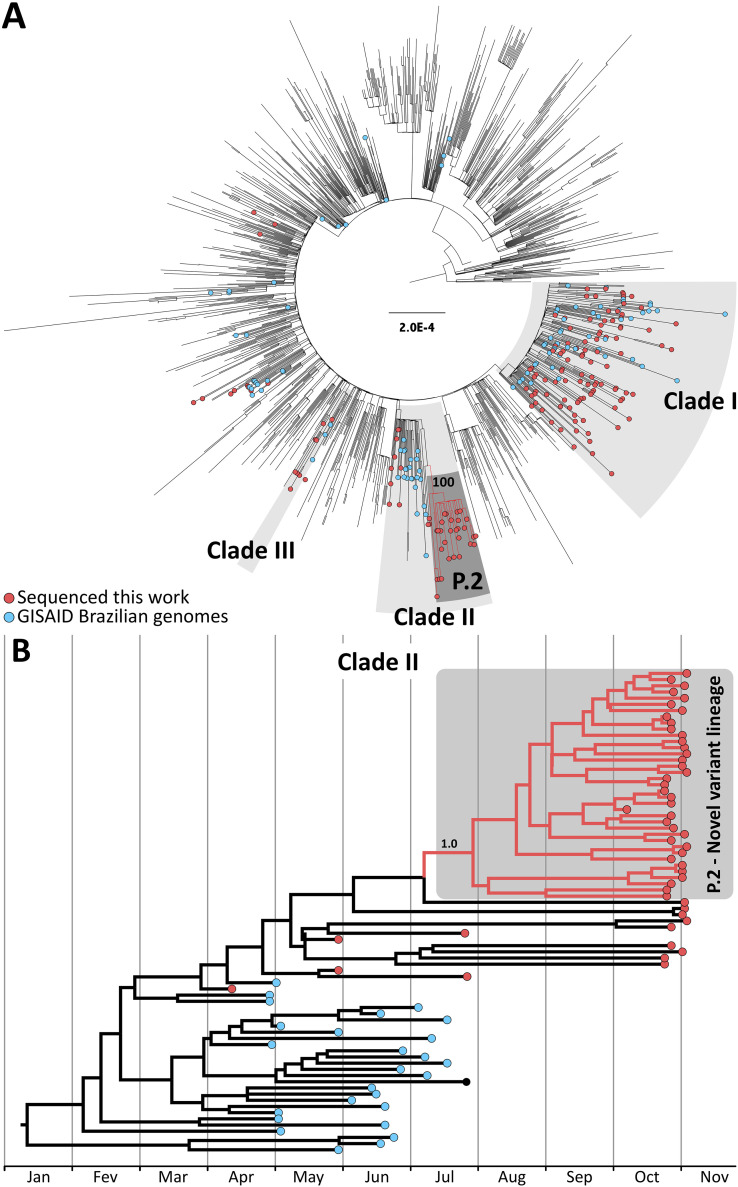
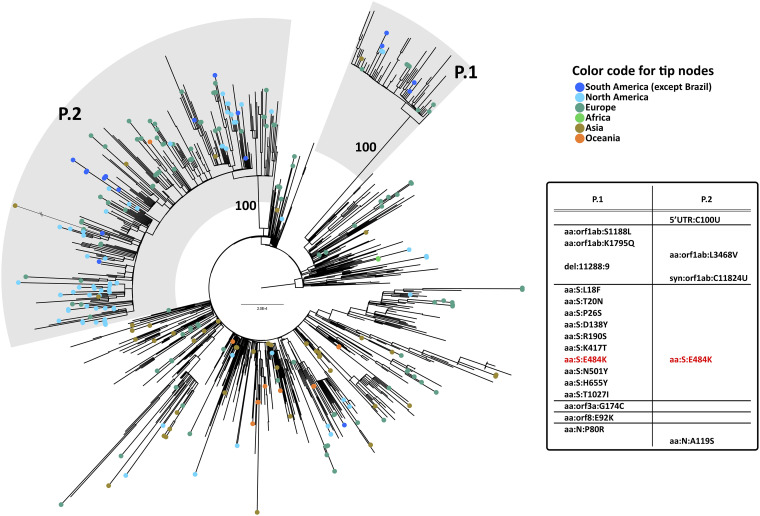
In this study, we report the sequencing of 180 new viral genomes obtained from different municipalities of the state of Rio de Janeiro from April to December 2020. We identified a novel lineage of SARS-CoV-2, originated from B.1.1.28, distinguished by five single-nucleotide variants (SNVs): C100U, C28253U, G28628U, G28975U, and C29754U. The SNV G23012A (E484K), in the receptor-binding domain of Spike protein, was widely spread across the samples. This mutation was previously associated with escape from neutralizing antibodies against SARS-CoV-2. This novel lineage emerged in late July being first detected by us in late October and still mainly restricted to the capital of the state. However, as observed for other strains it can be rapidly spread in the state. The significant increase in the frequency of this lineage raises concerns about public health management and continuous need for genomic surveillance during the second wave of infections. Article Summary Line: We identified a novel circulating lineage of SARS-CoV-2 in the state of Rio de Janeiro Brazil originated from B.1.1.28 lineage.
Overview
The claims and statistics of this paper haven’t been checked yet.
Run the check — free, no account needed. It reads the open-access text and checks the sources it cites.
Integrity signals
Registry
Cites
Statistics
Figures
Verification
Claims the paper makes
The claims and statistics of this paper haven’t been checked yet.
Run the check — free, no account needed. It reads the open-access text and checks the sources it cites.
Claims other papers make about this one
Each is checked against this paper’s own text: does it say what the citing paper says it does?
In the citing paper
“Additionally, K417N, Y453F, S477R, N501Y, and D614G represent circulating variants some of which have been associated with rapidly increasing case numbers14,15,19,33–35.”
From mRNA vaccine-elicited antibodies to SARS-CoV-2 and circulating variants (2021) · cites this paper as [35]
Self-check
Percentages, sums and reported differences re-computed from the paper’s own numbers.
The self-check needs the paper’s full text.
Citations
Cites
Trimmomatic: a flexible trimmer for Illumina sequence data
Bolger, A. M., Lohse, M., & Usadel, B. (2014) · Bioinformatics · doi:10.1093/bioinformatics/btu170 · Cited by 65,548
BEDTools: a flexible suite of utilities for comparing genomic features
Quinlan, A. R., & Hall, I. M. (2010) · Bioinformatics · doi:10.1093/bioinformatics/btq033 · Cited by 27,437
IQ-TREE 2: New Models and Efficient Methods for Phylogenetic Inference in the Genomic Era
Minh, B. Q., Schmidt, H. A., Chernomor, O., Schrempf, D., Woodhams, M. D., von Haeseler, A., & Lanfear, R. (2020) · Molecular Biology and Evolution · doi:10.1093/molbev/msaa015 · Cited by 16,873
A framework for variation discovery and genotyping using next-generation DNA sequencing data
DePristo, M. A., Banks, E., Poplin, R. E., Garimella, K. V., Maguire, J., Hartl, C., Philippakis, A., del Angel, G., Rivas, M. A., Hanna, M., et al. (2011) · Nature Genetics · doi:10.1038/ng.806 · Cited by 11,457
Posterior summarization in Bayesian phylogenetics using tracer 1.7
Rambaut, A., Drummond, A. J., Xie, D., Baele, G., & Suchard, M. A. (2018) · Systematic Biology · doi:10.1093/sysbio/syy032 · Cited by 11,159
Application of Phylogenetic Networks in Evolutionary Studies
Huson, D. H., & Bryant, D. (2005) · Molecular Biology and Evolution · doi:10.1093/molbev/msj030 · Cited by 8,895
Dating of the human–ape splitting by a molecular clock of mitochondrial DNA.
Hasegawa, M., Kishino, H., & Yano, T.-A. (1985) · Journal of Molecular Evolution · doi:10.1007/bf02101694 · Cited by 8,687
adegenet : a R package for the multivariate analysis of genetic markers
Jombart, T. (2008) · Bioinformatics · doi:10.1093/bioinformatics/btn129 · Cited by 8,335
Li, H. (2011) · Bioinformatics · doi:10.1093/bioinformatics/btr509 · Cited by 6,454
Bayesian phylogenetic and phylodynamic data integration using BEAST 1.10
Suchard, M. A., Lemey, P., Baele, G., Ayres, D. L., Drummond, A. J., & Rambaut, A. (2018) · Virus Evolution · doi:10.1093/ve/vey016 · Cited by 3,749
Cited by
Sorted by citations
Items 301–356 of 356
Miraglia, F. F. D. O., Martins-Freitas, B., Doi, A. M., Santana, R. A. F., Pinho, J. R. R., & Avelino‐Silva, V. I. (2023) · Revista do Instituto de Medicina Tropical de São Paulo · doi:10.1590/s1678-9946202365053 · Cited by 2
Schiffler, F., Moreira, S., Pereira, A. H., et al. (2023) · bioRxiv · doi:10.1101/2023.09.27.559677 · Cited by 2
“…2020, during the first year of the Coronavirus Disease 2019 (COVID-19) pandemic and concomitant with the emergence of the P.2 strain in Brazil [1], ten neotropical primates (NP) from five different species died within approximately four days of the onset of clinical signs at the Centro de…”
BackgroundSelf-citationAccuracy of a raw saliva-based COVID-19 RT-LAMP diagnostic assay
Cabral, K. M. D. S., Baptista, R. C. G., Castiñeiras, T. M. P. P., Tanuri, A., Carneiro, F. A., Almeida, M. S., & Montero-Lomelı́, M. (2023) · The Brazilian Journal of Infectious Diseases · doi:10.1016/j.bjid.2023.102790 · Cited by 2
Self-citationTONSILS ARE MAJOR SITES OF PROLONGED SARS-COV-2 INFECTION IN CHILDRENPreprint
de Lima, T. M., Júnior, R. B. M., Miura, C. S., de Souza, M. G. M., Cassiano, M. H. A., Rodrigues, T. S., Veras, F. P., Sousa, J. F., Gomes, R. S., de Almeida, G. M., et al. (2023) · medRxiv · doi:10.1101/2023.01.21.23284592 · Cited by 4
“The sequence analysis revealed several Pangolin lineages (Figure 5), all of which circulated in Brazil during the study period.(16)”
BackgroundDofuor, A. K., Quartey, N. K.-A., Osabutey, A. F., Boateng, B. O., Lutuf, H., Osei, J. H. N., Ayivi-Tosuh, S. M., Aiduenu, A. F., Ekloh, W., Loh, S. K., et al. (2023) · Clinical Pathology · doi:10.1177/2632010x231218075 · Cited by 4
“110 Freire et al 111 stated that many commercially available RDTs can detect SARS-CoV-2-specific antigens.”
BackgroundEssaidi-Laziosi, M., Rodríguez, F., Alvarez, C., Sattonnet‐Roche, P., Torriani, G., Bekliz, M., Adea, K., Lenk, M., Suliman, T., Preiser, W., et al. (2023) · Virus Research · doi:10.1016/j.virusres.2023.199255 · Cited by 2
“In addition, VUMs and VOIs were co64 circulating along with VOCs, including the (former) VOI Zeta used in our study here, that 65 arose alongside the Gamma VOC in South America during a surge in local cases, but nearly 66 all have disappeared (12).”
Rodrigues, B. D. C., Cheohen, C. F. D. A. R., Sciammarella, F., Pozzobon, A. P. B., Ribeiro, L., Nepomuceno‐Silva, J. L., de Medeiros, M. J., Mury, F. B., de Barros, C. M., Lazoski, C., et al. (2022) · International Journal of Molecular Sciences · doi:10.3390/ijms231911497 · Cited by 1
Self-citationSARS-CoV-2 vaccine challenge based on spike glycoprotein against several new variants
Syahniar, R., & Kharisma, D. S. (2022) · Clinical and Experimental Vaccine Research · doi:10.7774/cevr.2022.11.2.173 · Cited by 4
“This mutation was previously associated with the release of neutralizing antibodies against SARS-CoV-2 [32].”
BackgroundRahman, S. M. A., Shishir, M. A., Hosen, M. I., Khan, M. J., Arefin, A., & Khandaker, A. M. (2022) · Gene Reports · doi:10.1016/j.genrep.2022.101608 · Cited by 3
Sola‐Campoy, P. J., Buenestado‐Serrano, S., Pérez‐Lago, L., Rodríguez‐Grande, C., Catalán, P., Andrés-Zayas, C., Alcalá, L., Losada, C., Rico-Luna, C., Muñóz, P., et al. (2021) · Enfermedades Infecciosas y Microbiología Clínica · doi:10.1016/j.eimc.2021.05.008 · Cited by 5
SARS-CoV-2 UK, South African and Brazilian Variants in Karachi- Pakistan
Khan, A., Hanif, M., Syed, S., Ahmed, A., Ghazali, S., & Khanani, R. (2021) · Frontiers in Molecular Biosciences · doi:10.3389/fmolb.2021.724208 · Cited by 4
de Oliveira, M. D. L., de Oliveira, K. M. T., Silva, J. N., Santos, C., Bessa, J., & de Freitas, R. (2021) · bioRxiv (Cold Spring Harbor Laboratory) · doi:10.1101/2021.04.09.439181 · Cited by 3
“In South Africa, lineage B.1.351 emerged whose studies report greater difficulty in the recognition of antibodies (Moyo-Gwete et al., 2021; P. Wang et al., 2021).”
BackgroundInfluentialCabecinhas, T. R. A. R. G., Stange, C. B. M., Huber, A. R. M., et al. (2021) · medRxiv · doi:10.1101/2021.02.11.21251589 · Cited by 2
Upadhyay, V., Lucas, A., Panja, S., Miyauchi, R., & Mallela, K. M. G. (2021) · doi:10.1101/2021.05.23.445348 · Cited by 1
“Still, SARS-CoV-2 variants pose a major challenge for devising measures to counter the virus threat, as new variants continue to emerge, some of which are believed to be more infectious than the wild-type virus (17-19).”
BackgroundJones, L. R., D’Andrea, J. S., Levite, J., Brito, M., & Manrique, J. M. (2026) · Archives of Virology · doi:10.1007/s00705-026-06624-2 · Cited by 1
“In contrast, at the earliest of the second wave there was already a substantial prevalence of the Zeta variant nationwide, which was included in the list of VOIs after its rapid spread in Brazil in late 2020 [53 ].”
Genomic epidemiology of SARS-CoV-2 in Peru from 2020 to 2024
Sobkowiak, B., Langdon, A., Romero, P., Carrasco-Escobar, G., Villa, D., Miller, R. C., Cornejo-Villanueva, V., Dávila-Barclay, A., Cuicapuza, D., Salvatierra, G., et al. (2026) · Communications Medicine · doi:10.1038/s43856-025-01273-z · Cited by 1
“Distinctvirallineages,suchasGamma/P.1 14 ,Zeta/P.2 15 , Mu/B.1.621 16 ,andLambda/C.37 17,18 were fi rstidenti fi edinBrazil,Colombia, and Peru, respectively, and dominated the region in 2020 – 2021, preventing the Alpha/B.1.1.7 variant from spreading widely, as in most other countries 12 .”
InfluentialCorrêa, I. A., de Souza, M. R. M., da Silva, G. P. D., Pimentel, A. B. S. V. M., Calil, P. T., Cunha, M. S., Mariani, D., Brindeiro, R., Costa, S. M., Simas, M. C. D. C., et al. (2025) · Frontiers in Cellular and Infection Microbiology · doi:10.3389/fcimb.2025.1582137 · Cited by 1
Self-citationSARS-CoV-2 strains and clinical profiles of COVID-19 patients in a Southern Brazil hospital
Fam, B. S. D. O., Cadore, N. A., Sbruzzi, R., Feira, M. F., Giudicelli, G. C., de Almeida, L. D., Gerber, A. L., Guimarães, A. P. D. C., Vasconcelos, A. T., Pereira, A. C., et al. (2024) · Frontiers in Immunology · doi:10.3389/fimmu.2024.1444620 · Cited by 1
Self-citationLunardi, M., Martins, F. D. C., Gustani‐Buss, E., Chideroli, R. T., de Oliveira, I. M., Peronni, K. C., Figueiredo, D. L. A., Alfieri, A. F., & Alfieri, A. A. (2024) · Viruses · doi:10.3390/v16101599 · Cited by 2
“…Brazil was initially characterized by the circulation of lineages B.1.1.28 and B.1.1.33, which were first replaced by the emergence of lineage P.2 in the Rio de Janeiro state, probably in late 2020, becoming the dominant lineage in several Brazilian states from November 2020 to January 2021 [3,4].”
BackgroundInfluentialSilva, T., Oliveira, E., Oliveira, A., de Menezes, A. L., Jeremias, W. D. J., Grenfell, R. F. Q., do Monte‐Neto, R. L., Pascoal-Xavier, M. A., Campos, M. A., Fernandes, G. D. R., et al. (2024) · Brazilian Journal of Microbiology · doi:10.1007/s42770-024-01387-x · Cited by 2
“The viral evolution profile of SARS-CoV-2 observed during the COVID-19 pandemic demonstrates the importance of the early detection of variants [50].”
The macroeconomic and epidemiological impacts of Covid-19 in PakistanPreprint
Jensen, H. T., Keogh-Brown, M. R., Eggo, R. M., Pearson, C. A. B., Rueda, S. T., Huda, M., Khalid, M., Zulfiqar, W., CMMID COVID-19 Working Group, Smith, R., et al. (2023) · medRxiv · doi:10.1101/2023.10.06.23296657 · Cited by 1
Miliu, A., Lavergne, A., Succo, T., Laizé, C., Andrieu, A., Enfissi, A., Enouf, V., van der Werf, S., Blanchet, D., Demar, M., et al. (2022) · Infection Genetics and Evolution · doi:10.1016/j.meegid.2022.105370 · Cited by 3
“This VOC Alpha (Pango lineage B.1.1.7; Nextclade 20I/V1) (Genomic Epidemiology, 2022) was characterized by a higher intrinsic transmissibility than the prior variants (Volz et al., 2021; Davies et al., 2021; Obermeyer et al., 2022).”
InfluentialMaestri, S., Grosso, V., Alfano, M., Lavezzari, D., Piubelli, C., Bisoffi, Z., Rossato, M., & Delledonne, M. (2022) · Biology Methods and Protocols · doi:10.1093/biomethods/bpac020 · Cited by 1
“Among those, strains first documented in the UK, Brazil, South Africa and India quickly became the dominant lineages in delimited areas, suggesting that they may be associated to an increased transmissibility [11, 19, 22, 23].”
BackgroundMolecular dynamics of the COVID-19 pandemic in Espirito Santo (Brazil) and border States
Torezani, R., Vargas, A. M. C., Ardisson, J. S., Pirovani, M. M., dos Santos, P. H. D., Paneto, G. G., & Bastos-Filho, T. (2022) · Revista do Instituto de Medicina Tropical de São Paulo · doi:10.1590/s1678-9946202264024 · Cited by 1
Cai, H., Hu, J., Huang, L., Gao, C., Xu, M., Gao, Y., Sun, T., & Fang, X. (2022) · Frontiers in Microbiology · doi:10.3389/fmicb.2021.833054 · Cited by 2
Graf, T., Bello, G., Naveca, F., et al. (2021) · medRxiv · doi:10.1101/2021.10.24.21265116 · Cited by 1
Spread of endemic SARS-CoV-2 lineages in Russia before April 2021
Klink, G. V., Safina, K. R., Garushyants, S. K., Moldovan, M. A., Nabieva, E., Komissarov, A. B., Lioznov, D. A., & Bazykin, G. A. (2022) · PLoS ONE · doi:10.1371/journal.pone.0270717 · Cited by 21
Fares, W., Ghedira, K., Gdoura, M., et al. (2021) · bioRxiv · doi:10.1101/2021.06.18.449083 · Cited by 1
“28, also with high transmissibility, 83 were reported in South Africa and Brazil, respectively (14-16).”
BackgroundHow Triple Mutation of Coronavirus (SARS-CoV-2) Developed in India
Khan, S. F. (2021) · European Journal of Medical and Health Sciences · doi:10.24018/ejmed.2021.3.3.893 · Cited by 1
Dias, I. R., Janhaque, V. R., Vilas-Boas, V. A., Fusco, S. D. F. B., & Nunes, D. P. (2024) · Revista Brasileira de Geriatria e Gerontologia · doi:10.1590/1981-22562023026.230088.pt · Cited by 1
Afshar, Z. M. (2022) · Eurasian Journal of Pulmonology · doi:10.14744/ejop_82_21 · Cited by 1
“1 variant contains the E484K mutation,[21] whereas the P.”
BackgroundAyres, F., Lambson, B. E., Mkhize, N. N., Makhado, Z., Mhlanga, D., Serage, R., Moore, P. L., Wibmer, C. K., & Moyo-Gwete, T. (2026) · Structure · doi:10.1016/j.str.2026.01.006
Bezerra, B. B., Macedo, K. V. G., Corrêa, I. A., Coelho, S. V. A., de Souza, M. R. M., Cordeiro, B. M., Fontes, C. F. L., Carneiro, F. A., Matassoli, F. L., da Costa, L. J., et al. (2025) · Biomedicine & Pharmacotherapy · doi:10.1016/j.biopha.2025.118465
Long-term chronic infection of a young immunocompromised patient by the SARS-CoV-2 P.2 VOI
Romano, C. M., da Silva, V. G. L., da Silva, L. S., Aranda, C. S., de Oliveira, C. M., Siqueira, M. M., Pereira, E. C., Resende, P. C., Bellei, N., Levi, J. E., et al. (2024) · Revista do Instituto de Medicina Tropical de São Paulo · doi:10.1590/s1678-9946202466069 · Cited by 1
Moraes, M. M., Campos, G. R. F., Banho, C. Á., Versiani, A. F., Santos, T. M. D., Parra, M. C. P., Lobl, E. E. D. O., Galvão, T. M., Vasilakis, N., & Nogueira, M. L. (2024) · Pathogens · doi:10.3390/pathogens13121069
“Additionally, the presence of mutations along the genome that caused an increase in viral fitness led to Zeta’s classification as a VOI [30–32].”
Cordovil, D. C., Bezerra, D. A. M., Bedran, R. L. S., da Penha, E. T., Teixeira, D. M., Lobo, P. D. S., Siqueira, J. A. M., Ramos, A. G., Silva, A. M., Pinheiro, K. D. C., et al. (2024) · Brazilian Journal of Microbiology · doi:10.1007/s42770-024-01557-x
“Zeta was first identified in October 2020 in Rio de Janeiro state, however, afterwards it was found to have been circulating in the country since July 2020, then, four months before its identification [31].”
Padrões de tomografia computadorizada da COVID-19 em pacientes em terapia renal substitutiva
do Carmo, G. A. L., Oliveira, M. P., Campos, A. L. L., Couto, B. R. G. M., do Carmo, L. P. D. F., Cerqueira, T. L., de Souza, C. A. M., Goll, Y. L., de Souza, V. S., Vieira, M. O. G., et al. (2024) · Brazilian Journal of Nephrology · doi:10.1590/2175-8239-jbn-2023-0029pt
Whole genome sequencing analysis of SARS-CoV-2 Omicron variant isolated from Egypt
Ahmed, H. H., Seadawy, M. G., Abdel-Razik, M., Gad, A. F., & Hassan, M. (2024) · Microbes and Infectious Diseases /Microbes and Infectious Diseases · doi:10.21608/mid.2024.290569.1955 · Cited by 1
COVID-19 Computed tomography patterns in renal replacement therapy patients
do Carmo, G. A. L., Oliveira, M. P., Campos, A. L. L., Couto, B. R. G. M., do Carmo, L. P. D. F., Cerqueira, T. L., de Souza, C. A. M., Goll, Y. L., de Souza, V. S., Vieira, M. O. G., et al. (2024) · Brazilian Journal of Nephrology · doi:10.1590/2175-8239-jbn-2023-0029en
An overview of bioinformatics technology application in the study of novel coronavirus
Tang, X. (2023) · International Conference on Biological Engineering and Medical Science · doi:10.1117/12.2669630
Strain Variation Based on Spike Glycoprotein Gene of SARS-CoV-2 in Kuwait from 2020 to 2021
Madi, N., Sadeq, M., Essa, S. S., Safar, H. A., Al‐Adwani, A., & Al-Khabbaz, M. (2022) · Pathogens · doi:10.3390/pathogens11090985
Laboratory diagnosis of emerging human infections by SARS-COVID-19: Prevalence and challenges
Nigam, S., Vijay, U., & Kour, B. (2022) · Novel Research in Microbiology Journal · doi:10.21608/nrmj.2022.244415
“In South Africa, Hong kong, Belgium and Israel (Tegally et al., 2021; Voloch et al., 2021), OMICRON variant have emerged that enhanced the transmissibility and pathogenicity, and\or diminished the vaccination effectiveness.”
BackgroundHoang, T. H., Vu, G., Tran, M., Vo, N. S., Le, Q., & Tran, T. V. (2021) · Research Square · doi:10.21203/rs.3.rs-1092321/v1
Ratcliff, J., Al-Beidh, F., Bibi, S., Bonsall, D., Clemens, S. A., Estcourt, L., Evans, A., Fish, M., Folegatti, P., Gordon, A., et al. (2021) · medRxiv · doi:10.1101/2021.11.01.21265384
Houdroge, F., Palmer, A. Y., Delport, D., Walsh, T., Kelly, S. L., Hainsworth, S. W., Abeysuriya, R., Stuart, R. M., Kerr, C. C., COPLAN, P. M., et al. (2021) · medRxiv · doi:10.1101/2021.09.30.21264273
Verkhivker, G. M., Agajanian, S., Öztaş, D. Y., & Gupta, G. (2021) · Preprints.org · doi:10.20944/preprints202107.0295.v1 · Cited by 1
Verkhivker, G. M., Agajanian, S., Oztas, D., et al. (2021) · bioRxiv · doi:10.1101/2021.07.07.451538
Pasquale, A. D., Radomski, N., Mangone, I., et al. (2021) · medRxiv · doi:10.1101/2021.05.25.21257370
Maclot, F., Bontems, S., Meex, C., Artesi, M., Beckers, P., Bours, V., Durkin, K., & Hayette, M. (2021) · Journal of Infection · doi:10.1016/j.jinf.2021.04.035 · Cited by 1
Valadan, R., Alizadeh‐Navaei, R., Golpour, M., Gholami, M., Zargari, M., Haghshenas, M., & Mousavi, T. (2021) · Research Square · doi:10.21203/rs.3.rs-307547/v1 · Cited by 1
“[15], [16] - This variant contain N501Y (More transmission) and E484K (Escape of antibody) and K417N.”
Alonso, F. D. O. M., Sabino, B. D., de Oliveira, M. S. C., Knackfuss, F. B., & Varella, R. B. (2021) · medRxiv · doi:10.1101/2021.03.02.21252759
“Not least, the emergence of SARS-CoV-2 variants were detected in the state at 92 the time (13), although its transmissibility has not been proven to be major, nor has it 93 been a homogeneous event in the country.”
BackgroundAl-Griw, H. H. (2021) · Current Research in Microbiology and Infection · doi:10.31559/crmi2021.2.1.2
“These are the P.2, the lineage of SARS-CoV-2, originated from B.1.1.28, reported from 180 sequenced samples obtained from different municipalities in the state of Rio de Janeiro from April to December 2020 and was distinguished by five lineage-defining mutations (C100U/ C28253U/ G28628U/ G28975U/ C29754U) (Voloch et a…”
InfluentialDetection of the new SARS-CoV-2 variant B.1.526 with the Spike E484K mutation in South AmericaPreprint
Fernández‐Cadena, J. C., Muñoz, M., Gabriel Morey-León, G., Armas-González, R., Amaya-Márquez, D. J., Sacheri-Viteri, K., Cárdenas, P., Valiente‐Echeverría, F., Soto‐Rifo, R., & Andrade-Molina, D. (2021) · Research Square · doi:10.21203/rs.3.rs-248965/v1
Dias, I. R., Janhaque, V. R., Vilas-Boas, V. A., Fusco, S. D. F. B., & Nunes, D. P. (2024) · Revista Brasileira de Geriatria e Gerontologia · doi:10.1590/1981-22562023026.230088.en
Alonso, F. D. O. M., Sabino, B. D., de Oliveira, M. S. C., Knackfuss, F. B., & Varella, R. B. (2021) · Journal of Clinical Immunology & Microbiology · doi:10.46889/jcim.2021.2204
“Not least, the emergence of SARS-CoV-2 variants were detected in the state at the time, although its transmissibility has not been proven to be major [11].”
BackgroundEscape of SARS-CoV-2 501Y.V2 from neutralization by convalescent plasma
Cele, S., Gazy, I., Jackson, L., Hwa, S.-H., Tegally, H., Lustig, G., Giandhari, J., Pillay, S., Wilkinson, E., Naidoo, Y., et al. (2021) · doi:10.1101/2021.01.26.21250224 · Cited by 651
“Through genomic surveillance of the severe acute respiratory syndrome-related coronavirus 2 (SARS22 CoV-2), a number of new variants have recently been identified with multiple mutations in the spike 23 glycoprotein [1, 2, 3].”
Background
Metadata
- Authors
- Voloch, C. M., Silva F, R. D., de Almeida, L. G. P., Cardoso, C. C., Brustolini, O. J., Gerber, A. L., Guimarães, A. P. D. C., Mariani, D., Costa, R. M. D., Ferreira, O. C., Workgroup, C.-U., LNCC-Workgroup, Cavalcanti, A. C., Frauches, T. S., de Mello, C. M. B., Galliez, R. M., Faffe, D. S., Castiñeiras, T. M. P. P., Tanuri, A., & de Vasconcelos, A. T. R.
- Affiliations
- Universidade Federal do Rio de Janeiro (BR)
- Laboratório Nacional de Computação Científica (BR)
- Secretaria de Estado de Saúde do Rio de Janeiro (BR)
- ORCID
- Venue
- Journal of Virology
- Publisher
- openRxiv
- Published
- 2020-12-26
- Volume
- 95
- Issue
- 10
- ISSN
- 0022-538X (ISSN-L)
- PMC
- PMC8139668
- OpenAlex
- W3135409471
- Cited by
- 372
- References
- 31
- Citations by year
- 2026: 5 · 2025: 8 · 2024: 25 · 2023: 34 · 2022: 93 · 2021: 206
- FWCI
- 28.43
- Type
- journal article
- Language
- en
- Open access
- hybrid
- doi.org
- Licence
- cc-by
- Locations
- Journal of Virology (publishedVersion, cc-by)
- medRxiv (acceptedVersion)
- PubMed Central (publishedVersion, cc-by)
- PubMed (publishedVersion)
- Funders
- Ministério da Ciência, Tecnologia e Inovação (01.20.0029.000462/20, 303170/2017-4, 404096/2020-4)
- Conselho Nacional de Desenvolvimento Científico e Tecnológico (= 404,096/2020–4, # 303170/2017-4)
- Fundação Carlos Chagas Filho de Amparo à Pesquisa do Estado do Rio de Janeiro (E-26/202.791/2019, E-26/010.002278/2019, E-26/, E‐26/210.178/2020, E-26/210, =E-26/210.179/2020, E-26/202.903/20, E-26/010.002434/2019)
- Financiadora de Estudos e Projetos (01.20.0029.000462/20)
- Instituto Serrapilheira
- Topics
- Health Sciences › Medicine › Infectious Diseases › SARS-CoV-2 and COVID-19 Research
- Health Sciences › Medicine › Infectious Diseases › COVID-19 Clinical Research Studies
- Health Sciences › Medicine › Infectious Diseases › SARS-CoV-2 detection and testing
- Keywords
- SARS-CoV-2, novel viral lineages, genomic profiling, phylogenetic analysis, genetic divergence, Rio de Janeiro, COVID-19 pandemic
About these checks
Registry, retraction, Cites and statistics results are computed, not judged, with one exception: a printed reference that no index lists is read once by a model before it counts as a citation error. Claims are extracted by a model and kept only when their quote appears verbatim in the text; each cited source is then checked, with a model’s help, for whether it says what the claim relies on. Those verdicts can be wrong — read the claim’s quote and the cited source before relying on one.
Statistics and arithmetic are recomputed, not judged.
Confidence bands are shown only for fields calibrated on our annotated test set. None is calibrated yet, so no band is shown.
What counts as a claim ›How we measure confidence ›How we check this ›
Are you an author, or do you see a problem with this page? Request a review
