

Accurate prediction of protein structures and interactions using a 3-track network
Open accessThe DOI matches its Crossref record; 85 of the 85 references it cites were found in a registry or an index; 13 of the 36 sources its claims cite were checked for support.
Abstract
DeepMind presented remarkably accurate protein structure predictions at the CASP14 conference. We explored network architectures incorporating related ideas and obtained the best performance with a 3-track network in which information at the 1D sequence level, the 2D distance map level, and the 3D coordinate level is successively transformed and integrated. The 3-track network produces structure predictions with accuracies approaching those of DeepMind in CASP14, enables rapid solution of challenging X-ray crystallography and cryo-EM structure modeling problems, and provides insights into the functions of proteins of currently unknown structure. The network also enables rapid generation of accurate models of protein-protein complexes from sequence information alone, short circuiting traditional approaches which require modeling of individual subunits followed by docking. We make the method available to the scientific community to speed biological research. One-Sentence Summary: Accurate protein structure modeling enables rapid solution of structure determination problems and provides insights into biological function.
Overview
CoChat Summary
TL;DR
RoseTTAFold is a 3-track neural network that integrates 1D sequence, 2D distance-map, and 3D coordinate information to predict protein structures and interactions. It approaches AlphaFold2 accuracy in CASP14, solves challenging crystallography and cryo-EM modeling problems, and generates protein-complex models directly from sequence.
Key findings
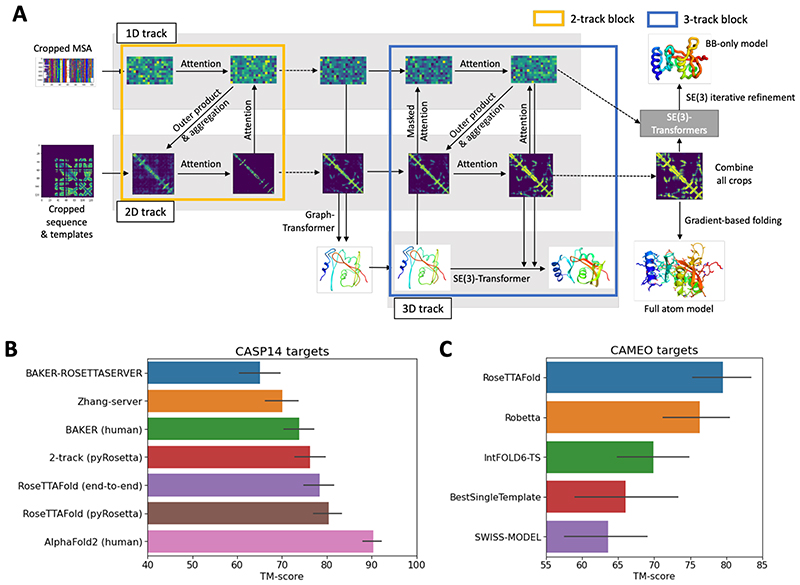
- In CASP14, the 3-track RoseTTAFold outperformed the top 2 server groups (Zhang-server and BAKER-ROSETTASERVER), the BAKER human group, and the authors’ 2-track models, though its performance was still not as good as AlphaFold2.
- On CAMEO, over 69 medium and hard targets released May 15–June 19, 2021, RoseTTAFold outperformed all other evaluated servers, including Robetta, IntFold6-TS, BestSingleTemplate, and SWISS-MODEL.
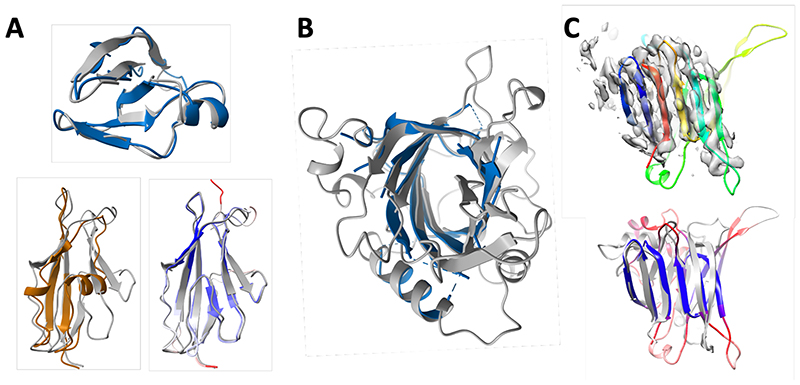
- RoseTTAFold models enabled molecular-replacement solutions for four previously unsolved crystallographic datasets; for the cryo-EM p101 Gβγ binding domain, the Cα-RMSD between predicted and refined structure was 3.0 Å over the beta-sheets.
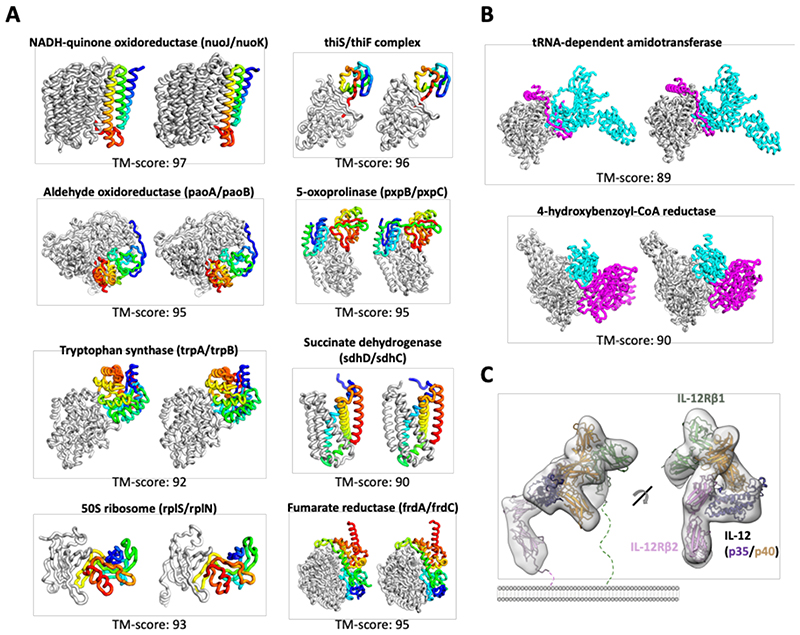
- Among 693 domains from human disease-related proteins, over one-third had predicted lDDT > 0.8, corresponding to an average Cα-RMSD of 2.6 Å on CASP14 targets; many protein-complex models had TM-score > 0.8, with complex generation taking ~30 min on a 24G TITAN RTX GPU.
Methods
- The 3-track network transforms and integrates information at the 1D sequence/MSA level, the 2D distance/orientation-map level, and the 3D backbone-coordinate level, with information flowing between tracks; training used discontinuous sequence crops spanning 260 residues.
- Final 3D structures were generated either by feeding predicted distance/orientation distributions into pyRosetta for all-atom models or by an end-to-end SE(3)-equivariant layer producing backbone coordinates directly.
- Evaluation included CASP14 targets, CAMEO blind server assessment, four X-ray molecular-replacement datasets, a cryo-EM PI3Kγ complex, GPCRs, 693 human disease-related domains, and paired-sequence complexes of known structure, using accuracy comparisons, Cα-RMSD, lDDT, TM-score, and MR/cryo-EM fit.
Limitations
- Stated: hardware memory limitations constrained model size and training; performance remained below AlphaFold2; the end-to-end version was less accurate than the pyRosetta version due to incomplete optimization and neglect of side-chain information; the accuracy predictor did not consistently identify models better than the rapid single-pass method; the network was trained on monomeric proteins, not complexes; and current RoseTTAFold uses only the top 1000 sequences due to memory limits.
- Stated: the Perceiver-based extension for using all available sequences gave promising initial results, but more training is required for rigorous comparison.
- Evident: CASP14 and CAMEO evaluations cover limited target sets and time windows, and the end-to-end model does not produce side chains.
Model-written summary. Check it against the paper before relying on it.
Integrity signals
Registry
Cites
Statistics
Figures
Verification
Claims the paper makes
3 Valid · 8 Not valid · 14 Not checked · 44 Own results and interpretations
The cited sources support only part of this claim — read each source’s verdict below.
In the paper
“The bi-annual Critical Assessment of Structure (CASP) meetings have demonstrated that deep learning methods such as AlphaFold (1, 2) and trRosetta (3), that extract information from the large database of known protein structures in the PDB, outperform more traditional approaches that explicitly model the folding process.”
§ Accurate prediction of protein structures and interactions using a 3-track neural network > Abstract
What the sources say
- Not matchedcites [1] Jumper John Evans Richard Pritzel Alexander Green Tim Figurnov Michael Tunyasuvunakool Kathryn Ronneberger Olaf Bates Russ Augustin Žídek Alex Bridgland Clemens Meyer Fourteenth Critical Assessment of Techniques for Protein Structure Prediction
Its entry has no title and year that we can search by.
- Partly supportedcites [2] Anishchenko I Chidyausiku TM Ovchinnikov S Pellock SJ Baker D De novo protein design by deep network hallucination bioRxiv 2020 2020.07.22.211482 PMC9293396 34853475 sourceExperimental — accuracy not yet measured
The Introduction (page not provided) says deep networks improved protein-structure prediction accuracy, notes an AlphaFold observation at CASP13, and reports that trRosetta outperformed other methods in benchmark tests. The Conclusion says the network learned from native protein structures and contrasts it with physically based approaches. The paper does not establish the claimed CASP comparison in which both AlphaFold and trRosetta outperform approaches that explicitly model folding. (LLM, conf=0.82)
- Not checked — no full text of the sourcecites [3] Yang J Anishchenko I Park H Peng Z Ovchinnikov S Baker D Improved protein structure prediction using predicted interresidue orientations Proc Natl Acad Sci U S A 2020 117 1496 1503 31896580 PMC6983395 source
boostedstates a cause- Asserted: passes — The authors put it forward as true.
- Checkable: passes — It can be checked against evidence.
- Load-bearing: passes — The paper’s conclusions depend on it.
- Based: passes — The paper gives a reason why it holds.
- Not matched
The cited sources that could be checked couldn’t confirm or dispute this claim.
In the paper
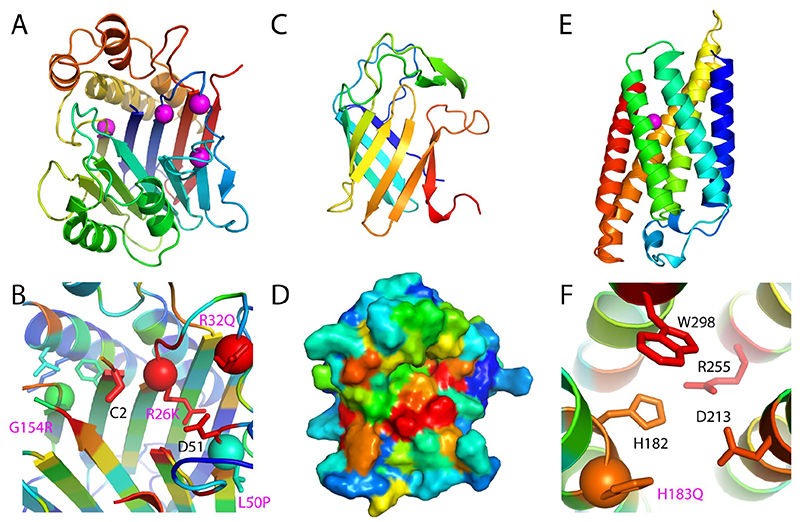
“The RoseTTAFold CERS1 model for residues 98 to 304 (Pfam TLC domain) (29) includes six TMH that traverse the membrane in an up and down arrangement (Fig. 3E).”
§ Accurate prediction of protein structures and interactions using a 3-track neural network > Providing insights into biological function
What the sources say
- Could not verifycites [29] Cong Q Anishchenko I Ovchinnikov S Baker D Protein interaction networks revealed by proteome coevolution Science 2019 365 185 189 31296772 PMC6948103 sourceExperimental — accuracy not yet measured
The paper’s Abstract (page unavailable) describes coevolution-based protein interaction models in E. coli and M. tuberculosis, not a CERS1 model. Searches for CERS1, the Pfam TLC domain, RoseTTAFold, and six transmembrane helices found no passage in our copy addressing the cited domain identification or the stated membrane arrangement. (LLM, conf=0.76)
plain- Asserted: passes — The authors put it forward as true.
- Checkable: passes — It can be checked against evidence.
- Load-bearing: passes — The paper’s conclusions depend on it.
- Based: passes — The paper gives a reason why it holds.
- Could not verify
A result the paper reports from its own data — it cites no other source for it, so there is none to check. The quote shows it is in the paper.
In the paper
“in the case of SLP, only a distant model covering part of the N-terminal domain (38% of the sequence) was available in the PDB”
§ Accurate prediction of protein structures and interactions using a 3-track neural network > Enabling experimental protein structure determination
plainSingle case- Asserted: passes — The authors put it forward as true.
- Checkable: passes — It can be checked against evidence.
- Load-bearing: passes — The paper’s conclusions depend on it.
- Based: passes — The paper gives a reason why it holds.
A result the paper reports from its own data — it cites no other source for it, so there is none to check. The quote shows it is in the paper.
In the paper
“trRosetta failed to predict the correct fold with the same MSA input (fig. S6)”
§ Accurate prediction of protein structures and interactions using a 3-track neural network > Enabling experimental protein structure determination
plainSingle case- Asserted: passes — The authors put it forward as true.
- Checkable: passes — It can be checked against evidence.
- Load-bearing: passes — The paper’s conclusions depend on it.
- Based: passes — The paper gives a reason why it holds.
A result the paper reports from its own data — it cites no other source for it, so there is none to check. The quote shows it is in the paper.
In the paper
“The 3-track models with attention operating at the 1D, 2D, and 3D levels and information flowing between the three levels were the best models we tested (Fig. 1B), clearly outperforming the top 2 server groups (Zhang-server and BAKER-ROSETTASERVER), BAKER human group (ranked second among all groups), and our 2-track attention models on CASP14 targets.”
§ Accurate prediction of protein structures and interactions using a 3-track neural network > Network architecture development
boostedstates a cause- Asserted: passes — The authors put it forward as true.
- Checkable: passes — It can be checked against evidence.
- Load-bearing: passes — The paper’s conclusions depend on it.
- Based: passes — The paper gives a reason why it holds.
33 more claims
Create a free account to see all 69 claims and to verify the 2 references still open.
- It may state two separate claims as one. 24
- Probably not a substantial claim. 13
- The quote only partly states this claim. 2
Claims other papers make about this one
Each is checked against this paper’s own text: does it say what the citing paper says it does?
The source backs part of the claim, not all of it — or backs it for a different population, condition or comparison.
In the citing paper
“RF has properties well suited for use in a protein design DDPM (Fig. 1a): it generates protein structures with high precision, operates on a rigid-frame representation of residues with rotational equivariance and has an architecture enabling conditioning on design specifications at the individual residue, inter-residue distance and orientation, and 3D coordinate levels.”
From De novo design of protein structure and function with RFdiffusion (2023) · cites this paper as [18]
Experimental — accuracy not yet measuredThe source backs part of the claim, not all of it — or backs it for a different population, condition or comparison.
In the citing paper
“are the best and most accurate answer to the structure prediction problem to date”
From The power and pitfalls of AlphaFold2 for structure prediction beyond rigid globular proteins (2024) · cites this paper as [18]
Experimental — accuracy not yet measuredThe source backs part of the claim, not all of it — or backs it for a different population, condition or comparison.
In the citing paper
“DeepMind’s AlphaFold2 success in sequence-based protein structure prediction,4 as well as the RoseTTAFold70 open-source counterpart, and the publicly available AlphaFold2 prediction of all human proteins203 are major steps that benefit the scientific community.”
From AlphaFold, Artificial Intelligence (AI), and Allostery (2022) · cites this paper as [70]
Experimental — accuracy not yet measuredThe source backs part of the claim, not all of it — or backs it for a different population, condition or comparison.
In the citing paper
“The unprecedented accuracy of AlphaFold2,127 RosettaFold,128 and others129,130 offers, at least in principle, the opportunity to virtually screen any protein of interest with the structure-based approach, irrespective of its a priori ligandability (after AlphaFold2, the structural coverage of the human proteome increased from 48% to 76% of the total residues).131”
From Advancing Targeted Protein Degradation via Multiomics Profiling and Artificial Intelligence (2023) · cites this paper as [128]
Experimental — accuracy not yet measuredThe source backs part of the claim, not all of it — or backs it for a different population, condition or comparison.
In the citing paper
“The programs were also shown to accurately assess their confidence at the level of individual residues and interdomain contacts (27,28,62).”
From AI-based structure prediction empowers integrative structural analysis of human nuclear pores (2022) · cites this paper as [27]
Experimental — accuracy not yet measured
17 more claims about this paper
Create a free account to see every claim other papers make about this one.
Citations
Cites
Vaswani, A., Shazeer, N., Parmar, N., Uszkoreit, J., Jones, L., Gomez, A. N., Kaiser, L., & Polosukhin, I. (2017) · arXiv · doi:10.48550/arxiv.1706.03762 · Cited by 120,404
MAFFT Multiple Sequence Alignment Software Version 7: Improvements in Performance and Usability
Katoh, K., & Standley, D. M. (2013) · Molecular Biology and Evolution · doi:10.1093/molbev/mst010 · Cited by 46,209
Features and development of Coot
Emsley, P., Lohkamp, B., Scott, W. G., & Cowtan, K. (2010) · Acta Crystallographica Section D Biological Crystallography · doi:10.1107/s0907444910007493 · Cited by 29,915
Clustal W and Clustal X version 2.0
Larkin, M. A., Blackshields, G., Brown, N. P., Chenna, R., McGettigan, P. A., McWilliam, H., Valentin, F., Wallace, I. M., Wilm, A., Lopez, R., et al. (2007) · Bioinformatics · doi:10.1093/bioinformatics/btm404 · Cited by 28,358
Phaser crystallographic software
McCoy, A. J., Grosse-Kunstleve, R. W., Adams, P. D., Winn, M. D., Storoni, L. C., & Read, R. J. (2007) · Journal of Applied Crystallography · doi:10.1107/s0021889807021206 · Cited by 20,612
Self-citationSWISS-MODEL: homology modelling of protein structures and complexes
Waterhouse, A., Bertoni, M., Bienert, S., Studer, G., Tauriello, G., Gumienny, R., Heer, F. T., de Beer, T. A. P., Rempfer, C., Bordoli, L., et al. (2018) · Nucleic Acids Research · doi:10.1093/nar/gky427 · Cited by 13,067 · cited 2×
“Fortunately,theContinuousAutomated ModelEvaluation(CAMEO)experiment( 7 ) tests structure prediction servers blindly on protein structures as they are submitted to the PDB. RoseTTAFold has been evaluated since 15 May 2021 on CAMEO; over the 69 medium and hard targets released during this time (15 May 2021 to 19 June 20…”
UCSF ChimeraX: Structure visualization for researchers, educators, and developers
Pettersen, E. F., Goddard, T. D., Huang, C. C., Meng, E. C., Couch, G. S., Croll, T. I., Morris, J. H., & Ferrin, T. E. (2021) · Protein Science · doi:10.1002/pro.3943 · Cited by 9,514
Liebschner, D., Afonine, P. V., Baker, M. L., Bunkóczi, G., Chen, V. B., Croll, T. I., Hintze, B., Hung, L.-W., Jain, S., McCoy, A. J., et al. (2019) · Acta Crystallographica Section D Structural Biology · doi:10.1107/s2059798319011471 · Cited by 7,953
Self-citationUniProt: the Universal Protein knowledgebase
Apweiler, R. (2004) · Nucleic Acids Research · doi:10.1093/nar/gkh131 · Cited by 7,498
Towards automated crystallographic structure refinement with phenix.refine
Afonine, P. V., Grosse-Kunstleve, R. W., Echols, N., Headd, J. J., Moriarty, N. W., Mustyakimov, M., Terwilliger, T. C., Urzhumtsev, A., Zwart, P. H., & Adams, P. D. (2012) · Acta Crystallographica Section D Biological Crystallography · doi:10.1107/s0907444912001308 · Cited by 5,511
Self-citation
Research works printed but not linked: 2
- Bunkóczi G Read RJ phenix. ensembler: a tool for multiple superposition Comput Crystallogr Newsl 2011 2 8 9
- Vagin A Lebedev A ACTA CRYSTALLOGRAPHICA A-FOUNDATION AND ADVANCES INT UNION CRYSTALLOGRAPHY 2 ABBEY SQ, CHESTER, CH1 2HU ENGLAND 2015 71 S19
Cited by
Items 5,001–5,100 of 5,652
Wang, X., Bensch, S., Huang, X., & Dong, L. (2023) · Figshare · doi:10.6084/m9.figshare.24116527
Kienzle, L., Bettinazzi, S., Choquette, T., Brunet, M. A., Khorami, H. H., Jacques, J., Moreau, M., Roucou, X., Landry, C. R., Angers, A., et al. (2024) · Figshare · doi:10.6084/m9.figshare.26590149
Li, M., Kang, L., Xiong, Y., Wang, Y. G., Fan, G., Tan, P., & Hong, L. (2024) · Figshare · doi:10.6084/m9.figshare.26566178
Wierbowski, S. D. (2022) · eCommons (Cornell University) · doi:10.7298/kxbq-ef19
Kienzle, L., Bettinazzi, S., Choquette, T., Brunet, M. A., Khorami, H. H., Jacques, J., Moreau, M., Roucou, X., Landry, C. R., Angers, A., et al. (2024) · Figshare · doi:10.6084/m9.figshare.26590152
Çınar, B. (2025) · Institutional Repository of Leibniz Universität Hannover (Leibniz Universität Hannover) · doi:10.15488/18643
Barakat, C. (2023) · Opin vísindi (Opin vísindi) · doi:10.34734/fzj-2023-02488
Kravchenko, A., de Vries, S. J., Smaïl‐Tabbone, M., & de Beauchêne, I. C. (2024) · Figshare · doi:10.6084/m9.figshare.26698232
Dirvelyte, E., Bujanauskienė, D., Jankaitytė, E., Daugelaviciene, N., Kisieliute, U., Nagula, I., Budvytytė, R., & Neniškytė, U. (2023) · Figshare · doi:10.6084/m9.figshare.23797269
Li, M., Kang, L., Xiong, Y., Wang, Y. G., Fan, G., Tan, P., & Hong, L. (2024) · Figshare · doi:10.6084/m9.figshare.26566175
Grigorjew, A., Gynter, A., Dias, F. H. C., Buchfink, B., Drost, H., & Tomescu, A. I. (2024) · Figshare · doi:10.6084/m9.figshare.26604619
Grigorjew, A., Gynter, A., Dias, F. H. C., Buchfink, B., Drost, H., & Tomescu, A. I. (2024) · Figshare · doi:10.6084/m9.figshare.26604613
Additional file 1 of Systemic evolutionary chemical space exploration for drug discovery
Lu, C., Liu, S., Shi, W., Yu, J., Zhou, Z., Zhang, X., Lu, X., Cai, F., Xia, N., & Wang, Y. (2022) · Figshare · doi:10.6084/m9.figshare.19498414
Nakata, S., Mori, Y., & Tanaka, S. (2024) · Figshare · doi:10.6084/m9.figshare.26594075
Grigorjew, A., Gynter, A., Dias, F. H. C., Buchfink, B., Drost, H., & Tomescu, A. I. (2024) · Figshare · doi:10.6084/m9.figshare.26604622
Smith, E. D., Vo, Q., Giasson, B. I., Borchelt, D. R., Prokop, S., & Chakrabarty, P. (2023) · Figshare · doi:10.6084/m9.figshare.24452451
Chu, C., Li, L., Li, S., Zhou, Q., Zheng, P., Zhang, Y.-D., Duan, A.-H., Lu, D., & Wu, Y.-M. (2022) · Figshare · doi:10.6084/m9.figshare.19497954
Stranger, V. (2025) · cIRcle (University of British Columbia) · doi:10.14288/1.0447708
Li, X., Yu, H., Liu, S., Ma, B., Wu, X., Zheng, X., & Xu, Y. (2024) · Figshare · doi:10.6084/m9.figshare.26734638
Grigorjew, A., Gynter, A., Dias, F. H. C., Buchfink, B., Drost, H., & Tomescu, A. I. (2024) · Figshare · doi:10.6084/m9.figshare.26604601
Dirvelyte, E., Bujanauskienė, D., Jankaitytė, E., Daugelaviciene, N., Kisieliute, U., Nagula, I., Budvytytė, R., & Neniškytė, U. (2023) · Figshare · doi:10.6084/m9.figshare.23797272
Hao, J.-H., Zheng, D.-J., Ye, Y.-H., Yu, J.-T., Li, X.-Y., Xiong, M.-J., Jiang, W.-H., He, K.-P., Li, P.-Y., Lv, Y.-S., et al. (2022) · Figshare · doi:10.6084/m9.figshare.19766213
Kienzle, L., Bettinazzi, S., Choquette, T., Brunet, M. A., Khorami, H. H., Jacques, J., Moreau, M., Roucou, X., Landry, C. R., Angers, A., et al. (2024) · Figshare · doi:10.6084/m9.figshare.26590146
Grigorjew, A., Gynter, A., Dias, F. H. C., Buchfink, B., Drost, H., & Tomescu, A. I. (2024) · Figshare · doi:10.6084/m9.figshare.26604604
Perona Gomez, I. (2024) · UPCommons institutional repository (Universitat Politècnica de Catalunya)
Development of novel antibody-drug conjugated molecules for treatment of B-cell maligancies
André, A. F. S. (2023) · Portuguese National Funding Agency for Science, Research and Technology (RCAAP Project by FCT)
Integracija umetne inteligence in tehnologije CRISPR-Cas
Bevk, T. (2023) · Repository of the University of Ljubljana (University of Ljubljana)
Tijman Nuñez, A. (2023) · LA Referencia (Red Federada de Repositorios Institucionales de Publicaciones Científicas)
Investigation into the molecular mechanisms underlying circadian rhythm disruption and human cancer
Janoski, J. R. (2023) · VTechWorks (Virginia Tech)
한용희 (2024) · Seoul National University Open Repository (Seoul National University)
\nThe long and winding path towards efficacious transmission blocking malaria vaccines
Jong, R. M. D. (2023) · Radboud Repository (Radboud University) · Cited by 2
Modelling Asparaginases for Leukemia Treatments: Multiscale Simulations as a Guide for Enzyme Design
Andelkovic, M. (2025) · Repository of Digital Objects for Teaching Research and Culture (University of Valencia)
Controlling Polymer Conformation and Hydration with Monomer Sequence
DeStefano, A. J. (2023) · eScholarship (California Digital Library)
At the Edge of AI : Human Computation Systems and Their Intraverting Relations (Edition 1)
Veprek, L. H. (2024) · BiblioBoard Library Catalog (Open Research Library)
Prior knowledge and verification in macromolecular crystallography
Jiménez, E. (2024) · Dipòsit Digital de la Universitat de Barcelona (Universitat de Barcelona)
Development of Machine Learning Models for Comprehensive Prediction of Enzyme Annotations
渡邉, 直., ワタナベ, ナ., & Watanabe, N. (2023) · Institutional Repositories DataBase (IRDB)
Geometric Deep Learning for Biomolecules
Mitnikov, I. (2024) · DSpace@MIT (Massachusetts Institute of Technology)
In Silico Identification and Prioritisation of Antifilarial Drug Targets in Setaria digitata
Diyagu Hannadi Jayaweera Patabadige, K. C. (2025) · Epsilon Archive for Student Projects (Swedish University of Agricultural Sciences)
Kommer, D. C. (2024) · Brunel University Research Archive (BURA) (Brunel University London)
Abdelhamid, I. (2023) · Qucosa (Saxon State and University Library Dresden)
Deep Learning and Cloud Science for the Engineering of Biological Molecules and Systems
Armer, C. (2022) · ResearchWorks at the University of Washington (University of Washington)
At the Edge of AI : Human Computation Systems and Their Intraverting Relations
(2024) · BiblioBoard Library Catalog (Open Research Library)
Identification and characterization of TANGO2 protein and its interaction with metabolites
Powers, A. (2024) · D-Scholarship@Pitt (University of Pittsburgh)
Accurate Protein Function Prediction with Graph Transformer-Based Function Localization
Mitra, S. (2025) · DSpace@MIT (Massachusetts Institute of Technology)
Three Strategies for Salvaging Epistemic Value in Deep Neural Network Modeling
Verreault-Julien, P. (n.d.) · PhilPapers (PhilPapers Foundation) · Cited by 1
Stabilizacija in strukturna karakterizacija proteinov iz obvitih vijačnic
Satler, T. (2024) · Repository of the University of Ljubljana (University of Ljubljana)
Efficient and Scalable Deep Learning Systems for Protein Design
Randolph, N. Z. (2025) · Carolina Digital Repository (University of North Carolina at Chapel Hill) · doi:10.17615/mxzc-7s37
ProFusion: 3D Reconstruction of Protein Complex Structures from Multi-view AFM ImagesPreprint
Rade, J., Hasib, M. H. H., Öztürk, M., Faal, B., Yang, S., Sashital, D. G., Venditti, V., Chen, B., Sarkar, S., Krishnamurthy, A., et al. (2025) · arXiv (Cornell University) · doi:10.48550/arxiv.2509.15242
Evaluation Metrics and Quality Assessment Methods for Predicted Protein Complex Structures
Zhai, J., Wang, W., Huang, Y., & Gong, X. (2025) · Tsinghua Science & Technology · doi:10.26599/tst.2025.9010068
Biacchesi, S., Fauvet, C., Mérour, E., Bernard, J., Lamoureux, A., Lallias, D., & Millet, J. K. (2025) · bioRxiv (Cold Spring Harbor Laboratory) · doi:10.1101/2025.09.19.677251
Fundamentals of hydrogen energy
Shanmughom, R., Balakrishnan, D., Lathika, A. S., & Jayachandran, R. (2025) · Elsevier eBooks · doi:10.1016/b978-0-443-34090-1.00007-5
Statistical Model Checking with Robust Markov Decision Processes
Wienhöft, P. (2025) · Qucosa (Saxon State and University Library Dresden) · Cited by 1
Thompson, C. O. D. (2025) · UCL Discovery (University College London)
Lehes, C. (2025) · DSpace repository (University of Tartu)
Benchmarking datasets for machine learning in protein function predictionPreprint
Jang, Y. J., Qin, Q.-Q., Wang, J.-L., & Kornmann, B. (2025) · bioRxiv (Cold Spring Harbor Laboratory) · doi:10.64898/2025.12.17.694800
Self-citationMurase, Y., Kitamura, N., Namba, S., Satoh, A., Makino, T., Moriya, A., & Moriya, H. (2025) · bioRxiv (Cold Spring Harbor Laboratory) · doi:10.64898/2025.12.19.695406
Achimba, F., Priyadarshini, P., Faezov, B., Habib, M., Gelashvili, M., Cohen, B., Dunbrack, R. L., & Holford, M. (2025) · ChemRxiv · doi:10.26434/chemrxiv-2025-9gd3c
From Thousands to a Handful: Streamlining Breast Cancer Pathway Enrichment with LLMs
Kania, M., Żyła, J., Widzisz, K., & Polański, A. (2025) · International Conference on Bioinformatics Research and Applications (ICBRA) · doi:10.1145/3774976.3774993
A Conserved Planthopper MATH-BTB Protein Regulates Fecundity in Nilaparvata legens Stål
Dai, Y., Gong, G., Wang, S., Guo, Y., Qiu, C., Li, Y., Yuan, L., Xiao, H., Jin, F., Pang, R., et al. (2025) · International Journal of Molecular Sciences · doi:10.3390/ijms27010219
“In this study, predicted 3D structures based on AI methods [44,45] were compared and clustered to classify the proteins [46].”
Multisubstrate Allostery with a Single Helical Switch in Cytochrome P450cam
Sahil, M., & Mondal, J. (2025) · The Journal of Physical Chemistry Letters · doi:10.1021/acs.jpclett.5c03844
Learning Protein Structure Representation with Orientation-Aware Networks
Li, J., Luo, S., Deng, C., Cheng, C., Guan, J., Guibas, L., Peng, J., & Ma, J. (2025) · Journal of Computational Biology · doi:10.1177/15578666251406300
“Recently, transformer-based methods (Vaswani et al., 2017) have been trending to replace conventional methods in other bioinformatics tasks (Ingraham et al., 2019; Baek et al., 2021; Jumper et al., 2021; Cao et al., 2021).”
Design of Protein and Peptide Macromolecular Drugs
Li, H., & Li, S. (2026) · Springer eBooks · doi:10.1007/978-981-95-2525-6_45
Database of Biomacromolecular Structures
Li, G. (2026) · Springer eBooks · doi:10.1007/978-981-95-2525-6_21
Introduction: The Development of Artificial Intelligence and Drug Design
Li, H. (2025) · Springer eBooks · doi:10.1007/978-981-95-2525-6_1 · Cited by 1
Molecular Dynamics in Predicting the Stability of Drug-Receptor Interactions
Chen, S., & Zacharias, M. (2025) · Springer handbooks · doi:10.1007/978-3-031-81728-1_27
Invisible Players in AI: A Comparative Study of Underrepresented Research Topics in AI Healthcare
(2025) · Southwestern Mass Communication Journal · doi:10.58997/24sy6f78
Long, M., & Bernacchi, S. (2026) · Methods in molecular biology · doi:10.1007/978-1-0716-5084-4_17
AAV-TNNI3 rescues an experimental murine Tnni3 mutation resulting in thin filament mediated DCM
Bushway, P., Feng, W., Cruz, M. S., Maisel, S., Shathaya, A., Rao, P., Patel, U., Park, J., Chen, C., Tang, Z., et al. (2026) · Journal of Molecular and Cellular Cardiology · doi:10.1016/j.yjmcc.2026.01.001
Pires, V. S., Gravina-Oliveira, M. P., Júnior, N. S., Velozo, B. S., de Sousa, S. F. M., & Mesquita, R. D. (2026) · Acta Tropica · doi:10.1016/j.actatropica.2026.107969
Loss of Modular Folding in Full-Length Protein APreprint
Rahimi, K., Halbing, A., Nguyen, M. N., Şen, M., Willson, R. C., & Zerze, G. H. (2026) · SSRN Electronic Journal · doi:10.2139/ssrn.6038497
Masnoddin, M., Ling, C. M. W. V., & Yusof, N. A. (2025) · Borneo Science | The Journal of Science and Technology · doi:10.51200/bsj.v46i1.6314
Artificial Intelligence: A Current and Updated Review of Repurposed Drugs for SARS-CoV-2
Tolou–Ghamari, Z. (2026) · Current Respiratory Medicine Reviews · doi:10.2174/011573398x382360251012171433
Challenges and Future Directions in Al for Drug Discovery
Zhang, J., Shao, X., & Fan, X. (2026) · Springer eBooks · doi:10.1007/978-3-031-98022-0_27
Jeevannavar, A. (2026) · UTUPub (University of Turku)
Structural analysis of uridine modifications in solved RNA structures
Arteaga, S. J., & Znosko, B. M. (2025) · NAR Genomics and Bioinformatics · doi:10.1093/nargab/lqaf197
Protein Secondary Structure Prediction Using Soft Computing Techniques
Sajani, K., Yaduvanshi, P., Masood, S., & Singh, P. K. (2026) · Biotechnology and Applied Biochemistry · doi:10.1002/bab.70127 · Cited by 1
“Additionally, it aligns with recent advances in AI-driven modeling, complementing state-of-the-art tools like AlphaFold [ 15 ] and RoseTTAFold [ 16 ].”
Azeem, M., Lee, C., Hein, A., Ott, C., & Valafar, H. (2026) · Frontiers in Molecular Biosciences · doi:10.3389/fmolb.2025.1694750
Gene function predicts divergence across molecular levels
Piya, A. A., Calix, K. M., & Assis, R. (2026) · Scientific Reports · doi:10.1038/s41598-026-64001-0
Manoj, M., Bhagavathi, K., Fathima, S. A. N., Pillai, S. S., Malarvizhi, M., Shenbagam, M., Velayuthaprabhu, S., & Anand, A. V. (2026) · CABI biotechnology series. · doi:10.1079/9781800628649.0001 · Cited by 1
Wünschiers, R. (2026) · Springer eBooks · doi:10.1007/978-3-662-71410-2_1
Sánchez, J. R. S., Cárdenas, G. R., Chtereva, C. B. G., Moreno, E., & Jimenez-Angeles, L. (2026) · World Congress on Medical Physics and Biomedical Engineering, September 7 - 12, 2009, Munich, Germany · doi:10.1007/978-3-032-13729-6_20
Wei, Z., Wei, L., Wu, Z., Hu, Y. A., Fang, Y., Miaomiao, G., Xing, B., Weng, J., Liu, S., & Ming, K. (2026) · Research Square · doi:10.21203/rs.3.rs-8645836/v1
Baldiwala, A., Baldiwala, A. M., Patel, M. A., Amrutiya, P., Natesan, G., & Chaube, U. (2026) · Chemical Papers · doi:10.1007/s11696-025-04598-0
“It achieves this by systems such as AlphaFold, which predicts protein structures with high accuracy (Jumper et al. 2021 ), RoseTTAFold, which forecasts complex protein interactions (Baek et al. 2021 ) and DiffDock, which employs diffusion-based docking (Corso et al. 2022 ).”
Hsieh, M.-K., & Klauda, J. B. (2026) · The Journal of Physical Chemistry B · doi:10.1021/acs.jpcb.5c07529
Correia, C., Ung, C. Y., Grenko, C. M., Zhu, S., Billadeau, D. D., & Li, H. (2026) · Challenges and advances in computational chemistry and physics · doi:10.1007/978-3-032-07880-3_1
Protein Trimerization and Viral Fusion: Structural Insights and Therapeutic Applications
Mayandi, V., Majumdar, D., Shrestha, P., Kousoulas, K. G., & Jois, S. D. S. (2026) · Challenges and advances in computational chemistry and physics · doi:10.1007/978-3-032-07880-3_8
Triviño, J., Jiménez, E., Grininger, C., Caballero, I., Medina, A., Castellví, A., Petrillo, G., Govantes, F., Sagmeister, T., Alcorlo, M., et al. (2026) · Protein Science · doi:10.1002/pro.70481 · Cited by 1
“Along with RoseTTAFold (Baek et al., 2021), these tools have spread throughout structural biology enhancing our view beyond the available experimental structures.”
Self-citationDeep Learning Approaches for Accurate RNA 3D Structure Prediction from Primary SequencesPreprint
Ugwumba, N. K. (2026) · Research Square · doi:10.21203/rs.3.rs-8695387/v1
Applied Causality to Infer Protein Dynamics and Kinetics
Aranganathan, A., & Beyerle, E. R. (2026) · Journal of Chemical Information and Modeling · doi:10.1021/acs.jcim.5c02554 · Cited by 1
Shao, N., & Guo, Y. (2026) · Frontiers in Bioinformatics · doi:10.3389/fbinf.2025.1738737
“…prediction—such as AlphaFold and RoseTTAFold—have demonstrated that these learned embeddings can be directly translated into accurate three-dimensional models, effectively linking statistical patterns to molecular structure (Baek et al., 2021; Townshend et al., 2021; Jumper et al., 2021).”
Transforming macromolecular structures into simulations of self-assembly with ioNERDSS
Ying, Y. M., Sang, M., Au, G., Chhibber, S., Du, Y., Fischer, J. A., Foley, S. L., Guo, S., Herzog-Pohl, I., Liu, Z. H., et al. (2026) · Biophysical Journal · doi:10.64898/2026.01.27.702082
Goldani, M. (2025) · arXiv (Cornell University) · doi:10.48550/arxiv.2507.16655
Osuna, S. (2025) · Estudis Romànics (Institut d'Estudis Catalans)
Huang, H., Bao, Z., Zhou, T., Wang, Y., Zhou, Q., Xiao, T., Zhang, Q., Liu, Z., Li, D., & Yang, H. (2025) · IEEE International Conference on Bioinformatics and Biomedicine (BIBM) · doi:10.1109/bibm66473.2025.11356435
“Similarly, RoseTTAFold introduces an innovative three-track neural architecture that integrates information across sequence, distance map, and 3D co-ordinate levels, delivering near–AlphaFold-level accuracy and enabling rapid modeling of protein complexes directly from sequence data [17].”
DiffNB: Aligning a Nanobody Diffusion Model with Direct Preference Optimization
Wu, Y., JiaShu, Wu, D., Qin, Y., Plötz, T., Hrovatin, K., Linker, S. M., Hopp, A. V., Winkel, M., Harbach, P. H. P., et al. (2025) · IEEE International Conference on Bioinformatics and Biomedicine (BIBM) · doi:10.1109/bibm66473.2025.11356690
“As Table II and Table III, DiffNB generates entities with higher structural certainty as RMSD lower than 1 ˚ A and TM-score higher than 0.9, while maintaining high structural confidence (DockQ/LDDT, developed by DeepMind [21]), which indicates a high docking confidence.”
InfluentialCamelid Single-Domain Antibodies as Tools for Novel Target Identification in Kinetoplastid Research
Odongo, S., Vocht, L. D., Jin, B.-K., Li, Z., Magez, S., & Sterckx, Y. G. ‐. (2026) · Methods in molecular biology · doi:10.1007/978-1-0716-5146-9_22
Synthetic Biology and Machine Learning: Developing Novel Biomolecules for Therapeutic Application
Mahadik, P. B., Mohan, K. M., N.Srinivas, Soujanya, T., Saida, D., & Athiraja, A. (2025) · IEEE Global Conference for Advancement in Technology (GCAT) · doi:10.1109/gcat66372.2025.11368563 · Cited by 1
“The research demonstrates a systematic methodology to connect these gaps which intends to both speed up biomolecular development and therapeutic research as well as minimize experimental burdens in drug discovery processes[7].”
Khan, R. I. (2026) · Elsevier eBooks · doi:10.1016/b978-0-443-34193-9.00016-8
Metadata
- Authors
- Baek, M., DiMaio, F., Anishchenko, I., Dauparas, J., Ovchinnikov, S., Lee, G. R., Wang, J., Cong, Q., Kinch, L. N., Schaeffer, R. D., Millán, C., Park, H., Adams, C., Glassman, C. R., DeGiovanni, A., Pereira, J. H., Rodrigues, A. V., van Dijk, A. A., Ebrecht, A. C., Opperman, D. J., Sagmeister, T., Buhlheller, C., Pavkov-Keller, T., Rathinaswamy, M. K., Dalwadi, U., Yip, C. K., Burke, J. E., Garcia, K. C., Grishin, N. V., Adams, P. D., Read, R. J., & Baker, D.
- Affiliations
- University of Washington (US)
- Harvard University (US)
- The University of Texas Southwestern Medical Center (US)
- Howard Hughes Medical Institute (US)
- University of Cambridge (GB)
- Stanford Medicine (US)
- Lawrence Berkeley National Laboratory (US)
- North-West University (ZA)
- University of the Free State (ZA)
- University of Graz (AT)
- University of Victoria (CA)
- University of British Columbia (CA)
- Corresponding author
- Baker, David
- ORCID
- Baek, Minkyung
- DiMaio, Frank
- Anishchenko, Ivan
- Dauparas, Justas
- Ovchinnikov, Sergey
- Lee, Gyu Rie
- Wang, Jue
- Cong, Qian
- Kinch, Lisa N.
- Schaeffer, R. Dustin
- Millán, Claudia
- Park, Hahnbeom
- Adams, Carson
- Glassman, Caleb R.
- Pereira, Jose H.
- Rodrigues, Andria V.
- van Dijk, Alberdina A.
- Ebrecht, Ana C.
- Opperman, Diederik J.
- Sagmeister, Theo
- Buhlheller, Christoph
- Rathinaswamy, Manoj K
- Dalwadi, Udit
- Yip, Calvin K
- Burke, John E
- Grishin, Nick V.
- Adams, Paul D.
- Read, Randy J.
- Baker, David
- Venue
- Science
- Publisher
- openRxiv
- Published
- 2021-06-15
- Volume
- 373
- Issue
- 6557
- Pages
- 871-876
- ISSN
- 0036-8075 (ISSN-L)
- PMC
- PMC7612213
- OpenAlex
- W3186179742
- Semantic Scholar
- 51362860fb8ad08255660303550ed4bc345535fc
- Cited by
- 5,549
- References
- 85
- Citations by year
- 2026: 912 · 2025: 1108 · 2024: 1165 · 2023: 1144 · 2022: 982 · 2021: 227
- FWCI
- 247.22
- Type
- journal article
- Language
- en
- Open access
- hybrid
- doi.org
- Licence
- cc-by
- Locations
- Science (publishedVersion, cc-by)
- bioRxiv (Cold Spring Harbor Laboratory) (submittedVersion, cc-by-nc-nd)
- PubMed (publishedVersion)
- PubMed Central (acceptedVersion, cc-by)
- eScholarship (California Digital Library) (submittedVersion, cc-by)
- OSTI OAI (U.S. Department of Energy Office of Scientific and Technical Information) (submittedVersion, cc-by)
- DESY Publication Database (PUBDB) (Deutsches Elektronen-Synchrotron) (submittedVersion)
- Apollo (University of Cambridge) (submittedVersion, cc-by)
- Apollo (cc-by)
- Funders
- National Science Foundation (GM127390, 1937533)
- Welch Foundation (I‐1505)
- Washington Research Foundation
- Microsoft
- TU Graz, Internationale Beziehungen und Mobilitätsprogramme
- Wellcome Trust (Z/17/Z, 209407/Z/17/Z, 209407)
- G. Harold and Leila Y. Mathers Foundation
- Diamond Light Source
- Open Philanthropy Project
- Global Challenges Research Fund (ST/R002754/1)
- Schmidt Family Foundation
- European Synchrotron Radiation Facility
- Austrian Science Fund (P 29432, DOC 50)
- National Institutes of Health (DP5OD026389, RO1-AI51321)
- Canadian Institutes of Health Research (168998, 168907)
- Science and Technology Facilities Council (ST/R002754/1)
- Deutsches Elektronen-Synchrotron
- National Institute of General Medical Sciences (P01GM063210, R35GM127390, R01GM123089)
- National Institute of Allergy and Infectious Diseases (R01AI051321)
- Topics
- Life Sciences › Biochemistry, Genetics and Molecular Biology › Molecular Biology › Protein Structure and Dynamics
- Life Sciences › Biochemistry, Genetics and Molecular Biology › Molecular Biology › Machine Learning in Bioinformatics
- Life Sciences › Biochemistry, Genetics and Molecular Biology › Structural Biology › Enzyme Structure and Function
- Keywords
- protein structure prediction, protein-protein complex prediction, distance maps, sequence-based structure prediction, CASP14, protein function prediction
- MeSH terms
- Deep Learning, Amino Acid Sequence, Computer Simulation, Membrane Proteins, Models, Molecular, Protein Conformation, Proteins, Neural Networks, Computer, Protein Folding, Crystallography, X-Ray, Cryoelectron Microscopy, Protein Subunits, Databases, Protein, Receptors, G-Protein-Coupled, Multiprotein Complexes, Sphingosine N-Acyltransferase, ADAM Proteins
About these checks
Registry, retraction, Cites and statistics results are computed, not judged, with one exception: a printed reference that no index lists is read once by a model before it counts as a citation error. Claims are extracted by a model and kept only when their quote appears verbatim in the text; each cited source is then checked, with a model’s help, for whether it says what the claim relies on. Those verdicts can be wrong — read the claim’s quote and the cited source before relying on one.
The claim verdicts this report counts are experimental: their accuracy is not yet measured.
A language model drew the claims from the paper on 2026-10-10, under version 3 of the claim definition (model deepseek-v4.1-flash, prompt extract-v3).
A second model labelled each claim on 2026-10-10 (model jev-1.13-20260917, definition revision gold-guideline-v0.2).
Cited sources are checked with a language model’s help (gpt-6-sol).
Statistics and arithmetic are recomputed, not judged.
Confidence bands are shown only for fields calibrated on our annotated test set. None is calibrated yet, so no band is shown.
What counts as a claim ›How we measure confidence ›How we check this ›
Are you an author, or do you see a problem with this page? Request a review
Data sources
Bibliographic data: Semantic Scholar, OpenAlex, Crossref.
Contains information from the Semantic Scholar Academic Graph Datasets, made available under the ODC Attribution License (ODC-BY 1.0).
Semantic Scholar’s data is described in: Kinney, R., et al. (2023). The Semantic Scholar Open Data Platform. arXiv:2301.10140.
