

Low dimensional subject representation based transfer learning in eeg decoding
Open accessThe DOI matches its Crossref record; 54 of the 54 references it cites were found in a registry or an index.
Abstract
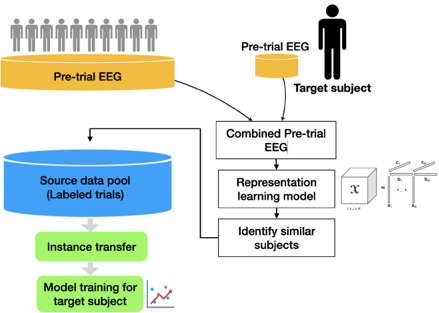
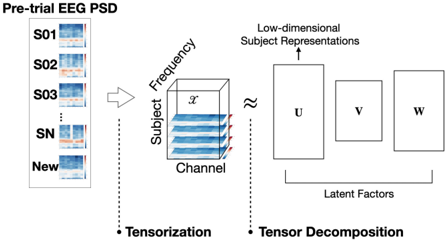
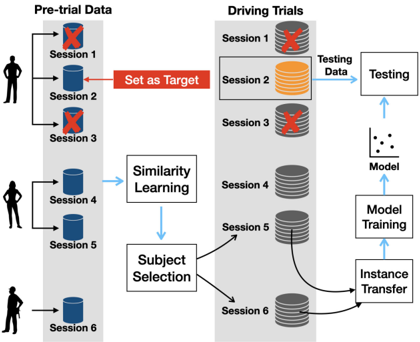
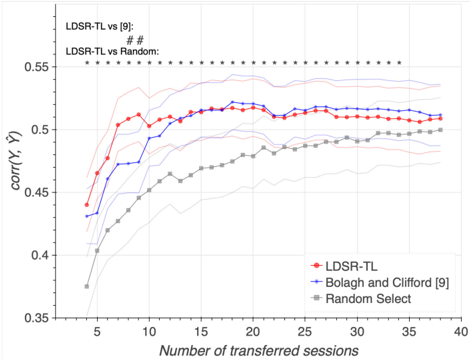
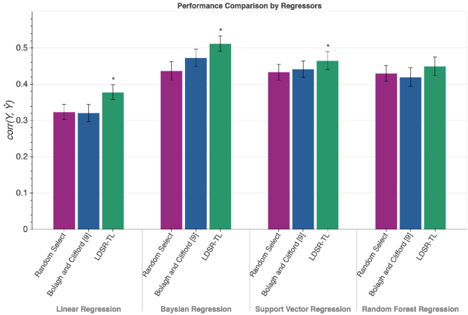
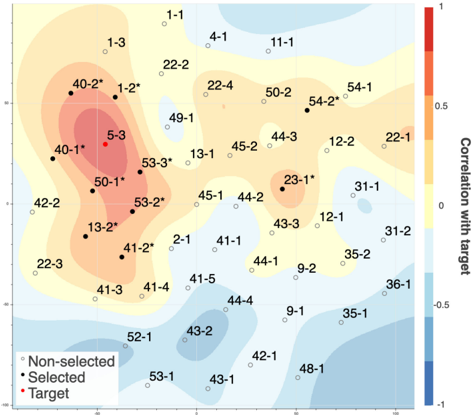
Recently, the advances in passive brain-computer interfaces (BCIs) based on electroencephalogram (EEG) have shed light on real-world neuromonitoring technologies. However, human variability in the EEG activities hinders the development of practical applications of EEG-based BCI. To tackle this problem, many transfer-learning techniques perform supervised calibration. This kind of calibration approach requires task-relevant data, which is impractical in real-life scenarios such as drowsiness during driving. This study presents a transfer-learning framework for EEG decoding based on the low-dimensional representations of subjects learned from the pre-trial EEG. Tensor decomposition was applied to the pre-trial EEG of subjects to extract the underlying characteristics in subject, spatial, and spectral domains. Then, the proposed framework assessed the characteristics to obtain the low-dimensional subject representations such that the subjects with similar brain dynamics can be identified. This method can leverage the existing data from other users, and a small number of data from a rapid, non-task, unsupervised calibration from a new user to build an accurate BCI. Our results demonstrated that, in terms of prediction accuracy, the proposed low-dimensional subject representation-based transfer learning (LDSR-TL) framework outperformed the random selection, and the Riemannian manifold approach in cognitive-state tracking, while requiring fewer training data. The results can greatly improve the practicability, and usability of EEG-based BCI in the real world.
Overview
The claims and statistics of this paper haven’t been checked yet.
Free: it reads the open-access text and checks the first 5 claims that cite a source we can check. Create a free account to check every claim.
Integrity signals
Registry
Cites
Statistics
Figures
Verification
Claims the paper makes
The claims and statistics of this paper haven’t been checked yet.
Free: it reads the open-access text and checks the first 5 claims that cite a source we can check. Create a free account to check every claim.
Claims other papers make about this one
Each is checked against this paper’s own text: does it say what the citing paper says it does?
The cited source says what the claim attributes to it.
In the citing paper
“One of the biggest challenges to making BCIs practical in daily life is high inter-subject variability in brain signals across individuals.”
From Transfer learning for EEG-based BCIs: a comparative evaluation and optimization of data alignment methods (2026) · cites this paper as Jeng et al., 2020
The cited source says what the claim attributes to it.
In the citing paper
“This variability makes it difficult to develop models that can perform well for any individual without requiring time-consuming and lengthy calibration sessions for each individual (Jeng et al., 2020).”
From Transfer learning for EEG-based BCIs: a comparative evaluation and optimization of data alignment methods (2026) · cites this paper as Jeng et al., 2020
Self-check
Percentages, sums and reported differences re-computed from the paper’s own numbers.
The self-check needs the paper’s full text.
Citations
Cites
(2008) · Journal of Machine Learning Research · Cited by 33,051
Pan, S. J., & Yang, Q. (2010) · IEEE Transactions on Knowledge and Data Engineering · doi:10.1109/tkde.2009.191 · Cited by 23,387
Matrix Factorization Techniques for Recommender Systems
Koren, Y., Bell, R., & Volinsky, C. (2009) · Computer · doi:10.1109/mc.2009.263 · Cited by 11,673 · cited 1×
“In fact, latent factors from matrix/tensor decomposition are heavily used in recommendation systems to discover users with similar behaviors [39], [40].”
BackgroundTensor Decompositions and Applications
Kolda, T. G., & Bader, B. W. (2009) · SIAM Review · doi:10.1137/07070111x · Cited by 10,301 · cited 1×
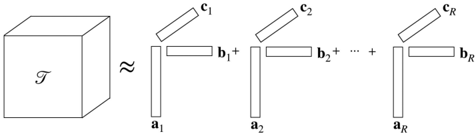
“Thisstudyproposesalow-dimensionalsubject-representation (LDSR) approach based on tensor decomposition [16], [17].”
MethodWeiss, K., Khoshgoftaar, T. M., & Wang, D. (2016) · Journal of Big Data · doi:10.1186/s40537-016-0043-6 · Cited by 6,260
MEG and EEG data analysis with MNE-Python
Gramfort, A. (2013) · Frontiers in Neuroscience · doi:10.3389/fnins.2013.00267 · Cited by 3,784 · cited 1×
“To obtain PSD, we adopted an open-source neurophysiologicaldataanalysislibrary-MNE[46],[47].”
MethodA review of classification algorithms for EEG-based brain–computer interfaces: A 10 year update
Lotte, F., Bougrain, L., Cichocki, A., Clerc, M., Congedo, M., Rakotomamonjy, A., & Yger, F. (2018) · Journal of Neural Engineering · doi:10.1088/1741-2552/aab2f2 · Cited by 2,239 · cited 1×
“A neuromonitoring BCI usually involves a data-driven EEG decoding model that characterizes EEG patterns associated with brain states of interest [6].”
On the Surprising Behavior of Distance Metrics in High Dimensional Space
Aggarwal, C. C., Hinneburg, A., & Keim, D. A. (2001) · Lecture Notes in Computer Science · doi:10.1007/3-540-44503-x_27 · Cited by 2,083 · cited 1×
“First,thevectors ( # channel × # frequency ) falls onto a very high dimensional space, where the concepts of distance and proximity become meaningless [13].”
BackgroundMNE software for processing MEG and EEG data
Gramfort, A., Luessi, M., Larson, E., Engemann, D. A., Strohmeier, D., Brodbeck, C., Parkkonen, L., & Hämäläinen, M. S. (2014) · NeuroImage · doi:10.1016/j.neuroimage.2013.10.027 · Cited by 1,951 · cited 1×
“To obtain PSD, we adopted an open-source neurophysiologicaldataanalysislibrary-MNE[46],[47].”
MethodTensor Decomposition for Signal Processing and Machine Learning
Sidiropoulos, N. D., De Lathauwer, L., Fu, X., Huang, K., Papalexakis, E. E., & Faloutsos, C. (2017) · IEEE Transactions on Signal Processing · doi:10.1109/tsp.2017.2690524 · Cited by 1,617 · cited 1×
“Secondly, constraints may be imposed on the latent factors for model complexity control such as the sparsity of latent factors [36].”
BackgroundCichocki, A., Mandic, D., De Lathauwer, L., Zhou, G., Zhao, Q., Caiafa, C., & PHAN, H. A. (2015) · IEEE Signal Processing Magazine · doi:10.1109/msp.2013.2297439 · Cited by 1,384 · cited 1×
“In other words, tensor decomposition can capture multi-way interactions in the data, which provides more information than the standard pairwise analysis [37].”
BackgroundEmotions Recognition Using EEG Signals: A Survey
Alarcao, S. M., & Fonseca, M. J. (2019) · IEEE Transactions on Affective Computing · doi:10.1109/taffc.2017.2714671 · Cited by 1,201 · cited 1×
“…passive brain-computer interfaces (BCIs) based on electroencephalogram (EEG) decoding of brain activities have enabled many non-invasive neuromonitoring applications including emotion recognition [1], [2], psychiatric diagnosis [3], cognitive load estimation [4], alertness tracking [5], etc.”
BackgroundEEG-Based Emotion Recognition in Music Listening
Lin, Y.-P., Wang, C.-H., Jung, T.-P., Wu, T.-L., Jeng, S.-K., Duann, J.-R., & Chen, J.-H. (2010) · IEEE Transactions on Biomedical Engineering · doi:10.1109/tbme.2010.2048568 · Cited by 1,021 · cited 1×
“R ECENTLY, passive brain-computer interfaces (BCIs) based on electroencephalogram (EEG) decoding of brain activities have enabled many non-invasive neuromonitoring applications including emotion recognition [1], [2], psychiatric di-”
MethodSelf-citationMulticlass Brain–Computer Interface Classification by Riemannian Geometry
Barachant, A., Bonnet, S., Congedo, M., & Jutten, C. (2012) · IEEE Transactions on Biomedical Engineering · doi:10.1109/tbme.2011.2172210 · Cited by 878 · cited 1×
“It has been reported as a good feature for classification tasks [49]– [52].”
BackgroundThe Curse of Dimensionality in Data Mining and Time Series Prediction
Verleysen, M., & François, D. (2005) · Lecture Notes in Computer Science · doi:10.1007/11494669_93 · Cited by 681 · cited 1×
“This phenomenon is the curse of dimensionality that has been reported as a major problem in many machinelearning studies [14], [15].”
BackgroundTransfer Learning for Brain–Computer Interfaces: A Euclidean Space Data Alignment Approach
He, H., & Wu, D. (2020) · IEEE Transactions on Biomedical Engineering · doi:10.1109/tbme.2019.2913914 · Cited by 569 · cited 1×
“First, the baseline-aligning-based transformation method aligns the features of data by removing subject-specific baselines so that the model can be trained from all the aligned data [24], [25], [28].”
MethodWhy and when can deep-but not shallow-networks avoid the curse of dimensionality: A review
Poggio, T., Mhaskar, H., Rosasco, L., Miranda, B., & Liao, Q. (2017) · International Journal of Automation and Computing · doi:10.1007/s11633-017-1054-2 · Cited by 559 · cited 1×
“This phenomenon is the curse of dimensionality that has been reported as a major problem in many machine-learning studies [14], [15].”
BackgroundJayaram, V., Alamgir, M., Altun, Y., Scholkopf, B., & Grosse-Wentrup, M. (2016) · IEEE Computational Intelligence Magazine · doi:10.1109/mci.2015.2501545 · Cited by 468 · cited 1×
“In [19], [20].”
Riemannian geometry for EEG-based brain-computer interfaces; a primer and a review
Congedo, M., Barachant, A., & Bhatia, R. (2017) · Brain-Computer Interfaces · doi:10.1080/2326263x.2017.1297192 · Cited by 456
Unsupervised Multiway Data Analysis: A Literature Survey
Acar, E., & Yener, B. (2009) · IEEE Transactions on Knowledge and Data Engineering · doi:10.1109/tkde.2008.112 · Cited by 434 · cited 1×
“Thisstudyproposesalow-dimensionalsubject-representation (LDSR) approach based on tensor decomposition [16], [17].”
MethodRiemannian Approaches in Brain-Computer Interfaces: A Review
Yger, F., Berar, M., & Lotte, F. (2017) · IEEE Transactions on Neural Systems and Rehabilitation Engineering · doi:10.1109/tnsre.2016.2627016 · Cited by 420
Transfer Learning: A Riemannian Geometry framework with applications to Brain-Computer Interfaces
Zanini, P., Congedo, M., Jutten, C., Said, S., & Berthoumieu, Y. (2018) · IEEE Transactions on Biomedical Engineering · doi:10.1109/tbme.2017.2742541 · Cited by 412 · cited 2×
“First, the baseline-aligning-based transformation method aligns the features of data by removing subjectspecific baselines so that the model can be trained from all the aligned data [24], [25], [28].”
MethodResultEstimating workload using EEG spectral power and ERPs in the n-back task
Brouwer, A.-M., Hogervorst, M. A., van Erp, J. B. F., Heffelaar, T., Zimmerman, P. H., & Oostenveld, R. (2012) · Journal of Neural Engineering · doi:10.1088/1741-2560/9/4/045008 · Cited by 407 · cited 1×
“agnosis [3], cognitive load estimation [4], alertness tracking [5], etc.”
BackgroundTensors for Data Mining and Data Fusion: Models, Applications, and Scalable Algorithms
Papalexakis, E. E., Faloutsos, C., & Sidiropoulos, N. D. (2017) · ACM Transactions on Intelligent Systems and Technology · doi:10.1145/2915921 · Cited by 354 · cited 1×
“Tensors can store data in various domains as real-world data commonly present a multi-way nature [35].”
BackgroundMultisource Transfer Learning for Cross-Subject EEG Emotion Recognition
Li, J., Qiu, S., Shen, Y.-Y., Liu, C.-L., & He, H. (2019) · IEEE Transactions on Cybernetics · doi:10.1109/tcyb.2019.2904052 · Cited by 353 · cited 2×
“The Distribution-matching-based transformation method aims to transform the features of the domain into a latent subspace, where the differences of the feature distributions are small [12], [22], [26], [27], [32].”
BackgroundMethodTensor decomposition of EEG signals: A brief review
Cong, F., Lin, Q.-H., Kuang, L.-D., Gong, X.-F., Astikainen, P., & Ristaniemi, T. (2015) · Journal of Neuroscience Methods · doi:10.1016/j.jneumeth.2015.03.018 · Cited by 334
An electroencephalographic signature predicts antidepressant response in major depression
Wu, W., Zhang, Y., Jiang, J., Lucas, M. V., Fonzo, G. A., Rolle, C. E., Cooper, C., Chin-Fatt, C., Krepel, N., Cornelssen, C. A., et al. (2020) · Nature Biotechnology · doi:10.1038/s41587-019-0397-3 · Cited by 302 · cited 1×
“…passive brain-computer interfaces (BCIs) based on electroencephalogram (EEG) decoding of brain activities have enabled many non-invasive neuromonitoring applications including emotion recognition [1], [2], psychiatric diagnosis [3], cognitive load estimation [4], alertness tracking [5], etc.”
BackgroundDomain Adaptation for EEG Emotion Recognition Based on Latent Representation Similarity
Li, J., Qiu, S., Du, C., Wang, Y., & He, H. (2020) · IEEE Transactions on Cognitive and Developmental Systems · doi:10.1109/tcds.2019.2949306 · Cited by 291 · cited 1×
“The Distribution-matchingbased transformation method aims to transform the features of the domain into a latent subspace, where the differences of the feature distributions are small [12], [22], [26], [27], [32].”
MethodMulti-channel EEG recordings during a sustained-attention driving task
Cao, Z., Chuang, C.-H., King, J.-K., & Lin, C.-T. (2019) · Scientific Data · doi:10.1038/s41597-019-0027-4 · Cited by 268 · cited 1×
“This study exploits a public EEG dataset of a lane-keeping experiment in a simulated driving environment [45].”
BackgroundComposite Common Spatial Pattern for Subject-to-Subject Transfer
Kang, H., Nam, Y., & Choi, S. (2009) · IEEE Signal Processing Letters · doi:10.1109/lsp.2009.2022557 · Cited by 265 · cited 1×
“Kang et al. developed a weighted common spatial filter (CSF) that can be applied to all subjects [34].”
BackgroundAll-at-once Optimization for Coupled Matrix and Tensor Factorizations
Acar, E., Kolda, T. G., & Dunlavy, D. (2011) · arXiv (Cornell University) · doi:10.48550/arxiv.1105.3422 · Cited by 233 · cited 1×
“Weobtainpartialgradientsfor allvariables: The partial gradients for CANDECOMP/PARAFAC (CP) decomposition term can be obtained from [41].”
BackgroundRiemannian Procrustes Analysis: Transfer Learning for Brain–Computer Interfaces
Rodrigues, P. L. C., Jutten, C., & Congedo, M. (2019) · IEEE Transactions on Biomedical Engineering · doi:10.1109/tbme.2018.2889705 · Cited by 219 · cited 1×
“The Distribution-matching-based transformation method aims to transform the features of the domain into a latent subspace, where the differences of the feature distributions are small [12], [22], [26], [27], [32].”
MethodA Convolutional Recurrent Attention Model for Subject-Independent EEG Signal Analysis
Zhang, D., Yao, L., Chen, K., & Monaghan, J. (2019) · IEEE Signal Processing Letters · doi:10.1109/lsp.2019.2906824 · Cited by 211 · cited 1×
“Zhang et al. and Jeon et al. were developing methods for learning the invariant data representations with deep learning approach [29], [31].”
MethodManifold Embedded Knowledge Transfer for Brain-Computer Interfaces
Zhang, W., & Wu, D. (2020) · IEEE Transactions on Neural Systems and Rehabilitation Engineering · doi:10.1109/tnsre.2020.2985996 · Cited by 183 · cited 1×
“Also, both approaches can be integrated together to reduce the differences [23].”
BackgroundMutual Information-Driven Subject-Invariant and Class-Relevant Deep Representation Learning in BCI
Jeon, E., Ko, W., Yoon, J. S., & Suk, H. (2021) · IEEE Transactions on Neural Networks and Learning Systems · doi:10.1109/tnnls.2021.3100583 · Cited by 120 · cited 1×
“Zhang et al. and Jeon et al. were developing methods for learning the invariant data representations with deep learning approach [29], [31].”
MethodA subject transfer framework for EEG classification
Tu, W., & Sun, S. (2011) · Neurocomputing · doi:10.1016/j.neucom.2011.10.024 · Cited by 118 · cited 1×
“Tu and Sun proposed a method that can extract both robust CSFs for all the subjects and adaptive CSFs for a single subject [10].”
MethodWei, C.-S., Lin, Y.-P., Wang, Y.-T., Lin, C.-T., & Jung, T.-P. (2018) · NeuroImage · doi:10.1016/j.neuroimage.2018.03.032 · Cited by 115 · cited 4×
“Pre-trial EEG is adopted to measure subject similarity in a recent study [5].”
BackgroundMethodInfluentialSelf-citationMultitask Learning for Brain-Computer Interfaces
Alamgir, M., Grosse‐Wentrup, M., & Altün, Y. (2010) · Max Planck Institute for Plasma Physics · Cited by 108
Multi-channel EEG recordings during a sustained-attention driving task
Cao, Z., Chuang, C., King, J.-K., & Lin, C. (2018) · Figshare · doi:10.48550/arxiv.1809.06534 · Cited by 96 · cited 1×
“This study exploits a public EEG dataset of a lane-keeping experiment in a simulated driving environment [45].”
BackgroundLearning Invariant Representations From EEG via Adversarial Inference
Ozdenizci, O., Wang, Y., Koike-Akino, T., & Erdogmus, D. (2020) · IEEE Access · doi:10.1109/access.2020.2971600 · Cited by 95 · cited 1×
“aimed at discovering the subject-independent features across subjects by using convolutional neural networks and adversarial training [21].”
BackgroundCitywide traffic congestion estimation with social media
Wang, S., He, L., Stenneth, L., Yu, P. S., & Li, Z. (2015) · ACM SIGSPATIAL International Conference on Advances in Geographic Information Systems (SIGSPATIAL GIS) · doi:10.1145/2820783.2820829 · Cited by 81 · cited 1×
“The iterative algorithm has been studied and applied for solving tensor models in recent works [42]–[44].”
MethodEEG-Based User Reaction Time Estimation Using Riemannian Geometry Features
Wu, D., Lance, B. J., Lawhern, V. J., Gordon, S., Jung, T.-P., & Lin, C.-T. (2017) · IEEE Transactions on Neural Systems and Rehabilitation Engineering · doi:10.1109/tnsre.2017.2699784 · Cited by 64
Self-citationHybrid Real-Time Matrix Factorization for Implicit Feedback Recommendation Systems
Lin, C., Wang, L., & Tsai, K.-H. (2018) · IEEE Access · doi:10.1109/access.2018.2819428 · Cited by 57 · cited 1×
“In fact, latent factors from matrix/tensor decomposition are heavily used in recommendation systems to discover users with similar behaviors [39], [40].”
BackgroundSelf-citationA subject-independent brain-computer interface based on smoothed, second-order baselining
Reuderink, B., Farquhar, J., Poel, M., & Nijholt, A. (2011) · 2011 Annual International Conference of the IEEE Engineering in Medicine and Biology Society · doi:10.1109/iembs.2011.6091139 · Cited by 54 · cited 1×
“First, the baseline-aligning-based transformation method aligns the features of data by removing subjectspecific baselines so that the model can be trained from all the aligned data [24], [25], [28].”
MethodMining Online Social Data for Detecting Social Network Mental Disorders
Shuai, H.-H., Shen, C.-Y., Yang, D.-N., Lan, Y.-F., Lee, W.-C., Yu, P. S., & Chen, M.-S. (2016) · Proceedings of the 25th International Conference on World Wide Web · doi:10.1145/2872427.2882996 · Cited by 51 · cited 1×
“Theiterativealgorithmhas beenstudiedandappliedforsolvingtensormodelsinrecent works[42]–[44].”
Individual Similarity Guided Transfer Modeling for EEG-based Emotion Recognition
Zhang, X., Liang, W., Ding, T., Pan, J., Shen, J. G., Huang, X., & Gao, J. (2019) · IEEE International Conference on Bioinformatics and Biomedicine (BIBM) · doi:10.1109/bibm47256.2019.8982972 · Cited by 37 · cited 1×
“evaluated the values by measuring the differences in data distributions between the two subjects [11], [30].”
MethodTransfer Components Between Subjects for EEG-based Driving Fatigue Detection
Zhang, Y., Zheng, W., & Lu, B. (2015) · Lecture notes in computer science · doi:10.1007/978-3-319-26561-2_8 · Cited by 35 · cited 1×
“The Distribution-matching-based transformation method aims to transform the features of the domain into a latent subspace, where the differences of the feature distributions are small [12], [22], [26], [27], [32].”
MethodDomain Transfer Multiple Kernel Boosting for Classification of EEG Motor Imagery Signals
Dai, M., Wang, S., Zheng, D., Na, R., & Zhang, S. (2019) · IEEE Access · doi:10.1109/access.2019.2908851 · Cited by 35 · cited 1×
“The Distribution-matchingbased transformation method aims to transform the features of the domain into a latent subspace, where the differences of the feature distributions are small [12], [22], [26], [27], [32].”
MethodTensor classification for P300-based brain computer interface
Onishi, A., Phan, A. H., Matsuoka, K., & Cichocki, A. S. (2012) · IEEE International Conference on Acoustics Speech and Signal Processing · doi:10.1109/icassp.2012.6287946 · Cited by 24 · cited 1×
“tensor decomposition to multi-way EEG data to obtain the features of prediction tasks [18], [38].”
MethodTransfer Learning for a Multimodal Hybrid EEG-fTCD Brain–Computer Interface
Dagois, E., Khalaf, A. F., Sejdić, E., & Akçakaya, M. (2018) · IEEE Sensors Letters · doi:10.1109/lsens.2018.2879466 · Cited by 18 · cited 1×
“Dagois etal. and Zhang et al. evaluated the values by measuring the differences in data distributions between the two subjects [11], [30].”
BackgroundBoosting Transfer Learning Improves Performance of Driving Drowsiness Classification Using EEG
He, J., Zhou, G., Wang, H., Sigalas, E., Thakor, N. V., Bezerianos, A., & Li, J. (2018) · International Workshop on Pattern Recognition in NeuroImaging · doi:10.1109/prni.2018.8423951 · Cited by 17 · cited 1×
“Although some research aimed at intra-subject-cross session transfer [33], this study will mainly”
Subject Selection on a Riemannian Manifold for Unsupervised Cross-subject Seizure DetectionPreprint
Bolagh, S. N. G., & Clifford, G. D. (2017) · arXiv (Cornell University) · doi:10.48550/arxiv.1712.00465 · Cited by 11
MUSA: Wi-Fi AP-assisted video prefetching via Tensor Learning
Hu, W., Huang, J., Wang, Z., Wang, P., Yi, K., Wen, Y., Chu, K., & Sun, L. (2017) · International Workshop on Quality of Service · doi:10.1109/iwqos.2017.7969173 · Cited by 6
Mutual Information-driven Subject-invariant and Class-relevant Deep Representation Learning in BCI
Jeon, E., Ko, W., Yoon, J. S., & Suk, H.-I. (2019) · arXiv · doi:10.48550/arxiv.1910.07747
Cited by
Can Emotion Be Transferred?—A Review on Transfer Learning for EEG-Based Emotion Recognition
Li, W., Huan, W., Hou, B., Tian, Y., Zhang, Z., & Song, A. (2021) · IEEE Transactions on Cognitive and Developmental Systems · doi:10.1109/tcds.2021.3098842 · Cited by 138
“This transfer mode usually constructs a feature space or subspace to minimize the discrepancy of data distributions between different domains [58]–[69].”
BackgroundCho, J.-H., Jeong, J.-H., & Lee, S.-W. (2021) · IEEE Transactions on Cybernetics · doi:10.1109/tcyb.2021.3122969 · Cited by 139
“The EEG data were bandpass filtered in the range [4– 40 ] Hz [ For kinematic data, we recorded surface EMG signals to detect muscle activation.”
BackgroundMethodRethinking Membership Inference Attacks Against Transfer Learning
Wu, C., Chen, J., Fang, Q., He, K., Zhao, Z., Ren, H., Xu, G., Liu, Y., & Xiang, Y. (2024) · IEEE Transactions on Information Forensics and Security · doi:10.1109/tifs.2024.3413592 · Cited by 90
“Additionally, our attack method targets typical parameter-based transfer learning, excluding other types such as instance-based, feature representation-based, and relational knowledge-based transfer learning [68], [69], [70], [71].”
MethodJiménez-Guarneros, M., & Fuentes-Pineda, G. (2023) · Biomedical Signal Processing and Control · doi:10.1016/j.bspc.2023.105138 · Cited by 78
Lightweight Source-Free Transfer for Privacy-Preserving Motor Imagery Classification
Zhang, W., & Wu, D. (2022) · IEEE Transactions on Cognitive and Developmental Systems · doi:10.1109/tcds.2022.3193731 · Cited by 41
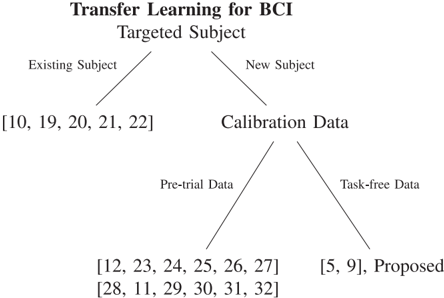
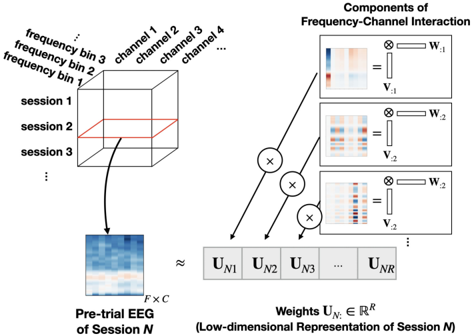
“Jeng et al. [20] proposed a low-dimensional representation-based transfer learning approach, which decomposes the EEG signal into a subject latent factor, a channel latent factor, and a frequency factor.”
Background
Metadata
- Authors
- Jeng, P.-Y., Wei, C.-S., Jung, T.-P., & Wang, L.-C.
- Affiliations
- National Yang Ming Chiao Tung University (TW)
- University of California San Diego (US)
- Venue
- IEEE Journal of Biomedical and Health Informatics
- Published
- 2021-06
- Volume
- 25
- Issue
- 6
- Pages
- 1915-1925
- ISSN
- 2168-2194 (ISSN-L)
- 2168-2208
- OpenAlex
- W3088964528
- Cited by
- 35
- References
- 53
- Citations by year
- 2026: 2 · 2025: 6 · 2024: 8 · 2023: 8 · 2022: 5 · 2021: 6
- FWCI
- 2.56
- Type
- journal article
- Language
- en
- Open access
- hybrid
- doi.org
- Licence
- Locations
- IEEE Journal of Biomedical and Health Informatics (publishedVersion, cc-by-nc-nd)
- PubMed (publishedVersion)
- Funders
- Ministry of Education (108DR012)
- National Chiao Tung University
- Ministry of Science and Technology, Taiwan (107-2917-I-009-008, 108-2634-F-009-006, 109-2222-E-009-006-MY3)
- Army Research Laboratory (W911NF-10-2-0022, W911NF2020088)
- US National Science Foundation (CBET-1935860)
- Topics
- Life Sciences › Neuroscience › Cognitive Neuroscience › EEG and Brain-Computer Interfaces
- Physical Sciences › Computer Science › Artificial Intelligence › Emotion and Mood Recognition
- Physical Sciences › Computer Science › Human-Computer Interaction › Gaze Tracking and Assistive Technology
- Keywords
- EEG decoding, transfer learning, passive brain-computer interface, unsupervised calibration, tensor decomposition, drowsiness detection, interindividual variability, neuromonitoring
- MeSH terms
- Machine Learning, Algorithms, Brain, Electroencephalography, Humans, Brain-Computer Interfaces
About these checks
Registry, retraction, Cites and statistics results are computed, not judged, with one exception: a printed reference that no index lists is read once by a model before it counts as a citation error. Claims are extracted by a model and kept only when their quote appears verbatim in the text; each cited source is then checked, with a model’s help, for whether it says what the claim relies on. Those verdicts can be wrong — read the claim’s quote and the cited source before relying on one.
Statistics and arithmetic are recomputed, not judged.
Confidence bands are shown only for fields calibrated on our annotated test set. None is calibrated yet, so no band is shown.
What counts as a claim ›How we measure confidence ›How we check this ›
Are you an author, or do you see a problem with this page? Request a review
Data sources
Bibliographic data: Semantic Scholar, OpenAlex, Crossref.
Contains information from the Semantic Scholar Academic Graph Datasets, made available under the ODC Attribution License (ODC-BY 1.0).
Semantic Scholar’s data is described in: Kinney, R., et al. (2023). The Semantic Scholar Open Data Platform. arXiv:2301.10140.
