

Edge YOLO: Real-Time Intelligent Object Detection System Based on Edge-Cloud Cooperation in Autonomous Vehicles
Open accessThe DOI matches its Crossref record; 58 of the 64 references it cites were found in a registry or an index; 3 of the 4 sources its claims cite were checked for support.
Abstract
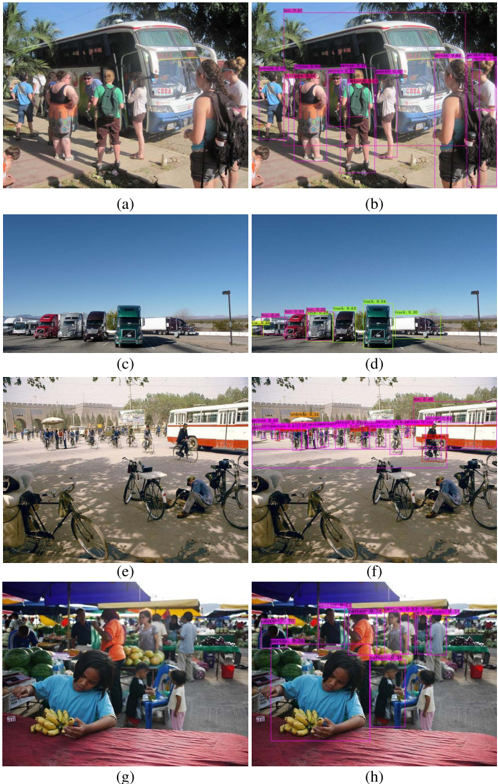
Driven by the ever-increasing requirements of autonomous vehicles, such as traffic monitoring and driving assistant, deep learning-based object detection (DL-OD) has been increasingly attractive in intelligent transportation systems. However, it is difficult for the existing DL-OD schemes to realize the responsible, cost-saving, and energy-efficient autonomous vehicle systems due to low their inherent defects of low timeliness and high energy consumption. In this paper, we propose an object detection (OD) system based on edge-cloud cooperation and reconstructive convolutional neural networks, which is called Edge YOLO. This system can effectively avoid the excessive dependence on computing power and uneven distribution of cloud computing resources. Specifically, it is a lightweight OD framework realized by combining pruning feature extraction network and compression feature fusion network to enhance the efficiency of multi-scale prediction to the largest extent. In addition, we developed an autonomous driving platform equipped with NVIDIA Jetson for system-level verification. We experimentally demonstrate the reliability and efficiency of Edge YOLO on COCO2017 and KITTI data sets, respectively. According to COCO2017 standard datasets with a speed of 26.6 frames per second (FPS), the results show that the number of parameters in the entire network is only 25.67 MB, while the accuracy (mAP) is up to 47.3%.
Overview
CoChat Summary
## TL;DR
Edge YOLO is a lightweight edge-cloud object detection system for autonomous vehicles that keeps real-time inference on Jetson edge devices while using the cloud for training and weight updates. The paper reports 47.3% mAP on COCO2017 at 26.6 FPS, with 25.27 MB model size and 8 million parameters.
## Key findings
- On COCO2017, Edge YOLO reached 47.3% mAP at 26.6 FPS with a model size of 25.27 MB; the paper also states the network has 8 million parameters and about 10.2% of the original YOLOv4 structure.
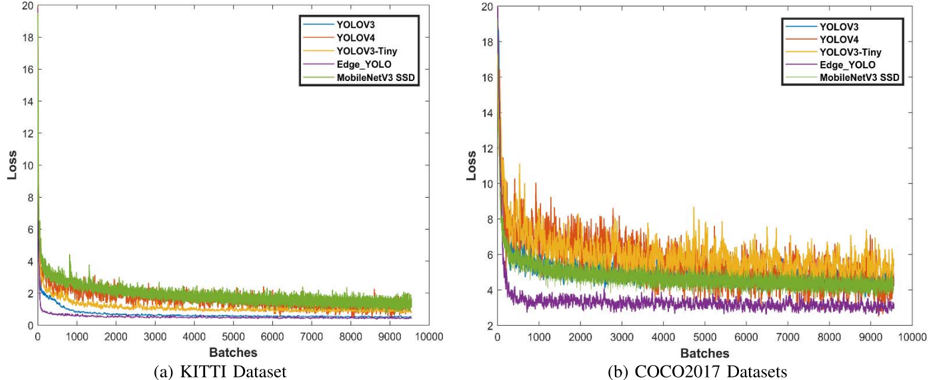
- On the KITTI 2D object dataset, Edge YOLO achieved 0.8212 mAP with 40.6 FPS on Jetson Xavier and 9.7 FPS on Jetson Nano, according to the comparison table.
- Compared with YOLOV3, YOLOV4, MobileNetV3 SSD, and YOLOV3-Tiny, Edge YOLO is presented as a balance between speed and accuracy; on COCO2017 it is reported at 26.6 FPS versus 11.8, 5.2, 11.4, and 62.7 FPS for those baselines, respectively, with the corresponding mAP values listed in Table V.
- The paper states average power consumption is 16.8 W and claims the edge-cloud cooperation scheme improves real-time performance while reducing dependence on cloud resources.
## Methods
- The system is an edge-cloud cooperation (E-CC) design: the edge device performs real-time inference, while the cloud handles data upload, labeling, retraining, and weight updates.
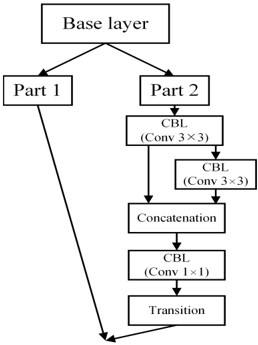
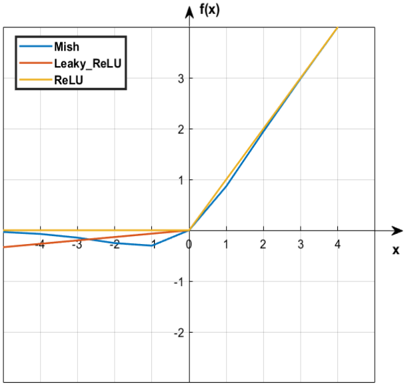
- The model is built by modifying YOLOv4: the paper says it trims the Backbone using channel pruning, simplifies the Neck by retaining SPP + FPN and removing PANet parts, and uses Leaky_ReLU plus TensorRT for acceleration.
- Experiments use COCO2017 and KITTI 2D Object Dataset, with training in Ubuntu 18.04 using PyTorch 1.6 for MobileNetV3 SSD and Darknet for YOLO-based networks; evaluation uses mAP, FPS, BFLOPS, size, and IoU = 0.5.
## Limitations
- The paper itself notes that in super multi-target detection, Edge YOLO is slightly inferior to YOLOV4 because of the limited number of network layers and parameters.
- The text makes evident that reported performance depends on specific hardware and inference settings, including Jetson Xavier/Nano, TensorRT FP16, and the stated network environment; this limits direct generalization beyond the tested setup.
- The paper states that mAP drops to a certain extent during FP16 accelerated inference on the large COCO2017 dataset.
Model-written summary. Check it against the paper before relying on it.
Integrity signals
Registry
Cites
Statistics
Figures










Verification
Claims the paper makes
3 Valid · 4 Not valid · 1 Not checked · 51 Own results and interpretations
Every source the paper cites for this claim was checked and supports it.
In the paper
“Based on the latest object detection network YOLOV4 [19] in the YOLO series, the proposed Edge YOLO is more suitable for edge computing scenarios based on 5G for traffic safety monitoring and driving assistance.”
What the sources say
- Supportedcites [19] [19] A. Bochkovskiy, C.-Y. Wang, and H.-Y. M. Liao, 'YOLOv4: Optimal speed and accuracy of object detection,' 2020, arXiv:2004.10934 . - source
The citation is attached to YOLOv4 as the network on which the citing authors base their proposed Edge YOLO. The source identifies and describes YOLOv4 in §3.4 (p. 7); the statement about Edge YOLO’s suitability for 5G edge computing is the citing authors’ own claim, not one attributed to this source. (LLM, conf=0.91)
plainstates a cause- Asserted: passes — The authors put it forward as true.
- Checkable: passes — It can be checked against evidence.
- Load-bearing: passes — The paper’s conclusions depend on it.
- Based: passes — The paper gives a reason why it holds.
- Rests on an assumption not shown here.
- Supported
A result the paper reports from its own data — it cites no other source for it, so there is none to check. The quote shows it is in the paper.
In the paper
“Edge YOLO | 25.27 | 0.473 | 26.6 | 11.4 | 10.250G | 0.325 | 49.5 | 26.6 |”
plain- Asserted: passes — The authors put it forward as true.
- Checkable: passes — It can be checked against evidence.
- Load-bearing: passes — The paper’s conclusions depend on it.
- Based: passes — The paper gives a reason why it holds.
The paper states this without a source or data behind it here, so there is nothing to check it against. The quote shows it is in the paper.
In the paper
“The parameter quantity is only about 10% of the original network.”
plain- Asserted: passes — The authors put it forward as true.
- Checkable: passes — It can be checked against evidence.
- Load-bearing: passes — The paper’s conclusions depend on it.
- Based: unclear — It is unclear why the paper says it holds.
A result the paper reports from its own data — it cites no other source for it, so there is none to check. The quote shows it is in the paper.
In the paper
“However, its mAP is up to 47.3%.”
plain- Asserted: passes — The authors put it forward as true.
- Checkable: passes — It can be checked against evidence.
- Load-bearing: passes — The paper’s conclusions depend on it.
- Based: passes — The paper gives a reason why it holds.
A result the paper reports from its own data — it cites no other source for it, so there is none to check. The quote shows it is in the paper.
In the paper
“According to COCO2017 standard datasets with a speed of 26.6 frames per second (FPS), the results show that the number of parameters in the entire network is only 25.67 MB, while the accuracy (mAP) is up to 47.3%.”
plain- Asserted: passes — The authors put it forward as true.
- Checkable: passes — It can be checked against evidence.
- Load-bearing: passes — The paper’s conclusions depend on it.
- Based: passes — The paper gives a reason why it holds.
15 more claims
Create a free account to see all 59 claims and every source verdict.
- It may state two separate claims as one. 29
- Probably not a substantial claim. 14
- The quote only partly states this claim. 4
Claims other papers make about this one
Each is checked against this paper’s own text: does it say what the citing paper says it does?
The source backs part of the claim, not all of it — or backs it for a different population, condition or comparison.
In the citing paper
“Relying solely on edge devices may not handle all complex or rare defects, affecting overall inspection results, whereas relying entirely on cloud computing may encounter bottlenecks in network latency and data transmission [6].”
From Cloud-Edge Collaborative Defect Detection Based on Efficient Yolo Networks and Incremental Learning (2024) · cites this paper as [6]
Experimental — accuracy not yet measuredThe cited source says what the claim attributes to it.
In the citing paper
“Relying solely on edge devices may not handle all complex or rare defects, affecting overall inspection results, whereas relying entirely on cloud computing may encounter bottlenecks in network latency and data transmission [6].”
From Cloud-Edge Collaborative Defect Detection Based on Efficient Yolo Networks and Incremental Learning (2024) · cites this paper as [6]
Citations
Cites
Deep Residual Learning for Image Recognition
He, K., Zhang, X., Ren, S., & Sun, J. (2016) · 2016 IEEE Conference on Computer Vision and Pattern Recognition (CVPR) · doi:10.1109/cvpr.2016.90 · Cited by 235,474
ImageNet classification with deep convolutional neural networks
Krizhevsky, A., Sutskever, I., & Hinton, G. E. (2017) · Communications of the ACM · doi:10.1145/3065386 · Cited by 112,155
Faster R-CNN: Towards Real-Time Object Detection with Region Proposal Networks
Ren, S., He, K., Girshick, R., & Sun, J. (2017) · IEEE Transactions on Pattern Analysis and Machine Intelligence · doi:10.1109/tpami.2016.2577031 · Cited by 73,472
Densely Connected Convolutional Networks
Huang, G., Liu, Z., van der Maaten, L., & Weinberger, K. Q. (2016) · arXiv · doi:10.48550/arxiv.1608.06993 · Cited by 48,960
Densely Connected Convolutional Networks
Huang, G., Liu, Z., Van Der Maaten, L., & Weinberger, K. Q. (2017) · 2017 IEEE Conference on Computer Vision and Pattern Recognition (CVPR) · doi:10.1109/cvpr.2017.243 · Cited by 48,566
Microsoft COCO: Common Objects in Context
Lin, T.-Y., Maire, M., Belongie, S., Hays, J., Perona, P., Ramanan, D., Dollár, P., & Zitnick, C. L. (2014) · Lecture Notes in Computer Science · doi:10.1007/978-3-319-10602-1_48 · Cited by 45,460
Rich Feature Hierarchies for Accurate Object Detection and Semantic Segmentation
Girshick, R., Donahue, J., Darrell, T., & Malik, J. (2014) · 2014 IEEE Conference on Computer Vision and Pattern Recognition · doi:10.1109/cvpr.2014.81 · Cited by 32,684
(2016) · Cited by 31,590
Feature Pyramid Networks for Object Detection
Lin, T.-Y., Dollar, P., Girshick, R., He, K., Hariharan, B., & Belongie, S. (2017) · 2017 IEEE Conference on Computer Vision and Pattern Recognition (CVPR) · doi:10.1109/cvpr.2017.106 · Cited by 30,939
Girshick, R. (2015) · 2015 IEEE International Conference on Computer Vision (ICCV) · doi:10.1109/iccv.2015.169 · Cited by 28,105
SSD: Single Shot MultiBox Detector
Liu, W., Anguelov, D., Erhan, D., Szegedy, C., Reed, S., Fu, C.-Y., & Berg, A. C. (2016) · Lecture Notes in Computer Science · doi:10.1007/978-3-319-46448-0_2 · Cited by 22,128
MobileNets: Efficient Convolutional Neural Networks for Mobile Vision Applications
Howard, A. G., Zhu, M., Chen, B., Kalenichenko, D., Wang, W., Weyand, T., Andreetto, M., & Adam, H. (2017) · arXiv · doi:10.48550/arxiv.1704.04861 · Cited by 19,015
YOLOv3: An Incremental Improvement
Redmon, J., & Farhadi, A. (2018) · arXiv · doi:10.48550/arxiv.1804.02767 · Cited by 17,141
A Multi-Modal Distributed Real-Time IoT System for Urban Traffic Control (Invited Paper)
Khanam, Z., Achari, V. P. S., Boukhennoufa, I., Jindal, A., & Singh, A. K. (2024) · DROPS (Schloss Dagstuhl – Leibniz Center for Informatics) · doi:10.4230/oasics.ng-res.2024.2 · Cited by 14,040
YOLOv4: Optimal Speed and Accuracy of Object Detection
Bochkovskiy, A., Wang, C.-Y., & Liao, H.-Y. M. (2020) · arXiv · doi:10.48550/arxiv.2004.10934 · Cited by 10,307
Howard, A., Sandler, M., Chen, B., Wang, W., Chen, L.-C., Tan, M., Chu, G., Vasudevan, V., Zhu, Y., Pang, R., et al. (2019) · 2019 IEEE/CVF International Conference on Computer Vision (ICCV) · doi:10.1109/iccv.2019.00140 · Cited by 9,708
ShuffleNet V2: Practical Guidelines for Efficient CNN Architecture Design
Ma, N., Zhang, X., Zheng, H.-T., & Sun, J. (2018) · Lecture notes in computer science · doi:10.1007/978-3-030-01264-9_8 · Cited by 7,356 · cited 1×
“For example, group pointwise convolution channel rearrangement and other methods in ShuffleNet [31], MobileNet [32] changes the convolution structure by decomposing a standard convolution factor into a depth-wise conv and a pointwise conv, and completely separate the spatial correlation between the…”
MethodShuffleNet V2: Practical Guidelines for Efficient CNN Architecture Design
Ma, N., Zhang, X., Zheng, H.-T., & Sun, J. (2018) · arXiv · Cited by 7,344
Distance-IoU Loss: Faster and Better Learning for Bounding Box Regression
Zheng, Z., Wang, P., Liu, W., Li, J., Ye, R., & Ren, D. (2019) · arXiv · doi:10.48550/arxiv.1911.08287 · Cited by 5,313
Distance-IoU Loss: Faster and Better Learning for Bounding Box Regression
Zheng, Z., Wang, P., Liu, W., Li, J., Ye, R., & Ren, D. (2020) · Proceedings of the AAAI Conference on Artificial Intelligence · doi:10.1609/aaai.v34i07.6999 · Cited by 5,288
CSPNet: A New Backbone that can Enhance Learning Capability of CNN
Wang, C.-Y., Mark Liao, H.-Y., Wu, Y.-H., Chen, P.-Y., Hsieh, J.-W., & Yeh, I.-H. (2020) · 2020 IEEE/CVF Conference on Computer Vision and Pattern Recognition Workshops (CVPRW) · doi:10.1109/cvprw50498.2020.00203 · Cited by 5,265
Deep Residual Learning for Image Recognition
He, K., Zhang, X., Ren, S., & Sun, J. (2015) · arXiv · doi:10.48550/arxiv.1512.03385 · Cited by 4,196
Soft-NMS — Improving Object Detection with One Line of Code
Bodla, N., Singh, B., Chellappa, R., & Davis, L. S. (2017) · 2017 IEEE International Conference on Computer Vision (ICCV) · doi:10.1109/iccv.2017.593 · Cited by 2,274 · cited 1×
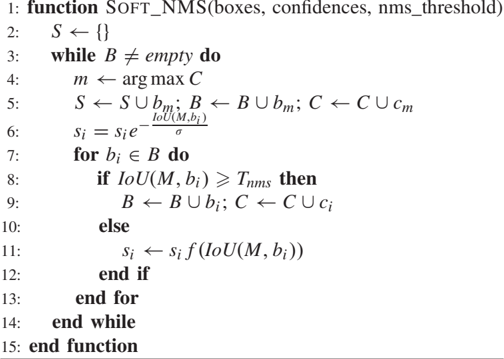
“We use an optimization algorithm called Soft-NMS [44] to adjust the score of the score and output the result through the function of the IoU, instead of directly setting the score to zero.”
MethodPANet: Few-Shot Image Semantic Segmentation With Prototype Alignment
Wang, K., Liew, J. H., Zou, Y., Zhou, D., & Feng, J. (2019) · 2019 IEEE/CVF International Conference on Computer Vision (ICCV) · doi:10.1109/iccv.2019.00929 · Cited by 1,500
Rich feature hierarchies for accurate object detection and semantic segmentationPreprint
Girshick, R., Donahue, J., Darrell, T. J., et al. (2013) · arXiv (Cornell University) · doi:10.48550/arxiv.1311.2524 · Cited by 514
Choi, J., Chun, D., Kim, H., & Lee, H.-J. (2019) · 2019 IEEE/CVF International Conference on Computer Vision (ICCV) · doi:10.1109/iccv.2019.00059 · Cited by 505 · cited 1×
“Among those algorithms, the most representative one is the You Only Look Once (YOLO) [13] series of object detection networks.”
MethodFeature Pyramid Networks for Object Detection
Lin, T.-Y., Dollár, P., Girshick, R., He, K., Hariharan, B., & Belongie, S. (2016) · arXiv (Cornell University) · doi:10.48550/arxiv.1612.03144 · Cited by 380
Deep Fuzzy Hashing Network for Efficient Image Retrieval
Lu, H., Zhang, M., Xu, X., Li, Y., & Shen, H. T. (2021) · IEEE Transactions on Fuzzy Systems · doi:10.1109/tfuzz.2020.2984991 · Cited by 340 · cited 1×
“However, massive amounts of data will be generated in this scenario, especially image and video, which are transmitted to the edge layer of the network [5], [6].”
BackgroundAttribute-Based Encryption With Parallel Outsourced Decryption for Edge Intelligent IoV
Feng, C., Yu, K., Aloqaily, M., Alazab, M., Lv, Z., & Mumtaz, S. (2020) · IEEE Transactions on Vehicular Technology · doi:10.1109/tvt.2020.3027568 · Cited by 253
Self-citationBlockchain-Based Cross-Domain Authentication for Intelligent 5G-Enabled Internet of Drones
Feng, C., Liu, B., Guo, Z., Yu, K., Qin, Z., & Choo, K.-K. R. (2022) · IEEE Internet of Things Journal · doi:10.1109/jiot.2021.3113321 · Cited by 243
Self-citationUser-Oriented Virtual Mobile Network Resource Management for Vehicle Communications
Lu, H., Zhang, Y., Li, Y., Jiang, C., & Abbas, H. (2021) · IEEE Transactions on Intelligent Transportation Systems · doi:10.1109/tits.2020.2991766 · Cited by 221
Blockchain-Empowered Decentralized Horizontal Federated Learning for 5G-Enabled UAVs
Feng, C., Liu, B., Yu, K., Goudos, S. K., & Wan, S. (2022) · IEEE Transactions on Industrial Informatics · doi:10.1109/tii.2021.3116132 · Cited by 213
Self-citationTan, L., Yu, K., Shi, N., Yang, C., Wei, W., & Lu, H. (2022) · IEEE Transactions on Network Science and Engineering · doi:10.1109/tnse.2021.3101842 · Cited by 208
Self-citationZhang, J., Liu, M., & Shen, D. (2017) · IEEE Transactions on Image Processing · doi:10.1109/tip.2017.2721106 · Cited by 192 · cited 1×
“Then, we review the development history of deep learning algorithms for object detection, including one-stage and two-stage object detection networks and lightweight neural networks [24].”
MethodAnti-Forensics for Face Swapping Videos via Adversarial Training
Ding, F., Zhu, G., Li, Y., Zhang, X., Atrey, P. K., & Lyu, S. (2022) · IEEE Transactions on Multimedia · doi:10.1109/tmm.2021.3098422 · Cited by 142
End-to-End Optimized ROI Image Compression
Cai, C., Chen, L., Zhang, X., & Gao, Z. (2019) · IEEE Transactions on Image Processing · doi:10.1109/tip.2019.2960869 · Cited by 128
Melanoma Lesion Detection and Segmentation Using YOLOv4-DarkNet and Active Contour
Albahli, S., Nida, N., Irtaza, A., Yousaf, M. H., & Mahmood, M. T. (2020) · IEEE Access · doi:10.1109/access.2020.3035345 · Cited by 126
Visual information processing for deep-sea visual monitoring system
Ma, C., Li, X., Li, Y., Tian, X., Wang, Y., Kim, H., & Serikawa, S. (2021) · Cognitive Robotics · doi:10.1016/j.cogr.2020.12.002 · Cited by 126
Yang, L., Yu, K., Yang, S. X., Chakraborty, C., Lu, Y., & Guo, T. (2022) · IEEE Transactions on Industrial Informatics · doi:10.1109/tii.2021.3128954 · Cited by 126 · cited 1×
“By virtue of 5G future networks, more smart devices at the edge can access to the cloud platform rapidly and reliably [3].”
BackgroundSelf-citationEarly Collision Detection for Massive Random Access in Satellite-Based Internet of Things
Zhen, L., Zhang, J., Yu, K., Kumar, N., Barnawi, A., & Xie, Y. (2021) · IEEE Transactions on Vehicular Technology · doi:10.1109/tvt.2021.3076015 · Cited by 116
Self-citationDeep-Learning-Empowered Digital Forensics for Edge Consumer Electronics in 5G HetNets
Ding, F., Zhu, G., Alazab, M., Li, X., & Yu, K. (2020) · IEEE Consumer Electronics Magazine · doi:10.1109/mce.2020.3047606 · Cited by 112
Self-citationDRRS-BC: Decentralized Routing Registration System Based on Blockchain
Lu, H., Tang, Y., & Sun, Y. (2021) · IEEE/CAA Journal of Automatica Sinica · doi:10.1109/jas.2021.1004204 · Cited by 111
Constructing a prior-dependent graph for data clustering and dimension reduction in the edge of AIoT
Guo, T., Yu, K., Aloqaily, M., & Wan, S. (2021) · Future Generation Computer Systems · doi:10.1016/j.future.2021.09.044 · Cited by 109
Self-citationYOLOv3-DPFIN: A Dual-Path Feature Fusion Neural Network for Robust Real-Time Sonar Target Detection
Kong, W., Hong, J., Jia, M., Yao, J., Cong, W., Hu, H., & Zhang, H. (2020) · IEEE Sensors Journal · doi:10.1109/jsen.2019.2960796 · Cited by 107 · cited 1×
“6, in order to count the most common box sizes from all ground-truth boxes in the training set, we follow the anchor box [43] mechanism in YOLOV3 to optimize the range of predicted objects and combine them with the prediction of bounding box and add its prior experience for multi-scale prediction.”
MethodDing, F., Yu, K., Gu, Z., Li, X., & Shi, Y.-Q. (2021) · IEEE Transactions on Intelligent Transportation Systems · doi:10.1109/tits.2021.3120075 · Cited by 102
Self-citationCross-Layer Device Authentication With Quantum Encryption for 5G Enabled IIoT in Industry 4.0
Xu, D., Yu, K., & Ritcey, J. A. (2021) · IEEE Transactions on Industrial Informatics · doi:10.1109/tii.2021.3130163 · Cited by 101
Self-citationNovel Online Sequential Learning-Based Adaptive Routing for Edge Software-Defined Vehicular Networks
Zhao, L., Zhao, W., Hawbani, A., Al-Dubai, A. Y., Min, G., Zomaya, A. Y., & Gong, C. (2021) · IEEE Transactions on Wireless Communications · doi:10.1109/twc.2020.3046275 · Cited by 95 · cited 1×
“In this regard, edge computing is deemed as potential solution, which can compensate for the uneven distribution of computing power of each edge node generated by the cloud due to releasing the restriction of transmission bandwidth [8].”
BackgroundOvercoming Multi-Model Forgetting in One-Shot NAS With Diversity Maximization
Zhang, M., Li, H., Pan, S., Chang, X., & Su, S. (2020) · 2020 IEEE/CVF Conference on Computer Vision and Pattern Recognition (CVPR) · doi:10.1109/cvpr42600.2020.00783 · Cited by 83
Schug, D., Nadig, V., Weissler, B., Gebhardt, P., & Schulz, V. (2019) · IEEE Transactions on Radiation and Plasma Medical Sciences · doi:10.1109/trpms.2018.2884564 · Cited by 56 · cited 1×
“At present, devices that can implement edge computing include SoC, FPGA, Application Specific Integrated Circuit(ASIC) [36], Central Processing Units (CPU) and GPU.”
MethodStrategies for Re-Training a Pruned Neural Network in an Edge Computing Paradigm
Chandakkar, P. S., Li, Y., Ding, P. L. K., & Li, B. (2017) · 2017 IEEE International Conference on Edge Computing (EDGE) · doi:10.1109/ieee.edge.2017.45 · Cited by 39
Haut, J. M., Bernabé, S., Paoletti, M. E., Fernández-Beltrán, R., Plaza, A., & Plaza, J. (2018) · IEEE Geoscience and Remote Sensing Letters · doi:10.1109/lgrs.2018.2881045 · Cited by 35
High performance neural network inference, streaming, and visualization of medical images using FAST
Smistad, E., Ostvik, A., & Pedersen, A. (2019) · IEEE Access · doi:10.1109/access.2019.2942441 · Cited by 32 · cited 1×
“More importantly, it can use migration learning tools to convert the common deep learning frameworks such as Tensorflow, Caffe, and Pytorch into TensorRT [38] to accelerate model inference.”
MethodRegion average pooling for context-aware object detection
Kuan, K., Manek, G., Lin, J., Fang, Y., & Chandrasekhar, V. (2017) · Proceedings - International Conference on Image Processing · doi:10.1109/icip.2017.8296501 · Cited by 25
When Edge Caching Meets a Budget: Near Optimal Service Delivery in Multi-Tiered Edge Clouds
Xia, Q., Ren, W., Xu, Z., Wang, X., & Liang, W. (2021) · IEEE Transactions on Services Computing · doi:10.1109/tsc.2021.3091462 · Cited by 18
Hagiwara, K., Hayashi, T., Kawasaki, S., Arakawa, F., Endo, O., Nomura, H., Tsukamoto, A., Nguyen, D., Nguyen, B., Tran, A., et al. (2018) · 2018 IEEE Symposium in Low-Power and High-Speed Chips (COOL CHIPS) · doi:10.1109/coolchips.2018.8373084 · Cited by 8 · cited 1×
“What’s more, it is worth mentioning that the NVIDIA Jetson series is a promising AI SoC [37].”
BackgroundLustig, F., & Lustig, F. (2016) · 2016 13th International Conference on Remote Engineering and Virtual Instrumentation (REV) · doi:10.1109/rev.2016.7444513
Cited by
A Comprehensive Review of YOLO Architectures in Computer Vision: From YOLOv1 to YOLOv8 and YOLO-NAS
Terven, J., Córdova-Esparza, D.-M., & Romero-González, J.-A. (2023) · Machine Learning and Knowledge Extraction · doi:10.3390/make5040083 · Cited by 3,052
Liu, C., Wang, K., Li, Q., Zhao, F., Zhao, K., & Ma, H. (2024) · Neural Networks · doi:10.1016/j.neunet.2023.11.041 · Cited by 251
Sadaf, M., Iqbal, Z., Javed, A. R., Saba, I., Krichen, M., Majeed, S., & Raza, A. (2023) · Technologies · doi:10.3390/technologies11050117 · Cited by 205
Empowering Edge Intelligence: A Comprehensive Survey on On-Device AI Models
Wang, X., Tang, Z., Guo, J., Meng, T., Wang, C., Wang, T., & Jia, W. (2025) · ACM Computing Surveys · doi:10.1145/3724420 · Cited by 202
An Improved YOLOv8 to Detect Moving Objects
Safaldin, M., Zaghden, N., & Mejdoub, M. (2024) · IEEE Access · doi:10.1109/access.2024.3393835 · Cited by 171
Metadata
- Authors
- Liang, S., Wu, H., Zhen, L., Hua, Q., Garg, S., Kaddoum, G., Hassan, M. M., & Yu, K.
- Affiliations
- Xi’an University of Posts and Telecommunications (CN)
- Hubei University of Arts and Science (CN)
- École de Technologie Supérieure (CA)
- King Saud University (SA)
- Waseda University (JP)
- ORCID
- Venue
- IEEE Transactions on Intelligent Transportation Systems
- Published
- 2022-12
- Volume
- 23
- Issue
- 12
- Pages
- 25345-25360
- ISSN
- 1524-9050 (ISSN-L)
- 1558-0016
- OpenAlex
- W4220827132
- Cited by
- 367
- References
- 64
- Citations by year
- 2026: 88 · 2025: 148 · 2024: 75 · 2023: 51 · 2022: 5
- FWCI
- 22.83
- Type
- journal article
- Language
- en
- Open access
- green
- arxiv.org
- Licence
- Locations
- IEEE Transactions on Intelligent Transportation Systems (publishedVersion)
- arXiv (Cornell University) (submittedVersion)
- Espace ÉTS (ETS) (submittedVersion)
- arXiv (Cornell University) (cc-by)
- Funders
- King Saud University, Riyadh, Saudi Arabia, through the Researchers Supporting Project (RSP 2022/18)
- Topics
- Physical Sciences › Computer Science › Computer Vision and Pattern Recognition › Advanced Neural Network Applications
- Physical Sciences › Computer Science › Computer Networks and Communications › IoT and Edge/Fog Computing
- Physical Sciences › Engineering › Automotive Engineering › Autonomous Vehicle Technology and Safety
- Keywords
- object detection, autonomous vehicles, lightweight neural networks, network pruning, feature fusion, multi-scale prediction, real-time detection, energy efficiency, NVIDIA Jetson, traffic monitoring, driving assistance
About these checks
Registry, retraction, Cites and statistics results are computed, not judged, with one exception: a printed reference that no index lists is read once by a model before it counts as a citation error. Claims are extracted by a model and kept only when their quote appears verbatim in the text; each cited source is then checked, with a model’s help, for whether it says what the claim relies on. Those verdicts can be wrong — read the claim’s quote and the cited source before relying on one.
The claim verdicts this report counts are experimental: their accuracy is not yet measured.
A language model drew the claims from the paper on 2026-09-28, under version 3 of the claim definition (model deepseek-v4.1-flash, prompt extract-v3).
A second model labelled each claim on 2026-09-28 (model jev-1.13-20260917, definition revision gold-guideline-v0.2).
Cited sources are checked with a language model’s help (gpt-6-sol).
Statistics and arithmetic are recomputed, not judged.
Confidence bands are shown only for fields calibrated on our annotated test set. None is calibrated yet, so no band is shown.
What counts as a claim ›How we measure confidence ›How we check this ›
Are you an author, or do you see a problem with this page? Request a review
Data sources
Bibliographic data: Semantic Scholar, OpenAlex, Crossref.
Contains information from the Semantic Scholar Academic Graph Datasets, made available under the ODC Attribution License (ODC-BY 1.0).
Semantic Scholar’s data is described in: Kinney, R., et al. (2023). The Semantic Scholar Open Data Platform. arXiv:2301.10140.
