

The DOI matches its Crossref record; 14 of the 14 references it cites were found in a registry or an index.
Resilience during uncertainty? Greater social connectedness during COVID‐19 lockdown is associated with reduced distress and fatigue
Open accessAbstract
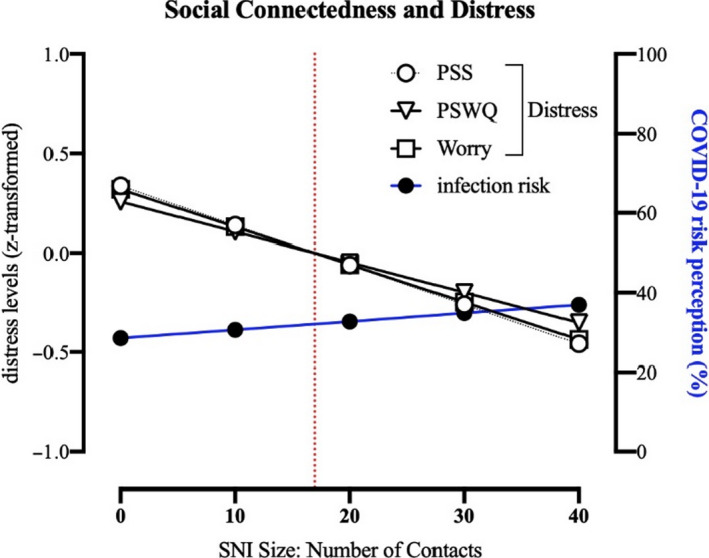
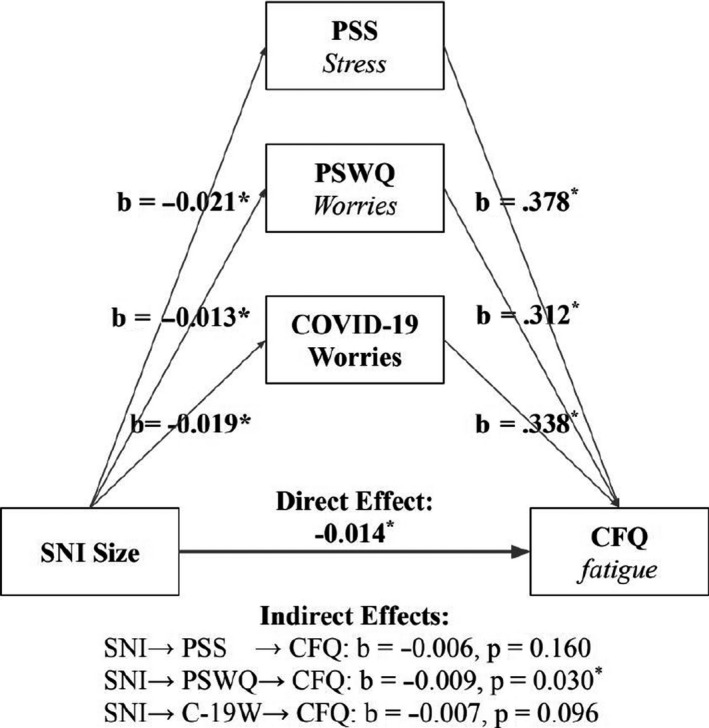
Background: Social connections are crucial for our health and well‐being. This is especially true during times of high uncertainty and distress, such as during the COVID‐19 lockdown. This period was characterized by unprecedented physical distancing (often communicated as social distancing) measures resulting in significant changes to people’s usual social lives. Given the potential effects of this disruption on people’s well‐being, it is crucial to identify factors which are associated with negative health outcomes, and conversely, those that promote resilience during times of adversity. Aims: We examined the relationship between individuals’ levels of social connectedness during lockdown and self‐reported stress, worry, and fatigue. Method: Survey data were collected from 981 individuals in a representative sample of Austrian citizens. Data collection occurred during the last week of a six‐week nationwide lockdown due to the COVID‐19 pandemic. The final sample consisted of 902 participants. Participants were asked to complete validated questionnaires to assess levels of social connectedness as well as measures of perceived stress, worry—both general and COVID‐19 specific—and symptoms of fatigue during the previous two weeks. Results: Our results demonstrate that greater social connectedness during the lockdown period was associated with lower levels of perceived stress, as well as general and COVID‐19‐specific worries. Furthermore, we found a negative relationship between fatigue and social connectedness, which was mediated by feelings of stress, general worries, and COVID‐19‐specific worries—respectively, indicating that individuals with smaller network sizes, who were highly distressed during the pandemic, were also likely to report feeling more fatigued. Conclusion: Our findings highlight the important role that social connections play in promoting resilience by buffering against negative physical and mental health outcomes, particularly in times of adversity in times of adversity.
Overview
The claims and statistics of this paper haven’t been checked yet.
Run the check — free, no account needed. It reads the open-access text and checks the sources it cites.
Integrity signals
Registry
Cites
Statistics
Figures
Verification
Claims the paper makes
The claims and statistics of this paper haven’t been checked yet.
Run the check — free, no account needed. It reads the open-access text and checks the sources it cites.
Claims other papers make about this one
Each is checked against this paper’s own text: does it say what the citing paper says it does?
The cited source says what the claim attributes to it.
In the citing paper
“demonstrating that social connections play an important role in promoting resilience by buffering against negative physical and mental health outcomes (Nitschke, et al., 2021).”
From Living through lockdown: A qualitative exploration of individuals' experiences in the UK. (2022) · cites this paper as Nitschke, et al., 2021
The cited source says what the claim attributes to it.
In the citing paper
“a recent study showed that greater social connectedness during lockdown was associated with lower levels of perceived stress, lower COVID‐19 related worries and feeling less fatigued”
From Living through lockdown: A qualitative exploration of individuals' experiences in the UK. (2022) · cites this paper as Nitschke, et al., 2021
Self-check
Percentages, sums and reported differences re-computed from the paper’s own numbers.
The self-check needs the paper’s full text.
Citations
Cites
The Use of Cronbach’s Alpha When Developing and Reporting Research Instruments in Science Education
Taber, K. S. (2018) · Research in Science Education · doi:10.1007/s11165-016-9602-2 · Cited by 10,679
Social Relationships and Mortality Risk: A Meta-analytic Review
Holt-Lunstad, J., Smith, T. B., & Layton, J. B. (2010) · PLoS Medicine · doi:10.1371/journal.pmed.1000316 · Cited by 7,272
Dickerson, S. S., & Kemeny, M. E. (2004) · Psychological Bulletin · doi:10.1037/0033-2909.130.3.355 · Cited by 5,881
Development and validation of the Penn State Worry Questionnaire
Meyer, T. J., Miller, M. L., Metzger, R. L., & Borkovec, T. D. (1990) · Behaviour Research and Therapy · doi:10.1016/0005-7967(90)90135-6 · Cited by 5,099 · cited 2×
“, 1994)—and general worry (PSWQ; Meyer et al., 1990), and fatigue (CFQ; Chalder et al.”
BackgroundDevelopment of a fatigue scale
Chalder, T., Berelowitz, G., Pawlikowska, T., Watts, L., Wessely, S., Wright, D., & Wallace, E. P. (1993) · Journal of Psychosomatic Research · doi:10.1016/0022-3999(93)90081-p · Cited by 3,032 · cited 3×
“…a higher number of social contacts in the last two weeks of a nationwide lockdown (i.e., higher social connectedness; Cohen et al., 1997) was associated with lower levels of stress (PSS; Cohen et al., 1994)—and general worry (PSWQ; Meyer et al., 1990), and fatigue (CFQ; Chalder et al., 1993).”
BackgroundMethodSocial relationships and health: The toxic effects of perceived social isolation
Cacioppo, J. T., & Cacioppo, S. (2014) · Social and Personality Psychology Compass · doi:10.1111/spc3.12087 · Cited by 1,057
Interpersonal emotion regulation.
Zaki, J., & Williams, W. C. (2013) · Emotion · doi:10.1037/a0033839 · Cited by 988
Holt-Lunstad, J. (2018) · Annual Review of Psychology · doi:10.1146/annurev-psych-122216-011902 · Cited by 873
Americans’ COVID-19 stress, coping, and adherence to CDC guidelines
Park, C. L., Russell, B. S., Fendrich, M., Finkelstein-Fox, L., Hutchison, M., & Becker, J. (2020) · Journal of General Internal Medicine · doi:10.1007/s11606-020-05898-9 · Cited by 728
Social determinants of health and survival in humans and other animals
Snyder-Mackler, N., Burger, J. R., Gaydosh, L., Belsky, D. W., Noppert, G. A., Campos, F. A., Bartolomucci, A., Yang, Y. C., Aiello, A. E., O’Rand, A., et al. (2020) · Science · doi:10.1126/science.aax9553 · Cited by 679
Behar, E., Alcaine, O., Zuellig, A. R., & Borkovec, T. D. (2003) · Journal of Behavior Therapy and Experimental Psychiatry · doi:10.1016/s0005-7916(03)00004-1 · Cited by 373
The Psychology of Fatigue: Work, Effort and Control
Hockey, R. (2013) · doi:10.1017/cbo9781139015394 · Cited by 350
Neural mechanisms of social homeostasis
Matthews, G. A., & Tye, K. M. (2019) · Annals of the New York Academy of Sciences · doi:10.1111/nyas.14016 · Cited by 273 · cited 1×
“Conversely, thosewho report higher levels of distressmay also be less likely to seek social contactwith others (Matthews & Tye, 2019).”
BackgroundSocial networks, social support mechanisms, and quality of life after breast cancer diagnosis
Kroenke, C. H., Kwan, M. L., Neugut, A. I., Ergas, I. J., Wright, J. D., Caan, B. J., Hershman, D., & Kushi, L. H. (2013) · Breast Cancer Research and Treatment · doi:10.1007/s10549-013-2477-2 · Cited by 233
Research works printed but not linked: 40
- 10.1176/appi.ajp.160.2.221 · DOI
- 10.1177/0898264308324626 · DOI
- 10.1080/10615809608249406 · DOI
- 10.1097/NMD.0b013e31819d9334 · DOI
- 10.1016/j.tics.2020.05.016 · DOI · Paper page
- 10.1016/j.jpsychores.2009.10.007 · DOI
- 10.1080/13607863.2018.1481928 · DOI
- 10.1016/j.socscimed.2016.01.020 · DOI
- 10.1037/0033-2909.112.1.155 · DOI · Paper page
- 10.1001/jama.1997.03540480040036 · DOI · Paper page
- Cohen S., 1994, Perceived stress scale, Measuring Stress: A Guide for Health and Social Scientists, 10, 1
- Cohen S., 1985, Social support and health
- 10.1037/hea0000029 · DOI
- 10.1038/npp.2017.231 · DOI
- 10.1038/nn.3086 · DOI · Paper page
- 10.1016/j.neuroimage.2007.01.038 · DOI · Paper page
- 10.1111/1467-6494.00066 · DOI
- 10.1016/S0006-3223(03)00465-7 · DOI · Paper page
- 10.1037/0278-6133.15.2.135 · DOI
- 10.1016/j.neubiorev.2009.10.002 · DOI · Paper page
- 10.1177/0093854806290007 · DOI
- 10.1093/scan/nsz033 · DOI
- 10.1016/j.neuropsychologia.2018.04.030 · DOI
- 10.1016/j.psychres.2011.07.015 · DOI
- 10.1007/s00127-013-0798-4 · DOI
- R Core Team, 2020, R: A language and environment for statistical computing
- 10.1016/j.ajp.2020.102066 · DOI · Paper page
- 10.1016/j.jad.2014.12.049 · DOI · Paper page
- Shevlin M., 2020, COVID‐19‐related anxiety predicts somatic symptoms in the UK population, British Journal of Health Psychology, 26
- 10.1111/j.1749-6632.2009.04418.x · DOI · Paper page
- 10.1146/annurev.soc.34.040507.134601 · DOI · Paper page
- 10.1097/PSY.0b013e31825941ff · DOI
- 10.1007/BF03405526 · DOI
- 10.1016/j.neubiorev.2016.05.008 · DOI
- Tingley D. Yamamoto T. Hirose K. Keele L. &Imai K.(2014).mediation: R package for causal mediation analysis. · DOI
- 10.1016/j.socscimed.2005.10.034 · DOI
- 10.1016/j.euroneuro.2020.05.003 · DOI · Paper page
- 10.1111/j.1083-6101.2012.01584.x · DOI
- 10.1093/med:psych/9780195126709.003.0004 · DOI
- 10.1186/1744-9081-5-10 · DOI
Cited by
Sorted by citations
Manchia, M., Gathier, A. W., Eser, H. Y., Schmidt, M. V., de Quervain, D. J. ‐., van Amelsvoort, T., Bisson, J. I., Cryan, J. F., Howes, O. D., Pinto, L., et al. (2021) · European Neuropsychopharmacology · doi:10.1016/j.euroneuro.2021.10.864 · Cited by 532
Nobari, H., Fashi, M., Eskandari, A., Villafaina, S., Murillo-Garcia, Á., & Pérez-Gómez, J. (2021) · International Journal of Environmental Research and Public Health · doi:10.3390/ijerph18094563 · Cited by 204
“According to a systematic review, children should perform 60–180 min of daily moderate to vigorous physical activity and use their own bodyweight or light weights during strength training [48].”
BackgroundLabrague, L. (2021) · Journal of Nursing Management · doi:10.1111/jonm.13383 · Cited by 174
“Research during the first few months of the pandemic correlated poor staffing ratios with increased patient workloads, leading to a higher incidence of anxiety, depression, anxiety and post- traumatic stress disorder among nurses in Canada (Havaei et al., 2021).”
BackgroundDo we experience pandemic fatigue? current state, predictors, and prevention
Haktanır, A., Can, N., Seki, T., Kurnaz, M. F., & Dilmaç, B. (2021) · Current Psychology · doi:10.1007/s12144-021-02397-w · Cited by 161
Simon, J., Helter, T. M., White, R. G., van der Boor, C., & Łaszewska, A. (2021) · BMC Public Health · doi:10.1186/s12889-021-10351-5 · Cited by 154
Metadata
- Authors
- Nitschke, J. P., Forbes, P. A. G., Ali, N., Cutler, J., Apps, M. A. J., Lockwood, P. L., & Lamm, C.
- Affiliations
- University of Vienna (AT)
- University of Oxford (GB)
- Corresponding author
- Nitschke, Jonas P.
- Lamm, Claus
- ORCID
- Venue
- British Journal of Health Psychology
- Publisher
- Wiley
- Published
- 2020-10-25
- Volume
- 26
- Issue
- 2
- Pages
- 553-569
- ISSN
- 1359-107X (ISSN-L)
- 2044-8287
- PMC
- PMC8247344
- OpenAlex
- W3094151465
- Cited by
- 329
- References
- 68
- Citations by year
- 2026: 9 · 2025: 34 · 2024: 38 · 2023: 65 · 2022: 98 · 2021: 77 · 2020: 8
- FWCI
- 24.82
- Type
- journal article
- Language
- en
- Open access
- hybrid
- doi.org
- Licence
- Locations
- British Journal of Health Psychology (publishedVersion, cc-by)
- PubMed Central (publishedVersion, cc-by)
- PubMed (publishedVersion)
- eScholarship@McGill (McGill) (submittedVersion)
- University of Birmingham Research Portal (University of Birmingham) (submittedVersion, other-oa)
- PsyArXiv (OSF Preprints) (submittedVersion, cc-by)
- PsyArXiv (OSF Preprints) (submittedVersion)
- Funders
- Universität Wien
- Austrian Science Fund (I3381)
- Topics
- Social Sciences › Psychology › Clinical Psychology › COVID-19 and Mental Health
- Social Sciences › Psychology › Clinical Psychology › Resilience and Mental Health
- Social Sciences › Health › Health disparities and outcomes
- Keywords
- social connectedness, COVID-19 lockdown, perceived stress, worry, fatigue, resilience, social distancing, social networks, psychological distress, mediation
- MeSH terms
- COVID-19, SARS-CoV-2, Communicable Disease Control, Fatigue, Humans, Uncertainty, Pandemics
About these checks
Registry, retraction, Cites and statistics results are computed, not judged, with one exception: a printed reference that no index lists is read once by a model before it counts as a citation error. Claims are extracted by a model and kept only when their quote appears verbatim in the text; each cited source is then checked, with a model’s help, for whether it says what the claim relies on. Those verdicts can be wrong — read the claim’s quote and the cited source before relying on one.
Statistics and arithmetic are recomputed, not judged.
Confidence bands are shown only for fields calibrated on our annotated test set. None is calibrated yet, so no band is shown.
What counts as a claim ›How we measure confidence ›How we check this ›
Are you an author, or do you see a problem with this page? Request a review
