

The DOI matches its Crossref record; 94 of the 100 references it cites were found in a registry or an index; none of the 31 sources its claims cite is checked for support yet.
A Re-Evaluation of Random-Effects Meta-Analysis
Open accessAbstract
Summary: Meta-analysis in the presence of unexplained heterogeneity is frequently undertaken by using a random-effects model, in which the effects underlying different studies are assumed to be drawn from a normal distribution. Here we discuss the justification and interpretation of such models, by addressing in turn the aims of estimation, prediction and hypothesis testing. A particular issue that we consider is the distinction between inference on the mean of the random-effects distribution and inference on the whole distribution. We suggest that random-effects meta-analyses as currently conducted often fail to provide the key results, and we investigate the extent to which distribution-free, classical and Bayesian approaches can provide satisfactory methods. We conclude that the Bayesian approach has the advantage of naturally allowing for full uncertainty, especially for prediction. However, it is not without problems, including computational intensity and sensitivity to a priori judgements. We propose a simple prediction interval for classical meta-analysis and offer extensions to standard practice of Bayesian meta-analysis, making use of an example of studies of ‘set shifting’ ability in people with eating disorders.
Overview
AI snapshot
Written from the paper’s full text.
TL;DR
This paper re-evaluates random-effects meta-analysis, arguing that inference should address the whole distribution of effects—especially prediction—rather than only the mean effect. It proposes a simple classical prediction interval and illustrates the issues with 14 studies of set-shifting ability in eating disorders.
Key findings
- Focusing only on the mean of the random-effects distribution is insufficient: two meta-analytic data sets can produce identical mean estimates and standard errors while differing greatly in heterogeneity, so τ² and the whole distribution matter.
- Distribution-free classical methods can estimate μ and τ² but cannot satisfactorily address prediction; the paper proposes an approximate prediction interval using a t-distribution with k−2 degrees of freedom.
- In the 14-study set-shifting example, heterogeneity was Q=16.73, df=13, P=0.02, I²=22%, and τ²=0.022; the classical random-effects interval was 0.19–0.53, while the approximate prediction interval for a new study ranged from −0.01 to 0.74.
- Bayesian normal random-effects analysis gave μ median 0.36 (95% credible interval 0.18–0.55), θ_new median 0.36 (−0.12–0.84), P(θ_new<0)=0.950, and τ² median 0.023 (0.000024–0.196); Bayesian credible intervals were wider because uncertainty in τ² was properly accounted for.
Methods
- The paper is a methodological re-evaluation structured around estimation, prediction, and hypothesis testing, comparing distribution-free, classical parametric, Bayesian, and non-normal/flexible random-effects approaches.
- The example uses 14 comparative studies of set-shifting ability in people with eating disorders versus healthy controls, taken from Roberts et al. (2007), with effect sizes as standardized differences in means and their standard errors.
- Analyses include classical inverse-variance random-effects meta-analysis with a moment estimate of between-study variance, and Bayesian normal random-effects meta-analysis via MCMC in WinBUGS with a uniform prior for τ (>0) and a vague N(0,10³) prior for μ; sensitivity analyses used a t-distribution with 4 degrees of freedom, an inverse gamma prior, and a shrinkage prior.
Limitations
- Stated: the Bayesian approach has problems including computational intensity and sensitivity to a priori judgements; prior choice can substantially affect results; model uncertainty is not accounted for; the normal random-effects assumption is strong and usually made without convincing evidence; few studies make τ² and μ imprecise; separating diversity from bias is difficult; and caution is warranted with funnel plot asymmetry.
- Stated: the example data were available only as effect sizes and confidence intervals, from which standard errors were calculated; more detailed data should be explicitly modelled when available.
- Evident: the example has only 14 studies and some large within-study standard errors; the paper notes that meta-analyses with very small numbers of studies (2–4) pose particular problems, and prediction intervals depend on the number of studies and within-study standard errors.
Model-written summary. Check it against the paper before relying on it.
Integrity signals
Registry
Cites
Statistics
Figures
Verification
Claims the paper makes
52 Own interpretation · 22 Not checked yet · 12 No basis given · 7 Own result
The paper states this without a source or data behind it here, so there is nothing to check it against. The quote shows it is in the paper.
In the paper
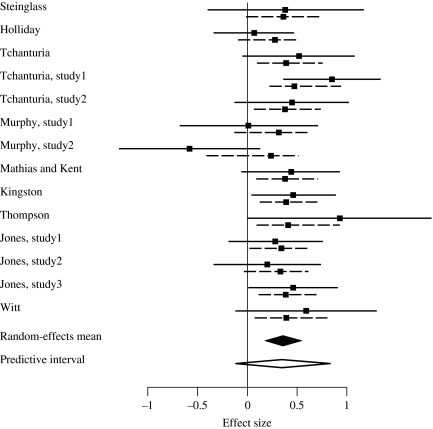
“The approximate prediction interval (12) for the true effect in a new study, however, ranges from −0.01 to 0.74, which is slightly less convincing.”
§ A re-evaluation of random-effects meta-analysis > 7 Example
plain- Asserted: passes — The authors put it forward as true.
- Checkable: passes — It can be checked against evidence.
- Load-bearing: passes — The paper’s conclusions depend on it.
- Based: passes — The paper gives a reason why it holds.
- The authors state this as an assumption: The random effects in the meta-analysis are normally distributed.
In the paper
“Alternatively using an inverse gamma distribution for τ2 with parameters 0.001 and 0.001 (Smith et al., 1995) produces a prediction interval from −0.008 to 0.73 (P(θnew<0)=0.973)”
§ A re-evaluation of random-effects meta-analysis > 7 Example
What the sources say
- Not checked yetcites Smith et al., 1995 source
plaindirect- Asserted: passes — The authors put it forward as true.
- Checkable: passes — It can be checked against evidence.
- Load-bearing: unclear — It is unclear whether the paper’s conclusions depend on it.
- Based: passes — The paper gives a reason why it holds.
A result the paper reports from its own data — it cites no other source for it, so there is none to check. The quote shows it is in the paper.
In the paper
“| τ2 | 0.023 | (0.000024, 0.196) | — |”
§ A re-evaluation of random-effects meta-analysis > 7 Example
plain- Asserted: passes — The authors put it forward as true.
- Checkable: passes — It can be checked against evidence.
- Load-bearing: unclear — It is unclear whether the paper’s conclusions depend on it.
- Based: passes — The paper gives a reason why it holds.
- The authors state this as an assumption: The random effects in the meta-analysis are normally distributed.
In the paper
“There is some heterogeneity between the effect sizes, accounting for 22% of the variation in point estimates by using the statistic I2 (Higgins and Thompson, 2002).”
§ A re-evaluation of random-effects meta-analysis > 7 Example
What the sources say
- Not checked yetcites Higgins and Thompson, 2002
plaincorrelational- Asserted: passes — The authors put it forward as true.
- Checkable: passes — It can be checked against evidence.
- Load-bearing: unclear — It is unclear whether the paper’s conclusions depend on it.
- Based: passes — The paper gives a reason why it holds.
- The authors state this as an assumption: The random effects in the meta-analysis are normally distributed.
The paper states this without a source or data behind it here, so there is nothing to check it against. The quote shows it is in the paper.
In the paper
“A random-effects meta-analysis reveals a statistically significant benefit on average, based on the inference in equation (13) regarding μ alone.”
§ A re-evaluation of random-effects meta-analysis > 7 Example
plaincorrelational- Asserted: passes — The authors put it forward as true.
- Checkable: passes — It can be checked against evidence.
- Load-bearing: passes — The paper’s conclusions depend on it.
- Based: passes — The paper gives a reason why it holds.
- The authors state this as an assumption: The random effects in the meta-analysis are normally distributed.
A result the paper reports from its own data — it cites no other source for it, so there is none to check. The quote shows it is in the paper.
In the paper
“It is evident from Table 1, as well as from the estimated effect sizes, plotted with 95% confidence intervals in Fig. 2, that the majority of trials indicate greater set shifting deficiency in people with eating disorders.”
§ A re-evaluation of random-effects meta-analysis > 7 Example
boostedcorrelational- Asserted: passes — The authors put it forward as true.
- Checkable: passes — It can be checked against evidence.
- Load-bearing: unclear — It is unclear whether the paper’s conclusions depend on it.
- Based: passes — The paper gives a reason why it holds.
- The authors state this as an assumption: The random effects in the meta-analysis are normally distributed.
In the paper
“Correspondingly, the test for qualitative interaction (9) produces a statistically non-significant test statistic Q*=2.56, compared with a critical value of 14.15 for a significance level of 5% (Gail and Simon, 1985).”
§ A re-evaluation of random-effects meta-analysis > 7 Example
What the sources say
- Not checked yetcites Gail and Simon, 1985 source
plain- Asserted: passes — The authors put it forward as true.
- Checkable: passes — It can be checked against evidence.
- Load-bearing: unclear — It is unclear whether the paper’s conclusions depend on it.
- Based: passes — The paper gives a reason why it holds.
- The authors state this as an assumption: The random effects in the meta-analysis are normally distributed.
A conclusion the paper draws from its own results — it cites no other source for it, so there is none to check. The quote shows it is in the paper.
In the paper
“However, such an assumption of homogeneity can seldom be made for studies in the biomedical and social sciences.”
§ A re-evaluation of random-effects meta-analysis > 1 Introduction
plain- Asserted: passes — The authors put it forward as true.
- Checkable: unclear — It is unclear whether it could be checked against evidence.
- Load-bearing: passes — The paper’s conclusions depend on it.
- Based: passes — The paper gives a reason why it holds.
A conclusion the paper draws from its own results — it cites no other source for it, so there is none to check. The quote shows it is in the paper.
In the paper
“This property is shared with the conventional test from a random-effects meta-analysis, i.e. of hypothesis (2) against”
§ A re-evaluation of random-effects meta-analysis > 2 Important questions to address in a random-effects meta-analysis > 2.3 Statistical tests in the presence of heterogeneity
plain- Asserted: passes — The authors put it forward as true.
- Checkable: passes — It can be checked against evidence.
- Load-bearing: passes — The paper’s conclusions depend on it.
- Based: passes — The paper gives a reason why it holds.
A conclusion the paper draws from its own results — it cites no other source for it, so there is none to check. The quote shows it is in the paper.
In the paper
“Estimation of τ2 is just as important.”
§ A re-evaluation of random-effects meta-analysis > 2 Important questions to address in a random-effects meta-analysis > 2.1 Estimation in random-effects meta-analysis
plain- Asserted: passes — The authors put it forward as true.
- Checkable: unclear — It is unclear whether it could be checked against evidence.
- Load-bearing: passes — The paper’s conclusions depend on it.
- Based: passes — The paper gives a reason why it holds.
- It may state two separate claims as one. 25
- Probably not a substantial claim. 29
A result the paper reports from its own data — it cites no other source for it, so there is none to check. The quote shows it is in the paper.
In the paper
“Various sensitivity analyses have small effects on the results, though they do not materially affect the conclusions from the Bayesian meta-analysis.”
§ A re-evaluation of random-effects meta-analysis > 7 Example
plain- Asserted: passes — The authors put it forward as true.
- Checkable: passes — It can be checked against evidence.
- Load-bearing: unclear — It is unclear whether the paper’s conclusions depend on it.
- Based: passes — The paper gives a reason why it holds.
It may state two separate claims as one.
In the paper
“using the shrinkage prior that was advocated by DuMouchel and Normand (2000) produces a prediction interval from −0.009 to 0.72 (P(θnew<0)=0.973)”
§ A re-evaluation of random-effects meta-analysis > 7 Example
What the sources say
- Not checked yetcites DuMouchel and Normand (2000)
plaindirect- Asserted: passes — The authors put it forward as true.
- Checkable: passes — It can be checked against evidence.
- Load-bearing: fails — The paper’s conclusions may not depend on it.
- Based: passes — The paper gives a reason why it holds.
Probably not a substantial claim. The paper’s conclusions may not depend on it.
A result the paper reports from its own data — it cites no other source for it, so there is none to check. The quote shows it is in the paper.
In the paper
“The estimate of the heterogeneity variance is 0.022 and the test for heterogeneity is statistically significant at conventional levels of significance.”
§ A re-evaluation of random-effects meta-analysis > 7 Example
plain- Asserted: passes — The authors put it forward as true.
- Checkable: passes — It can be checked against evidence.
- Load-bearing: passes — The paper’s conclusions depend on it.
- Based: passes — The paper gives a reason why it holds.
It may state two separate claims as one.
- The authors state this as an assumption: The random effects in the meta-analysis are normally distributed.
The paper states this without a source or data behind it here, so there is nothing to check it against. The quote shows it is in the paper.
In the paper
“Using a t-distribution with 4 degrees of freedom for the random effects yields a prediction interval from −0.16 to 0.89 (P(θnew<0)=0.947).”
§ A re-evaluation of random-effects meta-analysis > 7 Example
plaindirect- Asserted: passes — The authors put it forward as true.
- Checkable: passes — It can be checked against evidence.
- Load-bearing: unclear — It is unclear whether the paper’s conclusions depend on it.
- Based: passes — The paper gives a reason why it holds.
It may state two separate claims as one.
A result the paper reports from its own data — it cites no other source for it, so there is none to check. The quote shows it is in the paper.
In the paper
“Results for μ and θnew are comparable with the classical results, with credible intervals being wider because the Bayesian analyses properly account for uncertainty in the estimation of τ2.”
§ A re-evaluation of random-effects meta-analysis > 7 Example
plaindirect- Asserted: passes — The authors put it forward as true.
- Checkable: passes — It can be checked against evidence.
- Load-bearing: unclear — It is unclear whether the paper’s conclusions depend on it.
- Based: passes — The paper gives a reason why it holds.
It may state two separate claims as one.
- The authors state this as an assumption: The random effects in the meta-analysis are normally distributed.
A result the paper reports from its own data — it cites no other source for it, so there is none to check. The quote shows it is in the paper.
In the paper
“| μ | 0.36 | (0.18, 0.55) | 0.999 |”
§ A re-evaluation of random-effects meta-analysis > 7 Example
plain- Asserted: passes — The authors put it forward as true.
- Checkable: passes — It can be checked against evidence.
- Load-bearing: unclear — It is unclear whether the paper’s conclusions depend on it.
- Based: passes — The paper gives a reason why it holds.
It may state two separate claims as one.
- The authors state this as an assumption: The random effects in the meta-analysis are normally distributed.
A result the paper reports from its own data — it cites no other source for it, so there is none to check. The quote shows it is in the paper.
In the paper
“| θnew | 0.36 | (−0.12, 0.84) | 0.950 |”
§ A re-evaluation of random-effects meta-analysis > 7 Example
plain- Asserted: passes — The authors put it forward as true.
- Checkable: passes — It can be checked against evidence.
- Load-bearing: unclear — It is unclear whether the paper’s conclusions depend on it.
- Based: passes — The paper gives a reason why it holds.
It may state two separate claims as one.
- The authors state this as an assumption: The random effects in the meta-analysis are normally distributed.
None of the sources cited for this claim have been checked yet.
In the paper
“Although sources of heterogeneity should ideally be investigated (Thompson, 1994), selection of covariates to explain heterogeneity can be difficult, both practically (Higgins et al., 2002) and theoretically (Thompson and Higgins, 2002).”
§ A re-evaluation of random-effects meta-analysis > 1 Introduction
What the sources say
plain- Asserted: passes — The authors put it forward as true.
- Checkable: passes — It can be checked against evidence.
- Load-bearing: passes — The paper’s conclusions depend on it.
- Based: passes — The paper gives a reason why it holds.
Probably not a substantial claim. It may state two separate claims as one.
A conclusion the paper draws from its own results — it cites no other source for it, so there is none to check. The quote shows it is in the paper.
In the paper
“Realistic interpretation of predictions from a random-effects model can, however, be difficult.”
§ A re-evaluation of random-effects meta-analysis > 2 Important questions to address in a random-effects meta-analysis > 2.2 Prediction using random-effects meta-analysis
plain- Asserted: passes — The authors put it forward as true.
- Checkable: fails — It may be too vague to check against evidence.
- Load-bearing: passes — The paper’s conclusions depend on it.
- Based: passes — The paper gives a reason why it holds.
Probably not a substantial claim. It may be too vague to check against evidence.
A conclusion the paper draws from its own results — it cites no other source for it, so there is none to check. The quote shows it is in the paper.
In the paper
“This variance explicitly describes the extent of the heterogeneity and has a crucial role in assessing the degree of consistency of effects across studies, which is an element of random-effects meta-analysis that often receives too little attention.”
§ A re-evaluation of random-effects meta-analysis > 2 Important questions to address in a random-effects meta-analysis > 2.1 Estimation in random-effects meta-analysis
plaincorrelational- Asserted: passes — The authors put it forward as true.
- Checkable: passes — It can be checked against evidence.
- Load-bearing: passes — The paper’s conclusions depend on it.
- Based: passes — The paper gives a reason why it holds.
Probably not a substantial claim. It may state two separate claims as one.
In the paper
“However, a single parameter cannot adequately summarize heterogeneous effects (Raudenbush and Bryk, 1985) and so focusing on μ alone is usually insufficient.”
§ A re-evaluation of random-effects meta-analysis > 2 Important questions to address in a random-effects meta-analysis > 2.1 Estimation in random-effects meta-analysis
What the sources say
- Not checked yetcites Raudenbush and Bryk, 1985 source
plain- Asserted: passes — The authors put it forward as true.
- Checkable: passes — It can be checked against evidence.
- Load-bearing: passes — The paper’s conclusions depend on it.
- Based: passes — The paper gives a reason why it holds.
It may state two separate claims as one.
A conclusion the paper draws from its own results — it cites no other source for it, so there is none to check. The quote shows it is in the paper.
In the paper
“Although often useful, the test may be misleading if there is heterogeneity and in particular will not reject hypothesis (1) if effects are variable and centred on 0.”
§ A re-evaluation of random-effects meta-analysis > 2 Important questions to address in a random-effects meta-analysis > 2.3 Statistical tests in the presence of heterogeneity
hedgedconditional- Asserted: passes — The authors put it forward as true.
- Checkable: passes — It can be checked against evidence.
- Load-bearing: passes — The paper’s conclusions depend on it.
- Based: passes — The paper gives a reason why it holds.
It may state two separate claims as one.
In the paper
“Meta-analyses are often built on an assumption that directions of effect are consistent across studies (Peto, 1987), yet formal tests of this important supposition are not routinely undertaken.”
§ A re-evaluation of random-effects meta-analysis > 2 Important questions to address in a random-effects meta-analysis > 2.3 Statistical tests in the presence of heterogeneity
What the sources say
- Not checked yetcites Peto, 1987 source
plain- Asserted: passes — The authors put it forward as true.
- Checkable: passes — It can be checked against evidence.
- Load-bearing: passes — The paper’s conclusions depend on it.
- Based: passes — The paper gives a reason why it holds.
It may state two separate claims as one.
The paper states this without a source or data behind it here, so there is nothing to check it against. The quote shows it is in the paper.
In the paper
“An important rationale for meta-analyses is the possibility of increased power, compared with the individual studies, to detect moderate effects.”
§ A re-evaluation of random-effects meta-analysis > 2 Important questions to address in a random-effects meta-analysis > 2.3 Statistical tests in the presence of heterogeneity
hedgedconditional- Asserted: passes — The authors put it forward as true.
- Checkable: passes — It can be checked against evidence.
- Load-bearing: fails — The paper’s conclusions may not depend on it.
- Based: fails — The paper may give no reason why it holds.
Probably not a substantial claim. The paper’s conclusions may not depend on it. The paper may give no reason why it holds.
In the paper
“We have argued that such a null hypothesis is typically untenable and have discouraged the use of homogeneity tests in favour of quantifying the extent of heterogeneity (Higgins and Thompson, 2002).”
§ A re-evaluation of random-effects meta-analysis > 2 Important questions to address in a random-effects meta-analysis > 2.3 Statistical tests in the presence of heterogeneity
What the sources say
- Not checked yetcites Higgins and Thompson, 2002
plain- Asserted: passes — The authors put it forward as true.
- Checkable: fails — It may be too vague to check against evidence.
- Load-bearing: passes — The paper’s conclusions depend on it.
- Based: passes — The paper gives a reason why it holds.
Probably not a substantial claim. It may be too vague to check against evidence. It may state two separate claims as one.
A conclusion the paper draws from its own results — it cites no other source for it, so there is none to check. The quote shows it is in the paper.
In the paper
“Point estimation of μ and τ2 poses no problem, although confidence intervals rely on approximating distributions, sometimes based on the central limit theorem, which may not be realistic when there are few studies.”
§ A re-evaluation of random-effects meta-analysis > 3 Meeting the important objectives with no distributional assumption for the random effects > 3.6 Summarizing remarks
hedgedconditional- Asserted: passes — The authors put it forward as true.
- Checkable: passes — It can be checked against evidence.
- Load-bearing: passes — The paper’s conclusions depend on it.
- Based: passes — The paper gives a reason why it holds.
It may state two separate claims as one.
- The authors state this as an assumption: The available effect estimates are unbiased for the study-specific effects θi.
- The authors state this as an assumption: The estimated variances may be used in place of the true variances.
In the paper
“However, NPML has been noted to be unstable (Van Houwelingen et al., 1993) and has not been widely adopted.”
§ A re-evaluation of random-effects meta-analysis > 6 Non-normal and flexible assumptions for the random effects
What the sources say
- Not checked yetcites Van Houwelingen et al., 1993 source
plain- Asserted: passes — The authors put it forward as true.
- Checkable: passes — It can be checked against evidence.
- Load-bearing: unclear — It is unclear whether the paper’s conclusions depend on it.
- Based: passes — The paper gives a reason why it holds.
It may state two separate claims as one.
None of the sources cited for this claim have been checked yet.
In the paper
“NPML procedures provide a discrete distribution that is based on a finite number of mass points (Laird, 1978; Böhning, 2005).”
§ A re-evaluation of random-effects meta-analysis > 6 Non-normal and flexible assumptions for the random effects
What the sources say
plain- Asserted: passes — The authors put it forward as true.
- Checkable: passes — It can be checked against evidence.
- Load-bearing: passes — The paper’s conclusions depend on it.
- Based: passes — The paper gives a reason why it holds.
Probably not a substantial claim.
A conclusion the paper draws from its own results — it cites no other source for it, so there is none to check. The quote shows it is in the paper.
In the paper
“The assumption of a normal distribution for the random-effects distribution allows the calculation of confidence intervals and prediction intervals.”
§ A re-evaluation of random-effects meta-analysis > 5 Meeting the important objectives with a normal assumption for the random effects > 5.6 Summarizing remarks
plaindirect- Asserted: passes — The authors put it forward as true.
- Checkable: passes — It can be checked against evidence.
- Load-bearing: passes — The paper’s conclusions depend on it.
- Based: fails — The paper may give no reason why it holds.
Probably not a substantial claim. The paper may give no reason why it holds.
- The authors state this as an assumption: The random-effects distribution is normal.
A conclusion the paper draws from its own results — it cites no other source for it, so there is none to check. The quote shows it is in the paper.
In the paper
“A second potential advantage of a Bayesian approach is the intuitive interpretation of posterior distributions in terms of probability, including the ready availability of probabilities that effects exceed specified levels.”
§ A re-evaluation of random-effects meta-analysis > 5 Meeting the important objectives with a normal assumption for the random effects > 5.6 Summarizing remarks
hedgeddirect- Asserted: passes — The authors put it forward as true.
- Checkable: passes — It can be checked against evidence.
- Load-bearing: fails — The paper’s conclusions may not depend on it.
- Based: fails — The paper may give no reason why it holds.
Probably not a substantial claim. The paper’s conclusions may not depend on it. The paper may give no reason why it holds. It may state two separate claims as one.
The paper states this without a source or data behind it here, so there is nothing to check it against. The quote shows it is in the paper.
In the paper
“A particular advantage of the NPML approach is its ability to detect and incorporate outliers.”
§ A re-evaluation of random-effects meta-analysis > 6 Non-normal and flexible assumptions for the random effects
plaindirect- Asserted: passes — The authors put it forward as true.
- Checkable: passes — It can be checked against evidence.
- Load-bearing: fails — The paper’s conclusions may not depend on it.
- Based: passes — The paper gives a reason why it holds.
Probably not a substantial claim. The paper’s conclusions may not depend on it.
A conclusion the paper draws from its own results — it cites no other source for it, so there is none to check. The quote shows it is in the paper.
In the paper
“Bayesian probabilities can address a variety of questions more readily than classical hypothesis tests.”
§ A re-evaluation of random-effects meta-analysis > 5 Meeting the important objectives with a normal assumption for the random effects > 5.5 Testing
plaindirect- Asserted: passes — The authors put it forward as true.
- Checkable: fails — It may be too vague to check against evidence.
- Load-bearing: fails — The paper’s conclusions may not depend on it.
- Based: passes — The paper gives a reason why it holds.
Probably not a substantial claim. It may be too vague to check against evidence. The paper’s conclusions may not depend on it.
A conclusion the paper draws from its own results — it cites no other source for it, so there is none to check. The quote shows it is in the paper.
In the paper
“Whatever the reason for it, an asymmetric funnel plot leads necessarily to a difference in point estimates between common effect and random-effects meta-analyses (using standard inverse variance methods), because random-effects methods give relatively more weight to less precise studies.”
§ A re-evaluation of random-effects meta-analysis > 8 Some special considerations in random-effects meta-analysis > 8.2 Reporting biases and small study effects
boosteddirect- Asserted: passes — The authors put it forward as true.
- Checkable: passes — It can be checked against evidence.
- Load-bearing: unclear — It is unclear whether the paper’s conclusions depend on it.
- Based: passes — The paper gives a reason why it holds.
It may state two separate claims as one.
A conclusion the paper draws from its own results — it cites no other source for it, so there is none to check. The quote shows it is in the paper.
In the paper
“Meta-analyses of a large number of large studies lend themselves to relatively complex models, since there may be strong evidence against a normal distribution assumption for the random effect.”
§ A re-evaluation of random-effects meta-analysis > 6 Non-normal and flexible assumptions for the random effects
hedgedconditional- Asserted: passes — The authors put it forward as true.
- Checkable: passes — It can be checked against evidence.
- Load-bearing: passes — The paper’s conclusions depend on it.
- Based: fails — The paper may give no reason why it holds.
Probably not a substantial claim. The paper may give no reason why it holds.
A conclusion the paper draws from its own results — it cites no other source for it, so there is none to check. The quote shows it is in the paper.
In the paper
“The posterior distribution for the underlying mean μ is readily available from a Bayesian meta-analysis.”
§ A re-evaluation of random-effects meta-analysis > 5 Meeting the important objectives with a normal assumption for the random effects > 5.2 Mean effect
plain- Asserted: passes — The authors put it forward as true.
- Checkable: passes — It can be checked against evidence.
- Load-bearing: fails — The paper’s conclusions may not depend on it.
- Based: fails — The paper may give no reason why it holds.
Probably not a substantial claim. The paper’s conclusions may not depend on it. The paper may give no reason why it holds.
A conclusion the paper draws from its own results — it cites no other source for it, so there is none to check. The quote shows it is in the paper.
In the paper
“In practice, it can be difficult to separate diversity from bias, and it is partly this lack of identifiability that often necessitates the use of the conventional random-effects model.”
§ A re-evaluation of random-effects meta-analysis > 8 Some special considerations in random-effects meta-analysis > 8.1 Diversity and bias
plainconditional- Asserted: passes — The authors put it forward as true.
- Checkable: passes — It can be checked against evidence.
- Load-bearing: passes — The paper’s conclusions depend on it.
- Based: passes — The paper gives a reason why it holds.
It may state two separate claims as one.
- The authors state this as an assumption: The true (unbiased) effects Φi follow a normal distribution across studies.
- The authors state this as an assumption: The study-specific bias components βi follow a normal distribution.
- The authors state this as an assumption: The diversity and bias components are uncorrelated.
- The authors state this as an assumption: The effect being evaluated in the ith study is the sum of the true effect and bias: θi=Φi+βi.
A conclusion the paper draws from its own results — it cites no other source for it, so there is none to check. The quote shows it is in the paper.
In the paper
“The posterior distributions for the study-specific effects θi are readily available from a Bayesian analysis. These provide fully Bayesian shrunken estimates, in which inference for each particular study is performed by ‘borrowing strength’ from the other studies.”
§ A re-evaluation of random-effects meta-analysis > 5 Meeting the important objectives with a normal assumption for the random effects > 5.3 Study effects
plaindirect- Asserted: passes — The authors put it forward as true.
- Checkable: passes — It can be checked against evidence.
- Load-bearing: fails — The paper’s conclusions may not depend on it.
- Based: passes — The paper gives a reason why it holds.
Probably not a substantial claim. The paper’s conclusions may not depend on it. It may state two separate claims as one.
None of the sources cited for this claim have been checked yet.
In the paper
“An important distinction to make when considering heterogeneity of effect sizes is between the effects of diversity (variation in populations, interventions, exposures, outcome measures etc.) and bias (variation in the quality of the design and conduct of the studies) (Glasziou and Sanders, 2002; Greenland and O'Rourke, 2001).”
§ A re-evaluation of random-effects meta-analysis > 8 Some special considerations in random-effects meta-analysis > 8.1 Diversity and bias
What the sources say
- Not checked yetcites Glasziou and Sanders, 2002
- Not checked yetcites Greenland and O'Rourke, 2001
plain- Asserted: passes — The authors put it forward as true.
- Checkable: passes — It can be checked against evidence.
- Load-bearing: passes — The paper’s conclusions depend on it.
- Based: passes — The paper gives a reason why it holds.
Probably not a substantial claim.
A conclusion the paper draws from its own results — it cites no other source for it, so there is none to check. The quote shows it is in the paper.
In the paper
“No model for the random-effects distribution will be ‘true’, and we might seek a parsimonious model that adequately fits the observed data.”
§ A re-evaluation of random-effects meta-analysis > 5 Meeting the important objectives with a normal assumption for the random effects
plain- Asserted: passes — The authors put it forward as true.
- Checkable: fails — It may be too vague to check against evidence.
- Load-bearing: passes — The paper’s conclusions depend on it.
- Based: fails — The paper may give no reason why it holds.
Probably not a substantial claim. It may be too vague to check against evidence. The paper may give no reason why it holds.
A conclusion the paper draws from its own results — it cites no other source for it, so there is none to check. The quote shows it is in the paper.
In the paper
“However, this uncertainty does not extend to the choice of model for the random effects, which is more difficult to defend empirically when there are few studies.”
§ A re-evaluation of random-effects meta-analysis > 5 Meeting the important objectives with a normal assumption for the random effects > 5.6 Summarizing remarks
plain- Asserted: passes — The authors put it forward as true.
- Checkable: passes — It can be checked against evidence.
- Load-bearing: passes — The paper’s conclusions depend on it.
- Based: passes — The paper gives a reason why it holds.
It may state two separate claims as one.
- The authors state this as an assumption: The random-effects distribution is normal.
The paper states this without a source or data behind it here, so there is nothing to check it against. The quote shows it is in the paper.
In the paper
“Tests for heterogeneity have low power when there are few studies, and heterogeneity may be just as likely for small numbers of studies as it is for large numbers of studies.”
§ A re-evaluation of random-effects meta-analysis > 8 Some special considerations in random-effects meta-analysis > 8.3 Small numbers of studies
hedged- Asserted: passes — The authors put it forward as true.
- Checkable: passes — It can be checked against evidence.
- Load-bearing: passes — The paper’s conclusions depend on it.
- Based: passes — The paper gives a reason why it holds.
It may state two separate claims as one.
None of the sources cited for this claim have been checked yet.
In the paper
“For example, when 2×2 contingency tables are available for binary outcomes, meta-analyses are appropriately performed by using binomial likelihoods (Smith et al., 1995; Warn et al., 2002).”
§ A re-evaluation of random-effects meta-analysis > 7 Example
What the sources say
plain- Asserted: passes — The authors put it forward as true.
- Checkable: passes — It can be checked against evidence.
- Load-bearing: fails — The paper’s conclusions may not depend on it.
- Based: passes — The paper gives a reason why it holds.
Probably not a substantial claim. The paper’s conclusions may not depend on it.
A conclusion the paper draws from its own results — it cites no other source for it, so there is none to check. The quote shows it is in the paper.
In the paper
“Bayesian posterior probabilities in particular can depend heavily on the distribution of the assumed likelihood and prior specification.”
§ A re-evaluation of random-effects meta-analysis > 5 Meeting the important objectives with a normal assumption for the random effects > 5.6 Summarizing remarks
plaincorrelational- Asserted: passes — The authors put it forward as true.
- Checkable: passes — It can be checked against evidence.
- Load-bearing: passes — The paper’s conclusions depend on it.
- Based: fails — The paper may give no reason why it holds.
Probably not a substantial claim. The paper may give no reason why it holds.
- The authors state this as an assumption: The prior distributions of μ and τ2 are independent.
The paper states this without a source or data behind it here, so there is nothing to check it against. The quote shows it is in the paper.
In the paper
“The derivation of the predictive distributions for the effect θnew in a future study has received little methodological attention in a frequentist context.”
§ A re-evaluation of random-effects meta-analysis > 5 Meeting the important objectives with a normal assumption for the random effects > 5.4 Prediction
plain- Asserted: passes — The authors put it forward as true.
- Checkable: passes — It can be checked against evidence.
- Load-bearing: passes — The paper’s conclusions depend on it.
- Based: fails — The paper may give no reason why it holds.
Probably not a substantial claim. The paper may give no reason why it holds.
In the paper
“However, it is unclear how prior distributions should be specified, which is an important limitation since Bayes factors can be very sensitive to them (Kass and Raftery, 1995).”
§ A re-evaluation of random-effects meta-analysis > 5 Meeting the important objectives with a normal assumption for the random effects > 5.5 Testing
What the sources say
- Not checked yetcites Kass and Raftery, 1995 source
plaincorrelational- Asserted: passes — The authors put it forward as true.
- Checkable: passes — It can be checked against evidence.
- Load-bearing: unclear — It is unclear whether the paper’s conclusions depend on it.
- Based: passes — The paper gives a reason why it holds.
It may state two separate claims as one.
A conclusion the paper draws from its own results — it cites no other source for it, so there is none to check. The quote shows it is in the paper.
In the paper
“Such an infinite population does not in reality exist, although the construct does allow inference about treatment effects to be extended to a broader population than the studies at hand.”
§ A re-evaluation of random-effects meta-analysis > 4 Classical parametric and Bayesian approaches to random-effects meta-analysis
plain- Asserted: passes — The authors put it forward as true.
- Checkable: fails — It may be too vague to check against evidence.
- Load-bearing: fails — The paper’s conclusions may not depend on it.
- Based: passes — The paper gives a reason why it holds.
Probably not a substantial claim. It may be too vague to check against evidence. The paper’s conclusions may not depend on it. It may state two separate claims as one.
A conclusion the paper draws from its own results — it cites no other source for it, so there is none to check. The quote shows it is in the paper.
In the paper
“The true predictive distribution is a complex function of the degree of heterogeneity, the number of studies and the within-study standard errors.”
§ A re-evaluation of random-effects meta-analysis > 5 Meeting the important objectives with a normal assumption for the random effects > 5.6 Summarizing remarks
plaincorrelational- Asserted: passes — The authors put it forward as true.
- Checkable: passes — It can be checked against evidence.
- Load-bearing: passes — The paper’s conclusions depend on it.
- Based: fails — The paper may give no reason why it holds.
Probably not a substantial claim. The paper may give no reason why it holds.
A conclusion the paper draws from its own results — it cites no other source for it, so there is none to check. The quote shows it is in the paper.
In the paper
“A particular advantage is that they may be used to provide evidence specifically in favour of a null hypothesis.”
§ A re-evaluation of random-effects meta-analysis > 5 Meeting the important objectives with a normal assumption for the random effects > 5.5 Testing
hedgedconditional- Asserted: passes — The authors put it forward as true.
- Checkable: passes — It can be checked against evidence.
- Load-bearing: fails — The paper’s conclusions may not depend on it.
- Based: passes — The paper gives a reason why it holds.
Probably not a substantial claim. The paper’s conclusions may not depend on it.
The paper states this without a source or data behind it here, so there is nothing to check it against. The quote shows it is in the paper.
In the paper
“From a classical point of view, interpretation of parametric random-effects meta-analysis is formally in the context of an imaginary ‘universe’, or ‘population’ of similar effects from which the effects in the observed studies are independently and identically sampled.”
§ A re-evaluation of random-effects meta-analysis > 4 Classical parametric and Bayesian approaches to random-effects meta-analysis
plain- Asserted: passes — The authors put it forward as true.
- Checkable: passes — It can be checked against evidence.
- Load-bearing: passes — The paper’s conclusions depend on it.
- Based: passes — The paper gives a reason why it holds.
Probably not a substantial claim.
A conclusion the paper draws from its own results — it cites no other source for it, so there is none to check. The quote shows it is in the paper.
In the paper
“A realistic predictive distribution must recognize, however, that τ2 is estimated, usually from a small number of studies, and imprecision in affects both terms in the variance of θnew.”
§ A re-evaluation of random-effects meta-analysis > 5 Meeting the important objectives with a normal assumption for the random effects > 5.4 Prediction
plaindirect- Asserted: passes — The authors put it forward as true.
- Checkable: passes — It can be checked against evidence.
- Load-bearing: passes — The paper’s conclusions depend on it.
- Based: passes — The paper gives a reason why it holds.
It may state two separate claims as one.
- The authors state this as an assumption: Approximately, the predictive distribution of θnew follows a t-distribution with k−2 degrees of freedom.
A conclusion the paper draws from its own results — it cites no other source for it, so there is none to check. The quote shows it is in the paper.
In the paper
“Requiring only two parameters for its full specification, the most parsimonious choice is also the conventional choice, where f(Φ) is chosen to be a normal distribution: (10)”
§ A re-evaluation of random-effects meta-analysis > 5 Meeting the important objectives with a normal assumption for the random effects
plain- Asserted: passes — The authors put it forward as true.
- Checkable: passes — It can be checked against evidence.
- Load-bearing: passes — The paper’s conclusions depend on it.
- Based: passes — The paper gives a reason why it holds.
Probably not a substantial claim.
The paper states this without a source or data behind it here, so there is nothing to check it against. The quote shows it is in the paper.
In the paper
“Flexible distributions such as Bayesian semiparametric models are available, although it remains difficult to implement non-normal distributions outside an MCMC approach to the analysis.”
§ A re-evaluation of random-effects meta-analysis > 9 Discussion
plain- Asserted: passes — The authors put it forward as true.
- Checkable: passes — It can be checked against evidence.
- Load-bearing: fails — The paper’s conclusions may not depend on it.
- Based: fails — The paper may give no reason why it holds.
Probably not a substantial claim. The paper’s conclusions may not depend on it. The paper may give no reason why it holds.
A conclusion the paper draws from its own results — it cites no other source for it, so there is none to check. The quote shows it is in the paper.
In the paper
“A Bayesian approach has the additional advantages of flexibility, allowing incorporation of full uncertainty in all parameters (but not uncertainty in the model) and of yielding more readily interpretable inferences.”
§ A re-evaluation of random-effects meta-analysis > 9 Discussion
plaindirect- Asserted: passes — The authors put it forward as true.
- Checkable: fails — It may be too vague to check against evidence.
- Load-bearing: fails — The paper’s conclusions may not depend on it.
- Based: fails — The paper may give no reason why it holds.
Probably not a substantial claim. It may be too vague to check against evidence. The paper’s conclusions may not depend on it. The paper may give no reason why it holds. It may state two separate claims as one.
A conclusion the paper draws from its own results — it cites no other source for it, so there is none to check. The quote shows it is in the paper.
In the paper
“In many situations this is the most feasible assumption given the limited number of studies and the lack of strong evidence for or against the assumption.”
§ A re-evaluation of random-effects meta-analysis > 9 Discussion
plain- Asserted: passes — The authors put it forward as true.
- Checkable: fails — It may be too vague to check against evidence.
- Load-bearing: passes — The paper’s conclusions depend on it.
- Based: passes — The paper gives a reason why it holds.
Probably not a substantial claim. It may be too vague to check against evidence.
A conclusion the paper draws from its own results — it cites no other source for it, so there is none to check. The quote shows it is in the paper.
In the paper
“Thus the rationale is not strong for opting for a common effect model in this situation.”
§ A re-evaluation of random-effects meta-analysis > 8 Some special considerations in random-effects meta-analysis > 8.3 Small numbers of studies
plain- Asserted: passes — The authors put it forward as true.
- Checkable: passes — It can be checked against evidence.
- Load-bearing: passes — The paper’s conclusions depend on it.
- Based: passes — The paper gives a reason why it holds.
Probably not a substantial claim.
A conclusion the paper draws from its own results — it cites no other source for it, so there is none to check. The quote shows it is in the paper.
In the paper
“Meta-analyses of very few studies need not ‘default’ to a common effect model, since informative prior distributions for the extent of heterogeneity can be incorporated in a simple Bayesian approach.”
§ A re-evaluation of random-effects meta-analysis > 9 Discussion
plaindirect- Asserted: passes — The authors put it forward as true.
- Checkable: passes — It can be checked against evidence.
- Load-bearing: passes — The paper’s conclusions depend on it.
- Based: passes — The paper gives a reason why it holds.
Probably not a substantial claim.
In the paper
“Furthermore, certain common effect approaches have practical advantages over random-effects methods. For example, they are easier to implement, and the one-step ‘Peto’ method has been observed to have desirable properties when binary events are rare (Bradburn et al., 2006).”
§ A re-evaluation of random-effects meta-analysis > 9 Discussion
What the sources say
- Not checked yetcites Bradburn et al., 2006 source
plain- Asserted: passes — The authors put it forward as true.
- Checkable: passes — It can be checked against evidence.
- Load-bearing: unclear — It is unclear whether the paper’s conclusions depend on it.
- Based: passes — The paper gives a reason why it holds.
It may state two separate claims as one.
The authors state this as an assumption.
If an effect exists then heterogeneity exists, although it may be negligible.
“We assume a priori that if an effect exists then heterogeneity exists, although it may be negligible.”
The authors state this as an assumption.
The available effect estimates are unbiased for the study-specific effects θi.
“For generality, the situation that we address assumes only the availability of effect estimates that are unbiased for θi (i =1,…,k), with sampling variance (i.e. squared standard error) .”
The authors state this as an assumption.
The estimated variances may be used in place of the true variances.
“We shall follow the conventional assumption that estimates (which are independent of ) may be used in place of the true variances, and we use the two interchangeably.”
The authors state this as an assumption.
The effect estimates from each study are normally distributed.
“We are willing to assume normality of the effect estimates from each study, so(6)”
The authors state this as an assumption.
The prior distributions of μ and τ2 are independent.
“It is standard to assume prior independence of μ and τ2.”
The authors state this as an assumption.
Approximately, the predictive distribution of θnew follows a t-distribution with k−2 degrees of freedom.
“Again taking a t-distribution with k−2 degrees of freedom, we assume that, approximately, (11)”
The authors state this as an assumption.
The between-study variance is common to each study.
“The assumption of a common between-study variance for each study is a strong one that we return to in Section 8.1.”
The authors state this as an assumption.
The underlying effects are exchangeable.
“Fundamental to a Bayesian approach to random-effects meta-analysis is the concept of exchangeability. Exchangeability represents a judgement that the treatment effects may be non-identical but their magnitudes cannot be differentiated a priori (Skene and Wakefield, 1990; Gelman et al., 1995).”
The authors state this as an assumption.
The random-effects distribution is normal.
“Requiring only two parameters for its full specification, the most parsimonious choice is also the conventional choice, where f(Φ) is chosen to be a normal distribution: (10)”
The authors state this as an assumption.
The random effects in the meta-analysis are normally distributed.
“by assuming a normal distribution for the random effects”
“Using a normal distribution for the underlying effects in different studies is a strong assumption”
The authors state this as an assumption.
The true (unbiased) effects Φi follow a normal distribution across studies.
“we represent this by using a normal distribution across the ‘true’ (unbiased) effects”
The authors state this as an assumption.
The study-specific bias components βi follow a normal distribution.
“Suppose that the study-specific bias components follow a normal distribution such that .”
The authors state this as an assumption.
The diversity and bias components are uncorrelated.
“assuming that the diversity and bias components are uncorrelated”
The authors state this as an assumption.
The effect being evaluated in the ith study is the sum of the true effect and bias: θi=Φi+βi.
“The effect being evaluated in the ith study, θi, is the sum of the true effect and bias: θi=Φi+βi.”
Claims other papers make about this one
Each is checked against this paper’s own text: does it say what the citing paper says it does?
The cited source says what the claim attributes to it.
In the citing paper
“In addition to the pooled 95% CI, a 95% prediction interval (PI) was calculated to reflect the expected dispersion of true effects in future clinical settings (20,21).”
From Comparison of point‑of‑care HbA1c devices with laboratory HPLC methods: A systematic review and meta‑analysis (2026) · cites this paper as [21]
The cited source says what the claim attributes to it.
In the citing paper
“a 95% prediction interval (PI) was calculated to reflect the expected dispersion of true effects in future clinical settings (20,21).”
From Comparison of point‑of‑care HbA1c devices with laboratory HPLC methods: A systematic review and meta‑analysis (2026) · cites this paper as [21]
In the citing paper
“This is particularly relevant when confronting sparse data, multiple comparisons, collinearity, or non-identification, and for deriving PI.51”
From A framework for meta-analysis of prediction model studies with binary and time-to-event outcomes (2019) · cites this paper as [51]
Self-check
Percentages, sums and reported differences re-computed from the paper’s own numbers.
Each contradiction between two passages listed here was confirmed by an independent check.
Rated minor: it would not touch a result — a value no result rests on, a p-value that stays on the same side of the significance level, or a conflict that is clerical, resolved elsewhere in the paper, or outside its own findings.
In the paper
§ A re-evaluation of random-effects meta-analysis > 7 Example
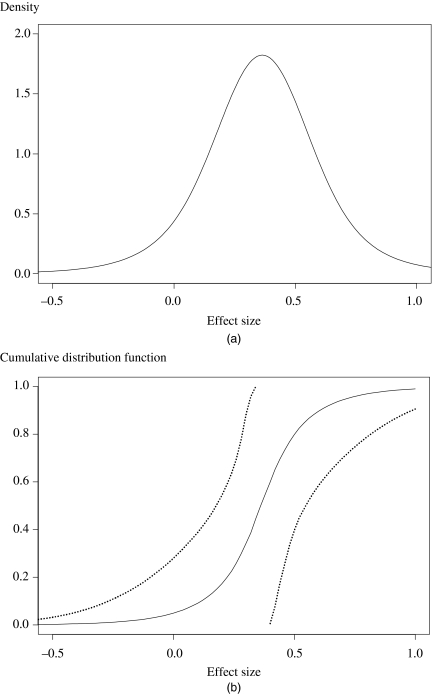
“Note that P(θnew<0)=0.950 in Table 2 corresponds to the point at which the full curve in Fig. 3(b) crosses the vertical axis (at approximately 5% probability)”
§ A re-evaluation of random-effects meta-analysis > 7 Example
“| Parameter | Median | 95% credible interval | P(parameter > 0) | | --- | --- | --- | --- | | μ | 0.36 | (0.18, 0.55) | 0.999 | | θnew | 0.36 | (−0.12, 0.84) | 0.950 |”
Rated minor: it would not touch a result — a value no result rests on, a p-value that stays on the same side of the significance level, or a conflict that is clerical, resolved elsewhere in the paper, or outside its own findings.
In the paper
§ A re-evaluation of random-effects meta-analysis > 7 Example
“Random-effects meta-analysis: standardized mean difference (95% credible interval 0.19–0.53); U*=4.23 (P =2×10⁻⁵); .”
§ A re-evaluation of random-effects meta-analysis > 7 Example
“Classical normal random-effects meta-analysis results as traditionally presented appear at the bottom of Table 1.”
Citations
Cites
Bias in meta-analysis detected by a simple, graphical test
Egger, M., Smith, G. D., Schneider, M., & Minder, C. (1997) · BMJ · doi:10.1136/bmj.315.7109.629 · Cited by 56,722 · cited 1×
“This may reflect publication bias, or correlation between study size and another important covariate such as quality of study (Egger et al., 1997).”
BackgroundMeta-analysis in clinical trials
DerSimonian, R., & Laird, N. (1986) · Controlled Clinical Trials · doi:10.1016/0197-2456(86)90046-2 · Cited by 39,552 · cited 6×
“Heterogeneity Several estimators of the heterogeneity variance τ2 are available that are based on normal likelihoods, including iterative maximum likelihood and restricted maximum likelihood estimates (DerSimonian and Laird, 1986; DerSimonian and Kacker, 2007).”
MethodInfluentialQuantifying heterogeneity in a meta‐analysis
Higgins, J. P. T., & Thompson, S. G. (2002) · Statistics in Medicine · doi:10.1002/sim.1186 · Cited by 36,763 · cited 10×
“Confidence intervals for measures of inconsistency can be calculated (Higgins and Thompson, 2002).”
BackgroundMethodInfluentialSelf-citationGelman, A., Carlin, J. B., Stern, H. S., & Rubin, D. B. (2003) · doi:10.1201/9780429258480 · Cited by 27,276
Kass, R. E., & Raftery, A. E. (1995) · Journal of the American Statistical Association · doi:10.1080/01621459.1995.10476572 · Cited by 12,558
Wasserman, S. S., Hedges, L. V., & Olkin, I. (1988) · Journal of Educational Statistics · doi:10.2307/1164953 · Cited by 10,377
Statistical Methods for Meta-Analysis
Rosenbaum, P. R., Hedges, L., & Olkin, I. (1987) · Journal of the American Statistical Association · doi:10.2307/2289186 · Cited by 6,027 · cited 1×
“A common misinterpretation of the random-effects assumption is that the studies themselves are sampled from a population of studies (Hedges, 1987; Anello and Fleiss, 1995; Colditz et al., 1995).”
BackgroundStatistical Methods for Meta-Analysis.
Freeman, P. R., Hedges, L. V., & Olkin, I. (1986) · Biometrics · doi:10.2307/2531069 · Cited by 4,840
Gelman, A. (2006) · Bayesian Analysis · doi:10.1214/06-ba117a · Cited by 4,050 · cited 1×
“It has been suggested that a prior distribution on τ might comprise the positive part of a symmetric distribution around 0, say Cauchy or normal (Gelman, 2006).”
BackgroundAssessing the quality of controlled clinical trials
Jüni, P., Altman, D. G., & Egger, M. (2001) · BMJ · doi:10.1136/bmj.323.7303.42 · Cited by 3,309 · cited 1×
“There are strong arguments against the former (Greenland and O’Rourke, 2001) and an item-based approach to dealing with quality is to be preferred (Jüni et al., 2001).”
Background
Research works printed but not linked: 3
- DuMouchel, 1994, Hierarchical Bayes linear models for meta-analysis
- Morris, 1992, Hierachical models for combining information and for meta-analysis, Bayes. Statist., 4, 321
- Stein, 1956, Proc. 3rd Berkeley Symp, 197
Cited by
Sorted by citations
Items 501–600 of 1,013
Wang, C., & Lee, W. (2019) · Research Synthesis Methods · doi:10.1002/jrsm.1345 · Cited by 72
“Recently, researchers have argued that a summary estimate (such as a mean with a confidence interval) provides an incomplete summary of the underlying distribution.(9) The prediction interval, which shows the range of true effects in future studies, has been advocated to be regularly presented in meta‐analyses.”
BackgroundEstimating Heterogeneity Variance in Meta-Analysis
Rukhin, A. L. (2012) · Journal of the Royal Statistical Society Series B (Statistical Methodology) · doi:10.1111/j.1467-9868.2012.01047.x · Cited by 70
“According to Higgins et al. (2009), page 139, ‘The naive presentation of inference only on the mean of the random-effects distribution is highly misleading.”
BackgroundMethodInfluentialTricco, A. C., Soobiah, C., Blondal, E., Veroniki, A. A., Khan, P. A., Vafaei, A., Ivory, J. D., Strifler, L., Ashoor, H. M., MacDonald, H. R., et al. (2015) · BMC Medicine · doi:10.1186/s12916-015-0379-3 · Cited by 71
“The PrI, representing the interval within which the estimated treatment effect of a future study is expected to lie, captures the uncertainty of the NMA estimate and the magnitude of heterogeneity within the network overall [34, 35].”
BackgroundSurgery for the treatment of obesity in children and adolescents
Ells, L. J., Mead, E., Atkinson, G., Corpeleijn, E., Roberts, K. E., Viner, R., Baur, L. A., Metzendorf, M., & Richter, B. (2015) · Cochrane Database of Systematic Reviews · doi:10.1002/14651858.cd011740 · Cited by 75
Sun, J., Ma, C., Zhao, M., Magnussen, C. G., & Xi, B. (2022) · Sleep Medicine Reviews · doi:10.1016/j.smrv.2022.101682 · Cited by 72
Dai, B., Liu, Y., Fu, L., Li, Y., Zhang, J., & Mei, C. (2012) · American Journal of Kidney Diseases · doi:10.1053/j.ajkd.2012.02.332 · Cited by 69
“Prediction interval was calculated according to the method reported by Higgins et al.35 The presence of heterogeneity across trials was assessed with the I2 statistic, a standard test that measured the degree of inconsistency across studies.36 Higher values indicated more heterogeneity.”
MethodKelley, G. A., Kelley, K. S., & Pate, R. R. (2015) · BioMed Research International · doi:10.1155/2015/704539 · Cited by 77
“Table 1 describes the characteristics of each included study.”
BackgroundGenerosity among the Ik of Uganda
Townsend, C., Aktipis, A., Balliet, D. P., & Cronk, L. (2020) · Evolutionary Human Sciences · doi:10.1017/ehs.2020.22 · Cited by 68
A loss of mature microglial markers without immune activation in schizophrenia
Snijders, G. J. L., van Zuiden, W., Sneeboer, M. A. M., van Berlekom, A. B., van der Geest, A. T., Schnieder, T. P., MacIntyre, D. J., Hol, E. M., Kahn, R. S., & de Witte, L. D. (2021) · Glia · doi:10.1002/glia.23962 · Cited by 70
Aiolfi, A., Gagner, M., Zappa, M. A., Lastraioli, C., Lombardo, F., Panizzo, V., Bonitta, G., Cavalli, M., Campanelli, G., & Bona, D. (2022) · Obesity Surgery · doi:10.1007/s11695-022-05950-z · Cited by 71
“Compared to the frequentist meta-analysis, the Bayesian approach takes into account all sources of variation, reflects these variations in the pooled result, can provide accurate estimates for small samples, and allows computation of predictive distribution [32, 33].”
Unsaturated Fatty Acids in Mental Disorders: An Umbrella Review of Meta‐Analyses
Gao, X., Su, X., Han, X., Wen, H., Chen, C., Zhang, S., Li, W., Cai, J., Zheng, L., Ma, J., et al. (2022) · Advances in Nutrition · doi:10.1093/advances/nmac084 · Cited by 71
Self management interventions for type 2 diabetes in adult people with severe mental illness
McBain, H. B., Mulligan, K., Haddad, M., Flood, C., Jones, J., & Simpson, A. (2016) · Cochrane Database of Systematic Reviews · doi:10.1002/14651858.cd011361.pub2 · Cited by 70
Meta-analysis of binary outcomes via generalized linear mixed models: a simulation study
Bakbergenuly, I., & Kulinskaya, E. (2018) · BMC Medical Research Methodology · doi:10.1186/s12874-018-0531-9 · Cited by 69
Relationship Between Cannabis Use and Erectile Dysfunction: A Systematic Review and Meta-Analysis
Pizzol, D., Demurtas, J., Stubbs, B., Soysal, P., Mason, C., Işık, A. T., Solmi, M., Smith, L., & Veronese, N. (2019) · American Journal of Men s Health · doi:10.1177/1557988319892464 · Cited by 68
“The prediction interval (PIs) and its 95% CI was also estimated, which further accounts for between-study effects and estimates the certainty of the association if a new study addresses that same association (Higgins et al., 2009; IntHout et al., 2016).”
BackgroundCrippa, S., Cirocchi, R., Randolph, J., Partelli, S., Belfiori, G., Piccioli, A. N., Parisi, A., & Falconi, M. (2016) · Langenbeck s Archives of Surgery · doi:10.1007/s00423-016-1418-z · Cited by 67
Mohan, B. P., Asokkumar, R., Khan, S. R., Kotagiri, R., Sridharan, G. K., Chandan, S., Ravikumar, N. P. G., Ponnada, S., Jayaraj, M., & Adler, D. G. (2020) · Endoscopy International Open · doi:10.1055/a-1120-8350 · Cited by 67
Gahl, B., Çelik, M., Head, S. J., Vanoverschelde, J., Pîbarot, P., Reardon, M. J., Mieghem, N. M. V., Kappetein, A. P., Jüni, P., & da Costa, B. R. (2020) · JAMA Cardiology · doi:10.1001/jamacardio.2020.2497 · Cited by 70
Bellou, V., Tzoulaki, I., van Smeden, M., Moons, K. G. M., Εvangelou, Ε., & Belbasis, L. (2021) · European Respiratory Journal · doi:10.1183/13993003.02964-2020 · Cited by 69
“We estimated the 95% prediction interval, which further accounts for the uncertainty for the effect that would be expected in a new study addressing the same association [16].”
Keogh, R. H., & Cox, D. R. (2014) · Cambridge University Press eBooks · doi:10.1017/cbo9781139094757 · Cited by 73
Dib, R. E., Gameiro, O. L., Ogata, M. S. P., Módolo, N. S. P., Braz, L. G., Jorge, E. C., do Nascimento, P., & Beletate, V. (2015) · Cochrane Database of Systematic Reviews · doi:10.1002/14651858.cd005525.pub3 · Cited by 71
You May Believe You Are a Bayesian But You Are Probably Wrong
Senn, S. J. (2011) · RePEc: Research Papers in Economics · doi:10.22029/jlupub-378 · Cited by 66
Kelley, G. A., & Kelley, K. S. (2017) · BMC Cancer · doi:10.1186/s12885-017-3687-5 · Cited by 71
Veronese, N., Demurtas, J., Celotto, S., Caruso, M. G., Maggi, S., Bolzetta, F., Firth, J., Smith, L., Schofield, P., Koyanagi, A., et al. (2018) · Clinical Nutrition · doi:10.1016/j.clnu.2018.05.019 · Cited by 66
Hoornweder, S. V., Vanderzande, L., Bloemers, E., Verstraelen, S., Depestele, S., Cuypers, K., van Dun, K., Strouwen, C., & Meesen, R. (2021) · Clinical Neurophysiology · doi:10.1016/j.clinph.2021.05.015 · Cited by 67
Srisurapanont, M., Suttajit, S., Maneeton, N., & Maneeton, B. (2015) · Journal of Psychiatric Research · doi:10.1016/j.jpsychires.2015.01.004 · Cited by 70
“Because high heterogeneity might be unavoidable, a random effect model was used throughout the study (DerSimonian and Laird, 1986; Higgins et al., 2009).”
MethodGaleone, C., Edefonti, V. C., Parpinel, M. T., Leoncini, E., Matsuo, K., Talamini, R., Olshan, A. F., Zevallos, J. P., Winn, D. M., Jayaprakash, V., et al. (2014) · International Journal of Cancer · doi:10.1002/ijc.29044 · Cited by 65
“We quantified inconsistencies across studies and their impact on the analysis by using Cochrane’s Q and the I(2) statistic.(39,40) We also conducted a sensitivity analysis in which each study was excluded one at a time to ensure that the magnitude of the overall estimates was not dependent on any specific study.”
MethodA note on the graphical presentation of prediction intervals in random-effects meta-analyses
Guddat, C., Grouven, U., Bender, R., & Skipka, G. (2012) · Systematic Reviews · doi:10.1186/2046-4053-1-34 · Cited by 66
“[7] proposed using an additional hollow diamond for the presentation of PIs, whereas Riley et al.”
BackgroundMethodInfluentialEmpirical evidence about inconsistency among studies in a pair‐wise meta‐analysis
Rhodes, K. M., Turner, R., & Higgins, J. P. T. (2015) · Research Synthesis Methods · doi:10.1002/jrsm.1193 · Cited by 65
“We can allow for unexplained heterogeneity in a random-effects meta-analysis, estimating a between-study variance and a summary effect (Higgins et al , 2009).”
Self-citationSelecting the best meta-analytic estimator for evidence-based practice: a simulation study
Doi, S. A. R., & Furuya‐Kanamori, L. (2019) · International Journal of Evidence-Based Healthcare · doi:10.1097/xeb.0000000000000207 · Cited by 66
“The second issue arises due to the assumption that the differences between the study results originate because the studies are measuring different effects.(17,28,29) However, if this is true, the appropriateness of meta-analysing the studies should be questioned.”
ResultUnkel, S., Amiri, M., Benda, N., Beyersmann, J., Knoerzer, D., Kupas, K., Langer, F., Leverkus, F., Loos, A. H., Ose, C., et al. (2018) · Pharmaceutical Statistics · doi:10.1002/pst.1915 · Cited by 70
“Bayesian random-effects meta-analysis with weakly informative prior on the between-trial heterogeneity (and an uninformative prior on the treatment effect) has been suggested for meta-analysis with few studies [59, 60].”
MethodEstimation in meta‐analyses of mean difference and standardized mean difference
Bakbergenuly, I., Hoaglin, D. C., & Kulinskaya, E. (2019) · Statistics in Medicine · doi:10.1002/sim.8422 · Cited by 65
“?̂?i ∼ N ( θi, σ 2 i ) and θi ∼ N(θ, τ2), (5)”
Cantini, F., Boccia, S., Goletti, D., et al. (2014) · International Journal of Rheumatology · doi:10.1155/2014/926836 · Cited by 65
Hemmingsen, B., Sonne, D. P., Metzendorf, M.-I., & Richter, B. (2017) · Cochrane Database of Systematic Reviews · doi:10.1002/14651858.cd012204.pub2 · Cited by 63
Fullerton, B., Siebenhofer, A., Jeitler, K., Horvath, K., Semlitsch, T., Berghold, A., & Gerlach, F. M. (2018) · Cochrane Database of Systematic Reviews · doi:10.1002/14651858.cd013228 · Cited by 67
Levin, A., Hanage, W. P., Owusu‐Boaitey, N., Cochran, K., Walsh, S. P., & Meyerowitz‐Katz, G. (2020) · National Bureau of Economic Research · doi:10.3386/w27597 · Cited by 66
MetaForest: Exploring heterogeneity in meta-analysis using random forestsPreprint
Lissa, C. J. V. (2017) · PsyArXiv (OSF Preprints) · doi:10.31234/osf.io/myg6s · Cited by 70
Altobelli, E., Angeletti, P. M., Marziliano, C., Mastrodomenico, M., Giuliani, A. R., & Petrocelli, R. (2021) · Nutrients · doi:10.3390/nu13020404 · Cited by 67
“A random effects model was used to account for the different sources of variation among studies [19].”
MethodFan, L.-C., Lu, H.-W., Wei, P., Ji, X.-B., Liang, S., & Xu, J. (2015) · BMC Infectious Diseases · doi:10.1186/s12879-015-0872-5 · Cited by 61
“10 or I(2) > 50% was suggestive of significant heterogeneity, in which case we chose a random-effects model [15].”
BackgroundKvarven, A., Strømland, E., Wollbrant, C., Andersson, D., Johannesson, M., Tinghög, G., Västfjäll, D., & Myrseth, K. O. R. (2020) · Journal of the Economic Science Association · doi:10.1007/s40881-020-00084-3 · Cited by 68
Conde‐Agudelo, A., & Romero, R. J. (2022) · American Journal of Obstetrics and Gynecology · doi:10.1016/j.ajog.2022.04.023 · Cited by 66
de Jong, V. M. T., Rousset, R. Z., Antonio‐Villa, N. E., Buenen, A. G., CALSTER, B. V., Bello‐Chavolla, O. Y., Brunskill, N. J., Ćurčin, V., Damen, J. A., Fermín‐Martínez, C. A., et al. (2022) · BMJ · doi:10.1136/bmj-2021-069881 · Cited by 64
Hepatitis E Virus in Water Environments: A Systematic Review and Meta-analysis
Takuissu, G. R., Kenmoe, S., Ndip, L., Ebogo‐Belobo, J. T., Kengne-Ndé, C., Mbaga, D. S., Bowo‐Ngandji, A., Oyono, M. G., Kenfack‐Momo, R., Tchatchouang, S., et al. (2022) · Food and Environmental Virology · doi:10.1007/s12560-022-09530-3 · Cited by 67
Dastamooz, S., Bahmani, D. S., Farahani, M. H. D., Wong, S. H., Yam, J. C. S., Tham, C. C. Y., & Sit, C. H. P. (2023) · EClinicalMedicine · doi:10.1016/j.eclinm.2023.102137 · Cited by 80
An informed reference prior for between‐study heterogeneity in meta‐analyses of binary outcomes
Pullenayegum, E. (2011) · Statistics in Medicine · doi:10.1002/sim.4326 · Cited by 64
Perna, S., Giacosa, A., Bonitta, G., Bologna, C., Isu, A., Guido, D., & Rondanelli, M. (2016) · Nutrients · doi:10.3390/nu8120747 · Cited by 65
Flodgren, G., Gonçalves, D. C., & Summerbell, C. (2017) · Cochrane Database of Systematic Reviews · doi:10.1002/14651858.cd000984.pub3 · Cited by 71
Blinded sample size reestimation with count data: Methods and applications in multiple sclerosis
Friede, T., & Schmidli, H. (2010) · Statistics in Medicine · doi:10.1002/sim.3861 · Cited by 63
“For example, a random-effect meta-analysis [37] of the placebo groups of relevant clinical trials can provide the predictive distribution of the annualized relapse rate in a new placebo-controlled phase 3 study with the annualized relapse rate as the primary clinical endpoint.”
BackgroundBias in emerging biomarkers for bipolar disorder
Carvalho, A. F., Köhler, C. A., Fernandes, B. S., Quevedo, J., Miskowiak, K. W., Brunoni, A. R., Machado-Vieira, R., Maes, M., Vieta, E., & Berk, M. (2016) · Psychological Medicine · doi:10.1017/s0033291716000957 · Cited by 63
“Although this statistic was not reported in the included references, Higgins et al. suggest that one of the main roles of meta-analytic reviews is to quantify the level of uncertainty in a specific subject or field (Higgins et al. 2009).”
BackgroundResultAiolfi, A., Tornese, S., Bonitta, G., Rausa, E., Micheletto, G., & Bona, D. (2019) · Surgery for Obesity and Related Diseases · doi:10.1016/j.soard.2019.03.006 · Cited by 63
Meta-analysis in vocational behavior: A systematic review and recommendations for best practices
Rudolph, C. W., Chang, C. K., Rauvola, R. S., & Zacher, H. (2020) · Journal of Vocational Behavior · doi:10.1016/j.jvb.2020.103397 · Cited by 67
Farsalinos, K. E., Bagos, P. G., Giannouchos, T. V., NIAURA, R. S., Barbouni, A., & Poulas, K. A. (2021) · Harm Reduction Journal · doi:10.1186/s12954-020-00437-5 · Cited by 64
Global Case Fatality of Bacterial Meningitis During an 80-Year Period
van Ettekoven, C. N., Liechti, F. D., Brouwer, M. C., Bijlsma, M. W., & van de Beek, D. (2024) · JAMA Network Open · doi:10.1001/jamanetworkopen.2024.24802 · Cited by 74
O’Neill, M., Moran, P. S., Teljeur, C., O’Sullivan, O. E., O’Reilly, B., Hewitt, M., Flattery, M. J., & Ryan, M. (2013) · Archives of Gynecology and Obstetrics · doi:10.1007/s00404-012-2681-z · Cited by 63
“S ea m o n (b ) [2 7 ] 2 0 0 9 U S R et ro sp ec ti v e S T N S 9 2 – 5 6 • • • • • •”
BackgroundInfluentialAbramovitch (2019) · doi:10.1016/j.cpr.2018.09.001 · Cited by 59
Aiolfi, A., Asti, E., Rausa, E., Bonavina, G., Bonitta, G., & Bonavina, L. (2018) · PLoS ONE · doi:10.1371/journal.pone.0209272 · Cited by 65
Kliem, S., & Kröger, C. (2013) · Behaviour Research and Therapy · doi:10.1016/j.brat.2013.08.005 · Cited by 62
van de Vorst, I. E., Koek, H. L., de Vries, R., Bots, M. L., Reitsma, J. B., & Vaartjes, I. C. H. (2015) · Journal of the American Geriatrics Society · doi:10.1111/jgs.13835 · Cited by 61
“The amount of between-study variation (also known as the tau-squared value of a random effects model) is the critical factor determining the width of a 95% prediction interval; large values of between-study variation will result in a wide prediction interval, even if a large number of studies are included in a review.…”
BackgroundGualano, M. R., Corradi, A., Voglino, G., Catozzi, D., Olivero, E., Corezzi, M., Bert, F., & Siliquini, R. (2021) · Vaccine · doi:10.1016/j.vaccine.2020.12.061 · Cited by 61
Tricco, A. C., Strifler, L., Veroniki, A. A., Yazdi, F., Khan, P. A., Scott, A., Ng, C., Antony, J., Mrklas, K., D'Souza, J., et al. (2015) · BMJ Open · doi:10.1136/bmjopen-2015-009183 · Cited by 63
Bowden, J., Tierney, J. F., Simmonds, M. C., Copas, A. J., & Higgins, J. P. T. (2011) · Research Synthesis Methods · doi:10.1002/jrsm.45 · Cited by 62
“A two-stage approach for estimating the trial BLUPs also exists; the trial specific hazard ratio, overall mean and heterogeneity parameters can be combined into the ‘Empirical Bayes’ estimator s2i s2i þ t2 θþ t 2 s2i þ t2 θi (6) for trial i (Higgins et al., 2009).”
BackgroundSelf-citationKelley, G. A., Kelley, K. S., Roberts, S. B., & Haskell, W. L. (2011) · BMC Medicine · doi:10.1186/1741-7015-9-74 · Cited by 62
“Prediction intervals (95%) were calculated to determine treatment effects in a new trial [ 37 ,38].”
BackgroundMethodInfluentialMetformin monotherapy for adults with type 2 diabetes mellitus
Gnesin, F., Thuesen, A. C. B., Kähler, L. K. A., Madsbad, S., & Hemmingsen, B. (2020) · Cochrane Database of Systematic Reviews · doi:10.1002/14651858.cd012906.pub2 · Cited by 63
Adler, D., Mohan, B., Jayaraj, M., Asokkumar, R., Shakhatreh, M. K., Pahal, P., Ponnada, S., & Navaneethan, U. (2019) · Endoscopic Ultrasound · doi:10.4103/eus.eus_7_19 · Cited by 62
“[18] Since random-effects model estimates an average effect, we calculated the 95% of prediction interval, which deals with the dispersion of the effects.[19,20] Publication bias was ascertained, qualitatively, by visual inspection of funnel plot and quantitatively, by the Egger test.”
MethodChandan, S., Mohan, B. P., Chandan, O. C., Jha, L. K., Mashiana, H. S., Hewlett, A. T., & Khashab, M. A. (2019) · Surgical Endoscopy · doi:10.1007/s00464-019-06819-6 · Cited by 62
“Heterogeneity between studyspecific estimates was assessed by using Cochran Q statistical test for heterogeneity, 95% prediction interval (PI), which deals with the dispersion of the effects [12, 13] and the I2 statistics [14, 15].”
MethodReduction in mortality risk with opioid agonist therapy: a systematic review and meta‐analysis
Bahji, A., Cheng, B., Gray, S., & Stuart, H. L. (2019) · Acta Psychiatrica Scandinavica · doi:10.1111/acps.13088 · Cited by 62
Methods for estimating between‐study variance and overall effect in meta‐analysis of odds ratios
Bakbergenuly, I., Hoaglin, D. C., & Kulinskaya, E. (2020) · Research Synthesis Methods · doi:10.1002/jrsm.1404 · Cited by 63
“Contemporary Clinical Trials 2007; 28(2): 105–114.”
Zens, Y., Barth, M., Bucher, H. C., Dreck, K., Felsch, M., Groß, W., Jaschinski, T., Kölsch, H., Kromp, M., Overesch, I., et al. (2020) · Systematic Reviews · doi:10.1186/s13643-020-01476-6 · Cited by 62
Mao, Y., Wang, W., Ma, J., Wu, S., & Sun, F. (2021) · Chinese Medical Journal · doi:10.1097/cm9.0000000000001892 · Cited by 60
“random” are TRUE.([18]) The protection provided by previous infection was calculated using a combined Mantel–Hanzsel method with the random-effects model.”
MethodWound drainage for caesarean section
Gates, S., & Anderson, E. R. (2013) · Cochrane Database of Systematic Reviews · doi:10.1002/14651858.cd004549.pub3 · Cited by 75
Assessing discriminative ability of risk models in clustered data
Klaveren, D. V., Steyerberg, E. W., Perel, P., & Vergouwe, Y. (2014) · BMC Medical Research Methodology · doi:10.1186/1471-2288-14-5 · Cited by 61
When is a further clinical trial justified?
Ferreira, M. L., Herbert, R., Crowther, M. J., Verhagen, A. P., & Sutton, A. J. (2012) · BMJ · doi:10.1136/bmj.e5913 · Cited by 61
O’Keefe, D. J., & Hoeken, H. (2021) · Frontiers in Psychology · doi:10.3389/fpsyg.2021.664160 · Cited by 73
Zhang, Y., Wang, T., He, J., et al. (2014) · International Wound Journal · doi:10.1111/iwj.12313 · Cited by 60
“Risk of bias assessment in RCTs was performed according to the Cochrane Methodology under consideration of random sequence generation, allocation concealment, blinding of participants and personnel, blinding of outcome assessment, incomplete outcome data, selective reporting and other potential sources of bias (27).”
MethodThe first metatarsophalangeal joint in gout: a systematic review and meta-analysis
Stewart, S., Dalbeth, N., Vandal, A. C., et al. (2016) · BMC Musculoskeletal Disorders · doi:10.1186/s12891-016-0919-9 · Cited by 60
Hemmingsen, B., Sonne, D. P., Metzendorf, M., & Richter, B. (2016) · Cochrane Database of Systematic Reviews · doi:10.1002/14651858.cd012151.pub2 · Cited by 76
Bodkin, C., Pivnick, L., Bondy, S. J., Ziegler, C. P., Martin, R. E., Jernigan, C. A., & Kouyoumdjian, F. G. (2019) · American Journal of Public Health · doi:10.2105/ajph.2018.304855 · Cited by 62
Quantifying how diagnostic test accuracy depends on threshold in a meta‐analysis
Jones, H. E., Gatsonsis, C. A., Trikalinos, T. A., Welton, N. J., & Ades, A. E. (2019) · Statistics in Medicine · doi:10.1002/sim.8301 · Cited by 58
Hypofractionation for clinically localized prostate cancer
Hickey, B. E., James, M. L., Daly, T., Soh, F.-Y., & Jeffery, M. (2019) · Cochrane Database of Systematic Reviews · doi:10.1002/14651858.cd011462.pub2 · Cited by 63
Claus, B. B., Stahlschmidt, L., Dunford, E., Major, J., Harbeck-Weber, C., Bhandari, R. P., Baerveldt, A., Neß, V., Grochowska, K., Hübner-Möhler, B., et al. (2022) · Pain · doi:10.1097/j.pain.0000000000002636 · Cited by 59
Santos, A., Braaten, K., MacPherson, M., Vasconcellos, D., Vis-Dunbar, M., Lonsdale, C., Lubans, D., & Jung, M. E. (2023) · International Journal of Behavioral Nutrition and Physical Activity · doi:10.1186/s12966-023-01535-w · Cited by 59
Liu, D., Meng, X., Tian, Q., Cao, W., Fan, X., Wu, L., Song, M., Meng, Q., Wang, W., & Wang, Y. (2021) · Advances in Nutrition · doi:10.1093/advances/nmab142 · Cited by 132
Chandan, S., Khan, S. R., Mohan, B. P., et al. (2021) · Endoscopy International Open · doi:10.1055/a-1341-0788 · Cited by 59
“We assessed heterogeneity between study-specific estimates by using Cochran Q statistical test for heterogeneity, 95% confidence interval (CI) and the I 2 statistics [37 – 39].”
MethodBui, M., Nijmeijer, W. S., Hegeman, J. H., Witteveen, A., & Groothuis‐Oudshoorn, C. G. M. (2023) · Osteoporosis International · doi:10.1007/s00198-023-06942-0 · Cited by 72
“ORs and HRs were meta-analysed separately for each of the predictors, using DerSimonian-Laird random-effects models [21] to accommodate for population and intervention heterogeneity [22–24].”
MethodLevothyroxine or minimally invasive therapies for benign thyroid nodules
Bandeira-Echtler, E., Bergerhoff, K., & Richter, B. (2014) · Cochrane Database of Systematic Reviews · doi:10.1002/14651858.cd004098.pub2 · Cited by 60
Maternal breastfeeding and attention-deficit/hyperactivity disorder in children: a meta-analysis
Tseng, P., Yen, C., Chen, Y., Stubbs, B., Carvalho, A. F., Whiteley, P., Chu, C., Li, D., Chen, T., Yang, W., et al. (2018) · European Child & Adolescent Psychiatry · doi:10.1007/s00787-018-1182-4 · Cited by 58
O’Mahony, C., Akhtar, M. M., Anastasiou, Z., Guttmann, O. P., Vriesendorp, P. A., Michels, M., Magrì, D., Autore, C., Fernández, A., Ochoa, J. P., et al. (2018) · Heart · doi:10.1136/heartjnl-2018-313700 · Cited by 59
Baumeister, S. E., Leitzmann, M. F., Linseisen, J., & Schlesinger, S. (2019) · JNCI Journal of the National Cancer Institute · doi:10.1093/jnci/djz111 · Cited by 58
Markozannes, G., Aretouli, E., Rintou, E., Dragioti, E., Damigos, D., Ntzani, E., Εvangelou, Ε., & Tsilidis, K. K. (2017) · BMC Psychology · doi:10.1186/s40359-017-0200-5 · Cited by 59
Garrett, J., Chak, C., Bullock, T., & Giesbrecht, B. (2024) · Communications Psychology · doi:10.1038/s44271-024-00124-2 · Cited by 77
“The overall effect of exercise on cognition was assessed using a Bayesian hierarchical model 46,47 , which was implemented through the R package brms 48 .”
MethodAhmadieh, H., Kreidieh, O., Akl, E. A., & Fuleihan, G. E. (2020) · Cochrane Database of Systematic Reviews · doi:10.1002/14651858.cd010787.pub2 · Cited by 61
“Higgins 2009 Higgins JPT, Thompson SG, Spiegelhalter DJ.”
MethodCohen, A. T., Hill, N. R., Luo, X., Masseria, C., Abariga, S. A., & Ashaye, A. O. (2018) · International Journal of Cardiology · doi:10.1016/j.ijcard.2018.06.114 · Cited by 57
Kunutsor, S. K., Barrett, M. C., Whitehouse, M. R., Craig, R., Lenguerrand, E., Beswick, A. D., & Blom, A. W. (2020) · Journal of Infection · doi:10.1016/j.jinf.2020.01.008 · Cited by 56
“true effects of future studies will lie with 95% certainty.(36, 37) We conducted stratified analyses and random effects meta-regression to assess several pre-defined study level characteristics which could explain heterogeneity between”
McCarty, T. R., Bazarbashi, A. N., Njei, B. M., Ryou, M. K., Aslanian, H. R., & Muniraj, T. (2020) · Clinical Endoscopy · doi:10.5946/ce.2019.211 · Cited by 57
Riccò, M., Cascio, A., Corrado, S., Bottazzoli, M., Marchesi, F., Gili, R., Giuri, P. G., Gori, D., & Manzoni, P. (2024) · Vaccines · doi:10.3390/vaccines12060640 · Cited by 57
“In other words, as random effects account for variability and differences between different entities or subjects within a larger group, the REM was considered more effective at dealing with the genuine differences underlying the results of the studies, or heterogeneity [73,74].”
BackgroundMoelands, S. V., Lucassen, P. L., Akkermans, R. P., De Grauw, W. J., & Van de Laar, F. A. (2018) · Cochrane Database of Systematic Reviews · doi:10.1002/14651858.cd005061.pub3 · Cited by 57
Weight change and the risk of incident atrial fibrillation: a systematic review and meta-analysis
Jones, N. R., Taylor, K., Taylor, C. J., & Aveyard, P. N. (2019) · Heart · doi:10.1136/heartjnl-2019-314931 · Cited by 56
“19 20 Where there were insufficient data to pool, we report results descriptively.”
Device use errors with soft mist inhalers: A global systematic literature review and meta-analysis
Navaie, M., Dembek, C., Cho‐Reyes, S., Yeh, K., & Celli, B. R. (2020) · Chronic Respiratory Disease · doi:10.1177/1479973119901234 · Cited by 56
Wang, Z., Singh, A., Jones, G., Winzenberg, T., Ding, C., Chopra, A., Das, S., Danda, D., Laslett, L., & Antony, B. (2021) · Current Rheumatology Reports · doi:10.1007/s11926-020-00975-8 · Cited by 57
Chromium picolinate supplementation for overweight or obese adults
Tian, H., Guo, X., Wang, X., He, Z., Sun, R., Ge, S., & Zhang, Z. (2013) · Cochrane Database of Systematic Reviews · doi:10.1002/14651858.cd010063.pub2 · Cited by 57
Sfeir, M. M., Askin, G., & Christos, P. J. (2018) · International Journal of Antimicrobial Agents · doi:10.1016/j.ijantimicag.2018.07.021 · Cited by 56
Metadata
- Authors
- Higgins, J. P. T., Thompson, S. G., & Spiegelhalter, D. J.
- Affiliations
- MRC Biostatistics Unit (GB)
- Corresponding author
- Higgins, Julian P. T.
- Venue
- Journal of the Royal Statistical Society Series A: Statistics in Society
- Publisher
- Oxford University Press (OUP)
- Published
- 2008-07-24
- Volume
- 172
- Issue
- 1
- Pages
- 137-159
- ISSN
- 0964-1998 (ISSN-L)
- 1467-985X
- PMC
- PMC2667312
- OpenAlex
- W2108116635
- Semantic Scholar
- b42717775886e436d97964fca187c3248684112e
- Cited by
- 2,569
- References
- 100
- Citations by year
- 2026: 222 · 2025: 197 · 2024: 219 · 2023: 186 · 2022: 208 · 2021: 246 · 2020: 224 · 2019: 160 · 2018: 153 · 2017: 124 · 2016: 128 · 2015: 117 · 2014: 93 · 2013: 96 · 2012: 89
- FWCI
- 38.18
- Type
- journal article
- Language
- en
- Open access
- green
- www.ncbi.nlm.nih.gov
- Licence
- academic.oup.com/journals/pages/open_access/funder_policies/chorus/standard_publication_model (vor)
- Locations
- Journal of the Royal Statistical Society Series A (Statistics in Society) (publishedVersion)
- PubMed Central (publishedVersion)
- PubMed (publishedVersion)
- Explore Bristol Research (publishedVersion)
- Bristol Research (University of Bristol) (submittedVersion)
- Funders
- UK Medical Research Council (U.1052.00.011, U.1052.00.001, U.1052.00.005)
- Topics
- Social Sciences › Decision Sciences › Statistics, Probability and Uncertainty › Meta-analysis and systematic reviews
- Physical Sciences › Mathematics › Statistics and Probability › Statistical Methods and Bayesian Inference
- Physical Sciences › Mathematics › Statistics and Probability › Statistical Methods in Epidemiology
- Keywords
- random-effects meta-analysis, heterogeneity, Bayesian meta-analysis, prediction intervals, nonparametric inference, hypothesis testing, set-shifting, eating disorders, prior sensitivity
About these checks
Registry, retraction, Cites and statistics results are computed, not judged, with one exception: a printed reference that no index lists is read once by a model before it counts as a citation error. Claims are extracted by a model and kept only when their quote appears verbatim in the text; each cited source is then checked, with a model’s help, for whether it says what the claim relies on. Those verdicts can be wrong — read the claim’s quote and the cited source before relying on one.
A language model drew the claims from the paper on 2026-10-09, under version 3 of the claim definition (model deepseek-v4.1-flash, prompt extract-v3).
A second model labelled each claim on 2026-10-09 (model jev-1.13-20260917, definition revision gold-guideline-v0.2).
Statistics and arithmetic are recomputed, not judged.
Confidence bands are shown only for fields calibrated on our annotated test set. None is calibrated yet, so no band is shown.
What counts as a claim ›How we measure confidence ›How we check this ›
Are you an author, or do you see a problem with this page? Request a review
