

The DOI matches its Crossref record; 94 of the 100 references it cites were found in a registry or an index; none of the 31 sources its claims cite is checked for support yet.
A Re-Evaluation of Random-Effects Meta-Analysis
Open accessAbstract
Summary: Meta-analysis in the presence of unexplained heterogeneity is frequently undertaken by using a random-effects model, in which the effects underlying different studies are assumed to be drawn from a normal distribution. Here we discuss the justification and interpretation of such models, by addressing in turn the aims of estimation, prediction and hypothesis testing. A particular issue that we consider is the distinction between inference on the mean of the random-effects distribution and inference on the whole distribution. We suggest that random-effects meta-analyses as currently conducted often fail to provide the key results, and we investigate the extent to which distribution-free, classical and Bayesian approaches can provide satisfactory methods. We conclude that the Bayesian approach has the advantage of naturally allowing for full uncertainty, especially for prediction. However, it is not without problems, including computational intensity and sensitivity to a priori judgements. We propose a simple prediction interval for classical meta-analysis and offer extensions to standard practice of Bayesian meta-analysis, making use of an example of studies of ‘set shifting’ ability in people with eating disorders.
Overview
AI snapshot
Written from the paper’s full text.
TL;DR
This paper re-evaluates random-effects meta-analysis, arguing that inference should address the whole distribution of effects—especially prediction—rather than only the mean effect. It proposes a simple classical prediction interval and illustrates the issues with 14 studies of set-shifting ability in eating disorders.
Key findings
- Focusing only on the mean of the random-effects distribution is insufficient: two meta-analytic data sets can produce identical mean estimates and standard errors while differing greatly in heterogeneity, so τ² and the whole distribution matter.
- Distribution-free classical methods can estimate μ and τ² but cannot satisfactorily address prediction; the paper proposes an approximate prediction interval using a t-distribution with k−2 degrees of freedom.
- In the 14-study set-shifting example, heterogeneity was Q=16.73, df=13, P=0.02, I²=22%, and τ²=0.022; the classical random-effects interval was 0.19–0.53, while the approximate prediction interval for a new study ranged from −0.01 to 0.74.
- Bayesian normal random-effects analysis gave μ median 0.36 (95% credible interval 0.18–0.55), θ_new median 0.36 (−0.12–0.84), P(θ_new<0)=0.950, and τ² median 0.023 (0.000024–0.196); Bayesian credible intervals were wider because uncertainty in τ² was properly accounted for.
Methods
- The paper is a methodological re-evaluation structured around estimation, prediction, and hypothesis testing, comparing distribution-free, classical parametric, Bayesian, and non-normal/flexible random-effects approaches.
- The example uses 14 comparative studies of set-shifting ability in people with eating disorders versus healthy controls, taken from Roberts et al. (2007), with effect sizes as standardized differences in means and their standard errors.
- Analyses include classical inverse-variance random-effects meta-analysis with a moment estimate of between-study variance, and Bayesian normal random-effects meta-analysis via MCMC in WinBUGS with a uniform prior for τ (>0) and a vague N(0,10³) prior for μ; sensitivity analyses used a t-distribution with 4 degrees of freedom, an inverse gamma prior, and a shrinkage prior.
Limitations
- Stated: the Bayesian approach has problems including computational intensity and sensitivity to a priori judgements; prior choice can substantially affect results; model uncertainty is not accounted for; the normal random-effects assumption is strong and usually made without convincing evidence; few studies make τ² and μ imprecise; separating diversity from bias is difficult; and caution is warranted with funnel plot asymmetry.
- Stated: the example data were available only as effect sizes and confidence intervals, from which standard errors were calculated; more detailed data should be explicitly modelled when available.
- Evident: the example has only 14 studies and some large within-study standard errors; the paper notes that meta-analyses with very small numbers of studies (2–4) pose particular problems, and prediction intervals depend on the number of studies and within-study standard errors.
Model-written summary. Check it against the paper before relying on it.
Integrity signals
Registry
Cites
Statistics
Figures
Verification
Claims the paper makes
52 Own interpretation · 22 Not checked yet · 12 No basis given · 7 Own result
The paper states this without a source or data behind it here, so there is nothing to check it against. The quote shows it is in the paper.
In the paper
“The approximate prediction interval (12) for the true effect in a new study, however, ranges from −0.01 to 0.74, which is slightly less convincing.”
§ A re-evaluation of random-effects meta-analysis > 7 Example
plain- Asserted: passes — The authors put it forward as true.
- Checkable: passes — It can be checked against evidence.
- Load-bearing: passes — The paper’s conclusions depend on it.
- Based: passes — The paper gives a reason why it holds.
- The authors state this as an assumption: The random effects in the meta-analysis are normally distributed.
In the paper
“Alternatively using an inverse gamma distribution for τ2 with parameters 0.001 and 0.001 (Smith et al., 1995) produces a prediction interval from −0.008 to 0.73 (P(θnew<0)=0.973)”
§ A re-evaluation of random-effects meta-analysis > 7 Example
What the sources say
- Not checked yetcites Smith et al., 1995 source
plaindirect- Asserted: passes — The authors put it forward as true.
- Checkable: passes — It can be checked against evidence.
- Load-bearing: unclear — It is unclear whether the paper’s conclusions depend on it.
- Based: passes — The paper gives a reason why it holds.
A result the paper reports from its own data — it cites no other source for it, so there is none to check. The quote shows it is in the paper.
In the paper
“| τ2 | 0.023 | (0.000024, 0.196) | — |”
§ A re-evaluation of random-effects meta-analysis > 7 Example
plain- Asserted: passes — The authors put it forward as true.
- Checkable: passes — It can be checked against evidence.
- Load-bearing: unclear — It is unclear whether the paper’s conclusions depend on it.
- Based: passes — The paper gives a reason why it holds.
- The authors state this as an assumption: The random effects in the meta-analysis are normally distributed.
In the paper
“There is some heterogeneity between the effect sizes, accounting for 22% of the variation in point estimates by using the statistic I2 (Higgins and Thompson, 2002).”
§ A re-evaluation of random-effects meta-analysis > 7 Example
What the sources say
- Not checked yetcites Higgins and Thompson, 2002
plaincorrelational- Asserted: passes — The authors put it forward as true.
- Checkable: passes — It can be checked against evidence.
- Load-bearing: unclear — It is unclear whether the paper’s conclusions depend on it.
- Based: passes — The paper gives a reason why it holds.
- The authors state this as an assumption: The random effects in the meta-analysis are normally distributed.
The paper states this without a source or data behind it here, so there is nothing to check it against. The quote shows it is in the paper.
In the paper
“A random-effects meta-analysis reveals a statistically significant benefit on average, based on the inference in equation (13) regarding μ alone.”
§ A re-evaluation of random-effects meta-analysis > 7 Example
plaincorrelational- Asserted: passes — The authors put it forward as true.
- Checkable: passes — It can be checked against evidence.
- Load-bearing: passes — The paper’s conclusions depend on it.
- Based: passes — The paper gives a reason why it holds.
- The authors state this as an assumption: The random effects in the meta-analysis are normally distributed.
A result the paper reports from its own data — it cites no other source for it, so there is none to check. The quote shows it is in the paper.
In the paper
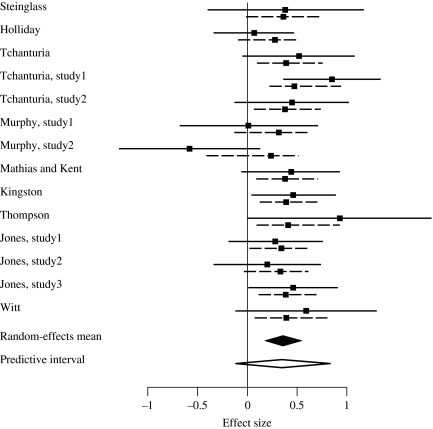
“It is evident from Table 1, as well as from the estimated effect sizes, plotted with 95% confidence intervals in Fig. 2, that the majority of trials indicate greater set shifting deficiency in people with eating disorders.”
§ A re-evaluation of random-effects meta-analysis > 7 Example
boostedcorrelational- Asserted: passes — The authors put it forward as true.
- Checkable: passes — It can be checked against evidence.
- Load-bearing: unclear — It is unclear whether the paper’s conclusions depend on it.
- Based: passes — The paper gives a reason why it holds.
- The authors state this as an assumption: The random effects in the meta-analysis are normally distributed.
In the paper
“Correspondingly, the test for qualitative interaction (9) produces a statistically non-significant test statistic Q*=2.56, compared with a critical value of 14.15 for a significance level of 5% (Gail and Simon, 1985).”
§ A re-evaluation of random-effects meta-analysis > 7 Example
What the sources say
- Not checked yetcites Gail and Simon, 1985 source
plain- Asserted: passes — The authors put it forward as true.
- Checkable: passes — It can be checked against evidence.
- Load-bearing: unclear — It is unclear whether the paper’s conclusions depend on it.
- Based: passes — The paper gives a reason why it holds.
- The authors state this as an assumption: The random effects in the meta-analysis are normally distributed.
A conclusion the paper draws from its own results — it cites no other source for it, so there is none to check. The quote shows it is in the paper.
In the paper
“However, such an assumption of homogeneity can seldom be made for studies in the biomedical and social sciences.”
§ A re-evaluation of random-effects meta-analysis > 1 Introduction
plain- Asserted: passes — The authors put it forward as true.
- Checkable: unclear — It is unclear whether it could be checked against evidence.
- Load-bearing: passes — The paper’s conclusions depend on it.
- Based: passes — The paper gives a reason why it holds.
A conclusion the paper draws from its own results — it cites no other source for it, so there is none to check. The quote shows it is in the paper.
In the paper
“This property is shared with the conventional test from a random-effects meta-analysis, i.e. of hypothesis (2) against”
§ A re-evaluation of random-effects meta-analysis > 2 Important questions to address in a random-effects meta-analysis > 2.3 Statistical tests in the presence of heterogeneity
plain- Asserted: passes — The authors put it forward as true.
- Checkable: passes — It can be checked against evidence.
- Load-bearing: passes — The paper’s conclusions depend on it.
- Based: passes — The paper gives a reason why it holds.
A conclusion the paper draws from its own results — it cites no other source for it, so there is none to check. The quote shows it is in the paper.
In the paper
“Estimation of τ2 is just as important.”
§ A re-evaluation of random-effects meta-analysis > 2 Important questions to address in a random-effects meta-analysis > 2.1 Estimation in random-effects meta-analysis
plain- Asserted: passes — The authors put it forward as true.
- Checkable: unclear — It is unclear whether it could be checked against evidence.
- Load-bearing: passes — The paper’s conclusions depend on it.
- Based: passes — The paper gives a reason why it holds.
- It may state two separate claims as one. 25
- Probably not a substantial claim. 29
A result the paper reports from its own data — it cites no other source for it, so there is none to check. The quote shows it is in the paper.
In the paper
“Various sensitivity analyses have small effects on the results, though they do not materially affect the conclusions from the Bayesian meta-analysis.”
§ A re-evaluation of random-effects meta-analysis > 7 Example
plain- Asserted: passes — The authors put it forward as true.
- Checkable: passes — It can be checked against evidence.
- Load-bearing: unclear — It is unclear whether the paper’s conclusions depend on it.
- Based: passes — The paper gives a reason why it holds.
It may state two separate claims as one.
In the paper
“using the shrinkage prior that was advocated by DuMouchel and Normand (2000) produces a prediction interval from −0.009 to 0.72 (P(θnew<0)=0.973)”
§ A re-evaluation of random-effects meta-analysis > 7 Example
What the sources say
- Not checked yetcites DuMouchel and Normand (2000)
plaindirect- Asserted: passes — The authors put it forward as true.
- Checkable: passes — It can be checked against evidence.
- Load-bearing: fails — The paper’s conclusions may not depend on it.
- Based: passes — The paper gives a reason why it holds.
Probably not a substantial claim. The paper’s conclusions may not depend on it.
A result the paper reports from its own data — it cites no other source for it, so there is none to check. The quote shows it is in the paper.
In the paper
“The estimate of the heterogeneity variance is 0.022 and the test for heterogeneity is statistically significant at conventional levels of significance.”
§ A re-evaluation of random-effects meta-analysis > 7 Example
plain- Asserted: passes — The authors put it forward as true.
- Checkable: passes — It can be checked against evidence.
- Load-bearing: passes — The paper’s conclusions depend on it.
- Based: passes — The paper gives a reason why it holds.
It may state two separate claims as one.
- The authors state this as an assumption: The random effects in the meta-analysis are normally distributed.
The paper states this without a source or data behind it here, so there is nothing to check it against. The quote shows it is in the paper.
In the paper
“Using a t-distribution with 4 degrees of freedom for the random effects yields a prediction interval from −0.16 to 0.89 (P(θnew<0)=0.947).”
§ A re-evaluation of random-effects meta-analysis > 7 Example
plaindirect- Asserted: passes — The authors put it forward as true.
- Checkable: passes — It can be checked against evidence.
- Load-bearing: unclear — It is unclear whether the paper’s conclusions depend on it.
- Based: passes — The paper gives a reason why it holds.
It may state two separate claims as one.
A result the paper reports from its own data — it cites no other source for it, so there is none to check. The quote shows it is in the paper.
In the paper
“Results for μ and θnew are comparable with the classical results, with credible intervals being wider because the Bayesian analyses properly account for uncertainty in the estimation of τ2.”
§ A re-evaluation of random-effects meta-analysis > 7 Example
plaindirect- Asserted: passes — The authors put it forward as true.
- Checkable: passes — It can be checked against evidence.
- Load-bearing: unclear — It is unclear whether the paper’s conclusions depend on it.
- Based: passes — The paper gives a reason why it holds.
It may state two separate claims as one.
- The authors state this as an assumption: The random effects in the meta-analysis are normally distributed.
A result the paper reports from its own data — it cites no other source for it, so there is none to check. The quote shows it is in the paper.
In the paper
“| μ | 0.36 | (0.18, 0.55) | 0.999 |”
§ A re-evaluation of random-effects meta-analysis > 7 Example
plain- Asserted: passes — The authors put it forward as true.
- Checkable: passes — It can be checked against evidence.
- Load-bearing: unclear — It is unclear whether the paper’s conclusions depend on it.
- Based: passes — The paper gives a reason why it holds.
It may state two separate claims as one.
- The authors state this as an assumption: The random effects in the meta-analysis are normally distributed.
A result the paper reports from its own data — it cites no other source for it, so there is none to check. The quote shows it is in the paper.
In the paper
“| θnew | 0.36 | (−0.12, 0.84) | 0.950 |”
§ A re-evaluation of random-effects meta-analysis > 7 Example
plain- Asserted: passes — The authors put it forward as true.
- Checkable: passes — It can be checked against evidence.
- Load-bearing: unclear — It is unclear whether the paper’s conclusions depend on it.
- Based: passes — The paper gives a reason why it holds.
It may state two separate claims as one.
- The authors state this as an assumption: The random effects in the meta-analysis are normally distributed.
None of the sources cited for this claim have been checked yet.
In the paper
“Although sources of heterogeneity should ideally be investigated (Thompson, 1994), selection of covariates to explain heterogeneity can be difficult, both practically (Higgins et al., 2002) and theoretically (Thompson and Higgins, 2002).”
§ A re-evaluation of random-effects meta-analysis > 1 Introduction
What the sources say
plain- Asserted: passes — The authors put it forward as true.
- Checkable: passes — It can be checked against evidence.
- Load-bearing: passes — The paper’s conclusions depend on it.
- Based: passes — The paper gives a reason why it holds.
Probably not a substantial claim. It may state two separate claims as one.
A conclusion the paper draws from its own results — it cites no other source for it, so there is none to check. The quote shows it is in the paper.
In the paper
“Realistic interpretation of predictions from a random-effects model can, however, be difficult.”
§ A re-evaluation of random-effects meta-analysis > 2 Important questions to address in a random-effects meta-analysis > 2.2 Prediction using random-effects meta-analysis
plain- Asserted: passes — The authors put it forward as true.
- Checkable: fails — It may be too vague to check against evidence.
- Load-bearing: passes — The paper’s conclusions depend on it.
- Based: passes — The paper gives a reason why it holds.
Probably not a substantial claim. It may be too vague to check against evidence.
A conclusion the paper draws from its own results — it cites no other source for it, so there is none to check. The quote shows it is in the paper.
In the paper
“This variance explicitly describes the extent of the heterogeneity and has a crucial role in assessing the degree of consistency of effects across studies, which is an element of random-effects meta-analysis that often receives too little attention.”
§ A re-evaluation of random-effects meta-analysis > 2 Important questions to address in a random-effects meta-analysis > 2.1 Estimation in random-effects meta-analysis
plaincorrelational- Asserted: passes — The authors put it forward as true.
- Checkable: passes — It can be checked against evidence.
- Load-bearing: passes — The paper’s conclusions depend on it.
- Based: passes — The paper gives a reason why it holds.
Probably not a substantial claim. It may state two separate claims as one.
In the paper
“However, a single parameter cannot adequately summarize heterogeneous effects (Raudenbush and Bryk, 1985) and so focusing on μ alone is usually insufficient.”
§ A re-evaluation of random-effects meta-analysis > 2 Important questions to address in a random-effects meta-analysis > 2.1 Estimation in random-effects meta-analysis
What the sources say
- Not checked yetcites Raudenbush and Bryk, 1985 source
plain- Asserted: passes — The authors put it forward as true.
- Checkable: passes — It can be checked against evidence.
- Load-bearing: passes — The paper’s conclusions depend on it.
- Based: passes — The paper gives a reason why it holds.
It may state two separate claims as one.
A conclusion the paper draws from its own results — it cites no other source for it, so there is none to check. The quote shows it is in the paper.
In the paper
“Although often useful, the test may be misleading if there is heterogeneity and in particular will not reject hypothesis (1) if effects are variable and centred on 0.”
§ A re-evaluation of random-effects meta-analysis > 2 Important questions to address in a random-effects meta-analysis > 2.3 Statistical tests in the presence of heterogeneity
hedgedconditional- Asserted: passes — The authors put it forward as true.
- Checkable: passes — It can be checked against evidence.
- Load-bearing: passes — The paper’s conclusions depend on it.
- Based: passes — The paper gives a reason why it holds.
It may state two separate claims as one.
In the paper
“Meta-analyses are often built on an assumption that directions of effect are consistent across studies (Peto, 1987), yet formal tests of this important supposition are not routinely undertaken.”
§ A re-evaluation of random-effects meta-analysis > 2 Important questions to address in a random-effects meta-analysis > 2.3 Statistical tests in the presence of heterogeneity
What the sources say
- Not checked yetcites Peto, 1987 source
plain- Asserted: passes — The authors put it forward as true.
- Checkable: passes — It can be checked against evidence.
- Load-bearing: passes — The paper’s conclusions depend on it.
- Based: passes — The paper gives a reason why it holds.
It may state two separate claims as one.
The paper states this without a source or data behind it here, so there is nothing to check it against. The quote shows it is in the paper.
In the paper
“An important rationale for meta-analyses is the possibility of increased power, compared with the individual studies, to detect moderate effects.”
§ A re-evaluation of random-effects meta-analysis > 2 Important questions to address in a random-effects meta-analysis > 2.3 Statistical tests in the presence of heterogeneity
hedgedconditional- Asserted: passes — The authors put it forward as true.
- Checkable: passes — It can be checked against evidence.
- Load-bearing: fails — The paper’s conclusions may not depend on it.
- Based: fails — The paper may give no reason why it holds.
Probably not a substantial claim. The paper’s conclusions may not depend on it. The paper may give no reason why it holds.
In the paper
“We have argued that such a null hypothesis is typically untenable and have discouraged the use of homogeneity tests in favour of quantifying the extent of heterogeneity (Higgins and Thompson, 2002).”
§ A re-evaluation of random-effects meta-analysis > 2 Important questions to address in a random-effects meta-analysis > 2.3 Statistical tests in the presence of heterogeneity
What the sources say
- Not checked yetcites Higgins and Thompson, 2002
plain- Asserted: passes — The authors put it forward as true.
- Checkable: fails — It may be too vague to check against evidence.
- Load-bearing: passes — The paper’s conclusions depend on it.
- Based: passes — The paper gives a reason why it holds.
Probably not a substantial claim. It may be too vague to check against evidence. It may state two separate claims as one.
A conclusion the paper draws from its own results — it cites no other source for it, so there is none to check. The quote shows it is in the paper.
In the paper
“Point estimation of μ and τ2 poses no problem, although confidence intervals rely on approximating distributions, sometimes based on the central limit theorem, which may not be realistic when there are few studies.”
§ A re-evaluation of random-effects meta-analysis > 3 Meeting the important objectives with no distributional assumption for the random effects > 3.6 Summarizing remarks
hedgedconditional- Asserted: passes — The authors put it forward as true.
- Checkable: passes — It can be checked against evidence.
- Load-bearing: passes — The paper’s conclusions depend on it.
- Based: passes — The paper gives a reason why it holds.
It may state two separate claims as one.
- The authors state this as an assumption: The available effect estimates are unbiased for the study-specific effects θi.
- The authors state this as an assumption: The estimated variances may be used in place of the true variances.
In the paper
“However, NPML has been noted to be unstable (Van Houwelingen et al., 1993) and has not been widely adopted.”
§ A re-evaluation of random-effects meta-analysis > 6 Non-normal and flexible assumptions for the random effects
What the sources say
- Not checked yetcites Van Houwelingen et al., 1993 source
plain- Asserted: passes — The authors put it forward as true.
- Checkable: passes — It can be checked against evidence.
- Load-bearing: unclear — It is unclear whether the paper’s conclusions depend on it.
- Based: passes — The paper gives a reason why it holds.
It may state two separate claims as one.
None of the sources cited for this claim have been checked yet.
In the paper
“NPML procedures provide a discrete distribution that is based on a finite number of mass points (Laird, 1978; Böhning, 2005).”
§ A re-evaluation of random-effects meta-analysis > 6 Non-normal and flexible assumptions for the random effects
What the sources say
plain- Asserted: passes — The authors put it forward as true.
- Checkable: passes — It can be checked against evidence.
- Load-bearing: passes — The paper’s conclusions depend on it.
- Based: passes — The paper gives a reason why it holds.
Probably not a substantial claim.
A conclusion the paper draws from its own results — it cites no other source for it, so there is none to check. The quote shows it is in the paper.
In the paper
“The assumption of a normal distribution for the random-effects distribution allows the calculation of confidence intervals and prediction intervals.”
§ A re-evaluation of random-effects meta-analysis > 5 Meeting the important objectives with a normal assumption for the random effects > 5.6 Summarizing remarks
plaindirect- Asserted: passes — The authors put it forward as true.
- Checkable: passes — It can be checked against evidence.
- Load-bearing: passes — The paper’s conclusions depend on it.
- Based: fails — The paper may give no reason why it holds.
Probably not a substantial claim. The paper may give no reason why it holds.
- The authors state this as an assumption: The random-effects distribution is normal.
A conclusion the paper draws from its own results — it cites no other source for it, so there is none to check. The quote shows it is in the paper.
In the paper
“A second potential advantage of a Bayesian approach is the intuitive interpretation of posterior distributions in terms of probability, including the ready availability of probabilities that effects exceed specified levels.”
§ A re-evaluation of random-effects meta-analysis > 5 Meeting the important objectives with a normal assumption for the random effects > 5.6 Summarizing remarks
hedgeddirect- Asserted: passes — The authors put it forward as true.
- Checkable: passes — It can be checked against evidence.
- Load-bearing: fails — The paper’s conclusions may not depend on it.
- Based: fails — The paper may give no reason why it holds.
Probably not a substantial claim. The paper’s conclusions may not depend on it. The paper may give no reason why it holds. It may state two separate claims as one.
The paper states this without a source or data behind it here, so there is nothing to check it against. The quote shows it is in the paper.
In the paper
“A particular advantage of the NPML approach is its ability to detect and incorporate outliers.”
§ A re-evaluation of random-effects meta-analysis > 6 Non-normal and flexible assumptions for the random effects
plaindirect- Asserted: passes — The authors put it forward as true.
- Checkable: passes — It can be checked against evidence.
- Load-bearing: fails — The paper’s conclusions may not depend on it.
- Based: passes — The paper gives a reason why it holds.
Probably not a substantial claim. The paper’s conclusions may not depend on it.
A conclusion the paper draws from its own results — it cites no other source for it, so there is none to check. The quote shows it is in the paper.
In the paper
“Bayesian probabilities can address a variety of questions more readily than classical hypothesis tests.”
§ A re-evaluation of random-effects meta-analysis > 5 Meeting the important objectives with a normal assumption for the random effects > 5.5 Testing
plaindirect- Asserted: passes — The authors put it forward as true.
- Checkable: fails — It may be too vague to check against evidence.
- Load-bearing: fails — The paper’s conclusions may not depend on it.
- Based: passes — The paper gives a reason why it holds.
Probably not a substantial claim. It may be too vague to check against evidence. The paper’s conclusions may not depend on it.
A conclusion the paper draws from its own results — it cites no other source for it, so there is none to check. The quote shows it is in the paper.
In the paper
“Whatever the reason for it, an asymmetric funnel plot leads necessarily to a difference in point estimates between common effect and random-effects meta-analyses (using standard inverse variance methods), because random-effects methods give relatively more weight to less precise studies.”
§ A re-evaluation of random-effects meta-analysis > 8 Some special considerations in random-effects meta-analysis > 8.2 Reporting biases and small study effects
boosteddirect- Asserted: passes — The authors put it forward as true.
- Checkable: passes — It can be checked against evidence.
- Load-bearing: unclear — It is unclear whether the paper’s conclusions depend on it.
- Based: passes — The paper gives a reason why it holds.
It may state two separate claims as one.
A conclusion the paper draws from its own results — it cites no other source for it, so there is none to check. The quote shows it is in the paper.
In the paper
“Meta-analyses of a large number of large studies lend themselves to relatively complex models, since there may be strong evidence against a normal distribution assumption for the random effect.”
§ A re-evaluation of random-effects meta-analysis > 6 Non-normal and flexible assumptions for the random effects
hedgedconditional- Asserted: passes — The authors put it forward as true.
- Checkable: passes — It can be checked against evidence.
- Load-bearing: passes — The paper’s conclusions depend on it.
- Based: fails — The paper may give no reason why it holds.
Probably not a substantial claim. The paper may give no reason why it holds.
A conclusion the paper draws from its own results — it cites no other source for it, so there is none to check. The quote shows it is in the paper.
In the paper
“The posterior distribution for the underlying mean μ is readily available from a Bayesian meta-analysis.”
§ A re-evaluation of random-effects meta-analysis > 5 Meeting the important objectives with a normal assumption for the random effects > 5.2 Mean effect
plain- Asserted: passes — The authors put it forward as true.
- Checkable: passes — It can be checked against evidence.
- Load-bearing: fails — The paper’s conclusions may not depend on it.
- Based: fails — The paper may give no reason why it holds.
Probably not a substantial claim. The paper’s conclusions may not depend on it. The paper may give no reason why it holds.
A conclusion the paper draws from its own results — it cites no other source for it, so there is none to check. The quote shows it is in the paper.
In the paper
“In practice, it can be difficult to separate diversity from bias, and it is partly this lack of identifiability that often necessitates the use of the conventional random-effects model.”
§ A re-evaluation of random-effects meta-analysis > 8 Some special considerations in random-effects meta-analysis > 8.1 Diversity and bias
plainconditional- Asserted: passes — The authors put it forward as true.
- Checkable: passes — It can be checked against evidence.
- Load-bearing: passes — The paper’s conclusions depend on it.
- Based: passes — The paper gives a reason why it holds.
It may state two separate claims as one.
- The authors state this as an assumption: The true (unbiased) effects Φi follow a normal distribution across studies.
- The authors state this as an assumption: The study-specific bias components βi follow a normal distribution.
- The authors state this as an assumption: The diversity and bias components are uncorrelated.
- The authors state this as an assumption: The effect being evaluated in the ith study is the sum of the true effect and bias: θi=Φi+βi.
A conclusion the paper draws from its own results — it cites no other source for it, so there is none to check. The quote shows it is in the paper.
In the paper
“The posterior distributions for the study-specific effects θi are readily available from a Bayesian analysis. These provide fully Bayesian shrunken estimates, in which inference for each particular study is performed by ‘borrowing strength’ from the other studies.”
§ A re-evaluation of random-effects meta-analysis > 5 Meeting the important objectives with a normal assumption for the random effects > 5.3 Study effects
plaindirect- Asserted: passes — The authors put it forward as true.
- Checkable: passes — It can be checked against evidence.
- Load-bearing: fails — The paper’s conclusions may not depend on it.
- Based: passes — The paper gives a reason why it holds.
Probably not a substantial claim. The paper’s conclusions may not depend on it. It may state two separate claims as one.
None of the sources cited for this claim have been checked yet.
In the paper
“An important distinction to make when considering heterogeneity of effect sizes is between the effects of diversity (variation in populations, interventions, exposures, outcome measures etc.) and bias (variation in the quality of the design and conduct of the studies) (Glasziou and Sanders, 2002; Greenland and O'Rourke, 2001).”
§ A re-evaluation of random-effects meta-analysis > 8 Some special considerations in random-effects meta-analysis > 8.1 Diversity and bias
What the sources say
- Not checked yetcites Glasziou and Sanders, 2002
- Not checked yetcites Greenland and O'Rourke, 2001
plain- Asserted: passes — The authors put it forward as true.
- Checkable: passes — It can be checked against evidence.
- Load-bearing: passes — The paper’s conclusions depend on it.
- Based: passes — The paper gives a reason why it holds.
Probably not a substantial claim.
A conclusion the paper draws from its own results — it cites no other source for it, so there is none to check. The quote shows it is in the paper.
In the paper
“No model for the random-effects distribution will be ‘true’, and we might seek a parsimonious model that adequately fits the observed data.”
§ A re-evaluation of random-effects meta-analysis > 5 Meeting the important objectives with a normal assumption for the random effects
plain- Asserted: passes — The authors put it forward as true.
- Checkable: fails — It may be too vague to check against evidence.
- Load-bearing: passes — The paper’s conclusions depend on it.
- Based: fails — The paper may give no reason why it holds.
Probably not a substantial claim. It may be too vague to check against evidence. The paper may give no reason why it holds.
A conclusion the paper draws from its own results — it cites no other source for it, so there is none to check. The quote shows it is in the paper.
In the paper
“However, this uncertainty does not extend to the choice of model for the random effects, which is more difficult to defend empirically when there are few studies.”
§ A re-evaluation of random-effects meta-analysis > 5 Meeting the important objectives with a normal assumption for the random effects > 5.6 Summarizing remarks
plain- Asserted: passes — The authors put it forward as true.
- Checkable: passes — It can be checked against evidence.
- Load-bearing: passes — The paper’s conclusions depend on it.
- Based: passes — The paper gives a reason why it holds.
It may state two separate claims as one.
- The authors state this as an assumption: The random-effects distribution is normal.
The paper states this without a source or data behind it here, so there is nothing to check it against. The quote shows it is in the paper.
In the paper
“Tests for heterogeneity have low power when there are few studies, and heterogeneity may be just as likely for small numbers of studies as it is for large numbers of studies.”
§ A re-evaluation of random-effects meta-analysis > 8 Some special considerations in random-effects meta-analysis > 8.3 Small numbers of studies
hedged- Asserted: passes — The authors put it forward as true.
- Checkable: passes — It can be checked against evidence.
- Load-bearing: passes — The paper’s conclusions depend on it.
- Based: passes — The paper gives a reason why it holds.
It may state two separate claims as one.
None of the sources cited for this claim have been checked yet.
In the paper
“For example, when 2×2 contingency tables are available for binary outcomes, meta-analyses are appropriately performed by using binomial likelihoods (Smith et al., 1995; Warn et al., 2002).”
§ A re-evaluation of random-effects meta-analysis > 7 Example
What the sources say
plain- Asserted: passes — The authors put it forward as true.
- Checkable: passes — It can be checked against evidence.
- Load-bearing: fails — The paper’s conclusions may not depend on it.
- Based: passes — The paper gives a reason why it holds.
Probably not a substantial claim. The paper’s conclusions may not depend on it.
A conclusion the paper draws from its own results — it cites no other source for it, so there is none to check. The quote shows it is in the paper.
In the paper
“Bayesian posterior probabilities in particular can depend heavily on the distribution of the assumed likelihood and prior specification.”
§ A re-evaluation of random-effects meta-analysis > 5 Meeting the important objectives with a normal assumption for the random effects > 5.6 Summarizing remarks
plaincorrelational- Asserted: passes — The authors put it forward as true.
- Checkable: passes — It can be checked against evidence.
- Load-bearing: passes — The paper’s conclusions depend on it.
- Based: fails — The paper may give no reason why it holds.
Probably not a substantial claim. The paper may give no reason why it holds.
- The authors state this as an assumption: The prior distributions of μ and τ2 are independent.
The paper states this without a source or data behind it here, so there is nothing to check it against. The quote shows it is in the paper.
In the paper
“The derivation of the predictive distributions for the effect θnew in a future study has received little methodological attention in a frequentist context.”
§ A re-evaluation of random-effects meta-analysis > 5 Meeting the important objectives with a normal assumption for the random effects > 5.4 Prediction
plain- Asserted: passes — The authors put it forward as true.
- Checkable: passes — It can be checked against evidence.
- Load-bearing: passes — The paper’s conclusions depend on it.
- Based: fails — The paper may give no reason why it holds.
Probably not a substantial claim. The paper may give no reason why it holds.
In the paper
“However, it is unclear how prior distributions should be specified, which is an important limitation since Bayes factors can be very sensitive to them (Kass and Raftery, 1995).”
§ A re-evaluation of random-effects meta-analysis > 5 Meeting the important objectives with a normal assumption for the random effects > 5.5 Testing
What the sources say
- Not checked yetcites Kass and Raftery, 1995 source
plaincorrelational- Asserted: passes — The authors put it forward as true.
- Checkable: passes — It can be checked against evidence.
- Load-bearing: unclear — It is unclear whether the paper’s conclusions depend on it.
- Based: passes — The paper gives a reason why it holds.
It may state two separate claims as one.
A conclusion the paper draws from its own results — it cites no other source for it, so there is none to check. The quote shows it is in the paper.
In the paper
“Such an infinite population does not in reality exist, although the construct does allow inference about treatment effects to be extended to a broader population than the studies at hand.”
§ A re-evaluation of random-effects meta-analysis > 4 Classical parametric and Bayesian approaches to random-effects meta-analysis
plain- Asserted: passes — The authors put it forward as true.
- Checkable: fails — It may be too vague to check against evidence.
- Load-bearing: fails — The paper’s conclusions may not depend on it.
- Based: passes — The paper gives a reason why it holds.
Probably not a substantial claim. It may be too vague to check against evidence. The paper’s conclusions may not depend on it. It may state two separate claims as one.
A conclusion the paper draws from its own results — it cites no other source for it, so there is none to check. The quote shows it is in the paper.
In the paper
“The true predictive distribution is a complex function of the degree of heterogeneity, the number of studies and the within-study standard errors.”
§ A re-evaluation of random-effects meta-analysis > 5 Meeting the important objectives with a normal assumption for the random effects > 5.6 Summarizing remarks
plaincorrelational- Asserted: passes — The authors put it forward as true.
- Checkable: passes — It can be checked against evidence.
- Load-bearing: passes — The paper’s conclusions depend on it.
- Based: fails — The paper may give no reason why it holds.
Probably not a substantial claim. The paper may give no reason why it holds.
A conclusion the paper draws from its own results — it cites no other source for it, so there is none to check. The quote shows it is in the paper.
In the paper
“A particular advantage is that they may be used to provide evidence specifically in favour of a null hypothesis.”
§ A re-evaluation of random-effects meta-analysis > 5 Meeting the important objectives with a normal assumption for the random effects > 5.5 Testing
hedgedconditional- Asserted: passes — The authors put it forward as true.
- Checkable: passes — It can be checked against evidence.
- Load-bearing: fails — The paper’s conclusions may not depend on it.
- Based: passes — The paper gives a reason why it holds.
Probably not a substantial claim. The paper’s conclusions may not depend on it.
The paper states this without a source or data behind it here, so there is nothing to check it against. The quote shows it is in the paper.
In the paper
“From a classical point of view, interpretation of parametric random-effects meta-analysis is formally in the context of an imaginary ‘universe’, or ‘population’ of similar effects from which the effects in the observed studies are independently and identically sampled.”
§ A re-evaluation of random-effects meta-analysis > 4 Classical parametric and Bayesian approaches to random-effects meta-analysis
plain- Asserted: passes — The authors put it forward as true.
- Checkable: passes — It can be checked against evidence.
- Load-bearing: passes — The paper’s conclusions depend on it.
- Based: passes — The paper gives a reason why it holds.
Probably not a substantial claim.
A conclusion the paper draws from its own results — it cites no other source for it, so there is none to check. The quote shows it is in the paper.
In the paper
“A realistic predictive distribution must recognize, however, that τ2 is estimated, usually from a small number of studies, and imprecision in affects both terms in the variance of θnew.”
§ A re-evaluation of random-effects meta-analysis > 5 Meeting the important objectives with a normal assumption for the random effects > 5.4 Prediction
plaindirect- Asserted: passes — The authors put it forward as true.
- Checkable: passes — It can be checked against evidence.
- Load-bearing: passes — The paper’s conclusions depend on it.
- Based: passes — The paper gives a reason why it holds.
It may state two separate claims as one.
- The authors state this as an assumption: Approximately, the predictive distribution of θnew follows a t-distribution with k−2 degrees of freedom.
A conclusion the paper draws from its own results — it cites no other source for it, so there is none to check. The quote shows it is in the paper.
In the paper
“Requiring only two parameters for its full specification, the most parsimonious choice is also the conventional choice, where f(Φ) is chosen to be a normal distribution: (10)”
§ A re-evaluation of random-effects meta-analysis > 5 Meeting the important objectives with a normal assumption for the random effects
plain- Asserted: passes — The authors put it forward as true.
- Checkable: passes — It can be checked against evidence.
- Load-bearing: passes — The paper’s conclusions depend on it.
- Based: passes — The paper gives a reason why it holds.
Probably not a substantial claim.
The paper states this without a source or data behind it here, so there is nothing to check it against. The quote shows it is in the paper.
In the paper
“Flexible distributions such as Bayesian semiparametric models are available, although it remains difficult to implement non-normal distributions outside an MCMC approach to the analysis.”
§ A re-evaluation of random-effects meta-analysis > 9 Discussion
plain- Asserted: passes — The authors put it forward as true.
- Checkable: passes — It can be checked against evidence.
- Load-bearing: fails — The paper’s conclusions may not depend on it.
- Based: fails — The paper may give no reason why it holds.
Probably not a substantial claim. The paper’s conclusions may not depend on it. The paper may give no reason why it holds.
A conclusion the paper draws from its own results — it cites no other source for it, so there is none to check. The quote shows it is in the paper.
In the paper
“A Bayesian approach has the additional advantages of flexibility, allowing incorporation of full uncertainty in all parameters (but not uncertainty in the model) and of yielding more readily interpretable inferences.”
§ A re-evaluation of random-effects meta-analysis > 9 Discussion
plaindirect- Asserted: passes — The authors put it forward as true.
- Checkable: fails — It may be too vague to check against evidence.
- Load-bearing: fails — The paper’s conclusions may not depend on it.
- Based: fails — The paper may give no reason why it holds.
Probably not a substantial claim. It may be too vague to check against evidence. The paper’s conclusions may not depend on it. The paper may give no reason why it holds. It may state two separate claims as one.
A conclusion the paper draws from its own results — it cites no other source for it, so there is none to check. The quote shows it is in the paper.
In the paper
“In many situations this is the most feasible assumption given the limited number of studies and the lack of strong evidence for or against the assumption.”
§ A re-evaluation of random-effects meta-analysis > 9 Discussion
plain- Asserted: passes — The authors put it forward as true.
- Checkable: fails — It may be too vague to check against evidence.
- Load-bearing: passes — The paper’s conclusions depend on it.
- Based: passes — The paper gives a reason why it holds.
Probably not a substantial claim. It may be too vague to check against evidence.
A conclusion the paper draws from its own results — it cites no other source for it, so there is none to check. The quote shows it is in the paper.
In the paper
“Thus the rationale is not strong for opting for a common effect model in this situation.”
§ A re-evaluation of random-effects meta-analysis > 8 Some special considerations in random-effects meta-analysis > 8.3 Small numbers of studies
plain- Asserted: passes — The authors put it forward as true.
- Checkable: passes — It can be checked against evidence.
- Load-bearing: passes — The paper’s conclusions depend on it.
- Based: passes — The paper gives a reason why it holds.
Probably not a substantial claim.
A conclusion the paper draws from its own results — it cites no other source for it, so there is none to check. The quote shows it is in the paper.
In the paper
“Meta-analyses of very few studies need not ‘default’ to a common effect model, since informative prior distributions for the extent of heterogeneity can be incorporated in a simple Bayesian approach.”
§ A re-evaluation of random-effects meta-analysis > 9 Discussion
plaindirect- Asserted: passes — The authors put it forward as true.
- Checkable: passes — It can be checked against evidence.
- Load-bearing: passes — The paper’s conclusions depend on it.
- Based: passes — The paper gives a reason why it holds.
Probably not a substantial claim.
In the paper
“Furthermore, certain common effect approaches have practical advantages over random-effects methods. For example, they are easier to implement, and the one-step ‘Peto’ method has been observed to have desirable properties when binary events are rare (Bradburn et al., 2006).”
§ A re-evaluation of random-effects meta-analysis > 9 Discussion
What the sources say
- Not checked yetcites Bradburn et al., 2006 source
plain- Asserted: passes — The authors put it forward as true.
- Checkable: passes — It can be checked against evidence.
- Load-bearing: unclear — It is unclear whether the paper’s conclusions depend on it.
- Based: passes — The paper gives a reason why it holds.
It may state two separate claims as one.
The authors state this as an assumption.
If an effect exists then heterogeneity exists, although it may be negligible.
“We assume a priori that if an effect exists then heterogeneity exists, although it may be negligible.”
The authors state this as an assumption.
The available effect estimates are unbiased for the study-specific effects θi.
“For generality, the situation that we address assumes only the availability of effect estimates that are unbiased for θi (i =1,…,k), with sampling variance (i.e. squared standard error) .”
The authors state this as an assumption.
The estimated variances may be used in place of the true variances.
“We shall follow the conventional assumption that estimates (which are independent of ) may be used in place of the true variances, and we use the two interchangeably.”
The authors state this as an assumption.
The effect estimates from each study are normally distributed.
“We are willing to assume normality of the effect estimates from each study, so(6)”
The authors state this as an assumption.
The prior distributions of μ and τ2 are independent.
“It is standard to assume prior independence of μ and τ2.”
The authors state this as an assumption.
Approximately, the predictive distribution of θnew follows a t-distribution with k−2 degrees of freedom.
“Again taking a t-distribution with k−2 degrees of freedom, we assume that, approximately, (11)”
The authors state this as an assumption.
The between-study variance is common to each study.
“The assumption of a common between-study variance for each study is a strong one that we return to in Section 8.1.”
The authors state this as an assumption.
The underlying effects are exchangeable.
“Fundamental to a Bayesian approach to random-effects meta-analysis is the concept of exchangeability. Exchangeability represents a judgement that the treatment effects may be non-identical but their magnitudes cannot be differentiated a priori (Skene and Wakefield, 1990; Gelman et al., 1995).”
The authors state this as an assumption.
The random-effects distribution is normal.
“Requiring only two parameters for its full specification, the most parsimonious choice is also the conventional choice, where f(Φ) is chosen to be a normal distribution: (10)”
The authors state this as an assumption.
The random effects in the meta-analysis are normally distributed.
“by assuming a normal distribution for the random effects”
“Using a normal distribution for the underlying effects in different studies is a strong assumption”
The authors state this as an assumption.
The true (unbiased) effects Φi follow a normal distribution across studies.
“we represent this by using a normal distribution across the ‘true’ (unbiased) effects”
The authors state this as an assumption.
The study-specific bias components βi follow a normal distribution.
“Suppose that the study-specific bias components follow a normal distribution such that .”
The authors state this as an assumption.
The diversity and bias components are uncorrelated.
“assuming that the diversity and bias components are uncorrelated”
The authors state this as an assumption.
The effect being evaluated in the ith study is the sum of the true effect and bias: θi=Φi+βi.
“The effect being evaluated in the ith study, θi, is the sum of the true effect and bias: θi=Φi+βi.”
Claims other papers make about this one
Each is checked against this paper’s own text: does it say what the citing paper says it does?
The cited source says what the claim attributes to it.
In the citing paper
“In addition to the pooled 95% CI, a 95% prediction interval (PI) was calculated to reflect the expected dispersion of true effects in future clinical settings (20,21).”
From Comparison of point‑of‑care HbA1c devices with laboratory HPLC methods: A systematic review and meta‑analysis (2026) · cites this paper as [21]
The cited source says what the claim attributes to it.
In the citing paper
“a 95% prediction interval (PI) was calculated to reflect the expected dispersion of true effects in future clinical settings (20,21).”
From Comparison of point‑of‑care HbA1c devices with laboratory HPLC methods: A systematic review and meta‑analysis (2026) · cites this paper as [21]
In the citing paper
“This is particularly relevant when confronting sparse data, multiple comparisons, collinearity, or non-identification, and for deriving PI.51”
From A framework for meta-analysis of prediction model studies with binary and time-to-event outcomes (2019) · cites this paper as [51]
Self-check
Percentages, sums and reported differences re-computed from the paper’s own numbers.
Each contradiction between two passages listed here was confirmed by an independent check.
Rated minor: it would not touch a result — a value no result rests on, a p-value that stays on the same side of the significance level, or a conflict that is clerical, resolved elsewhere in the paper, or outside its own findings.
In the paper
§ A re-evaluation of random-effects meta-analysis > 7 Example
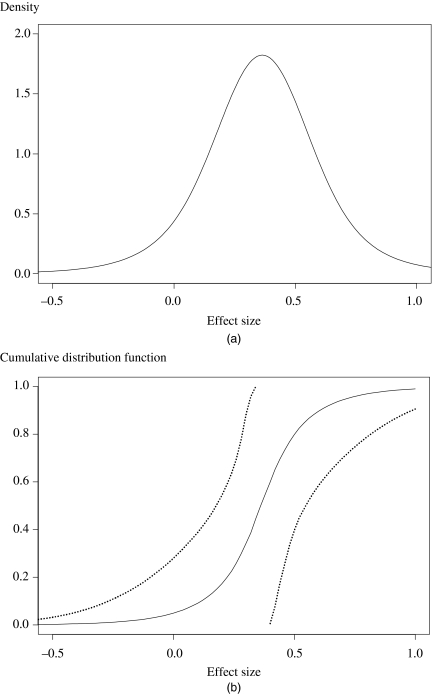
“Note that P(θnew<0)=0.950 in Table 2 corresponds to the point at which the full curve in Fig. 3(b) crosses the vertical axis (at approximately 5% probability)”
§ A re-evaluation of random-effects meta-analysis > 7 Example
“| Parameter | Median | 95% credible interval | P(parameter > 0) | | --- | --- | --- | --- | | μ | 0.36 | (0.18, 0.55) | 0.999 | | θnew | 0.36 | (−0.12, 0.84) | 0.950 |”
Rated minor: it would not touch a result — a value no result rests on, a p-value that stays on the same side of the significance level, or a conflict that is clerical, resolved elsewhere in the paper, or outside its own findings.
In the paper
§ A re-evaluation of random-effects meta-analysis > 7 Example
“Random-effects meta-analysis: standardized mean difference (95% credible interval 0.19–0.53); U*=4.23 (P =2×10⁻⁵); .”
§ A re-evaluation of random-effects meta-analysis > 7 Example
“Classical normal random-effects meta-analysis results as traditionally presented appear at the bottom of Table 1.”
Citations
Cites
Bias in meta-analysis detected by a simple, graphical test
Egger, M., Smith, G. D., Schneider, M., & Minder, C. (1997) · BMJ · doi:10.1136/bmj.315.7109.629 · Cited by 56,722 · cited 1×
“This may reflect publication bias, or correlation between study size and another important covariate such as quality of study (Egger et al., 1997).”
BackgroundMeta-analysis in clinical trials
DerSimonian, R., & Laird, N. (1986) · Controlled Clinical Trials · doi:10.1016/0197-2456(86)90046-2 · Cited by 39,552 · cited 6×
“Heterogeneity Several estimators of the heterogeneity variance τ2 are available that are based on normal likelihoods, including iterative maximum likelihood and restricted maximum likelihood estimates (DerSimonian and Laird, 1986; DerSimonian and Kacker, 2007).”
MethodInfluentialQuantifying heterogeneity in a meta‐analysis
Higgins, J. P. T., & Thompson, S. G. (2002) · Statistics in Medicine · doi:10.1002/sim.1186 · Cited by 36,763 · cited 10×
“Confidence intervals for measures of inconsistency can be calculated (Higgins and Thompson, 2002).”
BackgroundMethodInfluentialSelf-citationGelman, A., Carlin, J. B., Stern, H. S., & Rubin, D. B. (2003) · doi:10.1201/9780429258480 · Cited by 27,276
Kass, R. E., & Raftery, A. E. (1995) · Journal of the American Statistical Association · doi:10.1080/01621459.1995.10476572 · Cited by 12,558
Wasserman, S. S., Hedges, L. V., & Olkin, I. (1988) · Journal of Educational Statistics · doi:10.2307/1164953 · Cited by 10,377
Statistical Methods for Meta-Analysis
Rosenbaum, P. R., Hedges, L., & Olkin, I. (1987) · Journal of the American Statistical Association · doi:10.2307/2289186 · Cited by 6,027 · cited 1×
“A common misinterpretation of the random-effects assumption is that the studies themselves are sampled from a population of studies (Hedges, 1987; Anello and Fleiss, 1995; Colditz et al., 1995).”
BackgroundStatistical Methods for Meta-Analysis.
Freeman, P. R., Hedges, L. V., & Olkin, I. (1986) · Biometrics · doi:10.2307/2531069 · Cited by 4,840
Gelman, A. (2006) · Bayesian Analysis · doi:10.1214/06-ba117a · Cited by 4,050 · cited 1×
“It has been suggested that a prior distribution on τ might comprise the positive part of a symmetric distribution around 0, say Cauchy or normal (Gelman, 2006).”
BackgroundAssessing the quality of controlled clinical trials
Jüni, P., Altman, D. G., & Egger, M. (2001) · BMJ · doi:10.1136/bmj.323.7303.42 · Cited by 3,309 · cited 1×
“There are strong arguments against the former (Greenland and O’Rourke, 2001) and an item-based approach to dealing with quality is to be preferred (Jüni et al., 2001).”
Background
Research works printed but not linked: 3
- DuMouchel, 1994, Hierarchical Bayes linear models for meta-analysis
- Morris, 1992, Hierachical models for combining information and for meta-analysis, Bayes. Statist., 4, 321
- Stein, 1956, Proc. 3rd Berkeley Symp, 197
Cited by
Sorted by citations
Items 201–300 of 1,013
Koretsi, V., Zymperdikas, V. F., Papageorgiou, S. N., & Papadopoulos, M. A. (2015) · The European Journal of Orthodontics · doi:10.1093/ejo/cju071 · Cited by 191
“For meta-analyses with ≥3 trials, 95% prediction intervals (PIs) (58, 59) were calculated to predict treatment effects in a future setting.”
MethodO’Driscoll, R., Turicchi, J., Beaulieu, K., Scott, S., Matu, J., Deighton, K., Finlayson, G., & Stubbs, R. J. (2018) · British Journal of Sports Medicine · doi:10.1136/bjsports-2018-099643 · Cited by 202
The prevalence of occult leiomyosarcoma at surgery for presumed uterine fibroids: a meta-analysis
Pritts, E. A., Vanness, D. J., Berek, J. S., Parker, W. H., Feinberg, R. F., Feinberg, J., & Olive, D. L. (2015) · Gynecological Surgery · doi:10.1007/s10397-015-0894-4 · Cited by 190
“Thus, a random effect meta-analysis, which assumes that design differences lead each study to produce rates that are different but related to the rate of the population of interest, was the approach used here [141].”
MethodManagement of Frailty: A Systematic Review and Network Meta-analysis of Randomized Controlled Trials
Negm, A. M., Kennedy, C. C., Thabane, L., Veroniki, A. A., Adachi, J. D., Richardson, J. A., Cameron, I. D., Giangregorio, A., Πετροπούλου, Μ., Alsaad, S. M., et al. (2019) · Journal of the American Medical Directors Association · doi:10.1016/j.jamda.2019.08.009 · Cited by 194
Meta‐analysis of few small studies in orphan diseases
Friede, T., Röver, C., Wandel, S., & Neuenschwander, B. E. (2016) · Research Synthesis Methods · doi:10.1002/jrsm.1217 · Cited by 187
Darma, K., Hyde, M. J., Santhakumaran, S., Gale, C., & Modi, N. (2014) · PLoS ONE · doi:10.1371/journal.pone.0087896 · Cited by 184
Comprehensive geriatric assessment in older people: an umbrella review of health outcomes
Veronese, N., Custodero, C., Demurtas, J., Smith, L., Barbagallo, M., Maggi, S., Cella, A., Vanacore, N., Aprile, P. L., Ferrucci, L., et al. (2022) · Age and Ageing · doi:10.1093/ageing/afac104 · Cited by 185
Interactive computer-based interventions for sexual health promotion
Bailey, J. V., Murray, E., Rait, G., Mercer, C. H., Morris, R. W., Peacock, R., Cassell, J., & Nazareth, I. (2010) · Cochrane Database of Systematic Reviews · doi:10.1002/14651858.cd006483.pub2 · Cited by 183
Esteves, S. C., Miyaoka, R., Roque, M., et al. (2015) · Asian Journal of Andrology · doi:10.4103/1008-682x.169562 · Cited by 183
Borenstein, M. (2023) · Research Synthesis Methods · doi:10.1002/jrsm.1678 · Cited by 185
“4 While the idea of a prediction interval applies in primary studies, we do not typically call it by that name.”
BackgroundAttridge, M., Creamer, J., Ramsden, M., Cannings-John, R. L., & Hawthorne, K. (2014) · Cochrane Database of Systematic Reviews · doi:10.1002/14651858.cd006424.pub3 · Cited by 201
Molenaar, N. M., Bais, B., den Berg, M. P. L., Mulder, C. L., Howell, E. A., Fox, N. S., Rommel, A., Bergink, V., & Kamperman, A. M. (2019) · Journal of Affective Disorders · doi:10.1016/j.jad.2019.12.014 · Cited by 188
Sibanda, E. L., Weller, I. V. D., Hakim, J. G., & Cowan, F. M. (2013) · AIDS · doi:10.1097/qad.0000000000000027 · Cited by 188
“There was extensive heterogeneity of study findings; therefore, predictive intervals (PrIs; approximate 95% confidence intervals of a future study based on the observed heterogeneity) were computed as recommended good practice in the presence of significant heterogeneity [14].”
MethodFröhlich, G., Lansky, A. J., Webb, J. G., Roffi, M., Toggweiler, S., Reinthaler, M., Wang, D., Hutchinson, N., Wendler, O., Hildick‐Smith, D., et al. (2014) · BMC Medicine · doi:10.1186/1741-7015-12-41 · Cited by 177
When should meta‐analysis avoid making hidden normality assumptions?
Jackson, D., & White, I. R. (2018) · Biometrical Journal · doi:10.1002/bimj.201800071 · Cited by 177
Röver, C., Bender, R., Dias, S., Schmid, C. H., Schmidli, H., Sturtz, S., Weber, S., & Friede, T. (2021) · Research Synthesis Methods · doi:10.1002/jrsm.1475 · Cited by 209
Autotransplantation of teeth in humans: a systematic review and meta-analysis
Almpani, K., Papageorgiou, S. N., & Papadopoulos, M. A. A. P. (2015) · Clinical Oral Investigations · doi:10.1007/s00784-015-1473-9 · Cited by 180
Efficacy and safety of EUS-guided liver biopsy: a systematic review and meta-analysis
Mohan, B. P., Shakhatreh, M. K., Garg, R., Ponnada, S., & Adler, D. G. (2018) · Gastrointestinal Endoscopy · doi:10.1016/j.gie.2018.10.018 · Cited by 178
Li, D., Lu, Y., Yuan, S., Cai, X., He, Y., Chen, J., Wu, Q., He, D., Fang, A., Bo, Y., et al. (2022) · American Journal of Clinical Nutrition · doi:10.1093/ajcn/nqac074 · Cited by 193
“the 95% prediction interval (95% PI) to predict the range of effect size that would be expected in a new original study after accounting for both the heterogeneity among individual studies and the uncertainty of the summary effect estimated in the random-effects model (28) (the calculation of the 95% PI is based on th…”
BackgroundSmithers, L. G., Sawyer, A. C. P., Chittleborough, C. R., Davies, N. M., Davey Smith, G., & Lynch, J. W. (2018) · Nature Human Behaviour · doi:10.1038/s41562-018-0461-x · Cited by 175
Missed opportunities to prevent mother-to-child-transmission
Wettstein, C., Mugglin, C., Egger, M., Blaser, N., Vizcaya, L. S., Estill, J. A. M., Bender, N., Davies, M., Wandeler, G., & Keiser, O. (2012) · AIDS · doi:10.1097/qad.0b013e328359ab0c · Cited by 176
“PrI predict the likely underlying mean percentages in new studies and are the most sensible way to summarize the results of heterogeneous studies [6].”
BackgroundRiley, R. D., Debray, T. P. A., Fisher, D. J., Hattle, M., Marlin, N., Hoogland, J., Gueyffier, F., Staessen, J. A., Wang, J., Moons, K. G. M., et al. (2020) · Statistics in Medicine · doi:10.1002/sim.8516 · Cited by 180
Wolfenden, L., Nathan, N., Sutherland, R., Yoong, S. L., Hodder, R. K., Wyse, R., Delaney, T. M., Grady, A., Fielding, A., Tzelepis, F., et al. (2017) · Cochrane Database of Systematic Reviews · doi:10.1002/14651858.cd011677.pub2 · Cited by 187
Prediction intervals for random-effects meta-analysis: A confidence distribution approach
Nagashima, K., Noma, H., & Furukawa, T. A. (2018) · Statistical Methods in Medical Research · doi:10.1177/0962280218773520 · Cited by 199
“1 The random-effects model and the exact distribution of Cochran’s Q statistic We consider the random-effects model [6, 16, 17, 18, 19].”
InfluentialActive versus expectant management for women in the third stage of labour
Begley, C., Gyte, G. M., Devane, D., McGuire, W. L., & Weeks, A. D. (2011) · Cochrane Database of Systematic Reviews · doi:10.1002/14651858.cd007412.pub3 · Cited by 171
Niemeijer, A., Lund, H., Stafne, S. N., Ipsen, T., Goldschmidt, C. L., Jørgensen, C. T., & Juhl, C. B. (2020) · British Journal of Sports Medicine · doi:10.1136/bjsports-2018-100461 · Cited by 157
Signorini, M. L., Soto, L. P., Zbrun, M. V., Sequeira, G. J., Rosmini, M. R., & Frizzo, L. S. (2012) · Research in Veterinary Science · doi:10.1016/j.rvsc.2011.05.001 · Cited by 164
“…prediction intervals (PIs) were calculated for incidence of diarrhea, fecal consistency and LAB:coliforms ratio, by using the following formula from Higgins et al. (2009): l tak 2 ffiffiffiffiffiffiffiffiffiffiffiffiffiffiffiffiffiffiffiffiffiffiffiffiffi SEðlÞ2 þ s2 q where l is the average…”
MethodDeterminants of physical activity maintenance: a systematic review and meta-analyses
Amireault, S., Godin, G., & Vézina‐Im, L. (2012) · Health Psychology Review · doi:10.1080/17437199.2012.701060 · Cited by 178
“For all reported summary effect sizes, predictive distribution of the true effect in a new study was addressed with prediction intervals [95%PI] in order to strengthen statistical inferences from heterogeneous meta-analysis results (Higgins, Thompson, & Spiegelhalter, 2009 ).”
MethodMeadows, A., Kaambwa, B., Novielli, N., Huissoon, A. P., Fry-Smith, A., Meads, C., Barton, P., & Dretzke, J. (2013) · Health Technology Assessment · doi:10.3310/hta17270 · Cited by 159
Kunutsor, S. K., Beswick, A. D., Whitehouse, M. R., Wylde, V., & Blom, A. W. (2018) · Journal of Infection · doi:10.1016/j.jinf.2018.08.017 · Cited by 162
Zhu, J., Yu, X., Zheng, Y., Li, J., Wang, Y., Yin, L., He, Z., Zhao, W., Chen, C., Qiu, K., et al. (2020) · The Lancet Diabetes & Endocrinology · doi:10.1016/s2213-8587(19)30422-x · Cited by 162
Meta‐analysis of magnitudes, differences and variation in evolutionary parameters
Morrissey, M. B. (2016) · Journal of Evolutionary Biology · doi:10.1111/jeb.12950 · Cited by 149
Drug interventions for the treatment of obesity in children and adolescents
Axon, E., Atkinson, G., Richter, B., Metzendorf, M., Baur, L. A., Finer, N., Corpeleijn, E., O’Malley, C. L., & Ells, L. J. (2016) · Cochrane Database of Systematic Reviews · doi:10.1002/14651858.cd012436 · Cited by 164
Dias, S., Sutton, A. J., Welton, N. J., & Ades, A. E. (2011) · Bristol Research (University of Bristol) · Cited by 158
Surgery first in orthognathic surgery: A systematic review of the literature
Guijarro, M. A. P., Guijarro‐Martínez, R., & Hernández-Alfaro, F. J. (2016) · American Journal of Orthodontics and Dentofacial Orthopedics · doi:10.1016/j.ajodo.2015.09.022 · Cited by 166
Cirocchi, R., Arezzo, A., D’Andrea, V., Abraha, I., Popivanov, G., Avenia, N., Gerardi, C., Henry, B. M., Randolph, J., & Barczyński, M. (2019) · Cochrane Database of Systematic Reviews · doi:10.1002/14651858.cd012483.pub2 · Cited by 159
“Higgins 2009 Higgins JPT, Thompson SG, Spiegelhalter DJ.”
MethodMcPhail, M. J. W., Wendon, J. A., & Bernal, W. E. (2010) · Journal of Hepatology · doi:10.1016/j.jhep.2010.03.023 · Cited by 156
“4 (Universidad Complutense, Madrid) using DerSimonian–Laird random effects models with over-dispersion corrections [22].”
MethodIncidence and Outcomes of COVID-19 in People With CKD: A Systematic Review and Meta-analysis
Chung, E. Y. M., Palmer, S. C., Natale, P., Krishnan, A., Cooper, T. E., Saglimbene, V. M., Ruospo, M., Au, E. H. K., Jayanti, S., Liang, A. C., et al. (2021) · American Journal of Kidney Diseases · doi:10.1053/j.ajkd.2021.07.003 · Cited by 161
“KTR 1,893 120,281 23 (18-30) [2-67] 29 Lowc COVID-19–attributable outcomes in people with COVID-19 and CKD (per 1,000 person-weeks) Death 19,938 70,922 32 (30-35) [4-81] 229 Lowc Respiratory failure 14,635 68,840 31 (27-35) [3-81] 101 Lowc Dyspnea 2,587 5,767 80 (66-95) [2-234] 75 Lowc COVID-19 recovery 1,473 3,463 83…”
Demystifying fixed and random effects meta-analysis
Nikolakopoulou, A., Mavridis, D., & Salanti, G. (2014) · Evidence-Based Mental Health · doi:10.1136/eb-2014-101795 · Cited by 157
“Predictive intervals refer to the 95% of the possible treatment effects in individual settings and can be interpreted as the predicted range for the ‘true’ treatment effect in a new study.(7) 15 CIs and predictive intervals are not interchangeable; CIs reflect uncertainty about the estimation of the mean whereas predi…”
BackgroundLikelihood-based random-effects meta-analysis with few studies: empirical and simulation studies
Seide, S., Röver, C., & Friede, T. (2019) · BMC Medical Research Methodology · doi:10.1186/s12874-018-0618-3 · Cited by 160
“Bayesian random-effects metaanalyses with weakly informative priors for the betweenstudy heterogeneity have been proposed for this setting [4] and their performance has been found to be satisfactory in numerical applications and simulations [3, 5].”
BackgroundGiacoppo, D., Matsuda, Y., Fovino, L. N., D’Amico, G., Gargiulo, G., Byrne, R. A., Capodanno, D., Valgimigli, M., Mehran, R., & Tarantini, G. (2020) · European Heart Journal · doi:10.1093/eurheartj/ehaa739 · Cited by 159
Meta-Analysis for Evidence Synthesis in Plant Pathology: An Overview
Madden, L. V., & Paul, P. A. (2010) · Phytopathology · doi:10.1094/phyto-03-10-0069 · Cited by 156
Heida, K. Y., Bots, M. L., de Groot, C. J., van Dunné, F. M., Hammoud, N. M., Hoek, A., Laven, J. S., Maas, A. H., Roeters van Lennep, J. E., Velthuis, B. K., et al. (2016) · European Journal of Preventive Cardiology · doi:10.1177/2047487316659573 · Cited by 153
“Values of I(2)> 50% indicate significant heterogeneity.(23) Although most meta-analyses had an I(2)> 50%, all included studies showed a positive effect on the relation between CVD and preeclampsia/GH.”
BackgroundInker, L. A., Heerspink, H. J. L., Mondal, H., Schmid, C. H., Tighiouart, H., Noubary, F., Coresh, J., Greene, T., & Levey, A. S. (2014) · American Journal of Kidney Diseases · doi:10.1053/j.ajkd.2014.08.017 · Cited by 155
Jarvis, P. T., Turner, A. N., Read, P. J., & Bishop, C. J. (2021) · Sports Medicine · doi:10.1007/s40279-021-01566-y · Cited by 156
Samii, C., Lisiecki, M., Kulkarni, P., Paler, L., Chavis, L., Snilstveit, B., Vojtkova, M., & Gallagher, E. (2014) · Campbell Systematic Reviews · doi:10.4073/csr.2014.11 · Cited by 153
“…the empirical Bayes procedure, the confidence interval for the random effects mean applies the small sample adjustment of Knapp and Hartung (2003), and the predictive interval uses a t-distribution with degrees of freedom equal to the number of studies minus 1, following Higgins et al. (2009).”
MethodLawry, S., Samii, C., Hall, R., Leopold, A., Hornby, D., & Mtero, F. (2014) · Campbell Systematic Reviews · doi:10.4073/csr.2014.1 · Cited by 148
Prevalence, aetiologies and prognosis of the symptom dizziness in primary care – a systematic review
Bösner, S., Schwarm, S., Grevenrath, P., Schmidt, L., Hörner, K., Beidatsch, D., Bergmann, M., Viniol, A., Becker, A., & Haasenritter, J. (2018) · BMC Family Practice · doi:10.1186/s12875-017-0695-0 · Cited by 150
Langan, D., Higgins, J. P. T., & Simmonds, M. (2017) · Research Synthesis Methods · doi:10.1002/jrsm.1198 · Cited by 149
“…estimator, BM, and Kontopantelis et al. (2013) recommended DLb, which produces a lower number of zero estimates in comparison with DL. Meta-analyses containing a truly homogeneous group of studies and therefore zero heterogeneity are thought to be untenable in practice (Higgins et al., 2009).”
ResultSelf-citationManagement of Extracranial Carotid Artery Aneurysm
Welleweerd, J. C., den Ruijter, H. M., Nelissen, B. G. L., et al. (2015) · European Journal of Vascular and Endovascular Surgery · doi:10.1016/j.ejvs.2015.05.002 · Cited by 148
Belbasis, L., Köhler, C. A., Stefanis, N. C., Stubbs, B., van Os, J., Vieta, E., Seeman, M. V., Arango, C., Carvalho, A. F., & Εvangelou, Ε. (2017) · Acta Psychiatrica Scandinavica · doi:10.1111/acps.12847 · Cited by 154
The Incidence of Injury in Amateur Male Rugby Union: A Systematic Review and Meta-Analysis
Yeomans, C., Kenny, I. C., Cahalan, R., et al. (2018) · Sports Medicine · doi:10.1007/s40279-017-0838-4 · Cited by 148
“Following the papers by Guddat et al. [26] and Higgins et al. [27], the results were gathered together and presented by means of a forest plot (Fig.”
Barbui, C., Purgato, M., Abdulmalik, J., Caldas-de-Almeida, J. M., Eaton, J., Gureje, O., Hanlon, C., Nosè, M., Ostuzzi, G., Saraceno, B., et al. (2021) · The British Journal of Psychiatry · doi:10.1192/bjp.2020.144 · Cited by 148
“29 Prediction intervals further account for heterogeneity between studies and specify the uncertainty for the effectthatwould beexpected ina new study examining that same research question.”
InfluentialZhang, S., Sun, X., Chang, W., et al. (2015) · PLoS ONE · doi:10.1371/journal.pone.0136082 · Cited by 147
“As in previous meta-analyses in which unexplained heterogeneity was identified, we accommodated this condition by using REM, in which the effects underlying the results of different studies are assumed to be drawn from a normal distribution [124].”
MethodThoma, D. S., Bienz, S. P., Figuero, E., Jung, R. E., & Sanz‐Martín, I. (2019) · Journal Of Clinical Periodontology · doi:10.1111/jcpe.13050 · Cited by 148
Hunt, L. M., Camp, E., van Poorten, B. T., & Arlinghaus, R. (2019) · Reviews in Fisheries Science & Aquaculture · doi:10.1080/23308249.2019.1583166 · Cited by 155
Fixed- and Random-Effects Models
Kanters, S. (2021) · Methods in molecular biology · doi:10.1007/978-1-0716-1566-9_3 · Cited by 160
da Costa, B. R., Rutjes, A. W., Johnston, B. C., Reichenbach, S., Nüesch, E., Tonia, T., Gemperli, A., Guyatt, G. H., & Jüni, P. (2012) · International Journal of Epidemiology · doi:10.1093/ije/dys124 · Cited by 145
International variation in shoulder arthroplasty
Lübbeke, A., Rees, J. L., Baréa, C., Combescure, C., Carr, A. J., & Silman, A. J. (2017) · Acta Orthopaedica · doi:10.1080/17453674.2017.1368884 · Cited by 146
Feasibility, Safety, and Efficacy of Posterior Wall Isolation During Atrial Fibrillation Ablation
Thiyagarajah, A., Kadhim, K., Lau, D. H., Emami, M., Linz, D., Khokhar, K. B., Munawar, D. A., Mishima, R. S., Malik, V., O’Shea, C., et al. (2019) · Circulation Arrhythmia and Electrophysiology · doi:10.1161/circep.118.007005 · Cited by 145
Comment on: heterogeneity in meta-analysis should be expected and appropriately quantified
Coory, M. D. (2009) · International Journal of Epidemiology · doi:10.1093/ije/dyp157 · Cited by 145
Methods to increase reproducibility in differential gene expression via meta-analysis
Sweeney, T. E., Haynes, W. A., Vallania, F., Ioannidis, J. P. A., & Khatri, P. (2016) · Nucleic Acids Research · doi:10.1093/nar/gkw797 · Cited by 137
“One drawback of random-effects meta-analysis is that it is not appropriate for count-based data such as RNAseq (as the count data are not normally distributed), as discussed elsewhere (27,28).”
MethodStockdale, A. J., Chaponda, M., Beloukas, A. I., et al. (2017) · The Lancet Global Health · doi:10.1016/s2214-109x(17)30298-x · Cited by 144
Wilson, C. A., Newham, J. J., Rankin, J. M., Ismail, K., Simonoff, E. A., Reynolds, R. M., Stoll, N. R., & Howard, L. M. (2019) · Diabetic Medicine · doi:10.1111/dme.14170 · Cited by 150
Active versus expectant management for women in the third stage of labour
Begley, C., Gyte, G. M., Murphy, D. J., Devane, D., McDonald, S., & McGuire, W. L. (2010) · Cochrane Database of Systematic Reviews · doi:10.1002/14651858.cd007412.pub2 · Cited by 145
Scoping Reviews, Systematic Reviews, and Meta-Analysis: Applications in Veterinary Medicine
Sargeant, J. M., & O'Connor, A. M. C. (2020) · Frontiers in Veterinary Science · doi:10.3389/fvets.2020.00011 · Cited by 177
Tricco, A. C., Soobiah, C., Blondal, E., Veroniki, A. A., Khan, P. A., Vafaei, A., Ivory, J. D., Strifler, L., Ashoor, H. M., MacDonald, H. R., et al. (2015) · BMC Medicine · doi:10.1186/s12916-015-0371-y · Cited by 142
Systematic Review of the Prevalence of Long COVID
Woodrow, M., Carey, C., Ziauddeen, N., Thomas, R., Akrami, A., Lutje, V., Greenwood, D. C., & Alwan, N. A. (2023) · Open Forum Infectious Diseases · doi:10.1093/ofid/ofad233 · Cited by 162
“In a variation to our protocol, we present pooled estimates (PEs) alongside 95% prediction intervals (PIs) to evaluate and incorporate uncertainty in the analysis, as recently recommended for prevalence studies, where true between-study heterogeneity is expected [13, 14].”
A Bayesian basket trial design using a calibrated Bayesian hierarchical model
Chu, Y., & Yuan, Y. (2018) · Clinical Trials · doi:10.1177/1740774518755122 · Cited by 139
“This is analogous to a random-effects model-based meta-analysis, for which it is difficult to obtain a reasonably precise estimate for the betweentrial variability if only a few trials are available.(11)”
MethodParent-only interventions for childhood overweight or obesity in children aged 5 to 11 years
Loveman, E., Al-Khudairy, L., Johnson, R. E., Robertson, W., Colquitt, J. L., Mead, E., Ells, L. J., Metzendorf, M., & Rees, K. (2015) · Cochrane Database of Systematic Reviews · doi:10.1002/14651858.cd012008 · Cited by 155
Psychological interventions for diabetes-related distress in adults with type 2 diabetes mellitus
Chew, B. H., Vos, R. C., Metzendorf, M.-I., Scholten, R. J., & Rutten, G. E. (2017) · Cochrane Database of Systematic Reviews · doi:10.1002/14651858.cd011469.pub2 · Cited by 138
Su, Y., D’Arcy, C., Yuan, S., & Meng, X. (2019) · Journal of Affective Disorders · doi:10.1016/j.jad.2019.04.026 · Cited by 154
Detecting and adjusting for small‐study effects in meta‐analysis
Rücker, G., Carpenter, J. R., & Schwarzer, G. (2011) · Biometrical Journal · doi:10.1002/bimj.201000151 · Cited by 132
“…estimates for all parameters and the observed study residual for ei obtaining x1;i ¼ b̂1 ffiffiffiffiffiffiffiffiffiffiffiffi t̂2 s2i 1t̂2 s ðxi b̂Þ: The limit meta-analysis yields shrunken estimates of the study-specific effects, comparable to empirical Bayes estimates (Higgins et al., 2009).”
ResultKelley, G. A., Kelley, K. S., & Kohrt, W. M. (2012) · BMC Musculoskeletal Disorders · doi:10.1186/1471-2474-13-177 · Cited by 135
Ma, M., Dorstyn, D., Ward, L., & Prentice, S. (2018) · Aging & Mental Health · doi:10.1080/13607863.2017.1370689 · Cited by 133
Adult height and head and neck cancer: a pooled analysis within the INHANCE Consortium
Leoncini, E., Ricciardi, W., Cadoni, G., Arzani, D., Petrelli, L., Paludetti, G., Brennan, P., Luce, D., Stücker, I., Matsuo, K., et al. (2013) · European Journal of Epidemiology · doi:10.1007/s10654-013-9863-2 · Cited by 134
“We quantified inconsistencies across studies and their impact on the analysis by using Cochrane’s Q and the I(2) statistic [36, 37].”
MethodAgarwal, A. K., Sharma, R., Harlev, A., & Esteves, S. C. (2015) · Asian Journal of Andrology · doi:10.4103/1008-682x.172638 · Cited by 138
Screening for postnatal depression in primary care: cost effectiveness analysis
Paulden, M., Palmer, S., Hewitt, C. E., & Gilbody, S. M. (2009) · BMJ · doi:10.1136/bmj.b5203 · Cited by 131
“Finally, there were moderate to high levels of heterogeneity between studies across all cut points of the instruments considered. Consequently, we used random effects meta-analysis to incorporate the additional uncertainty caused by that heterogeneity in the test performance results for each instrument. It has recentl…”
MethodMohan, B. P., Khan, S. R., Trakroo, S., Ponnada, S., Jayaraj, M., Asokkumar, R., & Adler, D. G. (2019) · Endoscopy · doi:10.1055/a-1020-3932 · Cited by 141
Clarke, M. A., Deshmukh, A. A., Suk, R., Roberts, J. M., Gilson, R. J. C., Jay, N., Stier, E. A., & Wentzensen, N. (2022) · International Journal of Cancer · doi:10.1002/ijc.34199 · Cited by 140
Papalia, N., Spivak, B., Daffern, M., & Ogloff, J. R. P. (2019) · Clinical Psychology: Science and Practice · doi:10.1111/cpsp.12282 · Cited by 130
Downe, S. M., Gyte, G. M., Dahlen, H. G., & Singata‐Madliki, M. (2013) · Cochrane Database of Systematic Reviews · doi:10.1002/14651858.cd010088.pub2 · Cited by 150
Pre‐eclampsia and long‐term health outcomes for mother and infant: an umbrella review
Pittara, T., Vyrides, A., Lamnisos, D., & Giannakou, K. (2021) · BJOG: An International Journal of Obstetrics & Gynaecology · doi:10.1111/1471-0528.16683 · Cited by 125
Prediction interval in random-effects meta-analysis
Spineli, L. M., & Pandis, N. (2020) · American Journal of Orthodontics and Dentofacial Orthopedics · doi:10.1016/j.ajodo.2019.12.011 · Cited by 131
Shapley variable importance cloud for interpretable machine learning
Ning, Y., Ong, M. E. H., Chakraborty, B., Goldstein, B. A., Ting, D. S. W., VAUGHAN, R. D., & Liu, N. (2022) · Patterns · doi:10.1016/j.patter.2022.100452 · Cited by 137
“The ShapleyVIC value from a new model within the Rashomon set,mr new, may be predicted by assuming a t-distribution with M 2 degrees of freedom for ðmrs new mrÞ = ffiffiffiffiffiffiffiffiffiffiffiffiffiffiffiffiffiffiffiffiffiffiffiffiffiffiffiffiffiffiffi ðvarðmrÞ+ t2Þ p .(24) The 95% prediction interval (PI) for mr…”
Fetal and umbilical Doppler ultrasound in high-risk pregnancies
Alfirević, Ž., Stampalija, T., & Gyte, G. M. (2010) · Cochrane Database of Systematic Reviews · doi:10.1002/14651858.cd007529.pub2 · Cited by 126
A comparison of methods for meta‐analysis of a small number of studies with binary outcomes
Mathes, T., & Kuß, O. (2018) · Research Synthesis Methods · doi:10.1002/jrsm.1296 · Cited by 136
“The termination of the optimal number of degrees of freedom for the Student t‐distribution is difficult because it depends on between‐ and within‐study variances and the number of included studies in the meta‐analysis.(8) Our simulation indicates that for the number of degrees of freedom, BB1N (number of studies minus…”
BackgroundMethodAssociation between Use of Statin and Risk of Dementia: A Meta-Analysis of Observational Studies
Poly, T. N., Islam, M. M., Walther, B. A., Yang, H., Wu, C.-C., Lin, M., & Li, Y. (2019) · Neuroepidemiology · doi:10.1159/000503105 · Cited by 127
Sanz‐Sánchez, I., Sanz‐Martín, I., Figuero, E., et al. (2014) · Clinical Oral Implants Research · doi:10.1111/clr.12428 · Cited by 127
Kelley, G. A., Kelley, K. S., Roberts, S., & Haskell, W. (2012) · Clinical Nutrition · doi:10.1016/j.clnu.2011.11.011 · Cited by 125
Tseng, P.-T., Cheng, Y.-S., Yen, C.-F., Chen, Y.-W., Stubbs, B., Whiteley, P., Carvalho, A. F., Li, D.-J., Chen, T.-Y., Yang, W.-C., et al. (2018) · Scientific Reports · doi:10.1038/s41598-017-19096-x · Cited by 126
Moran, P. S., O’Neill, M., Teljeur, C., Flattery, M. J., Murphy, L. A., Smyth, G. P., & Ryan, M. (2013) · International Journal of Urology · doi:10.1111/iju.12070 · Cited by 126
Snell, K. I. E., Ensor, J., Debray, T. P. A., Moons, K. G. M., & Riley, R. D. (2017) · Statistical Methods in Medical Research · doi:10.1177/0962280217705678 · Cited by 130
“Yet, the assumption is fundamentally important when making predictive inferences about potential performance in new studies or populations; for example, when deriving a 95% prediction interval for the potential calibration slope in a new study.(14,22) Lee and Thomson explored flexible parametric models for random-effe…”
BackgroundMethodInfluentialOral vitamin B 12 versus intramuscular vitamin B 12 for vitamin B 12 deficiency
Wang, H., Li, L., Qin, L., Song, Y., Vidal‐Alaball, J., & Liu, T. H. (2018) · Cochrane Database of Systematic Reviews · doi:10.1002/14651858.cd004655.pub3 · Cited by 126
Sarcopenia and health-related outcomes: an umbrella review of observational studies
the Special Interest Groups in Systematic Reviews and Meta-analyses for healthy ageing Sarcopenia and Frailty and resilience in older persons of the European Geriatric Medicine Society (EuGMS), Veronese, N., Demurtas, J., Soysal, P., Smith, L., Torbahn, G., Schoene, D., Schwingshackl, L., Sieber, C. C., Bauer, J. M., et al. (2019) · European Geriatric Medicine · doi:10.1007/s41999-019-00233-w · Cited by 133
Fetal and umbilical Doppler ultrasound in normal pregnancy
Alfirević, Ž., Stampalija, T., & Gyte, G. M. (2010) · Cochrane Database of Systematic Reviews · doi:10.1002/14651858.cd001450.pub3 · Cited by 123
The association between gestational diabetes and ASD and ADHD: a systematic review and meta-analysis
Rowland, J., & Wilson, C. A. (2021) · Scientific Reports · doi:10.1038/s41598-021-84573-3 · Cited by 120
Verde, P. E., & Ohmann, C. (2015) · Research Synthesis Methods · doi:10.1002/jrsm.1122 · Cited by 123
“Bayesian predictive data are conditionally independent from the data used to build the model and can be used for model checking in meta-analysis (Higgins et al., 2009; Verde, 2010).”
BackgroundMethodInfluentialAnti-Tumor Effects of Ketogenic Diets in Mice: A Meta-Analysis
Klement, R. J., Champ, C. E., Otto, C., & Kämmerer, U. (2016) · PLoS ONE · doi:10.1371/journal.pone.0155050 · Cited by 123
“Here yi and si denote the outcome [ln(MR) or ln(HR)] and its SE in the ith study, and the true study effects θi are assumed to be exchangeable [28] and drawn from an underlying distribution given by”
BackgroundMethodResultTabinor, M., Elphick, E. H., Dudson, M., Kwok, C. S., Lambie, M., & Davies, S. (2018) · Scientific Reports · doi:10.1038/s41598-018-21226-y · Cited by 123
Metadata
- Authors
- Higgins, J. P. T., Thompson, S. G., & Spiegelhalter, D. J.
- Affiliations
- MRC Biostatistics Unit (GB)
- Corresponding author
- Higgins, Julian P. T.
- Venue
- Journal of the Royal Statistical Society Series A: Statistics in Society
- Publisher
- Oxford University Press (OUP)
- Published
- 2008-07-24
- Volume
- 172
- Issue
- 1
- Pages
- 137-159
- ISSN
- 0964-1998 (ISSN-L)
- 1467-985X
- PMC
- PMC2667312
- OpenAlex
- W2108116635
- Semantic Scholar
- b42717775886e436d97964fca187c3248684112e
- Cited by
- 2,569
- References
- 100
- Citations by year
- 2026: 222 · 2025: 197 · 2024: 219 · 2023: 186 · 2022: 208 · 2021: 246 · 2020: 224 · 2019: 160 · 2018: 153 · 2017: 124 · 2016: 128 · 2015: 117 · 2014: 93 · 2013: 96 · 2012: 89
- FWCI
- 38.18
- Type
- journal article
- Language
- en
- Open access
- green
- www.ncbi.nlm.nih.gov
- Licence
- academic.oup.com/journals/pages/open_access/funder_policies/chorus/standard_publication_model (vor)
- Locations
- Journal of the Royal Statistical Society Series A (Statistics in Society) (publishedVersion)
- PubMed Central (publishedVersion)
- PubMed (publishedVersion)
- Explore Bristol Research (publishedVersion)
- Bristol Research (University of Bristol) (submittedVersion)
- Funders
- UK Medical Research Council (U.1052.00.011, U.1052.00.001, U.1052.00.005)
- Topics
- Social Sciences › Decision Sciences › Statistics, Probability and Uncertainty › Meta-analysis and systematic reviews
- Physical Sciences › Mathematics › Statistics and Probability › Statistical Methods and Bayesian Inference
- Physical Sciences › Mathematics › Statistics and Probability › Statistical Methods in Epidemiology
- Keywords
- random-effects meta-analysis, heterogeneity, Bayesian meta-analysis, prediction intervals, nonparametric inference, hypothesis testing, set-shifting, eating disorders, prior sensitivity
About these checks
Registry, retraction, Cites and statistics results are computed, not judged, with one exception: a printed reference that no index lists is read once by a model before it counts as a citation error. Claims are extracted by a model and kept only when their quote appears verbatim in the text; each cited source is then checked, with a model’s help, for whether it says what the claim relies on. Those verdicts can be wrong — read the claim’s quote and the cited source before relying on one.
A language model drew the claims from the paper on 2026-10-09, under version 3 of the claim definition (model deepseek-v4.1-flash, prompt extract-v3).
A second model labelled each claim on 2026-10-09 (model jev-1.13-20260917, definition revision gold-guideline-v0.2).
Statistics and arithmetic are recomputed, not judged.
Confidence bands are shown only for fields calibrated on our annotated test set. None is calibrated yet, so no band is shown.
What counts as a claim ›How we measure confidence ›How we check this ›
Are you an author, or do you see a problem with this page? Request a review
