

The DOI matches its Crossref record; 61 of the 62 references it cites were found in a registry or an index, and 1 are not checked yet; none of the 51 sources its claims cite is checked for support yet.
Research Review: Help‐seeking intentions, behaviors, and barriers in college students – a systematic review and meta‐analysis
Open accessAbstract
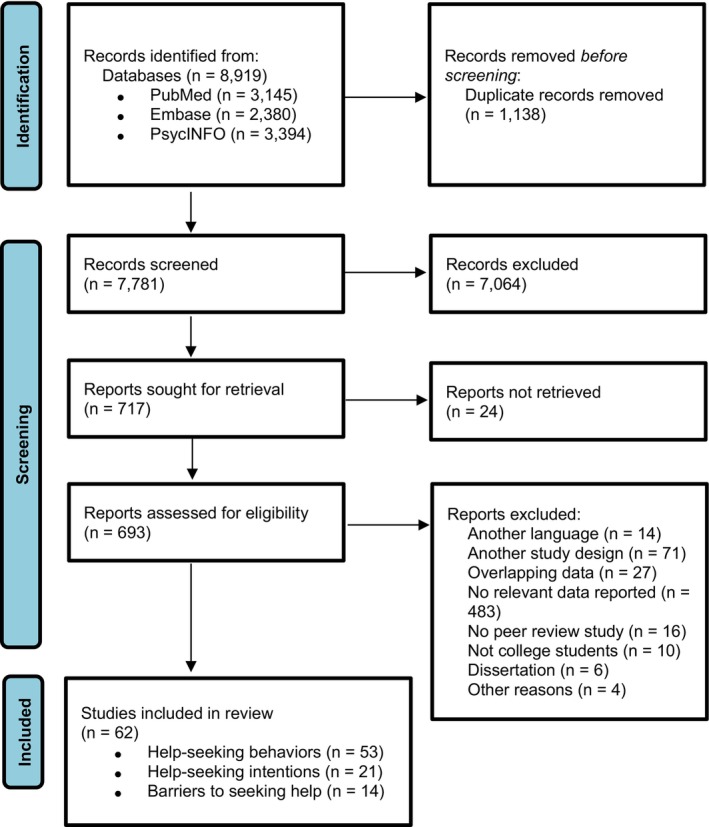
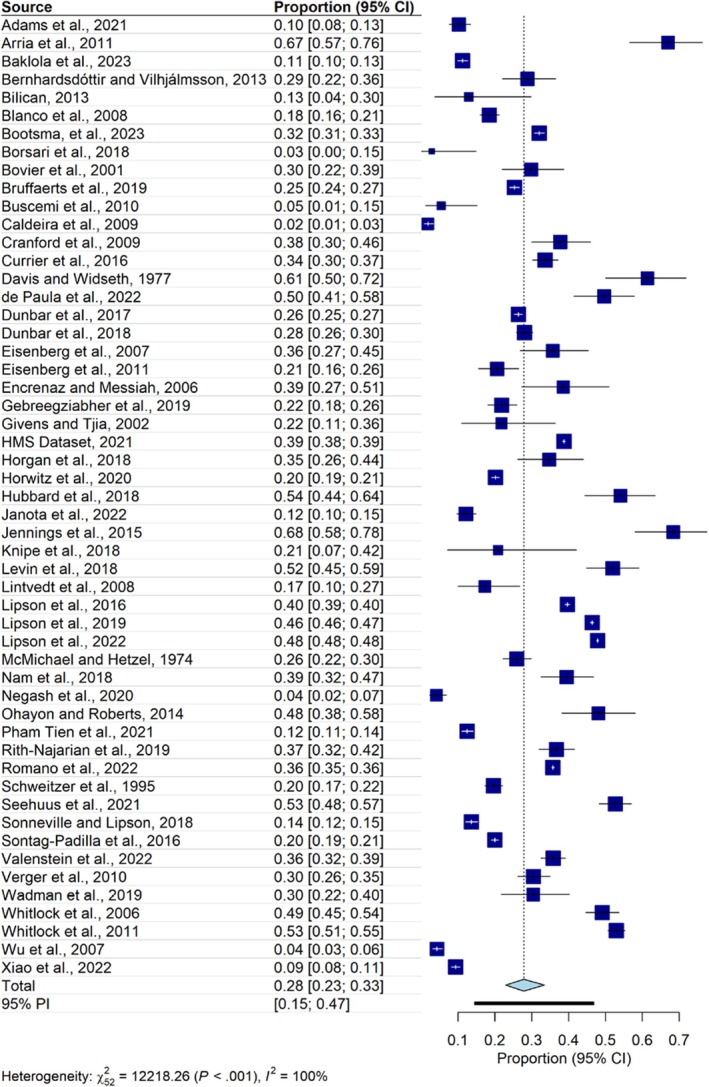
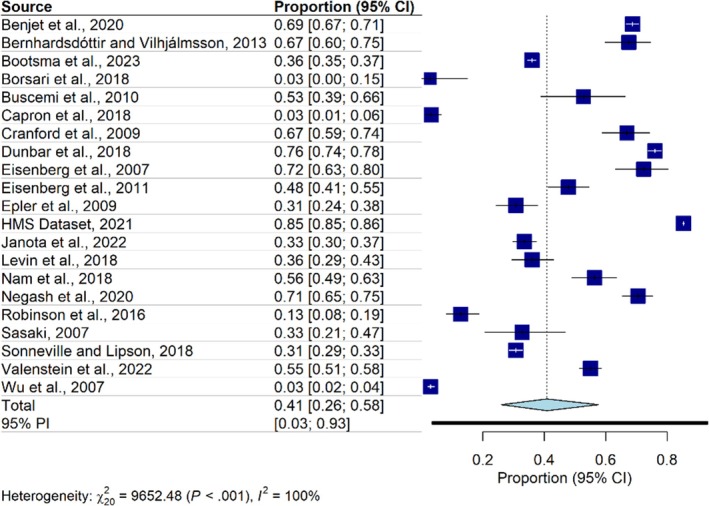
Background: The prevalence of mental health problems among college students has increased over the past decade. Even when mental health services are available, many students still struggle to access these services. This systematic review and meta‐analysis aimed to identify the rates at which students actively seek or consider using formal help and to determine the main reasons for not seeking help. Methods: A comprehensive literature search was conducted on PubMed, PsycINFO, and Embase to identify studies on help‐seeking behaviors, intentions, and barriers to help‐seeking among college students with mental health problems. Random effect models were used to calculate the pooled proportions. Results: Of the 8,919 identified studies, 62 met the inclusion criteria and were included ( n = 53 on help‐seeking behaviors, n = 21 on help‐seeking intentions, and n = 14 on treatment barriers). The pooled prevalence of active help‐seeking behaviors was 28% (179,915/435,768 individuals; 95% CI: 23%–33%, I 2 = 99.6%), and the aggregated prevalence of help‐seeking intentions was 41% (62,456/80161 individuals; 95% CI: 26%–58%, I 2 = 99.8%). Common barriers reported by students included a preference to address issues on their own, time constraints, insufficient knowledge of accessible resources, and a perceived lack of need for professional help. Conclusions: The findings highlight the gap between the mental health needs of the students and their actual help‐seeking rates. Although personal barriers are common, systemic or contextual challenges also affect college students' help‐seeking behaviors.
Checked 2026-11-11 · 1 reference not checked yet
Overview
AI snapshot
Written from the paper’s full text.
TL;DR
This systematic review and meta-analysis pooled 62 studies to estimate formal help-seeking intentions, behaviors, and barriers among college students with mental health problems. It found that 41% intended to seek help but only 28% actively sought formal help, with self-reliance, time constraints, limited resource knowledge, and low perceived need among the most common barriers.
Key findings
- Pooled active help-seeking behavior was 28% (179,915/435,768 individuals; 95% CI 23%–33%; I² = 99.6%) across 53 studies.
- Pooled help-seeking intentions were 41% (62,456/80,161 individuals; 95% CI 26%–58%; I² = 99.8%) across 21 studies.
- Help-seeking was especially low for alcohol and/or drug use problems: 12% for behavior (95% CI 4%–28%) and 14% for intentions (95% CI 2%–54%).
- Common barriers were preference for self-management (41%; 95% CI 26%–59%), lack of time (41%; 95% CI 27%–56%), lack of knowledge of where to seek help (35%; 95% CI 20%–53%), and lack of perceived need (34%; 95% CI 19%–54%).
Methods
- Systematic review and meta-analysis following PRISMA 2020, preregistered on OSF, searching PubMed, PsycINFO, and Embase on 23 June 2021 and updating on 16 December 2023.
- Included empirical, peer-reviewed studies of college students with mental health conditions or high distress that reported formal help-seeking behaviors, intentions, or barriers; 62 studies met criteria (53 behavior, 21 intention, 14 barrier).
- Random-effects models using the DerSimonian-Laird estimator pooled logit-transformed proportions; heterogeneity was assessed with I², with subgroup analyses by country income level, risk of bias, student type, and compensation, plus publication-bias and sensitivity analyses.
Limitations
- The paper states that it focused mainly on general college students, did not adequately cover specific populations such as international students or diverse ethnic groups, and examined only self-reported barriers, potentially missing contextual or university-level factors.
- The paper also notes heterogeneous barrier reporting across studies, extremely high heterogeneity that remained high after excluding outliers, and that most included studies (87%) were from high-income countries, limiting generalizability to low- and middle-income countries.
- The text makes evident additional concerns: 25 of 62 studies were classified as high risk of bias (40%), 54 reported low response rates (87%), and the included studies were largely cross-sectional with varied sampling frameworks and assessment methods.
Model-written summary. Check it against the paper before relying on it.
Integrity signals
Registry
Cites
Statistics
Figures
Verification
Claims the paper makes
46 Own result · 17 Own method · 12 Not checked yet · 11 Check pending · 7 No full text of the sources · 5 No basis given · 3 Own interpretation · 2 Sources not found
The paper states this without a source or data behind it here, so there is nothing to check it against. The quote shows it is in the paper.
In the paper
“Furthermore, the estimated proportion of help‐seeking behavior was even lower in students with alcohol and/or drug use problems, only 12% of whom sought help.”
§ Research Review: Help‐seeking intentions, behaviors, and barriers in college students – a systematic review and meta‐analysis > Discussion
hedged- Asserted: passes — The authors put it forward as true.
- Checkable: passes — It can be checked against evidence.
- Load-bearing: passes — The paper’s conclusions depend on it.
- Based: passes — The paper gives a reason why it holds.
A result the paper reports from its own data — it cites no other source for it, so there is none to check. The quote shows it is in the paper.
In the paper
“| Anxiety | 5 | 37,920 | 42,562 | 69 | 39–89 | 98.2% [97.2%–98.8%] | 3–99 |”
§ Research Review: Help‐seeking intentions, behaviors, and barriers in college students – a systematic review and meta‐analysis > Results > Results of the meta‐analysis
plain- Asserted: passes — The authors put it forward as true.
- Checkable: passes — It can be checked against evidence.
- Load-bearing: unclear — It is unclear whether the paper’s conclusions depend on it.
- Based: passes — The paper gives a reason why it holds.
The paper states this without a source or data behind it here, so there is nothing to check it against. The quote shows it is in the paper.
In the paper
“This systematic review and meta‐analysis reveal an increasing trend in intentions to seek help among college students with mental health problems.”
§ Research Review: Help‐seeking intentions, behaviors, and barriers in college students – a systematic review and meta‐analysis > Conclusion
plainstates an association- Asserted: passes — The authors put it forward as true.
- Checkable: passes — It can be checked against evidence.
- Load-bearing: passes — The paper’s conclusions depend on it.
- Based: passes — The paper gives a reason why it holds.
A result the paper reports from its own data — it cites no other source for it, so there is none to check. The quote shows it is in the paper.
In the paper
“The series of separate meta‐analyses resulted in similar proportions of help‐seeking for each mental disorder or mental health condition, such as depression, anxiety, suicidal thoughts and behaviors, psychological distress, or eating disorders; about two‐thirds of college students with those mental disorders did not seek help.”
§ Research Review: Help‐seeking intentions, behaviors, and barriers in college students – a systematic review and meta‐analysis > Discussion
plain- Asserted: passes — The authors put it forward as true.
- Checkable: passes — It can be checked against evidence.
- Load-bearing: passes — The paper’s conclusions depend on it.
- Based: passes — The paper gives a reason why it holds.
A result the paper reports from its own data — it cites no other source for it, so there is none to check. The quote shows it is in the paper.
In the paper
“Overall, help‐seeking intentions were present in 41% of college students ([95% CI: 26%–58%]; prediction interval: 4 to 93), with very high heterogeneity (I 2 = 99.8%; [95% CI: 99.7%–99.8%]).”
§ Research Review: Help‐seeking intentions, behaviors, and barriers in college students – a systematic review and meta‐analysis > Results > Results of the meta‐analysis
plain- Asserted: passes — The authors put it forward as true.
- Checkable: passes — It can be checked against evidence.
- Load-bearing: passes — The paper’s conclusions depend on it.
- Based: passes — The paper gives a reason why it holds.
A result the paper reports from its own data — it cites no other source for it, so there is none to check. The quote shows it is in the paper.
In the paper
“and compensation (higher in studies offering compensation compared to those without compensation or unspecified; p = .03)”
§ Research Review: Help‐seeking intentions, behaviors, and barriers in college students – a systematic review and meta‐analysis > Results > Results of the meta‐analysis
plainstates an association- Asserted: passes — The authors put it forward as true.
- Checkable: passes — It can be checked against evidence.
- Load-bearing: unclear — It is unclear whether the paper’s conclusions depend on it.
- Based: passes — The paper gives a reason why it holds.
A result the paper reports from its own data — it cites no other source for it, so there is none to check. The quote shows it is in the paper.
In the paper
“The main reasons for not seeking help were self‐reliance (41%), lack of time (41%), limited awareness of available resources (35%), and lack of perceived need (34%).”
- Also stated in: § Discussion · hedged
“Furthermore, more than one‐third of the students reported low perceived need, suggesting that they did not view their mental disorders as serious enough to take action and therefore did not feel the need for professional help.”
§ Research Review: Help‐seeking intentions, behaviors, and barriers in college students – a systematic review and meta‐analysis > Ethical considerations
plain- Asserted: passes — The authors put it forward as true.
- Checkable: passes — It can be checked against evidence.
- Load-bearing: unclear — It is unclear whether the paper’s conclusions depend on it.
- Based: passes — The paper gives a reason why it holds.
- Also stated in: § Discussion · hedged
A result the paper reports from its own data — it cites no other source for it, so there is none to check. The quote shows it is in the paper.
In the paper
“The meta‐analysis on help‐seeking intentions indicated that almost half of college students with mental disorders have intentions to seek help.”
- Also stated in: § Ethical considerations · plain
“This meta‐analysis of 62 studies found that 41% of college students with mental health problems consider using formal help, whereas 28% actively seek formal help.”
§ Research Review: Help‐seeking intentions, behaviors, and barriers in college students – a systematic review and meta‐analysis > Discussion
plain- Asserted: passes — The authors put it forward as true.
- Checkable: passes — It can be checked against evidence.
- Load-bearing: passes — The paper’s conclusions depend on it.
- Based: passes — The paper gives a reason why it holds.
- Also stated in: § Ethical considerations · plain
A result the paper reports from its own data — it cites no other source for it, so there is none to check. The quote shows it is in the paper.
In the paper
“33% of students with suicidal thoughts and behaviors [95% CI: 22%–47%] sought help”
§ Research Review: Help‐seeking intentions, behaviors, and barriers in college students – a systematic review and meta‐analysis > Results > Results of the meta‐analysis
plain- Asserted: passes — The authors put it forward as true.
- Checkable: passes — It can be checked against evidence.
- Load-bearing: passes — The paper’s conclusions depend on it.
- Based: passes — The paper gives a reason why it holds.
A result the paper reports from its own data — it cites no other source for it, so there is none to check. The quote shows it is in the paper.
In the paper
“After removing 30 outliers, the pooled prevalence rate remained comparable (30% [95% CI: 27%–32%]; prediction interval: 22–39), but heterogeneity was still very high at 86.5% [95% CI: 81%–90.4%].”
§ Research Review: Help‐seeking intentions, behaviors, and barriers in college students – a systematic review and meta‐analysis > Results > Results of the meta‐analysis
plain- Asserted: passes — The authors put it forward as true.
- Checkable: passes — It can be checked against evidence.
- Load-bearing: unclear — It is unclear whether the paper’s conclusions depend on it.
- Based: passes — The paper gives a reason why it holds.
- It may state two separate claims as one. 15
- Probably not a substantial claim. 25
A result the paper reports from its own data — it cites no other source for it, so there is none to check. The quote shows it is in the paper.
In the paper
“Of the 8,919 identified studies, 62 met the inclusion criteria and were included (n = 53 on help‐seeking behaviors, n = 21 on help‐seeking intentions, and n = 14 on treatment barriers).”
- Also stated in: § Study selection · plain
“the final inclusion of 53 studies on help‐seeking behaviors, 21 on help‐seeking intentions, and 14 on barriers to seeking help.”
§ Research Review: Help‐seeking intentions, behaviors, and barriers in college students – a systematic review and meta‐analysis > Abstract > Results
plainn = 53- Asserted: passes — The authors put it forward as true.
- Checkable: passes — It can be checked against evidence.
- Load-bearing: passes — The paper’s conclusions depend on it.
- Based: passes — The paper gives a reason why it holds.
It may state two separate claims as one.
- Also stated in: § Study selection · plain
A result the paper reports from its own data — it cites no other source for it, so there is none to check. The quote shows it is in the paper.
In the paper
“Forty‐five were cross‐sectional studies, and eight were longitudinal studies.”
§ Research Review: Help‐seeking intentions, behaviors, and barriers in college students – a systematic review and meta‐analysis > Results > Study characteristics
plain- Asserted: passes — The authors put it forward as true.
- Checkable: passes — It can be checked against evidence.
- Load-bearing: fails — The paper’s conclusions may not depend on it.
- Based: passes — The paper gives a reason why it holds.
Probably not a substantial claim. The paper’s conclusions may not depend on it. It may state two separate claims as one.
A result the paper reports from its own data — it cites no other source for it, so there is none to check. The quote shows it is in the paper.
In the paper
“The subgroup analysis of help‐seeking behaviors did not show significant associations between prevalence rates and student type (i.e., undergraduate vs. mixed; p = .25) and risk of bias (i.e., low vs. high; p = .97).”
§ Research Review: Help‐seeking intentions, behaviors, and barriers in college students – a systematic review and meta‐analysis > Results > Results of the meta‐analysis
plain- Asserted: passes — The authors put it forward as true.
- Checkable: passes — It can be checked against evidence.
- Load-bearing: unclear — It is unclear whether the paper’s conclusions depend on it.
- Based: passes — The paper gives a reason why it holds.
It may state two separate claims as one.
A result the paper reports from its own data — it cites no other source for it, so there is none to check. The quote shows it is in the paper.
In the paper
“In total, 62 studies were included.”
§ Research Review: Help‐seeking intentions, behaviors, and barriers in college students – a systematic review and meta‐analysis > Discussion
plain- Asserted: passes — The authors put it forward as true.
- Checkable: passes — It can be checked against evidence.
- Load-bearing: fails — The paper’s conclusions may not depend on it.
- Based: passes — The paper gives a reason why it holds.
Probably not a substantial claim. The paper’s conclusions may not depend on it.
A result the paper reports from its own data — it cites no other source for it, so there is none to check. The quote shows it is in the paper.
In the paper
“Of the 53 studies on help‐seeking behaviors (Table S2), most (87%) were carried out in high‐income countries, whereas seven studies were conducted in low‐ and middle‐income countries.”
§ Research Review: Help‐seeking intentions, behaviors, and barriers in college students – a systematic review and meta‐analysis > Results > Study characteristics
plain- Asserted: passes — The authors put it forward as true.
- Checkable: passes — It can be checked against evidence.
- Load-bearing: unclear — It is unclear whether the paper’s conclusions depend on it.
- Based: passes — The paper gives a reason why it holds.
It may state two separate claims as one.
A result the paper reports from its own data — it cites no other source for it, so there is none to check. The quote shows it is in the paper.
In the paper
“Fourth, extremely high heterogeneity was observed in most analyses, and it remained high even after excluding outliers.”
§ Research Review: Help‐seeking intentions, behaviors, and barriers in college students – a systematic review and meta‐analysis > Discussion
plain- Asserted: passes — The authors put it forward as true.
- Checkable: passes — It can be checked against evidence.
- Load-bearing: passes — The paper’s conclusions depend on it.
- Based: passes — The paper gives a reason why it holds.
It may state two separate claims as one.
A result the paper reports from its own data — it cites no other source for it, so there is none to check. The quote shows it is in the paper.
In the paper
“A total of 22 studies included undergraduate students, 26 studies included both undergraduate and graduate students, and 5 studies included other student samples or unspecified.”
§ Research Review: Help‐seeking intentions, behaviors, and barriers in college students – a systematic review and meta‐analysis > Results > Study characteristics
plain- Asserted: passes — The authors put it forward as true.
- Checkable: passes — It can be checked against evidence.
- Load-bearing: fails — The paper’s conclusions may not depend on it.
- Based: passes — The paper gives a reason why it holds.
Probably not a substantial claim. The paper’s conclusions may not depend on it. It may state two separate claims as one.
The paper states this without a source or data behind it here, so there is nothing to check it against. The quote shows it is in the paper.
In the paper
“The most frequently reported mental health problems were depression and anxiety (42%).”
§ Research Review: Help‐seeking intentions, behaviors, and barriers in college students – a systematic review and meta‐analysis > Results > Study characteristics
plain- Asserted: passes — The authors put it forward as true.
- Checkable: passes — It can be checked against evidence.
- Load-bearing: fails — The paper’s conclusions may not depend on it.
- Based: passes — The paper gives a reason why it holds.
Probably not a substantial claim. The paper’s conclusions may not depend on it.
A result the paper reports from its own data — it cites no other source for it, so there is none to check. The quote shows it is in the paper.
In the paper
“Twenty‐one studies offered compensation to participants during data collection.”
§ Research Review: Help‐seeking intentions, behaviors, and barriers in college students – a systematic review and meta‐analysis > Results > Study characteristics
plain- Asserted: passes — The authors put it forward as true.
- Checkable: passes — It can be checked against evidence.
- Load-bearing: fails — The paper’s conclusions may not depend on it.
- Based: passes — The paper gives a reason why it holds.
Probably not a substantial claim. The paper’s conclusions may not depend on it.
In the paper
“This meta‐analysis followed the reporting standards outlined by the updated PRISMA 2020 guidelines (Page et al., 2021).”
§ Research Review: Help‐seeking intentions, behaviors, and barriers in college students – a systematic review and meta‐analysis > Methods > Protocol and registration
What the sources say
- Not checked yetcites Page et al., 2021 source
plain- Asserted: passes — The authors put it forward as true.
- Checkable: passes — It can be checked against evidence.
- Load-bearing: fails — The paper’s conclusions may not depend on it.
- Based: passes — The paper gives a reason why it holds.
Probably not a substantial claim. The paper’s conclusions may not depend on it.
In the paper
“despite these resources, college students with mental health conditions continue to show both relatively low intentions to seek help and limited help‐seeking behaviors (Abassi, Fekih‐Romdhane, Maktouf, & Moalla, 2021).”
§ Research Review: Help‐seeking intentions, behaviors, and barriers in college students – a systematic review and meta‐analysis > Introduction
What the sources say
- Check pendingcites Abassi, Fekih‐Romdhane, Maktouf, & Moalla, 2021 source
plain- Asserted: passes — The authors put it forward as true.
- Checkable: passes — It can be checked against evidence.
- Load-bearing: passes — The paper’s conclusions depend on it.
- Based: passes — The paper gives a reason why it holds.
It may state two separate claims as one.
None of the sources cited for this claim have been checked yet.
In the paper
“The disparity between the high prevalence of mental health problems, affecting one‐third of students (Auerbach et al., 2018), and the limited service use (Osborn, Li, Saunders, & Fonagy, 2022) raises a crucial question about why students do not seek professional help when needed.”
§ Research Review: Help‐seeking intentions, behaviors, and barriers in college students – a systematic review and meta‐analysis > Introduction
What the sources say
plain- Asserted: passes — The authors put it forward as true.
- Checkable: passes — It can be checked against evidence.
- Load-bearing: passes — The paper’s conclusions depend on it.
- Based: passes — The paper gives a reason why it holds.
Probably not a substantial claim. It may state two separate claims as one.
The paper states this without a source or data behind it here, so there is nothing to check it against. The quote shows it is in the paper.
In the paper
“within the context of higher education, financial cost may not be the predominant factor, especially not in high‐income countries where universities often offer free or affordable services.”
§ Research Review: Help‐seeking intentions, behaviors, and barriers in college students – a systematic review and meta‐analysis > Introduction
hedged- Asserted: passes — The authors put it forward as true.
- Checkable: passes — It can be checked against evidence.
- Load-bearing: fails — The paper’s conclusions may not depend on it.
- Based: passes — The paper gives a reason why it holds.
Probably not a substantial claim. The paper’s conclusions may not depend on it.
In the paper
“these attitudinal barriers may be declining (Apolinário‐Hagen et al., 2020).”
§ Research Review: Help‐seeking intentions, behaviors, and barriers in college students – a systematic review and meta‐analysis > Introduction
What the sources say
- Not checked yetcites Apolinário‐Hagen et al., 2020 source
hedged- Asserted: passes — The authors put it forward as true.
- Checkable: passes — It can be checked against evidence.
- Load-bearing: fails — The paper’s conclusions may not depend on it.
- Based: passes — The paper gives a reason why it holds.
Probably not a substantial claim. The paper’s conclusions may not depend on it.
None of the sources cited for this claim have been checked yet.
In the paper
“Several adverse consequences can occur when mental disorders remain untreated, such as poor academic performance, high rates of study dropout, disrupted relationships with peers and families, and low quality of life (Bruffaerts et al., 2018; Buchanan, 2012; Hunt & Eisenberg, 2010; Hysenbegasi et al., 2005; Kessler, Walters, & Forthofer, 1998).”
§ Research Review: Help‐seeking intentions, behaviors, and barriers in college students – a systematic review and meta‐analysis > Introduction
What the sources say
plainstates an association- Asserted: passes — The authors put it forward as true.
- Checkable: passes — It can be checked against evidence.
- Load-bearing: passes — The paper’s conclusions depend on it.
- Based: passes — The paper gives a reason why it holds.
It may state two separate claims as one.
In the paper
“some colleges, especially in high‐income countries, have provided a range of mental health resources, including group therapy, peer‐support programs, individual counseling, and mental health awareness training for faculty and staff (Abrams, 2022; Lisiecka, Chimicz, & Lewicka‐Zelent, 2023; Priestley, Broglia, Hughes, & Spanner, 2022).”
§ Research Review: Help‐seeking intentions, behaviors, and barriers in college students – a systematic review and meta‐analysis > Introduction
What the sources say
- Not matchedcites Abrams, 2022
Couldn’t be matched to a paper in Crossref, so it can’t be checked.
- Check pendingcites Lisiecka, Chimicz, & Lewicka‐Zelent, 2023 source
- Not matchedcites Priestley, Broglia, Hughes, & Spanner, 2022
Couldn’t be matched to a paper in Crossref, so it can’t be checked.
plain- Asserted: passes — The authors put it forward as true.
- Checkable: passes — It can be checked against evidence.
- Load-bearing: fails — The paper’s conclusions may not depend on it.
- Based: passes — The paper gives a reason why it holds.
Probably not a substantial claim. The paper’s conclusions may not depend on it.
- Not matched
In the paper
“31% of incoming college students experienced at least one common mental disorder in the past year (Auerbach et al., 2018)”
§ Research Review: Help‐seeking intentions, behaviors, and barriers in college students – a systematic review and meta‐analysis > Introduction
What the sources say
- Not checked yetcites Auerbach et al., 2018 source
plain- Asserted: passes — The authors put it forward as true.
- Checkable: passes — It can be checked against evidence.
- Load-bearing: fails — The paper’s conclusions may not depend on it.
- Based: passes — The paper gives a reason why it holds.
Probably not a substantial claim. The paper’s conclusions may not depend on it.
In the paper
“several colleges have increasingly adopted remote service delivery through digital interventions and apps (Taylor et al., 2024).”
§ Research Review: Help‐seeking intentions, behaviors, and barriers in college students – a systematic review and meta‐analysis > Introduction
What the sources say
- Check pendingcites Taylor et al., 2024 source
plain- Asserted: passes — The authors put it forward as true.
- Checkable: passes — It can be checked against evidence.
- Load-bearing: fails — The paper’s conclusions may not depend on it.
- Based: passes — The paper gives a reason why it holds.
Probably not a substantial claim. The paper’s conclusions may not depend on it.
In the paper
“35% of first‐year college students meet criteria for a lifetime mental disorder”
§ Research Review: Help‐seeking intentions, behaviors, and barriers in college students – a systematic review and meta‐analysis > Introduction
What the sources say
- Not checked yetcites Auerbach et al., 2018 source
plain- Asserted: passes — The authors put it forward as true.
- Checkable: passes — It can be checked against evidence.
- Load-bearing: fails — The paper’s conclusions may not depend on it.
- Based: passes — The paper gives a reason why it holds.
Probably not a substantial claim. The paper’s conclusions may not depend on it.
None of the sources cited for this claim have been checked yet.
In the paper
“Several effective treatments are available for college students with mental disorders (Cuijpers et al., 2016; Harrer, Adam, et al., 2019).”
§ Research Review: Help‐seeking intentions, behaviors, and barriers in college students – a systematic review and meta‐analysis > Introduction
What the sources say
plain- Asserted: passes — The authors put it forward as true.
- Checkable: passes — It can be checked against evidence.
- Load-bearing: fails — The paper’s conclusions may not depend on it.
- Based: passes — The paper gives a reason why it holds.
Probably not a substantial claim. The paper’s conclusions may not depend on it.
None of the sources cited for this claim have been checked yet.
In the paper
“two previous systematic reviews examined barriers to mental health help‐seeking among college students, but only listed barriers reported by students in the studies (Gulliver, Griffiths, & Christensen, 2010; Lui, Sagar‐Ouriaghli, & Brown, 2022), without estimating a pooled proportion for each barrier.”
§ Research Review: Help‐seeking intentions, behaviors, and barriers in college students – a systematic review and meta‐analysis > Introduction
What the sources say
- Not checked yetcites Gulliver, Griffiths, & Christensen, 2010 source
- Not matchedcites Lui, Sagar‐Ouriaghli, & Brown, 2022
Couldn’t be matched to a paper in Crossref, so it can’t be checked.
plain- Asserted: passes — The authors put it forward as true.
- Checkable: passes — It can be checked against evidence.
- Load-bearing: passes — The paper’s conclusions depend on it.
- Based: passes — The paper gives a reason why it holds.
It may state two separate claims as one.
In the paper
“Students often express a preference for help‐seeking from informal sources such as their friends or families or do not experience a perceived need (Eisenberg, Hunt, Speer, & Zivin, 2011).”
§ Research Review: Help‐seeking intentions, behaviors, and barriers in college students – a systematic review and meta‐analysis > Introduction
What the sources say
- Not checked — no full text of the sourcecites Eisenberg, Hunt, Speer, & Zivin, 2011 source
plain- Asserted: passes — The authors put it forward as true.
- Checkable: passes — It can be checked against evidence.
- Load-bearing: unclear — It is unclear whether the paper’s conclusions depend on it.
- Based: passes — The paper gives a reason why it holds.
It may state two separate claims as one.
In the paper
“a recent meta‐analysis explored the use of mental health services among college students, it did not specifically examine the intentions or behaviors of help‐seeking (Osborn et al., 2022).”
§ Research Review: Help‐seeking intentions, behaviors, and barriers in college students – a systematic review and meta‐analysis > Introduction
What the sources say
- Not checked yetcites Osborn et al., 2022 source
plain- Asserted: passes — The authors put it forward as true.
- Checkable: passes — It can be checked against evidence.
- Load-bearing: passes — The paper’s conclusions depend on it.
- Based: passes — The paper gives a reason why it holds.
It may state two separate claims as one.
What the paper did — it cites no source for this, so there is none to check. The quote shows it is in the paper.
In the paper
“Second, only self‐reported barriers were explored, which may not cover all potentially influential factors affecting help‐seeking.”
§ Research Review: Help‐seeking intentions, behaviors, and barriers in college students – a systematic review and meta‐analysis > Discussion
hedged- Asserted: passes — The authors put it forward as true.
- Checkable: passes — It can be checked against evidence.
- Load-bearing: passes — The paper’s conclusions depend on it.
- Based: passes — The paper gives a reason why it holds.
It may state two separate claims as one.
What the paper did — it cites no source for this, so there is none to check. The quote shows it is in the paper.
In the paper
“Two researchers (different combinations of YA and JP, RZ, CG, LAF, FCR, and OR) independently extracted relevant information from the full texts using a standardized data extraction sheet.”
§ Research Review: Help‐seeking intentions, behaviors, and barriers in college students – a systematic review and meta‐analysis > Methods > Data extraction
plain- Asserted: passes — The authors put it forward as true.
- Checkable: passes — It can be checked against evidence.
- Load-bearing: fails — The paper’s conclusions may not depend on it.
- Based: passes — The paper gives a reason why it holds.
Probably not a substantial claim. The paper’s conclusions may not depend on it.
In the paper
“Publication bias was investigated using funnel plots and Peters' regression test (Peters, 2006).”
§ Research Review: Help‐seeking intentions, behaviors, and barriers in college students – a systematic review and meta‐analysis > Methods > Data synthesis and statistical analysis
What the sources say
- Not checked — no full text of the sourcecites Peters, 2006 source
plain- Asserted: passes — The authors put it forward as true.
- Checkable: passes — It can be checked against evidence.
- Load-bearing: fails — The paper’s conclusions may not depend on it.
- Based: passes — The paper gives a reason why it holds.
Probably not a substantial claim. The paper’s conclusions may not depend on it.
In the paper
“a random effects model, based on the DerSimonian‐Laird estimator, was used for pooling (DerSimonian & Laird, 1986).”
§ Research Review: Help‐seeking intentions, behaviors, and barriers in college students – a systematic review and meta‐analysis > Methods > Data synthesis and statistical analysis
What the sources say
- Not checked — no full text of the sourcecites DerSimonian & Laird, 1986 source
plain- Asserted: passes — The authors put it forward as true.
- Checkable: passes — It can be checked against evidence.
- Load-bearing: passes — The paper’s conclusions depend on it.
- Based: passes — The paper gives a reason why it holds.
Probably not a substantial claim.
What the paper did — it cites no source for this, so there is none to check. The quote shows it is in the paper.
In the paper
“A systematic search was performed in three databases (PubMed, PsycINFO, and Embase) using predefined search strings”
§ Research Review: Help‐seeking intentions, behaviors, and barriers in college students – a systematic review and meta‐analysis > Methods > Information sources and eligibility criteria
plain- Asserted: passes — The authors put it forward as true.
- Checkable: passes — It can be checked against evidence.
- Load-bearing: passes — The paper’s conclusions depend on it.
- Based: passes — The paper gives a reason why it holds.
Probably not a substantial claim.
What the paper did — it cites no source for this, so there is none to check. The quote shows it is in the paper.
In the paper
“two researchers (different combinations of YA and JP, RZ, CG, LAF, FCR, SNU, and OR) independently screened the titles and abstracts based on the criteria, followed by a full‐text review. Discrepancies among the researchers were resolved through discussion with the senior researcher (PC).”
§ Research Review: Help‐seeking intentions, behaviors, and barriers in college students – a systematic review and meta‐analysis > Methods > Information sources and eligibility criteria
plain- Asserted: passes — The authors put it forward as true.
- Checkable: passes — It can be checked against evidence.
- Load-bearing: passes — The paper’s conclusions depend on it.
- Based: passes — The paper gives a reason why it holds.
Probably not a substantial claim. It may state two separate claims as one.
What the paper did — it cites no source for this, so there is none to check. The quote shows it is in the paper.
In the paper
“The risk of bias for one study could not be evaluated because the dataset was obtained through personal contact with the authors, making it impossible to evaluate its quality.”
§ Research Review: Help‐seeking intentions, behaviors, and barriers in college students – a systematic review and meta‐analysis > Results > Quality assessment
plainstates a cause- Asserted: passes — The authors put it forward as true.
- Checkable: passes — It can be checked against evidence.
- Load-bearing: fails — The paper’s conclusions may not depend on it.
- Based: passes — The paper gives a reason why it holds.
Probably not a substantial claim. The paper’s conclusions may not depend on it.
In the paper
“Resources for utilizing formal mental health services could be different between these regions (Ito, Setoya, & Suzuki, 2012).”
§ Research Review: Help‐seeking intentions, behaviors, and barriers in college students – a systematic review and meta‐analysis > Discussion
What the sources say
- Check pendingcites Ito, Setoya, & Suzuki, 2012 source
hedgedstates an association- Asserted: passes — The authors put it forward as true.
- Checkable: passes — It can be checked against evidence.
- Load-bearing: fails — The paper’s conclusions may not depend on it.
- Based: passes — The paper gives a reason why it holds.
Probably not a substantial claim. The paper’s conclusions may not depend on it.
In the paper
“According to Andersen's behavioral model, factors at the individual, social, and structural levels shape help‐seeking behaviors (Andersen, 1995).”
§ Research Review: Help‐seeking intentions, behaviors, and barriers in college students – a systematic review and meta‐analysis > Discussion
What the sources say
- Not checked — no full text of the sourcecites Andersen, 1995 source
plainstates a cause- Asserted: passes — The authors put it forward as true.
- Checkable: passes — It can be checked against evidence.
- Load-bearing: fails — The paper’s conclusions may not depend on it.
- Based: passes — The paper gives a reason why it holds.
Probably not a substantial claim. The paper’s conclusions may not depend on it.
In the paper
“In many colleges, the size of counseling centers and counseling staff cannot meet the rising demand (Abrams, 2022).”
§ Research Review: Help‐seeking intentions, behaviors, and barriers in college students – a systematic review and meta‐analysis > Discussion
What the sources say
- Not matchedcites Abrams, 2022
Couldn’t be matched to a paper in Crossref, so it can’t be checked.
plain- Asserted: passes — The authors put it forward as true.
- Checkable: passes — It can be checked against evidence.
- Load-bearing: fails — The paper’s conclusions may not depend on it.
- Based: passes — The paper gives a reason why it holds.
Probably not a substantial claim. The paper’s conclusions may not depend on it.
- Not matched
A conclusion the paper draws from its own results — it cites no other source for it, so there is none to check. The quote shows it is in the paper.
In the paper
“Although personal barriers are common, systemic or contextual challenges also affect college students' help‐seeking behaviors.”
§ Research Review: Help‐seeking intentions, behaviors, and barriers in college students – a systematic review and meta‐analysis > Abstract > Conclusions
plainstates an association- Asserted: passes — The authors put it forward as true.
- Checkable: passes — It can be checked against evidence.
- Load-bearing: passes — The paper’s conclusions depend on it.
- Based: passes — The paper gives a reason why it holds.
It may state two separate claims as one.
- Rests on an assumption: Self-reported reasons for not seeking help accurately reflect the barriers that prevent college students from seeking professional help.
What the paper did — it cites no source for this, so there is none to check. The quote shows it is in the paper.
In the paper
“sensitivity analyses were performed by excluding outliers.”
§ Research Review: Help‐seeking intentions, behaviors, and barriers in college students – a systematic review and meta‐analysis > Methods > Data synthesis and statistical analysis
plain- Asserted: passes — The authors put it forward as true.
- Checkable: passes — It can be checked against evidence.
- Load-bearing: fails — The paper’s conclusions may not depend on it.
- Based: passes — The paper gives a reason why it holds.
Probably not a substantial claim. The paper’s conclusions may not depend on it.
What the paper did — it cites no source for this, so there is none to check. The quote shows it is in the paper.
In the paper
“This study was preregistered at the Open Science Framework: https://osf.io/wemzf.”
§ Research Review: Help‐seeking intentions, behaviors, and barriers in college students – a systematic review and meta‐analysis > Methods > Protocol and registration
plain- Asserted: passes — The authors put it forward as true.
- Checkable: passes — It can be checked against evidence.
- Load-bearing: fails — The paper’s conclusions may not depend on it.
- Based: passes — The paper gives a reason why it holds.
Probably not a substantial claim. The paper’s conclusions may not depend on it.
The paper relies on this without support.
The included studies' measures of help-seeking behaviors and intentions are sufficiently comparable to be pooled in meta-analyses despite heterogeneous definitions, time frames, and types of help.
“A series of meta‐analyses were conducted for help‐seeking behaviors, help‐seeking intentions, and each individual barrier to help‐seeking. Initially, studies examining help‐seeking behaviors in various mental health conditions were pooled.”
The paper relies on this without support.
The included studies' samples are representative of college students with mental health conditions generally, so the pooled prevalence estimates can be generalized to that population.
“The findings highlight the gap between the mental health needs of the students and their actual help‐seeking rates.”
The paper relies on this without support.
Self-reported reasons for not seeking help accurately reflect the barriers that prevent college students from seeking professional help.
“Barrier data were extracted from selected studies if reasons for not seeking help were provided.”
The paper relies on this without support.
Receiving current to lifetime treatment is a valid indicator of active help-seeking behavior.
“The results showed that 28% ([95% CI: 23%–33%]; prediction interval: 15–17) of the students with mental health conditions received current to lifetime treatment.”
The paper relies on this without support.
This is the first meta-analysis to explore the rates of help-seeking intentions, behaviors, and self-reported barriers among college students with mental health problems.
“This is the first meta‐analysis to explore the rates of help‐seeking intentions, behaviors, and self‐reported barriers among college students with mental health problems.”
Self-check
Percentages, sums and reported differences re-computed from the paper’s own numbers.
Each contradiction between two passages listed here was confirmed by an independent check.
Rated minor: it would not touch a result — a value no result rests on, a p-value that stays on the same side of the significance level, or a conflict that is clerical, resolved elsewhere in the paper, or outside its own findings.
In the paper
§ Research Review: Help‐seeking intentions, behaviors, and barriers in college students – a systematic review and meta‐analysis > Results > Results of the meta‐analysis
“The results showed that 28% ([95% CI: 23%–33%]; prediction interval: 15–17) of the students with mental health conditions received current to lifetime treatment.”
§ Research Review: Help‐seeking intentions, behaviors, and barriers in college students – a systematic review and meta‐analysis > Results > Results of the meta‐analysis
“| All studies | 53 | 179,915 | 435,768 | 28 | 23–33 | 99.6% [99.5%–99.6%] | | 15–47 |”
Citations
Cites
The PRISMA 2020 statement: An updated guideline for reporting systematic reviews
Page, M. J., McKenzie, J. E., Bossuyt, P. M., Boutron, I., Hoffmann, T. C., Mulrow, C. D., Shamseer, L., Tetzlaff, J. M., Akl, E. A., Brennan, S. E., et al. (2021) · BMJ · doi:10.1136/bmj.n71 · Cited by 108,283
Meta-analysis in clinical trials
DerSimonian, R., & Laird, N. (1986) · Controlled Clinical Trials · doi:10.1016/0197-2456(86)90046-2 · Cited by 39,552
Quantifying heterogeneity in a meta‐analysis
Higgins, J. P. T., & Thompson, S. G. (2002) · Statistics in Medicine · doi:10.1002/sim.1186 · Cited by 36,763
Conducting Meta-Analyses in R with the metafor Package
Viechtbauer, W. (2010) · Journal of Statistical Software · doi:10.18637/jss.v036.i03 · Cited by 20,464
(2014) · Medical Entomology and Zoology · Cited by 17,633
Emerging adulthood: A theory of development from the late teens through the twenties.
Arnett, J. J. (2000) · American Psychologist · doi:10.1037/0003-066x.55.5.469 · Cited by 16,843
Revisiting the Behavioral Model and Access to Medical Care: Does it Matter?
Andersen, R. M. (1995) · Journal of Health and Social Behavior · doi:10.2307/2137284 · Cited by 9,831
How to perform a meta-analysis with R: a practical tutorial
Balduzzi, S., Rücker, G., & Schwarzer, G. (2019) · Evidence Based Mental Health · doi:10.1136/ebmental-2019-300117 · Cited by 5,827
Age at onset of mental disorders worldwide: Large-scale meta-analysis of 192 epidemiological studies
Solmi, M., Radua, J., Olivola, M., Croce, E., Soardo, L., Salazar de Pablo, G., Il Shin, J., Kirkbride, J. B., Jones, P., Kim, J. H., et al. (2022) · Molecular Psychiatry · doi:10.1038/s41380-021-01161-7 · Cited by 3,835
Age of onset of mental disorders: a review of recent literature
Kessler, R. C., Amminger, G. P., Aguilar-Gaxiola, S., Alonso, J., Lee, S., & ??st??n, T. B. (2007) · Current Opinion in Psychiatry · doi:10.1097/yco.0b013e32816ebc8c · Cited by 3,457 · cited 1×
“Most mental disorders have their onset during this period (Kessler, Amminger, Aguilar-Gaxiola, Alonso, & Lee, 2007), and a considerable number of students enter college with already established mental health conditions (Solmi et al., 2022).”
Self-citationGulliver, A., Griffiths, K. M., & Christensen, H. (2010) · BMC Psychiatry · doi:10.1186/1471-244x-10-113 · Cited by 3,292
Jorm, A. F., Korten, A. E., Jacomb, P. A., Christensen, H., Rodgers, B., & Pollitt, P. (1997) · Medical Journal of Australia · doi:10.5694/j.1326-5377.1997.tb140071.x · Cited by 2,585 · cited 1×
“Those two common barriers might indicate poor mental health literacy among college students, including recognizing mental health problems, understanding risks, causes, and treatments, and knowing how to seek information and services on mental health (Jorm et al., 1997).”
Auerbach, R. P., Collaborators, W. W.-I., Mortier, P., Bruffaerts, R., Alonso, J., Benjet, C., Cuijpers, P., Demyttenaere, K., Ebert, D. D., Green, J. G., et al. (2018) · Journal of Abnormal Psychology · doi:10.1037/abn0000362 · Cited by 2,522
Self-citationComparison of two methods to detect publication bias in meta-analysis.
Peters, J. L. (2006) · JAMA · doi:10.1001/jama.295.6.676 · Cited by 2,278
Mental health literacy: Public knowledge and beliefs about mental disorders
Jorm, A. F. (2000) · British Journal of Psychiatry · doi:10.1192/bjp.177.5.396 · Cited by 2,114
Mental health problems and help-seeking behavior among college students
Hunt, J., & Eisenberg, D. (2010) · Journal of Adolescent Health · doi:10.1016/j.jadohealth.2009.08.008 · Cited by 1,949
Vogel, D. L., Wade, N. G., & Hackler, A. H. (2007) · Journal of Counseling Psychology · doi:10.1037/0022-0167.54.1.40 · Cited by 1,111
Mental health problems in college freshmen: Prevalence and academic functioning
Bruffaerts, R., Mortier, P., Kiekens, G., Auerbach, R. P., Cuijpers, P., Demyttenaere, K., Green, J. G., Nock, M. K., & Kessler, R. C. (2018) · Journal of Affective Disorders · doi:10.1016/j.jad.2017.07.044 · Cited by 1,047
Self-citation(2005) · PubMed · Cited by 649
Mental Health Service Utilization Among College Students in the United States
Eisenberg, D., Hunt, J., Speer, N., & Zivin, K. (2011) · Journal of Nervous & Mental Disease · doi:10.1097/nmd.0b013e3182175123 · Cited by 633
The prevalence of suicidal thoughts and behaviours among college students: a meta-analysis
Mortier, P., Cuijpers, P., Kiekens, G., Auerbach, R. P., Demyttenaere, K., Green, J. G., Kessler, R. C., Nock, M. K., & Bruffaerts, R. (2018) · Psychological Medicine · doi:10.1017/s0033291717002215 · Cited by 572
Self-citationThe social consequences of psychiatric disorders, III: probability of marital stability
Kessler, R. C., Walters, E. E., & Forthofer, M. S. (1998) · American Journal of Psychiatry · doi:10.1176/ajp.155.8.1092 · Cited by 518
Self-citationHarrer, M., Adam, S. H., Baumeister, H., Cuijpers, P., Karyotaki, E., Auerbach, R. P., Kessler, R. C., Bruffaerts, R., Berking, M., & Ebert, D. D. (2019) · International Journal of Methods in Psychiatric Research · doi:10.1002/mpr.1759 · Cited by 445
Self-citationEbert, D. D., Mortier, P., Kaehlke, F., Bruffaerts, R., Baumeister, H., Auerbach, R. P., Alonso, J., Vilagut, G., Martínez, K. U., Lochner, C., et al. (2019) · International Journal of Methods in Psychiatric Research · doi:10.1002/mpr.1782 · Cited by 407
Self-citationWinsper, C., Bilgin, A., Thompson, A. D., Marwaha, S., Chanen, A. M., Singh, S. P., Wang, A., & Furtado, V. A. (2019) · The British Journal of Psychiatry · doi:10.1192/bjp.2019.166 · Cited by 406
Eisenberg, D., Hunt, J., & Speer, N. (2012) · Harvard Review of Psychiatry · doi:10.3109/10673229.2012.712839 · Cited by 365
(2021) · doi:10.1007/s10755-021-09552-y · Cited by 358
Karyotaki, E., Ebert, D. D., Donkin, L., Riper, H., Twisk, J., Burger, S., Rozental, A., Lange, A., Williams, A. D., Zarski, A. C., et al. (2018) · Clinical Psychology Review · doi:10.1016/j.cpr.2018.06.007 · Cited by 303
Self-citationPsychological antecedents to help-seeking behavior: A reanalysis using path modeling structures.
Cramer, K. M. (1999) · Journal of Counseling Psychology · doi:10.1037/0022-0167.46.3.381 · Cited by 288
Prevention of Depression in the College Student Population: A Review of the Literature
Buchanan, J. L. (2011) · Archives of Psychiatric Nursing · doi:10.1016/j.apnu.2011.03.003 · Cited by 265
Suicidal ideation and help‐negation: Not just hopelessness or prior help
Deane, F. P., Wilson, C. J., & Ciarrochi, J. (2001) · Journal of Clinical Psychology · doi:10.1002/jclp.1058 · Cited by 260
Duration of untreated illness and suicide in bipolar disorder: a naturalistic study
Altamura, A. C., Dell’Osso, B. M., Berlin, H. A., Buoli, M., Bassetti, R., & Mundo, E. (2009) · European Archives of Psychiatry and Clinical Neuroscience · doi:10.1007/s00406-009-0085-2 · Cited by 212
Eylem, O., de Wit, L., van Straten, A., Steubl, L., Melissourgaki, Z., Danışman, G. T., de Vries, R., Kerkhof, A. J. F. M., Bhui, K., & Cuijpers, P. (2020) · BMC Public Health · doi:10.1186/s12889-020-08964-3 · Cited by 196
Self-citationUniversity students’ use of mental health services: a systematic review and meta-analysis
Osborn, T. G., Li, S., Saunders, R., & Fonagy, P. (2022) · International Journal of Mental Health Systems · doi:10.1186/s13033-022-00569-0 · Cited by 167
Students' benefits and barriers to mental health help-seeking
Vidourek, R. A., King, K. A., Nabors, L. A., & Merianos, A. L. (2014) · Health Psychology and Behavioral Medicine · doi:10.1080/21642850.2014.963586 · Cited by 160
CARLTON, P. A., & DEANE, F. P. (2000) · Journal of Adolescence · doi:10.1006/jado.1999.0299 · Cited by 159
Student Perspectives on improving mental health support Services at university
Priestley, M. J., Broglia, E., Hughes, G., & Spanner, L. (2021) · Counselling and Psychotherapy Research · doi:10.1002/capr.12391 · Cited by 158
Predictors of help seeking among a longitudinal sample of the general population, 1984-1992.
Kaskutas, L. A., Weisner, C., & Caetano, R. (1997) · Journal of Studies on Alcohol · doi:10.15288/jsa.1997.58.155 · Cited by 143
Cuijpers, P., Cristea, I. A., Ebert, D. D., Koot, H. M., Auerbach, R. P., Bruffaerts, R., & Kessler, R. C. (2016) · Depression and Anxiety · doi:10.1002/da.22461 · Cited by 137
Self-citationPrimary prevention of secondary disorders: A proposal and agenda
Kessler, R. C., & Price, R. H. (1993) · American Journal of Community Psychology · doi:10.1007/bf00942174 · Cited by 121
Self-citationEbert, D. D., Franke, M., Kählke, F., Küchler, A., Bruffaerts, R., Mortier, P., Karyotaki, E., Alonso, J., Cuijpers, P., Berking, M., et al. (2019) · International Journal of Methods in Psychiatric Research · doi:10.1002/mpr.1754 · Cited by 105
Self-citationLui, J. C., Sagar-Ouriaghli, I., & Brown, J. S. L. (2024) · Journal of American College Health · doi:10.1080/07448481.2022.2119859 · Cited by 102
Doll, C. M., Michel, C., Rosen, M., Osman, N., Schimmelmann, B. G., & Schultze-Lutter, F. (2021) · BMC Psychiatry · doi:10.1186/s12888-021-03435-4 · Cited by 99
Help-seeking behaviors for mental health problems during the COVID-19 pandemic: A systematic review
Yonemoto, N., & Kawashima, Y. (2022) · Journal of Affective Disorders · doi:10.1016/j.jad.2022.11.043 · Cited by 87
White, M. M., Clough, B. A., & Casey, L. M. (2017) · Clinical Psychology Review · doi:10.1016/j.cpr.2017.11.001 · Cited by 82
Duration of untreated symptoms in common mental disorders: association with outcomes
Kisely, S. R., Scott, A., Denney, J., & Simon, G. E. (2006) · The British Journal of Psychiatry · doi:10.1192/bjp.bp.105.019869 · Cited by 77
Pandya, A., & Lodha, P. (2022) · SSM - Mental Health · doi:10.1016/j.ssmmh.2022.100122 · Cited by 70
Lessons learned in developing community mental health care in East and South East Asia
ITO, H., SETOYA, Y., & SUZUKI, Y. (2012) · World Psychiatry · doi:10.1002/j.2051-5545.2012.tb00129.x · Cited by 68
Taylor, M. E., Liu, M., Abelson, S., Eisenberg, D., Lipson, S. K., & Schueller, S. M. (2024) · Current Psychiatry Reports · doi:10.1007/s11920-024-01545-w · Cited by 54
Pei, J., Amanvermez, Y., Vigo, D., Puyat, J., Kessler, R. C., Mortier, P., Bruffaerts, R., Rankin, O., Chua, S. N., Martínez, V., et al. (2024) · Psychiatric Services · doi:10.1176/appi.ps.20230414 · Cited by 50
Self-citationKoelen, J. A., Mansueto, A. C., Finnemann, A., de Koning, L., der Heijde, C. M. V., Vonk, P., Wolters, N. E., Klein, A. M., Epskamp, S., & Wiers, R. W. H. J. (2021) · International Journal of Methods in Psychiatric Research · doi:10.1002/mpr.1901 · Cited by 45
Apolinário-Hagen, J., Hennemann, S., Kück, C., Wodner, A., Geibel, D., Riebschläger, M., Zeißler, M., & Breil, B. (2020) · Health Services Insights · doi:10.1177/1178632920911061 · Cited by 26
Crockett, M. A., Martínez, V., & Caviedes, P. (2022) · International Journal of Environmental Research and Public Health · doi:10.3390/ijerph192416520 · Cited by 21
Self-citationLisiecka, A., Chimicz, D., & Lewicka-Zelent, A. (2023) · International Journal of Environmental Research and Public Health · doi:10.3390/ijerph20064969 · Cited by 17
Depression and Associated Factors among International Students in a Private University of Bangladesh
Jamilah, A., Haque, M. I., Muhammad, F., Harun, M. G. D., Chowdhury, A. B. M. A., Akramuzzaman, M., Arafat, S. M. Y., & Kabir, R. (2020) · GLOBAL PSYCHIATRY ARCHIVES · doi:10.2478/gp-2020-0021 · Cited by 12
Gaddis, S. M., Ramirez, D., & Hernandez, E. L. (2019) · Stigma and Health · doi:10.1037/sah0000202 · Cited by 11
Zhao, R., Amarnath, A., Karyotaki, E., Struijs, S. Y., & Cuijpers, P. (2022) · Psychological Medicine · doi:10.1017/s0033291722003518 · Cited by 5
Self-citationDepression and associated factors among international students in a private university of Bangladesh
Jamilah, A., Haque, M., & Kabir, R. (2021) · GLOBAL PSYCHIATRY ARCHIVES · doi:10.52095/gp.2020.1406 · Cited by 5
The relationship between stigma and help‐seeking intentions in college students
Abassi, B., Fekih-Romdhane, F., Maktouf, H., & Moalla, I. (2021) · European Psychiatry · doi:10.1192/j.eurpsy.2021.1052 · Cited by 2
Crockett, M. A., Martínez, V., Mac-Ginty, S., Langer, Á. I., Gaete, J., Núñez, D., & Léniz, I. (2025) · International Journal of LGBTQ+ Youth Studies · doi:10.1080/19361653.2024.2347962 · Cited by 2
Self-citationDuration of untreated illness in panic disorder: a poor outcome risk factor?
Altamura, A. C., Santini, A., Salvadori, D., & Mundo, E. (2005) · Neuropsychiatric Disease and Treatment · doi:10.2147/ndt.a801 · Cited by 1
Research works printed but not linked: 3
- Abrams Z., 2022, Student mental health is in crisis: Campuses are rethinking their approach, Monitor on Psychology, 53, 60
- Lee J., 2021, Stress, anxiety, and depression among undergraduate students during the COVID‐19 pandemic and their use of mental health services, International Journal of Environmental Research and Public Health, 18, 9891
- Substance Abuse and Mental Health Services Administration (SAMSA), 2014, Results from the 2013 National Survey on Drug Use and Health: Mental Health Findings
Cited by
Sorted by citations
Ntumi, S., Upoalkpajor, J.-L. N., & Nimo, D. G. (2025) · BMC Psychology · doi:10.1186/s40359-025-03256-0 · Cited by 35
Wang, R. X., Siau, K. L., & Zhang, Z. (2026) · Decision Support Systems · doi:10.1016/j.dss.2026.114696 · Cited by 16
Liu, J., Zheng, W., Li, Z., Xie, G., Cheng, L., & Zhang, W. (2025) · Construction and Building Materials · doi:10.1016/j.conbuildmat.2025.143777 · Cited by 13
Wao, H., Wao, M. A., Omollo, S., & Mutua, C. K. (2025) · BMC Psychiatry · doi:10.1186/s12888-025-07529-1 · Cited by 13
Dale, M., Duffy, A. C., King, N., Saunders, K., & Matlock, K. (2025) · Journal of American College Health · doi:10.1080/07448481.2025.2555594 · Cited by 9
Metadata
- Authors
- Zhao, R., Amanvermez, Y., Pei, J., Castro‐Ramirez, F., Rapsey, C., Garcia, C., Ebert, D. D., Haro, J. M., Fodor, L. A., David, O. A., Rankin, O., Chua, S. N., Martínez, V., Bruffaerts, R., Kessler, R. C., & Cuijpers, P.
- Affiliations
- Amsterdam Public Health (NL)
- Department of Medical and Clinical Psychology Tilburg University Tilburg The Netherlands
- University of British Columbia (CA)
- Harvard University (US)
- University of Otago (NZ)
- Department of Psychological Medicine University of Otago Dunedin New Zealand
- Technical University of Munich (DE)
- Instituto de Salud Carlos III (ES)
- Babeș-Bolyai University (RO)
- DATA Lab International Institute for Advanced Studies of Psychotherapy and Applied Mental Health, Babeș‐Bolyai University Cluj‐Napoca Romania
- Relate Mental Health Malaysia Kuala Lumpur Malaysia
- University of Chile (CL)
- KU Leuven (BE)
- Corresponding author
- Zhao, Ruiying
- ORCID
- Venue
- Journal of Child Psychology and Psychiatry
- Publisher
- Wiley
- Published
- 2025-03-12
- Volume
- 66
- Issue
- 10
- Pages
- 1593-1605
- ISSN
- 0021-9630 (ISSN-L)
- 1469-7610
- PMC
- PMC12447698
- OpenAlex
- W4408418997
- Semantic Scholar
- 230df0250a23792c7cdb10c0835fb151256305f7
- Cited by
- 110
- References
- 62
- Citations by year
- 2026: 89 · 2025: 21
- FWCI
- 13.83
- Type
- journal article
- Language
- en
- Open access
- hybrid
- doi.org
- Licence
- Locations
- Journal of Child Psychology and Psychiatry (publishedVersion, cc-by)
- Europe PMC (PubMed Central) (publishedVersion, cc-by)
- PubMed (publishedVersion)
- PubMed Central (publishedVersion, cc-by)
- VU Research Portal (publishedVersion, cc-by)
- Lirias (KU Leuven) (submittedVersion, cc-by)
- Universidad de Chile (submittedVersion, cc-by-nc-nd)
- Funders
- Massachusetts General Hospital
- Sage Therapeutics
- Child Mind Institute
- Agencia Nacional de Investigación y Desarrollo (1221230, NCS2021_081)
- National Institute of Mental Health (T32MH125815)
- Topics
- Health Sciences › Medicine › Psychiatry and Mental health › Mental Health Treatment and Access
- Social Sciences › Psychology › Developmental and Educational Psychology › Student Stress and Coping
- Social Sciences › Gender Studies › Gender Roles and Identity Studies
- Keywords
- help-seeking, help-seeking intentions, help-seeking barriers, university students, student mental health, access to mental health care, time constraints
- MeSH terms
- Help-Seeking Behavior, Adolescent, Mental Disorders, Health Services Accessibility, Humans, Mental Health Services, Patient Acceptance of Health Care, Students, Universities, Intention, Young Adult
About these checks
Registry, retraction, Cites and statistics results are computed, not judged, with one exception: a printed reference that no index lists is read once by a model before it counts as a citation error. Claims are extracted by a model and kept only when their quote appears verbatim in the text; each cited source is then checked, with a model’s help, for whether it says what the claim relies on. Those verdicts can be wrong — read the claim’s quote and the cited source before relying on one.
A language model drew the claims from the paper on 2026-11-11, under version 3 of the claim definition (model deepseek-v4.1-flash, prompt extract-v3).
A second model labelled each claim on 2026-11-11 (model jev-1.13-20260917, definition revision gold-guideline-v0.2).
Statistics and arithmetic are recomputed, not judged.
Confidence bands are shown only for fields calibrated on our annotated test set. None is calibrated yet, so no band is shown.
What counts as a claim ›How we measure confidence ›How we check this ›
Are you an author, or do you see a problem with this page? Request a review
