

The DOI matches its Crossref record; 286 of the 286 references it cites were found in a registry or an index; 98 of the 330 sources its claims cite were checked for support.
The Archean atmosphere
Open accessAbstract
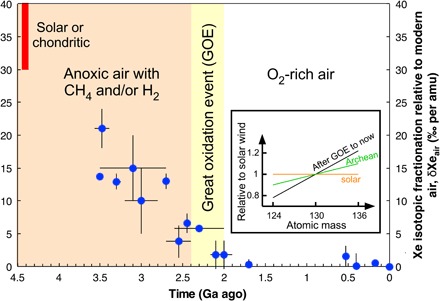
times modern amounts, respectively. The greenhouse gas concentrations were sufficient to offset a fainter Sun. Climate moderation by the carbon cycle suggests average surface temperatures between 0° and 40°C, consistent with occasional glaciations. Isotopic mass fractionation of atmospheric xenon through the Archean until atmospheric oxygenation is best explained by drag of xenon ions by hydrogen escaping rapidly into space. These data imply that substantial loss of hydrogen oxidized the Earth. Despite these advances, detailed understanding of the coevolving solid Earth, biosphere, and atmosphere remains elusive, however.
Overview
CoChat Summary
TL;DR
This review synthesizes proxies and models for the Archean atmosphere (4–2.5 Ga), concluding it was anoxic with negligible O2 and likely enriched in CO2 and CH4, with N2 as a bulk gas and a mostly moderate climate. It highlights major uncertainties in gas levels and the role of life, especially oxygenic photosynthesis and the later Great Oxidation Event.
Key findings
- O2 was extremely low: sulfur mass-independent fractionation indicates ground-level O2 <10−6 PAL (<0.2 ppmv for 1-bar air) before 2.4 Ga, while local “oxygen oases” are estimated at 0.001–0.017 mM O2 (0.4–7% of present).
- N2 and pressure were likely not much higher than today: fluid inclusions give pN2 <1.0 bar at 3.3 Ga and <1.1 bar at 3.5–3.0 Ga; vesicles imply 0.23 ± 0.23 bar at 2.7 Ga; raindrop imprints give a probable limit of <0.52–1.2 bar.
- CO2 and CH4 were important greenhouse gases: paleosol estimates include 0.03–0.15 bar CO2 at 2.77 Ga, 0.02–0.75 bar at 2.75 Ga, and 0.05–0.15 bar at 2.46 Ga; CH4 >20 ppmv is required for S-MIF, and xenon isotopes suggest >~5000 ppmv at ~3.5 Ga.
- Climate was probably mostly moderate: with a Sun 25–30% fainter at 4 Ga, carbonate-silicate models give 0–40°C and seawater pH 6.4–7.4; glacial rocks at 3.5, 2.9, and 2.7 Ga argue against a persistently hot Archean.
Methods
- This is a review/synthesis, not a primary study; it covers the Archean eon from 4 to 2.5 Ga and draws on proxies from rocks, minerals, fluid inclusions, paleosols, raindrop imprints, vesicles, and isotopic records including S-MIF, Xe, N, and C.
- The paper compiles constraints in Table 1 and figures, compares proxy estimates with photochemical, climate, and carbon-cycle models, and discusses the Hadean context and the Great Oxidation Event.
Limitations
- The paper states that limited proxy data leave major uncertainties about exact atmospheric gas levels over time; direct evidence for Archean CO2 remains scanty; when and whether an organic haze formed is uncertain; and knowledge of Archean climatic variability is meager.
- Several proxies are debated: raindrop paleopressure has been criticized but defended; putative Archean biomarkers suffer contamination; some O2 “whiffs” are disputed as post-GOE alteration; siderite is omitted as a pCO2 proxy because it appears diagenetic; and an alternative Xe explanation via organic hazes is considered problematic.
- Evident from the text: as a review, its conclusions depend on cited studies and models, and many constraints are indirect, model-dependent, or permissive rather than definitive.
Model-written summary. Check it against the paper before relying on it.
Integrity signals
Registry
Cites
Statistics
Figures



Verification
Claims the paper makes
78 Valid · 10 Not valid · 121 Not checked · 87 Own results and interpretations
Some cited sources support this claim and some don’t — read each source’s verdict below.
In the paper
“However, observations are unsupportive: Fast mass loss only happens in the first ~200 Ma after Sun-like stars form (207, 208).”
§ The Archean atmosphere > THE ARCHEAN CLIMATE > The Faint Young Sun problem
What the sources say
- Disputedcites [207] Wood B. E., Muller H. R., Zank G. P., Linsky J. L., Redfield S., New mass-loss measurements from astrospheric Lyman-alpha absorption. Astrophys. J. 628, L143– L146 (2005). sourceExperimental — accuracy not yet measured
Figure 3(b) and its accompanying discussion (page not provided) place the inferred weakening of the solar wind at about 0.7 Gyr when looking back toward younger ages. The paper therefore does not confine strong mass loss to the first ~200 million years; it suggests a different age pattern, with especially active, younger stars having weaker winds than the trend would predict. (LLM, conf=0.86)
Checked by a reasoning model — may be wrong.
- Partly supportedcites [208] Minton D. A., Malhotra R., Assessing the massive young sun hypothesis to solve the warm young Earth puzzle. Astrophys. J. 660, 1700– 1706 (2007). sourceExperimental — accuracy not yet measured
Section 3 (Stellar Winds of Sun-like Stars; page unavailable) says observations indicate that stellar-wind flux decreases on a timescale of order 10^8 years and do not support the prolonged mass loss required by the hypothesis. It does not establish a cutoff at approximately 200 million years or say that fast mass loss happens only before then; the Introduction also cautions that the observations cannot rule out a different history for the Sun. (LLM, conf=0.86)
plain- Asserted: passes — The authors put it forward as true.
- Checkable: passes — It can be checked against evidence.
- Load-bearing: passes — The paper’s conclusions depend on it.
- Based: passes — The paper gives a reason why it holds.
- Disputed
The sources with a verdict support this claim; the rest weren’t checked yet, have no full text we could read, or their verdicts aren’t rated yet.
In the paper
“At 4 Ga ago, solar luminosity was 25 to 30% lower than today (12, 13)”
§ The Archean atmosphere > INTRODUCTION: BACKGROUND TO ARCHEAN EARTH
What the sources say
- Not checked — no full text of the sourcecites [12] Gough D. O., Solar interior structure and luminosity variations. Sol. Phys. 74, 21– 34 (1981). source
- Supportedcites [13] Bahcall J. N., Pinsonneault M. H., Basu S., Solar models: Current epoch and time dependences, neutrinos, and helioseismological properties. Astrophys. J. 555, 990– 1012 (2001). source
Table 2 (§3.1) gives the Sun’s present age as 4.57 billion years and its luminosity at solar age 0.6 billion years as 0.744 of today’s. Four billion years ago corresponds to solar age about 0.57 billion years, when luminosity was therefore about 26% lower than today. (LLM, conf=0.94)
plain- Asserted: passes — The authors put it forward as true.
- Checkable: passes — It can be checked against evidence.
- Load-bearing: passes — The paper’s conclusions depend on it.
- Based: passes — The paper gives a reason why it holds.
The sources with a verdict support this claim; the rest weren’t checked yet, have no full text we could read, or their verdicts aren’t rated yet.
In the paper
“Liquid water under a fainter Sun likely implies more abundant greenhouse gases than today (14, 15).”
§ The Archean atmosphere > INTRODUCTION: BACKGROUND TO ARCHEAN EARTH
What the sources say
- Not checked — no full text of the sourcecites [14] Sagan C., Mullen G., Earth and Mars: Evolution of atmospheres and surface temperatures. Science 177, 52– 56 (1972). 17756316 source
- Supportedcites [15] Feulner G., The faint young Sun problem. Rev. Geophys. 50, RG2006 (2012). source
Section 5.5, paragraph 102 (page unavailable), calls an enhanced greenhouse effect the most likely solution to the faint young Sun problem, while acknowledging uncertainty about the gases involved. Section 2.2 discusses the cooling expected under a fainter Sun. Together, these support the claim’s qualified inference that liquid water on early Earth likely required more greenhouse warming than today. (LLM, conf=0.90)
hedgedstates a possible cause- Asserted: passes — The authors put it forward as true.
- Checkable: passes — It can be checked against evidence.
- Load-bearing: passes — The paper’s conclusions depend on it.
- Based: passes — The paper gives a reason why it holds.
Every source the paper cites for this claim was checked and supports it.
In the paper
“Iron formations (IFs), which are marine chemical sedimentary rocks rich in iron and silica [15 to 40 weight % (wt %) Fe and 40 to 60 wt % SiO2], indicate that the deep Archean ocean contained Fe2+(aq) and so was anoxic [e.g., (72)].”
§ The Archean atmosphere > WHAT WAS THE ARCHEAN ATMOSPHERE MADE OF? > Negligible Archean O2 but oxygen oases after oxygenic photosynthesis evolved
What the sources say
- Supportedcites [72] Konhauser K. O., Planavsky N. J., Hardisty D. S., Robbins L. J., Warchola T. J., Haugaard R., Lalonde S. V., Partin C. A., Oonk P. B. H., Tsikos H., Lyons T. W., Bekker A., Johnson C. M., Iron formations: A global record of neoarchaean to palaeoproterozoic environmental history. Earth Sci. Rev. 172, 140– 177 (2017). source
Section 2.1 links Archaean iron-formation deposition to the transport of dissolved Fe(II) under less oxidising conditions. Section 2.6 states that deep waters remained anoxic during iron-formation deposition, and Section 4 calls the Archaean deep-ocean state ferruginous (anoxic). Page numbers are unavailable in our copy. (LLM, conf=0.92)
hedgedstates a cause- Asserted: passes — The authors put it forward as true.
- Checkable: passes — It can be checked against evidence.
- Load-bearing: passes — The paper’s conclusions depend on it.
- Based: passes — The paper gives a reason why it holds.
- Supported
The cited sources support only part of this claim — read each source’s verdict below.
In the paper
“However, consumption of CO2 in the weathering of impact ejecta by carbonic acid suggests a cool early Hadean surface near 0°C under the faint Sun (35, 36).”
§ The Archean atmosphere > A BRIEF OVERVIEW OF THE ENVIRONMENT BEFORE THE ARCHEAN
What the sources say
- Not checked — no full text of the sourcecites [35] Sleep N. H., Zahnle K., Carbon dioxide cycling and implications for climate on ancient Earth. J. Geophys. Res. 106, 1373– 1399 (2001). source
- Partly supportedcites [36] Kadoya S., Krissansen-Totton J., Catling D. C., Probable cold and alkaline surface environment of the Hadean earth caused by impact ejecta weathering. Geochem. Geophys. Geosyst. 21, e2019GC008734 (2019). sourceExperimental — accuracy not yet measured
The Introduction says carbonic-acid weathering of impact ejecta lowers atmospheric CO₂, and Results §4.1 links that consumption to a probably cold climate at 4.3 Ga. The specific temperature is less well supported: the Conclusions give a modeled value of 259.2 K (about −14°C), with substantial uncertainty, rather than a temperature near 0°C. No page numbers are available in our copy. (LLM, conf=0.83)
hedgedstates a cause- Asserted: passes — The authors put it forward as true.
- Checkable: passes — It can be checked against evidence.
- Load-bearing: unclear — It is unclear whether the paper’s conclusions depend on it.
- Based: passes — The paper gives a reason why it holds.
182 more claims · 47 with their cited sources checked
Create a free account to see all 296 claims and to verify the 3 references still open.
- It may state two separate claims as one. 65
- Probably not a substantial claim. 62
- The quote only partly states this claim. 1
Claims other papers make about this one
Each is checked against this paper’s own text: does it say what the citing paper says it does?
The cited source says what the claim attributes to it.
In the citing paper
“liquid water was already present at the surface during the Hadean (4.56 Ga to ≈ 4.0 Ga 1 ) and Archean eons ( ≈ 4.0 Ga to 2.4 Ga)”
From The young Sun's XUV-activity as a constraint for lower CO2-limits in the Earth's Archean atmosphere (2021) · cites this paper as Catling and Zahnle, 2020
Self-check
Percentages, sums and reported differences re-computed from the paper’s own numbers.
Each contradiction between two passages listed here was confirmed by an independent check.
Rated minor: it would not touch a result — a value no result rests on, a p-value that stays on the same side of the significance level, or a conflict that is clerical, resolved elsewhere in the paper, or outside its own findings.
In the paper
§ The Archean atmosphere > CONCLUSIONS AND OUTLOOK
“The secular decline of CO2 is a feedback effect in the geological carbon cycle induced by decreasing solar luminosity.”
§ The Archean atmosphere > INTRODUCTION: BACKGROUND TO ARCHEAN EARTH
“In addition to a gradual increase in solar luminosity, slow changes in the solid Earth over time provided boundary conditions for atmospheric evolution.”
Rated minor: it would not touch a result — a value no result rests on, a p-value that stays on the same side of the significance level, or a conflict that is clerical, resolved elsewhere in the paper, or outside its own findings.
In the paper
§ The Archean atmosphere > WHAT WAS THE ARCHEAN ATMOSPHERE MADE OF?
“Surface barometric pressure | <0.52–1.1 bar | 2.7 Ga | Maximum fossil raindrop imprint size (57)”
§ The Archean atmosphere > WHAT WAS THE ARCHEAN ATMOSPHERE MADE OF? > Nitrogen gases in the Archean
“the largest size of 2.7-Ga-old fossil raindrop imprints provides a conservative limit of paleopressure of <2.1 bar and a probable limit of <0.52 to 1.2 bar (57).”
Citations
Cites
An early Cenozoic perspective on greenhouse warming and carbon-cycle dynamics
Zachos, J. C., Dickens, G. R., & Zeebe, R. E. (2008) · Nature · doi:10.1038/nature06588 · Cited by 3,550 · cited 1×
“In the Archean, any indication of polar environments from glacial rocks would suggest a relatively cool world given that since ~34Ma, a climate with poles covered in ice has required average global temperatures below ~20°C (223).”
BackgroundThe rise of oxygen in Earth's early ocean and atmosphere
Lyons, T. W., Reinhard, C. T., & Planavsky, N. J. (2014) · Nature · doi:10.1038/nature13068 · Cited by 2,810
A negative feedback mechanism for the long‐term stabilization of Earth's surface temperature
Walker, J. C. G., Hays, P. B., & Kasting, J. F. (1981) · Journal of Geophysical Research: Oceans · doi:10.1029/jc086ic10p09776 · Cited by 2,310
The Chemical Evolution of the Atmosphere and Oceans
Holland, H. D. (1984) · doi:10.1515/9780691220239 · Cited by 1,836
Atmospheric Influence of Earth's Earliest Sulfur Cycle
Farquhar, J., Bao, H., & Thiemens, M. (2000) · Science · doi:10.1126/science.289.5480.756 · Cited by 1,805
Wilde, S. A., Valley, J. W., Peck, W. H., & Graham, C. M. (2001) · Nature · doi:10.1038/35051550 · Cited by 1,744 · cited 1×
“3-Ga-old zircons was possibly inherited from (18)O-enriched, weathered surface rocks thatwere later buried and melted, which implies the presence of surficial liquid water and even land (17, 18).”
BackgroundThe Redox State of Earth's Mantle
Frost, D. J., & McCammon, C. A. (2008) · Annual Review of Earth and Planetary Sciences · doi:10.1146/annurev.earth.36.031207.124322 · Cited by 1,134 · cited 1×
“Therefore, the Hadean atmosphere and mantle were probably initially highly reducing, before subsequent oxidation either by hydrogen escape (29) or disproportionation of mantle FeO accompanied by Fe loss to the core (30, 31).”
BackgroundGEOCARBSULF: A combined model for Phanerozoic atmospheric O2 and CO2
Berner, R. A. (2006) · Geochimica et Cosmochimica Acta · doi:10.1016/j.gca.2005.11.032 · Cited by 1,120 · cited 1×
“The post-Devonian black line for O2 evolution approximately represents curves from calculations of C and S isotopic mass balance (254, 255).”
BackgroundTracing the stepwise oxygenation of the Proterozoic ocean
Scott, C., Lyons, T. W., Bekker, A., Shen, Y., Poulton, S. W., Chu, X., & Anbar, A. D. (2008) · Nature · doi:10.1038/nature06811 · Cited by 1,098
A Whiff of Oxygen Before the Great Oxidation Event?
Anbar, A. D., Duan, Y., Lyons, T. W., Arnold, G. L., Kendall, B., Creaser, R. A., Kaufman, A. J., Gordon, G. W., Scott, C., Garvin, J., et al. (2007) · Science · doi:10.1126/science.1140325 · Cited by 1,024
Research works printed but not linked: 8
- D. C. Catling in Treatise on Geochemistry H. D. Holland K. K. Turekian Eds. (Elsevier 2014) vol. 8 pp. 191–233.
- K. J. Zahnle D. C. Catling in Special Paper 504: Early Earth's Atmosphere and Surface Environment G. H. Shaw Ed. (Geological Soc. of America 2014) pp. 37–48.
- J. F. Kasting in Special Paper 504: Early Earth’s Atmosphere and Surface Environment G. H. Shaw Ed. (Geological Society of America 2014) pp. 19–28.
- N. J. Page in Earth’s Pre-Pleistocene Glacial Record M. J. Hambrey N. B. Harland Eds. (Cambridge Univ. Press 1981) pp. 821–823.
- R. T. Gregory in Stable Isotope Geochemistry: A Tribute to Samuel Epstein H. P. Taylor J. R. O'Neil I. R. Kaplan Eds. (Min. Soc. America 1991) pp. 65–76.
- A. Knoll in The Cyanobacteria: Molecular Biology Genetics and Evolution A. Herrero E. Flores Eds. (Caister Academic Press 2008) pp. 1–19.
- D. C. Catling, K. J. Zahnle, C. P. McKay, What caused the second rise of O2 in the late Proterozoic? Methane, sulfate. and irreversible oxidation. Astrobiology 2, 569 (2002).
- J. W. Murray K. Stewart S. Kassakian M. Krynytzky D. DiJulio in The Black Sea Flood Question: Changes in Coastline Climate and Human Settlement V. Yanko-Hombach A. S. Gilbert N. Panin P. M. Dolukhanov Eds. (Springer Netherlands 2007) pp. 1–21.
Cited by
Secular Evolution of Continents and the Earth System
Cawood, P. A., Chowdhury, P., Mulder, J. A., Hawkesworth, C. J., Capitanio, F. A., Gunawardana, P. M., & Nebel, O. (2022) · Reviews of Geophysics · doi:10.1029/2022rg000789 · Cited by 265
Solar energy conversion by photosystem II: principles and structures
Shevela, D., Kern, J. F., Govindjee, G., & Messinger, J. (2023) · Photosynthesis Research · doi:10.1007/s11120-022-00991-y · Cited by 194
“Current estimates range from ~ 3.5 billion years ago (or even earlier) to the time points close to the GOE (Farquhar et al.”
BackgroundInfluentialSignatures of early microbial life from the Archean (4 to 2.5 Ga) eon
Lepot, K. (2020) · Earth-Science Reviews · doi:10.1016/j.earscirev.2020.103296 · Cited by 179
“…activity through hydrothermal fluid and volcanic emissions and their transformation products, as well as the alteration of the early crust (or proto-crust) before and during the Archean (Huston and Logan, 2004; Kump and Barley, 2007; Arndt and Nisbet, 2012; Kasting, 2019; Catling and Zahnle, 2020).”
InfluentialThe Great Oxidation Event preceded a Paleoproterozoic “snowball Earth”
Warke, M. R., Di Rocco, T., Zerkle, A. L., Lepland, A., Prave, A. R., Martin, A. P., Ueno, Y., Condon, D. J., & Claire, M. W. (2020) · Proceedings of the National Academy of Sciences · doi:10.1073/pnas.2003090117 · Cited by 159
Day–night cloud asymmetry prevents early oceans on Venus but not on Earth
Turbet, M., Bolmont, É., Chaverot, G., Ehrenreich, D., Leconte, J., & Marcq, E. (2021) · Nature · doi:10.1038/s41586-021-03873-w · Cited by 176
Metadata
- Authors
- Catling, D. C., & Zahnle, K. J.
- Affiliations
- University of Washington (US)
- Ames Research Center (US)
- Corresponding author
- Catling, David C.
- Venue
- Science Advances
- Published
- 2020-02-28
- Volume
- 6
- Issue
- 9
- Pages
- eaax1420-eaax1420
- ISSN
- 2375-2548 (ISSN-L)
- PMC
- PMC7043912
- OpenAlex
- W3007909729
- Cited by
- 568
- References
- 278
- Citations by year
- 2026: 98 · 2025: 104 · 2024: 95 · 2023: 96 · 2022: 84 · 2021: 59 · 2020: 32
- FWCI
- 8.70
- Type
- journal article
- Language
- en
- Open access
- gold
- doi.org
- Licence
- cc-by
- Locations
- Science Advances (publishedVersion, cc-by)
- Europe PMC (PubMed Central) (publishedVersion, cc-by)
- PubMed Central (publishedVersion, cc-by)
- PubMed (publishedVersion)
- Funders
- National Science Foundation (1338810)
- Simons Foundation (511570)
- NASA Astrobiology Institute (NNA13AA93A, 80NSSC18K0829)
- Leverhulme Trust (VP2-2016-041)
- NASA Exobiology (NNX15AL23G)
- Topics
- Physical Sciences › Earth and Planetary Sciences › Paleontology › Paleontology and Stratigraphy of Fossils
- Physical Sciences › Earth and Planetary Sciences › Geochemistry and Petrology › Geological and Geochemical Analysis
- Physical Sciences › Earth and Planetary Sciences › Space and Planetary Science › Astro and Planetary Science
- Keywords
- Archean atmosphere, greenhouse gases, carbon cycle, surface temperature, glaciation, atmospheric xenon, hydrogen escape, atmospheric oxygenation, early Earth climate
About these checks
Registry, retraction, Cites and statistics results are computed, not judged, with one exception: a printed reference that no index lists is read once by a model before it counts as a citation error. Claims are extracted by a model and kept only when their quote appears verbatim in the text; each cited source is then checked, with a model’s help, for whether it says what the claim relies on. Those verdicts can be wrong — read the claim’s quote and the cited source before relying on one.
The claim verdicts this report counts are experimental: their accuracy is not yet measured.
A language model drew the claims from the paper on 2026-10-10, under version 3 of the claim definition (model deepseek-v4.1-flash, prompt extract-v3).
A second model labelled each claim on 2026-10-10 (model jev-1.13-20260917, definition revision gold-guideline-v0.2).
Cited sources are checked with a language model’s help (gpt-6-sol).
Statistics and arithmetic are recomputed, not judged.
Confidence bands are shown only for fields calibrated on our annotated test set. None is calibrated yet, so no band is shown.
What counts as a claim ›How we measure confidence ›How we check this ›
Are you an author, or do you see a problem with this page? Request a review
Data sources
Bibliographic data: Semantic Scholar, OpenAlex, Crossref.
Contains information from the Semantic Scholar Academic Graph Datasets, made available under the ODC Attribution License (ODC-BY 1.0).
Semantic Scholar’s data is described in: Kinney, R., et al. (2023). The Semantic Scholar Open Data Platform. arXiv:2301.10140.
