

A 2D Quantum Walk Simulation of Two-Particle Dynamics
Open accessThe DOI matches its Crossref record; 31 of the 33 references it cites were found in a registry or an index; none of the 25 sources its claims cite is checked for support yet.
Abstract
Here, There, Everywhere: Random walks are a powerful mathematical method that can be used to simulate certain processes in biology, chemistry, or even the stock market. They present a statistical method for mapping the possible routes that processes can take. Quantum walks are expected to be able to probe multiple paths simultaneously. Quantum walks have been demonstrated for one-dimensional, or straight-line, walks. Now, Schreiber et al. (p. 55 , published online 8 March) demonstrate an optical system that can simulate quantum walks over a two-dimensional system, thereby providing the capability of describing much more complex processes.
Overview
CoChat Summary
TL;DR
The paper reports a flexible 2D optical quantum walk on a fiber network, realizing a coherent walk over 12 steps and 169 positions. It uses the 2D lattice to simulate two-particle dynamics, including controlled interactions, bipartite entanglement, and bound-molecule-like behavior.
Key findings
- A 2D quantum walk was implemented over 12 steps and 169 positions using an optical fiber network, with separable and controlled coin operations.
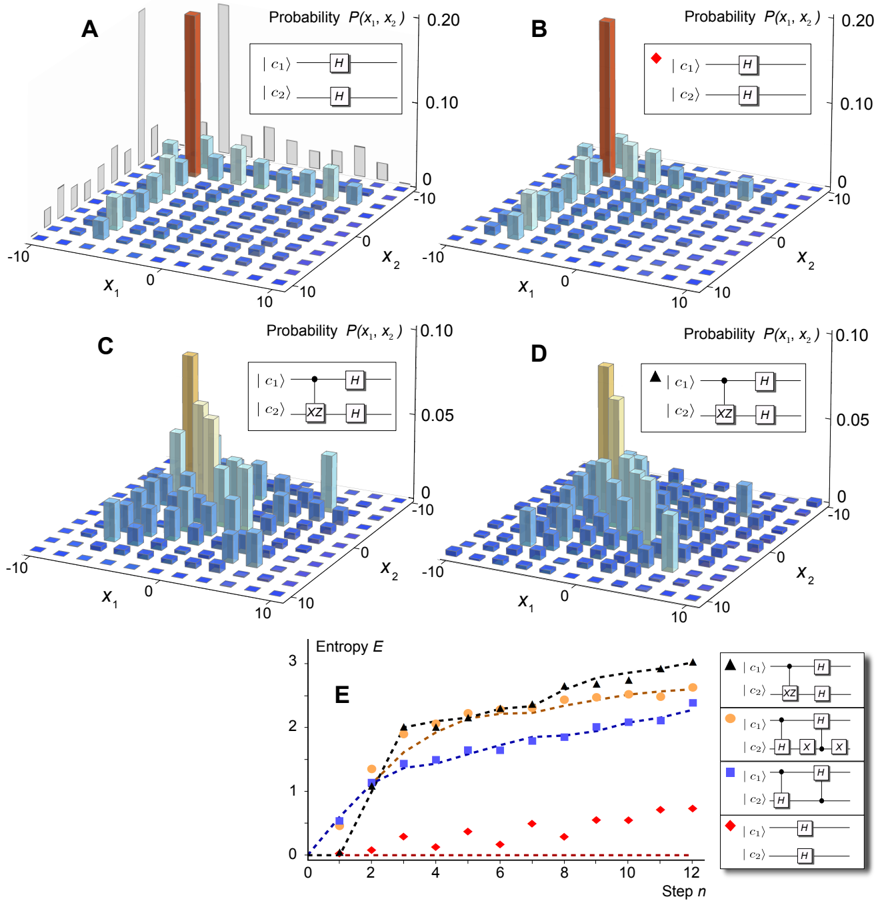
- For a 10-step Hadamard walk across 121 positions, measured similarity to theory was \(S = 0.957 \pm 0.003\); with controlling gates, \(S = 0.903 \pm 0.018\).
- Controlled operations produced simulated bipartite entanglement with a lower-bound von Neumann entropy of \(E = 2.63 \pm 0.01\) after 12 steps, stated as 56% of the maximal entropy.
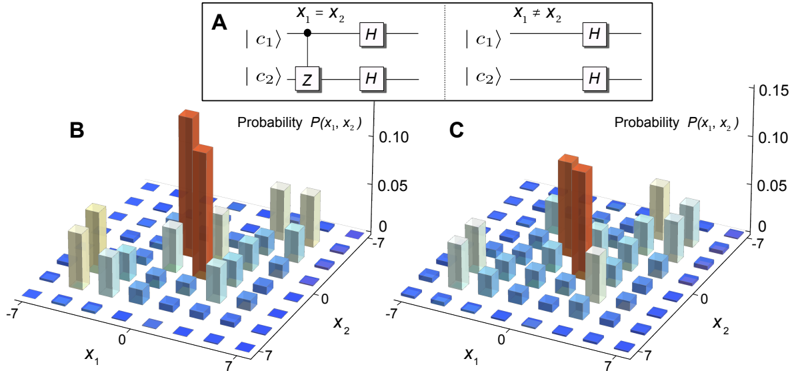
- A diagonal nonlinear coin simulated a bound molecule state: \(\sum_x P(x,x) = 0.317 \pm 0.006\) versus \(0.242 \pm 0.001\) for the Hadamard walk, with measured similarity \(S = 0.957 \pm 0.013\) after seven steps.
Methods
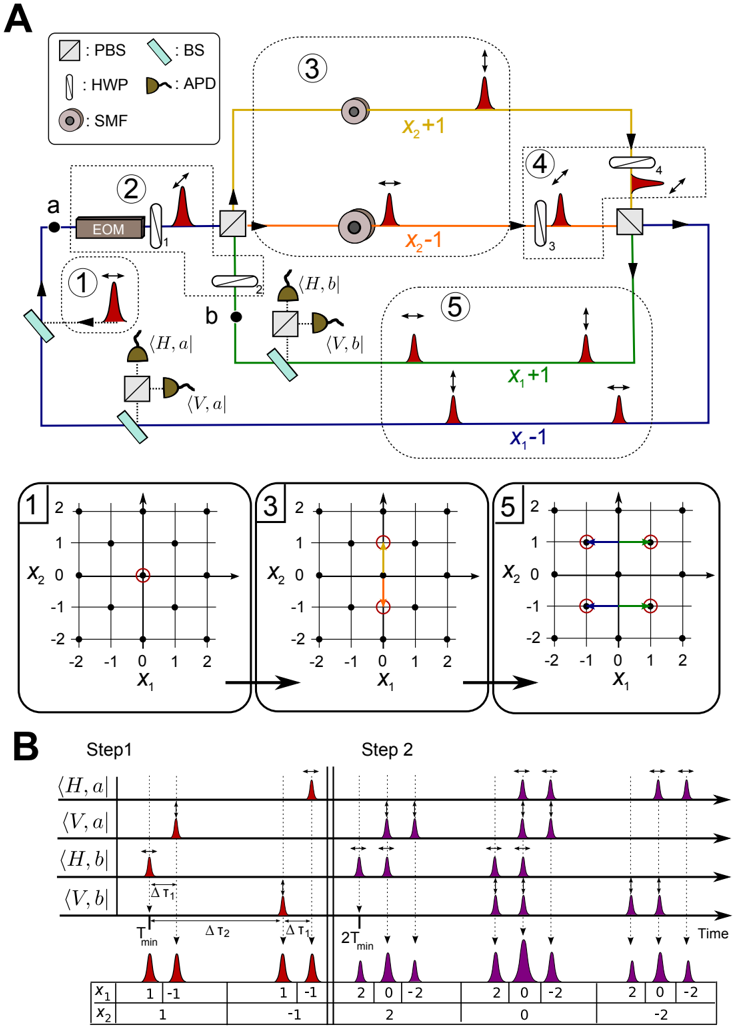
- Time-multiplexed optical setup using attenuated laser pulses from a pulsed diode laser (88 ps, 805 nm, 110 kHz), with coin states encoded in polarization and spatial modes and manipulated by HWPs, PBSs, and an EOM.
- Each round trip implemented one step; temporal delays were \(\Delta\tau_1 = 3.11\) ns and \(\Delta\tau_2 = 46.42\) ns, with minimum round-trip time \(T_{\min} = 676\) ns; detection used time-resolving single-photon counting modules/APDs.
- Analysis reconstructed output photostatistics and compared to theory via similarity \(S\); entanglement was quantified by von Neumann entropy assuming pure final states, with phases reconstructed from interference patterns and chosen to minimize entropy for a lower bound.
Limitations
- The paper states the EOM is the most significant systematic error: it affects the vertical polarization component with a factor \(1/3.5\) and distorts wavefronts differently for both polarizations, reducing achievable similarities.
- The paper states losses per step are the main scalability limit; adding the EOM for dynamic control limited the step number to \(n = 7\) due to higher losses, and temporal-overlap constraints required \(\Delta\tau_2 > 13 \cdot \Delta\tau_1\) and \(T_{\min} > 13 \cdot \Delta\tau_2\) for the first 12 steps.
- The paper states the entanglement values are lower bounds because phase information is not directly extractable, leaving three undetermined relative phases between coin states plus a global phase; it also notes the experiment uses an entirely classical light source to simulate quantum features.
Model-written summary. Check it against the paper before relying on it.
Integrity signals
Registry
Cites
Statistics
Figures

Verification
Claims the paper makes
0 Valid · 2 Not valid · 13 Not checked · 41 Own results and interpretations
A result the paper reports from its own data — it cites no other source for it, so there is none to check. The quote shows it is in the paper.
In the paper
“With our broad spectrum of quantum coins we were able to simulate the creation of entanglement in bipartite systems with conditioned interactions.”
plainstates a cause- Asserted: passes — The authors put it forward as true.
- Checkable: passes — It can be checked against evidence.
- Load-bearing: passes — The paper’s conclusions depend on it.
- Based: passes — The paper gives a reason why it holds.
A result the paper reports from its own data — it cites no other source for it, so there is none to check. The quote shows it is in the paper.
In the paper
“We realized a coherent quantum walk over 12 steps and 169 positions using an optical fiber network.”
plain- Asserted: passes — The authors put it forward as true.
- Checkable: passes — It can be checked against evidence.
- Load-bearing: passes — The paper’s conclusions depend on it.
- Based: passes — The paper gives a reason why it holds.
A result the paper reports from its own data — it cites no other source for it, so there is none to check. The quote shows it is in the paper.
In the paper
“For the Hadamard walk (Fig. 2A+B) we observe S = 0 . 957 ± 0 . 003, and for the quantum walk with controlling gates (Fig. 2C+D) S = 0 . 903 ± 0 . 018 (after 10 steps, across 121 positions).”
plain- Asserted: passes — The authors put it forward as true.
- Checkable: passes — It can be checked against evidence.
- Load-bearing: passes — The paper’s conclusions depend on it.
- Based: passes — The paper gives a reason why it holds.
A result the paper reports from its own data — it cites no other source for it, so there is none to check. The quote shows it is in the paper.
In the paper
“In Fig. 2E we show a lower bound for the simulated entanglement between the two particles during the stepwise evolution with four different coin operations.”
plain- Asserted: passes — The authors put it forward as true.
- Checkable: passes — It can be checked against evidence.
- Load-bearing: passes — The paper’s conclusions depend on it.
- Based: passes — The paper gives a reason why it holds.
- Rests on an assumption not shown here.
A result the paper states — it cites no source for it, so there is none to check. The quote shows it is in the paper.
In the paper
“We demonstrated that, with a physical resource overhead, a classical experiment can simulate many genuine quantum features.”
boostedstates a cause- Asserted: passes — The authors put it forward as true.
- Checkable: passes — It can be checked against evidence.
- Load-bearing: passes — The paper’s conclusions depend on it.
- Based: passes — The paper gives a reason why it holds.
29 more claims
Create a free account to see all 56 claims and to verify the 2 references still open.
- Probably not a substantial claim. 12
- It may state two separate claims as one. 14
Claims other papers make about this one
Each is checked against this paper’s own text: does it say what the citing paper says it does?
The cited source says what the claim attributes to it.
In the citing paper
“An additional physical dimension in the network can, in principle, entail the degrees of freedom offered by two walkers on a 1D-network [22,24,25].”
From Quantum Walks of Correlated Photon Pairs in Two-Dimensional Waveguide Arrays (2014) · cites this paper as [22]
The cited source says what the claim attributes to it.
In the citing paper
“A current limitation of our approach is that the walk evolution cannot be position-dependent (that is, OAM-dependent), in contrast to other implementations (9, 23).”
From Quantum walks and wavepacket dynamics on a lattice with twisted photons (2015) · cites this paper as [23]
Self-check
Percentages, sums and reported differences re-computed from the paper’s own numbers.
Each contradiction between two passages listed here was confirmed by an independent check.
Rated minor: it would not touch a result — a value no result rests on, a p-value that stays on the same side of the significance level, or a conflict that is clerical, resolved elsewhere in the paper, or outside its own findings.
In the paper
§ Appendix 2: Quantum walk implementation via time-multiplexing · p. 8
“T min + ∆ τ 1 stating position | 1 , -1 〉 , T min + ∆ τ 2 ( | -1 , 1 〉 )”
§ A 2D Quantum Walk Simulation of Two-Particle Dynamics · p. 2
“Each step consists of a shift in both x 1 direction, corresponding to a time difference of ∆ τ 1 = 3 . 11ns, and x 2 direction with ∆ τ 2 = 46 . 42ns.”
Citations
Cites
Experimental realization of any discrete unitary operator
Reck, M., Zeilinger, A., Bernstein, H. J., & Bertani, P. (1994) · Physical Review Letters · doi:10.1103/physrevlett.73.58 · Cited by 2,155
Aharonov, Y., Davidovich, L., & Zagury, N. (1993) · Physical Review A · doi:10.1103/physreva.48.1687 · Cited by 1,622
Environment-assisted quantum walks in photosynthetic energy transfer
Mohseni, M., Rebentrost, P., Lloyd, S., & Aspuru-Guzik, A. (2008) · The Journal of Chemical Physics · doi:10.1063/1.3002335 · Cited by 1,189
Quantum random-walk search algorithm
Shenvi, N., Kempe, J., & Whaley, K. B. (2003) · Physical Review A · doi:10.1103/physreva.67.052307 · Cited by 1,150
Universal Computation by Quantum Walk
Childs, A. M. (2009) · Physical Review Letters · doi:10.1103/physrevlett.102.180501 · Cited by 1,002
Dephasing-assisted transport: quantum networks and biomolecules
Plenio, M. B., & Huelga, S. F. (2008) · New Journal of Physics · doi:10.1088/1367-2630/10/11/113019 · Cited by 1,002
Quantum Walks of Correlated Photons
Peruzzo, A., Lobino, M., Matthews, J. C. F., Matsuda, N., Politi, A., Poulios, K., Zhou, X.-Q., Lahini, Y., Ismail, N., Wörhoff, K., et al. (2010) · Science · doi:10.1126/science.1193515 · Cited by 929
Quantum Walk in Position Space with Single Optically Trapped Atoms
Karski, M., Förster, L., Choi, J.-M., Steffen, A., Alt, W., Meschede, D., & Widera, A. (2009) · Science · doi:10.1126/science.1174436 · Cited by 659
Photons Walking the Line: A Quantum Walk with Adjustable Coin Operations
Schreiber, A., Cassemiro, K. N., Potoček, V., Gábris, A., Mosley, P. J., Andersson, E., Jex, I., & Silberhorn, C. (2010) · Physical Review Letters · doi:10.1103/physrevlett.104.050502 · Cited by 588
Self-citationTwo-Particle Bosonic-Fermionic Quantum Walk via Integrated Photonics
Sansoni, L., Sciarrino, F., Vallone, G., Mataloni, P., Crespi, A., Ramponi, R., & Osellame, R. (2012) · Physical Review Letters · doi:10.1103/physrevlett.108.010502 · Cited by 578
Research works printed but not linked: 6
- D. Aharonov, A. Ambainis, J. Kempe, U. Vazirani, in Proceedings of the Thirty-Third Annual ACM Symposium on Theory of Computing , STOC '01, Hersonissos, Greece, 6 to 8 July 2001 (ACM, New York, NY, USA, 2001), pp. 50-59.
- A. Ahlbrecht, et al. , arxiv: quant-ph/1105.1051 (2011).
- A. M. Childs, et al. , in Proceedings of the thirty-fifth ACM symposium on Theory of computing - STOC '03 (San Diego, CA, USA, 2003), p. 59.
- A. Ambainis, J. Kempe, A. Rivosh, in Proceedings of the Sixteenth ACM-SIAM Symposium on Discrete Algorithms , SODA '05, Vancouver, Canada, 23 to 25 January 2005 (Society for Industrial and Applied Mathematics, Philadelphia, 2005), p. 1099-1108.
- J. C. F. Matthews, et al. , arxiv: quant-ph/1106.1166 (2011).
- Y. Lahini, et al. , arxiv: quant-ph/1105.2273 (2011).
Cited by
Items 101–200 of 425
Learning an unknown transformation via a genetic approach
Spagnolo, N., Maiorino, E., Vitelli, C., Bentivegna, M., Crespi, A., Ramponi, R., Mataloni, P., Osellame, R., & Sciarrino, F. (2017) · Scientific Reports · doi:10.1038/s41598-017-14680-7 · Cited by 40
Nonclassical light manipulation in a multiple-scattering medium
Defienne, H., Barbieri, M., Chalopin, B., Chatel, B., Walmsley, I. A., Smith, B. J., & Gigan, S. (2014) · Optics Letters · doi:10.1364/ol.39.006090 · Cited by 40
Coincidence landscapes for three-channel linear optical networks
de Guise, H., Tan, S.-H., Poulin, I. P., & Sanders, B. C. (2014) · Physical Review A · doi:10.1103/physreva.89.063819 · Cited by 37
Anderson localization of a one-dimensional quantum walker
Derevyanko, S. (2018) · Scientific Reports · doi:10.1038/s41598-017-18498-1 · Cited by 46
“( sin cos ) , , 2, , 1 (4) n i n n i n”
InfluentialLimit distributions of three-state quantum walks: The role of coin eigenstates
Štefaňák, M., Bezděková, I., & Jex, I. (2014) · Physical Review A · doi:10.1103/physreva.90.012342 · Cited by 42
Self-citationQuantum-optical tests of Planck-scale physics
Kumar, S. P., & Plenio, M. B. (2018) · Physical Review A · doi:10.1103/physreva.97.063855 · Cited by 39
Observation of non-Hermitian aggregation effects induced by strong interactions
Zhang, W., Di, F., Yuan, H., Wang, H., Zheng, X., He, L., Sun, H., & Zhang, X. (2022) · Physical review. B./Physical review. B · doi:10.1103/physrevb.105.195131 · Cited by 46
Proposal for Quantum Simulation via All-Optically-Generated Tensor Network States
Dhand, I., Engelkemeier, M., Sansoni, L., Barkhofen, S., Silberhorn, C., & Plenio, M. B. (2018) · Physical Review Letters · doi:10.1103/physrevlett.120.130501 · Cited by 44
Self-citationTopological bound states of a quantum walk with cold atoms
Mugel, S., Celi, A., Massignan, P., Asbóth, J. K., Lewenstein, M., & Lobo, C. (2016) · Physical Review A · doi:10.1103/physreva.94.023631 · Cited by 38
Probing quantum walks through coherent control of high-dimensionally entangled photons
Imany, P., Lingaraju, N. B., Alshaykh, M. S., Leaird, D. E., & Weiner, A. M. (2020) · Science Advances · doi:10.1126/sciadv.aba8066 · Cited by 49
Quantum walks of two correlated photons in a 2D synthetic lattice
Esposito, C., Barros, M. R., Durán Hernández, A., Carvacho, G., Di Colandrea, F., Barboza, R., Cardano, F., Spagnolo, N., Marrucci, L., & Sciarrino, F. (2022) · npj Quantum Information · doi:10.1038/s41534-022-00544-0 · Cited by 41
Trapping photons on the line: controllable dynamics of a quantum walk
Xue, P., Qin, H., & Tang, B. (2014) · Scientific Reports · doi:10.1038/srep04825 · Cited by 38
Lin, Q., Yi, W., & Xue, P. (2023) · Nature Communications · doi:10.1038/s41467-023-42045-4 · Cited by 37
“1, the overall architecture is that of a fiber network [37, 38, 42], through which attenuated singlephoton pulses are sent, with each full cycle around the network representing a discrete time step.”
BackgroundMethodTwo-dimensional quantum walk under artificial magnetic field
Yalçınkaya, İ., & Gedik, Z. (2015) · Physical Review A · doi:10.1103/physreva.92.042324 · Cited by 42
Quantum walks with memory provided by recycled coins and a memory of the coin-flip history
Rohde, P. P., Brennen, G. K., & Gilchrist, A. (2013) · Physical Review A · doi:10.1103/physreva.87.052302 · Cited by 35
Self-citationSprague, M. R., England, D. G., Abdolvand, A., Nunn, J., Jin, X.-M., Steven Kolthammer, W., Barbieri, M., Rigal, B., Michelberger, P. S., Champion, T. F. M., et al. (2013) · New Journal of Physics · doi:10.1088/1367-2630/15/5/055013 · Cited by 35
“Secondly, an integrated platform can be easily interfaced with existing photonic architectures [16, 17] as well as easily scaled-up to build multiple units.”
MethodQubit state transfer via discrete-time quantum walks
Yalçınkaya, İ., & Gedik, Z. (2015) · Journal of Physics A Mathematical and Theoretical · doi:10.1088/1751-8113/48/22/225302 · Cited by 46
A versatile quantum walk resonator with bright classical light
Sephton, B., Dudley, A., Ruffato, G., Romanato, F., Marrucci, L., Padgett, M., Goyal, S., Roux, F., Konrad, T., & Forbes, A. (2019) · PLOS ONE · doi:10.1371/journal.pone.0214891 · Cited by 35
Hamilton, C. S., Kruse, R., Sansoni, L., Silberhorn, C., & Jex, I. (2014) · Physical Review Letters · doi:10.1103/physrevlett.113.083602 · Cited by 40
Self-citationTopological band structure via twisted photons in a degenerate cavity
Yang, M., Zhang, H., Liao, Y., Liu, Z., Zhou, Z.-W., Zhou, X., Xu, J., Han, Y., Li, C., & Guo, G. (2022) · Nature Communications · doi:10.1038/s41467-022-29779-3 · Cited by 36
Microwave Experiments Simulating Quantum Search and Directed Transport in Artificial Graphene
Böhm, J., Bellec, M., Mortessagne, F., Kuhl, U., Barkhofen, S., Gehler, S., Stöckmann, H. ‐., Foulger, I., Gnutzmann∥, S., & Tanner, G. (2015) · Physical Review Letters · doi:10.1103/physrevlett.114.110501 · Cited by 36
Quantum walk coherences on a dynamical percolation graph
Elster, F., Barkhofen, S., Nitsche, T., Novotný, J., Gábris, A., Jex, I., & Silberhorn, C. (2015) · Scientific Reports · doi:10.1038/srep13495 · Cited by 37
“We employ an optical time-multiplexed quantum walk experiment [2, 3] of up to six steps, depicted in figure 1c, to reveal the intricate interplay between the internal and external degrees of freedom by performing full quantum state tomography of the coin state.”
MethodSelf-citationEntanglement engineering and topological protection by discrete-time quantum walks
Moulieras, S., Lewenstein, M., & Puentes, G. (2013) · Journal of Physics B Atomic Molecular and Optical Physics · doi:10.1088/0953-4075/46/10/104005 · Cited by 35
Quantum walk as a simulator of nonlinear dynamics: Nonlinear Dirac equation and solitons
Lee, C.-W., Kurzyński, P., & Nha, H. (2015) · Physical Review A · doi:10.1103/physreva.92.052336 · Cited by 35
Coherent time evolution and boundary conditions of two-photon quantum walks in waveguide arrays
Meinecke, J. D. A., Poulios, K., Politi, A., Matthews, J. C. F., Peruzzo, A., Ismail, N., Wörhoff, K., O’Brien, J. L., & Thompson, M. G. (2013) · Physical Review A · doi:10.1103/physreva.88.012308 · Cited by 35
“The latter approach has been recently adopted with optical fibres and laser light [23].”
BackgroundSimulating Dirac Hamiltonian in curved space-time by split-step quantum walk
Mallick, A., Mandal, S., Karan, A., & Chandrashekar, C. M. (2019) · Journal of Physics Communications · doi:10.1088/2399-6528/aafe2f · Cited by 29
Multiplexed single-photon-state preparation using a fiber-loop architecture
Rohde, P. P., Helt, L. G., Steel, M. J., & Gilchrist, A. (2015) · Physical Review A · doi:10.1103/physreva.92.053829 · Cited by 33
Self-citationRohde, P. P. (2015) · Physical Review A · doi:10.1103/physreva.91.012306 · Cited by 34
Self-citationTwo-body bound and edge states in the extended SSH Bose-Hubbard model
Liberto, M. F. D., Recati, A., Carusotto, I., & Menotti, C. (2017) · The European Physical Journal Special Topics · doi:10.1140/epjst/e2016-60388-y · Cited by 33
Information processing at the speed of light
AbuGhanem, M. (2024) · Frontiers of Optoelectronics · doi:10.1007/s12200-024-00133-3 · Cited by 35
Implementation of multidimensional quantum walks using linear optics and classical light
Goyal, S. K., Roux, F. S., Forbes, A., & Konrad, T. (2015) · Physical Review A · doi:10.1103/physreva.92.040302 · Cited by 34
Supersymmetric Polarization Anomaly in Photonic Discrete-Time Quantum Walks
Barkhofen, S., Lorz, L., Nitsche, T., Silberhorn, C., & Schomerus, H. (2018) · Physical Review Letters · doi:10.1103/physrevlett.121.260501 · Cited by 35
Self-citationLocalized state in a two-dimensional quantum walk on a disordered lattice
Xue, P., Zhang, R., Bian, Z., Zhan, X., Qin, H., & Sanders, B. C. (2015) · Physical Review A · doi:10.1103/physreva.92.042316 · Cited by 30
Experimental Quantum Stochastic Walks Simulating Associative Memory of Hopfield Neural Networks
Tang, H. L., Feng, Z., Wang, Y., Lai, P.-C., Wang, C., Ye, Z., Wang, C.-K., Shi, Z.-Y., Wang, T., Chen, Y., et al. (2019) · Physical Review Applied · doi:10.1103/physrevapplied.11.024020 · Cited by 30
Superfluidity of Light and Its Breakdown in Optical Mesh Lattices
Wimmer, M., Monika, M., Carusotto, I., Peschel, U., & Price, H. M. (2021) · Physical Review Letters · doi:10.1103/physrevlett.127.163901 · Cited by 34
Observation of Novel Robust Edge States in Dissipative Non‐Hermitian Quantum Walks
Wang, B., Chen, T., & Zhang, X. (2020) · Laser & Photonics Review · doi:10.1002/lpor.202000092 · Cited by 31
Non-Hermitian physics in photonic systems
Xiao, L., Wang, K., Qu, D., Gao, H., Lin, Q., Bian, Z., Zhan, X., & Xue, P. (2025) · Photonics Insights · doi:10.3788/pi.2025.r09 · Cited by 41
Optical quantum computing with photons of arbitrarily low fidelity and purity
Rohde, P. P. (2012) · Physical Review A · doi:10.1103/physreva.86.052321 · Cited by 26
Self-citationCreating cat states in one-dimensional quantum walks using delocalized initial states
Zhang, W., Goyal, S. K., Gao, F., Sanders, B. C., & Simon, C. (2016) · New Journal of Physics · doi:10.1088/1367-2630/18/9/093025 · Cited by 33
Simulating lossy Gaussian boson sampling with matrix-product operators
Liu, M., Oh, C., Liu, J., Jiang, L., & Alexeev, Y. (2023) · Physical Review A · doi:10.1103/physreva.108.052604 · Cited by 37
“Examples of such systems include the hardcore Bose Hubbard model [60], the spin-1 / 2 XXZ quantum spin chain [61], boson sampling [9], quantum walk [6, 62–65], and monitored quantum circuits [66].”
Interfering trajectories in experimental quantum-enhanced stochastic simulation
Ghafari, F., Tischler, N., Franco, C. D., Thompson, J., Gu, M., & Pryde, G. J. (2019) · Nature Communications · doi:10.1038/s41467-019-08951-2 · Cited by 30
Biphoton generation in quadratic waveguide arrays: A classical optical simulationPreprint
Gräfe, M., Solntsev, A. S., Keil, R., Sukhorukov, A. A., Heinrich, M., Tünnermann, A., Nolte, S., Szameit, A., & Kivshar, Y. S. (2016) · Cited by 28
Physical realization of topological quantum walks on IBM-Q and beyond
Balu, R., Castillo, D., & Siopsis, G. (2018) · Quantum Science and Technology · doi:10.1088/2058-9565/aab823 · Cited by 33
Scattering and inverse scattering for nonlinear quantum walks
Maeda, M., Sasaki, H., Segawa, E., Suzuki, A., & Suzuki, K. (2018) · Discrete and Continuous Dynamical Systems · doi:10.3934/dcds.2018159 · Cited by 30
“, 10, 15, 18, 19, 20], simulator of Dirac particles coupled with gauge and gravitational fields [3, 4, 27, 28, 29, 42]. Moreover, QWs have been realized experimentally by optical lattice [17], photons [36, 37] and ion trappping [46] (see [23] for more reference). In this paper, we consider the QWs with state dependent…”
BackgroundFermion confinement via quantum walks in (2+1)-dimensional and (3+1)-dimensional space-time
Márquez-Martín, I., Molfetta, G. D., & Pérez, A. (2017) · Physical Review A · doi:10.1103/physreva.95.042112 · Cited by 30
Self acceleration from spectral geometry in dissipative quantum-walk dynamics
Xue, P., Lin, Q., Wang, K., Xiao, L., Longhi, S., & Yi, W. (2024) · Nature Communications · doi:10.1038/s41467-024-48815-y · Cited by 28
“For the latter, we build path-dependent time delays into the loop, so that the spatial superposition of the photonic walker is translated to the temporal superposition of multiple well-resolved pulses within each discrete time step [56].”
Spectral backbone of excitation transport in ultracold Rydberg gases
Scholak, T., Wellens, T., & Buchleitner, A. (2014) · Physical Review A · doi:10.1103/physreva.90.063415 · Cited by 26
Anderson Localization for Electric Quantum Walks and Skew-Shift CMV Matrices
Cedzich, C., & Werner, A. H. (2021) · Communications in Mathematical Physics · doi:10.1007/s00220-021-04204-w · Cited by 31
Two-Dimensional Quantum Walk with Non-Hermitian Skin Effects
Li, T., Zhang, Y.-S., & Yi, W. (2021) · Chinese Physics Letters · doi:10.1088/0256-307x/38/3/030301 · Cited by 33
Implementation of a spatial two-dimensional quantum random walk with tunable decoherence
Svozilík, J., León-Montiel, R. D. J., & Torres, J. P. (2012) · Physical Review A · doi:10.1103/physreva.86.052327 · Cited by 25
Revivals in quantum walks with a quasiperiodically-time-dependent coin
Cedzich, C., & Werner, R. F. (2016) · Physical Review A · doi:10.1103/physreva.93.032329 · Cited by 25
Quantum walks as a probe of structural anomalies in graphs
Hillery, M. S., Zheng, H., Feldman, E., Reitzner, D., & Bužek, V. (2012) · Physical Review A · doi:10.1103/physreva.85.062325 · Cited by 24
Experimental Realization of Parrondo's Paradox in 1D Quantum Walks
Jan, M., Wang, Q., Xu, X., Pan, W., Chen, Z., Han, Y., Li, C., Guo, G., & Abbott, D. (2020) · Advanced Quantum Technologies · doi:10.1002/qute.201900127 · Cited by 27
Persistence of topological phases in non-Hermitian quantum walks
Mittal, V., Raj, A., Dey, S., & Goyal, S. K. (2021) · Scientific Reports · doi:10.1038/s41598-021-89441-8 · Cited by 27
“Using the expression for the winding number W from (15), we calculate the winding numbers for the lower and upper bands and we name them as W− and W+ , respectively.”
MethodTime-Domain Universal Linear-Optical Operations for Universal Quantum Information Processing
Yonezu, K., Enomoto, Y., Yoshida, T. O., & Takeda, S. (2023) · Physical Review Letters · doi:10.1103/physrevlett.131.040601 · Cited by 32
Finding Structural Anomalies in Star Graphs Using Quantum Walks
Cottrell, S. S., & Hillery, M. S. (2014) · Physical Review Letters · doi:10.1103/physrevlett.112.030501 · Cited by 24
Finding paths in tree graphs with a quantum walk
Koch, D., & Hillery, M. S. (2018) · Physical Review A · doi:10.1103/physreva.97.012308 · Cited by 27
Photonic quantum walks with four-dimensional coins
Lorz, L., Meyer-Scott, E., Nitsche, T., Potoček, V., Gábris, A., Barkhofen, S., Jex, I., & Silberhorn, C. (2019) · Physical Review Research · doi:10.1103/physrevresearch.1.033036 · Cited by 30
Self-citationExperimental Parity-Time Symmetric Quantum Walks for Centrality Ranking on Directed Graphs
Wu, T., Izaac, J., Li, Z., Wang, K., Chen, Z., Zhu, S. N., Wang, J. B., & Ma, X. (2020) · Physical Review Letters · doi:10.1103/physrevlett.125.240501 · Cited by 26
Eigenvalue measurement of topologically protected edge states in split-step quantum walks
Nitsche, T., Geib, T., Stahl, C., Lorz, L., Cedzich, C., Barkhofen, S., Werner, R. F., & Silberhorn, C. (2019) · New Journal of Physics · doi:10.1088/1367-2630/ab12fa · Cited by 25
Self-citationPhotonic Discrete-time Quantum Walks and Applications
Neves, L., & Puentes, G. (2018) · Entropy · doi:10.3390/e20100731 · Cited by 31
“Moreover, multi-particle quantum walks warrant a powerful tool for encoding information in an exponentially larger space [29], and for quantum simulations in biological, chemical and physical systems [30] in 1D and 2D geometries [31–33].”
MethodObservation of Non-Hermitian Edge Burst Effect in One-Dimensional Photonic Quantum Walk
Zhu, J., Mao, Y.-L., Chen, H., Yang, K.-X., Li, L., Yang, B., Li, Z.-D., & Fan, J. (2024) · Physical Review Letters · doi:10.1103/physrevlett.132.203801 · Cited by 32
Bloch–Landau–Zener dynamics induced by a synthetic field in a photonic quantum walk
D’Errico, A., Barboza, R., Tudor, R., Dauphin, A., Massignan, P., Marrucci, L., & Cardano, F. (2021) · APL Photonics · doi:10.1063/5.0037327 · Cited by 22
“[26] A.”
BackgroundFiber-compatible photonic feed-forward with 99% fidelity
Zanin, G. L., Jacquet, M. J., Spagnolo, M., Schiansky, P., Calafell, I. A., Rozema, L. A., & Walther, P. (2020) · Optics Express · doi:10.1364/oe.409867 · Cited by 24
Guiding and confining of light in a two-dimensional synthetic space using electric fields
Chalabi, H., Barik, S., Mittal, S., Murphy, T. E., Hafezi, M., & Waks, E. (2020) · Optica · doi:10.1364/optica.386347 · Cited by 24
Quantum simulations with multiphoton Fock states
Sturges, T. J., McDermott, T. C., Buraczewski, A., Clements, W. R., Renema, J. J., Nam, S. W., Gerrits, T., Lita, A., Kolthammer, W. S., Eckstein, A., et al. (2021) · npj Quantum Information · doi:10.1038/s41534-021-00427-w · Cited by 34
Quantum walk of a Bose-Einstein condensate in the Brillouin zone
Alberti, A., & Wimberger, S. (2017) · Physical Review A · doi:10.1103/physreva.96.023620 · Cited by 20
“This regime completely differs from that of strongly correlated quantum walks in real space [12, 17, 76].”
BackgroundQuantum fast hitting on glued trees mapped on a photonic chip
Shi, Z.-Y., Tang, H. L., Feng, Z., Wang, Y., Li, Z., Gao, J., Chang, Y.-J., Wang, T.-Y., Dou, J.-P., Zhang, Z.-Y., et al. (2020) · Optica · doi:10.1364/optica.388451 · Cited by 22
Passive quantum error correction of linear optics networks through error averaging
Marshman, R. J., Lund, A. P., Rohde, P. P., & Ralph, T. C. (2018) · Physical Review A · doi:10.1103/physreva.97.022324 · Cited by 21
Self-citationKapitza light guiding in photonic mesh lattice
Muniz, A. L. M., Alberucci, A., Jisha, C. P., Monika, M., Nolte, S., Morandotti, R., & Peschel, U. (2019) · Optics Letters · doi:10.1364/ol.44.006013 · Cited by 22
Optical Neural Network Based on Synthetic Nonlinear Photonic Lattices
Pankov, A. V., Vatnik, I. D., & Sukhorukov, A. A. (2022) · Physical Review Applied · doi:10.1103/physrevapplied.17.024011 · Cited by 21
Two-walker discrete-time quantum walks on the line with percolation
Rigovacca, L., & Franco, C. D. (2016) · Scientific Reports · doi:10.1038/srep22052 · Cited by 26
Programmable multiphoton quantum interference in a single spatial mode
Carosini, L., Oddi, V., Giorgino, F., Hansen, L. M., Seron, B., Piacentini, S., Guggemos, T., Agresti, I., Loredo, J. C., & Walther, P. J. (2024) · Science Advances · doi:10.1126/sciadv.adj0993 · Cited by 25
Dynamic control of 2D non-Hermitian photonic corner skin modes in synthetic dimensions
Zheng, X., Mehrabad, M. J., Vannucci, J., Li, K., Dutt, A., Hafezi, M., Mittal, S., & Waks, E. (2024) · Nature Communications · doi:10.1038/s41467-024-55236-4 · Cited by 19
“In a fi nite system, the nontrivial winding of the complex energies and the associated 2D non-Hermitian skin effect 24 is manifested as corner skin modes, that is, localization of the walker can happen at an interface between regions with opposite windings (or bulk band topologies).”
Simple source for large linear cluster photonic states
Pilnyak, Y., Aharon, N., Istrati, D., Megidish, E., Retzker, A., & Eisenberg, H. S. (2017) · Physical Review A · doi:10.1103/physreva.95.022304 · Cited by 21
Non-classical photon correlation in a two-dimensional photonic lattice
Gao, J., Qiao, L.-F., Lin, X.-F., Jiao, Z.-Q., Feng, Z., Zhou, Z., Gao, Z.-W., Xu, X.-Y., Chen, Y., Tang, H., et al. (2016) · Optics Express · doi:10.1364/oe.24.012607 · Cited by 19
Lattice topology and spontaneous parametric down-conversion in quadratic nonlinear waveguide arrays
Leykam, D., Solntsev, A. S., Sukhorukov, A. A., & Desyatnikov, A. S. (2015) · Physical Review A · doi:10.1103/physreva.92.033815 · Cited by 21
Arbitrary synthetic dimensions via multiboson dynamics on a one-dimensional lattice
Cheng, D., Peng, B., Wang, D., Chen, X., Yuan, L., & Fan, S. (2021) · Physical Review Research · doi:10.1103/physrevresearch.3.033069 · Cited by 19
“Quantum many-body physics, as an important research subject in the quantum physics, receives intensive studies, with its counterparts also greatly explored by quantum simulations in optical platforms [26-28].”
BackgroundExtraordinary behaviors in a two-dimensional decoherent alternative quantum walk
Chen, T., & Zhang, X. (2016) · Physical Review A · doi:10.1103/physreva.94.012316 · Cited by 19
Mendes, C. V. C., Almeida, G. M. A., Lyra, M. L., & de Moura, F. A. B. F. (2019) · Physical review. E · doi:10.1103/physreve.99.022117 · Cited by 20
Uncertainty and symmetry bounds for the quantum total detection probability
Thiel, F., Mualem, I., Kessler, D. A., & Barkai, E. (2020) · Physical Review Research · doi:10.1103/physrevresearch.2.023392 · Cited by 21
Asymptotic properties of the Dirac quantum cellular automaton
Pérez, A. (2016) · Physical Review A · doi:10.1103/physreva.93.012328 · Cited by 18
Wang, Q., Tao, S.-J., Pan, W.-W., Chen, Z., Chen, G., Sun, K., Xu, J., Xu, X.-Y., Han, Y., Li, C., et al. (2022) · Light Science & Applications · doi:10.1038/s41377-022-00887-5 · Cited by 20
Photonic quantum walk with ultrafast time-bin encoding
Fenwick, K. L., Bouchard, F., Thekkadath, G., England, D. G., Bustard, P. J., Heshami, K., & Sussman, B. (2024) · Optica · doi:10.1364/optica.510312 · Cited by 25
“Extending the space of the QW to two dimensions [31, 60, 61] can be used to simulate quantum systems with a natural mapping to two dimensions, such as in topological systems [62].”
BackgroundDisorder and decoherence in coined quantum walks
Zhang, R., Qin, H., Tang, B., & Xue, P. (2013) · Chinese Physics B · doi:10.1088/1674-1056/22/11/110312 · Cited by 22
Discrete time quantum walks on percolation graphs
Kollár, B., Novotný, J., Kiss, T., & Jex, I. (2014) · The European Physical Journal Plus · doi:10.1140/epjp/i2014-14103-6 · Cited by 19
“[22] A Schreiber, A Gábris, P P Rohde, K Laiho, M Štefaňák, V Potoček, C Hamilton, I Jex, and Ch Silberhorn.”
BackgroundSelf-citationGorlach, M. A., Liberto, M. F. D., Recati, A., Carusotto, I., Poddubny, A. N., & Menotti, C. (2018) · Physical Review A · doi:10.1103/physreva.98.063625 · Cited by 19
Tera-sample-per-second arbitrary waveform generation in a synthetic dimension
Guan, Y., Zhang, J., Li, L., Cao, R., Wang, G., Chen, J., Wang, X., Guan, B., & Yao, J. (2023) · Communications Physics · doi:10.1038/s42005-023-01383-x · Cited by 17
Decomposition of split-step quantum walks for simulating Majorana modes and edge states
Zhang, W.-W., Goyal, S. K., Simon, C., & Sanders, B. C. (2017) · Physical Review A · doi:10.1103/physreva.95.052351 · Cited by 17
Electric‐Circuit Simulation of Quantum Fast Hitting with Exponential Speedup
Zhang, H., Chen, T., Pan, N., & Zhang, X. (2022) · Advanced Quantum Technologies · doi:10.1002/qute.202100143 · Cited by 17
The defect-induced localization in many positions of the quantum random walk
Chen, T., & Zhang, X. (2016) · Scientific Reports · doi:10.1038/srep25767 · Cited by 17
Continuous-time quantum walks on multilayer dendrimer networks
Galiceanu, M. D., & Strunz, W. T. (2016) · Physical review. E · doi:10.1103/physreve.94.022307 · Cited by 18
Experimental investigation of a four-qubit linear-optical quantum logic circuit
Stárek, R., Mičuda, M., Miková, M., Straka, I., Dušek, M., Ježek, M., & Fiurášek, J. (2016) · Scientific Reports · doi:10.1038/srep33475 · Cited by 18
“σ = + Σ = + + + a a b b b b 0 1 , 00 01 10 11 , (34) 0 1 00 01 10 11”
Multi-particle quantum walks on 3D integrated photonic chip
Zhou, W.-H., Wang, X.-W., Ren, R.-J., Fu, Y.-X., Chang, Y.-J., Xu, X.-Y., Tang, H., & Jin, X.-M. (2024) · Light: Science & Applications · doi:10.1038/s41377-024-01627-7 · Cited by 16
Topological Spin Texture of Chiral Edge States in Photonic Two-Dimensional Quantum Walks
Chen, C., Ding, X., Qin, J., Wu, J., He, Y., Lu, C.-Y., Li, L., Liu, X.-J., Sanders, B. C., & Pan, J.-W. (2022) · Physical Review Letters · doi:10.1103/physrevlett.129.046401 · Cited by 16
Controlling probability transfer in the discrete-time quantum walk by modulating the symmetries
Chen, T., Wang, B., & Zhang, X. (2017) · New Journal of Physics · doi:10.1088/1367-2630/aa8fe4 · Cited by 16
Probing the topological Anderson transition with quantum walks
Bagrets, D., Kim, K. W., Barkhofen, S., De, S., Sperling, J., Silberhorn, C., Altland, A., & Micklitz, T. (2021) · Physical Review Research · doi:10.1103/physrevresearch.3.023183 · Cited by 18
Self-citationN -dimensional alternate coined quantum walks from a dispersion-relation perspective
Roldán, E., Franco, C. D., Silva, F., & de Valcárcel, G. J. (2013) · Physical Review A · doi:10.1103/physreva.87.022336 · Cited by 16
Repelling, binding, and oscillating of two-particle discrete-time quantum walks
Wang, Q., & Li, Z.-J. (2016) · Annals of Physics · doi:10.1016/j.aop.2016.06.015 · Cited by 17
Percolation induced effects in two-dimensional coined quantum walks: analytic asymptotic solutions
Kollár, B., Novotný, J., Kiss, T., & Jex, I. (2014) · New Journal of Physics · doi:10.1088/1367-2630/16/2/023002 · Cited by 18
“The considerable degree of control on the walk is within reach of optical feedback loop experiments implementing quantum walks [25].”
BackgroundSelf-citation
Metadata
- Authors
- Schreiber, A., Gábris, A., Rohde, P. P., Laiho, K., Štefaňák, M., Potoček, V., Hamilton, C., Jex, I., & Silberhorn, C.
- Affiliations
- Paderborn University (DE)
- HUN-REN Wigner Research Centre for Physics (HU)
- Czech Technical University in Prague (CZ)
- Corresponding author
- Schreiber, Andreas
- ORCID
- Venue
- Science
- Published
- 2012-04-06
- Volume
- 336
- Issue
- 6077
- Pages
- 55-58
- ISSN
- 0036-8075 (ISSN-L)
- 1095-9203
- OpenAlex
- W1999799374
- Cited by
- 425
- References
- 31
- Citations by year
- 2026: 20 · 2025: 18 · 2024: 27 · 2023: 21 · 2022: 30 · 2021: 21 · 2020: 30 · 2019: 41 · 2018: 39 · 2017: 30 · 2016: 38 · 2015: 33 · 2014: 39 · 2013: 27 · 2012: 10
- FWCI
- 34.33
- Type
- journal article
- Language
- en
- Open access
- green
- arxiv.org
- Locations
- Science (publishedVersion)
- PubMed (publishedVersion)
- arXiv (Cornell University) (submittedVersion)
- ENLIGHTEN (Jurnal Bimbingan dan Konseling Islam) (submittedVersion)
- UTS ePRESS (University of Technology Sydney) (submittedVersion)
- MPG.PuRe (Max Planck Society) (submittedVersion)
- arXiv (Cornell University)
- Topics
- Physical Sciences › Computer Science › Artificial Intelligence › Quantum Computing Algorithms and Architecture
- Physical Sciences › Physics and Astronomy › Atomic and Molecular Physics, and Optics › Quantum Information and Cryptography
- Physical Sciences › Physics and Astronomy › Atomic and Molecular Physics, and Optics › Quantum Mechanics and Applications
- Keywords
- quantum walks, two-dimensional quantum walk, optical fiber communication, quantum coin, entanglement generation, bipartite entanglement, two-body scattering, nonlinear quantum dynamics, quantum simulation, topological structure
About these checks
Registry, retraction, Cites and statistics results are computed, not judged, with one exception: a printed reference that no index lists is read once by a model before it counts as a citation error. Claims are extracted by a model and kept only when their quote appears verbatim in the text; each cited source is then checked, with a model’s help, for whether it says what the claim relies on. Those verdicts can be wrong — read the claim’s quote and the cited source before relying on one.
A language model drew the claims from the paper on 2026-11-10, under version 3 of the claim definition (model deepseek-v4.1-flash, prompt extract-v3).
A second model labelled each claim on 2026-11-10 (model jev-1.13-20260917, definition revision gold-guideline-v0.2).
Statistics and arithmetic are recomputed, not judged.
Confidence bands are shown only for fields calibrated on our annotated test set. None is calibrated yet, so no band is shown.
What counts as a claim ›How we measure confidence ›How we check this ›
Are you an author, or do you see a problem with this page? Request a review
Data sources
Bibliographic data: Semantic Scholar, OpenAlex, Crossref.
Contains information from the Semantic Scholar Academic Graph Datasets, made available under the ODC Attribution License (ODC-BY 1.0).
Semantic Scholar’s data is described in: Kinney, R., et al. (2023). The Semantic Scholar Open Data Platform. arXiv:2301.10140.
