

A 2D Quantum Walk Simulation of Two-Particle Dynamics
Open accessThe DOI matches its Crossref record; 31 of the 33 references it cites were found in a registry or an index; none of the 25 sources its claims cite is checked for support yet.
Abstract
Here, There, Everywhere: Random walks are a powerful mathematical method that can be used to simulate certain processes in biology, chemistry, or even the stock market. They present a statistical method for mapping the possible routes that processes can take. Quantum walks are expected to be able to probe multiple paths simultaneously. Quantum walks have been demonstrated for one-dimensional, or straight-line, walks. Now, Schreiber et al. (p. 55 , published online 8 March) demonstrate an optical system that can simulate quantum walks over a two-dimensional system, thereby providing the capability of describing much more complex processes.
Overview
CoChat Summary
TL;DR
The paper reports a flexible 2D optical quantum walk on a fiber network, realizing a coherent walk over 12 steps and 169 positions. It uses the 2D lattice to simulate two-particle dynamics, including controlled interactions, bipartite entanglement, and bound-molecule-like behavior.
Key findings
- A 2D quantum walk was implemented over 12 steps and 169 positions using an optical fiber network, with separable and controlled coin operations.
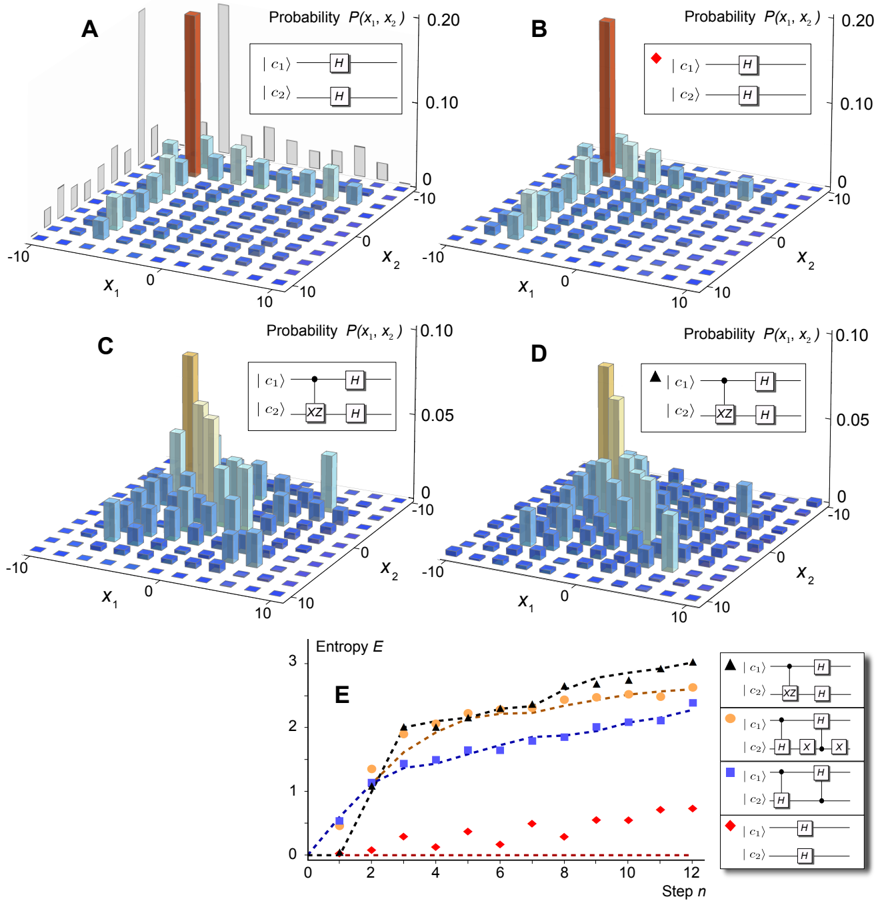
- For a 10-step Hadamard walk across 121 positions, measured similarity to theory was \(S = 0.957 \pm 0.003\); with controlling gates, \(S = 0.903 \pm 0.018\).
- Controlled operations produced simulated bipartite entanglement with a lower-bound von Neumann entropy of \(E = 2.63 \pm 0.01\) after 12 steps, stated as 56% of the maximal entropy.
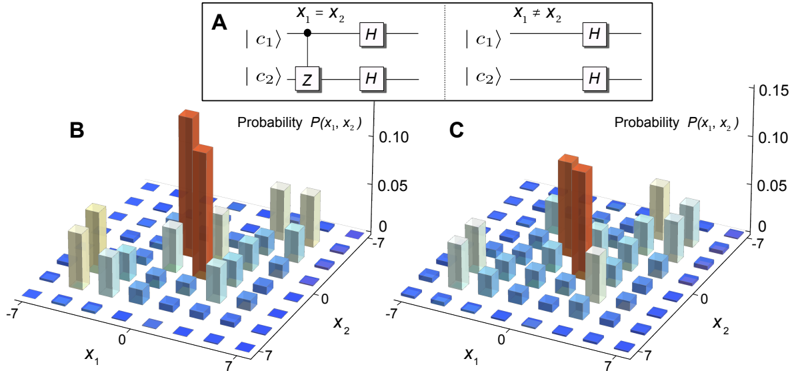
- A diagonal nonlinear coin simulated a bound molecule state: \(\sum_x P(x,x) = 0.317 \pm 0.006\) versus \(0.242 \pm 0.001\) for the Hadamard walk, with measured similarity \(S = 0.957 \pm 0.013\) after seven steps.
Methods
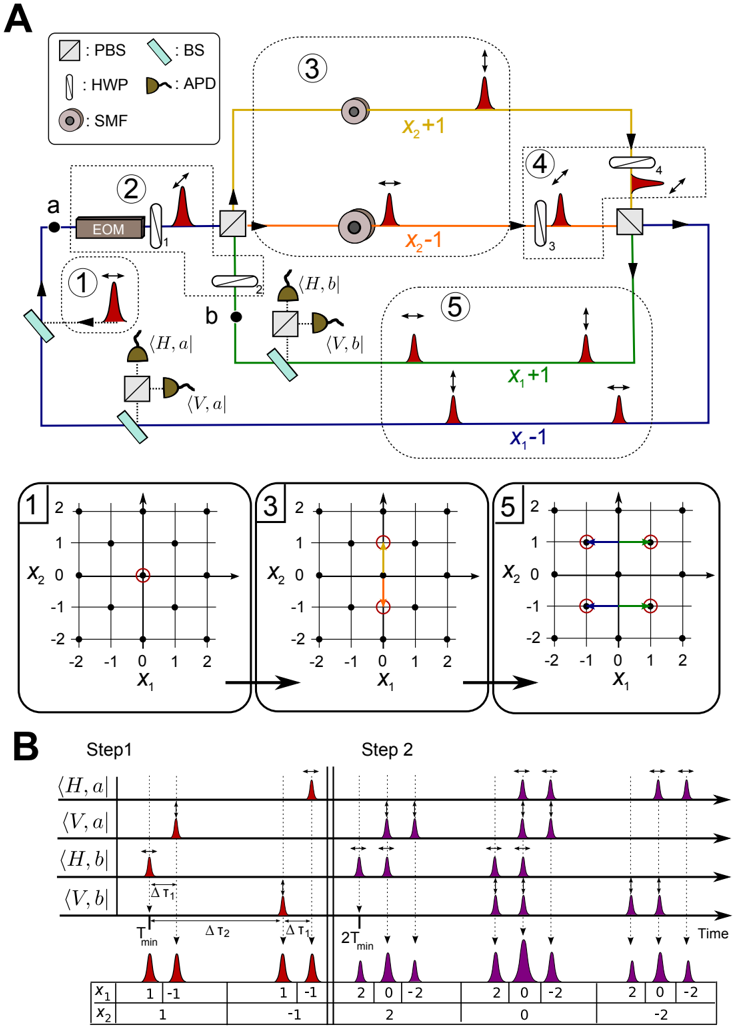
- Time-multiplexed optical setup using attenuated laser pulses from a pulsed diode laser (88 ps, 805 nm, 110 kHz), with coin states encoded in polarization and spatial modes and manipulated by HWPs, PBSs, and an EOM.
- Each round trip implemented one step; temporal delays were \(\Delta\tau_1 = 3.11\) ns and \(\Delta\tau_2 = 46.42\) ns, with minimum round-trip time \(T_{\min} = 676\) ns; detection used time-resolving single-photon counting modules/APDs.
- Analysis reconstructed output photostatistics and compared to theory via similarity \(S\); entanglement was quantified by von Neumann entropy assuming pure final states, with phases reconstructed from interference patterns and chosen to minimize entropy for a lower bound.
Limitations
- The paper states the EOM is the most significant systematic error: it affects the vertical polarization component with a factor \(1/3.5\) and distorts wavefronts differently for both polarizations, reducing achievable similarities.
- The paper states losses per step are the main scalability limit; adding the EOM for dynamic control limited the step number to \(n = 7\) due to higher losses, and temporal-overlap constraints required \(\Delta\tau_2 > 13 \cdot \Delta\tau_1\) and \(T_{\min} > 13 \cdot \Delta\tau_2\) for the first 12 steps.
- The paper states the entanglement values are lower bounds because phase information is not directly extractable, leaving three undetermined relative phases between coin states plus a global phase; it also notes the experiment uses an entirely classical light source to simulate quantum features.
Model-written summary. Check it against the paper before relying on it.
Integrity signals
Registry
Cites
Statistics
Figures

Verification
Claims the paper makes
0 Valid · 2 Not valid · 13 Not checked · 41 Own results and interpretations
A result the paper reports from its own data — it cites no other source for it, so there is none to check. The quote shows it is in the paper.
In the paper
“With our broad spectrum of quantum coins we were able to simulate the creation of entanglement in bipartite systems with conditioned interactions.”
plainstates a cause- Asserted: passes — The authors put it forward as true.
- Checkable: passes — It can be checked against evidence.
- Load-bearing: passes — The paper’s conclusions depend on it.
- Based: passes — The paper gives a reason why it holds.
A result the paper reports from its own data — it cites no other source for it, so there is none to check. The quote shows it is in the paper.
In the paper
“We realized a coherent quantum walk over 12 steps and 169 positions using an optical fiber network.”
plain- Asserted: passes — The authors put it forward as true.
- Checkable: passes — It can be checked against evidence.
- Load-bearing: passes — The paper’s conclusions depend on it.
- Based: passes — The paper gives a reason why it holds.
A result the paper reports from its own data — it cites no other source for it, so there is none to check. The quote shows it is in the paper.
In the paper
“For the Hadamard walk (Fig. 2A+B) we observe S = 0 . 957 ± 0 . 003, and for the quantum walk with controlling gates (Fig. 2C+D) S = 0 . 903 ± 0 . 018 (after 10 steps, across 121 positions).”
plain- Asserted: passes — The authors put it forward as true.
- Checkable: passes — It can be checked against evidence.
- Load-bearing: passes — The paper’s conclusions depend on it.
- Based: passes — The paper gives a reason why it holds.
A result the paper reports from its own data — it cites no other source for it, so there is none to check. The quote shows it is in the paper.
In the paper
“In Fig. 2E we show a lower bound for the simulated entanglement between the two particles during the stepwise evolution with four different coin operations.”
plain- Asserted: passes — The authors put it forward as true.
- Checkable: passes — It can be checked against evidence.
- Load-bearing: passes — The paper’s conclusions depend on it.
- Based: passes — The paper gives a reason why it holds.
- Rests on an assumption not shown here.
A result the paper states — it cites no source for it, so there is none to check. The quote shows it is in the paper.
In the paper
“We demonstrated that, with a physical resource overhead, a classical experiment can simulate many genuine quantum features.”
boostedstates a cause- Asserted: passes — The authors put it forward as true.
- Checkable: passes — It can be checked against evidence.
- Load-bearing: passes — The paper’s conclusions depend on it.
- Based: passes — The paper gives a reason why it holds.
29 more claims
Create a free account to see all 56 claims and to verify the 2 references still open.
- Probably not a substantial claim. 12
- It may state two separate claims as one. 14
Claims other papers make about this one
Each is checked against this paper’s own text: does it say what the citing paper says it does?
The cited source says what the claim attributes to it.
In the citing paper
“An additional physical dimension in the network can, in principle, entail the degrees of freedom offered by two walkers on a 1D-network [22,24,25].”
From Quantum Walks of Correlated Photon Pairs in Two-Dimensional Waveguide Arrays (2014) · cites this paper as [22]
The cited source says what the claim attributes to it.
In the citing paper
“A current limitation of our approach is that the walk evolution cannot be position-dependent (that is, OAM-dependent), in contrast to other implementations (9, 23).”
From Quantum walks and wavepacket dynamics on a lattice with twisted photons (2015) · cites this paper as [23]
Self-check
Percentages, sums and reported differences re-computed from the paper’s own numbers.
Each contradiction between two passages listed here was confirmed by an independent check.
Rated minor: it would not touch a result — a value no result rests on, a p-value that stays on the same side of the significance level, or a conflict that is clerical, resolved elsewhere in the paper, or outside its own findings.
In the paper
§ Appendix 2: Quantum walk implementation via time-multiplexing · p. 8
“T min + ∆ τ 1 stating position | 1 , -1 〉 , T min + ∆ τ 2 ( | -1 , 1 〉 )”
§ A 2D Quantum Walk Simulation of Two-Particle Dynamics · p. 2
“Each step consists of a shift in both x 1 direction, corresponding to a time difference of ∆ τ 1 = 3 . 11ns, and x 2 direction with ∆ τ 2 = 46 . 42ns.”
Citations
Cites
Experimental realization of any discrete unitary operator
Reck, M., Zeilinger, A., Bernstein, H. J., & Bertani, P. (1994) · Physical Review Letters · doi:10.1103/physrevlett.73.58 · Cited by 2,155
Aharonov, Y., Davidovich, L., & Zagury, N. (1993) · Physical Review A · doi:10.1103/physreva.48.1687 · Cited by 1,622
Environment-assisted quantum walks in photosynthetic energy transfer
Mohseni, M., Rebentrost, P., Lloyd, S., & Aspuru-Guzik, A. (2008) · The Journal of Chemical Physics · doi:10.1063/1.3002335 · Cited by 1,189
Quantum random-walk search algorithm
Shenvi, N., Kempe, J., & Whaley, K. B. (2003) · Physical Review A · doi:10.1103/physreva.67.052307 · Cited by 1,150
Universal Computation by Quantum Walk
Childs, A. M. (2009) · Physical Review Letters · doi:10.1103/physrevlett.102.180501 · Cited by 1,002
Dephasing-assisted transport: quantum networks and biomolecules
Plenio, M. B., & Huelga, S. F. (2008) · New Journal of Physics · doi:10.1088/1367-2630/10/11/113019 · Cited by 1,002
Quantum Walks of Correlated Photons
Peruzzo, A., Lobino, M., Matthews, J. C. F., Matsuda, N., Politi, A., Poulios, K., Zhou, X.-Q., Lahini, Y., Ismail, N., Wörhoff, K., et al. (2010) · Science · doi:10.1126/science.1193515 · Cited by 929
Quantum Walk in Position Space with Single Optically Trapped Atoms
Karski, M., Förster, L., Choi, J.-M., Steffen, A., Alt, W., Meschede, D., & Widera, A. (2009) · Science · doi:10.1126/science.1174436 · Cited by 659
Photons Walking the Line: A Quantum Walk with Adjustable Coin Operations
Schreiber, A., Cassemiro, K. N., Potoček, V., Gábris, A., Mosley, P. J., Andersson, E., Jex, I., & Silberhorn, C. (2010) · Physical Review Letters · doi:10.1103/physrevlett.104.050502 · Cited by 588
Self-citationTwo-Particle Bosonic-Fermionic Quantum Walk via Integrated Photonics
Sansoni, L., Sciarrino, F., Vallone, G., Mataloni, P., Crespi, A., Ramponi, R., & Osellame, R. (2012) · Physical Review Letters · doi:10.1103/physrevlett.108.010502 · Cited by 578
Research works printed but not linked: 6
- D. Aharonov, A. Ambainis, J. Kempe, U. Vazirani, in Proceedings of the Thirty-Third Annual ACM Symposium on Theory of Computing , STOC '01, Hersonissos, Greece, 6 to 8 July 2001 (ACM, New York, NY, USA, 2001), pp. 50-59.
- A. Ahlbrecht, et al. , arxiv: quant-ph/1105.1051 (2011).
- A. M. Childs, et al. , in Proceedings of the thirty-fifth ACM symposium on Theory of computing - STOC '03 (San Diego, CA, USA, 2003), p. 59.
- A. Ambainis, J. Kempe, A. Rivosh, in Proceedings of the Sixteenth ACM-SIAM Symposium on Discrete Algorithms , SODA '05, Vancouver, Canada, 23 to 25 January 2005 (Society for Industrial and Applied Mathematics, Philadelphia, 2005), p. 1099-1108.
- J. C. F. Matthews, et al. , arxiv: quant-ph/1106.1166 (2011).
- Y. Lahini, et al. , arxiv: quant-ph/1105.2273 (2011).
Cited by
Items 201–300 of 425
Localization and limit laws of a three-state alternate quantum walk on a two-dimensional lattice
Machida, T., & Chandrashekar, C. M. (2015) · Physical Review A · doi:10.1103/physreva.92.062307 · Cited by 15
“Experimental implementation of quantum walks in various physical systems, for example, single atom in an optical lattice [6], two-photon optical fiber networks [7], and interacting bosonic atoms in an optical lattice [8], have demonstrated the accessibility of systems via quantum walks.”
BackgroundMethodAnalysis of coined quantum walks with renormalization
Boettcher, S., & Li, S. (2018) · Physical Review A · doi:10.1103/physreva.97.012309 · Cited by 15
Dispersive estimates for quantum walks on 1D lattice
Maeda, M., Sasaki, H., Segawa, E., Suzuki, A., & Suzuki, K. (2021) · Journal of the Mathematical Society of Japan · doi:10.2969/jmsj/85218521 · Cited by 20
“Moreover, QWs have been realized experimentally by optical lattice [26], photons [44, 45] and ion trappping [59] (see [38] for more reference).”
BackgroundEntropy rate of message sources driven by quantum walks
Kollár, B., & Koniorczyk, M. (2014) · Physical Review A · doi:10.1103/physreva.89.022338 · Cited by 16
Toward scalable fault-tolerant photonic quantum computers
AbuGhanem, M. (2026) · The Journal of Supercomputing · doi:10.1007/s11227-025-08132-7 · Cited by 17
Robust Approach for Time-Bin-Encoded Photonic Quantum Information Protocols
White, S., Polino, E., Ghafari, F., Joch, D. J., Villegas-Aguilar, L., Shalm, L. K., Verma, V. B., Huber, M., & Tischler, N. (2025) · Physical Review Letters · doi:10.1103/physrevlett.134.180802 · Cited by 21
Two-dimensional quantum walk with position-dependent phase defects
Zhang, R., & Xue, P. (2014) · Quantum Information Processing · doi:10.1007/s11128-014-0775-1 · Cited by 15
Experimental realization of one-dimensional optical quantum walks
Xue, P., Qin, H., Tang, B., Zhan, X., Bian, Z., & Li, J. (2014) · Chinese Physics B · doi:10.1088/1674-1056/23/11/110307 · Cited by 14
Fang, X., An, K., Zhang, B., Sanders, B. C., & Lu, H. (2023) · Physical Review A · doi:10.1103/physreva.107.012433 · Cited by 16
“Due to the principle of superposition in quantum mechanics, a QW gives rise to impressive applications in quantum information science, from quantum computing [3–6] to quantum simulation [7], and from implementing quantum measurement [8–10] to exploring topological phases [11–18].”
BackgroundDuda, R., Ivaki, M. N., Sahlberg, I., Pöyhönen, K., & Ojanen, T. (2023) · Physical Review Research · doi:10.1103/physrevresearch.5.023150 · Cited by 16
“…of quantum walks include quantum computing, quantum cryptography, quantum search algorithms on the quantum information side, and a simulation of fundamental properties of quantum phases of matter on the condensed-matter side, some of which have already seen experimental realization [19–26].”
BackgroundLarge reconfigurable quantum circuits with SPAD arrays and multimode fibers
Makowski, A., Dąbrowski, M., Antolović, I. M., Bruschini, C. E., Defienne, H., Charbon, E., Łapkiewicz, R., & Gigan, S. (2024) · Optica · doi:10.1364/optica.506943 · Cited by 21
A graph isomorphism algorithm using signatures computed via quantum walk search model
Wang, H., Wu, J., Yang, X., & Yi, X. (2015) · Journal of Physics A Mathematical and Theoretical · doi:10.1088/1751-8113/48/11/115302 · Cited by 14
“For example, a quantum walk can be realized by replacing the classical walker in random walk by quantum photons [30].”
BackgroundDriven discrete time quantum walks
Hamilton, C. S., Barkhofen, S., Sansoni, L., Jex, I., & Silberhorn, C. (2016) · New Journal of Physics · doi:10.1088/1367-2630/18/7/073008 · Cited by 16
Self-citationFinding paths with quantum walks or quantum walking through a maze
Reitzner, D., Hillery, M. S., & Koch, D. (2017) · Physical Review A · doi:10.1103/physreva.96.032323 · Cited by 15
Experimental control of the degree of non-classicality via quantum coherence
Smirne, A., Nitsche, T., Egloff, D., Barkhofen, S., De, S., Dhand, I., Silberhorn, C., Huelga, S. F., & Plenio, M. B. (2020) · Quantum Science and Technology · doi:10.1088/2058-9565/aba039 · Cited by 16
Self-citationContinuous-time quantum walks on planar lattices and the role of the magnetic field
Razzoli, L., Paris, M. G. A., & Bordone, P. (2020) · Physical Review A · doi:10.1103/physreva.101.032336 · Cited by 16
Strongly trapped two-dimensional quantum walks
Kollár, B., Kiss, T., & Jex, I. (2015) · Physical Review A · doi:10.1103/physreva.91.022308 · Cited by 14
Self-citationMaximal coin-walker entanglement in a ballistic quantum walk
Zhang, R., Yang, R., Guo, J., Sun, C.-W., Duan, J.-C., Zhou, H., Xie, Z., Xu, P., Gong, Y.-X., & Zhu, S.-N. (2022) · Physical Review A · doi:10.1103/physreva.105.042216 · Cited by 13
Localizationlike effect in two-dimensional alternate quantum walks with periodic coin operations
Franco, C. D., & Paternostro, M. (2015) · Physical Review A · doi:10.1103/physreva.91.012328 · Cited by 13
Quantum cloning by cellular automata
D’Ariano, G. M., Macchiavello, C., & Rossi, M. A. C. (2013) · Physical Review A · doi:10.1103/physreva.87.032337 · Cited by 14
Percolation assisted excitation transport in discrete-time quantum walks
Štefaňák, M., Novotný, J., & Jex, I. (2016) · New Journal of Physics · doi:10.1088/1367-2630/18/2/023040 · Cited by 15
Self-citationQuantum photonics with active feedback loops
Engelkemeier, M., Lorz, L., De, S., Brecht, B., Dhand, I., Plenio, M. B., Silberhorn, C., & Sperling, J. (2020) · Physical Review A · doi:10.1103/physreva.102.023712 · Cited by 13
“Quantum walks in Mach-Zehnder setups are proven to provide a versatile platform to approach the goal of realizing a universal quantum simulator [79–83].”
BackgroundSelf-citationQuantum verification of NP problems with single photons and linear optics
Zhang, A., Zhan, H., Liao, J., Zheng, K., Jiang, T., Mi, M., Yao, P., & Zhang, L. (2021) · Light Science & Applications · doi:10.1038/s41377-021-00608-4 · Cited by 20
“[24] Schreiber, A.”
MethodMassless Dirac equation from Fibonacci discrete-time quantum walk
Molfetta, G. D., Honter, L., Luo, B. B., Wada, T., & Shikano, Y. (2015) · Quantum Studies Mathematics and Foundations · doi:10.1007/s40509-015-0038-6 · Cited by 16
Entanglement and interaction in a topological quantum walk
Verga, A., & Elías, R. G. (2018) · SciPost Physics · doi:10.21468/scipostphys.5.2.019 · Cited by 18
Stability of point spectrum for three-state quantum walks on a line
Štefaňák, M., Bezděková, I., Jex, I., & Barnett, S. M. (2014) · Quantum Information and Computation · doi:10.26421/qic14.13-14-11 · Cited by 14
Self-citationQuantum search with interacting Bose-Einstein condensates
Kahou, M. E., & Feder, D. L. (2013) · Physical Review A · doi:10.1103/physreva.88.032310 · Cited by 13
Implementation of a one-dimensional quantum walk in both position and phase spaces
Qin, H., & Xue, P. (2014) · Chinese Physics B · doi:10.1088/1674-1056/23/1/010301 · Cited by 12
Fully tunable and switchable coupler for photonic routing in quantum detection and modulation
Švarc, V., Nováková, M., Mazin, G., & Ježek, M. (2019) · Optics Letters · doi:10.1364/ol.44.005844 · Cited by 13
Collapse on the line – how synthetic dimensions influence nonlinear effects
Muniz, A. L. M., Wimmer, M., Bisianov, A., Morandotti, R., & Peschel, U. (2019) · Scientific Reports · doi:10.1038/s41598-019-46060-8 · Cited by 12
Experimental classification of quenched quantum walks by dynamical Chern number
Xu, X., Wang, Q., Tao, S.-J., Pan, W.-W., Chen, Z., Jan, M., Zhan, Y., Sun, K., Xu, J., Han, Y., et al. (2019) · Physical Review Research · doi:10.1103/physrevresearch.1.033039 · Cited by 13
Disordered quantum walks in two-dimensional lattices
Zhang, R., Xu, Y.-Q., & Xue, P. (2015) · Chinese Physics B · doi:10.1088/1674-1056/24/1/010303 · Cited by 12
Ben, 王. W., & Lijian, 张. Z. (2024) · Chinese Journal of Lasers · doi:10.3788/cjl231494 · Cited by 12
Hinarejos, M., Pérez, A., Roldán, E., Romanelli, A., & de Valcárcel, G. J. (2013) · New Journal of Physics · doi:10.1088/1367-2630/15/7/073041 · Cited by 12
A simple method for finding the scattering coefficients of quantum graphs
Cottrell, S. S. (2015) · Journal of Mathematical Physics · doi:10.1063/1.4931082 · Cited by 11
Mochizuki, K., Kawakami, N., & Obuse, H. (2020) · Journal of Physics A Mathematical and Theoretical · doi:10.1088/1751-8121/ab6514 · Cited by 12
Quantum transport on generalized scale-free networks
Maciel, C. M., Mendes, C. F. O., Strunz, W. T., & Galiceanu, M. D. (2020) · Physical Review A · doi:10.1103/physreva.102.032219 · Cited by 13
Quantum walks with tuneable self-avoidance in one dimension
Camilleri, E., Rohde, P. P., & Twamley, J. (2014) · Scientific Reports · doi:10.1038/srep04791 · Cited by 10
Self-citationThe Quantum Internet (Technical Version)Preprint
Rohde, P. P., Huang, Z., Ouyang, Y., Huang, H.-L., Su, Z.-E., Devitt, S. J., Ramakrishnan, R. K., Mantri, A., Tan, S.-H., Liu, N., et al. (2025) · arXiv (Cornell University) · doi:10.48550/arxiv.2501.12107 · Cited by 21
Self-citationFloquet Simulators for Topological Surface States in Isolation
Kim, K. W., Bagrets, D., Micklitz, T., & Altland, A. (2023) · Physical Review X · doi:10.1103/physrevx.13.011003 · Cited by 10
Berry Curvature and Bulk-Boundary Correspondence from Transport Measurement for Photonic Chern Bands
Chen, C., Liu, R., Wu, J., Su, Z.-E., Ding, X., Qin, J., Wang, L., Zhang, W., He, Y., Wang, X., et al. (2023) · Physical Review Letters · doi:10.1103/physrevlett.131.133601 · Cited by 12
Quantum random walks on congested lattices and the effect of dephasing
Motes, K. R., Gilchrist, A., & Rohde, P. P. (2016) · Scientific Reports · doi:10.1038/srep19864 · Cited by 15
Self-citationLonghi, S. (2012) · Journal of Physics B Atomic Molecular and Optical Physics · doi:10.1088/0953-4075/45/22/225504 · Cited by 10
Interacting quantum walk on a graph
Verga, A. (2019) · Physical review. E · doi:10.1103/physreve.99.012127 · Cited by 10
Directionally-Unbiased Unitary Optical Devices in Discrete-Time Quantum Walks
Osawa, S., Simon, D. S., & Sergienko, A. V. (2019) · Entropy · doi:10.3390/e21090853 · Cited by 10
“his combination of equations using matrix formalism 0 B B B @ dA1 dz dA2 dz dA3 dz dA4 dz 1 C C C A = i 0 B B B @ b k1 k2 k1 k1 b k1 k2 k2 k1 b k1 k1 2 1 b 1 C C C A 0 B B B @ A1 A2 A3 A4 1 C C C A . (40) and by finding its eigenvalues and eigenvectors: l1 = bi Ck2i : 0 B B B @ 1 0 1 0 1 C C C A , 0 B B B @ 0 1 0 1 1 C…”
GPU-accelerated algorithms for many-particle continuous-time quantum walks
Piccinini, E., Benedetti, C., Siloi, I., Paris, M. G. A., & Bordone, P. (2017) · Computer Physics Communications · doi:10.1016/j.cpc.2017.02.014 · Cited by 11
“lkers depends upon their statistics, indistinguishability and kind of interaction [3, 4, 5, 6]. CTQWs on more complex structures, e.g. complex graphs, have been also the focus of more recent analysis [7, 8, 9, 10]. Overall, CTQWs have been proved a useful tool in a variety of contexts, ranging from transport through a…”
MethodQuantum walk on a graph of spins: Magnetism and entanglement
Sellapillay, K., & Verga, A. (2021) · Physical review. E · doi:10.1103/physreve.103.032123 · Cited by 9
“t of topological invariants [26{28]. Generalizations from the one particle case to two entangled particles, including possible interactions, were also studied theoretically [29{32] and experimentally [33,34]; besides, Anderson localization was observed in an array of interferometers [35], and the eect of boson and fer…”
MethodExperimental quantum simulation of dynamic localization on curved photonic lattices
Tang, H. L., Wang, T., Shi, Z.-Y., Feng, Z., Wang, Y., Shang, X.-W., Gao, J., Jiao, Z., Li, Z., Chang, Y.-J., et al. (2022) · Photonics Research · doi:10.1364/prj.439637 · Cited by 9
Quantum transport on honeycomb networks
Batalha, G. M., Volta, A., Strunz, W. T., & Galiceanu, M. D. (2022) · Scientific Reports · doi:10.1038/s41598-022-10537-w · Cited by 10
Dynamic conditioning of two particle discrete-time quantum walks
Pegoraro, F., Held, P., Barkhofen, S., Brecht, B., & Silberhorn, C. (2023) · Physica Scripta · doi:10.1088/1402-4896/acbcaa · Cited by 12
Self-citationFinding structural anomalies in star graphs using quantum walks: a general approach
Cottrell, S. S. (2014) · Journal of Physics A Mathematical and Theoretical · doi:10.1088/1751-8113/48/3/035304 · Cited by 9
Topology and Holonomy in Discrete-time Quantum Walks
Puentes, G. (2017) · Crystals · doi:10.3390/cryst7050122 · Cited by 13
“We compare the theoretical and experimental probability distributions via the similariy S = [∑x √ Ptheo(x)Pexp(x)](2), with S = 0(1) for orthogonal(identical) distributions [45], typically obtaining S ≈ 0.”
MethodScaling hypothesis of a spatial search on fractal lattices using a quantum walk
Sato, R., Nikuni, T., & Watabe, S. (2020) · Physical Review A · doi:10.1103/physreva.101.022312 · Cited by 11
Disorder-aided pulse stabilization in dissipative synthetic photonic lattices
Derevyanko, S. (2019) · Scientific Reports · doi:10.1038/s41598-019-49259-x · Cited by 10
Discrete-time quantum walk with time-correlated noise
Peng, Y.-Y., Wang, W., & Yi, X. X. (2021) · Physical Review A · doi:10.1103/physreva.103.032205 · Cited by 9
Ramsauer effect in a one-dimensional quantum walk with multiple defects
Lam, H. T., & Szeto, K. Y. (2015) · Physical Review A · doi:10.1103/physreva.92.012323 · Cited by 8
Boundary-localized many-body bound states in the continuum
Sun, N., Zhang, W., Yuan, H., & Zhang, X. (2024) · Communications Physics · doi:10.1038/s42005-024-01777-5 · Cited by 8
“Theexperimentalsimulationofthree-bosonandfour-bosonBICs byelectriccircuits Motivated by previous experimental breakthroughs in simulating few-body quantum systems by electric circuits 41 – 43 , optical waveguides 44 and fi ber networks 45 .”
Observing Quantum Correlation Dynamics in Tunable Superconducting Bose-Hubbard Simulators
Wang, Z., Zhou, S.-Y., Shi, Y., Huang, K., Yang, Z. H., Zhang, J.-N., Zhao, K., Xu, Y., Li, H., Zhao, S. K., et al. (2026) · Physical Review Letters · doi:10.1103/hj9h-3tjc · Cited by 8
Observation of Topological Structures in Photonic Quantum Walks
Puentes, G., Gerhardt, I., Katzschmann, F., Silberhorn, C., Wrachtrup, J., & Lewenstein, M. (2014) · Physical Review Letters · doi:10.1103/physrevlett.112.120502 · Cited by 10
Self-citationRetractedComplete classification of trapping coins for quantum walks on the two-dimensional square lattice
Kollár, B., Gilyén, A., Tkáčová, I., Kiss, T., Jex, I., & Štefaňák, M. (2020) · Physical Review A · doi:10.1103/physreva.102.012207 · Cited by 9
Self-citationExperimental investigation of equivalent Laplacian and adjacency quantum walks on irregular graphs
Qu, D., Xiao, L., Wang, K., Zhan, X., & Xue, P. (2022) · Physical Review A · doi:10.1103/physreva.105.062448 · Cited by 8
Transmission and transformation of entangled states with high fidelity in a non-Hermitian system
Tang, Z., Wang, B., Chen, T., & Zhang, X. (2022) · Physical Review Research · doi:10.1103/physrevresearch.4.043144 · Cited by 8
Discrete propagation of trapped modes in acoustic waveguide arrays
Molerón, M., Faure, C., Félix, S., Pagneux, V., & Richoux, O. (2019) · Physical review. B./Physical review. B · doi:10.1103/physrevb.99.201404 · Cited by 8
Gülbahar, B. (2019) · Quantum Information Processing · doi:10.1007/s11128-019-2286-6 · Cited by 9
“There are also optical implementations of QWs resembling the structure of MPD with increasing numbers of trajectories such as multi-dimensional QWs implemented with classical optics [52–54].”
MethodSengupta, K., Dinesh, S. P., Shafi, K. M., Asokan, S., & Chandrashekar, C. M. (2025) · Physical Review Applied · doi:10.1103/r7yp-1vz4 · Cited by 7
An algorithm to factorize quantum walks into shift and coin operations
Cedzich, C., Geib, T., & Werner, R. F. (2022) · Letters in Mathematical Physics · doi:10.1007/s11005-022-01578-3 · Cited by 8
An HHL-based algorithm for computing hitting probabilities of quantum walks
Guan, J., Wang, Q., & Ying, M. (2021) · Quantum Information and Computation · doi:10.26421/qic21.5-6-4 · Cited by 11
Spontaneous parametric downconversion and quantum walk topology
Puentes, G. (2016) · Journal of the Optical Society of America B · doi:10.1364/josab.33.000461 · Cited by 7
Complexity bounds on quantum search algorithms in finite-dimensional networks
Boettcher, S., Li, S., Fernandes, T. D., & Portugal, R. (2018) · Physical Review A · doi:10.1103/physreva.98.012320 · Cited by 9
Time-Multiplexed Methods for Optical Quantum Information Processing
Victora, M., Kaneda, F., Bergmann, F., Wong, J. J., Graf, A., & Kwiat, P. G. (2019) · Springer series in optical sciences/SPringer series in optical sciences · doi:10.1007/978-3-319-98402-5_5 · Cited by 8
Physics-inspired Generative AI models via real hardware-based noisy quantum diffusion
Parigi, M., Martina, S., Venturelli, F. A., & Caruso, F. (2026) · Quantum Machine Intelligence · doi:10.1007/s42484-026-00459-5 · Cited by 7
“…model for quantum computation (Lovett et al, 2010; Singh et al, 2021; Chawla et al, 2023) and can be efficiently implemented by physical experiments (D¨ur et al, 2002; Schreiber et al, 2012; Goyal et al, 2013) and quantum processors (Lahini et al, 2018; Acasiete et al, 2020; Razzoli et al, 2024).”
Properties of long quantum walks in one and two dimensions
Luo, H., & Xue, P. (2015) · Quantum Information Processing · doi:10.1007/s11128-015-1127-5 · Cited by 6
“1, it is the advent of experiments capable of realizing a 2D QW [28] that has caused the resurgence of interest, both experimental and theoretical, in the field.”
Unmonitored and monitored recurrence in single-photon quantum walks
Chen, X.-X., Wang, Y., Zhang, A., Meng, Z., Wu, Q., Song, X.-B., & Shi, X. (2024) · Physical Review A · doi:10.1103/physreva.110.012219 · Cited by 6
Compact and programmable large-scale optical processor in free space
Ammendola, M. G., Dehghan, N., Scarfe, L., D’Errico, A., Colandrea, F. D., Karimi, E., & Cardano, F. (2026) · Light Science & Applications · doi:10.1038/s41377-026-02236-2 · Cited by 7
“Integrated circuits exploit waveguide arrays with beam splitters and phase shifters to couple spatial modes [6, 7], while temporal modes are controlled with integrated optics [8], fiber loops [9], or birefrin-gent materials for ultrafast operations [10].”
Demonstration of a photonic router via quantum walks
Gao, H., Wang, K., Qu, D., Lin, Q., & Xue, P. (2023) · New Journal of Physics · doi:10.1088/1367-2630/acd270 · Cited by 6
“The parameters A x satisfy the following relations Next, we extend the algorithm to that for an entanglement router based on a QW in figure 1(b), which consists of two walkers and two coins [75, 76].”
MethodTwo-particle coined-quantum walk with long-range interaction
Alonso-Lobo, C., Martínez-Quesada, M., Hinarejos, M., de Valcárcel, G. J., & Roldán, E. (2018) · Journal of Physics A Mathematical and Theoretical · doi:10.1088/1751-8121/aadfa2 · Cited by 7
Exceptional points for photon pairs bound by nonlinear dissipation in cavity arrays
Lyubarov, M. D., & Poddubny, A. N. (2018) · Optics Letters · doi:10.1364/ol.43.005917 · Cited by 6
Quantum magic in discrete-time quantum walk
Mittal, V., & Huang, Y.-P. (2026) · Physical Review Research · doi:10.1103/7rwg-lhpv · Cited by 6
“Third, they have been successfully implemented in a range of experimental systems, including photonic circuits [24–26], trapped ions [27–29], and superconducting qubits [30–32] to name a few and offer continuous tunability through control parameters [33].”
Programmable photonic system for quantum simulation in arbitrary topologies
Bartlett, B., Long, O. Y., Dutt, A., & Fan, S. (2024) · APL Quantum · doi:10.1063/5.0181151 · Cited by 8
Strongly interacting photonic quantum walk using single atom beamsplitters
Zheng, X., & Waks, E. (2024) · Physical Review Research · doi:10.1103/physrevresearch.6.013245 · Cited by 6
Bloch oscillations of Fibonacci anyons
Zhou, X., Zhang, W., Yuan, H., & Zhang, X. (2024) · Physical review. B./Physical review. B · doi:10.1103/physrevb.110.094301 · Cited by 5
“…experimental breakthroughs in simulating few-body quantum systems by electric circuits [32,46,47], optical waveguides [48] and fiber networks [49], in this part, we experimentally simulate the non-Abelian fusion BOs and BZOs of two Fibonacci anyons by mapping Schrödinger equation of two…”
MethodLimit distributions for different forms of four-state quantum walks on a two-dimensional lattice
Machida, T., Chandrashekar, C. M., Konno, N., & Busch, T. (2015) · Quantum Information and Computation · doi:10.26421/qic15.13-14-10 · Cited by 5
Search algorithm of structure anomalies in complete graph based on scattering quantum walk
Xue, X., Chen, H., Liu, Z., & Bin-Bin, Z. (2016) · Acta Physica Sinica · doi:10.7498/aps.65.080302 · Cited by 5
Chen, H. L., Wang, G., & Lee, R. (2018) · Optics Express · doi:10.1364/oe.26.033205 · Cited by 5
Theory of hydrodynamic phenomena in optical mesh lattices
Price, H. M., Wimmer, M., Monika, M., Peschel, U., & Carusotto, I. (2023) · Physical Review A · doi:10.1103/physreva.108.063517 · Cited by 6
Suitable bases for quantum walks with Wigner coins
Bezděková, I., Štefaňák, M., & Jex, I. (2015) · Physical Review A · doi:10.1103/physreva.92.022347 · Cited by 5
Self-citationQuantum walks with coins undergoing different quantum noisy channels
Qin, H., & Peng, X. (2016) · Chinese Physics B · doi:10.1088/1674-1056/25/1/010501 · Cited by 5
Quantum transport on modified multilayered spiderwebs
Maciel, C. M., Strunz, W. T., & Galiceanu, M. D. (2018) · Journal of Physics A Mathematical and Theoretical · doi:10.1088/1751-8121/aae8ab · Cited by 5
Mapping a quantum walk by tuning the coupling coefficient
Ng, K. F., Rodrigues, M. J. L. F., Viana‐Gomes, J., Ling, A., & Grieve, J. A. (2020) · Optics Letters · doi:10.1364/ol.45.000288 · Cited by 5
Edge states of photon pairs in cavity arrays with spatially modulated nonlinearity
Lyubarov, M. D., & Poddubny, A. N. (2019) · Physical Review A · doi:10.1103/physreva.100.053813 · Cited by 5
“First, it can be readily emulated even classically by considering a mathematically equivalent two-dimensional array of coupled waveguides [13, 14] or even equivalent electric circuits [15].”
BackgroundTopological quantum walks in cavity-based quantum networks
Meng, Y., Mei, F., Chen, G., & Jia, S. (2020) · Quantum Information Processing · doi:10.1007/s11128-020-2614-x · Cited by 5
Arbitrary coherent distributions in a programmable quantum walk
Zhang, R., Yang, R., Guo, J. W., Sun, C., Liu, Y.-C., Zhou, H., Xu, P., Xie, Z., Gong, Y.-X., & Zhu, S. N. (2022) · Physical Review Research · doi:10.1103/physrevresearch.4.023042 · Cited by 5
Non-Hermitian physics in the dissipative many-body system of Rydberg atoms
王, Y.-J. 雅. W., 王, Y.-J. 雅. W., & Ding, D.-S. (2026) · Journal of Physics Condensed Matter · doi:10.1088/1361-648x/ae8d69 · Cited by 4
Delanty, M., & Steel, M. J. (2012) · Physical Review A · doi:10.1103/physreva.86.043821 · Cited by 4
Multiphoton hyperfine Raman transitions with different quantization axes
Chang, J.-W., Huang, Y.-C., Xu, Z.-W., Kan, Y.-H., Huang, H.-H., Huang, J.-Z., Fu, K.-J., Liu, X., & Kuan, P.-C. (2023) · Physical Review A · doi:10.1103/physreva.108.013308 · Cited by 4
Reconfigurable unitary transformations of optical beam arrays
Martinez-Becerril, A. C., Luo, S., Li, L., Pagé, J. T. R., Giner, L., Abrahão, R. A., & Lundeen, J. S. (2024) · Optics Express · doi:10.1364/oe.535204 · Cited by 4
“A device that creates a reconfigurable unitary could implement matrix multiplication [1], optical quantum gates [2, 3] and quantum random walks [4–6].”
BackgroundDetecting high-dimensional time-bin entanglement in fiber-loop systems
Euler, N., Monika, M., Peschel, U., & Gärttner, M. (2025) · Physical Review A · doi:10.1103/bn8s-bqnp · Cited by 4
“Various loop topologies have been used to implement DTQWs [38, 39, 41, 42] with the goal of studying boson sampling tasks [40, 43, 44] and even to probe topological quantum state properties [45].”
Controlling migration of a pair of correlated particles by doubly modulated fields
Zheng, Y., & Yang, S.-J. (2015) · New Journal of Physics · doi:10.1088/1367-2630/18/1/013005 · Cited by 5
Distinguishability transitions in nonunitary boson-sampling dynamics
Mochizuki, K., & Hamazaki, R. (2023) · Physical Review Research · doi:10.1103/physrevresearch.5.013177 · Cited by 5
Kendon, V. M. (2014) · AIP conference proceedings · doi:10.1063/1.4903129 · Cited by 4
Metadata
- Authors
- Schreiber, A., Gábris, A., Rohde, P. P., Laiho, K., Štefaňák, M., Potoček, V., Hamilton, C., Jex, I., & Silberhorn, C.
- Affiliations
- Paderborn University (DE)
- HUN-REN Wigner Research Centre for Physics (HU)
- Czech Technical University in Prague (CZ)
- Corresponding author
- Schreiber, Andreas
- ORCID
- Venue
- Science
- Published
- 2012-04-06
- Volume
- 336
- Issue
- 6077
- Pages
- 55-58
- ISSN
- 0036-8075 (ISSN-L)
- 1095-9203
- OpenAlex
- W1999799374
- Cited by
- 425
- References
- 31
- Citations by year
- 2026: 20 · 2025: 18 · 2024: 27 · 2023: 21 · 2022: 30 · 2021: 21 · 2020: 30 · 2019: 41 · 2018: 39 · 2017: 30 · 2016: 38 · 2015: 33 · 2014: 39 · 2013: 27 · 2012: 10
- FWCI
- 34.33
- Type
- journal article
- Language
- en
- Open access
- green
- arxiv.org
- Locations
- Science (publishedVersion)
- PubMed (publishedVersion)
- arXiv (Cornell University) (submittedVersion)
- ENLIGHTEN (Jurnal Bimbingan dan Konseling Islam) (submittedVersion)
- UTS ePRESS (University of Technology Sydney) (submittedVersion)
- MPG.PuRe (Max Planck Society) (submittedVersion)
- arXiv (Cornell University)
- Topics
- Physical Sciences › Computer Science › Artificial Intelligence › Quantum Computing Algorithms and Architecture
- Physical Sciences › Physics and Astronomy › Atomic and Molecular Physics, and Optics › Quantum Information and Cryptography
- Physical Sciences › Physics and Astronomy › Atomic and Molecular Physics, and Optics › Quantum Mechanics and Applications
- Keywords
- quantum walks, two-dimensional quantum walk, optical fiber communication, quantum coin, entanglement generation, bipartite entanglement, two-body scattering, nonlinear quantum dynamics, quantum simulation, topological structure
About these checks
Registry, retraction, Cites and statistics results are computed, not judged, with one exception: a printed reference that no index lists is read once by a model before it counts as a citation error. Claims are extracted by a model and kept only when their quote appears verbatim in the text; each cited source is then checked, with a model’s help, for whether it says what the claim relies on. Those verdicts can be wrong — read the claim’s quote and the cited source before relying on one.
A language model drew the claims from the paper on 2026-11-10, under version 3 of the claim definition (model deepseek-v4.1-flash, prompt extract-v3).
A second model labelled each claim on 2026-11-10 (model jev-1.13-20260917, definition revision gold-guideline-v0.2).
Statistics and arithmetic are recomputed, not judged.
Confidence bands are shown only for fields calibrated on our annotated test set. None is calibrated yet, so no band is shown.
What counts as a claim ›How we measure confidence ›How we check this ›
Are you an author, or do you see a problem with this page? Request a review
Data sources
Bibliographic data: Semantic Scholar, OpenAlex, Crossref.
Contains information from the Semantic Scholar Academic Graph Datasets, made available under the ODC Attribution License (ODC-BY 1.0).
Semantic Scholar’s data is described in: Kinney, R., et al. (2023). The Semantic Scholar Open Data Platform. arXiv:2301.10140.
