

A 2D Quantum Walk Simulation of Two-Particle Dynamics
Open accessThe DOI matches its Crossref record; 31 of the 33 references it cites were found in a registry or an index; none of the 25 sources its claims cite is checked for support yet.
Abstract
Here, There, Everywhere: Random walks are a powerful mathematical method that can be used to simulate certain processes in biology, chemistry, or even the stock market. They present a statistical method for mapping the possible routes that processes can take. Quantum walks are expected to be able to probe multiple paths simultaneously. Quantum walks have been demonstrated for one-dimensional, or straight-line, walks. Now, Schreiber et al. (p. 55 , published online 8 March) demonstrate an optical system that can simulate quantum walks over a two-dimensional system, thereby providing the capability of describing much more complex processes.
Overview
CoChat Summary
TL;DR
The paper reports a flexible 2D optical quantum walk on a fiber network, realizing a coherent walk over 12 steps and 169 positions. It uses the 2D lattice to simulate two-particle dynamics, including controlled interactions, bipartite entanglement, and bound-molecule-like behavior.
Key findings
- A 2D quantum walk was implemented over 12 steps and 169 positions using an optical fiber network, with separable and controlled coin operations.
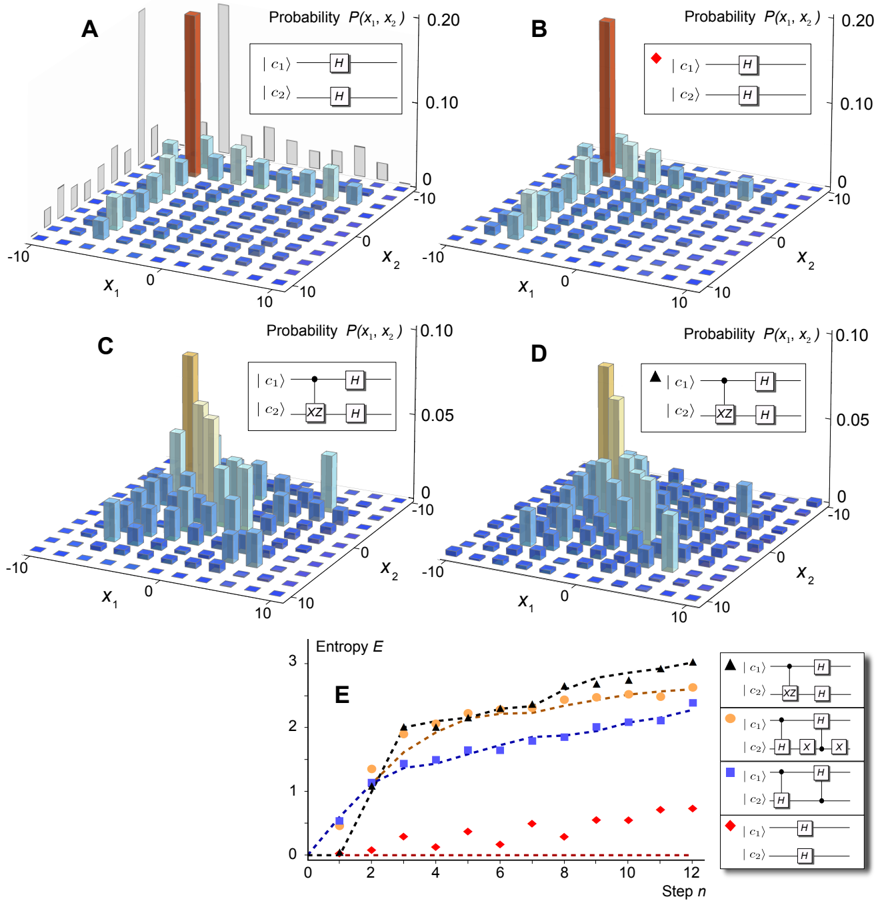
- For a 10-step Hadamard walk across 121 positions, measured similarity to theory was \(S = 0.957 \pm 0.003\); with controlling gates, \(S = 0.903 \pm 0.018\).
- Controlled operations produced simulated bipartite entanglement with a lower-bound von Neumann entropy of \(E = 2.63 \pm 0.01\) after 12 steps, stated as 56% of the maximal entropy.
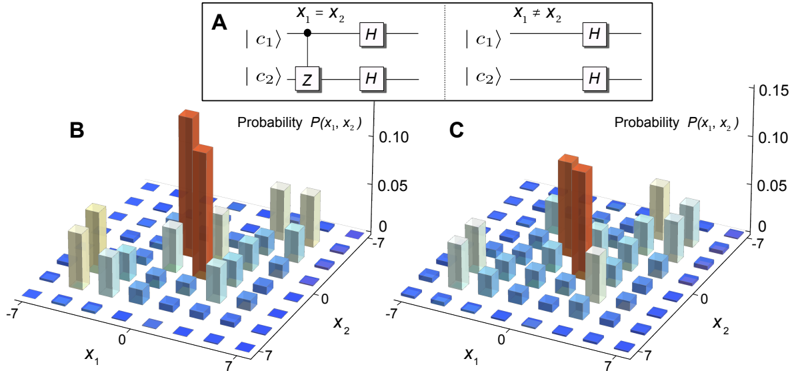
- A diagonal nonlinear coin simulated a bound molecule state: \(\sum_x P(x,x) = 0.317 \pm 0.006\) versus \(0.242 \pm 0.001\) for the Hadamard walk, with measured similarity \(S = 0.957 \pm 0.013\) after seven steps.
Methods
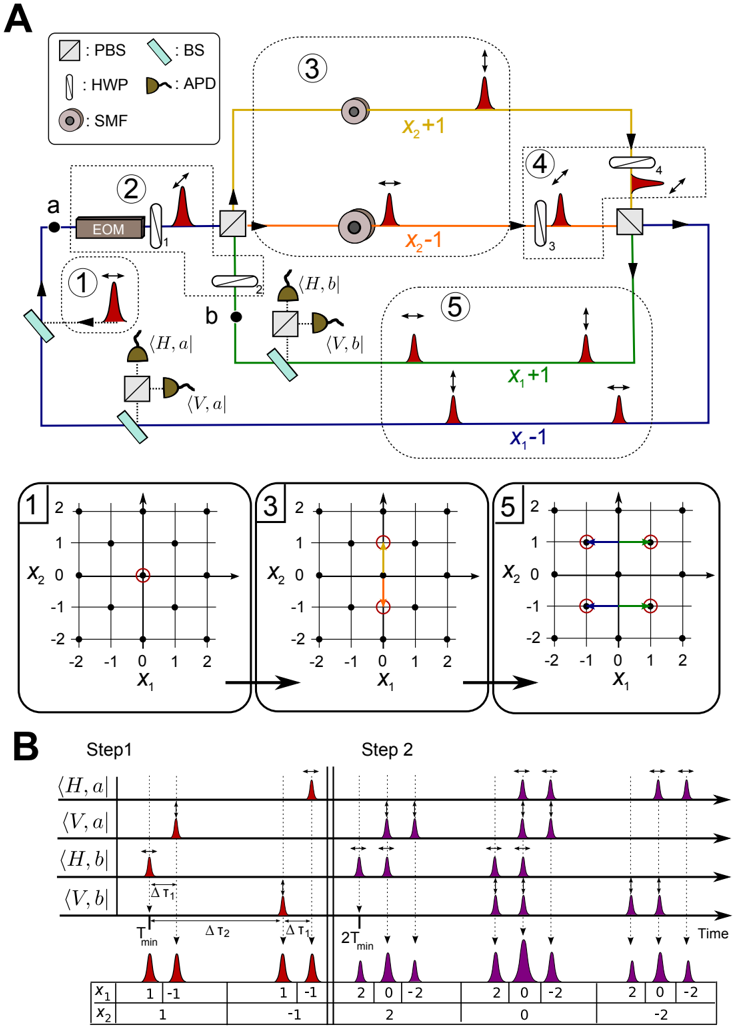
- Time-multiplexed optical setup using attenuated laser pulses from a pulsed diode laser (88 ps, 805 nm, 110 kHz), with coin states encoded in polarization and spatial modes and manipulated by HWPs, PBSs, and an EOM.
- Each round trip implemented one step; temporal delays were \(\Delta\tau_1 = 3.11\) ns and \(\Delta\tau_2 = 46.42\) ns, with minimum round-trip time \(T_{\min} = 676\) ns; detection used time-resolving single-photon counting modules/APDs.
- Analysis reconstructed output photostatistics and compared to theory via similarity \(S\); entanglement was quantified by von Neumann entropy assuming pure final states, with phases reconstructed from interference patterns and chosen to minimize entropy for a lower bound.
Limitations
- The paper states the EOM is the most significant systematic error: it affects the vertical polarization component with a factor \(1/3.5\) and distorts wavefronts differently for both polarizations, reducing achievable similarities.
- The paper states losses per step are the main scalability limit; adding the EOM for dynamic control limited the step number to \(n = 7\) due to higher losses, and temporal-overlap constraints required \(\Delta\tau_2 > 13 \cdot \Delta\tau_1\) and \(T_{\min} > 13 \cdot \Delta\tau_2\) for the first 12 steps.
- The paper states the entanglement values are lower bounds because phase information is not directly extractable, leaving three undetermined relative phases between coin states plus a global phase; it also notes the experiment uses an entirely classical light source to simulate quantum features.
Model-written summary. Check it against the paper before relying on it.
Integrity signals
Registry
Cites
Statistics
Figures

Verification
Claims the paper makes
0 Valid · 2 Not valid · 13 Not checked · 41 Own results and interpretations
A result the paper reports from its own data — it cites no other source for it, so there is none to check. The quote shows it is in the paper.
In the paper
“With our broad spectrum of quantum coins we were able to simulate the creation of entanglement in bipartite systems with conditioned interactions.”
plainstates a cause- Asserted: passes — The authors put it forward as true.
- Checkable: passes — It can be checked against evidence.
- Load-bearing: passes — The paper’s conclusions depend on it.
- Based: passes — The paper gives a reason why it holds.
A result the paper reports from its own data — it cites no other source for it, so there is none to check. The quote shows it is in the paper.
In the paper
“We realized a coherent quantum walk over 12 steps and 169 positions using an optical fiber network.”
plain- Asserted: passes — The authors put it forward as true.
- Checkable: passes — It can be checked against evidence.
- Load-bearing: passes — The paper’s conclusions depend on it.
- Based: passes — The paper gives a reason why it holds.
A result the paper reports from its own data — it cites no other source for it, so there is none to check. The quote shows it is in the paper.
In the paper
“For the Hadamard walk (Fig. 2A+B) we observe S = 0 . 957 ± 0 . 003, and for the quantum walk with controlling gates (Fig. 2C+D) S = 0 . 903 ± 0 . 018 (after 10 steps, across 121 positions).”
plain- Asserted: passes — The authors put it forward as true.
- Checkable: passes — It can be checked against evidence.
- Load-bearing: passes — The paper’s conclusions depend on it.
- Based: passes — The paper gives a reason why it holds.
A result the paper reports from its own data — it cites no other source for it, so there is none to check. The quote shows it is in the paper.
In the paper
“In Fig. 2E we show a lower bound for the simulated entanglement between the two particles during the stepwise evolution with four different coin operations.”
plain- Asserted: passes — The authors put it forward as true.
- Checkable: passes — It can be checked against evidence.
- Load-bearing: passes — The paper’s conclusions depend on it.
- Based: passes — The paper gives a reason why it holds.
- Rests on an assumption not shown here.
A result the paper states — it cites no source for it, so there is none to check. The quote shows it is in the paper.
In the paper
“We demonstrated that, with a physical resource overhead, a classical experiment can simulate many genuine quantum features.”
boostedstates a cause- Asserted: passes — The authors put it forward as true.
- Checkable: passes — It can be checked against evidence.
- Load-bearing: passes — The paper’s conclusions depend on it.
- Based: passes — The paper gives a reason why it holds.
29 more claims
Create a free account to see all 56 claims and to verify the 2 references still open.
- Probably not a substantial claim. 12
- It may state two separate claims as one. 14
Claims other papers make about this one
Each is checked against this paper’s own text: does it say what the citing paper says it does?
The cited source says what the claim attributes to it.
In the citing paper
“An additional physical dimension in the network can, in principle, entail the degrees of freedom offered by two walkers on a 1D-network [22,24,25].”
From Quantum Walks of Correlated Photon Pairs in Two-Dimensional Waveguide Arrays (2014) · cites this paper as [22]
The cited source says what the claim attributes to it.
In the citing paper
“A current limitation of our approach is that the walk evolution cannot be position-dependent (that is, OAM-dependent), in contrast to other implementations (9, 23).”
From Quantum walks and wavepacket dynamics on a lattice with twisted photons (2015) · cites this paper as [23]
Self-check
Percentages, sums and reported differences re-computed from the paper’s own numbers.
Each contradiction between two passages listed here was confirmed by an independent check.
Rated minor: it would not touch a result — a value no result rests on, a p-value that stays on the same side of the significance level, or a conflict that is clerical, resolved elsewhere in the paper, or outside its own findings.
In the paper
§ Appendix 2: Quantum walk implementation via time-multiplexing · p. 8
“T min + ∆ τ 1 stating position | 1 , -1 〉 , T min + ∆ τ 2 ( | -1 , 1 〉 )”
§ A 2D Quantum Walk Simulation of Two-Particle Dynamics · p. 2
“Each step consists of a shift in both x 1 direction, corresponding to a time difference of ∆ τ 1 = 3 . 11ns, and x 2 direction with ∆ τ 2 = 46 . 42ns.”
Citations
Cites
Experimental realization of any discrete unitary operator
Reck, M., Zeilinger, A., Bernstein, H. J., & Bertani, P. (1994) · Physical Review Letters · doi:10.1103/physrevlett.73.58 · Cited by 2,155
Aharonov, Y., Davidovich, L., & Zagury, N. (1993) · Physical Review A · doi:10.1103/physreva.48.1687 · Cited by 1,622
Environment-assisted quantum walks in photosynthetic energy transfer
Mohseni, M., Rebentrost, P., Lloyd, S., & Aspuru-Guzik, A. (2008) · The Journal of Chemical Physics · doi:10.1063/1.3002335 · Cited by 1,189
Quantum random-walk search algorithm
Shenvi, N., Kempe, J., & Whaley, K. B. (2003) · Physical Review A · doi:10.1103/physreva.67.052307 · Cited by 1,150
Universal Computation by Quantum Walk
Childs, A. M. (2009) · Physical Review Letters · doi:10.1103/physrevlett.102.180501 · Cited by 1,002
Dephasing-assisted transport: quantum networks and biomolecules
Plenio, M. B., & Huelga, S. F. (2008) · New Journal of Physics · doi:10.1088/1367-2630/10/11/113019 · Cited by 1,002
Quantum Walks of Correlated Photons
Peruzzo, A., Lobino, M., Matthews, J. C. F., Matsuda, N., Politi, A., Poulios, K., Zhou, X.-Q., Lahini, Y., Ismail, N., Wörhoff, K., et al. (2010) · Science · doi:10.1126/science.1193515 · Cited by 929
Quantum Walk in Position Space with Single Optically Trapped Atoms
Karski, M., Förster, L., Choi, J.-M., Steffen, A., Alt, W., Meschede, D., & Widera, A. (2009) · Science · doi:10.1126/science.1174436 · Cited by 659
Photons Walking the Line: A Quantum Walk with Adjustable Coin Operations
Schreiber, A., Cassemiro, K. N., Potoček, V., Gábris, A., Mosley, P. J., Andersson, E., Jex, I., & Silberhorn, C. (2010) · Physical Review Letters · doi:10.1103/physrevlett.104.050502 · Cited by 588
Self-citationTwo-Particle Bosonic-Fermionic Quantum Walk via Integrated Photonics
Sansoni, L., Sciarrino, F., Vallone, G., Mataloni, P., Crespi, A., Ramponi, R., & Osellame, R. (2012) · Physical Review Letters · doi:10.1103/physrevlett.108.010502 · Cited by 578
Research works printed but not linked: 6
- D. Aharonov, A. Ambainis, J. Kempe, U. Vazirani, in Proceedings of the Thirty-Third Annual ACM Symposium on Theory of Computing , STOC '01, Hersonissos, Greece, 6 to 8 July 2001 (ACM, New York, NY, USA, 2001), pp. 50-59.
- A. Ahlbrecht, et al. , arxiv: quant-ph/1105.1051 (2011).
- A. M. Childs, et al. , in Proceedings of the thirty-fifth ACM symposium on Theory of computing - STOC '03 (San Diego, CA, USA, 2003), p. 59.
- A. Ambainis, J. Kempe, A. Rivosh, in Proceedings of the Sixteenth ACM-SIAM Symposium on Discrete Algorithms , SODA '05, Vancouver, Canada, 23 to 25 January 2005 (Society for Industrial and Applied Mathematics, Philadelphia, 2005), p. 1099-1108.
- J. C. F. Matthews, et al. , arxiv: quant-ph/1106.1166 (2011).
- Y. Lahini, et al. , arxiv: quant-ph/1105.2273 (2011).
Cited by
Items 301–400 of 425
Scattering quantum random walks on square grids and randomly generated mazes
Koch, D. (2019) · Physical Review A · doi:10.1103/physreva.99.012330 · Cited by 4
A two-dimensional quantum walk driven by a single two-side coin*
Lin, Q., Qin, H., Wang, K., Xiao, L., & Xue, P. (2020) · Chinese Physics B · doi:10.1088/1674-1056/abaee8 · Cited by 4
History states of one-dimensional quantum walks
Lomoc, F., Boette, A., Canosa, N., & Rossignoli, R. (2022) · Physical Review A · doi:10.1103/physreva.106.062215 · Cited by 5
Feynman checkers: External electromagnetic field and asymptotic properties
Ozhegov, F. (2024) · Reviews in Mathematical Physics · doi:10.1142/s0129055x2450017x · Cited by 4
Photonic random walks with traps
Longhi, S. (2024) · Optics Letters · doi:10.1364/ol.522686 · Cited by 5
Time travel without paradoxes: Ring resonator as a universal paradigm for looped quantum evolutions
Czachor, M. (2019) · Physics Letters A · doi:10.1016/j.physleta.2019.05.043 · Cited by 8
Multidimensional matter-wave beam splitters by multiphoton hyperfine Raman transitions
Liu, X.-D., Chen, Z., Huang, W., Lee, Y.-K., Chen, Y., & Kuan, P.-C. (2024) · Physical Review A · doi:10.1103/physreva.109.013327 · Cited by 4
Experimental revival of an unknown state from the past in quantum walks
Huo, B., Qu, D., Lin, Q., Zhu, G., Xiao, L., Zhan, X., & Xue, P. (2024) · National Science Review · doi:10.1093/nsr/nwae263 · Cited by 3
Maximal coin-position entanglement and non-Hermitian skin effect in discrete-time quantum walks
Cheng, D., Li, Y., Zhao, H., Kang, H., Kong, C., Wang, J., Mei, F., Shan, C.-J., & Liu, J.-B. (2025) · Physical Review A · doi:10.1103/7m2n-9vmf · Cited by 4
Partition of graphs and quantum walk based search algorithms
Ide, Y. (2018) · Nonlinear Theory and Its Applications IEICE · doi:10.1587/nolta.10.16 · Cited by 3
“Recently, QWs have received much attention in various fields not only mathematical interests but also such as experimental realization [11,22], connection between topological phase [3,14], reduction method for radioactivity [9, 20], quantum search algorithms [1, 2, 4–7, 18, 23].”
Localization of two dimensional quantum walks defined by generalized Grover coins
Mandal, A., Sarkar, R. S., & Adhikari, B. (2023) · Journal of Physics A Mathematical and Theoretical · doi:10.1088/1751-8121/acb304 · Cited by 7
Bright and dark solitons in a photonic nonlinear quantum walk: lessons from the continuum
Anglés-Castillo, A., Pérez, A., & Roldán, E. (2024) · New Journal of Physics · doi:10.1088/1367-2630/ad1e24 · Cited by 3
“…in several ways, e.g. with an electro-optic modulator that increases/ decreases the light beam frequency depending on the polarization state, as in [80, 81], or with a design that forces, again depending on the polarization state, the following of paths with different lengths, as in [82].”
BackgroundMethodZhang, Y., Li, S., Xu, Y., Tian, R., Zhang, M., Li, H., Gao, H. R., Zubairy, M. S., Li, F., & Liu, B. (2025) · Physical Review Letters · doi:10.1103/physrevlett.134.113603 · Cited by 3
A quantum walk in phase space with resonator-assisted double quantum dots
Bian, Z., Qin, H., Zhan, X., Li, J., & Xue, P. (2016) · Chinese Physics B · doi:10.1088/1674-1056/25/2/020307 · Cited by 3
A Large-Number and Multilayer Quantum Walk using Silicon Nano-photonic Chip
Wan, L., Yan, L., Huang, J. G., Zhang, G., Kwek, L. C., Fitzsimons, J. F., Chong, Y. D., Gong, J., Szameit, A., Zhou, X., et al. (2018) · Conference on Lasers and Electro-Optics · doi:10.1364/cleo_qels.2018.fm1g.2 · Cited by 3
“It will pave the way for further realization of QW based simulation tools [2].”
BackgroundFinding more than one path through a simple maze with a quantum walk
Hillery, M. S. (2021) · Journal of Physics A Mathematical and Theoretical · doi:10.1088/1751-8121/abde79 · Cited by 4
Quantum transport on multilayer generalized scale-free networks
Galiceanu, M. D., & Strunz, W. T. (2024) · Physica Scripta · doi:10.1088/1402-4896/ad29cf · Cited by 3
Dynamic Control of Non‐Hermitian On‐Site Potential in the Lithium Niobate Microresonator
Wang, P., Wan, S., Zhang, M., Ma, R., Fang, B., Shen, Z., Wan, W., Sun, F., Guo, G., & Dong, C. (2025) · Laser & Photonics Review · doi:10.1002/lpor.202500552 · Cited by 3
Coherent transport over an explosive percolation lattice
Yalçınkaya, İ., & Gedik, Z. (2017) · Journal of Physics A Mathematical and Theoretical · doi:10.1088/1751-8121/aa6201 · Cited by 3
Quantum walk with quadratic position-dependent phase defects
Farooq, U., Alshammari, A. S., & Rekik, N. (2019) · Quantum Information Processing · doi:10.1007/s11128-019-2496-y · Cited by 3
Jayakumar, J., Das, S., Sen, A., & Sen, U. (2020) · Europhysics Letters (EPL) · doi:10.1209/0295-5075/128/20007 · Cited by 5
Quantum Simulation of Neutrino Oscillation and Dirac Particle Dynamics in Curved Space-timePreprint
Mallick, A. (2019) · arXiv (Cornell University) · doi:10.48550/arxiv.1901.04014 · Cited by 3
“studied in ref. [103,104,105]. Two-particle quantum walk under position dependent or independent coin operations which are separable in their coin degrees of freedom, have been investigated in refs. [106,107,108,109,110,111]. But their frameworks are dierent than ours. Two-particle dynamics are interesting when the pa…”
BackgroundBernier, S., & Agarwal, K. (2025) · Physical review. B./Physical review. B · doi:10.1103/physrevb.111.054311 · Cited by 3
Discrete-time quantum walk of locally interacting walkers
Mittal, V., & Sowiński, T. (2026) · Physical Review A · doi:10.1103/tg6f-v65l · Cited by 2
“This choice of interaction is motivated by both experimental feasibility and the desire to isolate the role of phase interactions in correlation dynamics [36, 47–52].”
Implementation of Leaking Quantum Walks on a Photonic Processor
Stefanutti, E., Philipps, J., Bütow, J., Guidara, A., Nuvoli, M., Chiuri, A., & Sansoni, L. (2026) · Applied Sciences · doi:10.3390/app16041976 · Cited by 4
“…coherence: controlled disorder has been introduced to observe Anderson localization in the presence of static noise [20–22], while QWs on multidimensional lattices have been experimentally realized using both fiber-loop architectures [23] and femtosecond-laser-written waveguide circuits [24].”
Optical large-scale quantum computation
Fukui, K., & Takeda, S. (2024) · Elsevier eBooks · doi:10.1016/b978-0-323-98378-5.00012-x · Cited by 2
Topological quantum walk in synthetic non-Abelian gauge fields with photonic mesh lattices
Pang, Z., Abdelghani, O., Soljacic, M., & Yang, Y. (2025) · Optica · doi:10.1364/optica.567878 · Cited by 6
The discrete-time quantum walk as a stochastic process in quantum mechanics
Shikano, Y., Horikawa, J., & Wada, T. (2012) · Physica Scripta · doi:10.1088/0031-8949/2012/t151/014016 · Cited by 2
Quantum Walk Coherences on a Dynamical Percolation Graph
Elster, F., Barkhofen, S., Nitsche, T., Novotný, J., Gábris, A., Jex, I., & Silberhorn, C. (2015) · Conference on Lasers and Electro-Optics · doi:10.1364/cleo_qels.2015.ftu4a.6 · Cited by 2
Self-citationCo-evolution of networks and quantum dynamics: a generalization of preferential attachment
Nicosia, V., Machida, T., Wilson, R. C., Hancock, E. R., Konno, N., Latora, V., & Severini, S. (2013) · Journal of Statistical Mechanics Theory and Experiment · doi:10.1088/1742-5468/2013/08/p08016 · Cited by 3
Complex scattering as canonical transformation: A semiclassical approach in Fock space
Engl, T., Urbina, J. D., Hummel, Q., & Richter, K. (2015) · Annalen der Physik · doi:10.1002/andp.201500151 · Cited by 4
Stopping time of a one-dimensional bounded quantum walk
Luo, H., Zhan, X., Zhang, P., & Xue, P. (2016) · Chinese Physics B · doi:10.1088/1674-1056/25/11/110304 · Cited by 2
Controlling correlated particles and generating entanglement in an ac-driving lattice
Zheng, Y., & Yang, S.-J. (2017) · The European Physical Journal Special Topics · doi:10.1140/epjst/e2016-60371-8 · Cited by 2
Implementing arbitrary coined two-dimensional quantum walks via bulk optical interferometry
Xue, P., Zhang, X., Wang, K., Zhan, X., & Wang, X. (2018) · Optics Communications · doi:10.1016/j.optcom.2018.06.006 · Cited by 2
Quantum ultra-walks: Walks on a line with hierarchical spatial heterogeneity
Boettcher, S. (2020) · Physical Review Research · doi:10.1103/physrevresearch.2.023411 · Cited by 2
Transport and localization in quantum walks on a random hierarchy of barriers
Sharma, R., & Boettcher, S. (2022) · Journal of Physics A Mathematical and Theoretical · doi:10.1088/1751-8121/ac7117 · Cited by 3
Universal Multi-mode Linear Optical Quantum Operation in Time Domain
Yonezu, K., Enomoto, Y., Yoshida, T. O., & Takeda, S. (2022) · Frontiers in Optics · doi:10.1364/fio.2022.jtu5a.33 · Cited by 2
Optimizing Quantum Walk Search on a Reduced Uniform Complete Multi-Partite GraphPreprint
Chiang, C.-F., & Hsieh, C. (2017) · arXiv (Cornell University) · doi:10.48550/arxiv.1706.05403 · Cited by 3
“and quantum simulation [19, 2, 24], even including certain aspects of complex biological processes [12, 22].”
BackgroundOsawa, S., Simon, D. S., & Sergienko, A. V. (2019) · Quantum Communications and Quantum Imaging · doi:10.1117/12.2527915 · Cited by 1
Optimization for the propagation of a multiparticle quantum walk in a one-dimensional lattice
Feng, D., & Pang, S. (2024) · Physical Review A · doi:10.1103/physreva.109.052402 · Cited by 2
Quantum walk on a square lattice with identical particles
Camacho, G., Meinecke, J. D. A., & Wolters, J. (2025) · Physical Review A · doi:10.1103/physreva.111.052416 · Cited by 2
Quantum walk on a line with absorbing boundaries
Ammara, A., Potoček, V., Štefaňák, M., & Pepe, F. V. (2026) · Journal of Physics A Mathematical and Theoretical · doi:10.1088/1751-8121/ae8f8b · Cited by 4
“To further simplify the absorption probabilities we decompose the initial state into the coin eigenstates, a useful trick which can high-light otherwise hidden features of quantum walks [49–52].”
Self-citationQuantum walk with coherent multiple translations induces fast quantum gate operations
Zhang, Y., Qiao, X., Wang, L., He, Y., Dong, Z., Chen, X., & Yuan, L. (2026) · Light Science & Applications · doi:10.1038/s41377-025-02106-3 · Cited by 2
Improving quantum walk metrology with split-step quantum walk
Moradi, M., & Annabestani, M. (2026) · Physical Review A · doi:10.1103/x6h2-4rbp · Cited by 3
Quantum walks in waveguide-based optical quantum device
Wu, N., Hu, H., Xu, P., Song, F., & Li, X. (2014) · Proceedings of SPIE, the International Society for Optical Engineering/Proceedings of SPIE · doi:10.1117/12.2051167 · Cited by 1
Quantitative Verification of the Kibble–Zurek Mechanism in Quantum Nonequilibrium Dynamics
Xu, X. (2016) · Springer theses · doi:10.1007/978-3-662-49804-0_5 · Cited by 1
Two-dimensional Quantum Walk using 3D Silicon Photonic Fabrication
Yan, L., Huang, J. G., Zhang, G., Kwek, L. C., Gong, J., Gao, W., Chong, Y. D., Ser, W., & Liu, A. Q. (2017) · Conference on Lasers and Electro-Optics · doi:10.1364/cleo_si.2017.sf2i.4 · Cited by 1
“However, most of the multi-dimensional quantum walks system are demonstrated in bulky optical system, which is an obstacle for mass production and practical applications [1].”
BackgroundExperimental observations of 1D quantum walks in a limited region
Han, X., Feng, L., Li, Y., Zhang, L., Song, J.-F., & Zhang, Y.-S. (2019) · Quantum Information Processing · doi:10.1007/s11128-019-2202-0 · Cited by 2
Resonance transmission of one-dimensional quantum walk with phase defects
Dan-Dan, W., & Li, Z.-J. (2016) · Acta Physica Sinica · doi:10.7498/aps.65.060301 · Cited by 1
Manouchehri, K., & Wang, J. B. (2013) · Springer eBooks · doi:10.1007/978-3-642-36014-5_3 · Cited by 1
An improved algorithm for computing hitting probabilities of quantum walks
Zhang, Y., Song, T., & Wu, Z. (2022) · Physica A Statistical Mechanics and its Applications · doi:10.1016/j.physa.2022.127009 · Cited by 2
Topological Corner States in Non-Unitary Coinless Discrete-Time Quantum Walks
Meng, Y. (2022) · Frontiers in Physics · doi:10.3389/fphy.2022.861125 · Cited by 1
Research progress of integrated optical quantum computing
Zhou, W., Wang, Y., Weng, W.-K., & Jin, X. (2022) · Acta Physica Sinica · doi:10.7498/aps.71.20221782 · Cited by 3
Simulating many-body physics with quantum nonlinear optics
Chen, Z., Xu, X., Wang, Q., Han, Y., Li, C., & Guo, G. (2023) · Physical Review A · doi:10.1103/physreva.107.053711 · Cited by 1
The first detection time of one-dimensional systems with long-range interactions
Meng, X., & Chen, L. (2023) · International Journal of Modern Physics B · doi:10.1142/s021797922450190x · Cited by 1
Eigenvalues and threshold resonances of a two-dimensional split-step quantum walk with strong shift
Fuda, T., Funakawa, D., Sasayama, S., & Suzuki, A. (2023) · Quantum Studies Mathematics and Foundations · doi:10.1007/s40509-023-00307-2 · Cited by 2
“Quantum walks have been actively studied in recent years, being introduced to quantum information [16,26], quantum simulations [22,25], and topological phases [10,11].”
BackgroundSimulations of quantum walks on beam splitter arrays modeled as higher-order rotations
Estrada-Delgado, M. I., & Blanco-Garcia, Z. (2024) · The European Physical Journal Plus · doi:10.1140/epjp/s13360-024-05050-0 · Cited by 1
High-order spectral filtering based on photonic synthetic dimensions
Liao, Y.-W., Yang, M., Zhang, H.-Q., Luo, X.-W., Zhou, Z.-W., Xu, J., Li, C., & Guo, G. (2025) · Optics Letters · doi:10.1364/ol.546410 · Cited by 1
Multiphoton interference in a single-spatial-mode quantum walk
Fenwick, K. L., Baker, J., Thekkadath, G., Goldberg, A. Z., Heshami, K., Bustard, P. J., England, D. G., Bouchard, F., & Sussman, B. (2025) · Optics Express · doi:10.1364/oe.550931 · Cited by 1
Reversibility and quantum coherence in one-dimensional quantum cellular automata
Centrone, F., Tassi, C., Barbieri, M., & Serafini, A. (2018) · Physical Review A · doi:10.1103/physreva.98.012105 · Cited by 1
Discrete time quantum walks : from synthetic gauge fields to spontaneous equilibration
Molfetta, G. D. (2015) · theses.fr (ABES) · doi:10.70675/9ab716cdz1333z4feazb3c0z43a9960bb57f · Cited by 3
Simulation and bulk detection of topological phases of matter
Maffei, M. (2019) · UPCommons institutional repository (Universitat Politècnica de Catalunya) · doi:10.5821/dissertation-2117-129268 · Cited by 1
“ferent architectures: the walker is typically mapped onto a degree of freedom of a laser field, such as the optical path of the beam [59, 57, 58, 76, 77], the time delay between optical pulses [60, 78, 79].”
BackgroundMethodInfluentialTopology in Photonic Discrete-Time Quantum Walks: A Comprehensive Review
Puentes, G. (2022) · IntechOpen eBooks · doi:10.5772/intechopen.95111 · Cited by 1
Mobility edges in pseudo-unitary quasiperiodic quantum walksPreprint
Cedzich, C., & Fillman, J. (2024) · arXiv (Cornell University) · doi:10.48550/arxiv.2411.16843 · Cited by 2
Introducing a Kondo-type interaction to the model of quantum walkersPreprint
Yamagishi, M., Hatano, N., Kawabata, K., Kiumi, C., Nishino, A., Nori, F., & Obuse, H. (2026) · arXiv (Cornell University) · doi:10.48550/arxiv.2603.24444 · Cited by 1
Microwave experiments on atypical transport phenomena induced by spatial and spectral wave shaping
Böhm, J. (2016) · theses.fr (ABES) · doi:10.70675/dc04666cz23ebz4831za1c3z691245a58238 · Cited by 3
Photonic Quantum Walks on Finite Graphs and with Non-Localised Initial States
Barkhofen, S., Elster, F., Nitsche, T., Novotný, J., Gábris, A., Jex, I., & Silberhorn, C. (2015) · Conference on Lasers and Electro-Optics · doi:10.1364/cleo_at.2015.jw2a.9
Self-citationSimulations of two particle dynamics employing dynamic coin control in 2D quantum walks
Schreiber, A., Katzschmann, F., Gábris, A., Rohde, P. P., Laiho, K., Štefaňák, M., Potoček, V., Hamilton, C. S., Jex, I., & Silberhorn, C. (2013) · Conference on Lasers and Electro-Optics Europe & European Quantum Electronics Conference (CLEO/Europe-EQEC) · doi:10.1109/cleoe-iqec.2013.6801681 · Cited by 1
“There has been constantly rising interest in quantum walks in recent years, as they are a well-suited framework to study quantum algorithms, for example [1, 2] or to use them as a simulator for other quantum systems, which are not as readily accessible [3].”
BackgroundMethodSelf-citationde Valcárcel, G. J., Franco, C. D., Hinarejos, M., Pérez, A., Roldán, E., Romanelli, A., & Silva, F. (2013) · Conference on Lasers and Electro-Optics Europe & European Quantum Electronics Conference (CLEO/Europe-EQEC) · doi:10.1109/cleoe-iqec.2013.6801726
Basic Concepts of Linear Optical System
Xu, X. (2016) · Springer theses · doi:10.1007/978-3-662-49804-0_1
Kevés szabadsági fokú kvantumrendszerek dinamikai tulajdonságai
Darázs, Z. (2015) · Eötvös Loránd Tudományegyetem · doi:10.15476/elte.2015.055
Observation of Topological Structure in Photonic Quantum Walks
Puentes, G., Gerhardt, I., Katzschmann, F., Silberhorn, C., Wracthrup, J., & Lewenstein, M. (2014) · Research in Optical Sciences · doi:10.1364/qim.2014.qth1a.5
Self-citationContinuous-time limit of topological quantum walks
Balu, R., Castillo, D., Siopsis, G., & Weedbrook, C. (2017) · Proceedings of SPIE, the International Society for Optical Engineering/Proceedings of SPIE · doi:10.1117/12.2262596
“In this chain, it is convenient to define the repeated block U ′ = e−i θ 2Y ZSe−i θ 2Y (8) The advantage of working with U ′ instead of U is that U ′ is of the form U ′ = iFXF−1X (9) where F = e−i θ 2Y e−i π 4 S− (10) and S+ = Π0 ⊗ L + Π1 ⊗ I , S− = Π0 ⊗ I + Π1 ⊗ L− (11) X acts as a “chiral” transformation (Xe−iθYX =…”
Localization of quantum walks on finite graphs
Hu, Y.-Y., & Chen, P. (2016) · Chinese Physics B · doi:10.1088/1674-1056/25/12/120303
Observation of Topological Structures in Photonic Quantum Walks
Puentes, G., Gerhardt, I., Katzschmann, F., Silberhorn, C., Wrachtrup, J., & Lewenstein, M. (2014) · Conference on Lasers and Electro-Optics · doi:10.1364/cleo_qels.2014.fw1a.7
Self-citationProbing the measurement process in DTQW via recurrence
Nitsche, T., Kruse, R., Sansoni, L., Štefaňák, M., Kiss, T., Jex, I., Barkhofen, S., & Silberhorn, C. (2017) · Quantum Information and Measurement (QIM) · doi:10.1364/qim.2017.qt5a.5
Self-citationHow to Realize One-dimensional Discrete-time Quantum Walk by Dirac Particle
Shikano, Y. (2017) · Interdisciplinary Information Sciences · doi:10.4036/iis.2017.a.05 · Cited by 1
Probing the measurement process in DTQW via recurrence
Nitsche, T., Kruse, R., Sansoni, L., Štefaňák, M., Kiss, T., Jex, I., Barkhofen, S., & Silberhorn, C. (2017) · Conference on Lasers and Electro-Optics · doi:10.1364/cleo_at.2017.jw2a.27
“Our system of choice is a time-multiplexing quantum walk setup built with a fibre loop architecture, which has proven to provide great resource efficiency, high homogeneity and long-lasting stability against uncontrolled dephasing [3, 4].”
BackgroundSelf-citationSpreading and transport properties of quantum walks
Yalçınkaya, İ. (2016) · Sabanci University
Simulating continuous-time and discrete-time quantum walks with self-collimated light
Ma, Q., Wang, Y., Liu, Z., & Zheng, W. (2017) · Applied Optics and Photonics China: Optoelectronics and Micro/Nano-Optics (AOPC) · doi:10.1117/12.2284914
Quantum Coherence in Noisy Cellular AutomataPreprint
Centrone, F., Barbieri, M., & Serafini, A. (2018) · arXiv (Cornell University) · doi:10.48550/arxiv.1801.02057
Nonlinear Wave Collapse in Coupled Fiber Systems
Muniz, A. L. M., Wimmer, M., Bisianov, A., Christodoulides, D. N., Morandotti, R., & Peschel, U. (2018) · Conference on Lasers and Electro-Optics · doi:10.1364/cleo_qels.2018.fth4e.4
“1 , 2 2 1 1 1 1 1, 1, 1, 1, 1 exp exp 2 m x y m m m m x y x y x y x y b d i d ic i c (2)”
Chattaraj, T. (2018) · arXiv (Cornell University) · doi:10.14288/1.0372343
Linear and Nonlinear Experiments in 𝒫 𝒯 $$ \mathbb{PT} $$ -Symmetric Photonic Mesh Lattices
Wimmer, M., Christodoulides, D. N., & Peschel, U. (2018) · Springer tracts in modern physics · doi:10.1007/978-981-13-1247-2_1 · Cited by 1
Time‐Multiplexed Networks for Quantum Optics
Barkhofen, S., Sansoni, L., & Silberhorn, C. (2016) · Wiley eBooks · doi:10.1002/9783527805785.ch26
Self-citationExperimental Observation of PT Soliton Collapse in 2D Synthetic Lattice
Muniz, A. L. M., Wimmer, M., Bisianov, A., Morandotti, R., & Peschel, U. (2019) · Conference on Lasers and Electro-Optics · doi:10.23919/cleo.2019.8749584
Quantum walk topology and spontaneous parametric down conversion
Puentes, G. (2016) · Optical and Quantum Electronics · doi:10.1007/s11082-016-0410-8
Continuous-time limit of topological quantum walksPreprint
Balu, R., Castillo, D., Siopsis, G., & Weedbrook, C. (2016) · arXiv (Cornell University) · doi:10.48550/arxiv.1611.07457
“In this chain, it is convenient to define the repeated block U ′ = e−i θ 2Y ZSe−i θ 2Y (8) The advantage of working with U ′ instead of U is that U ′ is of the form U ′ = iFXF−1X (9) where F = e−i θ 2Y e−i π 4 S− (10) and S+ = Π0 ⊗ L + Π1 ⊗ I , S− = Π0 ⊗ I + Π1 ⊗ L− (11) X acts as a “chiral” transformation (Xe−iθYX =…”
PT-Symmetry in two Synthetic Dimensions
Muniz, A. L. M., Wimmer, M., Bisianov, A., Morandotti, R., & Peschel, U. (2019) · Conference on Lasers and Electro-Optics Europe & European Quantum Electronics Conference (CLEO/Europe-EQEC) · doi:10.1109/cleoe-eqec.2019.8873106
Introduction to Quantum Simulation
Sansoni, L. (2014) · Springer theses · doi:10.1007/978-3-319-07103-9_8
Bosonic and Fermionic Quantum Walk
Sansoni, L. (2014) · Springer theses · doi:10.1007/978-3-319-07103-9_9
The maximal coin-walker entanglement in quantum walks with ballistic transports
Zhang, R., Yang, D., & Chen, B. (2021) · International Conference on Wireless Communications and Signal Processing (WCSP) · doi:10.1109/wcsp52459.2021.9613481
Glisic, S., & Lorenzo, B. (2022) · Wiley eBooks · doi:10.1002/9781119790327.ch16
(2018) · SciPost Physics · doi:10.21468/scipost.report.495
Experimental Observation of P T. Soliton Collapse in 2D Synthetic Lattice
Muniz, A. L. M., Wimmer, M., Bisianov, A., Morandotti, R., & Peschel, U. (2019) · Conference on Lasers and Electro-Optics · doi:10.1364/cleo_at.2019.jth5c.8
Bachor, H., & Ralph, T. C. (2019) · Wiley eBooks · doi:10.1002/9783527695805.ch13
Verga, A., & Elías, R. G. (2018) · SciPost Physics · doi:10.21468/scipost.report.560
Reducing circuit complexity in optical quantum computation using 3D architectures
Zhou, W., Vijayan, M. K., Wang, X., Lu, Y., Gao, J., Jiao, Z., Ren, R.-J., Chang, Y.-J., Shen, Z.-S., Rohde, P. P., et al. (2022) · Optics Express · doi:10.1364/oe.464108
Self-citationExperimental 61-partite entanglement on a three-dimensional photonic chip
Zhou, W., Jiao, Z., Li, H., Gao, J., Wang, X., Ren, R.-J., Xu, X.-Y., Qiao, L.-F., & Jin, X. (2023) · Optics Express · doi:10.1364/oe.492725
Two-particle Hadamard walk on dynamically percolated line and circle
Parýzková, M., Štefaňák, M., Novotný, J., Kollár, B., & Kiss, T. (2024) · Physica Scripta · doi:10.1088/1402-4896/ad24b3 · Cited by 1
“If the initial state is a superposition of | ψ + 〉 and | f − 〉 , i.e. b = c = 0, the reduced coin state converges to a static asymptotic state”
BackgroundSelf-citation
Metadata
- Authors
- Schreiber, A., Gábris, A., Rohde, P. P., Laiho, K., Štefaňák, M., Potoček, V., Hamilton, C., Jex, I., & Silberhorn, C.
- Affiliations
- Paderborn University (DE)
- HUN-REN Wigner Research Centre for Physics (HU)
- Czech Technical University in Prague (CZ)
- Corresponding author
- Schreiber, Andreas
- ORCID
- Venue
- Science
- Published
- 2012-04-06
- Volume
- 336
- Issue
- 6077
- Pages
- 55-58
- ISSN
- 0036-8075 (ISSN-L)
- 1095-9203
- OpenAlex
- W1999799374
- Cited by
- 425
- References
- 31
- Citations by year
- 2026: 20 · 2025: 18 · 2024: 27 · 2023: 21 · 2022: 30 · 2021: 21 · 2020: 30 · 2019: 41 · 2018: 39 · 2017: 30 · 2016: 38 · 2015: 33 · 2014: 39 · 2013: 27 · 2012: 10
- FWCI
- 34.33
- Type
- journal article
- Language
- en
- Open access
- green
- arxiv.org
- Locations
- Science (publishedVersion)
- PubMed (publishedVersion)
- arXiv (Cornell University) (submittedVersion)
- ENLIGHTEN (Jurnal Bimbingan dan Konseling Islam) (submittedVersion)
- UTS ePRESS (University of Technology Sydney) (submittedVersion)
- MPG.PuRe (Max Planck Society) (submittedVersion)
- arXiv (Cornell University)
- Topics
- Physical Sciences › Computer Science › Artificial Intelligence › Quantum Computing Algorithms and Architecture
- Physical Sciences › Physics and Astronomy › Atomic and Molecular Physics, and Optics › Quantum Information and Cryptography
- Physical Sciences › Physics and Astronomy › Atomic and Molecular Physics, and Optics › Quantum Mechanics and Applications
- Keywords
- quantum walks, two-dimensional quantum walk, optical fiber communication, quantum coin, entanglement generation, bipartite entanglement, two-body scattering, nonlinear quantum dynamics, quantum simulation, topological structure
About these checks
Registry, retraction, Cites and statistics results are computed, not judged, with one exception: a printed reference that no index lists is read once by a model before it counts as a citation error. Claims are extracted by a model and kept only when their quote appears verbatim in the text; each cited source is then checked, with a model’s help, for whether it says what the claim relies on. Those verdicts can be wrong — read the claim’s quote and the cited source before relying on one.
A language model drew the claims from the paper on 2026-11-10, under version 3 of the claim definition (model deepseek-v4.1-flash, prompt extract-v3).
A second model labelled each claim on 2026-11-10 (model jev-1.13-20260917, definition revision gold-guideline-v0.2).
Statistics and arithmetic are recomputed, not judged.
Confidence bands are shown only for fields calibrated on our annotated test set. None is calibrated yet, so no band is shown.
What counts as a claim ›How we measure confidence ›How we check this ›
Are you an author, or do you see a problem with this page? Request a review
Data sources
Bibliographic data: Semantic Scholar, OpenAlex, Crossref.
Contains information from the Semantic Scholar Academic Graph Datasets, made available under the ODC Attribution License (ODC-BY 1.0).
Semantic Scholar’s data is described in: Kinney, R., et al. (2023). The Semantic Scholar Open Data Platform. arXiv:2301.10140.
