

A 2D Quantum Walk Simulation of Two-Particle Dynamics
Open accessThe DOI matches its Crossref record; 31 of the 33 references it cites were found in a registry or an index; none of the 25 sources its claims cite is checked for support yet.
Abstract
Here, There, Everywhere: Random walks are a powerful mathematical method that can be used to simulate certain processes in biology, chemistry, or even the stock market. They present a statistical method for mapping the possible routes that processes can take. Quantum walks are expected to be able to probe multiple paths simultaneously. Quantum walks have been demonstrated for one-dimensional, or straight-line, walks. Now, Schreiber et al. (p. 55 , published online 8 March) demonstrate an optical system that can simulate quantum walks over a two-dimensional system, thereby providing the capability of describing much more complex processes.
Overview
CoChat Summary
TL;DR
The paper reports a flexible 2D optical quantum walk on a fiber network, realizing a coherent walk over 12 steps and 169 positions. It uses the 2D lattice to simulate two-particle dynamics, including controlled interactions, bipartite entanglement, and bound-molecule-like behavior.
Key findings
- A 2D quantum walk was implemented over 12 steps and 169 positions using an optical fiber network, with separable and controlled coin operations.
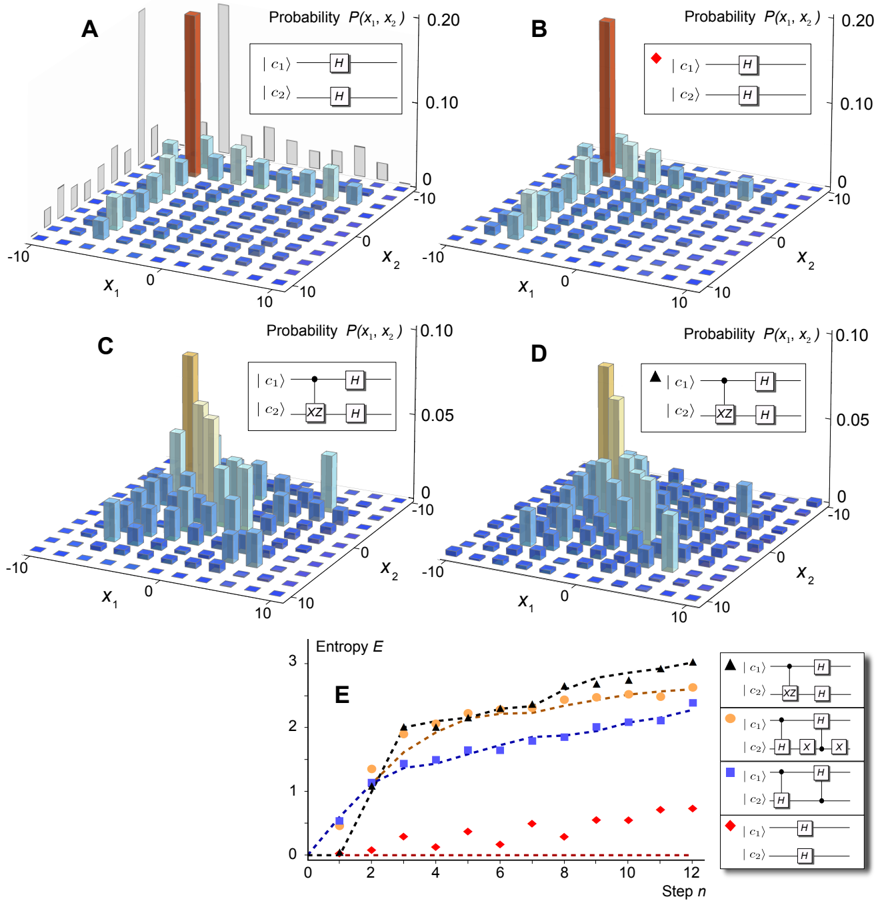
- For a 10-step Hadamard walk across 121 positions, measured similarity to theory was \(S = 0.957 \pm 0.003\); with controlling gates, \(S = 0.903 \pm 0.018\).
- Controlled operations produced simulated bipartite entanglement with a lower-bound von Neumann entropy of \(E = 2.63 \pm 0.01\) after 12 steps, stated as 56% of the maximal entropy.
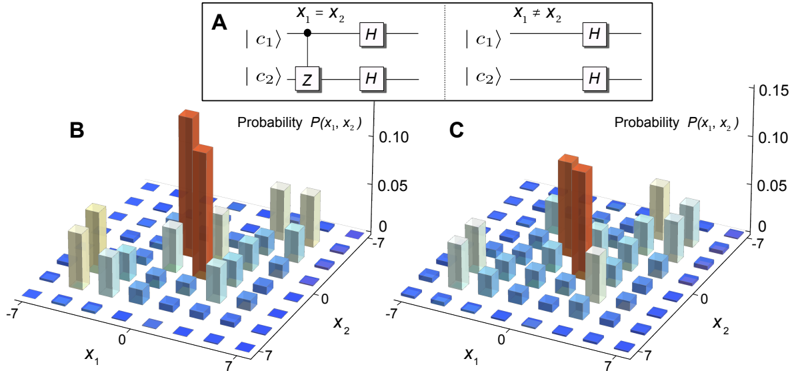
- A diagonal nonlinear coin simulated a bound molecule state: \(\sum_x P(x,x) = 0.317 \pm 0.006\) versus \(0.242 \pm 0.001\) for the Hadamard walk, with measured similarity \(S = 0.957 \pm 0.013\) after seven steps.
Methods
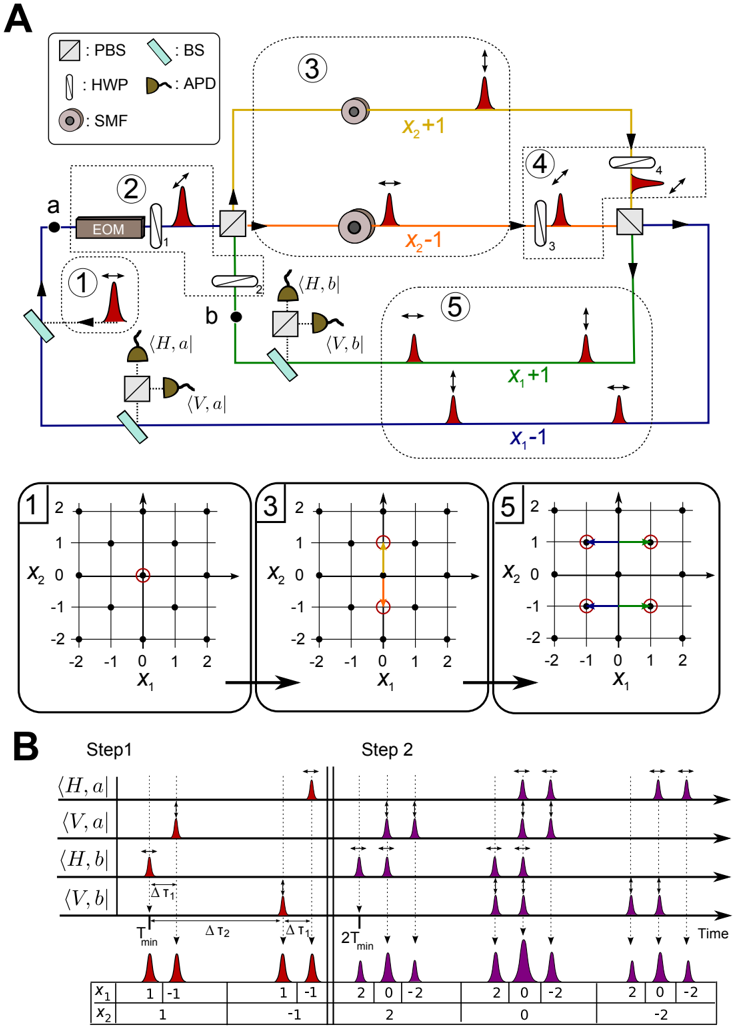
- Time-multiplexed optical setup using attenuated laser pulses from a pulsed diode laser (88 ps, 805 nm, 110 kHz), with coin states encoded in polarization and spatial modes and manipulated by HWPs, PBSs, and an EOM.
- Each round trip implemented one step; temporal delays were \(\Delta\tau_1 = 3.11\) ns and \(\Delta\tau_2 = 46.42\) ns, with minimum round-trip time \(T_{\min} = 676\) ns; detection used time-resolving single-photon counting modules/APDs.
- Analysis reconstructed output photostatistics and compared to theory via similarity \(S\); entanglement was quantified by von Neumann entropy assuming pure final states, with phases reconstructed from interference patterns and chosen to minimize entropy for a lower bound.
Limitations
- The paper states the EOM is the most significant systematic error: it affects the vertical polarization component with a factor \(1/3.5\) and distorts wavefronts differently for both polarizations, reducing achievable similarities.
- The paper states losses per step are the main scalability limit; adding the EOM for dynamic control limited the step number to \(n = 7\) due to higher losses, and temporal-overlap constraints required \(\Delta\tau_2 > 13 \cdot \Delta\tau_1\) and \(T_{\min} > 13 \cdot \Delta\tau_2\) for the first 12 steps.
- The paper states the entanglement values are lower bounds because phase information is not directly extractable, leaving three undetermined relative phases between coin states plus a global phase; it also notes the experiment uses an entirely classical light source to simulate quantum features.
Model-written summary. Check it against the paper before relying on it.
Integrity signals
Registry
Cites
Statistics
Figures

Verification
Claims the paper makes
0 Valid · 2 Not valid · 13 Not checked · 41 Own results and interpretations
A result the paper reports from its own data — it cites no other source for it, so there is none to check. The quote shows it is in the paper.
In the paper
“With our broad spectrum of quantum coins we were able to simulate the creation of entanglement in bipartite systems with conditioned interactions.”
plainstates a cause- Asserted: passes — The authors put it forward as true.
- Checkable: passes — It can be checked against evidence.
- Load-bearing: passes — The paper’s conclusions depend on it.
- Based: passes — The paper gives a reason why it holds.
A result the paper reports from its own data — it cites no other source for it, so there is none to check. The quote shows it is in the paper.
In the paper
“We realized a coherent quantum walk over 12 steps and 169 positions using an optical fiber network.”
plain- Asserted: passes — The authors put it forward as true.
- Checkable: passes — It can be checked against evidence.
- Load-bearing: passes — The paper’s conclusions depend on it.
- Based: passes — The paper gives a reason why it holds.
A result the paper reports from its own data — it cites no other source for it, so there is none to check. The quote shows it is in the paper.
In the paper
“For the Hadamard walk (Fig. 2A+B) we observe S = 0 . 957 ± 0 . 003, and for the quantum walk with controlling gates (Fig. 2C+D) S = 0 . 903 ± 0 . 018 (after 10 steps, across 121 positions).”
plain- Asserted: passes — The authors put it forward as true.
- Checkable: passes — It can be checked against evidence.
- Load-bearing: passes — The paper’s conclusions depend on it.
- Based: passes — The paper gives a reason why it holds.
A result the paper reports from its own data — it cites no other source for it, so there is none to check. The quote shows it is in the paper.
In the paper
“In Fig. 2E we show a lower bound for the simulated entanglement between the two particles during the stepwise evolution with four different coin operations.”
plain- Asserted: passes — The authors put it forward as true.
- Checkable: passes — It can be checked against evidence.
- Load-bearing: passes — The paper’s conclusions depend on it.
- Based: passes — The paper gives a reason why it holds.
- Rests on an assumption not shown here.
A result the paper states — it cites no source for it, so there is none to check. The quote shows it is in the paper.
In the paper
“We demonstrated that, with a physical resource overhead, a classical experiment can simulate many genuine quantum features.”
boostedstates a cause- Asserted: passes — The authors put it forward as true.
- Checkable: passes — It can be checked against evidence.
- Load-bearing: passes — The paper’s conclusions depend on it.
- Based: passes — The paper gives a reason why it holds.
29 more claims
Create a free account to see all 56 claims and to verify the 2 references still open.
- Probably not a substantial claim. 12
- It may state two separate claims as one. 14
Claims other papers make about this one
Each is checked against this paper’s own text: does it say what the citing paper says it does?
The cited source says what the claim attributes to it.
In the citing paper
“An additional physical dimension in the network can, in principle, entail the degrees of freedom offered by two walkers on a 1D-network [22,24,25].”
From Quantum Walks of Correlated Photon Pairs in Two-Dimensional Waveguide Arrays (2014) · cites this paper as [22]
The cited source says what the claim attributes to it.
In the citing paper
“A current limitation of our approach is that the walk evolution cannot be position-dependent (that is, OAM-dependent), in contrast to other implementations (9, 23).”
From Quantum walks and wavepacket dynamics on a lattice with twisted photons (2015) · cites this paper as [23]
Self-check
Percentages, sums and reported differences re-computed from the paper’s own numbers.
Each contradiction between two passages listed here was confirmed by an independent check.
Rated minor: it would not touch a result — a value no result rests on, a p-value that stays on the same side of the significance level, or a conflict that is clerical, resolved elsewhere in the paper, or outside its own findings.
In the paper
§ Appendix 2: Quantum walk implementation via time-multiplexing · p. 8
“T min + ∆ τ 1 stating position | 1 , -1 〉 , T min + ∆ τ 2 ( | -1 , 1 〉 )”
§ A 2D Quantum Walk Simulation of Two-Particle Dynamics · p. 2
“Each step consists of a shift in both x 1 direction, corresponding to a time difference of ∆ τ 1 = 3 . 11ns, and x 2 direction with ∆ τ 2 = 46 . 42ns.”
Citations
Cites
Experimental realization of any discrete unitary operator
Reck, M., Zeilinger, A., Bernstein, H. J., & Bertani, P. (1994) · Physical Review Letters · doi:10.1103/physrevlett.73.58 · Cited by 2,155
Aharonov, Y., Davidovich, L., & Zagury, N. (1993) · Physical Review A · doi:10.1103/physreva.48.1687 · Cited by 1,622
Environment-assisted quantum walks in photosynthetic energy transfer
Mohseni, M., Rebentrost, P., Lloyd, S., & Aspuru-Guzik, A. (2008) · The Journal of Chemical Physics · doi:10.1063/1.3002335 · Cited by 1,189
Quantum random-walk search algorithm
Shenvi, N., Kempe, J., & Whaley, K. B. (2003) · Physical Review A · doi:10.1103/physreva.67.052307 · Cited by 1,150
Universal Computation by Quantum Walk
Childs, A. M. (2009) · Physical Review Letters · doi:10.1103/physrevlett.102.180501 · Cited by 1,002
Dephasing-assisted transport: quantum networks and biomolecules
Plenio, M. B., & Huelga, S. F. (2008) · New Journal of Physics · doi:10.1088/1367-2630/10/11/113019 · Cited by 1,002
Quantum Walks of Correlated Photons
Peruzzo, A., Lobino, M., Matthews, J. C. F., Matsuda, N., Politi, A., Poulios, K., Zhou, X.-Q., Lahini, Y., Ismail, N., Wörhoff, K., et al. (2010) · Science · doi:10.1126/science.1193515 · Cited by 929
Quantum Walk in Position Space with Single Optically Trapped Atoms
Karski, M., Förster, L., Choi, J.-M., Steffen, A., Alt, W., Meschede, D., & Widera, A. (2009) · Science · doi:10.1126/science.1174436 · Cited by 659
Photons Walking the Line: A Quantum Walk with Adjustable Coin Operations
Schreiber, A., Cassemiro, K. N., Potoček, V., Gábris, A., Mosley, P. J., Andersson, E., Jex, I., & Silberhorn, C. (2010) · Physical Review Letters · doi:10.1103/physrevlett.104.050502 · Cited by 588
Self-citationTwo-Particle Bosonic-Fermionic Quantum Walk via Integrated Photonics
Sansoni, L., Sciarrino, F., Vallone, G., Mataloni, P., Crespi, A., Ramponi, R., & Osellame, R. (2012) · Physical Review Letters · doi:10.1103/physrevlett.108.010502 · Cited by 578
Research works printed but not linked: 6
- D. Aharonov, A. Ambainis, J. Kempe, U. Vazirani, in Proceedings of the Thirty-Third Annual ACM Symposium on Theory of Computing , STOC '01, Hersonissos, Greece, 6 to 8 July 2001 (ACM, New York, NY, USA, 2001), pp. 50-59.
- A. Ahlbrecht, et al. , arxiv: quant-ph/1105.1051 (2011).
- A. M. Childs, et al. , in Proceedings of the thirty-fifth ACM symposium on Theory of computing - STOC '03 (San Diego, CA, USA, 2003), p. 59.
- A. Ambainis, J. Kempe, A. Rivosh, in Proceedings of the Sixteenth ACM-SIAM Symposium on Discrete Algorithms , SODA '05, Vancouver, Canada, 23 to 25 January 2005 (Society for Industrial and Applied Mathematics, Philadelphia, 2005), p. 1099-1108.
- J. C. F. Matthews, et al. , arxiv: quant-ph/1106.1166 (2011).
- Y. Lahini, et al. , arxiv: quant-ph/1105.2273 (2011).
Cited by
Ozawa, T., Price, H. M., Amo, A., Goldman, N., Hafezi, M., Lu, L., Rechtsman, M. C., Schuster, D., Simon, J., Zilberberg, O., et al. (2019) · Reviews of Modern Physics · doi:10.1103/revmodphys.91.015006 · Cited by 3,722
“…point of view, focusing on works related to topological photonics, it is worth noting that a discrete version of the position-to-time mapping was exploited by Schreiber et al. (2012) to obtain a 2D analog quantum walk by encoding two extra spatial variables in the arrival time of optical pulses.”
BackgroundMethodPhotonic quantum information processing: a review
Flamini, F., Spagnolo, N., & Sciarrino, F. (2019) · Reports on Progress in Physics · doi:10.1088/1361-6633/aad5b2 · Cited by 770
Observation of topological edge states in parity–time-symmetric quantum walks
Xiao, L., Zhan, X., Bian, Z. H., Wang, K. K., Zhang, X., Wang, X. P., Li, J., Mochizuki, K., Kim, D., Kawakami, N., et al. (2017) · Nature Physics · doi:10.1038/nphys4204 · Cited by 576
Anderson localization of entangled photons in an integrated quantum walk
Crespi, A., Osellame, R., Ramponi, R., Giovannetti, V., Fazio, R., Sansoni, L., De Nicola, F., Sciarrino, F., & Mataloni, P. (2013) · Nature Photonics · doi:10.1038/nphoton.2013.26 · Cited by 474
Microscopic observation of magnon bound states and their dynamics
Fukuhara, T., Schauß, P., Endres, M., Hild, S., Cheneau, M., Bloch, I., & Gross, C. (2013) · Nature · doi:10.1038/nature12541 · Cited by 460
Universal Computation by Multiparticle Quantum Walk
Childs, A. M., Gosset, D., & Webb, Z. (2013) · Science · doi:10.1126/science.1229957 · Cited by 456
Strongly correlated quantum walks in optical lattices
Preiss, P. M., Ma, R., Tai, M. E., Lukin, A., Rispoli, M., Zupancic, P., Lahini, Y., Islam, R., & Greiner, M. (2015) · Science · doi:10.1126/science.1260364 · Cited by 443
Polino, E., Valeri, M., Spagnolo, N., & Sciarrino, F. (2020) · AVS Quantum Science · doi:10.1116/5.0007577 · Cited by 414
Topological quantum matter in synthetic dimensions
Ozawa, T., & Price, H. M. (2019) · Nature Reviews Physics · doi:10.1038/s42254-019-0045-3 · Cited by 387
Bulk-boundary correspondence for chiral symmetric quantum walks
Asbóth, J. K., & Obuse, H. (2013) · Physical Review B · doi:10.1103/physrevb.88.121406 · Cited by 260
Experimental two-dimensional quantum walk on a photonic chip
Tang, H., Lin, X.-F., Feng, Z., Chen, J.-Y., Gao, J., Sun, K., Wang, C.-Y., Lai, P.-C., Xu, X.-Y., Wang, Y., et al. (2018) · Science Advances · doi:10.1126/sciadv.aat3174 · Cited by 248
Q-plate technology: a progress review [Invited]
Rubano, A., Cardano, F., Piccirillo, B., & Marrucci, L. (2019) · Journal of the Optical Society of America B · doi:10.1364/josab.36.000d70 · Cited by 233
Observation of Defect States inPT-Symmetric Optical Lattices
Regensburger, A., Miri, M.-A., Bersch, C., Näger, J., Onishchukov, G., Christodoulides, D. N., & Peschel, U. (2013) · Physical Review Letters · doi:10.1103/physrevlett.110.223902 · Cited by 236
Toward large-scale fault-tolerant universal photonic quantum computing
Takeda, S., & Furusawa, A. (2019) · APL Photonics · doi:10.1063/1.5100160 · Cited by 234
Quantum walks and wavepacket dynamics on a lattice with twisted photons
Cardano, F., Massa, F., Qassim, H., Karimi, E., Slussarenko, S., Paparo, D., de Lisio, C., Sciarrino, F., Santamato, E., Boyd, R. W., et al. (2015) · Science Advances · doi:10.1126/sciadv.1500087 · Cited by 207
“A current limitation of our approach is that the walk evolution cannot be position-dependent (that is, OAM-dependent), in contrast to other implementations (9, 23).”
BackgroundResultInfluentialTime-Bin-Encoded Boson Sampling with a Single-Photon Device
He, Y., Ding, X., Su, Z.-E., Huang, H.-L., Qin, J., Wang, C., Unsleber, S., Chen, C., Wang, H., He, Y.-M., et al. (2017) · Physical Review Letters · doi:10.1103/physrevlett.118.190501 · Cited by 175
Two-photon quantum walk in a multimode fiber
Defienne, H., Barbieri, M., Walmsley, I. A., Smith, B. J., & Gigan, S. (2016) · Science Advances · doi:10.1126/sciadv.1501054 · Cited by 185
Quantum Computing and Communications: An Engineering Approach
Imre, S., & Balázs, F. (2004) · Wiley eBooks · doi:10.1002/9780470869048 · Cited by 163
Quantum walk and its application domains: A systematic review
Kadian, K., Garhwal, S., & Kumar, A. (2021) · Computer Science Review · doi:10.1016/j.cosrev.2021.100419 · Cited by 204
Observing Topological Invariants Using Quantum Walks in Superconducting Circuits
Flurin, E., Ramasesh, V. V., Hacohen-Gourgy, S., Martin, L. S., Yao, N. Y., & Siddiqi, I. (2017) · Physical Review X · doi:10.1103/physrevx.7.031023 · Cited by 149
“The generalization of quantum-walk-based protocols to measurements of many-body topological invariants represents an exciting frontier at the interface of topology, interactions, and quantum simulation [36,37].”
BackgroundQuantum Walks of Correlated Photon Pairs in Two-Dimensional Waveguide Arrays
Poulios, K., Keil, R., Fry, D., Meinecke, J. D. A., Matthews, J. C. F., Politi, A., Lobino, M., Gräfe, M., Heinrich, M., Nolte, S., et al. (2014) · Physical Review Letters · doi:10.1103/physrevlett.112.143604 · Cited by 148
Linear optical quantum computing in a single spatial mode
Humphreys, P. C., Metcalf, B. J., Spring, J. B., Moore, M., Jin, X.-M., Barbieri, M., Kolthammer, W. S., & Walmsley, I. A. (2013) · Physical Review Letters · doi:10.1103/physrevlett.111.150501 · Cited by 145
Single-photon detection and cryogenic reconfigurability in lithium niobate nanophotonic circuits
Lomonte, E., Wolff, M. A., Beutel, F., Ferrari, S., Schuck, C., Pernice, W. H. P., & Lenzini, F. (2021) · Nature Communications · doi:10.1038/s41467-021-27205-8 · Cited by 163
Scalable Boson Sampling with Time-Bin Encoding Using a Loop-Based Architecture
Motes, K. R., Gilchrist, A., Dowling, J. P., & Rohde, P. P. (2014) · Physical Review Letters · doi:10.1103/physrevlett.113.120501 · Cited by 141
Self-citationTopological photonics in synthetic dimensions
Lustig, E., & Segev, M. (2021) · Advances in Optics and Photonics · doi:10.1364/aop.418074 · Cited by 135
Topological Phase Transitions and Mobility Edges in Non-Hermitian Quasicrystals
Lin, Q., Li, T., Xiao, L., Wang, K., Yi, W., & Xue, P. (2022) · Physical Review Letters · doi:10.1103/physrevlett.129.113601 · Cited by 169
Observation of Topologically Protected Edge States in a Photonic Two-Dimensional Quantum Walk
Chen, C., Ding, X., Qin, J., He, Y., Luo, Y.-H., Chen, M.-C., Liu, C., Wang, X.-L., Zhang, W.-J., Li, H., et al. (2018) · Physical Review Letters · doi:10.1103/physrevlett.121.100502 · Cited by 127
Optical mesh lattices with PT symmetry
Miri, M., Regensburger, A., Peschel, U., & Christodoulides, D. N. (2012) · Physical Review A · doi:10.1103/physreva.86.023807 · Cited by 127
Implementing Quantum Walks Using Orbital Angular Momentum of Classical Light
Goyal, S. K., Roux, F. S., Forbes, A., & Konrad, T. (2013) · Physical Review Letters · doi:10.1103/physrevlett.110.263602 · Cited by 114
Optical diametric drive acceleration through action–reaction symmetry breaking
Wimmer, M., Regensburger, A., Bersch, C., Miri, M.-A., Batz, S., Onishchukov, G., Christodoulides, D. N., & Peschel, U. (2013) · Nature Physics · doi:10.1038/nphys2777 · Cited by 113
Experimental quantum fast hitting on hexagonal graphs
Tang, H., Di Franco, C., Shi, Z.-Y., He, T.-S., Feng, Z., Gao, J., Sun, K., Li, Z.-M., Jiao, Z.-Q., Wang, T.-Y., et al. (2018) · Nature Photonics · doi:10.1038/s41566-018-0282-5 · Cited by 113
Direct characterization of linear-optical networks
Rahimi-Keshari, S., Broome, M. A., Fickler, R., Fedrizzi, A., Ralph, T. C., & White, A. G. (2013) · Optics Express · doi:10.1364/oe.21.013450 · Cited by 107
Realization of high-dimensional frequency crystals in electro-optic microcombs
Hu, Y., Reimer, C., Shams-Ansari, A., Zhang, M., & Loncar, M. (2020) · Optica · doi:10.1364/optica.395114 · Cited by 104
Efficient quantum walk on a quantum processor
Qiang, X., Loke, T., Montanaro, A., Aungskunsiri, K., Zhou, X., O’Brien, J. L., Wang, J. B., & Matthews, J. C. F. (2016) · Nature Communications · doi:10.1038/ncomms11511 · Cited by 108
Quantum computational advantage via high-dimensional Gaussian boson sampling
Deshpande, A., Mehta, A., Vincent, T., Quesada, N., Hinsche, M., Ioannou, M., Madsen, L., Lavoie, J., Qi, H., Eisert, J., et al. (2022) · Science Advances · doi:10.1126/sciadv.abi7894 · Cited by 106
Fast escape of a quantum walker from an integrated photonic maze
Caruso, F., Crespi, A., Ciriolo, A. G., Sciarrino, F., & Osellame, R. (2016) · Nature Communications · doi:10.1038/ncomms11682 · Cited by 105
“In the last years, several technological platforms have been employed to investigate quantum transport phenomena, such as NMR [29, 30], trapped ions [31, 32], neutral atoms [33], and several photonic schemes as bulk optics [34, 35], fiber loop configurations [36, 37], and miniaturized integrated waveguide circuits [38…”
Topological Quantum Walks in Momentum Space with a Bose-Einstein Condensate
Xie, D., Deng, T.-S., Xiao, T., Gou, W., Chen, T., Yi, W., & Yan, B. (2020) · Physical Review Letters · doi:10.1103/physrevlett.124.050502 · Cited by 122
Propagation of Quantum Walks in Electric Fields
Cedzich, C., Rybár, T., Werner, A. H., Alberti, A., Genske, M., & Werner, R. F. (2013) · Physical Review Letters · doi:10.1103/physrevlett.111.160601 · Cited by 94
Two-body physics in the Su-Schrieffer-Heeger model
Liberto, M. F. D., Recati, A., Carusotto, I., & Menotti, C. (2016) · Physical Review A · doi:10.1103/physreva.94.062704 · Cited by 103
Interference of identical particles from entanglement to boson-sampling
Tichy, M. C. (2014) · Journal of Physics B: Atomic, Molecular and Optical Physics · doi:10.1088/0953-4075/47/10/103001 · Cited by 97
Takeda, S., & Furusawa, A. (2017) · Physical Review Letters · doi:10.1103/physrevlett.119.120504 · Cited by 120
Quantum walks in artificial electric and gravitational fields
Di Molfetta, G., Brachet, M., & Debbasch, F. (2014) · Physica A: Statistical Mechanics and its Applications · doi:10.1016/j.physa.2013.11.036 · Cited by 93
“Experiments with time- and space-dependent coins are now possible thanks to at least two recently developed techniques [47,48].”
MethodQuantum Walks with Encrypted Data
Rohde, P. P., Fitzsimons, J. F., & Gilchrist, A. (2012) · Physical Review Letters · doi:10.1103/physrevlett.109.150501 · Cited by 102
Self-citationTopological edge states of bound photon pairs
Gorlach, M. A., & Poddubny, A. N. (2017) · Physical Review A · doi:10.1103/physreva.95.053866 · Cited by 99
Measuring topological invariants in disordered discrete-time quantum walks
Barkhofen, S., Nitsche, T., Elster, F., Lorz, L., Gábris, A., Jex, I., & Silberhorn, C. (2017) · Physical Review A · doi:10.1103/physreva.96.033846 · Cited by 79
Self-citationMeasuring a dynamical topological order parameter in quantum walks
Xu, X.-Y., Wang, Q.-Q., Heyl, M., Budich, J. C., Pan, W.-W., Chen, Z., Jan, M., Sun, K., Xu, J.-S., Han, Y.-J., et al. (2020) · Light Science & Applications · doi:10.1038/s41377-019-0237-8 · Cited by 104
Generation of Nonclassical Biphoton States through Cascaded Quantum Walks on a Nonlinear Chip
Solntsev, A. S., Setzpfandt, F., Clark, A. S., Wu, C. W., Collins, M. J., Xiong, C., Schreiber, A., Katzschmann, F., Eilenberger, F., Schiek, R., et al. (2014) · Physical Review X · doi:10.1103/physrevx.4.031007 · Cited by 85
“schemes provide an ideal platform for the implementation of quantum walks [10,12,15,23–25].”
BackgroundInfluentialSelf-citationTwo-dimensional topological quantum walks in the momentum space of structured light
D’Errico, A., Cardano, F., Maffei, M., Dauphin, A., Barboza, R., Esposito, C., Piccirillo, B., Lewenstein, M., Massignan, P., & Marrucci, L. (2020) · Optica · doi:10.1364/optica.365028 · Cited by 84
Einstein–Podolsky–Rosen spatial entanglement in ordered and Anderson photonic lattices
Di Giuseppe, G., Martin, L., Perez-Leija, A., Keil, R., Dreisow, F., Nolte, S., Szameit, A., Abouraddy, A. F., Christodoulides, D. N., & Saleh, B. E. A. (2013) · Physical Review Letters · doi:10.1103/physrevlett.110.150503 · Cited by 82
Explicit definition of PT symmetry for nonunitary quantum walks with gain and loss
Mochizuki, K., Kim, D., & Obuse, H. (2016) · Physical Review A · doi:10.1103/physreva.93.062116 · Cited by 93
Unveiling hidden topological phases of a one-dimensional Hadamard quantum walk
Obuse, H., Asbóth, J. K., Nishimura, Y., & Kawakami, N. (2015) · Physical Review B · doi:10.1103/physrevb.92.045424 · Cited by 79
A Hybrid Neqr Image Encryption Cryptosystem Using Two-Dimensional Quantum Walks and Quantum Coding
Hao, W., Zhang, T., Chen, X., & Zhou, X. (2022) · Signal Processing · doi:10.1016/j.sigpro.2022.108890 · Cited by 84
Synthetic Gauge Field for Two-Dimensional Time-Multiplexed Quantum Random Walks
Chalabi, H., Barik, S., Mittal, S., Murphy, T. E., Hafezi, M., & Waks, E. (2019) · Physical Review Letters · doi:10.1103/physrevlett.123.150503 · Cited by 78
Experimental realization of a delayed-choice quantum walk
Jeong, Y.-C., Di Franco, C., Lim, H.-T., Kim, M. S., & Kim, Y.-H. (2013) · Nature Communications · doi:10.1038/ncomms3471 · Cited by 76
“[28], where the classical interference effects of laser”
BackgroundQuantum Walk Computing: Theory, Implementation, and Application
Qiang, X., Ma, S., & Song, H. (2024) · Intelligent Computing · doi:10.34133/icomputing.0097 · Cited by 92
Nanowire‐based integrated photonics for quantum information and quantum sensing
Chang, J., Gao, J., Zadeh, I. E., Elshaari, A. W., & Zwiller, V. (2023) · Nanophotonics · doi:10.1515/nanoph-2022-0652 · Cited by 82
“Early-stage quantum walk experiments are conducted by the bulk optics beam splitters [131] and fiber loops [132, 133] in the time domain.”
Perfect state transfer and efficient quantum routing: A discrete-time quantum-walk approach
Zhan, X., Qin, H., Bian, Z., Li, J., & Xue, P. (2014) · Physical Review A · doi:10.1103/physreva.90.012331 · Cited by 83
Scattering theory of topological phases in discrete-time quantum walks
Tarasinski, B., Asbóth, J. K., & Dahlhaus, J. P. (2014) · Physical Review A · doi:10.1103/physreva.89.042327 · Cited by 69
Integrated photonic quantum walks
Gräfe, M., Heilmann, R., Lebugle, M., Guzman-Silva, D., Perez-Leija, A., & Szameit, A. (2016) · Journal of Optics · doi:10.1088/2040-8978/18/10/103002 · Cited by 70
Simple factorization of unitary transformations
de Guise, H., Di Matteo, O., & Sánchez-Soto, L. L. (2018) · Physical Review A · doi:10.1103/physreva.97.022328 · Cited by 70
Bulk-edge correspondence of one-dimensional quantum walks
Cedzich, C., Grünbaum, F. A., Stahl, C., Velázquez, L., Werner, A. H., & Werner, R. F. (2016) · Journal of Physics A: Mathematical and Theoretical · doi:10.1088/1751-8113/49/21/21lt01 · Cited by 57
“physical systems as neutral atoms in optical lattices [30], trapped ions [48, 55], wave guide lattices [44, 46] and light pulses in optical fibres [49, 50] as well as single photons in free space [14].”
BackgroundMeasuring the Winding Number in a Large-Scale Chiral Quantum Walk
Xu, X.-Y., Wang, Q., Pan, W.-W., Sun, K., Xu, J., Chen, G., Tang, J., Gong, M., Han, Y., Li, C., et al. (2018) · Physical Review Letters · doi:10.1103/physrevlett.120.260501 · Cited by 75
Implementation of quantum walks on IBM quantum computers
Acasiete, F., Agostini, F. P., Moqadam, J. K., & Portugal, R. (2020) · Quantum Information Processing · doi:10.1007/s11128-020-02938-5 · Cited by 76
Quantum light in complex media and its applications
Lib, O., & Bromberg, Y. (2022) · Nature Physics · doi:10.1038/s41567-022-01692-y · Cited by 76
Rakovszky, T., & Asbóth, J. K. (2015) · Physical Review A · doi:10.1103/physreva.92.052311 · Cited by 67
Combinatorial optimization via highly efficient quantum walks
Marsh, S., & Wang, J. B. (2020) · Physical Review Research · doi:10.1103/physrevresearch.2.023302 · Cited by 90
Qin, X., Ke, Y., Guan, X., Li, Z., Andrei, N., & Lee, C. (2014) · Physical Review A · doi:10.1103/physreva.90.062301 · Cited by 68
Wang, B., Chen, T., & Zhang, X. (2018) · Physical Review Letters · doi:10.1103/physrevlett.121.100501 · Cited by 62
Quantum key distribution with quantum walks
Vlachou, C., Krawec, W., Mateus, P., Paunković, N., & Souto, A. (2018) · Quantum Information Processing · doi:10.1007/s11128-018-2055-y · Cited by 65
Topologically robust transport of entangled photons in a 2D photonic system
Mittal, S., Orre, V. V., & Hafezi, M. (2016) · Optics Express · doi:10.1364/oe.24.015631 · Cited by 60
Building a large-scale quantum computer with continuous-variable optical technologies
Fukui, K., & Takeda, S. (2022) · Journal of Physics B Atomic Molecular and Optical Physics · doi:10.1088/1361-6455/ac489c · Cited by 78
Comprehensive review on developments of synthetic dimensions
Yu, D., Song, W., Wang, L., Srikanth, R., Sridhar, S. K., Chen, T., Huang, C., Li, G., Qiao, X., Wu, X., et al. (2025) · Photonics Insights · doi:10.3788/pi.2025.r06 · Cited by 72
Quantum Simulation of Single-Qubit Thermometry Using Linear Optics
Mancino, L., Sbroscia, M., Gianani, I., Roccia, E., & Barbieri, M. (2017) · Physical Review Letters · doi:10.1103/physrevlett.118.130502 · Cited by 68
Universally optimal noisy quantum walks on complex networks
Caruso, F. (2014) · New Journal of Physics · doi:10.1088/1367-2630/16/5/055015 · Cited by 54
Observation of quasiperiodic dynamics in a one-dimensional quantum walk of single photons in space
Xue, P., Qin, H., Tang, B., & Sanders, B. C. (2014) · New Journal of Physics · doi:10.1088/1367-2630/16/5/053009 · Cited by 55
Asymptotic Dynamics of Coined Quantum Walks on Percolation Graphs
Kollár, B., Kiss, T., Novotný, J., & Jex, I. (2012) · Physical Review Letters · doi:10.1103/physrevlett.108.230505 · Cited by 59
Self-citationQuantum Simulation of Landau-Zener Model Dynamics Supporting the Kibble-Zurek Mechanism
Xu, X.-Y., Han, Y., Sun, K., Xu, J., Tang, J., Li, C.-F., & Guo, G.-C. (2014) · Physical Review Letters · doi:10.1103/physrevlett.112.035701 · Cited by 63
Quantum state engineering using one-dimensional discrete-time quantum walks
Innocenti, L., Majury, H., Giordani, T., Spagnolo, N., Sciarrino, F., Paternostro, M., & Ferraro, A. (2017) · Physical Review A · doi:10.1103/physreva.96.062326 · Cited by 52
Probing measurement-induced effects in quantum walks via recurrence
Nitsche, T., Barkhofen, S., Kruse, R., Sansoni, L., Štefaňák, M., Gábris, A., Potoček, V., Kiss, T., Jex, I., & Silberhorn, C. (2018) · Science Advances · doi:10.1126/sciadv.aar6444 · Cited by 57
Self-citationDiscrete-time quantum walk with feed-forward quantum coin
Shikano, Y., Wada, T., & Horikawa, J. (2014) · Scientific Reports · doi:10.1038/srep04427 · Cited by 55
Edge-state-enhanced transport in a two-dimensional quantum walk
Asboth, J. K., & Edge, J. M. (2015) · Physical Review A · doi:10.1103/physreva.91.022324 · Cited by 50
Temporal and spectral manipulations of correlated photons using a time lens
Mittal, S., Orre, V. V., Restelli, A., Salem, R., Goldschmidt, E. A., & Hafezi, M. (2017) · Physical Review A · doi:10.1103/physreva.96.043807 · Cited by 50
One-dimensional quantum walks with single-point phase defects
Zhang, R., Xue, P., & Twamley, J. (2014) · Physical Review A · doi:10.1103/physreva.89.042317 · Cited by 50
Quantum diffusion with disorder, noise and interaction
D’Errico, C., Moratti, M., Lucioni, E., Tanzi, L., Deissler, B., Inguscio, M., Modugno, G. C., Plenio, M. B., & Caruso, F. (2013) · New Journal of Physics · doi:10.1088/1367-2630/15/4/045007 · Cited by 56
Nitsche, T., Elster, F., Novotný, J., Gábris, A., Jex, I., Barkhofen, S., & Silberhorn, C. (2016) · New Journal of Physics · doi:10.1088/1367-2630/18/6/063017 · Cited by 54
Self-citationDynamic-disorder-induced enhancement of entanglement in photonic quantum walks
Wang, Q.-Q., Xu, X.-Y., Pan, W.-W., Sun, K., Xu, J.-S., Chen, G., Han, Y.-J., Li, C.-F., & Guo, G.-C. (2018) · Optica · doi:10.1364/optica.5.001136 · Cited by 50
Salerno, G., Palumbo, G., Goldman, N., & Liberto, M. F. D. (2020) · Physical Review Research · doi:10.1103/physrevresearch.2.013348 · Cited by 51
Playing a true Parrondo's game with a three-state coin on a quantum walk
Rajendran, J., & Benjamin, C. (2018) · Europhysics Letters (EPL) · doi:10.1209/0295-5075/122/40004 · Cited by 54
“Quantum walks(QW), motivated from classical random walks, have proven to be of great utility in simulating many physical systems [1, 2] as well as in developing better quantum algorithms [3--5], so as universal computational primitive[6].”
BackgroundA hybrid quantum memory–enabled network at room temperature
Pang, X.-L., Yang, A.-L., Dou, J.-P., Li, H., Zhang, C.-N., Poem, E., Saunders, D. J., Tang, H. L., Nunn, J., Walmsley, I. A., et al. (2020) · Science Advances · doi:10.1126/sciadv.aax1425 · Cited by 58
Quantum walks of two interacting anyons in one-dimensional optical lattices
Wang, L., Wang, L., & Zhang, Y. (2014) · Physical Review A · doi:10.1103/physreva.90.063618 · Cited by 54
Higher winding number in a nonunitary photonic quantum walk
Xiao, L., Qiu, X., Wang, K., Bian, Z., Zhan, X., Obuse, H., Sanders, B. C., Yi, W., & Xue, P. (2018) · Physical Review A · doi:10.1103/physreva.98.063847 · Cited by 51
2D Solitons in P T -Symmetric Photonic Lattices
Muniz, A. L. M., Wimmer, M., Bisianov, A., Peschel, U., Morandotti, R., Jung, P. S., & Christodoulides, D. N. (2019) · Physical Review Letters · doi:10.1103/physrevlett.123.253903 · Cited by 50
Biphoton generation in quadratic waveguide arrays: A classical optical simulation
Gräfe, M., Solntsev, A. S., Keil, R., Sukhorukov, A. A., Heinrich, M., Tünnermann, A., Nolte, S., Szameit, A., & Kivshar, Y. S. (2012) · Scientific Reports · doi:10.1038/srep00562 · Cited by 44
Two-dimensional quantum walks of correlated photons
Jiao, Z.-Q., Gao, J., Zhou, W.-H., Wang, X.-W., Ren, R.-J., Xu, X.-Y., Qiao, L.-F., Wang, Y., & Jin, X.-M. (2021) · Optica · doi:10.1364/optica.425879 · Cited by 43
A Perspective on Synthetic Dimensions in Photonics
Ehrhardt, M., Weidemann, S., Maczewsky, L. J., Heinrich, M., & Szameit, A. (2023) · Laser & Photonics Reviews · doi:10.1002/lpor.202200518 · Cited by 43
Tensor network states in time-bin quantum optics
Lubasch, M., Valido, A. A., Renema, J. J., Kolthammer, W. S., Jaksch, D., Kim, M. S., Walmsley, I. A., & García−Patrón, R. (2018) · Physical Review A · doi:10.1103/physreva.97.062304 · Cited by 48
Ultra-long quantum walks via spin–orbit photonics
Colandrea, F. D., Babazadeh, A., Dauphin, A., Massignan, P., Marrucci, L., & Cardano, F. (2022) · Optica · doi:10.1364/optica.474542 · Cited by 46
“While optical circuits typically rely on the manipulation of spatial modes arranged in separated optical paths, either in integrated [5, 22] or in bulk interferometers [6], the control of co-propagating optical modes having complex temporal [15, 21] or spatial [23–25] structures is emerging as a powerful technology to…”
BackgroundTransport properties of continuous-time quantum walks on Sierpinski fractals
Darázs, Z., Anishchenko, A., Kiss, T., Blumen, A., & Mülken, O. (2014) · Physical Review E · doi:10.1103/physreve.90.032113 · Cited by 42
Nicola, F. D., Sansoni, L., Crespi, A., Ramponi, R., Osellame, R., Giovannetti, V., Fazio, R., Mataloni, P., & Sciarrino, F. (2014) · Physical Review A · doi:10.1103/physreva.89.032322 · Cited by 47
“[42] Andreas Schreiber, Aurél Gábris, Peter P.”
BackgroundObservation of Bloch oscillations dominated by effective anyonic particle statistics
Zhang, W., Yuan, H., Wang, H., Di, F., Sun, N., Zheng, X., Sun, H., & Zhang, X. (2022) · Nature Communications · doi:10.1038/s41467-022-29895-0 · Cited by 49
Metadata
- Authors
- Schreiber, A., Gábris, A., Rohde, P. P., Laiho, K., Štefaňák, M., Potoček, V., Hamilton, C., Jex, I., & Silberhorn, C.
- Affiliations
- Paderborn University (DE)
- HUN-REN Wigner Research Centre for Physics (HU)
- Czech Technical University in Prague (CZ)
- Corresponding author
- Schreiber, Andreas
- ORCID
- Venue
- Science
- Published
- 2012-04-06
- Volume
- 336
- Issue
- 6077
- Pages
- 55-58
- ISSN
- 0036-8075 (ISSN-L)
- 1095-9203
- OpenAlex
- W1999799374
- Cited by
- 425
- References
- 31
- Citations by year
- 2026: 20 · 2025: 18 · 2024: 27 · 2023: 21 · 2022: 30 · 2021: 21 · 2020: 30 · 2019: 41 · 2018: 39 · 2017: 30 · 2016: 38 · 2015: 33 · 2014: 39 · 2013: 27 · 2012: 10
- FWCI
- 34.33
- Type
- journal article
- Language
- en
- Open access
- green
- arxiv.org
- Locations
- Science (publishedVersion)
- PubMed (publishedVersion)
- arXiv (Cornell University) (submittedVersion)
- ENLIGHTEN (Jurnal Bimbingan dan Konseling Islam) (submittedVersion)
- UTS ePRESS (University of Technology Sydney) (submittedVersion)
- MPG.PuRe (Max Planck Society) (submittedVersion)
- arXiv (Cornell University)
- Topics
- Physical Sciences › Computer Science › Artificial Intelligence › Quantum Computing Algorithms and Architecture
- Physical Sciences › Physics and Astronomy › Atomic and Molecular Physics, and Optics › Quantum Information and Cryptography
- Physical Sciences › Physics and Astronomy › Atomic and Molecular Physics, and Optics › Quantum Mechanics and Applications
- Keywords
- quantum walks, two-dimensional quantum walk, optical fiber communication, quantum coin, entanglement generation, bipartite entanglement, two-body scattering, nonlinear quantum dynamics, quantum simulation, topological structure
About these checks
Registry, retraction, Cites and statistics results are computed, not judged, with one exception: a printed reference that no index lists is read once by a model before it counts as a citation error. Claims are extracted by a model and kept only when their quote appears verbatim in the text; each cited source is then checked, with a model’s help, for whether it says what the claim relies on. Those verdicts can be wrong — read the claim’s quote and the cited source before relying on one.
A language model drew the claims from the paper on 2026-11-10, under version 3 of the claim definition (model deepseek-v4.1-flash, prompt extract-v3).
A second model labelled each claim on 2026-11-10 (model jev-1.13-20260917, definition revision gold-guideline-v0.2).
Statistics and arithmetic are recomputed, not judged.
Confidence bands are shown only for fields calibrated on our annotated test set. None is calibrated yet, so no band is shown.
What counts as a claim ›How we measure confidence ›How we check this ›
Are you an author, or do you see a problem with this page? Request a review
Data sources
Bibliographic data: Semantic Scholar, OpenAlex, Crossref.
Contains information from the Semantic Scholar Academic Graph Datasets, made available under the ODC Attribution License (ODC-BY 1.0).
Semantic Scholar’s data is described in: Kinney, R., et al. (2023). The Semantic Scholar Open Data Platform. arXiv:2301.10140.
