

The DOI matches its Crossref record; 4 of the 4 references it cites were found in a registry or an index.
High-Risk Human Papillomavirus E7 Proteins Target PTPN14 for Degradation
Abstract
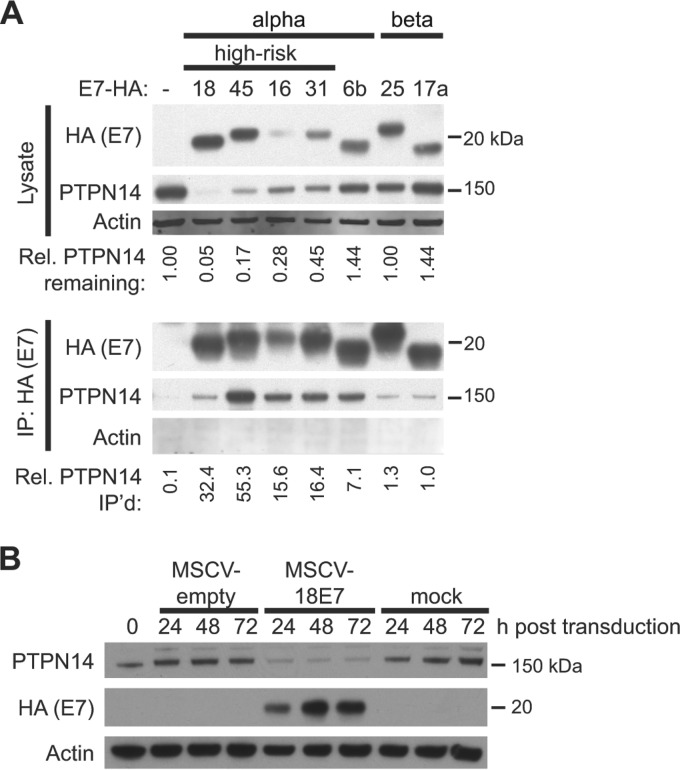
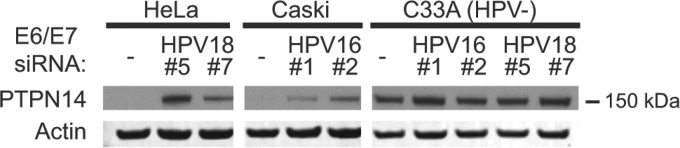
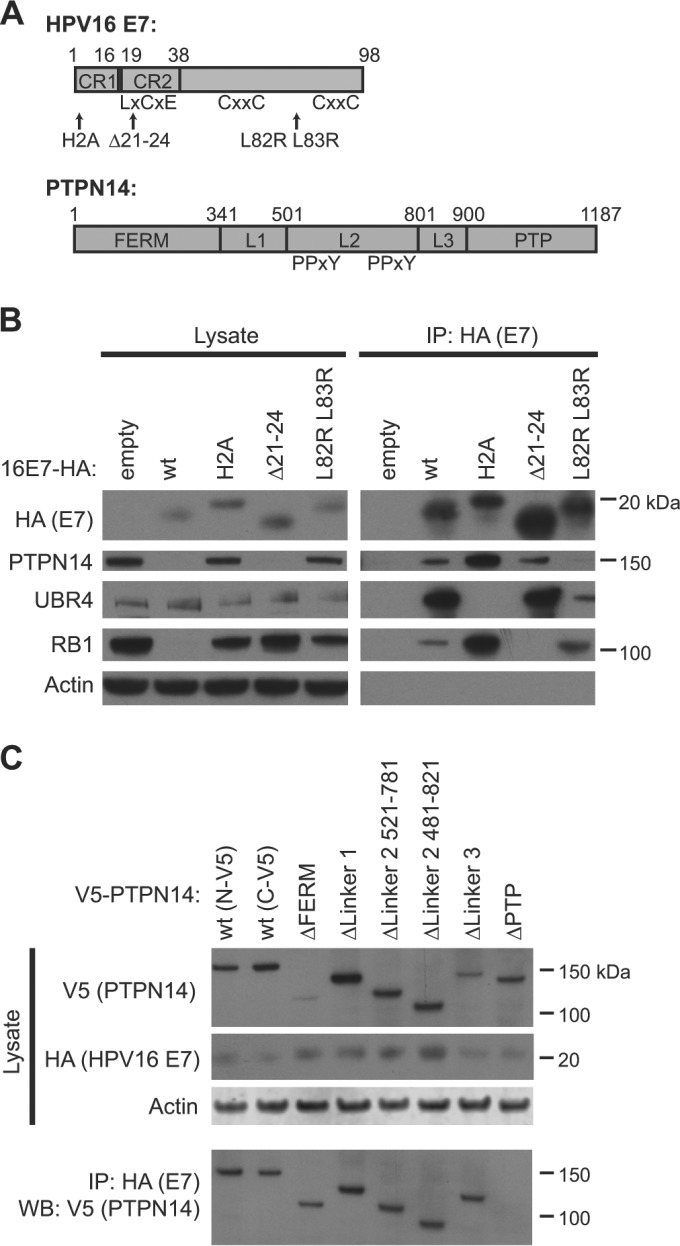
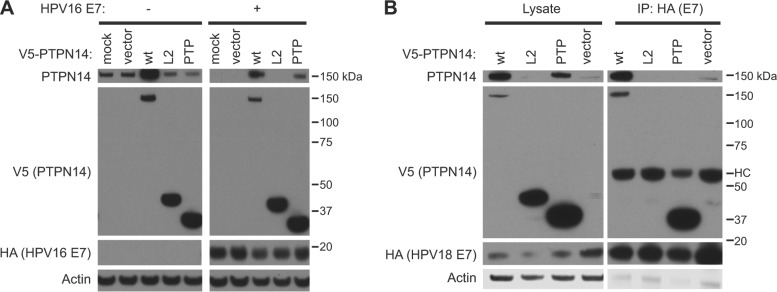
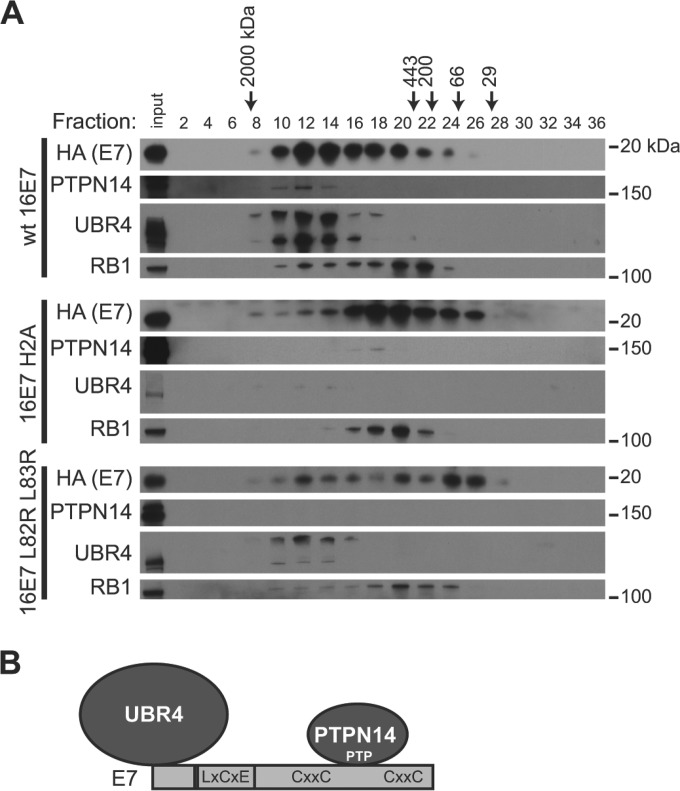
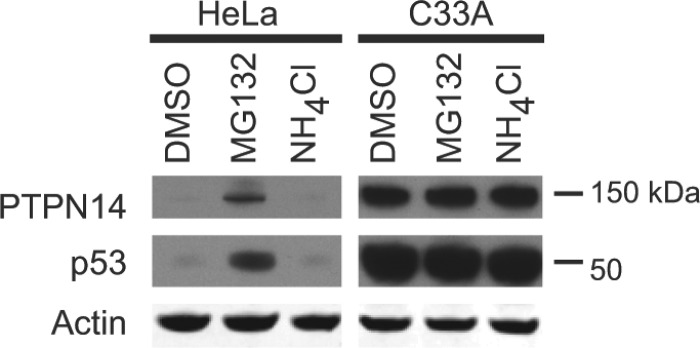
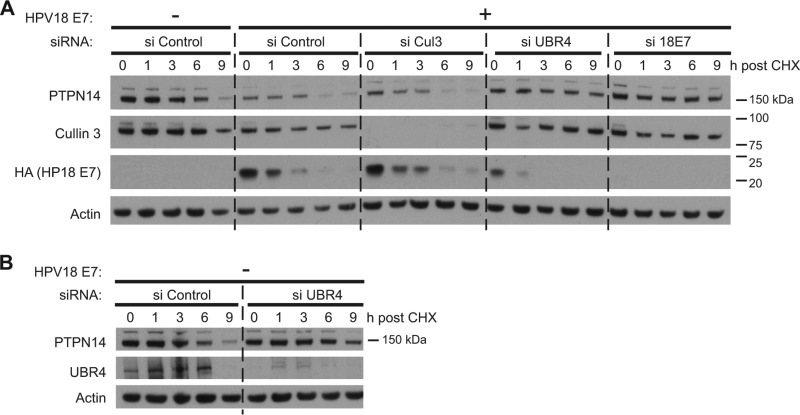
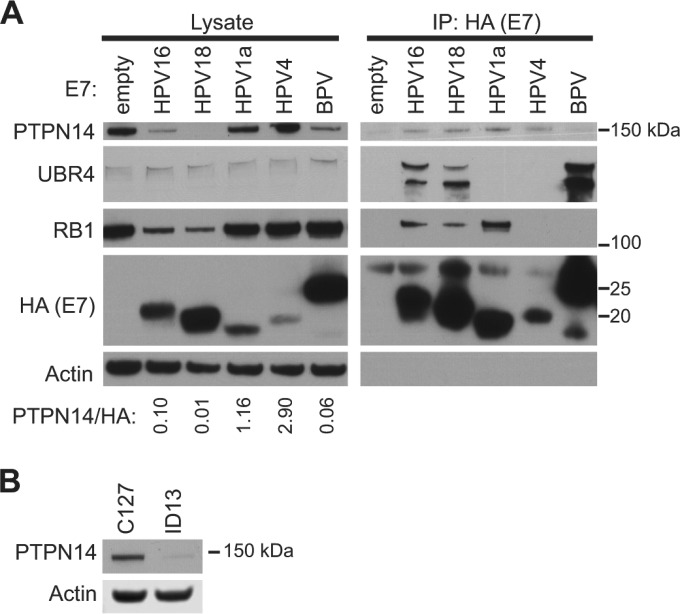
The major transformation activity of the high-risk human papillomaviruses (HPV) is associated with the E7 oncoprotein. The interaction of HPV E7 with retinoblastoma family proteins is important for several E7 activities; however, this interaction does not fully account for the high-risk E7-specific cellular immortalization and transformation activities. We have determined that the cellular non-receptor protein tyrosine phosphatase PTPN14 interacts with HPV E7 from many genus alpha and beta HPV types. We find that high-risk genus alpha HPV E7, but not low-risk genus alpha or beta HPV E7, is necessary and sufficient to reduce the steady-state level of PTPN14 in cells. High-risk E7 proteins target PTPN14 for proteasome-mediated degradation, which requires the ubiquitin ligase UBR4, and PTPN14 is degraded by the proteasome in HPV-positive cervical cancer cell lines. Residues in the C terminus of E7 interact with the C-terminal phosphatase domain of PTPN14, and interference with the E7-PTPN14 interaction restores PTPN14 levels in cells. Finally, PTPN14 degradation correlates with the retinoblastoma-independent transforming activity of high-risk HPV E7. IMPORTANCE High-risk human papillomaviruses (HPV) are the cause of cervical cancer, some other anogenital cancers, and a growing fraction of oropharyngeal carcinomas. The high-risk HPV E6 and E7 oncoproteins enable these viruses to cause cancer, and the mechanistic basis of their carcinogenic activity has been the subject of intense study. The high-risk E7 oncoprotein is especially important in the immortalization and transformation of human cells, which makes it a central component of HPV-associated cancer development. E7 oncoproteins interact with retinoblastoma family proteins, but for several decades, it has been recognized that high-risk HPV E7 oncoproteins have additional cancer-associated activities. We have determined that high-risk E7 proteins target the proteolysis of the cellular protein tyrosine phosphatase PTPN14 and find that this activity is correlated with the retinoblastoma-independent transforming activity of E7.
Overview
The claims and statistics of this paper haven’t been checked yet.
Run the check — free, no account needed. It reads the open-access text and checks the sources it cites.
Integrity signals
Registry
Cites
Statistics
Figures
Verification
Claims the paper makes
The claims and statistics of this paper haven’t been checked yet.
Run the check — free, no account needed. It reads the open-access text and checks the sources it cites.
Claims other papers make about this one
Each is checked against this paper’s own text: does it say what the citing paper says it does?
In the citing paper
“the p600/UBR4 interaction with high-risk E7 was shown to be important for the destabilization of PTPN14 [204,205]”
From The Not-So-Good, the Bad and the Ugly: HPV E5, E6 and E7 Oncoproteins in the Orchestration of Carcinogenesis (2021) · cites this paper as [205]
Self-check
Percentages, sums and reported differences re-computed from the paper’s own numbers.
The self-check needs the paper’s full text.
Citations
Cites
The human papilloma virus-16 E7-oncoprotein is able to bind to the retinoblastoma gene product
Dyson, N., Howley, P. M., Münger, K., & Harlow, E. (1989) · Science · doi:10.1126/science.2537532 · Cited by 3,017
Interpreting cancer genomes using systematic host network perturbations by tumour virus proteins
Rozenblatt-Rosen, O., Deo, R. C., Padi, M., Adelmant, G., Calderwood, M. A., Rolland, T., Grace, M., Dricot, A., Askenazi, M., Tavares, M., et al. (2012) · Nature · doi:10.1038/nature11288 · Cited by 378
Self-citationWhite, E. A., Sowa, M. E., Tan, M. J. A., Jeudy, S., Hayes, S. D., Santha, S., Münger, K., Harper, J. W., & Howley, P. M. (2012) · Proceedings of the National Academy of Sciences · doi:10.1073/pnas.1116776109 · Cited by 198
Self-citationPTPN14 is required for the density-dependent control of YAP1
Wang, W., Huang, J., Wang, X., Yuan, J., Li, X., Feng, L., Park, J.-I., & Chen, J. (2012) · Genes & Development · doi:10.1101/gad.192955.112 · Cited by 195
Research works printed but not linked: 64
- Howley PM, Schiller JT, Lowy DR. 2013. Papillomaviruses, p 1662–1703. In Knipe DM, Howley PM (ed), Fields virology, 6th ed. Lippincott Williams & Wilkins, Philadelphia, PA.
- 10.1056/NEJMoa021641 · DOI · Paper page
- 10.1016/j.virol.2005.04.002 · DOI · Paper page
- 10.1016/j.virol.2008.12.006 · DOI
- 10.1016/j.virol.2013.04.013 · DOI
- 10.1128/jvi.66.12.6893-6902.1992 · DOI · Paper page
- 10.1002/j.1460-2075.1989.tb08594.x · DOI · Paper page
- Berezutskaya E, Yu B, Morozov A, Raychaudhuri P, Bagchi S. 1997. Differential regulation of the pocket domains of the retinoblastoma family proteins by the HPV16 E7 oncoprotein. Cell Growth Differ 8:1277–1286.
- Boyer SN, Wazer DE, Band V. 1996. E7 protein of human papillomavirus-16 induces degradation of retinoblastoma protein through the ubiquitin-proteasome pathway. Cancer Res 56:4620–4624.
- 10.1128/JVI.75.16.7583-7591.2001 · DOI · Paper page
- 10.1128/jvi.71.4.2905-2912.1997 · DOI · Paper page
- 10.1016/0092-8674(90)90409-8 · DOI · Paper page
- 10.1126/science.2157286 · DOI · Paper page
- 10.3390/pathogens5010008 · DOI · Paper page
- Duensing S, Münger K. 2002. The human papillomavirus type 16 E6 and E7 oncoproteins independently induce numerical and structural chromosome instability. Cancer Res 62:7075–7082.
- 10.1002/j.1460-2075.1989.tb08570.x · DOI · Paper page
- 10.1128/jvi.65.1.473-478.1991 · DOI · Paper page
- 10.1128/jvi.63.10.4417-4421.1989 · DOI · Paper page
- 10.1099/0022-1317-71-1-165 · DOI
- 10.1128/jvi.65.1.292-298.1991 · DOI · Paper page
- 10.1073/pnas.89.10.4442 · DOI
- 10.1128/JVI.75.15.6737-6747.2001 · DOI · Paper page
- 10.1128/jvi.66.3.1329-1335.1992 · DOI
- 10.1128/jvi.66.4.2418-2427.1992 · DOI · Paper page
- Banks L, Edmonds C, Vousden KH. 1990. Ability of the HPV16 E7 protein to bind RB and induce DNA synthesis is not sufficient for efficient transforming activity in NIH3T3 cells. Oncogene 5:1383–1389.
- 10.1073/pnas.0505337102 · DOI · Paper page
- 10.1128/jvi.67.6.3142-3150.1993 · DOI · Paper page
- 10.1158/0008-5472.CAN-12-2083 · DOI
- 10.1016/j.virol.2012.09.046 · DOI · Paper page
- 10.1128/JVI.02172-12 · DOI · Paper page
- 10.1038/nrm2039 · DOI
- 10.1126/science.1096096 · DOI
- 10.1158/2159-8290.CD-12-0095 · DOI · Paper page
- 10.1038/ng.3525 · DOI
- 10.1038/ng.3349 · DOI
- 10.1128/MCB.20.4.1436-1447.2000 · DOI · Paper page
- 10.1128/jvi.70.10.6862-6869.1996 · DOI
- 10.1073/pnas.0505322102 · DOI · Paper page
- 10.1016/0092-8674(93)90384-3 · DOI · Paper page
- 10.1128/JVI.00422-07 · DOI
- Ciccolini F, Di Pasquale G, Carlotti F, Crawford L, Tommasino M. 1994. Functional studies of E7 proteins from different HPV types. Oncogene 9:2633–2638.
- 10.1007/BF01702398 · DOI
- 10.1128/JVI.75.1.513-521.2001 · DOI
- 10.1128/jvi.63.1.259-266.1989 · DOI
- 10.1128/jvi.52.2.377-388.1984 · DOI
- 10.1128/JVI.00881-07 · DOI · Paper page
- 10.1128/JVI.03282-14 · DOI
- 10.1002/j.1460-2075.1988.tb03185.x · DOI · Paper page
- 10.1128/JVI.03486-14 · DOI
- 10.1128/JVI.03263-13 · DOI
- 10.18632/oncotarget.3465 · DOI
- 10.1371/journal.ppat.1004712 · DOI · Paper page
- Kong Q, Wang W, Li P. 2015. Regulator role of HPV E7 protein on miR-21 expression in cervical carcinoma cells and its functional implication. Int J Clin Exp Pathol 8:15808–15813.
- 10.1371/journal.pone.0002557 · DOI
- 10.1016/j.bbagrm.2011.05.005 · DOI
- 10.1038/onc.2012.231 · DOI
- 10.1038/onc.2012.147 · DOI · Paper page
- 10.1101/gad.173435.111 · DOI
- 10.1016/j.tcb.2015.05.002 · DOI
- 10.1074/jbc.M114.627968 · DOI
- 10.1128/JVI.01197-14 · DOI
- 10.1073/pnas.0914818107 · DOI
- 10.1073/pnas.0507458102 · DOI
- 10.1128/MCB.00201-12 · DOI
Cited by
Basukala, O., & Banks, L. (2021) · Viruses · doi:10.3390/v13101892 · Cited by 137
Metadata
- Authors
- White, E. A., Münger, K., & Howley, P. M.
- Affiliations
- Department of Microbiology and Immunobiology, Harvard Medical School, Boston, Massachusetts, USA
- Department of Developmental, Molecular and Chemical Biology, Tufts University School of Medicine, Boston, Massachusetts, USA
- Venue
- mBio
- Publisher
- American Society for Microbiology
- Published
- 2016-11-02
- Volume
- 7
- Issue
- 5
- ISSN
- 2161-2129
- 2150-7511
- PMC
- PMC5030362
- Cited by
- 101
- References
- 4
- Language
- en
- Funders
- HHS | NIH | National Cancer Institute (R35CA197262)
- Alexander and Margaret Stewart Trust
About these checks
Registry, retraction, Cites and statistics results are computed, not judged, with one exception: a printed reference that no index lists is read once by a model before it counts as a citation error. Claims are extracted by a model and kept only when their quote appears verbatim in the text; each cited source is then checked, with a model’s help, for whether it says what the claim relies on. Those verdicts can be wrong — read the claim’s quote and the cited source before relying on one.
Statistics and arithmetic are recomputed, not judged.
Confidence bands are shown only for fields calibrated on our annotated test set. None is calibrated yet, so no band is shown.
What counts as a claim ›How we measure confidence ›How we check this ›
Are you an author, or do you see a problem with this page? Request a review
