

Whole genome sequencing revealed high proportions of ST152 MRSA among clinical Staphylococcus aureus isolates from ten hospitals in Ghana
Open accessThe DOI matches its Crossref record; 78 of the 78 references it cites were found in a registry or an index; none of the 77 sources its claims cite is checked for support yet.
Abstract
Previous studies in Ghana indicated low prevalence of methicillin-resistant Staphylococcus aureus (MRSA) and predominance of ST152 methicillin-susceptible S. aureus (MSSA) among clinical isolates. ST152 MRSA clones are associated with severe infections and epidemics. Using whole genome sequencing (WGS), 159 S . aureus isolated from clinical sources (wound, blood, urine, ear, abscess, umbilical cord, eye, vaginal samples, and others) from 10 hospitals across Ghana were investigated. mecA (gene for methicillin resistance) was detected in 38% of the isolates. Panton–Valentine leucocidin toxin (PVL) gene occurred in 65% isolates, with 84% of the MRSA’s harboring the PVL gene. ST152 was the major clone, with 74% harboring the mecA gene. Other MRSA clones detected were ST5, ST5204, ST852, and ST1. MSSA clones included ST3249, ST152, ST5, ST1, and ST8. Twenty-three genes encoding resistance to 12 antimicrobial classes were observed with blaZ (97%) being the most prevalent. Other predominant resistance genes included tetK (46%), cat (42%), and dfrG (36%) encoding resistance for tetracyclines, phenicols, and diaminopyrimidine, respectively. Virulence genes for enterotoxins, biofilms, toxic-shock-syndrome toxins, hemolysins , and leukotoxins were also detected. Phylogenetic analysis revealed a shift in the dominant clone from MSSA ST152 to MRSA ST152 over the past decade. The study provides valuable insights into the genomic content of S. aureus from clinical sources in Ghana. The finding of ST152 MRSA in high numbers suggests a shifting epidemiological landscape of these pathogens and continuous surveillance using robust tools like WGS is needed to monitor the rise and spread of these epidemic clones in the country. IMPORTANCE: Since its emergence in 1959, MRSA has been a significant public health concern, causing infections in both clinical and community settings. Patients with MRSA-related infections experience higher mortality rates due to its ability to evade antimicrobials and immune defenses. In Ghana, understanding the molecular epidemiology of MRSA has been hindered by the lack of appropriate laboratory infrastructure and the limited capacity for molecular data analysis. This study, the largest genomic study of S. aureus in Ghana, addresses this gap by utilizing whole genome sequencing to examine the diversity of circulating S. aureus strains from 10 hospitals. Our findings highlight the predominance of pandemic clones, particularly ST152, and the notable transition of ST152 MSSA to ST152 MRSA over the past decade. The findings from this study supports AMR surveillance efforts in Ghana and emphasize the importance of implementing genomic surveillance using WGS to comprehensively monitor the rise and spread of multi-drug-resitant organisms such as MRSA in the country.
Overview
CoChat Summary
TL;DR
WGS of 159 clinical *S. aureus* isolates from ten Ghanaian hospitals found *mecA* in 38%, PVL genes in 65%, and ST152 as the major clone, with 74% of ST152 isolates carrying *mecA*. Phylogenomic comparison with prior Ghanaian ST152 isolates suggests a shift from ST152 MSSA to ST152 MRSA over the past decade.
Key findings
- Among 159 isolates, 38% (n = 61) carried *mecA*; *blaZ* was the most common resistance gene (97%, n = 154), followed by *tetK* (46%, n = 73), *cat* (42%, n = 66), and *dfrG* (36%, n = 57). PVL genes *lukF-PV*/*lukS-PV* were detected in 65% (n = 103), and 84% of MRSA isolates harbored PVL.
- ST152 was the predominant sequence type (36%, n = 58); among MRSA (n = 61), ST152 accounted for 72% (n = 44), and 74% of ST152 isolates harbored *mecA*. Other MRSA clones included ST5, ST5204, ST852, and ST1; MSSA clones included ST3249, ST152, ST5, ST1, and ST8.
- SCC*mec* type IVa dominated among *mecA*-positive isolates (84%, n = 51), and 82% (n = 41) of SCC*mec* IVa isolates belonged to ST152. Plasmid replicons rep16 (75%, n = 119), rep5a (69%, n = 109), and rep7a (65%, n = 103) were most common.
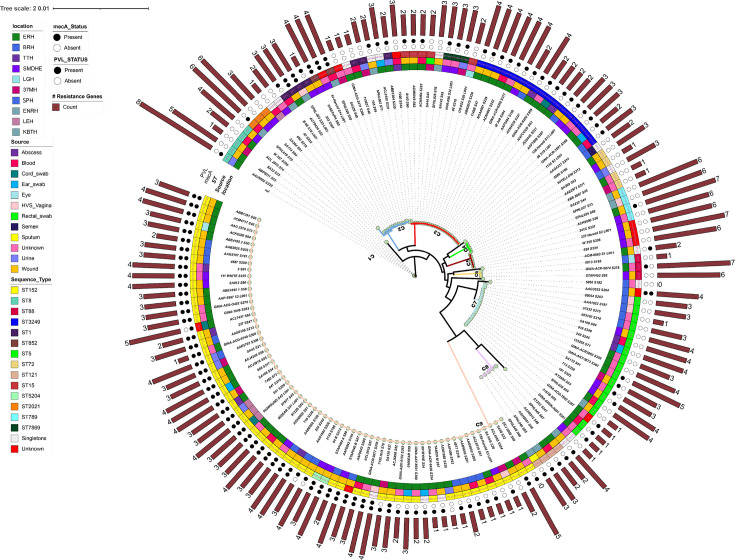
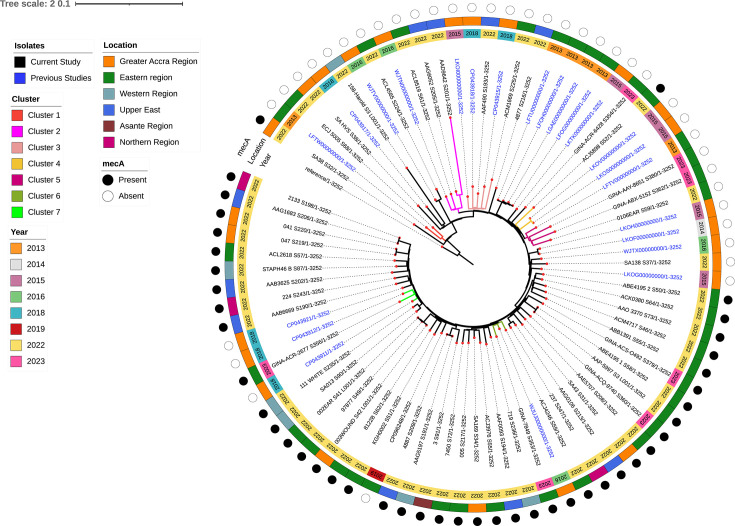
- Core-genome phylogeny using 24,140 SNPs resolved nine clusters; the largest cluster (C9) was predominantly ST152, mostly carrying both PVL and *mecA*. Comparison with 24 prior Ghanaian ST152 genomes indicated a shift from MSSA to MRSA, with some current strains differing by <25 SNPs.
Methods
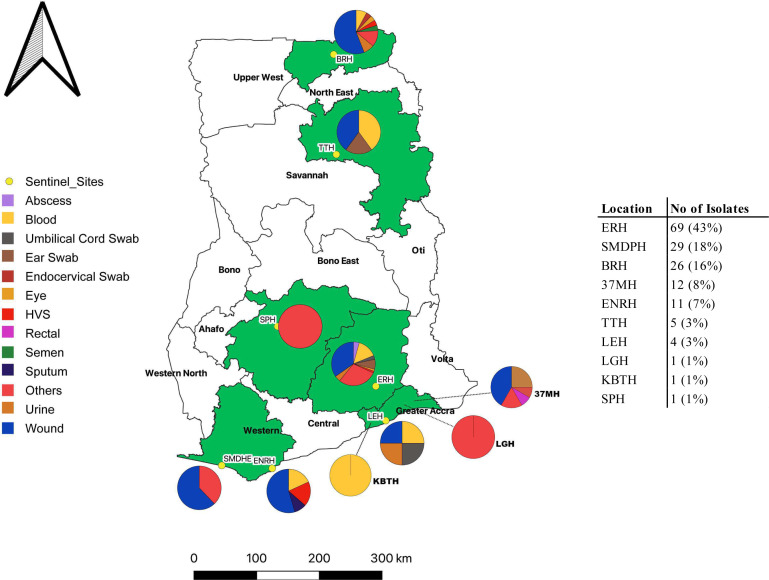
- Cross-sectional study using total enumerative sampling of 159 *S. aureus* isolates from routine clinical cultures at ten sentinel hospitals in Ghana between February 2022 and October 2023; isolates came from wound, blood, urine, ear, abscess, umbilical cord, eye, vaginal, and other samples, and were confirmed by MALDI-TOF.
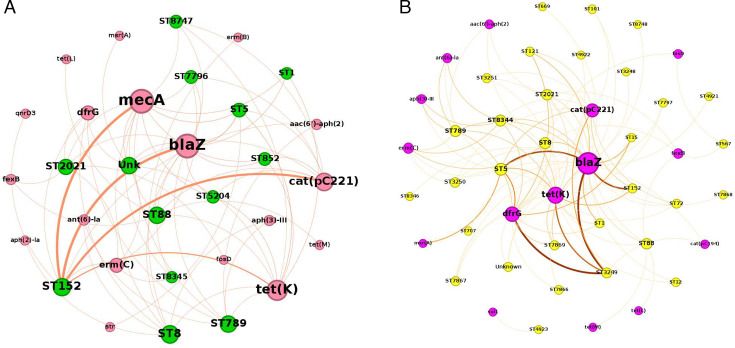
- DNA was sequenced on Illumina NextSeq 2000; bioinformatic analysis used FASTQC, Trimmomatic, Unicycler, QUAST, Kmerfinder, CARD/Resfinder, Virulencefinder/VFDB, MLST, SCC*mec*Finder, PlasmidFinder, and Mob-suite. Phylogenies were built with CSI Phylogeny/Realphy and visualized in iTOL; network analysis used Gephi.
- Comparative genomic analysis included ST152 isolates from previous Ghanaian studies (n = 24) downloaded from BV-BRC.
Limitations
- Stated limitations: Not stated in the paper; the discussion notes that a direct link between *dfrG* prevalence and co-trimoxazole prescribing patterns is not established and that the clinical impact of hemolysin genes requires further investigation.
- Evident from text: cross-sectional sampling of routine clinical submissions from ten hospitals limits population-level generalizability.
- Evident from text: the study reports WGS-derived genotypes without phenotypic antimicrobial susceptibility testing or clinical outcome data; metadata were limited to hospital laboratory records, and 38 isolates had unknown source.
Model-written summary. Check it against the paper before relying on it.
Integrity signals
Registry
Cites
Statistics
Figures
Verification
Claims the paper makes
0 Valid · 0 Not valid · 42 Not checked · 60 Own results and interpretations
A result the paper reports from its own data — it cites no other source for it, so there is none to check. The quote shows it is in the paper.
In the paper
“mecA (gene for methicillin resistance) was detected in 38% of the isolates.”
- Also stated in: § Resistome and mobile genetic elements of S. aureus isolates · plain
“Thirty-eight percent (n = 61) of the isolates were MRSAs harboring the mecA gene.”
§ Whole genome sequencing revealed high proportions of ST152 MRSA among clinical Staphylococcus aureus isolates from ten hospitals in Ghana > Abstract
plainn = 61- Asserted: passes — The authors put it forward as true.
- Checkable: passes — It can be checked against evidence.
- Load-bearing: passes — The paper’s conclusions depend on it.
- Based: passes — The paper gives a reason why it holds.
- Also stated in: § Resistome and mobile genetic elements of S. aureus isolates · plain
A result the paper reports from its own data — it cites no other source for it, so there is none to check. The quote shows it is in the paper.
In the paper
“Panton–Valentine leucocidin toxin (PVL) gene occurred in 65% isolates”
- Also stated in: § Array of virulence factors · plain
“The PVL genes lukF-PV and lukS-PV were detected in 65% (n = 103) of the isolates”
§ Whole genome sequencing revealed high proportions of ST152 MRSA among clinical Staphylococcus aureus isolates from ten hospitals in Ghana > Abstract
plainn = 103- Asserted: passes — The authors put it forward as true.
- Checkable: passes — It can be checked against evidence.
- Load-bearing: unclear — It is unclear whether the paper’s conclusions depend on it.
- Based: passes — The paper gives a reason why it holds.
- Also stated in: § Array of virulence factors · plain
A result the paper reports from its own data — it cites no other source for it, so there is none to check. The quote shows it is in the paper.
In the paper
“the aminoglycoside resistance genes aac(6')-aph(2”) and aph(3')-III showed a high correlation (r = 0.73)”
§ Whole genome sequencing revealed high proportions of ST152 MRSA among clinical Staphylococcus aureus isolates from ten hospitals in Ghana > RESULTS > Clonal diversity and resistome of S. aureus isolates
plainstates an association- Asserted: passes — The authors put it forward as true.
- Checkable: passes — It can be checked against evidence.
- Load-bearing: unclear — It is unclear whether the paper’s conclusions depend on it.
- Based: passes — The paper gives a reason why it holds.
A result the paper reports from its own data — it cites no other source for it, so there is none to check. The quote shows it is in the paper.
In the paper
“Plasmids belonging to 17 distinct replicon types were detected among the 159 S. aureus isolates.”
§ Whole genome sequencing revealed high proportions of ST152 MRSA among clinical Staphylococcus aureus isolates from ten hospitals in Ghana > RESULTS > Resistome and mobile genetic elements of S. aureus isolates
plain- Asserted: passes — The authors put it forward as true.
- Checkable: passes — It can be checked against evidence.
- Load-bearing: unclear — It is unclear whether the paper’s conclusions depend on it.
- Based: passes — The paper gives a reason why it holds.
A result the paper reports from its own data — it cites no other source for it, so there is none to check. The quote shows it is in the paper.
In the paper
“Hemolysin-encoding genes hlgA, hlgB, hla and hld were the most prevalent virulence genes (>99%).”
§ Whole genome sequencing revealed high proportions of ST152 MRSA among clinical Staphylococcus aureus isolates from ten hospitals in Ghana > DISCUSSION
plain- Asserted: passes — The authors put it forward as true.
- Checkable: passes — It can be checked against evidence.
- Load-bearing: unclear — It is unclear whether the paper’s conclusions depend on it.
- Based: passes — The paper gives a reason why it holds.
45 more claims
Create a free account to see all 102 claims and to verify the 77 references still open.
- It may state two separate claims as one. 25
- Probably not a substantial claim. 34
- The quote only partly states this claim. 1
Self-check
Percentages, sums and reported differences re-computed from the paper’s own numbers.
Rated major: it would touch a result — a value a result rests on, reported and recomputed p-values on opposite sides of the significance level, two passages that conflict with no sign which is right, or a cited work retracted before this paper was published.
In the paper
“Sequence types ST152 (36%, n = 58), ST5 (11%, n = 17), and ST3249 (11%, n = 17) were the most predominant.”
§ Whole genome sequencing revealed high proportions of ST152 MRSA among clinical Staphylococcus aureus isolates from ten hospitals in Ghana > RESULTS > Clonal diversity and resistome of S. aureus isolates
Reported 58 · recomputed 59
Rated minor: it would not touch a result — a value no result rests on, a p-value that stays on the same side of the significance level, or a conflict that is clerical, resolved elsewhere in the paper, or outside its own findings.
In the paper
“The majority of SCCmec_type_IVa(2B) isolates belonged to the ST152 sequence type (82%, n = 41)”
§ Whole genome sequencing revealed high proportions of ST152 MRSA among clinical Staphylococcus aureus isolates from ten hospitals in Ghana > RESULTS > Resistome and mobile genetic elements of S. aureus isolates
Reported 82 · recomputed 80.392157
Rated minor: it would not touch a result — a value no result rests on, a p-value that stays on the same side of the significance level, or a conflict that is clerical, resolved elsewhere in the paper, or outside its own findings.
In the paper
“The blaZ beta-lactam gene was detected in rep16 (86%, n = 106)”
§ Whole genome sequencing revealed high proportions of ST152 MRSA among clinical Staphylococcus aureus isolates from ten hospitals in Ghana > RESULTS > Resistome and mobile genetic elements of S. aureus isolates
Reported 86 · recomputed 89.07563
Rated minor: it would not touch a result — a value no result rests on, a p-value that stays on the same side of the significance level, or a conflict that is clerical, resolved elsewhere in the paper, or outside its own findings.
In the paper
“| | seb | 16 (10) | 5 (8) | 4 (22) | 1 (11) | 1 (17) | 3 (5) |”
§ Whole genome sequencing revealed high proportions of ST152 MRSA among clinical Staphylococcus aureus isolates from ten hospitals in Ghana > RESULTS > Array of virulence factors
Reported 16 · recomputed 14
Rated minor: it would not touch a result — a value no result rests on, a p-value that stays on the same side of the significance level, or a conflict that is clerical, resolved elsewhere in the paper, or outside its own findings.
In the paper
“| | sep | 15 (9) | 6 (8) | 3 (18) | - | - | 7 (13) |”
§ Whole genome sequencing revealed high proportions of ST152 MRSA among clinical Staphylococcus aureus isolates from ten hospitals in Ghana > RESULTS > Array of virulence factors
Reported 15 · recomputed 16
6 more findings
Create a free account to see every finding of this check.
Citations
Cites
Trimmomatic: a flexible trimmer for Illumina sequence data
Bolger, A. M., Lohse, M., & Usadel, B. (2014) · Bioinformatics · doi:10.1093/bioinformatics/btu170 · Cited by 65,548
QUAST: quality assessment tool for genome assemblies
Gurevich, A., Saveliev, V., Vyahhi, N., & Tesler, G. (2013) · Bioinformatics · doi:10.1093/bioinformatics/btt086 · Cited by 11,172
Interactive Tree Of Life (iTOL) v5: an online tool for phylogenetic tree display and annotation
Letunic, I., & Bork, P. (2021) · Nucleic Acids Research · doi:10.1093/nar/gkab301 · Cited by 11,124
Unicycler: Resolving bacterial genome assemblies from short and long sequencing reads
Wick, R. R., Judd, L. M., Gorrie, C. L., & Holt, K. E. (2017) · PLOS Computational Biology · doi:10.1371/journal.pcbi.1005595 · Cited by 8,653
Tacconelli, E., Carrara, E., Savoldi, A., Harbarth, S., Mendelson, M., Monnet, D. L., Pulcini, C., Kahlmeter, G., Kluytmans, J., Carmeli, Y., et al. (2018) · The Lancet Infectious Diseases · doi:10.1016/s1473-3099(17)30753-3 · Cited by 6,142
Tong, S. Y. C., Davis, J. S., Eichenberger, E., Holland, T. L., & Fowler, V. G. (2015) · Clinical Microbiology Reviews · doi:10.1128/cmr.00134-14 · Cited by 5,192
Carattoli, A., Zankari, E., García-Fernández, A., Voldby Larsen, M., Lund, O., Villa, L., Møller Aarestrup, F., & Hasman, H. (2014) · Antimicrobial Agents and Chemotherapy · doi:10.1128/aac.02412-14 · Cited by 4,877
ResFinder 4.0 for predictions of phenotypes from genotypes
Bortolaia, V., Kaas, R. S., Ruppe, E., Roberts, M. C., Schwarz, S., Cattoir, V., Philippon, A., Allesoe, R. L., Rebelo, A. R., Florensa, A. F., et al. (2020) · Journal of Antimicrobial Chemotherapy · doi:10.1093/jac/dkaa345 · Cited by 3,373
CARD 2020: Antibiotic Resistome Surveillance with the Comprehensive Antibiotic Resistance Database
Alcock, B. P., Raphenya, A. R., Lau, T. T. Y., Tsang, K. K., Bouchard, M., Edalatmand, A., Huynh, W., Nguyen, A.-L. V., Cheng, A. A., Liu, S., et al. (2019) · Nucleic Acids Research · doi:10.1093/nar/gkz935 · Cited by 3,202
Multilocus Sequence Typing of Total-Genome-Sequenced Bacteria
Larsen, M. V., Cosentino, S., Rasmussen, S., Friis, C., Hasman, H., Marvig, R. L., Jelsbak, L., Sicheritz-Pontén, T., Ussery, D. W., Aarestrup, F. M., et al. (2012) · Journal of Clinical Microbiology · doi:10.1128/jcm.06094-11 · Cited by 2,328
VFDB 2022: a general classification scheme for bacterial virulence factors
Liu, B., Zheng, D., Zhou, S., Chen, L., & Yang, J. (2022) · Nucleic Acids Research · doi:10.1093/nar/gkab1107 · Cited by 1,774
Methicillin-resistant Staphylococcus aureus
Lee, A. S., de Lencastre, H., Garau, J., Kluytmans, J., Malhotra-Kumar, S., Peschel, A., & Harbarth, S. (2018) · Nature Reviews Disease Primers · doi:10.1038/nrdp.2018.33 · Cited by 1,556
Adhesion, invasion and evasion: the many functions of the surface proteins of Staphylococcus aureus
Foster, T. J., Geoghegan, J. A., Ganesh, V. K., & Höök, M. (2014) · Nature Reviews Microbiology · doi:10.1038/nrmicro3161 · Cited by 1,533
Community-associated meticillin-resistant Staphylococcus aureus
DeLeo, F. R., Otto, M., Kreiswirth, B. N., & Chambers, H. F. (2010) · The Lancet · doi:10.1016/s0140-6736(09)61999-1 · Cited by 1,506
Joensen, K. G., Scheutz, F., Lund, O., Hasman, H., Kaas, R. S., Nielsen, E. M., & Aarestrup, F. M. (2014) · Journal of Clinical Microbiology · doi:10.1128/jcm.03617-13 · Cited by 1,409
Robertson, J., & Nash, J. H. E. (2018) · Microbial Genomics · doi:10.1099/mgen.0.000206 · Cited by 1,013
Solving the Problem of Comparing Whole Bacterial Genomes across Different Sequencing Platforms
Kaas, R. S., Leekitcharoenphon, P., Aarestrup, F. M., & Lund, O. (2014) · PLoS ONE · doi:10.1371/journal.pone.0104984 · Cited by 931
The molecular evolution of methicillin-resistant Staphylococcus aureus
Deurenberg, R. H., Vink, C., Kalenic, S., Friedrich, A. W., Bruggeman, C. A., & Stobberingh, E. E. (2007) · Clinical Microbiology and Infection · doi:10.1111/j.1469-0691.2006.01573.x · Cited by 597
Hasman, H., Saputra, D., Sicheritz-Ponten, T., Lund, O., Svendsen, C. A., Frimodt-Møller, N., & Aarestrup, F. M. (2014) · Journal of Clinical Microbiology · doi:10.1128/jcm.02452-13 · Cited by 542
Automated Reconstruction of Whole-Genome Phylogenies from Short-Sequence Reads
Bertels, F., Silander, O. K., Pachkov, M., Rainey, P. B., & van Nimwegen, E. (2014) · Molecular Biology and Evolution · doi:10.1093/molbev/msu088 · Cited by 506
Staphylococcus aureus Toxins: An Update on Their Pathogenic Properties and Potential Treatments
Ahmad-Mansour, N., Loubet, P., Pouget, C., Dunyach-Remy, C., Sotto, A., Lavigne, J.-P., & Molle, V. (2021) · Toxins · doi:10.3390/toxins13100677 · Cited by 386
The Staphylococcal Toxin Panton-Valentine Leukocidin Targets Human C5a Receptors
Spaan, A. N., Henry, T., van Rooijen, W. J. M., Perret, M., Badiou, C., Aerts, P. C., Kemmink, J., de Haas, C. J. C., van Kessel, K. P. M., Vandenesch, F., et al. (2013) · Cell Host & Microbe · doi:10.1016/j.chom.2013.04.006 · Cited by 301
Kaya, H., Hasman, H., Larsen, J., Stegger, M., Johannesen, T. B., Allesøe, R. L., Lemvigh, C. K., Aarestrup, F. M., Lund, O., & Larsen, A. R. (2018) · mSphere · doi:10.1128/msphere.00612-17 · Cited by 298
Liu, J., Chen, D., Peters, B. M., Li, L., Li, B., Xu, Z., & Shirliff, M. E. (2016) · Microbial Pathogenesis · doi:10.1016/j.micpath.2016.10.028 · Cited by 285
Evolutionary dynamics of Staphylococcus aureus during progression from carriage to disease
Young, B. C., Golubchik, T., Batty, E. M., Fung, R., Larner-Svensson, H., Votintseva, A. A., Miller, R. R., Godwin, H., Knox, K., Everitt, R. G., et al. (2012) · Proceedings of the National Academy of Sciences · doi:10.1073/pnas.1113219109 · Cited by 273
Methicillin-resistant Staphylococcus aureus: the superbug
Ippolito, G., Leone, S., Lauria, F. N., Nicastri, E., & Wenzel, R. P. (2010) · International Journal of Infectious Diseases · doi:10.1016/j.ijid.2010.05.003 · Cited by 244
Wardenburg, J. B., Palazzolo‐Ballance, A. M., Otto, M., Schneewind, O., & DeLeo, F. R. (2008) · The Journal of Infectious Diseases · doi:10.1086/592053 · Cited by 236
Montgomery, C. P., Boyle‐Vavra, S., Adem, P. V., Lee, J. C., Husain, A. N., Clasen, J., & Daum, R. S. (2008) · The Journal of Infectious Diseases · doi:10.1086/590157 · Cited by 212
Tackling the threat of antimicrobial resistance: from policy to sustainable action
Shallcross, L. J., Howard, S. J., Fowler, T., & Davies, S. C. (2015) · Philosophical Transactions of the Royal Society B: Biological Sciences · doi:10.1098/rstb.2014.0082 · Cited by 196
New epidemiology of Staphylococcus aureus infection in Africa
Schaumburg, F., Alabi, A. S., Peters, G., & Becker, K. (2014) · Clinical Microbiology and Infection · doi:10.1111/1469-0691.12690 · Cited by 174
Coll, F., Raven, K. E., Knight, G. M., Blane, B., Harrison, E. M., Leek, D., Enoch, D. A., Brown, N. M., Parkhill, J., & Peacock, S. J. (2020) · The Lancet Microbe · doi:10.1016/s2666-5247(20)30149-x · Cited by 168
Resistance to antimicrobial drugs in Ghana
Donkor, E., & Newman, M. (2011) · Infection and Drug Resistance · doi:10.2147/idr.s21769 · Cited by 164
Gündoğan, N., Çıtak, S., Yücel, N., & Devren, A. (2004) · Meat Science · doi:10.1016/j.meatsci.2004.10.011 · Cited by 156
Perforation risk in pediatric appendicitis: assessment and management
Howell, E. C., Dubina, E. D., & Lee, S. L. (2018) · Pediatric Health Medicine and Therapeutics · doi:10.2147/phmt.s155302 · Cited by 142
Susceptibility patterns of Staphylococcus aureus biofilms in diabetic foot infections
Mottola, C., Matias, C. S., Mendes, J. J., Melo-Cristino, J., Tavares, L., Cavaco-Silva, P., & Oliveira, M. (2016) · BMC Microbiology · doi:10.1186/s12866-016-0737-0 · Cited by 118
Egyir, B., Guardabassi, L., Sørum, M., Nielsen, S. S., Kolekang, A., Frimpong, E., Addo, K. K., Newman, M. J., & Larsen, A. R. (2014) · PLoS ONE · doi:10.1371/journal.pone.0089716 · Cited by 108
Self-citationGoudarzi, M., Seyedjavadi, S. S., Nasiri, M. J., Goudarzi, H., Nia, R. S. S., & Dabiri, H. (2017) · Microbial Pathogenesis · doi:10.1016/j.micpath.2017.01.055 · Cited by 101
Kumar, R., Yadav, B. R., & Singh, R. S. (2010) · Current Microbiology · doi:10.1007/s00284-009-9553-1 · Cited by 83
Tabor, D. E., Yu, L., Mok, H., Tkaczyk, C., Sellman, B. R., Wu, Y., Oganesyan, V., Slidel, T. W. F., Jafri, H. S., McCarthy, M., et al. (2016) · Antimicrobial Agents and Chemotherapy · doi:10.1128/aac.00357-16 · Cited by 68
Population Structure of Staphylococcus aureus from Remote African Babongo Pygmies
Schaumburg, F., Köck, R., Friedrich, A. W., Soulanoudjingar, S., Ngoa, U. A., von Eiff, C., Issifou, S., Kremsner, P. G., Herrmann, M., Peters, G., et al. (2011) · PLoS Neglected Tropical Diseases · doi:10.1371/journal.pntd.0001150 · Cited by 62
Epidemiology of Staphylococcus aureus in Pigs and Farmers in the Largest Farm in Dakar, Senegal
Fall, C., Seck, A., Richard, V., Ndour, M., Sembène, M., Laurent, F. J., & Breurec, S. (2012) · Foodborne Pathogens and Disease · doi:10.1089/fpd.2012.1197 · Cited by 62
Nasal Carriage of Staphylococcus aureus among Children in the Ashanti Region of Ghana
Eibach, D., Nagel, M., Hogan, B., Azuure, C., Krumkamp, R., Dekker, D. M., Gajdiss, M., Brunke, M., Sarpong, N., Owusu‐Dabo, E., et al. (2017) · PLoS ONE · doi:10.1371/journal.pone.0170320 · Cited by 59
Arêde, P., Ministro, J., & Oliveira, D. C. (2013) · Antimicrobial Agents and Chemotherapy · doi:10.1128/aac.02621-12 · Cited by 44
Ahmad, N., Ruzan, I. N., Abd Ghani, M. K., Hussin, A., Nawi, S., Aziz, M. N., Maning, N., & Eow, V. L. K. (2009) · Journal of Medical Microbiology · doi:10.1099/jmm.0.011353-0 · Cited by 42
Egyir, B., Guardabassi, L., Nielsen, S. S., Larsen, J., Addo, K. K., Newman, M. J., & Larsen, A. R. (2013) · Journal of Global Antimicrobial Resistance · doi:10.1016/j.jgar.2013.05.006 · Cited by 42
Self-citationAchek, R., Hotzel, H., Cantekin, Z., Nabi, I., Hamdi, T. M., Neubauer, H., & El‐Adawy, H. (2018) · BMC Research Notes · doi:10.1186/s13104-018-3762-2 · Cited by 41
Dekker, D., Wolters, M., Mertens, E., Boahen, K. G., Krumkamp, R., Eibach, D., Schwarz, N. G., Adu-Sarkodie, Y., Rohde, H., Christner, M., et al. (2016) · BMC Infectious Diseases · doi:10.1186/s12879-016-2048-3 · Cited by 40
Aung, M. S., Urushibara, N., Kawaguchiya, M., Sumi, A., Shinagawa, M., Takahashi, S., & Kobayashi, N. (2019) · Microbial Drug Resistance · doi:10.1089/mdr.2018.0468 · Cited by 39
A genomic infection control study for Staphylococcus aureus in two Ghanaian hospitals
Donkor, E. S., Jamrozy, D., Mills, R. O., Dankwah, T., Amoo, P., Egyir, B., Badoe, E., Twasam, J., & Bentley, S. (2018) · Infection and Drug Resistance · doi:10.2147/idr.s167639 · Cited by 37
Self-citationFooladvand, S., Sarmadian, H., Habibi, D., van Belkum, A., & Ghaznavi‐Rad, E. (2018) · European Journal of Clinical Microbiology & Infectious Diseases · doi:10.1007/s10096-018-3398-0 · Cited by 36
Bitrus, A. A., Zunita, Z., Bejo, S. K., Othman, S. S., & Nadzir, N. A. A. (2017) · BMC Microbiology · doi:10.1186/s12866-017-0994-6 · Cited by 34
Egyir, B., Obeng‐Nkrumah, N., & Kyei, G. B. (2020) · African Journal of Laboratory Medicine · doi:10.4102/ajlm.v9i1.1302 · Cited by 32
Self-citationKlein, S., Hannesen, J., Zanger, P., Heeg, K., Boutin, S., & Nurjadi, D. (2020) · Scientific Reports · doi:10.1038/s41598-020-70112-z · Cited by 32
Okiki, P. A., Eromosele, E. S., Adeojo, P. I., Sobajo, O. A., Idris, O. O., & Agbana, R. D. (2020) · New Microbes and New Infections · doi:10.1016/j.nmni.2020.100772 · Cited by 31
Anafo, R. B., Atiase, Y., Dayie, N. T. K. D., Kotey, F. C. N., Tetteh‐Quarcoo, P. B., Duodu, S., Osei, M., Alzahrani, K. J., & Donkor, E. S. (2021) · Pathogens · doi:10.3390/pathogens10080937 · Cited by 30
Virulence potential of Staphylococcus aureus isolates from Buruli ulcer patients
Amissah, N. A., Chlebowicz, M. A., Ablordey, A. S., Tetteh, C. S., Prah, I., van der Werf, T. S., Friedrich, A. W., van Dijl, J. M., Stienstra, Y., & Rossen, J. W. A. (2017) · International Journal of Medical Microbiology · doi:10.1016/j.ijmm.2017.04.002 · Cited by 28
Hoppe, P.-A., Hanitsch, L. G., Leistner, R., Niebank, M., Bührer, C., von Bernuth, H., & Krüger, R. (2018) · BMC Infectious Diseases · doi:10.1186/s12879-018-3281-8 · Cited by 26
Hamada, M., Yamaguchi, T., Sato, A., Ono, D., Aoki, K., Kajiwara, C., Kimura, S., Maeda, T., Sasaki, M., Murakami, H., et al. (2021) · Frontiers in Cellular and Infection Microbiology · doi:10.3389/fcimb.2021.602833 · Cited by 26
Egyir, B., Hadjirin, N. F., Gupta, S., Owusu, F., Agbodzi, B., Adogla-Bessa, T., Addo, K. K., Stegger, M., Larsen, A. R., & Holmes, M. A. (2020) · Journal of Global Antimicrobial Resistance · doi:10.1016/j.jgar.2020.03.029 · Cited by 24
Self-citationWolters, M., Frickmann, H., Christner, M., Both, A., Rohde, H., Oppong, K., Akenten, C. W., May, J., & Dekker, D. M. (2020) · Microorganisms · doi:10.3390/microorganisms8122052 · Cited by 23
Karimi-Dehkordi, M., Shamsabadi, M. G., & BaniMehdi, P. (2019) · PubMed · doi:10.7416/ai.2019.2289 · Cited by 23
Bastos, C. P., Bassani, M. T., Mata, M. M., Lopes, G. V., & da Silva, W. P. (2017) · Canadian Journal of Microbiology · doi:10.1139/cjm-2017-0316 · Cited by 20
Owusu, E., Adjei, H., & Afutu, E. (2022) · Diseases · doi:10.3390/diseases10040124 · Cited by 19
Poilvache, H., Ruiz-Sorribas, A., Sakoulas, G., Rodriguez‐Villalobos, H., Cornu, O., & Bambeke, F. V. (2020) · Frontiers in Medicine · doi:10.3389/fmed.2020.00527 · Cited by 19
Leistner, R., Kola, A., Gastmeier, P., Krüger, R., Hoppe, P.-A., Schneider‐Burrus, S., Zuschneid, I., Wischnewski, N., Bender, J. K., Layer, F., et al. (2017) · PLoS ONE · doi:10.1371/journal.pone.0189961 · Cited by 18
Kong, H., Fang, L., RuJin, J., & Tong, J. (2018) · Infection and Drug Resistance · doi:10.2147/idr.s153399 · Cited by 17
Amissah, N. A., Buultjens, A. H., Ablordey, A., van Dam, L., Opoku-Ware, A., Baines, S. L., Bulach, D., Tetteh, C. S., Prah, I., van der Werf, T. S., et al. (2017) · Frontiers in Microbiology · doi:10.3389/fmicb.2017.01906 · Cited by 17
Jauneikaite, E., Ferguson, T., Mosavie, M., Fallowfield, J. L., Davey, T., Thorpe, N., Allsopp, A., Shaw, A. M., Fudge, D., O'Shea, M. K., et al. (2020) · Clinical Microbiology and Infection · doi:10.1016/j.cmi.2019.07.014 · Cited by 17
Odonkor, S. T., Newman, M. J., & Addo, K. K. (2012) · Microbiology Research · doi:10.4081/mr.2012.e20 · Cited by 16
Egyir, B., Bentum, J., Attram, N., Fox, A., Obeng-Nkrumah, N., Appiah-Korang, L., Behene, E., Kumordjie, S., Yeboah, C., Agbodzi, B., et al. (2021) · Pathogens · doi:10.3390/pathogens10020196 · Cited by 13
Self-citationCongilosi, J. L., Wallace, J. S., Neher, T. P., Howe, A., Soupir, M. L., & Aga, D. S. (2022) · Frontiers in Environmental Science · doi:10.3389/fenvs.2022.1018739 · Cited by 13
Yamuna, D. B., Francis, Y. I., Doss, C. G. P., & Veeraraghavan, B. (2017) · New Microbes and New Infections · doi:10.1016/j.nmni.2017.08.005 · Cited by 12
Rapid plasmid replicon typing by real time PCR melting curve analysis
Boot, M., Raadsen, S., Savelkoul, P. H., & Vandenbroucke-Grauls, C. (2013) · BMC Microbiology · doi:10.1186/1471-2180-13-83 · Cited by 9
Schaumburg, F., Witten, A., Flamen, A., Stoll, M., Alabi, A. S., Kremsner, P. G., Löffler, B., Zipfel, P. F., Velavan, T. P., & Peters, G. (2019) · Clinical Infectious Diseases · doi:10.1093/cid/ciy666 · Cited by 8
Malaria, sickle cell disease, HIV, and co-trimoxazole prophylaxis: An observational study
Owusu, E. D. A., Cofie, N. S. A., Nai, E. A., Klipstein‐Grobusch, K., Brown, C. A., Mens, P. F., & Grobusch, M. P. (2018) · International Journal of Infectious Diseases · doi:10.1016/j.ijid.2018.01.031 · Cited by 6
Ahmed, O. B. (2020) · Cureus · doi:10.7759/cureus.12289 · Cited by 5
Association between SCCmec types and antimicrobial resistance in clinical MRSA isolates
Rezk, S., Roufaeil, M., Kader, O., & Aboulela, A. (2022) · Microbes and Infectious Diseases · doi:10.21608/mid.2022.155995.1367 · Cited by 2
Li, Y. (2015) · JOURNAL OF CLINICAL AND DIAGNOSTIC RESEARCH · doi:10.7860/jcdr/2015/12090.5990 · Cited by 2
Cited by
Fenta, M. D., Bitew, A. B., Wondu, B., Abey, S. L., Mengistu, B. A., Kinde, M. Z., Getnet, K., Demessie, Y., Mekasha, Y. T., Feleke, M. G., et al. (2025) · One Health · doi:10.1016/j.onehlt.2025.101229 · Cited by 18
SeqAfrica: empowering Africa’s fight against antimicrobial resistance through genomics
Nilsson, P., Gibson, C. T., Thornval, N. R., Lacy-Roberts, N., Odgaard, C., Owusu-Nyantakyi, C., Amuasi, G. R., Boateng, W., Mohktar, Q., Bortey, A., et al. (2025) · Frontiers in Public Health · doi:10.3389/fpubh.2025.1716498 · Cited by 16
Self-citationAlhejaili, A. Y., Zhou, G., Halawa, H., Huang, J., Fallatah, O., Hirayban, R., Iftikhar, S., AlAsmari, A., Milner, M., Banzhaf, M., et al. (2025) · Frontiers in Microbiology · doi:10.3389/fmicb.2025.1602985 · Cited by 13
Genomic insights into antimicrobial resistance in Africa: a one health scoping review (2015–2025)
Matee, M. I. (2026) · Bulletin of the National Research Centre/Bulletin of the National Research Center · doi:10.1186/s42269-026-01421-y · Cited by 6
Staphylococcus aureus transcriptomics and single-cell sequencing approaches
Małachowa, N., & DeLeo, F. R. (2025) · Infection and Immunity · doi:10.1128/iai.00411-25 · Cited by 3
Metadata
- Authors
- Egyir, B., Owusu-Nyantakyi, C., Bortey, A., Rabbi Amuasi, G., Owusu, F. A., Boateng, W., Ahmed, H., Danso, J. K., Oclu, A. A. G., Mohktar, Q., Tetteh-Ocloo, G., Amegbletor, H., Fosu, K., Tetteh, F. K. M., Asante-Sefa, S., Deberu, O. N., Osei, K. M., Twasam, J., Kodom, S., Gyinae, E., Sampah, J., Dzifa Dayie, N., Obeng-Nkrumah, N., Mills-Pappoe, W. A., Boateng, G., Nilsson, P., Bonful, H. A., Adu, B., & Hendriksen, R. S.
- Affiliations
- University of Ghana (GH)
- Department of Bacteriology, Noguchi Memorial Institute for Medical Research, University of Ghana
- Eastern Regional Hospital
- St. Martin de Porress Hospital
- Bolgatanga Regional Hospital
- 37 Military Hospital (GH)
- Ghana Health Service (GH)
- Tamale Teaching Hospital (GH)
- Lekma Hospital
- Korle Bu Teaching Hospital (GH)
- St. Patrick’s Hospital
- Department of Medical Microbiology, University of Ghana Medical School
- Department of Medical Laboratory Sciences, School of Biomedical and Allied Health Sciences, University of Ghana
- Public Health Reference Lab
- Technical University of Denmark (DK)
- Corresponding author
- Egyir, Beverly
- ORCID
- Venue
- mSphere
- Publisher
- American Society for Microbiology
- Published
- 2024-12-19
- Volume
- 9
- Issue
- 12
- Pages
- e0044624-e0044624
- ISSN
- 2379-5042 (ISSN-L)
- PMC
- PMC11656792
- OpenAlex
- W4404536292
- Cited by
- 17
- References
- 78
- Citations by year
- 2026: 8 · 2025: 9
- FWCI
- 4.29
- Type
- journal article
- Language
- en
- Open access
- gold
- doi.org
- Licence
- cc-by
- creativecommons.org/licenses/by/4.0/ (vor)
- journals.asm.org/non-commercial-tdm-license (tdm)
- Locations
- mSphere (publishedVersion, cc-by)
- PubMed Central (publishedVersion, cc-by)
- PubMed (publishedVersion)
- DOAJ (DOAJ: Directory of Open Access Journals) (submittedVersion)
- Technical University of Denmark, DTU Orbit (Technical University of Denmark, DTU) (submittedVersion, cc-by)
- Funders
- Department of Health and Social Care
- Topics
- Health Sciences › Medicine › Infectious Diseases › Antimicrobial Resistance in Staphylococcus
- Health Sciences › Medicine › Microbiology (medical) › Antibiotic Resistance in Bacteria
- Health Sciences › Medicine › Infectious Diseases › Antibiotic Use and Resistance
- Keywords
- methicillin-resistant Staphylococcus aureus, ST152, Staphylococcus aureus, molecular epidemiology, mecA gene, Panton-Valentine leukocidin, antimicrobial resistance genes, virulence genes, epidemic clones, clinical isolates, Ghana, phylogenetic analysis, surveillance (medicine), tetK, cats, blaZ
- MeSH terms
- Whole Genome Sequencing, Anti-Bacterial Agents, Bacterial Proteins, Bacterial Toxins, Exotoxins, Genotype, Ghana, Hospitals, Humans, Leukocidins, Microbial Sensitivity Tests, Staphylococcal Infections, Staphylococcus aureus, Genome, Bacterial, Drug Resistance, Multiple, Bacterial, Virulence Factors, Methicillin-Resistant Staphylococcus aureus
About these checks
Registry, retraction, Cites and statistics results are computed, not judged, with one exception: a printed reference that no index lists is read once by a model before it counts as a citation error. Claims are extracted by a model and kept only when their quote appears verbatim in the text; each cited source is then checked, with a model’s help, for whether it says what the claim relies on. Those verdicts can be wrong — read the claim’s quote and the cited source before relying on one.
A language model drew the claims from the paper on 2026-11-23, under version 3 of the claim definition (model deepseek-v4.1-flash, prompt extract-v3).
A second model labelled each claim on 2026-11-23 (model jev-1.13-20260917, definition revision gold-guideline-v0.2).
Statistics and arithmetic are recomputed, not judged.
Confidence bands are shown only for fields calibrated on our annotated test set. None is calibrated yet, so no band is shown.
What counts as a claim ›How we measure confidence ›How we check this ›
Are you an author, or do you see a problem with this page? Request a review
Data sources
Bibliographic data: Semantic Scholar, OpenAlex, Crossref.
Contains information from the Semantic Scholar Academic Graph Datasets, made available under the ODC Attribution License (ODC-BY 1.0).
Semantic Scholar’s data is described in: Kinney, R., et al. (2023). The Semantic Scholar Open Data Platform. arXiv:2301.10140.
