

Dose-response association of screen time-based sedentary behaviour in children and adolescents and depression: a meta-analysis of observational studies
Open accessThe DOI matches its Crossref record; 75 of the 77 references it cites were found in a registry or an index.
Abstract
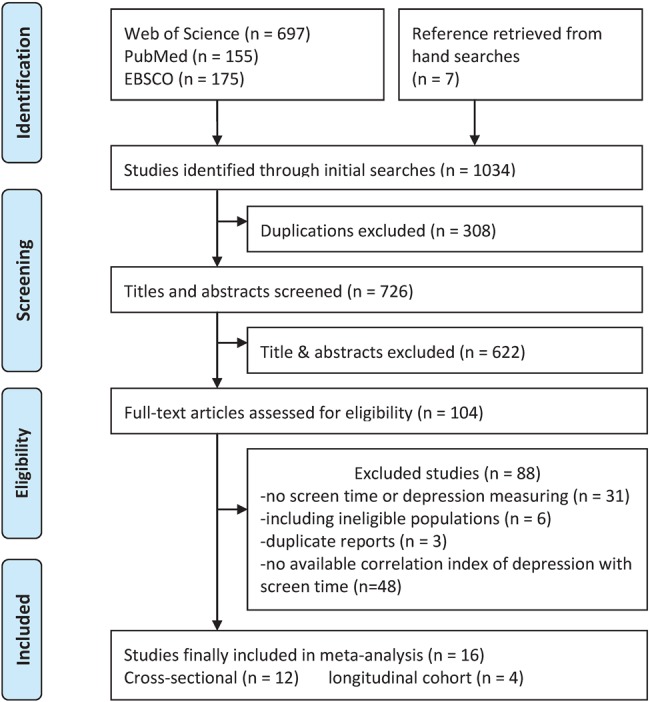
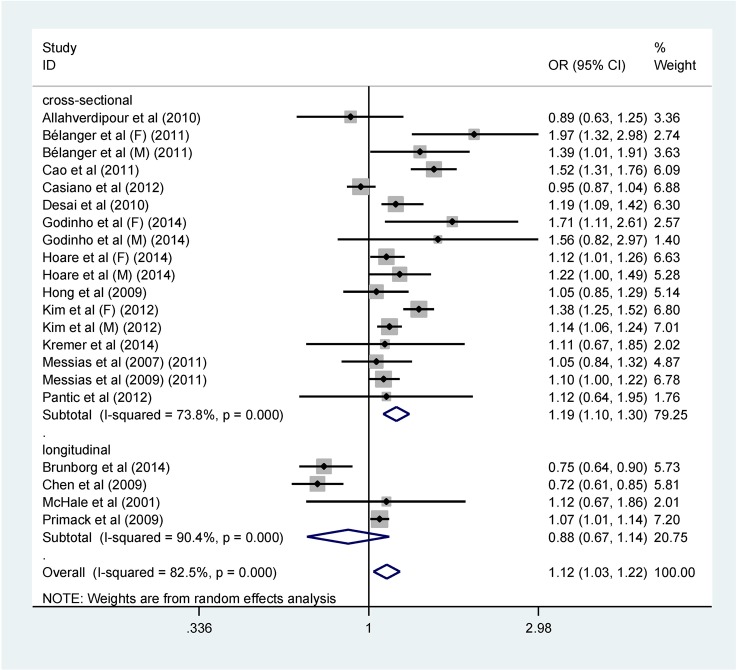
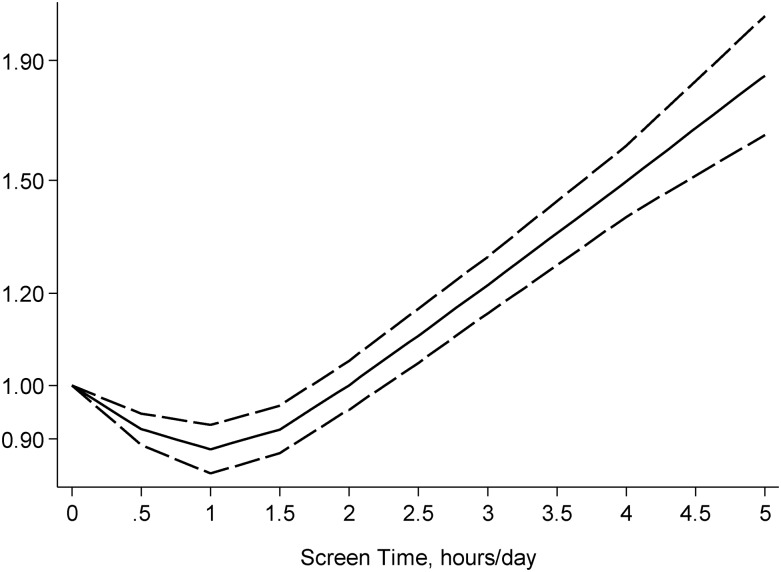
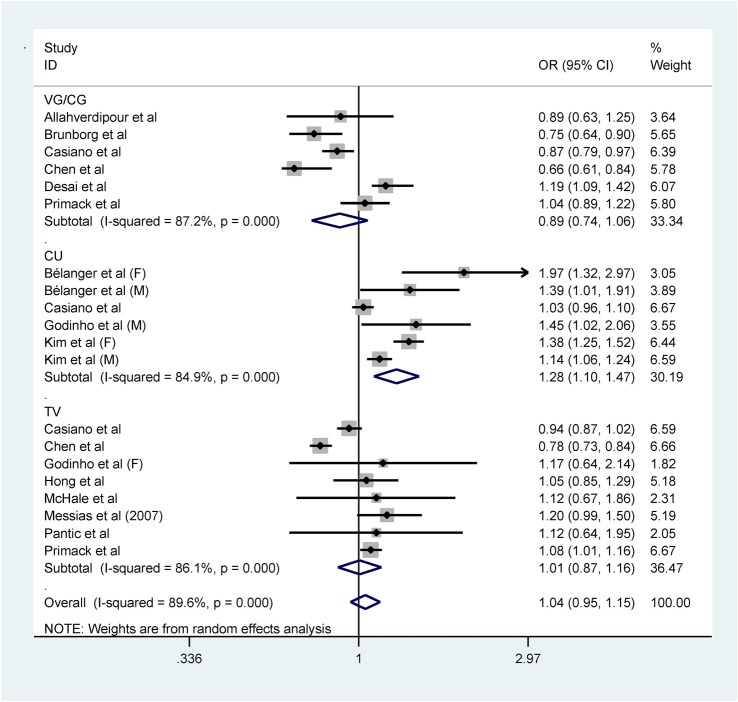
Background: Depression represents a growing public health burden. Understanding how screen time (ST) in juveniles may be associated with risk of depression is critical for the development of prevention and intervention strategies. Findings from studies addressing this question thus far have been inconsistent. Therefore, we conducted a comprehensive systematic review and meta-analysis of data related to this question. Methods: The meta-analysis was conducted in accordance with the PRISMA guideline. We searched the electronic databases of PubMed, Web of Science and EBSCO systematically (up to 6 May 2015). OR was adopted as the pooled measurement of association between ST and depression risk. Dose–response was estimated by a generalised least squares trend estimation. Results: Twelve cross-sectional studies and four longitudinal studies (including 1 cohort study) involving a total of 127 714 participants were included. Overall, higher ST in preadolescent children and adolescents was significantly associated with a higher risk of depression (OR=1.12; 95% CI 1.03 to 1.22). Screen type, age, population and reference category acted as significant moderators. Compared with the reference group who had no ST, there was a non-linear dose–response association of ST with a decreasing risk of depression at ST<2 h/day, with the lowest risk being observed for 1 h/day (OR=0.88; 95% CI 0.84 to 0.93). Conclusions: Our meta-analysis suggests that ST in children and adolescents is associated with depression risk in a non-linear dose–response manner.
Overview
The claims and statistics of this paper haven’t been checked yet.
Free: it reads the open-access text and checks the first 5 claims that cite a source we can check. Create a free account to check every claim.
Integrity signals
Registry
Cites
Statistics
Figures
Verification
Claims the paper makes
The claims and statistics of this paper haven’t been checked yet.
Free: it reads the open-access text and checks the first 5 claims that cite a source we can check. Create a free account to check every claim.
Claims other papers make about this one
Each is checked against this paper’s own text: does it say what the citing paper says it does?
The cited source says what the claim attributes to it.
In the citing paper
“More screen time has been associated with depressive symptoms among children and adolescents in several systematic reviews [11, 12, 43–50].”
From Screen time and mental health: a prospective analysis of the Adolescent Brain Cognitive Development (ABCD) Study (2024) · cites this paper as [50]
The cited source says what the claim attributes to it.
In the citing paper
“However, the presence of a cross-sectional association found in this and several previous studies [38] conveys no information about the temporal sequence of the 2 processes or the underlying mechanisms of the association, therefore potential explanations remain speculative.”
From Social Media and Mental Health Among Early Adolescents in Sweden: A Longitudinal Study With 2-Year Follow-Up (KUPOL Study). (2021) · cites this paper as [38]
The check wasn’t confident either way, so it gives no verdict — never disputed.
In the citing paper
“Most previous studies did not distinguish these 2 levels of associations, which might explain the reports of social media use being associated with depressive symptoms [38].”
From Social Media and Mental Health Among Early Adolescents in Sweden: A Longitudinal Study With 2-Year Follow-Up (KUPOL Study). (2021) · cites this paper as [38]
Experimental — accuracy not yet measuredIn the citing paper
“and depression [4,5]”
From Using Wearable Cameras to Categorize the Type and Context of Screen-Based Behaviors Among Adolescents: Observational Study (2022) · cites this paper as [5]
Self-check
Percentages, sums and reported differences re-computed from the paper’s own numbers.
The self-check needs the paper’s full text.
Citations
Cites
Preferred Reporting Items for Systematic Reviews and Meta-Analyses: the PRISMA statement
Moher, D., Liberati, A., Tetzlaff, J., Altman, D. G., & for the PRISMA Group (2009) · BMJ · doi:10.1136/bmj.b2535 · Cited by 83,823
Preferred Reporting Items for Systematic Reviews and Meta-Analyses: The PRISMA Statement
Moher, D., Liberati, A., Tetzlaff, J., Altman, D. G., & The PRISMA Group (2009) · PLoS Medicine · doi:10.1371/journal.pmed.1000097 · Cited by 64,042
Bias in meta-analysis detected by a simple, graphical test
Egger, M., Smith, G. D., Schneider, M., & Minder, C. (1997) · BMJ · doi:10.1136/bmj.315.7109.629 · Cited by 56,722
The CES-D Scale: A Self-Report Depression Scale for Research in the General Population
Radloff, L. S. (1977) · Applied Psychological Measurement · doi:10.1177/014662167700100306 · Cited by 53,267
Preferred reporting items for systematic reviews and meta-analyses: the PRISMA Statement.
(2009) · PubMed Central · Cited by 44,859
An inventory for measuring depression
BECK, A. T. (1961) · Archives of General Psychiatry · doi:10.1001/archpsyc.1961.01710120031004 · Cited by 38,032
Dermyshi, E., Wang, Y., Yan, C., Hong, W., Qiu, G., Gong, X., & Zhang, T. (2017) · Neonatology · doi:10.1159/000454668 · Cited by 24,451
von Elm, E., Altman, D. G., Egger, M., Pocock, S. J., Gøtzsche, P. C., Vandenbroucke, J. P., & Initiative, F. T. S. (2007) · PLoS Medicine · doi:10.1371/journal.pmed.0040296 · Cited by 23,020
Meta-analysis of Observational Studies in Epidemiology<SUBTITLE>A Proposal for Reporting</SUBTITLE>
Stroup, D. F. (2000) · JAMA · doi:10.1001/jama.283.15.2008 · Cited by 20,623
Wang, G., Ma, R., Qiao, G., Wada, K., Aizawa, Y., & Satoh, T. (2015) · Integrative Medicine International · doi:10.1159/000368408 · Cited by 18,657
Cited by
Items 301–364 of 364
WILFRED, M. K. H., Devanthini, D. G., Wee, L. H., Poh, B. K., & Talib, R. A. (2019) · Jurnal Sains Kesihatan Malaysia · doi:10.17576/jskm-2019-17si-18 · Cited by 2
“Sebaliknya, kanak-kanak yang kurang menjalankan aktiviti fizikal, maka kesan yang negatif juga timbul akibat daripada aktiviti sedentari seperti masa skrin yang berlebihan (Carson et al. 2016; Liu et al. 2016).”
BackgroundAnalysis of the Prevalence of Computer Gaming Addiction among Teenage Students in the Metropolis
Цодикова, О. А., & Гарбар, Е. Б. (2020) · Педиатрия Восточная Европа · doi:10.34883/pi.2020.8.2.005
Beesdo‐Baum, K. (2020) · Faculty Opinions – Post-Publication Peer Review of the Biomedical Literature · doi:10.3410/f.738680951.793580928
Bui, C., Lin, L.-Y., Lin, C.-J., Chiu, Y.-W., & Chiou, H.-Y. (2022) · Research Square · doi:10.21203/rs.3.rs-1600016/v1
Screen adaptation theory for humans
Lortie, C. J. (2022) · Ideas in Ecology and Evolution · doi:10.24908/iee.2022.15.2.e
Park, S., Yun, D.-H., & Kim, S. (2022) · 한국여성체육학회지 · doi:10.16915/jkapesgw.2022.3.36.2.91
Slussareff, M., & Lukavská, K. (2021) · Psychiatrie pro praxi · doi:10.36290/psy.2021.039
Child Mental Health in the Milieu of Online Education
Reddy, K. J., Nataraj, B. M., & Pant, S. (2022) · Springer eBooks · doi:10.1007/978-981-16-9820-0_21
A Longitudinal Study on the Effects of Parental Mental Health and Handheld Devices on Child Outcomes
Bui, N. H., Cruickshank, M., McAloon, J., & Maguire, J. M. (2022) · Humanities and Social Sciences · doi:10.11648/j.hss.20221003.17 · Cited by 2
Amid Covid-19: The Rise of Gaming Addiction
Kahar, N. F. A., Sabri, F., Hamid, H. A., Dali, N. R. S. M., & Bakar, A. A. (2023) · International Journal of Academic Research in Business and Social Sciences · doi:10.6007/ijarbss/v13-i5/14834 · Cited by 1
Mahmud, J. U., Ali, M. F., Siddique, A. B., & Hossain, M. N. (2023) · Annals of International medical and Dental Research · doi:10.53339/aimdr.2023.9.4.9
Saha, S. K., Chakrabarti, S., Mishra, A., Mondal, A., Mandal, M., & Basu, M. (2024) · Asian Journal of Medical Sciences · doi:10.3126/ajms.v15i1.57442 · Cited by 2
“The previous many studies documented and confirmed an U-shaped relation between screen time and mental health, 40-42 which increased the risk of depressive symptoms in groups with high screen time but conversely had a positive effect in groups with low or moderate screen time levels.”
ResultThe Influence of Online Social Groups on Adolescents’ Self-Esteem and Academic Performance in China
Zhang, A., He, M., Fu, D., & Tang, X. (2023) · Studies in Psychological Science · doi:10.56397/sps.2023.12.04
Haddad, M. E., Hecker, I., Wallez, S., et al. (2023) · Cambridge Prisms Global Mental Health · doi:10.1017/gmh.2024.2.pr11
Haddad, M. E., Hecker, I., Wallez, S., et al. (2023) · Cambridge Prisms Global Mental Health · doi:10.1017/gmh.2024.2.pr12
Haddad, M. E., Hecker, I., Wallez, S., et al. (2023) · Cambridge Prisms Global Mental Health · doi:10.1017/gmh.2024.2.pr13
Mary‐Krause, M. (2023) · Cambridge Prisms Global Mental Health · doi:10.1017/gmh.2024.2.pr10
Haddad, M. E., Hecker, I., Wallez, S., et al. (2023) · Cambridge Prisms Global Mental Health · doi:10.1017/gmh.2024.2.pr9
Haddad, M. E., Hecker, I., Wallez, S., et al. (2023) · Cambridge Prisms Global Mental Health · doi:10.1017/gmh.2024.2.pr8
Haddad, M. E., Hecker, I., Wallez, S., et al. (2023) · Cambridge Prisms Global Mental Health · doi:10.1017/gmh.2024.2.pr7
Mary‐Krause, M. (2023) · Cambridge Prisms Global Mental Health · doi:10.1017/gmh.2024.2.pr6
Haddad, M. E., Hecker, I., Wallez, S., et al. (2023) · Cambridge Prisms Global Mental Health · doi:10.1017/gmh.2024.2.pr5
Haddad, M. E., Hecker, I., Wallez, S., et al. (2023) · Cambridge Prisms Global Mental Health · doi:10.1017/gmh.2024.2.pr4
Haddad, M. E., Hecker, I., Wallez, S., et al. (2023) · Cambridge Prisms Global Mental Health · doi:10.1017/gmh.2024.2.pr3
Haddad, M. E., Hecker, I., Wallez, S., et al. (2023) · Cambridge Prisms Global Mental Health · doi:10.1017/gmh.2024.2.pr2
Mary‐Krause, M. (2023) · Cambridge Prisms Global Mental Health · doi:10.1017/gmh.2024.2.pr1
Is socio-economic status a priviledge anymore? A new explanation of this question
Coşkun, K., Kara, C., & Coskun, M. (2024) · SN Social Sciences · doi:10.1007/s43545-024-00902-z
“Screen time is associated with behavioural problems and ADHD-related behaviours (Gentile et al. 2012; Huber et al. 2018; Nikkelen et al. 2014; Liu et al. 2016).”
gao, L., & Gao, J. (2024) · SSRN Electronic Journal · doi:10.2139/ssrn.4848193
Predictors of Screen Media Use among Children Aged 3 - 13
Dwairej, D. A., Alfarajat, E. M., & Dwairej, L. A. (2025) · Open Journal of Nursing · doi:10.4236/ojn.2025.151009
Impact of television on children: An umbrella review
Amalakanti, S., Avula, V. C. R., & Jillella, J. P. (2025) · Adesh University Journal of Medical Sciences & Research · doi:10.25259/aujmsr_54_2023
Genetic predisposition to digital device use and the risk of five psychiatric disorders
Liu, Q., & Zhang, Z. (2025) · Frontiers in Psychiatry · doi:10.3389/fpsyt.2025.1463212
Temporal trend of sedentary behavior in adolescents: A 10-year analysis
Bezerra, J., Lima, R. A., Cantieri, F. P., Tassitano, R. M., Júnior, J. C. D. F., de Barros, M. V. G., & Soares, F. C. (2025) · Ciência & Saúde Coletiva · doi:10.1590/1413-812320242911.16342023
Physical activity and brain health: a systematic review of Mendelian Randomization studiesPreprint
Túnez, A., van de Weijer, M. P., Firth, J., Verweij, K. J. H., & Treur, J. L. (2025) · medRxiv · doi:10.1101/2025.06.23.25330111
“In summary, many questions remain on the extent to which effects of PA vary across the type and setting [26].”
Maddox, M. A., Walsh, R. F. L., Smith, L. T., Olino, T. M., Zee, P. C., Nusslock, R., & Alloy, L. B. (2025) · Journal of Youth and Adolescence · doi:10.1007/s10964-025-02224-6 · Cited by 2
“Speci fi - cally, people at risk for and diagnosed with a major depressive disorder often endorse both a blunted reward sensitivity (Alloy et al., 2016) and a more sedentary lifestyle (Liu et al., 2016; Zhai et al., 2015), potentially leading to a more stable circadian rhythm across days.”
Ding, L., Zhang, H., Wang, X., Ma, M., & Kong, W. (2025) · Journal of Affective Disorders · doi:10.1016/j.jad.2025.120860 · Cited by 4
Impact of Screen Time on Children's Health: Identifying and Analysing Screen Time Related Issues
Akshatha, A., Gagana, M. V., Mittal, N., Yaswanth, B. S. N., Jeevan, S., Soumya, A., & Sowmyarani, C. N. (2025) · International Conference on Computation System and Information Technology for Sustainable Solutions (CSITSS) · doi:10.1109/csitss67709.2025.11294695
Wu, H. T., Li, J., & Tsurumi, A. (2024) · Figshare · doi:10.6084/m9.figshare.26667421
Nikolis, L., Wakim, A., Adams, W., & DO, P. B. (2021) · Figshare · doi:10.6084/m9.figshare.15058081
Nikolis, L., Wakim, A., Adams, W., & DO, P. B. (2021) · Figshare · doi:10.6084/m9.figshare.15058084
Catling, J. C., Kelly, P., Walsh, E., Yeung, C., Gomez, N., & Catling, I. (2026) · International Journal of Adolescence and Youth · doi:10.1080/02673843.2026.2618696 · Cited by 1
Song, S., Bakour, C., Rote, W. M., Scacco, J. M., Martin, J. D., & Rance, L. (2026) · Behaviour and Information Technology · doi:10.1080/0144929x.2025.2598601 · Cited by 1
“Frequent users of social networking sites tend to report lower self-esteem and greater loneliness than less frequent social media users (Liu, Wu, and Yao 2016).”
van Rooij, A. J., van der Rijst, V. G., Date, M., Tuijnman, A., Oostenbach, K. P. J., Carras, M. C., & Thrul, J. (2026) · Royal Society Open Science · doi:10.1098/rsos.250969 · Cited by 1
Niu, L., Ji, J., Zhang, D. “., Li, L., Xiang, M., & Li, Y. (2026) · Child and Adolescent Mental Health · doi:10.1111/camh.70074 · Cited by 1
Tézier, B., Haddad, S. H. S., Bélanger, R. E., Dion, C. B., Leatherdale, S. T., & Turcotte‐Tremblay, A. (2026) · Public Health · doi:10.1016/j.puhe.2026.106192 · Cited by 1
Digital Addiction Scale for Children (DASC): Age, gender, sleep and emotional correlates
García-Morales, E., Cuesta-Zamora, C., Arana, F., Olmeda, N., Tapia-Bernal, A., & Ricarte, J. J. (2026) · Europe’s Journal of Psychology · doi:10.5964/ejop.17937
“While the consequences of problematic DD use (depression, anxiety and sleep distur bances) have been more extensively studied in adolescents (e.g., Mihara et al., 2016) than in children, recent research highlights that problematic DD use may be a hallmark in younger ages (Liu et al., 2016).”
Weight Stigma’s Relationship to the Practice and Maintenance of Physical Activity
Rojas-Sánchez, A. (2019) · theses.fr (ABES) · doi:10.70675/152715c2z4dbfz40bez916dz999325dee07b
Editorial: Impact of physical activity on health and behavioral risks in adolescents
Peng, Y., Xu, X., & Wu, Y. (2026) · Frontiers in Sports and Active Living · doi:10.3389/fspor.2026.1828473
Mei, L., Chen, B., Xu, J., Cao, X., Zhang, X., Huang, H., & Tang, Z. (2026) · Public Health · doi:10.1016/j.puhe.2026.106302
Schmidt‐Persson, J., Gejl, A. K., Philipsen, K. B., Johansen, M. S., Mathiesen, J., Taylor, R., Flensborg‐Madsen, T., Kristensen, P. L., & Grøntved, A. (2026) · BMC Psychology · doi:10.1186/s40359-026-04827-5
Xu, J., Baldwin, J. R., Hughes, A., Herbert, A., Jones, H. J., Munafo, M. R., & Howe, L. D. (2026) · International Journal of Epidemiology · doi:10.1093/ije/dyag079
“A meta-analysis of observational studies reported dose–response associations between screen time and risk of depression in children and adolescents [10].”
Takakura, M., Kyan, A., & Miyagi, M. (2026) · Research Square · doi:10.21203/rs.3.rs-9787695/v1
Hamerla, A., Gawron, J., Szydłowski, R., Bodera, M., Porwolik, H., Hamerla, D., Czarnecki, B., Kaźmierska, A., & Grajcarek, Ł. (2026) · International Journal of Innovative Technologies in Social Science · doi:10.31435/ijitss.2(50).2026.4759
Zhang, W., Yang, Y., Fu, Y., Li, S., Chen, J., Chen, Y., Wang, J., Li, E., Chen, X., & Zou, Z. (2026) · BMC Pregnancy and Childbirth · doi:10.1186/s12884-026-09426-1 · Cited by 1
Bildschirmnutzung im Kindes- und Jugendalter: Evidenz und Empfehlungen
Aberle, J. S., & Felnhofer, A. (2026) · Monatsschrift Kinderheilkunde · doi:10.1007/s00112-026-02443-6
“Metaanalysenfindenkleinebismo- derateAssoziationenzwischenBildschirm- zeitunddepressivenSymptomenbei5-bis 18-Jährigen,wobeiinsbesondereeineNut-zungsdauer ≥2h täglich mit einem er-höhten Risiko für depressive Störungen einhergeht [11, 12].”
Digital engagement and adolescent wellbeing: insights from the UK millennium cohort study
Yang, M., Opondo, C., Wang, Y., & Martin, A. (2026) · European Journal of Public Health · doi:10.1093/eurpub/ckag128
Zhang, T., Duan, M., Guo, L., Hanmudu, Z., & Wang, W. (2026) · Computers in Human Behavior Reports · doi:10.1016/j.chbr.2026.101258
Wang, J., Sun, H., Duan, M., & Zhang, X. (2026) · Journal of Medical Internet Research · doi:10.2196/99762
“Below this summary estimate, risk increased rapidly with longer screen use, whereas the marginal increase in risk diminished at higher exposure levels, consistent with evidence from population-based studies on early digital media use [34,54,55].”
Saxena, A., Laxmi, R. K., Jali, B., Kumar, M., Singh, S., Rana, A., Goel, I., Mittal, A., & Dua, A. (2026) · Proceedings of the Indian National Science Academy · doi:10.1007/s43538-026-00909-5
Al-Jbouri, E., Nivison, M. D., Neville, R. D., Marsh, A., McArthur, B. A., Christakis, D., Fearon, P. R. M., & Madigan, S. L. (2026) · Archives of Pediatrics and Adolescent Medicine · doi:10.1001/jamapediatrics.2026.4339 · Cited by 1
Xu, Z., Yang, S., Wang, S., & Wang, X. (2026) · Frontiers in Pediatrics · doi:10.3389/fped.2026.1957282
Alhowimel, A., Alenazi, A. M., Alqahtani, B. A., Alotaibi, M., Alhwoaimel, N. A., & AlMuhaya, A. H. (2026) · Journal of Clinical Medicine · doi:10.3390/jcm15218275
Metadata
- Authors
- Liu, M., Wu, L., & Yao, S.
- Affiliations
- Hunan University of Science and Technology (CN)
- Mayo Clinic (US)
- Second Xiangya Hospital of Central South University (CN)
- Corresponding author
- Yao, Shuqiao
- Venue
- British Journal of Sports Medicine
- Publisher
- BMJ
- Published
- 2015-11-09
- Volume
- 50
- Issue
- 20
- Pages
- 1252-1258
- ISSN
- 0306-3674 (ISSN-L)
- 1473-0480
- PMC
- PMC4977203
- OpenAlex
- W2140004648
- Semantic Scholar
- 0ec12b65042be69b6cdf8832f689895b20f9b6f0
- Cited by
- 364
- References
- 77
- Citations by year
- 2026: 28 · 2025: 33 · 2024: 36 · 2023: 58 · 2022: 57 · 2021: 42 · 2020: 43 · 2019: 29 · 2018: 16 · 2017: 11 · 2016: 10
- FWCI
- 1.51
- Type
- journal article
- Language
- en
- Open access
- hybrid
- doi.org
- Licence
- cc-by-nc
- Locations
- British Journal of Sports Medicine (publishedVersion, cc-by-nc)
- PubMed Central (publishedVersion, cc-by-nc)
- PubMed (publishedVersion)
- HighWire Press Open Archive (submittedVersion)
- Funders
- National Cancer Institute (R25CA160056)
- Topics
- Health Sciences › Medicine › Public Health, Environmental and Occupational Health › Physical Activity and Health
- Social Sciences › Education › Child Development and Digital Technology
- Social Sciences › Sociology and Political Science › Impact of Technology on Adolescents
- Keywords
- screen time, sedentary behavior, depression, children, adolescents, dose-response relationship, nonlinear relationship, depression risk
- MeSH terms
- Adolescent, Child, Computers, Depression, Female, Humans, Male, Risk Factors, Television, Time Factors, Video Games, Sedentary Behavior, Observational Studies as Topic
About these checks
Registry, retraction, Cites and statistics results are computed, not judged, with one exception: a printed reference that no index lists is read once by a model before it counts as a citation error. Claims are extracted by a model and kept only when their quote appears verbatim in the text; each cited source is then checked, with a model’s help, for whether it says what the claim relies on. Those verdicts can be wrong — read the claim’s quote and the cited source before relying on one.
Statistics and arithmetic are recomputed, not judged.
Confidence bands are shown only for fields calibrated on our annotated test set. None is calibrated yet, so no band is shown.
What counts as a claim ›How we measure confidence ›How we check this ›
Are you an author, or do you see a problem with this page? Request a review
Data sources
Bibliographic data: Semantic Scholar, OpenAlex, Crossref.
Contains information from the Semantic Scholar Academic Graph Datasets, made available under the ODC Attribution License (ODC-BY 1.0).
Semantic Scholar’s data is described in: Kinney, R., et al. (2023). The Semantic Scholar Open Data Platform. arXiv:2301.10140.
