

Dose-response association of screen time-based sedentary behaviour in children and adolescents and depression: a meta-analysis of observational studies
Open accessThe DOI matches its Crossref record; 75 of the 77 references it cites were found in a registry or an index.
Abstract
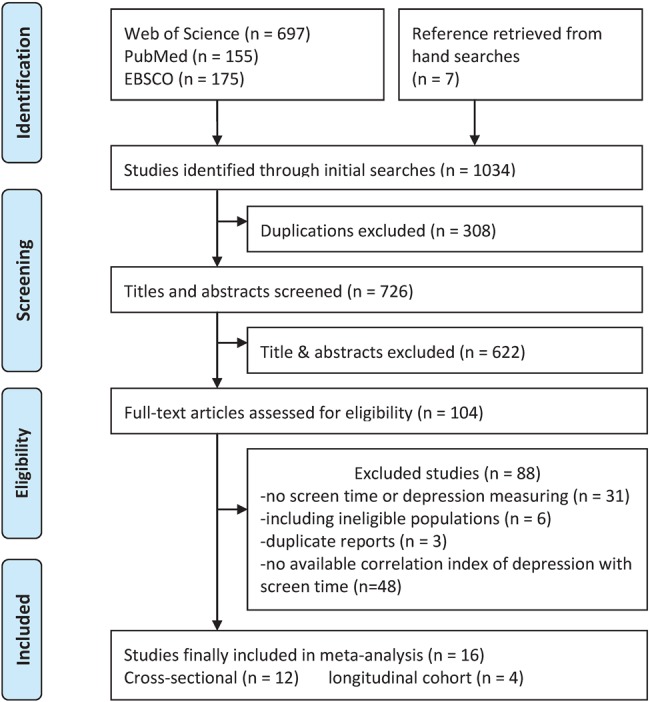
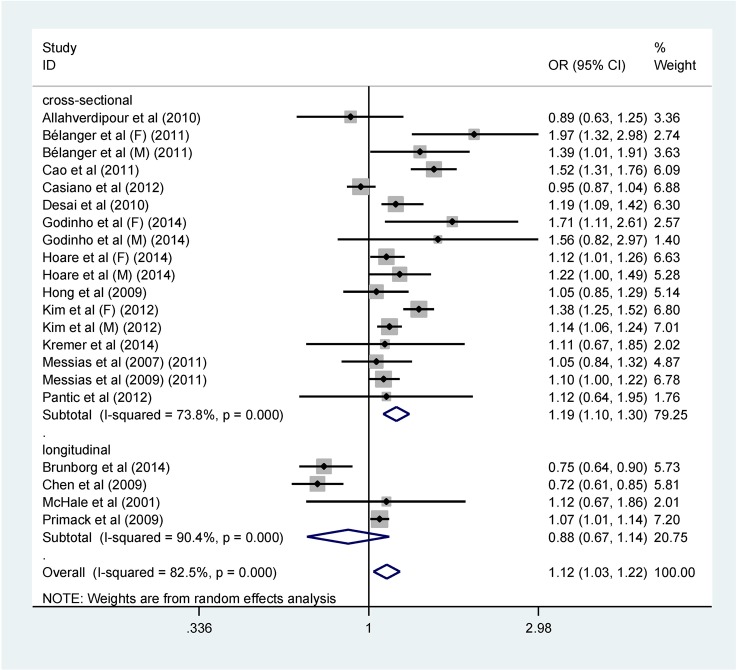
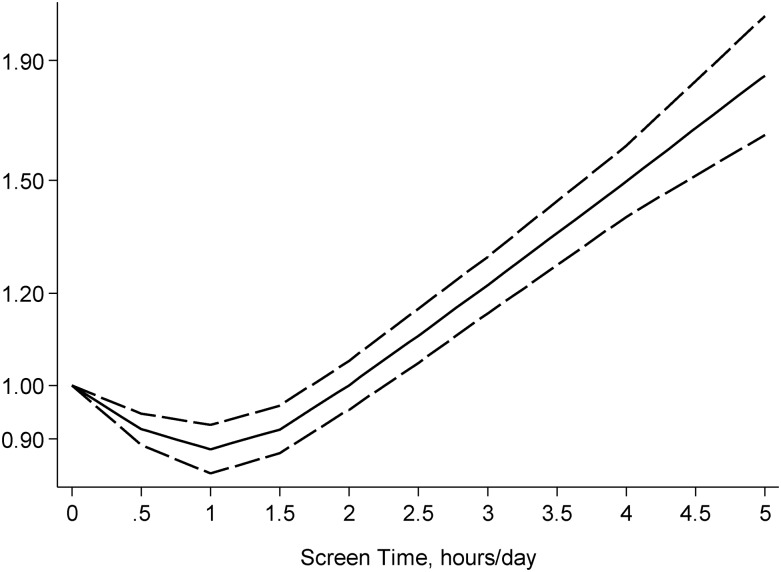
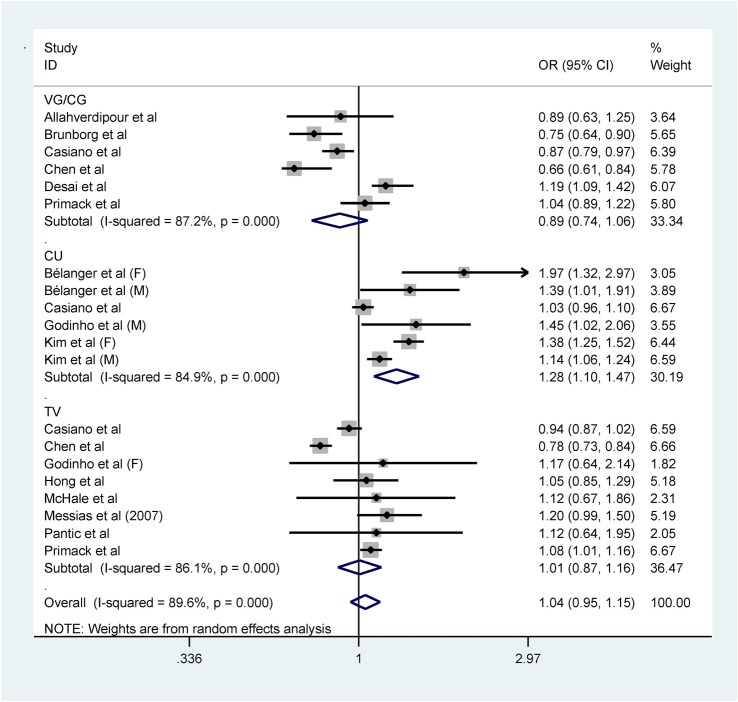
Background: Depression represents a growing public health burden. Understanding how screen time (ST) in juveniles may be associated with risk of depression is critical for the development of prevention and intervention strategies. Findings from studies addressing this question thus far have been inconsistent. Therefore, we conducted a comprehensive systematic review and meta-analysis of data related to this question. Methods: The meta-analysis was conducted in accordance with the PRISMA guideline. We searched the electronic databases of PubMed, Web of Science and EBSCO systematically (up to 6 May 2015). OR was adopted as the pooled measurement of association between ST and depression risk. Dose–response was estimated by a generalised least squares trend estimation. Results: Twelve cross-sectional studies and four longitudinal studies (including 1 cohort study) involving a total of 127 714 participants were included. Overall, higher ST in preadolescent children and adolescents was significantly associated with a higher risk of depression (OR=1.12; 95% CI 1.03 to 1.22). Screen type, age, population and reference category acted as significant moderators. Compared with the reference group who had no ST, there was a non-linear dose–response association of ST with a decreasing risk of depression at ST<2 h/day, with the lowest risk being observed for 1 h/day (OR=0.88; 95% CI 0.84 to 0.93). Conclusions: Our meta-analysis suggests that ST in children and adolescents is associated with depression risk in a non-linear dose–response manner.
Overview
The claims and statistics of this paper haven’t been checked yet.
Free: it reads the open-access text and checks the first 5 claims that cite a source we can check. Create a free account to check every claim.
Integrity signals
Registry
Cites
Statistics
Figures
Verification
Claims the paper makes
The claims and statistics of this paper haven’t been checked yet.
Free: it reads the open-access text and checks the first 5 claims that cite a source we can check. Create a free account to check every claim.
Claims other papers make about this one
Each is checked against this paper’s own text: does it say what the citing paper says it does?
The cited source says what the claim attributes to it.
In the citing paper
“More screen time has been associated with depressive symptoms among children and adolescents in several systematic reviews [11, 12, 43–50].”
From Screen time and mental health: a prospective analysis of the Adolescent Brain Cognitive Development (ABCD) Study (2024) · cites this paper as [50]
The cited source says what the claim attributes to it.
In the citing paper
“However, the presence of a cross-sectional association found in this and several previous studies [38] conveys no information about the temporal sequence of the 2 processes or the underlying mechanisms of the association, therefore potential explanations remain speculative.”
From Social Media and Mental Health Among Early Adolescents in Sweden: A Longitudinal Study With 2-Year Follow-Up (KUPOL Study). (2021) · cites this paper as [38]
The check wasn’t confident either way, so it gives no verdict — never disputed.
In the citing paper
“Most previous studies did not distinguish these 2 levels of associations, which might explain the reports of social media use being associated with depressive symptoms [38].”
From Social Media and Mental Health Among Early Adolescents in Sweden: A Longitudinal Study With 2-Year Follow-Up (KUPOL Study). (2021) · cites this paper as [38]
Experimental — accuracy not yet measuredIn the citing paper
“and depression [4,5]”
From Using Wearable Cameras to Categorize the Type and Context of Screen-Based Behaviors Among Adolescents: Observational Study (2022) · cites this paper as [5]
Self-check
Percentages, sums and reported differences re-computed from the paper’s own numbers.
The self-check needs the paper’s full text.
Citations
Cites
Preferred Reporting Items for Systematic Reviews and Meta-Analyses: the PRISMA statement
Moher, D., Liberati, A., Tetzlaff, J., Altman, D. G., & for the PRISMA Group (2009) · BMJ · doi:10.1136/bmj.b2535 · Cited by 83,823
Preferred Reporting Items for Systematic Reviews and Meta-Analyses: The PRISMA Statement
Moher, D., Liberati, A., Tetzlaff, J., Altman, D. G., & The PRISMA Group (2009) · PLoS Medicine · doi:10.1371/journal.pmed.1000097 · Cited by 64,042
Bias in meta-analysis detected by a simple, graphical test
Egger, M., Smith, G. D., Schneider, M., & Minder, C. (1997) · BMJ · doi:10.1136/bmj.315.7109.629 · Cited by 56,722
The CES-D Scale: A Self-Report Depression Scale for Research in the General Population
Radloff, L. S. (1977) · Applied Psychological Measurement · doi:10.1177/014662167700100306 · Cited by 53,267
Preferred reporting items for systematic reviews and meta-analyses: the PRISMA Statement.
(2009) · PubMed Central · Cited by 44,859
An inventory for measuring depression
BECK, A. T. (1961) · Archives of General Psychiatry · doi:10.1001/archpsyc.1961.01710120031004 · Cited by 38,032
Dermyshi, E., Wang, Y., Yan, C., Hong, W., Qiu, G., Gong, X., & Zhang, T. (2017) · Neonatology · doi:10.1159/000454668 · Cited by 24,451
von Elm, E., Altman, D. G., Egger, M., Pocock, S. J., Gøtzsche, P. C., Vandenbroucke, J. P., & Initiative, F. T. S. (2007) · PLoS Medicine · doi:10.1371/journal.pmed.0040296 · Cited by 23,020
Meta-analysis of Observational Studies in Epidemiology<SUBTITLE>A Proposal for Reporting</SUBTITLE>
Stroup, D. F. (2000) · JAMA · doi:10.1001/jama.283.15.2008 · Cited by 20,623
Wang, G., Ma, R., Qiao, G., Wada, K., Aizawa, Y., & Satoh, T. (2015) · Integrative Medicine International · doi:10.1159/000368408 · Cited by 18,657
Operating characteristics of a rank correlation test for publication bias
Begg, C. B., & Mazumdar, M. (1994) · Biometrics · doi:10.2307/2533446 · Cited by 16,955
Borenstein, M., Hedges, L. V., Higgins, J. P. T., & Rothstein, H. R. (2009) · doi:10.1002/9780470743386 · Cited by 14,225
Duval, S., & Tweedie, R. (2000) · Biometrics · doi:10.1111/j.0006-341x.2000.00455.x · Cited by 14,099
Borenstein, M., Hedges, L. V., Higgins, J. P. T., & Rothstein, H. R. (2021) · doi:10.1002/9781119558378 · Cited by 9,799
Scoville, W. B. (1949) · Journal of neurosurgery · doi:10.3171/jns.1949.6.1.0065 · Cited by 7,381
Internet paradox: A social technology that reduces social involvement and psychological well-being?
Kraut, R., Patterson, M., Lundmark, V., Kiesler, S., Mukophadhyay, T., & Scherlis, W. (1998) · American Psychologist · doi:10.1037/0003-066x.53.9.1017 · Cited by 4,793
Zhang, J., & Yu, K. F. (1998) · JAMA · doi:10.1001/jama.280.19.1690 · Cited by 4,138
von Elm, E., Altman, D. G., Egger, M., Pocock, S. J., Gøtzsche, P. C., & Vandenbroucke, J. P. (2007) · Preventive Medicine · doi:10.1016/j.ypmed.2007.08.012 · Cited by 2,698
Thapar, A., Collishaw, S., Pine, D. S., & Thapar, A. K. (2012) · The Lancet · doi:10.1016/s0140-6736(11)60871-4 · Cited by 2,365
Methods for Trend Estimation from Summarized Dose-Response Data, with Applications to Meta-Analysis
Greenland, S., & Longnecker, M. P. (1992) · American Journal of Epidemiology · doi:10.1093/oxfordjournals.aje.a116237 · Cited by 2,353
Systematic review of sedentary behaviour and health indicators in school-aged children and youth.
Tremblay, M. S., LeBlanc, A. G., Kho, M. E., Saunders, T. J., Larouche, R., Colley, R. C., Goldfield, G., & Gorber, S. (2011) · International Journal of Behavioral Nutrition and Physical Activity · doi:10.1186/1479-5868-8-98 · Cited by 2,085
Sex differences in unipolar depression: Evidence and theory.
Nolen–Hoeksema, S. (1987) · Psychological Bulletin · doi:10.1037//0033-2909.101.2.259 · Cited by 2,001
The use of the Center for Epidemiologic Studies Depression Scale in adolescents and young adults
Radloff, L. S. (1991) · Journal of Youth and Adolescence · doi:10.1007/bf01537606 · Cited by 1,997
Letter to the Editor: Standardized use of the terms “sedentary” and “sedentary behaviours”
Networ, S. B. R. (2012) · Applied Physiology, Nutrition, and Metabolism · doi:10.1139/h2012-024 · Cited by 1,873
Children, Adolescents, and Television
Committee on Public Education (2001) · Pediatrics · doi:10.1542/peds.107.2.423 · Cited by 1,721
Hawton, K., & van Heeringen, K. (2009) · The Lancet · doi:10.1016/s0140-6736(09)60372-x · Cited by 1,671
Sanderson, S., Tatt, I. D., & Higgins, J. P. (2007) · International Journal of Epidemiology · doi:10.1093/ije/dym018 · Cited by 1,531
Orsini, N., Li, R., Wolk, A., Khudyakov, P., & Spiegelman, D. (2012) · American Journal of Epidemiology · doi:10.1093/aje/kwr265 · Cited by 1,280
Generalized Least Squares for Trend Estimation of Summarized Dose–response Data
Orsini, N., Bellocco, R., & Greenland, S. (2006) · The Stata Journal: Promoting communications on statistics and Stata · doi:10.1177/1536867x0600600103 · Cited by 1,241
Fruit and vegetable consumption and stroke: meta-analysis of cohort studies
He, F. J., Nowson, C. A., & MacGregor, G. A. (2006) · The Lancet · doi:10.1016/s0140-6736(06)68069-0 · Cited by 1,108
Marshall, S. J., Biddle, S. J. H., Gorely, T., Cameron, N., & Murdey, I. (2004) · International Journal of Obesity · doi:10.1038/sj.ijo.0802706 · Cited by 1,103
Is there an epidemic of child or adolescent depression?
Jane Costello, E., Erkanli, A., & Angold, A. (2006) · Journal of Child Psychology and Psychiatry · doi:10.1111/j.1469-7610.2006.01682.x · Cited by 983
Sedentary behavior and health outcomes: an overview of systematic reviews.
Rezende, L. F. M. D., Rodrigues Lopes, M., Rey-López, J. P., Matsudo, V. K. R., & Luiz, O. D. C. (2014) · PLoS ONE · doi:10.1371/journal.pone.0105620 · Cited by 965
Subthreshold Depression in Adolescence and Mental Health Outcomes in Adulthood
Fergusson, D. M., Horwood, L. J., Ridder, E. M., & Beautrais, A. L. (2005) · Archives of General Psychiatry · doi:10.1001/archpsyc.62.1.66 · Cited by 792
Measurement Issues in the Assessment of Physical Activity in Children
Welk, G. J., Corbin, C. B., & Dale, D. (2000) · Research Quarterly for Exercise and Sport · doi:10.1080/02701367.2000.11082788 · Cited by 782
Hamling, J., Lee, P., Weitkunat, R., & Ambühl, M. (2008) · Statistics in Medicine · doi:10.1002/sim.3013 · Cited by 651
Canadian Sedentary Behaviour Guidelines for Children and Youth
Tremblay, M. S., LeBlanc, A. G., Janssen, I., Kho, M. E., Hicks, A., Murumets, K., Colley, R. C., & Duggan, M. (2011) · Applied Physiology, Nutrition, and Metabolism · doi:10.1139/h11-012 · Cited by 548
Sedentary behaviour and the risk of depression: a meta-analysis
Zhai, L., Zhang, Y., & Zhang, D. (2015) · British Journal of Sports Medicine · doi:10.1136/bjsports-2014-093613 · Cited by 500
Symptoms versus a diagnosis of depression: Differences in psychosocial functioning.
Gotlib, I. H., Lewinsohn, P. M., & Seeley, J. R. (1995) · Journal of Consulting and Clinical Psychology · doi:10.1037/0022-006x.63.1.90 · Cited by 459
Brunborg, G. S., Mentzoni, R. A., & Frøyland, L. R. (2014) · Journal of Behavioral Addictions · doi:10.1556/jba.3.2014.002 · Cited by 445
How to obtain the confidence interval from a P value
Altman, D. G., & Bland, J. M. (2011) · BMJ · doi:10.1136/bmj.d2090 · Cited by 402
Liu, M., Wu, L., & Ming, Q. (2015) · PLOS ONE · doi:10.1371/journal.pone.0134804 · Cited by 374
Self-citationDesai, R. A., Krishnan-Sarin, S., Cavallo, D., & Potenza, M. N. (2010) · Pediatrics · doi:10.1542/peds.2009-2706 · Cited by 372
Generation M[superscript 2]: Media in the Lives of 8- to 18-Year-Olds.
Rideout, V. J., Foehr, U. G., & Roberts, D. F. (2010) · Cited by 321
(2012) · PubMed · Cited by 317
Brown, H. E., Pearson, N., Braithwaite, R. E., Brown, W. J., & Biddle, S. J. H. (2013) · Sports Medicine · doi:10.1007/s40279-012-0015-8 · Cited by 313
Free-Time Activities in Middle Childhood: Links with Adjustment in Early Adolescence
McHale, S. M., Crouter, A. C., & Tucker, C. J. (2001) · Child Development · doi:10.1111/1467-8624.00377 · Cited by 309
Costigan, S. A., Barnett, L., Plotnikoff, R. C., & Lubans, D. R. (2013) · Journal of Adolescent Health · doi:10.1016/j.jadohealth.2012.07.018 · Cited by 290
Physical activity, leisure-time screen use and depression among children and young adolescents
Kremer, P., Elshaug, C., Leslie, E., Toumbourou, J. W., Patton, G. C., & Williams, J. (2014) · Journal of Science and Medicine in Sport · doi:10.1016/j.jsams.2013.03.012 · Cited by 287
Feng, Q., Zhang, Q.-L., Du, Y., Ye, Y.-L., & He, Q.-Q. (2014) · PLoS ONE · doi:10.1371/journal.pone.0100914 · Cited by 285
Prospective Study of Sedentary Behavior, Risk of Depression, and Cognitive Impairment
Hamer, M., & Stamatakis, E. (2014) · Medicine & Science in Sports & Exercise · doi:10.1249/mss.0000000000000156 · Cited by 258
Taxonomy, assessment, and diagnosis of depression during adolescence.
Compas, B. E., Ey, S., & Grant, K. E. (1993) · Psychological Bulletin · doi:10.1037//0033-2909.114.2.323 · Cited by 257
Screen time, physical activity and mental health among urban adolescents in China
Cao, H., Qian, Q., Weng, T., Yuan, C., Sun, Y., Wang, H., & Tao, F. (2011) · Preventive Medicine · doi:10.1016/j.ypmed.2011.09.002 · Cited by 211
Symptoms versus a diagnosis of depression: Differences in psychosocial functioning.
Gotlib, I. H., Lewinsohn, P. M., & Seeley, J. R. (1995) · Journal of Consulting and Clinical Psychology · doi:10.1037//0022-006x.63.1.90 · Cited by 197
Messias, E., Castro, J., Saini, A., Usman, M., & Peeples, D. (2011) · Suicide and Life-Threatening Behavior · doi:10.1111/j.1943-278x.2011.00030.x · Cited by 181
Electronic Gaming and Psychosocial Adjustment
Przybylski, A. K. (2014) · Pediatrics · doi:10.1542/peds.2013-4021 · Cited by 179
A U-Shaped Association Between Intensity of Internet Use and Adolescent Health
Bélanger, R. E., Akre, C., Berchtold, A., & Michaud, P.-A. (2011) · Pediatrics · doi:10.1542/peds.2010-1235 · Cited by 176
Wang, M., Armour, C., Wu, Y., Ren, F., Zhu, X., & Yao, S. (2013) · Journal of Clinical Psychology · doi:10.1002/jclp.21978 · Cited by 172
Self-citationTaveras, E. M., Field, A. E., Berkey, C. S., Rifas-Shiman, S. L., Frazier, A. L., Colditz, G. A., & Gillman, M. W. (2007) · Pediatrics · doi:10.1542/peds.2005-2974 · Cited by 151
Media Use and Adolescent Psychological Adjustment: An Examination of Gender Differences
Ohannessian, C. M. (2009) · Journal of Child and Family Studies · doi:10.1007/s10826-009-9261-2 · Cited by 142
Correlates of video games playing among adolescents in an Islamic country
Allahverdipour, H., Bazargan, M., Farhadinasab, A., & Moeini, B. (2010) · BMC Public Health · doi:10.1186/1471-2458-10-286 · Cited by 129
Hong, X., Li, J., Xu, F., Tse, L. A., Liang, Y., Wang, Z., Yu, I. T.-S., & Griffiths, S. (2009) · BMC Public Health · doi:10.1186/1471-2458-9-148 · Cited by 96
Media use and health outcomes in adolescents: findings from a nationally representative survey.
Casiano, H., Kinley, J., Katz, L. Y., Chartier, M., & Sareen, J. (2012) · Europe PMC (PubMed Central) · Cited by 95
After-school time use in Taiwan: effects on educational achievement and well-being.
Chen, S., & Lu, L. (2009) · PubMed · Cited by 78
Neonatal Intensive Care Unit Census Influences Discharge of Moderately Preterm Infants
Profit, J., McCormick, M. C., Escobar, G. J., Richardson, D. K., Zheng, Z., Coleman-Phox, K., Roberts, R., & Zupancic, J. A. F. (2007) · PEDIATRICS · doi:10.1542/peds.2005-2909 · Cited by 74
Wu, W., Lu, Y., Tan, F., Yao, S., Steca, P., Abela, J. R. Z., & Hankin, B. L. (2011) · Assessment · doi:10.1177/1073191111421286 · Cited by 46
Self-citationDepression in Children and Adolescents
Calles, J. L. (2007) · Primary Care Clinics in Office Practice · doi:10.1016/j.pop.2007.04.008 · Cited by 44
Kim, J. Y. (2012) · Journal of Preventive Medicine & Public Health · doi:10.3961/jpmph.2012.45.1.37 · Cited by 43
Correlates of Sedentary Behaviour in Children and Adolescents Aged 7-18: A Systematic Review
Temmel, C. S. D., & Rhodes, R. E. (2013) · Health & fitness journal of Canada · doi:10.14288/hfjc.v6i1.146 · Cited by 38
Hoare, E., Millar, L., Fuller-Tyszkiewicz, M., Skouteris, H., Nichols, M., Jacka, F., Swinburn, B., Chikwendu, C., & Allender, S. (2014) · Journal of Epidemiology and Community Health · doi:10.1136/jech-2013-203562 · Cited by 35
What is the Impact of Comorbid Depression on Adolescent Substance Abuse Treatment?
Hersh, J., Curry, J. F., & Kaminer, Y. (2014) · Substance Abuse · doi:10.1080/08897077.2014.956164 · Cited by 33
Association Between Media Use in Adolescence and Depression in Young Adulthood: A Longitudinal Study
Primack, B. A., Swanier, B., Georgiopoulos, A. M., Land, S. R., & Fine, M. J. (2009) · Archives of General Psychiatry · doi:10.1001/archgenpsychiatry.2008.532 · Cited by 30
Effect Sizes Based on Binary Data (2×2 Tables)
(2009) · Introduction to Meta‐Analysis · doi:10.1002/9780470743386.ch5 · Cited by 27
Benson, L. P., Williams, R. J., & Novick, M. B. (2013) · Clinical Pediatrics · doi:10.1177/0009922812459949 · Cited by 26
Characteristics associated with media use in early adolescence
Godinho, J., Araújo, J., Barros, H., & Ramos, E. (2014) · Cadernos de Saúde Pública · doi:10.1590/0102-311x00100313 · Cited by 16
Cited by
Rodriguez-Ayllon, M., Cadenas-Sánchez, C., Estévez-López, F., Muñoz, N. E., Mora-Gonzalez, J., Migueles, J. H., Molina-García, P., Henriksson, H., Mena-Molina, A., Martínez-Vizcaíno, V., et al. (2019) · Sports Medicine · doi:10.1007/s40279-019-01099-5 · Cited by 1,360
Firth, J., Solmi, M., Wootton, R. E., Vancampfort, D., Schuch, F. B., Hoare, E., Gilbody, S., Torous, J., Teasdale, S. B., Jackson, S. E., et al. (2020) · World Psychiatry · doi:10.1002/wps.20773 · Cited by 1,242
Lissak, G. (2018) · Environmental Research · doi:10.1016/j.envres.2018.01.015 · Cited by 1,024
Social media use and adolescent mental health: Findings from the UK Millennium Cohort Study
Kelly, Y., Zilanawala, A., Booker, C., & Sacker, A. (2018) · EClinicalMedicine · doi:10.1016/j.eclinm.2018.12.005 · Cited by 740
“Undoubtedly, using social media can be beneficial including as a source of social support and knowledge acquisition, however, a mounting body of evidence suggests associations with poor mental health among young people [7,8].”
BackgroundResultTeenagers, screens and social media: a narrative review of reviews and key studies
Orben, A. (2020) · Social Psychiatry and Psychiatric Epidemiology · doi:10.1007/s00127-019-01825-4 · Cited by 706
Metadata
- Authors
- Liu, M., Wu, L., & Yao, S.
- Affiliations
- Hunan University of Science and Technology (CN)
- Mayo Clinic (US)
- Second Xiangya Hospital of Central South University (CN)
- Corresponding author
- Yao, Shuqiao
- Venue
- British Journal of Sports Medicine
- Publisher
- BMJ
- Published
- 2015-11-09
- Volume
- 50
- Issue
- 20
- Pages
- 1252-1258
- ISSN
- 0306-3674 (ISSN-L)
- 1473-0480
- PMC
- PMC4977203
- OpenAlex
- W2140004648
- Cited by
- 364
- References
- 77
- Citations by year
- 2026: 28 · 2025: 33 · 2024: 36 · 2023: 58 · 2022: 57 · 2021: 42 · 2020: 43 · 2019: 29 · 2018: 16 · 2017: 11 · 2016: 10
- FWCI
- 1.51
- Type
- journal article
- Language
- en
- Open access
- hybrid
- doi.org
- Licence
- cc-by-nc
- Locations
- British Journal of Sports Medicine (publishedVersion, cc-by-nc)
- PubMed Central (publishedVersion, cc-by-nc)
- PubMed (publishedVersion)
- HighWire Press Open Archive (submittedVersion)
- Funders
- National Cancer Institute (R25CA160056)
- Topics
- Health Sciences › Medicine › Public Health, Environmental and Occupational Health › Physical Activity and Health
- Social Sciences › Education › Child Development and Digital Technology
- Social Sciences › Sociology and Political Science › Impact of Technology on Adolescents
- Keywords
- screen time, sedentary behavior, depression, children, adolescents, dose-response relationship, nonlinear relationship, depression risk
- MeSH terms
- Adolescent, Child, Computers, Depression, Female, Humans, Male, Risk Factors, Television, Time Factors, Video Games, Sedentary Behavior, Observational Studies as Topic
About these checks
Registry, retraction, Cites and statistics results are computed, not judged, with one exception: a printed reference that no index lists is read once by a model before it counts as a citation error. Claims are extracted by a model and kept only when their quote appears verbatim in the text; each cited source is then checked, with a model’s help, for whether it says what the claim relies on. Those verdicts can be wrong — read the claim’s quote and the cited source before relying on one.
Statistics and arithmetic are recomputed, not judged.
Confidence bands are shown only for fields calibrated on our annotated test set. None is calibrated yet, so no band is shown.
What counts as a claim ›How we measure confidence ›How we check this ›
Are you an author, or do you see a problem with this page? Request a review
Data sources
Bibliographic data: Semantic Scholar, OpenAlex, Crossref.
Contains information from the Semantic Scholar Academic Graph Datasets, made available under the ODC Attribution License (ODC-BY 1.0).
Semantic Scholar’s data is described in: Kinney, R., et al. (2023). The Semantic Scholar Open Data Platform. arXiv:2301.10140.
