

Gestational diabetes mellitus and adverse pregnancy outcomes: systematic review and meta-analysis
Open accessThe DOI matches its Crossref record; 191 of the 196 references it cites were found in a registry or an index.
Abstract
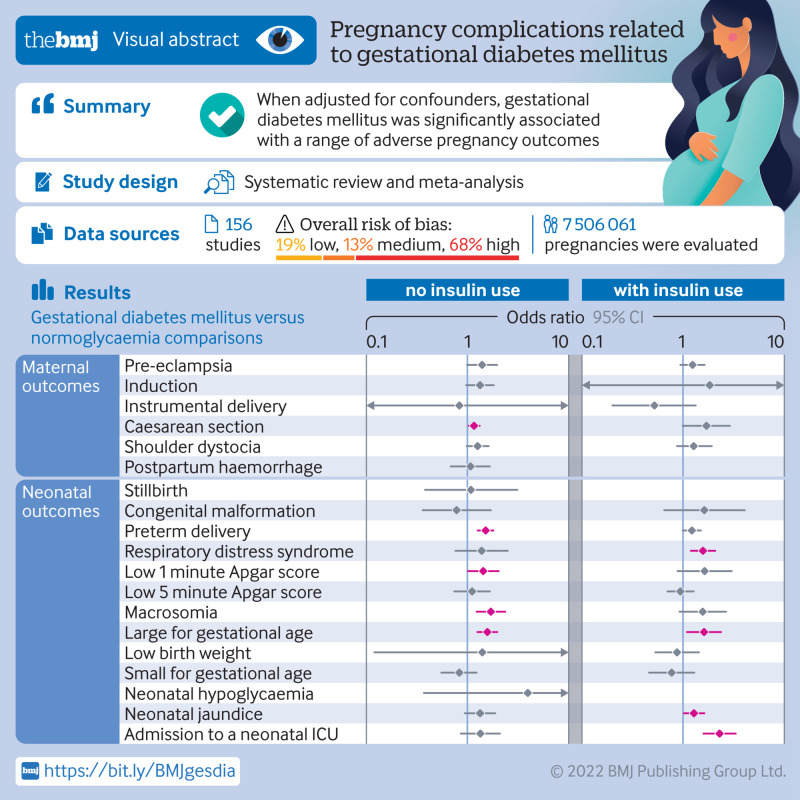
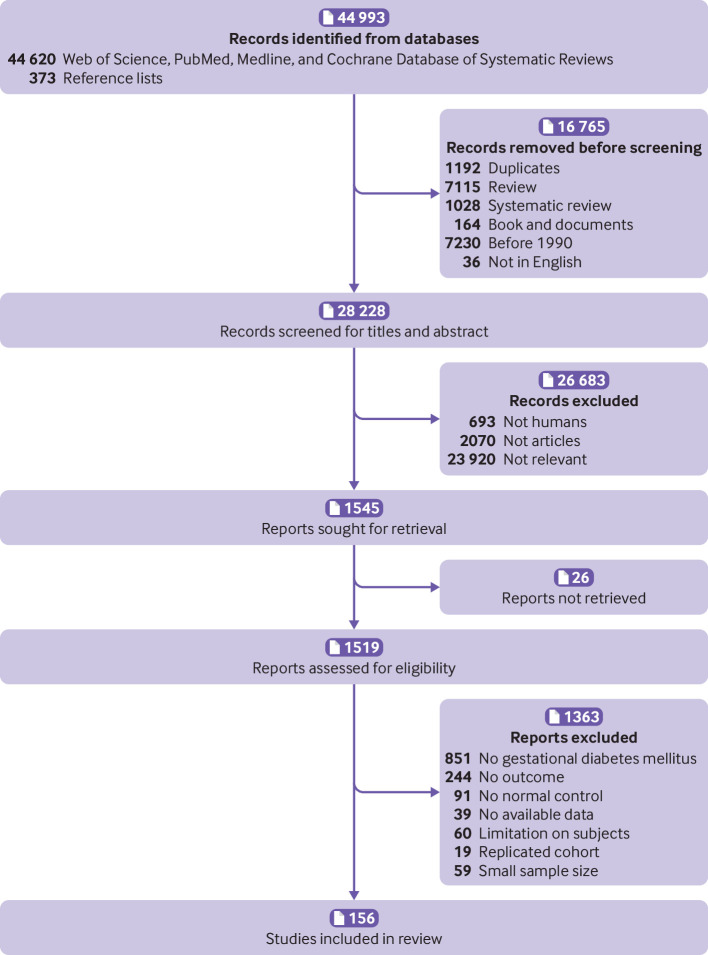
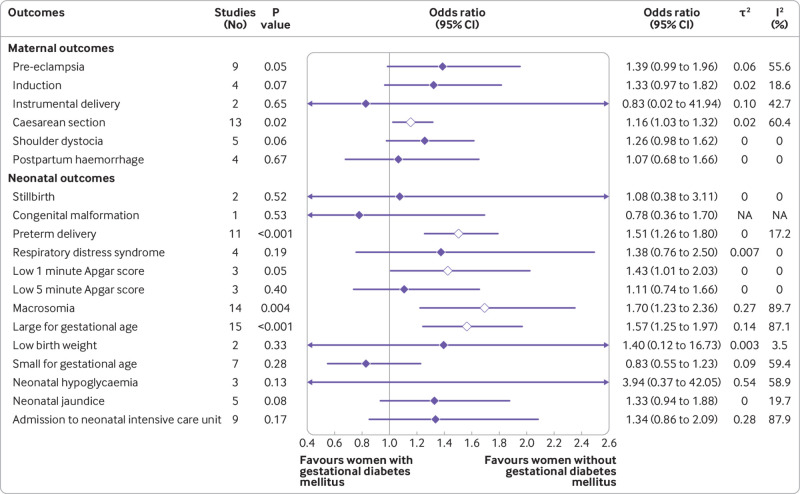
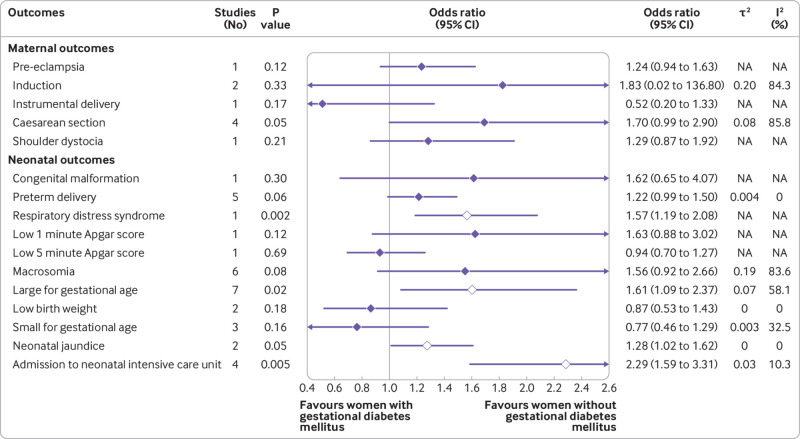
Objective: To investigate the association between gestational diabetes mellitus and adverse outcomes of pregnancy after adjustment for at least minimal confounding factors. Design: Systematic review and meta-analysis. Data sources: Web of Science, PubMed, Medline, and Cochrane Database of Systematic Reviews, from 1 January 1990 to 1 November 2021. Review methods: Cohort studies and control arms of trials reporting complications of pregnancy in women with gestational diabetes mellitus were eligible for inclusion. Based on the use of insulin, studies were divided into three subgroups: no insulin use (patients never used insulin during the course of the disease), insulin use (different proportions of patients were treated with insulin), and insulin use not reported. Subgroup analyses were performed based on the status of the country (developed or developing), quality of the study, diagnostic criteria, and screening method. Meta-regression models were applied based on the proportion of patients who had received insulin. Results: 156 studies with 7 506 061 pregnancies were included, and 50 (32.1%) showed a low or medium risk of bias. In studies with no insulin use, when adjusted for confounders, women with gestational diabetes mellitus had increased odds of caesarean section (odds ratio 1.16, 95% confidence interval 1.03 to 1.32), preterm delivery (1.51, 1.26 to 1.80), low one minute Apgar score (1.43, 1.01 to 2.03), macrosomia (1.70, 1.23 to 2.36), and infant born large for gestational age (1.57, 1.25 to 1.97). In studies with insulin use, when adjusted for confounders, the odds of having an infant large for gestational age (odds ratio 1.61, 1.09 to 2.37), or with respiratory distress syndrome (1.57, 1.19 to 2.08) or neonatal jaundice (1.28, 1.02 to 1.62), or requiring admission to the neonatal intensive care unit (2.29, 1.59 to 3.31), were higher in women with gestational diabetes mellitus than in those without diabetes. No clear evidence was found for differences in the odds of instrumental delivery, shoulder dystocia, postpartum haemorrhage, stillbirth, neonatal death, low five minute Apgar score, low birth weight, and small for gestational age between women with and without gestational diabetes mellitus after adjusting for confounders. Country status, adjustment for body mass index, and screening methods significantly contributed to heterogeneity between studies for several adverse outcomes of pregnancy. Conclusions: When adjusted for confounders, gestational diabetes mellitus was significantly associated with pregnancy complications. The findings contribute to a more comprehensive understanding of the adverse outcomes of pregnancy related to gestational diabetes mellitus. Future primary studies should routinely consider adjusting for a more complete set of prognostic factors. Review registration: PROSPERO CRD42021265837.
Overview
The claims and statistics of this paper haven’t been checked yet.
Free: it reads the open-access text and checks the first 5 claims that cite a source we can check. Create a free account to check every claim.
Integrity signals
Registry
Cites
Statistics
Figures
Verification
Claims the paper makes
The claims and statistics of this paper haven’t been checked yet.
Free: it reads the open-access text and checks the first 5 claims that cite a source we can check. Create a free account to check every claim.
Self-check
Percentages, sums and reported differences re-computed from the paper’s own numbers.
The self-check needs the paper’s full text.
Citations
Cites
Measuring inconsistency in meta-analyses
Higgins, J. P. T., Thompson, S. G., Deeks, J. J., & Altman, D. G. (2003) · BMJ · doi:10.1136/bmj.327.7414.557 · Cited by 63,139
Bias in meta-analysis detected by a simple, graphical test
Egger, M., Smith, G. D., Schneider, M., & Minder, C. (1997) · BMJ · doi:10.1136/bmj.315.7109.629 · Cited by 56,722
Hyperglycemia and adverse pregnancy outcomes
(2008) · New England Journal of Medicine · doi:10.1056/nejmoa0707943 · Cited by 5,563
2. Classification and Diagnosis of Diabetes: Standards of Medical Care in Diabetes—2020
American Diabetes Association (2020) · Diabetes Care · doi:10.2337/dc20-s002 · Cited by 3,187
IntHout, J., Ioannidis, J. P., & Borm, G. F. (2014) · BMC Medical Research Methodology · doi:10.1186/1471-2288-14-25 · Cited by 2,419
McIntyre, H. D., Catalano, P., Zhang, C., Desoye, G., Mathiesen, E. R., & Damm, P. (2019) · Nature Reviews Disease Primers · doi:10.1038/s41572-019-0098-8 · Cited by 1,850
What to add to nothing? Use and avoidance of continuity corrections in meta‐analysis of sparse data
J. Sweeting, M., J. Sutton, A., & C. Lambert, P. (2004) · Statistics in Medicine · doi:10.1002/sim.1761 · Cited by 1,734
Prevalence of Gestational Diabetes and Risk of Progression to Type 2 Diabetes: a Global Perspective
Zhu, Y., & Zhang, C. (2016) · Current Diabetes Reports · doi:10.1007/s11892-015-0699-x · Cited by 1,260
(1964) · PubMed · Cited by 1,230
The Hyperglycemia and Adverse Pregnancy Outcome Study
Catalano, P. M., McIntyre, H. D., Cruickshank, J. K., McCance, D. R., Dyer, A. R., Metzger, B. E., Lowe, L. P., Trimble, E. R., Coustan, D. R., Hadden, D. R., et al. (2012) · Diabetes Care · doi:10.2337/dc11-1790 · Cited by 954
Research works printed but not linked: 3
- Cochran WG. Some methods for strengthening the common×2 tests. Bioethics 1954; 10: 417.
- Zhao E Zhang Y Zeng X Liu B. Association between maternal diabetes mellitus and the risk of congenital malformations: A meta-analysis of cohort studies. Drug Discov Ther 2015; 9: 274- 81. 10.5582/ddt.2015.01044. 26370526 · DOI · Paper page
- Li Y Wang W Zhang D. Maternal diabetes mellitus and risk of neonatal respiratory distress syndrome: a meta-analysis. Acta Diabetol 2019; 56: 729- 40. 10.1007/s00592-019-01327-4. 30955125 · DOI
Cited by
Items 401–500 of 1,000
Li, Q., Tang, Y., Yang, X., Tingqiang, S. O. N. G., Wei, G., Gu, R., Pan, Y., Wang, J., Li, Y., & Wei, L. (2025) · BMC Pregnancy and Childbirth · doi:10.1186/s12884-025-08500-4 · Cited by 4
“GDM is a potentially modifiable long-term disease that results in a growing burden of obesity and cardiometabolic disorders in women and future generations of children [5, 6].”
Sabbagh, I. T., Seedat, F., Hirose, A., & Wade, A. N. (2026) · AJOG Global Reports · doi:10.1016/j.xagr.2026.100607 · Cited by 6
Germaine, M., Belsti, Y., O'Higgins, A. C., Egan, B., Teede, H. J., Healy, G. F., & Enticott, J. (2026) · Computers in Biology and Medicine · doi:10.1016/j.compbiomed.2026.111547 · Cited by 4
Huang, J., Zhang, Y., Zheng, W., & Li, G. (2026) · Frontiers in Cellular and Infection Microbiology · doi:10.3389/fcimb.2026.1675560 · Cited by 4
“Gestational diabetes mellitus (GDM), a metabolic disorder characterized by glucose intolerance fi rst diagnosed during pregnancy (Wang et al., 2022; Sweeting et al., 2024), poses signi fi cant risks to maternal and neonatal health (Ye et al., 2022).”
Self-citationKang, J., Kim, H. J., Jo, Y., Smith, K. J., Lark, A. R. S., Mir, F. A., Park, J., Lee, H., Kim, Y., Rahmati, M., et al. (2026) · Obesity Reviews · doi:10.1111/obr.70102 · Cited by 7
Gao, B.-B., Zhang, Q., Dong, S.-Q., Gao, F., Liu, X., Wei, J., & Yu, L. (2024) · Diabetes Metabolic Syndrome and Obesity · doi:10.2147/dmso.s436178 · Cited by 4
“11 A French cohort study reported a 30% higher risk of cardiac malformations in the offspring of GDM patients.”
BackgroundSmocot, J., Benedetti, A., Newbold, R., Meltzer, S., Kimoff, R. J., Garfield, N., Rey, É., Dasgupta, K., Gagnon, R. J., & Pamidi, S. (2024) · American Journal of Respiratory and Critical Care Medicine · doi:10.1164/rccm.202401-0099le · Cited by 4
Zeng, Y., Meng, X., Wen, M., Qin, Y., Wang, X., Dai, X., & Huang, Q. (2024) · Clinical and Experimental Obstetrics & Gynecology · doi:10.31083/j.ceog5109209 · Cited by 4
The Challenges of Diagnosing Gestational Diabetes after Bariatric Surgery: Where Do We Stand?
Rodrigues-Martins, D., Nunes, I., & Monteiro, M. P. (2024) · Obesity Facts · doi:10.1159/000541623 · Cited by 6
Yang, X., Li, W., Li, W., Liu, H., Wang, L., Leng, J., Fan, Y., Yang, X., Liu, M., & Hu, G. (2024) · Frontiers in Nutrition · doi:10.3389/fnut.2024.1436450 · Cited by 4
Primary Care for Gestational Diabetes: A Bibliometric Analysis of Publications from 1991 to 2024
Макашева, А. М., Yermukhanova, L. S., Kudabayeva, K. I., Tazhbenova, S., Nogayeva, M. G., Tautanova, A., & Zhylkybekova, A. (2024) · International Journal of Environmental Research and Public Health · doi:10.3390/ijerph21111405 · Cited by 5
“GDM stands as a prevalent medical complication during pregnancy [2].”
Wu, H., Zhang, L., Xie, Z., Cai, H., Zhang, J., & Yu, L. (2025) · International Journal of Women s Health · doi:10.2147/ijwh.s500531 · Cited by 7
Jensen, M. E., Harvey, S. M., Dizon, J., Holliday, E. G., Weaver, N., Barrass, K., Colaco, A., Hong, J. X., Leverett, K., Brew, B. K., et al. (2025) · The Journal of Allergy and Clinical Immunology In Practice · doi:10.1016/j.jaip.2025.04.022 · Cited by 4
Guo, J., Yan, D., Chen, W., Wang, S., Zheng, Y., Zhang, W., Hu, C., Luo, M., & Yu, X. (2025) · Journal of Diabetes · doi:10.1111/1753-0407.70118 · Cited by 4
“Neonatal APOs include stillbirth, neonatal death, congenital anomalies, preterm birth, macrosomia, small for gestational age (SGA) neonates, neonatal hypoglycemia, hyperbilirubin-emia, respiratory distress syndrome, and low Apgar score [7, 8].”
Davies, A. K., Lenguerrand, E., SCOTT, E. M., Kandiyali, R., Douek, I. F., Norman, J. E., Loose, A., Sawyer, L., Timlin, L., & Burden, C. (2023) · Pilot and Feasibility Studies · doi:10.1186/s40814-023-01341-y · Cited by 4
Impact of Selected Eicosanoids in Normal and Pathological Pregnancies
Szczuko, M., Golańska, J., Palma, J., & Ziętek, M. (2023) · Journal of Clinical Medicine · doi:10.3390/jcm12185995 · Cited by 7
“The diagnosis of GDM is made based on an oral glucose tolerance test or elevated fasting blood glucose [14].”
Koorn, I., Vis, L. C., Verschueren, K. J. C., Rosman, A. N., & van den Akker, T. (2023) · Birth · doi:10.1111/birt.12803 · Cited by 4
Garrow, J., Fan, I., Lilly, C. L., Lefeber, C., Gibbs, B. B., Lefeber, T., John, C. C., & Umer, A. (2024) · Diabetes Research and Clinical Practice · doi:10.1016/j.diabres.2024.111126 · Cited by 5
Sleep health predicted glucose metabolism among pregnant women: A prospective cohort study
Wang, Y., Chen, P., Wang, J., Lin, Q., Hong, L., Izci‐Balserak, B., Yuan, J., Zhao, R., & Zhu, B. (2024) · Diabetes Research and Clinical Practice · doi:10.1016/j.diabres.2024.111570 · Cited by 4
Andrade, C. (2024) · The Journal of Clinical Psychiatry · doi:10.4088/jcp.24f15318 · Cited by 4
Interpregnancy weight change and neonatal and infant outcomes: A systematic review and meta-analysis
Martínez‐Hortelano, J. A., Blázquez‐González, P., Rodríguez‐Rojo, I. C., Garrido‐Miguel, M., de Arenas‐Arroyo, S. N., Sequí‐Domínguez, I., Martínez‐Vizcaíno, V., & Berlanga‐Macías, C. (2024) · Annals of Epidemiology · doi:10.1016/j.annepidem.2024.07.002 · Cited by 4
Xu, M., Tang, L., & Wang, Y. (2024) · BMC Pregnancy and Childbirth · doi:10.1186/s12884-024-06846-9 · Cited by 4
Chen, T., Wu, C.-H., Gau, M., & Cheng, S. (2024) · Midwifery · doi:10.1016/j.midw.2024.104211 · Cited by 4
Ługowski, F., Babińska, J., Awiżeń-Panufnik, Z., Litwińska-Korcz, E., Litwińska, M., Ludwin, A., & Stanirowski, P. J. (2024) · Journal of Clinical Medicine · doi:10.3390/jcm13237129 · Cited by 6
“Moreover, women with GDM-complicated pregnancies have a higher risk of Cesarean section, pregnancy-induced hypertension, and preeclampsia [11,12].”
Shan, Y., Hu, H. W., Yang, A., Zhao, W., & Chu, Y. (2025) · The Journal of Maternal-Fetal & Neonatal Medicine · doi:10.1080/14767058.2024.2445665 · Cited by 4
“Gestational diabetes mellitus (GDM), defined as new-onset maternal hyperglycemia during pregnancy that resolves after birth, is a chronic condition that impacts the health of millions of women globally [1,2].”
Karcz, K., & Królak‐Olejnik, B. (2025) · Nutrients · doi:10.3390/nu17010177 · Cited by 5
“Following delivery, when the glucose supply is ceased, the newborn is at risk of developing hypoglycemia due to the elevated insulin concentration that persists in the absence of glucose [11–13].”
Ryan, L. W. K., Weiying, L., Wright, A., & Tan, L. (2025) · Cambridge University Press eBooks · doi:10.1017/9781009507189 · Cited by 4
Apizi, A., Li, J., Liu, W., Dong, L., Ding, Y., & Yu, Z. (2025) · Biomolecules and Biomedicine · doi:10.17305/bb.2025.11909 · Cited by 5
Liu, J. H., Li, H., Wang, X., Liu, B., He, D., Zhang, G., & Gao, Y. (2025) · BMC Pregnancy and Childbirth · doi:10.1186/s12884-025-07383-9 · Cited by 4
“A systematic review and meta-analysis indicated that GDM women with insufficient GWG had a higher risk of PTB than GDM women with adequate GWG [37, 38], which aligns with our study.”
Karim, F. S., Maharana, S., Akhter, S., & Chowdhury, S. R. (2025) · Complementary Therapies in Clinical Practice · doi:10.1016/j.ctcp.2025.101981 · Cited by 4
Huang, J., Parsons, J., Forbes, A., Wang, L., & Forde, R. (2025) · Midwifery · doi:10.1016/j.midw.2025.104432 · Cited by 4
Self-citationRobiyanto, R., Barrett, J. W., Sandberg, L., Raemaekers, B. C., Norén, G. N., Schuiling‐Veninga, C. C. M., Hak, E., & van Puijenbroek, E. (2025) · Drug Safety · doi:10.1007/s40264-025-01607-9 · Cited by 4
“Poorly treated GDM may present harmful risks to pregnant women, including pre-eclampsia, preterm delivery, and the need for caesarean section, and to infants, including being large for gestational age and respiratory distress syndrome [14, 15].”
Bukasa, L., Cortina‐Borja, M., Peters, H., Taylor, G. P., & Thorne, C. (2023) · Journal of the International AIDS Society · doi:10.1002/jia2.26078 · Cited by 5
“These findings are comparable to results from studies in the general population that indicate that women who develop GD in pregnancy are more likely to have a preterm delivery [64] and have a CS [65], partly due to fetal macrosomia [66].”
BackgroundResultGao, M., Li, J., Li, N., Li, W., Zhang, S., Zhang, T., Wang, H., Fang, Z., Yu, Z., Hu, G., et al. (2023) · Clinica Chimica Acta · doi:10.1016/j.cca.2023.117512 · Cited by 4
Chan, E. S., Chadha, R., & de Koning, L. (2023) · Pediatric and Developmental Pathology · doi:10.1177/10935266231194697 · Cited by 4
“Pregnancies complicated by GDM carry an increased risk of adverse outcomes, 14 underscoring the importance of assessing maternal glycemic levels in cases of perinatal demise.”
BackgroundChen, A., Acharya, G., Hu, M. S., Gao, X., Cheng, G., Jiang, L., & Ni, Q. (2023) · Acta Obstetricia Et Gynecologica Scandinavica · doi:10.1111/aogs.14704 · Cited by 4
Placental expression of inflammatory Galectin-12 is associated with gestational diabetes
Buschmann, C., Unverdorben, L., Knabl, J., Hutter, S., Meister, S., Beyer, S., Burgmann, M., zehni, A. Z., Schmoeckel, E., Kessler, M., et al. (2024) · Journal of Reproductive Immunology · doi:10.1016/j.jri.2024.104240 · Cited by 4
Bune, G. T. (2024) · Diabetes Metabolic Syndrome and Obesity · doi:10.2147/dmso.s457739 · Cited by 4
“11 Publication bias could also contribute to the perceived result consistency by selectively displaying conflicting findings from unpublished studies.”
ResultContributors to Preterm Birth: Data from a Single Polish Perinatal Center
Jańczewska, I., Cichoń-Kotek, M., Glińska, M., Deptulska-Hurko, K., Basiński, K., Woźniak, M. K., Wiergowski, M., Biziuk, M., Szablewska, A. W., Cichoń, M., et al. (2023) · Children · doi:10.3390/children10030447 · Cited by 4
Gao, J., & Liu, J. (2024) · Frontiers in Endocrinology · doi:10.3389/fendo.2024.1389453 · Cited by 3
Yu, J., Liu, Y., & Xu, L. (2024) · Diabetes, Metabolic Syndrome and Obesity · doi:10.2147/dmso.s460796 · Cited by 3
The role of hsa_circ_0042260/ miR ‐4782‐3p/ LAPTM4A axis in gestational diabetes mellitus
Ji, R. P., Yang, H., Chen, J., Zhao, A., Chen, X., & Niu, Y. (2024) · Apmis · doi:10.1111/apm.13407 · Cited by 3
“The incidence of GDM has been observed to increase with the rise in high-fat diet consumption [2].”
BackgroundLiu, W., Zou, H., Liu, W., & Qin, J. (2024) · BMC Public Health · doi:10.1186/s12889-024-19767-1 · Cited by 3
“GDM affects not only the health of pregnant women, [2–4] but also the potential occurrence of adverse pregnancy outcomes, including macrosomia and neonatal hypoglycaemia, and increases the long-term risk of diabetes in both mothers and children [5–7].”
BackgroundLiu, Y., Liu, M., Liu, J., Sheng, M., Hu, Z., & Zhang, X. (2024) · Frontiers in Medicine · doi:10.3389/fmed.2024.1441085 · Cited by 3
Hong, J. G. S., Crawford, K., Cavanagh, E., Clifton, V. L., Costa, F. D. S., Perkins, A. V., & Kumar, S. (2025) · Placenta · doi:10.1016/j.placenta.2024.12.025 · Cited by 4
Yin, B., Bai, Y., Zhang, J., Zhang, Y., Li, X., Jin, Y., Mou, X., Fang, K., Chen, Y., Cheng, Y., et al. (2025) · Annals of Medicine · doi:10.1080/07853890.2025.2452352 · Cited by 3
“…diabetes mellitus (GDM) is a prevalent pregnancy complication that significantly correlates with adverse maternal and infant health outcomes [1, 2]. according to the guidelines, an oral glucose tolerance test (OGtt) is recommended for diagnosing GDM in all pregnant women without…”
Impact of Self-Management Clustered Care on Psychological and Birth Outcomes in Gestational Diabetes
Tang, S., Wang, S., Wu, J., Hu, S., Lü, T., Zhu, M., Li, J., & Xue, F. (2025) · International Journal of Women s Health · doi:10.2147/ijwh.s504365 · Cited by 3
“6 Finally, the effects of GDM do not stop at birth, as infants with GDM may be at a a high risk for developing obesity and diabetes later in life, a phenomenon known as the “foetal programming effect.””
Gestational Diabetes: From Mechanism to Therapy – A Short Review
Cursaru, R., Bratu, A., Radulian, G., Pavelescu, M. L., Rusu, E., Cirstoiu, F. C., & Cursaru, A. (2024) · Romanian Journal of Military Medicine · doi:10.55453/rjmm.2024.127.6.10 · Cited by 4
Li, Y., Zhao, B., Yang, T., Li, Y., Li, X., Guo, H., Li, X., & Yuan, J. (2025) · Frontiers in Nutrition · doi:10.3389/fnut.2025.1565986 · Cited by 3
Zhang, X., Ding, Y., Duan, Z., Cai, R., Gao, X., Zhang, R., & Wang, R. (2025) · Diabetes Metabolic Syndrome and Obesity · doi:10.2147/dmso.s524237 · Cited by 3
Jiao, J., Zhang, Y., Zhou, J., Lv, R., & Cui, L. (2025) · BMC Pregnancy and Childbirth · doi:10.1186/s12884-025-07755-1 · Cited by 3
“First, abnormal glycolipid metabolism increases the risk of developing GDM, changes amniotic fluid metabolism, and stimulates fetal leptin and insulin secretion [52, 53].”
He, Y., Ni, Q., Zhang, C., Zhou, L., Li, S., Yu, T., & Liu, L. (2025) · Scientific Reports · doi:10.1038/s41598-025-10576-z · Cited by 4
Ezveci, H., Doğru, Ş., & Yaman, F. K. (2025) · Congenital Anomalies · doi:10.1111/cga.70018 · Cited by 3
“6,7 Decreased fetal pulmonary artery vascular resistance, tissue impedance, and increased blood flow in the pulmonary vascular bed are important stages in the developmental processes of the fetal pulmonary system.”
Wu, Q. H., Wang, X., & Zhu, F. (2025) · International Journal of Women s Health · doi:10.2147/ijwh.s527848 · Cited by 4
Göbl, C. S., Dardano, A., Daniele, G., & Tura, A. (2025) · Nutrients · doi:10.3390/nu17162682 · Cited by 3
“To answer this question, it is important to note that remarkable efforts are still being made to identify biomarkers of pregnancy complications and adverse fetal, neonatal, and perinatal outcomes [50,51].”
Chai, Y., Tang, J., Liu, A., & Zhou, Q. (2025) · Diabetology & Metabolic Syndrome · doi:10.1186/s13098-025-01915-1 · Cited by 3
“GDM not only increases the risk of pregnant women developing type 2 diabetes and cardiovascular disease in the future, but is also closely related to adverse pregnancy outcomes such as fetal macrosomia, premature birth, stillbirth, and neonatal respiratory distress syndrome [5, 6].”
Katayama, A., Hasegawa, M., Morimoto, E., Watanabe, M., Matsushita, Y., Takeda, M., Kai, K., Yoshida, M., 塚原, 紗., Okimoto, N., et al. (2025) · BMJ Open Diabetes Research & Care · doi:10.1136/bmjdrc-2025-005114 · Cited by 4
From exposure to outcomes: How air pollutants impact maternal and foetal health
Parikh, G., & Patel, B. M. (2025) · Reproductive Toxicology · doi:10.1016/j.reprotox.2025.109080 · Cited by 3
Insulin Resistance in GDM A1 vs Healthy Pregnancy: A Comparative Study Using METS-IR and TyG Index
Jiang, H., Shang, M., & Gao, S. (2025) · International Journal of Women s Health · doi:10.2147/ijwh.s557974 · Cited by 4
The relationship between first-trimester progesterone treatment and gestational diabetes
Romano, A., Friedrich, L., Zeevi, G., Bor, N., Walfisch, A., Hadar, E., Houri, O., & Berezowsky, A. (2025) · European Journal of Obstetrics & Gynecology and Reproductive Biology · doi:10.1016/j.ejogrb.2025.114791 · Cited by 3
Awel, S., Worku, B. T., Jemal, R., Amdisa, D., & Abdulahi, M. (2025) · BMC Pregnancy and Childbirth · doi:10.1186/s12884-025-08277-6 · Cited by 3
“Thus, a GDM diagnosis can serve as an important warning sign of the likelihood of future type 2 diabetes and is considered an “excellent marker” for implementing targeted preventive measures during and after pregnancy [26].”
New visions and research trends in fetal-originated adult cardiovascular and metabolic diseases
Xu, Y., Yan, Z., Li, N., Tang, J., & Xu, Z. (2025) · Drug Discovery Today · doi:10.1016/j.drudis.2025.104517 · Cited by 3
Yu, H., Qin, Y. H., Tao, R., Chen, Y., Yuan, L., & Lizhou, S. (2025) · Journal of Biomedical Research · doi:10.7555/jbr.39.20250350 · Cited by 3
Wang, R., Liu, J., Li, Q., Yin, X., Li, N., Wang, G., Zhu, Y., & Jiang, H. (2025) · Scientific Reports · doi:10.1038/s41598-025-31193-w · Cited by 3
“GDM is one of the most common metabolic disorders during pregnancy and can similarly cause multiple adverse birth outcomes 23 .”
Wang, L., Qin, M., Chen, G. Q., Wang, Y., Zhang, D., Chen, Q., Gu, Y., & Zhao, M. (2026) · Archives of Gynecology and Obstetrics · doi:10.1007/s00404-025-08266-2 · Cited by 4
Ziyab, A. H., Al‐Taiar, A., Al‐Sabah, R., Hammoud, M. S., & Akhtar, S. (2026) · Public Health Nutrition · doi:10.1017/s1368980026101906 · Cited by 3
Du, H., Lin, Q., He, X., Yang, B., Huang, Y., Li, Q., Wang, Y., Wen, R., Lin, W., Li, S., et al. (2026) · Gut Microbes · doi:10.1080/19490976.2026.2623353 · Cited by 3
Laffel, L. M., & Valent, A. M. (2026) · Diabetes Technology & Therapeutics · doi:10.1177/15209156251403591 · Cited by 3
Pregnancy lab test dynamics resemble rejuvenation of some organs and aging of others
Moran, R., Pridham, G., Toledano, Y., & Alon, U. (2026) · Nature Communications · doi:10.1038/s41467-026-69340-0 · Cited by 3
Jiang, S., Meng, Q., Jiang, C., Lv, Y., Liu, L., Xie, R., Ya, F., & Gao, Q. (2026) · Food & Function · doi:10.1039/d5fo04882f · Cited by 4
Zhang, T., Liu, L., Zhang, Q., Jiang, W. H., Huang, Y., Ye, W., Zhang, N., & Zhang, J. (2026) · Journal of Hazardous Materials · doi:10.1016/j.jhazmat.2026.141652 · Cited by 3
Self-citationDHA ameliorates GDM placental angiogenesis by regulating HAMP-mediated iron imbalance
Huang, Z., Zhou, S., Cui, Z., Li, J., Liu, L., Feng, X., Ye, H., Ma, K., Huang, S., Xiang, Q., et al. (2026) · Journal of Advanced Research · doi:10.1016/j.jare.2026.03.005 · Cited by 3
Zhu, Y., Ngo, A. L., Liao, L. D., HARVILL, R., Marafino, B. J., Chehab, R. F., Greenberg, M., & Ferrara, A. M. (2026) · Diabetes Care · doi:10.2337/dc25-2131 · Cited by 3
Pan, Q., Cai, Z., Lin, D., Chen, L., & Xiang, J. (2026) · Diabetology & Metabolic Syndrome · doi:10.1186/s13098-026-02145-9 · Cited by 3
Pazaras, N., Siargkas, A., Tranidou, A., Apostolopoulou, A., Tsakiridis, I. G., Bamidis, P. D., Stavros, S., Potiris, A., Chourdakis, M., & Dagklis, T. (2026) · Journal of Clinical Medicine · doi:10.3390/jcm15062461 · Cited by 3
“…obesity rates [1,2], with outcomes including but not limited to hypertensive disorders of pregnancy (such as preeclampsia), cesarean delivery, fetal macrosomia, neonatal metabolic complications [2,3], and an increased lifetime risk of type 2 diabetes mellitus for both mother and offspring [4,5].”
The effect of continuous glucose monitoring on neonatal outcomes in pregnant women with diabetes
Lai, X., Yu, J., 朱书涛, Zhang, K., & Ye, X. (2026) · Frontiers in Endocrinology · doi:10.3389/fendo.2026.1815133 · Cited by 3
“Diabetes in pregnancy is associated with increased risks of adverse maternal and neonatal outcomes, including preeclampsia, cesarean delivery, large for gestational age (LGA) infants, neonatal hypoglycemia, and neonatal intensive care unit (NICU) admission (3, 4).”
Eroğlu, S., Gümüşburun, N., Ürkmez, S. S., Ürkmez, Y. C., ÇELİK, S., & Şahin, K. (2026) · Zeitschrift für Geburtshilfe und Neonatologie · doi:10.1055/a-2827-9333 · Cited by 3
Taheri, Z., Tajdari, M., Ghadikolaei, Y. H., Eftekhari, H., Dodangeh, S., Jamshidi, P., Andarzbakhsh, K., & Rezazadeh, A. (2026) · Journal of Diabetes & Metabolic Disorders · doi:10.1007/s40200-025-01817-z · Cited by 3
“In most cases, GDM can lead to various complications, such as gestational hypertension, pre-eclampsia, cesarean delivery, macroso-mia, and congenital malformations [3].”
Qu, D., Liu, J., Peng, X., Dou, H., Huang, L., Lin, H., Yang, L., & Wang, Y. (2026) · International Journal of Women s Health · doi:10.2147/ijwh.s585565 · Cited by 3
“11 16–18 Eclampsia is a severe pregnancy-induced hypertensive disorder that may affect fetal growth and increase the risk of low birth weight.”
Maternal Diabetes and Risk of Early-Onset Cardiovascular Diseases in Offspring
Mo, X., Janszky, I., Wang, H. L., Yang, F., Möller, J., Liang, Y., & László, K. D. (2026) · JAMA Cardiology · doi:10.1001/jamacardio.2026.0915 · Cited by 4
Wang, X.-H., Saeed, G., Afzal, A., Saddozai, U. A. K., Shao, G.-M., Rehman, A., Hamid, S. E., Pan, S.-Y., Ji, X., & Khawar, M. B. (2026) · Frontiers in Endocrinology · doi:10.3389/fendo.2026.1858727 · Cited by 3
“Fetal complications include macrosomia, neonatal hypoglycemia, and shoulder dystocia, while the maternal and child risks associated with GDM are obesity, type 2 DM, and cardiovascular disease (112, 113).”
Huang, Y., Cai, F., Zhang, W., Shen, R., & Jin, L. (2023) · Annals of Translational Medicine · doi:10.21037/atm-22-6223 · Cited by 3
“Specific patient characteristics, such as age 35 years or older, higher BMI, no insulin use, and so on, can increase the incidence of GDM (10,11).”
BackgroundJiang, H., Guo, Y., Chen, L., Shi, H., Huang, N., Chi, H., Yang, R. J., Long, X., & Qiao, J. (2023) · Journal of Clinical Medicine · doi:10.3390/jcm12113863 · Cited by 3
“Previous studies have shown that gestational maternal hyperglycemia is associated with preterm delivery, induction of labor, macrosomia, LGA infants, shoulder dystocia, neonatal jaundice, and respiratory distress syndrome [9,30].”
BackgroundSong, J., & Cai, R. (2023) · The Journal of Maternal-Fetal & Neonatal Medicine · doi:10.1080/14767058.2023.2259048 · Cited by 4
“GDM, the most common metabolic disorder during pregnancy affecting the health of pregnant women, develops in about 15% of pregnant women worldwide [18], and can increase the risk of adverse pregnancy outcomes such as cesarean delivery and macrosomia [19,20].”
BackgroundMethodHong, M., Liang, F., Zheng, Z., Chen, H., Li, X., Guo, Y., Liu, X., Li, K., & Xia, H. (2023) · Clinical Nutrition ESPEN · doi:10.1016/j.clnesp.2023.11.001 · Cited by 3
Tehrani, F. R., Sheidaei, A., Rahmati, M., Farzadfar, F., Noroozzadeh, M., Hosseinpanah, F., Abedini, M., Hadaegh, F., Valizadeh, M., Torkestani, F., et al. (2023) · BMJ Open Diabetes Research & Care · doi:10.1136/bmjdrc-2023-003510 · Cited by 4
Gao, H., Miao, C., Liu, W., Sun, Y., Li, H., Wu, Z., Li, W., Xu, L., Sun, B., Zheng, B., et al. (2024) · Journal of Sleep Research · doi:10.1111/jsr.14191 · Cited by 3
“According to the current diagnostic data, the prevalence of GDM has continued to increase over the past few years, and 9% – 25% of pregnancies are affected by GDM (Alejandro et al., 2020; Ye et al., 2022).”
Wang, Y., Gao, W., & Wang, X. (2024) · World Journal of Clinical Cases · doi:10.12998/wjcc.v12.i18.3378 · Cited by 3
Li, X., Bu, W., Hu, X., Han, T., & Xuan, Y. (2024) · International Journal of Pediatric Otorhinolaryngology · doi:10.1016/j.ijporl.2024.112056 · Cited by 4
Cho, Y., Choi, E., Choi, A., Han, J. Y., Ye, B. D., Kim, J. H., & Shin, J. (2024) · The American Journal of Gastroenterology · doi:10.14309/ajg.0000000000003100 · Cited by 3
“Given that GDM itself raises the risk of adverse outcomes for both mother and o ff spring (3,4), managing IBD with appropriate medical therapy is essential to ensure a safe pregnancy and reduce the risk of complications.”
Pan, Y., Gu, R., Li, Q., Wang, J., Zhang, Y., Zhao, L., Wu, Y., & Wei, L. S. (2024) · BMC Pregnancy and Childbirth · doi:10.1186/s12884-024-06994-y · Cited by 3
Epidemiology and long-term effects of gestational diabetes mellitus
Cho, G. J., & Bae, J. G. (2024) · Journal of Korean Medical Association · doi:10.5124/jkma.2024.67.11.679 · Cited by 3
Cheng, Y., Ding, W., Zhang, Y., Wang, H., Zhu, X., & Xu, X. (2025) · Healthcare and Rehabilitation · doi:10.1016/j.hcr.2025.100020 · Cited by 3
Yang, G., Wen, J., Si, L., Wang, N., & Zhao, Y. (2025) · Scientific Reports · doi:10.1038/s41598-025-98447-5 · Cited by 3
“It has been reported that women with gestational diabetes mellitus (GDM) have an increased risk of LGA and macrosomia 6–8 .”
Liu, R., She, J., Li, X., Ding, M., Li, S., Sheng, J., Yang, H., & Huang, H. (2025) · Journal of Agricultural and Food Chemistry · doi:10.1021/acs.jafc.4c11857 · Cited by 3
Modified electroconvulsive therapy for perinatal depression: scoping review
Bobo, W. V., Moore, O., Hurley, C. B., Rosasco, R. E., Sharpe, E. E., Larish, A. M., Moore, K. M., & Betcher, H. K. (2025) · Frontiers in Psychiatry · doi:10.3389/fpsyt.2025.1619098 · Cited by 3
“Additionally, an essential core treatment for patients with chronic psychoses, antipsychotic drugs, may increase the risk of gestational diabetes (122), an independent risk factor for numerous pregnancy and neonatal complications (123).”
Wang, L., Wang, Y., Chen, H., Liu, L., Chen, X., & Gan, Q. (2025) · BMJ Open · doi:10.1136/bmjopen-2025-101475 · Cited by 3
Wang, Y., Yuan, H., Jiang, R., Jia, K., Ding, X., Gu, P., & Sun, J. (2025) · Trials · doi:10.1186/s13063-025-09080-6 · Cited by 3
“The results of prospective studies indicate that GDM can pose a series of Health risks, such as preterm delivery, mac-rosomia, cesarean, and type 2 diabetes, to offspring or mothers [2, 3].”
Scobie, I. N., & Hopkins, D. L. (2023) · CRC Press eBooks · doi:10.1201/9781003342700 · Cited by 4
A terhességi intrahepaticus cholestasis és a gestatiós diabetes mellitus összefüggése
Ozsvári-Vidákovich, M., Somogyi, A., & Rosta, K. (2023) · Orvosi Hetilap · doi:10.1556/650.2023.32778 · Cited by 3
Metadata
- Authors
- Ye, W., Luo, C., Huang, J., Li, C., Liu, Z., & Liu, F.
- Affiliations
- Central South University (CN)
- Corresponding author
- Liu, Fangkun
- Venue
- BMJ
- Publisher
- BMJ
- Published
- 2022-05-25
- Volume
- 377
- Pages
- e067946
- ISSN
- 1756-1833 (ISSN-L)
- PMC
- PMC9131781
- OpenAlex
- W4281563604
- Cited by
- 1,073
- References
- 196
- Citations by year
- 2026: 258 · 2025: 321 · 2024: 313 · 2023: 160 · 2022: 20
- FWCI
- 41.00
- Type
- journal article
- Language
- en
- Open access
- hybrid
- doi.org
- Licence
- Locations
- BMJ (publishedVersion, cc-by-nc)
- PubMed Central (publishedVersion, cc-by-nc)
- PubMed (publishedVersion)
- Funders
- National Natural Science Foundation of China
- Topics
- Health Sciences › Medicine › Obstetrics and Gynecology › Gestational Diabetes Research and Management
- Health Sciences › Medicine › Public Health, Environmental and Occupational Health › Pregnancy and Medication Impact
- Health Sciences › Medicine › Endocrinology, Diabetes and Metabolism › Diabetes, Cardiovascular Risks, and Lipoproteins
- Keywords
- gestational diabetes mellitus, adverse pregnancy outcomes, cesarean section, preterm birth, macrosomia, large for gestational age, insulin therapy, neonatal respiratory distress syndrome, neonatal jaundice, neonatal intensive care admission, Apgar score, maternal risk factors, confounding adjustment, parity, maternal obesity
- MeSH terms
- Cesarean Section, Female, Fetal Macrosomia, Humans, Infant, Newborn, Insulin, Pregnancy, Pregnancy Complications, Pregnancy Outcome, Diabetes, Gestational
About these checks
Registry, retraction, Cites and statistics results are computed, not judged, with one exception: a printed reference that no index lists is read once by a model before it counts as a citation error. Claims are extracted by a model and kept only when their quote appears verbatim in the text; each cited source is then checked, with a model’s help, for whether it says what the claim relies on. Those verdicts can be wrong — read the claim’s quote and the cited source before relying on one.
Statistics and arithmetic are recomputed, not judged.
Confidence bands are shown only for fields calibrated on our annotated test set. None is calibrated yet, so no band is shown.
What counts as a claim ›How we measure confidence ›How we check this ›
Are you an author, or do you see a problem with this page? Request a review
Data sources
Bibliographic data: Semantic Scholar, OpenAlex, Crossref.
Contains information from the Semantic Scholar Academic Graph Datasets, made available under the ODC Attribution License (ODC-BY 1.0).
Semantic Scholar’s data is described in: Kinney, R., et al. (2023). The Semantic Scholar Open Data Platform. arXiv:2301.10140.
