

The DOI matches its Crossref record; 130 of the 130 references it cites were found in a registry or an index; 14 of the 33 sources its claims cite were checked for support.
Detecting cervical precancer and reaching underscreened women by using HPV testing on self samples: updated meta-analyses
Open accessAbstract
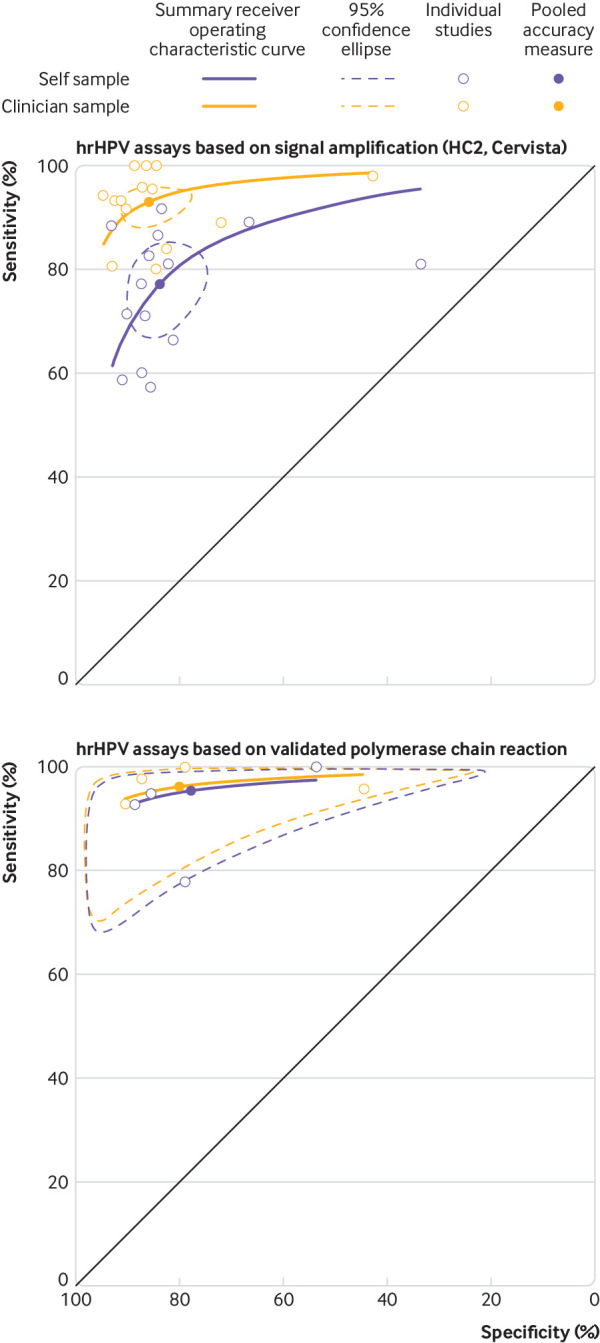
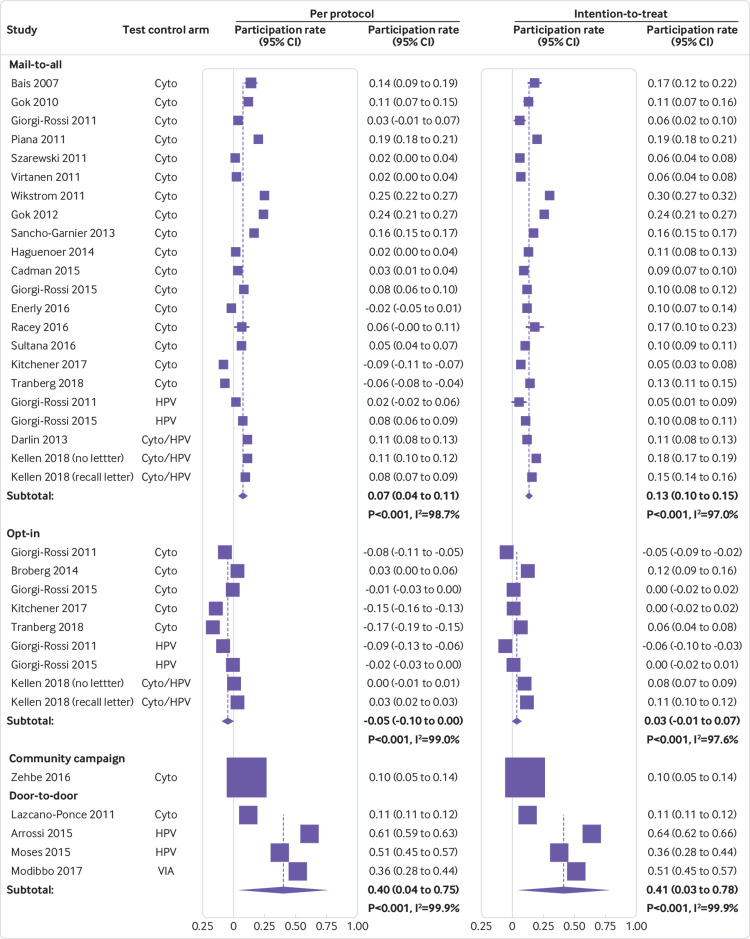
Objective: To evaluate the diagnostic accuracy of high-risk human papillomavirus (hrHPV) assays on self samples and the efficacy of self sampling strategies to reach underscreened women. Design: Updated meta-analysis. Data sources: Medline (PubMed), Embase, and CENTRAL from 1 January 2013 to 15 April 2018 (accuracy review), and 1 January 2014 to 15 April 2018 (participation review). Review methods: Accuracy review: hrHPV assay on a vaginal self sample and a clinician sample; and verification of the presence of cervical intraepithelial neoplasia grade 2 or worse (CIN2+) by colposcopy and biopsy in all enrolled women or in women with positive tests. Participation review: study population included women who were irregularly or never screened; women in the self sampling arm (intervention arm) were invited to collect a self sample for hrHPV testing; women in the control arm were invited or reminded to undergo a screening test on a clinician sample; participation in both arms was documented; and a population minimum of 400 women. Results: 56 accuracy studies and 25 participation trials were included. hrHPV assays based on polymerase chain reaction were as sensitive on self samples as on clinician samples to detect CIN2+ or CIN3+ (pooled ratio 0.99, 95% confidence interval 0.97 to 1.02). However, hrHPV assays based on signal amplification were less sensitive on self samples (pooled ratio 0.85, 95% confidence interval 0.80 to 0.89). The specificity to exclude CIN2+ was 2% or 4% lower on self samples than on clinician samples, for hrHPV assays based on polymerase chain reaction or signal amplification, respectively. Mailing self sample kits to the woman’s home address generated higher response rates to have a sample taken by a clinician than invitation or reminder letters (pooled relative participation in intention-to-treat-analysis of 2.33, 95% confidence interval 1.86 to 2.91). Opt-in strategies where women had to request a self sampling kit were generally not more effective than invitation letters (relative participation of 1.22, 95% confidence interval 0.93 to 1.61). Direct offer of self sampling devices to women in communities that were underscreened generated high participation rates (>75%). Substantial interstudy heterogeneity was noted (I 2 >95%). Conclusions: When used with hrHPV assays based on polymerase chain reaction, testing on self samples was similarly accurate as on clinician samples. Offering self sampling kits generally is more effective in reaching underscreened women than sending invitations. However, since response rates are highly variable among settings, pilots should be set up before regional or national roll out of self sampling strategies.
Overview
AI snapshot
Written from the paper’s full text.
TL;DR
In updated meta-analyses of 56 diagnostic accuracy studies and 25 randomized participation trials, hrHPV testing on self samples was as sensitive as clinician samples when using PCR-based assays, but less sensitive with signal-amplification assays. Mailing self-sampling kits increased participation among underscreened women, though effects varied substantially by invitation strategy and setting.
Key findings
- PCR-based hrHPV assays on self samples were as sensitive as clinician samples for CIN2+ (pooled ratio 0.99, 95% CI 0.97 to 1.02) and CIN3+ (0.99, 0.96 to 1.02), with slightly lower specificity to exclude CIN2+ (0.98, 0.97 to 0.99).
- Signal-amplification hrHPV assays were less sensitive on self samples for CIN2+ (0.85, 0.80 to 0.89) and CIN3+ (0.86, 0.76 to 0.98), and less specific to exclude CIN2+ (0.96, 0.93 to 0.98).
- In intention-to-treat analysis, mailing self-sampling kits to the home increased participation versus invitation/reminder letters (relative participation 2.33, 95% CI 1.86 to 2.91), whereas opt-in strategies were not significantly more effective (1.22, 0.93 to 1.61).
- Door-to-door delivery generated high participation (>75%; pooled self-sampling participation 94.2% per protocol and 94.6% intention-to-treat), and CIN2+ detection per 1000 invited women was higher in self-sampling arms (relative proportion 2.28, 95% CI 1.44 to 3.61).
Methods
- Updated meta-analyses: accuracy review searched Medline, Embase, and CENTRAL from 1 January 2013 to 15 April 2018; participation review searched from 1 January 2014 to 15 April 2018.
- Included 56 diagnostic test accuracy studies comparing hrHPV testing on vaginal self samples versus clinician samples with CIN2+/CIN3+ verification, and 25 randomized trials of self-sampling offers among irregularly/never-screened women with at least 400 women.
- Pooled accuracy using a bivariate normal model for logit-transformed sensitivity/specificity; pooled participation using random-effects models for proportions and ratios; assessed quality with QUADAS-2 and Cochrane risk-of-bias tools.
Limitations
- Stated: meta-analyses based on aggregated published results lacked detailed data equally stratified by potentially influencing factors; meta-regression including only eight studies did not reveal age effects, and subgroup analyses/meta-regressions were not possible because covariates were categorized differently across studies.
- Stated: the authors propose pooling individual patient data from the best trials to evaluate influential factors more efficiently.
- Evident: substantial interstudy heterogeneity was noted (I²>95%), including high heterogeneity for participation outcomes and opt-in results (P<0.001), and quality reporting was incomplete for some domains, such as uninterpretable results poorly reported for evaluated tests (39%) and reference standard (45%).
Model-written summary. Check it against the paper before relying on it.
Integrity signals
Registry
Cites
Statistics
Figures
Verification
Claims the paper makes
52 Own result · 11 Own method · 6 No full text of the sources · 5 Partly supported · 3 Own interpretation · 2 Supported · 2 Supported so far · 2 Not checked yet · 1 Sources not found · 1 No basis given · accuracy not yet measured
The cited sources support only part of this claim — read each source’s verdict below.
In the paper
“The participation was not significantly different when hrHPV testing was performed versus when cytology was performed (P=0.60 v P=0.76).104 117”
§ Detecting cervical precancer and reaching underscreened women by using HPV testing on self samples: updated meta-analyses > Results > Efficacy of invitation scenarios
What the sources say
- Partly supportedcites [104] sourceExperimental — accuracy not yet measured
The Results (‘Effect on compliance’; page unavailable) report similar participation after invitations for clinic-based HPV testing (14.9%) and standard Pap-test recall (13.9%). The Abstract (‘Results’; page unavailable) explicitly calls the difference nonsignificant. Our copy does not report the cited P=0.60 or P=0.76 values; this paper also accounts for only one of the two studies cited. (LLM, conf=0.83)
- Partly supportedcites [117] sourceExperimental — accuracy not yet measured
The Results (page unavailable) report no difference in participation between the cytology and HPV clinic-control groups at one centre. However, the reported P value is 0.9, not 0.60 or 0.76; this source does not support the quoted figures or the claim about two studies. (LLM, conf=0.88)
plain- Asserted: passes — The authors put it forward as true.
- Checkable: passes — It can be checked against evidence.
- Load-bearing: unclear — It is unclear whether the paper’s conclusions depend on it.
- Based: passes — The paper gives a reason why it holds.
- Partly supported
The sources with a verdict support this claim; the rest weren’t checked yet, have no full text we could read, or their verdicts aren’t rated yet.
In the paper
“Third, a proportion of screened women with cervical precancer and cancer show false negative Pap tests.18 19”
§ Detecting cervical precancer and reaching underscreened women by using HPV testing on self samples: updated meta-analyses > Introduction
What the sources say
- Not checked — no full text of the sourcecites [18] source
- Supportedcites [19] Koliopoulos, 2017, Cytology versus HPV testing for cervical cancer screening in the general population, Cochrane Database Syst Rev source
The Rationale section reports that some women who developed cervical cancer had previously had false-negative Pap smears. The Quality of the evidence section also reports false-negative Pap results for CIN 2+ (cervical precancer). (LLM, conf=0.94)
plain- Asserted: passes — The authors put it forward as true.
- Checkable: passes — It can be checked against evidence.
- Load-bearing: passes — The paper’s conclusions depend on it.
- Based: passes — The paper gives a reason why it holds.
The cited sources support only part of this claim — read each source’s verdict below.
In the paper
“In the first control arm (reminder letter) the response rate was 10.5% (95% confidence interval 9.9% to 11.2%)”
§ Detecting cervical precancer and reaching underscreened women by using HPV testing on self samples: updated meta-analyses > Results > Efficacy of invitation scenarios
What the sources say
- Partly supportedcites [69] sourceExperimental — accuracy not yet measured
The Participation section reports that 931 of 8,830 women (10.5%) in the recall-letter control group had a Pap smear within 12 months. Our copy does not report the claimed 95% confidence interval of 9.9% to 11.2%, although it is consistent with the reported counts. (LLM, conf=0.82)
plain- Asserted: passes — The authors put it forward as true.
- Checkable: passes — It can be checked against evidence.
- Load-bearing: unclear — It is unclear whether the paper’s conclusions depend on it.
- Based: passes — The paper gives a reason why it holds.
- Partly supported
The cited sources support only part of this claim — read each source’s verdict below.
In the paper
“Three (12%) of the 25 trials met the criteria for low risk of bias in all categories.114 115 117”
§ Detecting cervical precancer and reaching underscreened women by using HPV testing on self samples: updated meta-analyses > Results > Quality of randomized clinical trials in the participation review
What the sources say
- Partly supportedcites [114] sourceExperimental — accuracy not yet measured
The Design (p. 2) identifies this source as a randomized trial, and Randomization and blinding (p. 4) describes its allocation and blinding procedures. The paper does not assess 25 trials or establish that three met low-risk-of-bias criteria in every category; it supports identifying one trial, not the aggregate claim. (LLM, conf=0.82)
- Could not verifycites [115] sourceExperimental — accuracy not yet measured
The Materials and Methods > Design section describes this paper as a single three-group randomised trial, not an assessment of 25 trials. Searches for “25 trials” and “low risk of bias” found no passage in our copy reporting that three trials (12%) met low-risk criteria in all categories. Page numbers were not available in the indexed passages. (LLM, conf=0.77)
- Could not verifycites [117] sourceExperimental — accuracy not yet measured
The Methods (Analysis and Study design; page unavailable) describe this paper’s own randomized trial, not an assessment of 25 trials. Searches for “25 trials,” “low risk of bias,” and “three trials 12%” found no passage reporting the claimed count or bias rating. (LLM, conf=0.75)
plain- Asserted: passes — The authors put it forward as true.
- Checkable: passes — It can be checked against evidence.
- Load-bearing: unclear — It is unclear whether the paper’s conclusions depend on it.
- Based: passes — The paper gives a reason why it holds.
- Partly supported
The cited sources support only part of this claim — read each source’s verdict below.
In the paper
“whereas in the second control arm (no letter), the response rate was slightly lower (8.0%, 95% confidence interval 7.5% to 8.6%)”
§ Detecting cervical precancer and reaching underscreened women by using HPV testing on self samples: updated meta-analyses > Results > Efficacy of invitation scenarios
What the sources say
- Partly supportedcites [69] sourceExperimental — accuracy not yet measured
The Participation section reports that 709 women (8%) in the no-intervention arm had a PAP smear within 12 months, and the study description identifies this as the second control group. Our copy does not report the claimed 95% confidence interval of 7.5%–8.6% for that rate; the Statistical analysis section discusses confidence intervals for odds ratios instead. Page numbers are not available for these passages. (LLM, conf=0.86)
plain- Asserted: passes — The authors put it forward as true.
- Checkable: passes — It can be checked against evidence.
- Load-bearing: unclear — It is unclear whether the paper’s conclusions depend on it.
- Based: passes — The paper gives a reason why it holds.
- Partly supported
The sources with a verdict support this claim; the rest weren’t checked yet, have no full text we could read, or their verdicts aren’t rated yet.
In the paper
“Second, certain groups of the target population do not attend screening.15 16 17”
§ Detecting cervical precancer and reaching underscreened women by using HPV testing on self samples: updated meta-analyses > Introduction
What the sources say
- Not checked — no full text of the sourcecites [15] source
- Not checked — no full text of the sourcecites [16] source
- Supportedcites [17] source
The Results (Social status) report screening coverage of 40% among women receiving increased health-care reimbursement, compared with 64% among other women in the Belgian target population. The Results (Age groups) also show lower coverage in older target-age groups. These findings support the claim that some groups do not attend screening. (LLM, conf=0.93)
plain- Asserted: passes — The authors put it forward as true.
- Checkable: passes — It can be checked against evidence.
- Load-bearing: passes — The paper’s conclusions depend on it.
- Based: passes — The paper gives a reason why it holds.
The cited sources support only part of this claim — read each source’s verdict below.
In the paper
“Two previous participation meta-analyses showed that sending self sampling kits to a woman’s home address generated greater response rates than invitation or reminder letters.23 24”
§ Detecting cervical precancer and reaching underscreened women by using HPV testing on self samples: updated meta-analyses > Introduction
What the sources say
- Not checked — no full text of the sourcecites [23] source
- Partly supportedcites [24] Racey, 2013, Self-collected HPV Testing Improves Participation in Cervical Cancer Screening: A Systematic Review and Meta-analysis, Can.J.Public Health sourceExperimental — accuracy not yet measured
The Synthesis in our copy (Abstract; page not specified) reports that this meta-analysis found greater screening participation with self-collected HPV testing than with Pap testing. It does not establish the more specific comparison of kits sent to home addresses against invitation or reminder letters, so that part of the claim is unsupported by the available passages. (LLM, conf=0.76)
plaindirect- Asserted: passes — The authors put it forward as true.
- Checkable: passes — It can be checked against evidence.
- Load-bearing: unclear — It is unclear whether the paper’s conclusions depend on it.
- Based: passes — The paper gives a reason why it holds.
Every source the paper cites for this claim was checked and supports it.
In the paper
“We found five studies that provided response rates in both trial arms stratified by categories defined on the screening history status.”
§ Detecting cervical precancer and reaching underscreened women by using HPV testing on self samples: updated meta-analyses > Results > Efficacy of invitation scenarios
What the sources say
- Supportedcites [26] source
The Results section (‘Participation in relation to screening history’; page not available) reports participation comparisons between intervention and control groups for women with different screening histories. The Methods section (‘Statistical analysis’; page not available) also states that participation analyses were stratified by screening history. This paper therefore fits as one of the studies the citing authors identified; the count of five is the citing authors’ own finding. (LLM, conf=0.90)
- Supportedcites [65] source
The Participation (as randomised) section reports participation rates for both trial arms separately for apparently never-screened and under-screened women. This confirms that the cited trial is one study with rates stratified by screening history; the citing authors’ count of five studies is their own finding, not a finding attributed to this paper. (LLM, conf=0.91)
- Supportedcites [103] source
The Results (Participation rate; page unavailable) report response rates in both the self-sampling and recall-control arms, separately for women who had and had not had a smear in the past seven years. This confirms that the cited paper is one study fitting the citing authors’ description; the count of five studies is the citing authors’ own finding. (LLM, conf=0.92)
plain- Asserted: passes — The authors put it forward as true.
- Checkable: passes — It can be checked against evidence.
- Load-bearing: unclear — It is unclear whether the paper’s conclusions depend on it.
- Based: passes — The paper gives a reason why it holds.
- Supported
A result the paper reports from its own data — it cites no other source for it, so there is none to check. The quote shows it is in the paper.
In the paper
“However, in screening studies, where partial verification bias was avoided, the specificity of the hrHPV assay based on signal amplification on self samples was significantly lower (83%) than in studies where verification was not avoided or unclear (87%; P=0.03).”
§ Detecting cervical precancer and reaching underscreened women by using HPV testing on self samples: updated meta-analyses > Results > Accuracy of hrHPV assay
plaincorrelational- Asserted: passes — The authors put it forward as true.
- Checkable: passes — It can be checked against evidence.
- Load-bearing: unclear — It is unclear whether the paper’s conclusions depend on it.
- Based: passes — The paper gives a reason why it holds.
The paper states this without a source or data behind it here, so there is nothing to check it against. The quote shows it is in the paper.
In the paper
“Direct offer of self sampling devices to women in communities that were underscreened generated high participation rates (>75%).”
§ Detecting cervical precancer and reaching underscreened women by using HPV testing on self samples: updated meta-analyses > Abstract > Results
plaindirect- Asserted: passes — The authors put it forward as true.
- Checkable: passes — It can be checked against evidence.
- Load-bearing: passes — The paper’s conclusions depend on it.
- Based: passes — The paper gives a reason why it holds.
- Probably not a substantial claim. 9
- It may state two separate claims as one. 19
- The quote only partly states this claim. 2
Every source the paper cites for this claim was checked and supports it.
In the paper
“We assessed the quality of the randomized clinical trials for the participation review by using the Cochrane Collaboration’s tool for risk of bias in randomized trials.30”
§ Detecting cervical precancer and reaching underscreened women by using HPV testing on self samples: updated meta-analyses > Methods > Study selection, data extraction, and checking
What the sources say
- Supportedcites [30] source
The Additional information section identifies this as the Cochrane Collaboration’s tool for assessing risk of bias in randomised trials. The citation identifies the instrument the citing authors say they used; their use of it in the participation review is not a finding attributed to this source. (LLM, conf=0.93)
plain- Asserted: passes — The authors put it forward as true.
- Checkable: passes — It can be checked against evidence.
- Load-bearing: fails — The paper’s conclusions may not depend on it.
- Based: passes — The paper gives a reason why it holds.
Probably not a substantial claim. The paper’s conclusions may not depend on it.
- Supported
A result the paper reports from its own data — it cites no other source for it, so there is none to check. The quote shows it is in the paper.
In the paper
“Each hrHPV assay based on polymerase chain reaction was equally sensitive for CIN2+ and for CIN3+ on self samples versus clinician samples.”
§ Detecting cervical precancer and reaching underscreened women by using HPV testing on self samples: updated meta-analyses > Results > Accuracy of hrHPV assay
plain- Asserted: passes — The authors put it forward as true.
- Checkable: passes — It can be checked against evidence.
- Load-bearing: passes — The paper’s conclusions depend on it.
- Based: passes — The paper gives a reason why it holds.
It may state two separate claims as one.
A result the paper reports from its own data — it cites no other source for it, so there is none to check. The quote shows it is in the paper.
In the paper
“56 accuracy studies and 25 participation trials were included.”
- Also stated in: § Results · plain
“The updated meta-analyses finally comprised 56 diagnostic test accuracy studies and 25 randomized trials.”
§ Detecting cervical precancer and reaching underscreened women by using HPV testing on self samples: updated meta-analyses > Abstract > Results
plain- Asserted: passes — The authors put it forward as true.
- Checkable: passes — It can be checked against evidence.
- Load-bearing: fails — The paper’s conclusions may not depend on it.
- Based: passes — The paper gives a reason why it holds.
Probably not a substantial claim. The paper’s conclusions may not depend on it. It may state two separate claims as one.
- Also stated in: § Results · plain
A result the paper reports from its own data — it cites no other source for it, so there is none to check. The quote shows it is in the paper.
In the paper
“In general, hrHPV assays were less specific on self samples except for the HC2 assay on a tampon self sample (n=1) or an assay based on polymerase chain reaction on a vaginal lavage self sample (2).”
§ Detecting cervical precancer and reaching underscreened women by using HPV testing on self samples: updated meta-analyses > Results > Accuracy of hrHPV assay
plainSingle case- Asserted: passes — The authors put it forward as true.
- Checkable: passes — It can be checked against evidence.
- Load-bearing: passes — The paper’s conclusions depend on it.
- Based: passes — The paper gives a reason why it holds.
It may state two separate claims as one.
A result the paper reports from its own data — it cites no other source for it, so there is none to check. The quote shows it is in the paper.
In the paper
“The test positivity rate was, on average, 14% higher and the positive predictive value was significantly lower for both CIN2+ and CIN3+ for self samples (positive predictive value< 1).”
§ Detecting cervical precancer and reaching underscreened women by using HPV testing on self samples: updated meta-analyses > Results > Accuracy of hrHPV assay
plaincorrelational- Asserted: passes — The authors put it forward as true.
- Checkable: passes — It can be checked against evidence.
- Load-bearing: unclear — It is unclear whether the paper’s conclusions depend on it.
- Based: passes — The paper gives a reason why it holds.
The quote only partly states this claim.
A result the paper reports from its own data — it cites no other source for it, so there is none to check. The quote shows it is in the paper.
In the paper
“The test positivity rate was similar in self samples versus clinician samples.”
§ Detecting cervical precancer and reaching underscreened women by using HPV testing on self samples: updated meta-analyses > Results > Accuracy of hrHPV assay
plain- Asserted: passes — The authors put it forward as true.
- Checkable: passes — It can be checked against evidence.
- Load-bearing: unclear — It is unclear whether the paper’s conclusions depend on it.
- Based: passes — The paper gives a reason why it holds.
The quote only partly states this claim.
A result the paper reports from its own data — it cites no other source for it, so there is none to check. The quote shows it is in the paper.
In the paper
“The participation difference was nearly always positive except for two studies where the difference was significantly lower than zero.”
§ Detecting cervical precancer and reaching underscreened women by using HPV testing on self samples: updated meta-analyses > Results > Efficacy of invitation scenarios
plain- Asserted: passes — The authors put it forward as true.
- Checkable: passes — It can be checked against evidence.
- Load-bearing: unclear — It is unclear whether the paper’s conclusions depend on it.
- Based: passes — The paper gives a reason why it holds.
It may state two separate claims as one.
A result the paper reports from its own data — it cites no other source for it, so there is none to check. The quote shows it is in the paper.
In the paper
“whereas on average in the intention-to-treat analysis, the pooled relative participation exceeded unity, although not significantly (1.22, 0.93 to 1.61)”
§ Detecting cervical precancer and reaching underscreened women by using HPV testing on self samples: updated meta-analyses > Results > Efficacy of invitation scenarios
plain- Asserted: passes — The authors put it forward as true.
- Checkable: passes — It can be checked against evidence.
- Load-bearing: unclear — It is unclear whether the paper’s conclusions depend on it.
- Based: passes — The paper gives a reason why it holds.
It may state two separate claims as one.
What the paper did — it cites no source for this, so there is none to check. The quote shows it is in the paper.
In the paper
“The quality of verification with a reference standard (acceptable validity, blinding toward tests, and avoidance of incorporating test results in final conclusion of disease outcome) was good in 84%, moderate in 13%, and problematic in 4% of the studies.”
§ Detecting cervical precancer and reaching underscreened women by using HPV testing on self samples: updated meta-analyses > Results > Quality of diagnostic studies in the accuracy review
plain- Asserted: passes — The authors put it forward as true.
- Checkable: passes — It can be checked against evidence.
- Load-bearing: unclear — It is unclear whether the paper’s conclusions depend on it.
- Based: passes — The paper gives a reason why it holds.
It may state two separate claims as one.
What the paper did — it cites no source for this, so there is none to check. The quote shows it is in the paper.
In the paper
“Reporting and execution of tests (description of cut-off, blinding of the index test toward comparator and reference test) was adequate in 73% and unclear in 27%, but the risk of bias was never assessed as high.”
§ Detecting cervical precancer and reaching underscreened women by using HPV testing on self samples: updated meta-analyses > Results > Quality of diagnostic studies in the accuracy review
plain- Asserted: passes — The authors put it forward as true.
- Checkable: passes — It can be checked against evidence.
- Load-bearing: unclear — It is unclear whether the paper’s conclusions depend on it.
- Based: passes — The paper gives a reason why it holds.
It may state two separate claims as one.
What the paper did — it cites no source for this, so there is none to check. The quote shows it is in the paper.
In the paper
“The risk of bias for enrolment of women was considered low in 59%, moderate in 39%, and high in 2% of the 56 diagnostic studies (supplementary materials).”
§ Detecting cervical precancer and reaching underscreened women by using HPV testing on self samples: updated meta-analyses > Results > Quality of diagnostic studies in the accuracy review
plain- Asserted: passes — The authors put it forward as true.
- Checkable: passes — It can be checked against evidence.
- Load-bearing: unclear — It is unclear whether the paper’s conclusions depend on it.
- Based: passes — The paper gives a reason why it holds.
It may state two separate claims as one.
What the paper did — it cites no source for this, so there is none to check. The quote shows it is in the paper.
In the paper
“Withdrawal of patients was explained appropriately in 70%, but not in 18%, and unclear in 12% of the studies.”
§ Detecting cervical precancer and reaching underscreened women by using HPV testing on self samples: updated meta-analyses > Results > Quality of diagnostic studies in the accuracy review
plain- Asserted: passes — The authors put it forward as true.
- Checkable: passes — It can be checked against evidence.
- Load-bearing: unclear — It is unclear whether the paper’s conclusions depend on it.
- Based: passes — The paper gives a reason why it holds.
It may state two separate claims as one.
In the paper
“We assessed the quality of the diagnostic studies for the accuracy review by using the QUADAS-2 check list.29”
§ Detecting cervical precancer and reaching underscreened women by using HPV testing on self samples: updated meta-analyses > Methods > Study selection, data extraction, and checking
What the sources say
- Not checked — no full text of the sourcecites [29] source
plain- Asserted: passes — The authors put it forward as true.
- Checkable: passes — It can be checked against evidence.
- Load-bearing: fails — The paper’s conclusions may not depend on it.
- Based: passes — The paper gives a reason why it holds.
Probably not a substantial claim. The paper’s conclusions may not depend on it.
What the paper did — it cites no source for this, so there is none to check. The quote shows it is in the paper.
In the paper
“The delay between self sampling, clinician sampling, and verification with the reference standard was short in 61%, unreported in 38%, and long in 2% of the studies.”
§ Detecting cervical precancer and reaching underscreened women by using HPV testing on self samples: updated meta-analyses > Results > Quality of diagnostic studies in the accuracy review
plain- Asserted: passes — The authors put it forward as true.
- Checkable: passes — It can be checked against evidence.
- Load-bearing: unclear — It is unclear whether the paper’s conclusions depend on it.
- Based: passes — The paper gives a reason why it holds.
It may state two separate claims as one.
None of the sources cited for this claim have been checked yet.
In the paper
“The meta-analyses followed PRISMA guidelines for reporting of meta-analyses, and recommendations established by the Cochrane Collaboration for diagnostic test accuracy and intervention trials.31 32”
§ Detecting cervical precancer and reaching underscreened women by using HPV testing on self samples: updated meta-analyses > Methods > Statistical methods
What the sources say
- Not checked — no full text of the sourcecites [31] Moher, 2009, Preferred reporting items for systematic reviews and meta-analyses: the PRISMA statement, Ann Intern Med source
- Not matchedcites [32] Deeks, 2013
Couldn’t be matched to a paper in Crossref, so it can’t be checked.
plain- Asserted: passes — The authors put it forward as true.
- Checkable: passes — It can be checked against evidence.
- Load-bearing: fails — The paper’s conclusions may not depend on it.
- Based: passes — The paper gives a reason why it holds.
Probably not a substantial claim. The paper’s conclusions may not depend on it. It may state two separate claims as one.
What the paper did — it cites no source for this, so there is none to check. The quote shows it is in the paper.
In the paper
“All trials had complete data for the participation outcome and were therefore at low risk of attrition bias.”
§ Detecting cervical precancer and reaching underscreened women by using HPV testing on self samples: updated meta-analyses > Results > Quality of randomized clinical trials in the participation review
plaindirect- Asserted: passes — The authors put it forward as true.
- Checkable: passes — It can be checked against evidence.
- Load-bearing: unclear — It is unclear whether the paper’s conclusions depend on it.
- Based: passes — The paper gives a reason why it holds.
It may state two separate claims as one.
None of the sources cited for this claim have been checked yet.
In the paper
“However, recent trend analyses reveal an increasing burden of cervical cancer, even in countries with well organized screening programs based on cytology and good coverage.8 9 10 11 12”
§ Detecting cervical precancer and reaching underscreened women by using HPV testing on self samples: updated meta-analyses > Introduction
What the sources say
- Not checked — no full text of the sourcecites [8] source
- Not checked — no full text of the sourcecites [9] source
- Not matchedcites [10] Finnish Cancer Registry. Cancer Statistics. Cancer Society of Finland. https://cancerregistry.fi/statistics/cancer-statistics/
Couldn’t be matched to a paper in Crossref, so it can’t be checked.
plaincorrelational- Asserted: passes — The authors put it forward as true.
- Checkable: passes — It can be checked against evidence.
- Load-bearing: fails — The paper’s conclusions may not depend on it.
- Based: passes — The paper gives a reason why it holds.
Probably not a substantial claim. The paper’s conclusions may not depend on it.
A claim is checked only against the cited paper’s full text, never its abstract, and none is available for its sources.
In the paper
“We assessed publication bias by using Deeks' and Harbord's regression tests for the pooled absolute and relative accuracy estimates, respectively.36 37”
§ Detecting cervical precancer and reaching underscreened women by using HPV testing on self samples: updated meta-analyses > Methods > Statistical methods
What the sources say
plain- Asserted: passes — The authors put it forward as true.
- Checkable: passes — It can be checked against evidence.
- Load-bearing: fails — The paper’s conclusions may not depend on it.
- Based: passes — The paper gives a reason why it holds.
Probably not a substantial claim. The paper’s conclusions may not depend on it.
In the paper
“The previous accuracy meta-analysis concluded that hrHPV testing was less sensitive on self samples than on clinician samples, but also found that the reason for lower sensitivity was the use of assays based on signal amplification.22”
§ Detecting cervical precancer and reaching underscreened women by using HPV testing on self samples: updated meta-analyses > Introduction
What the sources say
- Not checked — no full text of the sourcecites [22] source
plaindirect- Asserted: passes — The authors put it forward as true.
- Checkable: passes — It can be checked against evidence.
- Load-bearing: passes — The paper’s conclusions depend on it.
- Based: passes — The paper gives a reason why it holds.
Probably not a substantial claim. It may state two separate claims as one.
What the paper did — it cites no source for this, so there is none to check. The quote shows it is in the paper.
In the paper
“Partial verification was avoided in 70% but clearly present in 25%, whereas differential verification was absent in 89% but unclear or present in 11% of the studies.”
§ Detecting cervical precancer and reaching underscreened women by using HPV testing on self samples: updated meta-analyses > Results > Quality of diagnostic studies in the accuracy review
boosted- Asserted: passes — The authors put it forward as true.
- Checkable: passes — It can be checked against evidence.
- Load-bearing: unclear — It is unclear whether the paper’s conclusions depend on it.
- Based: passes — The paper gives a reason why it holds.
It may state two separate claims as one.
In the paper
“hrHPV testing provides another advantage: it can be done on vaginal samples collected by the patient (self samples), whereas cytology on self samples shows poor accuracy.21”
§ Detecting cervical precancer and reaching underscreened women by using HPV testing on self samples: updated meta-analyses > Introduction
What the sources say
- Not checked — no full text of the sourcecites [21] source
plain- Asserted: passes — The authors put it forward as true.
- Checkable: passes — It can be checked against evidence.
- Load-bearing: passes — The paper’s conclusions depend on it.
- Based: passes — The paper gives a reason why it holds.
It may state two separate claims as one.
What the paper did — it cites no source for this, so there is none to check. The quote shows it is in the paper.
In the paper
“MA and one other author (SBS, ST, FS, or a Collaboration on Self-Sampling and HPV Testing group member) independently performed the study selection and data extraction. PC judged any unresolvable discordances.”
§ Detecting cervical precancer and reaching underscreened women by using HPV testing on self samples: updated meta-analyses > Methods > Study selection, data extraction, and checking
plain- Asserted: passes — The authors put it forward as true.
- Checkable: passes — It can be checked against evidence.
- Load-bearing: fails — The paper’s conclusions may not depend on it.
- Based: passes — The paper gives a reason why it holds.
Probably not a substantial claim. The paper’s conclusions may not depend on it. It may state two separate claims as one.
In the paper
“Most cervical cancer cases occur in women who have never been screened for cervical cancer, or do not participate in routine screening.7”
§ Detecting cervical precancer and reaching underscreened women by using HPV testing on self samples: updated meta-analyses > Introduction
What the sources say
- Not matchedcites [7] IARC, 2005
Couldn’t be matched to a paper in Crossref, so it can’t be checked.
plaincorrelational- Asserted: passes — The authors put it forward as true.
- Checkable: passes — It can be checked against evidence.
- Load-bearing: passes — The paper’s conclusions depend on it.
- Based: passes — The paper gives a reason why it holds.
It may state two separate claims as one.
- Not matched
What the paper did — it cites no source for this, so there is none to check. The quote shows it is in the paper.
In the paper
“The quality of reporting was adequate in 12 trials (48%),26 67 102 103 104 107 108 109 114 115 116 117 118 incomplete in one trial,106 and intermediate in the other trials.”
§ Detecting cervical precancer and reaching underscreened women by using HPV testing on self samples: updated meta-analyses > Results > Quality of randomized clinical trials in the participation review
plain- Asserted: passes — The authors put it forward as true.
- Checkable: passes — It can be checked against evidence.
- Load-bearing: fails — The paper’s conclusions may not depend on it.
- Based: passes — The paper gives a reason why it holds.
Probably not a substantial claim. The paper’s conclusions may not depend on it. It may state two separate claims as one.
What the paper did — it cites no source for this, so there is none to check. The quote shows it is in the paper.
In the paper
“In eight trials (32%) allocation was random and concealed,26 63 64 65 104 114 115 117 in 14 trials (56%) allocation was unclear,66 67 102 103 105 106 107 108 109 110 111 112 113 116 and in three trials (12%) allocation was problematic.62 68 69”
§ Detecting cervical precancer and reaching underscreened women by using HPV testing on self samples: updated meta-analyses > Results > Quality of randomized clinical trials in the participation review
plain- Asserted: passes — The authors put it forward as true.
- Checkable: passes — It can be checked against evidence.
- Load-bearing: unclear — It is unclear whether the paper’s conclusions depend on it.
- Based: passes — The paper gives a reason why it holds.
It may state two separate claims as one.
The paper relies on this without support.
Intention-to-treat analyses of participation trials reflect the overall public health effect in a real world situation.
“In the intention-to-treat analyses, which reflected the overall public health effect in a real world situation, we additionally included women in the experimental arm who had been offered self sampling but choose to have a clinician sample taken instead.”
The paper relies on this without support.
New assays, self sampling devices, storage media, and participation strategies have entered the market since the publication of the two previous meta-analyses, and more accuracy and participation studies have been conducted.
“New assays, self sampling devices, storage media, and participation strategies have entered the market since the publication of these two meta-analyses; and more accuracy and participation studies have been conducted.”
Claims other papers make about this one
Each is checked against this paper’s own text: does it say what the citing paper says it does?
The source backs part of the claim, not all of it — or backs it for a different population, condition or comparison.
In the citing paper
“Encouragingly, there is promising evidence supporting the potential of a self-sampling approach to increase screening participation in under-screened and never-screened women and the efficacy of a single-dose vaccine to facilitate straightforward implementation of the programs.[144][145][146]”
From Global cancer statistics 2022: GLOBOCAN estimates of incidence and mortality worldwide for 36 cancers in 185 countries. (2024) · cites this paper as [145]
Experimental — accuracy not yet measuredThe source backs part of the claim, not all of it — or backs it for a different population, condition or comparison.
In the citing paper
“as shown by multiple previous studies, the Roche Cobas 4800 assay is known for having a relatively high sensitivity compared with other HPV assays (12, 13, 17).”
From Comparison between the Roche Cobas 4800 Human Papillomavirus (HPV), Abbott RealTime High-Risk HPV, Seegene Anyplex II HPV28, and Novel Seegene Allplex HPV28 Assays for High-Risk HPV Detection and Genotyping in Mocked Self-Samples (2023) · cites this paper as [12]
Experimental — accuracy not yet measuredThe source backs part of the claim, not all of it — or backs it for a different population, condition or comparison.
In the citing paper
“An additional and significant benefit of HPV-based screening is that vaginal samples collected via self-collection, hereafter referred to as self-collection, can detect HPV at levels indicative of precancer of the cervix (cervical intraepithelial neoplasia grade 2 or above—CIN2+) as accurately as cervical samples collected using a speculum by a clinician.8”
From Protocol for a cervical screening implementation trial comparing two approaches for delivering HPV self-collection in low-resource settings in India: a type 3 hybrid cluster randomised controlled trial (SHE-CAN) (2025) · cites this paper as [8]
Experimental — accuracy not yet measuredThe cited source says what the claim attributes to it.
In the citing paper
“Polymerase chain reaction (PCR) based HPV assays to detect high-risk HPVs are as accurate on HPV self-samples as the clinician collected samples [8].”
From Performance of HPV Self-Sample Collected by a Novel Kit in Comparison with Clinician Collected Sample for Cervical Cancer Screening (2024) · cites this paper as [8]
The cited source says what the claim attributes to it.
In the citing paper
“This has led to improved screening rates among unscreened women.8 9 16 18 48”
Self-check
Percentages, sums and reported differences re-computed from the paper’s own numbers.
Each contradiction between two passages listed here was confirmed by an independent check.
Rated minor: it would not touch a result — a value no result rests on, a p-value that stays on the same side of the significance level, or a conflict that is clerical, resolved elsewhere in the paper, or outside its own findings.
In the paper
§ Detecting cervical precancer and reaching underscreened women by using HPV testing on self samples: updated meta-analyses > Results > Accuracy of hrHPV assay
“an assay based on polymerase chain reaction on a vaginal lavage self sample (2)”
§ Detecting cervical precancer and reaching underscreened women by using HPV testing on self samples: updated meta-analyses > Results > Accuracy of hrHPV assay
“| Lavage† | 4 | 0.95 (0.87 to 1.04) | 1.09 (0.91 to 1.30) |”
Citations
Cites
Preferred Reporting Items for Systematic Reviews and Meta-Analyses: the PRISMA statement
Moher, D., Liberati, A., Tetzlaff, J., Altman, D. G., & for the PRISMA Group (2009) · BMJ · doi:10.1136/bmj.b2535 · Cited by 83,823
Measuring inconsistency in meta-analyses
Higgins, J. P. T., Thompson, S. G., Deeks, J. J., & Altman, D. G. (2003) · BMJ · doi:10.1136/bmj.327.7414.557 · Cited by 63,139
Preferred reporting items for systematic reviews and meta-analyses: the PRISMA Statement.
(2009) · PubMed Central · Cited by 44,859
Meta-analysis in clinical trials
DerSimonian, R., & Laird, N. (1986) · Controlled Clinical Trials · doi:10.1016/0197-2456(86)90046-2 · Cited by 39,552
Preferred reporting items for systematic reviews and meta-analyses: The PRISMA statement
Moher, D., Liberati, A., Tetzlaff, J., Altman, D. G., & the PRISMA Group* (2009) · Annals of Internal Medicine · doi:10.7326/0003-4819-151-4-200908180-00135 · Cited by 37,554
The Cochrane Collaboration's tool for assessing risk of bias in randomised trials
Higgins, J. P. T., Altman, D. G., Gotzsche, P. C., Juni, P., Moher, D., Oxman, A. D., Savovic, J., Schulz, K. F., Weeks, L., Sterne, J. A. C., et al. (2011) · BMJ · doi:10.1136/bmj.d5928 · Cited by 33,817
QUADAS-2: a revised tool for the quality assessment of diagnostic accuracy studies
Whiting, P. F., Rutjes, A. W. S., Westwood, M. E., Mallett, S., Deeks, J. J., Reitsma, J. B., Leeflang, M. M. G., Sterne, J. A. C., Bossuyt, P. M. M., & the QUADAS-2 Group* (2011) · Annals of Internal Medicine · doi:10.7326/0003-4819-155-8-201110180-00009 · Cited by 14,199
Deeks, J. J., Macaskill, P., & Irwig, L. (2005) · Journal of Clinical Epidemiology · doi:10.1016/j.jclinepi.2005.01.016 · Cited by 2,910
Metaprop: a Stata command to perform meta-analysis of binomial data
Nyaga, V. N., Arbyn, M., & Aerts, M. (2014) · Archives of Public Health · doi:10.1186/2049-3258-72-39 · Cited by 2,139
Self-citationRonco, G., Dillner, J., Elfström, K. M., Tunesi, S., Snijders, P. J. F., Arbyn, M., Kitchener, H., Segnan, N., Gilham, C., Giorgi-Rossi, P., et al. (2014) · The Lancet · doi:10.1016/s0140-6736(13)62218-7 · Cited by 1,810
Self-citation
Research works printed but not linked: 2
- IARC, 2005, Cervix Cancer Screening. IARC Handbooks of Cancer Prevention. Vol. 10
- Deeks, 2013, Cochrane Handbook for Systematic Reviews of Diagnostic Test Accuracy Version 1.0.0.
Cited by
Sorted by citations
Sung, H., Ferlay, J., Siegel, R. L., Laversanne, M., Soerjomataram, I., Jemal, A., & Bray, F. (2021) · CA: A Cancer Journal for Clinicians · doi:10.3322/caac.21660 · Cited by 108,699
Bray, F., Laversanne, M., Sung, H., Ferlay, J., Siegel, R. L., Soerjomataram, I., & Jemal, A. (2024) · CA: a cancer journal for clinicians · doi:10.3322/caac.21834 · Cited by 27,064
Estimates of incidence and mortality of cervical cancer in 2018: a worldwide analysis
Arbyn, M., Weiderpass, E., Bruni, L., de Sanjosé, S., Saraiya, M., Ferlay, J., & Bray, F. (2019) · The Lancet Global Health · doi:10.1016/s2214-109x(19)30482-6 · Cited by 4,465
Self-citationSingh, D., Vignat, J., Lorenzoni, V., Eslahi, M., Ginsburg, O., Lauby-Secretan, B., Arbyn, M., Basu, P., Bray, F., & Vaccarella, S. (2023) · The Lancet Global Health · doi:10.1016/s2214-109x(22)00501-0 · Cited by 1,616
“38,39 Surveillance system and health infrastructures, developed to monitor the COVID-19 pandemic could be customised to improve HPV vaccination, the monitoring of national cervical cancer screening programmes, and to improve health system capacity to deliver more efficient preventive services.”
Self-citationEstimates of the global burden of cervical cancer associated with HIV
Stelzle, D., Tanaka, L. F., Lee, K. K., Khalil, A. I., Baussano, I., Shah, A. S. V., McAllister, D., Gottlieb, S. L., Klug, S. J., Winkler, A. S., et al. (2020) · The Lancet Global Health · doi:10.1016/s2214-109x(20)30459-9 · Cited by 1,004
Smith, R. A., Andrews, K. S., Brooks, D. D., Fedewa, S. A., Manassaram‐Baptiste, D., Saslow, D., & Wender, R. C. (2019) · CA A Cancer Journal for Clinicians · doi:10.3322/caac.21557 · Cited by 747
Canfell, K., Kim, J. J., Brisson, M., Keane, A., Simms, K. T., Caruana, M., Burger, E. A., Martin, D., Nguyen, D. T. N., Bénard, É., et al. (2020) · The Lancet · doi:10.1016/s0140-6736(20)30157-4 · Cited by 650
The IARC Perspective on Cervical Cancer Screening
Bouvard, V., Wentzensen, N., Mackie, A., Berkhof, J., Brotherton, J., Giorgi-Rossi, P., Kupets, R., Smith, R., Arrossi, S., Bendahhou, K., et al. (2021) · New England Journal of Medicine · doi:10.1056/nejmsr2030640 · Cited by 357
Self-citationSelf-sampling for human papillomavirus (HPV) testing: a systematic review and meta-analysis
Yeh, P. T., Kennedy, C. E., Vuyst, H. D., & Narasimhan, M. (2019) · BMJ Global Health · doi:10.1136/bmjgh-2018-001351 · Cited by 348
“Four systematic reviews of randomised trials in the context of population-based screening programmes showed that offering high-risk HPV self-sampling to never-screened and underscreened women increased participation compared with inviting women to have samples taken by health professionals.(12) 14–16 In order to devel…”
BackgroundMethodResultInfluentialMaver, P. J., & Poljak, M. (2019) · Clinical Microbiology and Infection · doi:10.1016/j.cmi.2019.09.006 · Cited by 319
Worldwide use of HPV self-sampling for cervical cancer screening
Serrano, B., Ibáñez, R., Robles, C., Peremiquel‐Trillas, P., de Sanjosé, S., & Bruni, L. (2021) · Preventive Medicine · doi:10.1016/j.ypmed.2021.106900 · Cited by 298
2020 list of human papillomavirus assays suitable for primary cervical cancer screening
Arbyn, M., Simon, M., Peeters, E., Xu, L., Meijer, C. J. L. M., Berkhof, J., Cuschieri, K., Bonde, J., Ostrbenk Vanlencak, A., Zhao, F.-H., et al. (2021) · Clinical Microbiology and Infection · doi:10.1016/j.cmi.2021.04.031 · Cited by 284
Self-citationCervical cancer prevention and control in women living with human immunodeficiency virus
Castle, P. E., Einstein, M. H., & Sahasrabuddhe, V. V. (2021) · CA A Cancer Journal for Clinicians · doi:10.3322/caac.21696 · Cited by 224
Self-citationChanges in Cancer Screening in the US During the COVID-19 Pandemic
Fedewa, S. A., Star, J., Bandi, P., et al. (2022) · JAMA Network Open · doi:10.1001/jamanetworkopen.2022.15490 · Cited by 174
Li, Z., Liu, P., Yin, A., Zhang, B., Xu, J., Chen, Z., Zhang, Z., Zhang, Y., Wang, S., Tang, L., et al. (2025) · International Journal of Cancer · doi:10.1002/ijc.35369 · Cited by 200
“45 Cervical cancer continues to be a major public health challenge in LMICs, where limited resources and fragile health systems impede access to essential services such as HPV vaccination and primary HPV testing.”
Miller, M. J., Xu, L., Qin, J., et al. (2021) · MMWR Morbidity and Mortality Weekly Report · doi:10.15585/mmwr.mm7004a1 · Cited by 164
Kyrgiou, M., Arbyn, M., Bergeron, C., Bosch, F. X., Dillner, J., Jit, M., Kim, J., Poljak, M., Nieminen, P., Sasieni, P. D., et al. (2020) · British Journal of Cancer · doi:10.1038/s41416-020-0920-9 · Cited by 168
Self-citationCosta, S., Verberckmoes, B., Castle, P. E., & Arbyn, M. (2023) · British Journal of Cancer · doi:10.1038/s41416-022-02094-w · Cited by 139
“The search strategy is identical to the one used in the previous review and is available in the supplementary materials [10].”
MethodInfluentialSelf-citationEun, T. J., & Perkins, R. B. (2020) · Medical Clinics of North America · doi:10.1016/j.mcna.2020.08.006 · Cited by 155
Wentzensen, N., Clarke, M. A., & Perkins, R. B. (2021) · Preventive Medicine · doi:10.1016/j.ypmed.2021.106596 · Cited by 136
“Large metaanalyses have demonstrated similar accuracy of PCR-based HPV testing from self-collected and clinician-collected samples (Arbyn et al., 2018).”
ResultUpdates on cervical cancer prevention
Viveros-Carreño, D. A., Fernándes, A., & Pareja, R. (2023) · International Journal of Gynecological Cancer · doi:10.1136/ijgc-2022-003703 · Cited by 131
The European response to the WHO call to eliminate cervical cancer as a public health problem
Arbyn, M., Gültekin, M., Morice, P., Nieminen, P., Cruickshank, M. E., Poortmans, P. M., Kelly, D. M., Poljak, M., Bergeron, C., Ritchie, D., et al. (2020) · International Journal of Cancer · doi:10.1002/ijc.33189 · Cited by 123
Self-citationArbyn, M., Simon, M., de Sanjosé, S., Clarke, M. A., Poljak, M., Rezhake, R., Berkhof, J. H., Nyaga, V. N., Gültekin, M., Canfell, K., et al. (2022) · The Lancet Oncology · doi:10.1016/s1470-2045(22)00294-7 · Cited by 130
Self-citationProjected time to elimination of cervical cancer in the USA: a comparative modelling study
Burger, E. A., Smith, M. A., Killen, J., Sy, S., Simms, K. T., Canfell, K., & Kim, J. J. (2020) · The Lancet Public Health · doi:10.1016/s2468-2667(20)30006-2 · Cited by 112
Arbyn, M., Castle, P. E., SCHIFFMAN, M. H., Wentzensen, N., Heckman‐Stoddard, B. M., & Sahasrabuddhe, V. V. (2022) · International Journal of Cancer · doi:10.1002/ijc.33967 · Cited by 108
Self-citationSimms, K. T., Keane, A., Nguyen, D. T. N., Caruana, M., Hall, M. T., Lui, G., Gauvreau, C., Demke, O., Arbyn, M., Basu, P., et al. (2023) · Nature Medicine · doi:10.1038/s41591-023-02600-4 · Cited by 105
Self-citationCost-effectiveness studies of HPV self-sampling: A systematic review
Malone, C., Barnabas, R. V., Buist, D. S. M., Tiro, J. A., & Winer, R. L. (2020) · Preventive Medicine · doi:10.1016/j.ypmed.2019.105953 · Cited by 106
“A recent meta-analysis of 19 randomized trials found this “direct mail” method significantly increased screening uptake among underscreened women compared to usual care Pap invitations.[27] “Opt-in” HPV-SS is a variation in which women Malone et al.”
BackgroundResultInfluentialInturrisi, F., Aitken, C. A., Melchers, W. J. G., van den Brule, A. J. C., Molijn, A. C., Hinrichs, J. W. J., Niesters, H. G. M., Siebers, A. G., Schuurman, R., Heideman, D. A. M., et al. (2021) · The Lancet Regional Health - Europe · doi:10.1016/j.lanepe.2021.100235 · Cited by 104
“However, that study had a smaller sample size and used a signal amplification test for self-collected samples, which is known to be inferior to target amplification [7].”
BackgroundMethodResultInfluentialWiner, R. L., Lin, J. W., Tiro, J. A., Miglioretti, D. L., Beatty, T. C., Gao, H., Kimbel, K. J., Thayer, C., & Buist, D. S. M. (2019) · JAMA Network Open · doi:10.1001/jamanetworkopen.2019.14729 · Cited by 104
Cancer Screening in the United States During the Second Year of the COVID-19 Pandemic
Star, J., Bandi, P., Siegel, R. L., Han, X., Minihan, A. K., Smith, R. A., & Jemal, A. (2023) · Journal of Clinical Oncology · doi:10.1200/jco.22.02170 · Cited by 92
Advances in cervical cancer prevention: Efficacy, effectiveness, elimination?
Sundström, K., & Elfström, K. M. (2020) · PLoS Medicine · doi:10.1371/journal.pmed.1003035 · Cited by 98
Self-Collection for Cervical Screening Programs: From Research to Reality
Hawkes, D. J., Keung, M. H. T., Huang, Y., McDermott, T. L., Romano, J., Saville, M., & Brotherton, J. M. L. (2020) · Cancers · doi:10.3390/cancers12041053 · Cited by 89
“The meta-analysis by Arbyn [10] determined that careHPV was significantly less sensitive for HPV associated with CIN2+ lesions when a self-collected sample was used rather than a clinician-collected sample.”
BackgroundMethodResultInfluentialCubie, H., & Campbell, C. (2020) · Women s Health · doi:10.1177/1745506520914804 · Cited by 92
Perkins, R. B., Guido, R. L., Saraiya, M., et al. (2021) · Journal of Women s Health · doi:10.1089/jwh.2020.8918 · Cited by 85
Daponte, N., Valasoulis, G., Michail, G., Magaliou, I., Daponte, A.-I., Garas, A., Grivea, I., Bogdanos, D. P., & Daponte, A. (2023) · Cancers · doi:10.3390/cancers15061669 · Cited by 84
“Adequate f-u rates might be influenced by triage policy: studies with direct patient referral exhibit higher attendance at f-u care than studies with a triage policy [21].”
BackgroundMethodInfluentialHuman Papilloma Virus self-sampling performance in low- and middle-income countries
Mulki, A. K., & Withers, M. H. (2021) · BMC Women s Health · doi:10.1186/s12905-020-01158-4 · Cited by 87
The importance of long-term follow up of participants in clinical trials
Cuzick, J. (2023) · British Journal of Cancer · doi:10.1038/s41416-022-02038-4 · Cited by 101
“Several studies have also shown that HPV testing can be done on a vaginal self-sample or a urine sample, and achieves similar sensitivity for high-grade CIN, although specificity was somewhat lower [17].”
BackgroundYang, L. P. H., Boily, M., Rönn, M. M., Obiri‐Yeboah, D., Morhason-Bello, I. O., Méda, N., Lompo, O., Mayaud, P., Pickles, M., Brisson, M., et al. (2023) · PLoS Medicine · doi:10.1371/journal.pmed.1004143 · Cited by 83
Shin, M., Liu, G., Mugo, N., Garcia, P. J., Rao, D. W., Broshkevitch, C. J., Eckert, L. O., Pinder, L. F., Wasserheit, J. N., & Barnabas, R. V. (2021) · Frontiers in Public Health · doi:10.3389/fpubh.2021.670032 · Cited by 81
“…user-friendly, rapid, equipment-free, delivered) (87, 137), and has a point-of-care platform (138), it requires batch testing (106), which enables same-day treatment only under special circumstances, such as health campaigns, and the sensitivity is significantly lower with self-sampling (109).”
Desai, K. T., Befano, B., Xue, Z., Kelly, H. A., Campos, N. G., Egemen, D., Gage, J. C., Rodríguez, A. C., Sahasrabuddhe, V. V., Levitz, D., et al. (2021) · International Journal of Cancer · doi:10.1002/ijc.33879 · Cited by 76
“However, to avoid overtreatment, HPV positivity is best followed by triage testing to identify the minority of HPV infections linked to precancer.(7) Deep learning (DL)-based automated visual evaluation (AVE) of cervical images is emerging as an alternative novel, low-cost screening”
BackgroundMethodArrossi, S., Paolino, M., Laudi, R., Gago, J. E., Campanera, A., Marín, O., Falcón, C., Serra, V., Herrero, R., & Thouyaret, L. (2019) · The Lancet Global Health · doi:10.1016/s2214-109x(19)30048-8 · Cited by 78
Zhao, S., Huang, L., Basu, P. S., Domingo, E. J., Supakarapongkul, W., Ling, W. Y., Ocviyanti, D., Rezhake, R., Qiao, Y., Tay, E. H., et al. (2021) · Cancer Letters · doi:10.1016/j.canlet.2021.10.036 · Cited by 75
Ložar, T., Nagvekar, R., Rohrer, C. T., Mandishora, R. S. D., Ivanuš, U., & Fitzpatrick, M. B. (2021) · International Journal of Women s Health · doi:10.2147/ijwh.s288376 · Cited by 74
“to clinician-collected samples (96%) for detection of CIN2.(9) The improved diagnostic accuracy of self-sampling using PCR-based HPV-testing assays has led to some countries, such as Australia, the Netherlands, and Denmark,(93,94)”
BackgroundMethodResultInfluentialvan den Helder, R., Steenbergen, R. D. M., van Splunter, A., et al. (2022) · Clinical Cancer Research · doi:10.1158/1078-0432.ccr-21-3710 · Cited by 70
Pretsch, P. K., Spees, L. P., Brewer, N. T., Hudgens, M. G., Sanusi, B. O., Rohner, E., Miller, E. M., Jackson, S., Barclay, L. B., Carter, A., et al. (2023) · The Lancet Public Health · doi:10.1016/s2468-2667(23)00076-2 · Cited by 70
Cervical cancer prevention in transgender men: a review
Weyers, S., Garland, S. M., Cruickshank, M. E., Kyrgiou, M., & Arbyn, M. (2020) · BJOG An International Journal of Obstetrics & Gynaecology · doi:10.1111/1471-0528.16503 · Cited by 93
Self-citationKeer, S. V., Peeters, E., Broeck, D. V., Sutter, P. D., Donders, G. G. G., Doyen, J., Tjalma, W. A. A., Weyers, S., Vorsters, A., & Arbyn, M. (2021) · Gynecologic Oncology · doi:10.1016/j.ygyno.2021.06.010 · Cited by 68
Self-citationCohen, M. A., Powell, A. M., Coleman, J. S., Keller, J. M., Livingston, A. G., & Anderson, J. (2020) · American Journal of Obstetrics and Gynecology · doi:10.1016/j.ajog.2020.06.006 · Cited by 69
Achieving cervical cancer elimination among Indigenous women
Whop, L. J., Smith, M. A., Butler, T., Adcock, A., Bartholomew, K., Goodman, M. T., Winer, R. L., Milosevic, E., & LAWTON, B. A. (2021) · Preventive Medicine · doi:10.1016/j.ypmed.2020.106314 · Cited by 68
Ørnskov, D., Jochumsen, K. M., Steiner, P., Grunnet, I. M., Lykkebo, A. W., & Waldstrøm, M. (2021) · BMJ Open · doi:10.1136/bmjopen-2020-041512 · Cited by 66
“30 31”
InfluentialGennaro, G. D., Licata, F., Trovato, A., & Bianco, A. (2022) · Frontiers in Public Health · doi:10.3389/fpubh.2022.1003461 · Cited by 73
“found similar results when comparing opt-out self-samplers distribution with a reminder letter/advice from HCP to have a clinician to collect the sample (9).”
BackgroundResultInfluentialPauw, H. D., Donders, G. G. G., Weyers, S., Sutter, P. D., Doyen, J., Tjalma, W. A. A., Broeck, D. V., Peeters, E., Keer, S. V., Vorsters, A., et al. (2021) · Archives of Public Health · doi:10.1186/s13690-021-00667-4 · Cited by 63
“Moreover, randomised participation trials have shown that the offer of a self-sampling kit generates higher response rates than conventional invitations to have a screening specimen taken by a clinician [11].”
BackgroundInfluentialSelf-citationBrandt, T., Wubneh, S. B., Handebo, S., Debalkie, G., Ayanaw, Y., Alemu, K., Jede, F., Doeberitz, M. V. K., & Bussmann, H. (2019) · BMC Public Health · doi:10.1186/s12889-019-7354-4 · Cited by 65
Vink, F. J., Lissenberg-Witte, B. I., Meijer, C. J. L. M., Berkhof, J. H., van Kemenade, F. J., Siebers, A. G., Steenbergen, R. D. M., Bleeker, M. C. G., & Heideman, D. A. M. (2020) · Clinical Microbiology and Infection · doi:10.1016/j.cmi.2020.03.018 · Cited by 60
Boon, S. S., Luk, H. Y., Xiao, C.-Y., Chen, Z., & Chan, P. K. S. (2022) · Cancers · doi:10.3390/cancers14122913 · Cited by 69
“Self-sampling has become popular and acceptable among women as this method is convenient, flexible, and can be performed in a variety of settings, while avoiding the need to perform a pelvic examination and the awkwardness, particularly among women in a conservative society [54].”
BackgroundSturt, A. S., Webb, E. L., Phiri, C. R., et al. (2020) · PLoS neglected tropical diseases · doi:10.1371/journal.pntd.0008337 · Cited by 61
“Self-sampling has been used for diagnosis of reproductive tract infections, including human papillomavirus (HPV) [22].”
BackgroundInfluentialGravitt, P. E., Silver, M. I., Hussey, H. M., Arrossi, S., Huchko, M. J., Jerónimo, J., Kapambwe, S. K., Kumar, S., Meza, G., Nervi, L., et al. (2021) · Preventive Medicine · doi:10.1016/j.ypmed.2020.106322 · Cited by 64
“…community or health facilities for primary screening which increases coverage (an even more attractive option in a post-COVID-19 pandemic world), (Arbyn et al., 2018) (2) eliminate the need for speculum exams for 80–90% of women (lower cost, increased acceptability), (de Sanjose and Holme, 2019)…”
BackgroundCho, H.-W., Shim, S. R., Lee, J. K., et al. (2021) · Journal of Gynecologic Oncology · doi:10.3802/jgo.2022.33.e4 · Cited by 60
Wentzensen, N., Massad, L. S., Clarke, M. A., Garcia, F. M. P., Smith, R. A., Murphy, J., Guido, R. S., Reyes, A., Phillips, S. M., Berman, N. R., et al. (2025) · Journal of Lower Genital Tract Disease · doi:10.1097/lgt.0000000000000885 · Cited by 62
Cadman, L., Reuter, C., Jitlal, M., Kleeman, M., Austin, J., Hollingworth, T., Parberry, A. L., Ashdown-Barr, L., Patel, D., Nedjai, B., et al. (2021) · Cancer Epidemiology Biomarkers & Prevention · doi:10.1158/1055-9965.epi-20-1226 · Cited by 60
Saville, M., Hawkes, D. J., Keung, M. H. T., Ip, E. W. K., Silvers, J., Sultana, F., Malloy, M., Velentzis, L. S., l, K. C., Wrede, C. D., et al. (2020) · Journal of Clinical Virology · doi:10.1016/j.jcv.2020.104375 · Cited by 60
Self-citationFisher‐Borne, M., Isher-Witt, J., Comstock, S. E., et al. (2021) · Preventive Medicine · doi:10.1016/j.ypmed.2021.106681 · Cited by 59
Urine collection in cervical cancer screening – analytical comparison of two HPV DNA assays
Tranberg, M., Jensen, J. S., Bech, B. H., & Andersen, B. S. (2020) · BMC Infectious Diseases · doi:10.1186/s12879-020-05663-7 · Cited by 62
Strategies to Increase Cervical Cancer Screening With Mailed Human Papillomavirus Self-Sampling Kits
Winer, R. L., Lin, J. W., Anderson, M. L., Tiro, J. A., Green, B. B., Gao, H., Meenan, R. T., Hansen, K., Sparks, A., & Buist, D. S. M. (2023) · JAMA · doi:10.1001/jama.2023.21471 · Cited by 58
Lim, A. W., Gambell, J., Gambell, J., Lawrence, A., Lei, J., Lyons, M., North, B., Parmar, D., Patel, H., Waller, J., et al. (2024) · EClinicalMedicine · doi:10.1016/j.eclinm.2024.102672 · Cited by 57
Vallely, A. J., Saville, M., Badman, S. G., Gabuzzi, J., Bolnga, J. W., Mola, G., Kuk, J., Wai, M., Munnull, G., Garland, S. M., et al. (2022) · The Lancet Global Health · doi:10.1016/s2214-109x(22)00271-6 · Cited by 60
Ong, S. K., Abe, S. K., Thilagaratnam, S., Haruyama, R., Pathak, R. S., Jayasekara, H., Togawa, K., Bhandari, A. K. C., Shankar, A., Nessa, A., et al. (2023) · The Lancet Regional Health - Western Pacific · doi:10.1016/j.lanwpc.2023.100860 · Cited by 57
Kundrod, K. A., Barra, M., Wilkinson, A. F., Smith, C. A., Natoli, M. E., Chang, M. M., Coole, J. B., Santhanaraj, A., Lorenzoni, C. F., Mavume, C., et al. (2023) · Science Translational Medicine · doi:10.1126/scitranslmed.abn4768 · Cited by 56
Self-citationLong-term CIN3+ risk of HPV positive women after triage with FAM19A4/miR124-2 methylation analysis
Dick, S., Kremer, W. W., Strooper, L. M. A. D., Lissenberg-Witte, B. I., Steenbergen, R. D. M., Meijer, C. J. L. M., Berkhof, J. H., & Heideman, D. A. M. (2019) · Gynecologic Oncology · doi:10.1016/j.ygyno.2019.06.002 · Cited by 55
Cervical screening during the COVID-19 pandemic: optimising recovery strategies
Castañón, A., Rebolj, M., Burger, E. A., de Kok, I. M. C. M., Smith, M. A., Hanley, S. J. B., Carozzi, F. M., Peacock, S. J., & O’Mahony, J. F. (2021) · The Lancet Public Health · doi:10.1016/s2468-2667(21)00078-5 · Cited by 55
Ciavattini, A., Carpini, G. D., Giannella, L., et al. (2020) · International Journal of Gynecological Cancer · doi:10.1136/ijgc-2020-001617 · Cited by 51
Self-citationLefeuvre, C., Pivert, A., Guillou‐Guillemette, H. L., Lunel, F., Veillon, P., Duc-Banaszuk, A.-S. L., & Ducancelle, A. (2020) · Journal of Infection · doi:10.1016/j.jinf.2020.05.006 · Cited by 51
Rebolj, M., Cuschieri, K. S., Mathews, C. S., Pesola, F., Denton, K. J., & Kitchener, H. C. (2022) · BMJ · doi:10.1136/bmj-2021-068776 · Cited by 49
Keer, S. V., Latsuzbaia, A., Broeck, D. V., Sutter, P. D., Donders, G. G. G., Doyen, J., Tjalma, W. A. A., Weyers, S., Arbyn, M., & Vorsters, A. (2022) · Journal of Clinical Virology · doi:10.1016/j.jcv.2022.105271 · Cited by 51
Self-citationGavinski, K., & DiNardo, D. J. (2022) · Medical Clinics of North America · doi:10.1016/j.mcna.2022.10.006 · Cited by 59
Desai, K. T., Ajenifuja, K. O., Banjo, A. A. F., et al. (2020) · Infectious Agents and Cancer · doi:10.1186/s13027-020-00324-5 · Cited by 49
“Also, HC2 is not generally used for self-sampling, as it is slightly less sensitive for detection of precancer than PCR-based HPV test methods [37].”
BackgroundSelf-citationMacDonald, E. J., GELLER, S. E., Sibanda, N., Stevenson, K., Denmead, L., Adcock, A., Cram, F., Hibma, M. H., Sykes, P. H., & LAWTON, B. A. (2020) · Australian and New Zealand Journal of Obstetrics and Gynaecology · doi:10.1111/ajo.13285 · Cited by 51
Cancer Screening in the Coronavirus Pandemic Era: Adjusting to a New Situation
Basu, P. S., Alhomoud, S. J., Taghavi, K., Carvalho, A. L., Lucas, E., & Baussano, I. (2021) · JCO Global Oncology · doi:10.1200/go.21.00033 · Cited by 48
“HPV testing obtained without a gynecologic examination, by women themselves either at home or clinic, provides a reliable result.(17) The kits for self-collection may be sent by post or distributed by the community health workers.”
BackgroundCervical cancer in Nepal: Current screening strategies and challenges
Narasimhamurthy, M., & Kafle, S. U. (2022) · Frontiers in Public Health · doi:10.3389/fpubh.2022.980899 · Cited by 56
Elfström, M. K., Sundström, K., Andersson, S., Bzhalava, Z., Carlsten‐Thor, A., Gzoul, Z., Öhman, D., Lamin, H., Eklund, C., Dillner, J., et al. (2019) · International Journal of Cancer · doi:10.1002/ijc.32374 · Cited by 49
“kits for human papillomavirus (HPV) testing to women has been proposed, with some promising results on attendance.(7)”
BackgroundAlmonte, M., Murillo, R., Sánchez, G. I., et al. (2020) · BMJ Open · doi:10.1136/bmjopen-2019-035796 · Cited by 47
Introduction of HPV testing for cervical cancer screening in Central America: The Scale-Up project
Holme, F., Jerónimo, J., Maldonado, F., Camel, C., Sandoval, M., Martinez-Granera, B., Montenegro, M., Figueroa, J., Slavkovsky, R. C., Thomson, K. A., et al. (2020) · Preventive Medicine · doi:10.1016/j.ypmed.2020.106076 · Cited by 51
Dutton, T., Marjoram, J., Burgess, S., Montgomery, L., Vail, A., Callan, N., Jacob, S., Hawkes, D. J., Saville, M., & Bailey, J. (2020) · BMC Health Services Research · doi:10.1186/s12913-020-05214-5 · Cited by 49
Cervical cancer risk profiling: molecular biomarkers predicting the outcome of hrHPV infection
Molina, M. A., Diatricch, L. C., Quintana, M. C., Melchers, W. J. G., & Andralojc, K. M. (2020) · Expert Review of Molecular Diagnostics · doi:10.1080/14737159.2020.1835472 · Cited by 46
Creagh, N. S., Zammit, C. M., Brotherton, J. M. L., Saville, M., McDermott, T. L., Nightingale, C. E., & Kelaher, M. (2021) · The Medical Journal of Australia · doi:10.5694/mja2.51137 · Cited by 44
Cervical Cancer Screening Recommendations: Now and for the Future
Rayner, M., Welp, A. M., Stoler, M. H., & Cantrell, L. A. (2023) · Healthcare · doi:10.3390/healthcare11162273 · Cited by 60
“Newer advancements in HPV testing have led to the development of selfcollected sampling modalities that have been found to have similar rates of accuracy when compared to clinician-collected tests [40].”
BackgroundResultAasbø, G., Tropé, A., Nygård, M., Christiansen, I. K., Baasland, I., Iversen, G. A., Munk, A. C., Christiansen, M. H., Presthus, G. K., Undem, K., et al. (2022) · British Journal of Cancer · doi:10.1038/s41416-022-01954-9 · Cited by 45
“When used with HPV assays based on polymerase chain reaction (PCR), selfsampling and HPV testing identifies women with cervical precancer and cancer, cervical intraepithelial neoplasia grade 2 or more severe diagnoses (CIN2+), with similar accuracy as clinician-collected samples [15, 16].”
BackgroundMethodResultInfluentialSelf-citationSecondary Prevention of Cervical Cancer: ASCO Resource–Stratified Guideline Update
Shastri, S. S., Temin, S., Almonte, M., Basu, P. S., Campos, N. G., Gravitt, P. E., Gupta, V., Lombe, D. C., Murillo, R., Nakisige, C., et al. (2022) · JCO Global Oncology · doi:10.1200/go.22.00217 · Cited by 46
Self-citationCervical Cancer Screening—Past, Present, and Future
Wentzensen, N., & Clarke, M. A. (2021) · Cancer Epidemiology Biomarkers & Prevention · doi:10.1158/1055-9965.epi-20-1628 · Cited by 42
“Results from a large meta-analysis have demonstrated similar accuracy of HPV testing using PCR-based HPV tests from selfcollected samples and clinician-collected samples (14).”
Urine HPV in the Context of Genital and Cervical Cancer Screening—An Update of Current Literature
Daponte, A. I., Michail, G., Daponte, A., Daponte, A., & Valasoulis, G. (2021) · Cancers · doi:10.3390/cancers13071640 · Cited by 47
“Implementing sensitive screening modalities combined with easy sampling methods with minimal pain or discomfort bypassing the doctors’ visit, such as self-sampling of vaginal and urine samples, is feasible and possibly cost-effective [18].”
BackgroundInfluentialSmith, M. A., Burger, E. A., Castañón, A., de Kok, I. M. C. M., Hanley, S. J. B., Rebolj, M., Hall, M. T., Jansen, E. E. L., Killen, J., O'Farrell, X., et al. (2021) · Preventive Medicine · doi:10.1016/j.ypmed.2021.106623 · Cited by 43
“Self-sampling is also more acceptable to under- and never-screened women than clinician collection, and so provides a tool to reach the women most vulnerable to screening disruptions (Arbyn et al., 2018).”
BackgroundTesting for Human Papillomaviruses in Urine, Blood, and Oral Specimens: an Update for the Laboratory
Poljak, M., Cuschieri, K. S., Alemany, L., & Vorsters, A. (2023) · Journal of Clinical Microbiology · doi:10.1128/jcm.01403-22 · Cited by 44
Arbyn, M., Costa, S., Latsuzbaia, A., Kellen, E., Rossi, P. G., Cocuzza, C. E., Basu, P. S., & Castle, P. E. (2023) · Cancer Epidemiology Biomarkers & Prevention · doi:10.1158/1055-9965.epi-22-1041 · Cited by 41
Self-citationPatterns in the prevalence and wealth-based inequality of cervical cancer screening in India
Muthuramalingam, M. R., & Muraleedharan, V. R. (2023) · BMC Women's Health · doi:10.1186/s12905-023-02504-y · Cited by 40
Preventive care recommendations to promote health equity
Persaud, N., Sabir, A., Woods, H., Sayani, A., Agarwal, A., Chowdhury, M., de Leon-Demare, K., Ibezi, S., Jan, S. H., Katz, A., et al. (2023) · Canadian Medical Association Journal · doi:10.1503/cmaj.230237 · Cited by 46
Dick, S., Verhoef, L., Strooper, L. M. A. D., Ciocănea‐Teodorescu, I., Wisman, G. B. A., Meijer, C. J. L. M., Bleeker, M. C. G., Steenbergen, R. D. M., & Heideman, D. A. M. (2020) · Epigenomics · doi:10.2217/epi-2019-0331 · Cited by 39
Macios, A., & Nowakowski, A. M. (2022) · Diagnostics · doi:10.3390/diagnostics12061508 · Cited by 38
“Recently published studies suggested that proper test selection for self-sampling results in a sensitivity comparable with cliniciansampling; therefore, sampling errors will be of less importance [114].”
BackgroundBarriers to Cervical Cancer Screening: A Systematic Review
Farajimakin, O. (2024) · Cureus · doi:10.7759/cureus.65555 · Cited by 38
“These methods can increase access to screening for women who face geographical, cultural, or personal barriers to clinic-based screening [18].”
What is needed now for successful scale-up of screening?
de Sanjosé, S., & Holme, F. (2019) · Papillomavirus Research · doi:10.1016/j.pvr.2019.04.011 · Cited by 42
“Implementing self-sampling(4) of vaginal cells allows accurate detection of HPV infection and provides an opportunity to maximize coverage in low-resource settings compared to provider-collected samples of cervical cells [8,9].”
BackgroundZhao, X., Xu, X., Duan, X., Rezhake, R., Hu, S., Wang, Y., Xia, C., Zhang, X., Qiao, Y., Sankaranarayanan, R., et al. (2020) · International Journal of Cancer · doi:10.1002/ijc.32881 · Cited by 38
“0%) of clinically validated PCR HPV tests on self-samples.(6) Our study underlines the current understanding that a PCR-based HPV test is superior to signal amplification-based test in self-sampling based screening and demonstrated that PCR-based HPV test is potentially doable in rural China.”
Background
Metadata
- Authors
- Arbyn, M., Smith, S. B., Temin, S., Sultana, F., & Castle, P.
- Affiliations
- Sciensano (Belgium) (BE)
- American Society of Clinical Oncology (US)
- The University of Melbourne (AU)
- Albert Einstein College of Medicine (US)
- Corresponding author
- Arbyn, Marc
- Venue
- BMJ
- Publisher
- BMJ
- Published
- 2018-12-05
- Volume
- 363
- Pages
- k4823
- ISSN
- 1756-1833 (ISSN-L)
- 0959-8138
- PMC
- PMC6278587
- OpenAlex
- W2902810541
- Semantic Scholar
- 19a6b46f3981556042ef796240496a98ab9d26f6
- Cited by
- 851
- References
- 130
- Citations by year
- 2026: 93 · 2025: 136 · 2024: 136 · 2023: 137 · 2022: 116 · 2021: 104 · 2020: 89 · 2019: 39
- FWCI
- 39.55
- Type
- journal article
- Language
- en
- Open access
- hybrid
- doi.org
- Licence
- Locations
- BMJ (publishedVersion, cc-by-nc)
- PubMed (publishedVersion)
- Europe PMC (PubMed Central) (submittedVersion, other-oa)
- PubMed Central (submittedVersion, cc-by-nc)
- HighWire Press Open Archive (submittedVersion)
- Topics
- Health Sciences › Medicine › Epidemiology › Cervical Cancer and HPV Research
- Health Sciences › Medicine › Public Health, Environmental and Occupational Health › Women's cancer prevention and management
- Life Sciences › Immunology and Microbiology › Microbiology › Reproductive tract infections research
- Keywords
- cervical cancer screening, HPV testing, self-sampling, cervical intraepithelial neoplasia, CIN2+ detection, diagnostic accuracy, underscreened women, screening uptake, reminder letters, clinician-collected samples, community-based screening
- MeSH terms
- Uterine Cervical Dysplasia, Uterine Cervical Neoplasms, Colposcopy, Female, Humans, Mass Screening, Sensitivity and Specificity, Specimen Handling, Vagina, Vaginal Smears, Incidence, Randomized Controlled Trials as Topic, Papillomaviridae, Papillomavirus Infections, Early Detection of Cancer, Intention to Treat Analysis
About these checks
Registry, retraction, Cites and statistics results are computed, not judged, with one exception: a printed reference that no index lists is read once by a model before it counts as a citation error. Claims are extracted by a model and kept only when their quote appears verbatim in the text; each cited source is then checked, with a model’s help, for whether it says what the claim relies on. Those verdicts can be wrong — read the claim’s quote and the cited source before relying on one.
A language model drew the claims from the paper on 2026-10-16, under version 3 of the claim definition (model deepseek-v4.1-flash, prompt extract-v3).
A second model labelled each claim on 2026-10-16 (model jev-1.13-20260917, definition revision gold-guideline-v0.2).
Cited sources are checked with a language model’s help (gpt-6-sol).
Statistics and arithmetic are recomputed, not judged.
Confidence bands are shown only for fields calibrated on our annotated test set. None is calibrated yet, so no band is shown.
What counts as a claim ›How we measure confidence ›How we check this ›
Are you an author, or do you see a problem with this page? Request a review
