

A systematic review of newborn health interventions in humanitarian settings
Open accessThe DOI matches its Crossref record; 60 of the 63 references it cites were found in a registry or an index, and 2 are not checked yet; 27 of the 103 sources its claims cite were checked for support.
Abstract
Background: Almost half of the under-5 deaths occur in the neonatal period and most can be prevented with quality newborn care. The already vulnerable state of newborns is exacerbated in humanitarian settings. This review aims to assess the current evidence of the interventions being provided in these contexts, identify strategies that increase their utilisation and their effects on health outcomes in order to inform involved actors in the field and to guide future research. Methods: Searched for peer-reviewed and grey literature in four databases and in relevant websites, for published studies between 1990 and 15 November 2021. Search terms were related to newborns, humanitarian settings, low-income and middle-income countries and newborn health interventions. Quality assessment using critical appraisal tools appropriate to the study design was conducted. Data were extracted and analysed using a narrative synthesis approach. Results: A total of 35 articles were included in this review, 33 peer-reviewed and 2 grey literature publications. The essential newborn care (ENC) interventions reported varied across the studies and only three used the Newborn Health in Humanitarian Settings: Field Guide as a guideline document. The ENC interventions most commonly reported were thermal care and feeding support whereas delaying of cord clamping and administration of vitamin K were the least. Training of healthcare workers was the most frequent strategy reported to increase utilisation. Community interventions, financial incentives and the provision of supplies and equipment were also reported. Conclusion: There is insufficient evidence documenting the reality of newborn care in humanitarian settings in low-income and middle-income countries. There is a need to improve the reporting of these interventions, including when there are gaps in service provision. More evidence is needed on the strategies used to increase their utilisation and the effect on health outcomes. PROSPERO registration number: CRD42020199639.
Verified 2026-10-06 · 2 references not checked yet
Overview
CoChat Summary
TL;DR
This systematic review assessed evidence on newborn health interventions in humanitarian settings in low-income and middle-income countries, including strategies to increase utilisation and effects on health outcomes. It found 35 included articles, varied essential newborn care reporting, training of health workers as the most common strategy, and insufficient evidence on intervention effectiveness.
Key findings
- The review included 35 articles: 33 peer-reviewed and 2 grey literature publications. Quality was rated high for 48.6% (n=17), medium for 37.1% (n=13), and low for 14.3% (n=5). Thermal care and feeding support were the most commonly reported essential newborn care (ENC) interventions, while delaying cord clamping and administration of vitamin K were the least; only three studies used the Newborn Health in Humanitarian Settings: Field Guide as a guideline document.
- Training of healthcare workers was the most frequent strategy reported to increase utilisation, followed by community interventions, financial incentives, and provision of supplies and equipment. Examples include increased early breastfeeding initiation by 53.6% (95% CI 46.4 to 60.9, p<0.001) after training in Somalia, vitamin K administration rising to 60% after training and supplies, and in Myanmar increased skin-to-skin contact (PRR=2.70, 95% CI 1.93 to 3.78) and postnatal care visits (PRR=2.07, 95% CI 1.81 to 2.37) through community-based providers.
- Most studies did not assess interventions’ effect on newborn health outcomes. Among outcome findings reported, mortality due to asphyxia in South Sudan decreased from 30.7% pre-training to 17.9% one year post-training (p=0.001), and neonatal mortality in a Thailand refugee camp declined by 51% from 21.8 to 10.7 deaths per 1000 live births (p=0.04).
- The evidence came from 21 LMICs, mostly conflict-affected areas (n=27), with 16 studies at community level, 14 at primary healthcare centres, and 11 in hospitals. Most included studies specifically focused on newborn health (n=15), nine focused on the maternal-newborn continuum, and 11 focused on general sexual and reproductive health, maternal care, or nutrition while including some newborn care interventions.
Methods
- Systematic review following PRISMA and registered in PROSPERO (CRD42020199639). Peer-reviewed literature was searched in Medline, Embase, Global Health, and PsycINFO, plus grey literature websites, for publications from 1 January 1990 to 15 November 2021 in English, Portuguese, Spanish, or French.
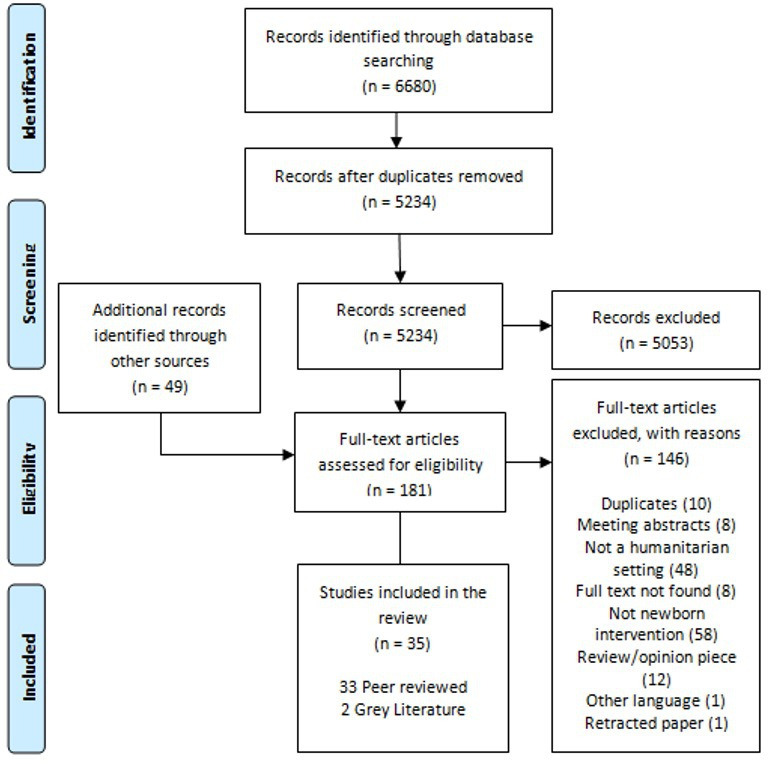
- Inclusion criteria covered newborns aged 0–28 days in humanitarian settings in LMICs, interventions directly aimed at newborn health as defined by the Minimum Initial Service Package and Field Guide, and quantitative, qualitative, or mixed methods studies reporting empirical data. The search identified 5234 records; 181 full texts were screened and 35 articles were included.
- Data were extracted and analysed using narrative synthesis. Quality was critically appraised with design-specific tools, and scores were converted to percentages and rated low (0%–33%), medium (34%–66%), or high (>67%).
Limitations
- The paper states that interventions implemented by local governments and smaller organisations may be less likely to be documented, evaluated, and published; inconsistent reporting may not represent what is actually implemented; heterogeneity of organisations and aid delivery models limits conclusions; varied contexts may limit generalisability; and the review did not cover all continuum-of-care interventions from preconception to postpartum, so it may have missed overlapping intrapartum interventions.
- The paper also states that most pre-post studies lacked a control group and assessed training through post-training knowledge tests and observations rather than newborn health outcomes, and that overall strength of evidence is low due to lack of experimental or quasi-experimental designs, sufficient adjustment for confounders, and evidence of attribution.
- Evident from the text: use of different critical appraisal tools across study designs made quality difficult to compare across studies, and the five studies using the Field Guide were conducted by only two authors in two countries.
Model-written summary. Check it against the paper before relying on it.
Integrity signals
Registry
Cites
Statistics
Figures
Verification
Claims the paper makes
15 Valid · 3 Not valid · 65 Not checked · 55 Own results and interpretations
The cited sources support only part of this claim — read each source’s verdict below.
In the paper
“From the previous systematic reviews focusing on the effectiveness, utilisation of and evaluation of SRH services and programmes,2 16 17 only one reported a study where ENC was evaluated.2”
§ A systematic review of newborn health interventions in humanitarian settings > Introduction
What the sources say
- Could not verifycites [2] matched to “Sleep and use of electronic devices in adolescence: results from a large population-based study” (2015) sourceExperimental — accuracy not yet measured
The Methods (Study population and Statistics; page unavailable) describe a survey of adolescents’ electronic-device use and sleep, not a review of SRH services. Searches for ENC, SRH programmes, and the claimed count of reviews found no passage addressing the claim in our copy. (LLM, conf=0.78)
- Not checked yetcites [16] Casey SE. Evidence for the implementation of contraceptive services in humanitarian settings. Diss Abstr Int Sect B Sci Eng 2017; 77 http://ovidsp.ovid.com/ovidweb.cgi?T=JS&PAGE=reference&D=psyc14&NEWS=N&AN=2016-53072-171
- Partly supportedcites [17] Singh NS, Aryasinghe S, Smith J, et al. A long way to go: a systematic review to assess the utilisation of sexual and reproductive health services during humanitarian crises. BMJ Glob Health 2018; 3: 1– 12. 10.1136/bmjgh-2017-000682 PMC5935157 29736272 sourceExperimental — accuracy not yet measured
The Results section (‘Maternal and newborn health including obstetric care’; page not available) reports one study assessing use of neonatal and child care services through breastfeeding stations in Haiti. It does not identify that study as an evaluation of essential newborn care (ENC), so the more specific claim is not established by this source. (LLM, conf=0.78)
plain- Asserted: passes — The authors put it forward as true.
- Checkable: passes — It can be checked against evidence.
- Load-bearing: passes — The paper’s conclusions depend on it.
- Based: passes — The paper gives a reason why it holds.
- Could not verify
The cited sources support only part of this claim — read each source’s verdict below.
In the paper
“Skin-to-skin contact was not generally reported as being practised, and when practised, its frequency varied across levels of care.28 31 36 48”
§ A systematic review of newborn health interventions in humanitarian settings > Results > Essential newborn care
What the sources say
- Partly supportedcites [28] Gee S, Vargas J, Foster AM. "The more children you have, the more praise you get from the community": exploring the role of sociocultural context and perceptions of care on maternal and newborn health among Somali refugees in UNHCR supported camps in Kenya. Confl Health 2019; 13: 11. 10.1186/s13031-019-0195-z 30976297 PMC6440025 sourceExperimental — accuracy not yet measured
The Results > Postnatal section ('Newborn umbilical and thermal care') supports the first half of the citing sentence: health staff report strong resistance to early skin-to-skin care, informal kangaroo mother care attempts had been unsuccessful, and midwives say mothers rarely hold the baby in the hours after birth. However, that passage (and every other passage in our copy, searched for 'skin-to-skin/kangaroo mother care', 'levels of care', 'thermal care') describes only facility/postnatal-ward practice in general and nowhere compares frequency of skin-to-skin contact across levels of care (e.g. health posts vs. the four hospitals vs. the stand-alone maternity centre, mentioned only in the Introduction's 'Dadaab context'). The 'varied across levels of care' element attributed to this source is not supported by our copy. (LLM, conf=0.75)
- Supportedcites [31] Sami S, Kerber K, Kenyi S, et al. State of newborn care in South Sudan's displacement camps: a descriptive study of facility-based deliveries. Reprod Health 2017; 14: 161. 10.1186/s12978-017-0417-z 29187210 PMC5707872 source
The Results section 'Delivery and immediate postnatal practices' (p. on Table 4) states that in the first hour after birth a significantly higher proportion of mothers placed their newborn skin-to-skin in the hospital (88.9%) than the PHCC (49.7%), p = 0.000, and that among those providing skin-to-skin the median duration also differed by level of care (12 min, IQR 8–20, hospital vs 1 min, IQR 1–10, PHCC). The Discussion reiterates that skin-to-skin contact immediately after delivery was more common at hospital than PHCC level, and Table 5 includes skin-to-skin within the thermal-care and feeding-support components that differed by facility type. This directly supports the attributed point that, where practised, skin-to-skin frequency varied across levels of care. (LLM, conf=0.85)
- Partly supportedcites [36] Amsalu R, Morris CN, Chukwumalu K, et al. Essential newborn care practice at four primary health facilities in conflict affected areas of Bossaso, Somalia: a cross-sectional study. Confl Health 2019; 13: 1– 13. 10.1186/s13031-019-0202-4 31210781 PMC6567601 sourceExperimental — accuracy not yet measured
The Results section (Essential newborn care by health facility, Table 4/Fig. 2) supports the first half of the sentence: skin-to-skin contact 'was rare, with only 8.6% (95% CI: 5.4, 12.9) observed', and its frequency did vary significantly, from 1.9% at Facility 1 to 29.5% at Facility 4 (p < 0.001). However, that variation is between four facilities of the same level — the Methods (Study Sites & Study Population) state all four purposely selected sites are primary health centres in Bossaso, and the Discussion reports 'significant variation by health facility'. The cross-level difference the claim attributes ('across levels of care') is not this paper's finding: the Discussion credits it to another work, noting 'a study in South Sudan ... had lower proportions of women practicing skin-to-skin contact at the primary health facility level as compared to the hospital [26]'. So the 'varied across levels of care' element is unsupported by this source's own data. (LLM, conf=0.80)
plainstates an association- Asserted: passes — The authors put it forward as true.
- Checkable: passes — It can be checked against evidence.
- Load-bearing: unclear — It is unclear whether the paper’s conclusions depend on it.
- Based: passes — The paper gives a reason why it holds.
- Partly supported
The cited sources support only part of this claim — read each source’s verdict below.
In the paper
“Hand washing was reported in five studies and its level of practice varied across settings.36 46 49 52 55”
§ A systematic review of newborn health interventions in humanitarian settings > Results > Essential newborn care
What the sources say
- Supportedcites [36] Amsalu R, Morris CN, Chukwumalu K, et al. Essential newborn care practice at four primary health facilities in conflict affected areas of Bossaso, Somalia: a cross-sectional study. Confl Health 2019; 13: 1– 13. 10.1186/s13031-019-0202-4 31210781 PMC6567601 source
The Discussion reports significant variation in handwashing practice across the four health facilities studied. The Results also report that handwashing varied by facility (p < 0.001). (LLM, conf=0.93)
- Supportedcites [46] Hoogenboom G, Thwin MM, Velink K, et al. Quality of intrapartum care by skilled birth attendants in a refugee clinic on the Thai-Myanmar border: a survey using who safe motherhood needs assessment. BMC Pregnancy Childbirth 2015; 15: 17. 10.1186/s12884-015-0444-0 25652646 PMC4332741 source
The Results section (‘Support and hygiene’) reports hand-washing practice at the refugee clinic: at least one attendant washed her hands in 15 of 20 observed births, but all attendants did so in only one. This supports the paper’s inclusion as one of the studies reporting a level of hand-washing practice; the variation across settings is the citing authors’ synthesis of the five studies. (LLM, conf=0.88)
- Partly supportedcites [49] Lam JO, Amsalu R, Kerber K, et al. Neonatal survival interventions in humanitarian emergencies: a survey of current practices and programs. Confl Health 2012; 6: 2– 9. 10.1186/1752-1505-6-2 22824461 PMC3488319 sourceExperimental — accuracy not yet measured
The Results > Childbirth services section reports that 80.4% of surveyed organizations promoted hand-washing with soap and water before handling a newborn. This supports identifying the paper as one that reports on hand-washing, but it measures promotion rather than actual practice and does not establish how practice varied across settings. (LLM, conf=0.84)
plain- Asserted: passes — The authors put it forward as true.
- Checkable: passes — It can be checked against evidence.
- Load-bearing: unclear — It is unclear whether the paper’s conclusions depend on it.
- Based: passes — The paper gives a reason why it holds.
- Supported
Every source the paper cites for this claim was checked and supports it.
In the paper
“Four studies present high percentages of EBI being practised among women in the assessed hospitals, PHCCs and communities31 50 59 60; and one from a community in Uganda reports a lower percentage.48”
§ A systematic review of newborn health interventions in humanitarian settings > Results > Essential newborn care
What the sources say
- Supportedcites [48] Komakech H, Lubogo D, Nabiwemba E, et al. Essential newborn care practices and determinants amongst mothers of infants aged 0-6 months in refugee settlements, Adjumani district, West Nile, Uganda. PLoS One 2020; 15: e0231970. 10.1371/journal.pone.0231970 32324787 PMC7179823 source
The Results (Table 2; page unavailable) report that 57% of respondents initiated breastfeeding on time. The Discussion (page unavailable) specifies that this meant within one hour of birth and describes the rate as much lower than the 97.7% reported in another study. (LLM, conf=0.93)
plain- Asserted: passes — The authors put it forward as true.
- Checkable: passes — It can be checked against evidence.
- Load-bearing: unclear — It is unclear whether the paper’s conclusions depend on it.
- Based: passes — The paper gives a reason why it holds.
- Supported
Every source the paper cites for this claim was checked and supports it.
In the paper
“and in Myanmar this practice increased (10.1%–27.2%) with the creation of a network of trained community-based providers.59”
§ A systematic review of newborn health interventions in humanitarian settings > Results > Essential newborn care
What the sources say
- Supportedcites [59] Mullany LC, Lee TJ, Yone L, et al. Impact of community-based maternal health workers on coverage of essential maternal health interventions among internally displaced communities in eastern Burma: the mom project. PLoS Med 2010; 7: e1000317– 11. 10.1371/journal.pmed.1000317 20689805 PMC2914639 source
Table 3 in the Results reports that skin-to-skin care increased from 10.1% at baseline to 27.2% at endline. The Methods describe the MOM project’s three-tiered network of trained community-based providers in eastern Burma (Myanmar), and the Discussion associates the project with increased skin-to-skin contact. (LLM, conf=0.94)
plainstates a cause- Asserted: passes — The authors put it forward as true.
- Checkable: passes — It can be checked against evidence.
- Load-bearing: unclear — It is unclear whether the paper’s conclusions depend on it.
- Based: passes — The paper gives a reason why it holds.
- Supported
63 more claims · 9 with their cited sources checked
Create a free account to see all 138 claims and to verify the 76 references still open.
- Probably not a substantial claim. 30
- It may state two separate claims as one. 52
Claims other papers make about this one
Each is checked against this paper’s own text: does it say what the citing paper says it does?
The cited source says what the claim attributes to it.
In the citing paper
“Few studies have been published on the implementation of newborn care in vulnerable communities such as those in humanitarian settings (33, 34).”
Self-check
Percentages, sums and reported differences re-computed from the paper’s own numbers.
Each contradiction between two passages listed here was confirmed by an independent check.
Rated major: it would touch a result — a value a result rests on, reported and recomputed p-values on opposite sides of the significance level, two passages that conflict with no sign which is right, or a cited work retracted before this paper was published.
In the paper
“−15.0 (95% CI −22.7 to 7.4) a year after. P<0.001 for both.”
§ A systematic review of newborn health interventions in humanitarian settings > Results > Study design and quality
Reported 0.001 · recomputed 30.1
Rated minor: it would not touch a result — a value no result rests on, a p-value that stays on the same side of the significance level, or a conflict that is clerical, resolved elsewhere in the paper, or outside its own findings.
In the paper
§ A systematic review of newborn health interventions in humanitarian settings > Results
“the remaining 4 were published before 2010”
§ A systematic review of newborn health interventions in humanitarian settings > References
“Mullany LC, Lee TJ, Yone L, et al. Impact of community-based maternal health workers on coverage of essential maternal health interventions among internally displaced communities in eastern Burma: the mom project. PLoS Med 2010; 7: e1000317– 11.”
Rated minor: it would not touch a result — a value no result rests on, a p-value that stays on the same side of the significance level, or a conflict that is clerical, resolved elsewhere in the paper, or outside its own findings.
In the paper
§ A systematic review of newborn health interventions in humanitarian settings > Results > Study design and quality
“attendance to PNC within 1 week of delivery p=0.01.”
§ A systematic review of newborn health interventions in humanitarian settings > Results > Strategies to increase utilisation and effectiveness of newborn services
“PNC attendance within 1 week of delivery (p=0.02)”
Rated minor: it would not touch a result — a value no result rests on, a p-value that stays on the same side of the significance level, or a conflict that is clerical, resolved elsewhere in the paper, or outside its own findings.
In the paper
§ A systematic review of newborn health interventions in humanitarian settings > Abstract > Results
“only three used the Newborn Health in Humanitarian Settings: Field Guide as a guideline document.”
§ A systematic review of newborn health interventions in humanitarian settings > Discussion
“The five studies that use the Field Guide as a guideline reported more comprehensively on ENC compared with other studies.”
Citations
Cites
Preferred Reporting Items for Systematic Reviews and Meta-Analyses: the PRISMA statement
Moher, D., Liberati, A., Tetzlaff, J., Altman, D. G., & for the PRISMA Group (2009) · BMJ · doi:10.1136/bmj.b2535 · Cited by 83,823
Preferred Reporting Items for Systematic Reviews and Meta-Analyses: The PRISMA Statement
Moher, D., Liberati, A., Tetzlaff, J., Altman, D. G., & The PRISMA Group (2009) · PLoS Medicine · doi:10.1371/journal.pmed.1000097 · Cited by 64,042
von Elm, E., Altman, D. G., Egger, M., Pocock, S. J., Gøtzsche, P. C., Vandenbroucke, J. P., & Initiative, F. T. S. (2007) · PLoS Medicine · doi:10.1371/journal.pmed.0040296 · Cited by 23,020
Wang, G., Ma, R., Qiao, G., Wada, K., Aizawa, Y., & Satoh, T. (2015) · Integrative Medicine International · doi:10.1159/000368408 · Cited by 18,657
von Elm, E., Altman, D. G., Egger, M., Pocock, S. J., Gøtzsche, P. C., & Vandenbroucke, J. P. (2008) · Journal of Clinical Epidemiology · doi:10.1016/j.jclinepi.2007.11.008 · Cited by 17,893
CONSORT 2010 Statement: updated guidelines for reporting parallel group randomised trials
the CONSORT Group, Schulz, K. F., Altman, D. G., & Moher, D. (2010) · BMC Medicine · doi:10.1186/1741-7015-8-18 · Cited by 13,371
CONSORT 2010 Statement: updated guidelines for reporting parallel group randomised trials
Schulz, K. F., Altman, D. G., Moher, D., & for the CONSORT Group (2010) · BMJ · doi:10.1136/bmj.c332 · Cited by 9,329
Every Newborn: progress, priorities, and potential beyond survival
Lawn, J. E., Blencowe, H., Oza, S., You, D., Lee, A. C., Waiswa, P., Lalli, M., Bhutta, Z., Barros, A. J., Christian, P., et al. (2014) · The Lancet · doi:10.1016/s0140-6736(14)60496-7 · Cited by 1,929
Bhutta, Z. A., Das, J. K., Bahl, R., Lawn, J. E., Salam, R. A., Paul, V. K., Sankar, M. J., Blencowe, H., Rizvi, A., Chou, V. B., et al. (2014) · The Lancet · doi:10.1016/s0140-6736(14)60792-3 · Cited by 1,367
Sleep and use of electronic devices in adolescence: results from a large population-based study
Hysing, M., Pallesen, S., Stormark, K. M., Jakobsen, R., Lundervold, A. J., & Sivertsen, B. (2015) · BMJ Open · doi:10.1136/bmjopen-2014-006748 · Cited by 678
Natural Disasters, Armed Conflict, and Public Health
Leaning, J., & Guha-Sapir, D. (2013) · New England Journal of Medicine · doi:10.1056/nejmra1109877 · Cited by 476
Count every newborn; a measurement improvement roadmap for coverage data
Moxon, S. G., Ruysen, H., Kerber, K. J., Amouzou, A., Fournier, S., Grove, J., Moran, A. C., Vaz, L. M., Blencowe, H., Conroy, N., et al. (2015) · BMC Pregnancy and Childbirth · doi:10.1186/1471-2393-15-s2-s8 · Cited by 356
Lessons learned from complex emergencies over past decade
Salama, P., Spiegel, P., Talley, L., & Waldman, R. (2004) · The Lancet · doi:10.1016/s0140-6736(04)17405-9 · Cited by 346
Petticrew, M., Rehfuess, E., Noyes, J., Higgins, J. P. T., Mayhew, A., Pantoja, T., Shemilt, I., & Sowden, A. (2013) · Journal of Clinical Epidemiology · doi:10.1016/j.jclinepi.2013.06.005 · Cited by 292 · cited 1×
“17 20 21 The synthesis of results was done by categorising the type of intervention reported, identifying any strategies used to increase utilisation and effectiveness and the implementers of these interventions.”
MethodEvidence on public health interventions in humanitarian crises
Blanchet, K., Ramesh, A., Frison, S., Warren, E., Hossain, M., Smith, J., Knight, A., Post, N., Lewis, C., Woodward, A., et al. (2017) · The Lancet · doi:10.1016/s0140-6736(16)30768-1 · Cited by 280
Are birth-preparedness programmes effective? Results from a field trial in Siraha district, Nepal.
McPherson, R. A., Khadka, N., Moore, J. M., & Sharma, M. (2006) · PubMed Central · Cited by 167
Casey, S. E., Chynoweth, S. K., Cornier, N., Gallagher, M. C., & Wheeler, E. E. (2015) · Conflict and Health · doi:10.1186/1752-1505-9-s1-s3 · Cited by 157
Singh, N. S., Aryasinghe, S., Smith, J., Khosla, R., Say, L., & Blanchet, K. (2018) · BMJ Global Health · doi:10.1136/bmjgh-2017-000682 · Cited by 144 · cited 1×
“17 20 21 The synthesis of results was done by categorising the type of intervention reported, identifying any strategies used to increase utilisation and effectiveness and the implementers of these interventions.”
MethodSelf-citationKrause, S., Williams, H., Onyango, M. A., Sami, S., Doedens, W., Giga, N., Stone, E., & Tomczyk, B. (2015) · Conflict and Health · doi:10.1186/1752-1505-9-s1-s4 · Cited by 130
Jennings, L., George, A. S., Jacobs, T., Blanchet, K., & Singh, N. (2019) · Conflict and Health · doi:10.1186/s13031-019-0240-y · Cited by 119 · cited 1×
“17 20 21 The synthesis of results was done by categorising the type of intervention reported, identifying any strategies used to increase utilisation and effectiveness and the implementers of these interventions.”
MethodSelf-citationMeasuring Coverage in MNCH: Indicators for Global Tracking of Newborn Care
Moran, A. C., Kerber, K. J., Sitrin, D., Guenther, T., Morrissey, C. S., Newby, H., Fishel, J. D., Yoder, P. S., Hill, Z. E., & Lawn, J. E. (2013) · PLoS Medicine · doi:10.1371/journal.pmed.1001415 · Cited by 118 · cited 1×
“66 67 Together with recent advances enlightening the situation of newborns, this could be a way to improve the available information on newborn care and consequently, improve the comparability of data, although it could also increase the burden on healthcare workers if not aligned with local and…”
BackgroundSingh, N., Ataullahjan, A., Ndiaye, K., Das, J. K., Wise, P. H., Altare, C., Ahmed, Z., Sami, S., Akik, C., Tappis, H., et al. (2021) · The Lancet · doi:10.1016/s0140-6736(21)00132-x · Cited by 116
Self-citationLokot, M., & Avakyan, Y. (2020) · Sexual and Reproductive Health Matters · doi:10.1080/26410397.2020.1764748 · Cited by 112 · cited 1×
“The grey literature evaluations were done by WRC in partnership with CARE, Save the Children and International Planned Parenthood Federation.”
MethodBee, M., Shiroor, A., & Hill, Z. E. (2018) · Journal of Health Population and Nutrition · doi:10.1186/s41043-018-0141-5 · Cited by 112 · cited 1×
“65 Previous publications, although not specific for humanitarian settings, have called for the standardisation in reporting newborn care practices.”
BackgroundReview: Addressing the challenge of neonatal mortality
Blencowe, H. K., & Cousens, S. (2013) · Tropical Medicine & International Health · doi:10.1111/tmi.12048 · Cited by 110
Child health in complex emergencies
Moss, W. (2004) · Bulletin of the World Health Organisation · doi:10.2471/blt.04.019570 · Cited by 98
Mullany, L. C., Lee, T. J., Yone, L., Lee, C. I., Teela, K. C., Paw, P., Shwe Oo, E. K., Maung, C., Kuiper, H., Masenior, N. F., et al. (2010) · PLoS Medicine · doi:10.1371/journal.pmed.1000317 · Cited by 92
Warren, E., Post, N., Hossain, M., Blanchet, K., & Roberts, B. (2015) · BMJ Open · doi:10.1136/bmjopen-2015-008226 · Cited by 84
Gopalan, S. S., Das, A., & Howard, N. (2017) · BMC Women's Health · doi:10.1186/s12905-017-0379-x · Cited by 65
Newbrander, W., Natiq, K., Shahim, S., Hamid, N., & Skena, N. B. (2014) · Global Public Health · doi:10.1080/17441692.2013.827735 · Cited by 61 · cited 1×
“For example, it allows for deeper understanding of local community practices and social beliefs, 28 56 and the reasons behind the HWs not practising a certain intervention.”
BackgroundKatirayi, L., Chadambuka, A., Muchedzi, A., Ahimbisibwe, A., Musarandega, R., Woelk, G., Tylleskar, T., & Moland, K. M. (2017) · Reproductive Health · doi:10.1186/s12978-017-0387-1 · Cited by 56
Myers, A., Sami, S., Onyango, M. A., Karki, H., Anggraini, R., & Krause, S. K. (2018) · Conflict and Health · doi:10.1186/s13031-018-0170-0 · Cited by 54
Neonatal Intensive Care in a Karen Refugee Camp: A 4 Year Descriptive Study
Turner, C., Carrara, V., Aye Mya Thein, N., Chit Mo Mo Win, N., Turner, P., Bancone, G., White, N. J., McGready, R., & Nosten, F. (2013) · PLoS ONE · doi:10.1371/journal.pone.0072721 · Cited by 52
Hoogenboom, G., Thwin, M. M., Velink, K., Baaijens, M., Charrunwatthana, P., Nosten, F., & McGready, R. (2015) · BMC Pregnancy and Childbirth · doi:10.1186/s12884-015-0444-0 · Cited by 48
Marsh, D. R., Sternin, M., Khadduri, R., Ihsan, T., Nazir, R., Bari, A., & Lapping, K. (2002) · Food and Nutrition Bulletin · doi:10.1177/15648265020234s215 · Cited by 48
Availability and quality of emergency obstetric and neonatal care services in Afghanistan
Kim, Y., Zainullah, P., Mungia, J., Tappis, H., Bartlett, L., & Zaka, N. (2012) · International Journal of Gynecology & Obstetrics · doi:10.1016/j.ijgo.2011.10.017 · Cited by 44
Chaudhary, P., Vallese, G., Thapa, M., Alvarez, V. B., Pradhan, L. M., Bajracharya, K., Sekine, K., Adhikari, S., Samuel, R., & Goyet, S. (2017) · Reproductive Health Matters · doi:10.1080/09688080.2017.1405664 · Cited by 41
Draiko, C. V., Yamarat, K., Panza, A., & Draleru, J. (2019) · Pan African Medical Journal · doi:10.11604/pamj.2019.33.175.17560 · Cited by 39
Sami, S., Amsalu, R., Dimiti, A., Jackson, D., Kenyi, S., Meyers, J., Mullany, L. C., Scudder, E., Tomczyk, B., & Kerber, K. (2018) · BMC Pregnancy and Childbirth · doi:10.1186/s12884-018-1953-4 · Cited by 38 · cited 2×
“43 This valuable information can assist to adapt programmes to the context and achieve the desired outcomes.”
BackgroundAmsalu, R., Morris, C. N., Chukwumalu, K., Hynes, M., Janjua, S., Couture, A., Summers, A., Cannon, A., Hulland, E. N., & Baunach, S. (2019) · Conflict and Health · doi:10.1186/s13031-019-0202-4 · Cited by 38 · cited 1×
“31 In PHCCs in Somalia, 4.1% (95% CI 2.0 to 7.4) of newborns received vitamin K 36 and after training and supplies provision it increased to 60%.”
BackgroundInfluentialSami, S., Kerber, K., Tomczyk, B., Amsalu, R., Jackson, D., Scudder, E., Dimiti, A., Meyers, J., Kenneth, K., Kenyi, S., et al. (2017) · Reproductive Health Matters · doi:10.1080/09688080.2017.1405677 · Cited by 37 · cited 1×
“53 Another study found some challenges in the implementation of this intervention package, as staff did not have enough time to provide this specialised level of care and the hierarchy between HWs hindered treatment provision.”
BackgroundLawry, L., Canteli, C., Rabenzanahary, T., & Pramana, W. (2017) · Reproductive Health · doi:10.1186/s12978-016-0269-y · Cited by 37
Sami, S., Kerber, K., Kenyi, S., Amsalu, R., Tomczyk, B., Jackson, D., Dimiti, A., Scudder, E., Meyers, J., Umurungi, J. P. D. C., et al. (2017) · Reproductive Health · doi:10.1186/s12978-017-0417-z · Cited by 34
Amsalu, R., Morris, C. N., Hynes, M. E., Had, H., Seriki, J. A., Meehan, K., Ayella, S., Barasa, S. O., Couture, A., Myers, A., et al. (2020) · BMC Pediatrics · doi:10.1186/s12887-020-02120-x · Cited by 33
Edmond, K. M., Foshanji, A. I., Naziri, M., Higgins‐Steele, A., Burke, J. M., Strobel, N., & Farewar, F. (2019) · BMC Pregnancy and Childbirth · doi:10.1186/s12884-019-2327-2 · Cited by 33
Lam, J. O., Amsalu, R., Kerber, K., Lawn, J. E., Tomczyk, B., Cornier, N., Adler, A., Golaz, A., & Moss, W. J. (2012) · Conflict and Health · doi:10.1186/1752-1505-6-2 · Cited by 31
Khatri, R. B., Assefa, Y. A., Protani, M. M., Karkee, R., & Durham, J. (2021) · BMC Public Health · doi:10.1186/s12889-021-11142-8 · Cited by 28 · cited 1×
“Finally, acknowledging the continuum between maternal and newborn health, 68 more research is needed to understand how intersectional inequities may affect the care of newborns in humanitarian settings.”
BackgroundHynes, M., Meehan, K., Meyers, J., Mashukano Maneno, L., & Hulland, E. (2017) · Reproductive Health Matters · doi:10.1080/09688080.2017.1403276 · Cited by 27
Eze, P., Fatoum, A.-M., Alshehari, A. H., & Lawani, L. O. (2020) · Conflict and Health · doi:10.1186/s13031-020-00297-7 · Cited by 27
Gee, S., Vargas, J., & Foster, A. M. (2019) · Conflict and Health · doi:10.1186/s13031-019-0195-z · Cited by 22 · cited 2×
“For example, it allows for deeper understanding of local community practices and social beliefs, 28 56 and the reasons behind the HWs not practising a certain intervention.”
BackgroundKomakech, H., Lubogo, D., Nabiwemba, E., & Orach, C. G. (2020) · PLoS ONE · doi:10.1371/journal.pone.0231970 · Cited by 22
Hambridge, T., Nartey, Y. A., Duah, A., & Plymoth, A. (2019) · Pan African Medical Journal · doi:10.11604/pamj.2019.33.218.17242 · Cited by 21
Partamin, Kim, Y., Mungia, J., Faqir, M., Ansari, N., & Evans, C. (2012) · International Journal of Gynecology & Obstetrics · doi:10.1016/j.ijgo.2012.05.030 · Cited by 21
Nutritional training in a humanitarian context: Evidence from a cluster randomized trial
Kurdi, S., Figueroa, J. L., & Ibrahim, H. (2020) · Maternal and Child Nutrition · doi:10.1111/mcn.12973 · Cited by 17
Lessons Learned From Helping Babies Survive in Humanitarian Settings
Amsalu, R., Schulte-Hillen, C., Garcia, D. M., Lafferty, N., Morris, C. N., Gee, S., Akseer, N., Scudder, E., Sami, S., Barasa, S. O., et al. (2020) · Pediatrics · doi:10.1542/peds.2020-016915l · Cited by 14
Trained traditional birth attendants as educators of refugee mothers.
Miller, L. C., Jami-Imam, F., Timouri, M., & Wijnker, J. J. (1995) · PubMed · Cited by 13
de Vries, I., Hamad, B. A. A., van Gurp, M., Alba, S., Khammash, U. M., & Baatsen, P. (2021) · Eastern Mediterranean Health Journal · doi:10.26719/emhj.21.005 · Cited by 13
Aboubaker, S., Evers, E. S., Kobeissi, L. H., Francis, L., Najjemba, R., Miller, N. P., Wall, S. N., García, D. M., Vargas, J., & Ashorn, P. (2020) · BMJ Global Health · doi:10.1136/bmjgh-2019-002060 · Cited by 13
Breastfeeding knowledge of mothers in protracted crises: the Gaza strip example
Iellamo, A., Monaghan, E., Moghany, S. A. L., Latham, J., & Nassereddin, N. (2021) · BMC Public Health · doi:10.1186/s12889-021-10748-2 · Cited by 12
Dörnemann, J., van den Boogaard, W., Van den Bergh, R., Takarinda, K. C., Martinez, P., Bekouanebandi, J. G., Javed, I., Ndelema, B., Lefèvre, A., Khalid, G. G., et al. (2017) · Public Health Action · doi:10.5588/pha.16.0127 · Cited by 10
Massad, S., Tucktuck, M., Khawaja, R. D., Dalloul, H., Saman, K. A., Salman, R., Kafri, R., & Khammash, H. (2020) · Journal of Multidisciplinary Healthcare · doi:10.2147/jmdh.s270484 · Cited by 10 · cited 3×
“40 44 In Yemen, this unit was prepared to provide all interventions, although there was no mention of the type of extra thermal care methods used.”
BackgroundMethodInfluentialEssential newborn care in rural settings: the case of Warrap state in South Sudan
Rosales, A. C., Hedrick, J. A., Cherian, D. T., Moore, E. C., Brown, K. M., & Walumbe, E. (2014) · African Evaluation Journal · doi:10.4102/aej.v2i1.80 · Cited by 3
Research works printed but not linked: 4
- United Nations Office for the Coordination Humanitarian Affairs (OCHA). Global humanitarian overview 2022, 2022: 88. https://gho.unocha.org/
- Inter-Agency Working Group on Reproductive Health in Crises (IAWG). Inter-Agency field manual on reproductive health in humanitarian settings, 2018. 26203479
- Save The Children, UNICEF, World Health Organization,. Roadmap to accelerate progress for every newborn in humanitarian settings 2020 – 2025, 2019: 48. https://www.healthynewbornnetwork.org/hnn-content/uploads/Roadmap-to-Accelerate-Progress-for-Every-Newborn-in-Humanitarian-Settings-2020-2025.pdf
- 10.1186/s12887-020-1966-9/figures/2 · doi:10.1186/s12887-020-1966-9/figures/2
Cited by
Born Too Soon: Integration of intersectoral interventions for impact on preterm birth
Langlois, É. V., Bizri, M. E., Thompson, K., Reid, A., Khalil, M., Gasparri, G., Lawn, J. E., Dey, T., Robb-McCord, J., Benaskeur, Y.-I., et al. (2025) · Reproductive Health · doi:10.1186/s12978-025-02043-9 · Cited by 11
“…neonatal outcomes are likely to increase substantially in humanitarian settings: examples include exposure to acute and chronic stressful events [101, 102], gender-based violence [103, 104], infectious diseases and unsanitary conditions [105], disrupted access to care [38] and displacement [101].”
Child public health interventions for conflict-affected populations: A systematic review
Kadir, A., Krishnan, S., McGowan, C. R., & García, D. M. (2025) · PLOS Global Public Health · doi:10.1371/journal.pgph.0004880 · Cited by 7
“Studies that only provided data on nutrition, perinatal, or neonatal interventions and outcomes were excluded, due to recent reviews on these subjects [5,32,33].”
Hashmi, A., Darakamon, M. C., Aung, K. K., Mu, M., Misa, P., Jittamala, P., Chu, C., Phyo, A. P., Turner, C., Nosten, F., et al. (2023) · Frontiers in Public Health · doi:10.3389/fpubh.2023.1144642 · Cited by 4
Moutwakil, A., Kumar, A., Li, A. T., Huang, C. J., Nelson, B. D., Woodward, A. L., Amsalu, R., Darmstadt, G. L., & Mediratta, R. P. (2026) · BMJ Global Health · doi:10.1136/bmjgh-2025-018964 · Cited by 3
Allison, L. E., Ruysen, H., Alva, M. J. S., Agravat, P., Loucaides, E., Kumar, M. B., Molina-García, A., Sebina, I., Fitchett, E. J. A., Russell, N., et al. (2025) · SSM - Health Systems · doi:10.1016/j.ssmhs.2025.100144 · Cited by 2
Metadata
- Authors
- Rodo, M., Duclos, D., DeJong, J., Akik, C., & Singh, N. S.
- Affiliations
- London School of Hygiene & Tropical Medicine (GB)
- American University of Beirut (LB)
- Corresponding author
- Singh, Neha S
- Venue
- BMJ Global Health
- Publisher
- BMJ
- Published
- 2022-07
- Volume
- 7
- Issue
- 7
- Pages
- e009082
- ISSN
- 2059-7908 (ISSN-L)
- PMC
- PMC9252185
- OpenAlex
- W4283770637
- Semantic Scholar
- 0e0527a8375831811783772aab4bda08701f574b
- Cited by
- 11
- References
- 63
- Citations by year
- 2026: 4 · 2025: 6 · 2023: 1
- FWCI
- 0.45
- Type
- journal article
- Language
- en
- Open access
- gold
- doi.org
- Locations
- BMJ Global Health (publishedVersion, cc-by)
- PubMed Central (publishedVersion, cc-by)
- PubMed (publishedVersion)
- LSHTM Research Online (London School of Hygiene and Tropical Medicine) (acceptedVersion)
- DOAJ (DOAJ: Directory of Open Access Journals) (submittedVersion, cc-by-sa)
- Funders
- UK Research and Innovation as part of the Global Challenges Research Fund (ES/P010873/1)
- Topics
- Health Sciences › Medicine › Pediatrics, Perinatology and Child Health › Global Maternal and Child Health
- Health Sciences › Medicine › Pediatrics, Perinatology and Child Health › Maternal and Neonatal Healthcare
- Health Sciences › Nursing › Nutrition and Dietetics › Child Nutrition and Water Access
- Keywords
- newborn health, humanitarian settings, essential newborn care, neonatal mortality, thermal care, feeding assistance, delayed cord clamping, vitamin K prophylaxis, health professions education, community-based intervention, financial incentives, service utilization, low- and middle-income countries
- MeSH terms
- Infant Health, Developing Countries, Humans, Infant, Newborn, Poverty, Quality of Health Care, Research Design
About these checks
Registry, retraction, Cites and statistics results are computed, not judged, with one exception: a printed reference that no index lists is read once by a model before it counts as a citation error. Claims are extracted by a model and kept only when their quote appears verbatim in the text; each cited source is then checked, with a model’s help, for whether it says what the claim relies on. Those verdicts can be wrong — read the claim’s quote and the cited source before relying on one.
The claim verdicts this report counts are experimental: their accuracy is not yet measured.
A language model drew the claims from the paper on 2026-10-06, under version 3 of the claim definition (model deepseek-v4.1-flash, prompt extract-v3).
A second model labelled each claim on 2026-10-06 (model jev-1.13-20260917, definition revision gold-guideline-v0.2).
Cited sources are checked with a language model’s help (gpt-6-sol and qwen3.8-omni-flash).
Statistics and arithmetic are recomputed, not judged.
Confidence bands are shown only for fields calibrated on our annotated test set. None is calibrated yet, so no band is shown.
What counts as a claim ›How we measure confidence ›How we check this ›
Are you an author, or do you see a problem with this page? Request a review
Data sources
Bibliographic data: Semantic Scholar, OpenAlex, Crossref.
Contains information from the Semantic Scholar Academic Graph Datasets, made available under the ODC Attribution License (ODC-BY 1.0).
Semantic Scholar’s data is described in: Kinney, R., et al. (2023). The Semantic Scholar Open Data Platform. arXiv:2301.10140.
