

Hypnotics' association with mortality or cancer: a matched cohort study
Open accessThe DOI matches its Crossref record; 39 of the 39 references it cites were found in a registry or an index.
Abstract
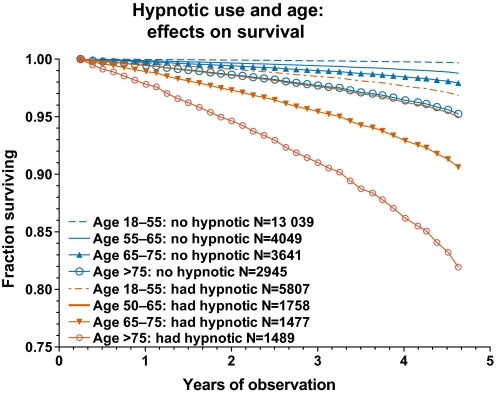
Objectives: An estimated 6%–10% of US adults took a hypnotic drug for poor sleep in 2010. This study extends previous reports associating hypnotics with excess mortality. Setting: A large integrated health system in the USA. Design: Longitudinal electronic medical records were extracted for a one-to-two matched cohort survival analysis. Subjects: Subjects (mean age 54 years) were 10 529 patients who received hypnotic prescriptions and 23 676 matched controls with no hypnotic prescriptions, followed for an average of 2.5 years between January 2002 and January 2007. Main outcome measures: Data were adjusted for age, gender, smoking, body mass index, ethnicity, marital status, alcohol use and prior cancer. Hazard ratios (HRs) for death were computed from Cox proportional hazards models controlled for risk factors and using up to 116 strata, which exactly matched cases and controls by 12 classes of comorbidity. Results: As predicted, patients prescribed any hypnotic had substantially elevated hazards of dying compared to those prescribed no hypnotics. For groups prescribed 0.4–18, 18–132 and >132 doses/year, HRs (95% CIs) were 3.60 (2.92 to 4.44), 4.43 (3.67 to 5.36) and 5.32 (4.50 to 6.30), respectively, demonstrating a dose–response association. HRs were elevated in separate analyses for several common hypnotics, including zolpidem, temazepam, eszopiclone, zaleplon, other benzodiazepines, barbiturates and sedative antihistamines. Hypnotic use in the upper third was associated with a significant elevation of incident cancer; HR=1.35 (95% CI 1.18 to 1.55). Results were robust within groups suffering each comorbidity, indicating that the death and cancer hazards associated with hypnotic drugs were not attributable to pre-existing disease. Conclusions: Receiving hypnotic prescriptions was associated with greater than threefold increased hazards of death even when prescribed <18 pills/year. This association held in separate analyses for several commonly used hypnotics and for newer shorter-acting drugs. Control of selective prescription of hypnotics for patients in poor health did not explain the observed excess mortality.
Overview
The claims and statistics of this paper haven’t been checked yet.
Free: it reads the open-access text and checks the first 5 claims that cite a source we can check. Create a free account to check every claim.
Integrity signals
Registry
Cites
Statistics
Figures
Verification
Claims the paper makes
The claims and statistics of this paper haven’t been checked yet.
Free: it reads the open-access text and checks the first 5 claims that cite a source we can check. Create a free account to check every claim.
Claims other papers make about this one
Each is checked against this paper’s own text: does it say what the citing paper says it does?
The source backs part of the claim, not all of it — or backs it for a different population, condition or comparison.
In the citing paper
“They found that the hazard of death was doubled in patients prescribed BZD compared to control patients [47].”
From Benzodiazepines: Uses, Dangers, and Clinical Considerations (2021) · cites this paper as [47]
Experimental — accuracy not yet measuredThe source backs part of the claim, not all of it — or backs it for a different population, condition or comparison.
In the citing paper
“There was an association between the prescription of anxiolytic drugs and mortality, resulting in 4 excess deaths in the anxiolytic drug group within an average of 7.6 years [47].”
From Benzodiazepines: Uses, Dangers, and Clinical Considerations (2021) · cites this paper as [47]
Experimental — accuracy not yet measuredThe source backs part of the claim, not all of it — or backs it for a different population, condition or comparison.
In the citing paper
“One study further showed that the risk of dying is doubled in patients prescribed BZD compared with controls [47].”
From Benzodiazepines: Uses, Dangers, and Clinical Considerations (2021) · cites this paper as [47]
Experimental — accuracy not yet measuredIn the citing paper
“All of these interventions resulted in higher discontinuation rates than usual care. 37,38”
From Comparative efficacy of two interventions to discontinue long-term benzodiazepine use: cluster randomised controlled trial in primary care (2014) · cites this paper as [38]
Self-check
Percentages, sums and reported differences re-computed from the paper’s own numbers.
The self-check needs the paper’s full text.
Citations
Cites
Risk Factors for Falls among Elderly Persons Living in the Community
Tinetti, M. E., Speechley, M., & Ginter, S. F. (1988) · New England Journal of Medicine · doi:10.1056/nejm198812293192604 · Cited by 6,509
The global health burden of infection‐associated cancers in the year 2002
Parkin, D. M. (2006) · International Journal of Cancer · doi:10.1002/ijc.21731 · Cited by 2,932
Mortality Associated With Sleep Duration and Insomnia
Kripke, D. F., Garfinkel, L., Wingard, D. L., Klauber, M. R., & Marler, M. R. (2002) · Archives of General Psychiatry · doi:10.1001/archpsyc.59.2.131 · Cited by 1,614
Self-citationSedative hypnotics in older people with insomnia: meta-analysis of risks and benefits
Glass, J., Lanctôt, K. L., Herrmann, N., Sproule, B. A., & Busto, U. E. (2005) · BMJ · doi:10.1136/bmj.38623.768588.47 · Cited by 1,161 · cited 2×
“21 30 Zolpidem has been shown to increase gastroesophageal regurgitation.”
BackgroundSmith, G. C. S., & Pell, J. P. (2003) · BMJ · doi:10.1136/bmj.327.7429.1459 · Cited by 1,157
Excess mortality in depression: a meta-analysis of community studies
Cuijpers, P., & Smit, F. (2002) · Journal of Affective Disorders · doi:10.1016/s0165-0327(01)00413-x · Cited by 775
Short and Long Sleep and Sleeping Pills: Is Increased Mortality Associated?
Kripke, D. F. (1979) · Archives of General Psychiatry · doi:10.1001/archpsyc.1979.01780010109014 · Cited by 660
Self-citationSmoking in relation to the death rates of one million men and women.
Ec, H. (1966) · PubMed · Cited by 648
Jacobs, G. D., Pace-Schott, E. F., Stickgold, R., & Otto, M. W. (2004) · Archives of Internal Medicine · doi:10.1001/archinte.164.17.1888 · Cited by 579
Bronstein, A. C., Spyker, D. A., Cantilena, L. R., Green, J. L., Rumack, B. H., & Giffin, S. L. (2009) · Clinical Toxicology · doi:10.3109/15563650903438566 · Cited by 485
Research works printed but not linked: 1
- National Institute for Clinical Excellence Guidance of the use of zaleplon, zolpidem and zopiclone for the short-term management of insomnia. Technol Appraisal 2004; 77: 1– 27
Cited by
Items 301–400 of 418
What do hypnotics cost hospitals and healthcare?
Kripke, D. F. (2017) · F1000Research · doi:10.12688/f1000research.11328.1 · Cited by 4
Self-citationChen, J., Lu, L., Xu, N., Chen, J., Fan, Y., Feng, F., Qin, X., & Kui, Y. (2018) · Medicine · doi:10.1097/md.0000000000012060 · Cited by 3
Listening to music for improving sleep in adults with insomnia
Jespersen, K. V., Koenig, J., Jennum, P., & Vuust, P. (2013) · Cochrane Database of Systematic Reviews · doi:10.1002/14651858.cd010459 · Cited by 3
Insomnia in the elderly: the role of age-related changes in sleep homeostasis
Moraes, W. A. D. S. (2014) · Sleep Medicine · doi:10.1016/j.sleep.2014.07.021 · Cited by 3
FDA issues black box warnings on common insomnia drugs
Dyer, O. (2019) · BMJ · doi:10.1136/bmj.l2165 · Cited by 3
Benzodiazepines: Pharmacology Up-to-Date and Practical Issues
Kang, U. G., Kim, S. H., Lee, N. Y., Lee, K. Y., Kim, Y. S., & Chung, I. W. (2023) · 신경정신의학 · doi:10.4306/jknpa.2023.62.1.1 · Cited by 2
Shin, J., Jun, S. Y., Won, D., Kim, M., Lee, S. Y., Seo, M. C., Shin, A., & Lee, Y. J. (2025) · Journal of Korean Medical Science · doi:10.3346/jkms.2026.41.e1 · Cited by 2
“17 Long-term use is also associated with a higher likelihood of falls in older adults, 18 higher mortality rates, 19,20 greater incidence of cancer 19,21 and dementia, 22 and an increased risk of suicidality.”
The Association of Zolpidem and Suicidality in Psychiatric Outpatients With Insomnia
Jung, J. Y., Yeo, H., Kim, H., Kim, Y., Yoon, S. J., Lyoo, I. K., & Kim, S. J. (2025) · Psychiatry Investigation · doi:10.30773/pi.2024.0397 · Cited by 2
Tamraz, B., Reisner, L. A., French, A. L., King, S. T., Fischl, M. A., Ofotokun, I., Kashuba, A. D. M., Milam, J. E., Murphy, K., Augenbraun, M. H., et al. (2019) · Pharmacotherapy The Journal of Human Pharmacology and Drug Therapy · doi:10.1002/phar.2312 · Cited by 2
“Hypnotics(31), H1-antihistamines(34), Tamraz et al.”
Moloney, M., Oh, G., & Moga, D. C. (2019) · Journal of Applied Gerontology · doi:10.1177/0733464819888447 · Cited by 2
“Short-term risks include falls and impaired cognition (American Geriatrics Society Beers Criteria Update Expert Panel, 2015, 2019; Treves et al., 2018), and long-term risks include neurocognitive disorders (Glass et al., 2005; Kripke et al., 2012).”
BackgroundInfluentialLohse, M. J., & Müller-Oerlinghausen, B. (2016) · Springer eBooks · doi:10.1007/978-3-662-50351-5_29 · Cited by 2
Judge, D. J., Miller, C. B., Bartlett, D. J., Jomaa, I., Wong, K. K., Saini, B., Semsarian, C. R., Espie, C. A., Kyle, S. D., Grunstein, R. R., et al. (2022) · Journal of Sleep Research · doi:10.1111/jsr.13699 · Cited by 2
“…risk of falls, increased risk of motor vehicle accidents, and potentially with the Z-class drugs, parasomnias (Buysse, 2013; Glass et al., 2005; Gustavsen et al., 2008; Kripke et al., 2012; Laugsand et al., 2014; Perrier et al., 2014; Vermeeren, 2004; Winkler et al., 2014; Wong et al., 2017).”
BackgroundHanda, N., Ishizaki, T., Mitsutake, S., Ono, K., & Akishita, M. (2024) · International Journal of Geriatric Psychiatry · doi:10.1002/gps.6085 · Cited by 2
“5,6 28 The present study suggests that hypnotic ‐ sedatives significantly increased the risk of mortality in the target population, while the attribute risk difference was small.”
BackgroundLiu, L., Jin, Q., Chen, Y., & Yin, P. (2024) · BMJ Open · doi:10.1136/bmjopen-2023-080140 · Cited by 3
“6 Preliminary findings suggested that certain non-pharmaceutical interventions including cognitive behavioural therapy for Insomnia (CBT-I), exercise, various forms of complementary medicine (CAM), such as hypnosis, acupuncture, massage, among others, may demonstrate potential efficacy in…”
BackgroundYoo, D. M., Kang, H. S., Kim, J. H., Kim, J. H., Choi, H. G., Han, K. M., Kim, N. Y., Bang, W., & Kwon, M. J. (2025) · Healthcare · doi:10.3390/healthcare13101145 · Cited by 2
“The matched cohort design comprising 8232 individuals with PD and 32,928 matched controls, coupled with stratified Cox proportional hazards modeling, enhanced the validity of time-to-event comparisons and minimized selection bias [49,50].”
Sleep and Sleep–Wake Disorders
Buysse, D. J., Soehner, A. M., Abbott, S. M., Kapur, V. K., Mahowald, M. W., Parker, K. P., Honeycutt, E. F., Redline, S. S., Schenck, C. H., & Zee, P. C. (2015) · Wiley eBooks · doi:10.1002/9781118753378.ch66 · Cited by 2
Die geisteswissenschaftliche Bedeutung des Schlafs
Girke, M. (2017) · Der Merkurstab · doi:10.14271/dms-20734-de · Cited by 2
Lohse, M. J., & Müller-Oerlinghausen, B. (2014) · Springer eBooks · doi:10.1007/978-3-662-43487-1_27 · Cited by 3
Safety and Tolerability of Anxiolytics/Sedative-Hypnotics
Arcoraci, V., & Spina, E. (2015) · Springer eBooks · doi:10.1007/978-3-319-24741-0_10 · Cited by 2
Cognitive Behavioral Therapy for Primary Insomnia: A Meta-analysis
Kim, J.-H., & Oh, P. J. (2016) · Journal of the Korea Academia-Industrial cooperation Society · doi:10.5762/kais.2016.17.9.407 · Cited by 2
“약물치료를 하는 경우는 수면제 또는 항우울제가 주 로 처방되어 치료의 효과는 빠른 반면 REM 수면의 억 압, 남용 가능성 및 내성의 위험성이 있고[9], 장기간 복 용 시 오히려 수면을 저해하는 부작용이 있어 단기간 사 용하도록 권장하고 있다[10].”
Hartse, K. M. (2017) · Springer eBooks · doi:10.1007/978-1-4939-6578-6_9 · Cited by 2
Dietary Supplements for Insomnia
Ring, M. R., Marchlewski, A., & Kaplan, J. (2017) · Current Sleep Medicine Reports · doi:10.1007/s40675-017-0091-2 · Cited by 2
Kamel, M. A., Mohammed, H., & Hamid, N. E. A. (2018) · Slovenian Veterinary Research · doi:10.26873/svr-626-2018 · Cited by 2
Reply to ‘Evidence for harm, comment on …’ by K ripke & L anger
Pottegård, A., Friis, S., Andersen, M. T., & Hallas, J. (2013) · British Journal of Clinical Pharmacology · doi:10.1111/bcp.12271 · Cited by 2
Benzodiazepines vs mortality - Causation or confounding?
Neutel, C. I., & Johansen, H. (2019) · Sleep Medicine · doi:10.1016/j.sleep.2018.12.016 · Cited by 2
Square-Wave-Based Multi-Tone Generator for Sleep-Improving Brain Stimulation
Garayar-Leyva, G. G., Estrada-López, J. J., & Moreira-Tamayo, O. (2021) · IEEE International Midwest Symposium on Circuits and Systems (MWSCAS) · doi:10.1109/mwscas47672.2021.9531755 · Cited by 1
Chapter 20. Psychopharmacology
Mulsant, B. H., & Pollock, B. G. (2022) · American Psychiatric Association Publishing eBooks · doi:10.1176/appi.books.9781615375196.ds20 · Cited by 1
A novel sleep aid device to reduce sleep latency using air–CO2 mixed gas
Han, H.-W., Kim, D., Kim, J. S., Kwac, L. K., Hyeon, J., & Oh, J. (2023) · Frontiers in Neurology · doi:10.3389/fneur.2023.1163904 · Cited by 1
Sleep disorders in obese patients
P'yanykh, O. P., Lebedeva, D. D., & Айдаровна, К. Р. (2023) · Endocrinology News Opinions Training · doi:10.33029/2304-9529-2023-12-2-63-68 · Cited by 3
You, Z., Liu, D., Wang, T., Wang, H., & Pan, J. (2025) · BMC Cardiovascular Disorders · doi:10.1186/s12872-025-05208-3 · Cited by 1
“There are, of course, a few studies [25, 26] with contradicting results, indicating that sleep medications are associated with higher mortality, potentially due to differences in clinical populations.”
Trends in non-pharmacological treatment for insomnia: A nationwide study
Choi, M., Lee, J., Lee, J., Lee, S., Lee, E. M., & Shin, J. (2025) · PLoS ONE · doi:10.1371/journal.pone.0334142 · Cited by 1
“Drugs such as benzodiaz-epines are the most commonly used treatments in the United States and were used by approximately 6–10% of adults as of 2010 [21].”
Sinnamon, C., Hughes, C. M., Cardwell, C. R., & Barry, H. E. (2026) · Journal of Alzheimer s Disease · doi:10.1177/13872877251414888 · Cited by 1
“10,41,43,44 Patients often respond positively to benzodiazepines, with a reduction in the severity of their behavioral problems; however, these medications fail to improve functioning, care needs or quality of life in PwD. 45”
Fu, M., Li, C., Zhou, X., Gong, Z., Zhu, Y., Ding, Y. S., Ling, K., Wang, F., Shi, L., & Guan, X. (2026) · BJPsych Open · doi:10.1192/bjo.2025.10967 · Cited by 1
“13,14 Approximately 15% of adult out-patient visits at primary healthcare facilities involved a prescription for insomnia.”
Bramoweth, A. D., Hough, C. E., Lickel, J. J., Spitznogle, B. L., McQuillan, A. D., McCoy, J. L., Boudreaux-Kelly, M. Y., Hamm, M., Thorpe, C. T., & Germain, A. (2026) · Journal of Behavioral Medicine · doi:10.1007/s10865-026-00671-5 · Cited by 1
“Epidemiological research also links sleep medications to suicide (Yang et al., 2026), and when taken ≥ 1 year, an elevated incidence of cancer and an increased risk of death (controlling for prior cancer diagnosis) (Kripke et al., 2012).”
Riemann, D. W., Baglioni, C., Nissen, C., Nevière, A., Irfan, O., Nouveau, P. L., Leontiou, C., & Léger, D. (2026) · Journal of Sleep Research · doi:10.1111/jsr.70352 · Cited by 1
“Kripke et al. 2012, reported higher mortality rates in adults using temazepam for > 3 months, though not specifically in chronic insomnia patients.”
Etscheidt, M. A., & Sloan, P. A. (2014) · Cambridge University Press eBooks · doi:10.1017/cbo9781107281950.067 · Cited by 1
Zolpidem Use in the Elderly and Recent Safety Data
Wong, E., & Nguyen, T. V. (2013) · The Journal for Nurse Practitioners · doi:10.1016/j.nurpra.2013.09.012 · Cited by 1
Late life insomnia: A brief review
Singh, P., Tiwari, S., & Pandey, N. M. (2014) · Journal of Geriatric Mental Health · doi:10.4103/2348-9995.152425 · Cited by 1
Varma, S. (2012) · Medicine · doi:10.1016/j.mpmed.2012.09.016 · Cited by 1
Bianchi, M. T., & Westover, M. B. (2014) · Journal of Clinical Psychopharmacology · doi:10.1097/jcp.0000000000000134 · Cited by 1
“Multiple other risks have also been associated with immediate and/or long-term hypnotic use,(13,14) including tolerance, dependence, cognitive complaints, and falls, and some authors have reported increased risks of cancer and death from even infrequent risk.(15) These epidemiological studies have limitations, and any…”
BackgroundDrugs and Acupuncture: The Energetic Impact of Benzodiazepines
Greenwood, M. T. (2013) · Medical Acupuncture · doi:10.1089/acu.2013.0988 · Cited by 1
Pros and cons of pharmacotherapy in insomnia
Lee, E. M. (2015) · Journal of Korean Medical Association · doi:10.5124/jkma.2015.58.9.827 · Cited by 1
“한편, Kripke 등[23] 은 수면제 사용이 암으로 인한 사망률과 관련된다고 보고하 였다.”
Hartse, K. M. (2015) · Springer eBooks · doi:10.1007/978-1-4939-2089-1_62 · Cited by 1
Lipschitz, D. L., Olin, J., & Nakamura, Y. (2016) · European Journal of Integrative Medicine · doi:10.1016/j.eujim.2016.08.002 · Cited by 3
Yoo, J., Jang, S., Cha, Y., Gwak, J.-H., Kim, J.-T., Park, C. H., & Choy, W.-S. (2021) · Journal of Orthopaedic Science · doi:10.1016/j.jos.2021.07.011 · Cited by 1
Lin, C., Su, M., Kao, C., Lin, C., & Yang, T.-Y. (2022) · Psychology Health & Medicine · doi:10.1080/13548506.2022.2050269 · Cited by 1
“…but also cause severe infections (Joya et al., 2009b; Obiora et al., 2013), such as pneumonia (Obiora et al., 2013), or increased of mortality (Kripke et al., 2012; Kripke, 2018), the inference is related to affect the macrophage function dysregulation (Sanders et al., 2013) or harm…”
Background(2012) · Drug and Therapeutics Bulletin · doi:10.1136/dtb.2012.04.0095 · Cited by 1
Management of Insomnia Disorder
Carlson, G. E., Zeidler, M. R., & Martin, J. L. (2022) · Respiratory medicine · doi:10.1007/978-3-030-93739-3_13 · Cited by 1
Wu, T., Ma, X., Zuo, P., Chen, S., Tang, X., Zhang, X., & Hou, E. (2025) · Medicine · doi:10.1097/md.0000000000045357 · Cited by 1
Mason, E. C., & Harvey, A. G. (2015) · Wiley eBooks · doi:10.1002/9781118900772.etrds0184 · Cited by 1
Ethics Commentary: Ethical Considerations in Sleep Medicine
Peters, B. R. (2014) · FOCUS The Journal of Lifelong Learning in Psychiatry · doi:10.1176/appi.focus.12.1.64 · Cited by 4
Garland, S. N. (2012) · Libraries and Cultural Resources (University of Calgary) · doi:10.5072/prism/27123 · Cited by 1
Belknap, S. M. (2017) · Annals of Internal Medicine · doi:10.7326/acpjc-2017-167-12-071 · Cited by 1
Sedative load and adverse events among community-dwelling older people
Taipale, H. T. (2012) · UEF eRepo (University of Eastern Finland) · Cited by 2
Sleep issues in people experiencing homelessness
Gonzalez, A., Bufe, J., & Tran, H. E. (2021) · Elsevier eBooks · doi:10.1016/b978-0-12-822963-7.00033-5 · Cited by 1
The association of long working hours and the use of prescription sedatives among U.S. workers.
Ezekekwu, E. U. (2023) · ThinkIR: The University of Louisville's Institutional Repository (University of Louisville) · doi:10.18297/etd/4117 · Cited by 1
Eszopiclone: Review and Clinical Applications in Chronic and Comorbid Insomnia
Najib, J. S. (2014) · Milestones in drug therapy · doi:10.1007/978-3-319-11514-6_8
How do sleep disturbances affect driving practices in the elderly?
Fragoso, C. A. V., & Marottoli, R. A. (2014) · Clinical Practice · doi:10.2217/cpr.13.91
À qui faire confiance pour améliorer la santé publique ?
Royant‐Parola, S. (2012) · Médecine du Sommeil · doi:10.1016/j.msom.2012.05.001
Nissen, C. (2012) · InFo Neurologie + Psychiatrie · doi:10.1007/s15005-012-0205-9
Hypnotic medications in older adults: a call for caution
Datta, S., & Takahashi, P. (2013) · OA Case Reports · doi:10.13172/2052-0077-2-11-884
Sleep Deprivation and Psychiatric Disorders
Bianchi, M. T., & Nyer, M. (2013) · Springer eBooks · doi:10.1007/978-1-4614-9087-6_6 · Cited by 1
Moorcroft, W. H. (2013) · Springer eBooks · doi:10.1007/978-1-4614-6467-9_13
Cognition, Adherence and Stigma in Schizophrenia
Brain, C. (2015)
Insomnia Drugs Linked to Increased Mortality
Mueller, P. S., & FACP., F. (2012) · Journal watch · doi:10.1056/jw201203130000001
Geisler, P., & Crönlein, T. (2014) · Schlaf · doi:10.1055/s-0038-1626104
Magnuson, V., Wang, Y., & Schork, N. J. (2016) · F1000Research · doi:10.12688/f1000research.7694.1
LA GESTIONE NON FARMACOLOGICA DELL'ANSIA NEL PAZIENTE ONCOLOGICO
Giacomuzzi, M. (2015)
Pines, A. (2012) · Climacteric · doi:10.3109/13697137.2012.699403
Zur Diagnostik und Therapie der chronischen Insomnie
Kröz, M., & Pranga, D. (2017) · Der Merkurstab · doi:10.14271/dms-20735-de
Short-term and chronic effects of aerobic and resistance exercise on sleep in young men
Drenowatz, C. J., Wirth, M. D., & Grieve, G. L. (2017) · Journal of Preventive Medicine And Care · doi:10.14302/issn.2474-3585.jpmc-17-1506
Tools for Treating Sleep Disturbances Among Latinos
Gentry, R. A., & Benuto, L. T. (2017) · Springer eBooks · doi:10.1007/978-3-319-64880-4_12
A Drosophila Model Of Sleep Restriction Therapy For Insomnia And Neurodegenerative Disease
Belfer, S. J. (2019) · ScholarlyCommons (University of Pennsylvania)
Die Bedeutung des Bewusstseins in der palliativmedizinischen Therapie
Girke, M. (2020) · Der Merkurstab · doi:10.14271/dms-21220-de
Judge, D. J. (2020) · The Sydney eScholarship Repository (The University of Sydney)
Chung, K., Suh, Y. J., Chin, S., Yu, E., Lee, H. J., Kim, J., Kim, S. W., & Koh, S. (2020) · JMIR Formative Research · doi:10.2196/17786
Davidson, R. D., & Zhou, E. S. (2021) · Springer eBooks · doi:10.1007/978-3-030-75377-1_11
Cognition, Adherence and Stigma in Schizophrenia. The COAST study
Brain, C. (2015) · Gothenburg University Publications Electronic Archive (Gothenburg University) · Cited by 1
Causas, tratamiento y prevención de la ceguera en el SIDA: la retinitis por citomegalovirus
Rozalen, J. L. M., & Llopis, M. D. (1992) · Virtual Defense Library (Ministerio de Defensa)
Akademia Wyższej Szkoły Biznesu, D. G., & KRACZLA, M. (2021) · Scientific Papers of Silesian University of Technology Organization and Management Series · doi:10.29119/1641-3466.2021.154.9
Klemperer, J. (2022) · eDiss (Georg-August-Universität Göttingen) · doi:10.53846/goediss-9059
Kaye, A. D., & Shah, R. V. (2014) · Cambridge University Press eBooks · doi:10.1017/cbo9781107281950.053
de Rooij, S. E. (2013) · Bohn Stafleu van Loghum eBooks · doi:10.1007/978-90-313-9265-0_31
Chung, K., Suh, Y. J., Chin, S., Yu, E., Lee, H. J., Kim, J., Kim, S. W., & Koh, S. (2020) · doi:10.2196/preprints.17786
Ettinger, A. B., Weisbrot, D. M., & Gallimore, C. E. (2019) · Cambridge University Press eBooks · doi:10.1017/9781107706866.009
Kroll, D. S. (2022) · Springer eBooks · doi:10.1007/978-3-031-08495-9_8
SLEEP DEFICIT AND MANAGERS’ FUNCTIONING IN STRESSFUL SITUATIONS
Akademia Wyższej Szkoły Biznesu, D. G., & KRACZLA, M. (2021) · Scientific Papers of Silesian University of Technology Organization and Management Series · doi:10.29119/1641-3466.2021.153.18
Cognitive behavior therapy for insomnia in adults
Halder, S., & Mahato, A. K. (2023) · Elsevier eBooks · doi:10.1016/b978-0-323-85726-0.00039-9
Erst schläft er nicht, dann schläft er zu viel
Frohnhofen, H. (2023) · Springer eBooks · doi:10.1007/978-3-662-60290-4_10
Safe Deprescribing of Benzodiazepines and Z‐drugs
(2024) · Wiley eBooks · doi:10.1002/9781394291052.mdg003
Z-drug Use and All-Cause Mortality: A Meta-Analysis of Observational Cohort Studies
Park, J.-Y., Ko, H., Park, H.-J., & Kim, A. (2025) · doi:10.37766/inplasy2025.3.0082
Sleep disturbances in brain tumors: a narrative review
Liang, Q., Hu, T., Yang, T., Pan, Y., Spruyt, K., Zhang, X., & Li, Q. (2025) · Frontiers in Oncology · doi:10.3389/fonc.2025.1594232
Arimoto, N., Nishimura, R., Kobayashi, T., Asaeda, M., Naito, T., Kojima, M., Umemura, O., Yokota, M., Hanada, N., Kawamura, T., et al. (2024) · Figshare · doi:10.6084/m9.figshare.26622508
Arimoto, N., Nishimura, R., Kobayashi, T., Asaeda, M., Naito, T., Kojima, M., Umemura, O., Yokota, M., Hanada, N., Kawamura, T., et al. (2024) · Figshare · doi:10.6084/m9.figshare.26622514
Collard, V. E. J., Moore, C., Nichols, V. P., Ellard, D. R., Patel, S., Sandhu, H., Parsons, H., Sharma, U., Underwood, M. R., Madan, J. J., et al. (2021) · Figshare · doi:10.6084/m9.figshare.16834981
Arimoto, N., Nishimura, R., Kobayashi, T., Asaeda, M., Naito, T., Kojima, M., Umemura, O., Yokota, M., Hanada, N., Kawamura, T., et al. (2024) · Figshare · doi:10.6084/m9.figshare.26622517
Arimoto, N., Nishimura, R., Kobayashi, T., Asaeda, M., Naito, T., Kojima, M., Umemura, O., Yokota, M., Hanada, N., Kawamura, T., et al. (2024) · Figshare · doi:10.6084/m9.figshare.26622511
Gozda, K., Leung, J., Baum, L., Singer, A. G., Konrad, G., McMillan, D. E., Falk, J., Kosowan, L., & Leong, C. (2022) · Figshare · doi:10.6084/m9.figshare.19746119
Navarro Denis, S. A. (2019) · LA Referencia (Red Federada de Repositorios Institucionales de Publicaciones Científicas)
Metadata
- Authors
- Kripke, D. F., Langer, R. D., & Kline, L. E.
- Affiliations
- Scripps Clinic (US)
- Corresponding author
- Kripke, Daniel F
- Venue
- BMJ Open
- Publisher
- BMJ
- Published
- 2012
- Volume
- 2
- Issue
- 1
- Pages
- e000850
- ISSN
- 2044-6055 (ISSN-L)
- PMC
- PMC3293137
- OpenAlex
- W2163579301
- Cited by
- 408
- References
- 39
- Citations by year
- 2026: 15 · 2025: 12 · 2024: 9 · 2023: 17 · 2022: 23 · 2021: 28 · 2020: 21 · 2019: 18 · 2018: 20 · 2017: 40 · 2016: 43 · 2015: 45 · 2014: 49 · 2013: 36 · 2012: 30
- FWCI
- 68.68
- Type
- journal article
- Language
- en
- Open access
- gold
- doi.org
- Licence
- cc-by-nc
- Locations
- BMJ Open (publishedVersion, cc-by-nc)
- PubMed Central (publishedVersion, cc-by-nc)
- PubMed (publishedVersion)
- DOAJ (DOAJ: Directory of Open Access Journals) (submittedVersion)
- eScholarship (California Digital Library) (submittedVersion)
- Funders
- University of California, San Diego
- Topics
- Social Sciences › Psychology › Experimental and Cognitive Psychology › Sleep and related disorders
- Health Sciences › Medicine › Geriatrics and Gerontology › Pharmaceutical Practices and Patient Outcomes
- Health Sciences › Medicine › Public Health, Environmental and Occupational Health › Opioid Use Disorder Treatment
- Keywords
- hypnotics, sleep aids, excess mortality, cancer incidence, benzodiazepines, barbiturates, zolpidem, temazepam, eszopiclone, zaleplon, dose-response relationship, prescribing patterns, comorbidities
About these checks
Registry, retraction, Cites and statistics results are computed, not judged, with one exception: a printed reference that no index lists is read once by a model before it counts as a citation error. Claims are extracted by a model and kept only when their quote appears verbatim in the text; each cited source is then checked, with a model’s help, for whether it says what the claim relies on. Those verdicts can be wrong — read the claim’s quote and the cited source before relying on one.
Statistics and arithmetic are recomputed, not judged.
Confidence bands are shown only for fields calibrated on our annotated test set. None is calibrated yet, so no band is shown.
What counts as a claim ›How we measure confidence ›How we check this ›
Are you an author, or do you see a problem with this page? Request a review
Data sources
Bibliographic data: Semantic Scholar, OpenAlex, Crossref.
Contains information from the Semantic Scholar Academic Graph Datasets, made available under the ODC Attribution License (ODC-BY 1.0).
Semantic Scholar’s data is described in: Kinney, R., et al. (2023). The Semantic Scholar Open Data Platform. arXiv:2301.10140.
