

Hypnotics' association with mortality or cancer: a matched cohort study
Open accessThe DOI matches its Crossref record; 39 of the 39 references it cites were found in a registry or an index.
Abstract
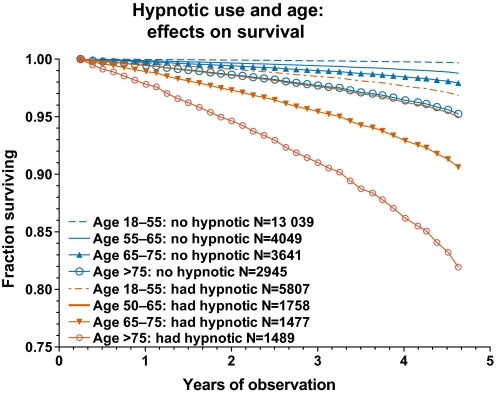
Objectives: An estimated 6%–10% of US adults took a hypnotic drug for poor sleep in 2010. This study extends previous reports associating hypnotics with excess mortality. Setting: A large integrated health system in the USA. Design: Longitudinal electronic medical records were extracted for a one-to-two matched cohort survival analysis. Subjects: Subjects (mean age 54 years) were 10 529 patients who received hypnotic prescriptions and 23 676 matched controls with no hypnotic prescriptions, followed for an average of 2.5 years between January 2002 and January 2007. Main outcome measures: Data were adjusted for age, gender, smoking, body mass index, ethnicity, marital status, alcohol use and prior cancer. Hazard ratios (HRs) for death were computed from Cox proportional hazards models controlled for risk factors and using up to 116 strata, which exactly matched cases and controls by 12 classes of comorbidity. Results: As predicted, patients prescribed any hypnotic had substantially elevated hazards of dying compared to those prescribed no hypnotics. For groups prescribed 0.4–18, 18–132 and >132 doses/year, HRs (95% CIs) were 3.60 (2.92 to 4.44), 4.43 (3.67 to 5.36) and 5.32 (4.50 to 6.30), respectively, demonstrating a dose–response association. HRs were elevated in separate analyses for several common hypnotics, including zolpidem, temazepam, eszopiclone, zaleplon, other benzodiazepines, barbiturates and sedative antihistamines. Hypnotic use in the upper third was associated with a significant elevation of incident cancer; HR=1.35 (95% CI 1.18 to 1.55). Results were robust within groups suffering each comorbidity, indicating that the death and cancer hazards associated with hypnotic drugs were not attributable to pre-existing disease. Conclusions: Receiving hypnotic prescriptions was associated with greater than threefold increased hazards of death even when prescribed <18 pills/year. This association held in separate analyses for several commonly used hypnotics and for newer shorter-acting drugs. Control of selective prescription of hypnotics for patients in poor health did not explain the observed excess mortality.
Overview
The claims and statistics of this paper haven’t been checked yet.
Free: it reads the open-access text and checks the first 5 claims that cite a source we can check. Create a free account to check every claim.
Integrity signals
Registry
Cites
Statistics
Figures
Verification
Claims the paper makes
The claims and statistics of this paper haven’t been checked yet.
Free: it reads the open-access text and checks the first 5 claims that cite a source we can check. Create a free account to check every claim.
Claims other papers make about this one
Each is checked against this paper’s own text: does it say what the citing paper says it does?
The source backs part of the claim, not all of it — or backs it for a different population, condition or comparison.
In the citing paper
“They found that the hazard of death was doubled in patients prescribed BZD compared to control patients [47].”
From Benzodiazepines: Uses, Dangers, and Clinical Considerations (2021) · cites this paper as [47]
Experimental — accuracy not yet measuredThe source backs part of the claim, not all of it — or backs it for a different population, condition or comparison.
In the citing paper
“There was an association between the prescription of anxiolytic drugs and mortality, resulting in 4 excess deaths in the anxiolytic drug group within an average of 7.6 years [47].”
From Benzodiazepines: Uses, Dangers, and Clinical Considerations (2021) · cites this paper as [47]
Experimental — accuracy not yet measuredThe source backs part of the claim, not all of it — or backs it for a different population, condition or comparison.
In the citing paper
“One study further showed that the risk of dying is doubled in patients prescribed BZD compared with controls [47].”
From Benzodiazepines: Uses, Dangers, and Clinical Considerations (2021) · cites this paper as [47]
Experimental — accuracy not yet measuredIn the citing paper
“All of these interventions resulted in higher discontinuation rates than usual care. 37,38”
From Comparative efficacy of two interventions to discontinue long-term benzodiazepine use: cluster randomised controlled trial in primary care (2014) · cites this paper as [38]
Self-check
Percentages, sums and reported differences re-computed from the paper’s own numbers.
The self-check needs the paper’s full text.
Citations
Cites
Risk Factors for Falls among Elderly Persons Living in the Community
Tinetti, M. E., Speechley, M., & Ginter, S. F. (1988) · New England Journal of Medicine · doi:10.1056/nejm198812293192604 · Cited by 6,509
The global health burden of infection‐associated cancers in the year 2002
Parkin, D. M. (2006) · International Journal of Cancer · doi:10.1002/ijc.21731 · Cited by 2,932
Mortality Associated With Sleep Duration and Insomnia
Kripke, D. F., Garfinkel, L., Wingard, D. L., Klauber, M. R., & Marler, M. R. (2002) · Archives of General Psychiatry · doi:10.1001/archpsyc.59.2.131 · Cited by 1,614
Self-citationSedative hypnotics in older people with insomnia: meta-analysis of risks and benefits
Glass, J., Lanctôt, K. L., Herrmann, N., Sproule, B. A., & Busto, U. E. (2005) · BMJ · doi:10.1136/bmj.38623.768588.47 · Cited by 1,161 · cited 2×
“21 30 Zolpidem has been shown to increase gastroesophageal regurgitation.”
BackgroundSmith, G. C. S., & Pell, J. P. (2003) · BMJ · doi:10.1136/bmj.327.7429.1459 · Cited by 1,157
Excess mortality in depression: a meta-analysis of community studies
Cuijpers, P., & Smit, F. (2002) · Journal of Affective Disorders · doi:10.1016/s0165-0327(01)00413-x · Cited by 775
Short and Long Sleep and Sleeping Pills: Is Increased Mortality Associated?
Kripke, D. F. (1979) · Archives of General Psychiatry · doi:10.1001/archpsyc.1979.01780010109014 · Cited by 660
Self-citationSmoking in relation to the death rates of one million men and women.
Ec, H. (1966) · PubMed · Cited by 648
Jacobs, G. D., Pace-Schott, E. F., Stickgold, R., & Otto, M. W. (2004) · Archives of Internal Medicine · doi:10.1001/archinte.164.17.1888 · Cited by 579
Bronstein, A. C., Spyker, D. A., Cantilena, L. R., Green, J. L., Rumack, B. H., & Giffin, S. L. (2009) · Clinical Toxicology · doi:10.3109/15563650903438566 · Cited by 485
Research works printed but not linked: 1
- National Institute for Clinical Excellence Guidance of the use of zaleplon, zolpidem and zopiclone for the short-term management of insomnia. Technol Appraisal 2004; 77: 1– 27
Cited by
Items 401–418 of 418
Coteur, K., Matheï, C., Nuland, M. V., Schoenmakers, B., Laenen, A., & Henrard, G. (2022) · Lirias
Z-Drug Use and All-Cause Mortality: A Meta-Analysis of Observational Cohort Studies
Park, J.-Y., Park, H. J., Ko, H., Kim, A., Song, J.-E., & Hong, H.-E. (2026) · Neuropsychiatric Disease and Treatment · doi:10.2147/ndt.s556191
“16,29,47,48 Among z-drugs, zopiclone and zaleplon are clastogenic, and clastogen can cause mutations by disruption or breakage of chromosomes.”
InfluentialMasfuri, M., Rahmini, J. A., Budiarto, E., Pujasari, H., Novita, D., Nurhayati, N., & Saharuddin, S. (2026) · doi:10.2196/preprints.92553
The association between sleep disorder and risk of early-onset colorectal cancer: A narrative review
Khalid, M., Ong, P. S., Iddir, A., Alnazeer, M. H., Babekir, E., Basendowah, M., Mousli, A., & Yousef, B. A. (2026) · Gastroenterology & Endoscopy · doi:10.1016/j.gande.2026.03.006
Jaussent, I. (2013) · theses.fr (ABES) · doi:10.70675/83cf054cz9c79z46daz8ce4z88ddf26c5d94 · Cited by 1
Boucherie, Q. (2016) · theses.fr (ABES) · doi:10.70675/76aa366bzda6cz48edz86b3z4ff65da77aae
Benzodiazepines and risk of dementia in the elderly
de Gage, S. B. (2015) · theses.fr (ABES) · doi:10.70675/57bdee52z24b3z49c5zb221z16eacbdc4963
Measurement of discontinuous drug exposure in large healthcare databases
Palmaro, A. (2017) · theses.fr (ABES) · doi:10.70675/dd71500eze05az409ez9d8dz9af8f0359d0b · Cited by 1
Huber, T., Krüerke, D., Kröz, M., Schlemmer, M., & Simões‐Wüst, A. P. (2026) · Complementary Medicine Research · doi:10.1159/000552252
“This would add to other reasons for avoiding benzo-diazepine use, such as the well described risk of dependency [16] and some additionally detected associations with mortality [17] and risk of developing cancer [18, 19].”
Birling, Y., Bhuyan, D. J., Feng, F., Jia, M., Liu, J., Zhang, H., Rahimi, M. M., Yu, W. Y., Carlson, L. E., Boge, H. B., et al. (2026) · Current Oncology Reports · doi:10.1007/s11912-026-01790-7
Tong, Z., Fan, S., Li, Y., Chen, Q., Li, H., & Wang, J. (2026) · Frontiers in Neurology · doi:10.3389/fneur.2026.1855450
Birling, Y., Bhuyan, D. J., Feng, F., Liu, J., Jia, M., Yu, W. Y., Rahimi, M. M., Carlson, L. E., Zhang, H., Jasim, N., et al. (2026) · Journal of Psychosocial Oncology Research and Practice · doi:10.1097/or9.0000000000000195
Zhao, X., Chen, X., Ma, J., Tang, J., Ai, X., & Zhao, Z. (2026) · Complementary Therapies in Medicine · doi:10.1016/j.ctim.2026.103397
Bonini, A. F., Rafihi‐Ferreira, R. E., Filho, H. S. L. S., Toscanini, A. C., & Hasan, R. (2026) · Sleep Science · doi:10.1055/s-0046-1825529
“14,15,18 In Brazil, zolpidem remains the most widely used hypnotic, with prescriptions increasing signi fi cantly over the past decade, re fl ecting a growing reliance on pharmacological approaches.”
Rusin, I., Wrzesińska, A., Korowacki, M., Przybylski, M., Świrad, B., Mączka, K., Kazimierczak, K., Grobecki, D., Kruczek, F., & Dyczko, J. (2026) · International Journal of Innovative Technologies in Social Science · doi:10.31435/ijitss.3(51).2026.5859
Tong, Z., Ye, G., Fan, S., Li, Y., Zhang, J., Zhang, H., Chen, Q., Wang, H., Li, H., & Wang, J. (2026) · BMC Medicine · doi:10.1186/s12916-026-05129-8 · Cited by 1
“The use of hypnotic drugs is also associated with a higher risk of mortality [17, 18].”
Treatment of insomnia with non-pharmacological methods in wellbeing services counties in Finland
Kemppainen, T. (2024) · UEF eRepo (University of Eastern Finland)
Metadata
- Authors
- Kripke, D. F., Langer, R. D., & Kline, L. E.
- Affiliations
- Scripps Clinic (US)
- Corresponding author
- Kripke, Daniel F
- Venue
- BMJ Open
- Publisher
- BMJ
- Published
- 2012
- Volume
- 2
- Issue
- 1
- Pages
- e000850
- ISSN
- 2044-6055 (ISSN-L)
- PMC
- PMC3293137
- OpenAlex
- W2163579301
- Cited by
- 408
- References
- 39
- Citations by year
- 2026: 15 · 2025: 12 · 2024: 9 · 2023: 17 · 2022: 23 · 2021: 28 · 2020: 21 · 2019: 18 · 2018: 20 · 2017: 40 · 2016: 43 · 2015: 45 · 2014: 49 · 2013: 36 · 2012: 30
- FWCI
- 68.68
- Type
- journal article
- Language
- en
- Open access
- gold
- doi.org
- Licence
- cc-by-nc
- Locations
- BMJ Open (publishedVersion, cc-by-nc)
- PubMed Central (publishedVersion, cc-by-nc)
- PubMed (publishedVersion)
- DOAJ (DOAJ: Directory of Open Access Journals) (submittedVersion)
- eScholarship (California Digital Library) (submittedVersion)
- Funders
- University of California, San Diego
- Topics
- Social Sciences › Psychology › Experimental and Cognitive Psychology › Sleep and related disorders
- Health Sciences › Medicine › Geriatrics and Gerontology › Pharmaceutical Practices and Patient Outcomes
- Health Sciences › Medicine › Public Health, Environmental and Occupational Health › Opioid Use Disorder Treatment
- Keywords
- hypnotics, sleep aids, excess mortality, cancer incidence, benzodiazepines, barbiturates, zolpidem, temazepam, eszopiclone, zaleplon, dose-response relationship, prescribing patterns, comorbidities
About these checks
Registry, retraction, Cites and statistics results are computed, not judged, with one exception: a printed reference that no index lists is read once by a model before it counts as a citation error. Claims are extracted by a model and kept only when their quote appears verbatim in the text; each cited source is then checked, with a model’s help, for whether it says what the claim relies on. Those verdicts can be wrong — read the claim’s quote and the cited source before relying on one.
Statistics and arithmetic are recomputed, not judged.
Confidence bands are shown only for fields calibrated on our annotated test set. None is calibrated yet, so no band is shown.
What counts as a claim ›How we measure confidence ›How we check this ›
Are you an author, or do you see a problem with this page? Request a review
Data sources
Bibliographic data: Semantic Scholar, OpenAlex, Crossref.
Contains information from the Semantic Scholar Academic Graph Datasets, made available under the ODC Attribution License (ODC-BY 1.0).
Semantic Scholar’s data is described in: Kinney, R., et al. (2023). The Semantic Scholar Open Data Platform. arXiv:2301.10140.
