

Therapeutic potential of omega-3 fatty acids supplementation in a mouse model of dry macular degeneration
Open accessThe DOI matches its Crossref record; 48 of the 49 references it cites were found in a registry or an index.
Abstract
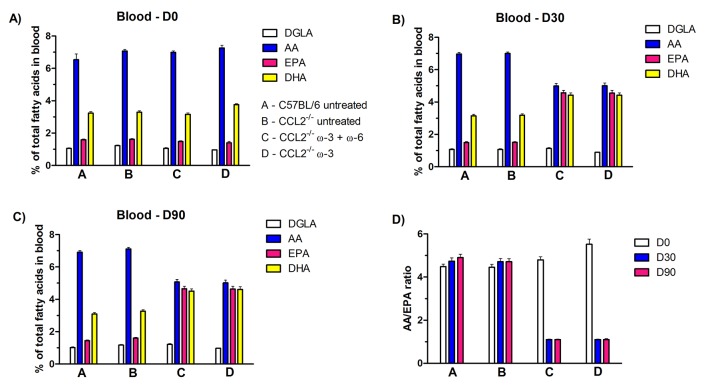
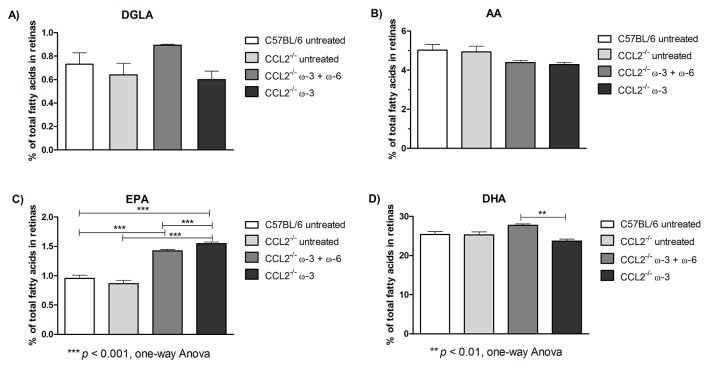
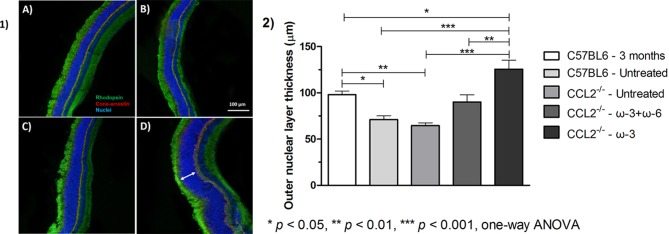
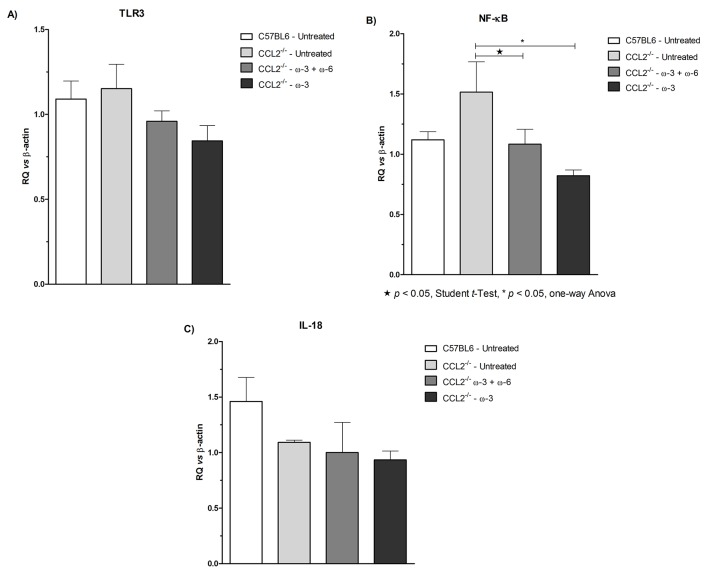
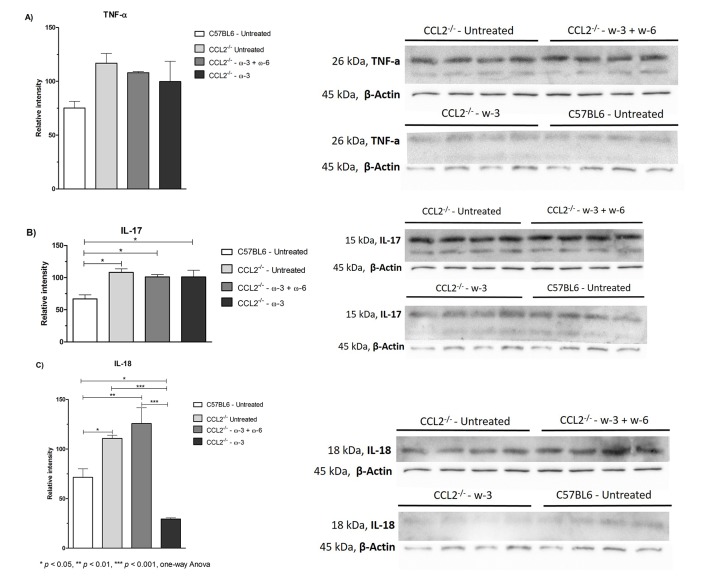
Purpose To evaluate the therapeutic effects of omega-3 (ω-3) and omega-6 (ω-6) fatty acids in the CCL2−/− model of dry age-related macular degeneration (AMD). The blood level of eicosapentaenoic acid (EPA) and arachidonic acid (AA) served to adjust the treatment dosage (AA/EPA=1–1.5). Methods Nine-month-old animals were allocated to different groups: (A) C57BL/6 untreated , (B) CCL2−/− untreated, (C) CCL2−/− treated with ω-3+ω-6, and (D) CCL2−/− treated with ω-3. Treatment was daily administered by gavage for 3 months. Fatty acids analysis was performed and retinas were histologically examined. Three-month-old wild type mice were used for comparison purposes. Real-time PCR and Western blot were performed for retinal inflammatory mediators. Results Increased EPA and decreased AA levels were observed in both blood and retinas in the treatment groups. The outer nuclear layer thickness was increased in groups C (45.0±3.9 µm) and D (62.8±4.9 µm), compared with groups B (65.6±3.0 µm) and A (71.1±4.2 µm), and in younger mice, it was 98.0±3.9 µm. A decrease in NF-κB expression was noted in the treatment groups. Interleukin (IL) 18 protein levels demonstrated a significant reduction in the ω-3-treated group only. Conclusion Supplementation with ω-3+ω-6 or ω-3 alone (AA/EPA=1–1.5) suggests a protective mechanism in the CCL2−/− animal model of dry AMD, with a more beneficial effect when ω-3 are used alone. Our findings indicated that inflammation is not the only determining factor; perhaps a regenerative process might be involved following administration of ω-3 fatty acids.
Overview
The claims and statistics of this paper haven’t been checked yet.
Free: it reads the open-access text and checks the first 5 claims that cite a source we can check. Create a free account to check every claim.
Integrity signals
Registry
Cites
Statistics
Figures
Verification
Claims the paper makes
The claims and statistics of this paper haven’t been checked yet.
Free: it reads the open-access text and checks the first 5 claims that cite a source we can check. Create a free account to check every claim.
Claims other papers make about this one
Each is checked against this paper’s own text: does it say what the citing paper says it does?
The source backs part of the claim, not all of it — or backs it for a different population, condition or comparison.
In the citing paper
“N-3 PUFAs can avert visual loss owing to AMD [63,66].”
From Microalgae n-3 PUFAs Production and Use in Food and Feed Industries (2021) · cites this paper as [66]
Experimental — accuracy not yet measured
Self-check
Percentages, sums and reported differences re-computed from the paper’s own numbers.
The self-check needs the paper’s full text.
Citations
Cites
Aging: a theory based on free radical and radiation chemistry
Harman, D. (1956) · Journal of Gerontology · doi:10.1093/geronj/11.3.298 · Cited by 8,567
Wong, W. L., Su, X., Li, X., Cheung, C. M. G., Klein, R., Cheng, C.-Y., & Wong, T. Y. (2014) · The Lancet Global Health · doi:10.1016/s2214-109x(13)70145-1 · Cited by 5,331
Prevalence of Age-Related Macular Degeneration in the United States
(2004) · Archives of Ophthalmology · doi:10.1001/archopht.122.4.564 · Cited by 2,736
Yokoyama, M., Origasa, H., Matsuzaki, M., Matsuzawa, Y., Saito, Y., Ishikawa, Y., Oikawa, S., Sasaki, J., Hishida, H., Itakura, H., et al. (2007) · The Lancet · doi:10.1016/s0140-6736(07)60527-3 · Cited by 2,516 · cited 1×
“75.(28) In addition, the ratio of PGI3 and PGI2 (which both reduce cardiac Key messages”
BackgroundThe role of omega-3 long-chain polyunsaturated fatty acids in health and disease of the retina
SanGiovanni, J. P., & Chew, E. Y. (2005) · Progress in Retinal and Eye Research · doi:10.1016/j.preteyeres.2004.06.002 · Cited by 874 · cited 1×
“Several studies have demonstrated that !-3 PUFAs may have a protective role in inflammatory-associated, ischaemia-associated, light-associated, oxygen-associated and age-associated pathology of the vascular and neural retinas.(18) Administration of PUFAs was previously found to have a promising effect in several anima…”
BackgroundAnderson, D. H., Radeke, M. J., Gallo, N. B., Chapin, E. A., Johnson, P. T., Curletti, C. R., Hancox, L. S., Hu, J., Ebright, J. N., Malek, G., et al. (2010) · Progress in Retinal and Eye Research · doi:10.1016/j.preteyeres.2009.11.003 · Cited by 727
Connor, K. M., SanGiovanni, J. P., Lofqvist, C., Aderman, C. M., Chen, J., Higuchi, A., Hong, S., Pravda, E. A., Majchrzak, S., Carper, D., et al. (2007) · Nature Medicine · doi:10.1038/nm1591 · Cited by 688
Para-Inflammation in the Aging Retina
Xu, H., Chen, M., & Forrester, J. V. (2009) · Progress in Retinal and Eye Research · doi:10.1016/j.preteyeres.2009.06.001 · Cited by 659
An animal model of age-related macular degeneration in senescent Ccl-2- or Ccr-2-deficient mice
Ambati, J., Anand, A., Fernandez, S., Sakurai, E., Lynn, B. C., Kuziel, W. A., Rollins, B. J., & Ambati, B. K. (2003) · Nature Medicine · doi:10.1038/nm950 · Cited by 631
Inflammation and atherosclerosis: role of C-Reactive protein in risk assessment
Libby, P., & Ridker, P. M. (2004) · The American Journal of Medicine · doi:10.1016/j.amjmed.2004.02.006 · Cited by 595
Dietary essential fatty acid supply and visual acuity development.
Birch, E. E., Birch, D. G., Hoffman, D. R., & Uauy, R. D. (1992) · PubMed · Cited by 480
Toll-like receptors in neurodegeneration
Okun, E., Griffioen, K. J., Lathia, J. D., Tang, S.-C., Mattson, M. P., & Arumugam, T. V. (2009) · Brain Research Reviews · doi:10.1016/j.brainresrev.2008.09.001 · Cited by 429 · cited 1×
“Regulation of the transcription of inflammatory target genes (eg, TNF-a, IL6 and IL-1) can take place via NF-kB activation.(42) Therefore, reduction of TLR3 and NF-kB mRNA levels may indicate a reduced profile of microglia activation in the retina and subsequent decrease in the production of inflammatory cytokines.”
BackgroundDoyle, S. L., Campbell, M., Ozaki, E., Salomon, R. G., Mori, A., Kenna, P. F., Farrar, G. J., Kiang, A.-S., Humphries, M. M., Lavelle, E. C., et al. (2012) · Nature Medicine · doi:10.1038/nm.2717 · Cited by 422
Assessing Activation States in Microglia
Colton, C. A., & Wilcock, D. M. (2010) · CNS & Neurological Disorders - Drug Targets · doi:10.2174/187152710791012053 · Cited by 420 · cited 1×
“TLR3 is associated with microglia cell activation, which is the brain’s principal resident immune cell population, central to the inflammatory response and activated by distress signals released from neighbouring cells.(40) On microglia activation, through TLR3, production of ILs(41) and other cytokines is stimulated.”
BackgroundThe Age-related Eye Disease Study 2 (AREDS2)
Chew, E. Y., Clemons, T., SanGiovanni, J. P., Danis, R., Domalpally, A., McBee, W., Sperduto, R., & Ferris, F. L. (2012) · Ophthalmology · doi:10.1016/j.ophtha.2012.05.027 · Cited by 415
Keenan, T. D., & Chew, E. Y. (2017) · JAMA Ophthalmology · doi:10.1001/jamaophthalmol.2017.2210 · Cited by 377
Association between C-reactive protein and age-related macular degeneration
Seddon, J. M. (2004) · JAMA · doi:10.1001/jama.291.6.704 · Cited by 376
Seddon, J. M. (2005) · Archives of Ophthalmology · doi:10.1001/archopht.123.6.774 · Cited by 354
Serhan, C. N., Arita, M., Hong, S., & Gotlinger, K. (2004) · Lipids · doi:10.1007/s11745-004-1339-7 · Cited by 349
Luhmann, U. F. O., Robbie, S., Munro, P. M. G., Barker, S. E., Duran, Y., Luong, V., Fitzke, F. W., Bainbridge, J. W. B., Ali, R. R., & MacLaren, R. E. (2009) · Investigative Opthalmology & Visual Science · doi:10.1167/iovs.09-3462 · Cited by 205
Long-chain n-3 fatty acids and inflammation: potential application in surgical and trauma patients
Calder, P. C. (2003) · Brazilian Journal of Medical and Biological Research · doi:10.1590/s0100-879x2003000400004 · Cited by 178 · cited 1×
“22 High levels of dietary !-3 PUFAs may result in the incorporation of EPA into cell membrane phospholipids at the expense of AA, leading to less substrate being available for eicosanoid synthesis.(36) Furthermore, Ramkumar et al reported the effect of the AREDS2 formulation in the same Ccl2 / /Cx3cr1 / model.”
BackgroundEarly age-related maculopathy in the cardiovascular health study
Klein, R., Klein, B. E. K., Marino, E. K., Kuller, L. H., Furberg, C., Burke, G. L., & Hubbard, L. D. (2003) · Ophthalmology · doi:10.1016/s0161-6420(02)01565-8 · Cited by 177
Cousins, S. W. (2004) · Archives of Ophthalmology · doi:10.1001/archopht.122.7.1013 · Cited by 176
β-oxidation and rapid metabolism, but not uptake regulate brain eicosapentaenoic acid levels
Chen, C. T., & Bazinet, R. P. (2014) · Prostaglandins Leukotrienes and Essential Fatty Acids · doi:10.1016/j.plefa.2014.05.007 · Cited by 137
Effect of Oral Re-esterified Omega-3 Nutritional Supplementation on Dry Eyes
Epitropoulos, A. T., Donnenfeld, E. D., Shah, Z. A., Holland, E. J., Gross, M., Faulkner, W. J., Matossian, C., Lane, S. S., Toyos, M., Bucci, F. A., et al. (2016) · Cornea · doi:10.1097/ico.0000000000000940 · Cited by 114
Facci, L., Barbierato, M., Marinelli, C., Argentini, C., Skaper, S. D., & Giusti, P. (2014) · Scientific Reports · doi:10.1038/srep06824 · Cited by 109
Systemic Markers of Inflammation, Endothelial Dysfunction, and Age-Related Maculopathy
Klein, R., Klein, R., Knudtson, M. D., Wong, T. Y., Shankar, A., & Tsai, M. Y. (2005) · American Journal of Ophthalmology · doi:10.1016/j.ajo.2005.01.051 · Cited by 103
Sawada, T., Tsubata, H., Hashimoto, N., Takabe, M., Miyata, T., Aoki, K., Yamashita, S., Oishi, S., Osue, T., Yokoi, K., et al. (2016) · Cardiovascular Diabetology · doi:10.1186/s12933-016-0437-y · Cited by 97 · cited 1×
“A number of studies have confirmed the association of EPA/AA both in coronary diseases and in diabetes and hyperlipidaemia.(30) 31 Lower levels of particular PUFAs in either circulating blood or the retina are associated with some retinopathies.”
Ultrastructure of the human retina in aging and various pathological states
Nag, T. C., & Wadhwa, S. (2012) · Micron · doi:10.1016/j.micron.2012.01.011 · Cited by 88
Ohnishi, H., & Saito, Y. (2013) · Journal of Atherosclerosis and Thrombosis · doi:10.5551/jat.18002 · Cited by 88 · cited 2×
“Thus, the effects of EPA in reducing the risk of CVD could be mediated by the biological action of PGI3 in addition to the hypo-triglyceridemic action of EPA.”
BackgroundDocosahexaenoic acid attenuates microglial activation and delays early retinal degeneration
Ebert, S., Weigelt, K., Walczak, Y., Drobnik, W., Mauerer, R., Hume, D. A., Weber, B. H. F., & Langmann, T. (2009) · Journal of Neurochemistry · doi:10.1111/j.1471-4159.2009.06286.x · Cited by 81
A high omega-3 fatty acid diet reduces retinal lesions in a murine model of macular degeneration
Tuo, J., Ross, R. J., Herzlich, A. A., Shen, D., Ding, X., Zhou, M., Coon, S. L., Hussein, N., Salem, N., & Chan, C.-C. (2009) · The American Journal of Pathology · doi:10.2353/ajpath.2009.090089 · Cited by 80 · cited 1×
“Previous studies have demonstrated that, in the Ccl2 / /Cx3cr1 / model, lower ocular TNF-a and IL-6 transcript levels are observed in animals fed with high !-3 diet, suggesting that reactive mediators of !-3 PUFAs may regulate differential gene expression.(22) Additional studies have confirmed this connection by demon…”
ResultCytochrome P450-generated metabolites derived from ω-3 fatty acids attenuate neovascularization
Yanai, R., Mulki, L., Hasegawa, E., Takeuchi, K., Sweigard, H., Suzuki, J., Gaissert, P., Vavvas, D. G., Sonoda, K.-H., Rothe, M., et al. (2014) · Proceedings of the National Academy of Sciences · doi:10.1073/pnas.1401191111 · Cited by 78
Ramkumar, H. L., Tuo, J., Shen, D. F., Zhang, J., Cao, X., Chew, E. Y., & Chan, C. (2013) · Journal of Nutrition · doi:10.3945/jn.112.169649 · Cited by 78 · cited 2×
“20 This formulation included !”
BackgroundAge related macular degeneration in monozygotic twins and their spouses in Iceland
Gottfredsdottir, M. S., Sverrisson, T., Musch, D. C., & Stefánsson, E. (1999) · Acta Ophthalmologica Scandinavica · doi:10.1034/j.1600-0420.1999.770413.x · Cited by 72
Gorusupudi, A., Liu, A., Hageman, G. S., & Bernstein, P. S. (2016) · Journal of Lipid Research · doi:10.1194/jlr.p065540 · Cited by 68 · cited 1×
“In another study, eyes from AMD donors exhibited significantly decreased levels of very longchain PUFAs and high !-6/!-3 ratios.(32) Therefore, examining systemic biomarkers (including the levels of AA and EPA) when undertaking therapeutic trials could be a good indication of disease progression and treatment success.”
BackgroundRegeneration of the retina: toward stem cell therapy for degenerative retinal diseases
Jeon, S., & Oh, I.-H. (2015) · BMB Reports · doi:10.5483/bmbrep.2015.48.4.276 · Cited by 54 · cited 1×
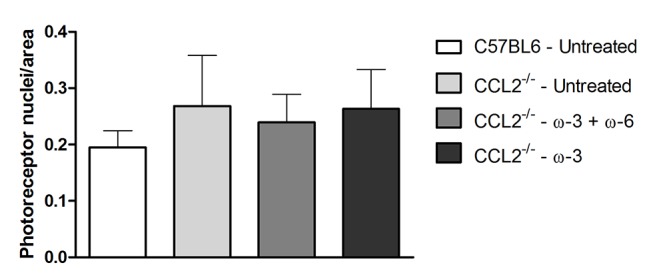
“Although there is no direct explanation for the pronounced effect of !-3 treatment with regard to the number of photoreceptors, it is hypothesised that the mode of action of !-3 PUFAs may involve a stimulatory effect on endogenous retinal stem cells, such as the Muller glial cells, the ciliary pigment epithelial cells…”
BackgroundGeorgiou, T., Wen, Y., Chang, C., Kolovos, P., Kalogerou, M., Prokopiou, E., Neokleous, A., Huang, C., & Tsai, R. (2017) · Investigative Ophthalmology & Visual Science · doi:10.1167/iovs.16-20979 · Cited by 47
Zhu, W., Wu, Y., Meng, Y.-F., Xing, Q., Tao, J.-J., & Lu, J. (2016) · Nutrients · doi:10.3390/nu8110743 · Cited by 44
Dornstauder, B., Suh, M., Kuny, S., Gaillard, F., MacDonald, I. M., Clandinin, M. T., & Sauvé, Y. (2012) · Investigative Opthalmology & Visual Science · doi:10.1167/iovs.11-8569 · Cited by 41
Ferrara, D., Merriam, J. E., Freund, K. B., Spaide, R. F., Takahashi, B. S., ZHITOMIRSKY, I., Fine, H. F., Yannuzzi, L. A., & Allikmets, R. (2008) · Archives of Ophthalmology · doi:10.1001/archopht.126.11.1562 · Cited by 40
Othman, K. R. B., Cercy, C., Amri, M., Doly, M., & Ranchon‐Cole, I. (2015) · PLoS ONE · doi:10.1371/journal.pone.0128395 · Cited by 30
The Role of Inflammation and Infection in Age-related Macular Degeneration
Barouch, F. C., & Miller, J. W. (2007) · International Ophthalmology Clinics · doi:10.1097/iio.0b013e3180377936 · Cited by 29
Georgiou, T., & Prokopiou, E. (2015) · PubMed · Cited by 13
Sharma, K. (2014) · Annals of Neurosciences · doi:10.5214/ans.0972.7531.210407 · Cited by 11 · cited 1×
“43 In addition, IL-18 was found to attenuate choroidal neovas-cularisation in a wet AMD model, 44 which demonstrated its importance in disease progression.”
BackgroundOkada, K., Kotani, K., Yagyu, H., & Ishibashi, S. (2014) · Diabetology & Metabolic Syndrome · doi:10.1186/1758-5996-6-85 · Cited by 7 · cited 1×
“30 31 Lower levels of particular PUFAs in either circulating blood or the retina are associated with some retinopa-thies.”
BackgroundRole of Omega-3 Fatty Acids for Eye Health
Georgiou, T., & Prokopiou, E. (2016) · Springer eBooks · doi:10.1007/978-3-319-40458-5_20 · Cited by 5 · cited 1×
“27 46 It is important to note that dietary consumption of fish plays a key role in disease progression.”
Background
Cited by
Lutein and Zeaxanthin and Their Roles in Age-Related Macular Degeneration—Neurodegenerative Disease
Mrowicka, M., Mrowicki, J., Kucharska, E., & Majsterek, I. (2022) · Nutrients · doi:10.3390/nu14040827 · Cited by 299
“Omega-3 fatty acids reduce pathological angiogenesis in various cellular and animal models by affecting multiple angiogenic factors, including platelet-derived growth factor (PDGF) and vascular endothelial growth factor (VEGF) [68,69].”
BackgroundMicroalgae n-3 PUFAs Production and Use in Food and Feed Industries
Remize, M., Brunel, Y., Silva, J. L., Berthon, J.-Y., & Filaire, E. (2021) · Marine Drugs · doi:10.3390/md19020113 · Cited by 214
“PUFAs and their derivatives can also play a role in the pathogenesis of retinal diseases (retinopathies) like retinopathy of prematurity (ROP), age-related macular degeneration (AMD), or diabetic retinopathy (DR).”
BackgroundEffects of Fish n-3 PUFAs on Intestinal Microbiota and Immune System
Parolini, C. (2019) · Marine Drugs · doi:10.3390/md17060374 · Cited by 170
Suzumura, A., Terao, R., & Kaneko, H. (2020) · Antioxidants · doi:10.3390/antiox9100920 · Cited by 44
“A previous study using the Ccl2(−/−) mouse revealed that n-3 fatty acids administration increased EPA and AA in the blood and retina, and decreased retinal NF-κB expression, accompanied by increased outer layer thickness [222].”
BackgroundOmega-3 fatty acids protect retinal neurons in the DBA/2J hereditary glaucoma mouse model
Kalogerou, M., Kolovos, P., Prokopiou, E., Papagregoriou, G., Deltas, C. C., Malas, S., & Georgiou, T. (2017) · Experimental Eye Research · doi:10.1016/j.exer.2017.12.005 · Cited by 42
Metadata
- Authors
- Prokopiou, E., Kolovos, P., Kalogerou, M., Neokleous, A., Papagregoriou, G., Deltas, C., Malas, S., & Georgiou, T.
- Affiliations
- Ophthalmos Research and Educational Institute, Nicosia, Cyprus
- University of Cyprus (CY)
- Cyprus Institute of Neurology and Genetics (CY)
- Corresponding author
- Georgiou, Tassos
- Venue
- BMJ Open Ophthalmology
- Publisher
- BMJ
- Published
- 2017-06
- Volume
- 1
- Issue
- 1
- Pages
- e000056
- ISSN
- 2397-3269 (ISSN-L)
- PMC
- PMC5721630
- OpenAlex
- W2638109236
- Cited by
- 16
- References
- 49
- Citations by year
- 2025: 1 · 2024: 2 · 2023: 1 · 2022: 4 · 2021: 2 · 2020: 1 · 2019: 3 · 2018: 1 · 2017: 1
- FWCI
- 1.60
- Type
- journal article
- Language
- en
- Open access
- gold
- doi.org
- Licence
- cc-by
- Locations
- BMJ Open Ophthalmology (publishedVersion, cc-by)
- PubMed Central (publishedVersion, cc-by)
- PubMed (publishedVersion)
- Funders
- Queen's University Belfast
- Queen's University
- Topics
- Health Sciences › Medicine › Ophthalmology › Retinal Diseases and Treatments
- Health Sciences › Nursing › Nutrition and Dietetics › Fatty Acid Research and Health
- Health Sciences › Medicine › Ophthalmology › Retinal Development and Disorders
- Keywords
- omega-3 fatty acids, omega-6 fatty acids, dry age-related macular degeneration, eicosapentaenoic acid, arachidonic acid, retinal inflammation, NF-κB, IL-18, outer nuclear layer thickness, retinal regeneration, dietary supplementation
About these checks
Registry, retraction, Cites and statistics results are computed, not judged, with one exception: a printed reference that no index lists is read once by a model before it counts as a citation error. Claims are extracted by a model and kept only when their quote appears verbatim in the text; each cited source is then checked, with a model’s help, for whether it says what the claim relies on. Those verdicts can be wrong — read the claim’s quote and the cited source before relying on one.
Statistics and arithmetic are recomputed, not judged.
Confidence bands are shown only for fields calibrated on our annotated test set. None is calibrated yet, so no band is shown.
What counts as a claim ›How we measure confidence ›How we check this ›
Are you an author, or do you see a problem with this page? Request a review
Data sources
Bibliographic data: Semantic Scholar, OpenAlex, Crossref.
Contains information from the Semantic Scholar Academic Graph Datasets, made available under the ODC Attribution License (ODC-BY 1.0).
Semantic Scholar’s data is described in: Kinney, R., et al. (2023). The Semantic Scholar Open Data Platform. arXiv:2301.10140.
