

The DOI matches its Crossref record; 133 of the 134 references it cites were found in a registry or an index.
An update on the use and investigation of probiotics in health and disease
Open accessAbstract
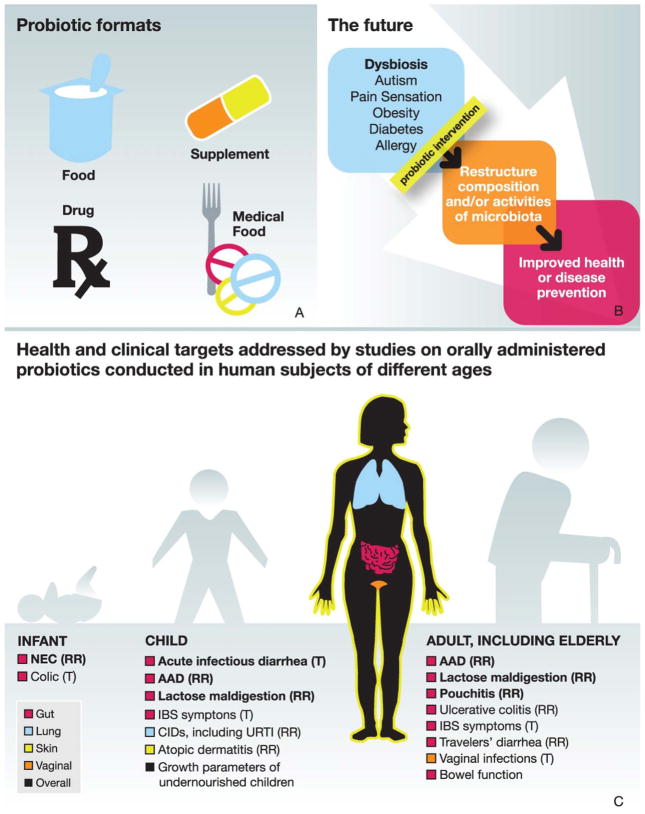
Probiotics are derived from traditional fermented foods, from beneficial commensals or from the environment. They act through diverse mechanisms affecting the composition or function of the commensal microbiota and by altering host epithelial and immunological responses. Certain probiotic interventions have shown promise in selected clinical conditions where aberrant microbiota have been reported, such as atopic dermatitis, necrotising enterocolitis, pouchitis and possibly irritable bowel syndrome. However, no studies have been conducted that can causally link clinical improvements to probiotic-induced microbiota changes. Whether a disease-prone microbiota pattern can be remodelled to a more robust, resilient and disease-free state by probiotic administration remains a key unanswered question. Progress in this area will be facilitated by: optimising strain, dose and product formulations, including protective commensal species; matching these formulations with selectively responsive subpopulations; and identifying ways to manipulate diet to modify bacterial profiles and metabolism.
Overview
The claims and statistics of this paper haven’t been checked yet.
Run the check — free, no account needed. It reads the open-access text and checks the sources it cites.
Integrity signals
Registry
Cites
Statistics
Figures
Verification
Claims the paper makes
The claims and statistics of this paper haven’t been checked yet.
Run the check — free, no account needed. It reads the open-access text and checks the sources it cites.
Claims other papers make about this one
Each is checked against this paper’s own text: does it say what the citing paper says it does?
In the citing paper
“FMT introduces a complete, stable, and durable community of gut microbiota [26] , unlike probiotics, that temporarily alter the metabolic, or immunologic activity, of the native gut microbiota [27] .”
From Intestinal microbiota in health and disease: Role of bifidobacteria in gut homeostasis (2014) · cites this paper as [27]
In the citing paper
“the use of probiotics in preventive medicine to keep a healthy intestinal function is well documented”
From Intestinal microbiota in health and disease: Role of bifidobacteria in gut homeostasis (2014) · cites this paper as [27]
Self-check
Percentages, sums and reported differences re-computed from the paper’s own numbers.
The self-check needs the paper’s full text.
Citations
Cites
Longstreth, G. F., Thompson, W. G., Chey, W. D., Houghton, L. A., Mearin, F., & Spiller, R. C. (2006) · Gastroenterology · doi:10.1053/j.gastro.2005.11.061 · Cited by 4,856
Dominguez-Bello, M. G., Costello, E. K., Contreras, M., Magris, M., Hidalgo, G., Fierer, N., & Knight, R. (2010) · Proceedings of the National Academy of Sciences · doi:10.1073/pnas.1002601107 · Cited by 4,774 · cited 1×
“92 Factors associated with allergy such as birth delivery mode (caesarean section vs vaginal delivery), 93 antibiotic use in the newborn and infant, and non-breast-milk diets are also associated with shifts in the gut microbiota.”
BackgroundInduction of Colonic Regulatory T Cells by Indigenous Clostridium Species
Atarashi, K., Tanoue, T., Shima, T., Imaoka, A., Kuwahara, T., Momose, Y., Cheng, G., Yamasaki, S., Saito, T., Ohba, Y., et al. (2011) · Science · doi:10.1126/science.1198469 · Cited by 3,752
Global, regional, and national causes of child mortality in 2008: a systematic analysis
Black, R. E., Cousens, S. N., Johnson, H. L., Lawn, J. E., Rudan, I., Bassani, D. G., Jha, P., Campbell, H. J., Walker, C. L. F., Cibulskis, R. E., et al. (2010) · The Lancet · doi:10.1016/s0140-6736(10)60549-1 · Cited by 3,062
Vrieze, A., Van Nood, E., Holleman, F., Salojärvi, J., Kootte, R. S., Bartelsman, J. F. W. M., Dallinga–Thie, G. M., Ackermans, M. T., Serlie, M. J., Oozeer, R., et al. (2012) · Gastroenterology · doi:10.1053/j.gastro.2012.06.031 · Cited by 2,913 · cited 1×
“Recently, faecal microbiota transplant from non-diabetic donors infused into the duodenum of patients with the metabolic syndrome improved their insulin sensitivity, highlighting the broad potential of this intervention.(116) However, cocktails of defined microbes imparting key functionalities may provide a more accep…”
BackgroundNeu, J., & Walker, W. A. (2011) · New England Journal of Medicine · doi:10.1056/nejmra1005408 · Cited by 2,141
Fusobacterium nucleatum infection is prevalent in human colorectal carcinoma
Castellarin, M., Warren, R. L., Freeman, J. D., Dreolini, L., Krzywinski, M., Strauss, J., Barnes, R., Watson, P., Allen-Vercoe, E., Moore, R. A., et al. (2012) · Genome Research · doi:10.1101/gr.126516.111 · Cited by 2,043 · cited 1×
“Others have analysed the microbiology in patients with CRC and suggested that the bacterial diversity is less,(72) altered(73) 74 or accompanied by high levels of Fusobacterium nucleatum sequences.(75) Studies in rodents have concentrated on probiotic effects on precancerous lesions and tumours.”
BackgroundMicrobial Influences in Inflammatory Bowel Diseases
Sartor, R. B. (2008) · Gastroenterology · doi:10.1053/j.gastro.2007.11.059 · Cited by 1,927
Self-citationThe Toll-like receptor 2 pathway establishes colonization by a commensal of the human microbiota
Round, J. L., Lee, S. M., Li, J., Tran, G., Jabri, B., Chatila, T. A., & Mazmanian, S. K. (2011) · Science · doi:10.1126/science.1206095 · Cited by 1,604
O’Mahony, L., McCarthy, J., Kelly, P., Hurley, G., Luo, F., Chen, K., O’Sullivan, G. C., Kiely, B., Collins, J. K., Shanahan, F., et al. (2005) · Gastroenterology · doi:10.1053/j.gastro.2004.11.050 · Cited by 1,448
Self-citation
Cited by
Sorted by citations
Inflammation-induced cancer: Crosstalk between tumours, immune cells and microorganisms
Elinav, E., Nowarski, R., Thaiss, C. A., Hu, B., Jin, C., & Flavell, R. A. (2013) · Nature reviews. Cancer · doi:10.1038/nrc3611 · Cited by 2,000
Gut microbiota and IBD: causation or correlation?
Ni, J., Wu, G. D., Albenberg, L., & Tomov, V. T. (2017) · Nature Reviews Gastroenterology & Hepatology · doi:10.1038/nrgastro.2017.88 · Cited by 1,778
Gut microbes and the brain: paradigm shift in neuroscience
Mayer, E. A., Knight, R., Mazmanian, S. K., Cryan, J. F., & Tillisch, K. (2014) · The Journal of Neuroscience · doi:10.1523/jneurosci.3299-14.2014 · Cited by 1,033
“Surprisingly, there has been a paucity of studies in animals or humans with prebiotics, although specific prebiotics have been shown to increase brain BDNF levels (Savignac et al., 2013).”
BackgroundSelf-citationIntestinal microbiota in health and disease: Role of bifidobacteria in gut homeostasis
Tojo, R. (2014) · World Journal of Gastroenterology · doi:10.3748/wjg.v20.i41.15163 · Cited by 533
Maldonado-Gómez, M. X., Martínez, I., Bottacini, F., O’Callaghan, A., Ventura, M., van Sinderen, D., Hillmann, B., Vangay, P., Knights, D., Hutkins, R. W., et al. (2016) · Cell Host & Microbe · doi:10.1016/j.chom.2016.09.001 · Cited by 517
“However, the degree to which clinical improvements have been causally linked to probiotic-induced microbiota changes has not been established (Sanders et al., 2013).”
Metadata
- Authors
- Sanders, M. E., Guarner, F., Guerrant, R., Holt, P. R., Quigley, E. M., Sartor, R. B., Sherman, P. M., & Mayer, E. A.
- Affiliations
- Dairy & Food Culture Technologies, Centennial, Colorado, USA
- Vall d'Hebron Hospital Universitari (ES)
- University of Virginia (US)
- Rockefeller University (US)
- Houston Methodist (US)
- University of North Carolina at Chapel Hill (US)
- University of Toronto (CA)
- University of California, Los Angeles (US)
- Corresponding author
- Mayer, Emeran A
- ORCID
- Venue
- Gut
- Publisher
- BMJ
- Published
- 2013-03-08
- Volume
- 62
- Issue
- 5
- Pages
- 787-796
- ISSN
- 0017-5749 (ISSN-L)
- 1468-3288
- PMC
- PMC4351195
- OpenAlex
- W2148017101
- Cited by
- 503
- References
- 134
- Citations by year
- 2026: 18 · 2025: 23 · 2024: 20 · 2023: 29 · 2022: 29 · 2021: 34 · 2020: 37 · 2019: 29 · 2018: 44 · 2017: 46 · 2016: 52 · 2015: 58 · 2014: 61 · 2013: 22
- FWCI
- 8.55
- Type
- journal article
- Language
- en
- Open access
- hybrid
- doi.org
- Licence
- cc-by-nc
- Locations
- Gut (publishedVersion, cc-by-nc)
- PubMed (publishedVersion)
- Europe PMC (PubMed Central) (acceptedVersion, cc-by-nc)
- PubMed Central (acceptedVersion, cc-by-nc)
- Carolina Digital Repository (University of North Carolina at Chapel Hill) (submittedVersion)
- eScholarship (California Digital Library) (submittedVersion)
- eScholarship (California Digital Library) (submittedVersion, cc-by-nc)
- HighWire Press Open Archive (submittedVersion)
- UNC Libraries
- Funders
- Procter and Gamble
- Mead Johnson Nutrition
- Danone
- Ironwood Pharmaceuticals, Incorporated
- Alimentary Health
- Instituto Danone
- Norgine
- National Institute of Diabetes and Digestive and Kidney Diseases (R01DK048351, U01DK082370)
- Topics
- Life Sciences › Agricultural and Biological Sciences › Food Science › Probiotics and Fermented Foods
- Life Sciences › Biochemistry, Genetics and Molecular Biology › Molecular Biology › Gut microbiota and health
- Health Sciences › Nursing › Nutrition and Dietetics › Infant Nutrition and Health
- Keywords
- probiotics, gut microbiota, commensal microbiota, atopic dermatitis, necrotizing enterocolitis, pouchitis, irritable bowel syndrome, host immune response, diet and microbiome, microbiota resilience
- MeSH terms
- Colitis, Ulcerative, Crohn Disease, Cross Infection, Diarrhea, Female, Health Status, Humans, Hypersensitivity, Vaginitis, Colorectal Neoplasms, Meta-Analysis as Topic, Evidence-Based Medicine, Probiotics, Enterocolitis, Necrotizing, Irritable Bowel Syndrome
About these checks
Registry, retraction, Cites and statistics results are computed, not judged, with one exception: a printed reference that no index lists is read once by a model before it counts as a citation error. Claims are extracted by a model and kept only when their quote appears verbatim in the text; each cited source is then checked, with a model’s help, for whether it says what the claim relies on. Those verdicts can be wrong — read the claim’s quote and the cited source before relying on one.
Statistics and arithmetic are recomputed, not judged.
Confidence bands are shown only for fields calibrated on our annotated test set. None is calibrated yet, so no band is shown.
What counts as a claim ›How we measure confidence ›How we check this ›
Are you an author, or do you see a problem with this page? Request a review
