

The DOI matches its Crossref record; 101 of the 102 references it cites were found in a registry or an index; none of the 71 sources its claims cite is checked for support yet.
Pictorial cigarette pack warnings: a meta-analysis of experimental studies
Open accessAbstract
OBJECTIVE: To inform international research and policy, we conducted a meta-analysis of the experimental literature on pictorial cigarette pack warnings. DATA SOURCES: We systematically searched 7 computerised databases in April 2013 using several search terms. We also searched reference lists of relevant articles. STUDY SELECTION: We included studies that used an experimental protocol to test cigarette pack warnings and reported data on both pictorial and text-only conditions. 37 studies with data on 48 independent samples (N=33,613) met criteria. DATA EXTRACTION AND SYNTHESIS: Two independent coders coded all study characteristics. Effect sizes were computed from data extracted from study reports and were combined using random effects meta-analytic procedures. RESULTS: Pictorial warnings were more effective than text-only warnings for 12 of 17 effectiveness outcomes (all p<0.05). Relative to text-only warnings, pictorial warnings (1) attracted and held attention better; (2) garnered stronger cognitive and emotional reactions; (3) elicited more negative pack attitudes and negative smoking attitudes and (4) more effectively increased intentions to not start smoking and to quit smoking. Participants also perceived pictorial warnings as being more effective than text-only warnings across all 8 perceived effectiveness outcomes. CONCLUSIONS: The evidence from this international body of literature supports pictorial cigarette pack warnings as more effective than text-only warnings. Gaps in the literature include a lack of assessment of smoking behaviour and a dearth of theory-based research on how warnings exert their effects.
Overview
AI snapshot
Written from the paper’s full text.
TL;DR
This meta-analysis of experimental studies found that pictorial cigarette pack warnings were generally more effective than text-only warnings across attention, reactions, attitudes, intentions, and perceived effectiveness. The authors conclude the evidence supports pictorial warnings but note major gaps in behavioural outcomes and theory-based research.
Key findings
- Across 37 studies with 48 independent samples (N=33,613), pictorial warnings were more effective than text-only warnings for 12 of 17 effectiveness outcomes, with 13 of 17 outcomes showing statistically significant effects (most p<0.001).
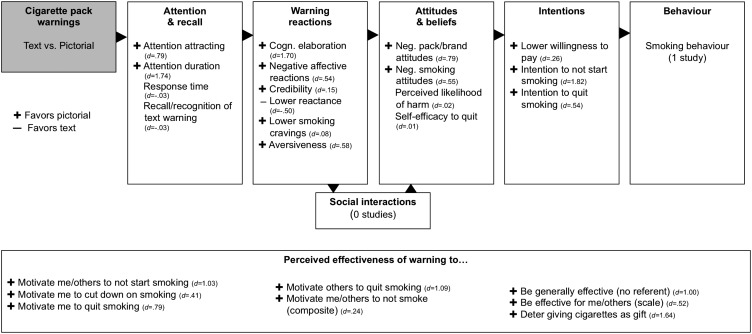
- Pictorial warnings improved attention attracting (d=0.79) and attention duration (d=1.74), cognitive elaboration (d=1.70), negative affective reactions (d=0.54), negative pack/brand attitudes (d=0.79), negative smoking attitudes (d=0.55), intention to not start smoking (d=1.82), and intention to quit smoking (d=0.54).
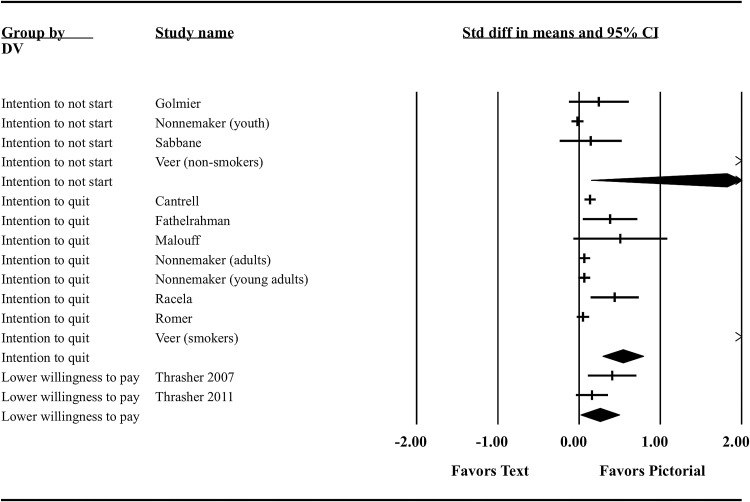
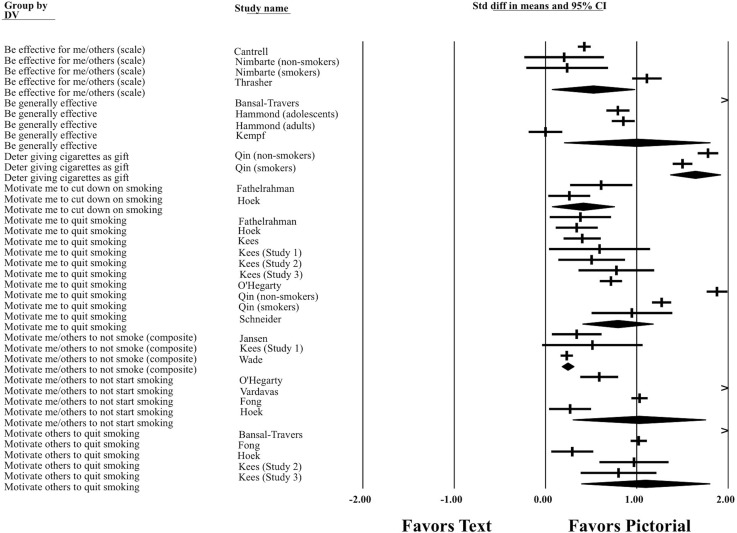
- Pictorial warnings were rated as more effective than text warnings on all 8 perceived effectiveness outcomes, including motivating not starting smoking (d=1.03), motivating oneself to quit (d=0.79), motivating others to quit (d=1.09), and deterring giving cigarettes as a gift (d=1.64).
- No significant effects were found for response time, recall/recognition of warning text, perceived likelihood of harm, or self-efficacy to quit; pictorial warnings also elicited greater psychological reactance (d=−0.50).
Methods
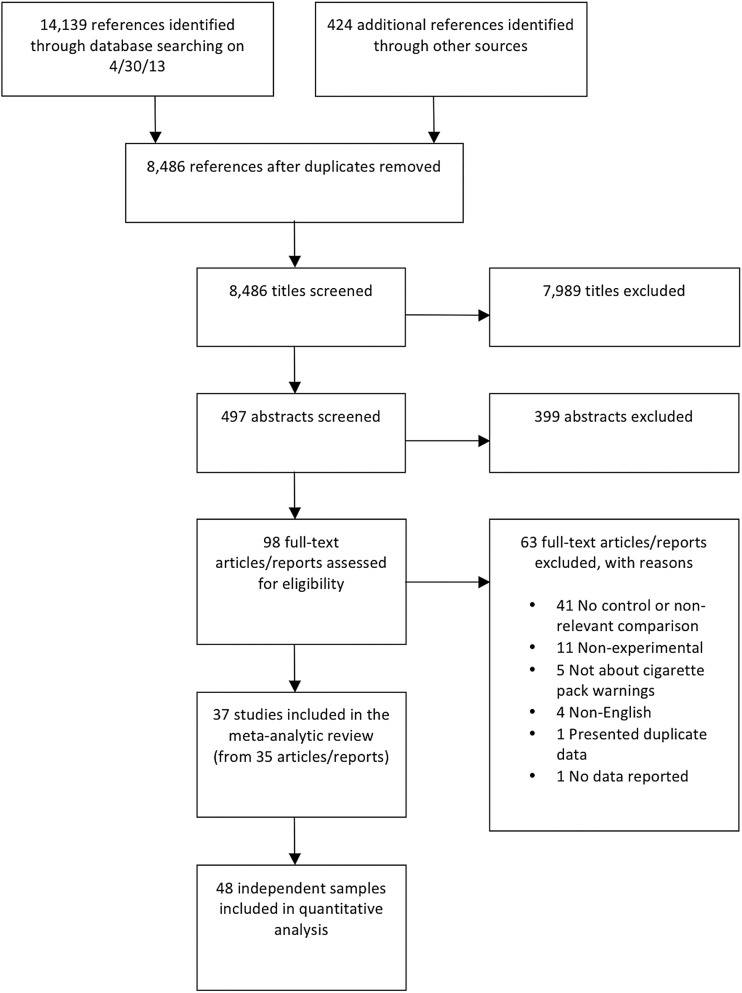
- Systematic search of 7 computerised databases in April 2013 plus reference lists; inclusion required an experimental protocol testing cigarette pack warnings and reporting both pictorial and text-only conditions.
- The final synthesis included 37 studies reporting 48 independent samples (N=33,613); two independent coders coded study characteristics with mean 96% agreement and mean Cohen’s κ=0.94.
- Effect sizes used standardised mean difference d, combined with random-effects meta-analytic procedures; heterogeneity assessed with Q and I², and moderator analyses conducted for a composite perceived-effectiveness motivation variable.
Limitations
- The paper states a lack of assessment of smoking behaviour and a dearth of theory-based research on how warnings exert their effects; only a single experimental study assessed behaviour.
- The paper notes that no study placed warnings on smokers’ own cigarette packs, exposures were brief and often on a computer screen, and all but one study assessed participants only immediately after exposure.
- The text makes evident high heterogeneity for many outcomes (6 of 9 heterogeneous outcomes had I²>90), and moderator analyses found within-subject designs produced larger effects than between-subject designs (d=1.37 vs d=0.51), suggesting design-related variability.
Model-written summary. Check it against the paper before relying on it.
Integrity signals
Registry
Cites
Statistics
Figures

Verification
Claims the paper makes
65 Own result · 34 Not checked yet · 8 Own interpretation · 6 No basis given · 4 Own method
A result the paper reports from its own data — it cites no other source for it, so there is none to check. The quote shows it is in the paper.
In the paper
“Pictorial warnings were more likely to be rated as effective in motivating not starting smoking (d=1.03), motivating reducing smoking (d=0.41), motivating themselves (d=0.79) or others (d=1.09) to quit smoking, and motivating (smokers or non-smokers) to not smoke (d=0.24).”
§ Pictorial cigarette pack warnings: a meta-analysis of experimental studies > Results > Perceived effectiveness of pictorial warnings
plaindirect- Asserted: passes — The authors put it forward as true.
- Checkable: passes — It can be checked against evidence.
- Load-bearing: passes — The paper’s conclusions depend on it.
- Based: passes — The paper gives a reason why it holds.
A result the paper reports from its own data — it cites no other source for it, so there is none to check. The quote shows it is in the paper.
In the paper
“Pictorial warnings exhibited statistically significant effects relative to text warnings for all eight perceived effectiveness outcomes (see table 4 and figure 7).”
§ Pictorial cigarette pack warnings: a meta-analysis of experimental studies > Results > Perceived effectiveness of pictorial warnings
plaindirect- Asserted: passes — The authors put it forward as true.
- Checkable: passes — It can be checked against evidence.
- Load-bearing: passes — The paper’s conclusions depend on it.
- Based: passes — The paper gives a reason why it holds.
A result the paper reports from its own data — it cites no other source for it, so there is none to check. The quote shows it is in the paper.
In the paper
“Pictorial warnings were more likely to be rated as effective in motivating not starting smoking (d=1.03), motivating reducing smoking (d=0.41), motivating themselves (d=0.79) or others (d=1.09) to quit smoking, and motivating (smokers or non-smokers) to not smoke (d=0.24).”
§ Pictorial cigarette pack warnings: a meta-analysis of experimental studies > Results > Perceived effectiveness of pictorial warnings
plaindirect- Asserted: passes — The authors put it forward as true.
- Checkable: passes — It can be checked against evidence.
- Load-bearing: passes — The paper’s conclusions depend on it.
- Based: passes — The paper gives a reason why it holds.
A result the paper reports from its own data — it cites no other source for it, so there is none to check. The quote shows it is in the paper.
In the paper
“Participants also perceived pictorial warnings as deterrents to giving cigarettes as a gift (d=1.64), as generally effective (d=1.00), and as effective for themselves and others (d=0.52).”
§ Pictorial cigarette pack warnings: a meta-analysis of experimental studies > Results > Perceived effectiveness of pictorial warnings
plain- Asserted: passes — The authors put it forward as true.
- Checkable: passes — It can be checked against evidence.
- Load-bearing: passes — The paper’s conclusions depend on it.
- Based: passes — The paper gives a reason why it holds.
A result the paper reports from its own data — it cites no other source for it, so there is none to check. The quote shows it is in the paper.
In the paper
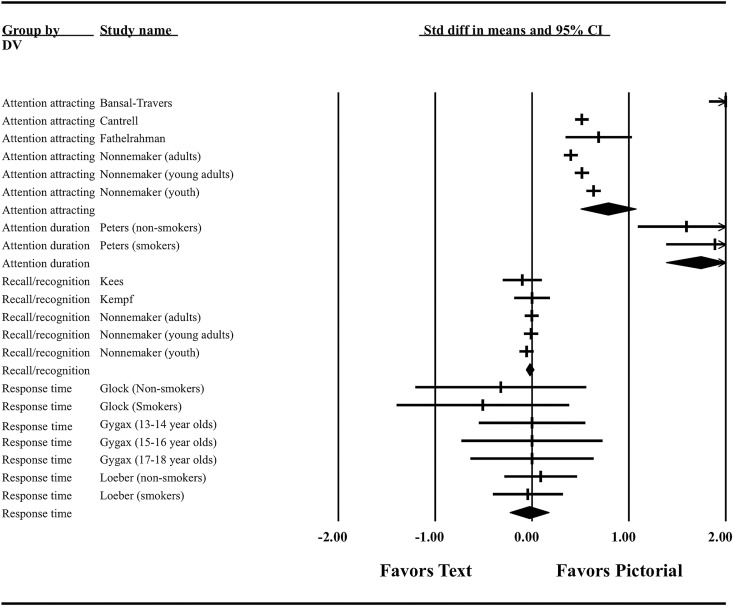
“We observed no effects on response time or recall/recognition of warning text.”
§ Pictorial cigarette pack warnings: a meta-analysis of experimental studies > Results > Effectiveness of pictorial warnings
plain- Asserted: passes — The authors put it forward as true.
- Checkable: passes — It can be checked against evidence.
- Load-bearing: unclear — It is unclear whether the paper’s conclusions depend on it.
- Based: passes — The paper gives a reason why it holds.
A result the paper reports from its own data — it cites no other source for it, so there is none to check. The quote shows it is in the paper.
In the paper
“pictorial warnings scoring higher on both attention attracting (d=0.79) and attention duration (d=1.74).”
§ Pictorial cigarette pack warnings: a meta-analysis of experimental studies > Results > Effectiveness of pictorial warnings
plaindirect- Asserted: passes — The authors put it forward as true.
- Checkable: passes — It can be checked against evidence.
- Load-bearing: passes — The paper’s conclusions depend on it.
- Based: passes — The paper gives a reason why it holds.
A result the paper reports from its own data — it cites no other source for it, so there is none to check. The quote shows it is in the paper.
In the paper
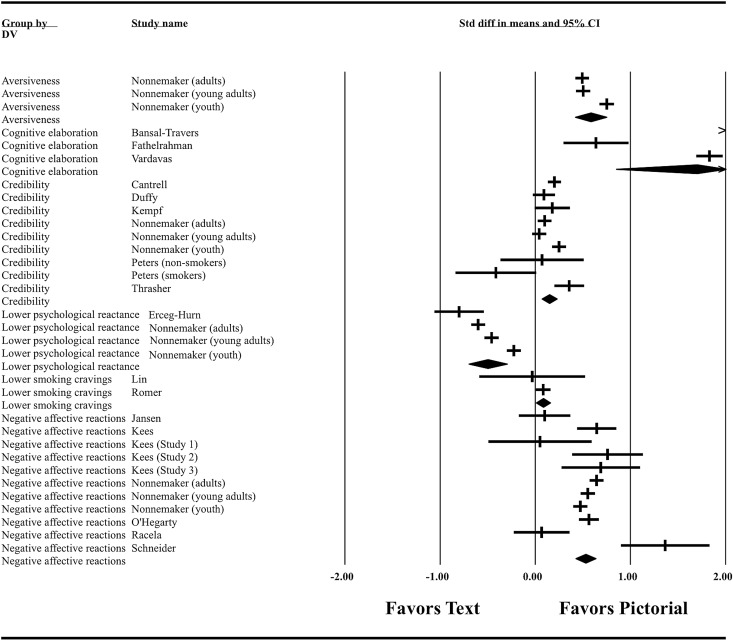
“pictorial warnings elicited more cognitive elaboration (d=1.70), negative affective reactions (d=0.54), credibility (d=0.15), lower smoking cravings (d=0.08), and aversiveness (d=0.58).”
§ Pictorial cigarette pack warnings: a meta-analysis of experimental studies > Results > Effectiveness of pictorial warnings
plaindirect- Asserted: passes — The authors put it forward as true.
- Checkable: passes — It can be checked against evidence.
- Load-bearing: unclear — It is unclear whether the paper’s conclusions depend on it.
- Based: passes — The paper gives a reason why it holds.
A result the paper reports from its own data — it cites no other source for it, so there is none to check. The quote shows it is in the paper.
In the paper
“Pictorial warnings were more likely to be rated as effective in motivating not starting smoking (d=1.03), motivating reducing smoking (d=0.41), motivating themselves (d=0.79) or others (d=1.09) to quit smoking, and motivating (smokers or non-smokers) to not smoke (d=0.24).”
§ Pictorial cigarette pack warnings: a meta-analysis of experimental studies > Results > Perceived effectiveness of pictorial warnings
plaindirect- Asserted: passes — The authors put it forward as true.
- Checkable: passes — It can be checked against evidence.
- Load-bearing: passes — The paper’s conclusions depend on it.
- Based: passes — The paper gives a reason why it holds.
A result the paper reports from its own data — it cites no other source for it, so there is none to check. The quote shows it is in the paper.
In the paper
“pictorial warnings elicited more cognitive elaboration (d=1.70), negative affective reactions (d=0.54), credibility (d=0.15), lower smoking cravings (d=0.08), and aversiveness (d=0.58).”
§ Pictorial cigarette pack warnings: a meta-analysis of experimental studies > Results > Effectiveness of pictorial warnings
plaindirect- Asserted: passes — The authors put it forward as true.
- Checkable: passes — It can be checked against evidence.
- Load-bearing: passes — The paper’s conclusions depend on it.
- Based: passes — The paper gives a reason why it holds.
A result the paper reports from its own data — it cites no other source for it, so there is none to check. The quote shows it is in the paper.
In the paper
“Pictorial warnings exhibited statistically significant effects relative to text warnings for 13 of 17 effectiveness outcomes (most at p<0.001; see table 3), with 12 of 17 effects favouring pictorial warnings.”
§ Pictorial cigarette pack warnings: a meta-analysis of experimental studies > Results > Effectiveness of pictorial warnings
plaindirect- Asserted: passes — The authors put it forward as true.
- Checkable: passes — It can be checked against evidence.
- Load-bearing: passes — The paper’s conclusions depend on it.
- Based: passes — The paper gives a reason why it holds.
A result the paper reports from its own data — it cites no other source for it, so there is none to check. The quote shows it is in the paper.
In the paper
“Participants also perceived pictorial warnings as deterrents to giving cigarettes as a gift (d=1.64), as generally effective (d=1.00), and as effective for themselves and others (d=0.52).”
§ Pictorial cigarette pack warnings: a meta-analysis of experimental studies > Results > Perceived effectiveness of pictorial warnings
plain- Asserted: passes — The authors put it forward as true.
- Checkable: passes — It can be checked against evidence.
- Load-bearing: unclear — It is unclear whether the paper’s conclusions depend on it.
- Based: passes — The paper gives a reason why it holds.
A result the paper reports from its own data — it cites no other source for it, so there is none to check. The quote shows it is in the paper.
In the paper
“However, pictorial warnings also elicited greater psychological reactance (d=−0.50).”
§ Pictorial cigarette pack warnings: a meta-analysis of experimental studies > Results > Effectiveness of pictorial warnings
plaindirect- Asserted: passes — The authors put it forward as true.
- Checkable: passes — It can be checked against evidence.
- Load-bearing: unclear — It is unclear whether the paper’s conclusions depend on it.
- Based: passes — The paper gives a reason why it holds.
A result the paper reports from its own data — it cites no other source for it, so there is none to check. The quote shows it is in the paper.
In the paper
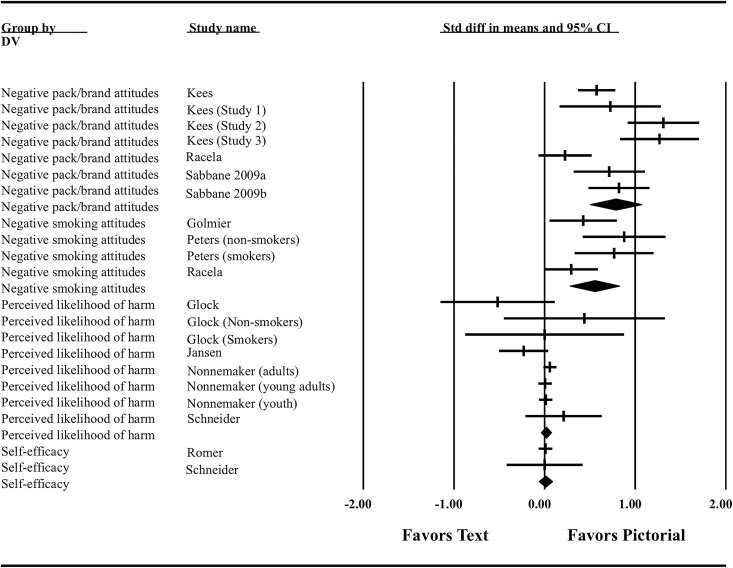
“with effects on both negative pack/brand attitudes (d=0.79) and negative smoking attitudes (d=0.55) relative to text warnings.”
§ Pictorial cigarette pack warnings: a meta-analysis of experimental studies > Results > Effectiveness of pictorial warnings
plaindirect- Asserted: passes — The authors put it forward as true.
- Checkable: passes — It can be checked against evidence.
- Load-bearing: passes — The paper’s conclusions depend on it.
- Based: passes — The paper gives a reason why it holds.
A result the paper reports from its own data — it cites no other source for it, so there is none to check. The quote shows it is in the paper.
In the paper
“pictorial warnings scoring higher on both attention attracting (d=0.79) and attention duration (d=1.74).”
§ Pictorial cigarette pack warnings: a meta-analysis of experimental studies > Results > Effectiveness of pictorial warnings
plaindirect- Asserted: passes — The authors put it forward as true.
- Checkable: passes — It can be checked against evidence.
- Load-bearing: passes — The paper’s conclusions depend on it.
- Based: passes — The paper gives a reason why it holds.
A result the paper reports from its own data — it cites no other source for it, so there is none to check. The quote shows it is in the paper.
In the paper
“No effects were observed on perceived likelihood of harm (d=0.02) or self-efficacy to quit (d=0.01).”
§ Pictorial cigarette pack warnings: a meta-analysis of experimental studies > Results > Effectiveness of pictorial warnings
plain- Asserted: passes — The authors put it forward as true.
- Checkable: passes — It can be checked against evidence.
- Load-bearing: unclear — It is unclear whether the paper’s conclusions depend on it.
- Based: passes — The paper gives a reason why it holds.
A result the paper reports from its own data — it cites no other source for it, so there is none to check. The quote shows it is in the paper.
In the paper
“Pictorial warnings were more likely to be rated as effective in motivating not starting smoking (d=1.03), motivating reducing smoking (d=0.41), motivating themselves (d=0.79) or others (d=1.09) to quit smoking, and motivating (smokers or non-smokers) to not smoke (d=0.24).”
§ Pictorial cigarette pack warnings: a meta-analysis of experimental studies > Results > Perceived effectiveness of pictorial warnings
plain- Asserted: passes — The authors put it forward as true.
- Checkable: passes — It can be checked against evidence.
- Load-bearing: passes — The paper’s conclusions depend on it.
- Based: passes — The paper gives a reason why it holds.
A result the paper reports from its own data — it cites no other source for it, so there is none to check. The quote shows it is in the paper.
In the paper
“pictorial warnings elicited more cognitive elaboration (d=1.70), negative affective reactions (d=0.54), credibility (d=0.15), lower smoking cravings (d=0.08), and aversiveness (d=0.58).”
§ Pictorial cigarette pack warnings: a meta-analysis of experimental studies > Results > Effectiveness of pictorial warnings
plaindirect- Asserted: passes — The authors put it forward as true.
- Checkable: passes — It can be checked against evidence.
- Load-bearing: passes — The paper’s conclusions depend on it.
- Based: passes — The paper gives a reason why it holds.
A result the paper reports from its own data — it cites no other source for it, so there is none to check. The quote shows it is in the paper.
In the paper
“37 studies with data on 48 independent samples (N=33 613) met criteria.”
- Also stated in: § Search strategy · plain
“This process resulted in a total of 35 articles reporting on 37 studies. Since some studies reported results separately for different subgroups, we analysed effect sizes for each independent sample. Thus, the meta-analysis synthesised effects of 48 independent samples.”
§ Pictorial cigarette pack warnings: a meta-analysis of experimental studies > Abstract > Study selection
plainn = 48- Asserted: passes — The authors put it forward as true.
- Checkable: passes — It can be checked against evidence.
- Load-bearing: passes — The paper’s conclusions depend on it.
- Based: passes — The paper gives a reason why it holds.
- Also stated in: § Search strategy · plain
A result the paper reports from its own data — it cites no other source for it, so there is none to check. The quote shows it is in the paper.
In the paper
“with effects on both negative pack/brand attitudes (d=0.79) and negative smoking attitudes (d=0.55) relative to text warnings.”
§ Pictorial cigarette pack warnings: a meta-analysis of experimental studies > Results > Effectiveness of pictorial warnings
plaindirect- Asserted: passes — The authors put it forward as true.
- Checkable: passes — It can be checked against evidence.
- Load-bearing: passes — The paper’s conclusions depend on it.
- Based: passes — The paper gives a reason why it holds.
A result the paper reports from its own data — it cites no other source for it, so there is none to check. The quote shows it is in the paper.
In the paper
“Gaps in the literature include a lack of assessment of smoking behaviour and a dearth of theory-based research on how warnings exert their effects.”
- Also stated in: § Study characteristics · plain
“Nineteen of 37 studies (51%) mentioned a theory as informing the study.”
§ Pictorial cigarette pack warnings: a meta-analysis of experimental studies > Abstract > Conclusions
plain- Asserted: passes — The authors put it forward as true.
- Checkable: passes — It can be checked against evidence.
- Load-bearing: unclear — It is unclear whether the paper’s conclusions depend on it.
- Based: passes — The paper gives a reason why it holds.
- Also stated in: § Study characteristics · plain
A result the paper reports from its own data — it cites no other source for it, so there is none to check. The quote shows it is in the paper.
In the paper
“pictorial warnings elicited more cognitive elaboration (d=1.70), negative affective reactions (d=0.54), credibility (d=0.15), lower smoking cravings (d=0.08), and aversiveness (d=0.58).”
§ Pictorial cigarette pack warnings: a meta-analysis of experimental studies > Results > Effectiveness of pictorial warnings
plaindirect- Asserted: passes — The authors put it forward as true.
- Checkable: passes — It can be checked against evidence.
- Load-bearing: passes — The paper’s conclusions depend on it.
- Based: passes — The paper gives a reason why it holds.
A result the paper reports from its own data — it cites no other source for it, so there is none to check. The quote shows it is in the paper.
In the paper
“Participants also perceived pictorial warnings as deterrents to giving cigarettes as a gift (d=1.64), as generally effective (d=1.00), and as effective for themselves and others (d=0.52).”
§ Pictorial cigarette pack warnings: a meta-analysis of experimental studies > Results > Perceived effectiveness of pictorial warnings
plain- Asserted: passes — The authors put it forward as true.
- Checkable: passes — It can be checked against evidence.
- Load-bearing: passes — The paper’s conclusions depend on it.
- Based: passes — The paper gives a reason why it holds.
A result the paper reports from its own data — it cites no other source for it, so there is none to check. The quote shows it is in the paper.
In the paper
“pictorial warnings elicited more cognitive elaboration (d=1.70), negative affective reactions (d=0.54), credibility (d=0.15), lower smoking cravings (d=0.08), and aversiveness (d=0.58).”
§ Pictorial cigarette pack warnings: a meta-analysis of experimental studies > Results > Effectiveness of pictorial warnings
plaindirect- Asserted: passes — The authors put it forward as true.
- Checkable: passes — It can be checked against evidence.
- Load-bearing: passes — The paper’s conclusions depend on it.
- Based: passes — The paper gives a reason why it holds.
A result the paper reports from its own data — it cites no other source for it, so there is none to check. The quote shows it is in the paper.
In the paper
“We observed no effects on response time or recall/recognition of warning text.”
§ Pictorial cigarette pack warnings: a meta-analysis of experimental studies > Results > Effectiveness of pictorial warnings
plain- Asserted: passes — The authors put it forward as true.
- Checkable: passes — It can be checked against evidence.
- Load-bearing: unclear — It is unclear whether the paper’s conclusions depend on it.
- Based: passes — The paper gives a reason why it holds.
A result the paper reports from its own data — it cites no other source for it, so there is none to check. The quote shows it is in the paper.
In the paper
“Pictorial warnings were more effective than text-only warnings for 12 of 17 effectiveness outcomes (all p<0.05).”
- Also stated in: § Effectiveness of pictorial warnings · plain
“with 12 of 17 effects favouring pictorial warnings.”
§ Pictorial cigarette pack warnings: a meta-analysis of experimental studies > Abstract > Results
plaindirect- Asserted: passes — The authors put it forward as true.
- Checkable: passes — It can be checked against evidence.
- Load-bearing: passes — The paper’s conclusions depend on it.
- Based: passes — The paper gives a reason why it holds.
- Also stated in: § Effectiveness of pictorial warnings · plain
A result the paper reports from its own data — it cites no other source for it, so there is none to check. The quote shows it is in the paper.
In the paper
“with effects on lower willingness to pay (d=0.26), intention to not start smoking (d=1.82), and intention to quit smoking (d=0.54).”
§ Pictorial cigarette pack warnings: a meta-analysis of experimental studies > Results > Effectiveness of pictorial warnings
plaindirect- Asserted: passes — The authors put it forward as true.
- Checkable: passes — It can be checked against evidence.
- Load-bearing: passes — The paper’s conclusions depend on it.
- Based: passes — The paper gives a reason why it holds.
The paper states this without a source or data behind it here, so there is nothing to check it against. The quote shows it is in the paper.
In the paper
“Gaps in the literature include a lack of assessment of smoking behaviour and a dearth of theory-based research on how warnings exert their effects.”
§ Pictorial cigarette pack warnings: a meta-analysis of experimental studies > Abstract > Conclusions
plain- Asserted: passes — The authors put it forward as true.
- Checkable: passes — It can be checked against evidence.
- Load-bearing: unclear — It is unclear whether the paper’s conclusions depend on it.
- Based: passes — The paper gives a reason why it holds.
A result the paper reports from its own data — it cites no other source for it, so there is none to check. The quote shows it is in the paper.
In the paper
“with effects on lower willingness to pay (d=0.26), intention to not start smoking (d=1.82), and intention to quit smoking (d=0.54).”
§ Pictorial cigarette pack warnings: a meta-analysis of experimental studies > Results > Effectiveness of pictorial warnings
plaindirect- Asserted: passes — The authors put it forward as true.
- Checkable: passes — It can be checked against evidence.
- Load-bearing: passes — The paper’s conclusions depend on it.
- Based: passes — The paper gives a reason why it holds.
A result the paper reports from its own data — it cites no other source for it, so there is none to check. The quote shows it is in the paper.
In the paper
“Analyses of exposure medium (two-dimensional vs three-dimensional pack), exposure channel (digital vs paper or pack), and country of sample (USA vs other countries) found no differences.”
§ Pictorial cigarette pack warnings: a meta-analysis of experimental studies > Results > Moderator analyses
plain- Asserted: passes — The authors put it forward as true.
- Checkable: passes — It can be checked against evidence.
- Load-bearing: unclear — It is unclear whether the paper’s conclusions depend on it.
- Based: passes — The paper gives a reason why it holds.
A result the paper reports from its own data — it cites no other source for it, so there is none to check. The quote shows it is in the paper.
In the paper
“Compared with text warnings, pictorial warnings (1) attracted and held attention better; (2) garnered stronger cognitive and emotional reactions; (3) elicited more negative pack attitudes and negative smoking attitudes; and (4) more effectively increased intentions to not start smoking and to quit smoking.”
§ Pictorial cigarette pack warnings: a meta-analysis of experimental studies > Discussion
plaindirect- Asserted: passes — The authors put it forward as true.
- Checkable: passes — It can be checked against evidence.
- Load-bearing: passes — The paper’s conclusions depend on it.
- Based: passes — The paper gives a reason why it holds.
A result the paper reports from its own data — it cites no other source for it, so there is none to check. The quote shows it is in the paper.
In the paper
“Smokers and non-smokers rated pictorial warnings as more effective than text warnings at motivating not starting, reducing and quitting smoking.”
§ Pictorial cigarette pack warnings: a meta-analysis of experimental studies > Discussion
plaindirect- Asserted: passes — The authors put it forward as true.
- Checkable: passes — It can be checked against evidence.
- Load-bearing: passes — The paper’s conclusions depend on it.
- Based: passes — The paper gives a reason why it holds.
A result the paper reports from its own data — it cites no other source for it, so there is none to check. The quote shows it is in the paper.
In the paper
“Across an international body of experimental studies, we found effects favouring pictorial warnings for 12 of 17 effectiveness outcomes.”
§ Pictorial cigarette pack warnings: a meta-analysis of experimental studies > Discussion
plaindirect- Asserted: passes — The authors put it forward as true.
- Checkable: passes — It can be checked against evidence.
- Load-bearing: passes — The paper’s conclusions depend on it.
- Based: passes — The paper gives a reason why it holds.
A result the paper reports from its own data — it cites no other source for it, so there is none to check. The quote shows it is in the paper.
In the paper
“Moderation analyses found that studies using a within-subject design (k=7) differed from those using a between-subject design (k=8; Qb=7.50, p<0.01; table 5). Studies using within-subject designs (d=1.37) had larger effect sizes than those using between-subject designs (d=0.51).”
§ Pictorial cigarette pack warnings: a meta-analysis of experimental studies > Results > Moderator analyses
plaincorrelational- Asserted: passes — The authors put it forward as true.
- Checkable: passes — It can be checked against evidence.
- Load-bearing: unclear — It is unclear whether the paper’s conclusions depend on it.
- Based: passes — The paper gives a reason why it holds.
A result the paper reports from its own data — it cites no other source for it, so there is none to check. The quote shows it is in the paper.
In the paper
“We saw the effects for many beliefs and attitudes that are plausible mediators according to theories of health behaviour.50 85 86”
§ Pictorial cigarette pack warnings: a meta-analysis of experimental studies > Discussion > Mediators of pictorial warning effects
plaindirect- Asserted: passes — The authors put it forward as true.
- Checkable: passes — It can be checked against evidence.
- Load-bearing: passes — The paper’s conclusions depend on it.
- Based: passes — The paper gives a reason why it holds.
A result the paper reports from its own data — it cites no other source for it, so there is none to check. The quote shows it is in the paper.
In the paper
“In our review, pictorial warnings were also superior to text warnings on all eight perceived effectiveness outcomes.”
§ Pictorial cigarette pack warnings: a meta-analysis of experimental studies > Discussion
plaindirect- Asserted: passes — The authors put it forward as true.
- Checkable: passes — It can be checked against evidence.
- Load-bearing: passes — The paper’s conclusions depend on it.
- Based: passes — The paper gives a reason why it holds.
A result the paper reports from its own data — it cites no other source for it, so there is none to check. The quote shows it is in the paper.
In the paper
“In our meta-analysis, pictorial warnings elicited greater fear-oriented reactions than text warnings, as intended.”
§ Pictorial cigarette pack warnings: a meta-analysis of experimental studies > Discussion > Mediators of pictorial warning effects
plaindirect- Asserted: passes — The authors put it forward as true.
- Checkable: passes — It can be checked against evidence.
- Load-bearing: passes — The paper’s conclusions depend on it.
- Based: passes — The paper gives a reason why it holds.
A result the paper reports from its own data — it cites no other source for it, so there is none to check. The quote shows it is in the paper.
In the paper
“It was surprising that only five studies (with 8 effect sizes) in the meta-analysis assessed perceived likelihood of harm, a component of perceived threat, when much theorising situates this as a central construct in fear appeals and risk communication.52 88 89”
§ Pictorial cigarette pack warnings: a meta-analysis of experimental studies > Discussion > Mediators of pictorial warning effects
plain- Asserted: passes — The authors put it forward as true.
- Checkable: passes — It can be checked against evidence.
- Load-bearing: passes — The paper’s conclusions depend on it.
- Based: passes — The paper gives a reason why it holds.
A result the paper reports from its own data — it cites no other source for it, so there is none to check. The quote shows it is in the paper.
In the paper
“Analyses of exposure medium (two-dimensional vs three-dimensional pack), exposure channel (digital vs paper or pack), and country of sample (USA vs other countries) found no differences.”
§ Pictorial cigarette pack warnings: a meta-analysis of experimental studies > Results > Moderator analyses
plain- Asserted: passes — The authors put it forward as true.
- Checkable: passes — It can be checked against evidence.
- Load-bearing: unclear — It is unclear whether the paper’s conclusions depend on it.
- Based: passes — The paper gives a reason why it holds.
A result the paper reports from its own data — it cites no other source for it, so there is none to check. The quote shows it is in the paper.
In the paper
“This effect was statistically heterogeneous, Q=1310, p<0.001, I2=99.”
§ Pictorial cigarette pack warnings: a meta-analysis of experimental studies > Results > Moderator analyses
plainn = 13 ·- Asserted: passes — The authors put it forward as true.
- Checkable: passes — It can be checked against evidence.
- Load-bearing: unclear — It is unclear whether the paper’s conclusions depend on it.
- Based: passes — The paper gives a reason why it holds.
A result the paper reports from its own data — it cites no other source for it, so there is none to check. The quote shows it is in the paper.
In the paper
“The trend, however, suggested that non-smokers and mixed samples (d=1.39), rated warnings as being more effective than did smokers (d=0.65).”
§ Pictorial cigarette pack warnings: a meta-analysis of experimental studies > Results > Moderator analyses
hedgedcorrelational- Asserted: passes — The authors put it forward as true.
- Checkable: passes — It can be checked against evidence.
- Load-bearing: unclear — It is unclear whether the paper’s conclusions depend on it.
- Based: passes — The paper gives a reason why it holds.
A result the paper reports from its own data — it cites no other source for it, so there is none to check. The quote shows it is in the paper.
In the paper
“Our review also demonstrated that pictorial warnings increased cognitive elaboration more than text-only warnings.”
§ Pictorial cigarette pack warnings: a meta-analysis of experimental studies > Discussion
boosteddirect- Asserted: passes — The authors put it forward as true.
- Checkable: passes — It can be checked against evidence.
- Load-bearing: passes — The paper’s conclusions depend on it.
- Based: passes — The paper gives a reason why it holds.
A result the paper reports from its own data — it cites no other source for it, so there is none to check. The quote shows it is in the paper.
In the paper
“Effect sizes were also not significantly correlated with gender composition, r (14)=−0.02 (p=0.98) or age, r(14)=−0.32 (p=0.49).”
§ Pictorial cigarette pack warnings: a meta-analysis of experimental studies > Results > Moderator analyses
plain- Asserted: passes — The authors put it forward as true.
- Checkable: passes — It can be checked against evidence.
- Load-bearing: unclear — It is unclear whether the paper’s conclusions depend on it.
- Based: passes — The paper gives a reason why it holds.
A result the paper reports from its own data — it cites no other source for it, so there is none to check. The quote shows it is in the paper.
In the paper
“Statistical comparisons of samples of smokers (k=9) to non-smokers and mixed samples (k=6) did not reach statistical significance (p=0.07).”
§ Pictorial cigarette pack warnings: a meta-analysis of experimental studies > Results > Moderator analyses
plain- Asserted: passes — The authors put it forward as true.
- Checkable: passes — It can be checked against evidence.
- Load-bearing: unclear — It is unclear whether the paper’s conclusions depend on it.
- Based: passes — The paper gives a reason why it holds.
A result the paper reports from its own data — it cites no other source for it, so there is none to check. The quote shows it is in the paper.
In the paper
“Analyses of exposure medium (two-dimensional vs three-dimensional pack), exposure channel (digital vs paper or pack), and country of sample (USA vs other countries) found no differences.”
§ Pictorial cigarette pack warnings: a meta-analysis of experimental studies > Results > Moderator analyses
plain- Asserted: passes — The authors put it forward as true.
- Checkable: passes — It can be checked against evidence.
- Load-bearing: unclear — It is unclear whether the paper’s conclusions depend on it.
- Based: passes — The paper gives a reason why it holds.
A result the paper reports from its own data — it cites no other source for it, so there is none to check. The quote shows it is in the paper.
In the paper
“Effect sizes were also not significantly correlated with gender composition, r (14)=−0.02 (p=0.98) or age, r(14)=−0.32 (p=0.49).”
§ Pictorial cigarette pack warnings: a meta-analysis of experimental studies > Results > Moderator analyses
plain- Asserted: passes — The authors put it forward as true.
- Checkable: passes — It can be checked against evidence.
- Load-bearing: unclear — It is unclear whether the paper’s conclusions depend on it.
- Based: passes — The paper gives a reason why it holds.
A result the paper reports from its own data — it cites no other source for it, so there is none to check. The quote shows it is in the paper.
In the paper
“While our meta-analysis did not find an effect of pictorial warnings on perceived likelihood of harm, the reason is unclear.”
§ Pictorial cigarette pack warnings: a meta-analysis of experimental studies > Discussion > Mediators of pictorial warning effects
plain- Asserted: passes — The authors put it forward as true.
- Checkable: passes — It can be checked against evidence.
- Load-bearing: passes — The paper’s conclusions depend on it.
- Based: passes — The paper gives a reason why it holds.
A result the paper reports from its own data — it cites no other source for it, so there is none to check. The quote shows it is in the paper.
In the paper
“The weighted mean effect size for the composite variable motivation to avoid cigarette use was statistically significant (p<0.001) at d=0.95 (CI 0.56 to 1.34, k=15, cumulative n=13 023).”
§ Pictorial cigarette pack warnings: a meta-analysis of experimental studies > Results > Moderator analyses
plainn = 13,023 ·- Asserted: passes — The authors put it forward as true.
- Checkable: passes — It can be checked against evidence.
- Load-bearing: passes — The paper’s conclusions depend on it.
- Based: passes — The paper gives a reason why it holds.
In the paper
“It is also important to note that the lone study that assessed perceived severity of harm, another component of perceived threat, found a large effect.36”
§ Pictorial cigarette pack warnings: a meta-analysis of experimental studies > Discussion > Mediators of pictorial warning effects
What the sources say
- Not checked yetcites [36] Schneider, 2012, Does the effect go up in smoke? A randomized controlled trial of pictorial warnings on cigarette packaging, Patient Educ Couns source
plaindirectSingle case- Asserted: passes — The authors put it forward as true.
- Checkable: passes — It can be checked against evidence.
- Load-bearing: unclear — It is unclear whether the paper’s conclusions depend on it.
- Based: passes — The paper gives a reason why it holds.
The paper states this without a source or data behind it here, so there is nothing to check it against. The quote shows it is in the paper.
In the paper
“Our meta-analysis included both experiments that manipulated pictorial warnings between subjects (participants viewed only text or only pictorial warnings) and within subjects (participants viewed both warning types).”
§ Pictorial cigarette pack warnings: a meta-analysis of experimental studies > Discussion > Study design
plain- Asserted: passes — The authors put it forward as true.
- Checkable: passes — It can be checked against evidence.
- Load-bearing: passes — The paper’s conclusions depend on it.
- Based: passes — The paper gives a reason why it holds.
The paper states this without a source or data behind it here, so there is nothing to check it against. The quote shows it is in the paper.
In the paper
“The between-subject studies had markedly smaller effect sizes for perceived effectiveness for motivation to avoid cigarette use than within-subject studies.”
§ Pictorial cigarette pack warnings: a meta-analysis of experimental studies > Discussion > Study design
plaincorrelational- Asserted: passes — The authors put it forward as true.
- Checkable: passes — It can be checked against evidence.
- Load-bearing: passes — The paper’s conclusions depend on it.
- Based: passes — The paper gives a reason why it holds.
The paper states this without a source or data behind it here, so there is nothing to check it against. The quote shows it is in the paper.
In the paper
“While some studies have assessed discussions about warnings,19 93 101 102 studies often use this variable in a composite scale representing depth of processing, making it impossible to tease out the influence of social interactions.”
§ Pictorial cigarette pack warnings: a meta-analysis of experimental studies > Discussion > Gaps and future directions
plain- Asserted: passes — The authors put it forward as true.
- Checkable: passes — It can be checked against evidence.
- Load-bearing: unclear — It is unclear whether the paper’s conclusions depend on it.
- Based: passes — The paper gives a reason why it holds.
A result the paper reports from its own data — it cites no other source for it, so there is none to check. The quote shows it is in the paper.
In the paper
“While we found that pictorial warnings elicited greater reactance than text warnings, the studies in our meta-analysis focused on the emotional aspect of reactance, and largely ignored the cognitive elements.”
§ Pictorial cigarette pack warnings: a meta-analysis of experimental studies > Discussion > Mediators of pictorial warning effects
plaindirect- Asserted: passes — The authors put it forward as true.
- Checkable: passes — It can be checked against evidence.
- Load-bearing: unclear — It is unclear whether the paper’s conclusions depend on it.
- Based: passes — The paper gives a reason why it holds.
A result the paper reports from its own data — it cites no other source for it, so there is none to check. The quote shows it is in the paper.
In the paper
“A final study design issue is that no study in this meta-analysis tested warnings by placing them on smokers’ cigarette packs.”
§ Pictorial cigarette pack warnings: a meta-analysis of experimental studies > Discussion > Study design
plain- Asserted: passes — The authors put it forward as true.
- Checkable: passes — It can be checked against evidence.
- Load-bearing: passes — The paper’s conclusions depend on it.
- Based: passes — The paper gives a reason why it holds.
A result the paper reports from its own data — it cites no other source for it, so there is none to check. The quote shows it is in the paper.
In the paper
“Despite the existence of several models to guide warnings research,53–55 our meta-analysis revealed a lack of consensus as to what outcomes experimental studies should assess.”
§ Pictorial cigarette pack warnings: a meta-analysis of experimental studies > Discussion > Theoretical and measurement issues
plain- Asserted: passes — The authors put it forward as true.
- Checkable: passes — It can be checked against evidence.
- Load-bearing: passes — The paper’s conclusions depend on it.
- Based: passes — The paper gives a reason why it holds.
A result the paper reports from its own data — it cites no other source for it, so there is none to check. The quote shows it is in the paper.
In the paper
“Pictorial warnings were more effective than text warnings on 20 of 25 outcomes examined in the meta-analysis;”
§ Pictorial cigarette pack warnings: a meta-analysis of experimental studies > Conclusion
plaindirect- Asserted: passes — The authors put it forward as true.
- Checkable: passes — It can be checked against evidence.
- Load-bearing: passes — The paper’s conclusions depend on it.
- Based: passes — The paper gives a reason why it holds.
In the paper
“First, our meta-analysis identified only a single experimental study that assessed behaviour.69”
§ Pictorial cigarette pack warnings: a meta-analysis of experimental studies > Discussion > Gaps and future directions
What the sources say
- Not checked yetcites [69] Malouff, 2012, Effects on smokers of exposure to graphic warning images, Am J Addict source
plainSingle case- Asserted: passes — The authors put it forward as true.
- Checkable: passes — It can be checked against evidence.
- Load-bearing: passes — The paper’s conclusions depend on it.
- Based: passes — The paper gives a reason why it holds.
A result the paper reports from its own data — it cites no other source for it, so there is none to check. The quote shows it is in the paper.
In the paper
“Finally, our meta-analysis found pictorial warnings increased aversiveness (ie, the warnings being ‘difficult to look at’).”
§ Pictorial cigarette pack warnings: a meta-analysis of experimental studies > Discussion > Mediators of pictorial warning effects
plaindirect- Asserted: passes — The authors put it forward as true.
- Checkable: passes — It can be checked against evidence.
- Load-bearing: unclear — It is unclear whether the paper’s conclusions depend on it.
- Based: passes — The paper gives a reason why it holds.
None of the sources cited for this claim have been checked yet.
In the paper
“and that attention to (and recall of) the warning influences warning reactions.”
§ Pictorial cigarette pack warnings: a meta-analysis of experimental studies > Method > Article coding
What the sources say
- Not checked yetcites [46] McGuire, 1989, Theoretical foundations of campaigns
- Not checked yetcites [47] Fishbein, 2010
- Not checked yetcites [48] Petty, 1986, The elaboration likelihood model of persuasion, Adv Exp Soc Psychol source
- Not checked yetcites [49] Southwell, 2007, The roles of interpersonal communication in mass media campaigns, Commun Yearbook
- Not checked yetcites [50] Noar, 2005, Health behavior theory and cumulative knowledge regarding health behaviors: are we moving in the right direction, Health Educ Res source
- Not checked yetcites [51] Cane, 2012, Validation of the theoretical domains framework for use in behaviour change and implementation research, Implement Sci source
- Not checked yetcites [52] Witte, 1992, Putting the fear back into fear appeals: the extended parallel process model, Commun Monogr source
- Not checked yetcites 29 53–55
plaindirect- Asserted: passes — The authors put it forward as true.
- Checkable: passes — It can be checked against evidence.
- Load-bearing: passes — The paper’s conclusions depend on it.
- Based: passes — The paper gives a reason why it holds.
A conclusion the paper draws from its own results — it cites no other source for it, so there is none to check. The quote shows it is in the paper.
In the paper
“The evidence from this international body of literature supports pictorial cigarette pack warnings as more effective than text-only warnings.”
§ Pictorial cigarette pack warnings: a meta-analysis of experimental studies > Abstract > Conclusions
plaindirect- Asserted: passes — The authors put it forward as true.
- Checkable: passes — It can be checked against evidence.
- Load-bearing: passes — The paper’s conclusions depend on it.
- Based: passes — The paper gives a reason why it holds.
- Rests on an assumption: The intermediate outcomes assessed in the experimental studies (attention, reactions, attitudes, and intentions) are valid indicators of warning effectiveness in changing smoking behaviour.
In the paper
“Importantly, this review did not examine many factors that are likely pre-requisites to changes in behaviour, such as attention to warnings, cognitive and emotional reactions to warnings, and changes in beliefs about smoking.”
§ Pictorial cigarette pack warnings: a meta-analysis of experimental studies > Introduction > Previous research on pictorial cigarette pack warnings
What the sources say
- Not checked yetcites [30] Monarrez-Espino, 2014, Systematic review of the effect of pictorial warnings on cigarette packages in smoking behavior, Am J Public Health source
plain- Asserted: passes — The authors put it forward as true.
- Checkable: passes — It can be checked against evidence.
- Load-bearing: passes — The paper’s conclusions depend on it.
- Based: passes — The paper gives a reason why it holds.
In the paper
“However, isolating the effects of pictorial warnings on smoking behaviour in such studies has proven difficult because governments often introduce the warnings alongside other tobacco control policies.8 12”
§ Pictorial cigarette pack warnings: a meta-analysis of experimental studies > Introduction
What the sources say
- Not checked yetcites 8 12
plaindirect- Asserted: passes — The authors put it forward as true.
- Checkable: passes — It can be checked against evidence.
- Load-bearing: passes — The paper’s conclusions depend on it.
- Based: passes — The paper gives a reason why it holds.
The paper states this without a source or data behind it here, so there is nothing to check it against. The quote shows it is in the paper.
In the paper
“By contrast, experiments can offer strong evidence of the causal impact of pictorial warnings, isolating the effects of warnings on key outcomes.”
§ Pictorial cigarette pack warnings: a meta-analysis of experimental studies > Introduction
boosteddirect- Asserted: passes — The authors put it forward as true.
- Checkable: passes — It can be checked against evidence.
- Load-bearing: passes — The paper’s conclusions depend on it.
- Based: passes — The paper gives a reason why it holds.
In the paper
“Thus, we applied conventional formulas58 and computed all within-subject effect sizes from raw (vs inferential) statistics.”
§ Pictorial cigarette pack warnings: a meta-analysis of experimental studies > Method > Effect-size extraction and calculation
What the sources say
- Not checked yetcites [58] Lipsey, 2001
plain- Asserted: passes — The authors put it forward as true.
- Checkable: passes — It can be checked against evidence.
- Load-bearing: passes — The paper’s conclusions depend on it.
- Based: passes — The paper gives a reason why it holds.
In the paper
“While these recent reviews have summarised portions of the cigarette pack warnings literature,8 9 30 no meta-analysis has synthesised the experimental literature on pictorial cigarette pack warnings.”
§ Pictorial cigarette pack warnings: a meta-analysis of experimental studies > Introduction > Previous research on pictorial cigarette pack warnings
What the sources say
- Not checked yetcites 8 9 30
plain- Asserted: passes — The authors put it forward as true.
- Checkable: passes — It can be checked against evidence.
- Load-bearing: passes — The paper’s conclusions depend on it.
- Based: passes — The paper gives a reason why it holds.
What the paper did — it cites no source for this, so there is none to check. The quote shows it is in the paper.
In the paper
“Most dependent variables had too few studies to perform moderator analyses.”
§ Pictorial cigarette pack warnings: a meta-analysis of experimental studies > Method > Meta-analytic approach
plain- Asserted: passes — The authors put it forward as true.
- Checkable: passes — It can be checked against evidence.
- Load-bearing: passes — The paper’s conclusions depend on it.
- Based: passes — The paper gives a reason why it holds.
A conclusion the paper draws from its own results — it cites no other source for it, so there is none to check. The quote shows it is in the paper.
In the paper
“The experimental studies we examined here showed promising evidence of effects.”
§ Pictorial cigarette pack warnings: a meta-analysis of experimental studies > Discussion
hedgedconditional- Asserted: passes — The authors put it forward as true.
- Checkable: passes — It can be checked against evidence.
- Load-bearing: passes — The paper’s conclusions depend on it.
- Based: passes — The paper gives a reason why it holds.
A conclusion the paper draws from its own results — it cites no other source for it, so there is none to check. The quote shows it is in the paper.
In the paper
“Our meta-analysis provides support for the notion that pictorial warnings elicit changes in an array of psychosocial constructs that are plausible mediators of the warning-behaviour link.”
§ Pictorial cigarette pack warnings: a meta-analysis of experimental studies > Discussion > Mediators of pictorial warning effects
plaindirect- Asserted: passes — The authors put it forward as true.
- Checkable: passes — It can be checked against evidence.
- Load-bearing: passes — The paper’s conclusions depend on it.
- Based: passes — The paper gives a reason why it holds.
A conclusion the paper draws from its own results — it cites no other source for it, so there is none to check. The quote shows it is in the paper.
In the paper
“Taken together, these findings on effectiveness (eg, increased quit intentions) and perceived effectiveness (eg, increased perception that warnings motivate quitting) offer strong evidence to support pictorial cigarette pack warnings as more effective than text-only warnings.”
§ Pictorial cigarette pack warnings: a meta-analysis of experimental studies > Discussion
boosteddirect- Asserted: passes — The authors put it forward as true.
- Checkable: passes — It can be checked against evidence.
- Load-bearing: passes — The paper’s conclusions depend on it.
- Based: passes — The paper gives a reason why it holds.
In the paper
“Because d can be upwardly biased when based on small sample sizes,59 we applied the recommended statistical correction for this bias.58”
§ Pictorial cigarette pack warnings: a meta-analysis of experimental studies > Method > Effect-size extraction and calculation
What the sources say
- Not checked yetcites [59] Hedges, 1985
plaindirect- Asserted: passes — The authors put it forward as true.
- Checkable: passes — It can be checked against evidence.
- Load-bearing: passes — The paper’s conclusions depend on it.
- Based: passes — The paper gives a reason why it holds.
A conclusion the paper draws from its own results — it cites no other source for it, so there is none to check. The quote shows it is in the paper.
In the paper
“Cognitive elaboration may play a particularly important role in the quitting process.”
§ Pictorial cigarette pack warnings: a meta-analysis of experimental studies > Discussion
hedgedconditional- Asserted: passes — The authors put it forward as true.
- Checkable: passes — It can be checked against evidence.
- Load-bearing: passes — The paper’s conclusions depend on it.
- Based: passes — The paper gives a reason why it holds.
In the paper
“A recent longitudinal study found that increased attention to cigarette pack warnings led to greater cognitive elaboration, which ultimately predicted quit attempts (via mediation through worry and quit intentions).81”
§ Pictorial cigarette pack warnings: a meta-analysis of experimental studies > Discussion
What the sources say
- Not checked yetcites [81] Yong, 2014, Mediational pathways of the impact of cigarette warning labels on quit attempts, Health Psychol source
plaindirect- Asserted: passes — The authors put it forward as true.
- Checkable: passes — It can be checked against evidence.
- Load-bearing: unclear — It is unclear whether the paper’s conclusions depend on it.
- Based: passes — The paper gives a reason why it holds.
In the paper
“However, internal validity threats make strong causal conclusions from such studies difficult, especially on outcomes such as smoking behaviour.30”
§ Pictorial cigarette pack warnings: a meta-analysis of experimental studies > Discussion > Study design
What the sources say
- Not checked yetcites [30] Monarrez-Espino, 2014, Systematic review of the effect of pictorial warnings on cigarette packages in smoking behavior, Am J Public Health source
plain- Asserted: passes — The authors put it forward as true.
- Checkable: passes — It can be checked against evidence.
- Load-bearing: passes — The paper’s conclusions depend on it.
- Based: passes — The paper gives a reason why it holds.
A conclusion the paper draws from its own results — it cites no other source for it, so there is none to check. The quote shows it is in the paper.
In the paper
“Our study was the first to estimate the effects of pictorial cigarette pack warnings through a meta-analysis of experimental studies.”
§ Pictorial cigarette pack warnings: a meta-analysis of experimental studies > Conclusion
plain- Asserted: passes — The authors put it forward as true.
- Checkable: passes — It can be checked against evidence.
- Load-bearing: passes — The paper’s conclusions depend on it.
- Based: passes — The paper gives a reason why it holds.
In the paper
“One observational study revealed that Canadian smokers who avoided pictorial warnings were equally likely to think about the warnings or engage in cessation behaviour than those who did not attempt to avoid the warnings.93”
§ Pictorial cigarette pack warnings: a meta-analysis of experimental studies > Discussion > Mediators of pictorial warning effects
What the sources say
- Not checked yetcites [93] Hammond, 2004, Graphic Canadian cigarette warning labels and adverse outcomes: evidence from Canadian smokers, Am J Public Health source
plain- Asserted: passes — The authors put it forward as true.
- Checkable: passes — It can be checked against evidence.
- Load-bearing: unclear — It is unclear whether the paper’s conclusions depend on it.
- Based: passes — The paper gives a reason why it holds.
In the paper
“By contrast, the large body of observational literature examines smokers who have had multiple exposures to warnings on their cigarette packs.8”
§ Pictorial cigarette pack warnings: a meta-analysis of experimental studies > Discussion > Study design
What the sources say
- Not checked yetcites [8] Hammond, 2011, Health warning messages on tobacco products: a review, Tob Control source
plain- Asserted: passes — The authors put it forward as true.
- Checkable: passes — It can be checked against evidence.
- Load-bearing: passes — The paper’s conclusions depend on it.
- Based: passes — The paper gives a reason why it holds.
- It may state two separate claims as one. 22
- Probably not a substantial claim. 24
A result the paper reports from its own data — it cites no other source for it, so there is none to check. The quote shows it is in the paper.
In the paper
“Homogeneity analyses indicated that 9 of 17 effect sizes were heterogeneous, with many outcomes exhibiting extremely high heterogeneity: 6 of these 9 outcomes had an I2 of greater than 90 (table 3).”
§ Pictorial cigarette pack warnings: a meta-analysis of experimental studies > Results > Effectiveness of pictorial warnings
hedged- Asserted: passes — The authors put it forward as true.
- Checkable: passes — It can be checked against evidence.
- Load-bearing: unclear — It is unclear whether the paper’s conclusions depend on it.
- Based: passes — The paper gives a reason why it holds.
It may state two separate claims as one.
A result the paper reports from its own data — it cites no other source for it, so there is none to check. The quote shows it is in the paper.
In the paper
“Compared with text warnings, pictorial warnings (1) attracted and held attention better; (2) garnered stronger cognitive and emotional reactions; (3) elicited more negative pack attitudes and negative smoking attitudes; and (4) more effectively increased intentions to not start smoking and to quit smoking.”
§ Pictorial cigarette pack warnings: a meta-analysis of experimental studies > Discussion
plaindirect- Asserted: passes — The authors put it forward as true.
- Checkable: passes — It can be checked against evidence.
- Load-bearing: passes — The paper’s conclusions depend on it.
- Based: passes — The paper gives a reason why it holds.
It may state two separate claims as one.
A result the paper reports from its own data — it cites no other source for it, so there is none to check. The quote shows it is in the paper.
In the paper
“On these two key constructs, we found no effects of pictorial warnings.”
§ Pictorial cigarette pack warnings: a meta-analysis of experimental studies > Discussion > Mediators of pictorial warning effects
plain- Asserted: passes — The authors put it forward as true.
- Checkable: passes — It can be checked against evidence.
- Load-bearing: passes — The paper’s conclusions depend on it.
- Based: passes — The paper gives a reason why it holds.
It may state two separate claims as one.
A result the paper reports from its own data — it cites no other source for it, so there is none to check. The quote shows it is in the paper.
In the paper
“However, only two studies in this meta-analysis measured self-efficacy, and none manipulated it experimentally.”
§ Pictorial cigarette pack warnings: a meta-analysis of experimental studies > Discussion > Mediators of pictorial warning effects
plain- Asserted: passes — The authors put it forward as true.
- Checkable: passes — It can be checked against evidence.
- Load-bearing: passes — The paper’s conclusions depend on it.
- Based: passes — The paper gives a reason why it holds.
It may state two separate claims as one.
A result the paper reports from its own data — it cites no other source for it, so there is none to check. The quote shows it is in the paper.
In the paper
“While we found that pictorial warnings elicited greater reactance than text warnings, the studies in our meta-analysis focused on the emotional aspect of reactance, and largely ignored the cognitive elements.”
§ Pictorial cigarette pack warnings: a meta-analysis of experimental studies > Discussion > Mediators of pictorial warning effects
plain- Asserted: passes — The authors put it forward as true.
- Checkable: passes — It can be checked against evidence.
- Load-bearing: fails — The paper’s conclusions may not depend on it.
- Based: passes — The paper gives a reason why it holds.
Probably not a substantial claim. The paper’s conclusions may not depend on it. It may state two separate claims as one.
A result the paper reports from its own data — it cites no other source for it, so there is none to check. The quote shows it is in the paper.
In the paper
“Pictorial warnings were more effective (eg, increased quit intentions) and perceived to be more effective (eg, rated as likely to motivate smokers to quit) as compared with text warnings;”
§ Pictorial cigarette pack warnings: a meta-analysis of experimental studies > Conclusion
plaindirect- Asserted: passes — The authors put it forward as true.
- Checkable: passes — It can be checked against evidence.
- Load-bearing: passes — The paper’s conclusions depend on it.
- Based: passes — The paper gives a reason why it holds.
It may state two separate claims as one.
The paper states this without a source or data behind it here, so there is nothing to check it against. The quote shows it is in the paper.
In the paper
“Third and finally, an area that remains understudied is the effect of pictorial warnings on reducing smoking initiation.”
§ Pictorial cigarette pack warnings: a meta-analysis of experimental studies > Discussion > Gaps and future directions
plain- Asserted: passes — The authors put it forward as true.
- Checkable: passes — It can be checked against evidence.
- Load-bearing: fails — The paper’s conclusions may not depend on it.
- Based: passes — The paper gives a reason why it holds.
Probably not a substantial claim. The paper’s conclusions may not depend on it.
A result the paper reports from its own data — it cites no other source for it, so there is none to check. The quote shows it is in the paper.
In the paper
“Instead, participants had only brief exposure to warnings, often on a computer screen.”
§ Pictorial cigarette pack warnings: a meta-analysis of experimental studies > Discussion > Study design
plain- Asserted: passes — The authors put it forward as true.
- Checkable: passes — It can be checked against evidence.
- Load-bearing: passes — The paper’s conclusions depend on it.
- Based: passes — The paper gives a reason why it holds.
It may state two separate claims as one.
A result the paper reports from its own data — it cites no other source for it, so there is none to check. The quote shows it is in the paper.
In the paper
“This investigation demonstrated that pictorial warnings were more effective than text warnings on the vast majority of outcomes studied, affecting several constructs, including intention to not start smoking and intention to quit smoking.”
§ Pictorial cigarette pack warnings: a meta-analysis of experimental studies > Conclusion
boosteddirect- Asserted: passes — The authors put it forward as true.
- Checkable: passes — It can be checked against evidence.
- Load-bearing: passes — The paper’s conclusions depend on it.
- Based: passes — The paper gives a reason why it holds.
It may state two separate claims as one.
A result the paper reports from its own data — it cites no other source for it, so there is none to check. The quote shows it is in the paper.
In the paper
“Outcomes varied widely, with little consistency across studies.”
§ Pictorial cigarette pack warnings: a meta-analysis of experimental studies > Discussion > Theoretical and measurement issues
plain- Asserted: passes — The authors put it forward as true.
- Checkable: passes — It can be checked against evidence.
- Load-bearing: passes — The paper’s conclusions depend on it.
- Based: passes — The paper gives a reason why it holds.
It may state two separate claims as one.
None of the sources cited for this claim have been checked yet.
In the paper
“Warning reactions are thought to, in turn, affect attitudes/beliefs”
§ Pictorial cigarette pack warnings: a meta-analysis of experimental studies > Method > Article coding
What the sources say
- Not checked yetcites [46] McGuire, 1989, Theoretical foundations of campaigns
- Not checked yetcites [47] Fishbein, 2010
- Not checked yetcites [48] Petty, 1986, The elaboration likelihood model of persuasion, Adv Exp Soc Psychol source
- Not checked yetcites [49] Southwell, 2007, The roles of interpersonal communication in mass media campaigns, Commun Yearbook
- Not checked yetcites [50] Noar, 2005, Health behavior theory and cumulative knowledge regarding health behaviors: are we moving in the right direction, Health Educ Res source
- Not checked yetcites [51] Cane, 2012, Validation of the theoretical domains framework for use in behaviour change and implementation research, Implement Sci source
- Not checked yetcites [52] Witte, 1992, Putting the fear back into fear appeals: the extended parallel process model, Commun Monogr source
- Not checked yetcites 29 53–55
hedgeddirect- Asserted: passes — The authors put it forward as true.
- Checkable: passes — It can be checked against evidence.
- Load-bearing: passes — The paper’s conclusions depend on it.
- Based: passes — The paper gives a reason why it holds.
Probably not a substantial claim.
In the paper
“Given that cigarette pack warnings are often in public view, they may spark interpersonal communication and social interactions.49 These social interactions, such as talking about the warnings with friends and family members, may affect individuals’ attitudes, beliefs, and reactions to the warnings.”
§ Pictorial cigarette pack warnings: a meta-analysis of experimental studies > Method > Article coding
What the sources say
- Not checked yetcites [49] Southwell, 2007, The roles of interpersonal communication in mass media campaigns, Commun Yearbook
hedgedconditional- Asserted: passes — The authors put it forward as true.
- Checkable: passes — It can be checked against evidence.
- Load-bearing: fails — The paper’s conclusions may not depend on it.
- Based: passes — The paper gives a reason why it holds.
Probably not a substantial claim. The paper’s conclusions may not depend on it. It may state two separate claims as one.
None of the sources cited for this claim have been checked yet.
In the paper
“The framework suggests that the characteristics of a warning affect the extent to which the warning will be noticed and later recalled”
§ Pictorial cigarette pack warnings: a meta-analysis of experimental studies > Method > Article coding
What the sources say
- Not checked yetcites [46] McGuire, 1989, Theoretical foundations of campaigns
- Not checked yetcites [47] Fishbein, 2010
- Not checked yetcites [48] Petty, 1986, The elaboration likelihood model of persuasion, Adv Exp Soc Psychol source
- Not checked yetcites [49] Southwell, 2007, The roles of interpersonal communication in mass media campaigns, Commun Yearbook
- Not checked yetcites [50] Noar, 2005, Health behavior theory and cumulative knowledge regarding health behaviors: are we moving in the right direction, Health Educ Res source
- Not checked yetcites [51] Cane, 2012, Validation of the theoretical domains framework for use in behaviour change and implementation research, Implement Sci source
- Not checked yetcites [52] Witte, 1992, Putting the fear back into fear appeals: the extended parallel process model, Commun Monogr source
- Not checked yetcites 29 53–55
hedgeddirect- Asserted: passes — The authors put it forward as true.
- Checkable: passes — It can be checked against evidence.
- Load-bearing: passes — The paper’s conclusions depend on it.
- Based: passes — The paper gives a reason why it holds.
Probably not a substantial claim.
None of the sources cited for this claim have been checked yet.
In the paper
“which later influence intentions and ultimately behaviour.”
§ Pictorial cigarette pack warnings: a meta-analysis of experimental studies > Method > Article coding
What the sources say
- Not checked yetcites [46] McGuire, 1989, Theoretical foundations of campaigns
- Not checked yetcites [47] Fishbein, 2010
- Not checked yetcites [48] Petty, 1986, The elaboration likelihood model of persuasion, Adv Exp Soc Psychol source
- Not checked yetcites [49] Southwell, 2007, The roles of interpersonal communication in mass media campaigns, Commun Yearbook
- Not checked yetcites [50] Noar, 2005, Health behavior theory and cumulative knowledge regarding health behaviors: are we moving in the right direction, Health Educ Res source
- Not checked yetcites [51] Cane, 2012, Validation of the theoretical domains framework for use in behaviour change and implementation research, Implement Sci source
- Not checked yetcites [52] Witte, 1992, Putting the fear back into fear appeals: the extended parallel process model, Commun Monogr source
- Not checked yetcites 29 53–55
plaindirect- Asserted: passes — The authors put it forward as true.
- Checkable: passes — It can be checked against evidence.
- Load-bearing: fails — The paper’s conclusions may not depend on it.
- Based: passes — The paper gives a reason why it holds.
Probably not a substantial claim. The paper’s conclusions may not depend on it. It may state two separate claims as one.
None of the sources cited for this claim have been checked yet.
In the paper
“These findings are noteworthy, as research has suggested that messages with higher perceived effectiveness ratings may be more effective than those with lower ratings.82–84”
§ Pictorial cigarette pack warnings: a meta-analysis of experimental studies > Discussion
What the sources say
- Not checked yetcites [82] Dillard, 2007, The relationship between the perceived and actual effectiveness of persuasive messages: a meta-analysis with implications for formative campaign research, J Commun source
- Not checked yetcites [83] Davis, 2012, Perceived effectiveness of cessation advertisements: the importance of audience reactions and practical implications for media campaign planning, Health Commun source
- Not checked yetcites [84] Brennan, 2014, Assessing the effectiveness of antismoking television advertisements: do audience ratings of perceived effectiveness predict changes in quitting intentions and smoking behaviours?, Tob Control source
hedgedconditional- Asserted: passes — The authors put it forward as true.
- Checkable: passes — It can be checked against evidence.
- Load-bearing: fails — The paper’s conclusions may not depend on it.
- Based: passes — The paper gives a reason why it holds.
Probably not a substantial claim. The paper’s conclusions may not depend on it.
None of the sources cited for this claim have been checked yet.
In the paper
“Because d can be upwardly biased when based on small sample sizes,59 we applied the recommended statistical correction for this bias.58”
§ Pictorial cigarette pack warnings: a meta-analysis of experimental studies > Method > Effect-size extraction and calculation
What the sources say
- Not checked yetcites [58] Lipsey, 2001
- Not checked yetcites [59] Hedges, 1985
plain- Asserted: passes — The authors put it forward as true.
- Checkable: passes — It can be checked against evidence.
- Load-bearing: passes — The paper’s conclusions depend on it.
- Based: passes — The paper gives a reason why it holds.
Probably not a substantial claim.
In the paper
“In our meta-analysis, it is especially noteworthy that pictorial warnings changed negative smoking attitudes and quit intentions, as these variables are associated with quitting behaviour. For example, a previous meta-analysis of eight longitudinal studies found that negative smoking attitudes and quit intentions predicted subsequent quit attempts.80”
§ Pictorial cigarette pack warnings: a meta-analysis of experimental studies > Discussion
What the sources say
- Not checked yetcites [80] Vangeli, 2011, Predictors of attempts to stop smoking and their success in adult general population samples: a systematic review, Addiction source
plaincorrelational- Asserted: passes — The authors put it forward as true.
- Checkable: passes — It can be checked against evidence.
- Load-bearing: fails — The paper’s conclusions may not depend on it.
- Based: passes — The paper gives a reason why it holds.
Probably not a substantial claim. The paper’s conclusions may not depend on it.
In the paper
“Most categories had perfect agreement, and the mean per cent agreement was 96%. Cohen's κ34 had a mean of 0.94.”
§ Pictorial cigarette pack warnings: a meta-analysis of experimental studies > Method > Article coding
What the sources say
- Not checked yetcites [34] Cohen, 1960, A coefficient of agreement for nominal scales, Educ Psychol Meas source
plain- Asserted: passes — The authors put it forward as true.
- Checkable: passes — It can be checked against evidence.
- Load-bearing: fails — The paper’s conclusions may not depend on it.
- Based: passes — The paper gives a reason why it holds.
Probably not a substantial claim. The paper’s conclusions may not depend on it. It may state two separate claims as one.
None of the sources cited for this claim have been checked yet.
In the paper
“It was surprising that only five studies (with 8 effect sizes) in the meta-analysis assessed perceived likelihood of harm, a component of perceived threat, when much theorising situates this as a central construct in fear appeals and risk communication.52 88 89”
§ Pictorial cigarette pack warnings: a meta-analysis of experimental studies > Discussion > Mediators of pictorial warning effects
What the sources say
- Not checked yetcites [52] Witte, 1992, Putting the fear back into fear appeals: the extended parallel process model, Commun Monogr source
- Not checked yetcites [88] Rogers, 1975, A protection motivation theory of fear appeals and attitude change, J Psychol source
- Not checked yetcites [89] Becker, 1974, The health belief model and personal health behavior, Health Educ Monogr source
plain- Asserted: passes — The authors put it forward as true.
- Checkable: passes — It can be checked against evidence.
- Load-bearing: fails — The paper’s conclusions may not depend on it.
- Based: passes — The paper gives a reason why it holds.
Probably not a substantial claim. The paper’s conclusions may not depend on it.
What the paper did — it cites no source for this, so there is none to check. The quote shows it is in the paper.
In the paper
“We calculated the Q statistic and I2 to examine whether heterogeneity existed among the effect sizes.”
§ Pictorial cigarette pack warnings: a meta-analysis of experimental studies > Method > Meta-analytic approach
plain- Asserted: passes — The authors put it forward as true.
- Checkable: passes — It can be checked against evidence.
- Load-bearing: fails — The paper’s conclusions may not depend on it.
- Based: passes — The paper gives a reason why it holds.
Probably not a substantial claim. The paper’s conclusions may not depend on it.
What the paper did — it cites no source for this, so there is none to check. The quote shows it is in the paper.
In the paper
“Two reviewers independently examined all study titles for relevance, reducing the number to 497, and then reviewed abstracts, further reducing the number to 98.”
- Also stated in: § Search strategy · plain
“If the two reviewers made a different determination about the classification of a particular article, they consulted with a third referee to resolve the discrepancy and make a final determination.”
§ Pictorial cigarette pack warnings: a meta-analysis of experimental studies > Method > Search strategy
plain- Asserted: passes — The authors put it forward as true.
- Checkable: passes — It can be checked against evidence.
- Load-bearing: fails — The paper’s conclusions may not depend on it.
- Based: passes — The paper gives a reason why it holds.
Probably not a substantial claim. The paper’s conclusions may not depend on it. It may state two separate claims as one.
- Also stated in: § Search strategy · plain
A conclusion the paper draws from its own results — it cites no other source for it, so there is none to check. The quote shows it is in the paper.
In the paper
“These findings suggest that pictorial warnings are superior to text warnings at multiple stages of our message impact framework (figure 8) and may move people towards quitting smoking.”
§ Pictorial cigarette pack warnings: a meta-analysis of experimental studies > Discussion
hedgedconditional- Asserted: passes — The authors put it forward as true.
- Checkable: passes — It can be checked against evidence.
- Load-bearing: passes — The paper’s conclusions depend on it.
- Based: passes — The paper gives a reason why it holds.
It may state two separate claims as one.
In the paper
“Monarrez-Espino et al found that most of these studies were of poor methodological quality; for this reason, their findings on the impact of pictorial warnings on smoking behaviour were inconclusive.”
§ Pictorial cigarette pack warnings: a meta-analysis of experimental studies > Introduction > Previous research on pictorial cigarette pack warnings
What the sources say
- Not checked yetcites [30] Monarrez-Espino, 2014, Systematic review of the effect of pictorial warnings on cigarette packages in smoking behavior, Am J Public Health source
plain- Asserted: passes — The authors put it forward as true.
- Checkable: passes — It can be checked against evidence.
- Load-bearing: passes — The paper’s conclusions depend on it.
- Based: passes — The paper gives a reason why it holds.
Probably not a substantial claim. It may state two separate claims as one.
In the paper
“This is consistent with previous research and theory on fear appeals, which has found that such appeals increase fear as a mechanism for attitude, intention and behavioural change.87”
§ Pictorial cigarette pack warnings: a meta-analysis of experimental studies > Discussion > Mediators of pictorial warning effects
What the sources say
- Not checked yetcites [87] Witte, 2000, A meta-analysis of fear appeals: implications for effective public health campaigns, Health Educ Behav source
plaindirect- Asserted: passes — The authors put it forward as true.
- Checkable: passes — It can be checked against evidence.
- Load-bearing: fails — The paper’s conclusions may not depend on it.
- Based: passes — The paper gives a reason why it holds.
Probably not a substantial claim. The paper’s conclusions may not depend on it.
None of the sources cited for this claim have been checked yet.
In the paper
“We saw the effects for many beliefs and attitudes that are plausible mediators according to theories of health behaviour.50 85 86”
§ Pictorial cigarette pack warnings: a meta-analysis of experimental studies > Discussion > Mediators of pictorial warning effects
What the sources say
- Not checked yetcites [50] Noar, 2005, Health behavior theory and cumulative knowledge regarding health behaviors: are we moving in the right direction, Health Educ Res source
- Not checked yetcites [85] Ajzen, 1991, The theory of planned behavior, Organ Behav Hum Decis Process source
- Not checked yetcites [86] Rosenstock, 1974, Historical origins of the health belief model, Health Educ Behav source
plain- Asserted: passes — The authors put it forward as true.
- Checkable: fails — It may be too vague to check against evidence.
- Load-bearing: fails — The paper’s conclusions may not depend on it.
- Based: passes — The paper gives a reason why it holds.
Probably not a substantial claim. It may be too vague to check against evidence. The paper’s conclusions may not depend on it.
In the paper
“In our meta-analysis, it is especially noteworthy that pictorial warnings changed negative smoking attitudes and quit intentions, as these variables are associated with quitting behaviour. For example, a previous meta-analysis of eight longitudinal studies found that negative smoking attitudes and quit intentions predicted subsequent quit attempts.80”
§ Pictorial cigarette pack warnings: a meta-analysis of experimental studies > Discussion
What the sources say
- Not checked yetcites [80] Vangeli, 2011, Predictors of attempts to stop smoking and their success in adult general population samples: a systematic review, Addiction source
plaincorrelational- Asserted: passes — The authors put it forward as true.
- Checkable: passes — It can be checked against evidence.
- Load-bearing: passes — The paper’s conclusions depend on it.
- Based: passes — The paper gives a reason why it holds.
It may state two separate claims as one.
In the paper
“While a recent systematic review did not find evidence that pictorial warnings were effective,30 that review examined only smoking behaviour and included mostly observational studies.”
§ Pictorial cigarette pack warnings: a meta-analysis of experimental studies > Discussion
What the sources say
- Not checked yetcites [30] Monarrez-Espino, 2014, Systematic review of the effect of pictorial warnings on cigarette packages in smoking behavior, Am J Public Health source
plain- Asserted: passes — The authors put it forward as true.
- Checkable: passes — It can be checked against evidence.
- Load-bearing: passes — The paper’s conclusions depend on it.
- Based: passes — The paper gives a reason why it holds.
It may state two separate claims as one.
In the paper
“Analyses weighted effect sizes by their inverse variance and combined them using random effects meta-analytic procedures.58”
§ Pictorial cigarette pack warnings: a meta-analysis of experimental studies > Method > Meta-analytic approach
What the sources say
- Not checked yetcites [58] Lipsey, 2001
plain- Asserted: passes — The authors put it forward as true.
- Checkable: passes — It can be checked against evidence.
- Load-bearing: passes — The paper’s conclusions depend on it.
- Based: passes — The paper gives a reason why it holds.
Probably not a substantial claim. It may state two separate claims as one.
In the paper
“While a recent systematic review did not find evidence that pictorial warnings were effective,30 that review examined only smoking behaviour and included mostly observational studies.”
§ Pictorial cigarette pack warnings: a meta-analysis of experimental studies > Discussion
What the sources say
- Not checked yetcites [30] Monarrez-Espino, 2014, Systematic review of the effect of pictorial warnings on cigarette packages in smoking behavior, Am J Public Health source
plain- Asserted: passes — The authors put it forward as true.
- Checkable: passes — It can be checked against evidence.
- Load-bearing: passes — The paper’s conclusions depend on it.
- Based: passes — The paper gives a reason why it holds.
Probably not a substantial claim.
None of the sources cited for this claim have been checked yet.
In the paper
“The potential mediator most proximal to behaviour is intentions, one of the strongest predictors of behaviour according to both theory85 and empirical research.80”
§ Pictorial cigarette pack warnings: a meta-analysis of experimental studies > Discussion > Mediators of pictorial warning effects
What the sources say
boostedcorrelational- Asserted: passes — The authors put it forward as true.
- Checkable: passes — It can be checked against evidence.
- Load-bearing: fails — The paper’s conclusions may not depend on it.
- Based: passes — The paper gives a reason why it holds.
Probably not a substantial claim. The paper’s conclusions may not depend on it.
None of the sources cited for this claim have been checked yet.
In the paper
“For within-subject designs, using statistics such as t and F for effect-size computation can bias effect-size estimates.60 However, using raw statistics such as means and SDs does not yield this bias.60 61”
§ Pictorial cigarette pack warnings: a meta-analysis of experimental studies > Method > Effect-size extraction and calculation
What the sources say
- Not checked yetcites [60] Dunlap, 1996, Meta-analysis of experiments with matched groups or repeated measures designs, Psychol Methods source
- Not checked yetcites 60 61
plaindirect- Asserted: passes — The authors put it forward as true.
- Checkable: passes — It can be checked against evidence.
- Load-bearing: passes — The paper’s conclusions depend on it.
- Based: passes — The paper gives a reason why it holds.
It may state two separate claims as one.
What the paper did — it cites no source for this, so there is none to check. The quote shows it is in the paper.
In the paper
“Two independent coders coded all study characteristics.”
§ Pictorial cigarette pack warnings: a meta-analysis of experimental studies > Abstract > Data extraction and synthesis
plain- Asserted: passes — The authors put it forward as true.
- Checkable: passes — It can be checked against evidence.
- Load-bearing: fails — The paper’s conclusions may not depend on it.
- Based: passes — The paper gives a reason why it holds.
Probably not a substantial claim. The paper’s conclusions may not depend on it.
In the paper
“However, fear appeal theories, such as the extended parallel process model (EPPM),52 also suggest that two key constructs help explain how people respond to fear appeals—perceived threat and efficacy.”
§ Pictorial cigarette pack warnings: a meta-analysis of experimental studies > Discussion > Mediators of pictorial warning effects
What the sources say
- Not checked yetcites [52] Witte, 1992, Putting the fear back into fear appeals: the extended parallel process model, Commun Monogr source
hedgeddirect- Asserted: passes — The authors put it forward as true.
- Checkable: passes — It can be checked against evidence.
- Load-bearing: fails — The paper’s conclusions may not depend on it.
- Based: passes — The paper gives a reason why it holds.
Probably not a substantial claim. The paper’s conclusions may not depend on it.
In the paper
“Previous fear appeal research and theory also suggest that fear-oriented communications can elicit reactance.87”
§ Pictorial cigarette pack warnings: a meta-analysis of experimental studies > Discussion > Mediators of pictorial warning effects
What the sources say
- Not checked yetcites [87] Witte, 2000, A meta-analysis of fear appeals: implications for effective public health campaigns, Health Educ Behav source
hedgedconditional- Asserted: passes — The authors put it forward as true.
- Checkable: passes — It can be checked against evidence.
- Load-bearing: fails — The paper’s conclusions may not depend on it.
- Based: passes — The paper gives a reason why it holds.
Probably not a substantial claim. The paper’s conclusions may not depend on it.
A conclusion the paper draws from its own results — it cites no other source for it, so there is none to check. The quote shows it is in the paper.
In the paper
“In the real world, participants are likely to see only text or pictorial warnings on cigarette packs, and so it may be that between-subject studies provide a more accurate estimate of effect size of that difference.”
§ Pictorial cigarette pack warnings: a meta-analysis of experimental studies > Discussion > Study design
hedgedconditional- Asserted: passes — The authors put it forward as true.
- Checkable: passes — It can be checked against evidence.
- Load-bearing: passes — The paper’s conclusions depend on it.
- Based: passes — The paper gives a reason why it holds.
It may state two separate claims as one.
In the paper
“Second, given that smoking is a social behaviour,100 a better understanding of how social interactions influence warning effectiveness is needed.”
§ Pictorial cigarette pack warnings: a meta-analysis of experimental studies > Discussion > Gaps and future directions
What the sources say
- Not checked yetcites [100] Christakis, 2008, The collective dynamics of smoking in a large social network, N Engl J Med source
plain- Asserted: passes — The authors put it forward as true.
- Checkable: fails — It may be too vague to check against evidence.
- Load-bearing: fails — The paper’s conclusions may not depend on it.
- Based: passes — The paper gives a reason why it holds.
Probably not a substantial claim. It may be too vague to check against evidence. The paper’s conclusions may not depend on it.
In the paper
“Research characterises reactance as a construct comprised of both emotion (eg, anger, irritation) and cognition (eg, defensive processing, denial).92”
§ Pictorial cigarette pack warnings: a meta-analysis of experimental studies > Discussion > Mediators of pictorial warning effects
What the sources say
- Not checked yetcites [92] Dillard, 2005, On the nature of reactance and its role in persuasive health communication, Commun Monogr source
plain- Asserted: passes — The authors put it forward as true.
- Checkable: passes — It can be checked against evidence.
- Load-bearing: fails — The paper’s conclusions may not depend on it.
- Based: passes — The paper gives a reason why it holds.
Probably not a substantial claim. The paper’s conclusions may not depend on it.
The paper relies on this without support.
Perceived effectiveness ratings do not play a direct role in warning message effects.
“However, currently, there is no evidence to suggest that these ratings play a direct role in warning message effects (ie, that participants must perceive a message to be effective in order for it to be so).”
The paper relies on this without support.
The intermediate outcomes assessed in the experimental studies (attention, reactions, attitudes, and intentions) are valid indicators of warning effectiveness in changing smoking behaviour.
“Pictorial warnings were more effective than text-only warnings for 12 of 17 effectiveness outcomes (all p<0.05).”
“Gaps in the literature include a lack of assessment of smoking behaviour and a dearth of theory-based research on how warnings exert their effects.”
Citations
Cites
The theory of planned behavior
Ajzen, I. (1991) · Organizational Behavior and Human Decision Processes · doi:10.1016/0749-5978(91)90020-t · Cited by 90,587
Prospect Theory: An Analysis of Decision under Risk
Kahneman, D., & Tversky, A. (1979) · Econometrica · doi:10.2307/1914185 · Cited by 48,524
A Coefficient of Agreement for Nominal Scales
Cohen, J. (1960) · Educational and Psychological Measurement · doi:10.1177/001316446002000104 · Cited by 42,398
Prospect theory: An analysis of decision under risk
Kahneman, D. J., & Tversky, A. (1988) · Cambridge University Press eBooks · doi:10.1017/cbo9780511609220.014 · Cited by 32,720
Wasserman, S. S., Hedges, L. V., & Olkin, I. (1988) · Journal of Educational Statistics · doi:10.2307/1164953 · Cited by 10,377
(2000) · Cited by 9,198
The Elaboration Likelihood Model of Persuasion
Petty, R. E., & Cacioppo, J. T. (1986) · Advances in Experimental Social Psychology · doi:10.1016/s0065-2601(08)60214-2 · Cited by 8,822
A Protection Motivation Theory of Fear Appeals and Attitude Change1
Rogers, R. W. (1975) · The Journal of Psychology · doi:10.1080/00223980.1975.9915803 · Cited by 6,805
Historical Origins of the Health Belief Model
Rosenstock, I. M. (1974) · Health Education Monographs · doi:10.1177/109019817400200403 · Cited by 6,116
Cane, J., O’Connor, D., & Michie, S. (2012) · Implementation Science · doi:10.1186/1748-5908-7-37 · Cited by 4,888
Research works printed but not linked: 7
- Canadian Cancer Society, 2014, Cigarette package health warnings: international status report
- Nonnemaker, 2010, Experimental study of graphic cigarette warning labels: final results report
- National Cancer Institute, 2009, Cigarette warning labels, packaging & product labeling: current science & practice to identify research priorities
- McGuire, 1989, Theoretical foundations of campaigns, 43
- International Agency for Research on Cancer, 2008, Measures to assess the effectiveness of restrictions on tobacco product labeling policies
- McQueen, 2013, What are the reactions of diverse US smokers when graphic warning labels are affixed to their cigarette packs?
- Peters, 2014, Reactive and thoughtful processing of graphic warnings: multiple roles for affect
Cited by
Sorted by citations
Using social and behavioural science to support COVID-19 pandemic response
Bavel, J. J. V., Baicker, K., Boggio, P. S., Capraro, V., Cichocka, A., Cikara, M., Crockett, M. J., Crum, A. J., Douglas, K. M., Druckman, J. N., et al. (2020) · Nature Human Behaviour · doi:10.1038/s41562-020-0884-z · Cited by 4,964
The Handbook of Behavior Change
Hagger, M. S., Cameron, L. D., Hamilton, K., Hankonen, N. E., & Lintunen, T. (2020) · Cambridge University Press eBooks · doi:10.1017/9781108677318 · Cited by 446
Noar, S. M., Francis, D. B., Bridges, C., Sontag, J. M., Ribisl, K. M., & Brewer, N. T. (2016) · Social Science & Medicine · doi:10.1016/j.socscimed.2016.06.011 · Cited by 347
Self-citationEffect of Pictorial Cigarette Pack Warnings on Changes in Smoking Behavior
Brewer, N. T., Hall, M. G., Noar, S. M., Parada, H., Stein-Seroussi, A., Bach, L., Hanley, S., & Ribisl, K. M. (2016) · JAMA Internal Medicine · doi:10.1001/jamainternmed.2016.2621 · Cited by 348
Self-citationChanging Behavior Using the Theory of Planned Behavior
Ajzen, I., & Schmidt, P. (2020) · Cambridge University Press eBooks · doi:10.1017/9781108677318.002 · Cited by 346
Metadata
- Authors
- Noar, S. M., Hall, M. G., Francis, D. B., Ribisl, K. M., Pepper, J. K., & Brewer, N. T.
- Affiliations
- University of North Carolina at Chapel Hill (US)
- Corresponding author
- Noar, Seth M
- Venue
- Tobacco Control
- Publisher
- BMJ
- Published
- 2015-05-06
- Volume
- 25
- Issue
- 3
- Pages
- 341-354
- ISSN
- 0964-4563 (ISSN-L)
- 1468-3318
- PMC
- PMC4636492
- OpenAlex
- W2126304455
- Semantic Scholar
- ba775abdc6588bfe20a61c1407c851b70557c9b9
- Cited by
- 674
- References
- 101
- Citations by year
- 2026: 31 · 2025: 49 · 2024: 43 · 2023: 56 · 2022: 53 · 2021: 72 · 2020: 117 · 2019: 67 · 2018: 83 · 2017: 67 · 2016: 32 · 2015: 4
- FWCI
- 7.58
- Type
- journal article
- Language
- en
- Open access
- hybrid
- doi.org
- Licence
- cc-by
- Locations
- Tobacco Control (publishedVersion, cc-by)
- PubMed Central (publishedVersion, cc-by)
- PubMed (publishedVersion)
- HighWire Press Open Archive (submittedVersion)
- Funders
- National Institutes of Health
- Centers for Disease Control and Prevention (U48DP001944)
- U.S. Public Health Service (P3OCAO1 6086-3832)
- University of North Carolina at Chapel Hill
- National Cancer Institute (P30CA016086)
- Center for Tobacco Products
- Topics
- Health Sciences › Medicine › Public Health, Environmental and Occupational Health › Smoking Behavior and Cessation
- Social Sciences › Psychology › Applied Psychology › Behavioral Health and Interventions
- Health Sciences › Medicine › Public Health, Environmental and Occupational Health › Global Public Health Policies and Epidemiology
- Keywords
- text-only warnings, tobacco warning labels, smoking prevention, smoking cessation intentions, attitudes toward smoking
- MeSH terms
- Smoking Prevention, Attention, Cognition, Health Education, Humans, Health Knowledge, Attitudes, Practice, Motivation, Photography, Product Labeling, Risk Factors, Smoking, Visual Perception, Health Behavior, Smoking Cessation, Risk Assessment, Tobacco Products
About these checks
Registry, retraction, Cites and statistics results are computed, not judged, with one exception: a printed reference that no index lists is read once by a model before it counts as a citation error. Claims are extracted by a model and kept only when their quote appears verbatim in the text; each cited source is then checked, with a model’s help, for whether it says what the claim relies on. Those verdicts can be wrong — read the claim’s quote and the cited source before relying on one.
A language model drew the claims from the paper on 2026-10-09, under version 3 of the claim definition (model deepseek-v4.1-flash, prompt extract-v3).
A second model labelled each claim on 2026-10-09 (model jev-1.13-20260917, definition revision gold-guideline-v0.2).
Statistics and arithmetic are recomputed, not judged.
Confidence bands are shown only for fields calibrated on our annotated test set. None is calibrated yet, so no band is shown.
What counts as a claim ›How we measure confidence ›How we check this ›
Are you an author, or do you see a problem with this page? Request a review
