

A Survey on Measuring Cognitive Workload in Human-Computer Interaction
Open accessThe DOI matches its Crossref record; 267 of the 271 references it cites were found in a registry or an index, and 2 are not checked yet; 16 of the 76 sources its claims cite were checked for support.
Abstract
The ever-increasing number of computing devices around us results in more and more systems competing for our attention, making cognitive workload a crucial factor for the user experience of human-computer interfaces. Research in Human-Computer Interaction (HCI) has used various metrics to determine users’ mental demands. However, there needs to be a systematic way to choose an appropriate and effective measure for cognitive workload in experimental setups, posing a challenge to their reproducibility. We present a literature survey of past and current metrics for cognitive workload used throughout HCI literature to address this challenge. By initially exploring what cognitive workload resembles in the HCI context, we derive a categorization supporting researchers and practitioners in selecting cognitive workload metrics for system design and evaluation. We conclude with three following research gaps: (1) defining and interpreting cognitive workload in HCI, (2) the hidden cost of the NASA-TLX, and (3) HCI research as a catalyst for workload-aware systems, highlighting that HCI research has to deepen and conceptualize the understanding of cognitive workload in the context of interactive computing systems.
Verified 2026-11-19 · 2 references not checked yet
Overview
CoChat Summary
TL;DR
This ACM Computing Surveys paper systematically reviews how cognitive workload has been measured in HCI, drawing on a final corpus of 579 records. It categorizes subjective, physiological, behavioral, and performance-based metrics and proposes a step-by-step procedure for selecting suitable measures, while identifying three research gaps around definition, NASA-TLX reliance, and workload-aware systems.
Key findings
- The review’s final corpus contains 579 records: 482 from 26 conferences and 97 from 11 journals, derived from an initial corpus of 6,414 papers (4,408 conference, 2,006 journal).
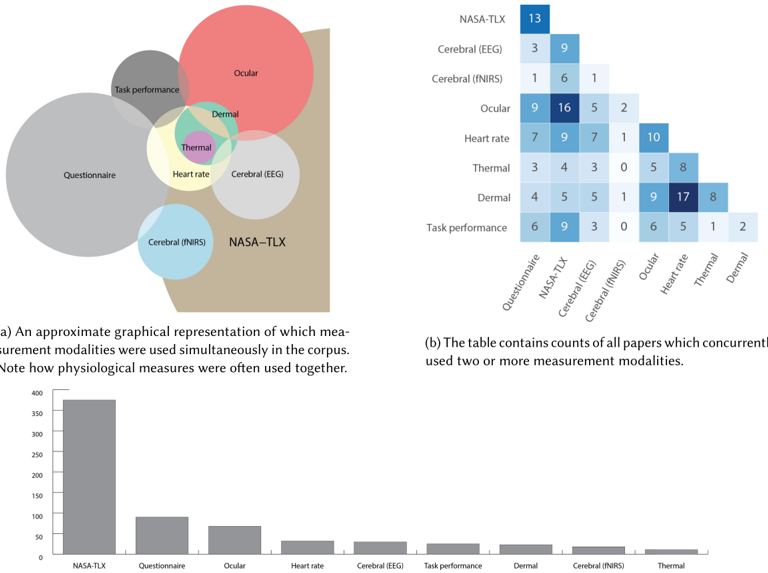
- Questionnaires are the most used metric, with the NASA-TLX described as the most frequently used questionnaire in the corpus; the paper argues its dominance may reflect community convention and an “academic tradition” rather than demonstrated HCI-specific validity.
- The authors identify three research gaps: (1) defining and interpreting cognitive workload in HCI, (2) the hidden cost of the NASA-TLX, and (3) HCI research as a catalyst for workload-aware systems.
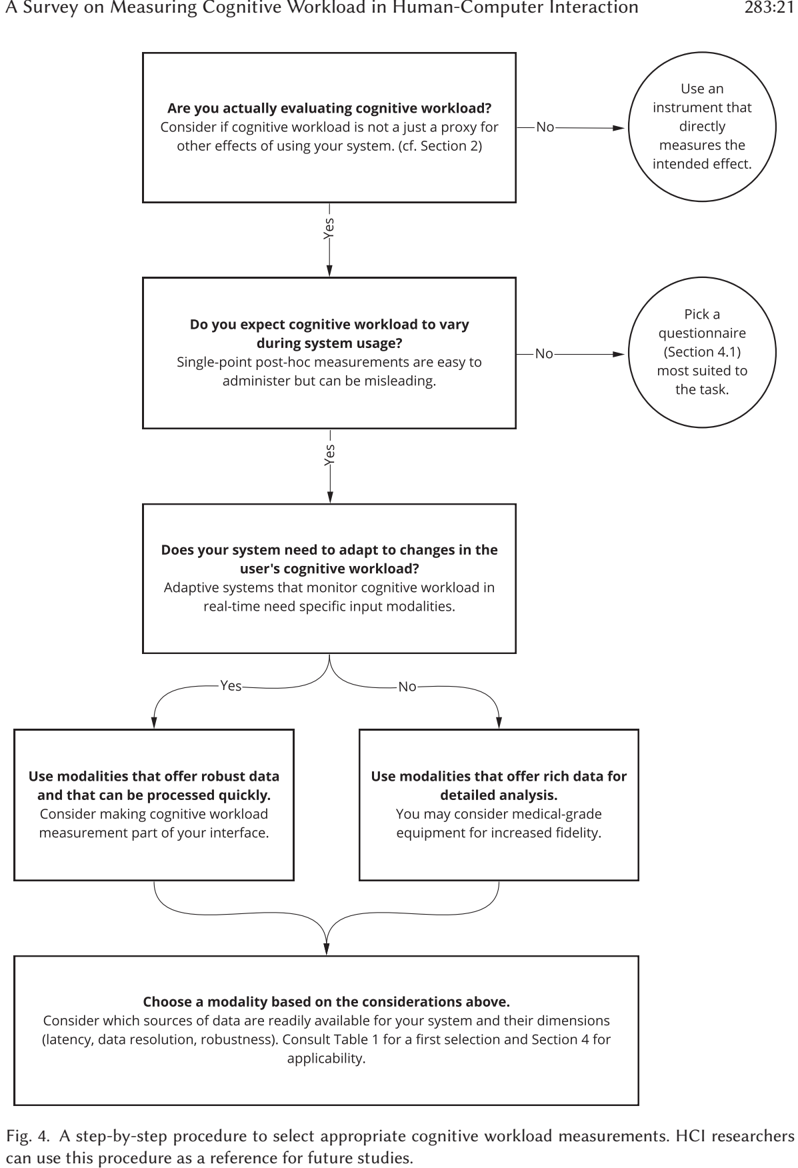
- They propose a four-step procedure for choosing cognitive workload metrics, covering whether cognitive workload is the right concept, whether it varies during use, whether the system must adapt to it, and which modality to choose.
Methods
- Systematic literature review following PRISMA procedures, with a keyword search in HCI-related proceedings and journals; venues included the top 20 conferences plus six conferences in the top 40, and all top 10 journals, confirmed via CORE 4 rankings, with a final cut-off date of 30 April 2020.
- The search used a regular expression matching terms such as “cognitive/mental load/workload” and “working memory”; the initial corpus was 6,414 papers.
- Filtering used paper eligibility (archival, peer-reviewed papers only; 904 excluded) and relevance via a double decision scheme with four researchers; 4,931 papers were excluded at relevance, yielding 579 records. Categorization used qualitative coding, a naming scheme agreed by four researchers, and affinity diagramming to build a taxonomy of measures.
Limitations
- The paper states that its qualitative analysis cannot guarantee the proposed taxonomy is the only correct one, though it aims for comprehensiveness.
- The paper states that the final choice of cognitive workload modality is almost always a trade-off between ecological validity and the requirements of the measurement modality, and that NASA-TLX validity in HCI is unclear because no empirical evidence determines the range of artifacts or experiences to which it applies.
- Evident from the text: the search is limited to selected top HCI venues and a cut-off of 30 April 2020, and many irrelevant papers were excluded due to ambiguity of the term “working memory,” especially in computer science venues.
Model-written summary. Check it against the paper before relying on it.
Integrity signals
Registry
Cites
Statistics
Figures



Verification
Claims the paper makes
6 Valid · 16 Not valid · 23 Not checked · 86 Own results and interpretations
At least one cited source doesn’t support this claim or points to a different paper, and none confirmed it — see the verdicts below.
In the paper
“Previous research has shown that the size and speed of saccades are highly discriminatory parameters for an increased cognitive workload: Here, an increased cognitive workload is indicated by larger or faster saccades [47].”
§ A Survey on Measuring Cognitive Workload in Human-Computer Interaction > 4.3.2 Saccades.
What the sources say
- Disputedcites [47] 47. Siyuan Chen, Julien Epps, Natalie Ruiz, and Fang Chen. 2011. Eye activity as a measure of human mental effort in HCI. In Proceedings of the 16th International Conference on Intelligent User Interfaces (IUI'11). ACM, New York, NY, USA, 315-318. https://doi.org/10.1145/1943403.1943454 sourceExperimental — accuracy not yet measured
The Discussion says saccade speed and especially size were highly discriminatory, but reports that both decreased as the task demanded more working memory and attention. The cited paper therefore supports their usefulness as measures, but gives the opposite direction from the claim’s ‘larger or faster’ saccades. (LLM, conf=0.90)
Checked by a reasoning model — may be wrong.
boostedstates an association- Asserted: passes — The authors put it forward as true.
- Checkable: passes — It can be checked against evidence.
- Load-bearing: unclear — It is unclear whether the paper’s conclusions depend on it.
- Based: passes — The paper gives a reason why it holds.
- Disputed
At least one cited source doesn’t support this claim or points to a different paper, and none confirmed it — see the verdicts below.
In the paper
“Similarly, touch input [39] -especially finger trajectories [173] -were used to measure cognitive workload.”
§ A Survey on Measuring Cognitive Workload in Human-Computer Interaction > 4.7 Haptic Interaction
What the sources say
- Not checked — no full text of the sourcecites [39] 39. Davide Maria Calandra, Antonio Caso, Francesco Cutugno, Antonio Origlia, and Silvia Rossi. 2013. CoWME: A gen- eral framework to evaluate cognitive workload during multimodal interaction. In Proceedings of the 15th ACM on International Conference on Multimodal Interaction (ICMI'13). ACM, Sydney, Australia, 111-118. https://doi.org/10. 1145/2522848.2522867 source
- Disputedcites [173] 173. E. M. Peck, E. Carlin, and R. Jacob. 2015. Designing brain-computer interfaces for attention-aware systems. Computer 48, 10 (Oct. 2015), 34-42. https://doi.org/10.1109/MC.2015.315 sourceExperimental — accuracy not yet measured
The citation [173] is attached specifically to “finger trajectories.” In “Training CARSON to Read the Brain” and Figure 3 (page not provided), the paper instead describes predicting cognitive workload from fNIRS brain-sensing signals, not finger trajectories or touch input. (LLM, conf=0.85)
Checked by a reasoning model — may be wrong.
plainstates an association- Asserted: passes — The authors put it forward as true.
- Checkable: passes — It can be checked against evidence.
- Load-bearing: unclear — It is unclear whether the paper’s conclusions depend on it.
- Based: passes — The paper gives a reason why it holds.
The cited sources that could be checked couldn’t confirm or dispute this claim.
In the paper
“Similarly, beta power is widely used as a metric for mental workload, including alertness, arousal, frustration, engagement, and workload states [141].”
§ A Survey on Measuring Cognitive Workload in Human-Computer Interaction > 4.2.1 Electroencephalography (EEG).
What the sources say
- Could not verifycites [141] 141. Kristiyan Lukanov, Horia A. Maior, and Max L. Wilson. 2016. Using fNIRS in Usability Testing: Understanding the Effect of Web Form Layout on Mental Workload. In Proceedings of the 2016 CHI Conference on Human Factors in Computing Systems (CHI'16). ACM, Santa Clara, California, USA, 4011-4016. https://doi.org/10.1145/2858036.2858236 sourceExperimental — accuracy not yet measured
The Measuring Mental Workload and Objective Measures sections discuss psychophysiological measures and fNIRS haemoglobin measurements, but do not address beta power. Searches for beta power and EEG spectral power found no passage linking beta power to alertness, arousal, frustration, engagement, or workload states. The available passages have no page numbers. (LLM, conf=0.76)
plainstates an association- Asserted: passes — The authors put it forward as true.
- Checkable: passes — It can be checked against evidence.
- Load-bearing: unclear — It is unclear whether the paper’s conclusions depend on it.
- Based: passes — The paper gives a reason why it holds.
- Could not verify
Every source the paper cites for this claim was checked and supports it.
In the paper
“Previous research shows that the rate and duration of fixation are indicators of an attention shift due to increasing task complexity [47].”
§ A Survey on Measuring Cognitive Workload in Human-Computer Interaction > 4.3.4 Fixations.
What the sources say
- Supportedcites [47] 47. Siyuan Chen, Julien Epps, Natalie Ruiz, and Fang Chen. 2011. Eye activity as a measure of human mental effort in HCI. In Proceedings of the 16th International Conference on Intelligent User Interfaces (IUI'11). ACM, New York, NY, USA, 315-318. https://doi.org/10.1145/1943403.1943454 source
The Discussion reports that fixation duration and fixation rate changed with task complexity and interprets those results as indicating that significantly more attention was needed for the more complex task. It also specifies that fixation duration increased while fixation rate decreased as attentional demands rose. (LLM, conf=0.92)
plainstates an association- Asserted: passes — The authors put it forward as true.
- Checkable: passes — It can be checked against evidence.
- Load-bearing: unclear — It is unclear whether the paper’s conclusions depend on it.
- Based: passes — The paper gives a reason why it holds.
- Supported
The cited sources support only part of this claim — read each source’s verdict below.
In the paper
“Previous research has shown that pupils dilate with increasing task difficulty [47] across tasks like reading, problem-solving, or visual search activities [208], where the cognitive demand can be estimated in real-time using machine learning [131].”
§ A Survey on Measuring Cognitive Workload in Human-Computer Interaction > 4.3.1 Pupil Diameter.
What the sources say
- Partly supportedcites [47] 47. Siyuan Chen, Julien Epps, Natalie Ruiz, and Fang Chen. 2011. Eye activity as a measure of human mental effort in HCI. In Proceedings of the 16th International Conference on Intelligent User Interfaces (IUI'11). ACM, New York, NY, USA, 315-318. https://doi.org/10.1145/1943403.1943454 sourceExperimental — accuracy not yet measured
The Discussion reports increased pupil size when participants performed the more demanding visual training task, supporting the link between pupil dilation and task difficulty. The paper does not establish that pattern across the cited examples of reading, problem-solving, and visual search; its own task involved recalling player positions in a basketball video. (LLM, conf=0.86)
- Not checked — no full text of the sourcecites [208] 208. Namrata Srivastava, Eduardo Velloso, Jason M. Lodge, Sarah Erfani, and James Bailey. 2019. Continuous evaluation of video lectures from real-time difficulty self-report. In Proceedings of the 2019 CHI Conference on Human Factors in Computing Systems (CHI'19). Association for Computing Machinery, Glasgow, Scotland, UK, 1-12. https://doi.org/ 10.1145/3290605.3300816 source
- Could not verifycites [131] 131. Moira LeMay and Eric Hird. 1986. Operator work load: When is enough enough? Commun. ACM 29, 7 (July 1986), 638-642. https://doi.org/10.1145/6138.6147 sourceExperimental — accuracy not yet measured
The Results report that time-stress ratings increased with workload, and the introduction lists physiological measures as a category, but neither addresses pupil dilation. Searches for pupil diameter, task difficulty, and pupillary response found no passage supporting the claim attributed to this paper; the task examples are attached to a different citation. (LLM, conf=0.75)
plainstates a cause- Asserted: passes — The authors put it forward as true.
- Checkable: passes — It can be checked against evidence.
- Load-bearing: unclear — It is unclear whether the paper’s conclusions depend on it.
- Based: passes — The paper gives a reason why it holds.
- Partly supported
52 more claims · 4 with their cited sources checked
Create a free account to see all 131 claims and every source verdict.
- It may state two separate claims as one. 35
- Probably not a substantial claim. 49
Self-check
Percentages, sums and reported differences re-computed from the paper’s own numbers.
Each contradiction between two passages listed here was confirmed by an independent check.
Rated minor: it would not touch a result — a value no result rests on, a p-value that stays on the same side of the significance level, or a conflict that is clerical, resolved elsewhere in the paper, or outside its own findings.
In the paper
§ A Survey on Measuring Cognitive Workload in Human-Computer Interaction > 4.1 Questionnaires
“Questionnaires lack real-time capabilities since they are employed after an experimental condition.”
§ A Survey on Measuring Cognitive Workload in Human-Computer Interaction > 4.1.3 Instantaneous Self-Assessment.
“Participants rate their perceived workload in predefined intervals during the execution of a task -allowing for real-time assessment of cognitive workload.”
Citations
Cites
Items 201–271 of 271
Kosch, T., Schmidt, A., Thanheiser, S., & Chuang, L. L. (2020) · Proceedings of the 2020 CHI Conference on Human Factors in Computing Systems · doi:10.1145/3313831.3376766 · Cited by 25 · cited 1×
“Cerebral EEG Frequencies [16, 17, 26, 52, 67, 70, 83, 86, 87, 100, 105, 106, 124, 130, 135, 138, 148, 150, 184, 197, 198, 207, 235, 243, 244, 268] EEG ERPs [23, 26, 59, 81, 184, 214, 227, 243] Hemodynamic Response (fNIRS) [3, 5, 32, 80, 96, 97, 104, 159, 161, 191, 192, 196, 221–223, 227, 261, 262]…”
Self-citationContinuous Evaluation of Video Lectures from Real-Time Difficulty Self-Report
Srivastava, N., Velloso, E., Lodge, J. M., Erfani, S., & Bailey, J. (2019) · Proceedings of the 2019 CHI Conference on Human Factors in Computing Systems · doi:10.1145/3290605.3300816 · Cited by 24 · cited 1×
“Research showed various links between respiratory activities and an increased cognitive workload: Here, respiration belts or thermistor-based flow sensors underneath the participant’s nose were used to measure the respiration rate, its variance, and depth [106].”
Estimating cognitive load using pupil diameter during a spoken dialogue task
Heeman, P. A., Meshorer, T., Kun, A. L., Palinko, O., & Medenica, Ž. (2013) · International Conference on Automotive User Interfaces and Interactive Vehicular Applications (AutomotiveUI) · doi:10.1145/2516540.2516570 · Cited by 23
Task Load Estimation and Mediation Using Psycho-physiological Measures
Rajan, R., Selker, T., & Lane, I. (2016) · Proceedings of the 21st International Conference on Intelligent User Interfaces · doi:10.1145/2856767.2856769 · Cited by 23 · cited 4×
“While some work showed feasible accuracy [182, 202], other work argues that other modalities are superior [87, 201].”
InfluentialExploring the Touch and Motion Features in Game-Based Cognitive Assessments
Intarasirisawat, J., Ang, C. S., Efstratiou, C., Dickens, L., & Page, R. A. (2019) · Proceedings of the ACM on Interactive Mobile Wearable and Ubiquitous Technologies · doi:10.1145/3351245 · Cited by 22
Can I Think of Something Else when Using a BCI? Cognitive Demand of an SSVEP-based BCI
Évain, A., Argelaguet, F., Roussel, N., Casiez, G., & Lécuyer, A. (2017) · CHI Conference on Human Factors in Computing Systems · doi:10.1145/3025453.3026037 · Cited by 22 · cited 1×
“Cerebral EEG Frequencies [16, 17, 26, 52, 67, 70, 83, 86, 87, 100, 105, 106, 124, 130, 135, 138, 148, 150, 184, 197, 198, 207, 235, 243, 244, 268] EEG ERPs [23, 26, 59, 81, 184, 214, 227, 243] Hemodynamic Response (fNIRS) [3, 5, 32, 80, 96, 97, 104, 159, 161, 191, 192, 196, 221–223, 227, 261, 262]…”
Measuring Workload in a Multitasking Environment Using Fractal Dimension of Pupil Dilation
Yang, X., & Kim, J. H. (2018) · International Journal of Human-Computer Interaction · doi:10.1080/10447318.2018.1525022 · Cited by 22
Moodmixer : {Eeg}-Based Collaborative Sonification
Leslie, G. A., & Mullen, T. R. (2011) · doi:10.5281/zenodo.1178088 · Cited by 22
Using touchscreen interaction data to predict cognitive workload
Mock, P., Gerjets, P., Tibus, M., Trautwein, U., Möller, K., & Rosenstiel, W. (2016) · Proceedings of the 18th ACM International Conference on Multimodal Interaction · doi:10.1145/2993148.2993202 · Cited by 21 · cited 1×
“Similarly, touch input [39] – especially finger trajectories [173] – were used to measure cognitive workload.”
Trust and cognitive load in the text-chat environment: the role of mouse movement
Khawaji, A., Chen, F., Zhou, J., & Marcus, N. (2014) · Proceedings of the 26th Australian Computer-Human Interaction Conference on Designing Futures: the Future of Design · doi:10.1145/2686612.2686661 · Cited by 21 · cited 2×
“Previous research investigated how these movements can be used as an input technique (e.g., target selection) and real-time cognitive workload measurement.”
Estimating cognitive load from speech gathered in a complex real-life training exercise
Vukovic, M., Sethu, V., Parker, J., Cavedon, L., Lech, M., & Thangarajah, J. (2018) · International Journal of Human-Computer Studies · doi:10.1016/j.ijhcs.2018.12.003 · Cited by 20 · cited 1×
“Additionally, linguistic features were analyzed to study participants’ cognitive workload [116, 246].”
Dönmez, O., Akbulut, Y., Telli, E., Kaptan, M., Özdemir, İ. H., & Erdem, M. (2022) · Education and Information Technologies · doi:10.1007/s10639-022-11035-2 · Cited by 20 · cited 1×
“In contrast to previous research reviewing work on cognitive workload [15, 60, 64, 65, 126, 186, 265], our survey focuses on cognitive workload assessments in the field of HCI to support researchers in their choice of cognitive workload measurement for their studies.”
Biswas, P., Dutt, V., & Langdon, P. (2015) · International Journal of Human-Computer Interaction · doi:10.1080/10447318.2015.1084112 · Cited by 19 · cited 4×
“Pupil Diameter [4, 5, 9–11, 18–22, 27, 28, 39, 44–47, 55, 58, 62, 63, 72, 87, 92, 94, 99, 103, 107, 108, 112, 142, 143, 153, 154, 157, 165, 175, 187–189, 195, 199–201, 207, 215, 227, 236, 239, 248, 249, 255, 257, 266] Saccades [10, 21, 27, 44–47, 76, 87, 99, 165, 184, 193, 228, 236, 258] Eye Blinks…”
InfluentialSjölie, D., Bodin, K., Elgh, E., Eriksson, J., Janlert, L.-E., & Nyberg, L. (2010) · Proceedings of the SIGCHI Conference on Human Factors in Computing Systems · doi:10.1145/1753326.1753454 · Cited by 19
Kujala, T. (2009) · International Conference on Automotive User Interfaces and Interactive Vehicular Applications (AutomotiveUI) · doi:10.1145/1620509.1620522 · Cited by 19 · cited 1×
“…27, 44–47, 76, 87, 99, 165, 184, 193, 228, 236, 258] Eye Blinks [4, 5, 27, 43–47, 76, 87, 99, 175, 182, 184, 236, 268] Fixations [1, 10, 54, 68, 99, 140, 153, 184, 219, 228] Smooth Pursuits and Ocular Movements [133] Cardiovascular Heart Rate [4, 10, 25, 27, 40, 41, 49, 50, 76, 78, 82, 85, 87, 99,…”
Multimodal person independent recognition of workload related biosignal patterns
Jarvis, J., Putze, F., Heger, D., & Schultz, T. (2011) · Proceedings of the 13th international conference on multimodal interfaces · doi:10.1145/2070481.2070516 · Cited by 19 · cited 6×
“…82, 85, 87, 99, 106, 146, 152, 160, 169, 184, 185, 194, 201, 202, 214, 216, 217, 224, 225, 227, 240, 244, 264, 264, 266, 268] Respiration [87, 99, 106, 184, 185, 194] Temperature [1, 2, 8, 87, 184, 185, 194, 216, 217, 268] Dermal Skin Conductance (EDA) [25, 50, 51, 76, 78, 87, 99, 106, 134,…”
InfluentialMultimodal Classification of EEG During Physical Activity
Ding, Y., Huynh, B., Xu, A., Bullock, T., Cecotti, H., Turk, M., Giesbrecht, B., & Höllerer, T. (2019) · INTERNATIONAL CONFERENCE ON MULTIMODAL INTERACTION · doi:10.1145/3340555.3353759 · Cited by 18 · cited 1×
“…[16, 17, 26, 52, 67, 70, 83, 86, 87, 100, 105, 106, 124, 130, 135, 138, 148, 150, 184, 197, 198, 207, 235, 243, 244, 268] EEG ERPs [23, 26, 59, 81, 184, 214, 227, 243] Hemodynamic Response (fNIRS) [3, 5, 32, 80, 96, 97, 104, 159, 161, 191, 192, 196, 221–223, 227, 261, 262] Electromagnetic…”
Evolutionary bases of human cognitive architecture: implications for computing education
Sweller, J. (2008) · ACM Conference on International Computing Education Research (ICER) · doi:10.1145/1404520.1404521 · Cited by 18
Analysing mouse activity for cognitive load detection
Arshad, S., Wang, Y., & Chen, F. (2013) · Proceedings of the 25th Australian Computer-Human Interaction Conference: Augmentation, Application, Innovation, Collaboration · doi:10.1145/2541016.2541083 · Cited by 18 · cited 2×
“Previous research investigated how these movements can be used as an input technique (e.g., target selection) and real-time cognitive workload measurement.”
Review of the Use of Electroencephalography as an Evaluation Method for Human-Computer Interaction
Frey, J., Mühl, C., Lotte, F., & Hachet, M. (2013) · elib (German Aerospace Center) · doi:10.48550/arxiv.1311.2222 · Cited by 18
An Item Response Modeling Approach to Cognitive Load Measurement
Ehrich, J. F., Howard, S. J., Bokosmaty, S., & Woodcock, S. (2021) · Frontiers in Education · doi:10.3389/feduc.2021.648324 · Cited by 17 · cited 2×
“Choosing the right assessment for the right task has been recently discussed in various research publications (cf. [15, 60, 64, 65, 126, 186, 265]), but especially HCI research needs to deepen and conceptualize our understanding of cognitive workload in interacting with computer systems.”
Music-Based Respiratory Biofeedback in Visually-Demanding Tasks
Bhandari, R. R., Parnandi, A., Shipp, E. M., Ahmed, B., & Gutiérrez‐Osuna, R. (2015) · New Interfaces for Musical Expression · doi:10.5072/zenodo.207675 · Cited by 17
Typing over autocomplete: cognitive load in website use by older adults
Doubé, W., & Beh, J. (2012) · Proceedings of the 24th Australian Computer-Human Interaction Conference · doi:10.1145/2414536.2414553 · Cited by 16 · cited 4×
“Previous research investigated how these movements can be used as an input technique (e.g., target selection) and real-time cognitive workload measurement.”
InfluentialTrutschel, U. E., Heinze, C., Sirois, B., et al. (2012) · International Conference on Automotive User Interfaces and Interactive Vehicular Applications (AutomotiveUI) · doi:10.1145/2390256.2390299 · Cited by 16 · cited 1×
“…Heart Rate [4, 10, 25, 27, 40, 41, 49, 50, 76, 78, 82, 85, 87, 99, 106, 146, 152, 160, 169, 184, 185, 194, 201, 202, 214, 216, 217, 224, 225, 227, 240, 244, 264, 264, 266, 268] Respiration [87, 99, 106, 184, 185, 194] Temperature [1, 2, 8, 87, 184, 185, 194, 216, 217, 268] Dermal Skin…”
Benthem, K. V., Cebulski, S., Herdman, C. M., & Keillor, J. M. (2017) · International Journal of Human-Computer Interaction · doi:10.1080/10447318.2017.1342942 · Cited by 15 · cited 2×
“…52, 67, 70, 83, 86, 87, 100, 105, 106, 124, 130, 135, 138, 148, 150, 184, 197, 198, 207, 235, 243, 244, 268] EEG ERPs [23, 26, 59, 81, 184, 214, 227, 243] Hemodynamic Response (fNIRS) [3, 5, 32, 80, 96, 97, 104, 159, 161, 191, 192, 196, 221–223, 227, 261, 262] Electromagnetic Changes (fMRI) [220]”
Cognitive Load Theory and Computer Science Education
Sweller, J. (2016) · doi:10.1145/2839509.2844549 · Cited by 15 · cited 1×
“Sweller developed the cognitive load theory [231–233], a theoretical framework that explains how learning is limited through instructional design.”
Eye tracking insights into cognitive modeling
Bartels, M., & Marshall, S. P. (2006) · ACM Symposium on Eye Tracking Research and Applications (ETRA) · doi:10.1145/1117309.1117358 · Cited by 14 · cited 1×
“…99, 103, 107, 108, 112, 142, 143, 153, 154, 157, 165, 175, 187–189, 195, 199–201, 207, 215, 227, 236, 239, 248, 249, 255, 257, 266] Saccades [10, 21, 27, 44–47, 76, 87, 99, 165, 184, 193, 228, 236, 258] Eye Blinks [4, 5, 27, 43–47, 76, 87, 99, 175, 182, 184, 236, 268] Fixations [1, 10, 54, 68,…”
Blinking: Toward Wearable Computing that Understands your Current Task
Chen, S., & Epps, J. (2013) · IEEE Pervasive Computing · doi:10.1109/mprv.2013.45 · Cited by 13 · cited 1×
“…207, 215, 227, 236, 239, 248, 249, 255, 257, 266] Saccades [10, 21, 27, 44–47, 76, 87, 99, 165, 184, 193, 228, 236, 258] Eye Blinks [4, 5, 27, 43–47, 76, 87, 99, 175, 182, 184, 236, 268] Fixations [1, 10, 54, 68, 99, 140, 153, 184, 219, 228] Smooth Pursuits and Ocular Movements [133]…”
Investigating Wearable Technology for Fatigue Identification in the Workplace
Griffiths, C., Bowen, J., & Hinze, A. (2017) · Lecture Notes in Computer Science · doi:10.1007/978-3-319-67684-5_22 · Cited by 13 · cited 2×
“Research showed various links between respiratory activities and an increased cognitive workload: Here, respiration belts or thermistor-based flow sensors underneath the participant’s nose were used to measure the respiration rate, its variance, and depth [106].”
Differentiating Cognitive Load Using a Modified Version of AttenD
Seppelt, B., Seaman, S., Angell, L., Mehler, B., & Reimer, B. (2017) · Proceedings of the 9th International Conference on Automotive User Interfaces and Interactive Vehicular Applications · doi:10.1145/3122986.3123019 · Cited by 13 · cited 1×
“…87, 99, 165, 184, 193, 228, 236, 258] Eye Blinks [4, 5, 27, 43–47, 76, 87, 99, 175, 182, 184, 236, 268] Fixations [1, 10, 54, 68, 99, 140, 153, 184, 219, 228] Smooth Pursuits and Ocular Movements [133] Cardiovascular Heart Rate [4, 10, 25, 27, 40, 41, 49, 50, 76, 78, 82, 85, 87, 99, 106, 146, 152,…”
Cognitive load measurement while driving
Gabaude, C., Baracat, B., Jallais, C., & Bonniaud, M. (2012) · doi:10.13140/2.1.1071.4888 · Cited by 13
Braahms: A Novel Adaptive Musical Interface Based On Users' Cognitive State
Yuksel, B. F., Afergan, D., Peck, E., Griffin, G., Harrison, L., Chen, N., Chang, R., & Jacob, R. (2015) · Zenodo · doi:10.5281/zenodo.1181417 · Cited by 13
Vizer, L. M., & Sears, A. (2017) · International Journal of Human-Computer Studies · doi:10.1016/j.ijhcs.2017.03.001 · Cited by 12 · cited 1×
“Additionally, keystroke dynamics and linguistic markers of typed text (i.e., language production) were highly related to cognitive workload [34, 245].”
Exploring differences in the impact of auditory and visual demands on driver behavior
Yang, Y., Reimer, B., Mehler, B. L., et al. (2012) · International Conference on Automotive User Interfaces and Interactive Vehicular Applications (AutomotiveUI) · doi:10.1145/2390256.2390285 · Cited by 12 · cited 1×
“…165, 175, 187–189, 195, 199–201, 207, 215, 227, 236, 239, 248, 249, 255, 257, 266] Saccades [10, 21, 27, 44–47, 76, 87, 99, 165, 184, 193, 228, 236, 258] Eye Blinks [4, 5, 27, 43–47, 76, 87, 99, 175, 182, 184, 236, 268] Fixations [1, 10, 54, 68, 99, 140, 153, 184, 219, 228] Smooth Pursuits and…”
"FaceLight": potentials and drawbacks of thermal imaging to infer driver stress
Anzengruber, B., & Riener, A. (2012) · Proceedings of the 4th International Conference on Automotive User Interfaces and Interactive Vehicular Applications · doi:10.1145/2390256.2390292 · Cited by 12 · cited 3×
“However, in lower constraint scenarios, e.g., in a driving context, classification is more difficult [8].”
InfluentialFreeform pen-input as evidence of cognitive load and expertise
Ruiz, N., Taib, R., & Chen, F. (2011) · Proceedings of the 13th international conference on multimodal interfaces · doi:10.1145/2070481.2070511 · Cited by 11 · cited 1×
“During handwriting with a stylus, the velocity [211, 260], frequency [210], trajectory duration [209], and pressure of strokes [260] were studied as indicators for cognitive workload.”
Jacko, J. A., Barreto, A. B., Scott, I. U., Rosa, R. H., & Pappas, C. J. (2000) · International Journal of Human-Computer Interaction · doi:10.1207/s15327590ijhc1201_6 · Cited by 11 · cited 1×
“Cerebral EEG Frequencies [16, 17, 26, 52, 67, 70, 83, 86, 87, 100, 105, 106, 124, 130, 135, 138, 148, 150, 184, 197, 198, 207, 235, 243, 244, 268] EEG ERPs [23, 26, 59, 81, 184, 214, 227, 243] Hemodynamic Response (fNIRS) [3, 5, 32, 80, 96, 97, 104, 159, 161, 191, 192, 196, 221–223, 227, 261, 262]…”
Imprecise but Fun: Playful Interaction Using Electromyography
Karolus, J., Thanheiser, S., Peterson, D., Viot, N., Kosch, T., Schmidt, A., & Wozniak, P. W. (2022) · Proceedings of the ACM on Human-Computer Interaction · doi:10.1145/3546725 · Cited by 11
Self-citationCould a dialog save your life?
Vetek, A., & Lemmelä, S. (2011) · INTERNATIONAL CONFERENCE ON MULTIMODAL INTERACTION · doi:10.1145/2070481.2070506 · Cited by 11 · cited 3×
“Scenarios include, for example, office-work [49], elementary cognitive tasks [87], and automotive environments [244].”
Towards Attentive Speed Reading on Small Screen Wearable Devices
Guo, W., & Wang, J. (2018) · INTERNATIONAL CONFERENCE ON MULTIMODAL INTERACTION · doi:10.1145/3242969.3243009 · Cited by 11 · cited 1×
“…68, 99, 140, 153, 184, 219, 228] Smooth Pursuits and Ocular Movements [133] Cardiovascular Heart Rate [4, 10, 25, 27, 40, 41, 49, 50, 76, 78, 82, 85, 87, 99, 106, 146, 152, 160, 169, 184, 185, 194, 201, 202, 214, 216, 217, 224, 225, 227, 240, 244, 264, 264, 266, 268] Respiration [87, 99, 106,…”
TAPRAV: An interactive analysis tool for exploring workload aligned to models of task execution
Bailey, B. P., Busbey, C. W., & Iqbal, S. T. (2007) · Interacting with Computers · doi:10.1016/j.intcom.2007.01.004 · Cited by 11
Mosaly, P. R., Guo, H., & Mazur, L. M. (2019) · International Journal of Human-Computer Interaction · doi:10.1080/10447318.2019.1575081 · Cited by 11 · cited 2×
“…236, 239, 248, 249, 255, 257, 266] Saccades [10, 21, 27, 44–47, 76, 87, 99, 165, 184, 193, 228, 236, 258] Eye Blinks [4, 5, 27, 43–47, 76, 87, 99, 175, 182, 184, 236, 268] Fixations [1, 10, 54, 68, 99, 140, 153, 184, 219, 228] Smooth Pursuits and Ocular Movements [133] Cardiovascular Heart Rate…”
Kosch, T., Hassib, M. E., & Schmidt, A. (2016) · CHI Conference Extended Abstracts on Human Factors in Computing Systems (CHI EA) · doi:10.1145/2851581.2892484 · Cited by 11
Self-citationToward Cognitive Load Inference for Attention Management in Ubiquitous Systems
Pejović, V., Gjoreski, M., Anderson, C., David, K., & Luštrek, M. (2020) · IEEE Pervasive Computing · doi:10.1109/mprv.2020.2968909 · Cited by 10 · cited 4×
“…106, 146, 152, 160, 169, 184, 185, 194, 201, 202, 214, 216, 217, 224, 225, 227, 240, 244, 264, 264, 266, 268] Respiration [87, 99, 106, 184, 185, 194] Temperature [1, 2, 8, 87, 184, 185, 194, 216, 217, 268] Dermal Skin Conductance (EDA) [25, 50, 51, 76, 78, 87, 99, 106, 134, 182–185, 194, 201,…”
InfluentialCognitive skills learning: pen input patterns in computer-based athlete training
Ruiz, N., Feng, Q. Q., Taib, R., Handke, T., & Chen, F. (2010) · International Conference on Multimodal Interfaces and the Workshop on Machine Learning for Multimodal Interaction · doi:10.1145/1891903.1891955 · Cited by 10 · cited 3×
“Previous research has shown that the rate and latency of blinks are related to cognitive workload: Lower blink rates and higher blink latencies indicate an increased cognitive workload [47].”
Using Psychophysiological Measurements in Physically Demanding Virtual Environments
Novak, D., Mihelj, M., & Munih, M. (2009) · Lecture Notes in Computer Science · doi:10.1007/978-3-642-03655-2_55 · Cited by 9 · cited 4×
“…87, 99, 106, 146, 152, 160, 169, 184, 185, 194, 201, 202, 214, 216, 217, 224, 225, 227, 240, 244, 264, 264, 266, 268] Respiration [87, 99, 106, 184, 185, 194] Temperature [1, 2, 8, 87, 184, 185, 194, 216, 217, 268] Dermal Skin Conductance (EDA) [25, 50, 51, 76, 78, 87, 99, 106, 134, 182–185, 194,…”
InfluentialAuda, J., Gruenefeld, U., Kosch, T., & Schneegaß, S. (2022) · Augmented Humans International Conference (AHs) · doi:10.1145/3519391.3519397 · Cited by 9 · cited 1×
“It consists of a hierarchical decision tree, and participants are asked whether (1) it was possible to complete the task, (2) the workload was tolerable, and (3) the workload was satisfactory without reduction.”
Self-citationInferring mental overload based on postural behavior and gestures
Hihn, H., Meudt, S., & Schwenker, F. (2016) · Proceedings of the 2nd workshop on Emotion Representations and Modelling for Companion Systems · doi:10.1145/3009960.3009961 · Cited by 8 · cited 1×
“So far, previous research has investigated (1) postural behavior and gestures to assess phases of cognitive underload or overload [95], (2) mouse movements such as traveled distances [12] or pause/break activities [119], and (3) differences in glance duration at input modalities and output devices…”
Operator work load: when is enough enough?
LeMay, M., & Hird, E. (1986) · Communications of the ACM · doi:10.1145/6138.6147 · Cited by 8 · cited 1×
“Yet, the detailed history of how cognitive workload was adapted to HCI from the field of psychology [88, 89, 149] via HCI’s human factors legacy remains uncharted.”
Designing Brain-Computer Interfaces for Attention-Aware Systems
Peck, E. M., Carlin, E., & Jacob, R. (2015) · Computer · doi:10.1109/mc.2015.315 · Cited by 8 · cited 1×
“…52, 67, 70, 83, 86, 87, 100, 105, 106, 124, 130, 135, 138, 148, 150, 184, 197, 198, 207, 235, 243, 244, 268] EEG ERPs [23, 26, 59, 81, 184, 214, 227, 243] Hemodynamic Response (fNIRS) [3, 5, 32, 80, 96, 97, 104, 159, 161, 191, 192, 196, 221–223, 227, 261, 262] Electromagnetic Changes (fMRI) [220]”
Do speech features for detecting cognitive load depend on specific languages?
Chen, R., Xie, T., Xie, Y., Lin, T., & Tang, N. (2016) · Proceedings of the 18th ACM International Conference on Multimodal Interaction · doi:10.1145/2993148.2993149 · Cited by 8 · cited 1×
“The fixation rate of an area of interest describes the number of times an object was looked at – this can be interpreted as a repeated interest in an area and relevant for the current cognitive activity [208].”
An eye gaze model for seismic interpretation support
de Santana, V. F., Ferreira, J. J., de Paula, R. A., & Cerqueira, R. (2018) · ACM Symposium on Eye Tracking Research and Applications (ETRA) · doi:10.1145/3204493.3204554 · Cited by 8 · cited 1×
“Pupil Diameter [4, 5, 9–11, 18–22, 27, 28, 39, 44–47, 55, 58, 62, 63, 72, 87, 92, 94, 99, 103, 107, 108, 112, 142, 143, 153, 154, 157, 165, 175, 187–189, 195, 199–201, 207, 215, 227, 236, 239, 248, 249, 255, 257, 266] Saccades [10, 21, 27, 44–47, 76, 87, 99, 165, 184, 193, 228, 236, 258] Eye Blinks…”
Antrobus, V., Burnett, G., & Skrypchuk, L. (2016) · International Conference on Automotive User Interfaces and Interactive Vehicular Applications (AutomotiveUI) · doi:10.1145/3003715.3005392 · Cited by 7 · cited 1×
“7 Among the irrelevant papers, most were excluded due to the ambiguity of the term “working memory”.”
Assessing User Mental Workload for Smartphone Applications With Built-In Sensors
Wang, L., Gu, T., Liu, A. X., Yao, H., Tao, X., & Lü, J. (2019) · IEEE Pervasive Computing · doi:10.1109/mprv.2018.2873851 · Cited by 7
CoWME: a general framework to evaluate cognitive workload during multimodal interaction
Calandra, D. M., Caso, A., Cutugno, F., Origlia, A., & Rossi, S. (2013) · Proceedings of the 15th ACM on International conference on multimodal interaction · doi:10.1145/2522848.2522867 · Cited by 7 · cited 3×
“Here, speech features such as the flow of words (e.g., tempo [42] or pauses [117, 118]), but also more nuanced features such as the lexical density [115], the spectral domain [259], or the pitch contour [39] while talking were shown to be indicators of changes in participants’ cognitive workload.”
Spoken tasks for human-human experiments
Kun, A. L., Shyrokov, A., & Heeman, P. A. (2010) · International Conference on Automotive User Interfaces and Interactive Vehicular Applications (AutomotiveUI) · doi:10.1145/1969773.1969784 · Cited by 7 · cited 1×
“Pupil Diameter [4, 5, 9–11, 18–22, 27, 28, 39, 44–47, 55, 58, 62, 63, 72, 87, 92, 94, 99, 103, 107, 108, 112, 142, 143, 153, 154, 157, 165, 175, 187–189, 195, 199–201, 207, 215, 227, 236, 239, 248, 249, 255, 257, 266] Saccades [10, 21, 27, 44–47, 76, 87, 99, 165, 184, 193, 228, 236, 258] Eye Blinks…”
Investigating Intrusiveness of Workload Adaptation
Putze, F., & Schultz, T. (2014) · INTERNATIONAL CONFERENCE ON MULTIMODAL INTERACTION · doi:10.1145/2663204.2663279 · Cited by 6 · cited 1×
“Cerebral EEG Frequencies [16, 17, 26, 52, 67, 70, 83, 86, 87, 100, 105, 106, 124, 130, 135, 138, 148, 150, 184, 197, 198, 207, 235, 243, 244, 268] EEG ERPs [23, 26, 59, 81, 184, 214, 227, 243] Hemodynamic Response (fNIRS) [3, 5, 32, 80, 96, 97, 104, 159, 161, 191, 192, 196, 221–223, 227, 261, 262]…”
Cognitive and context-aware applications
Rafiqi, S., Nair, S., & Fernández, E. (2014) · International Conference on PErvasive Technologies Related to Assistive Environments (PETRA) · doi:10.1145/2674396.2674445 · Cited by 6 · cited 1×
“…[4, 5, 9–11, 18–22, 27, 28, 39, 44–47, 55, 58, 62, 63, 72, 87, 92, 94, 99, 103, 107, 108, 112, 142, 143, 153, 154, 157, 165, 175, 187–189, 195, 199–201, 207, 215, 227, 236, 239, 248, 249, 255, 257, 266] Saccades [10, 21, 27, 44–47, 76, 87, 99, 165, 184, 193, 228, 236, 258] Eye Blinks [4, 5,…”
Hwang, Y., Lee, S., Jeon, H. S., Park, J. H. Y., Lee, K. W., & Lee, J. (2018) · doi:10.1145/3279954.3279958 · Cited by 6 · cited 1×
“Cerebral EEG Frequencies [16, 17, 26, 52, 67, 70, 83, 86, 87, 100, 105, 106, 124, 130, 135, 138, 148, 150, 184, 197, 198, 207, 235, 243, 244, 268] EEG ERPs [23, 26, 59, 81, 184, 214, 227, 243] Hemodynamic Response (fNIRS) [3, 5, 32, 80, 96, 97, 104, 159, 161, 191, 192, 196, 221–223, 227, 261, 262]…”
Gamer Style: Performance Factors in Gamified Simulation
Gupta, S., Coles, T., Dumas, C., McBride, S. J., & Bradford, D. (2016) · CHI Conference on Human Factors in Computing Systems · doi:10.1145/2858036.2858461 · Cited by 5 · cited 1×
“Cerebral EEG Frequencies [16, 17, 26, 52, 67, 70, 83, 86, 87, 100, 105, 106, 124, 130, 135, 138, 148, 150, 184, 197, 198, 207, 235, 243, 244, 268] EEG ERPs [23, 26, 59, 81, 184, 214, 227, 243] Hemodynamic Response (fNIRS) [3, 5, 32, 80, 96, 97, 104, 159, 161, 191, 192, 196, 221–223, 227, 261, 262]…”
Semi-aural Interfaces: Investigating Voice-controlled Aural Flows
Ghahari, R. R., George-Palilonis, J. A., Hossain, G., Kaser, L., & Bolchini, D. P. (2016) · Interacting with Computers · doi:10.1093/iwc/iww004 · Cited by 4 · cited 1×
“Researchers can then analyze the overall perceived workload in two ways: (a) with an individual sub-scale weighting, or (b) without an individual sub-scale weighting, often referred to as “Raw NASA-TLX”.”
Workload-Aware Systems and Interfaces for Cognitive Augmentation
Kosch, T. (2020) · Elektronische Hochschulschriften der LMU München (Ludwig-Maximilians-Universität München) · doi:10.48550/arxiv.2010.07703 · Cited by 4
Self-citationWhat's behind a choice? Understanding Modality Choices under Changing Environmental Conditions
Arboleda, S. A., Miller, S., Janka, M., et al. (2019) · INTERNATIONAL CONFERENCE ON MULTIMODAL INTERACTION · doi:10.1145/3340555.3353717 · Cited by 3 · cited 1×
“Pupil Diameter [4, 5, 9–11, 18–22, 27, 28, 39, 44–47, 55, 58, 62, 63, 72, 87, 92, 94, 99, 103, 107, 108, 112, 142, 143, 153, 154, 157, 165, 175, 187–189, 195, 199–201, 207, 215, 227, 236, 239, 248, 249, 255, 257, 266] Saccades [10, 21, 27, 44–47, 76, 87, 99, 165, 184, 193, 228, 236, 258] Eye Blinks…”
On the Suitability of Real-Time Assessment of Programming Proficiency using Gaze Properties
Liang, C., Karolus, J., Kosch, T., & Schmidt, A. (2018) · Proceedings of the 7th ACM International Symposium on Pervasive Displays · doi:10.1145/3205873.3210702 · Cited by 3 · cited 1×
“However, previous research has shown that various eye movements can also indicate increased cognitive demand [63, 131, 133] or derive the user proficiency during interaction [151].”
Self-citationZiegler, J., Graube, M., Suhrbier, A., et al. (2011) · International Conference on Human-Computer Interaction with Mobile Devices and Services (MobileHCI) · doi:10.1145/2037373.2037403 · Cited by 2 · cited 3×
“…25, 27, 40, 41, 49, 50, 76, 78, 82, 85, 87, 99, 106, 146, 152, 160, 169, 184, 185, 194, 201, 202, 214, 216, 217, 224, 225, 227, 240, 244, 264, 264, 266, 268] Respiration [87, 99, 106, 184, 185, 194] Temperature [1, 2, 8, 87, 184, 185, 194, 216, 217, 268] Dermal Skin Conductance (EDA) [25, 50, 51,…”
InfluentialTAPRAV: a tool for exploring workload aligned to models of task execution
Bailey, B. P., & Busbey, C. W. (2006) · International Conference on Advanced Visual Interfaces (AVI) · doi:10.1145/1133265.1133360 · Cited by 2 · cited 1×
“Pupil Diameter [4, 5, 9–11, 18–22, 27, 28, 39, 44–47, 55, 58, 62, 63, 72, 87, 92, 94, 99, 103, 107, 108, 112, 142, 143, 153, 154, 157, 165, 175, 187–189, 195, 199–201, 207, 215, 227, 236, 239, 248, 249, 255, 257, 266] Saccades [10, 21, 27, 44–47, 76, 87, 99, 165, 184, 193, 228, 236, 258] Eye Blinks…”
Test battery for assessment of cognitive function in older employees
Schapkin, S. A., & Weißbecker-Klaus, X. (2015) · International Conference on PErvasive Technologies Related to Assistive Environments (PETRA) · doi:10.1145/2769493.2769553 · Cited by 1 · cited 2×
“…17, 26, 52, 67, 70, 83, 86, 87, 100, 105, 106, 124, 130, 135, 138, 148, 150, 184, 197, 198, 207, 235, 243, 244, 268] EEG ERPs [23, 26, 59, 81, 184, 214, 227, 243] Hemodynamic Response (fNIRS) [3, 5, 32, 80, 96, 97, 104, 159, 161, 191, 192, 196, 221–223, 227, 261, 262] Electromagnetic Changes…”
Barbero (2014) · doi:10.1016/j · Cited by 1
Eyetracking in cognitive state detection for HCI
Rudmann, D. S., McConkie, G. W., & Zheng, X. S. (2003) · doi:10.1145/958462.958464 · Cited by 1
Research works printed but not linked: 9
- 10.5555/2993778.2993801 · doi:10.5555/2993778.2993801
- S. G. Hart, M. E. Childress, and J. R. Hauser. 1982. Individual definitions of the term “workload”. In Eighth Symposium on Psychology in the Department of Defense. 478–485.
- Sandra G. Hart. 1986. Theory and measurement of human workload. Human Productivity Enhancement 1 (1986), 396–456.
- A. V. Korshakov, A. A. Frolov, and P. D. Bobrov. 2010. On-line automatic suppression of artifacts in multi-dimensional signals using ICA. In Abstr. 10th Europ. Conf. on Non-Destructive Testing. 370.
- Thomas Kosch and Lewis L. Chuang. 2019. Investigating the influence of RSVP display parameters on working memory load using electroencephalography. In 2nd International Conference on Neuroadaptive Technology.
- Gerald Matthews, James Szalma, April Rose Panganiban, Catherine Neubauer, and Joel S. Warm. 2013. Profiling task stress with the Dundee Stress State Questionnaire. Psychology of Stress: New Research 1 (2013), 49–90.
- Christopher D. Wickens. 1984. Processing resources in attention. Varieties of Attention (1984).
- 10.5555/2993778.2993814 · doi:10.5555/2993778.2993814
- F. R. H. Zijlstra and L. Van Doorn. 1985. The Construction of a Scale to Measure Perceived Effort. University of Technology.
Cited by
Digital deception: generative artificial intelligence in social engineering and phishing
Schmitt, M., & Flechais, I. (2024) · Artificial Intelligence Review · doi:10.1007/s10462-024-10973-2 · Cited by 198
“The expectation that individuals can scrutinize every email they receive is impractical and counterproductive, especially in today’s fast-paced digital environment, that comes with heavy cognitive workload (Kosch et al. 2023 ).”
Industrial applications of large language models
Raza, M., Jahangir, Z., Riaz, M. B., Saeed, M. J., & Sattar, M. A. (2025) · Scientific Reports · doi:10.1038/s41598-025-98483-1 · Cited by 163
Workplace Well-Being in Industry 5.0: A Worker-Centered Systematic Review
Antonaci, F. G., Olivetti, E. C., Marcolin, F., Jiménez, I. A. C., Eynard, B., Vezzetti, E., & Moos, S. (2024) · Sensors · doi:10.3390/s24175473 · Cited by 121
“In recent years, there has been a proliferation of studies seeking the best physiological parameters to characterize and detect these emotional states [89,90], but most of these have been carried out in the laboratory under controlled conditions.”
BackgroundChiossi, F., Turgut, Y., Welsch, R., & Mayer, S. (2023) · Proceedings of the ACM on Human-Computer Interaction · doi:10.1145/3604243 · Cited by 59
“The idea is that physiological arousal can be used as a proxy for cognitive load [21, 64].”
BackgroundChiossi, F., Ou, C., Gerhardt, C., Putze, F., & Mayer, S. (2024) · International Journal of Human-Computer Studies · doi:10.1016/j.ijhcs.2024.103433 · Cited by 75
Metadata
- Authors
- Kosch, T., Karolus, J., Zagermann, J., Reiterer, H., Schmidt, A., & Woźniak, P. W.
- Affiliations
- Humboldt-Universität zu Berlin (DE)
- German Research Centre for Artificial Intelligence (DE)
- University of Konstanz (DE)
- Ludwig-Maximilians-Universität München (DE)
- Chalmers University of Technology (SE)
- ORCID
- Venue
- ACM Computing Surveys
- Published
- 2023-07-13
- Volume
- 55
- Issue
- 13s
- Pages
- 1-39
- ISSN
- 0360-0300 (ISSN-L)
- 1557-7341
- OpenAlex
- W4318618520
- Cited by
- 304
- References
- 259
- Citations by year
- 2026: 120 · 2025: 95 · 2024: 64 · 2023: 25
- FWCI
- 89.72
- Type
- journal article
- Language
- en
- Open access
- hybrid
- doi.org
- Licence
- Locations
- ACM Computing Surveys (publishedVersion, cc-by)
- Chalmers Research (Chalmers University of Technology) (submittedVersion)
- Funders
- Deutsche Forschungsgemeinschaft (251654672 – TRR 161 and 414984028 – CRC 1404 FONDA)
- Topics
- Social Sciences › Human Factors and Ergonomics › Human-Automation Interaction and Safety
- Physical Sciences › Computer Science › Human-Computer Interaction › Usability and User Interface Design
- Physical Sciences › Computer Science › Human-Computer Interaction › Innovative Human-Technology Interaction
- Keywords
- mental workload, workload metrics, NASA-TLX, mental demand, user experience, reproducibility, interactive systems
About these checks
Registry, retraction, Cites and statistics results are computed, not judged, with one exception: a printed reference that no index lists is read once by a model before it counts as a citation error. Claims are extracted by a model and kept only when their quote appears verbatim in the text; each cited source is then checked, with a model’s help, for whether it says what the claim relies on. Those verdicts can be wrong — read the claim’s quote and the cited source before relying on one.
The claim verdicts this report counts are experimental: their accuracy is not yet measured.
A language model drew the claims from the paper on 2026-09-29, under version 3 of the claim definition (model deepseek-v4.1-flash, prompt extract-v3).
A second model labelled each claim on 2026-09-29 (model jev-1.13-20260917, definition revision gold-guideline-v0.2).
Cited sources are checked with a language model’s help (gpt-6-sol).
Statistics and arithmetic are recomputed, not judged.
Confidence bands are shown only for fields calibrated on our annotated test set. None is calibrated yet, so no band is shown.
What counts as a claim ›How we measure confidence ›How we check this ›
Are you an author, or do you see a problem with this page? Request a review
Data sources
Bibliographic data: Semantic Scholar, OpenAlex, Crossref.
Contains information from the Semantic Scholar Academic Graph Datasets, made available under the ODC Attribution License (ODC-BY 1.0).
Semantic Scholar’s data is described in: Kinney, R., et al. (2023). The Semantic Scholar Open Data Platform. arXiv:2301.10140.
