

ClearMind Workshop: An ACT-based Intervention Tailored for Academic Procrastination among Computing Students
Open accessThe DOI matches its Crossref record; 45 of the 45 references it cites were found in a registry or an index; 19 of the 57 sources its claims cite were checked for support.
Abstract
Academic procrastination is a prevalent issue among students, detrimentally impacting their academic performance and well-being. Although existing Acceptance and Commitment Therapy (ACT) interventions have aimed to alleviate this problem, they often follow generic ACT protocols, lacking customizations to address the challenges of academic procrastination. In this study, we introduce the ClearMind Workshop, a unique workshop that utilizes web-based ACT content and additional content to explore the nature, causes, and management strategies of procrastination. We assessed the effectiveness of the workshop by collecting pre- and post-survey data from workshop participants (N=19) and a control group (N=38) on their level of procrastination, anxiety, and subjective happiness and their use of coping strategies. Results reveal that the workshop reduced academic procrastination and anxiety in computing students. Participants adopted healthier coping strategies such as positive reframing and active coping strategies, while practicing less unhealthy ones such as self-blame and avoidance strategies. These findings encourage future directions on assessing long-term effects with a larger sample size, exploring additional variables, and integrating technology-based or online interventions. © 2024 Owner/Author.
Overview
CoChat Summary
TL;DR
The ClearMind Workshop is a low-touch, in-person ACT-based intervention tailored to academic procrastination in computing/data science students, using web-based ACT content plus procrastination-specific material. In a controlled pre-post study, the workshop group showed a significant reduction in academic procrastination and some anxiety/coping changes, but no significant overall differences in anxiety, coping, or subjective happiness.
Key findings
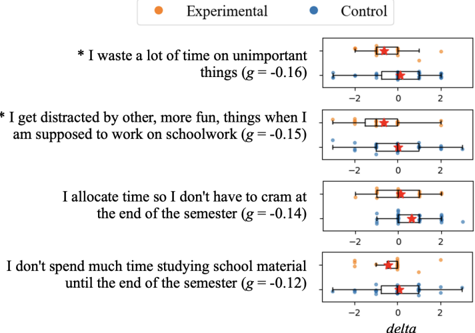
- Academic procrastination decreased significantly more in the experimental group than the control group at the overall scale level: \(p = 0.04\), \(g = -0.17\); mean delta was \(-0.12\) vs. \(0.08\). Two of 25 items showed significant differences: “I waste a lot of time on unimportant things” (\(p = 0.02\); \(g = -0.16\)) and “I get distracted by other, more fun, things when I am supposed to work on schoolwork” (\(p = 0.05\); \(g = -0.15\)).
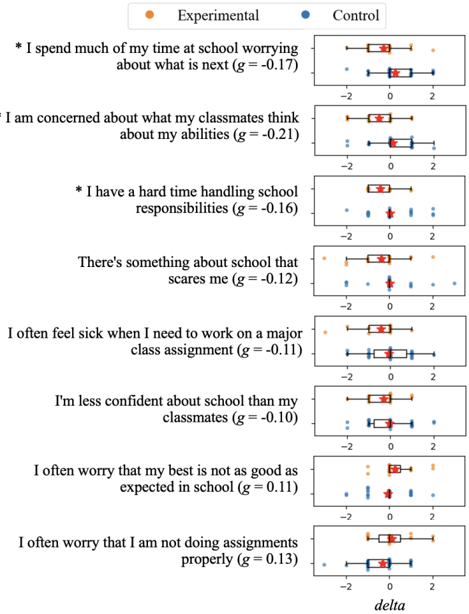
- Academic anxiety showed no significant overall difference (\(p = 0.18\)) but a negative meaningful effect size (\(g = -0.13\)), with mean delta \(-0.18\) vs. \(0.02\). Significant item-level decreases included “I spend much of my time at school worrying about what is next” (\(p = 0.03\); \(g = -0.17\)), “I am concerned about what my classmates think about my abilities” (\(p = 0.01\); \(g = -0.21\)), and “I have a hard time handling school responsibilities” (\(p = 0.05\); \(g = -0.16\)); 8 of 11 anxiety items showed notable decrease in the experimental group.
- Brief-COPE overall showed no significant difference (\(p = 0.77\); \(g = 0.02\)). Significant item-level changes were “I’ve been refusing to believe that it has happened” (\(p = 0.02\); \(g = -0.19\)) and “I’ve been looking for something good in what is happening” (\(p = 0.04\); \(g = 0.13\)); other meaningful effects included less self-criticism (\(g = -0.16\)), less giving up (\(g = -0.11\)), less self-blame (\(g = -0.10\)), and more active coping (\(g = 0.14\)).
- Subjective happiness showed no significant overall difference, with effect size near the meaningful threshold (\(g = 0.09\)); no individual happiness items showed significant or meaningful differences.
Methods
- Design: controlled pre-post study comparing the ClearMind Workshop experimental group against a control group. The workshop consisted of two one-hour in-person sessions in weeks 1 and 2 of an academic term, led by two authors, integrating ACT Guide Lite with additional content on procrastination’s nature, causes, and management.
- Sample: hosted at a North American R1 institution in winter 2023 with 23 first-/second-year data science students enrolled in 3 entry-level data science courses; 19 self-selected into the study and completed the workshop and surveys (experimental group), and 38 first-/second-year data science students formed the control group. Pre- and post-surveys were administered at the beginning and end of the academic term.
- Measures and analysis: surveys included 68 questions from the Academic Procrastination Scale (25 items), Academic Anxiety Scale (11 items), Brief-COPE (28 items), and Subjective Happiness Scale (4 items). Analysis compared post-minus-pre delta scores at overall-scale and individual-question levels using Mann-Whitney U tests and Hedges’ \(g\) with bias correction; a threshold of ±0.1 for Hedges’ \(g\) was used to identify meaningful differences.
Limitations
- The paper states the relatively small sample size may have impacted the accuracy of significance tests and effect size calculations, and that non-significant findings might be due to low statistical power rather than absence of actual effects.
- The paper notes the work is preliminary and novel in computing education research, so results are shared as preliminary.
- Evident from the text: the experimental group self-selected into the study, the control group was recruited separately, the study was conducted at a single North American R1 institution with first-/second-year data science students, and outcomes were assessed only from pre- to post-survey within one academic term, with no long-term follow-up.
Model-written summary. Check it against the paper before relying on it.
Integrity signals
Registry
Cites
Statistics
Figures


Verification
Claims the paper makes
14 Valid · 0 Not valid · 10 Not checked · 51 Own results and interpretations
The cited sources support only part of this claim — read each source’s verdict below.
In the paper
“However, existing ACT interventions for academic procrastination simply utilize general ACT protocols, without any specific customization to address academic procrastination [10,21,24,35,47].”
§ ClearMind Workshop: An ACT-based Intervention Tailored for Academic Procrastination among Computing Students > 1 INTRODUCTION
What the sources say
- Not checked — no full text of the sourcecites [10] 10. Joel Gagnon, Frédérick Dionne, Guillaume Raymond, and Simon Grégoire. 2019. Pilot study of a Web-based acceptance and commitment therapy intervention for university students to reduce academic procrastination. Journal of American College Health 67, 4 (2019), 374-382. source
- Partly supportedcites [21] 21. Noora Katajavuori, Kimmo Vehkalahti, and Henna Asikainen. 2023. Promoting university students' well-being and studying with an acceptance and commitment therapy (ACT)-based intervention. Current Psychology 42 (2023), 4900-4912. sourceExperimental — accuracy not yet measured
In “Promoting Psychological Flexibility in Higher Education” (page not provided), the paper says earlier higher-education ACT interventions had not combined ACT with study-skills practice. That supports a narrower point about prior interventions, but it does not establish that all existing ACT interventions for academic procrastination used general protocols without procrastination-specific customization. (LLM, conf=0.77)
- Partly supportedcites [24] 24. Michael E Levin, Jake A Haeger, Brian G Pierce, and Michael P Twohig. 2017. Web-Based Acceptance and Commitment Therapy for Mental Health Problems in College Students: A Randomized Controlled Trial. Behavior Modification 41, 1 (2017), 141-162. sourceExperimental — accuracy not yet measured
The ACT Self-Help Website section (page unavailable) says this study taught general ACT skills rather than focusing on specific problems. But the intervention addressed a range of college students’ mental health problems; the paper does not establish that existing ACT interventions for academic procrastination generally lack customization. (LLM, conf=0.85)
- Not checked — no full text of the sourcecites [35] 35. Panajiota Räsänen, Päivi Lappalainen, Joona Muotka, Asko Tolvanen, and Raimo Lappalainen. 2016. An online guided ACT intervention for enhancing the psy- chological wellbeing of university students: A randomized controlled clinical trial. Behaviour Research and Therapy 78 (2016), 30-42. source
- Not checked — no full text of the sourcecites [47] 47. Robert D. Zettle. 2003. Acceptance and Commitment Therapy (Act) vs. Systematic Desensitization in Treatment of Mathematics Anxiety. Psychological Record 53 (2003), 197-215. source
plain- Asserted: passes — The authors put it forward as true.
- Checkable: passes — It can be checked against evidence.
- Load-bearing: passes — The paper’s conclusions depend on it.
- Based: passes — The paper gives a reason why it holds.
The cited sources support only part of this claim — read each source’s verdict below.
In the paper
“Some prior research on computing students also mentioned procrastination exacerbates lower-performing students' learning as they cannot secure enough time to ask for help [25,26].”
§ ClearMind Workshop: An ACT-based Intervention Tailored for Academic Procrastination among Computing Students > 2.1 Intervention on Procrastination
What the sources say
- Partly supportedcites [25] 25. Soohyun Nam Liao, Kartik Shah, William G. Griswold, and Leo Porter. 2021. A Quantitative Analysis of Study Habits Among Lower-and Higher-Performing Students in CS1. In Proceedings of the 26th ACM Conference on Innovation and Technology in Computer Science Education V. 1 (Virtual Event, Germany) (ITiCSE '21). Association for Computing Machinery, New York, NY, USA, 366-372. sourceExperimental — accuracy not yet measured
Section 5.1 says lower-performing CS1 students who started assignments late often lacked the opportunity to ask instructional staff for help, and that they suffered from procrastination. The claim is broader than the paper's account: these students did seek help from friends and classmates, so the time constraint applied specifically to getting help from instructional staff. (LLM, conf=0.84)
- Supportedcites [26] 26. Soohyun Nam Liao, Sander Valstar, Kevin Thai, Christine Alvarado, Daniel Zin- garo, William G. Griswold, and Leo Porter. 2019. Behaviors of Higher and Lower Performing Students in CS1 (ITiCSE '19). Association for Computing Machinery, New York, NY, USA, 196-202. source
Section 4.2.1 reports that lower-performing students who started assignments late lacked time to obtain help, including time to wait for a tutor's response. Section 5.2 says procrastination amplified the effects of poor study practices and gives an example of a student who could not ask for help after starting at the last minute. Page numbers are not provided in our copy. (LLM, conf=0.92)
plainstates a cause- Asserted: passes — The authors put it forward as true.
- Checkable: passes — It can be checked against evidence.
- Load-bearing: unclear — It is unclear whether the paper’s conclusions depend on it.
- Based: passes — The paper gives a reason why it holds.
- Partly supported
The cited sources support only part of this claim — read each source’s verdict below.
In the paper
“Yet, ACT has shown higher potential in long-term behavioral change compared to CBT [1].”
§ ClearMind Workshop: An ACT-based Intervention Tailored for Academic Procrastination among Computing Students > 1 INTRODUCTION
What the sources say
- Partly supportedcites [1] 1. Jacqueline G.L. A-Tjak, Michelle L. Davis, Nexhmedin Morina, Mark B. Powers, Jasper A.J. Smits, and Paul M.G. Emmelkamp. 2014. A Meta-Analysis of the Efficacy of Acceptance and Commitment Therapy for Clinically Relevant Mental and Physical Health Problems. Psychother. Psychosom. 84, 1 (2014), 30-36. sourceExperimental — accuracy not yet measured
The Discussion says ACT aims to help clients engage in behaviors aligned with their goals and may have potential advantages over other treatments. It does not establish a greater potential for long-term behavioral change than CBT; its comparison with established treatments found no significant difference. The reported follow-up benefit was relative to control conditions, not specifically CBT. (LLM, conf=0.82)
plainstates a cause- Asserted: passes — The authors put it forward as true.
- Checkable: passes — It can be checked against evidence.
- Load-bearing: passes — The paper’s conclusions depend on it.
- Based: passes — The paper gives a reason why it holds.
- Partly supported
A result the paper reports from its own data — it cites no other source for it, so there is none to check. The quote shows it is in the paper.
In the paper
“Also, 8 out of 11 items on the Academic Anxiety Scale showed a notable decrease within the experimental group (Figure 3).”
§ ClearMind Workshop: An ACT-based Intervention Tailored for Academic Procrastination among Computing Students > 5.2 The ClearMind Workshop and Students' Well-Being/Achievement Goal
plain- Asserted: passes — The authors put it forward as true.
- Checkable: passes — It can be checked against evidence.
- Load-bearing: unclear — It is unclear whether the paper’s conclusions depend on it.
- Based: passes — The paper gives a reason why it holds.
A result the paper reports from its own data — it cites no other source for it, so there is none to check. The quote shows it is in the paper.
In the paper
“First two individual items on Figure 4 had a significant difference between 𝑑𝑒𝑙𝑡𝑎 𝑒𝑥𝑝 and 𝑑𝑒𝑙𝑡𝑎 𝑐𝑡𝑙 : 'I've been refusing to believe that it has happened' (𝑝 = 0.02; 𝑔 = -0.19),'I've been looking for something good in what is happening' (𝑝 = 0.04; 𝑔 = 0.13).”
§ ClearMind Workshop: An ACT-based Intervention Tailored for Academic Procrastination among Computing Students > 4.3 The Use of Different Coping Mechanisms
plainstates a cause- Asserted: passes — The authors put it forward as true.
- Checkable: passes — It can be checked against evidence.
- Load-bearing: unclear — It is unclear whether the paper’s conclusions depend on it.
- Based: passes — The paper gives a reason why it holds.
18 more claims
Create a free account to see all 75 claims and to verify the 7 references still open.
- It may state two separate claims as one. 33
- Probably not a substantial claim. 20
- The quote only partly states this claim. 5
Citations
Cites
On a Test of Whether one of Two Random Variables is Stochastically Larger than the Other
Mann, H. B., & Whitney, D. R. (1947) · The Annals of Mathematical Statistics · doi:10.1214/aoms/1177730491 · Cited by 14,320
You want to measure coping but your protocol’ too long: Consider the brief cope
Carver, C. S. (1997) · International Journal of Behavioral Medicine · doi:10.1207/s15327558ijbm0401_6 · Cited by 7,361 · cited 3×
“The pre-and post-survey consisted of validated scales from the psychology field, including Academic Procrastina-tion Scale [29], Academic Anxiety Scale [3], Brief-COPE [2], and Subjective Happiness Scale [27].”
BackgroundMethodAcceptance and commitment therapy: model, processes and outcomes
Hayes, S. C., Luoma, J. B., Bond, F. W., Masuda, A., & Lillis, J. (2006) · Behaviour Research and Therapy · doi:10.1016/j.brat.2005.06.006 · Cited by 6,587
Distribution Theory for Glass's Estimator of Effect Size and Related Estimators
Hedges, L. V. (1981) · Journal of Educational Statistics · doi:10.2307/1164588 · Cited by 5,695 · cited 4×
“We also measured the magnitude and direction of the effect using Hedge’ 𝑔 [17] with a bias correction, an adjustment for sample sizes under 50.”
MethodInfluentialA Measure of Subjective Happiness: Preliminary Reliability and Construct Validation
Lyubomirsky, S., & Lepper, H. S. (1999) · Social Indicators Research · doi:10.1023/a:1006824100041 · Cited by 4,071 · cited 3×
“…[2] 28 Measure the effectiveness of coping strategies under stressful life events Four-point Likert scale, ranging from 1 = “I haven’t been doing this at all” to 4 = “I’ve been doing this” SubjectiveHappinessScale [27] 4 Measure subjective well-being and happiness level Seven-point Likert scale.”
BackgroundMethodSteel, P. (2007) · Psychological bulletin · doi:10.1037/0033-2909.133.1.65 · Cited by 3,417 · cited 4×
“According to many studies, procrastination is widespread among students [ 6, 8, 19, 31, 32, 37, 38].”
BackgroundInfluentialAcademic procrastination: Frequency and cognitive-behavioral correlates.
Solomon, L. J., & Rothblum, E. D. (1984) · Journal of Counseling Psychology · doi:10.1037/0022-0167.31.4.503 · Cited by 1,788
A-Tjak, J. G. L., Davis, M. L., Morina, N., Powers, M. B., Smits, J. A. J., & Emmelkamp, P. M. G. (2015) · Psychotherapy and Psychosomatics · doi:10.1159/000365764 · Cited by 1,031 · cited 2×
“Yet, ACT has shown higher potential in long-term behavioral change compared to CBT [1].”
BackgroundForman, E. M., Herbert, J. D., Moitra, E., Yeomans, P. D., & Geller, P. A. (2007) · Behavior Modification · doi:10.1177/0145445507302202 · Cited by 687
The third wave of cognitive behavioral therapy and the rise of process-based care
Hayes, S. C., & Hofmann, S. G. (2017) · World Psychiatry · doi:10.1002/wps.20442 · Cited by 613 · cited 1×
“More-over, ACT is believed to be more transdiagnostic so it can be applied across a wide range of psychological disorders [14].”
BackgroundAcademic procrastination and statistics anxiety
Onwuegbuzie, A. J. (2004) · Assessment & Evaluation in Higher Education · doi:10.1080/0260293042000160384 · Cited by 538 · cited 3×
“According to many studies, procrastination is widespread among students [ 6, 8, 19, 31, 32, 37, 38].”
BackgroundCognitive-behavioral therapy for anxiety disorders: An update on the empirical evidence
Kaczkurkin, A. N., & Foa, E. B. (2015) · Dialogues in Clinical Neuroscience · doi:10.31887/dcns.2015.17.3/akaczkurkin · Cited by 523 · cited 2×
“It was introduced by Hayes in 1986 and contrasts with CBT which focuses rather on changing thoughts and behaviors to modify maladaptive emotional responses [20].”
MethodAffective, cognitive, and behavioral differences between high and low procrastinators.
Rothblum, E. D., Solomon, L. J., & Murakami, J. (1986) · Journal of Counseling Psychology · doi:10.1037/0022-0167.33.4.387 · Cited by 521 · cited 2×
“This issue negatively impacts students’ academic performance, well-being, and learning abilities [25, 26, 34, 39].”
BackgroundDahl, J., Wilson, K. G., & Nilsson, A. (2004) · Behavior Therapy · doi:10.1016/s0005-7894(04)80020-0 · Cited by 448 · cited 2×
“ACT is known to be an effective intervention for various clinical and mental health conditions[4, 9, 11, 16, 41, 48, 49].”
BackgroundGaudiano, B. A., & Herbert, J. D. (2006) · Behaviour Research and Therapy · doi:10.1016/j.brat.2005.02.007 · Cited by 435 · cited 3×
“ACT is known to be an effective intervention for various clinical and mental health conditions[4, 9, 11, 16, 41, 48, 49].”
BackgroundDysfunctional control by client verbal behavior: The context of reason-giving
Zettle, R. D., & Hayes, S. C. (1986) · The Analysis of Verbal Behavior · doi:10.1007/bf03392813 · Cited by 326
Twohig, M. P., Hayes, S. C., & Masuda, A. (2006) · Behavior Therapy · doi:10.1016/j.beth.2005.02.001 · Cited by 290 · cited 2×
“ACT is known to be an effective intervention for various clinical and mental health conditions[4, 9, 11, 16, 41, 48, 49].”
BackgroundHayes, S. C., Wilson, K. G., Gifford, E. V., Bissett, R., Piasecki, M., Batten, S. V., Byrd, M., & Gregg, J. (2004) · Behavior Therapy · doi:10.1016/s0005-7894(04)80014-5 · Cited by 283 · cited 2×
“ACT is known to be an effective intervention for various clinical and mental health conditions[4, 9, 11, 16, 41, 48, 49].”
BackgroundPatterns of Academic Procrastination
Day, V., Mensink, D., & O'Sullivan, M. (2000) · Journal of College Reading and Learning · doi:10.1080/10790195.2000.10850090 · Cited by 265 · cited 3×
“According to many studies, procrastination is widespread among students [ 6, 8, 19, 31, 32, 37, 38].”
Background(2006) · Psychotherapy in Australia · Cited by 254
Räsänen, P., Lappalainen, P., Muotka, J., Tolvanen, A., & Lappalainen, R. (2016) · Behaviour Research and Therapy · doi:10.1016/j.brat.2016.01.001 · Cited by 221 · cited 4×
“Several studies also investigated the effectiveness of ACT particularly in academic settings [21, 24, 35, 47].”
BackgroundInfluentialZettle, R. D. (2003) · The Psychological Record · doi:10.1007/bf03395440 · Cited by 213 · cited 4×
“Several studies also investigated the effectiveness of ACT particularly in academic settings [21, 24, 35, 47].”
BackgroundInfluentialLevin, M. E., Haeger, J. A., Pierce, B. G., & Twohig, M. P. (2017) · Behavior Modification · doi:10.1177/0145445516659645 · Cited by 207
Self-citationUsing acceptance and commitment therapy to increase self-compassion: A randomized controlled trial
Yadavaia, J. E., Hayes, S. C., & Vilardaga, R. (2014) · Journal of Contextual Behavioral Science · doi:10.1016/j.jcbs.2014.09.002 · Cited by 188 · cited 1×
“These findings are also consistent with what prior literature found as benefits of ACT, helping one to detach oneself from thoughts and emotions and to be more self-compassionate [46].”
ResultLevin, M. E., Pistorello, J., Seeley, J. R., & Hayes, S. C. (2014) · Journal of American College Health · doi:10.1080/07448481.2013.843533 · Cited by 179
Self-citationAcademic Procrastination Prevention/Intervention: Strategies and Recommendations.
Kachgal, M. M., Hansen, L. S., & Nutter, K. J. (2001) · Journal of developmental education · Cited by 126
Research on Social Work Practice
Tripodi, T. (1983) · Social Work Research and Abstracts · doi:10.1093/swra/19.1.2 · Cited by 126
Avoiding procrastination through time management: an experimental intervention study
Häfner, A., Oberst, V., & Stock, A. (2014) · Educational Studies · doi:10.1080/03055698.2014.899487 · Cited by 114 · cited 2×
“Some successful examples are: reminder messages until students complete their tasks using Short Message Service (SMS) [5], the Pomodoro Technique and Flow-time Technique [7], and training sessions on the cyclical model of self-regulated learning and time management [12, 18].”
BackgroundWang, S., Zhou, Y., Yu, S., Ran, L.-W., Liu, X.-P., & Chen, Y.-F. (2017) · Research on Social Work Practice · doi:10.1177/1049731515577890 · Cited by 84 · cited 2×
“These interventions aim to modify these underlying factors through mindfulness trainings [30, 33] and psychotherapies [40, 42–45].”
BackgroundGrunschel, C., Patrzek, J., Klingsieck, K. B., & Fries, S. (2018) · Journal of Prevention & Intervention in the Community · doi:10.1080/10852352.2016.1198166 · Cited by 79 · cited 2×
“Some successful examples are: reminder messages until students complete their tasks using Short Message Service (SMS) [5], the Pomodoro Technique and Flow-time Technique [7], and training sessions on the cyclical model of self-regulated learning and time management [12, 18].”
BackgroundScent, C. L., & Boes, S. R. (2014) · Journal of College Student Psychotherapy · doi:10.1080/87568225.2014.883887 · Cited by 77 · cited 1×
“Similarly, psychotherapies have demonstrated significant effectiveness in reducing procrastination behaviors as well [36, 40, 42, 44].”
BackgroundReducing Academic Procrastination Through a Group Treatment Program: A Pilot Study
Uzun Ozer, B., Demir, A., & Ferrari, J. R. (2013) · Journal of Rational-Emotive & Cognitive-Behavior Therapy · doi:10.1007/s10942-013-0165-0 · Cited by 77
Ugwuanyi, C. S., Gana, C. S., Ugwuanyi, C. C., Ezenwa, D. N., Eya, N. M., Ene, C. U., Nwoye, N. M., Ncheke, D. C., Adene, F. M., Ede, M. O., et al. (2020) · Journal of Rational-Emotive & Cognitive-Behavior Therapy · doi:10.1007/s10942-020-00350-7 · Cited by 52 · cited 3×
“Similarly, psychotherapies have demonstrated significant effectiveness in reducing procrastination behaviors as well [36, 40, 42, 44].”
BackgroundKatajavuori, N., Vehkalahti, K., & Asikainen, H. (2023) · Current Psychology · doi:10.1007/s12144-021-01837-x · Cited by 50
Steel, P. (2007) · Libraries and Cultural Resources (University of Calgary) · doi:10.11575/prism/34061 · Cited by 46
Mindfulness intervention for academic procrastination: A randomized control trial
Rad, H. S., Samadi, S., Sirois, F. M., & Goodarzi, H. (2023) · Learning and Individual Differences · doi:10.1016/j.lindif.2022.102244 · Cited by 45
Behaviors of Higher and Lower Performing Students in CS1
Liao, S. N., Valstar, S., Thai, K., Alvarado, C., Zingaro, D., Griswold, W. G., & Porter, L. (2019) · Proceedings of the 2019 ACM Conference on Innovation and Technology in Computer Science Education · doi:10.1145/3304221.3319740 · Cited by 44
Self-citation(2015) · Educational Sciences: Theory & Practice · doi:10.12738/estp.2015.5.0077 · Cited by 40 · cited 3×
“Similarly, psychotherapies have demonstrated significant effectiveness in reducing procrastination behaviors as well [36, 40, 42, 44].”
BackgroundAchievement Goals in CS1: Replication and Extension
Zingaro, D., Craig, M., Porter, L., Becker, B. A., Cao, Y., Conrad, P., Cukierman, D., Hellas, A., Loksa, D., & Thota, N. (2018) · Proceedings of the 49th ACM Technical Symposium on Computer Science Education · doi:10.1145/3159450.3159452 · Cited by 35
Gagnon, J., Dionne, F., Raymond, G., & Grégoire, S. (2019) · Journal of American College Health · doi:10.1080/07448481.2018.1484361 · Cited by 26 · cited 3×
“However, existing ACT interventions for academic procrastination simply utilize general ACT protocols, without any specific customization to address academic procrastination [10, 21, 24, 35, 47].”
Background(2013) · Journal of interactive online learning · Cited by 26
A Quantitative Analysis of Study Habits Among Lower- and Higher-Performing Students in CS1
Liao, S. N., Shah, K., Griswold, W. G., & Porter, L. (2021) · Proceedings of the 26th ACM Conference on Innovation and Technology in Computer Science Education V. 1 · doi:10.1145/3430665.3456350 · Cited by 18
Self-citationProviding Mindfulness-Based Educational Package for Evaluating Academic Procrastination
Motie, H., Heidari, M., Bagherian, F., & Zarani, F. (2019) · Iranian Journal of Psychiatry and Clinical Psychology · doi:10.32598/ijpcp.25.1.25 · Cited by 11 · cited 3×
“These interventions aim to modify these underlying factors through mindfulness trainings [30, 33] and psychotherapies [40, 42–45].”
BackgroundA-Tjak, J. G. L., Davis, M. L., Nexhmedin Morina, B., et al. (2014) · Figshare · doi:10.6084/m9.figshare.5126893
Group cognitive and contextual therapies in treatment of depression
Zettle, R. D., & Rains, J. C. (1989) · Journal of Clinical Psychology · doi:10.1002/1097-4679(198905)45:3<436::aid-jclp2270450314>3.0.co;2-l · cited 2×
“ACT is known to be an effective intervention for various clinical and mental health conditions[4, 9, 11, 16, 41, 48, 49].”
Background
Research works printed but not linked: 4
- R.J. Dizon, H.D. Ermitanio, D.M. Estevez, J. Ferrer, S.J. Flores, K.M. Fontanilla, A. Frias, E. Galang, and Dr. J. Sugay. 2021. THE EFFECTS OF POMODORO TECHNIQUE ON ACADEMIC-RELATED TASKS, PROCRASTINATION BEHAVIOR, AND ACADEMIC MOTIVATION AMONG COLLEGE STUDENTS IN A MIXED ONLINE LEARNING ENVIRONMENT. Globus Journal of Progressive Education , Vol. 11 (2021), 58--63.
- Justin D. Mccloskey. 2011. FINALLY, MY THESIS ON ACADEMIC PROCRASTINATION. Master's thesis. University of Texas at Arlington.
- William K. O'Brien. 2000. Applying the transtheoretical model to academic procrastination. Ph.D. Dissertation.
- D. M. Tice and R. F. Baureminder. 1997. Correlates of academic procrastination and mathematics achievement of university undergraduates. Journal of Counseling Psychology , Vol. 31 (1997), 503--509.
Cited by
Academic procrastination: A systematic review of causal factors and interventions
Ramadhani, E., Setiyosari, P., Indreswari, H., Setiyowati, A. J., & Putri, R. D. (2025) · Journal of Behavioral and Cognitive Therapy · doi:10.1016/j.jbct.2025.100552 · Cited by 32
Xu, S., Hu, D., Wang, R., & Zhang, X. (2025) · CHI Conference on Human Factors in Computing Systems · doi:10.1145/3706598.3713480 · Cited by 12
Lee, S. H., Othman, A., & Ramlee, F. (2025) · Discover Psychology · doi:10.1007/s44202-025-00379-8 · Cited by 5
“Three studies used pretest post-test semi-experimental design without a control group (i.e. [17, 34, 35]), whereas four study used a pretest posttest semi-experimental design with control group (i.e [36–39].”
Influential
Metadata
- Authors
- She, Y., Klimczak, K. S., Levin, M. E., & Liao, S. N.
- Affiliations
- University of California San Diego (US)
- Utah State University (US)
- Venue
- Proceedings of the 55th ACM Technical Symposium on Computer Science Education V. 1
- Publisher
- ACM
- Published
- 2024-03-07
- Pages
- 1216-1222
- OpenAlex
- W4392564411
- Cited by
- 3
- References
- 40
- Citations by year
- 2025: 3
- FWCI
- 14.99
- Type
- conference paper
- Language
- en
- Open access
- hybrid
- doi.org
- Licence
- Locations
- ACM Technical Symposium on Computer Science Education (SIGCSE) (publishedVersion, cc-by)
- Topics
- Social Sciences › Psychology › Clinical Psychology › Perfectionism, Procrastination, Anxiety Studies
- Social Sciences › Psychology › Developmental and Educational Psychology › Student Stress and Coping
- Social Sciences › Psychology › Clinical Psychology › Psychological Treatments and Assessments
- Keywords
- academic procrastination, acceptance and commitment therapy, computing students, anxiety, coping strategies, positive reframing, self-blame, avoidance, workshop intervention, student well-being
About these checks
Registry, retraction, Cites and statistics results are computed, not judged, with one exception: a printed reference that no index lists is read once by a model before it counts as a citation error. Claims are extracted by a model and kept only when their quote appears verbatim in the text; each cited source is then checked, with a model’s help, for whether it says what the claim relies on. Those verdicts can be wrong — read the claim’s quote and the cited source before relying on one.
The claim verdicts this report counts are experimental: their accuracy is not yet measured.
A language model drew the claims from the paper on 2026-10-11, under version 3 of the claim definition (model deepseek-v4.1-flash, prompt extract-v3).
A second model labelled each claim on 2026-10-11 (model jev-1.13-20260917, definition revision gold-guideline-v0.2).
Cited sources are checked with a language model’s help (gpt-6-sol).
Statistics and arithmetic are recomputed, not judged.
Confidence bands are shown only for fields calibrated on our annotated test set. None is calibrated yet, so no band is shown.
What counts as a claim ›How we measure confidence ›How we check this ›
Are you an author, or do you see a problem with this page? Request a review
Data sources
Bibliographic data: Semantic Scholar, OpenAlex, Crossref.
Contains information from the Semantic Scholar Academic Graph Datasets, made available under the ODC Attribution License (ODC-BY 1.0).
Semantic Scholar’s data is described in: Kinney, R., et al. (2023). The Semantic Scholar Open Data Platform. arXiv:2301.10140.
