

Streams, Substructures, and the Early History of the Milky Way
Open accessThe DOI matches its Crossref record; 366 of the 422 references it cites were found in a registry or an index; 76 of the 135 sources its claims cite were checked for support.
Abstract
The advent of the second data release of the Gaia mission, in combination with data from large spectroscopic surveys, is revolutionizing our understanding of the Galaxy. Thanks to these transformational data sets and the knowledge accumulated thus far, a new, more mature picture of the evolution of the early Milky Way is currently emerging. ▪ Two of the traditional Galactic components, namely, the stellar halo and the thick disk, appear to be intimately linked: Stars with halo-like kinematics originate in similar proportions from a heated (thick) disk and from debris from a system named Gaia-Enceladus. Gaia-Enceladus was the last big merger event experienced by the Milky Way and was completed around 10 Gyr ago. The puffed-up stars now present in the halo as a consequence of the merger have thus exposed the existence of a disk component at z ∼ 1.8. This is likely related to the previously known metal-weak thick disk and may be traceable to metallicities [Fe/H] −4. As importantly, there is evidence that the merger with Gaia-Enceladus triggered star formation in the early Milky Way, plausibly leading to the appearance of the thick disk as we know it. ▪ Other merger events have been characterized better, and new ones have been uncovered. These include, for example, the Helmi streams, Sequoia, and Thamnos, which add to the list of those discovered in wide-field photometric surveys, such as the Sagittarius streams. Current knowledge of their progenitors’ properties, star formation, and chemical evolutionary histories is still incomplete. ▪ Debris from different objects shows different degrees of overlap in phase-space. This sometimes confusing situation can be improved by determining membership probabilities via quantitative statistical methods. A task for the next few years will be to use ongoing and planned spectroscopic surveys for chemical labeling and to disentangle events from one another using dimensions other than phase-space, metallicity, or [α/Fe]. ▪ These large surveys will also provide line-of-sight velocities missing for faint stars in Gaia releases and more accurate distance determinations for distant objects, which in combination with other surveys could also lead to more accurate age dating. The resulting samples of stars will cover a much wider volume of the Galaxy, allowing, for example, the linking of kinematic substructures found in the inner halo to spatial overdensities in the outer halo. ▪ All the results obtained so far are in line with the expectations of current cosmological models. Nonetheless, tailored hydrodynamical simulations to reproduce in detail the properties of the merger debris, as well as constrained cosmological simulations of the Milky Way, are needed. Such simulations will undoubtedly unravel more connections between the different Galactic components and their substructures, and will aid in pushing our knowledge of the assembly of the Milky Way to the earliest times.
Overview
CoChat Summary
## TL;DR
This review argues that Gaia DR2 plus large spectroscopic surveys transformed Galactic archaeology by revealing that the Milky Way’s inner halo and thick disk are tightly linked. The central result is that a major merger, Gaia-Enceladus, occurred about 10 Gyr ago and likely built much of the inner halo while perturbing a pre-existing disk.
## Key findings
- Gaia DR2 and spectroscopic surveys made it possible to identify a major merger event, Gaia-Enceladus, which the paper says was the Milky Way’s last big merger and occurred approximately 10 Gyr ago.
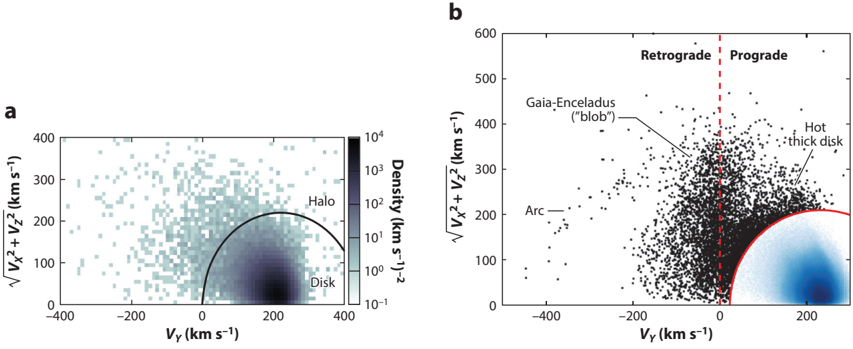
- The paper states that Gaia-Enceladus debris accounts for a large fraction of the inner stellar halo; it also reports that near the Sun, roughly 44% of stars with halo-like kinematics are in the hot thick disk region, while about 60%–80% of the remainder are in the elongated Gaia-Enceladus structure, depending on the exact definition.
- The paper reports a mean retrograde motion for Gaia-Enceladus debris of v_\u03c6 = -21.1 ± 1.8 km s^-1 within 1 kpc of the Sun (6 stars) and -16.1 ± 2.8 km s^-1 within 2 kpc (23 stars).
- For the Helmi streams, the paper reports a progenitor stellar mass of about 10^8 M_\u2609 and an infall time between 5 and 8 Gyr ago; for Sequoia and Thamnos, it cites approximate progenitor masses of ~10^7 M_\u2609 and ~5 × 10^6 M_\u2609, respectively.
## Methods
- This is a narrative review, not an original data-analysis paper; it synthesizes evidence from Gaia DR2, APOGEE, RAVE, LAMOST, SDSS, Pan-STARRS, DES, and prior literature.
- The main analytical framework is Galactic archaeology: using stellar chemical abundances, ages, kinematics, and integrals of motion / orbital properties to identify accretion debris and reconstruct the Milky Way’s assembly history.
- The paper also discusses comparisons to cosmological and hydrodynamical simulations, orbital integrations, and clustering/statistical methods such as Gaussian mixture models, HDBSCAN, Fourier analysis, and k-means as tools for interpreting substructure.
## Limitations
- The paper explicitly says that many questions remain open, that the picture is still “sketchy” and “in a state of flux,” and that more data will be needed over the next 5 to 10 years.
- It states that current simulations have important limitations: limited resolution, difficulty tracing stars from systems below about 10^6 M_\u2609, and incomplete treatment of chemical enrichment.
- It also says the evidence for some structures is ambiguous because debris from different objects overlaps in phase space; this is evident from the text’s repeated calls for membership probabilities and more detailed chemical abundances.
Model-written summary. Check it against the paper before relying on it.
Integrity signals
Registry
Cites
Statistics
Figures
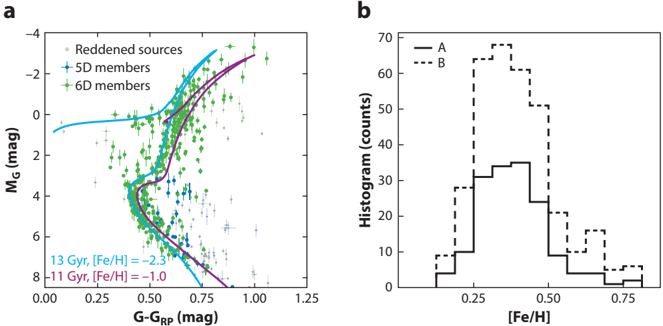
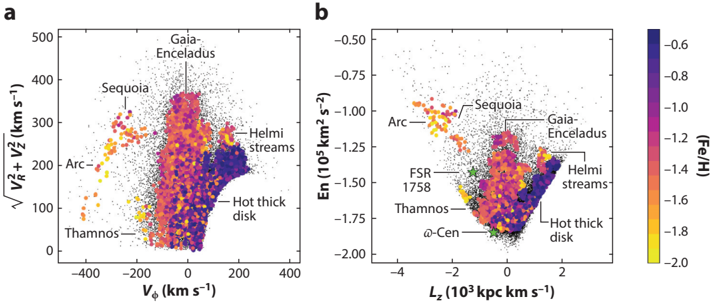
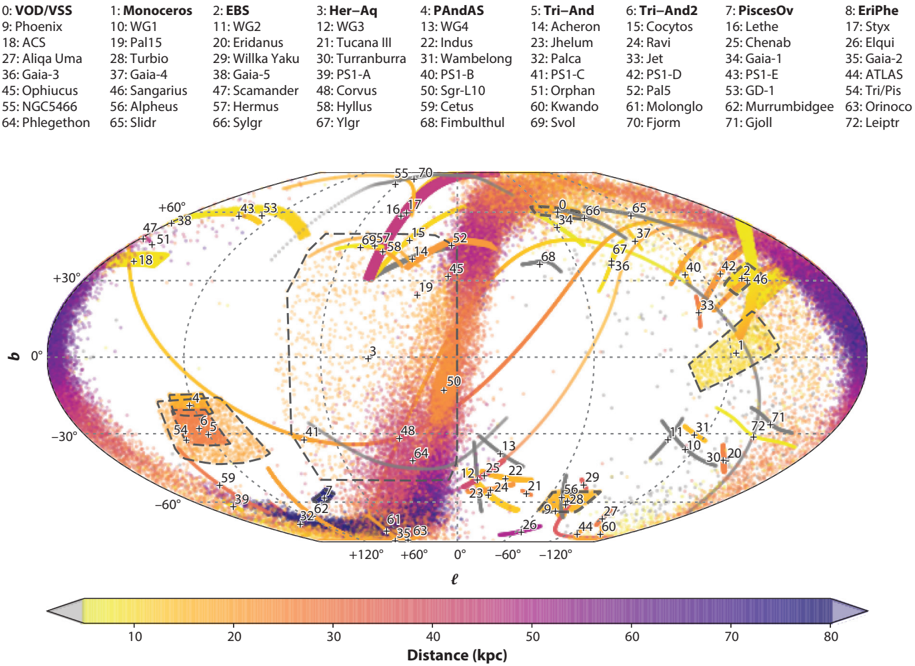
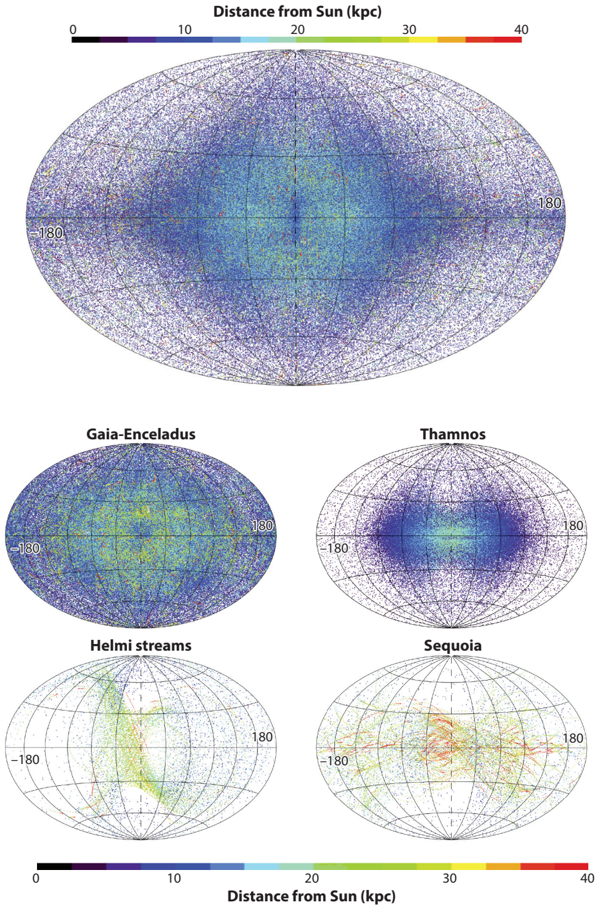
Verification
Claims the paper makes
55 Valid · 15 Not valid · 32 Not checked · 82 Own results and interpretations
At least one cited source doesn’t support this claim or points to a different paper, and none confirmed it — see the verdicts below.
In the paper
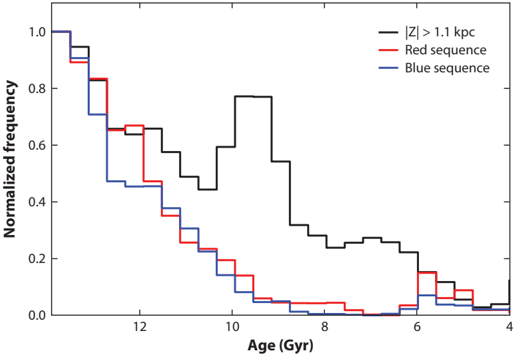
“As Gallart et al. (2019) showed, the majority of the thick disk stars likely formed during/after the merger with Gaia-Enceladus and not before.”
§ Streams, Substructures, and the Early History of the Milky Way > 5.2. Formation Paths
What the sources say
- Disputedcites Gallart et al. (2019) matched to “Uncovering the birth of the Milky Way through accurate stellar ages with Gaia” (2019) sourceExperimental — accuracy not yet measured
The age-distribution passage (p. 2) says 50% of thick-disc stars had formed by 10.5 billion years ago; the paper dates the Gaia-Enceladus merger to about 10 billion years ago (p. 3). Thus at least half had formed before the merger, contrary to the claim that the majority formed during or after it. The paper does say thick-disc star formation continued after the merger. (LLM, conf=0.88)
Checked by a reasoning model — may be wrong.
hedgedstates a cause- Asserted: passes — The authors put it forward as true.
- Checkable: passes — It can be checked against evidence.
- Load-bearing: unclear — It is unclear whether the paper’s conclusions depend on it.
- Based: passes — The paper gives a reason why it holds.
- Disputed
At least one cited source doesn’t support this claim or points to a different paper, and none confirmed it — see the verdicts below.
In the paper
“More detailed high-resolution chemical elemental abundance studies demonstrated that thick disk stars organize themselves in a segregated sequence from that of the thin disk stars in the solar neighborhood in, for example, [α/Fe] versus [Fe/H] (Gilmore et al. 1995).”
§ Streams, Substructures, and the Early History of the Milky Way > 5.1. Overview of Its Properties
What the sources say
- Disputedcites Gilmore et al. 1995 matched to “A determination of the thick disk chemical abundance distribution: Implications for galaxy evolution” (1995) sourceExperimental — accuracy not yet measured
Section 4.3 (p. 17) describes continuity of element ratios between thick- and thin-disk stars and says the populations are plausibly chemically connected, rather than occupying segregated sequences. The paper reports its own iron-abundance distribution, not a separate [α/Fe]–[Fe/H] sequence for thick-disk stars. (LLM, conf=0.87)
Checked by a reasoning model — may be wrong.
boostedstates an association- Asserted: passes — The authors put it forward as true.
- Checkable: passes — It can be checked against evidence.
- Load-bearing: unclear — It is unclear whether the paper’s conclusions depend on it.
- Based: passes — The paper gives a reason why it holds.
- Disputed
The cited sources support only part of this claim — read each source’s verdict below.
In the paper
“Helmi & White (1999) estimated analytically (this was later confirmed using cosmological simulations by Helmi et al. 2003, Gómez et al. 2013) that if the whole stellar halo had been built via mergers, approximately 500 streams would be expected in the halo near the Sun (independently of whether 10 or 100 galaxies had been accreted).”
§ Streams, Substructures, and the Early History of the Milky Way > 3.3. Kinematical Properties of Stars: Dynamics as a Tool
What the sources say
- Not matchedcites Helmi & White 1999
More than one paper fits this citation.
- Partly supportedcites Helmi et al. 2003 matched to “The phase-space structure of cold dark matter haloes: insights into the Galactic halo” (2003) sourceExperimental — accuracy not yet measured
The Introduction estimates 300–500 merger- and accretion-origin structures near the Sun. The Discussion says the simulations show reasonable agreement with earlier work and that its stellar-stream estimates “may indeed apply”; it does not establish the estimate independently of whether 10 or 100 galaxies were accreted, or confirm 500 stellar streams outright. No page numbers are available in our copy. (LLM, conf=0.85)
- Partly supportedcites Gómez et al. 2013 matched to “Streams in the Aquarius stellar haloes” (2013) sourceExperimental — accuracy not yet measured
Section 4.1 (p. 7) reports that the simulated solar-neighbourhood stream counts fall within the approximately 300–500 range predicted by Helmi & White, supporting the claim that Gómez et al. confirmed the approximate count. Our copy does not say that the count is independent of whether 10 or 100 galaxies were accreted. (LLM, conf=0.84)
hedgedstates a cause- Asserted: passes — The authors put it forward as true.
- Checkable: passes — It can be checked against evidence.
- Load-bearing: passes — The paper’s conclusions depend on it.
- Based: passes — The paper gives a reason why it holds.
- Not matched
Every source the paper cites for this claim was checked and supports it.
In the paper
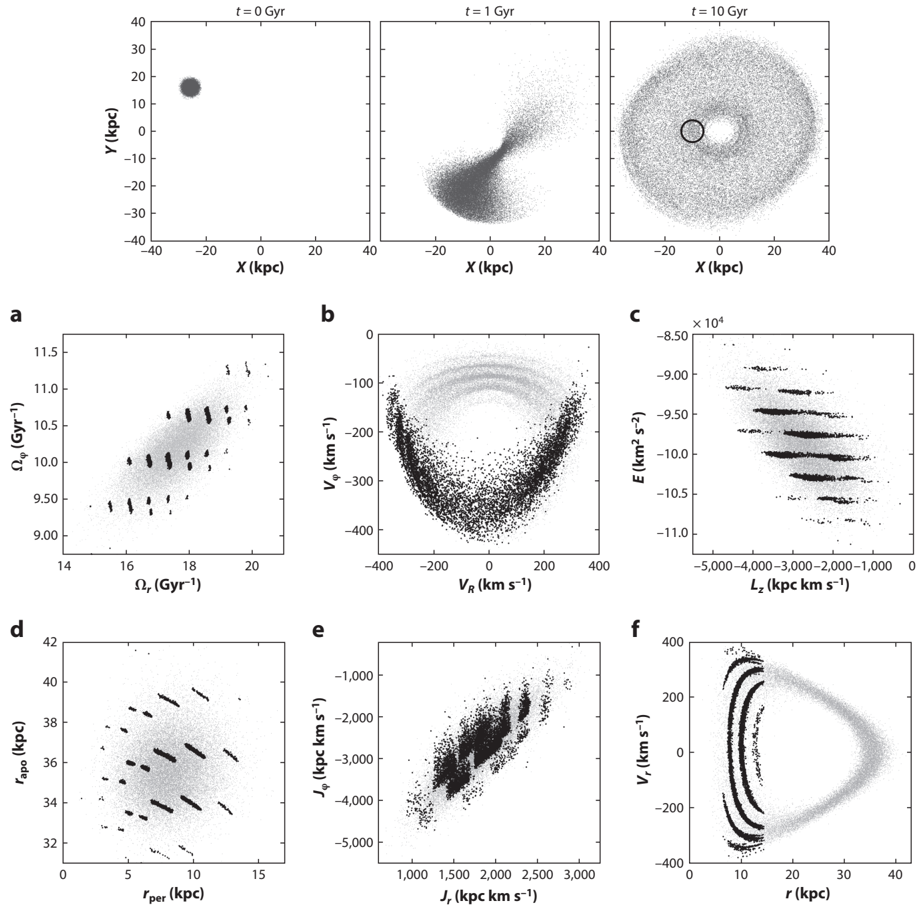
“Individual streams or portions of streams are particularly apparent in frequency space, as can be seen in Figure 4a.This is because the individual streams each have their own characteristic frequency (which defines their phase along the orbit; see McMillan & Binney 2008, Gómez & Helmi 2010).”
§ Streams, Substructures, and the Early History of the Milky Way > 218 Helmi
What the sources say
- Supportedcites McMillan & Binney 2008 matched to “Disassembling the Galaxy with angle-action coordinates” (2008) source
Section 4.1 (pp. 4–5) shows that particles from a disrupted satellite remain in distinct patches in frequency space, even after their spatial distribution becomes nearly featureless. Section 2 (p. 2) explains that orbital angles increase linearly with time at rates given by the orbital frequencies, supporting the claim’s connection between frequency and orbital phase. (LLM, conf=0.89)
- Supportedcites Gómez & Helmi 2010 matched to “On the identification of substructure in phase space using orbital frequencies” (2010) source
Section 3.1 (p. 3) says that particles with different frequencies form multiple streams, each with its own characteristic frequency, as their orbital angles evolve. Sections 3.2.2 (p. 6) and 6 (p. 15) say that frequency space makes those streams readily identifiable. (LLM, conf=0.92)
plainstates a cause- Asserted: passes — The authors put it forward as true.
- Checkable: passes — It can be checked against evidence.
- Load-bearing: passes — The paper’s conclusions depend on it.
- Based: passes — The paper gives a reason why it holds.
- Supported
Every source the paper cites for this claim was checked and supports it.
In the paper
“Nonetheless, Gómez et al. (2013) and Simpson et al. (2019), for example, have shown that substructure is still present in these spaces, even in simulations of the full hierarchical assembly of the halo.”
§ Streams, Substructures, and the Early History of the Milky Way > 218 Helmi
What the sources say
- Supportedcites Gómez et al. 2013 matched to “Streams in the Aquarius stellar haloes” (2013) source
Section 4.1 (p. 8) says substructure is clearly visible in integrals-of-motion space despite merger-driven changes to the host potential and chaotic orbital behaviour. The paper describes its stellar-halo simulations as fully cosmological (p. 2), supporting the claim's hierarchical-assembly context. (LLM, conf=0.94)
- Supportedcites Simpson et al. 2019 matched to “Simulating cosmological substructure in the solar neighbourhood” (2019) source
Section 3 reports clear stellar substructure in energy–angular-momentum (E–Lz) space in the cosmological Auriga simulations, with structures arising from accreted satellites. This supports the claim that substructure remains visible in an integrals-of-motion space in simulations of hierarchical assembly. Page numbers are not provided in our copy. (LLM, conf=0.93)
boosted- Asserted: passes — The authors put it forward as true.
- Checkable: passes — It can be checked against evidence.
- Load-bearing: passes — The paper’s conclusions depend on it.
- Based: passes — The paper gives a reason why it holds.
- Supported
79 more claims · 19 with their cited sources checked
Create a free account to see all 184 claims and to verify the 25 references still open.
- It may state two separate claims as one. 77
- The quote only partly states this claim. 2
- Probably not a substantial claim. 36
Claims other papers make about this one
Each is checked against this paper’s own text: does it say what the citing paper says it does?
The source backs part of the claim, not all of it — or backs it for a different population, condition or comparison.
In the citing paper
“Kraken may represent the tip of the iceberg of several further accretion events hidden towards the Galactic centre (Helmi 2020), where the identification of substructure is complicated by high stellar densities and phase space mixing on short orbital time-scales.”
From Kraken reveals itself – the merger history of the Milky Way reconstructed with the E-MOSAICS simulations (2020) · cites this paper as Helmi 2020
Experimental — accuracy not yet measured
Citations
Cites
The Sloan Digital Sky Survey: Technical Summary
York, D. G., Adelman, J., Anderson, Jr., Anderson, S. F., Annis, J., Bahcall, N. A., Bakken, J. A., Barkhouser, R., Bastian, S., Berman, E., et al. (2000) · The Astronomical Journal · doi:10.1086/301513 · Cited by 10,366
Gaia Data Release 2: Summary of the contents and survey properties
Gaia Collaboration, Brown, A. G. A., Vallenari, A., Prusti, T., de Bruijne, J. H. J., Babusiaux, C., Bailer-Jones, C. A. L., Biermann, M., Evans, D. W., Eyer, L., et al. (2018) · Astronomy & Astrophysics · doi:10.1051/0004-6361/201833051 · Cited by 8,442
Self-citationGalactic Dynamics: Second Edition
Binney, J., & Tremaine, S. (2008) · doi:10.1515/9781400828722 · Cited by 4,375
LSST: From Science Drivers to Reference Design and Anticipated Data Products
Ivezić, Ž., Kahn, S. M., Tyson, J. A., Abel, B., Acosta, E., Allsman, R., Alonso, D., AlSayyad, Y., Anderson, S. F., Andrew, J., et al. (2019) · The Astrophysical Journal · doi:10.3847/1538-4357/ab042c · Cited by 4,357
LSST: from Science Drivers to Reference Design and Anticipated Data Products
Ivezić, Ž., Kahn, S. M., Tyson, J. A., Abel, B., Acosta, E., Allsman, R., Alonso, D., AlSayyad, Y., Anderson, S. F., Andrew, J., et al. (2008) · arXiv · doi:10.48550/arxiv.0805.2366 · Cited by 4,357
Transiting Exoplanet Survey Satellite
Ricker, G. R., Winn, J. N., Vanderspek, R., Latham, D. W., Bakos, G. Á., Bean, J. L., Berta-Thompson, Z. K., Brown, T. M., Buchhave, L., Butler, N. R., et al. (2014) · Journal of Astronomical Telescopes, Instruments, and Systems · doi:10.1117/1.jatis.1.1.014003 · Cited by 4,056
Core condensation in heavy halos: a two-stage theory for galaxy formation and clustering
White, S. D. M., & Rees, M. J. (1978) · Monthly Notices of the Royal Astronomical Society · doi:10.1093/mnras/183.3.341 · Cited by 3,919
Tremonti, C. A., Heckman, T. M., Kauffmann, G., Brinchmann, J., Charlot, S., White, S. D. M., Seibert, M., Peng, E. W., Schlegel, D. J., Uomoto, A., et al. (2004) · The Astrophysical Journal · doi:10.1086/423264 · Cited by 3,608
The EAGLE project: simulating the evolution and assembly of galaxies and their environments
Schaye, J., Crain, R. A., Bower, R. G., Furlong, M., Schaller, M., Theuns, T., Dalla Vecchia, C., Frenk, C. S., McCarthy, I. G., Helly, J. C., et al. (2015) · Monthly Notices of the Royal Astronomical Society · doi:10.1093/mnras/stu2058 · Cited by 3,601
The physical properties of star-forming galaxies in the low-redshift Universe
Brinchmann, J., Charlot, S., White, S. D. M., Tremonti, C., Kauffmann, G., Heckman, T., & Brinkmann, J. (2004) · Monthly Notices of the Royal Astronomical Society · doi:10.1111/j.1365-2966.2004.07881.x · Cited by 3,290
Research works printed but not linked: 37
- 36. Bisterzo S, Gallino R, Straniero O, Cristallo S, Käppeler F. 2010. MNRAS 404:1529-44
- 57. Burton WB. 1988. Trans. Int. Astron. Union Ser. A 20A:377-421
- 68. Chaplin WJ, Basu S, Huber D, et al. 2014. Ap. J. Suppl. 210:1
- 74. Christlieb N, Battistini C, Bonifacio P, et al. 2019. Messenger 175:26-29
- 75. Conroy C, Bonaca A, Cargile P, et al. 2020. Ap. J. 883:107
- 2016, Ground-based and Airborne Instrumentation for Astronomy VI, 9908
- 82. de Jong RS, Agertz O, Berbel AA, et al. 2019. Messenger 175:3-11
- 98. Dierickx M, Klement R, Rix HW, Liu C. 2010. Ap. J. Lett. 725:L186-90
- 100. Dinescu DI. 2002. In Omega Centauri, A Unique Window into Astrophysics, ed. F van Leeuwen, JD Hughes, G Piotto, pp. 143-54. San Francisco: Astron. Soc. Pac. 250
- 106. Eneev TM, Kozlov NN, Sunyaev RA. 1973. Astron. Astrophys. 22:41
- 124. Gerin M, Combes F, Athanassoula E. 1990. Astron. Astrophys. 230:37-54
- 134. Gouda N. 2015. IAU Gen. Assembl. 29:2247720
- 136. Grand RJJ, Gómez FA, Marinacci F, et al. 2017. MNRAS 467:179-207
- 141. Grillmair CJ, Carlin JL. 2016. In Tidal Streams in the Local Group and Beyond, ed. HJ Newberg, JL Carlin, pp. 87-112. New York: Springer
- 153. Helmi A, de Zeeuw PT. 2000. MNRAS 319:657-65
- 154. Helmi A, Irwin M, Deason A, et al. 2019. Messenger 175:23-25
- 155. Helmi A, Navarro JF, Nordström B, et al. 2006. MNRAS 365:1309-23
- 172. Ishigaki MN. 2019. In Star Clusters: From the Milky Way to the Early Universe, ed. A Bragaglia, M Davies, A Sills, E Vesperini, pp. 24-33. Cambridge, UK: Cambridge Univ. Press
- 178. Johnston KV. 2016. In Tidal Streams in the Local Group and Beyond, ed. HJ Newberg, JL Carlin, pp. 141-67. New York: Springer
- 192. Kollmeier J, Fuller J, Gaensicke B, et al. 2019. Bull. Am. Astron. Soc. 51:503
- 211. Levi M, Allen LE, Raichoor A, et al. 2019. Bull. Am. Astron. Soc. 51:57
- 234. McMillan PJ. 2018. Res. Notes Am. Astron. Soc. 2:51
- 258. Ness M, Bird J, Johnson J, et al. 2019. Bull. Am. Astron. Soc. 51:238
- 262. Nissen PE, Schuster WJ. 1997. Astron. Astrophys. 326:751-62
- 269. Pasquini L, Delabre B, Ellis RS, et al. 2018. In Rediscovering Our Galaxy, ed. C Chiappini, I Minchev, E Starkenburg, M Valentini, pp. 242-47. Cambridge, UK: Cambridge Univ. Press
- 270. Perryman MAC, Lindegren L, Kovalevsky J, et al. 1997. Astron. Astrophys. 500:501-4
- 281. Purcell CW, Bullock JS, Kazantzidis S. 2010. MNRAS 404:1711-18
- 288. Richter P. 2017. In Gas Accretion onto Galaxies, ed. A Fox, R Davé, pp. 15-48. New York: Springer
- 289. Ricker GR, Winn JN, Vanderspek R, et al. 2015. J. Astron. Telesc. Instrum. Syst. 1:014003
- 293. Roman NG. 2019. Annu. Rev. Astron. Astrophys. 57:1-34
- 312. Shen J, Rich RM, Kormendy J, et al. 2010. Ap. J. Lett. 720:L72-76
- 317. Smith MC. 2016. In Tidal Streams in the Local Group and Beyond, ed. HJ Newberg, JL Carlin, pp. 113-39. New York: Springer
- 322. Spite F, Spite M. 1979. Messenger 16:7-8
- 328. Tamura N, Takato N, Shimono A, et al. 2016. In Ground-based and Airborne Instrumentation for Astronomy VI, Vol. 9908, ed. CJ Evans, L Simard, H Takami. Bellingham, WA: SPIE Taylor C, Boylan-Kolchin M, Torrey P, Vogelsberger M, Hernquist L. 2016. MNRAS 461:3483-93
- 329. Tinsley BM. 1980. Fundam. Cosmic Phys. 5:287-388
- 339. Turon C, Primas F, Binney J, et al. 2008. Messenger 134:46-49
- 366. Zoccali M. 2019. Bol. Asoc. Argent. Astron. 61:137-44
Cited by
Items 201–300 of 396
Hunting Gravitational Wave Black Holes with Microlensing
Abrams, N. S., & Takada, M. (2020) · The Astrophysical Journal · doi:10.3847/1538-4357/abc6aa · Cited by 14
“Hence the purpose of this paper is to study how microlensing can be used to study a population of BHs in the MW Galaxy.”
BackgroundInfluentialVEXAS: VISTA EXtension to Auxiliary Surveys
Khramtsov, V., Spiniello, C., Agnello, A., & Sergeyev, A. V. (2021) · Astronomy and Astrophysics · doi:10.1051/0004-6361/202040131 · Cited by 15
“The DR2 catalogues are also available from the CDS via anonymous ftp to cdsarc.u-strasbg.fr (130.79.128.5) or via http: //cdsarc.u-strasbg.fr/viz-bin/cat/J/A+A/ our own Milky Way (MW, see e.g. the review of Helmi 2020 and references therein).”
MethodInfluentialLithium, masses, and kinematics of young Galactic dwarf and giant stars with extreme [α/Fe] ratios
Borisov, S., Prantzos, N., & Charbonnel, C. (2022) · Astronomy and Astrophysics · doi:10.1051/0004-6361/202244468 · Cited by 14
Taniguchi, D., Matsunaga, N., Kobayashi, N., Jian, M., Thorsbro, B., Fukue, K., Hamano, S., Ikeda, Y., Kawakita, H., Kondo, S., et al. (2025) · Astronomy and Astrophysics · doi:10.1051/0004-6361/202452392 · Cited by 10
Александрович, Х. С., van de Ven, G., Steinmetz, M., Ratcliffe, B., Minchev, I., Krajnović, D., Haywood, M., Matteo, P. D., Kacharov, N., Marques, L., et al. (2025) · Astronomy and Astrophysics · doi:10.1051/0004-6361/202453304 · Cited by 14
Ferraro, F. R., Chiappino, L., Bartolomei, A., Origlia, L., Fanelli, C., Lanzoni, B., Pallanca, C., Loriga, M., Leanza, S., Valenti, E., et al. (2025) · Astronomy and Astrophysics · doi:10.1051/0004-6361/202554092 · Cited by 14
Villaume, A., Foreman-Mackey, D. T., Romanowsky, A. J., Brodie, J. P., & Strader, J. (2020) · The Astrophysical Journal · doi:10.3847/1538-4357/aba616 · Cited by 11
“The “archaelogical” approach is use the chemistry and dynamics of long-lived stars to uncover this history (e.g., Helmi 2020, and the references therein).”
Iza, F. G., Scannapieco, C., Nuza, S. E., Grand, R. J. J., Gómez, F. A., Springel, V., Pakmor, R., & Marinacci, F. (2022) · Monthly Notices of the Royal Astronomical Society · doi:10.1093/mnras/stac2709 · Cited by 15
Chemodynamical properties and ages of metal-poor stars in S-PLUS
Almeida-Fernandes, F., Placco, V. M., Rocha–Pinto, H. J., Fernandes, M. B., Limberg, G., Silva, L. J. B. E., Amarante, J. A. S., Perottoni, H. D., Overzier, R., Schoenell, W., et al. (2023) · Monthly Notices of the Royal Astronomical Society · doi:10.1093/mnras/stad1561 · Cited by 10
Galaxy Interactions in Filaments and Sheets: Insights from EAGLE Simulations
Das, A., Pandey, B., & Sarkar, S. (2023) · Research in Astronomy and Astrophysics · doi:10.1088/1674-4527/acf6f5 · Cited by 8
A Blueprint for the Milky Way’s Stellar Populations. V. 3D Local Dust Extinction
An, D., Beers, T. C., & Chiti, A. (2024) · The Astrophysical Journal Supplement Series · doi:10.3847/1538-4365/ad3641 · Cited by 9
“The availability of a vast amount of observational data for Galactic stars has significantly advanced our understanding of the Milky Way’s structure and evolution (e.g., Ivezi´c et al. 2012; Bland-Hawthorn & Gerhard 2016; Helmi 2020).”
BackgroundSearching for Dwarf Galaxies in Gaia DR2 Phase-space Data Using Wavelet Transforms
Darragh-Ford, E., Nadler, E. O., McLaughlin, S., & Wechsler, R. H. (2021) · The Astrophysical Journal · doi:10.3847/1538-4357/ac0053 · Cited by 8
“This data has already provided invaluable insights into our understanding of the interrelated properties of the Milky Way stellar halo, density profile, and accretion history (e.g., Belokurov et al. 2018; Deason et al. 2018; Helmi et al. 2018; Cautun et al. 2020; see the review in Helmi 2020).”
MethodA Very Metal-poor RR Lyrae Star with a Disk Orbit Found in the Solar Neighborhood
Matsunaga, N., Itane, A., Hattori, K., Crestani, J., Braga, V. F., Bono, G., Taniguchi, D., Baba, J., Maehara, H., Ukita, N., et al. (2022) · The Astrophysical Journal · doi:10.3847/1538-4357/ac3483 · Cited by 8
“It is possible to investigate stellar populations in the Galaxy with various detailed observations thanks to relatively low distances to individual stars.”
BackgroundInfluentialHigh-resolution Chemical Abundances of the Nyx Stream
汪, S. 书. W., Necib, L., Ji, A. P., Ou, X., Lisanti, M., Reyes, M. A. C. D. L., Strom, A. L., & Truong, M. (2023) · The Astrophysical Journal · doi:10.3847/1538-4357/acec4d · Cited by 10
The formation history of the Milky Way disc with high-resolution cosmological simulations
Giammaria, M., Spagna, A., Lattanzi, M. G., Murante, G., Fiorentin, P. R., & Valentini, M. (2021) · Monthly Notices of the Royal Astronomical Society · doi:10.1093/mnras/stab136 · Cited by 9
“These results are consistent with the standard hierarchical formation scenario of the MW (Helmi 2020, and references therein).”
BackgroundResultGrimozzi, S. E., Font, A. S., & Rossi, M. E. D. (2024) · Monthly Notices of the Royal Astronomical Society · doi:10.1093/mnras/stae878 · Cited by 11
Thomsen, J. S., Miglio, A., Brogaard, K., Montalbán, J., Tailo, M., van Rossem, W. E., Casali, G., Jones, D., Arentoft, T., Casagrande, L., et al. (2025) · Astronomy and Astrophysics · doi:10.1051/0004-6361/202453347 · Cited by 18
The chaos induced by the Galactic bar on the orbits of nearby halo stars
Woudenberg, H. C., & Helmi, A. (2025) · Astronomy and Astrophysics · doi:10.1051/0004-6361/202555672 · Cited by 15
Self-citationA simulation-based inference approach to the dynamics of the MW–LMC system - validation
Brooks, R. A. N., Sanders, J. L., Dillamore, A. M., Garavito-Camargo, N., & Price-Whelan, A. M. (2025) · Monthly Notices of the Royal Astronomical Society · doi:10.1093/mnras/staf2111 · Cited by 18
Ceccarelli, E., Massari, D., Palla, M., Mucciarelli, A., Bellazzini, M., & Helmi, A. (2025) · Astronomy and Astrophysics · doi:10.1051/0004-6361/202556685 · Cited by 10
Self-citationLi, S., Wang, W., Koposov, S. E., Amarante, J. A. S., Deason, A. J., Sandford, N. R., Li, T. S., Medina, G. E., Han, J., Valluri, M., et al. (2026) · The Astrophysical Journal · doi:10.3847/1538-4357/ae41b9 · Cited by 14
“…(Eggen et al. 1962; Searle & Zinn 1978; White & Frenk 1991; Helmi et al. 1999; Freeman & Bland-Hawthorn 2002; Bullock & Johnston 2005; Be-lokurov 2013; Bland-Hawthorn & Gerhard 2016; John-ston 2016; Helmi 2020), including, for example, the Hercules-Aquila Cloud South/North overdensity (HAC-N/-”
Trujillo-Gomez, S., Kruijssen, J. M. D., Pfeffer, J., Reina-Campos, M., Crain, R. A., Bastian, N., & Cabrera-Ziri, I. (2023) · Monthly Notices of the Royal Astronomical Society · doi:10.1093/mnras/stad3165 · Cited by 13
Characterization of high-velocity stars in the S-PLUS internal fourth data release
Quispe-Huaynasi, F., Roig, F., Placco, V. M., Silva, L. J. B. E., Daflon, S., Pereira, C. B., Kanaan, A., de Oliveira, C. M., Ribeiro, T., & Schoenell, W. (2023) · Monthly Notices of the Royal Astronomical Society · doi:10.1093/mnras/stad3610 · Cited by 9
Exploring theex-situcomponents withinGaiaDR3
Li, Z., Zhao, G., Zhang, R., Xue, X.-X., Chen, Y., & Amarante, J. A. S. (2023) · Monthly Notices of the Royal Astronomical Society · doi:10.1093/mnras/stad3817 · Cited by 9
Tan, V. Y. Y., Muzzin, A., Marchesini, D., Sok, V., Sarrouh, G. T. E., & Marsan, Z. C. (2024) · The Astrophysical Journal · doi:10.3847/1538-4357/ad2c90 · Cited by 9
“…of stars and gas within the Milky Way have long been the primary method of deciphering its formation and evolutionary history (Freeman & Bland-Hawthorn 2002; Freeman et al. 2013; Bovy et al. 2012; Bovy & Rix 2013; Rix & Bovy 2013, see Bland-Hawthorn & Gerhard 2016; Helmi 2020 for reviews).”
MethodMestre, M. F., Argüelles, C. R., Carpintero, D. D., Crespi, V., & Krut, A. (2024) · Astronomy and Astrophysics · doi:10.1051/0004-6361/202348626 · Cited by 11
Exploration of Halo Substructures in Integrals-of-motion Space with Gaia Data Release 3
Liu, H., Du, C., Ye, D., Zhang, J., & Deng, M. (2024) · The Astrophysical Journal · doi:10.3847/1538-4357/ad8352 · Cited by 7
Price-Whelan, A. M., Hunt, J. D., Horta, D., Oeur, M., Hogg, D. W., Johnston, K. V., & Widrow, L. M. (2025) · The Astrophysical Journal · doi:10.3847/1538-4357/ad969a · Cited by 13
“For one, the mass density determines the orbits of its gas, stars, star clusters, and satellite galaxies, and thus enables interpreting the kinematic snapshot we observe in terms of dynamical and galactic evolutionary processes (e.g., Freeman & Bland-Hawthorn 2002; Helmi 2020).”
Identifying Galactic Substructures in 5D Space Using All-sky RR Lyrae Stars in Gaia DR3
Sun, S. S., Wang, F., Zhang, H., Xue, X.-X., Huang, Y., Zhang, R., Rix, H., Li, X., Liu, G., Zhang, L., et al. (2025) · The Astrophysical Journal · doi:10.3847/1538-4357/ad9de0 · Cited by 10
Visual cluster separation using high-dimensional sharpened dimensionality reduction
Kim, Y., Telea, A. C., Trager, S. C., & Roerdink, J. B. T. M. (2022) · Information Visualization · doi:10.1177/14738716221086589 · Cited by 11
Estimating the Oblateness of Dark Matter Halos Using Neutral Hydrogen Velocity Dispersion
Das, M., Ianjamasimanana, R., McGaugh, S., Schombert, J. M., & Dwarakanath, K. S. (2023) · The Astrophysical Journal Letters · doi:10.3847/2041-8213/acc10e · Cited by 8
“…various methods to constrain halo shape, such as modeling polar rings around galaxies (Khoperskov et al. 2014), flaring of H I disks (Becquaert & Combes 1997), gas or stellar kinematics of edgeon disks (Olling 1996), globular cluster systems (Posti & Helmi 2019), and stellar streams (Helmi 2020).”
MethodThe age, kinematics, and metallicity of nearby Sun-like stars and the history of the Milky Way disc
Gondoin, P. (2023) · Astronomy and Astrophysics · doi:10.1051/0004-6361/202346828 · Cited by 8
Santucci, G., Lagos, C. D. P., Harborne, K. E., Ludlow, A. D., Proctor, K. L., Foster, C., McDermid, R. M., Poci, A., Thater, S., van de Ven, G., et al. (2024) · Monthly Notices of the Royal Astronomical Society · doi:10.1093/mnras/stae113 · Cited by 11
First measurement of the triaxiality of the inner dark matter halo of the Milky Way
Woudenberg, H. C., & Helmi, A. (2024) · Astronomy and Astrophysics · doi:10.1051/0004-6361/202451743 · Cited by 17
Self-citationStreams, Shells, and Substructures in the Accretion-built Stellar Halo of NGC 300
Fielder, C. E., Sand, D. J., Jones, M. G., Crnojević, D., Drlica-Wagner, A., Bennet, P., Carlin, J. L., Cerny, W., Doliva-Dolinsky, A., Hunter, L. E., et al. (2025) · The Astrophysical Journal Letters · doi:10.3847/2041-8213/adbf17 · Cited by 14
“Stellar halo structures are predicted in ΛCDM simulations (e.g. Bullock & Johnston 2005; Cooper et al. 2010), and extensive studies of M31 and the Milky Way’s stellar halo have been performed (e.g., Grillmair & Carlin 2016; Shipp et al. 2018; Ibata et al. 2019; Helmi 2020, and many others).”
Larsen, J. R., Mosumgaard, J. R., Aguirre, V. S., Lundkvist, M. S., Christensen-Dalsgaard, J., Winther, M. L., Stokholm, A., Li, Y., Slumstrup, D., Kjeldsen, H., et al. (2025) · Astronomy and Astrophysics · doi:10.1051/0004-6361/202453554 · Cited by 16
Tsakonas, C., Arnaboldi, M., Bhattacharya, S., Hammer, F., Yang, Y., Gerhard, O., Wyse, R. F. G., & Hatzidimitriou, D. (2025) · Astronomy and Astrophysics · doi:10.1051/0004-6361/202453175 · Cited by 11
Survivors and Zombies: The Quenching and Disruption of Satellites Around Milky Way Analogs
Pathak, D., Christensen, C., Brooks, A. M., Munshi, F., Wright, A. C., & Carter, C. (2025) · The Astrophysical Journal · doi:10.3847/1538-4357/adec94 · Cited by 12
Mapping the Distant and Metal-poor Milky Way with SDSS-V
Chandra, V., Cargile, P. A., Ji, A. P., Conroy, C., Rix, H., Cunningham, E. C., Dias, B., Laporte, C. F. P., Cerny, W., Limberg, G., et al. (2026) · The Astrophysical Journal · doi:10.3847/1538-4357/ae448a · Cited by 16
“The stellar halo of the Milky Way ( MW ) encodes a record of our Galaxy’s merger history and chemodynamical evolution ( e.g., J. S. Bullock & K. V. Johnston 2005; A. Helmi 2008, 2020; V. Belokurov 2013 ) .”
Contursi, G., de Laverny, P., Recio-Blanco, A., Palicio, P. A., & Abia, C. (2024) · Astronomy and Astrophysics · doi:10.1051/0004-6361/202347188 · Cited by 9
Guiglion, G., Bergemann, M., Storm, N., Lian, J., Cescutti, G., & Serenelli, A. M. (2024) · Astronomy and Astrophysics · doi:10.1051/0004-6361/202348522 · Cited by 8
Finding accreted stars in the Milky Way: clues from NIHAO simulations
Buder, S., Mijnarends, L., & Buck, T. (2024) · Monthly Notices of the Royal Astronomical Society · doi:10.1093/mnras/stae1552 · Cited by 10
On the mass assembly history of the Milky Way: clues from its stellar halo
Horta, D., & Schiavon, R. P. (2024) · Astrophysics and Space Science · doi:10.1007/s10509-024-04370-y · Cited by 8
“In addition, several other discoveries of debris from accreted systems have been advanced (see Helmi 2020 for a review), including the Heracles structure that we will discuss in the next section (Horta et al. 2021b).”
Contini, E., Spavone, M., Ragusa, R., Iodice, E., & Yi, S. K. (2024) · Astronomy and Astrophysics · doi:10.1051/0004-6361/202452741 · Cited by 10
Folsom, D., Lisanti, M., Necib, L., Horta, D., Vogelsberger, M., & Hernquist, L. (2025) · The Astrophysical Journal · doi:10.3847/1538-4357/adbe31 · Cited by 13
González-Koda, Y. K., Ruiz-Lara, T., Gallart, C., Ceccarelli, E., Dodd, E., Fernández-Alvar, E., Cassisi, S., Surot, F., Agelet, F. A., Massari, D., et al. (2025) · Astronomy and Astrophysics · doi:10.1051/0004-6361/202554272 · Cited by 14
Self-citationBajkova, A. T., & Бобылев, В. В. (2021) · Astronomical and Astrophysical Transactions · doi:10.17184/eac.5640 · Cited by 6
“…of Milky Way satellite galaxies, the presence of plumes in the Galaxy ⋆ E-mail: anisabajkova@mail.ru and the search for surviving remains from the destruction of dwarf galaxies (Helmi 2020), the analysis of the evolutionary relationship with globular clusters of the Galaxy (Massari et al. 2020).”
BackgroundDetection of the Actinide Th in an r-process-enhanced Star with Accretion Origin
Xing, Q., Zhao, G., Aoki, W., Li, H., Zhao, J., Matsuno, T., & Suda, T. (2024) · The Astrophysical Journal · doi:10.3847/1538-4357/ad2fa4 · Cited by 6
Synthetic Gaia DR3 Surveys from the FIRE Cosmological Simulations of Milky Way-mass Galaxies
Nguyên, T., Ou, X., Panithanpaisal, N., Shipp, N., Necib, L., Sanderson, R. E., & Wetzel, A. R. (2024) · The Astrophysical Journal · doi:10.3847/1538-4357/ad35ba · Cited by 7
“…of new merging events, such as the Gaia Sausage Enceladus (Belokurov et al. 2018; Helmi et al. 2018), and the Kraken (Kruijssen et al. 2019) (see Helmi (2020) for a review), the construction of a new 3D dust map of the MW (Green et al. 2019), a detailed study of open clusters to unveil the…”
BackgroundClose binary fractions in accreted and in situ halo stars
Bashi, D., Belokurov, V. A., & Hodgkin, S. T. (2024) · Monthly Notices of the Royal Astronomical Society · doi:10.1093/mnras/stae2385 · Cited by 8
Necib, L., & Lin, T. (2022) · The Astrophysical Journal · doi:10.3847/1538-4357/ac4243 · Cited by 12
“The Gaiamission (Lindegren et al. 2016; Gaia Collaboration et al. 2018, 2020) in particular has found evidence of multiple mergers in the Milky Way (see e.g., Helmi 2020 for a review).”
BackgroundNewton, O., Davies, J., Pfeffer, J., Crain, R. A., Kruijssen, J. M. D., Pontzen, A., & Bastian, N. (2025) · Monthly Notices of the Royal Astronomical Society · doi:10.1093/mnras/staf1226 · Cited by 12
Pakmor, R., Fragkoudi, F., Grand, R. J. J., Simpson, C. M., Gómez, F. A., van de Voort, F., Bieri, R., Trick, W. H., Werhahn, M., & Talbot, R. Y. (2025) · Monthly Notices of the Royal Astronomical Society · doi:10.1093/mnras/staf1755 · Cited by 11
Tan, V. Y. Y., Muzzin, A., Sarrouh, G. T. E., Antwi-Danso, J., Sok, V., Jagga, N., Rihtaršič, G., Brown, W., Abraham, R. G., Asada, Y., et al. (2025) · The Astrophysical Journal · doi:10.3847/1538-4357/ae0ffe · Cited by 27
“Furthermore, consensus on the MW’s bulge is that its structure is a box/peanut or “X-shaped” bulge (see e.g. B. Barbuy et al. 2018; A. Helmi 2020), rather than a classical bulge that is described by a de Vaucouleurs profile.”
Weatherford, N. C., & Bonaca, A. (2026) · The Astrophysical Journal · doi:10.3847/1538-4357/ae21e0 · Cited by 11
“INTRODUCTION Galactic archeologists have detected abundant Milky Way (MW) substructure, including > 120 stellar streams (Helmi 2020; Mateu 2023; Bonaca & Price-Whelan 2025).”
[C/N] Ages for Red Giants and Their Implications for Galactic Archaeology
Roberts, J., Pinsonneault, M. H., Johnson, J. A., Dubay, L. O., & Johnson, J. W. (2026) · The Astrophysical Journal · doi:10.3847/1538-4357/ae5bae · Cited by 18
Effects of Halo Spin on the Formation and Evolution of Bars in Disk Galaxies
Jang, D., & Kim, W. (2024) · The Astrophysical Journal · doi:10.3847/1538-4357/ad54b9 · Cited by 5
Scannapieco, C., Cescutti, G., & Chiappini, C. (2022) · Monthly Notices of the Royal Astronomical Society · doi:10.1093/mnras/stac2581 · Cited by 6
Dropulic, A., Liu, H., Ostdiek, B., & Lisanti, M. (2023) · Monthly Notices of the Royal Astronomical Society · doi:10.1093/mnras/stad209 · Cited by 8
Sodium Abundances in Very Metal-poor Stars
Shen, Y.-F., Alexeeva, S., Zhao, G., et al. (2023) · Research in Astronomy and Astrophysics · doi:10.1088/1674-4527/accdc3 · Cited by 5
All-sky Kinematics and Chemistry of Monoceros Stellar Overdensity
Borbolato, L., Perottoni, H. D., Rossi, S., Limberg, G., Pérez-Villegas, Á., Anders, F., Antoja, T., Laporte, C. F. P., Rocha–Pinto, H. J., & Santucci, R. M. (2023) · The Astrophysical Journal · doi:10.3847/1538-4357/ad02fb · Cited by 5
“…led to the currently most accepted scenario that the MW had a bottom-up formation (Searle & Zinn 1978; Spergel et al. 2007; Somerville & Davé 2015), including old and recent mergers of dwarf galaxies, which formed substructures from the tidal disruption of these satellites (Helmi 2020).”
BackgroundMapping the Milky Way in 5D with 170 Million Stars
Speagle, J. S., Zucker, C., Bonaca, A., Cargile, P. A., Johnson, B. D., Beane, A., Conroy, C., Finkbeiner, D. P., Green, G. M., Kamdar, H., et al. (2024) · The Astrophysical Journal · doi:10.3847/1538-4357/ad2b62 · Cited by 6
Fukushima, T., Chiba, M., Tanaka, M., Hayashi, K., Homma, D., Okamoto, S., Komiyama, Y., Tanaka, M., Arimoto, N., & Matsuno, T. (2024) · Publications of the Astronomical Society of Japan · doi:10.1093/pasj/psae108 · Cited by 8
“…precise astrometric data by Gaia satellite, and the cross-matching with photometry, spectroscopy and seismology data allows us to identify the stellar population properties of these ancient progenitors (e.g., Helmi 2020; Das et al. 2020; Horta et al. 2021; Matsuno et al. 2022; Horta et al. 2023).”
Progenitor Diversity in the Accreted Stellar Halos of Milky Way–like Galaxies
Pu, S.-Y., Cooper, A. P., Grand, R. J. J., Gómez, F. A., & Monachesi, A. (2025) · The Astrophysical Journal · doi:10.3847/1538-4357/ada382 · Cited by 10
“Clear evidence for this process is provided by the many stellar halo substructures that have been discovered in the Milky Way itself (e.g. Helmi 2020; Bonaca & Price-Whelan 2024), around M31 (e.g. Ibata et al. 2014a), and around other nearby galaxies (e.g. Mart´ınez-Delgado et al. 2010).”
Nearby stellar substructures in the Galactic halo from DESI Milky Way Survey Year 1 Data Release
Kim, B., Koposov, S. E., Li, T. S., Lilleengen, S., Cooper, A. P., Carrillo, A., Valluri, M., Riley, A. H., Han, J., Aguilar, J., et al. (2025) · Monthly Notices of the Royal Astronomical Society · doi:10.1093/mnras/staf705 · Cited by 9
Schuler, S. C., Andrews, J. J., Clanzy, V. R., Mourabit, M., Chanamé, J., & Agüeros, M. A. (2021) · The Astronomical Journal · doi:10.3847/1538-3881/ac10c6 · Cited by 6
“While it is generally accepted that at least part of the halo has been populated by accretion events (e.g., Helmi 2020), some recent studies suggest that it was built entirely by accretion (Helmi et al. 2017; Naidu et al. 2020).”
BackgroundInfluentialDiscovery of Faint Double-peak Hα Emission in the Halo of Low Redshift Galaxies
Alméida, J. S., Calhau, J., Muñoz-Tuñón, C., González-Morán, A. L., & Rodríguez-Espinosa, J. M. (2022) · The Astrophysical Journal · doi:10.3847/1538-4357/ac7319 · Cited by 6
“From lone low-mass stars (e.g., Helmi 2020), to BHs arising from stellar evolution (e.g., Fender et al. 2013), including remnants of Pop iii stars (e.g., Madau & Rees 2001; Filho & Sánchez Almeida 2018), and primordial BHs (e.g., Carr & Hawking 1974; Clesse & GarćıaBellido 2015).”
BackgroundJ-PLUS: characterization of high-velocity stars in the second data release
Quispe-Huaynasi, F., Roig, F., Daflon, S., Pereira, C. B., Placco, V. M., Jiménez-Esteban, F., Galindo-Guil, F. J., Álvarez-Candal, A., Alcaniz, J. S., Angulo, R. E., et al. (2023) · Monthly Notices of the Royal Astronomical Society · doi:10.1093/mnras/stad1230 · Cited by 7
GalactiKit: reconstructing mergers from z = 0 debris using simulation-based inference in Auriga
Sante, A., Kawata, D., Font, A. S., & Grand, R. J. J. (2025) · Monthly Notices of the Royal Astronomical Society · doi:10.1093/mnras/staf1343 · Cited by 6
On the Use of Field RR Lyrae as Galactic Probes. VIII. Early Formation of the Galactic Spheroid*
Bono, G., Braga, V. F., Fabrizio, M., Tantalo, M., Villagra, K. B., Crestani, J., D’Orazi, V., Dall’Ora, M., Criscienzo, M. D., Fiorentino, G., et al. (2026) · The Astrophysical Journal · doi:10.3847/1538-4357/ae2c60 · Cited by 7
Sante, A., Font, A. S., Ortega‐Martorell, S., Olier, I., & McCarthy, I. G. (2024) · Monthly Notices of the Royal Astronomical Society · doi:10.1093/mnras/stae1398 · Cited by 8
Feng, H.-C., Li, R., Napolitano, N. R., Li, S., Bai, J. M., Dong, Y., Li, R., Liu, H. T., Lu, K.-X., Pan, Z., et al. (2025) · The Astrophysical Journal Supplement Series · doi:10.3847/1538-4365/adde5a · Cited by 12
“Systematic observations and cataloging of stars not only yield a wealth of information about stellar evolution and the synthesis of heavy elements, but also aid in mapping the structure and dynamics of the Milky Way (Helmi 2020; Zhang et al. 2023).”
The effect of environment on the mass assembly history of the Milky Way and M31
Wempe, E., Helmi, A., White, S. D. M., Jasche, J., & Lavaux, G. (2025) · Astronomy and Astrophysics · doi:10.1051/0004-6361/202553744 · Cited by 12
Self-citationThe Chemodynamical Nature of the Triangulum–Andromeda Overdensity
Abuchaim, Y., Perottoni, H. D., Rossi, S., Limberg, G., Pérez-Villegas, Á., Santucci, R. M., Placco, V. M., Sales-Silva, J. V., Anders, F., & Rocha–Pinto, H. J. (2023) · The Astrophysical Journal · doi:10.3847/1538-4357/acc9bc · Cited by 5
“The Milky Way (MW) is teeming with substructures such as stellar streams and overdensities whose origins are still under debate (Belokurov 2013; Helmi 2020).”
BackgroundAlpha Element Populations Among Local Halo Stars
Reinhard, M., & Laird, J. B. (2023) · The Astronomical Journal · doi:10.3847/1538-3881/ad0a96 · Cited by 6
A geological telescope through the galaxy?
Kirkland, C. L., & Sutton, P. (2024) · Journal of the Geological Society · doi:10.1144/jgs2023-219 · Cited by 4
Sprague, J., Larson, S. L., Wang, Z., Klomp, S., Laeuger, A., Winstone, G., Aggarwal, N., Geraci, A. A., & Kalogera, V. (2024) · Physical review. D/Physical review. D. · doi:10.1103/physrevd.110.123025 · Cited by 8
“For the bulge, we assign each BH an age 10 x yr, with x ∼ U [9 , log 10 (13 × 10 9 )] [45].”
Viswanathan, A., Horta, D., Price-Whelan, A. M., & Starkenburg, E. (2025) · Astronomy and Astrophysics · doi:10.1051/0004-6361/202453063 · Cited by 18
Tronrud, T., Tissera, P. B., Gómez, F. A., Grand, R. J. J., Pakmor, R., Marinacci, F., & Simpson, C. M. (2022) · Monthly Notices of the Royal Astronomical Society · doi:10.1093/mnras/stac2027 · Cited by 6
What Is Missing from the Local Stellar Halo?
Sharpe, K., Naidu, R. P., & Conroy, C. (2024) · The Astrophysical Journal · doi:10.3847/1538-4357/ad19ca · Cited by 9
One stream or two – exploring Andromeda’s North West stream
Preston, J., Erkal, D., Collins, M., Rich, R. M., Ibata, R., & Delorme, M. (2024) · Monthly Notices of the Royal Astronomical Society · doi:10.1093/mnras/stae2327 · Cited by 4
Lucey, M., Sanderson, R. E., Horta, D., Kundu, A., Hopkins, P. F., Arora, A., Singh, J., & Panithanpaisal, N. (2025) · The Astrophysical Journal · doi:10.3847/1538-4357/adb9e8 · Cited by 5
“Classical bulges and halos are both thought to be made through mergers and galaxy accretion events (Kauff-mann et al. 1993; Kobayashi & Nakasato 2011; Guedes et al. 2013; Freeman & Bland-Hawthorn 2002; Belokurov 2013; Bland-Hawthorn & Gerhard 2016; Johnston et al. 1995; Helmi 2020).”
Classifying merger stages with adaptive deep learning and cosmological hydrodynamical simulations
de Graaff, R., Margalef-Bentabol, B., Wang, L., Marca, A. L., Pearson, W., Rodríguez-Gómez, V., & Walmsley, M. (2025) · Astronomy and Astrophysics · doi:10.1051/0004-6361/202452659 · Cited by 6
van de Ven, G., Falcón‐Barroso, J., & Lyubenova, M. (2025) · Annual Review of Astronomy and Astrophysics · doi:10.1146/annurev-astro-052622-025659 · Cited by 11
The spatially resolved effect of mergers on the stellar mass assembly of MaNGA galaxies
Angeloudi, E., Falcón‐Barroso, J., Perreault-Levasseur, L., Adam, A., & Boecker, A. (2025) · Astronomy and Astrophysics · doi:10.1051/0004-6361/202556260 · Cited by 5
Lost Sisters Found: TESS and Gaia Reveal a Dissolving Pleiades Complex
Boyle, A. W., Bouma, L. G., & Mann, A. W. (2025) · The Astrophysical Journal · doi:10.3847/1538-4357/ae0724 · Cited by 3
“In addition to random effects, astrophysical overdensities can arise from non-symmetric perturbations in the Milky Way’s potential (R. J. J. Grand et al. 2015) and from dwarf galaxy mergers (A. Helmi 2020).”
SpecCLIP: Aligning and Translating Spectroscopic Measurements for Stars
Zhao, X., Huang, Y., Xue, G., Kong, X., Liu, J., Tang, X., Beers, T. C., Ting, Y.-S., & Luo, A.-L. (2026) · The Astrophysical Journal · doi:10.3847/1538-4357/ae2c7e · Cited by 17
“Over the past decades, large-scale spectroscopic surveys have revolutionized our understanding of the formation and evolution of the Milky Way (Gilmore et al. 1989; Free-man & Bland-Hawthorn 2002; Gray et al. 2002; Wyse 2009; Helmi 2020).”
Lucey, M., Mateu, C., Price-Whelan, A. M., Hogg, D. W., Rix, H., & Sanderson, R. E. (2026) · The Astronomical Journal · doi:10.3847/1538-3881/ae4aaa · Cited by 6
oMEGACat. X. Shedding Light on the Disrupted Dwarf Galaxy of Omega Centauri
Souza, S. O., Neumayer, N., Seth, A. C., Wang, Z., Clontz, C., Häberle, M., Nitschai, M. S., Smith, P. J., Matsuno, T., Guiglion, G., et al. (2026) · The Astrophysical Journal · doi:10.3847/1538-4357/ae930a · Cited by 12
“A. Ibata et al. 1994; D. A. Forbes 2020; A. Helmi 2020; D. Horta et al. 2023; G. Limberg 2024; A. J. Deason & V. Belokurov 2024).”
Milky Way Mapper decoded abundances – I. Shared disc enrichment patterns
Ness, M., Aquilina, S. E., Mead, J., Griffith, E. J., Manea, C., Bird, J. C., Casey, A. R., Lu, L., Johnston, K. V., Blanton, M. R., et al. (2026) · Monthly Notices of the Royal Astronomical Society · doi:10.1093/mnras/stag637 · Cited by 5
Searching for new hypervelocity stars with Gaia DR3 and VLT/FORS2 spectroscopy
Carballo-Bello, J. A., Ramos, P., Corral-Santana, J. M., Navarrete, C., Antoja, T., Gran, F., Blaña, M., & Mora, M. D. (2025) · Astronomy and Astrophysics · doi:10.1051/0004-6361/202554784 · Cited by 5
Astrometry with extended-path intensity correlation
Tilburg, K. V., Baryakhtar, M., Galanis, M. D., & Weiner, N. (2025) · Physical review. D/Physical review. D. · doi:10.1103/gx2r-38yz · Cited by 7
Extended-path intensity correlation: Microarcsecond astrometry with an arcsecond field of view
Galanis, M. D., Tilburg, K. V., Baryakhtar, M., & Weiner, N. (2025) · Physical review. D/Physical review. D. · doi:10.1103/wqz5-2jjs · Cited by 7
An Update of the Catalog of Radial Velocity Standard Stars from the APOGEE DR17
Li, Q., Huang, Y., Dong, X.-B., Chen, J.-J., & Luo, A.-L. (2023) · Research in Astronomy and Astrophysics · doi:10.1088/1674-4527/acf1e5 · Cited by 4
A New Tidal Stream Discovered in Gaia DR3
Tian, H., Liu, C., Luo, C., Xue, X.-X., & Yang, Y. (2024) · The Astrophysical Journal · doi:10.3847/1538-4357/ad2c06 · Cited by 7
Sharda, P., Ting, Y.-S., & Frankel, N. (2024) · Monthly Notices of the Royal Astronomical Society · doi:10.1093/mnras/stae1362 · Cited by 3
Simulating Brown Dwarf Observations for Various Mass Functions, Birthrates, and Low-mass Cutoffs
Raghu, Y., Kirkpatrick, J., Marocco, F., Gelino, C., Gagliuffi, D. B. B., Faherty, J., Schurr, S., Schneider, A., Meisner, A., Kuchner, M., et al. (2024) · Astrophysical Journal · doi:10.3847/1538-4357/ad62fc · Cited by 3
“A constant distribution implies that the Galaxy’s star formation processes have been consistently efficient and have had sufficient star forming material from its nascence to present-day.”
BackgroundInfluentialConstraining Mass of M31 Combing Kinematics of Stars, Planetary Nebulae and Globular clusters
Yuan, S., Ling, Z., Liu, C., Qu, H., & Fan, Z. (2022) · Research in Astronomy and Astrophysics · doi:10.1088/1674-4527/ac7af9 · Cited by 6
Stellar halo density with LAMOST K and M giants
López-Corredoira, M., Tang, X.-C., Tian, H., Wang, H., B, G. C. A., & Liu, C. (2024) · Astronomy and Astrophysics · doi:10.1051/0004-6361/202348781 · Cited by 3
Xie, R., Li, H., Zhang, R., Wu, Y., Xue, X.-X., Zhao, G., Zhang, S., & Xie, X. (2025) · The Astrophysical Journal · doi:10.3847/1538-4357/adcba6 · Cited by 3
Metadata
- Authors
- Helmi, A.
- Affiliations
- University of Groningen (NL)
- Corresponding author
- Helmi, Amina
- ORCID
- Helmi, Amina
- Venue
- Annual Review of Astronomy and Astrophysics
- Publisher
- Annual Reviews
- Published
- 2020-08-18
- Volume
- 58
- Issue
- 1
- Pages
- 205-256
- ISSN
- 0066-4146 (ISSN-L)
- 1545-4282
- OpenAlex
- W3006524504
- Semantic Scholar
- 3597f052fce203991b184a60cea662d7e179e4b5
- Cited by
- 407
- References
- 422
- Citations by year
- 2026: 50 · 2025: 70 · 2024: 65 · 2023: 79 · 2022: 58 · 2021: 67 · 2020: 18
- FWCI
- 4.68
- Type
- journal article
- Language
- en
- Open access
- hybrid
- doi.org
- Licence
- cc-by-sa
- Locations
- Annual Review of Astronomy and Astrophysics (publishedVersion, cc-by-sa)
- University of Groningen research database (University of Groningen / Centre for Information Technology) (publishedVersion, other-oa)
- arXiv (Cornell University) (submittedVersion)
- University of Groningen research database (University of Groningen / Centre for Information Technology) (submittedVersion, other-oa)
- arXiv (Cornell University)
- Funders
- European Space Agency
- Nederlandse Organisatie voor Wetenschappelijk Onderzoek
- Topics
- Physical Sciences › Physics and Astronomy › Astronomy and Astrophysics › Stellar, planetary, and galactic studies
- Physical Sciences › Physics and Astronomy › Astronomy and Astrophysics › Galaxies: Formation, Evolution, Phenomena
- Physical Sciences › Physics and Astronomy › Astronomy and Astrophysics › Astrophysics and Star Formation Studies
- Keywords
- Milky Way formation, stellar streams, thick disk, stellar halo, Helmi streams, Sagittarius stream, chemical tagging, membership probability, chemical evolution, star formation history, galactic chemical evolution, fluid simulation, chemical substructures
About these checks
Registry, retraction, Cites and statistics results are computed, not judged, with one exception: a printed reference that no index lists is read once by a model before it counts as a citation error. Claims are extracted by a model and kept only when their quote appears verbatim in the text; each cited source is then checked, with a model’s help, for whether it says what the claim relies on. Those verdicts can be wrong — read the claim’s quote and the cited source before relying on one.
The claim verdicts this report counts are experimental: their accuracy is not yet measured.
A language model drew the claims from the paper on 2026-10-08, under version 3 of the claim definition (model deepseek-v4.1-flash, prompt extract-v3).
A second model labelled each claim on 2026-10-08 (model jev-1.13-20260917, definition revision gold-guideline-v0.2).
Cited sources are checked with a language model’s help (gpt-6-sol).
Statistics and arithmetic are recomputed, not judged.
Confidence bands are shown only for fields calibrated on our annotated test set. None is calibrated yet, so no band is shown.
What counts as a claim ›How we measure confidence ›How we check this ›
Are you an author, or do you see a problem with this page? Request a review
Data sources
Bibliographic data: Semantic Scholar, OpenAlex, Crossref.
Contains information from the Semantic Scholar Academic Graph Datasets, made available under the ODC Attribution License (ODC-BY 1.0).
Semantic Scholar’s data is described in: Kinney, R., et al. (2023). The Semantic Scholar Open Data Platform. arXiv:2301.10140.
