

Streams, Substructures, and the Early History of the Milky Way
Open accessThe DOI matches its Crossref record; 366 of the 422 references it cites were found in a registry or an index; 76 of the 135 sources its claims cite were checked for support.
Abstract
The advent of the second data release of the Gaia mission, in combination with data from large spectroscopic surveys, is revolutionizing our understanding of the Galaxy. Thanks to these transformational data sets and the knowledge accumulated thus far, a new, more mature picture of the evolution of the early Milky Way is currently emerging. ▪ Two of the traditional Galactic components, namely, the stellar halo and the thick disk, appear to be intimately linked: Stars with halo-like kinematics originate in similar proportions from a heated (thick) disk and from debris from a system named Gaia-Enceladus. Gaia-Enceladus was the last big merger event experienced by the Milky Way and was completed around 10 Gyr ago. The puffed-up stars now present in the halo as a consequence of the merger have thus exposed the existence of a disk component at z ∼ 1.8. This is likely related to the previously known metal-weak thick disk and may be traceable to metallicities [Fe/H] −4. As importantly, there is evidence that the merger with Gaia-Enceladus triggered star formation in the early Milky Way, plausibly leading to the appearance of the thick disk as we know it. ▪ Other merger events have been characterized better, and new ones have been uncovered. These include, for example, the Helmi streams, Sequoia, and Thamnos, which add to the list of those discovered in wide-field photometric surveys, such as the Sagittarius streams. Current knowledge of their progenitors’ properties, star formation, and chemical evolutionary histories is still incomplete. ▪ Debris from different objects shows different degrees of overlap in phase-space. This sometimes confusing situation can be improved by determining membership probabilities via quantitative statistical methods. A task for the next few years will be to use ongoing and planned spectroscopic surveys for chemical labeling and to disentangle events from one another using dimensions other than phase-space, metallicity, or [α/Fe]. ▪ These large surveys will also provide line-of-sight velocities missing for faint stars in Gaia releases and more accurate distance determinations for distant objects, which in combination with other surveys could also lead to more accurate age dating. The resulting samples of stars will cover a much wider volume of the Galaxy, allowing, for example, the linking of kinematic substructures found in the inner halo to spatial overdensities in the outer halo. ▪ All the results obtained so far are in line with the expectations of current cosmological models. Nonetheless, tailored hydrodynamical simulations to reproduce in detail the properties of the merger debris, as well as constrained cosmological simulations of the Milky Way, are needed. Such simulations will undoubtedly unravel more connections between the different Galactic components and their substructures, and will aid in pushing our knowledge of the assembly of the Milky Way to the earliest times.
Overview
CoChat Summary
## TL;DR
This review argues that Gaia DR2 plus large spectroscopic surveys transformed Galactic archaeology by revealing that the Milky Way’s inner halo and thick disk are tightly linked. The central result is that a major merger, Gaia-Enceladus, occurred about 10 Gyr ago and likely built much of the inner halo while perturbing a pre-existing disk.
## Key findings
- Gaia DR2 and spectroscopic surveys made it possible to identify a major merger event, Gaia-Enceladus, which the paper says was the Milky Way’s last big merger and occurred approximately 10 Gyr ago.
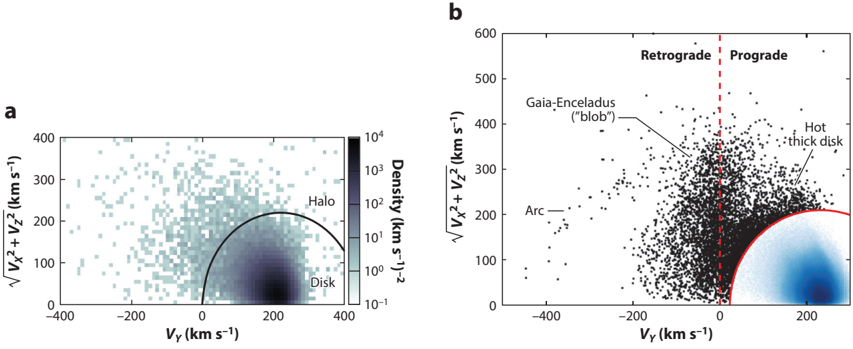
- The paper states that Gaia-Enceladus debris accounts for a large fraction of the inner stellar halo; it also reports that near the Sun, roughly 44% of stars with halo-like kinematics are in the hot thick disk region, while about 60%–80% of the remainder are in the elongated Gaia-Enceladus structure, depending on the exact definition.
- The paper reports a mean retrograde motion for Gaia-Enceladus debris of v_\u03c6 = -21.1 ± 1.8 km s^-1 within 1 kpc of the Sun (6 stars) and -16.1 ± 2.8 km s^-1 within 2 kpc (23 stars).
- For the Helmi streams, the paper reports a progenitor stellar mass of about 10^8 M_\u2609 and an infall time between 5 and 8 Gyr ago; for Sequoia and Thamnos, it cites approximate progenitor masses of ~10^7 M_\u2609 and ~5 × 10^6 M_\u2609, respectively.
## Methods
- This is a narrative review, not an original data-analysis paper; it synthesizes evidence from Gaia DR2, APOGEE, RAVE, LAMOST, SDSS, Pan-STARRS, DES, and prior literature.
- The main analytical framework is Galactic archaeology: using stellar chemical abundances, ages, kinematics, and integrals of motion / orbital properties to identify accretion debris and reconstruct the Milky Way’s assembly history.
- The paper also discusses comparisons to cosmological and hydrodynamical simulations, orbital integrations, and clustering/statistical methods such as Gaussian mixture models, HDBSCAN, Fourier analysis, and k-means as tools for interpreting substructure.
## Limitations
- The paper explicitly says that many questions remain open, that the picture is still “sketchy” and “in a state of flux,” and that more data will be needed over the next 5 to 10 years.
- It states that current simulations have important limitations: limited resolution, difficulty tracing stars from systems below about 10^6 M_\u2609, and incomplete treatment of chemical enrichment.
- It also says the evidence for some structures is ambiguous because debris from different objects overlaps in phase space; this is evident from the text’s repeated calls for membership probabilities and more detailed chemical abundances.
Model-written summary. Check it against the paper before relying on it.
Integrity signals
Registry
Cites
Statistics
Figures
Verification
Claims the paper makes
55 Valid · 15 Not valid · 32 Not checked · 82 Own results and interpretations
At least one cited source doesn’t support this claim or points to a different paper, and none confirmed it — see the verdicts below.
In the paper
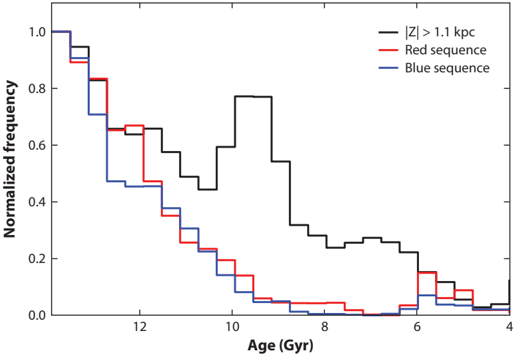
“As Gallart et al. (2019) showed, the majority of the thick disk stars likely formed during/after the merger with Gaia-Enceladus and not before.”
§ Streams, Substructures, and the Early History of the Milky Way > 5.2. Formation Paths
What the sources say
- Disputedcites Gallart et al. (2019) matched to “Uncovering the birth of the Milky Way through accurate stellar ages with Gaia” (2019) sourceExperimental — accuracy not yet measured
The age-distribution passage (p. 2) says 50% of thick-disc stars had formed by 10.5 billion years ago; the paper dates the Gaia-Enceladus merger to about 10 billion years ago (p. 3). Thus at least half had formed before the merger, contrary to the claim that the majority formed during or after it. The paper does say thick-disc star formation continued after the merger. (LLM, conf=0.88)
Checked by a reasoning model — may be wrong.
hedgedstates a cause- Asserted: passes — The authors put it forward as true.
- Checkable: passes — It can be checked against evidence.
- Load-bearing: unclear — It is unclear whether the paper’s conclusions depend on it.
- Based: passes — The paper gives a reason why it holds.
- Disputed
At least one cited source doesn’t support this claim or points to a different paper, and none confirmed it — see the verdicts below.
In the paper
“More detailed high-resolution chemical elemental abundance studies demonstrated that thick disk stars organize themselves in a segregated sequence from that of the thin disk stars in the solar neighborhood in, for example, [α/Fe] versus [Fe/H] (Gilmore et al. 1995).”
§ Streams, Substructures, and the Early History of the Milky Way > 5.1. Overview of Its Properties
What the sources say
- Disputedcites Gilmore et al. 1995 matched to “A determination of the thick disk chemical abundance distribution: Implications for galaxy evolution” (1995) sourceExperimental — accuracy not yet measured
Section 4.3 (p. 17) describes continuity of element ratios between thick- and thin-disk stars and says the populations are plausibly chemically connected, rather than occupying segregated sequences. The paper reports its own iron-abundance distribution, not a separate [α/Fe]–[Fe/H] sequence for thick-disk stars. (LLM, conf=0.87)
Checked by a reasoning model — may be wrong.
boostedstates an association- Asserted: passes — The authors put it forward as true.
- Checkable: passes — It can be checked against evidence.
- Load-bearing: unclear — It is unclear whether the paper’s conclusions depend on it.
- Based: passes — The paper gives a reason why it holds.
- Disputed
The cited sources support only part of this claim — read each source’s verdict below.
In the paper
“Helmi & White (1999) estimated analytically (this was later confirmed using cosmological simulations by Helmi et al. 2003, Gómez et al. 2013) that if the whole stellar halo had been built via mergers, approximately 500 streams would be expected in the halo near the Sun (independently of whether 10 or 100 galaxies had been accreted).”
§ Streams, Substructures, and the Early History of the Milky Way > 3.3. Kinematical Properties of Stars: Dynamics as a Tool
What the sources say
- Not matchedcites Helmi & White 1999
More than one paper fits this citation.
- Partly supportedcites Helmi et al. 2003 matched to “The phase-space structure of cold dark matter haloes: insights into the Galactic halo” (2003) sourceExperimental — accuracy not yet measured
The Introduction estimates 300–500 merger- and accretion-origin structures near the Sun. The Discussion says the simulations show reasonable agreement with earlier work and that its stellar-stream estimates “may indeed apply”; it does not establish the estimate independently of whether 10 or 100 galaxies were accreted, or confirm 500 stellar streams outright. No page numbers are available in our copy. (LLM, conf=0.85)
- Partly supportedcites Gómez et al. 2013 matched to “Streams in the Aquarius stellar haloes” (2013) sourceExperimental — accuracy not yet measured
Section 4.1 (p. 7) reports that the simulated solar-neighbourhood stream counts fall within the approximately 300–500 range predicted by Helmi & White, supporting the claim that Gómez et al. confirmed the approximate count. Our copy does not say that the count is independent of whether 10 or 100 galaxies were accreted. (LLM, conf=0.84)
hedgedstates a cause- Asserted: passes — The authors put it forward as true.
- Checkable: passes — It can be checked against evidence.
- Load-bearing: passes — The paper’s conclusions depend on it.
- Based: passes — The paper gives a reason why it holds.
- Not matched
Every source the paper cites for this claim was checked and supports it.
In the paper
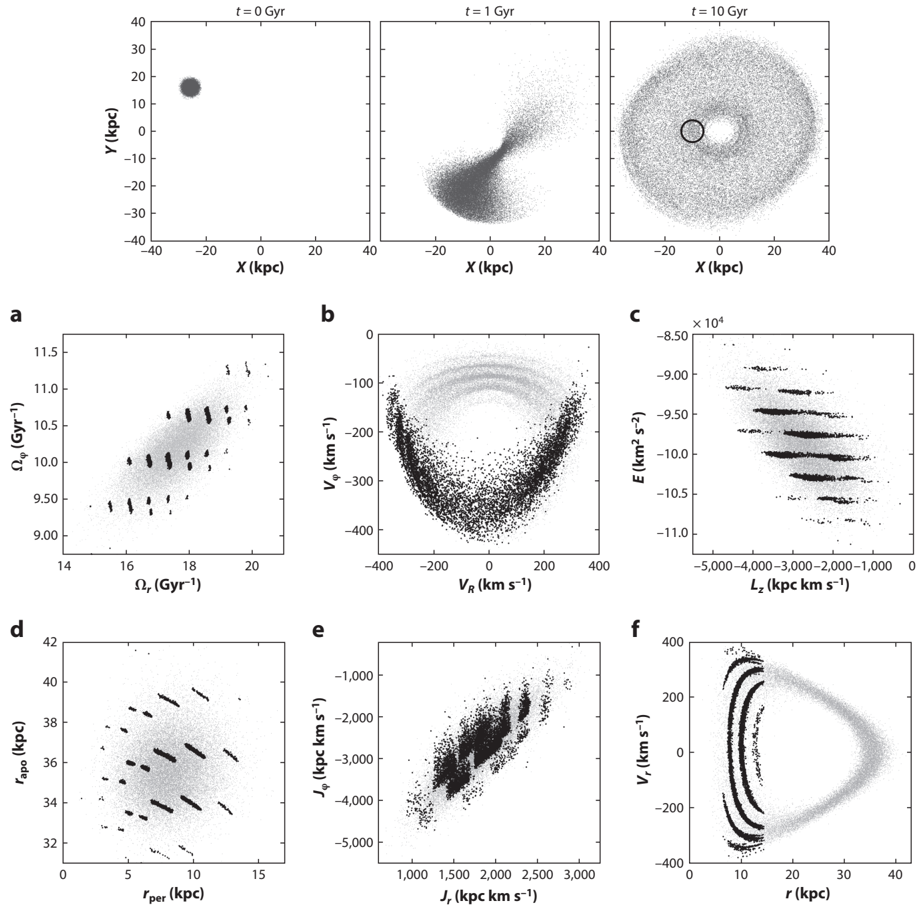
“Individual streams or portions of streams are particularly apparent in frequency space, as can be seen in Figure 4a.This is because the individual streams each have their own characteristic frequency (which defines their phase along the orbit; see McMillan & Binney 2008, Gómez & Helmi 2010).”
§ Streams, Substructures, and the Early History of the Milky Way > 218 Helmi
What the sources say
- Supportedcites McMillan & Binney 2008 matched to “Disassembling the Galaxy with angle-action coordinates” (2008) source
Section 4.1 (pp. 4–5) shows that particles from a disrupted satellite remain in distinct patches in frequency space, even after their spatial distribution becomes nearly featureless. Section 2 (p. 2) explains that orbital angles increase linearly with time at rates given by the orbital frequencies, supporting the claim’s connection between frequency and orbital phase. (LLM, conf=0.89)
- Supportedcites Gómez & Helmi 2010 matched to “On the identification of substructure in phase space using orbital frequencies” (2010) source
Section 3.1 (p. 3) says that particles with different frequencies form multiple streams, each with its own characteristic frequency, as their orbital angles evolve. Sections 3.2.2 (p. 6) and 6 (p. 15) say that frequency space makes those streams readily identifiable. (LLM, conf=0.92)
plainstates a cause- Asserted: passes — The authors put it forward as true.
- Checkable: passes — It can be checked against evidence.
- Load-bearing: passes — The paper’s conclusions depend on it.
- Based: passes — The paper gives a reason why it holds.
- Supported
Every source the paper cites for this claim was checked and supports it.
In the paper
“Nonetheless, Gómez et al. (2013) and Simpson et al. (2019), for example, have shown that substructure is still present in these spaces, even in simulations of the full hierarchical assembly of the halo.”
§ Streams, Substructures, and the Early History of the Milky Way > 218 Helmi
What the sources say
- Supportedcites Gómez et al. 2013 matched to “Streams in the Aquarius stellar haloes” (2013) source
Section 4.1 (p. 8) says substructure is clearly visible in integrals-of-motion space despite merger-driven changes to the host potential and chaotic orbital behaviour. The paper describes its stellar-halo simulations as fully cosmological (p. 2), supporting the claim's hierarchical-assembly context. (LLM, conf=0.94)
- Supportedcites Simpson et al. 2019 matched to “Simulating cosmological substructure in the solar neighbourhood” (2019) source
Section 3 reports clear stellar substructure in energy–angular-momentum (E–Lz) space in the cosmological Auriga simulations, with structures arising from accreted satellites. This supports the claim that substructure remains visible in an integrals-of-motion space in simulations of hierarchical assembly. Page numbers are not provided in our copy. (LLM, conf=0.93)
boosted- Asserted: passes — The authors put it forward as true.
- Checkable: passes — It can be checked against evidence.
- Load-bearing: passes — The paper’s conclusions depend on it.
- Based: passes — The paper gives a reason why it holds.
- Supported
79 more claims · 19 with their cited sources checked
Create a free account to see all 184 claims and to verify the 25 references still open.
- It may state two separate claims as one. 77
- The quote only partly states this claim. 2
- Probably not a substantial claim. 36
Claims other papers make about this one
Each is checked against this paper’s own text: does it say what the citing paper says it does?
The source backs part of the claim, not all of it — or backs it for a different population, condition or comparison.
In the citing paper
“Kraken may represent the tip of the iceberg of several further accretion events hidden towards the Galactic centre (Helmi 2020), where the identification of substructure is complicated by high stellar densities and phase space mixing on short orbital time-scales.”
From Kraken reveals itself – the merger history of the Milky Way reconstructed with the E-MOSAICS simulations (2020) · cites this paper as Helmi 2020
Experimental — accuracy not yet measured
Citations
Cites
The Sloan Digital Sky Survey: Technical Summary
York, D. G., Adelman, J., Anderson, Jr., Anderson, S. F., Annis, J., Bahcall, N. A., Bakken, J. A., Barkhouser, R., Bastian, S., Berman, E., et al. (2000) · The Astronomical Journal · doi:10.1086/301513 · Cited by 10,366
Gaia Data Release 2: Summary of the contents and survey properties
Gaia Collaboration, Brown, A. G. A., Vallenari, A., Prusti, T., de Bruijne, J. H. J., Babusiaux, C., Bailer-Jones, C. A. L., Biermann, M., Evans, D. W., Eyer, L., et al. (2018) · Astronomy & Astrophysics · doi:10.1051/0004-6361/201833051 · Cited by 8,442
Self-citationGalactic Dynamics: Second Edition
Binney, J., & Tremaine, S. (2008) · doi:10.1515/9781400828722 · Cited by 4,375
LSST: From Science Drivers to Reference Design and Anticipated Data Products
Ivezić, Ž., Kahn, S. M., Tyson, J. A., Abel, B., Acosta, E., Allsman, R., Alonso, D., AlSayyad, Y., Anderson, S. F., Andrew, J., et al. (2019) · The Astrophysical Journal · doi:10.3847/1538-4357/ab042c · Cited by 4,357
LSST: from Science Drivers to Reference Design and Anticipated Data Products
Ivezić, Ž., Kahn, S. M., Tyson, J. A., Abel, B., Acosta, E., Allsman, R., Alonso, D., AlSayyad, Y., Anderson, S. F., Andrew, J., et al. (2008) · arXiv · doi:10.48550/arxiv.0805.2366 · Cited by 4,357
Transiting Exoplanet Survey Satellite
Ricker, G. R., Winn, J. N., Vanderspek, R., Latham, D. W., Bakos, G. Á., Bean, J. L., Berta-Thompson, Z. K., Brown, T. M., Buchhave, L., Butler, N. R., et al. (2014) · Journal of Astronomical Telescopes, Instruments, and Systems · doi:10.1117/1.jatis.1.1.014003 · Cited by 4,056
Core condensation in heavy halos: a two-stage theory for galaxy formation and clustering
White, S. D. M., & Rees, M. J. (1978) · Monthly Notices of the Royal Astronomical Society · doi:10.1093/mnras/183.3.341 · Cited by 3,919
Tremonti, C. A., Heckman, T. M., Kauffmann, G., Brinchmann, J., Charlot, S., White, S. D. M., Seibert, M., Peng, E. W., Schlegel, D. J., Uomoto, A., et al. (2004) · The Astrophysical Journal · doi:10.1086/423264 · Cited by 3,608
The EAGLE project: simulating the evolution and assembly of galaxies and their environments
Schaye, J., Crain, R. A., Bower, R. G., Furlong, M., Schaller, M., Theuns, T., Dalla Vecchia, C., Frenk, C. S., McCarthy, I. G., Helly, J. C., et al. (2015) · Monthly Notices of the Royal Astronomical Society · doi:10.1093/mnras/stu2058 · Cited by 3,601
The physical properties of star-forming galaxies in the low-redshift Universe
Brinchmann, J., Charlot, S., White, S. D. M., Tremonti, C., Kauffmann, G., Heckman, T., & Brinkmann, J. (2004) · Monthly Notices of the Royal Astronomical Society · doi:10.1111/j.1365-2966.2004.07881.x · Cited by 3,290
Research works printed but not linked: 37
- 36. Bisterzo S, Gallino R, Straniero O, Cristallo S, Käppeler F. 2010. MNRAS 404:1529-44
- 57. Burton WB. 1988. Trans. Int. Astron. Union Ser. A 20A:377-421
- 68. Chaplin WJ, Basu S, Huber D, et al. 2014. Ap. J. Suppl. 210:1
- 74. Christlieb N, Battistini C, Bonifacio P, et al. 2019. Messenger 175:26-29
- 75. Conroy C, Bonaca A, Cargile P, et al. 2020. Ap. J. 883:107
- 2016, Ground-based and Airborne Instrumentation for Astronomy VI, 9908
- 82. de Jong RS, Agertz O, Berbel AA, et al. 2019. Messenger 175:3-11
- 98. Dierickx M, Klement R, Rix HW, Liu C. 2010. Ap. J. Lett. 725:L186-90
- 100. Dinescu DI. 2002. In Omega Centauri, A Unique Window into Astrophysics, ed. F van Leeuwen, JD Hughes, G Piotto, pp. 143-54. San Francisco: Astron. Soc. Pac. 250
- 106. Eneev TM, Kozlov NN, Sunyaev RA. 1973. Astron. Astrophys. 22:41
- 124. Gerin M, Combes F, Athanassoula E. 1990. Astron. Astrophys. 230:37-54
- 134. Gouda N. 2015. IAU Gen. Assembl. 29:2247720
- 136. Grand RJJ, Gómez FA, Marinacci F, et al. 2017. MNRAS 467:179-207
- 141. Grillmair CJ, Carlin JL. 2016. In Tidal Streams in the Local Group and Beyond, ed. HJ Newberg, JL Carlin, pp. 87-112. New York: Springer
- 153. Helmi A, de Zeeuw PT. 2000. MNRAS 319:657-65
- 154. Helmi A, Irwin M, Deason A, et al. 2019. Messenger 175:23-25
- 155. Helmi A, Navarro JF, Nordström B, et al. 2006. MNRAS 365:1309-23
- 172. Ishigaki MN. 2019. In Star Clusters: From the Milky Way to the Early Universe, ed. A Bragaglia, M Davies, A Sills, E Vesperini, pp. 24-33. Cambridge, UK: Cambridge Univ. Press
- 178. Johnston KV. 2016. In Tidal Streams in the Local Group and Beyond, ed. HJ Newberg, JL Carlin, pp. 141-67. New York: Springer
- 192. Kollmeier J, Fuller J, Gaensicke B, et al. 2019. Bull. Am. Astron. Soc. 51:503
- 211. Levi M, Allen LE, Raichoor A, et al. 2019. Bull. Am. Astron. Soc. 51:57
- 234. McMillan PJ. 2018. Res. Notes Am. Astron. Soc. 2:51
- 258. Ness M, Bird J, Johnson J, et al. 2019. Bull. Am. Astron. Soc. 51:238
- 262. Nissen PE, Schuster WJ. 1997. Astron. Astrophys. 326:751-62
- 269. Pasquini L, Delabre B, Ellis RS, et al. 2018. In Rediscovering Our Galaxy, ed. C Chiappini, I Minchev, E Starkenburg, M Valentini, pp. 242-47. Cambridge, UK: Cambridge Univ. Press
- 270. Perryman MAC, Lindegren L, Kovalevsky J, et al. 1997. Astron. Astrophys. 500:501-4
- 281. Purcell CW, Bullock JS, Kazantzidis S. 2010. MNRAS 404:1711-18
- 288. Richter P. 2017. In Gas Accretion onto Galaxies, ed. A Fox, R Davé, pp. 15-48. New York: Springer
- 289. Ricker GR, Winn JN, Vanderspek R, et al. 2015. J. Astron. Telesc. Instrum. Syst. 1:014003
- 293. Roman NG. 2019. Annu. Rev. Astron. Astrophys. 57:1-34
- 312. Shen J, Rich RM, Kormendy J, et al. 2010. Ap. J. Lett. 720:L72-76
- 317. Smith MC. 2016. In Tidal Streams in the Local Group and Beyond, ed. HJ Newberg, JL Carlin, pp. 113-39. New York: Springer
- 322. Spite F, Spite M. 1979. Messenger 16:7-8
- 328. Tamura N, Takato N, Shimono A, et al. 2016. In Ground-based and Airborne Instrumentation for Astronomy VI, Vol. 9908, ed. CJ Evans, L Simard, H Takami. Bellingham, WA: SPIE Taylor C, Boylan-Kolchin M, Torrey P, Vogelsberger M, Hernquist L. 2016. MNRAS 461:3483-93
- 329. Tinsley BM. 1980. Fundam. Cosmic Phys. 5:287-388
- 339. Turon C, Primas F, Binney J, et al. 2008. Messenger 134:46-49
- 366. Zoccali M. 2019. Bol. Asoc. Argent. Astron. 61:137-44
Cited by
Items 301–396 of 396
Ding, L.-F., Li, J., Xue, X.-X., Tian, H., Yan, Z., & Zhao, G. (2025) · Research in Astronomy and Astrophysics · doi:10.1088/1674-4527/ade522 · Cited by 3
Yolalan, G., Şahìn, T., Bilir, S., & Plevne, O. (2025) · The Astronomical Journal · doi:10.3847/1538-3881/ade9aa · Cited by 3
“The GSE merger is considered a major accretion event that significantly influenced the early assembly and structure of the proto-Galaxy, particularly the Galactic halo and disk (Helmi et al. 2018; Helmi 2020; Dodd et al. 2023; Ceccarelli et al. 2024; Fukushima et al. 2025).”
Monty, S., Strom, A. L., Stanton, T. M., Chruślińska, M., Cullen, F., Kobayashi, C., Starkenburg, T., Bhattacharya, S., Sanders, J. L., & Gieles, M. (2025) · Monthly Notices of the Royal Astronomical Society · doi:10.1093/mnras/staf1213 · Cited by 5
Milky Way’s Metal-poor Stars Display Chemical Transition near the Solar Radius
Malhan, K. (2025) · The Astrophysical Journal Letters · doi:10.3847/2041-8213/adf8d5 · Cited by 3
“A key focus of the Galactic archaeology field is to determine the Milky Way’s formation processes and its accretion history (see e.g. Freeman & Bland-Hawthorn 2002; Helmi 2020; Deason & Belokurov 2024).”
Ruiz-Lara, T., Mirabal, D., Gallart, C., Grand, R. J. J., Fragkoudi, F., Pérez, I., Cassisi, S., Fernández-Alvar, E., Queiroz, A. B. A., Aznar-Menargues, G., et al. (2026) · Astronomy and Astrophysics · doi:10.1051/0004-6361/202556468 · Cited by 5
Diehl, R., & Wiescher, M. (2026) · The European Physical Journal A · doi:10.1140/epja/s10050-026-01794-8 · Cited by 2
The multi-age stellar populations of Terzan 5 as revealed by JWST
Zullo, G., Pallanca, C., Ferraro, F. R., Lanzoni, B., Origlia, L., Massari, D., Dalessandro, E., Fanelli, C., Cadelano, M., Vesperini, E., et al. (2026) · Astronomy and Astrophysics · doi:10.1051/0004-6361/202659349 · Cited by 6
Not all nitrogen-rich field stars originate from globular clusters
Leitinger, E. I., Miglio, A., Montalbán, J., Massari, D., Bragaglia, A., van Rossem, W. E., Brogaard, K., Mazzi, A., Thomsen, J. S., & Willett, E. (2026) · Astronomy and Astrophysics · doi:10.1051/0004-6361/202558003 · Cited by 5
“However, the resulting age distribution is then younger than GC stars and more consistent with the age distribution of thick-disc field stars (Helmi 2020).”
Libralato, M., Bellini, A., Massari, D., Bellazzini, M., Aguado-Agelet, F., Cassisi, S., Ceccarelli, E., Dalessandro, E., Dodd, E., Ferraro, F. R., et al. (2026) · Astronomy and Astrophysics · doi:10.1051/0004-6361/202659363 · Cited by 4
“…spectroscopic information, are essential to understand GC origin and the main MW formation events; e.g., Massari et al. 2019; Kruijssen et al. 2020; Helmi 2020; Horta et al. 2021; Khoperskov & Gerhard 2022; Callingham et al. 2022; Massari et al. 2023; Chen & Gnedin 2024; Ceccarelli et al. 2025;…”
Evidence of a massive accretion event 1.8 billion years before the Gaia-Sausage-Enceladus merger
Massari, D., Zerbinati, C., Fanelli, C., Helmi, A., Ceccarelli, E., Agelet, F. A., Cassisi, S., Wempe, E., Monelli, M., Bellini, A., et al. (2026) · Nature Astronomy · doi:10.1038/s41550-026-02931-5 · Cited by 25
Self-citationBoutan, C., Carosi, G., Rosenberg, L. J., Rybka, G., Backes, K. M., Bartram, C., Baryakhtar, M., Bird, M. D., Braggio, C., Budker, D., et al. (2023) · International Journal of Modern Physics A · doi:10.1142/s0217751x23300120 · Cited by 4
Yang, W., Wu, Y., Gong, Y., Mauron, N., Zhang, B., Menten, K. M., Mai, X., 刘, D. 德. L., Li, J., & Li, J. J. (2024) · The Astrophysical Journal · doi:10.3847/1538-4357/ad05cb · Cited by 2
“…(e.g., Eder et al. 1988; te Lintel Hekkert et al. 1991; Lindqvist et al. 1992; Le Squeren et al. 1992; Engels & Lewis 1996; Sevenster et al. 1997; 1 Here is a brief description of each Galactic component based on the reviews (Sparke & Gallagher 2007; Bland-Hawthorn & Ger-hard 2016; Helmi 2020).”
BackgroundZhang, M., Bu, Y., Wu, F., Shi, J., Zhang, J., Wu, H., Li, S., Yi, Z., Liu, M., & Kong, X. (2024) · Astronomy and Astrophysics · doi:10.1051/0004-6361/202450361 · Cited by 2
Chemical abundances in nearby Sun-like stars and the history of the Milky Way disc
Gondoin, P. (2024) · Astronomy and Astrophysics · doi:10.1051/0004-6361/202449820 · Cited by 2
Theia 456: Tidally Shredding an Open Cluster
Tregoning, K. R., Andrews, J. J., Agüeros, M. A., Cargile, P. A., Chanamé, J., Curtis, J. L., & Schuler, S. C. (2024) · The Astronomical Journal · doi:10.3847/1538-3881/ad6a15 · Cited by 2
“The evolution of stars from their clustered birth-places to their eventual position within the Milky Way field is not yet fully understood, though significant steps have been made (see Helmi 2020, for a review).”
BackgroundACACIAS I: element abundance labels for 192 stars in the dwarf galaxy NGC 6822
Ness, M., Mendel, J. T., Buder, S., Wheeler, A., Ji, A. P., Mijnarends, L., Venn, K. A., Starkenburg, E., Leaman, R., Grasha, K., et al. (2025) · Monthly Notices of the Royal Astronomical Society · doi:10.1093/mnras/staf127 · Cited by 5
Lee, J.-W., Kim, T.-H., Kim, H., Sung, H.-I., Kim, H., & Mille, F. D. (2025) · The Astronomical Journal · doi:10.3847/1538-3881/ada94e · Cited by 2
Lane, J., & Bovy, J. (2025) · Monthly Notices of the Royal Astronomical Society · doi:10.1093/mnras/staf294 · Cited by 4
Evidence for a Catastrophically Disrupted Open Cluster
Miller, A., Tregoning, K. R., Andrews, J. J., Schuler, S. C., Curtis, J. L., Agüeros, M. A., Cargile, P. A., & Chanamé, J. (2025) · The Astrophysical Journal · doi:10.3847/1538-4357/adceb8 · Cited by 7
“The evolution of stars from birth to their place in the field is not fully understood, but is an active area of study ( H. Kamdar et al. 2019; A. Helmi 2020 ) .”
Machado, R. E. G., Tauil, G. C., & Schweder-Souza, N. (2025) · Universe · doi:10.3390/universe11060191 · Cited by 2
“Currently, over 120 streams are known [10–13].”
StreamGen: Connecting Populations of Streams and Shells to Their Host Galaxies
Dropulic, A., Shipp, N., Kim, S. Y., Mezghanni, Z., Necib, L., & Lisanti, M. (2025) · The Astrophysical Journal · doi:10.3847/1538-4357/adf1a7 · Cited by 13
Thick-to-thin disc transition and gas disc shrinking induced by the Gaia-Sausage-Enceladus merger
Funakoshi, N., Kawata, D., Sanders, J. L., Ciucă, I., Grand, R. J. J., & Zhang, H. (2025) · Monthly Notices of the Royal Astronomical Society · doi:10.1093/mnras/staf1632 · Cited by 12
Asymmetries in stellar streams induced by a galactic merger
Guillaume, C., Renaud, F., Martin, N. F., Famaey, B., Matteo, P. D., Thomas, G. F., Ferrone, S. M., Ibata, R., & Pagnini, G. (2025) · Astronomy and Astrophysics · doi:10.1051/0004-6361/202557552 · Cited by 3
Bernaldez, J. P., Minchev, I., Ratcliffe, B., Marques, L., Sysoliatina, K., Walcher, J., Александрович, Х. С., Martig, M., de Jong, R. S., & Steinmetz, M. (2026) · Astronomy and Astrophysics · doi:10.1051/0004-6361/202557002 · Cited by 14
LAMOST’s view on the Gaia-Sausage-Enceladus merger event
Han, Z. (2021) · Science China Physics Mechanics and Astronomy · doi:10.1007/s11433-020-1648-1 · Cited by 2
Implications of a spatially resolved main sequence for the size evolution of star-forming galaxies
Pezzulli, G. (2021) · Monthly Notices of the Royal Astronomical Society · doi:10.1093/mnras/stab2859 · Cited by 2
Cosmic Radioactivity and Galactic Chemical Evolution
Diehl, R., & Prantzos, N. (2023) · Springer eBooks · doi:10.1007/978-981-15-8818-1_107-1 · Cited by 8
Partitioning the Galactic halo with Gaussian Mixture Models
Liang, X., Chen, Y., Zhao, J., & Zhao, G. (2021) · Research in Astronomy and Astrophysics · doi:10.1088/1674-4527/21/5/128 · Cited by 3
capivara : a spectral-based segmentation method for IFU data cubes
de Souza, R. S., Dahmer-Hahn, L. G., Shen, S., Chies-Santos, A. L., Chen, M., Rahna, P. T., Coelho, P., Riffel, R., Ye, R., & Tahmasebzadeh, B. (2025) · Monthly Notices of the Royal Astronomical Society · doi:10.1093/mnras/staf688 · Cited by 4
A Novel Approach to Identifying Substructures through Analysis of Metallicity Distribution Functions
Kim, Y. K., Lee, Y. S., & Beers, T. C. (2025) · The Astrophysical Journal · doi:10.3847/1538-4357/adfd58 · Cited by 2
“…L Z ) are conserved under adiabatic changes of a Galactic gravitational potential (Binney & Tremaine 2008; Binney 2012), the merger remnants of a common origin should be clustered in integrals-of-motion (IoM) space (see Helmi & White 1999; G ´o mez & Helmi 2010; Helmi 2020, and references therein).”
Stream automatic detection with convolutional neural networks
Vera-Casanova, A., Gonzalez, N. M., Gómez, F. A., Arancibia, M. J., Fontirroig, V., Pallero, D., Pakmor, R., van de Voort, F., Grand, R. J. J., Bieri, R., et al. (2025) · Astronomy and Astrophysics · doi:10.1051/0004-6361/202554688 · Cited by 4
Tidal tails in open clusters: Morphology, binary fraction, dynamics, and rotation
Sharma, I., Jadhav, V. V., Subramaniam, A., & Wirth, H. (2025) · Astronomy and Astrophysics · doi:10.1051/0004-6361/202555711 · Cited by 8
Xie, R., Yuan, Z., Li, H., Matsuno, T., Martin, N. F., Zhang, R., Yan, Z., Sestito, F., Thomas, G. F., Banerjee, P., et al. (2026) · The Astrophysical Journal · doi:10.3847/1538-4357/ae39c8 · Cited by 2
“The sequence of these events leaves its imprint on the distribution of stars in the host galaxy ( A. Helmi 2008, 2020 ) .”
Weighing the Milky Way’s satellite galaxies using pulsar accelerations
Donlon, T., Chakrabarti, S., & Hunt, J. D. (2026) · Physical review. D/Physical review. D. · doi:10.1103/zz5s-zwh8 · Cited by 3
Placco, V. M., Limberg, G., Kennedy, C. R., & Christlieb, N. (2026) · The Astrophysical Journal Letters · doi:10.3847/2041-8213/ae4dea · Cited by 2
“These structures hold the key to the Milky Way’s turbulent history of past interactions and mergers ( V. Belokurov 2013; A. Helmi 2020; A. J. Deason & V. Belokurov 2024 ) .”
Monti, L., Muraveva, T., Sheridan, B., Massari, D., Garofalo, A., Clementini, G., & Michelucci, U. (2026) · Astronomy and Computing · doi:10.1016/j.ascom.2026.101118 · Cited by 1
“As remnants tracers of ancient stellar systems, RRLs are particularly valuable for studying the dynamical history of the Galaxy, including past accretion events that have shaped its halo (Massari et al., 2019; Helmi, 2020).”
A simulation-based inference of the Milky Way merger history
Sante, A., Font, A. S., Kawata, D., Makinen, T. L., & Grand, R. J. J. (2026) · Monthly Notices of the Royal Astronomical Society · doi:10.1093/mnras/stag1162 · Cited by 5
The Velocity Field of Our Milky Way Outer Stellar Halo Based on DESI DR2
Li, S., Wang, W., Koposov, S. E., Amarante, J. A. S., Deason, A. J., Valluri, M., Li, T. S., Byström, A., Lambert, M., Qiu, T., et al. (2026) · The Astrophysical Journal · doi:10.3847/1538-4357/ae7346 · Cited by 3
de Lima, E. V. R., Schwarz, G. B. O., Herpich, F. R., Almeida-Fernandes, F., Nakazono, L. M. I., Lacerda, A. D. E., Santos, A., Figueiredo, A. L., Gutiérrez-Soto, L. A., Sartori, M. J., et al. (2026) · The Astrophysical Journal · doi:10.3847/1538-4357/ae8d1f · Cited by 3
“; B. D. Johnson et al. 2020; E. C. Cunningham et al. 2024; A. Helmi 2020; A. J. Deason & V. Belokurov 2024), providing constraints on their origins and assembly histories.”
A stellar clock reveals the assembly history of the Milky Way
Beers, T. C. (2022) · Nature · doi:10.1038/d41586-022-00768-2 · Cited by 1
Tian, H., Liu, C., Xue, X.-X., Fan, D., Luo, C., Nie, J., Yang, M., Yang, Y., & Zhang, B. (2025) · Astronomy and Astrophysics · doi:10.1051/0004-6361/202453610 · Cited by 4
A greedy and optimistic clustering for leveraging individual covariate uncertainty
Okuno, A., & Hattori, K. (2025) · Annals of the Institute of Statistical Mathematics · doi:10.1007/s10463-025-00947-8 · Cited by 5
Star and Black Hole Formation at High Redshift
Biermann, P. L. (2022) · Universe · doi:10.3390/universe8030146 · Cited by 1
“How our Galaxy grew by merging has now been studied with Gaia data (e.g., [55,57,84,89]), with a review by Helmi [54].”
BackgroundInfluentialCarigi, L. (2021) · Encyclopedia of Astrobiology · doi:10.1007/978-3-642-27833-4_996-5 · Cited by 1
EC 22536−5304: a lead-rich and metal-poor long-period binary
Dorsch, M., Jeffery, C. S., Irrgang, A., Woolf, V. M., & Heber, U. (2021) · Astronomy and Astrophysics · doi:10.1051/0004-6361/202141381 · Cited by 28
The Abundance Pattern of α Elements in the Triangulum–Andromeda Overdensity
Sales-Silva, J. V., Cunha, K., Perottoni, H. D., Rocha–Pinto, H. J., Daflon, S., Almeida-Fernandes, F., Souto, D., & Majewski, S. R. (2020) · The Astrophysical Journal · doi:10.3847/1538-4357/abaaad · Cited by 5
“One such population that helps us understand our Galaxy is the TriAngulum-Andromeda (TriAnd) overdensity (e.g., Deason et al. 2014; Sheffield et al. 2014, 2018; PriceWhelan et al. 2015; Xu et al. 2015; Li et al. 2017; Helmi 2020).”
BackgroundElemental Abundances in the Local Group: Tracing the Formation History of the Great Andromeda GalaxyPreprint
Escala, I. (2020) · arXiv (Cornell University) · doi:10.7907/16bk-vm98
Dodd, E., Helmi, A., & Koppelman, H. H. (2021) · Astronomy and Astrophysics · doi:10.1051/0004-6361/202141354 · Cited by 25
Self-citationDebris of Gaia-Sausage-Enceladus that made a H I hole in the Milky Way ≈20 million years agoPreprint
Sakai, N., Nakanishi, H., & Kurahara, K. (2021) · Research Square · doi:10.21203/rs.3.rs-522829/v1
Carigi, L. (2021) · Encyclopedia of Astrobiology · doi:10.1007/978-3-642-27833-4_1460-6
Fernández-Alvar, E., & Carigi, L. (2021) · Encyclopedia of Astrobiology · doi:10.1007/978-3-642-27833-4_5509-1
Green, A. M. (2021) · SciPost Physics Lecture Notes · doi:10.21468/scipost.report.3765
Stellar elemental abundances constraining nucleosynthesis and chemical evolution of the universe
Aoki, W. (2022) · EPJ Web of Conferences · doi:10.1051/epjconf/202226007002
Fernández-Alvar, E., & Carigi, L. (2023) · Encyclopedia of Astrobiology · doi:10.1007/978-3-662-65093-6_5509
Carigi, L. (2023) · Encyclopedia of Astrobiology · doi:10.1007/978-3-662-65093-6_1460
Carigi, L. (2023) · Encyclopedia of Astrobiology · doi:10.1007/978-3-662-65093-6_996
Cosmic Radioactivity and Galactic Chemical Evolution
Diehl, R., & Prantzos, N. (2023) · Springer eBooks · doi:10.1007/978-981-19-6345-2_107
Galáxias: uma perspectiva desde suas origens
Lambas, D. G. (2024) · Cadernos de Astronomia · doi:10.47456/cad.astro.v5n1.43825
“Estes estudos tem demostrado em nossa vizinhança a formação hierarquia das galáxias através de fusões e incor-poração de galáxias anãs em forma continua [2].”
Análise do perfil quimiodinâmico da sobredensidade Triangulum-Andromeda
Abuchaim, Y. (2023) · Digital Library of Theses and Dissertations (Universidade de São Paulo) · doi:10.11606/d.14.2023.tde-15032024-153647
Machine learning reveals the merging history of nearby galaxies
(2024) · Nature Astronomy · doi:10.1038/s41550-024-02335-3
“Observed differences in the orbits and chemical properties of stellar populations in the Milky Way point towards the distinct cosmic origins of these populations, providing clues about the galaxy’s merging history 2 .”
An ancient system hidden in the Galactic plane?
Sestito, F., Fernández-Alvar, E., Brooks, R., Olson, E., Carigi, L., Jofré, P., Silva, D. D. B., Eldridge, C. J. L., Vitali, S., Venn, K. A., et al. (2026) · Monthly Notices of the Royal Astronomical Society · doi:10.1093/mnras/stag563 · Cited by 5
Star Proper Motions Based on Two-epoch Observations from the SDSS and DESI Imaging Surveys
Xiao, Y.-A., Zou, H., Xu, X., Feng, L., Guo, W.-J., Li, W.-X., Liu, S., Shen, Z.-X., Singh, G., Sui, J., et al. (2025) · The Astronomical Journal · doi:10.3847/1538-3881/adb72c
“The vast repository of knowledge derived from the Milky Way is a cornerstone of modern astrophysics.”
InfluentialInner structure of cold and warm dark matter halos from particle dynamics
Enomoto, Y., Taruya, A., Tanaka, S., & Nishimichi, T. (2025) · Publications of the Astronomical Society of Japan · doi:10.1093/pasj/psaf001 · Cited by 4
The distribution and origin of metals in simulated Milky Way-like galaxies
Iza, F. G., Scannapieco, C., Nuza, S. E., Pakmor, R., Grand, R. J. J., Gómez, F. A., Springel, V., Marinacci, F., & Fragkoudi, F. (2025) · Astronomy and Astrophysics · doi:10.1051/0004-6361/202554810 · Cited by 5
Baek, S., Kim, W., Jang, D., et al. (2025) · The Astrophysical Journal · doi:10.3847/1538-4357/adf213
Balu, S., Power, C., Walker, K., & Wyithe, J. S. B. (2026) · Monthly Notices of the Royal Astronomical Society · doi:10.1093/mnras/stag292
Signor, T., Jofré, P., Lira, H., Vitali, S., Martí, L., & Sánchez-Pi, N. (2025) · Astronomy and Astrophysics · doi:10.1051/0004-6361/202555376
Contini, E., Spavone, M., Ragusa, R., Iodice, E., & Yi, S. K. (2026) · Astronomy and Astrophysics · doi:10.1051/0004-6361/202557921 · Cited by 1
Bilodid, M., Ishchenko, M., & Berczik, P. (2025) · Astronomy and Astrophysics · doi:10.1051/0004-6361/202557210
“Based on observational data (Helmi 2020; Buder et al. 2021; Gaia Collaboration et al. 2023), both astrometric and spectroscopic, as well as numerical simulations (Wang et al. 2024; Merrow et al. 2024).”
Cristi-Cambiaso, N., Navarrete, C., Catelan, M., Zoccali, M., & Quezada, C. (2026) · Astronomy and Astrophysics · doi:10.1051/0004-6361/202556821
Webber, K., Hansen, T. T., Marshall, J. L., Ji, A. P., Li, T. S., Costa, G. S. D., Cullinane, L. R., Erkal, D., Koposov, S. E., Kuehn, K. W., et al. (2026) · The Astrophysical Journal · doi:10.3847/1538-4357/ae2d59 · Cited by 2
“The Milky Way’s ( MW ) stellar halo is composed of remnants from past mergers and accretion events ( K. V. Johnston et al. 2008; A. Helmi 2020; A. Bonaca & A. M. Price-Whelan 2025 ) .”
Stellar Populations in the Extreme Outer Halo of the Spiral Galaxy M96
Mihos, J. C., Durrell, P. R., Malkan, B. K., & Watkins, A. E. (2026) · The Astrophysical Journal · doi:10.3847/1538-4357/ae3fa2
“…& Bovy 2020) and metallicity, and while it contains numerous accretion signatures as well (e.g., Be-lokurov et al. 2006, 2018; Helmi et al. 2018; Naidu et al. 2020; Helmi 2020; Deason & Belokurov 2024, and references within), they tend to be lower in luminosity and than those found in Andromeda.”
Probing the Milky Way halo with RR Lyrae stars from Gaia Data Release 3
Muraveva, T., Monti, L., Massari, D., Leo, M. D., Garofalo, A., Clementini, G., Ceccarelli, E., & Michelucci, U. (2026) · Astronomy and Astrophysics · doi:10.1051/0004-6361/202658986 · Cited by 2
Galaxy Dancers : a dynamical study of globular star clusters
Vitral, E. (2022) · theses.fr (ABES) · doi:10.70675/9377df53z1c21z4f3dz916fz1498f5c345d0 · Cited by 1
The Fate of the Milky Way–Andromeda System: To Merge or Not?
Wu, H., Huang, Y., Zhang, H., Sun, G., & Shao, S. (2026) · The Astrophysical Journal Letters · doi:10.3847/2041-8213/ae5799 · Cited by 2
“The LG provides a unique laboratory for investigating hierarchical galaxy formation and evolution (e.g., Hammer et al. 2018; Helmi 2020) and also serves as an important benchmark for cosmological models.”
Ensemble Asteroseismology for 138 Kepler Metal-poor Red Giants: Stellar Fundamental Parameters
Li, T., Bi, S., 李, Y. 亚. L., 武, Y. 雅. W., 张, R. 睿. Z., Nielsen, M. B., Crawford, C. L., & Li, G. (2026) · The Astrophysical Journal · doi:10.3847/1538-4357/ae5db9
“…and chemical information of the environments in which they were formed ( A. Helmi & S. D. M. White 1999; G. C. Myeong et al. 2018; D. Horta et al. 2023 ) , hence they can be regarded as fossils for studying the formation and assembly history of galaxies ( A. Helmi 2020; T. Woody et al. 2025 ) .”
How to Build an Empirical Speed Distribution for Dark Matter in the Solar Neighborhood
Shpigel, T., Folsom, D., Lisanti, M., Necib, L., Vogelsberger, M., & Hernquist, L. (2026) · The Astrophysical Journal · doi:10.3847/1538-4357/ae60fd · Cited by 6
“…stellar population, there is evidence for such unequilibrated kinematic structure: groups of stars with particular chemical abundances and orbital dynamics appear differently in this chemo-dynamical space from the stars thought to have formed in the MW itself—see, e.g., Helmi (2020) for a review.”
Galligan, E., & Lépine, S. (2026) · The Astrophysical Journal · doi:10.3847/1538-4357/ae5d40 · Cited by 1
“Additionally, because thick-disk and halo stars pass through the disk on inclined / eccentric orbits ( A. Helmi 2020; B. Kim & S. Lépine 2022 ) , we explore the local Galactic kinematics of this sample to investigate the chemodynamic trends revealed by low-mass stars from the Galactic thin disk,…”
Olatoye, T. A., Botes, W., & Fru, R. N. (2026) · Frontiers in Education · doi:10.3389/feduc.2026.1771490 · Cited by 1
The intrinsic dispersion of elemental abundance ratios in nearby metal-poor halo stars
Nissen, P. E., & Amarsi, A. M. (2026) · Astronomy and Astrophysics · doi:10.1051/0004-6361/202659254
The Gaia GSP-Spec catalogue of interstellar extinctions, and stellar luminosities, radii, and masses
de Laverny, P., Recio-Blanco, A., Navarrete, C., Palicio, P. A., & Spitoni, E. (2026) · Astronomy and Astrophysics · doi:10.1051/0004-6361/202660323 · Cited by 2
Buder, S., Buck, T., Skúladóttir, Á., Ness, M., McKenzie, M., & Monty, S. (2026) · Monthly Notices of the Royal Astronomical Society · doi:10.1093/mnras/stag1090 · Cited by 8
Reconstructing chemical enrichment pathways in disc galaxies: A phylogenetic approach
Tapia-Contreras, B., Tissera, P. B., Sillero, E., Jofré, P., Yaxley, K. J., Hua, X., Yates, R. M., Márquez, S. Á., Signor, T., Das, P., et al. (2026) · Astronomy and Astrophysics · doi:10.1051/0004-6361/202557475 · Cited by 3
Mardini, M. K., Frebel, A., Placco, V. M., Chiti, A., Yatman, M., Beers, T. C., Ezzeddine, R., Hansen, T. T., Holmbeck, E. M., Roederer, I. U., et al. (2026) · The Astrophysical Journal · doi:10.3847/1538-4357/ae710f
Akbaba, F., & Plevne, O. (2026) · Publications of the Astronomical Society of the Pacific · doi:10.1088/1538-3873/ae8477
“Consequently, halo stars serve as a unique laboratory for studying the chemical and dynamical imprints of past accretion events ( Helmi 2020; Horta et al. 2023; Dodd et al. 2025 ) .”
Disentangling the Distant Stellar Halo Using K Giants in DESI Year 3 Data
Kizhuprakkat, N., Cooper, A. P., Wang, W., Byström, A., Najita, J., Koposov, S. E., Thomas, G. F., Li, S., Zhang, R., Prieto, C. A., et al. (2026) · The Astrophysical Journal · doi:10.3847/1538-4357/ae7f15 · Cited by 1
“…and interpreting massive structures, such as GSE, in terms of the overall assembly history of the Milky Way (e.g. Belokurov et al. 2018; Helmi et al. 2018; Myeong et al. 2019a; Evans 2020; Helmi 2020; Naidu et al. 2020, 2021; Horta et al. 2023; Horta & Schiavon 2024, and the references therein).”
The Properties of Globular Clusters and Elqui Associated with the Sagittarius Dwarf Galaxy
Wang, P., Shi, W. B., Chen, Y. Q., Zhao, J., Zhang, J., & Zhao, G. (2026) · The Astronomical Journal · doi:10.3847/1538-3881/ae81b5 · Cited by 1
“Current research, supported by theoretical models and numerical simulations, suggests that the MW formed through a complex sequence of accretion and merger events ( J. Bland-Hawthorn & O. Gerhard 2016; A. Helmi 2020 ) .”
The DECam MAGIC Survey: Uncovering the Tidal Tails of the Crater II Dwarf Galaxy
Atzberger, K. R., Pace, A. B., Kallivayalil, N., Chiti, A., Erkal, D., Cerny, W., Limberg, G., Placco, V. M., Prabhu, D. S., Stringfellow, G. S., et al. (2026) · The Astrophysical Journal · doi:10.3847/1538-4357/ae7f1f · Cited by 10
A chemo-dynamical search for planet-candidate hosts of possible extragalactic origin
Sun, T., Chen, X., Xiang, M., Zhou, J., & Lu, Z. (2026) · Monthly Notices of the Royal Astronomical Society · doi:10.1093/mnras/stag1502
Challenges, opportunities and open questions in Stellar Populations
Chiappini, C., & Renzini, A. (2024) · Proceedings of the International Astronomical Union · doi:10.1017/s174392132610619x
Suzuki, Y., Chiba, M., & Wyse, R. F. Ġ. (2026) · The Astrophysical Journal Letters · doi:10.3847/2041-8213/ae909f · Cited by 2
“…) is the dominant constituent of the inner MW halo ( R. P. Naidu et al. 2020 ) , while other kinematic substructures, such as the Helmi Stream, are also classified through chemical tagging ( e.g., K. Freeman & J. Bland-Hawthorn 2002; A. Helmi 2008, 2020; V. Belokurov 2013; D. Horta et al. 2023 ) .”
Analysis of the plane of satellites around Milky Way-mass galaxies in the IllustrisTNG simulation
Zhao, X., Tang, G., Gonzalez, P., Mathews, G. J., & Phillips, L. A. (2026) · Monthly Notices of the Royal Astronomical Society · doi:10.1093/mnras/stag1583 · Cited by 1
The Low- α Splash Population in the Milky Way
Borbolato, L., Amarante, J. A. S., Perottoni, H. D., Rossi, S., Debattista, V. P., Li, Z., Deg, N., & Khachaturyants, T. (2026) · The Astrophysical Journal Letters · doi:10.3847/2041-8213/ae9605 · Cited by 2
“…driving the formation and evolution of the Milky Way ( MW ) over the past 13 billion years continue to be extensively investigated in the field of Galactic archaeology ( e.g., K. Freeman & J. Bland-Hawthorn 2002; J. Bland-Hawthorn & O. Gerhard 2016; B. Barbuy et al. 2018; A. Helmi 2020 ) .”
Integrated Galactic Archaeology: An Inverse-Problem Framework for Galaxy Evolution
Takeuchi, T. T., Sakuragi, K. T., Kano, R. R., & Matsui, S. A. (2026) · Universe · doi:10.3390/universe12090259
Held-out dynamical validation of a cross-survey chemical decomposition of 468,000 Milky Way starsPreprint
Barua, N. (2026) · SSRN Electronic Journal · doi:10.2139/ssrn.7385521 · Cited by 1
Metadata
- Authors
- Helmi, A.
- Affiliations
- University of Groningen (NL)
- Corresponding author
- Helmi, Amina
- ORCID
- Helmi, Amina
- Venue
- Annual Review of Astronomy and Astrophysics
- Publisher
- Annual Reviews
- Published
- 2020-08-18
- Volume
- 58
- Issue
- 1
- Pages
- 205-256
- ISSN
- 0066-4146 (ISSN-L)
- 1545-4282
- OpenAlex
- W3006524504
- Semantic Scholar
- 3597f052fce203991b184a60cea662d7e179e4b5
- Cited by
- 407
- References
- 422
- Citations by year
- 2026: 50 · 2025: 70 · 2024: 65 · 2023: 79 · 2022: 58 · 2021: 67 · 2020: 18
- FWCI
- 4.68
- Type
- journal article
- Language
- en
- Open access
- hybrid
- doi.org
- Licence
- cc-by-sa
- Locations
- Annual Review of Astronomy and Astrophysics (publishedVersion, cc-by-sa)
- University of Groningen research database (University of Groningen / Centre for Information Technology) (publishedVersion, other-oa)
- arXiv (Cornell University) (submittedVersion)
- University of Groningen research database (University of Groningen / Centre for Information Technology) (submittedVersion, other-oa)
- arXiv (Cornell University)
- Funders
- European Space Agency
- Nederlandse Organisatie voor Wetenschappelijk Onderzoek
- Topics
- Physical Sciences › Physics and Astronomy › Astronomy and Astrophysics › Stellar, planetary, and galactic studies
- Physical Sciences › Physics and Astronomy › Astronomy and Astrophysics › Galaxies: Formation, Evolution, Phenomena
- Physical Sciences › Physics and Astronomy › Astronomy and Astrophysics › Astrophysics and Star Formation Studies
- Keywords
- Milky Way formation, stellar streams, thick disk, stellar halo, Helmi streams, Sagittarius stream, chemical tagging, membership probability, chemical evolution, star formation history, galactic chemical evolution, fluid simulation, chemical substructures
About these checks
Registry, retraction, Cites and statistics results are computed, not judged, with one exception: a printed reference that no index lists is read once by a model before it counts as a citation error. Claims are extracted by a model and kept only when their quote appears verbatim in the text; each cited source is then checked, with a model’s help, for whether it says what the claim relies on. Those verdicts can be wrong — read the claim’s quote and the cited source before relying on one.
The claim verdicts this report counts are experimental: their accuracy is not yet measured.
A language model drew the claims from the paper on 2026-10-08, under version 3 of the claim definition (model deepseek-v4.1-flash, prompt extract-v3).
A second model labelled each claim on 2026-10-08 (model jev-1.13-20260917, definition revision gold-guideline-v0.2).
Cited sources are checked with a language model’s help (gpt-6-sol).
Statistics and arithmetic are recomputed, not judged.
Confidence bands are shown only for fields calibrated on our annotated test set. None is calibrated yet, so no band is shown.
What counts as a claim ›How we measure confidence ›How we check this ›
Are you an author, or do you see a problem with this page? Request a review
Data sources
Bibliographic data: Semantic Scholar, OpenAlex, Crossref.
Contains information from the Semantic Scholar Academic Graph Datasets, made available under the ODC Attribution License (ODC-BY 1.0).
Semantic Scholar’s data is described in: Kinney, R., et al. (2023). The Semantic Scholar Open Data Platform. arXiv:2301.10140.
