

The DOI matches its Crossref record; 122 of the 124 references it cites were found in a registry or an index.
Chronic Inflammation in Obesity and the Metabolic Syndrome
Open accessAbstract
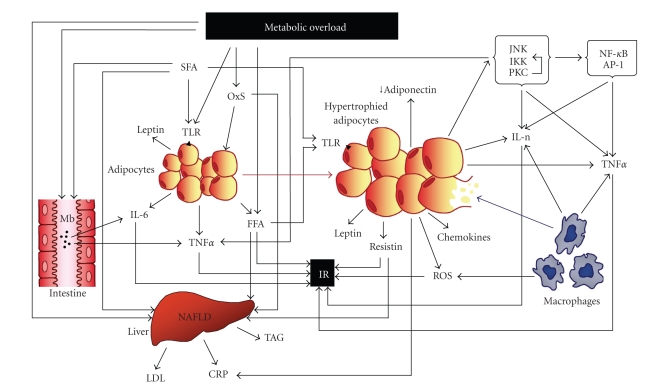
The increasing incidence of obesity and the metabolic syndrome is disturbing. The activation of inflammatory pathways, used normally as host defence, reminds the seriousness of this condition. There is probably more than one cause for activation of inflammation. Apparently, metabolic overload evokes stress reactions, such as oxidative, inflammatory, organelle and cell hypertrophy, generating vicious cycles. Adipocyte hypertrophy, through physical reasons, facilitates cell rupture, what will evoke an inflammatory reaction. Inability of adipose tissue development to engulf incoming fat leads to deposition in other organs, mainly in the liver, with consequences on insulin resistance. The oxidative stress which accompanies feeding, particularly when there is excessive ingestion of fat and/or other macronutrients without concomitant ingestion of antioxidant-rich foods/beverages, may contribute to inflammation attributed to obesity. Moreover, data on the interaction of microbiota with food and obesity brought new hypothesis for the obesity/fat diet relationship with inflammation. Beyond these, other phenomena, for instance psychological and/or circadian rhythm disturbances, may likewise contribute to oxidative/inflammatory status. The difficulty in the management of obesity/metabolic syndrome is linked to their multifactorial nature where environmental, genetic and psychosocial factors interact through complex networks.
Overview
The claims and statistics of this paper haven’t been checked yet.
Run the check — free, no account needed. It reads the open-access text and checks the sources it cites.
Integrity signals
Registry
Cites
Statistics
Figures
Verification
Claims the paper makes
The claims and statistics of this paper haven’t been checked yet.
Run the check — free, no account needed. It reads the open-access text and checks the sources it cites.
Claims other papers make about this one
Each is checked against this paper’s own text: does it say what the citing paper says it does?
In the citing paper
“Continuous low-level translocation of LPS into circulation can induce chronic low-level inflammatory states associated with development of obesity and other metabolic syndromes [92].”
From The athletic gut microbiota (2020) · cites this paper as [92]
In the citing paper
“As systemic inflammatory markers 123 and metabolites such as those derived from the gut microbiota have been associated with obesity and food addiction, future mechanistic studies that integrate these mediators are also of value.”
From History of early life adversity is associated with increased food addiction and sex-specific alterations in reward network connectivity in obesity (2019) · cites this paper as [123]
Self-check
Percentages, sums and reported differences re-computed from the paper’s own numbers.
The self-check needs the paper’s full text.
Citations
Cites
Grundy, S. M., Bilheimer, D. W., Chait, A., Clark, L. T., Denke, M. A., Havel, R. J., Hazzard, W. R., Hulley, S. B., Hunninghake, D. B., Kreisberg, R. A., et al. (1993) · JAMA · doi:10.1001/jama.269.23.3015 · Cited by 27,944
Expert Panel on Detection, E. (2001) · JAMA: The Journal of the American Medical Association · doi:10.1001/jama.285.19.2486 · Cited by 26,011
Diagnosis and Classification of Diabetes Mellitus
American Diabetes Association (2010) · Diabetes Care · doi:10.2337/dc11-s062 · Cited by 14,094
Inflammation and metabolic disorders
Hotamisligil, G. S. (2006) · Nature · doi:10.1038/nature05485 · Cited by 9,199 · cited 2×
“Other researchers have attempted to name this inflammatory state as “metaflammation”, meaning metabolically triggered inflammation [32], or “parainflammation” as a term to define an intermediate state between basal and inflammatory states [33].”
BackgroundOrigin and physiological roles of inflammation
Medzhitov, R. (2008) · Nature · doi:10.1038/nature07201 · Cited by 6,618 · cited 1×
“Other researchers have attempted to name this inflammatory state as “metaflammation”, meaning metabolically triggered inflammation [32], or “parainflammation” as a term to define an intermediate state between basal and inflammatory states [33].”
BackgroundEckel, R. H., Alberti, K., Grundy, S. M., & Zimmet, P. (2010) · The Lancet · doi:10.1016/s0140-6736(09)61794-3 · Cited by 6,317
Eckel, R. H., Grundy, S. M., & Zimmet, P. (2005) · The Lancet · doi:10.1016/s0140-6736(05)66378-7 · Cited by 5,755
Mechanisms underlying the resistance to diet-induced obesity in germ-free mice
Bäckhed, F., Manchester, J. K., Semenkovich, C. F., & Gordon, J. I. (2007) · Proceedings of the National Academy of Sciences · doi:10.1073/pnas.0605374104 · Cited by 2,615 · cited 2×
“[108] F.”
ResultCinti, S., Mitchell, G., Barbatelli, G., Murano, I., Ceresi, E., Faloia, E., Wang, S., Fortier, M., Greenberg, A. S., & Obin, M. S. (2005) · Journal of Lipid Research · doi:10.1194/jlr.m500294-jlr200 · Cited by 2,529 · cited 1×
“Macrophage crowns surrounding dead adipocytes in adipose tissue, as shown by Cinti and collaborators [71], are compatible with this hypothesis.”
BackgroundPhylogenetic Perspectives in Innate Immunity
Hoffmann, J. A., Kafatos, F. C., Janeway, C. A., & Ezekowitz, R. A. B. (1999) · Science · doi:10.1126/science.284.5418.1313 · Cited by 2,524 · cited 1×
“[72] J.”
Research works printed but not linked: 5
- 2003, Endocrine Practice, 9, 237
- 2000, Journal of Clinical Endocrinology and Metabolism, 85, 3338
- 2000, Diabetes and Metabolism, 26, 178
- 2008, International Journal of Obesity, 32, S11
- 2006, Journal of the American College of Nutrition, 25, 262S
Cited by
Sorted by citations
Items 401–500 of 1,000
Busquets-Cortés, C., Capó, X., Argelich, E., Ferrer, M. D., Mateos, D., Bouzas, C., Abbate, M., Tur, J. A., Sureda, A., & Pons, A. (2018) · Nutrients · doi:10.3390/nu10121920 · Cited by 24
“Indeed, the latter is characterized by chronic low-grade inflammation with permanently increased oxidative stress [7,8,57,58].”
BackgroundShared and unique characteristics of metabolic syndrome in psychotic disorders: a review
Saccaro, L. F., Aimo, A., Panichella, G., & Sentissi, O. (2024) · Frontiers in Psychiatry · doi:10.3389/fpsyt.2024.1343427 · Cited by 30
Why is Antactic krill (Euphasia superba) oil on the spotlight? A review
Shahidi, F., & Abad, A. (2024) · Food Production Processing and Nutrition · doi:10.1186/s43014-024-00260-6 · Cited by 23
“Additionally, systemic inflammation might be contributed to development of exacerbated like atherosclerosis, obesity, cachexia, osteoporosis, as well as anorexia (Gan, 2004; Monteiro and Azevedo, 2010).”
BackgroundThe metabolic syndrome in critically ill patients.
Robinson, K., Kruger, P., Prins, J., & Venkatesh, B. (2011) · Best practice & research. Clinical endocrinology & metabolism · doi:10.1016/j.beem.2011.04.008 · Cited by 21
Exercise Speeds Cutaneous Wound Healing in High-Fat Diet-Induced Obese Mice
Pence, B. D., DiPietro, L. A., & Woods, J. A. (2012) · Medicine & Science in Sports & Exercise · doi:10.1249/mss.0b013e31825a5971 · Cited by 23
Immune function during pregnancy varies between ecologically distinct populations
Hové, C., Trumble, B. C., Anderson, A., Stieglitz, J., Kaplan, H. S., Gurven, M., & Blackwell, A. D. (2020) · Evolution Medicine and Public Health · doi:10.1093/emph/eoaa022 · Cited by 23
“The potential effects of impaired immune calibration on maternal responses to fetal antigens likely interact with other common and evolutionarily novel aspects of post-industrial societies, such as elevated rates of obesity (a chronic inflammatory state) [11] and low parity (which results in less ‘exposure’ to fetal a…”
Ngcobo, S. R., Nkambule, B. B., Nyambuya, T. M., Mokgalaboni, K., Ntsethe, A., Mxinwa, V., Ziqubu, K., Ntamo, Y., Nyawo, T. A., & Dludla, P. V. (2021) · Biomedicine & Pharmacotherapy · doi:10.1016/j.biopha.2021.112579 · Cited by 23
Plasma Levels of Triglycerides and IL-6 Are Associated With Weight Regain and Fat Mass Expansion
Qiao, Q., Bouwman, F. G., van Baak, M. A., Roumans, N. J. T., Vink, R., & Mariman, E. C. M. (2022) · The Journal of Clinical Endocrinology & Metabolism · doi:10.1210/clinem/dgac198 · Cited by 23
Blood and Urinary Biomarkers of Antipsychotic-Induced Metabolic Syndrome
Khasanova, A. K., Добродеева, В. С., Shnayder, N. A., Петрова, М. М., Пронина, Е., Николаевна, Б. Е., Ларева, Н. В., Garganeeva, N. P., Smirnova, D. A., & Nasyrova, R. F. (2022) · Metabolites · doi:10.3390/metabo12080726 · Cited by 23
“Oxidative stress may be an early event in the pathology of these chronic diseases, and not just a consequence or concomitant process [28].”
BackgroundImportance of the endometrial immune environment in endometrial cancer and associated therapies
van der Woude, H., Hally, K. E., Currie, M. J., Gasser, O., & Henry, C. E. (2022) · Frontiers in Oncology · doi:10.3389/fonc.2022.975201 · Cited by 26
Bahari, H., Rafiei, H., Goudarzi, K., et al. (2023) · Inflammopharmacology · doi:10.1007/s10787-023-01294-x · Cited by 23
The Metabolic Syndrome and Inflammation: Role of Insulin Resistance and Increased Adiposity
Farooq, W., Farwa, U., & Khan, F. R. (2015) · Oman Medical Journal · doi:10.5001/omj.2015.22 · Cited by 24
GPR120 in adipocytes has differential roles in the production of pro-inflammatory adipocytokines
Hasan, A. U., Ohmori, K., Hashimoto, T., Kamitori, K., Yamaguchi, F., Noma, T., Igarashi, J., Tsuboi, K., Tokuda, M., Nishiyama, A., et al. (2017) · Biochemical and Biophysical Research Communications · doi:10.1016/j.bbrc.2017.03.001 · Cited by 23
Adipose Tissue and Inflammation
Muñoz‐Carrillo, J. L., del Campo, J. O.-M., Coronado, O. G., Villalobos‐Gutiérrez, P. T., Contreras‐Cordero, J. F., & Ventura‐Juárez, J. (2018) · InTech eBooks · doi:10.5772/intechopen.74227 · Cited by 26
Post-operative pain in mice is prolonged by diet-induced obesity and rescued by dietary intervention
Guillemot‐Legris, O., Buisseret, B., Mutemberezi, V., Hermans, E., Deumens, R., Alhouayek, M., & Muccioli, G. G. (2018) · Brain Behavior and Immunity · doi:10.1016/j.bbi.2018.07.022 · Cited by 23
Methenitis, S. K., Stergiou, I. Ε., Antonopoulou, S., & Nomikos, T. (2021) · Biomedicines · doi:10.3390/biomedicines9010036 · Cited by 23
“Thus, EIMD could find application in studies investigating the effect of nutrition and/or exercise, in acute and chronic inflammatory conditions such as those observed before and/or during the majority of chronic and non-communicable diseases [1,2,4,5,8,9,20,24,29,32,33,34,128,272].”
BackgroundWeight loss program is associated with decrease α-tocopherol status in obese adults
Hamułka, J., Górnicka, M., Sulich, A., & Frąckiewicz, J. (2018) · Clinical Nutrition · doi:10.1016/j.clnu.2018.07.011 · Cited by 23
Active Cushing Disease Is Characterized by Increased Adipose Tissue Macrophage Presence
Lee, I. T., Opata, A. A., EĞRİTAĞ, H. E., Wang, L., Donovan, M. J., Buettner, C., & Geer, E. B. (2019) · The Journal of Clinical Endocrinology & Metabolism · doi:10.1210/jc.2018-02552 · Cited by 22
Meal frequency and incidence of type 2 diabetes: a prospective study
Wang, X., Hu, Y., Qin, L., & Dong, J.-Y. (2021) · British Journal Of Nutrition · doi:10.1017/s0007114521003226 · Cited by 27
“Participants with a higher BMI may have chronic inflammation, dyslipidemia, impaired postprandial metabolism or insulin resistance (28,29) .”
Hu, R., Liu, Z., Geng, Y., Huang, Y., Li, F., Dong, H., Ma, W., Song, K., Zhang, M., & Song, Y. (2023) · Microorganisms · doi:10.3390/microorganisms11071725 · Cited by 23
“Bacteroidetes is considered a gram-negative bacterium that can produce a proinflammatory marker—LPS [75].”
BackgroundThe association of blood metals with latent tuberculosis infection among adults and adolescents
Wu, J., Wang, K., Tao, F., Li, Q., Luo, X., & Xia, F. (2023) · Frontiers in Nutrition · doi:10.3389/fnut.2023.1259902 · Cited by 22
“A previous study showed that cumulative exposure to heavy metals was associated with obesity (31); meanwhile, obese individuals may be more susceptible to chronic systemic inflammation (32) and metabolic disorders (33), which may reinforce the risk of LTBI.”
BackgroundRole of the Intestine and Its Gut Microbiota in Metabolic Syndrome and Obesity
Busch, C. B. E., Bergman, J. J. G. H. M., Nieuwdorp, M., & van Baar, A. C. G. (2024) · The American Journal of Gastroenterology · doi:10.14309/ajg.0000000000002730 · Cited by 29
Positive association between blood ethylene oxide levels and metabolic syndrome: NHANES 2013-2020
Zhou, C., Wang, S., Ju, L., Zhang, R., Yang, Y., & Liu, Y. (2024) · Frontiers in Endocrinology · doi:10.3389/fendo.2024.1365658 · Cited by 24
Is oxidative stress - antioxidants imbalance the physiopathogenic core in pediatric obesity?
Lupu, A., Fotea, S., Jechel, E., Stârcea, I. M., Ioniuc, I. K., Knieling, A., Șalaru, D. L., Săsăran, M. O., Cirstea, O., Revenco, N., et al. (2024) · Frontiers in Immunology · doi:10.3389/fimmu.2024.1394869 · Cited by 24
Ferretti, G., Bacchetti, T., Masciangelo, S., Grugni, G., & Bicchiega, V. (2012) · Disease Models & Mechanisms · doi:10.1242/dmm.009209 · Cited by 22
“…and other metabolic changes related to the increased adiposity could be involved in the development of complications in obese subjects (Higdon and Frei, 2003; Vincent and Taylor, 2006; González-Chávez et al., 2011; Thaler and Schwartz, 2010; Monteiro and Azevedo, 2010; BondiaPons et al., 2012).”
Drew, J. E. (2012) · Advances in Nutrition · doi:10.3945/an.112.002121 · Cited by 23
“Blood gene expression profiles associated with obesity have identified components of metabolic regulation linked to other cellular defense systems (22,76,88,89).”
BackgroundDayoub, O., Lay, S. L., Soleti, R., Clere, N., Hilairet, G., Dubois, S. G., Gagnadoux, F., Boursier, J., Martínez, M. C., & Andriantsitohaina, R. (2017) · Scientific Reports · doi:10.1038/s41598-017-09933-4 · Cited by 22
Nanomedicine Approaches Against Parasitic Worm Infections
Li, P., Coronado, P. E. R., Longstaff, X. R., Tarashansky, A. J., & Wang, B. (2018) · Advanced Healthcare Materials · doi:10.1002/adhm.201701494 · Cited by 23
Brady, S. R. E., Naderpoor, N., de Courten, M., Scragg, R. K. R., Cicuttini, F., Mousa, A., & de Courten, B. (2018) · The Journal of Steroid Biochemistry and Molecular Biology · doi:10.1016/j.jsbmb.2018.09.005 · Cited by 22
Association Between High Neutrophil to Lymphocyte Ratio and Delayed Recovery From Bell’s Palsy
Kim, H.-S., Jung, J., Dong, S. H., et al. (2018) · Clinical and Experimental Otorhinolaryngology · doi:10.21053/ceo.2018.01018 · Cited by 22
“For example, systemic low grade chronic inflammation has been observed in obese patients [26].”
BackgroundObese Animals as Models for Numerous Diseases: Advantages and Applications
Ghanemi, A., Yoshioka, M., & St‐Amand, J. (2021) · Medicina · doi:10.3390/medicina57050399 · Cited by 23
Impact of diet and weight loss on iron and zinc status in overweight and obese young women.
Cheng, H. L., Griffin, H. J., Bryant, C. E., Rooney, K. B., Steinbeck, K. S., & O'Connor, H. T. (2013) · PubMed · doi:10.6133/apjcn.2013.22.4.08 · Cited by 22
Early life environment and developmental immunotoxicity in inflammatory dysfunction and disease
Leifer, C. A., & Dietert, R. R. (2011) · Toxicological & Environmental Chemistry Reviews · doi:10.1080/02772248.2011.586114 · Cited by 22
“Chronic inflammation has been correlated with many different diseases and syndromes such as chronic obstructive pulmonary disease (COPD), inflammatory bowel disease, rheumatoid arthritis, psoriasis, and the metabolic syndrome-related conditions of childhood obesity, hepatic steatosis, and atherosclerotic vascular dise…”
BackgroundDuPre, N. C., Flavin, R., Sfanos, K. S., et al. (2018) · The Prostate · doi:10.1002/pros.23692 · Cited by 22
“Obesity is marked by a chronic inflammatory condition whereby adipocytes secrete cytokines and experience phagocytosis.(28,29) The associations with chronic inflammation and BMI highlight that corpora amylacea are related to pro-inflammatory exposures and that there are potentially modifiable factors contributing to t…”
BackgroundKreidieh, D., Itani, L., El Masri, D., Tannir, H., & El Ghoch, M. (2020) · Frontiers in Endocrinology · doi:10.3389/fendo.2020.00022 · Cited by 21
“, common denominator seen in both conditions) (7, 8), that appears to exacerbate the cardiometabolic comorbidities (9) in individuals affected by SO, rather than obesity alone.”
BackgroundAgrawal, N. (2025) · Chemical Biology & Drug Design · doi:10.1111/cbdd.70114 · Cited by 22
“For instance, non-steroidal anti-inflammatory drugs (NSAIDs) can increase the risk of gastrointestinal bleeding, renal impairment, and cardiovascular complications (Monteiro and Azevedo 2010; O'Neil et al. 2012).”
Parveen, S., & Alhazmi, Y. A. (2022) · International Journal of Environmental Research and Public Health · doi:10.3390/ijerph192114536 · Cited by 27
Son, T., Jeong, I., Park, J., Jun, W., Kim, A., & Kim, O. (2023) · Frontiers in Nutrition · doi:10.3389/fnut.2023.1162992 · Cited by 24
“Previous studies have shown that hepatic inflammation is associated with obesity-induced liver disease (6).”
BackgroundSato, S., Arai, S., Kato, K., Yoshida, K., Iwabuchi, N., Sagami, T., & Tanaka, M. (2024) · Nutrients · doi:10.3390/nu16060815 · Cited by 22
Higa, J. K., Liang, Z., Williams, P. G., & Panee, J. (2012) · PLoS ONE · doi:10.1371/journal.pone.0045082 · Cited by 22
“diseases of the metabolic syndrome such as type II diabetes, rheumatoid arthritis, and atherosclerosis [1].”
BackgroundShih, T., Liu, M.-H., Li, C.-W., & Kuo, C.-F. (2018) · Molecules · doi:10.3390/molecules23030597 · Cited by 21
Prevalence of Anaemia and Iron Deficiency among Primary Schoolchildren in Malaysia
Safii, N. S., Hanisa, A. S., Afifah, A. R. N., Lee, S. T., Chong, K. H., George, P., Norazida, A. B., Budin, S. B., Khouw, I. M. S. L., Norimah, A. K., et al. (2018) · International Journal of Environmental Research and Public Health · doi:10.3390/ijerph15112332 · Cited by 21
“Another mechanism could be that excessive intake of fats or other macronutrients without accompanying antioxidant-rich foods or beverages may lead to oxidative stress, which consequently causes inflammatory reaction [39].”
BackgroundFatty Acids, Gut Bacteria, and Immune Cell Function
Xiang, M. S. W., Tan, J. K., & Macia, L. (2018) · Elsevier eBooks · doi:10.1016/b978-0-12-811297-7.00011-1 · Cited by 20
Quante, M., Iske, J., Uehara, H., Minami, K., Nian, Y., Maenosono, R., Matsunaga, T., Liu, Y., Azuma, H., Perkins, D. L., et al. (2021) · American Journal of Transplantation · doi:10.1111/ajt.16856 · Cited by 21
Martínez‐Villaluenga, C., Peñas, E., Rico, D., Martín‐Diana, A. B., Portillo, M. P., Macarulla, M. T., de Luis, D. A., & Miranda, J. (2018) · Marine Drugs · doi:10.3390/md16120512 · Cited by 21
Zhao, F., Yue, Z., Zhang, L., Qi, Y., Sun, Y., Wang, S., & Tian, Q. (2025) · Journal of Innate Immunity · doi:10.1159/000546476 · Cited by 23
“Adipose tissue, comprising adipocytes, preadipocytes, endothelial cells, and immune cells such as macrophages and lymphocytes, plays a crucial role in initiating the inflammatory response to obesity [148].”
Immune Function, Nutrition, and Exercise
Aoi, W., & Naito, Y. (2018) · Elsevier eBooks · doi:10.1016/b978-0-12-813922-6.00007-2 · Cited by 20
Huang, J., Li, R.-H., & Tsai, L. (2022) · Nutrients · doi:10.3390/nu14194200 · Cited by 23
“In addition, studies have revealed the presence of obesity as the most significant determinant of low-grade chronic inflammation for unfavorable health effects [43,44].”
BackgroundZhou, Q., Zhou, L., Chen, X., Chen, Q., & Hao, L. (2024) · Preventive Medicine Reports · doi:10.1016/j.pmedr.2024.102704 · Cited by 20
“Thus, it is not inconceivable that amelioration of oxidative stress and chronic inflammation, which are key components in the pathogenesis of MetS, could be associated with reduced odds of MetS Q. Zhou et al. (Francisqueti et al., 2017; Monteiro and Azevedo, 2010).”
BackgroundZhang, J., Zhu, H., Chen, Y., Li, C., Li, C., Chu, H., Gozali, L., Lee, A. C.-Y., To, K. K., Hung, I. F., et al. (2018) · The Journal of Infectious Diseases · doi:10.1093/infdis/jiy527 · Cited by 20
Leptin differentially regulate STAT3 activation in ob/ob mouse adipose mesenchymal stem cells
Zhou, Z., Neupane, M., Zhou, H. R., Wu, D., Chang, C., Moustaïd‐Moussa, N., & Claycombe, K. (2012) · Nutrition & Metabolism · doi:10.1186/1743-7075-9-109 · Cited by 21
“The elevated risk has been suggested to be mediated, in part, by increased chronic inflammation [2].”
BackgroundModulación antioxidante y antiinflamatoria del ejercicio físico durante el envejecimiento
Galle, F. A., Martella, D., & Bresciani, G. (2018) · Revista Española de Geriatría y Gerontología · doi:10.1016/j.regg.2018.03.003 · Cited by 22
Parimelazhagan, R., Umapathy, D., Sivakamasundari, R. I., Sethupathy, S., Ali, D., Ramkumar, K. M., & Namasivayan, N. (2021) · BioMed Research International · doi:10.1155/2021/8568926 · Cited by 22
RetractedAbad‐Jiménez, Z., López‐Domènech, S., Gargallo, C. G., Vezza, T., Gómez‐Abril, S. Á., Morillas, C., Díaz-Pozo, P., Falcón, R., Bañuls, C., Víctor, V. M., et al. (2022) · Biomedicines · doi:10.3390/biomedicines10020430 · Cited by 20
“In turn, MCP-1 promotes macrophage infiltration in metabolic tissues and prolongs and exacerbates the inflammatory response, thus helping to maintain IR [7].”
BackgroundUnderstanding the development of sarcopenic obesity
Gross, D. C., Cheever, C. R., & Batsis, J. A. (2023) · Expert Review of Endocrinology & Metabolism · doi:10.1080/17446651.2023.2267672 · Cited by 19
High-Fat Diet Induces Resistance to Ghrelin and LEAP2 Peptide Analogs in Mice
Holá, L., Tureckiová, T., Kuneš, J., Železná, B., & Maletı́nská, L. (2023) · Physiological Research · doi:10.33549/physiolres.935189 · Cited by 19
Orekhov, A. N., Summerhill, V. I., Khotina, V. A., Popov, M. A., Uzokov, J., & Sukhorukov, V. N. (2023) · Gene Expression · doi:10.14218/ge.2023.00061 · Cited by 34
“53 Some individuals may have a genetic predisposition to the development of chronic inflammation, 9 which can be associated with their immune response, inflammation-regulating genes, or other genetic factors.”
BackgroundYang, S. O., Park, H., Sohn, E. S., Lee, S., Kim, H. D., Kim, Y. C., Kim, K. H., Na, S. W., Choi, H., Arasu, M. V., et al. (2014) · BMC Complementary and Alternative Medicine · doi:10.1186/1472-6882-14-455 · Cited by 19
“Obesity is a risk factor for major metabolic disease including type 2 diabetes, atherosclerosis, hyperlipidemia and hypertension and multifactorial syndrome in human [1,2].”
BackgroundFabian, U. A., Charles-Davies, M. A., Aa, F., Olaniyi, J. A., Oyewole, O. E., Owolabi, M. O., Adebusuyi, J. R., Oo, H., Ajobo, B. M., Ebesunun, M. O., et al. (2016) · PubMed Central · Cited by 19
CD4+ T cell imbalance is associated with recurrent endometrial polyps
Zhu, Y., Du, M., Yi, L., Liu, Z., Gong, G., & Tang, X. (2018) · Clinical and Experimental Pharmacology and Physiology · doi:10.1111/1440-1681.12913 · Cited by 19
Metataxonomic Analysis of Individuals at BMI Extremes and Monozygotic Twins Discordant for BMI
Finnicum, C. T., Doornweerd, S., Dolan, C. V., Luningham, J. M., Beck, J. J., Willemsen, G. A. H. M., Ehli, E. A., Boomsma, D. I., IJzerman, R. G., Davies, G. E., et al. (2018) · Twin Research and Human Genetics · doi:10.1017/thg.2018.26 · Cited by 19
“Obesity is associated with changes in the inflammatory profile in humans that may affect gut microbiota, as well as with eating behaviors and physical activity patterns that may also impact the microbiome (Monteiro & Azevedo, 2010; Rodriguez-Hernandez et al., 2013).”
BackgroundRazavi, B. M., & Hosseinzadeh, H. (2019) · Elsevier eBooks · doi:10.1016/b978-0-12-813822-9.00034-5 · Cited by 19
Counotte, J., Bergink, V., Pot-Kolder, R., Drexhage, H. A., Hoek, H. W., & Veling, W. (2019) · PLoS ONE · doi:10.1371/journal.pone.0219139 · Cited by 19
Evaluation of anti-inflammatory effect of Varanadi Kashayam (decoction) in THP-1-derived macrophages
Kumar, B. P., Chinchu, J. U., Mohan, M. C., et al. (2018) · AYU (An International Quarterly Journal of Research in Ayurveda) · doi:10.4103/ayu.ayu_53_18 · Cited by 19
“[1,2] However, excessive and prolonged inflammatory response contribute to inflammatory diseases such as cancer,[3] atherosclerosis,[4] rheumatoid arthritis (RA),[5] obesity[6] and cardiovascular disease.”
BackgroundRumińska, M., Witkowska–Sędek, E., Artemniak-Wojtowicz, D., et al. (2019) · Central European Journal of Immunology · doi:10.5114/ceji.2019.89608 · Cited by 19
Cannon, J., Weber, A. E., Park, S., Mayer, E. N., & Powers, C. M. (2019) · Physical Therapy · doi:10.1093/ptj/pzz189 · Cited by 20
Obesidade: inflamação e compostos bioativos
de Oliveira, C. B. C., Brito, L. A., Freitas, M. A., de Souza, M. P. A., Rêgo, J. M. D. C., & Machado, R. J. D. A. (2020) · Journal of Health & Biological Sciences · doi:10.12662/2317-3076jhbs.v8i1.2785.p1-5.2020 · Cited by 19
Iyengar, N. M., Zhou, X. K., Mendieta, H., Giri, D. D., El-Hely, O., Winston, L. A., Falcone, D. J., Wang, H., Meng, L., Landa, J., et al. (2021) · Cancer Prevention Research · doi:10.1158/1940-6207.capr-20-0507 · Cited by 19
Tian, Y., Gao, L., Guo, Y., & Xu, Y. (2017) · Journal of Food Biochemistry · doi:10.1111/jfbc.12407 · Cited by 19
Adipose Tissue and Inflammation
Awad, A. B., & Bradford, P. G. (2009) · CRC Press eBooks · doi:10.1201/9781420091311 · Cited by 20
Lv, C., Liu, X., Chen, S., Yi, Y., Wen, X., Li, T., & Qin, S. (2024) · Antioxidants · doi:10.3390/antiox13030293 · Cited by 21
“Glycolipid metabolism disorder is characterized by dysregulation in glucose and lipid metabolism, accompanied by insulin resistance, oxidative stress, inflammatory response, and an imbalance in intestinal flora as the core pathological mechanisms [1–3].”
BackgroundTime Restricted Eating: A Valuable Alternative to Calorie Restriction for Addressing Obesity?
Parrotta, M. E., Colangeli, L., Scipione, V., Vitale, C., Sbraccia, P., & Guglielmi, V. (2025) · Current Obesity Reports · doi:10.1007/s13679-025-00609-z · Cited by 19
Multidrug-Resistant Infections and Metabolic Syndrome: An Overlooked Bidirectional Relationship
Acierno, C., Nevola, R., Barletta, F., Rinaldi, L., Sasso, F. C., Adinolfi, L. E., & Caturano, A. (2025) · Biomedicines · doi:10.3390/biomedicines13061343 · Cited by 20
“A hallmark feature of metabolic syndrome (MetS) is the presence of low-grade, systemic inflammation that develops insidiously and persists chronically [35,42].”
Scazzocchio, B., Varı́, R., Silenzi, A., Giammarioli, S., Masotti, A., Baldassarre, A., Santangelo, C., D’Archivio, M., Giovannini, C., Cornò, M. D., et al. (2019) · European Journal of Nutrition · doi:10.1007/s00394-019-02003-7 · Cited by 19
“Excess macronutrient intake and/or lipid overload associated with adiposity are thought to contribute to inflammation and aberrant signaling in visceral AT [42].”
BackgroundInflammatory Markers and Atherogenic Coefficient: Early Markers of Metabolic Syndrome
Mahdavi‐Roshan, M., Shoaibinobarian, N., Noormohammadi, M., Mousavi, A. F., Rakhsh, A. S., Salari, A., & Ghorbani, Z. (2022) · Intern J Endocrinol Metab · doi:10.5812/ijem-127445 · Cited by 18
“Therefore, these inexpensive and available laboratory measures that could also be used in clinical settings would be most helpful in the early detection of atherosclerosis development and primary prevention of CVDs among MetSyn subjects.”
BackgroundResultInfluentialImmune response to arbovirus infection in obesity
Hameed, M., Geerling, E., Pinto, A. K., Miraj, I., & Weger‐Lucarelli, J. (2022) · Frontiers in Immunology · doi:10.3389/fimmu.2022.968582 · Cited by 19
Stress-induced brain responses are associated with BMI in women
Kühnel, A., Hagenberg, J., Arloth, J., Ködel, M., Czisch, M., Sämann, P. G., BeCOME working group, Brückl, T. M., Spoormaker, V. I., Erhardt, A., et al. (2023) · Communications Biology · doi:10.1038/s42003-023-05396-8 · Cited by 21
Temporal associations of BMI and glucose parameters with depressive symptoms among US adults
Meshkat, S., Liu, Y., Jung, H. J., Tassone, V. K., Pang, H. Y. M., Janssen‐Aguilar, R., Lou, W. Y. W., & Bhat, V. (2024) · Psychiatry Research · doi:10.1016/j.psychres.2023.115709 · Cited by 18
NADPH Oxidase 3: Beyond the Inner Ear
Herb, M. (2024) · Antioxidants · doi:10.3390/antiox13020219 · Cited by 19
Wu, S., Teng, Y., Lan, Y., Wang, M., Zhang, T., Wang, D., & Qi, F. (2024) · Lipids in Health and Disease · doi:10.1186/s12944-024-02223-9 · Cited by 20
“Obesity, once believed to be just a metabolic abnormality, has been shown to demonstrate mutual causality with non-specific immune responses [2–7].”
BackgroundPerinatal outcome in normal pregnant women with incidental thrombocytopenia at delivery
Lin, Y.-H., Lo, L., Hsieh, C.-C., et al. (2013) · Taiwanese Journal of Obstetrics and Gynecology · doi:10.1016/j.tjog.2013.01.025 · Cited by 18
Tuomisto, K., Jousilahti, P., Havulinna, A. S., et al. (2019) · Metabolism Open · doi:10.1016/j.metop.2019.100016 · Cited by 18
Żelechowska, P., Brzezińska‐Błaszczyk, E., Kusowska, A., & Kozłowska, E. (2020) · Obesity Reviews · doi:10.1111/obr.13055 · Cited by 18
“where they act in an endocrine manner to promote chronic systemic inflammation.(160) Thus, it can be stated that underweight or overweight and obesity notably affect the immune system functioning”
BackgroundPark, M., Park, E., Kim, S.-H., & Lee, H. (2021) · International Journal of Molecular Sciences · doi:10.3390/ijms22094444 · Cited by 18
Lordan, R., Τσούπρας, Α., & Zabetakis, I. (2019) · Elsevier eBooks · doi:10.1016/b978-0-12-813792-5.00002-1 · Cited by 20
Du, Y., Dai, Q., Zhang, H., et al. (2019) · Journal of Immunology Research · doi:10.1155/2019/7026067 · Cited by 18
“Inhibiting the expression or function of NF-κB is crucial for maintaining DCs in an immature state [35–37], with the decreased expression of various cytokines, such as IL-1β, IL-6, and TNF-α [38, 39], which further amplify the inflammatory responses [40].”
BackgroundGut microbiome links obesity to type 2 diabetes: insights from Mendelian randomization
Fu, L., Baranova, A. V., Cao, H., & Zhang, F. (2025) · BMC Microbiology · doi:10.1186/s12866-025-03968-8 · Cited by 20
“The chronic systemic inflammatory state induced by obesity may be a major factor affecting GM [87].”
Understanding Cystic Fibrosis Comorbidities and Their Impact on Nutritional Management
Patel, D. R., Shan, A., Mathews, S. K., & Sathe, M. (2022) · Nutrients · doi:10.3390/nu14051028 · Cited by 17
“Additionally, research shows that excessive fat ingestion, particularly without concomitant antioxidant ingestion, may contribute to inflammation linked with obesity [17].”
BackgroundZhang, R., Sun, X., Huang, Z., Pan, Y., Westbrook, A., Li, S.-X., Bazzano, L., Chen, W., He, J., Kelly, T., et al. (2022) · Obesity · doi:10.1002/oby.23386 · Cited by 15
“Second, obesity is characterized by chronic inflammation (36), and LPEs could regulate body weight through inhibiting the production of proinflammatory cytokines and promoting the secretion of antiinflammation cytokine interleukin (IL)10 (37,38).”
BackgroundLi, J., Gower, B. A., McLain, A., & Yarar‐Fisher, C. (2022) · Physiological Reports · doi:10.14814/phy2.15501 · Cited by 17
“Research showed that chronic inflammation associated with obesity impairs insulin signaling pathways and lipid metabolism (Monteiro & Azevedo, 2010).”
BackgroundBMI modifies HDL-C effects on coronary artery bypass grafting outcomes
Rezaee, M., Fallahzadeh, A., Sheikhy, A., Jameie, M., Behnoush, A. H., Pashang, M., Tajdini, M., Tavolinejad, H., Masoudkabir, F., Mansourian, S., et al. (2022) · Lipids in Health and Disease · doi:10.1186/s12944-022-01739-2 · Cited by 18
“As a result, these processes contribute to the activation of systemic inflammatory pathways [38].”
BackgroundLamichhane, G., Pandeya, P. R., Lamichhane, R., et al. (2023) · Current Research in Biotechnology · doi:10.1016/j.crbiot.2023.100138 · Cited by 17
Chen, Q., Luo, Y., Shen, Y., Li, X., Yang, H., Li, J., Wang, J., & Xiao, Y. (2023) · The Journal of Nutritional Biochemistry · doi:10.1016/j.jnutbio.2023.109527 · Cited by 17
Biomarkers of food intake and their relevance to metabolic syndrome
Cifuentes, M., Vahid, F., Devaux, Y., & Bohn, T. (2024) · Food & Function · doi:10.1039/d4fo00721b · Cited by 18
Diet-induced obesity reprograms the inflammatory response of the murine lung to inhaled endotoxin
Tilton, S. C., Waters, K. M., Karin, N. J., Webb‐Robertson, B., Zangar, R. C., Lee, K. M., Bigelow, D. J., Pounds, J. G., & CORLEY, R. A. (2013) · Toxicology and Applied Pharmacology · doi:10.1016/j.taap.2012.12.020 · Cited by 17
“…Author M anuscript N IH -PA Author M anuscript initiation of pulmonary pathologies and suggests convergent pathways of LPS exposure and obesity (Furukawa et al., 2004; Arkan et al., 2005; Xue et al., 2005; Hotamisligil, 2006; Houstis et al., 2006; Zhang et al., 2008; Monteiro and Azevedo, 2010).”
BackgroundA multiscale modeling framework for studying the mechanobiology of sarcopenic obesity
Shoham, N., Levy, A., Shabshin, N., Benayahu, D., & Gefen, A. (2016) · Biomechanics and Modeling in Mechanobiology · doi:10.1007/s10237-016-0816-z · Cited by 19
“…even in tissues with healthy fat contents, as part of the normal turnover process in fat; however, in subjects with excessive fat mass, there is often chronic inflammation in fat tissues, whichmay indeed relate to frequent cell deformation damage (Monteiro and Azevedo 2010; Gefen and Weihs 2016).”
BackgroundKemse, N. G., Sundrani, D. P., Kale, A. A., & Joshi, S. (2017) · Archives of Medical Research · doi:10.1016/j.arcmed.2017.10.006 · Cited by 18
Effect of Low-Fat Diet in Obese Mice Lacking Toll-like Receptors
Rau, C., Wu, S., Lu, T., Wu, Y.-C., Wu, C., Chien, P., Kuo, P., Lin, C.-W., Tsai, C.-W., & Hsieh, C. (2018) · Nutrients · doi:10.3390/nu10101464 · Cited by 17
“Uptake of a high-fat diet leads to the synthesis and release of adipokines and proinflammatory cytokines in the adipose tissue [1].”
BackgroundMoreira, B. P., Monteiro, M. P., Sousa, M., Oliveira, P. F., & Alves, M. G. (2018) · Biochemical Journal · doi:10.1042/bcj20180631 · Cited by 18
Kim, H., Kwon, H., Jeong, S., Hwang, S. E., & Park, J. (2019) · Scientific Reports · doi:10.1038/s41598-019-42398-1 · Cited by 17
Metadata
- Authors
- Monteiro, R., & Azevedo, I.
- Affiliations
- Universidade do Porto (PT)
- Corresponding author
- Monteiro, Rosário
- Venue
- Mediators of Inflammation
- Publisher
- Wiley
- Published
- 2010
- Volume
- 2010
- Pages
- 1-10
- ISSN
- 0962-9351 (ISSN-L)
- 1466-1861
- PMC
- PMC2913796
- OpenAlex
- W1997248937
- Cited by
- 1,186
- References
- 124
- Citations by year
- 2026: 40 · 2025: 93 · 2024: 104 · 2023: 99 · 2022: 126 · 2021: 102 · 2020: 120 · 2019: 113 · 2018: 95 · 2017: 68 · 2016: 47 · 2015: 33 · 2014: 29 · 2013: 45 · 2012: 34
- FWCI
- 4.15
- Type
- journal article
- Language
- en
- Open access
- gold
- doi.org
- Locations
- Mediators of Inflammation (publishedVersion, cc-by)
- PubMed Central (publishedVersion, cc-by)
- PubMed (publishedVersion)
- DOAJ (DOAJ: Directory of Open Access Journals) (submittedVersion, cc-by-sa)
- Topics
- Health Sciences › Medicine › Endocrinology, Diabetes and Metabolism › Adipokines, Inflammation, and Metabolic Diseases
- Health Sciences › Medicine › Cardiology and Cardiovascular Medicine › Cardiovascular Disease and Adiposity
- Health Sciences › Medicine › Physiology (medical) › Adipose Tissue and Metabolism
- Keywords
- obesity, metabolic syndrome, chronic inflammation, adipocyte hypertrophy, oxidative stress, insulin resistance, hepatic lipid accumulation, gut microbiota, dietary fat, circadian rhythm, psychological factors, adipose tissue
- MeSH terms
- Animals, Energy Metabolism, Humans, Inflammation, Obesity, Adipocytes, Metabolic Syndrome
About these checks
Registry, retraction, Cites and statistics results are computed, not judged, with one exception: a printed reference that no index lists is read once by a model before it counts as a citation error. Claims are extracted by a model and kept only when their quote appears verbatim in the text; each cited source is then checked, with a model’s help, for whether it says what the claim relies on. Those verdicts can be wrong — read the claim’s quote and the cited source before relying on one.
Statistics and arithmetic are recomputed, not judged.
Confidence bands are shown only for fields calibrated on our annotated test set. None is calibrated yet, so no band is shown.
What counts as a claim ›How we measure confidence ›How we check this ›
Are you an author, or do you see a problem with this page? Request a review
