

The DOI matches its Crossref record; 122 of the 124 references it cites were found in a registry or an index.
Chronic Inflammation in Obesity and the Metabolic Syndrome
Open accessAbstract
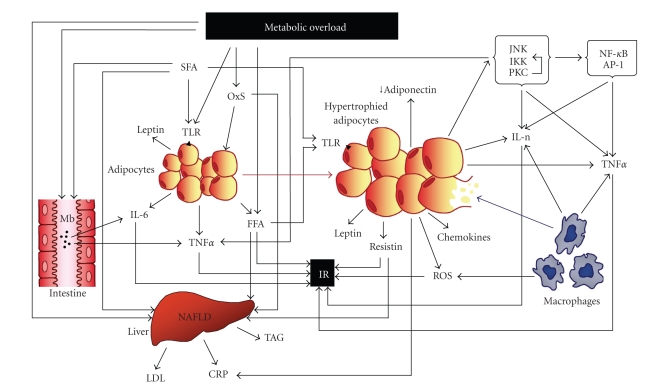
The increasing incidence of obesity and the metabolic syndrome is disturbing. The activation of inflammatory pathways, used normally as host defence, reminds the seriousness of this condition. There is probably more than one cause for activation of inflammation. Apparently, metabolic overload evokes stress reactions, such as oxidative, inflammatory, organelle and cell hypertrophy, generating vicious cycles. Adipocyte hypertrophy, through physical reasons, facilitates cell rupture, what will evoke an inflammatory reaction. Inability of adipose tissue development to engulf incoming fat leads to deposition in other organs, mainly in the liver, with consequences on insulin resistance. The oxidative stress which accompanies feeding, particularly when there is excessive ingestion of fat and/or other macronutrients without concomitant ingestion of antioxidant-rich foods/beverages, may contribute to inflammation attributed to obesity. Moreover, data on the interaction of microbiota with food and obesity brought new hypothesis for the obesity/fat diet relationship with inflammation. Beyond these, other phenomena, for instance psychological and/or circadian rhythm disturbances, may likewise contribute to oxidative/inflammatory status. The difficulty in the management of obesity/metabolic syndrome is linked to their multifactorial nature where environmental, genetic and psychosocial factors interact through complex networks.
Overview
The claims and statistics of this paper haven’t been checked yet.
Run the check — free, no account needed. It reads the open-access text and checks the sources it cites.
Integrity signals
Registry
Cites
Statistics
Figures
Verification
Claims the paper makes
The claims and statistics of this paper haven’t been checked yet.
Run the check — free, no account needed. It reads the open-access text and checks the sources it cites.
Claims other papers make about this one
Each is checked against this paper’s own text: does it say what the citing paper says it does?
In the citing paper
“Continuous low-level translocation of LPS into circulation can induce chronic low-level inflammatory states associated with development of obesity and other metabolic syndromes [92].”
From The athletic gut microbiota (2020) · cites this paper as [92]
In the citing paper
“As systemic inflammatory markers 123 and metabolites such as those derived from the gut microbiota have been associated with obesity and food addiction, future mechanistic studies that integrate these mediators are also of value.”
From History of early life adversity is associated with increased food addiction and sex-specific alterations in reward network connectivity in obesity (2019) · cites this paper as [123]
Self-check
Percentages, sums and reported differences re-computed from the paper’s own numbers.
The self-check needs the paper’s full text.
Citations
Cites
Grundy, S. M., Bilheimer, D. W., Chait, A., Clark, L. T., Denke, M. A., Havel, R. J., Hazzard, W. R., Hulley, S. B., Hunninghake, D. B., Kreisberg, R. A., et al. (1993) · JAMA · doi:10.1001/jama.269.23.3015 · Cited by 27,944
Expert Panel on Detection, E. (2001) · JAMA: The Journal of the American Medical Association · doi:10.1001/jama.285.19.2486 · Cited by 26,011
Diagnosis and Classification of Diabetes Mellitus
American Diabetes Association (2010) · Diabetes Care · doi:10.2337/dc11-s062 · Cited by 14,094
Inflammation and metabolic disorders
Hotamisligil, G. S. (2006) · Nature · doi:10.1038/nature05485 · Cited by 9,199 · cited 2×
“Other researchers have attempted to name this inflammatory state as “metaflammation”, meaning metabolically triggered inflammation [32], or “parainflammation” as a term to define an intermediate state between basal and inflammatory states [33].”
BackgroundOrigin and physiological roles of inflammation
Medzhitov, R. (2008) · Nature · doi:10.1038/nature07201 · Cited by 6,618 · cited 1×
“Other researchers have attempted to name this inflammatory state as “metaflammation”, meaning metabolically triggered inflammation [32], or “parainflammation” as a term to define an intermediate state between basal and inflammatory states [33].”
BackgroundEckel, R. H., Alberti, K., Grundy, S. M., & Zimmet, P. (2010) · The Lancet · doi:10.1016/s0140-6736(09)61794-3 · Cited by 6,317
Eckel, R. H., Grundy, S. M., & Zimmet, P. (2005) · The Lancet · doi:10.1016/s0140-6736(05)66378-7 · Cited by 5,755
Mechanisms underlying the resistance to diet-induced obesity in germ-free mice
Bäckhed, F., Manchester, J. K., Semenkovich, C. F., & Gordon, J. I. (2007) · Proceedings of the National Academy of Sciences · doi:10.1073/pnas.0605374104 · Cited by 2,615 · cited 2×
“[108] F.”
ResultCinti, S., Mitchell, G., Barbatelli, G., Murano, I., Ceresi, E., Faloia, E., Wang, S., Fortier, M., Greenberg, A. S., & Obin, M. S. (2005) · Journal of Lipid Research · doi:10.1194/jlr.m500294-jlr200 · Cited by 2,529 · cited 1×
“Macrophage crowns surrounding dead adipocytes in adipose tissue, as shown by Cinti and collaborators [71], are compatible with this hypothesis.”
BackgroundPhylogenetic Perspectives in Innate Immunity
Hoffmann, J. A., Kafatos, F. C., Janeway, C. A., & Ezekowitz, R. A. B. (1999) · Science · doi:10.1126/science.284.5418.1313 · Cited by 2,524 · cited 1×
“[72] J.”
Research works printed but not linked: 5
- 2003, Endocrine Practice, 9, 237
- 2000, Journal of Clinical Endocrinology and Metabolism, 85, 3338
- 2000, Diabetes and Metabolism, 26, 178
- 2008, International Journal of Obesity, 32, S11
- 2006, Journal of the American College of Nutrition, 25, 262S
Cited by
Sorted by citations
Items 201–300 of 1,000
Dludla, P. V., Mazibuko-Mbeje, S. E., Nyambuya, T. M., Mxinwa, V., Tiano, L., Marcheggiani, F., Cirilli, I., Louw, J., & Nkambule, B. B. (2019) · Pharmacological Research · doi:10.1016/j.phrs.2019.104332 · Cited by 54
Kobyliak, N. M., Falalyeyeva, T. M., Mykhalchyshyn, G., Molochek, N., Savchuk, О., Kyriienko, D., & Komisarenko, I. (2020) · Obesity Medicine · doi:10.1016/j.obmed.2020.100248 · Cited by 54
Physical Exercise Prescription in Metabolic Chronic Disease
Stefani, L., & Galanti, G. (2017) · Advances in experimental medicine and biology · doi:10.1007/978-981-10-5717-5_6 · Cited by 57
Low Dietary Fiber Intake Links Development of Obesity and Lupus Pathogenesis
Schäfer, A.-L., Eichhorst, A., Hentze, C., Kraemer, A. N., Amend, A., Sprenger, D. T. L., Fluhr, C., Finzel, S., Daniel, C., Salzer, U., et al. (2021) · Frontiers in Immunology · doi:10.3389/fimmu.2021.696810 · Cited by 54
Multiple Systemic Vascular Risk Factors Are Associated With Low-Tension Glaucoma
Funk, R. O., Hodge, D. O., Kohli, D., et al. (2021) · Journal of Glaucoma · doi:10.1097/ijg.0000000000001964 · Cited by 52
Kitabatake, M., Matsumura, Y., Ouji-Sageshima, N., Nishioka, T., Hara, A., Kayano, S.-I., & Ito, T. (2021) · Scientific Reports · doi:10.1038/s41598-021-86608-1 · Cited by 52
Cardiovascular risk factors in patients of lichen planus
Sharma, S. M., Dorjay, K., Sinha, S., et al. (2022) · Dermatology Review · doi:10.5114/dr.2022.116730 · Cited by 52
Cui, R., Gao, M., Qu, S., & Liu, D. (2014) · Gene Therapy · doi:10.1038/gt.2014.64 · Cited by 51
A review of obesity and asthma across the life span
Khalid, F., & Holguín, F. (2018) · Journal of Asthma · doi:10.1080/02770903.2018.1424187 · Cited by 54
“Fractional Exhaled NO in Obese Asthmatics (Findings summarized in Table 6a and 6b) Obesity is known to activate inflammatory pathways causing high-exhaled NO (50).”
BackgroundHughes, L., Simons, C. C. J. M., van den Brandt, P. A., Goldbohm, R. A., van Engeland, M., & Weijenberg, M. P. (2011) · American Journal of Epidemiology · doi:10.1093/aje/kwr247 · Cited by 50
Natural Killer Cells in the Orchestration of Chronic Inflammatory Diseases
Parisi, L., Bassani, B., Tremolati, M., Gini, E., Farronato, G., & Bruno, A. (2017) · Journal of Immunology Research · doi:10.1155/2017/4218254 · Cited by 57
“Inflammation is now considered a crucial hallmark of chronic disorders, including cardiovascular [1], neurodegenerative diseases [2–4], diabetes [5, 6], metabolic syndrome [7, 8], and cancer [9–11].”
BackgroundCosgrove, K. T., Burrows, K., Avery, J. A., Kerr, K. L., DeVille, D. C., Aupperle, R. L., Teague, T. K., Drevets, W. C., & Simmons, W. K. (2019) · Brain Behavior and Immunity · doi:10.1016/j.bbi.2019.10.006 · Cited by 50
Natural Product Heme Oxygenase Inducers as Treatment for Nonalcoholic Fatty Liver Disease
Stec, D. E., & Hinds, T. D. (2020) · International Journal of Molecular Sciences · doi:10.3390/ijms21249493 · Cited by 50
“One of the biggest challenges in treating obesity is reducing the chronic-low-grade inflammation associated [30].”
BackgroundSarvottam, K., & Yadav, R. K. (2014) · Europe PMC (PubMed Central) · Cited by 51
Effect of harvest time on some in vitro functional properties of hop polyphenols
Inui, T., Koharu, O., Matsui, H., et al. (2017) · Food Chemistry · doi:10.1016/j.foodchem.2017.01.002 · Cited by 49
Yang, J., Huang, M. J., Zhou, L., He, X., Jiang, X., Zhang, Y., & Xu, G. (2018) · Journal of Biological Chemistry · doi:10.1074/jbc.ra118.002246 · Cited by 48
“It has been reported that chronic inflammation is associated with many health problems, such as rheumatoid arthritis (2), inflammatory bowel disease (3), atherosclerosis (4), neurodegenerative diseases (5, 6), metabolic diseases (7), and acute pancreatitis (8).”
BackgroundCavaliere, G., Catapano, A., Trinchese, G., Cimmino, F., Penna, E., Pizzella, A., Cristiano, C., Lama, A., Crispino, M., & Mollica, M. P. (2022) · Antioxidants · doi:10.3390/antiox12010004 · Cited by 52
Brumpton, B. M., Leivseth, L., Romundstad, P., Langhammer, A., Chen, Y., Camargo, C. A., & Mai, X. (2013) · International Journal of Epidemiology · doi:10.1093/ije/dyt151 · Cited by 48
Menezes, I. C., Baes, C. V. W., Lacchini, R., & Juruena, M. F. (2018) · Behavioural Brain Research · doi:10.1016/j.bbr.2018.01.008 · Cited by 47
Capatina, N., Hemberger, M., Burton, G. J., Watson, E. D., & Yung, H. W. (2021) · The Journal of Physiology · doi:10.1113/jp281994 · Cited by 47
“These pre-gestational health conditions are frequently associated with chronic systemic inflammation (Monteiro & Azevedo, 2010).”
BackgroundRaso, G. M., Santoro, A. N., Russo, R., Simeoli, R., Paciello, O., Carlo, C. D., Diano, S., Calignano, A., & Meli, R. (2014) · Endocrinology · doi:10.1210/en.2013-1823 · Cited by 48
Al-Rawi, N. H., & Al-Marzooq, F. I. (2017) · Journal of Diabetes Research · doi:10.1155/2017/2643079 · Cited by 47
“Nowadays, obesity is considered a chronic inflammatory condition [20].”
BackgroundPedersen, K. M., Bak, M., Sørensen, A. L., Zwisler, A., Ellervik, C., Larsen, M. K., Hasselbalch, H. C., & Tolstrup, J. S. (2018) · Cancer Medicine · doi:10.1002/cam4.1815 · Cited by 47
Osadchiy, V., Mayer, E. A., Bhatt, R., Labus, J. S., Gao, L., Kilpatrick, L. A., Liu, C., Tillisch, K., Naliboff, B., Chang, L., et al. (2019) · Obesity Science & Practice · doi:10.1002/osp4.362 · Cited by 44
“As systemic inflammatory markers (123) and metabolites such as those derived from the gut microbiota have been associated with obesity and food addiction, future mechanistic studies that integrate these mediators are also of value.”
BackgroundVerdú, E., Homs, J., & Boadas‐Vaello, P. (2021) · International Journal of Environmental Research and Public Health · doi:10.3390/ijerph182413333 · Cited by 57
Jeong, H. R., Lee, H. S., Shim, Y. S., & Hwang, J. S. (2022) · Children · doi:10.3390/children9010109 · Cited by 53
“MS refers to a constellation of abnormalities, including central obesity, glucose intolerance, hypertriglyceridemia, decreased high-density lipoprotein (HDL) cholesterol levels, and high blood pressure [5].”
BackgroundMarchiani, S., Vignozzi, L., Filippi, S., Gurrieri, B., Comeglio, P., Morelli, A., Danza, G., Bartolucci, G., Maggi, M., & Baldi, E. (2014) · Molecular and Cellular Endocrinology · doi:10.1016/j.mce.2014.11.005 · Cited by 46
“In particular, no studies have addressed the role of the establishment of an inflammatory status in MetS (Monteiro and Azevedo, 2010) and semen quality.”
BackgroundObesity and breast cancer mechanisms and therapeutic implications
Brown, K. A. (2012) · Frontiers in Bioscience-Elite · doi:10.2741/e562 · Cited by 51
“Excessive fat storage leads to stress reactions within adipocytes which in turn lead to the release of pro-inflammatory cytokines, including TNFalpha and IL-6, from adipocytes themselves and immune cells within the adipose tissue (37).”
BackgroundFriedman, C., Dabelea, D., Thomas, D. S. K., Peel, J. L., Adgate, J. L., Magzamen, S. L., Martenies, S. E., Allshouse, W. B., & Starling, A. P. (2021) · Environmental Research · doi:10.1016/j.envres.2021.111165 · Cited by 49
Role of Bioactive Compounds in Obesity: Metabolic Mechanism Focused on Inflammation
Ramírez‐Moreno, E., Arias‐Rico, J., Sánchez, R. C. J., Estrada-Luna, D., Jiménez‐Osorio, A. S., Zafra‐Rojas, Q. Y., Ariza‐Ortega, J. A., Flores-Chávez, O. R., Castillejos, L. M., & Sandoval-Gallegos, E. M. (2022) · Foods · doi:10.3390/foods11091232 · Cited by 52
Natural products targeting inflammation-related metabolic disorders: A comprehensive review
Nainu, F., Frediansyah, A., Mamada, S. S., Permana, A. D., Salampe, M., Chandran, D., Emran, T. B., & Simal‐Gándara, J. (2023) · Heliyon · doi:10.1016/j.heliyon.2023.e16919 · Cited by 48
“But it is now known that the ability of PRRs to identify endogenous ligands generated in the obese state is a trigger in obesity-associated inflammation [179].”
BackgroundInfluentialNiu, L., Han, D. W., Xu, R. L., Han, B., Zhou, X., Wu, H., Li, S. H., Qu, C. X., & Liu, M. (2015) · The journal of nutrition health & aging · doi:10.1007/s12603-015-0601-1 · Cited by 48
“IR is center position in many metabolic diseases, and is one of the many symptoms of MS (5).”
Russo, I. (2012) · Scientifica · doi:10.6064/2012/525374 · Cited by 47
Translocator Protein 18 kDa (TSPO) Is Regulated in White and Brown Adipose Tissue by Obesity
Thompson, M. M., Manning, H. C., & Ellacott, K. L. J. (2013) · PLoS ONE · doi:10.1371/journal.pone.0079980 · Cited by 45
“through which these symptoms emerge [2,3].”
Gutierrez, D. A., Kennedy, A. J., Orr, J. S., Anderson‐Baucum, E. K., Webb, C. D., Gerrald, W. K., & Hasty, A. H. (2011) · Diabetes · doi:10.2337/db11-0314 · Cited by 46
Anti-Inflammatory Effects of Spirulina platensis Extract via the Modulation of Histone Deacetylases
Pham, T., Park, Y.-K., & Lee, J.-Y. (2016) · Nutrients · doi:10.3390/nu8060381 · Cited by 44
“ysreg late infla ation contrib tes to the evelo ent of infla atory, etabolic iseases s ch as atherosclerosis, non-alcoholic fatty liver isease, an iabetes [31].”
BackgroundGondal, A. B., Hsu, C.-H., Zeeshan, M., Hamidi, M., Joseph, B., & Ghaderi, I. (2019) · Surgery for Obesity and Related Diseases · doi:10.1016/j.soard.2019.06.028 · Cited by 46
Teixeira, D., Marques, C., Pestana, D., Faria, A., Norberto, S., Calhau, C., & Monteiro, R. (2015) · Environmental Toxicology · doi:10.1002/tox.22154 · Cited by 44
“Inflammation is responsible for the onset of numerous chronic diseases including diabetes, atherosclerosis, and obesity (Monteiro and Azevedo, 2010).”
BackgroundSelf-citationImmunity and Inflammation: From Jekyll to Hyde
Xu, W., & Larbi, A. (2017) · Experimental Gerontology · doi:10.1016/j.exger.2017.11.018 · Cited by 48
Thompson, J. R., Gustafsson, H., DeCapo, M., Takahashi, D. L., Bagley, J. L., Dean, T. A., Kievit, P., Fair, D. A., & Sullivan, E. L. (2018) · Frontiers in Endocrinology · doi:10.3389/fendo.2018.00161 · Cited by 45
“Chronic metabolic conditions induce systemic inflammation and alter the microenvironment, resulting in hypertrophic growth, oxidative stress, hypoxia, and altered lipid regulation and glucose metabolism (26).”
BackgroundMechanisms of action, chemical characteristics, and model systems of obesogens
Griffin, M. D., Pereira, S. R., DeBari, M. K., & Abbott, R. D. (2020) · BMC Biomedical Engineering · doi:10.1186/s42490-020-00040-6 · Cited by 48
“This is particularly useful for diseases with an inflammatory component, such as obesity [136], as animal models can mimic complex inflammatory responses.”
BackgroundParvaresh, K. C., Rasio, J. P., Wichman, D. M., et al. (2020) · The American Journal of Sports Medicine · doi:10.1177/0363546520976357 · Cited by 44
Zheng, P., Ma, W., Gu, Y., Wu, H., Bian, Z., Liu, N., Yang, D., & Chen, X. (2023) · Journal of Clinical Biochemistry and Nutrition · doi:10.3164/jcbn.22-73 · Cited by 48
Tabbaa, M., Golubić, M., Roizen, M. F., & Bernstein, A. (2013) · Nutrients · doi:10.3390/nu5083299 · Cited by 43
“Excessive adipose tissue expansion, as with obesity, heightens immune response [44] and is associated with infiltration of activated macrophages into adipose tissue [45].”
BackgroundTime-Restricted Feeding Alters the Innate Immune Response to Bacterial Endotoxin
Cissé, Y. M., Borniger, J. C., Lemanski, E. A., Walker, W. H., & Nelson, R. J. (2017) · The Journal of Immunology · doi:10.4049/jimmunol.1701136 · Cited by 43
Novel Anti-Obesity Properties of Palmaria mollis in Zebrafish and Mouse Models
Nakayama, H., Shimada, Y., Zang, L., Terasawa, M., Nishiura, K., Matsuda, K., Toombs, C., Langdon, C. J., & Nishimura, N. (2018) · Nutrients · doi:10.3390/nu10101401 · Cited by 43
Association between Sleep Quality and Body Composition in Sedentary Middle-Aged Adults
Jurado‐Fasoli, L., Amaro‐Gahete, F. J., De‐la‐O, A., Dote‐Montero, M., Gutiérrez, Á., & Castillo, M. J. (2018) · Medicina · doi:10.3390/medicina54050091 · Cited by 48
“A poor sleep quality increases inflammation [25], which is significantly elevated in obesity [40].”
BackgroundLu, B., Zhong, J., Pan, J., Yuan, X., Ren, M., Jiang, L., Yang, Y., Zhang, G., Liu, D., & Zhang, C. (2019) · Journal of Translational Medicine · doi:10.1186/s12967-019-02166-1 · Cited by 44
Auer, B. J., Calvi, J. L., Jordan, N. M., Schrader, D., & Byrd‐Craven, J. (2018) · Psychoneuroendocrinology · doi:10.1016/j.psyneuen.2018.05.011 · Cited by 43
Aliahmadi, M., Amiri, F., Bahrami, L. S., Hosseini, A. F., Abiri, B., & Vafa, M. (2021) · Journal of Diabetes & Metabolic Disorders · doi:10.1007/s40200-021-00798-z · Cited by 48
Cortiula, F., Hendriks, L. E. L., van de Worp, W. R. P. H., Schols, A. M. W. J., Vaes, R. D. W., LANGEN, R. C. J., & Ruysscher, D. D. (2022) · Journal of Cachexia Sarcopenia and Muscle · doi:10.1002/jcsm.12900 · Cited by 43
“Exercise training has also shown to lower LPS blood levels in healthy individuals.(107) Con-”
BackgroundLysyl oxidase and adipose tissue dysfunction
Pastel, E., Price, E., Sjöholm, K., McCulloch, L. J., Rittig, N. F., Liversedge, N., Knight, B., Møller, N., Svensson, P., & Kos, K. (2017) · Metabolism · doi:10.1016/j.metabol.2017.10.002 · Cited by 47
Nikniaz, L., Nikniaz, Z., Shivappa, N., & Hébert, J. R. (2018) · Primary care diabetes · doi:10.1016/j.pcd.2018.07.008 · Cited by 41
Burne, G., Mansfield, M., Gaida, J. E., & Lewis, J. S. (2019) · BMJ Open Sport & Exercise Medicine · doi:10.1136/bmjsem-2019-000544 · Cited by 46
Alsaggar, M., Bdour, S., Ababneh, Q., El‐Elimat, T., Qinna, N. A., & Alzoubi, K. H. (2020) · BMC Pharmacology and Toxicology · doi:10.1186/s40360-020-0385-8 · Cited by 42
“contributor to the rise of related complications [5].”
Brogaard, B. “. (2020) · doi:10.1093/oso/9780190084448.001.0001 · Cited by 53
Exploring the multifaceted potential of chlorogenic acid: Journey from nutraceutical to nanomedicine
Singh, S. K., Thakur, K., Sharma, V., Saini, M., Sharma, D., Vishwas, S., Kakoty, V., Pal, R. S., Chaitanya, M., Babu, M. R., et al. (2023) · South African Journal of Botany · doi:10.1016/j.sajb.2023.06.038 · Cited by 41
Wang, C., Wang, X., Zhang, D., Sun, X., Wu, Y., Wang, J., Li, Q., & Jiang, G. (2023) · Oncology Reports · doi:10.3892/or.2023.8627 · Cited by 43
Microbiota and nonalcoholic steatohepatitis
Imajo, K., Yoneda, M., Ogawa, Y., Wada, K., & Nakajima, A. (2013) · Seminars in Immunopathology · doi:10.1007/s00281-013-0404-6 · Cited by 42
Luvizotto, R., do Nascimento, A. F., Miranda, N. C., Wang, X.-D., & Ferreira, A. (2015) · Human & Experimental Toxicology · doi:10.1177/0960327114551395 · Cited by 42
Shi, Z., Li, M., Wang, Y., Liu, J., & Elobeid, T. (2018) · American Journal of Clinical Nutrition · doi:10.1093/ajcn/nqy254 · Cited by 41
Betalains: colours for human health
Calvi, P., Terzo, S., & Amato, A. (2022) · Natural Product Research · doi:10.1080/14786419.2022.2106481 · Cited by 41
“Hypertension, high cholesterol levels, obesity, diabetes and unhealthy lifestyles (poor diet, smoking, and alcohol) are the main risk factors for CVD. Prevention strategies, in addition to some lifestyle changes, may include ingestion of one or more ‘functional foods’.”
BackgroundInfluentialXiao, L., Zuo, Z., & Zhao, F. (2023) · Genomics Proteomics & Bioinformatics · doi:10.1093/gpbjnl/qzad005 · Cited by 44
“Obesity induces excessive accumulation of adipose tissue, which leads to chronic inflammation and disrupts metabolic homeostasis [58,59].”
BackgroundAbhishek, A., Doherty, S. A., Maciewicz, R. A., Muir, K. R., Zhang, W., & Doherty, M. (2013) · Annals of the Rheumatic Diseases · doi:10.1136/annrheumdis-2013-203400 · Cited by 40
Role of Obesity in Otorhinolaryngologic Diseases
Jung, S. Y., Park, D. C., Kim, S. H., & Yeo, S. G. (2019) · Current Allergy and Asthma Reports · doi:10.1007/s11882-019-0865-3 · Cited by 40
Quetglas‐Llabrés, M. M., Monserrat-Mesquida, M., Bouzas, C., Gómez, C., Mateos, D., Ripoll‐Vera, T., Tur, J. A., & Sureda, A. (2022) · Antioxidants · doi:10.3390/antiox11050901 · Cited by 42
“The characteristic chronic low-grade inflammation present in MetS patients is associated with the expansion of adipose tissue [17].”
BackgroundReljic, D., Dieterich, W., Herrmann, H. J., Neurath, M. F., & Zopf, Y. (2022) · Nutrients · doi:10.3390/nu14101996 · Cited by 40
“Obesity and MetS are typically associated with chronic low-grade inflammation, which in turn can contribute to the development of multiple secondary diseases, including cardiovascular disease (CVD) and several cancer types [8,9].”
BackgroundMeasurement of oxidatively generated base damage to nucleic acids in cells: facts and artifacts
Cadet, J., Douki, T., Ravanat, J.-L., & Wagner, J. R. (2012) · Bioanalytical Reviews · doi:10.1007/s12566-012-0029-6 · Cited by 38
“This may be initiated by physical exercise [4, 5] or associated with aging [6], ischemia–reperfusion [7], and pathological disorders including diabetes mellitus [8, 9], obesity [10], infertility [11], neurodegenerative diseases [12, 13], and malignant tumors [14, 15].”
BackgroundTian, S., Zhao, H., & Song, H. (2022) · Critical Reviews in Food Science and Nutrition · doi:10.1080/10408398.2022.2148090 · Cited by 42
“Obesity can promote systemic inflammation in healthy adults, and there is no apparent redness, swelling, and febrile reaction, although with chronic, low-grade inflammatory factors in the liver, muscle, fat, pancreas, spleen, and heart tissue (Monteiro and Azevedo 2010).”
BackgroundMicrobiome Dysbiosis: A Pathological Mechanism at the Intersection of Obesity and Glaucoma
Pezzino, S., Sofia, M., Greco, L. P., Litrico, G., Filippello, G., Sarvà, I., Greca, G. L., & Latteri, S. (2023) · International Journal of Molecular Sciences · doi:10.3390/ijms24021166 · Cited by 39
Effects of Bilberry Supplementation on Metabolic and Cardiovascular Disease Risk
Chan, S. W., & Tomlinson, B. (2020) · Molecules · doi:10.3390/molecules25071653 · Cited by 42
“Chronic inflammation has been linked to metabolic syndrome [1].”
BackgroundGed, Y. M. A., Sánchez, A., Patil, S., Knežević, A., Stein, E., Petruzella, S., Weiss, K. L., Düzgöl, C., Chaim, J. L., Akın, O., et al. (2022) · Clinical Cancer Research · doi:10.1158/1078-0432.ccr-22-1389 · Cited by 38
Lee, Y., & Lee, J. (2019) · Nutrients · doi:10.3390/nu11050975 · Cited by 38
“, IL-10 and insulin-like growth factor) in blood have been reported in obese subjects [30,31].”
BackgroundAutonomic regulation of T-lymphocytes: Implications in cardiovascular disease
Elkhatib, S. K., & Case, A. J. (2019) · Pharmacological Research · doi:10.1016/j.phrs.2019.104293 · Cited by 37
Influence of genetic and cardiometabolic risk factors in Alzheimer’s disease
Pasqualetti, G., Thayanandan, T., & Edison, P. (2022) · Ageing Research Reviews · doi:10.1016/j.arr.2022.101723 · Cited by 39
Biomarkers of Metabolic Syndrome: Biochemical Background and Clinical Significance
Robberecht, H. J., & Hermans, N. (2016) · Metabolic Syndrome and Related Disorders · doi:10.1089/met.2015.0113 · Cited by 38
Kang, M.-C., Ding, Y., Kim, H.-S., Jeon, Y.-J., & Lee, S.-H. (2019) · Marine Drugs · doi:10.3390/md17010044 · Cited by 37
“Obesity is a metabolic disease characterized by an excessive accumulation of body fat and further associated with complications such as type 2 diabetes, hypertension, hyperlipidemia, and increased risk of cancer and cardiovascular disease [3,4].”
BackgroundWang, S., Suh, J. H., Hung, W., Zheng, X., Wang, Y., & Ho, C. (2017) · Journal of Food and Drug Analysis · doi:10.1016/j.jfda.2017.06.002 · Cited by 37
Schoemaker, M. H., Kleemann, R., Morrison, M. C., Verheij, J., Salic, K., van Tol, E. A. F., Kooistra, T., & Wielinga, P. Y. (2017) · PLoS ONE · doi:10.1371/journal.pone.0180648 · Cited by 37
Han, Y., Yoon, J. H., & Choi, M. (2019) · Molecular Nutrition & Food Research · doi:10.1002/mnfr.201900982 · Cited by 37
Zhang, C., Sheng, J., Xie, W., Luo, X., Xue, Y., Xu, G., & Chen, C. (2021) · Frontiers in Pharmacology · doi:10.3389/fphar.2021.615895 · Cited by 42
Animal Models of Dysregulated Cardiac Metabolism
Bugger, H., Byrne, N. J., & Abel, E. D. (2022) · Circulation Research · doi:10.1161/circresaha.122.320334 · Cited by 37
Effect of citrus polyphenol- and curcumin-supplemented diet on inflammatory state in obese cats
Leray, V., Freuchet, B., Bloc’h, J. L., Jeusette, I. C., Torre, C., & Nguyen, P. (2011) · British Journal Of Nutrition · doi:10.1017/s0007114511002492 · Cited by 37
“A chronic low-grade inflammatory state has been described in obese human subjects((9)) and dogs((10)).”
BackgroundPodeanu, M.-A., Turcu-Ştiolică, A., Subtirelu, M. S., Stepan, M. D., Ionele, C. M., Gheonea, D.-I., Vintilescu, Ş. B., & Sandu, R. E. (2023) · Biomedicines · doi:10.3390/biomedicines11112961 · Cited by 36
Alsaggar, M., Mills, M. J., & Liu, D. (2016) · Gene Therapy · doi:10.1038/gt.2016.76 · Cited by 36
Biomedical applications of cell- and tissue-specific metabolic network models
Fouladiha, H., & Marashi, S. (2017) · Journal of Biomedical Informatics · doi:10.1016/j.jbi.2017.02.014 · Cited by 37
Roles of bone-derived hormones in type 2 diabetes and cardiovascular pathophysiology
Lin, X., Onda, D.-A., Yang, C.-H., Lewis, J. R., Levinger, I., & Loh, K. (2020) · Molecular Metabolism · doi:10.1016/j.molmet.2020.101040 · Cited by 39
“As such, the state is often referred to as “lowgrade chronic inflammation” or “metabolic inflammation” [3].”
BackgroundInfluentialPDE inhibitors: a new approach to treat metabolic syndrome?
Lugnier, C. (2011) · Current Opinion in Pharmacology · doi:10.1016/j.coph.2011.09.012 · Cited by 36
Asrih, M., Mach, F., Nencioni, A., Dallegri, F., Quercioli, A., & Montecucco, F. (2013) · Mediators of Inflammation · doi:10.1155/2013/367245 · Cited by 35
Mabhida, S. E., Dludla, P. V., Johnson, R., Ndlovu, M., Louw, J., Opoku, A. R., & Mosa, R. A. (2018) · Pharmacological Research · doi:10.1016/j.phrs.2018.10.004 · Cited by 35
Hirata, B. K. S., Cruz, M. M., de Sá, R. D. C. C., Farias, T. S. M., Machado, M. M. F., Bueno, A. A., Alonso‐Vale, M. I. C., & Telles, M. M. (2019) · Frontiers in Endocrinology · doi:10.3389/fendo.2019.00284 · Cited by 35
Razmpoosh, E., Zare, S., Fallahzadeh, H., Safi, S., & Nadjarzadeh, A. (2019) · Clinical Nutrition ESPEN · doi:10.1016/j.clnesp.2019.10.001 · Cited by 36
Recent advances and health implications of dietary fasting regimens on the gut microbiome
Mohr, A. E., Gumpricht, E., Sears, D. D., & Sweazea, K. L. (2021) · American Journal of Physiology-Gastrointestinal and Liver Physiology · doi:10.1152/ajpgi.00475.2020 · Cited by 35
Bäckryd, E., Themistocleous, A. C., Larsson, A. O., Gordh, T., Rice, A. S. C., Tesfaye, S. H., Bennett, D., & Gerdle, B. U. C. (2021) · Pain · doi:10.1097/j.pain.0000000000002451 · Cited by 36
Myeloid cell TBK1 restricts inflammatory responses
Gao, T., Liu, T., Ko, C., Zhang, L., Joo, D., Xie, X., Zhu, L., Li, Y., Cheng, X., & Sun, S. (2022) · Proceedings of the National Academy of Sciences · doi:10.1073/pnas.2107742119 · Cited by 35
“Adipose tissue, particularly visceral adipose tissue, plays a vital role in the development of metabolic disorders such as insulin resistance, obesity, and metabolic inflammation (41, 42).”
BackgroundAssociation between Visceral Adipose Tissue Metabolism and Alzheimer’s Disease Pathology
Kim, S., Yi, H., Won, K. S., Lee, J. S., & Kim, H. W. (2022) · Metabolites · doi:10.3390/metabo12030258 · Cited by 35
“Furthermore, VAT inflammation could induce adipocytes to produce various cytokines and chemokines, such as C-reactive protein, plasma monocyte chemoattractant protein-1, macrophage migration inhibitory factor, plasminogen activator inhibitor-1, and retinolbinding protein-4 [29].”
BackgroundLarsen, S. C., Fahrenkrug, J., Olsen, N. J., et al. (2016) · PLoS ONE · doi:10.1371/journal.pone.0163639 · Cited by 35
“Additionally, it is well known that obesity is often followed by chronic inflammation [26;27].”
BackgroundHuang, X., Lv, X., & Jiang, H. (2023) · Frontiers in Endocrinology · doi:10.3389/fendo.2023.1276212 · Cited by 34
Kartı, Ö., Nalbantoğlu, Ö., Abalı, S., Tunç, S., & Özkan, B. (2016) · International Ophthalmology · doi:10.1007/s10792-016-0371-8 · Cited by 34
Perry, B. I., Upthegrove, R., Crawford, O., Jang, S.-H., Lau, E., McGill, I., Carver, E., Jones, P. B., & Khandaker, G. M. (2020) · Acta Psychiatrica Scandinavica · doi:10.1111/acps.13212 · Cited by 36
Metadata
- Authors
- Monteiro, R., & Azevedo, I.
- Affiliations
- Universidade do Porto (PT)
- Corresponding author
- Monteiro, Rosário
- Venue
- Mediators of Inflammation
- Publisher
- Wiley
- Published
- 2010
- Volume
- 2010
- Pages
- 1-10
- ISSN
- 0962-9351 (ISSN-L)
- 1466-1861
- PMC
- PMC2913796
- OpenAlex
- W1997248937
- Cited by
- 1,186
- References
- 124
- Citations by year
- 2026: 40 · 2025: 93 · 2024: 104 · 2023: 99 · 2022: 126 · 2021: 102 · 2020: 120 · 2019: 113 · 2018: 95 · 2017: 68 · 2016: 47 · 2015: 33 · 2014: 29 · 2013: 45 · 2012: 34
- FWCI
- 4.15
- Type
- journal article
- Language
- en
- Open access
- gold
- doi.org
- Locations
- Mediators of Inflammation (publishedVersion, cc-by)
- PubMed Central (publishedVersion, cc-by)
- PubMed (publishedVersion)
- DOAJ (DOAJ: Directory of Open Access Journals) (submittedVersion, cc-by-sa)
- Topics
- Health Sciences › Medicine › Endocrinology, Diabetes and Metabolism › Adipokines, Inflammation, and Metabolic Diseases
- Health Sciences › Medicine › Cardiology and Cardiovascular Medicine › Cardiovascular Disease and Adiposity
- Health Sciences › Medicine › Physiology (medical) › Adipose Tissue and Metabolism
- Keywords
- obesity, metabolic syndrome, chronic inflammation, adipocyte hypertrophy, oxidative stress, insulin resistance, hepatic lipid accumulation, gut microbiota, dietary fat, circadian rhythm, psychological factors, adipose tissue
- MeSH terms
- Animals, Energy Metabolism, Humans, Inflammation, Obesity, Adipocytes, Metabolic Syndrome
About these checks
Registry, retraction, Cites and statistics results are computed, not judged, with one exception: a printed reference that no index lists is read once by a model before it counts as a citation error. Claims are extracted by a model and kept only when their quote appears verbatim in the text; each cited source is then checked, with a model’s help, for whether it says what the claim relies on. Those verdicts can be wrong — read the claim’s quote and the cited source before relying on one.
Statistics and arithmetic are recomputed, not judged.
Confidence bands are shown only for fields calibrated on our annotated test set. None is calibrated yet, so no band is shown.
What counts as a claim ›How we measure confidence ›How we check this ›
Are you an author, or do you see a problem with this page? Request a review
