

Emotion Regulation as a Mechanism of Mindfulness in Individual Cognitive-Behavioral Therapy for Depression and Anxiety Disorders
Open accessThe DOI matches its Crossref record; 126 of the 128 references it cites were found in a registry or an index; 57 of the 132 sources its claims cite were checked for support.
Abstract
Background. The global prevalence of depression and anxiety disorders underscores the need for a more profound comprehension of effective treatments. Mindfulness has shown promise in enhancing treatment outcomes and preventing relapse in these conditions, but the underlying mechanisms remain poorly understood. Methods. This study examined the role of emotion regulation as a mediator in the relationship between changes in mindfulness and the reduction of depression and anxiety symptoms during individual cognitive-behavioral therapy (CBT). We tracked longitudinal changes in mindfulness, emotion regulation, depression, and anxiety at baseline (pre), early treatment (session 5), midtreatment (session 15), and posttreatment (session 25) in 162 patients with depression and anxiety disorders. Further, we examined whether the effects of mindfulness on emotion regulation could be enhanced by introducing a brief mindfulness intervention at the beginning of each CBT session, as compared to progressive muscle relaxation and individual psychotherapy without any standardized session-introducing interventions. Results. Multilevel structural equation modeling indicated that decreases in rumination and increases in reappraisal and acceptance mediated the relationship between mindfulness and reductions in depressive symptoms. In contrast, reductions in avoidance explained the association between mindfulness and changes in anxiety symptoms. These links remained unchanged when adding a mindfulness intervention into individual CBT. Conclusion. Results support emotion regulatory properties of mindfulness and highlight distinct pathways of symptom reduction in depression and anxiety. These findings have important implications for understanding the mechanisms of mindfulness and tailoring treatment to individual patient needs. This trial is registered with NTC02270073. © 2024 Luise Pruessner et al.
Overview
CoChat Summary
## TL;DR
In 162 patients with depression or anxiety disorders receiving individual CBT, increases in mindfulness were linked to symptom reduction through distinct emotion-regulation pathways. Rumination, reappraisal, and acceptance mediated changes in depression, while avoidance mediated changes in anxiety; adding a 5-minute mindfulness exercise at session start did not change these mediation patterns.
## Key findings
- In the sample of 162 patients, mindfulness, reappraisal, acceptance, and problem-solving increased over CBT, while rumination, suppression, avoidance, depression, and anxiety decreased; effect sizes were medium to large for mindfulness, reappraisal, and acceptance (d ≥ 0.57), and for reductions in rumination, depression, and anxiety (d ≥ −0.71), with smaller change in problem-solving (d = 0.24) and medium-sized decreases in avoidance and suppression (d ≥ −0.48).
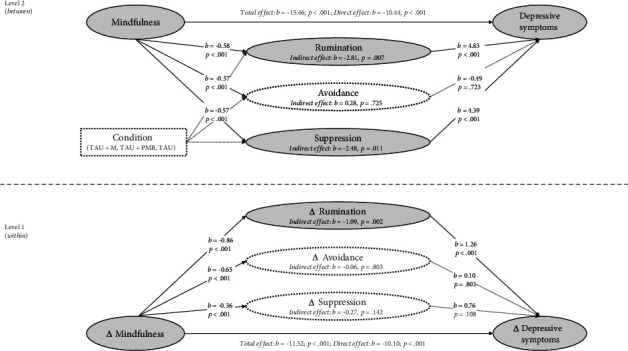
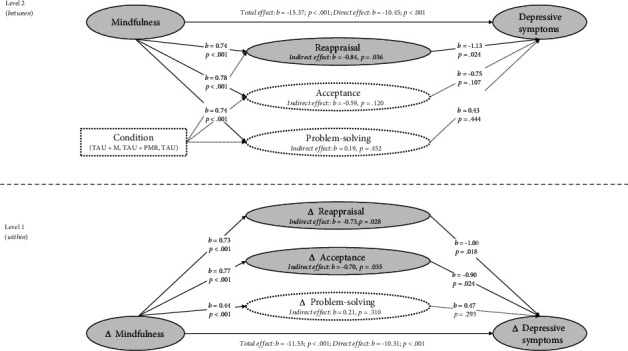
- For depressive symptoms, within-person mediation showed significant indirect effects via reduced rumination (b = −1.09, 95% CI [-1.80, -0.39]), increased reappraisal (b = −0.73, 95% CI [-1.38, -0.08]), and increased acceptance (b = −0.70, 95% CI [-1.34, -0.05]).
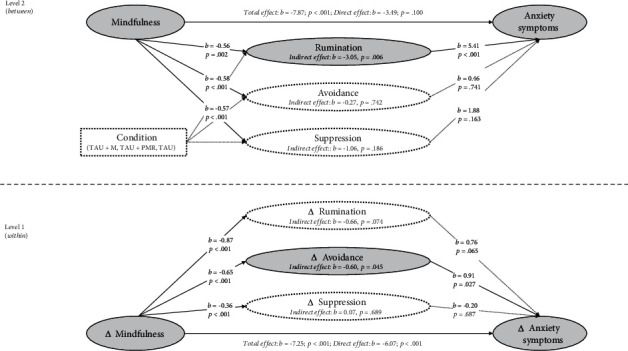
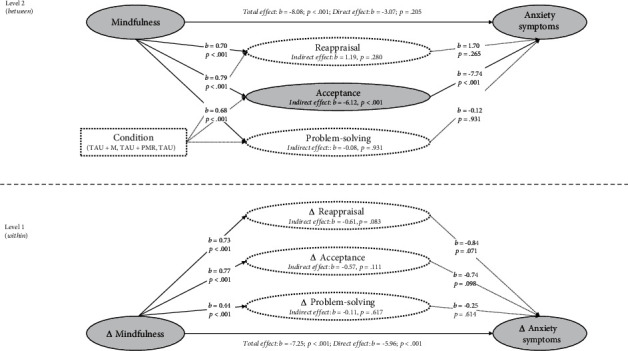
- For anxiety symptoms, the within-person indirect effect was through reduced avoidance (b = −0.60, 95% CI [-1.18, -0.01]); the paper also states that at the between-person level, mindfulness–anxiety relations were mediated by rumination and acceptance (all |b| ≥ 3.05, all p ≤ 0.006).
- Adding a brief session-introducing mindfulness intervention did not alter the mediation findings: the direct and indirect effects remained consistent across CBT conditions (all |b| ≤ 0.13; all p ≥ 0.243); only problem-solving improved slightly versus TAU (d = 0.22, p = 0.029).
## Methods
- Design: Randomized controlled trial with longitudinal repeated measures; participants were allocated to TAU + mindfulness (TAU + M), TAU + progressive muscle relaxation (TAU + PMR), or TAU.
- Sample/data: 162 outpatients in Germany with a primary depressive disorder or anxiety disorder, aged 18–65; assessments occurred at baseline (pre), session 5, session 15, and session 25.
- Analysis: Multilevel growth models examined temporal change; multilevel structural equation modeling (MSEM) in R/lavaan tested within-person and between-person mediation with mindfulness as predictor, emotion regulation strategies as mediators, and depression/anxiety as outcomes.
## Limitations
- The paper states that a longitudinal mediator analysis does not clearly establish causality because mediation assumes no unmeasured mediator–outcome confounder; the authors note future work should test other mediators to strengthen inference.
- The authors note the sample was from a naturalistic setting in Germany with broad inclusion criteria and a “significant proportion” of comorbidities, which may complicate interpretation and limits how broadly the findings can be generalized; they call for replication in varied cultural and clinical contexts.
- The study relied on self-report measures of mindfulness, emotion regulation, and symptoms; the authors explicitly recommend multimethod and observer-based assessments in future research.
Model-written summary. Check it against the paper before relying on it.
Integrity signals
Registry
Cites
Statistics
Figures
Verification
Claims the paper makes
31 Valid · 0 Not valid · 14 Not checked · 49 Own results and interpretations
The cited sources support only part of this claim — read each source’s verdict below.
In the paper
“Difficulties in emotion regulation strategy use play a central role in the development, maintenance, and treatment of depression and anxiety disorders [27–29].”
§ Emotion Regulation as a Mechanism of Mindfulness in Individual Cognitive-Behavioral Therapy for Depression and Anxiety Disorders > 1. Introduction
What the sources say
- Not checked — no full text of the sourcecites [27] Joormann J. Stanton C. H. Examining emotion regulation in depression: a review and future directions Behaviour Research and Therapy 2016 86 35 49 10.1016/j.brat.2016.07.007 2-s2.0-84992222014 27492851 source
- Not checked — no full text of the sourcecites [28] Lincoln T. M. Schulze L. Renneberg B. The role of emotion regulation in the characterization, development and treatment of psychopathology Nature Reviews Psychology 2022 1 5 272 286 10.1038/s44159-022-00040-4 source
- Partly supportedcites [29] Visted E. Vøllestad J. Nielsen M. B. Schanche E. Emotion regulation in current and remitted depression: a systematic review and meta-analysis Frontiers in Psychology 2018 9 756 1 20 10.3389/fpsyg.2018.00756 2-s2.0-85047264860 29867700 PMC5968125 sourceExperimental — accuracy not yet measured
The Introduction describes emotion-regulation difficulties as a potential mechanism in the development and maintenance of depression. The Discussion > Implications identifies maladaptive strategies as a psychotherapy target in depression and mentions emotion-regulation interventions for anxiety disorders. The paper does not establish that difficulties in strategy use play a central role in the development and maintenance of anxiety disorders; its findings concern current and remitted depression, including comorbid anxiety. (LLM, conf=0.86)
plainstates a cause- Asserted: passes — The authors put it forward as true.
- Checkable: passes — It can be checked against evidence.
- Load-bearing: passes — The paper’s conclusions depend on it.
- Based: passes — The paper gives a reason why it holds.
The cited sources support only part of this claim — read each source’s verdict below.
In the paper
“the precise mechanisms through which mindfulness influences depression and anxiety symptoms remain elusive [19–21].”
§ Emotion Regulation as a Mechanism of Mindfulness in Individual Cognitive-Behavioral Therapy for Depression and Anxiety Disorders > 1. Introduction
What the sources say
- Partly supportedcites [19] van der Velden A. M. Kuyken W. Wattar U. A systematic review of mechanisms of change in mindfulness-based cognitive therapy in the treatment of recurrent major depressive disorder Clinical Psychology Review 2015 37 26 39 10.1016/j.cpr.2015.02.001 2-s2.0-84924082948 25748559 sourceExperimental — accuracy not yet measured
Section 1.2 'Review aim' states that 'the specific mechanisms by which MBCT leads to therapeutic change remains unclear', and the Discussion opens with 'little is known about precisely how and why MBCT works in the treatment of recurrent MDD' — supporting the 'precise mechanisms remain elusive' point for depression. However, the source is confined to MBCT for recurrent major depressive depression (relapse/recurrence and residual depressive symptoms); no passage addresses mechanisms by which mindfulness influences anxiety symptoms, so that part of the claim is not supported here. The claim also generalizes from MBCT (a programme combining mindfulness training with CBT elements) to 'mindfulness' as such. (LLM, conf=0.78)
- Supportedcites [20] Stein E. Witkiewitz K. Dismantling mindfulness-based programs: a systematic review to identify active components of treatment Mindfulness 2020 11 11 2470 2485 10.1007/s12671-020-01444-0 36816712 PMC9937445 source
In Results (Dismantling Mindfulness-Based Cognitive Therapy; page unavailable), the review says it remains unclear whether improvements in depressive symptoms are due specifically to mindfulness meditation. In Discussion (Recommendations and Future Directions; page unavailable), it calls for research to determine which treatment components account for effects in people with anxiety disorders. These passages support the claim that the precise mechanisms are not yet established. (LLM, conf=0.87)
- Supportedcites [21] Goldberg S. B. A common factors perspective on mindfulness-based interventions Nature Reviews Psychology 2022 1 10 605 619 10.1038/s44159-022-00090-8 36339348 PMC9635456 source
The ‘Evidence for MBI efficacy’ section reports reductions in depression and anxiety symptoms. The ‘Evidence for MBI-specific mechanisms’ section says that, although many mechanisms have been proposed, limited research definitively establishes any particular one as causal. Together, these passages support the claim that the precise mechanisms remain elusive. (LLM, conf=0.90)
plain- Asserted: passes — The authors put it forward as true.
- Checkable: passes — It can be checked against evidence.
- Load-bearing: passes — The paper’s conclusions depend on it.
- Based: passes — The paper gives a reason why it holds.
- Partly supported
The sources with a verdict support this claim; the rest weren’t checked yet, have no full text we could read, or their verdicts aren’t rated yet.
In the paper
“A growing body of theoretical articles and empirical studies suggests a connection between mindfulness training and the enhancement of emotion regulation strategies [30–34].”
§ Emotion Regulation as a Mechanism of Mindfulness in Individual Cognitive-Behavioral Therapy for Depression and Anxiety Disorders > 1. Introduction
What the sources say
- Supportedcites [30] Guendelman S. Medeiros S. Rampes H. Mindfulness and emotion regulation: insights from neurobiological, psychological, and clinical studies Frontiers in Psychology 2017 8 220 10.3389/fpsyg.2017.00220 2-s2.0-85016975953 PMC5337506 28321194 source
The “Psychological mechanisms of emotion regulation involved in mindfulness” section says researchers have focused on mindfulness practice and its capacity to enhance emotion regulation. The paper also reviews psychological, clinical, and neurobiological evidence on that relationship, supporting the citing sentence’s hedged summary. (LLM, conf=0.92)
- Not checked — no full text of the sourcecites [31] Roemer L. Williston S. K. Rollins L. G. Mindfulness and emotion regulation Current Opinion in Psychology 2015 3 52 57 10.1016/j.copsyc.2015.02.006 2-s2.0-84923609792 source
- Not checked — no full text of the sourcecites [32] Hill C. L. Updegraff J. A. Mindfulness and its relationship to emotional regulation Emotion 2012 12 1 81 90 10.1037/a0026355 2-s2.0-84863963922 22148996 source
- Not checked — no full text of the sourcecites [33] Blanke E. S. Schmidt M. J. Riediger M. Brose A. Thinking mindfully: how mindfulness relates to rumination and reflection in daily life Emotion 2020 20 8 1369 1381 10.1037/emo0000659 2-s2.0-85071075469 31414836 source
- Not checked — no full text of the sourcecites [34] Hanley A. W. de Vibe M. Solhaug I. Modeling the mindfulness-to-meaning theory's mindful reappraisal hypothesis: replication with longitudinal data from a randomized controlled study Stress and Health 2021 37 4 778 789 10.1002/smi.3035 33607697 source
hedgedstates an association- Asserted: passes — The authors put it forward as true.
- Checkable: passes — It can be checked against evidence.
- Load-bearing: passes — The paper’s conclusions depend on it.
- Based: passes — The paper gives a reason why it holds.
- Supported
The cited sources support only part of this claim — read each source’s verdict below.
In the paper
“This may interrupt the feedback loop that amplifies anxiety and depression [30, 58–60].”
§ Emotion Regulation as a Mechanism of Mindfulness in Individual Cognitive-Behavioral Therapy for Depression and Anxiety Disorders > 1. Introduction
What the sources say
- Supportedcites [30] Guendelman S. Medeiros S. Rampes H. Mindfulness and emotion regulation: insights from neurobiological, psychological, and clinical studies Frontiers in Psychology 2017 8 220 10.3389/fpsyg.2017.00220 2-s2.0-85016975953 PMC5337506 28321194 source
The Longitudinal studies section links avoidance and suppression with anxiety and depression and suggests that mindfulness-based interventions may dismantle dysfunctional emotion-regulation patterns. The Clinical implications section describes decoupling emotional experience from maladaptive cognitions, supporting the hedged idea that this process may interrupt a reinforcing pattern. (LLM, conf=0.84)
- Not checked yetcites [58] Watkins E. R. Roberts H. Reflecting on rumination: consequences, causes, mechanisms and treatment of rumination Behaviour Research and Therapy 2020 127 103573 1 28 10.1016/j.brat.2020.103573 32087393 source
Checked before — its earlier verdict is held back until a new check runs.
- Not checked — no full text of the sourcecites [59] Olatunji B. O. Naragon-Gainey K. Wolitzky-Taylor K. B. Specificity of rumination in anxiety and depression: a multimodal meta-analysis Clinical Psychology: Science and Practice 2013 20 3 p. 225 10.1037/h0101719 source
- Partly supportedcites [60] McLaughlin K. A. Nolen-Hoeksema S. Rumination as a transdiagnostic factor in depression and anxiety Behaviour Research and Therapy 2011 49 3 186 193 10.1016/j.brat.2010.12.006 2-s2.0-79951675460 21238951 PMC3042543 sourceExperimental — accuracy not yet measured
The Discussion (page unavailable) describes rumination as a mediator of the reciprocal relationship between anxiety and depression and suggests targeting rumination in treatment. It does not say that reducing avoidance or suppression interrupts that relationship; those are different processes from the one studied. (LLM, conf=0.82)
hedgedstates a possible cause- Asserted: passes — The authors put it forward as true.
- Checkable: passes — It can be checked against evidence.
- Load-bearing: passes — The paper’s conclusions depend on it.
- Based: passes — The paper gives a reason why it holds.
- Supported
The sources with a verdict support this claim; the rest weren’t checked yet, have no full text we could read, or their verdicts aren’t rated yet.
In the paper
“Previous research, including our own [52, 53], suggests that mindfulness levels naturally increase during individual CBT, whether explicitly included or not.”
§ Emotion Regulation as a Mechanism of Mindfulness in Individual Cognitive-Behavioral Therapy for Depression and Anxiety Disorders > 1. Introduction
What the sources say
- Supportedcites [52] Mander J. Blanck P. Neubauer A. B. Mindfulness and progressive muscle relaxation as standardized session-introduction in individual therapy: a randomized controlled trial Journal of Clinical Psychology 2019 75 1 21 45 10.1002/jclp.22695 2-s2.0-85054588652 30295914 PMC6826255 source
The Results section reports that patient KIMS mindfulness scores increased significantly over time, with no significant difference in that increase across treatment conditions. The Treatment integrity section confirms that the treatment-as-usual group did not receive the study’s mindfulness exercise, supporting the claim that mindfulness increased whether or not it was explicitly added. (LLM, conf=0.92)
- Not checked — no full text of the sourcecites [53] Massaro A. F. Lecuona O. García-Rubio C. Castro-Paredes A. Bringing mindfulness-based relapse prevention for substance use disorders into individual therapy with spanish population: A feasibility and effectiveness study Mindfulness 2022 13 3 766 785 10.1007/s12671-022-01835-5 source
hedgedstates a cause- Asserted: passes — The authors put it forward as true.
- Checkable: passes — It can be checked against evidence.
- Load-bearing: passes — The paper’s conclusions depend on it.
- Based: passes — The paper gives a reason why it holds.
- Supported
46 more claims · 12 with their cited sources checked
Create a free account to see all 94 claims and to verify the 6 references still open.
- Probably not a substantial claim. 32
- It may state two separate claims as one. 18
Self-check
Percentages, sums and reported differences re-computed from the paper’s own numbers.
Each contradiction between two passages listed here was confirmed by an independent check.
Rated minor: it would not touch a result — a value no result rests on, a p-value that stays on the same side of the significance level, or a conflict that is clerical, resolved elsewhere in the paper, or outside its own findings.
In the paper
§ Emotion Regulation as a Mechanism of Mindfulness in Individual Cognitive-Behavioral Therapy for Depression and Anxiety Disorders > 2. Method > 2.5. Statistical Analyses
“The indirect effect of mindfulness on depression or anxiety through emotion regulation strategies was calculated as the product of the c-path and b-path (ab-path),”
§ Emotion Regulation as a Mechanism of Mindfulness in Individual Cognitive-Behavioral Therapy for Depression and Anxiety Disorders > 3. Results > 3.2. Multilevel Structural Equation Models
“reductions in rumination (ab-path: b = −1.09, 95% CI [-1.80, -0.39]) and increases in reappraisal (ab-path: b = −0.73, 95% CI [-1.38, -0.08]) and acceptance (ab-path: b = −0.70, 95% CI [-1.34, -0.05]) had a significant indirect effect on depressive symptoms.”
Citations
Cites
Hu, L., & Bentler, P. M. (1999) · Structural Equation Modeling A Multidisciplinary Journal · doi:10.1080/10705519909540118 · Cited by 108,788
lavaan : An R Package for Structural Equation Modeling
Rosseel, Y. (2012) · Journal of Statistical Software · doi:10.18637/jss.v048.i02 · Cited by 27,955 · cited 1×
“The mediating e ff ects of emotion regulation strategies on the longitudinal associations between mindfulness and symptom severity were tested based on multilevel structural equation modeling (MSEM) in the R environment using the package “ lavaan ” [100].”
MethodAn inventory for measuring clinical anxiety: Psychometric properties.
Beck, A. T., Epstein, N., Brown, G., & Steer, R. A. (1988) · Journal of Consulting and Clinical Psychology · doi:10.1037/0022-006x.56.6.893 · Cited by 14,407 · cited 2×
“Anxiety symptoms were captured based on the Beck Anxiety Inventory (BAI) [98, 99].”
Gratz, K. L., & Roemer, L. (2004) · Journal of Psychopathology and Behavioral Assessment · doi:10.1023/b:joba.0000007455.08539.94 · Cited by 8,942
Mindfulness-based interventions in context: Past, present, and future
Kabat-Zinn, J. (2003) · Clinical Psychology: Science and Practice · doi:10.1093/clipsy.bpg016 · Cited by 8,615 · cited 1×
“Mindfulness, characterized by present-moment awareness and a nonjudgmental attitude [9 – 11], has emerged as a promising approach to addressing these disorders.”
BackgroundMindfulness-based interventions in context: Past, present, and future.
Kabat-Zinn, J. (2003) · Clinical Psychology: Science and Practice · doi:10.1093/clipsy/bpg016 · Cited by 8,612
Beck, A. T., Steer, R. A., & Brown, G. (2011) · PsycTESTS Dataset · doi:10.1037/t00742-000 · Cited by 7,535
Mindfulness: A proposed operational definition.
Bishop, S. R., Lau, M., Shapiro, S., Carlson, L., Anderson, N. D., Carmody, J., Segal, Z. V., Abbey, S., Speca, M., Velting, D., et al. (2004) · Clinical Psychology: Science and Practice · doi:10.1093/clipsy.bph077 · Cited by 7,234 · cited 1×
“Mindfulness, characterized by present-moment awareness and a nonjudgmental attitude [9 – 11], has emerged as a promising approach to addressing these disorders.”
(2022) · The Lancet Psychiatry · doi:10.1016/s2215-0366(21)00395-3 · Cited by 6,481 · cited 1×
“Beyond causing individual distress and impairment, these disorders substantially strain healthcare systems and impose extensive socioeconomic costs [5, 6].”
Santomauro, D. F., Mantilla Herrera, A. M., Shadid, J., Zheng, P., Ashbaugh, C., Pigott, D. M., Abbafati, C., Adolph, C., Amlag, J. O., Aravkin, A. Y., et al. (2021) · The Lancet · doi:10.1016/s0140-6736(21)02143-7 · Cited by 5,444 · cited 1×
“Mitigating this global public health challenge necessitates a deeper understanding of e ff ective treatments and relapse prevention strategies [7, 8].”
Research works printed but not linked: 5
- Falkai P. Wittchen H. Diagnostic and Statistical Manual of Mental Disorders DSM-5, American Psychiatric Association (2013), German Translation 2014 Göttingen, Germany Hogrefe
- Beesdo-Baum K. Zaudig M. Wittchen H.-U. SCID-5-CV Strukturiertes Klinisches Interview für DSM-5-Störungen–Klinische Version: Deutsche Bearbeitung des Structured Clinical Interview for DSM-5 Disorders–Clinician Version von Michael B. First, Janet BW Williams, Rhonda S. Karg, Robert L Spitzer 2019 Hogrefe Göttingen
- Margraf J. Ehlers A. Das Beck-Angstinventar (BAI) 2007 Springer
- Bates D. Maechler M. Bolker B. Package ‘lme4’ 2012 Vienna, Austria CRAN. R Foundation for Statistical Computing
- Raudenbush S. W. Bryk A. S. Hierarchical linear models: applications and data analysis method vol. 2 Thousand Oaks 2002 CA Sage Publications
Cited by
Aliche, C. J., & Idemudia, E. S. (2025) · Discover Psychology · doi:10.1007/s44202-025-00509-2 · Cited by 5
“The capacity to stay present and attentive to one’s feelings, thoughts and sensations may encourage the selection of appropriate emotion regulation strategies needed to promote well-being [43].”
Slot, M., Reijnders, J. S. A. M., Janssens, M., Simons, M., Lataster, J., & Jacobs, N. (2024) · International Journal of Applied Positive Psychology · doi:10.1007/s41042-024-00194-x · Cited by 9
Coping strategies and psychological well-being among teachers experiencing victimization
Bitinaitė, R., Diržytė, A., Lhamo, N., Indrašienė, V., Jegelevičienė, V., Merfeldaitė, O., Pivorienė, J., Prakapas, R., Railienė, A., Penkauskienė, D., et al. (2026) · Frontiers in Education · doi:10.3389/feduc.2026.1784574 · Cited by 4
Chen, R., Ming, D., Zhou, T., Hao, X., & Fan, C.-Y. (2026) · Frontiers in Psychology · doi:10.3389/fpsyg.2026.1798978 · Cited by 1
Yang, J. H., & Chen, Y. (2025) · Noise and Health · doi:10.4103/nah.nah_139_25 · Cited by 1
Hu, S., Zhu, L., & Zhang, X. (2025) · Frontiers in Psychiatry · doi:10.3389/fpsyt.2025.1589040 · Cited by 2
“Psychotherapy studies targeting improved emotion regulation demonstrate that enhancing this capacity signi fi cantly improves prognosis in depression and anxiety (66, 67).”
Yuan, J., Chen, L., & Hongye, G. (2025) · Scientific Reports · doi:10.1038/s41598-025-11973-0 · Cited by 2
“Neurocognitive research has established emotion regulation as a critical mediating mechanism linking mindfulness practices to anxiety reduction 32 .”
Papenfuss, I., Lommen, M. J. J., & Ostafin, B. D. (2025) · Journal of Experimental Psychopathology · doi:10.1177/20438087251347677 · Cited by 1
“…decentering, reappraisal and decreased affective reactivity have all been proposed and investigated as potential mechanisms for the bene fi ts of mindfulness practice and have been associated with positive treatment outcomes (e.g., Hoge et al., 2014; Osta fi n et al., 2014; Pruessner et al., 2024).”
Bracht, T., Borel, P., Dendorfer, S., Soravia, L. M., Adorjan, K., Walther, S., Federspiel, A., Wiest, R., Florineth, G. A., & Denier, N. (2026) · European Archives of Psychiatry and Clinical Neuroscience · doi:10.1007/s00406-026-02355-2 · Cited by 1
Hidalgo-Fuentes, S., Martínez-Álvarez, I., González-Pérez, E., & Salguero, F. L. (2026) · Psychology Health & Medicine · doi:10.1080/13548506.2026.2731629
From Buddhist meditation to psychological well-being: an ethical-cultural training ecology model
Yukun, M. E. I., Li, J., & Phuchomsri, S. (2026) · Frontiers in Psychology · doi:10.3389/fpsyg.2026.1938434
Schadegg, M. J., Santacatterina, M., Szuhany, K. L., Bragdon, L. B., Kim, J., Dutton, M. A., Baker, A. W., Bui, É., Mete, M., Hoge, E. A., et al. (2026) · Cognitive Therapy and Research · doi:10.1007/s10608-026-10781-8
Xie, Z., Liang, Q., Xu, L., Xie, J., Xie, S., & Zou, L. (2026) · Frontiers in Psychology · doi:10.3389/fpsyg.2026.1792596
“Meanwhile, the meditative component culti-vates mindfulness and enhances emotional regulatory capacity, assisting students in disengaging from the ruminative thoughts characteristic of depression (Pruessner et al., 2024).”
Kou, H., Qiye, L., Hu, X., Yue, K., Xie, Q., Li, X., Jin, Y., Lu, T., Luo, W., & Bi, T. (2026) · Psycho-Oncology · doi:10.1002/pon.70585
“A previous study also revealed that emotion regulation strategy partially mediates the relationship between mindfulness and depressive symptoms [42].”
Maurya, R. K., & Panchal, S. (2026) · Journal of Workplace Behavioral Health · doi:10.1080/15555240.2026.2690133
Wijaya, D. A., Miharti, A., Ratnawati, M., & Dahlia, Y. (2026) · Kamali Jurnal Ilmu Agama · doi:10.64691/z7zf2859
Wang, Z., Tong, H. Q., Yue, J., Wu, S., Xia, Y., Zhang, H., & Yang, Y. (2026) · Journal of Medical Internet Research · doi:10.2196/91751
“Third, although theoretical models suggest that stress reduction mediates anxiety improvement, the temporal dynamics of stress-anxiety interactions during treatment remain underexplored [31].”
Sun, S., Sun, Y., Hu, C., Wang, M., Chen, M., Han, Z., Ma, J., Yu, X., & Qian, J. (2026) · Mindfulness · doi:10.1007/s12671-026-02862-2
Ren, X., Huang, W., Yuan, H., & Gao, X. (2026) · Mindfulness · doi:10.1007/s12671-026-02869-9 · Cited by 1
“This extends prior evidence that mindfulness-based practices modulate emotional responding (Beblo et al., 2012; Pruessner et al., 2024) by demonstrating that even a brief, one-time practice can attenuate the link between negative emotion and eating in an experimental context.”
InfluentialRainbow Mindfulness: Integrating Mindfulness-Based Interventions for the LGBTQIA+ Community
Srivastava, U., & Dhoundiyal, A. (2026) · IGI Global eBooks · doi:10.4018/979-8-2600-1202-4.ch006
Algaralleh, A., Matarneh, A. J., Majali, S. A., Salameh, M. I., Zaben, M. B. L. A., & Selim, H. F. F. (2026) · Frontiers in Education · doi:10.3389/feduc.2026.1764971 · Cited by 1
Gao, C., Zhao, X., & Li, S. (2026) · Psychology Research and Behavior Management · doi:10.2147/prbm.s550385 · Cited by 1
Fu, J., Su, Q., & Fu, T. (2026) · Psycho-Oncologie · doi:10.18282/po5706
Chen, Z., Wang, R., Wang, Y., Zhang, Y., & Song, A. (2026) · Frontiers in Psychiatry · doi:10.3389/fpsyt.2026.1715475
Yang, S., Zhou, W., Qin, Y., Zheng, T., Huang, F., Li, C., Dai, J., Zhou, L., Li, L., Wu, K., et al. (2026) · Journal of Psychiatric Research · doi:10.1016/j.jpsychires.2026.02.019 · Cited by 5
Ehmann, A.-L., Marggrander, D. T., Semmler, J., Berger, F. F., Helm, P., & Pfitzer, C. (2025) · Medical Sciences · doi:10.3390/medsci14010002
Emotion Regulation and Well-Being in Adults With Congenital Heart Disease
Ehmann, A.-L., Helm, P., Bauer, U., Barnow, S., & Pruessner, L. (2025) · Psychosomatic Medicine · doi:10.1097/psy.0000000000001451
Self-citationProblems regulating emotions during pregnancy linked with perinatal depression – new research
Weinmar, F. (2025) · The Conversation · doi:10.64628/ab.wfqhh9xgd
Esmaeili, R., Firoozi, M., & Beiranvand, M. (2025) · Journal of Health and Care · doi:10.61882/jhc.27.3.320
Saad, M. A. E. (2025) · International Journal of Developmental Disabilities · doi:10.1080/20473869.2025.2487868 · Cited by 1
Metadata
- Authors
- Pruessner, L., Timm, C., Kalmar, J., Bents, H., Barnow, S., & Mander, J.
- Affiliations
- Heidelberg University (DE)
- Corresponding author
- Pruessner, Luise
- Venue
- Depression and Anxiety
- Publisher
- Wiley
- Published
- 2024-04-02
- Volume
- 2024
- Pages
- 1-16
- ISSN
- 1091-4269 (ISSN-L)
- 1520-6394
- PMC
- PMC11919210
- OpenAlex
- W4393581422
- Cited by
- 37
- References
- 128
- Citations by year
- 2026: 23 · 2025: 13 · 2024: 1
- FWCI
- 13.59
- Type
- journal article
- Language
- en
- Open access
- hybrid
- doi.org
- Locations
- Depression and Anxiety (publishedVersion, cc-by)
- PubMed Central (publishedVersion, cc-by)
- PubMed (publishedVersion)
- Funders
- Deutsche Forschungsgemeinschaft (MA6526/2-1)
- Topics
- Social Sciences › Psychology › Clinical Psychology › Mindfulness and Compassion Interventions
- Social Sciences › Psychology › Experimental and Cognitive Psychology › Anxiety, Depression, Psychometrics, Treatment, Cognitive Processes
- Social Sciences › Psychology › Clinical Psychology › Psychotherapy Techniques and Applications
- Keywords
- mindfulness, emotion regulation, depression, anxiety disorders, rumination, cognitive reappraisal, acceptance, avoidance, mediation, therapeutic mechanisms, brief mindfulness intervention, progressive muscle relaxation
- MeSH terms
- Emotional Regulation, Adult, Anxiety Disorders, Depressive Disorder, Female, Humans, Male, Middle Aged, Cognitive Behavioral Therapy, Mindfulness
About these checks
Registry, retraction, Cites and statistics results are computed, not judged, with one exception: a printed reference that no index lists is read once by a model before it counts as a citation error. Claims are extracted by a model and kept only when their quote appears verbatim in the text; each cited source is then checked, with a model’s help, for whether it says what the claim relies on. Those verdicts can be wrong — read the claim’s quote and the cited source before relying on one.
The claim verdicts this report counts are experimental: their accuracy is not yet measured.
A language model drew the claims from the paper on 2026-10-11, under version 3 of the claim definition (model deepseek-v4.1-flash, prompt extract-v3).
A second model labelled each claim on 2026-10-11 (model jev-1.13-20260917, definition revision gold-guideline-v0.2).
Cited sources are checked with a language model’s help (gpt-6-sol and qwen3.8-omni-flash).
Statistics and arithmetic are recomputed, not judged.
Confidence bands are shown only for fields calibrated on our annotated test set. None is calibrated yet, so no band is shown.
What counts as a claim ›How we measure confidence ›How we check this ›
Are you an author, or do you see a problem with this page? Request a review
Data sources
Bibliographic data: Semantic Scholar, OpenAlex, Crossref.
Contains information from the Semantic Scholar Academic Graph Datasets, made available under the ODC Attribution License (ODC-BY 1.0).
Semantic Scholar’s data is described in: Kinney, R., et al. (2023). The Semantic Scholar Open Data Platform. arXiv:2301.10140.
