

The DOI matches its Crossref record; 36 of the 36 references it cites were found in a registry or an index.
Nighttime Blood Pressure Measured by Home Blood Pressure Monitoring as an Independent Predictor of Cardiovascular Events in General Practice: The J-HOP Nocturnal Blood Pressure Study
Open accessAbstract
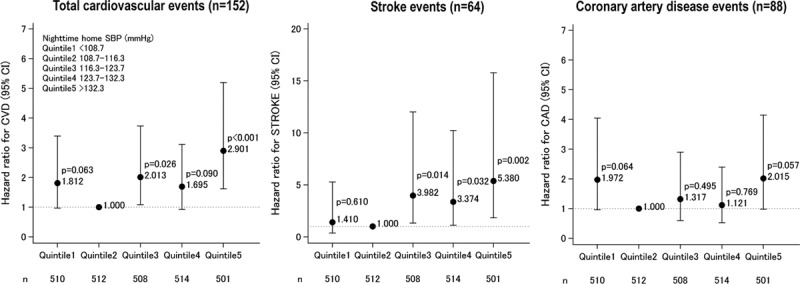
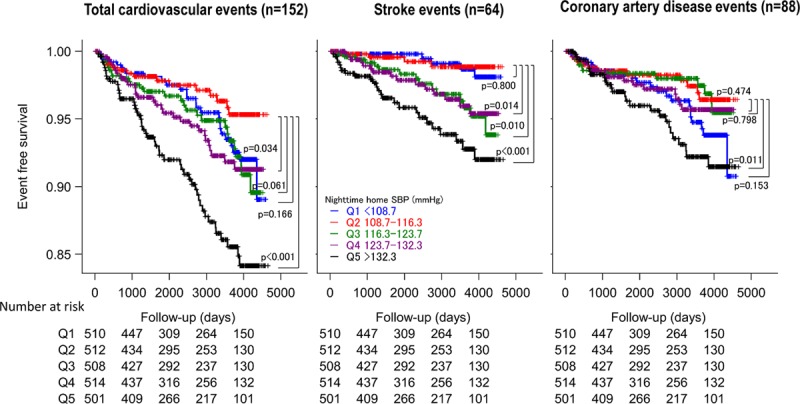
We developed an innovative automated home blood pressure (BP) monitoring method that measures BP while asleep repeatedly over several days. Our aim was to assess the predictive ability of nighttime BP obtained using the home BP device for incident cardiovascular disease (CVD) in general practice patients. We used data from the nationwide practice-based J-HOP (Japan Morning Surge–Home Blood Pressure) Nocturnal BP Study, which recruited 2545 Japanese with a history of or risk factors for CVD (mean age 63 years; antihypertensive medication use 83%). The associations between nighttime home BPs (measured at 2:00, 3:00, and 4:00 am using validated, automatic, and oscillometric home BP devices) and incident CVD, including coronary disease and stroke events, were assessed with Cox proportional hazards models. The mean±SD office, morning home, and nighttime home systolic BP (SBP)/diastolic BP were 140±15/82±10, 137±15/79±10, and 121±15/70±9 mm Hg, respectively. During a follow-up of 7.1±3.8 years (18,116 person-years), 152 CVD events occurred. A 10-mm Hg increase of nighttime home SBP was associated with an increased risk of CVD events (hazard ratios [95% CIs]: 1.201 [1.046–1.378]), after adjustments for covariates including office and morning home SBPs. The model fit assessed by the change in Goodness-of-Fit was improved when we added nighttime home SBP into the base models including office and morning home SBPs (Δ6.838 [5.6%]; P =0.009). This is among the first and largest nationwide practice-based study demonstrating that nighttime SBP obtained using a home device is a predictor of incident CVD events, independent of in-office and morning in-home SBP measurement. Clinical Trial Registration—: URL: http://www.umin.ac.jp/icdr/index.html . Unique identifier: UMIN000000894.
Overview
The claims and statistics of this paper haven’t been checked yet.
Run the check — free, no account needed. It reads the open-access text and checks the sources it cites.
Integrity signals
Registry
Cites
Statistics
Figures
Verification
Claims the paper makes
The claims and statistics of this paper haven’t been checked yet.
Run the check — free, no account needed. It reads the open-access text and checks the sources it cites.
Claims other papers make about this one
Each is checked against this paper’s own text: does it say what the citing paper says it does?
The source backs part of the claim, not all of it — or backs it for a different population, condition or comparison.
In the citing paper
“However, the measurement of asleep BP is made possible by a few models of HBPM, which is better tolerated and provides nocturnal BP readings and predicts cardiovascular events similar to those observed using ABPM. 48,61”
From Effect and Acceptability of Mindfulness-Based Stress Reduction Program on Patients With Elevated Blood Pressure or Hypertension: A Meta-Analysis of Randomized Controlled Trials (2020) · cites this paper as [48]
Experimental — accuracy not yet measuredThe check wasn’t confident either way, so it gives no verdict — never disputed.
In the citing paper
“Two studies have shown that HBPM with automated atrial fibrillation detector might be useful for early detection of asymptomatic atrial fibrillation in elderly individuals with hypertension [219,220].”
From Home blood pressure monitoring: methodology, clinical relevance and practical application: a 2021 position paper by the Working Group on Blood Pressure Monitoring and Cardiovascular Variability of the European Society of Hypertension (2021) · cites this paper as [220]
Experimental — accuracy not yet measured
Self-check
Percentages, sums and reported differences re-computed from the paper’s own numbers.
The self-check needs the paper’s full text.
Citations
Cites
2018 ESC/ESH Guidelines for the management of arterial hypertension
Williams, B., Mancia, G., Spiering, W., Agabiti Rosei, E., Azizi, M., Burnier, M., Clement, D. L., Coca, A., de Simone, G., Dominiczak, A., et al. (2018) · European Heart Journal · doi:10.1093/eurheartj/ehy339 · Cited by 10,286
Whelton, P. K., Carey, R. M., Aronow, W. S., Casey, D. E., Collins, K. J., Dennison Himmelfarb, C., DePalma, S. M., Gidding, S., Jamerson, K. A., Jones, D. W., et al. (2018) · Hypertension · doi:10.1161/hyp.0000000000000065 · Cited by 7,391
Pickering, T. G., Hall, J. E., Appel, L. J., Falkner, B. E., Graves, J., Hill, M. N., Jones, D. W., Kurtz, T., Sheps, S. G., & Roccella, E. J. (2005) · Circulation · doi:10.1161/01.cir.0000154900.76284.f6 · Cited by 3,985
Pickering, T. G., Hall, J. E., Appel, L. J., Falkner, B. E., Graves, J., Hill, M. N., Jones, D. W., Kurtz, T., Sheps, S. G., & Roccella, E. J. (2005) · Hypertension · doi:10.1161/01.hyp.0000150859.47929.8e · Cited by 2,051
European Society of hypertension position paper on ambulatory blood pressure monitoring
O’Brien, E., Parati, G., Stergiou, G., Asmar, R., Beilin, L., Bilo, G., Clement, D., de la Sierra, A., de Leeuw, P., Dolan, E., et al. (2013) · Journal of Hypertension · doi:10.1097/hjh.0b013e328363e964 · Cited by 1,419
Self-citationOhkubo, T., Hozawa, A., Yamaguchi, J., Kikuya, M., Ohmori, K., Michimata, M., Matsubara, M., Hashimoto, J., Hoshi, H., Araki, T., et al. (2002) · Journal of Hypertension · doi:10.1097/00004872-200211000-00017 · Cited by 1,053
The Japanese Society of Hypertension Guidelines for the Management of Hypertension (JSH 2014)
(2014) · Hypertension Research · doi:10.1038/hr.2014.20 · Cited by 1,049
Sega, R., Facchetti, R., Bombelli, M., Cesana, G., Corrao, G., Grassi, G., & Mancia, G. (2005) · Circulation · doi:10.1161/01.cir.0000160923.04524.5b · Cited by 1,009
Prognostic accuracy of day versus night ambulatory blood pressure: a cohort study
Boggia, J., Li, Y., Thijs, L., Hansen, T. W., Kikuya, M., Björklund-Bodegård, K., Richart, T., Ohkubo, T., Kuznetsova, T., Torp-Pedersen, C., et al. (2007) · The Lancet · doi:10.1016/s0140-6736(07)61538-4 · Cited by 887
Parati, G., Stergiou, G. S., Asmar, R., Bilo, G., de Leeuw, P., Imai, Y., Kario, K., Lurbe, E., Manolis, A., Mengden, T., et al. (2008) · Journal of Hypertension · doi:10.1097/hjh.0b013e328308da66 · Cited by 837
Self-citationStroke Prognosis and Abnormal Nocturnal Blood Pressure Falls in Older Hypertensives
Kario, K., Pickering, T. G., Matsuo, T., Hoshide, S., Schwartz, J. E., & Shimada, K. (2001) · Hypertension · doi:10.1161/hy1001.092640 · Cited by 758
Self-citationCall to Action on Use and Reimbursement for Home Blood Pressure Monitoring
Pickering, T. G., Miller, N. H., Ogedegbe, G. G., Krakoff, L. R., Artinian, N. T., & Goff, D. C. (2008) · Hypertension · doi:10.1161/hypertensionaha.107.189010 · Cited by 666
Prognostic Effect of the Nocturnal Blood Pressure Fall in Hypertensive Patients
Salles, G. F., Reboldi, G., Fagard, R. H., Cardoso, C. R. L., Pierdomenico, S. D., Verdecchia, P., Eguchi, K., Kario, K., Hoshide, S., Polónia, J. J., et al. (2016) · Hypertension · doi:10.1161/hypertensionaha.115.06981 · Cited by 525
Self-citationNocturnal Hypertension: New Technology and Evidence
Kario, K. (2018) · Hypertension · doi:10.1161/hypertensionaha.118.10971 · Cited by 298
Self-citationHoshide, S., Yano, Y., Haimoto, H., Yamagiwa, K., Uchiba, K., Nagasaka, S., Matsui, Y., Nakamura, A., Fukutomi, M., Eguchi, K., et al. (2016) · Hypertension · doi:10.1161/hypertensionaha.116.07201 · Cited by 235
Self-citationImai, Y., Kario, K., Shimada, K., Kawano, Y., Hasebe, N., Matsuura, H., Tsuchihashi, T., Ohkubo, T., Kuwajima, I., & Miyakawa, M. (2012) · Hypertension Research · doi:10.1038/hr.2012.56 · Cited by 204
Self-citationKario, K. (2016) · Progress in Cardiovascular Diseases · doi:10.1016/j.pcad.2016.04.001 · Cited by 144
Self-citationKuwabara, M., Harada, K., Hishiki, Y., & Kario, K. (2019) · The Journal of Clinical Hypertension · doi:10.1111/jch.13499 · Cited by 140
Self-citationNighttime Home Blood Pressure and the Risk of Hypertensive Target Organ Damage
Ishikawa, J., Hoshide, S., Eguchi, K., Ishikawa, S., Shimada, K., Kario, K., & for the Japan Morning Surge-Home Blood Pressure Study Investigators Group (2012) · Hypertension · doi:10.1161/hypertensionaha.112.198101 · Cited by 123
Self-citationNocturnal blood pressure measured by home devices: evidence and perspective for clinical application
Asayama, K., Fujiwara, T., Hoshide, S., Ohkubo, T., Kario, K., Stergiou, G. S., Parati, G., White, W. B., Weber, M. A., & Imai, Y. (2019) · Journal of Hypertension · doi:10.1097/hjh.0000000000001987 · Cited by 120
Self-citationDevice for the self-measurement of blood pressure that can monitor blood pressure during sleep
Chonan, K., Kikuya, M., Araki, T., Fujiwara, T., Suzuki, M., Michimata, M., Hashimoto, J., Ohkubo, T., Hozawa, A., Yamamoto, N., et al. (2001) · Blood Pressure Monitoring · doi:10.1097/00126097-200108000-00008 · Cited by 95
Self-citationEmergence of Home Blood Pressure-Guided Management of Hypertension Based on Global Evidence
Kario, K., Shimbo, D., Hoshide, S., Wang, J.-G., Asayama, K., Ohkubo, T., Imai, Y., McManus, R. J., Kollias, A., Niiranen, T. J., et al. (2019) · Hypertension · doi:10.1161/hypertensionaha.119.12630 · Cited by 82
Self-citationKario, K., Hoshide, S., Haimoto, H., Yamagiwa, K., Uchiba, K., Nagasaka, S., Yano, Y., Eguchi, K., Matsui, Y., Shimizu, M., et al. (2015) · Journal of Clinical Hypertension · doi:10.1111/jch.12500 · Cited by 76
Self-citationMancia, G., Omboni, S., Parati, G., Trazzi, S., & Mutti, E. (1992) · Journal of Hypertension · doi:10.1097/00004872-199210120-00014 · Cited by 72
Kario, K., Tomitani, N., Kanegae, H., Ishii, H., Uchiyama, K., Yamagiwa, K., Shiraiwa, T., Katsuya, T., Yoshida, T., Kanda, K., et al. (2017) · Circulation Journal · doi:10.1253/circj.cj-17-0109 · Cited by 71
Self-citationReproducibility of Nocturnal Blood Pressure Assessed by Self-Measurement of Blood Pressure at Home
Hosohata, K., Kikuya, M., Ohkubo, T., Metoki, H., Asayama, K., Inoue, R., Obara, T., Hashimoto, J., Totsune, K., Hoshi, H., et al. (2007) · Hypertension Research · doi:10.1291/hypres.30.707 · Cited by 51
Isolated Nocturnal Hypertension: What Do We Know and What Can We Do?
Tadić, M., Cuspidi, C., Grassi, G. M., & Mancia, G. (2020) · Integrated Blood Pressure Control · doi:10.2147/ibpc.s223336 · Cited by 47
Ishikawa, J., Shimizu, M., Edison, E. S., Yano, Y., Hoshide, S., Eguchi, K., & Kario, K. (2013) · Journal of Hypertension · doi:10.1097/hjh.0b013e328365c8a8 · Cited by 45
Self-citationKario, K., Hoshide, S., Okawara, Y., Tomitani, N., Yamauchi, K., Ohbayashi, H., Itabashi, N., Matsumoto, Y., & Kanegae, H. (2018) · Journal of Clinical Hypertension · doi:10.1111/jch.13367 · Cited by 42
Self-citationNight-time home versus ambulatory blood pressure in determining target organ damage
Andreadis, E. A., Agaliotis, G. D., Κόλλιας, Α., Kolyvas, G. N., Achimastos, A. D., & Stergiou, G. S. (2016) · Journal of Hypertension · doi:10.1097/hjh.0000000000000815 · Cited by 36
Kuwabara, M., Harada, K., Hishiki, Y., & Kario, K. (2019) · Journal of Clinical Hypertension · doi:10.1111/jch.13464 · Cited by 34
Self-citationKollias, A., Andreadis, E., Agaliotis, G., Kolyvas, G. N., Achimastos, A., & Stergiou, G. S. (2018) · Journal of Hypertension · doi:10.1097/hjh.0000000000001562 · Cited by 34
Imai, Y., Asayama, K., Fujiwara, S., Saito, K., Sato, H., Haga, T., Satoh, M., Murakami, T., Metoki, H., Kikuya, M., et al. (2018) · Blood Pressure Monitoring · doi:10.1097/mbp.0000000000000351 · Cited by 22
Fujiwara, T., Nishizawa, M., Hoshide, S., Kanegae, H., & Kario, K. (2018) · Journal of Clinical Hypertension · doi:10.1111/jch.13407 · Cited by 19
Self-citationKario, K. (2019) · Korean Circulation Journal · doi:10.4070/kcj.2019.0246 · Cited by 17
Self-citationXu, Y., Zhou, X. C., Zheng, Y., Guan, H., Fu, C., Xiao, J., & Ye, Z. (2020) · Clinical Hypertension · doi:10.1186/s40885-020-0136-6 · Cited by 5
Cited by
Sorted by citations
Mancia, G., Kreutz, R., Brunström, M., Burnier, M., Grassi, G., Januszewicz, A., Muiesan, M. L., Tsioufis, K., Agabiti-Rosei, E., Algharably, E. A. E., et al. (2023) · Journal of Hypertension · doi:10.1097/hjh.0000000000003480 · Cited by 3,473
Kario, K., Hoshide, S., Mizuno, H., Kabutoya, T., Nishizawa, M., Yoshida, T., Abe, H., Katsuya, T., Fujita, Y., Okazaki, O., et al. (2020) · Circulation · doi:10.1161/circulationaha.120.049730 · Cited by 324
Self-citationManagement of Hypertension in the Digital Era
Kario, K. (2020) · Hypertension · doi:10.1161/hypertensionaha.120.14742 · Cited by 247
Self-citationParati, G., Stergiou, G. S., Bilo, G., Kollias, A., Pengo, M., Ochoa, J. E., Agarwal, R., Asayama, K., Asmar, R., Burnier, M., et al. (2021) · Journal of Hypertension · doi:10.1097/hjh.0000000000002922 · Cited by 178
Self-citation(2022) · PubMed Central · doi:10.6515/acs.202205_38(3).20220321a · Cited by 117
Metadata
- Authors
- Kario, K., Kanegae, H., Tomitani, N., Okawara, Y., Fujiwara, T., Yano, Y., Hoshide, S., & on behalf of the J-HOP Study Group
- Affiliations
- Jichi Medical University (JP)
- JMU Center of Global Home and Ambulatory BP Analysis (GAP), Tochigi, Japan (Y.O.).
- JMU Center of Excellence, Community Medicine Cardiovascular Research and Development (JCARD), Tochigi, Japan (K.K., N.T., T.F., Y.Y., S.H.)
- Corresponding author
- Kario, Kazuomi
- ORCID
- Venue
- Hypertension
- Published
- 2019-06
- Volume
- 73
- Issue
- 6
- Pages
- 1240-1248
- ISSN
- 0194-911X (ISSN-L)
- 1524-4563
- PMC
- PMC6510323
- OpenAlex
- W2939115855
- Cited by
- 167
- References
- 36
- Citations by year
- 2026: 14 · 2025: 22 · 2024: 19 · 2023: 17 · 2022: 22 · 2021: 31 · 2020: 30 · 2019: 12
- FWCI
- 17.16
- Type
- journal article
- Language
- en
- Open access
- hybrid
- doi.org
- Licence
- cc-by-nc-nd
- Locations
- Hypertension (publishedVersion, cc-by-nc-nd)
- Europe PMC (PubMed Central) (publishedVersion, cc-by-nc-nd)
- PubMed Central (publishedVersion, cc-by-nc-nd)
- PubMed (publishedVersion)
- Topics
- Health Sciences › Medicine › Cardiology and Cardiovascular Medicine › Blood Pressure and Hypertension Studies
- Health Sciences › Medicine › Cardiology and Cardiovascular Medicine › Cardiovascular Health and Disease Prevention
- Health Sciences › Nursing › Nutrition and Dietetics › Sodium Intake and Health
- Keywords
- nocturnal blood pressure, home blood pressure monitoring, cardiovascular events, cardiovascular risk prediction, systolic blood pressure, coronary disease, stroke, general practice patients, antihypertensive drugs, oscillometric blood pressure devices
- MeSH terms
- Blood Pressure, Cardiovascular Diseases, Circadian Rhythm, Female, Follow-Up Studies, Humans, Japan, Male, Middle Aged, Prognosis, Systole, Time Factors, Incidence, Blood Pressure Monitoring, Ambulatory, General Practice
About these checks
Registry, retraction, Cites and statistics results are computed, not judged, with one exception: a printed reference that no index lists is read once by a model before it counts as a citation error. Claims are extracted by a model and kept only when their quote appears verbatim in the text; each cited source is then checked, with a model’s help, for whether it says what the claim relies on. Those verdicts can be wrong — read the claim’s quote and the cited source before relying on one.
Statistics and arithmetic are recomputed, not judged.
Confidence bands are shown only for fields calibrated on our annotated test set. None is calibrated yet, so no band is shown.
What counts as a claim ›How we measure confidence ›How we check this ›
Are you an author, or do you see a problem with this page? Request a review
